

Background
There are several concurrent opioid overdose crises globally, each influenced by distinct factors. In the United States and Canada, the epidemic is largely fueled by the widespread availability of the synthetic opioid fentanyl. By contrast, in North Africa, West Africa, the Near and Middle East, and Southwest Asia, the crisis is predominantly driven by the misuse of the synthetic opioid tramadol.1 Approximately 80% of global deaths attributable to drug use are now related to opioids.2
The opioid overdose crisis now represents one of the most significant public health crises in Canadian history, accounting for more than 42,000 opioid toxicity deaths since 2016.3 In 2018, Canadians were the second highest users per capita of prescription opioids in the world after the United States, with one in eight Canadians prescribed opioids annually.4
A primary factor driving the dramatic rise in opioid prescribing in Canada and the ensuing overdose crisis was the growing acceptability and use of prescription opioids for the treatment of chronic pain between the late 1980s and the early 2010s.Reference Fischer5 Defined as any pain that lasts more than three months, chronic pain is the most significant cause of disability and health resource utilization among working-age adults in Canada, affecting an estimated 20% of Canadian adults.Reference Dassieu6 Over the past two decades, aggressive pharmaceutical marketing, inadequate provider training, regulatory policies prioritizing patient satisfaction, and limited access to or insurance coverage for alternative therapies have collectively driven the overreliance on prescription opioids for chronic pain management.Reference Meldrum7
While opioids are highly effective for short-term pain relief, long-term use for pain can cause significant harms and long-term adverse health outcomes, including liver damage, increased tolerance, and worsening pain.Reference Strang8 Chronic pain patients particularly risk developing an opioid use disorder (OUD), a chronic relapsing disorder characterized by the persistent use of opioids despite adverse consequences.Reference Blanco and Volkow9 As both these harms and the overdose crisis became apparent, Canadian governments and medical bodies strongly shifted guidelines on opioid prescribing. Health Canada initiated numerous reviews of opioid prescribing through the 2010s, while provinces created formulary restrictions that limited coverage of high-dose opioids.Reference Belzak and Halverson10 In 2017, the Canadian Medical Association recommended prioritizing non-opioid pain management strategies and caution in prescribing opioids for chronic pain.Reference Busse11 The combination of these changes often led to rapid opioid discontinuation and the dismissal of chronic pain patients from physicians’ practices.Reference Dowell, Haegerich and Chou12
In 2019, Health Canada established the Canadian Pain Task Force (CPTF) to “provide advice regarding evidence and best practices for the prevention and management of chronic pain.”13 The nine CPTF members had a wide range of expertise and perspectives, including people with lived experience of chronic pain, researchers, educators, and health professionals. The CPTF was mandated to assess how chronic pain is addressed in Canada, conduct national consultations, review evidence on improving approaches to the prevention and management of chronic pain, and provide a set of recommendations on priority actions. While opioids were not specifically identified in the mandate, the topic was extensively discussed throughout the consultations and reports. The CPTF concluded its mandate on December 31, 2021, delivering three reports to Health Canada that recommended, among other actions, updating the Canadian Guideline for the Use of Opioids for Chronic Non-Cancer Pain to better balance the risks of opioids with the risks of discontinuation and issuing guidance on the dangers of rapid opioid tapering without shared decision-making. The federal government has since established a dedicated team within Health Canada to engage with pain stakeholders and coordinate the federal response to the CPTF’s recommendations. As of 2025, specific actions taken in response to the opioid-related recommendations have not been detailed publicly.14
Despite significant literature on the framing of the overdose crisis,Reference Klein15 there is minimal research on how pain stakeholders frame the causes and solutions to the overdose crisis. This is a vital omission: pain stakeholders are a key group that influences, and is influenced by, policy and public opinion regarding opioids and addiction. Given the central role of pain management in the overdose crisis, understanding how these stakeholders frame the issue is crucial for understanding how discourses of the crisis as a whole are constructed. In light of these gaps, this article explores how the first and only federal committee on pain in Canada to date, the Canadian Pain Task Force, framed the role of opioids in the overdose crisis. Drawing on policy framing theory, we seek to analyze how a primary concern around chronic pain impacted framings of the overdose crisis and opioids.
Framing Theory as an Approach to Policy Analysis
Framing theory falls within the interpretive tradition in policy studies and is used to examine how policy is defined, communicated, understood, and advocated for by policy actors within government and civil society.Reference van Hulst and Yanow16 It is founded on the notion that the inherent ambiguities in the policy process (and the wider social world) require actors to seek to impose structure and meaning on policy problems through processes of issue framing.Reference Fischer and Forester17 Stakeholders consequently attribute responsibility for these problems to specific actors, institutions, processes, and norms, and identify solutions in relation to this problem framing.Reference Fischer18
Framing theory is particularly relevant for the study of “stubborn” policy controversies in which issues cannot be resolved through mere fact-finding, as noted by Rein and Schön:
… [policies] cannot be understood in terms of the familiar separation of questions of value from questions of fact, for the participants construct the problems of their problematic policy situations through frames in which facts, values, theories, and interests are integrated.Reference Rein, Schon, Fischer and Forester19
Our study’s approach principally focused on how stakeholders’ problem definitions lent themselves to policy solutions.20 This approach builds from Rein and Schön’s conception of a frame as “a perspective from which an amorphous, ill-defined, problematic situation can be made sense of and acted on,”21 as well as van Hulst and Yanow’s emphasis on framing as an active, agent-centered process, which both reflects and reproduces power relations between policy actors.22 We draw on both frameworks: from Rein and Schön, we take the idea that frames are central to defining policy problems and shaping possible solutions, while from van Hulst and Yanow, we emphasize the dynamic, discursive, and power-laden nature of framing as it unfolds in practice. This integrated approach provides a more nuanced analytic lens, allowing us to examine not only how policy actors define issues but also how they engage in ongoing, contested framing processes that reshape policy debates over time. We were fundamentally interested in understanding how stakeholders took the amorphous, problematic situation of prescription opioids and the overdose crisis, made sense of it, and then suggested ways to act upon this understanding through policy solutions.
Methods
Study Design
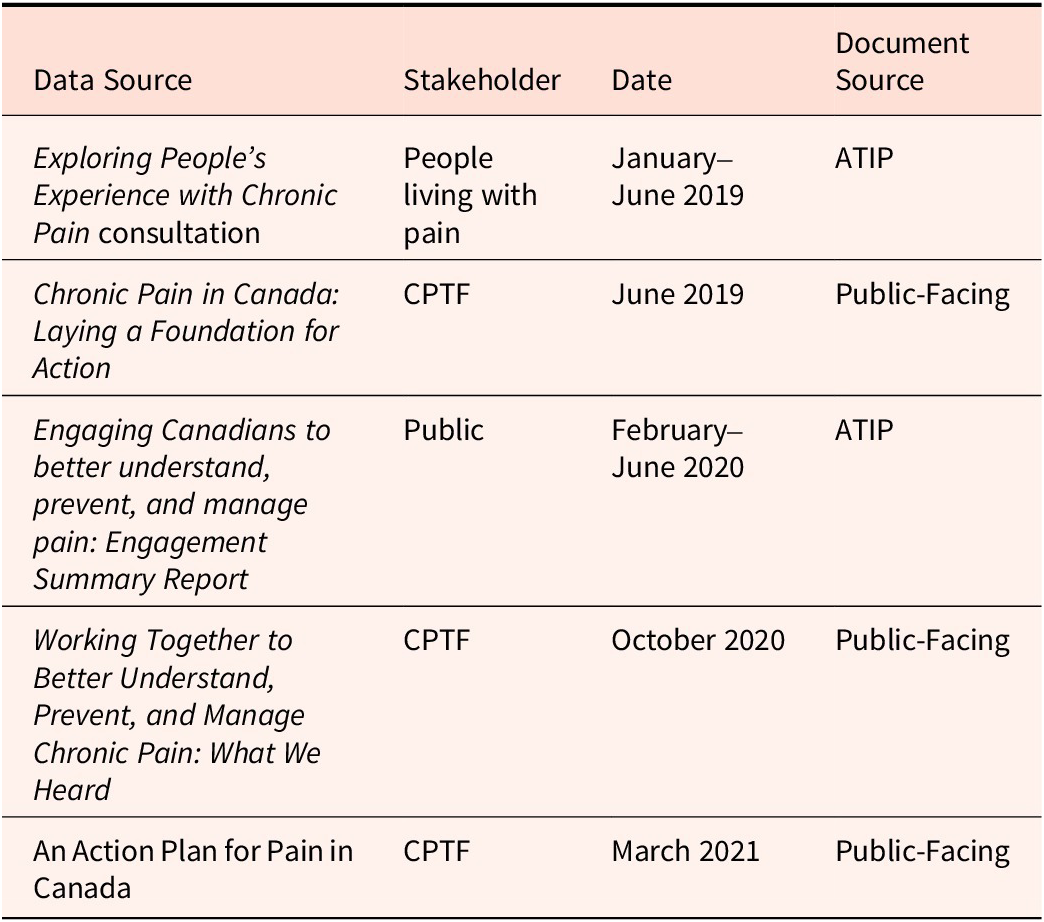
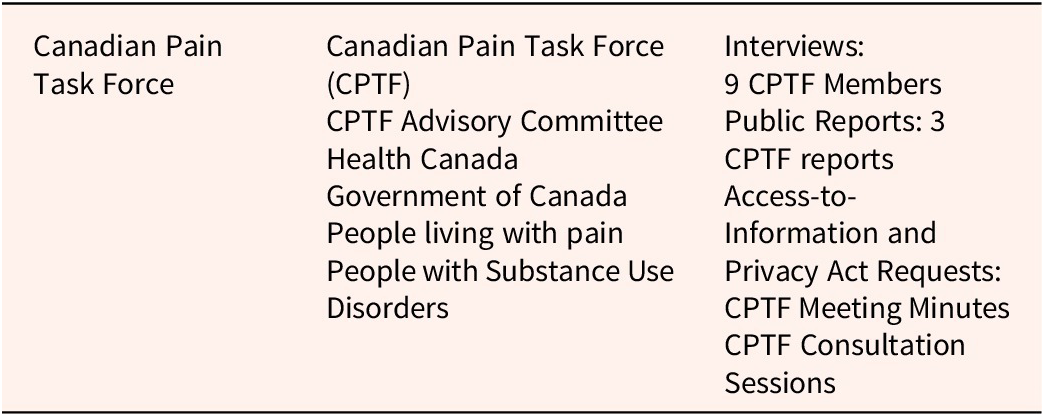
Our study employed a qualitative design with data collected through two primary sources: documents and semi-structured interviews, and is reported according to the consolidated criteria for reporting qualitative studies (COREQ).Reference Booth and Moher23 A qualitative design was selected to gain an in-depth understanding of stakeholder perspectives and framing strategies, which are best explored through methods allowing for nuanced data interpretation.Reference Green and Thorogood24 Document analysis consisted of analyzing two separate collections of documents: first, the three public-facing reports on chronic pain in Canada that the CPTF delivered to the Government of Canada between 2019 and 2021; and second, the internal Engagement Summary Report and consultation with people living with pain. These were provided by the CPTF to the Government of Canada and obtained through an Access to Information and Privacy Act (ATIP) Request (ATIP#: A-2019-001639). The Engagement Summary Report summarized all consultations conducted by the CPTF, including: thirteen regional workshops and targeted stakeholder discussions; 1,407 online questionnaire responses sent out to the public; 89 stories of personal experiences with pain from patients, their families, health care providers, and other stakeholders in the health system; and 12 longer-form invited submissions received from stakeholder organizations. These documents were chosen as they represent the CPTF’s primary outputs and summarize extensive public and stakeholder engagement efforts, ensuring a robust and representative dataset. While we did not have direct access to the Engagement Summary data, we were permitted access to the Task Force’s summary analysis and report of the consultation data. A summary of data sources can be found in Table 1 below.
Overview of CPTF Documents Data Sources

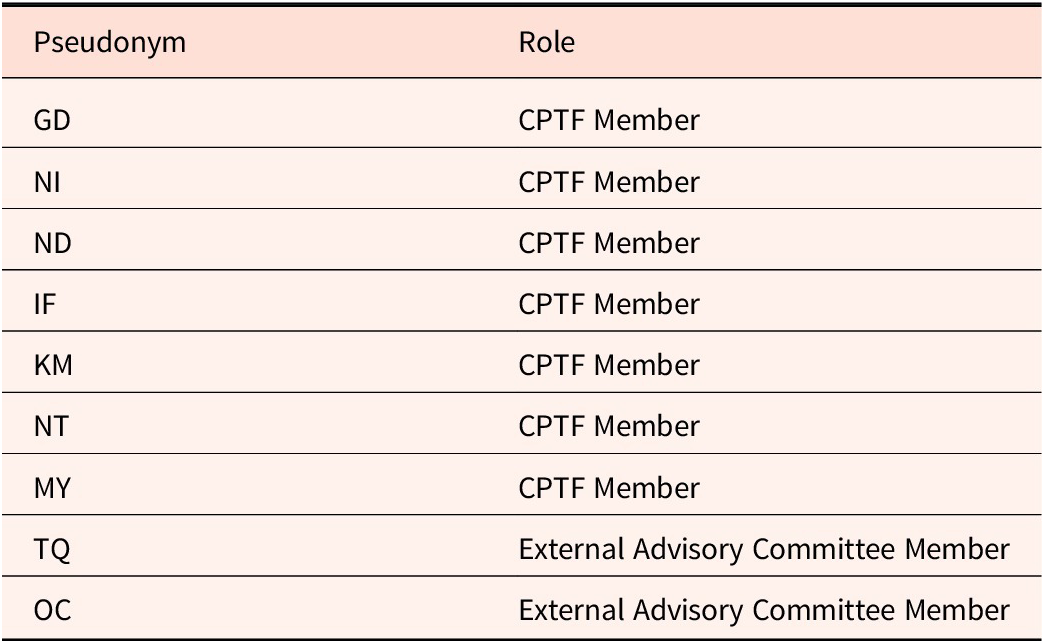
The second source of data comprised semi-structured interviews. The University of Toronto Health Research Ethics Board approved the study (Protocol #42555). Members of the CPTF and its External Advisory Committee (EAC) were eligible to participate in the study. We contacted all members of both groups using publicly available email addresses. Where direct contact information was unavailable, other CPTF members facilitated introductions. Seven of nine members of the CPTF were interviewed, while two declined. Two of the fifteen EAC members also agreed to be interviewed. While many invited members cited time constraints as the reason for declining the interviews, we do not have a complete picture of all the factors behind their decision. Although time was a significant barrier, there may have been additional, unrecorded reasons for their non-participation. While members declining limits the direct representation of perspectives from members of the EAC in the interviews, their viewpoints were incorporated through document analysis, as many of their contributions were reflected in the CPTF reports. The roles and pseudonyms can be found in Appendix 1.
Interviews were semi-structured and open-ended, which ensured that there were systematic and consistent questions that attended to the research questions across each interview, while offering flexibility for questions that emerged serendipitously.Reference Bryman25 Interviews took place between June and August of 2023, lasting between 20 and 65 minutes. All interviews were conducted via Zoom to limit travel barriers and costs of participation. Questions began with participants’ experiences and perspectives on pain and pain policy and then moved to questions about opioids and the overdose crisis. Following the more directed questions, participants were encouraged to offer their perspectives on broader pain management and policy issues, allowing for the emergence of further insights and unexpected themes.
We chose to analyze both public documents and conduct in-depth interviews to gain a comprehensive understanding of how members of the CPTF framed chronic pain and related issues. The public documents, including the CPTF’s reports and consultation summaries, provided insight into the official narratives and policy positions presented to the public and government. However, these documents could not capture the full spectrum of perspectives held by Task Force members. By conducting semi-structured interviews with CPTF members, we aimed to uncover additional framings and perspectives that were not evident in the public documents. Individually, the public documents offered a structured overview of the CPTF’s formal communications, while the interviews provided deeper insights into individual members’ viewpoints and the diversity of perspectives within the Task Force. Together, this approach allowed us to identify both the official and wider range of framings held by Task Force members, leading to a more nuanced understanding of the CPTF’s presentation of the overdose crisis. Throughout this process, our interview analysis was guided by insights from document analysis, allowing us to trace how policy framings evolved across different sources.
Data Analysis
The text for analysis comprised both the documents and de-identified transcripts, which were imported into NVivo 12. We chose to analyze both public documents and conduct in-depth interviews to gain a comprehensive understanding of how members of the CPTF framed chronic pain and related issues. The public documents, including the CPTF’s reports and consultation summaries, provided insight into the official narratives and policy positions presented to the public and government. However, these documents could not capture the full spectrum of perspectives held by Task Force members. By conducting semi-structured interviews with CPTF members, we aimed to uncover additional framings and perspectives that were not evident in the public documents. Individually, the public documents offered a structured overview of the CPTF’s formal communications, while the interviews provided deeper insights into individual members’ viewpoints and the diversity of perspectives within the Task Force. Together, this approach allowed us to identify both the official and wider range of framings held by Task Force members, leading to a more nuanced understanding of the CPTF’s presentation of the overdose crisis. Throughout this process, our interview analysis was guided by insights from document analysis, allowing us to trace how policy framings evolved across different sources. Author 1 systematically coded the data using framing as a sensitizing concept, inductively generating codes related to problem definitions and policy prescriptions. This process allowed us to capture how stakeholders framed key issues and justified particular policy responses. Co-authors contributed to emerging analyses through regular discussions to enhance rigor. By comparing these frames across different sources, we assessed areas of alignment, contestation, and evolution over time. This iterative process allowed us to understand how various actors strategically framed issues to influence policy discourse and outcomes, ensuring that our analysis remained reflective of the data and aligned with our research objectives.
Findings
The following section first provides an overview of stakeholders’ three primary problem definitions of the overdose crisis: a crisis of illicit supply; a consequence of the stigmatization of legacy patients; and a result of non-pharmacological care. It then outlines the proposed policy solutions that stakeholders built from these problem definitions, including a push to shift the government’s focus towards illicit opioids, increase education about “appropriate” opioid use, and to allow healthcare professionals more flexibility in prescribing practices.
Problem Definitions
The “Opioid Crisis” is Mislabeled and is a Crisis of Illicit Supply

* See Appendix 1 for table of pseudonyms used in this article.
From the outset of interviews and reports, stakeholders presented the pain crisis as inseparable from the opioid overdose crisis:
“You can’t talk about the opioid crisis, really, without talking about chronic pain.” (GD)
“One of the main drivers of the opioid crisis is the pain crisis.” (AF)
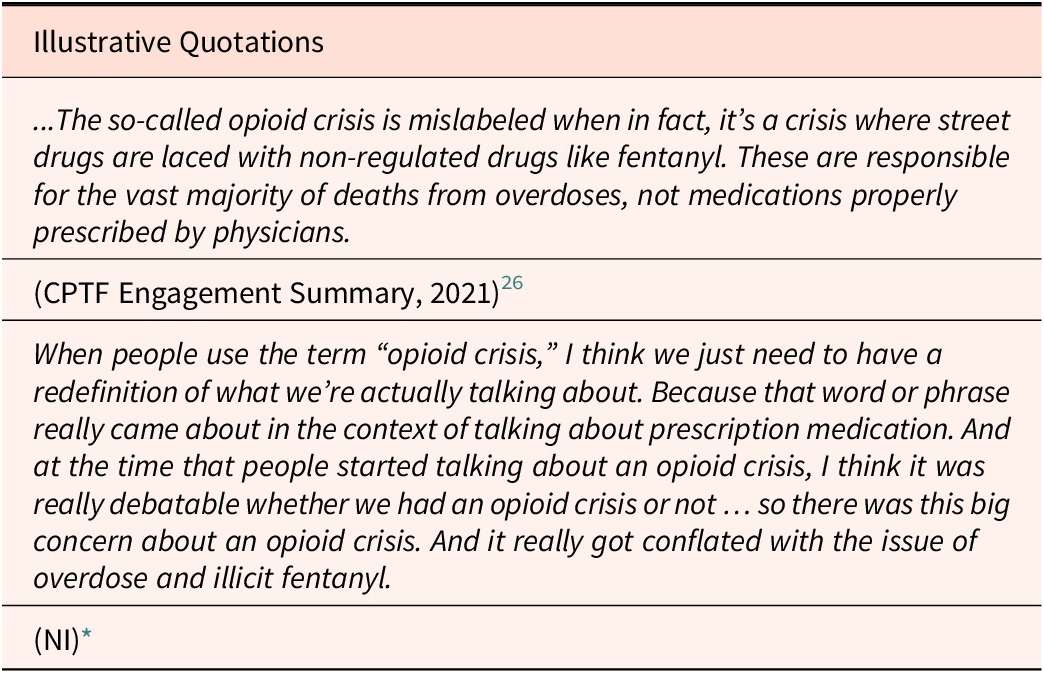
CPTF reports were also explicit in the connections between opioids and chronic pain, with the initial report noting that “Opioids … warrant special attention in the current Canadian context”27 and the final report noting that “Untreated chronic pain is connected to the opioid overdose crisis.”28 The CPTF reports also noted the use of prescription opioids in relation to both acute and chronic pain as having “contributed” to the earlier “public health crisis.”29 Yet, to the extent that prescription opioids were acknowledged as a problem, they were framed as a rare and ancillary issue that should be relegated to problems with access. But stakeholders resisted the presumption that prescription opioids for people with pain had a role to play in the crisis. Instead, they consistently identified the primary cause of the overdose crisis as the illicit drug supply. This framing was illustrated by a person with pain quoted in the Engagement Summary, who noted their disagreement with the way in which “opioid crisis” had become defined:
“The so-called opioid crisis is mislabeled when in fact, it’s a crisis where street drugs are laced with non-regulated drugs like fentanyl. These are responsible for the vast majority of deaths from overdoses, not medications properly prescribed by physicians.”30
This opposition to the “opioid crisis” labeling and framing of the problem as an illicit, toxic drug supply crisis coincided with specific characterizations of people who use illicit opioids. Stakeholders characterized those in need of policymakers’ attention as illicit opioid users and, occasionally, as “addicts,” as two people living with pain quoted in the Engagement Report noted,
“Stop enacting legislation and policies that lump people with chronic pain under the rubric of drug addiction and addicts!”31
“The majority of people living with chronic pain are not drug addicts looking for opioids.”32
A CPTF member echoed this language, noting,
“People that take opioids and suffer from chronic pain are not necessarily addicts. There are differences, very big differences.” (KM)
This characterization drew a clear line between “legitimate” and “illegitimate” opioid users, framing the former as legitimate users and the latter as addicts. Taken together, these problem definitions positioned the overdose crisis primarily as a result of the illicit drug supply and irresponsible use, rather than the inappropriate medical prescribing of opioids for pain management. Stakeholders emphasized that the overdose epidemic is driven by unregulated substances infiltrating the street drug supply, rather than by prescribed medications when used responsibly under medical supervision. By branding the crisis as “mislabeled,” they challenged the conflation of legitimate pain patients with individuals suffering from substance use disorders. The distinction between opioids prescribed for legitimate pain management and illicit opioid use was central to these arguments, with stakeholders consistently contrasting the two: prescribed opioids were framed as a necessary and regulated treatment for chronic pain, with users described as “reliant” on the medication, while illicit opioid users, often labeled as “addicts,” were seen as the primary drivers of the overdose crisis. This differentiation reinforced the perception that the crisis stemmed from illicit drug use rather than medical prescriptions.
Legacy Opioid Patients are Ignored and Stigmatized

Across stakeholders’ problem definitions, legacy patients repeatedly emerged as a primary priority. Legacy patients are individuals who have been prescribed opioids for years for chronic pain, and who often experience significant physiological and neurological changes due to long-term opioid therapy.Reference Coffin and Barreveld36 Legacy patients (referred to in the reports as those that “have and continue to rely on opioids to treat pain”) were positioned as a primary patient group that had been harmed by growing attention to the opioid crisis, with their access frequently reduced or eliminated as a result of an overreaction to illicit opioid harms. Reports and advocates expressed that the lives of people with chronic pain were characterized by stigma at several levels, including interpersonally, publicly, and, in particular, in the medical arena. One CPTF member summarized this sentiment:
“If you have chronic pain, you are stigmatized. If you take opioids for chronic pain, it’s double stigmatization.” (ND)
Stigma was framed as both a contributing factor to and a consequence of the opioid crisis: Stakeholders suggested that stigma not only resulted from the opioid crisis but also exacerbated it. For instance, stigma was characterized as resulting from opioid prescribing guidelines in the first CPTF report:
… actions to promote appropriate opioid prescribing in Canada have had unintended consequences on those with chronic pain, including increased stigma…37
By contrast, the Engagement Summary report warned of stigma leading to increased problematic substance use:
Stigma associated with chronic pain, lack of accessible pain treatment and management options, and reluctance from health care providers to deliver specific interventions, such as opioids, can further complicate treatment efforts, potentially resulting in the development of undertreatment of chronic pain, worsening mental health, and increased risk of problematic substance use.38
Advocates argued that the opioid crisis and resulting stigma had made prescribers more risk-averse and concerned with their own liability, leading to less access to prescription opioids and consequently driving people living with pain to access opioids through the illicit market. Prescription opioid users’ shift to the illicit market was not castigated in the same way as “addicts” using the illicit market. Instead, stakeholders framed this shift as a necessity in the face of unfair restrictions on the prescription opioid supply.
An Absence of Non-Pharmacological Care Was a Catalyst to the Crisis

Stakeholders identified the lack of access to non-pharmacological alternatives as a significant contributing factor to people living with pain’s reliance on opioids. They particularly emphasized a deficit in funded non-pharmacological treatments such as cannabis, traditional therapies, transitional pain services, physiotherapy, and pain clinics. The second CPTF report emphasized this need for alternatives to prevent opioid abuse multiple times:
Finding solutions to address unmanaged pain, and the trauma and complexity that often accompany it, can be a key means for reducing first exposure to or reliance on opioids and preventing harms associated with substance use more generally.41
Stakeholders therefore emphasized non-pharmacological options to explain the overreliance on prescription opioids. Here, stakeholders hint that the absence of non-pharmacological care was worsening prescription opioid reliance and the harms of opioids. The implication is that non-pharmacological care could therefore address one root cause of the overdose crisis. This need for alternative options for people living with pain has been previously acknowledged in the literature,Reference Finestone42 but framing it as exacerbating problematic opioid use strategically advocated that the federal government, already heavily concerned with the opioid crisis, provide more alternatives.
Proposed Solutions

Reducing Prescribing Restrictions
Solutions to the overdose crisis primarily focused on enhancing access and removing barriers to opioid prescribing. The framing of prescription opioid harms as overstated led to a primary emphasis on increasing access to prescription opioids. Increasing access was strategically positioned as simultaneously helping people living with pain and addressing the opioid crisis by discouraging individuals from turning to the toxic, illicit supply. This was articulated in the initial report:
Despite widespread decreased opioid prescribing, and investments in a continuum of harm reduction, treatment, and prevention initiatives, there are record high numbers of overdose deaths in Canada. We must urgently address untreated pain as a driver of this crisis.45
This reasoning suggested that prescriber reluctance to prescribe opioids might drive people living with pain to seek opioids through the illicit market, thus exacerbating an “opioid crisis” that stakeholders had defined as a crisis of a tainted supply and synthetic fentanyl. The final report, for instance, noted the need for “improved access to prescription medications and pharmaceutical alternatives to toxic drugs.”46 This focus on the toxic drug supply therefore positioned increasing access to prescription opioids as a potential solution. People living with pain argued that opioid restrictions would worsen opioid harms because it would shift prescription opioid users to an illicit and tainted supply. Once problematic opioid use was equated to toxic, illicit supply, restrictions on prescription opioids were framed as unnecessary and burdensome by extension. Addressing “the opioid crisis” meant addressing reliance on toxic illicit opioid supply, concerns around addiction or opioid use disorders related to prescription opioids were diminished, and inadequate access to safe opioids was presented as the main problem relating to prescription opioids.
Prescriber-Patient Relationships and Patient-Centered Care
Building on the need to improve access to opioids, stakeholders presented the prescriber-patient relationship and “patient-centered care” as an alternative to prescribing restrictions. They argued that prescribers and patients would ideally lead decisions about suitability of opioid treatment, rather than government or policy directives. These solutions were positioned in opposition to proposed or hypothetical alternatives that sought to reduce overall prescribing rates in Canada at the population-level, instead advocating for a focus on the individual patient-prescriber relationship. This discourse emphasized the value of the prescriber-patient relationship, encouraging regulators to defer to healthcare professionals to discern the patient’s best interests:
There should be balanced public messaging about the benefits and potential harms of opioids, as some participants noted that actions to promote appropriate opioid prescribing in Canada have had unintended consequences on people with chronic pain, such as increased stigma and additional barriers to receiving care (including prescription opioid medications).47
This approach positioned people living with pain, in tandem with their healthcare providers, as best positioned to make these decisions.
Education and Awareness
Finally, alongside the promotion of patient-centered care, a primary solution focused on enhancing awareness, education, and reducing the stigma associated with opioid use. Stakeholders’ problem definitions of the roots of the crisis as both healthcare professionals’ hesitation to prescribe opioids and an ongoing stigma surrounding opioid use lent themselves to pushing for education campaigns that simultaneously de-stigmatized use and encouraged prescribers to trust the perceptions people living with pain have of their own needs. Educating the public about pain was presented as a means by which to diminish stigma related to pain and opioid treatment more generally:
… a large-scale, unified, and accessible public awareness and education campaign would help build a basic understanding of pain, reduce stigma (particularly around the use of prescribed opioid medications and other pharmaceuticals to manage pain), and promote education around the mechanisms of pain as well as available resources for pain management.48
[Prescriber] guidance must also emphasize the need to end discrimination against people living with pain and denial of care based on a history or current use of opioids.49
This approach once more linked the reduction of stigma, discrimination, and enhanced access to opioids with the broader strategy of addressing the overdose crisis. In presenting stigma as both a cause and effect of problematic opioid use, de-stigmatization of prescription opioid use was positioned as addressing stakeholders’ conception of the “opioid crisis” as an overdose crisis related to tainted opioids and fentanyl.
Discussion
Pain stakeholders — including healthcare professionals, people with substance use disorders, and people living with pain — repeatedly pushed back at the Canadian government’s focus on decreasing opioid prescribing, arguing that the real crisis lay with non-prescription opioids. In parallel, stakeholders identified a crisis of untreated pain. Rather than denying challenges relating to any opioids, these strategic framings sought to focus attention away from the role of prescription opioids in the overdose crisis. The “problem” of prescription opioids consequently became framed as challenges of insufficient access, inadequate public and prescriber awareness, and the stigmatization of opioid use for people living with pain, rather than problems specific to opioid prescribing. These characterizations of the crisis placed the problem of inadequate access to prescription opioids for people living with pain on the same level of — or of even greater importance than — harms of opioid use more generally. Overall, stakeholders remained hesitant to discuss the role of prescription opioids in harming people living with pain’s lives.
Several important implications arise from these findings. First, the distinction between “legitimate” and “illegitimate” opioid use — while understandable in the context of chronic pain advocacy — has the potential to contribute to the stigmatization of people who use illicit opioids. By emphasizing that pain patients are not “addicts” and that their medication use is fundamentally different from illicit opioid consumption, pain advocates implicitly reinforce stigmatizing narratives that frame people who use drugs as irresponsible, undeserving, or beyond the scope of medical legitimacy. This framing has tangible policy consequences: While pain stakeholders advocate for expanded access to prescription opioids, efforts to decriminalize drug use or improve harm reduction services are consequently diminished.
This dynamic illustrates a broader phenomenon in health policy advocacy, where marginalized groups may unintentionally stigmatize others in their pursuit of policy goals. Similar patterns have been observed in other contested health debates, where patient communities seek legitimacy by distancing themselves from groups perceived as socially deviant. In this case, the strategic framing employed by pain advocates underscores the power of medical legitimacy in shaping policy outcomes while also raising important questions about the unintended consequences of advocacy-driven framings. Addressing the overdose crisis requires recognizing these complexities and ensuring that policy responses do not further entrench stigma against already marginalized communities.
Second, these findings suggest a significant effort by pain advocates to counter the standard media and social media narratives surrounding people living with pain as drug-seeking.Reference Dekeseredy50 Stakeholders challenged equating opioid use for pain management with opioid abuse, another narrative previously found in the media and amongst policymakers.Reference Jacqueline, Lili and Elizabeth51 This may speak to the experiences people living with pain have of enduring consistently shifting policies, as Wailoo argues:
People in pain, sadly, have carried two types of burdens— first, the onus of their own pain, and, second, the burden of being props in this political theater which saw actors assign conflicting meanings to their experiences.Reference Wailoo52
Our results bear out this reflection on political theater. Stakeholders communicated that people living with pain have a legitimate, serious, and debilitating condition, and have the right to access care and treatment well beyond opioids. Yet they also communicated that people living with pain operate in a context where there is no access to affordable, effective therapies. Thus, working in partnership with a trusted health professional, legacy patients were recommended (and continue to access) an available and affordable solution to pain. In absence of alternatives, stakeholders argued that withdrawing opioids is unethical and harmful because it will drive people toward an unsafe and unregulated poisonous supply, putting their lives at risk.
Third, although stakeholders recognized certain risks associated with opioid use — such as the potential for dependence — they markedly avoided proposing solutions that would require altering prescribing practices directly. Precisely which practices should or should not be changed was not conveyed; rather, any new regulations related to prescribing were characterized as unnecessary, excessive, and/or counterproductive. Despite some acknowledgement throughout reports of the problems with over-prescribing, solutions related to prescribing only focused on increasing access for people living with pain. As Larson et al. point out,Reference Larson, Salvalaggio and Bodkin53 the causes of the overdose crisis by 2016 can be understood as both prescribing and deprescribing. Given the wide net that federal policy inevitably casts, proposed chronic pain policies were thus presented as having the potential to both benefit and harm public health. Finally, this study sits within a broader literature on framing both chronic painReference Langford54 and the overdose crisis.Reference Ferguson and Eliasson55 These studies, however, have rarely taken up how policy stakeholders stigmatize other communities in service of their own priorities. Our results suggest that significant nuance is required in considering the process through which some members of a heavily stigmatized community — people with chronic pain — end up stigmatizing another community — people with opioid use disorders — in pursuit of their own objectives. Further research is thus needed to explore the dynamics of how marginalized groups may be driven to perpetuate stigma against other vulnerable populations in order to protect their own aims.
Strengths and Limitations
This study contains a number of important strengths: First, it is the first study to our knowledge to investigate how pain stakeholders frame opioids and the overdose crisis in a policy setting. This study thus fills an important gap to assess how an influential policy stakeholder articulated its policy positions; Second, using interviews provided a methodological contribution in combining data sources as a form of data triangulation for framing analyses. While interview data has become increasingly popular in framing analyses,Reference Koon56 it remains underutilized relative to document analysis. Interviews were an effective source for exploring stakeholders’ framings in tandem with the broader framings analyzed during consultations. These allowed for further critical analysis and “testing” of sources against one another;Reference Yin57 Finally, while many framing analyses have noted an emphasis on people living with pain and/or illicit opioid users, no framing or discourse analyses on the topic have taken up the issue of the “legitimate patient.” These framings are particularly important to understand given the power of medical validation for patients’ access to care and treatment. This is a key gap in the literature that this study fills.
Notwithstanding these contributions, this study has some limitations. First, the pain advocacy movement is not homogeneous. While the CPTF reports represented a wide range of pain professionals, people living with pain, and advocates, and thus represent an important component of the Canadian pain movement — with particular influence over Canadian policy — they should not be assumed to represent the movement as a whole. Despite extensive discussion about people living with pain, the focus of this study was the advocacy movement more generally. When originally conceived, the focus of the study was to solely speak to professional policy actors, for whom remuneration is generally less expected.58 Specifically seeking out unpaid participation from people with lived experience of chronic pain — particularly in the context of the intersecting forms of marginalization individuals already experience — was deemed unethical. Notwithstanding, the Canadian pain advocacy movement consists of many people living with chronic pain, and future research should be conducted with and for people living with pain that includes funding for their participation.
Finally, analysis often involved interpreting the CPTF’s own interpretations of the Canadian pain community’s interpretations of their own experiences. As a result, there are likely to be several experiences lost in the process of this diffused interpretive analysis. Notwithstanding, these consultations and reports provide an important overall summary of and significant insights into the most comprehensive consultation on the Canadian pain landscape to date.
Conclusion
There has been limited exploration of the role that chronic pain stakeholders play in opioid policymaking. Our findings point to a significant stakeholder group whose influence has been largely overlooked. It is essential to examine how chronic pain stakeholders’ framings, which may downplay the role of prescribing in the crisis, are strategically shaped to gain recognition for their cause. This underscores the need for more nuanced framing analyses that consider the diverse policy interests influencing stakeholders’ presentations of the overdose crisis’s causes, problem definitions, and proposed solutions.
Chronic pain has long been marked by systemic disbelief, marginalization, and stigma. Despite mixed evidence regarding their efficacy, opioids have remained a critical treatment option for many individuals with chronic pain, with few viable alternatives. In this context, it is both unsurprising and understandable that advocates would resist measures restricting access to one of their most limited treatment options. However, given the CPTF’s significant influence on federal policy and its proximity to decision-makers, it is crucial to examine how their framings shape the construction of the policy problem and its solutions. The implications of these framings — both for individuals who use illicit and prescription opioids, and for those with or without medically recognized pain — are critical in understanding how the crises are constructed, perceived, and addressed.
Supplementary material
The supplementary material for this article can be found at http://doi.org/10.1017/jme.2025.10158.
Disclosure
This study draws on research supported by a Social Sciences and Humanities Research Council Doctoral Fellowship awarded to Daniel Eisenkraft Klein. Benjamin Hawkins’ work in the MRC Epidemeology Unit at University of Cambridge is funded by the Medical Research Council, grant number MC_UU_00006/7. 20% of his time at the UKRI Public Health Improvement Cluster is supported by UK Research and Innovation funding for “Local Health and Global Profits,” grant number MR/Y030753/1. No other authors have funding or conflict of interest to disclose.
Appendix 1: Canadian Pain Task Force Participant Pseudonyms and Organizational Roles
Interview Participants

Overview of Stakeholders Involved in CPTF Consultations



 Open access

