

In 2013, a group of Republican Wisconsin State Assembly members introduced Assembly. Bill (AB) 161, which was ultimately enacted into law in 2014 as 2013 Wisconsin Act 156, makes any stay, injunction, or restraining order issued by a circuit court or intermediate appellate court immediately appealable. In doing so, this legislation would immediately halt any legal effect of trial and intermediate appellate court decisions until there was a full review of the state supreme court. Though this seems minor or procedural, it was passed to stop any immediate effect of a lower court decision, particularly on the constitutionality of a statute, thereby significantly constraining the lower courts’ power. This legislation came in the wake of the long political battle in the state over a 2011 law that limited almost all collective bargaining rights in the state. While ultimately that legislation was upheld as constitutional, prior to its enactment, there was significant political backlash at a lower state court that initially blocked its implementation.
In response to the introduction of AB 161, the League of Women Voters of Wisconsin Education Network Inc., a lobbying group, took note of the legislature’s efforts to constrain the state’s lower courts. The League argued that the bill violated the separation of powers in state government by constraining the judicial branch (Wisconsin Ethics Commission 2013). With the passing of AB 161, the legislators achieved their goal, enacting into law a court-curbing bill that targeted lower state courts. As a result, decisions by these lower courts – especially those declaring a law unconstitutional – would be stayed automatically pending the state supreme court’s decision. Notably, at the time, the Wisconsin Supreme Court had a 5–2 Republican supermajority that was likely to vote in line with the Republican legislature’s preferences. In doing so, the legislature was attempting to shift even more decision-making power in the court system to a state high court they were ideologically close to and who were elected statewide.
Court-curbing legislation seeks to constrain judicial independence and create a judicial environment that aligns with the preferences of the state legislature (Bonica and Sen Reference Bonica and Sen2020; Leonard Reference Leonard2024). Almost all the previous research on this type of legislation focuses on bills that would limit the power of high courts (state supreme courts and the US Supreme Court). Here, we examine bills like the one in Wisconsin that would strip power from lower state courts and ask what these bills look like, what courts these bills curb, and what might explain the introduction of this legislation.
State court-curbing legislation is not rare. From 2008 to 2016 alone, there were over 1,200 bills introduced into state legislatures that targeted the state judicial branch (Leonard Reference Leonard2022a). While court curbing has been studied extensively in the US Supreme Court (Clark Reference Clark2009, Reference Clark2011; Mark and Zilis Reference Mark and Zilis2019) and lower federal court context (Moyer and Key Reference Moyer and Key2018), recent scholarship has emphasized the importance of studying court curbing at the state level due to the institutional and contextual variation offered by the states (see Leonard Reference Leonard2022a). Most of the existing literature that centers on separation of powers tension and court-curbing legislation in the states focuses on state courts of last resort (e.g., Blackley Reference Blackley2019; Bosworth Reference Bosworth2017; Grey Reference Grey2019; Johnson Reference Johnson2014, Reference Johnson2015; Langer Reference Langer2002). However, we have limited information about the motivations of state legislators who sponsor legislation attacking lower state courts. This article seeks to fill this gap by examining the motivations of court-curbing bills targeting lower state courts. Understanding the factors that influence the introduction of court-curbing legislation targeting lower state courts is important, given the meaningful role that lower state courts play in state judicial systems. State intermediate appellate courts decide approximately three times as many cases as state courts of last resort, and state trial courts process tens of millions of cases each year (National Center for State Courts 2019). Thus, lower state courts are the workhorses of state judicial systems, underscoring the importance of studying court-curbing legislation at this level.
In this article, we test multiple hypotheses from existing court-curbing literature to examine the explanatory power of ideological and institutional factors on court-curbing legislation that targets lower state courts. We examine the use of court curbing in two separate ways. First, we look at which court the bill targets – the state supreme court, an intermediate appellate court, or the trial courts – and we examine the presence or count of this legislation in a state-year. Using Leonard’s (Reference Leonard2022a) dataset on state court-curbing bills from 2008 to 2016, we demonstrate that legislators are more likely to sponsor a court-curbing bill that targets state trial courts when legislators are operating in a highly professionalized environment. That is, as legislative professionalism increases, the likelihood of introducing a court-curbing bill also increases. Interestingly, the results indicate that ideology has no meaningful impact on court-curbing activity in this setting. This suggests that legislative motivations to target lower state courts differ from those at the federal level (i.e., position-taking) and that motivations for targeting lower courts also differ in part from those attacking state courts of last resort.
Court curbing at the federal and state levels
We define court curbing like Clark (Reference Clark2009, Reference Clark2011) as any proposed policy that aims to restrict, remove, or limit the power of the judiciary. In other words, court curbing constitutes a threat to courts by proposing to alter a court’s power and acts as an institutional encroachment (Mark and Zilis Reference Mark and Zilis2018a). Court curbing poses a threat to judicial independence, which is considered a necessary condition for democracy and is a central piece of the separation of powers that is intended to balance the three branches (Howard and Carey Reference Howard and Carey2004; Rosenberg Reference Rosenberg1992). As a threat to judicial independence, court curbing can be a component of democratic backsliding in the United States (Leonard Reference Leonard2024).
Judicial independence affords courts the ability to make decisions with minimal pushback from officeholders (Rosenberg Reference Rosenberg1992). Courts desire high levels of judicial independence, which allows them discretion to pursue preferred policy outcomes without interference from other political actors. Judicial independence benefits the public and other “political” branches as well. High levels of judicial independence allow courts to safeguard the public’s civil liberties, civil rights, and political rights from encroachment by other policymakers (Rosenberg Reference Rosenberg1992). In places where political competitiveness is high (e.g., democracies), legislatures and executives benefit from an independent judiciary, which can safeguard the policy gains of the current regime once they find themselves in opposition (Randazzo, Gibler, and Reid Reference Randazzo, Gibler and Reid2016). However, in places with low political competitiveness, legislatures and executives may find that an independent judiciary is a liability and seek to bring the judiciary under the regime’s control (Randazzo, Gibler, and Reid Reference Randazzo, Gibler and Reid2016).
Much of the court-curbing literature in the United States focuses on the national level and on courts of last resort. As a result, most of what we know about court curbing stems from studying the relationship between the United States Congress and the Supreme Court (see Clark Reference Clark2011; Hager and Uribe-McGuire Reference Hager and Uribe-McGuire2024). However, the “uniqueness” of the US Supreme Court and Congress and the relationship between the two poses “a nontrivial and stubborn threat to the external validity of studies based solely on it” (Collins and Martinek Reference Collins and Martinek2010, 398). To address this, this article contributes to two small but growing lines of court-curbing research. First, court curbing targets more than just courts of last resort – legislatures also attack lower courts as well, though less is known about this phenomenon beyond the Ninth Circuit of the US Courts of Appeals (Moyer and Key Reference Moyer and Key2018). They find that position-taking by members of Congress drives the decision to introduce legislation to split the Ninth Circuit. Second, studies of court curbing at the state level have leveraged institutional variation (e.g., judicial selection systems and judicial retention systems) to demonstrate that higher judicial independence and ideological divergence between legislatures and courts motivate more court-curbing activity (Blackley Reference Blackley2019; Catalano Reference Catalano2022; Hack Reference Hack2022; Leonard Reference Leonard2016, Reference Leonard2022a, Reference Leonard2022b, Reference Leonard2024).
Court curbing at the state level appears to be largely driven by institutional-level conflict. When ideological divergence between the state legislature and the state court of last resort increases, so does court-curbing activity (Hack Reference Hack2022; Leonard Reference Leonard2016). Methods of judicial selection structure this institutional conflict and motivation to court curb based on the ability of political elites and parties to select preferred judges ex ante (Catalano Reference Catalano2022). However, less is known about the motivations for court curbing beyond institutional conflict. This includes a lack of understanding of the connection between legislative position-taking and court curbing at the state level, which appears to exist at the national level (see Clark Reference Clark2011).
Curbing lower courts as position-taking?
While legislatures and courts of last resort may carry out a more visible institutional battle, lower courts incur attacks from state legislatures as well. These lower courts may raise the ire of legislatures on their own if the lower courts rule against the preferences of legislators. At the federal level, lower courts seem to be useful as the target of position-taking by legislators who wish to score political points with their constituents. Members of Congress from states that are ideologically divergent from the “liberal” Ninth Circuit of the US Courts of Appeals tended to introduce more court-curbing bills targeting the Ninth Circuit (Moyer and Key Reference Moyer and Key2018). These bills aimed to split the Ninth Circuit in an attempt to crack the “liberal” majority; however, none were enacted into law. This position-taking for the benefit of constituents may play out at the state level as well, for the highest state courts. State legislators are more likely to introduce court-curbing bills if the state legislator represents “safe” seats (e.g., a less competitive electoral district) and are increasingly ideologically divergent from the state court of last resort (Blackley Reference Blackley2019).
Legislators engage in position-taking to make public their stances on issues that may be of interest to their constituents. Legislators aim to use these public actions and statements to aid in their re-election efforts (Mayhew Reference Mayhew1974). When sponsoring or co-sponsoring bills in the legislature, legislators are able to send signals to constituents about their position on a topic without the same risk that an official committee or floor vote might incur (Lazarus Reference Lazarus2013). While constituents may not keep track of all the bills their legislator proposes, they tend to respond positively to legislators who sponsor more bills, particularly ones that address salient issues (Box-Steffensmeier et al. Reference Box-Steffensmeier, Kimball, Meinke and Tate2003; Parker and Goodman Reference Parker and Goodman2009; Rocca and Gordon Reference Rocca and Gordon2010). In sum, legislators engage in position-taking activities when they believe that it will benefit them electorally.
Proposing court-curbing bills represents one way in which legislators can engage in position-taking. When legislators sense that the judiciary no longer has the public’s confidence and that the judiciary is ideologically divergent from those constituents, legislators are incentivized to engage in court curbing (Clark Reference Clark2009, Reference Clark2011; Vanberg Reference Vanberg2001). Where constituents are more aligned ideologically with the judiciary or public perception of the judiciary becomes more positive, legislators engaging in court curbing risk running afoul of their constituents’ preferences, which may harm them in their re-election bids (Driscoll and Nelson Reference Driscoll and Nelson2023; Vanberg Reference Vanberg2001).
Yet, if they couch types of court-curbing legislation as reform proposals using apolitical language, legislators reduce their chance of seeing negative feedback (Driscoll and Nelson Reference Driscoll and Nelson2023). Of course, the translation of this theory may be more challenging when it comes to lower state courts, an area of very low information and salience among the voters. Lower court behavior may also be low salience for members of the state legislature, so we must expect that while lower courts that behave in an especially egregious manner may face curbing, there should be another explanation for this behavior. Thus, we test another institutional factor that could influence court-curbing activity. Specifically, we acknowledge the variation in institutional characteristics in which legislators are operating, and we argue that state legislatures and individual legislators with the resources to monitor lower courts should be more likely to introduce bills to curb lower courts.
Legislative professionalism and court curbing
Legislative professionalism measures, in large part, the level of resources that help legislatures do their jobs effectively in the policymaking process. Higher levels of legislative professionalization can insulate legislators from external political and economic phenomena while affording those same legislators the tools to respond to those phenomena (Berry, Berkman, and Schneiderman Reference Berry, Berkman and Schneiderman2000; Squire Reference Squire2023). Though greater amounts of resources in highly professionalized legislatures can increase influence over other components of the policymaking process, it can also lead to political careerism, which incentivizes legislators to foster and deepen relationships with the other branches of government (Woods and Baranowski Reference Woods and Baranowski2006). These countervailing forces of legislative professionalism can lead to unexpected outcomes regarding the effectiveness of the other branches. For example, higher levels of legislative professionalization can help the executive branch (e.g., governor and state agencies) do their work more efficiently, showing that the checks and balances system of government is not necessarily a zero-sum game (Dilger, Krause, and Moffett Reference Dilger, Krause and Moffett1995; Woods and Baranowski Reference Woods and Baranowski2006).
Efforts to determine the influence of legislative professionalism and legislative-court relationships offer mixed results and focus almost exclusively on courts of last result, rather than lower courts. At the institutional level, some have shown that higher levels of legislative professionalism bring about higher levels of court-curbing activity (see Hack Reference Hack2022 and Leonard Reference Leonard2024, to some extent), whereas others find the opposite or even no relationship (Catalano Reference Catalano2022; Leonard Reference Leonard2016). At the individual level, Blackley (Reference Blackley2019) shows that individual legislators are more likely to co-sponsor court-curbing bills as professionalism increases. Lower levels of legislative professionalization also expand the abilities of state courts to check their legislatures by hearing more cases involving less-professionalized legislatures and being more likely to declare acts of those legislatures invalid (Armaly Reference Armaly2020; Bosworth Reference Bosworth2017; Miller, Ringsmuth, and Little Reference Miller, Ringsmuth and Little2015). This means that state courts of last resort can have higher amounts of influence over the policymaking process in states with legislatures with lower professionalization.
Examples of lower court-curbing bills
Because we know so little about bills that may curb lower courts, we begin with an examination of the contents of this legislation. These examples are useful in building a theory of lower court curbing. In Table 1, we provide examples of bills targeting lower courts and see court-curbing bills with explicit or implicit intent. For example, in 2010, Mike Ritze, a Republican member of the Oklahoma State House of Representatives, proposed a constitutional amendment that would have granted the Republican-dominated legislature the authority to alter and overturn criminal sentences imposed by the state’s courts (Oklahoma 2010 HJR 1079). This has the implicit intent of stripping jurisdiction over criminal sentencing and the authority to review sentencing from the state judiciary and place that authority with the legislature, diminishing judicial independence from the legislature in the process. That same year, Jon Cardin, a Democrat in the Maryland State House of Delegates, also proposed a constitutional amendment that would have changed how lower court judges in Maryland are selected, from elections to a merit selection system (Maryland 2010 HB 1385). The merit selection system, where a nominating committee would send a list of candidates to the governor for the governor to appoint, would give more control over the judicial selection process to the Maryland to the state bar association, which tends to be more left-leaning compared with voters and politicians of the state (Bonica and Sen Reference Bonica and Sen2017).
Examples of court-curbing bills targeting lower courts

Note. The bills in this table are sourced from the Leonard (Reference Leonard2022a) database and the Gavel-to-Gavel database hosted by the National Center for State Courts.
In addition to the examples in the table, a bill in Louisiana in 2008 sought to remove the ability of the intermediate appellate court from hearing cases regarding state administrative agencies and workers’ compensation claims. Other examples of this legislation sought to change who was qualified to sit on the courts. Texas in 2009 and Tennessee in 2010 both had legislation introduced that would change the qualifications for lower court judges. In Tennessee, they were to be required to be licensed to practice law for five years prior to their election. For Texas judges at the trial level, the legislature sought to increase the qualifications to have been attorneys for 10 years (it was 4) and to require that they be 35 years old, where no age requirement had existed.
During the period of these data, several states sought to restructure their lower court systems. In 2010, legislation was introduced in Georgia that would have reduced the number of general jurisdiction trial court judges from 205 to 186. The next year, lawmakers in Michigan sought to redistrict their courts of appeals into four districts and reduce the number of judges from 28 to 24. In Arizona in 2012, legislation was introduced to reduce the number of lower appellate court judges from 22 to 6. That same year, a bill in Virginia would have eliminated the intermediate appellate court altogether. These pieces of legislation were introduced by both Republican and Democratic lawmakers. The data also include several bills that sought to impeach sitting judges. In Missouri, Democratic representative Rochelle Gray introduced articles of impeachment against St. Louis Circuit Judge John A. Ross for decision-making in various cases. However, Judge Ross was not impeached and later appointed to the US District Court for the Eastern District of Missouri by President Obama.
These examples provide some evidence that legislation attacking lower courts may at times be similar to bills that target high courts. For example, changing the methods of selection, impeachment threats, and legislatures seeking additional review power over court decisions are all common threats to state supreme courts. However, there are also some differences here. Many of these bills decrease the number of judges or increase their necessary qualifications. These bills certainly change the court or the judges, but are less explicitly ideological. Interestingly, we have come to think about court-curbing as a direct response to a decision by the court (such as the increased curbing in Iowa after the 2009 same-sex marriage decision or in Kansas after liberal decisions in 2014–15 on abortion and the death penalty). This idea does not translate directly to lower courts, where (except for a single intermediate appellate court in some states) there are many lower appellate and trial courts. Yet, during the period of the data, an overwhelming majority of these bills target all or most lower courts in the state. Of those not targeting all courts, a majority of them target courts in multiple counties or courts on the basis of population. Those who single out specific judges tend to follow the examples above. Of the impeachment bills in the data, we were unable to find themes of ideological targeting. We discuss this in more detail below, but this also provides initial evidence that these bills may be different from those that target the states’ highest courts.
Explaining lower court curbing
The existing literature on state courts of last resort outlined above demonstrates that court-curbing bill activity is highest when there is ideological divergence between legislatures and courts (Blackley Reference Blackley2019; Catalano Reference Catalano2022; Hack Reference Hack2022; Leonard Reference Leonard2016, Reference Leonard2022a, Reference Leonard2022b, Reference Leonard2024). Our analysis is focused on identifying the institutional and individual predictors of court-curbing bills that target lower state courts. Existing literature on court-curbing bills that target lower courts is limited to the Ninth Circuit US Courts of Appeals. The findings suggest that court-curbing bills in the Ninth Circuit are driven by the party of the legislator, ideological considerations, and judge performance (e.g., judge caseloads and Supreme Court of the United States reversals) (Moyer and Key Reference Moyer and Key2018). While the examples above seem to indicate less of a role for ideology in these lower court bills, given the existing findings that suggest that ideology and institutional factors influence court-curbing bill activity, we seek to identify the role of ideology and institutional factors in this new setting.
The literature suggests that the introduction of court-curbing legislation is an opportunity for legislators to send a signal to their constituents. We anticipate that when a legislator is ideologically distant from a court, they are more likely to introduce legislation aimed at constraining the court (Hack Reference Hack2022; Leonard Reference Leonard2016). We acknowledge that the public is less likely to have strong opinions about lower state courts, compared with the state court of last resort, because lower state courts are generally less visible. Thus, while the introduction of court-curbing legislation may give legislators an opportunity to send a signal to their constituents in some contexts, in this scenario the introduction of court-curbing legislation is primarily about ideological considerations rather than position-taking concerns. Ideology may drive individual legislator decisions via position-taking, but at an institutional level we also expect more court-curbing introductions when the distance between the lower courts and the state legislature increases. Thus, we include two sets of hypotheses.
Hypothesis 1: As the ideological distance between a bill sponsor and the lower courts increases, the bill is more likely to curb the trial or intermediate appellate courts than state supreme courts.
Hypothesis 1a: As the ideological distance between the state legislature and the lower courts increases, the likelihood a lower court curbing bill is introduced increases.
Second, we consider the level of professionalization of the legislature. Legislatures forge relationships with the executive branch and state agencies to make sure that laws are faithfully executed. Legislatures maintain similar relationships with their judiciaries. Legislatures tend to have the deepest relationships with state courts of last resort (see, e.g., Vining and Wilhelm Reference Vining and Wilhelm2023; Wilhelm et al. Reference Wilhelm, Vining, Boldt and Black2020). State appellate courts tend to consider fewer, but more salient, cases and have fewer judges making decisions compared with their trial court counterparts. This makes it easier for state legislatures to monitor appellate courts, putting less strain on legislative resources. Thus, monitoring lower state courts likely requires more legislative resources.Footnote 1
According to the National Center for State Courts (2025), over 99% of incoming cases in state courts are at the trial court level. This discrepancy makes the resources garnered in a more professional legislature more necessary to monitor trial courts compared with appellate courts. This monitoring can translate into court curbing if the legislature is dissatisfied with trial courts, as long as the legislature can correctly monitor the trial courts’ activities. As a result, we expect that states with higher levels of legislative professionalization will exhibit more court-curbing activity targeting trial courts.
Hypothesis 2: As the level of legislative professionalization increases, the likelihood that a bill will curb the trial or intermediate appellate courts increases.
Hypothesis 2a: As the level of legislative professionalization increases, the likelihood a lower court curbing bill is introduced increases.
Given the existing findings discussed above, we know that institutional factors can play a role in court-curbing bill activity. However, we also want to consider that, especially for these lower courts, there might be individual reasons for introducing this legislation. We anticipate that some members of state legislatures will be more likely to sponsor court-curbing bills than others. Members of a judiciary committee are intimately involved in business relating to the administration of justice. The experience that a legislator obtains by serving on the judiciary committee heightens their awareness of what courts are doing and their overall performance (Moyer and Key Reference Moyer and Key2018). This should be especially true for the actions of lower courts, which otherwise do not get the attention that state supreme courts do.
Hypothesis 3: Bills introduced by members of the judiciary committee are more likely to target trial or intermediate appellate courts than state supreme courts.
Data and methods
To test these hypotheses, we use Leonard’s (Reference Leonard2022a) data on court-curbing bills in all 50 states from 2008 to 2016. The universe of bills in these data is from the National Center for State Courts’ Gavel-to-Gavel database, which tracks all legislation introduced by state legislatures regarding the courts.Footnote 2 From there, Leonard (Reference Leonard2016, Reference Leonard2022a) coded each piece of legislation as one that “curbs” the relevant court or not. A bill is considered court-curbing if it in any way limits the power of a court or alters how judges make decisions in particular issue areas (see Clark Reference Clark2009, Reference Clark2011; Leonard Reference Leonard2016, Reference Leonard2022a). During the nine-year period in these data, there were 1,253 total court-curbing bills.
The Leonard (Reference Leonard2022a) dataset also has information on the court(s) within the state that the bill targets. This indicates which level or levels of court(s) are attacked by the legislation, such as the state’s highest court, different lower courts, and all courts. Sixty percent of the court-curbing legislation in the states targets all state courts. For example, a bill that targets all courts may change the method of selection from merit selection to partisan elections. While most of the legislation targets all courts, another 16% of these bills would attack only the state’s highest court. Of the remaining bills, 15% direct their attacks at courts other than the state supreme court, specifically the intermediate appellate court or trial courts (including general and limited jurisdiction). We are interested in what is driving the decision to introduce this last set of court-curbing bills, those that seek to target lower courts and ask if they are fundamentally different from other court-curbing introductions.
Leonard’s (Reference Leonard2022a) court-curbing bills dataset reveals a lot of meaningful information about each court-curbing bill. As this is one of the first examinations of these bills targeting lower courts, we begin with some descriptive statistics to help us better grasp whether there is reason to think that bills that target lower state courts are systematically different from those bills that would just affect the state supreme court. There are 280 bills in the data wherein the target of the court curbing is just the lower state courts (i.e., intermediate appellate courts or trial courts and the bill would have no effect on the state’s highest court). Of all bills, 2.2% target the intermediate appellate courts in the state. When including bills that would target all appellate courts, this increases to 8.5%; 15.2% target the trial courts, both general and limited jurisdiction courts; and 0.24% target all but the state high court.
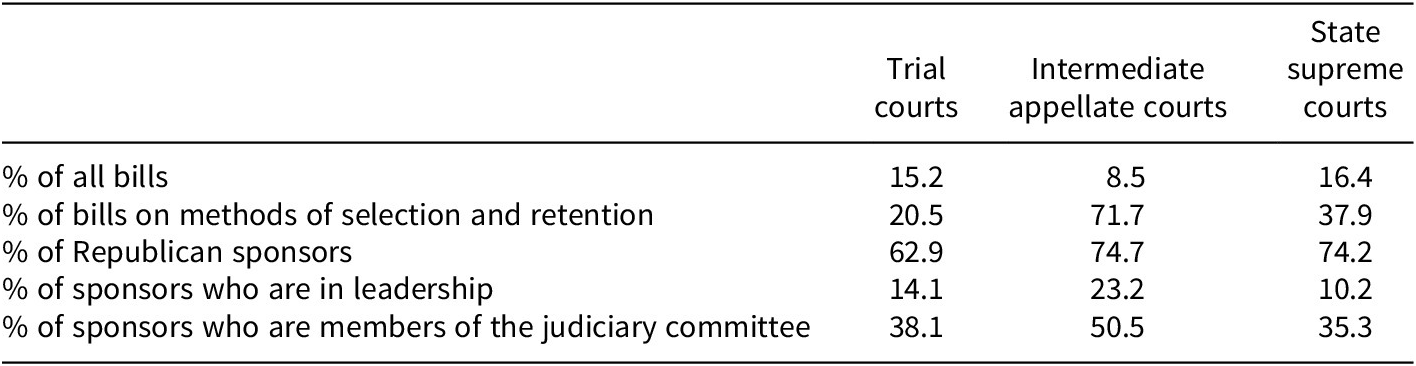
Of the bills that would target just the trial courts, 35.2% of these bills deal with issues related to the qualifications of those who sit on the court and/or their term length. This is compared to 10.7% of all bills that target qualification and terms. Another 20.5% would make changes to the methods of selection or retention for the justices (40.9% of all bills), and a further 11.6% would change the structure of the court, compared to 4.6% of all bills that would change the structure of the court. Table 2 reveals that there are some interesting differences in the bills that would target trial courts, intermediate appellate courts (including bills that would change all appellate courts), and those that target state supreme courts only. Appellate courts are also more likely to be targeted by members of the judiciary committee (and leadership, to a lesser degree) – meaning that those with presumably the most information about the court system are using their information and experience to write legislation that would alter the appellate courts. Finally, across all three courts and as expected from previous work, the great majority of sponsors for all of these bills are Republicans.
Descriptive statistics

Note. The bills in this table are sourced from the Leonard (Reference Leonard2022a) database and the Gavel-to-Gavel database hosted by the National Center for State Courts.
It is also important to consider whether the lower court-curbing bills in the dataset target all lower courts or target specific lower courts. For example, a bill introduced in Illinois that changes the method of selection for trial court judges in just Cook County could be a very different bill than one that changes the method of selection for all trial court judges in the state. Of the 280 bills that target lower courts, 32 bills target some or one specific court compared to all lower courts in the state. Of the 32 bills targeting specific courts, 9 of them call for the impeachment of or investigation into a specific judge. Of these nine bills, two of the bills target the same judge. When this is the case, the bill was either reintroduced or carried over from a previous session. This means there are only seven unique impeachment bills in the dataset and one bill calling for an investigation.
When a lower court-curbing bill targets specific lower courts rather than all lower courts in the state, knowing whether the sponsor of those bills represents voters in the district of the targeted court(s) may give us more insight into the drivers of introducing these bills. Of these bills, there are only three sponsors who represent the voters in the district in which the court is situated. Of the three sponsors, one Republican sponsor called for the impeachment of a judge who ran in a nonpartisan race, one Democratic sponsor called for the impeachment of a Democratic judge, and one Republican sponsor called for the impeachment of a Democratic judge. The remaining 20 bills target courts on the basis of population (e.g., a bill that impacts all trial courts serving counties with over 250,000 people) or target some but not all counties.Footnote 3 Taken together, these data suggest that lower court bills are more likely to target all lower courts compared with only those in the district that the sponsor represents. Reasons for targeting lower courts may not be motivated by idiosyncratic happenings in a sponsor’s district and may be driven by the state-level factors we account for in our theory and analysis.
Models and results
Using bill-level data nested within states encourages the use of random effects to deal with the panel data. Using a random-effects multinomial logistic regression, we measure bills that would attack all courts in the state (0), just the state supreme court (1), intermediate appellate courts (2), or trial courts (3). We also present a series of state-year models. The first two look at the presence (random-effects logit models) and count (random-effects ordered logit models) of trial court-curbing bills. The second pair of models does the same, but for bills that would attack intermediate appellate courts. For trial courts, the ordered categories are 0, 1, 2, 3, or more bills. For the intermediate appellate court, those categories are 0, 1, 2, or more bills. The random effects account for the related observations from within states.Footnote 4 The models regarding bills targeting intermediate appellate courts only include observations from the 44 states that have intermediate appellate courts.
The first independent variable we examine is ideology. We include measures of sponsor ideology and the ideology of the courts. The Leonard data include sponsor ideology for most of the bills, as well as the ideology of the Supreme Court. We expect that when the ideological distance between the sponsor and the lower court increases, they will be more likely to introduce legislation to attack the lower courts. Leonard’s data do not include a measure of lower court ideology. As far as we know, there are no formal court-level measures of lower court ideology in the states. Therefore, we need to create a measure of ideology. To do so, we use the Bonica (Reference Bonica2023) Database on Ideology, Money in Politics, and Elections (DIME) common-space scores (CFscores), which have ideology scores for a range of political actors, and select all judges indicated as state court judges. These data include appointed and elected judges and candidates for elections; therefore, we first remove any judges from the data that were candidates for a seat and lost. This gives us a list of all lower court judges in each state with a CF ideology score. Because of the lack of clear reporting across states (the data use a dichotomous indicator for those who are state lower court judges), it would be all but impossible to place each individual judge on a specific lower court. From this list of judges and their Bonica (Reference Bonica2023) DIME/CF scores, we calculate a general ideological measure for all lower court judges within each state by aggregating these judges and taking the median ideology score. In other words, our measure of lower court ideology is a measure of the median ideology of all non-highest court judges in the state.
Given the thousands of lower court judges across hundreds of lower courts in the American states, this measure may be less than perfect, but it is the best available given data limitations. From this measure, we calculate the ideological distance between the lower courts and the sponsors of the court-curbing legislation. This distance score is the independent variable of interest in our models. We also include a measure of distance between the sponsor(s) and the state’s highest court, as we use those bills that curb the state’s highest court as a comparison point. In the state-year models, we include a measure of the ideological distance between the lower court and the state legislature as an institution.
Previous work (Leonard Reference Leonard2016) finds that more professionalized legislatures introduce more court-curbing legislation and professionalism impacts legislative behavior (e.g., Jansa, Hansen, and Gray Reference Jansa, Hansen and Gray2019; Kroeger Reference Kroeger2022; Makse Reference Makse2022). We expect that professionalized legislatures would be more likely to attack lower courts as they are equipped with more resources (e.g., time and money) to draft these bills. We use the Squire Index’s measure of legislative professionalism (Squire Reference Squire2023). This is included in both the bill- and state-level models.
In our bill-level models, we use Leonard’s (Reference Leonard2022a) dataset to control for the characteristics of the bill sponsor. We indicate if a sponsor is a member of the judiciary committee. We expect that judiciary committee members will be more likely to sponsor court-curbing bills attacking the lower courts because of their deeper understanding of the court system, and legislators on the judiciary committee will likely face an easier time moving a judiciary-related bill through the legislature (Leonard Reference Leonard2022b). The judiciary committee member variable is a dichotomous variable that takes the value 1 if the sponsor is a member of the judiciary committee, and 0 otherwise. Additionally, much of the current research on court curbing in the states shows that these bills are overwhelmingly sponsored by Republican legislators (e.g. Leonard Reference Leonard2022a, Reference Leonard2024). Given this, we include an indicator of sponsor party, where 1 indicates that the sponsor is a Republican and 0 indicates a Democrat. We also expect that partisan characteristics of the legislature may affect the use of this legislation.
At the bill- and state-level models, we include a variable that accounts for the method of selection and retention for judges on the court that the bill is targeting. Research on state supreme court curbing and the methods of selection finds mixed results. However, we expect that legislators are more likely to introduce curbing measures when they cannot remove judges themselves. Given this, we use a series of dummy variables to categorize the different methods of retention, including those judges facing contestable elections, retention elections, and no election ever. Finally, at the bill and state levels, we include a variable that accounts for party competition. Here, we argue that court-curbing legislation may be about removing power from the lower courts to check the legislature. If this is the case, we may expect to see more court-curbing bills in states with less competition, as these one-party legislatures seek to increase their power relative to the courts. The variable measures the percentage of Democrats in each state’s upper house. We do not include a measure for the percentage of Democrats in each state’s lower house, too, as the variables are highly correlated.Footnote 5
To parse these court-curbing bills, we introduce a random-effects multinomial logit that compares the likelihood that a bill will curb each level of the state courts compared to legislation that would curb all courts. The results are presented in Table 3. The results are striking: no ideology or individual-level characteristics, such as being a member of the judiciary committee or a sponsor’s party, affect this decision.Footnote 6 Only the level of legislative professionalization increases the likelihood that a bill will curb the trial courts as opposed to all courts. Figure 1 shows the results for the effect of legislative professionalism on the court that the bill attacks. There is no variance for those bills that would target state high courts or intermediate appellate courts. What we see is that as a legislature gets more professional, two things happen: the probability that a court-curbing bill will attack all courts decreases, while the probability that a court-curbing bill attacks trial courts increases. In other words, more professionalized legislatures seem to have a different ability to introduce trial court-curbing legislation.
Multinomial logit: introduction of court-curbing bill attacking court level

Note. p > χ2 = 0.001; N = 828.
* p < 0.05.
** p < 0.001.
Legislative professionalism and the probability a bill will attack each court type.

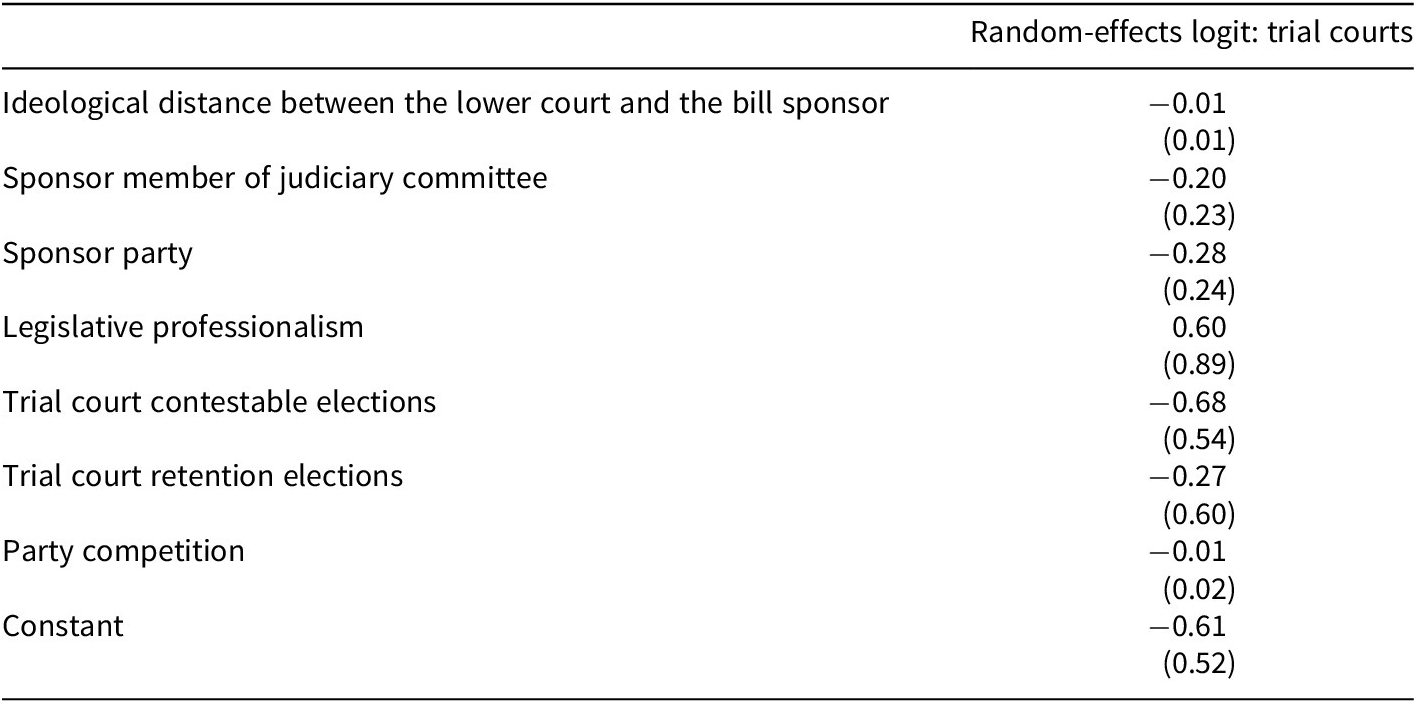
Given the existing literature on state courts of last resort that demonstrates the link between high levels of court-curbing bill activity when there is ideological divergence between legislatures and courts (Blackley Reference Blackley2019; Catalano Reference Catalano2022; Hack Reference Hack2022; Leonard Reference Leonard2016, Reference Leonard2022a, Reference Leonard2022b, Reference Leonard2024), we want to ensure that our results showing no ideological effect are not an artifact of our ideology measure. We introduce a second bill-level analysis of trial courts that employs a different measure of court-sponsor ideological distance. To create the new measure, we collected data on the democratic share of presidential votes for each bill sponsor’s district to serve as a proxy for bill sponsor ideology and the democratic share of presidential votes for each trial court or jurisdiction a bill targets to serve as a proxy for lower court ideology. We then take the difference between these measures to capture the distance between sponsor ideology and lower court ideology. The results from Table 4 provide further evidence that ideology is not a predictor of lower court curbing in our sample. Even with a different ideology measure, we find no relationship between ideological distance and court-curbing bill activity.
Bill-level trial court analysis

Note. p > χ2 = 0.000; N = 663.
* p < 0.05.
** p < 0.001.
We now turn to a state-year analysis to ensure that our conclusions are not an artifact of our modeling strategy. We include models of state-year introductions of trial and intermediate appellate court-curbing bills. The first models in Table 5 account for the number of bills introduced. However, because there are rarely more than three bills introduced in a state-year, we use random-effects ordered logit models to categorize these introductions. Second, we include random-effects logit models for the introduction of any court-curbing bill against a trial court or intermediate appellate court in a state-year.
State-year models of the count and presences of court-curbing legislation

Note. p > χ2 = 0.001.
* p < 0.05.
** p < 0.001.
The state-year modeling strategy first confirms what we learned from the previous results. More professionalized legislatures are significantly more likely to introduce legislation that attempts to curb trial courts. Over the measure of professionalization, this likelihood increases from 0.276 for the least professional legislatures to 0.653 for the most professionalized legislatures, which is an increase of 0.377. The most professionalized legislatures are almost 40% more likely to introduce legislation that curbs trial courts in a state-year. We also find, across both state-year models, that when at least one house is controlled by Republicans, the likelihood of an increase in the number of trial court-curbing bills and the presence of this legislation increases. The effect of this is smaller than legislative professionalization, where the likelihood of a trial court-curbing bill being introduced increases by 0.166 when the Republicans control at least one house. While we do find a small role for partisan control, there is again no role for ideology in explaining the introduction of lower court-curbing legislation.
The second set of models demonstrates that nothing significantly predicts the introduction of bills that curb intermediate appellate courts. Given that trial courts process an overwhelming majority of state cases and intermediate appellate courts are generally considered less visible than state supreme courts, legislators may center their focus on trial courts compared to intermediate appellate courts when drafting this legislation to have the greatest impact possible on shaping the lower courts. It could also be the case that court-curbing bills targeting intermediate appellate courts get wrapped in with the bills targeting state supreme courts as the appellate courts in the state.
There may be a question about whether some of the bills in our analysis are a result of chief justice requests. In most states, chief justices of state courts of last resort will advocate for reforms on behalf of the judiciary in their state of the judiciary addresses to their state legislatures (Vining and Wilhelm Reference Vining and Wilhelm2023; Wilhelm et al. Reference Wilhelm, Vining, Boldt and Black2020). We know that judicial reforms requested by chief justices are more likely to be acted upon by legislatures in states where the state legislatures and their judicial counterparts are more ideologically similar (Wilhelm et al. Reference Wilhelm, Vining, Boldt and Black2020). To assess the prevalence of legislators responding to chief justice requests in the court-curbing bills we use here, we went through Wilhelm et al.’s (Reference Wilhelm, Vining, Boldt and Black2020) dataset on chief justice speeches and attempted to match them with the court-curbing bills in this analysis. Out of almost 300 bills targeting the lower courts, we found three likely matches to chief justice requests. We believe that this provides evidence that these bills are ideas generated by the legislature.Footnote 7
Discussion and conclusion
This article examines court-curbing legislation that targets lower state courts. To open this article, we discussed a Wisconsin court-curbing bill where the legislature attacked their state trial courts by passing legislation that would ensure any trial court that struck legislation as unconstitutional would see that decision automatically appealed. The Wisconsin state legislature has a professionalization score of 0.422, which is one standard deviation above the mean score, and is one of the 10 most professionalized legislatures according to the Squire (Reference Squire2023) measure. That the legislature sought to and was successful in punishing their state trial courts is in line with what we demonstrate empirically in this article. More professionalized legislatures introduce legislation that attacks state trial courts. And, though ideology does not explain this introduction, Republican-controlled legislatures introduce more trial court-curbing bills compared with Democratic-controlled legislatures. In 2013 and 2014, when the bill outlined in the introduction was moving through the legislature and was enacted into law, the Wisconsin legislature was controlled by Republicans.
Prior to this analysis, existing court curbing work focused on the US Supreme Court (Clark Reference Clark2009, Reference Clark2011; Mark and Zilis Reference Mark and Zilis2019), lower federal courts (Moyer and Key Reference Moyer and Key2018), and state courts of last resort (e.g., Blackley Reference Blackley2019; Bosworth Reference Bosworth2017; Grey Reference Grey2019; Johnson Reference Johnson2014, Reference Johnson2015; Langer Reference Langer2002). Lower state courts are important fixtures in state judicial systems, as intermediate appellate courts decide far more cases than state courts of last resort and millions of cases are filed in trial courts each year (National Center for State Courts 2019). The lack of scholarly and public attention to lower state courts belies the outsized impact that lower state courts have on individuals and democratic institutions. Our findings suggest that the determinants of court-curbing activity in this context differ to some degree from those targeting state courts of last resort and federal courts. We show that increased legislative professionalization, an institutional feature, has a significant impact on court-curbing activity, increasing attacks on state trial courts. It is likely that this introduction is not a position-taking effort by state legislators but, rather, indicates a factor in a checks and balances institutional battle. However, we find no relationship between ideology and court-curbing activity. That is, the ideological difference between the bill’s sponsor and the targeted court(s) does not impact the likelihood of bill introduction. The same is true for ideological distance between the lower courts and the legislature. This finding is surprising, given the existing evidence demonstrating that court-curbing bill activity is highest when there is ideological divergence between legislatures and courts (Blackley Reference Blackley2019; Catalano Reference Catalano2022; Hack Reference Hack2022; Leonard Reference Leonard2016, Reference Leonard2022a, Reference Leonard2022b, Reference Leonard2024).
The findings from this article open three important lines of inquiry to understand the broader implications of court curbing and judicial independence, not just in the context of the American states, but in a comparative context as well. In April 2025, the House of Representatives passed a federal trial court-curbing bill that limited the ability of federal district court judges to issue nationwide injunctions.Footnote 8 We might expect altered behavior from lower federal court judges in response. Federal trial and appellate court judges alike acknowledge that they alter their behavior in the face of serious institutional threats to the judiciary (Mark and Zilis Reference Mark and Zilis2018b). Even the most insulated part of the American judicial system, the US Supreme Court, is less likely to engage in conflicts with Congress in times of higher court-curbing activity (Clark Reference Clark2009, Reference Clark2011; Mark and Zilis Reference Mark and Zilis2019). We also know that trial judges who face the possibility of losing reelection alter their behavior in criminal and civil cases (DeAngelo and McCannon Reference DeAngelo and McCannon2020); what is less certain is the extent to which threats from legislatures can alter these trial outcomes as well.
Second, future research should further delineate the institutional factors that empower or constrain lower courts, especially at the state level, where institutions vary in ways that they cannot at the national level. While this article looks at legislative constraints on lower state courts, others have begun to study how legislatures empower their courts, mainly courts of last resort (see, e.g., Vining and Wilhelm Reference Vining and Wilhelm2023; Wilhelm et al. Reference Wilhelm, Vining, Boldt and Black2020). Others have explored executive branch-sourced constraints on their judiciaries (Grey Reference Grey2019; Johnson Reference Johnson2014, Reference Johnson2015).
Third (and related to our first two points above), our findings enter into important ongoing conversations about democratic backsliding in the United States. Courts are often seen as safeguards for democracy and individual rights. Courts in Latin America, for example, have seen some success in pushing back against executive branch-sourced “reforms” that could facilitate democratic backsliding (Gamboa, García-Holgado, and González-Ocantos Reference Gamboa, García-Holgado and González-Ocantos2024). In the United States, Leonard (Reference Leonard2024) demonstrates that heightened attacks on judicial independence are associated with other types of democratic backsliding. With increased threats or even successful court-curbing proposals, courts may find themselves facilitating the sorts of democratic backsliding they are designed to prevent (Gardbaum Reference Gardbaum2024). While the backsliding attacks or curbing of higher courts may get the public’s attention, the curbing of lower courts should not be overlooked in the separation of powers.
Supplementary material
The supplementary material for this article can be found at http://doi.org/10.1017/spq.2025.10013.
Data availability statement
Replication materials are available on SPPQ Dataverse at https://doi.org/10.7910/DVN/KOVWWO (Leonard, Munir, and Catalano 2025).
Funding statement
This research was supported by the National Science Foundation (Grant No. 1654934).
Competing interests
The authors declared no potential competing interests with respect to the research, authorship, and/or publication of this article.
Author biographies
Meghan E. Leonard is an Associate Professor in the Department of Politics and Government at Illinois State University. She studies state supreme court decision-making.
Hayley Munir is an Assistant Professor in the Department of Criminal Justice Sciences at Illinois State University. Her research primarily focuses on the institutional and political factors that influence judicial and prosecutorial decision-making in state and federal courts.
Michael Anthony Catalano is an Assistant Professor in the Department of Political Science at the University of Scranton. His research focuses on judicial independence and state courts in the United States.





 Open access

