

1. Introduction
Addressing rising inequalities and inequities, and maintaining a stable and resilient planet are two defining and interdependent challenges of our age. Recognizing that we are now in the Anthropocene, scientists, policymakers and practitioners are increasingly paying attention to securing sustainable human futures within our planetary life support system [Reference Steffen, Richardson, Rockstrom, Cornell, Fetzer, Bennett, Biggs, Carpenter, de Vries, de Wit, Folke, Gerten, Heinke, Mace, Persson, Ramanathan, Reyers and Sörlin1]. At the same time, the question of equity now needs more focused attention, recasting positive sustainable futures in the Anthropocene as ones that are also fair and just [Reference Leach, Raworth and Rockström2]. This includes the United Nations Agenda 2030, which places equity at the heart of sustainable development, not only highlighting reducing inequalities as one of 17 Sustainable Development Goals (SDGs), but also recognizing its centrality to several other goals, and pledging to ‘leave no-one behind’ [3].
Recognizing the hyper-connectivity and complexity of the Anthropocene makes clear that human and environmental systems, which have always been entwined and co-evolving despite their disciplinary disconnection in the past two centuries [Reference Fischer-Kowalski, Weisz, Haberl, Fischer-Kowalski, Krausmann and Winiwarter4], are now even more so, often in new, teleconnected and uncertain ways. The Anthropocene implies real risks of destabilizing the Earth system, undermining all attempts for equitable human development on our planet. At the same time, in the Anthropocene we are witnessing rising and globalized inequities that have far-reaching consequences for almost every aspect of our lives, and our ability to achieve other goals, including sustainable human futures [Reference Wilkinson and Pickett5,6]. Unlike other concepts that have highlighted the impact of human pressures on the environment, the Anthropocene describes a state change in the Earth system, viewed as an interdependent, co-evolving social–ecological system [Reference Brondizio, O'Brien, Bai, Biermann, Steffen, Berkhout, Cudennec, Lemos, Wolfe, Palma-Oliveira and Chenk7], as well as a new set of ways of thinking about our recent and current epoch [Reference Bonneuil and Fressoz8]. Anthropocene thinking takes us away from reductionist linear cause–effect analysis of equity and sustainability, to underline the fully intertwined character of human and ecological systems, and the co-evolving fates of sustainability and equity [Reference Kallis and Norgaard9–Reference Folke, Biggs, Norstrom, Reyers and Rockstrom11].
While there is already much attention to the twin challenges of sustainability and equity, there is remarkably little systematic work to address their interlinkages. Some existing work addresses the interactions between inequality and unsustainability [Reference Duraiappah12–Reference Spratt16]; and numerous case studies attest to their importance (e.g. [Reference Narain17,Reference Jafry, Chinsinga, Zimba and Scanlon18]). However, the interlinkages between equity and sustainability need deeper and broader interdisciplinary analysis and understanding (e.g. [Reference Oxfam19]), as well as new concepts, approaches and agendas better suited to the intertwined complexity of the Anthropocene.
This paper offers the outline of a new conceptual framework and some key building blocks towards an agenda that deeply connects equity and sustainability, essentially asking ‘what are the dynamics of equitable sustainability’? It begins by introducing some central concepts and emerging debates in understandings of sustainability and equity, including offering a new synthetic framework for equity's multiple forms. It then proposes a new perspective on the interlinked fates of sustainability and equity and explores alternative ways in which they can be seen to be dynamically interacting in complex, coupled social–ecological systems (SES), in pathways which over time head towards or away from ‘equitable sustainability’. We end by using this foundation of intertwined equitable sustainability to outline some transformative pathways towards fair and sustainable futures in the Anthropocene, and a research agenda that could contribute to extending these initial framing thoughts.
2. Conceptualizing equity and sustainability
The concepts of sustainability and of equity have both been the subject of vast literatures extending back over many decades. Both past and present, how they are defined and used has depended on discipline and context. While acknowledging this depth and richness of debate that cannot be addressed in a short paper, it is worth outlining some fundamental concepts and recent developments, which are critical to developing a more integrated framework and an agenda for understanding their dynamic interactions.
2.1. Sustainability
The terms ‘sustainability’ and ‘sustainable development’ have been in use since the 1970s [Reference Meadows, Meadows, Randers and Behrens20] with increasing focus in policy circles since the Brundtland Commission [21] and the World Summit on Sustainable Development [22], recently becoming recognized as an interdisciplinary research discipline: Sustainability Science [Reference Kates23]. Despite, or perhaps because of, this long interdisciplinary history, the terms are interpreted in diverse ways by different groups.
We find it useful here to differentiate between ‘sustainable development’ as a process and ‘sustainability’ as an outcome or property. We further highlight that sustainability is a wider concept than environmental sustainability, recognizing that the term ‘sustainability’ has evolved from its earlier focus on environmental or natural resource limits on growth or development, to a broader vision of sustainability as three interdependent pillars of environmental, social and economic dimensions [22,24].
A social–ecological systems perspective on sustainability would suggest an even more integrated and dynamic vision of these three dimensions, moving towards the notion of society (including the economy) and ecosystems as inseparable and co-evolving (e.g. [Reference Leach, Raworth and Rockström2,Reference Kallis and Norgaard9,Reference Folke, Biggs, Norstrom, Reyers and Rockstrom11]). Recognizing that social–ecological systems act as strongly coupled, complex and integrated [Reference Liu, Dietz, Carpenter, Alberti, Folke, Moran, Pell, Deadman, Kratz, Lubchenco, Ostrom, Ouyang, Provencher, Redman, Schneider and Taylor25], this perspective focuses on sustainability of the whole dynamic social–ecological system over time [Reference Ostrom26].
Beyond acknowledging social, ecological and social–ecological dimensions of sustainability, such a SES perspective also makes clear a shift away from the notion of sustainability as an equilibrium state or an environmental/social end point to an acknowledgement of variability and system dynamics. In this SES perspective, sustainability is not achieved through interventions which aim to decrease variance in order to achieve system stability and predictability; in fact, research has shown that variance, within certain bounds, can prevent systems moving out of the desired system configuration in the long term [Reference Carpenter, Brock, Folke, van Nes and Scheffer27]. The concept of dynamic sustainability suggests the management of the whole system, its elements and their relationships with one another, within a specified range of variability – a multi-dimensional envelope of acceptable variation. This specified or desired range is bounded by multiple social, ecological and social–ecological thresholds beyond which the system would risk undesirable and often irreversible change (Figure 1). This is similar to the notion of planetary boundaries, social foundations or safe and just operating spaces [Reference Steffen, Richardson, Rockstrom, Cornell, Fetzer, Bennett, Biggs, Carpenter, de Vries, de Wit, Folke, Gerten, Heinke, Mace, Persson, Ramanathan, Reyers and Sörlin1,Reference Carpenter, Brock, Folke, van Nes and Scheffer27,Reference Raworth28], but offers a more coupled and context-specific perspective on systems and thresholds.
A schematic representation of a social–ecological systems perspective on sustainability showing systems variation across multiple social and ecological dimensions, but staying within a desirable and meaningful life support zone. In this figure, the dimensions are notional and situational, to be determined by scale or context. The set of sustainable development goals can be seen as an example of a possible set of dimensions at a global scale with which to define such a multidimensional social–ecological space, where the targets reflect positions along those dimensions which define the acceptable zone within which system states can vary. Adapted from Biggs and Rogers [Reference Biggs, Rogers, Du Toit, Rogers and Biggs30].
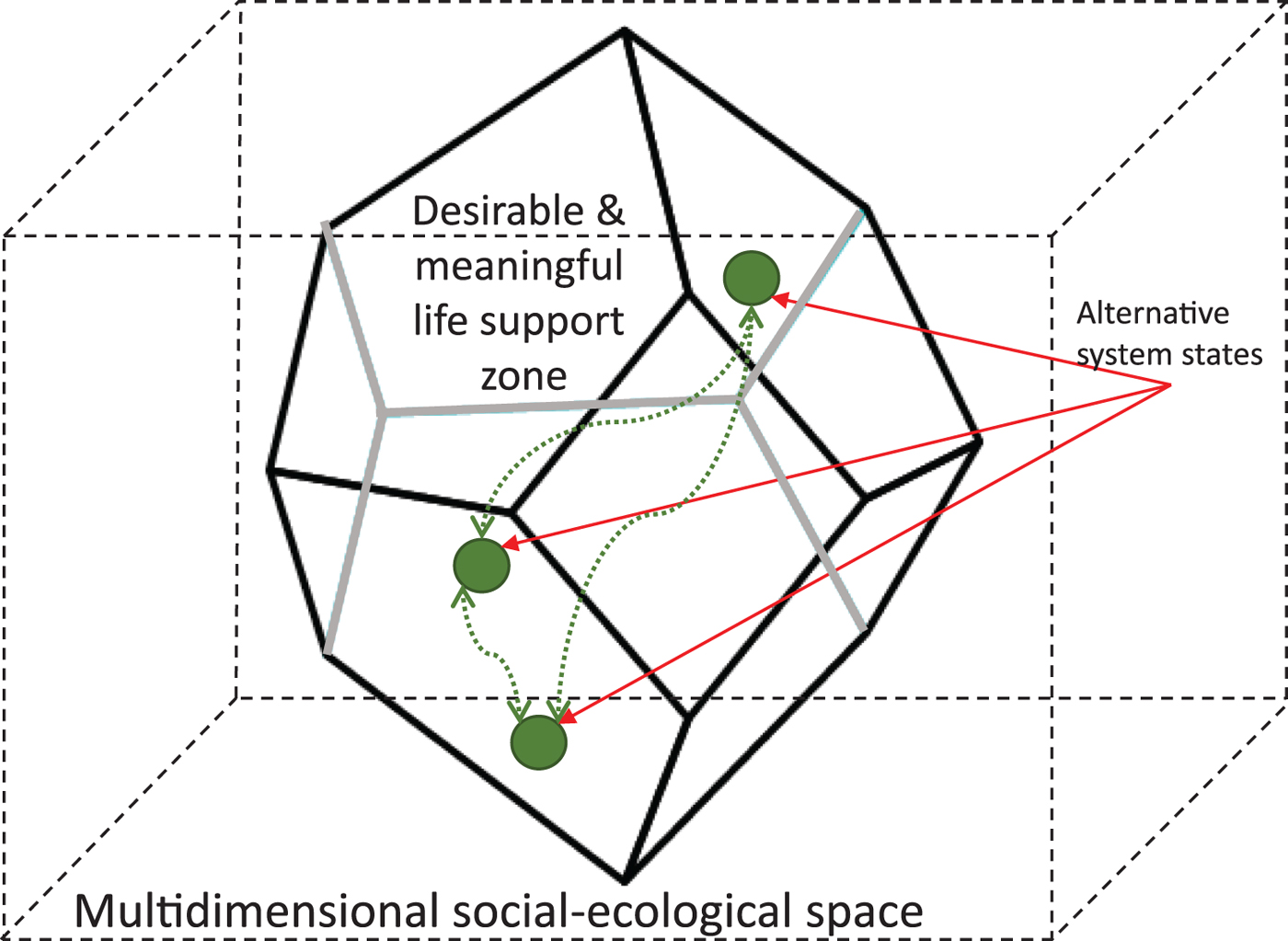
The SES perspective on sustainability proposes the bringing together of the sustainability of biophysical life support systems with the recognition that these support systems are not just biophysical, but are in fact coupled systems of local and cross-scale interconnections of people, place and environment. Such recognition broadens sustainability to focus on the long-term maintenance of desirable and meaningful life support systems which are biophysically, culturally and socially determined. Hereafter in this paper such a SES perspective on sustainability is adopted and thus references to sustainability imply this perspective. Often conflated with sustainability, resilience is, instead, key to helping the system stay in this desirable ‘zone of sustainability’ through the cultivation of social and ecological capacities needed to absorb or adapt to shocks and stressors to stay in the zone, as well as capacities needed to transform or reconfigure the system into a new desirable zone should social, ecological or economic circumstances become unsustainable [Reference Folke, Carpenter, Walker, Scheffer, Chapin and Rockstrom29].
While intuitively compelling, adopting this dynamic perspective on sustainability as a desirable zone or range of variation brings with it enormous challenges for implementation. While certain thresholds may be universal (e.g. basic income, air pollution standards) or global (e.g. climate or biodiversity status), others are often context and value specific, and may be contested (e.g., dietary needs, species numbers or education levels). Thus, we need to ask – desirability of what for whom? And who decides? – recognizing sustainability as a plural and politicized concept [Reference Leach, Scoones, Leach and Newell31,Reference Leach, Scoones and Stirling32]. Furthermore, many of the thresholds themselves are dynamic and linked through feedbacks across scales of space and time. The SDGs provide an approach to this through goals and targets which can be seen as a set of politically-negotiated thresholds outlining the desirable and meaningful life support zone to be sustained, at least at the global level (Figure 1). SDG implementation must, however, address both the interlinkages amongst the various goals and targets, and the challenges of grounding internationally-negotiated thresholds in diverse national and local contexts. Previous work on thresholds of desirable life support systems have not explored the social processes of defining desirability in depth. While ‘social equity’ (and gender equality) figure as part of the social foundations for a safe and just operating space [Reference Raworth28], there has been little attempt to unpack the various dimensions of equity, nor to relate them systematically to sustainability. Our next two sections lay out key elements of a framework for doing this.
2.2. Equity
Like sustainability, equity is a plural and politicized concept. Envisaging an equitable Anthropocene requires that the desirable zone or range of variation in which SES move over time is also bounded by acceptable notions of equity. Defining such zones requires attention to equity as a moral and political concept, recognizing that what is acceptable will vary between societies and over time. Integrating equity with sustainability requires attention to multiple forms of equity, asking ‘equity of what’ and ‘equity between whom’. It then requires consideration of how changes in SES are shaped by different forms of equity or inequity, both as inputs to a particular system intervention or change, and as emergent outcomes from the system which then provide the conditions for subsequent changes.
The concept of equity has a long and deep history in social science literature, addressed through numerous disciplinary and philosophical traditions rooted in the common dignity and transcendence of the human person and associated human rights. Looking across these, some key distinctions emerge. First is that between equity and equality. While often treated as synonyms, equality strictly refers to treating everyone in the same way, or evenly distributing a given ‘pie’. By contrast, equity refers to ensuring that everyone has what they need for wellbeing in a given context, implying ‘more for those who need it’. Equity is our preferred term in this paper. It refers more fully to fairness and justice, acknowledging that these have both material dimensions – fairness in means and capabilities for a worthwhile life – and moral ones – treating or representing someone or something with due fairness, respect or appreciation [Reference Sen33]. What is deemed equitable or fair is shaped by what is seen to be a ‘good society’, and this can vary across cultures and over time. We need to appreciate this variability in what is acceptable, while also acknowledging in a globally-collective sense (perhaps as currently and normatively defined in part by Agenda 2030) that extreme forms of inequity are intolerable, and incompatible with a fair and sustainable Anthropocene.
Recently, wide-ranging surveys of literature and examples from multiple disciplines and countries have been brought together in the World Social Science Report ‘Challenging inequalities: pathways to a just world’ [6]. The report uses the term ‘inequality’ broadly to cover dimensions of both inequity and inequality, as defined more specifically in the report's particular contributions. Economic inequalities have dominated most analyses past and present, and important recent works address the dimensions, trends, causes and consequences of economic inequalities, both globally (e.g. [Reference Milanovic34,Reference Bourguignon35]) and within countries (e.g. [Reference Deaton36,Reference Piketty37]), addressing why they have in most cases been rising over recent decades. Yet, as traditions of work in sociology, philosophy, anthropology, political science, environmental justice, feminist analysis and diverse applied fields have long argued, the forms of inequality and inequity that matter are not just economic; multiple forms need to be considered. All are relevant to conceptualizing a fair and sustainable Anthropocene. Indeed, we can argue that acceptable SES change (e.g. Figure 1) needs to be bounded by acceptable standards of the multiple forms of equity.
Figure 2 offers a summary of the multiple forms of equity. First, this addresses ‘equity of what’. Building on analysis in the World Social Science Report, and referencing only key examples from much larger literatures, the ‘what’ includes: economic incomes, assets, wealth and capital, living standards and employment [Reference Piketty37,Reference Belser38]; social status, rights, and experiences with respect to education, health, justice and social protection systems [Reference Starfield39]; cultural freedoms and abilities to hold and practise beliefs and identities [Reference Almeida, Hernandez-Wolfe and Tubbs40]; political capacities to influence decision-making processes and to benefit from those decisions, and to enter into political action [Reference Gaventa and Martorano41]; spatial attributes of where people live, and how different places and geographies are accorded status, value and attention [Reference Knight and Song42]; environmental endowments and entitlements, including access to natural resources and benefits from their exploitation, exposure to pollution and risks, and agency to adapt to such threats [Reference Leach, Mearns and Scoones43–Reference Agyeman, Bullard and Evans45]; and, knowledge – referring to access and contribution to different sources and types of knowledge, and the extent to which people's knowledge and cognitive systems have value and legitimacy [Reference Visvanathan, Leach, Scoones and Wynne46].
A schematic summary of different forms of equity, distinguishing between ‘equity of what’ and ‘equity between whom’, within an overarching typology of distributional, recognitional and procedural equity.
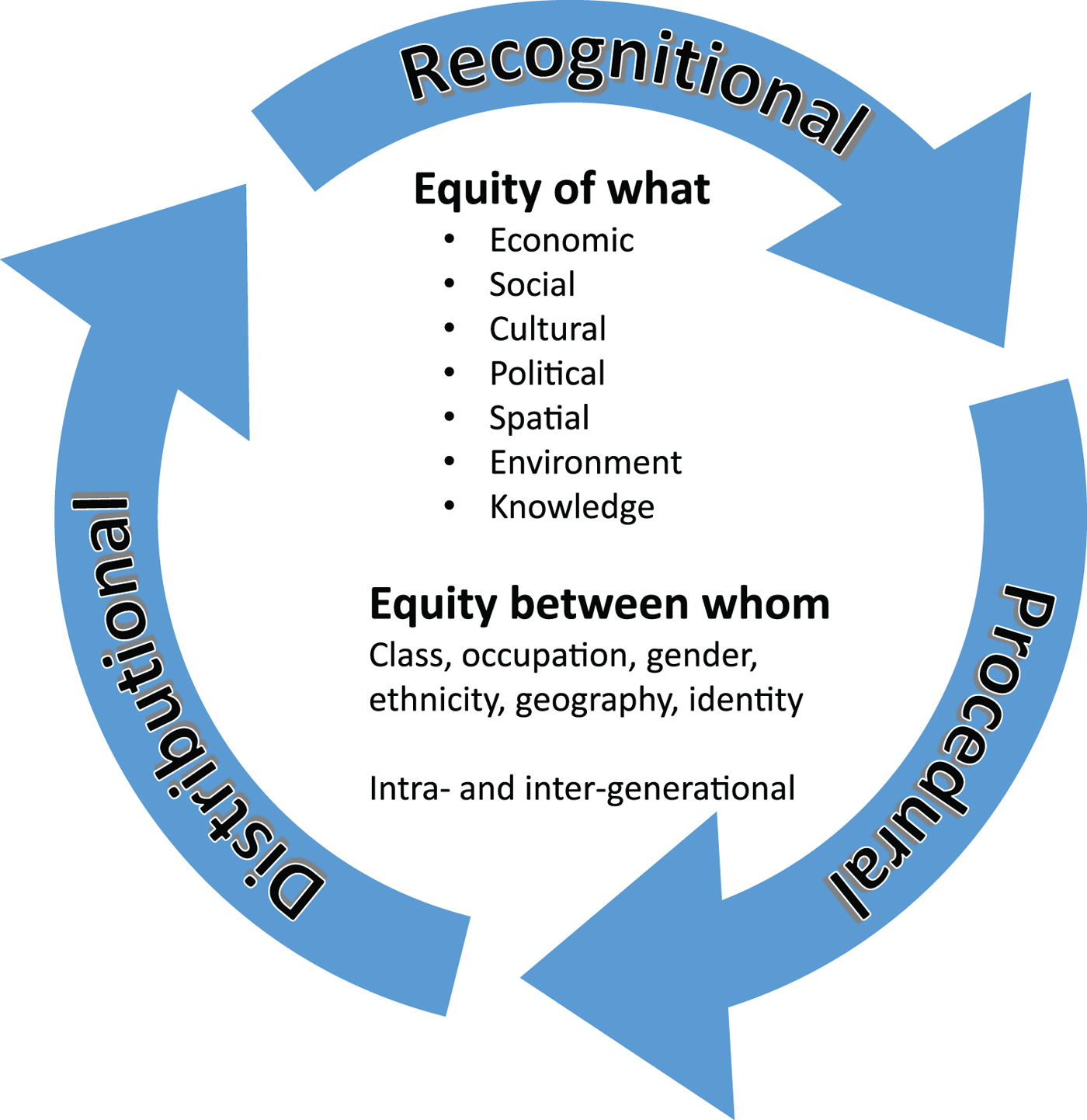
Second, our summary addresses ‘equity between whom’. This refers to how disparities (with respect to any of the ‘whats’ considered above) are distributed and experienced between individuals and groups, according to various dimensions of difference. These include class, occupation, gender, ethnicity, space/place, and other contextual aspects of status and identity (e.g. related to ability/disability; language; educational achievement; sexual identity). Such disparities might apply both in the present (intragenerational equity) and between social groups living in the present and those in the future, including as yet unborn (intergenerational equity).
Questions of ‘equity between whom’ also apply at different scales, according to differences amongst individuals or groups within a community, a locality, country or globally. Thus, disparities relating to space/place might pertain, for instance, to groups living in different parts of a city, relatively better or worse endowed with infrastructure or services [Reference Bai, Brondizio, Bullard, Edwards, Grimm, Lora-Wainwright, Özkaynak, Schindler, Lele, Brondizio, Byrne, Mace and Martinez-Alier44,Reference Bullard and Johnson47]. Within a country, they might relate to disparities between urban and rural areas, or those with different geographical conditions (coastal or mountainous areas, or rainfall or agro-ecological zones) [Reference Knight and Song42,Reference Deng and Bai48]. Globally, they might be linked to position in global geo-political orders, relative national resource endowments, or experience of global processes and risks such as climate change.
Importantly, these various forms of inequity (of what and between whom) intersect with one another, creating disadvantage or privilege in complex ways – as for instance economic, ethnic, spatial and gender inequities interact to affect people's experiences [Reference Kabeer49]. Downward spirals of intersecting inequities can, in turn, affect people's self perceptions, limiting their capacities to aspire to a different way of life [Reference Appadurai50,Reference Baillergeau and Duyvendak51]. And, indeed, all of the inequities in one generation can shape those in subsequent generations, as parental and community experiences affect the next generation's access to resources, status and aspirations. The literature on intersecting inequalities to date has generally had a local focus, but inequities can also be envisaged to intersect at an international scale. Thus, a developing small island state might experience a combination of global economic inequity and environmental inequity linked to vulnerability to extreme climatic events and sea level rise, as well as political inequity as its national political agendas are shaped by global decision making [Reference Scobie52].
The arrows forming the outer ring of Figure 2 provide an overarching typology that distinguishes between distributional, recognitional and procedural equity. This categorization, rooted in diverse theories of justice, has been articulated most clearly by Fraser [Reference Fraser53,Reference Fraser54]. Distributional equity refers to how resources, costs and benefits are allocated or shared amongst people and groups. While this was the dominant mode of thinking about and mobilizing for justice during much of the twentieth century, Fraser [Reference Fraser53] observed a rise in what she termed the ‘struggle for recognition’ as groups mobilized under the banners of nationality, ethnicity, ‘race’, gender, and sexuality. Recognitional equity thus refers to acknowledgement of and respect for identity, values and associated rights. Recognitional equity especially emphasizes cultural and political domination and discrimination as forms of inequity and injustice. Procedural equity, a third category, draws on literatures on institutions, governance and participation to highlight how decisions are made, and the extent to which different people and groups are able to influence these or have their perspectives represented or incorporated. It relates closely to political inequity and to broader debates on power and voice, and the ways these operate through both formal and informal institutions and spaces at local, national and international scales [Reference Gaventa and Martorano41]. Knowledge inequities are a crucial aspect of procedural equity, given the ways that groups can be included or excluded from decisions based on what they know, or the extent to which their knowledge and perspectives are deemed valid or legitimate, as works on cognitive justice and knowledge democracy have explored [Reference Leach, Scoones and Wynne55].
The tripartite typology of distributional, recognitional and procedural equity has recently been applied to protected area schemes – an application that gives some insights into its possible application to wider areas of sustainable development [Reference McDermott, Mahanty and Schreckenberg56–Reference Zafra-Calvo, Pascual, Brockington, Coolsaet, Cortes-Vazquez, Gross-Camp, Palomo and Burgess59]. As these examples illustrate, distributional, recognitional and procedural inequities interact with each other as feedbacks of a given intervention. Recognitional equity (identity, values, rights) is usually best understood as an input to a given intervention; this helps set up the context in which procedural equity emerges through governance and decision making, with feedbacks to particular distributional outputs (resources, costs and benefits). In turn, distributional outputs help shape the subsequent processes of recognitional equity, and further procedural equity, and so on through successive cycles of intervention and change.
As Figure 2 suggests, our summary integrates this typology with a more discriminating consideration of ‘equity of what’ and ‘equity between whom’, acknowledging that recognition, procedure and distribution may refer to particular forms of ‘what’ and ‘whom’, or bundles of these forms, depending on the issue and context. When taken together with the potential interactions and intersections between equity and sustainability, the complex systems nature of equity and sustainability outcomes become apparent.
In the next section, we integrate this equity typology, together with our SES perspective on sustainability (Figure 1), into a framework for understanding the relationships between equity and sustainability, by considering a variety of specific ‘interaction dynamics’. To frame this discussion, however, it is also important to address broader conceptualizations of the overlap or linkages between equity and sustainability, including in the SDGs.
2.3. Sustainability and equity: exploring the overlap
Equity and equality are mentioned explicitly in two of the SDGs – Goal 10, ‘Reduce inequality in and among countries’ and Goal 5, ‘Achieve gender equality’, and in around 18 of the 169 SDG targets (Table 1), broadly in three ways:
• Equitable recognition, rights and access expressed as inputs (to economic conditions, physical conditions, such as water, sanitation, energy, infrastructure and land, and processes such as education and justice)
• Procedural aspects of equitable participation and opportunity (across gender, in law and policy, and the international trading system)
• As distributional outcomes expressed as fair sharing of benefits (of use of genetic resources, and in wages or pay)
Equity as referenced in the Sustainable Development Goals/Agenda 2030.

This table includes all references in the goals and targets to equal*, equit*, fair* (omitting uses not related to equality, and deliberately abbreviating to emphasize primary meaning where sensible; ‘fair’ actually only appears twice, both times in conjunction with ‘equitable’, and both times related to genetic resources). It is interesting to note that goals 11–14 have no mention of equity or ‘for all’.
NB. ‘for all’, and ‘paying special attention to needs of vulnerable, and women and children’ are common additional phrases that also hint at equality/equity, depending on context.
SDG, Sustainable Development Goal.
Whilst these goals and targets provide the explicit focus on equity in the SDGs, the language of inclusivity, non-discrimination, ‘leave no-one behind’ and universality (‘for all’) implies a much wider intent to achieve equitable development outcomes. Of course, the SDGs also make explicit the need for sustainability outcomes, in both the goals and targets, and in the more general aspirations of Agenda 2030. However, here we contend that this is not enough, as social–ecological system feedbacks mean that many targets will not be achieved without attention to equity and sustainability dimensions that include/overlap with but go beyond those made explicit in specific SDG targets; it is these effects with high systems influence that we argue require greater attention, assisted by a more systemic framework for understanding, identifying and addressing critical interactions.
More broadly, recognizing sustainability and equity as dual aspects of SES change raises many questions about the similarities and differences between these concepts and how much they overlap. Diverse conceptualizations are visible in different literatures, ranging along an axis where at one extreme sustainability is mostly focused on biophysical life support systems with no reference to equity, other than protecting life support systems for future generations. At the other extreme, there is total overlap: equity is conceptualized as an intrinsic part of sustainability, implying that sustainability is defined as achieving equity outcomes and vice versa. Neither of these views, we suggest, is useful: the former is normatively incompatible with the notion of a sustainable and fair Anthropocene, does not adopt a SES perspective on sustainability, and analytically misses key aspects of equity which will critically influence the biophysical life support system. The latter is normatively attractive, and aligns with broad understandings of sustainable development, including as embodied in Agenda 2030. However, when the concepts of equity and sustainability are collapsed into each other, there is little analytical space to address which aspects of equity and sustainability interact in which ways and with what outcomes, and, indeed, what interactions do not matter. Thus, our approach occupies a middle ground of substantial overlap but some separation, matching our framing of sustainability as ‘the long-term maintenance of desirable and meaningful life support systems which are biophysically, culturally and socially determined’. Thus, equity is seen as a part of defining acceptable levels of sustainability (as above), as well as equity forming a key part of achieving aspects of sustainability and vice versa. However, there may remain aspects of equity and sustainability which are not critical to each other.
In the context of this broader framing, and through our SES perspective on sustainability and multi-faceted equity typology, we now go on to explore a variety of specific ways in which sustainability and equity interact using a complex systems perspective.
3. How equity and sustainability interact
Existing literature, and illustrations from the work of researchers and practitioners from around the world, signal diverse ways in which equity and sustainability – or their converses, inequity and unsustainability – can be linked. Currently this work is diffuse and scattered: some recent reviews offer helpful syntheses (e.g. [Reference Spratt16,Reference Oxfam19,Reference Glover and Hernandez60]), but all acknowledge that these are partial, and that this is a major agenda for further research. Here we explore how a complex SES view helps clarify these; we outline some known dynamics of interaction between equity and sustainability, before asking what forms of intervention may facilitate transformation of SES towards equitable and sustainable futures.
Sustainability and equity are understood as emerging outcomes from ‘coupled systems dynamics’, a view which resolves the difficulty some authors encounter in untangling causes and consequences. Instead, these coupled ‘interaction dynamics’ can be seen as the ways SES co-develop and co-evolve [Reference Gual and Norgaard61], with particular emergent outcomes for both equity and sustainability at any point in time, that then feeds back to shape the future systems development (Figure 3). These co-developing interaction dynamics can be seen as part of pathways [Reference Leach, Raworth and Rockström2,Reference Leach, Scoones and Stirling32] which over time might head in different directions. Some might lead to outcomes which threaten aspects of equity, or sustainability, or both; others offer the prospect of remaining within what we define as a space of ‘equitable sustainability’.
Conceptual figure illustrating alternative development pathways over time and their implications for equity and sustainability. These development pathways (shown as grey arrows) involve the interactions, mutual shaping and co-development of social and ecological systems, and of the emergent outcomes for equity and sustainability that then feed back to shape the future system development. A particular pathway might lead to outcomes which threaten aspects of equity, or sustainability, or both; others offer the prospects of remaining within or returning to what we define as a space of ‘equitable sustainability’. Through efforts such as the SDGs the constant nudging of these pathways into the equitable sustainability space is highlighted. The location and size of this equitable sustainability space becomes increasingly uncertain into the future and is depicted as such. Credit for graphic: Gary Edwards, IDS.
SDG, Sustainable Development Goal; SES, social–ecological systems.
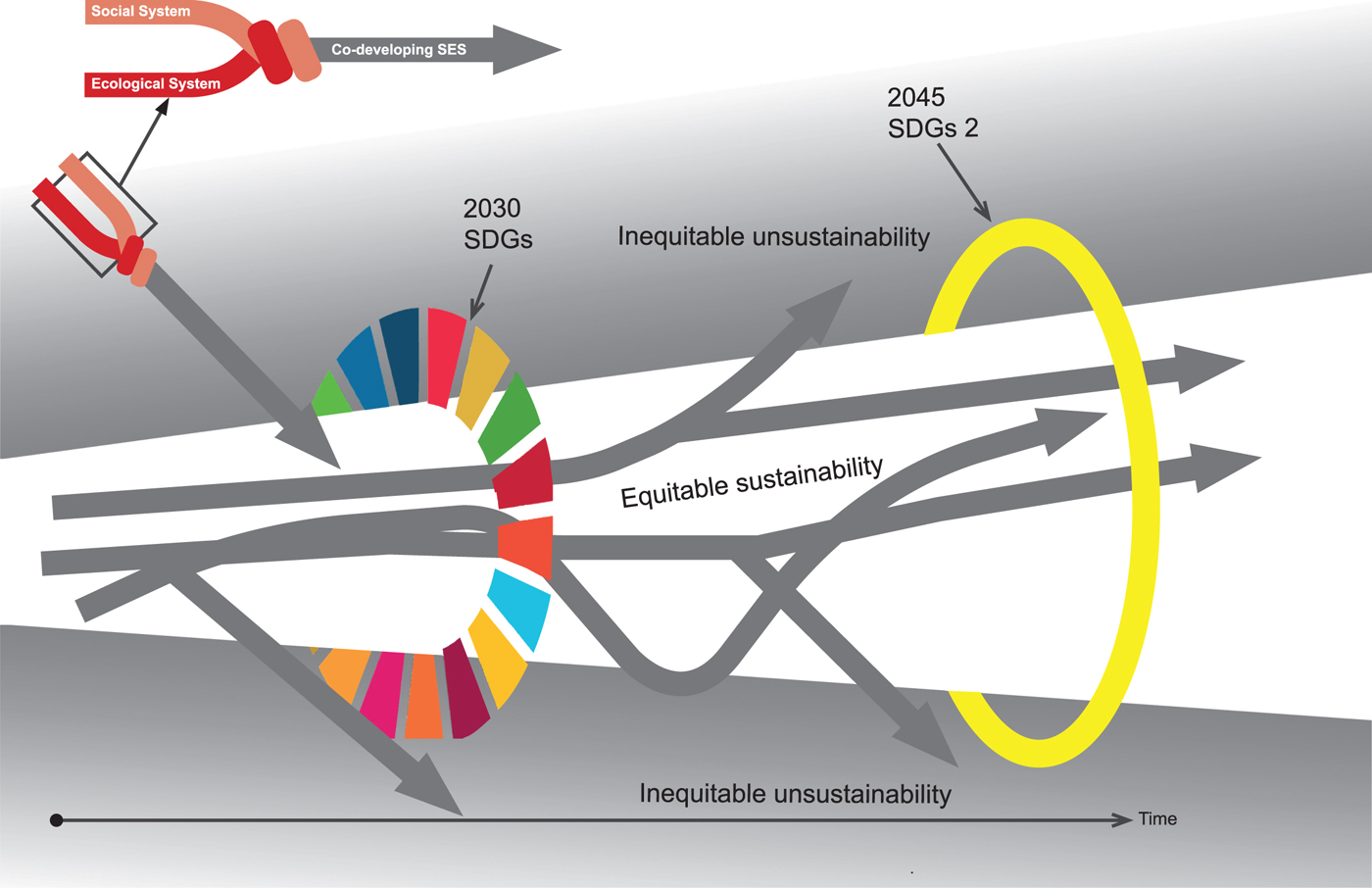
The proposed conceptual framework goes beyond current frameworks which lay out biophysical and social aspects of sustainable development [Reference Steffen, Richardson, Rockstrom, Cornell, Fetzer, Bennett, Biggs, Carpenter, de Vries, de Wit, Folke, Gerten, Heinke, Mace, Persson, Ramanathan, Reyers and Sörlin1,Reference Raworth28], where equity and sustainability are depicted as limits or foundations. In this conceptual framework, the two are intertwined outcomes and drivers of systems change.
3.1. Interaction dynamics
To demonstrate and explore this conceptual perspective, a Future Earth workshop with experts from social and natural science disciplines and practitioner backgrounds in March 2017 built on an analysis of previous reviews, the 2016 World Social Science Report [6], and individuals’ own knowledge and experience, to identify a variety of ways in which equity and sustainability could be interlinked in the context of the Anthropocene. From the workshop discussion we identified an illustrative suite of what we term ‘interaction dynamics’ in SES, which shape emergent equity and sustainability outcomes. These take a SES perspective on sustainability as a multidimensional zone and attend to the multiple forms of equity ‘of what’ and ‘between whom’, and the recognitional, procedural and distributional equity typology we outline above.
Provisionally, we identified ten different but overlapping forms of interaction dynamics to illustrate our approach and perspective. These reflect a range of empirically-observable situations, and interactions between particular (differentiated) social groups and dimensions of sustainability. The interaction dynamics involve different system structures and processes, operate at and across different levels, scales and modes of human organization and governance, and are more or less amenable to different types of intervention; our set of ten attempts to exemplify this diversity.
3.1.1. Ecological space dynamic
Globally, given biophysical boundaries to earth system function [Reference Steffen, Richardson, Rockstrom, Cornell, Fetzer, Bennett, Biggs, Carpenter, de Vries, de Wit, Folke, Gerten, Heinke, Mace, Persson, Ramanathan, Reyers and Sörlin1], the ‘ecological space’ available for growth of human activities before unacceptable thresholds are crossed is distributed inequitably – reflecting and reproducing economic, spatial, political and other inequity dimensions. This high-order interaction dynamic is most obviously significant at a global scale. It is notable in the distribution of greenhouse gas budgets [Reference Raupach, Davis, Peters, Andrew, Canadell, Ciais, Friedlingstein, Jotzo, van Vuuren and Le Quere62], the use and degradation of global biodiversity [63], biogeochemical inputs into food systems [Reference Carpenter and Bennett64], and many other resources [Reference Wackernagel, Hanscom and Lin65] among nations and population groups. Altering this dynamic by establishing a more equitable distribution of ecological space will be essential for sustainability and equity, in turn requiring recognitional and procedural equity in setting targets, incentives and standards. The interaction dynamics could also be altered by recognizing and supporting pathways that not only do not take up more ecological space, but contribute positively to earth system restoration and to buffering the global population from future change [Reference Folke, Biggs, Norstrom, Reyers and Rockstrom11,Reference Mace, Reyers, Alkemade, Biggs, Chapin, Cornell, Diaz, Jennings, Leadley, Mumby, Purvis, Schole, Seddon, Solan and Woodward66].
3.1.2. Resource distribution dynamic
Within any given context and at any particular scale, inequities and unsustainabilities are co-produced through the uneven distribution of resources between social groups (e.g. class, gender, ethnicity, location). Resource scarcities are often not problems of overall availability, but of distribution amidst social, economic, political and spatial inequities. For instance, threats to food security for growing populations reflect not just total availability of productive land and water, or total current food production, but also how these are distributed, including the dominance of unsustainable industrial production and wasteful consumption practices and behaviour. Distributional inequities in land and water access and use [63,Reference Galaz, Gars, Moberg, Nykvist and Repinski67] reflect and are linked to similar patterns in the exploitation of human capital and labour. Scarcities are often ‘manufactured’ as elites with economic and political power command and concentrate resources at the expense of others [Reference Mehta68]. Yet altering these dynamics by evening-up access to and control over natural resources can produce positive outcomes for both sustainability and equity (e.g. [Reference Steffen and Stafford Smith69]), as for instance in effective land reform programmes to small farmers or increasing gender equity through enhancing the security of women's resource access.
3.1.3. Elite dynamic
Concentration of power and resources (particularly economic wealth) in the hands of a few facilitates them polluting and degrading the environment with impunity, exacerbating inequity, influencing economies and regulations in their favour, and encouraging confidence that they will have the wealth and alternatives to escape the consequences [Reference Leach14]. Economic and political inequities intersect to produce and sustain, through feedbacks, extreme elite groupings – at different levels, whether the eight people who own as much as half of the world's population [70], the world's 2043 billionaires, or the upper-middle and politically-dominant classes of particular countries. The Anthropocene setting of a globally connected, rapidly changing planet adds further to such imbalances and their ability to ripple quickly through regions, impacting on far distant places and their equity and sustainability prospects. To break these feedbacks, examples of elite benevolence with respect to both sustainability and equity, for instance through leadership of ‘triple bottom line’ corporate practices and well-directed philanthropy, have roles to play but are limited. More fundamental challenges to elite dominance are needed, requiring greater recognitional and procedural equity in setting and implementing ‘the rules of the game’ in society, and challenging the power relations that shape them [Reference Leach14].
3.1.4. Marginalization dynamic
Environmental shocks and stresses exacerbate existing economic, social and spatial inequities and marginalization, contributing to downward spirals of impoverishment, vulnerability and environmental degradation. The impacts of climate change, pollution and toxic waste sites, or degradation of land, vegetation, water or fisheries are often distributed unevenly, according to differences of class, ethnicity, or where people live [Reference Bullard and Johnson47,Reference Martínez-Alier71]. The distribution of costs of environmental change also fall differentially between women and men, affected by gender inequities. Through feedbacks, economic, social and spatial inequities can push those at the bottom and already poor into unsustainable practices that further reduce equity and sustainability. Yet there are opportunities to reverse such feedbacks towards positive outcomes for both sustainability and equity. These can be assisted by recognitional and procedural equity to appreciate and support the agency and capacity of even highly marginalized groups, communities and even states to engage in sustainable practices, and to enforce global to national policies that prevent the rich perpetuating cycles of environmental injustice over poorer groups.
3.1.5. Status and consumption dynamic
Status hierarchies associated with economic and social inequities can drive unsustainable forms of material consumption. Economic inequity has been linked with ‘status anxiety’ and people's concerns about their relative position in social hierarchies, associated with stress and health problems, particularly mental illness [Reference Wilkinson and Pickett5]. Status anxiety has also been linked to higher and unsustainable levels of material consumption, which through feedbacks contribute to climate change and exploitative human–nature relationships [Reference Levine, Frank and Dijk72,Reference Power, Wilkinson and Pickett73]; although the whole hierarchy may be affected, the large middle part probably has most impacts in terms of total consumption to ‘keep up with the Joneses’. While examples of economically and socially equitable, low-consuming communities living sustainably exist, they are increasingly marginalized as they are connected into larger systems by globalization. Policies and action to tackle social and economic inequities directly, along with communication and production practices that enable consumers to have and make sustainable consumption choices, are therefore needed to enhance both equity and sustainability in relation to this dynamic.
3.1.6. Environmental disconnection dynamic
Current trends in urbanization and lifestyle, globally and in many countries, are reducing many people's direct reliance on and interactions with natures and the biosphere. Such environmental disconnection can intensify social inequities, for instance through feedback effects on wellbeing and mental and physical health [Reference Cumming, Buerkert, Hoffmann, Schlecht, von Cramon-Taubadel and Tscharntke74]. Spatial, economic, social and cultural recognitional inequities affect how these impacts play out, with particularly negative consequences for the poor in informal urban settings [Reference Bai, Brondizio, Bullard, Edwards, Grimm, Lora-Wainwright, Özkaynak, Schindler, Lele, Brondizio, Byrne, Mace and Martinez-Alier44]. At the same time, there is a growing disconnection of values and sustainability goals between a dominant and highly concentrated urban population, isolated from direct experience of many system changes, and poor local and indigenous populations who face negative distributional consequences of large-scale changes in land use, expansion in mining and food production systems, global conservation goals, energy production and climate change mitigation efforts [Reference Brondizio and Tourneau75]. New narratives and forms of communication that reconnect the experiences of differently-located people with each other and with the biosphere and sense of place [Reference Folke, Jansson, Rockstrom, Olsson, Carpenter, Chapin, Crapin, Daily, Danell, Ebbesson, Elmqvist, Galaz, Moberg, Nilsson, Österblom, Ostrom, Persson, Peterson, Polasky, Steffen, Walker and Westley76] have important roles to play in progress towards both greater equity and sustainability.
3.1.7. Environmental intervention dynamic
Interventions narrowly aimed at environmental conservation can lead to exclusion and dispossession for people, communities and states, undermining livelihoods and creating and intensifying economic, social, political and sometimes gender inequities. Knowledge and political inequities mean that some peoples’ or nations’ priorities and perspectives around environment and sustainability prevail over others. The result is unequal distribution of costs and benefits from interventions, which can exacerbate multiple forms of inequity, as well as unsustainability. This dynamic is seen in some conservation and protected area schemes [Reference Kohler and Brondizio77]; ‘green economy’ investments that undermine local employment [Reference Levidow78] or restructure national wealth [Reference Scobie52], and market-led forest carbon schemes associated with ‘green grabs’ that dispossess local forest users of livelihoods and resources [Reference Leach and Scoones79,Reference Fairhead, Leach and Scoones80]. Countering these negative dynamics, there is also potential for environmentally-focused interventions to promote both sustainability and equity. This requires design of participatory schemes with both equity and sustainability outcomes in focus. Recognitional and procedural equity amongst multiple groups in creating and implementing interventions is important to balancing a fair distribution of benefits and burdens between groups both horizontally, vertically and across scales.
3.1.8. Collective action dynamic
Inequities of many forms – social, economic, political, cultural, spatial, environmental, and knowledge – can compromise sustainability by making cooperation more difficult. Collective, cooperative institutional arrangements are required to manage public goods and common pool resources at different scales. Effective local regimes to manage common property resources such as forests or fisheries have often been undermined by class differences or group-based inequities [Reference Ostrom81]. Globally, inequities between countries have compromised cooperation on challenges such as climate and biodiversity change. Nationally, inequitable societies may be less able to address sustainability challenges as their ability to form a common commitment or compact for change is compromised [Reference Wilkinson, Pickett and De Vogli82]. Forging or rebuilding collective action can bring positive outcomes for both sustainability and also equity – as for instance where uniting to address a common sustainability challenge in a local urban or rural project or national or transnational social movement offers an aspirational exemplar of solidarity across social, cultural and class difference, and towards more ways of living based on better recognitional and procedural equity. This in turn requires goal-oriented design of institutions and practices, and political intent to enable collective action and solidarities to flourish.
3.1.9. Market capitalism dynamic
Fundamentally, common drivers of both inequity and unsustainability lie in the workings of a global capitalist system and its recent neo-liberal and financialized incarnations [Reference Piketty37]. Common structures and processes including deregulated markets and profit-oriented behaviour by individuals and firms are producing both economic inequities and environmental unsustainability [Reference Mazzucato and Jacobs83]. This broad dynamic manifests itself in numerous specific ways in particular contexts. For example, less equal societies have greater carbon emissions per dollar of GNP [Reference Power, Wilkinson and Pickett73]. The embedded lock-in of established political–economic structures mean this is a fundamentally challenging dynamic to shift. It will require active political choice and challenge, design and intent, combining regulatory and policy intervention, with the promotion of alternative sustainable and equitable economic models, including the scaling-up of community experiments. A key role may be played by social movements based on recognition and claims to procedural equity; these can pose alternatives to dominant models and challenge those in power.
3.1.10. Morality–power–knowledge dynamic
People interpret questions of equity and fairness, and sustainability and human–nature relations, within moral and ethical frames that specify what counts as good or bad. These are associated with forms of power and knowledge that are diverse, and can be contested. For instance, moralities that value ecosystems for their own sake, or value ‘multi-species’ relationships between people, plants and animals, may conflict with those privileging uniquely human purposes. Moral frames that understand human–nature relations as matters of collective or public good can conflict with those privileging private or individual rights or freedoms, as in neo-liberalism. Universalist moralities premised on a single form of truth, often cast as science, can conflict with recognition of and respect for local, historically-embedded and culturally-grounded forms of knowledge. While effective governance of SES and addressing inequity is sometimes seen to require conformity to shared moral standards, disrespect for diverse moral options can itself contribute to political and knowledge inequities, and perpetuate unsustainability, for instance when it represses alternative ways in which people interact sustainably and equitably with each other and with nature. Addressing this dynamic requires explicit intent to recognitional and procedural equity, appreciating multiple moralities and forms of knowledge and power.
The categorization of interaction dynamics above is incomplete, may be contested and will certainly vary by context. Nevertheless, these examples of interaction dynamics contain some provisional ideas about interventions that might take the social–ecological system in different directions towards equitable sustainability (Figure 3). The systems literature recognizes leverage points with different levels of effectiveness for transformation (e.g. [Reference Meadows84,Reference Abson, Fischer, Leventon, Newig, Schomerus, Vilsmaier, von Wehrden, Abernethy, Ives, Jager and Lang85]). This literature points to interventions that alter system parameters or resources as being simpler to implement but less effective in changing the whole systems than those that affect feedbacks or system design; most effective of all, but hardest to do, is to alter the system intent or values and goals [Reference Abson, Fischer, Leventon, Newig, Schomerus, Vilsmaier, von Wehrden, Abernethy, Ives, Jager and Lang85]. Exploring types and combinations of interventions needed across interactions dynamics to reconfigure or transform the system and its dynamics is an essential research frontier. Furthermore, there is great potential in considering how the different interaction dynamics may be brought together systemically to identify diverse, self-reinforcing interventions for action across multiple dynamics and multiple levels. We now turn to consider how these insights might frame future pathways and a research agenda to further develop them.
3.2. Towards transformational pathways
The interaction dynamics provide a useful lens on the central practical challenge of our time: how to reorient human–nature relations so as to enable a shift to more sustainable and equitable trajectories (Figure 3). It provides a basis from which we can start to develop a systematic approach to identifying interventions that can address the dynamics that threaten to move development outside the equitable sustainability space, and are thus less compatible with societal goals as embodied in Agenda 2030. We argue that, whilst the overall framing of Agenda 2030 certainly aims at shifting global design and intent leverage points, the SDG targets themselves are largely focused on parameters or feedbacks (sensu [Reference Abson, Fischer, Leventon, Newig, Schomerus, Vilsmaier, von Wehrden, Abernethy, Ives, Jager and Lang85]). These now need to be complemented by other entry points and approaches for influencing co-evolving systems. The analysis of these dynamics makes it clear that there is already a powerful design role in market capitalism. The environmental intervention dynamic needs to drive positive actions targeted at reducing the severity of many of the other feedbacks, at local to global scales. Both of these then require support from the collective action dynamic, which allows approaches to be tested locally but then scaled or remodelled and replicated to have global impact. Again, the design of appropriate institutions and multi-level governance regimes will be an important focus of these interventions. However, broader intent – political and societal – is also needed to enable effective design to operate and take root, especially for the market capitalism and collective action dynamics. Behind all of these actions, a shift in intent through the morality–power–knowledge dynamic is the hardest but most effective intervention to ensure the other desirable changes are deeply embedded.
Building on analysis in Part IV of the World Social Science Report [6] and on research on transformations to sustainability (e.g. [Reference Scoones, Leach and Newell86]), we can envisage such interventions contributing to ‘transformative pathways’ towards a fairer and more sustainable world. These must address the challenge of solving sustainability problems and creating conditions for good and just lives for people, today and in the future, creating the conditions to support 7.5 billion lives on Earth equitably, while strengthening the desirable and meaningful life support system. Such transformative pathways will often involve transformative alliances between different actors – governments, businesses, academia, and citizens – and new modes of governance of and by groups and regimes affecting multiple parts of the SES in dynamically evolving ways [Reference Biermann, Bai, Bondre, Broadgate, Chen, Dube, Erisman, Glaser, van der Hel, Lemos, Seitzingerm and Seton87,Reference Boas, Biermann and Kanie88].
Some approaches may be ‘top down’, involving changes in the rules of the economy, or new policy packages, that alter the market capitalism design dynamic, thus changing the outcomes of the various feedback dynamics (e.g. elite, status and consumption, and marginalization dynamics). ISSC et al. [6] document a range of measures that have proved effective in reducing inequities from local to global scales, ranging from macro-economic measures, labour and market regulation, and progressive tax regimes, to land and resource redistribution, universal health and education access, social protection measures and more accessible and effective systems of environmental justice. Further work is needed to explore the effects of such policy measures that have proven potential to reduce inequities on coupled equity–sustainability outcomes. Likewise, building on Steffen and Stafford Smith [Reference Steffen and Stafford Smith69], we might explore how policy and regulatory measures in the sustainability arena – such as those intended to address various planetary boundaries – could be shaped to bring synergies with various equity considerations through positive environmental intervention design dynamics.
‘Bottom-up’ experiments and small forms of innovation and action by citizens, businesses and local governments also have the potential to contribute to transformative pathways [Reference Bai, Roberts and Chen89–92]. These may, for instance, operate through the collective action design dynamic, or help to alter the feedbacks of the environmental disconnection dynamic. Many examples are emerging around the world of such alternatives that deliver simultaneously on greater equity and sustainability, ranging from community-based management of land, forests, fisheries or waste to collective, solidarity-based forms of economic management and sharing. Such ‘seeds’ of a more equitable and sustainable Anthropocene offer the potential to scale up and spread through networking, movements and learning [Reference Bennett, Solan, Biggs, McPhearson, Norström, Olsson, Pereira, Peterson, Raudsepp-Hearne, Biermann, Carpenter, Ellis, Hichert, Galaz, Lahsen, Milkoreit, Martin López, Nicholas, Preiser, Vince, Vervoort and Xu93].
We can therefore envisage a range of transformational pathways which offer the potential to (re-)orient within an equitable sustainability space (cf. Figure 3). These may play out in specific sectors and contexts, and will involve varying combinations of parameter, feedback, design and intent interventions, and of ‘bottom-up’ action and initiatives, with ‘top-down’ action to achieve and sustain larger impact. For change to be truly transformative, these pathways cannot simply involve ‘tweaks’ to the status quo through a new technology, or a changed market arrangement. Systemic challenges generally demand systemic responses. So they must involve changes that lead to more radical shifts in power relations, both to challenge dominant pathways and the political economies and power–knowledge relations that support them, and to appreciate and support alternatives [Reference Scoones, Leach and Newell86].
The following examples indicate the potential for such transformative change, especially arising from localized responses and alternatives in the face of equity, sustainability and development challenges. Each exemplifies a topic that could be elaborated and enriched in relation to our framework. Many further examples could be identified, in domains that relate to different SDGs and interactions between them; collecting and documenting these represents an important future research frontier.
3.2.1. Urban solidarity economies
Urban experiments in Asia [Reference Evans, Karvonen and Raven94] have emerged from the initiatives of marginalized communities in self-organized savings and credit groups, demands for land rights and benefits, and action to improve living conditions. These are exploring changes to the market capitalism dynamic at a local scale, often with women centrally involved with associated benefits for gender equity. Localized initiatives have sometimes connected through networks of learning and co-operation to create collective action impacts at larger scales, as in the cases of the Transition Towns movement and of Slum Dwellers’ International (see [Reference Leach, Scoones and Scoones91]), each now networking through 30–40 countries. Spreading such initiatives further will, however, require engaging with interaction dynamics around resource control and elite political–economic dominance that currently promote unequal, unsustainable patterns of urban development.
3.2.2. Food system transitions
Large scale transitions to more plant-based diets may occur in response to environmental, ethical and health considerations, to new metanarratives regarding the problems of meat-based diets in developed and emerging economies, as well as technological innovations and a market economy supporting the storage and transport of plant-based foods in large quantities [Reference Vinnari and Vinnari95], in some cases aligned with the proposition that ‘local food is better’ [Reference Edwards-Jones, Milà i Canals, Hounsome, Truninger, Koerber, Hounsome, Cross, York, Hospido, Plassmann, Harris, Edwards, Day, Tomos, Cowell and Jones96]. Such a transition could bring significant positive consequences for sustainability and for social, cultural and economic dimensions of equity [Reference Vinnari and Vinnari95,Reference Springmann, Godfray, Rayner and Scarborough97], but must challenge the status and consumption dynamic where meat is seen as a status food, and manage environmental disconnects. Positive impacts for some people and places – such as communities benefiting from reduced pollution, deforestation or land grabs – may also be offset by negative effects on the welfare of others such as producers and labourers in current food production systems, at least in the short term. Successful transformations to sustainable food systems therefore require addressing the dynamics of environmental interventions as they play out across local, national and global scales.
3.2.3. Climate change and migration
The principle of subsidiarity provides that where possible solutions should be provided to those closest to the problem. More and more, the victims of unequal global socio–ecological systems are taking control and responsibility for their own futures in ways that rebalance power and have implications for ethics, morality, human rights, international law and international economics. Climate migration is a response to one of the global inequities of climate change, where those directly affected become agents of their own future. Climate migrants are climate victims who are losing their rights to safe housing, to secure livelihoods and in some cases to nationhood (as Pacific islands continue to lose territory to sea level rise), suffering ecological, economic and spatial inequities. However, their displacement prompts new questions about political equity, and the legal relationships between climate right holders (the migrants) and duty holders (everyone else): what should be their immigration and legal status in new countries and towns in which they settle [Reference Tanner, Mitchell, Polack and Guenther98]? At the international level, the local actions of these migrants have prompted debates on the human rights status of climate migrants [99], and the need for a new international framework [Reference Skillington100], either under the UNFCCC [Reference Warren101] or through a widening of scope of the 1951 Refugee Convention (or a separate treaty) to afford them the same immigration and asylum rights as other migrants [Reference Biermann and Boas102–Reference Smith and McNamara105]. These debates implicate actions that could reverse the marginalization dynamics at the core of climate-related migration.
These illustrations highlight the tensions as well as positive synergies resulting from the complex SES interplays between sustainability and equity, amongst groups, across scales and intergenerationally. Transformative pathways must challenge and change human–nature interactions in several different ways, including roles and routines, resource flows, relations amongst people and networks, meaning and values, and crucially, relations of power. To bring these about requires that practical, materially-focused initiatives and actions are underpinned by moral suasion and supported by compelling narratives and forms of communication. The challenge ahead is both to provide and document compelling local examples, but also, crucially, to adapt these through learning and networking to have larger reach across scales, and to combine them with broader challenges to power relations, so as to contribute to major systemic changes and fundamental redirections in people–planet relationships.
4. Conclusion: towards a research–action agenda linking SES sustainability and equity in the Anthropocene
The dynamics that we have highlighted are deeply under-explored in research on both (in)equity and (un)sustainability. As we have argued, this is because these twin sets of issues have largely been addressed in separate literatures, not least reflecting a separation between natural sciences, and social sciences and the humanities. To rise to the fundamental challenge of creating conditions for a fair and sustainable future in the Anthropocene, a bold, transformative agenda is needed. This needs new approaches to research, integrated with action in new contracts between science and society.
Part of this agenda is conceptual – to develop further the more deeply interdisciplinary conceptual framework we have started to outline, by drawing on recent understandings of complex, dynamic SES, enriched by social science and humanities-led perspectives on power, knowledge and morality. The shift from perceiving people and nature as separate parts that occasionally interact, to seeing them as intertwined SES, across the whole planet, provides opportunities for articulating equity and sustainability within an innovative complex system framework. The Anthropocene makes this essential in our efforts to achieve equity and sustainability, recognizing that what appears equitable or sustainable now may not be universally so now and may be less so in the future. It emphasises thresholds, feedbacks, diversity, adaptive management and emergence.
Other parts of the agenda are more practical, building from this provisional analysis to ask what other interaction dynamics can be identified, how each interaction dynamic operates, what points of intervention they offer, and how they (and others not identified here) interact to create challenges and opportunities. This in turn raises policy-relevant questions across the dynamics, such as:
• Are there thresholds of equity that enhance or hamper sustainability and vice versa?
• What synergistic benefit can be gained by tackling equity and sustainability together – and in which dimensions?
• What new measures of sustainability capture dimensions of equity (and vice versa)?
• How do the various interaction dynamics relate to and interact with each other, with what sets of systemic intervention options?
• How do the multiple dimensions of equity and sustainability play out differently in different parts of the world, and across different cultural and moral spaces and spatial and temporal scales?
• How far do equitable and sustainable local systems and processes scale up and out across contexts?
• How can the earth system's available ecological space be equitably shared while considering regional differences and needs?
Conceptual work needs to iterate with empirical studies to ground and interrogate the ideas with respect to different issues – from climate change and urban development to changes in food systems, energy production and economies – and settings. Indeed a key priority is to enhance understanding of how equity/sustainability interactions are unfolding in different places, and as experienced and understood by the people living there. This includes studies with those who might be seen as at the ‘bottom’ of global inequity and unsustainability – marginalized and vulnerable people experiencing intersecting inequalities and unsustainabilities – as well as those at the ‘top’ – wealthy elites and powerful decision makers.
Drawing people's own lived experiences and expertise into such research will not only deepen understandings, but also help to address the knowledge inequities which have pervaded so much research on equity and sustainability to date, which often assumes that only accredited scientists are able to contribute to knowledge generation (see [6]). In building such transdisciplinary frameworks and communities working towards equity and sustainability in the Anthropocene, one size will not fit all; multiple inequities and unsustainabilities will require diverse forms of response, attuned to diverse contexts. There will be multiple (and changing) conceptions of what constitute good or at least acceptable futures in the Anthropocene, linked to (different perspectives on) equity and sustainability in diverse ways. Global research–action networks with regional and local embeddedness must be leveraged to identify and engage with diverse forms of knowledge and action that may take different forms in different places, but which can contribute to and help shape global-scale transformative pathways towards a fairer and more sustainable world.
Author ORCIDs
Melissa Leach 0000-0002-1293-6848
Acknowledgments
This article was originally conceptualized at a meeting of the Future Earth Science Committee in March 2017, of which nine of the authors were members at that time. Thanks are due to the Future Earth Secretariat for providing the funding and logistical support for this meeting. Thanks are also due to the whole team, as well as to Gary Edwards at the Institute of Development Studies for the graphic in Figure 3.
Author contributions
Since the abovementioned meeting the article has been developed by the authors together, acting in their personal capacities and without specific funding sources. Melissa Leach and Belinda Reyers co-led the writing, with Leach leading especially the sections on equity and interaction dynamics, and Reyers on sustainability. They co-led the development of the conceptual framework (Figure 3) with inputs from co-authors. Mark Stafford-Smith joined the lead author team at revision stage, providing substantive inputs on interaction dynamics, intervention points and the SDGs. Other authors all contributed to the initial conceptualization and have provided substantive written inputs and comments on specific sections.
Financial support
This research received no specific grant from any funding agency, commercial or not-for-profit sectors.
Conflict of interest
None.
Ethical standards
This research and article complies with Global Sustainability's publishing ethics guidelines.


 Open access

