




INTRODUCTION
Death rituals involving the burial of the deceased were unusual until the Late Mesolithic (Pettitt Reference Pettitt2011). The Mesolithic shell middens of the Tagus and Sado valleys in Portugal are remarkable because of the large number of human bodies buried in these sites. These are some of the largest and earliest burial grounds known, arranged and maintained by the last populations of hunter-gatherers in southwestern Europe (Jackes and Lubell Reference Jackes, Lubell, Gibaja, Carvalho and Chambon2012; Umbelino and Cunha Reference Umbelino, Cunha, Gibaja, Carvalho and Chambon2012; Peyroteo Stjerna Reference Peyroteo Stjerna2016a). The development of open-air burial grounds contrasts with earlier practices in the region; burial was practiced in the Iberian Peninsula, however, it was not a common treatment (Peyroteo Stjerna Reference Peyroteo Stjerna, Grünberg, Gramsch, Larsson, Orschiedt and Meller2016b).
The chronology of these burial grounds was established on typological analysis (Breuil and Zbyszewski Reference Breuil and Zbyszewski1947; Roche Reference Roche1972; Araújo Reference Araújo1997) and on several radiocarbon (14C) dates (Roche Reference Roche1957; Delibrias and Roche Reference Delibrias and Roche1965; Arnaud Reference Arnaud and Bonsall1989; Lubell et al. Reference Lubell, Jackes, Schwarcz, Knyf and Meiklejohn1994; Larsson Reference Larsson1996; Arnaud Reference Arnaud2000; Cunha and Cardoso Reference Cunha and Cardoso2001; Cunha and Umbelino Reference Cunha and Umbelino2001; Cunha et al. Reference Cunha, Cardoso, Umbelino and Larsson2003; Cunha and Cardoso Reference Cunha and Cardoso2003; Roksandic Reference Roksandic, Bicho and Carvalho2006; Meiklejohn et al. Reference Meiklejohn, Roksandic, Jackes and Lubell2009; Detry and Cardoso Reference Detry and Cardoso2010; Bicho et al. Reference Bicho, Cascalheira, Marreiros, Gonçalves, Pereira and Dias2013; Jackes et al. Reference Jackes, Alvim, Anacleto, Roksandic, Roksandic, Mendonça, Eggers, Burchell and Klokler2014; López-Dóriga et al. Reference López-Dóriga, Diniz and Arias2016; Peyroteo Stjerna Reference Peyroteo Stjerna2016a). These are generally framed within the Late Mesolithic chronology in Portugal, ca. 8300–7200 cal BP (Araújo Reference Araújo, Bicho, Detry, Price and Cunha2015), or more conservatively ca. 8150–7550 cal BP (Carvalho Reference Carvalho2009).
This study examines the chronology of the burial activity of the last hunter-gatherers in southwestern Iberia, Portugal, and contextualizes the start and end activity phases within regional environmental changes and cultural developments. The broad chronology has been established but there are several outstanding issues that this paper aims to address:
-
1. The nature and context of the 14C dates has not been systematically assessed in terms of the human activity they are supposed to date. Samples used in this study come from buried human bone only, and the reliability of the isotopic measurements is assessed.
-
2. Stable isotopes of carbon (13C) and nitrogen (15C) indicate the consumption of foods from terrestrial and marine reservoirs (Lubell et al. Reference Lubell, Jackes, Schwarcz, Knyf and Meiklejohn1994; Fontanals-Coll et al. Reference Fontanals-Coll, Subirà, Marín-Moratalla, Ruiz and Gibaja2014; Guiry et al. Reference Guiry, Hillier and Richards2015; Peyroteo Stjerna Reference Peyroteo Stjerna2016a), which may influence the calibration of 14C measurements and their chronological interpretation (Stuiver et al. Reference Stuiver, Pearson and Braziunas1986). This study applies a new approach to estimate the protein carbon contribution to diet with the Bayesian mixing model FRUITS (Fernandes et al. Reference Fernandes, Millard, Brabec, Nadeau and Grootes2014), and uses these measurements to calibrate the 14C dates with the Bayesian chronological models in OxCal (Bronk Ramsey Reference Bronk Ramsey2009).
-
3. The burial activity of the last hunter-gatherers in Portugal clusters in the Tagus and Sado valley, and the evidence for human remains outside these regions is scarce and largely undated (Peyroteo Stjerna Reference Peyroteo Stjerna, Grünberg, Gramsch, Larsson, Orschiedt and Meller2016b). This paper investigates human remains in Late Mesolithic contexts outside these river valleys and provides new 14C dates.
-
4. Hunter-gatherer and farmer relations at the onset of the Neolithic in Portugal, ca. 7450–7250 cal BP (Carvalho Reference Carvalho, Armbruester and Hegewisch2010; Martins et al. Reference Martins, Oms, Pereira, Pike, Rowsell and Zilhão2015) are poorly understood. A recent study suggested that one of the Tagus burial grounds was used simultaneously by Mesolithic and Neolithic people (Bicho et al. Reference Bicho, Cascalheira, Gonçalves, Umbelino, Rivero and André2017). This paper tests this hypothesis from a multi-site perspective by examining all human remains dated at the end boundaries of the burial activity.
The chronological analysis is based on a dataset of 76 14C dates on human bone (19 new, 57 published), excavated in Late Mesolithic contexts in Portugal. While the focus on the human burials allows the establishment of chronologies based on strong indicators of mortuary activity, other uses of the sites were not considered in this study.
ARCHAEOLOGICAL BACKGROUND
Most human remains dating to the Late Mesolithic in Portugal are in open-air shell midden sites in the valleys of two major southern rivers, the Tagus and the Sado (Peyroteo Stjerna Reference Peyroteo Stjerna, Grünberg, Gramsch, Larsson, Orschiedt and Meller2016b). The Tagus middens are located on the lower valley, ca. 80 km northeast from the river mouth in Lisbon, on the banks of three tributaries to the Tagus River: Fonte da Moça, Muge, and Magos. The sites of the Sado valley are located ca. 120 km south of Muge and ca. 80 km east from the river mouth (Figure 1). From the 13 middens identified in the Tagus valley, nine have human remains with a minimum number of individuals (MNI) of 263 (Paço Reference Paço1938; Santos et al. Reference Santos, Rolão and Marques1990; Cunha and Cardoso Reference Cunha and Cardoso2001; Cunha and Cardoso Reference Cunha and Cardoso2003; Roksandic Reference Roksandic, Bicho and Carvalho2006; Jackes and Meiklejohn Reference Jackes, Meiklejohn and Bocquet-Appel2008; Meiklejohn et al. Reference Meiklejohn, Roksandic, Jackes and Lubell2009; Bicho et al. Reference Bicho, Cascalheira, Marreiros, Gonçalves, Pereira and Dias2013). Similarly, in the Sado valley, there are 11 known middens, six of which with human burials to a total of ca. 113 individuals (Cunha and Umbelino Reference Cunha and Umbelino1997; Diniz et al. Reference Diniz, Arias, Teira, Araújo, Cubas, Neves, Nukushina, Rocha, Cerrillo-Cuenca and Fernádez Sánchez2014).
Iberian Peninsula and the location of the sites with 14C dated human remains discussed in this paper. 1) Tagus valley: Moita do Sebastião, Cabeço da Amoreira, Cabeço da Arruda, Cova da Onça; 2) Sado valley: Arapouco, Poças de S. Bento, Cabeço da Amoreira, Vale de Romeiras, Cabeço do Pez, Várzea da Mó; 3) Mira valley: Fiais; 4) Vale Boi.

Late Mesolithic human remains found outside these river valleys are rare. One tooth dating to the Late Mesolithic was excavated in an open-air site in southern Portugal (Carvalho et al. Reference Carvalho, Dean, Bicho, Figueiral, Petchey, Davis, Jackes, Lubell, Beukens and Morales2008). Skeletal remains were also found in a shell midden located in the Mira valley on the coast of Alentejo (Arnaud Reference Arnaud1988; Lubell et al. Reference Lubell, Jackes, Sheppard and Rowley-Conwy2004), and new 14C data confirm the Late Mesolithic chronology of the remains. Lastly, one skeleton excavated in the rock shelter Abrigo Grande das Bocas was interpreted as possibly Mesolithic based on the analysis of the original field notes (Bicho Reference Bicho1995). 14C measurements obtained for this study (Beta-447678) date the death of this individual to 133–330 cal CE (Table S1.1).
At the Tagus and Sado valleys, the burial of the deceased was a common way of handling the cadaver. Mortuary practices in both valleys were based on common principles indicating a shared mindset on the treatment of the dead (Peyroteo Stjerna Reference Peyroteo Stjerna2016a). There were slight variations, but these did not affect the overall pattern of the treatment of the dead. The cadavers were typically placed in individual graves, soon after death, while retaining their anatomical integrity. The bodies were normally laid on the back, with the upper limbs arranged close to the body, and with the lower limbs in flexion at various degrees, with the feet often placed towards the buttocks (Figure 2). Typically, the cadavers lay underground and undisturbed in their graves. In some instances the bones of a previous burial were partially removed to accommodate the burial of a new cadaver, indicating the continued preference of certain areas for the burial of the dead within a larger area of the site (Roche Reference Roche1972; Peyroteo Stjerna Reference Peyroteo Stjerna2016a). The relation between these burial clusters and the remaining areas of the sites remains an open question.
Human burials in the shell middens of the Tagus and Sado valleys as reconstructed in Peyroteo Stjerna (Reference Peyroteo Stjerna2016a). Drawings by Susanna Berglund.

In rare cases, burial analyses confirm the multiple nature of primary deposits containing the remains of two individuals (Roksandic and Jackes Reference Roksandic, Jackes, Roksandic, Mendonça de Souza, Eggers, Burchell and Klokler2014; Peyroteo Stjerna Reference Peyroteo Stjerna2016a). Recently, the context CAM-01-01 at Cabeço da Amoreira was referred to as a multiple burial, possibly in successive episodes, corresponding to changes in Mesolithic funerary patterns, in line with Neolithic practices (Bicho et al. Reference Bicho, Cascalheira, Marreiros, Gonçalves, Pereira and Dias2013; Bicho et al. Reference Bicho, Cascalheira, Gonçalves, Umbelino, Rivero and André2017). This interpretation is not supported by archaeological data. While CAM-01-01 contained the skeletal remains of one main individual and bone fragments of at least three others, this observation alone is not evidence of a multiple burial. The bones were distributed over an area of 2 × 2 m and excavated between 0.2–0.6 m from the surface of the shell midden. The material was heavily disturbed by recent activities, but it was possible to reconstruct the burial position of the main individual (Roksandic Reference Roksandic, Bicho and Carvalho2006). The scattering and fragmentation of the bones, as well as the lack of key observations (Duday Reference Duday2009) such as the identification of a common burial context, or the common arrangement of the remains does not allow the determination of CAM-01-01 as a multiple burial of Neolithic tradition.
These middens are also rich in faunal and botanical remains providing evidence for the consumption in situ of a varied range of food resources, terrestrial, estuarine and marine (Lentacker Reference Lentacker1986; Lentacker Reference Lentacker1994; Detry Reference Detry2007; Marques-Gabriel Reference Marques-Gabriel2015; Rowley-Conwy Reference Rowley-Conwy, Bicho, Detry, Price and Cunha2015; López-Dóriga et al. Reference López-Dóriga, Diniz and Arias2016). There is no evidence for domesticated plants or animals, except for the domestic dog (Detry and Cardoso Reference Detry and Cardoso2010; López-Dóriga et al. Reference López-Dóriga, Diniz and Arias2016). Stone tool production is also well documented for all stages of the chaîne opératoire (Araújo Reference Araújo1997; Marchand Reference Marchand2001; Nukushina Reference Nukushina2012; Diniz and Nukushina Reference Diniz and Nukushina2014; Cascalheira et al. Reference Cascalheira, Paixão, Marreiros, Pereira, Bicho, Bicho, Detry, Price and Cunha2015). The few fragments of pottery found in some areas of the sites show evidence for occasional Neolithic activity (Ferreira Reference Ferreira1974; Bicho et al. Reference Bicho, Cascalheira, Marreiros and Pereira2011; Diniz and Cubas Reference Diniz, Cubas, Bicho, Detry, Price and Cunha2015).
In southwestern Iberia, the Late Mesolithic settlement was clustered in the innermost areas of large estuaries, in contrast with the scattered pattern known for the Early Mesolithic (Araújo Reference Araújo, Bicho, Detry, Price and Cunha2015). Explanations for this reconfiguration (Zilhão Reference Zilhão2003; Bicho et al. Reference Bicho, Umbelino, Detry and Pereira2010) are based on paleoenvironmental evidence. Here, the rapid sea level rise during 12,000–7000 cal BP resulted in the drowning of the Tagus and Sado valleys creating inland sheltered seas and tidal environments several kilometers upstream (van der Schriek et al. Reference van der Schriek, Passmore, Stevenson and Rolão2007; Vis et al. Reference Vis, Kasse and Vandenberghe2008; Costa et al. Reference Costa, Freitas, Leira, Costas, Costa, Andrade, Bao, Duarte, Rodrigues and Cachão2019). Data from Muge show the rapid establishment of inner estuarine environments ca. 8050 cal BP (van der Schriek et al. Reference van der Schriek, Passmore, Stevenson and Rolão2007), although the tidal mudflat and saltmarsh conditions were settling in earlier (Vis et al. Reference Vis, Kasse and Vandenberghe2008). Research in the Sado valley indicates a similar pattern (Costa et al. Reference Costa, Freitas, Leira, Costas, Costa, Andrade, Bao, Duarte, Rodrigues and Cachão2019), and preliminary data suggest that estuarine conditions existed as early as 8500 BP (A. Costa, pers. comm.). These new ecosystems were particularly attractive not only because of their natural resources, but also because of their sheltered inland position with easy access to the interior and to the Atlantic coast through connected waterways. As the sea level rise declined, the river systems prevailed, and the estuaries began to contract. In Muge this occurred between ca. 7450–5750 cal BP and an open landscape was established around ca. 6950 cal BP, although the same rich and diverse ecological systems remained until at least ca. 5750 cal BP (van der Schriek et al. Reference van der Schriek, Passmore, Stevenson and Rolão2007). In the Sado valley, the estuarine environment and the transitional marine-fluvial habitats were still productive until ca. 3300 cal BP, at least at Arapouco (Costa et al. Reference Costa, Freitas, Leira, Costas, Costa, Andrade, Bao, Duarte, Rodrigues and Cachão2019).
MATERIALS
The analysis was based on 14C dates on buried human bone exclusively. Dates on other material are available, such as on charcoal and shells, but with few exceptions (Bicho et al. Reference Bicho, Cascalheira, Marreiros, Gonçalves, Pereira and Dias2013; Jackes et al. Reference Jackes, Lubell, Cardoso, Anacleto, Meiklejohn, Bicho, Detry, Price and Cunha2015; López-Dóriga et al. Reference López-Dóriga, Diniz and Arias2016) the context is unclear and the relationship with the burials is unknown.
A total of 76 sets of measurements of 14C and stable isotopes of 13C and 15 N were selected for analysis, corresponding to 70 individuals. This material was excavated since the 19th century from the shell middens in the Tagus valley (n = 4): Moita do Sebastião, Cabeço da Amoreira, Cabeço da Arruda, Cova da Onça; in the Sado valley (n = 6): Arapouco, Poças de S. Bento, Cabeço das Amoreiras, Vale de Romeiras, Cabeço do Pez, Várzea da Mó; in the Mira valley (n = 1): Fiais; and in the open-air site Vale Boi (Table 1).
Summary of the dataset: archaeological sites, minimum number of individuals (MNI), number of 14C dates and number of dated individuals.

Five sites in the Tagus valley with human remains but without direct 14C dates on human bone were not included in this study: Fonte da Moça 1 and 2 (fragments of bones) (Santos et al. Reference Santos, Rolão and Marques1990), Fonte do Padre Pedro (MNI = 2–3), Flor da Beira (MNI = 4–5) (Meiklejohn et al. Reference Meiklejohn, Roksandic, Jackes and Lubell2009), Cabeço dos Morros (MNI = 1) (Paço Reference Paço1938).
Moita do Sebastião is located on a low terrace, 20 m.a.s.l., on the left bank of Muge (Roche Reference Roche1972). It has excellent access and visibility towards the river and towards Cabeço da Arruda on the opposite margin. The neighboring site of Cabeço da Amoreira is ca. 700 m east. It was excavated in the 19th century (Ribeiro Reference Ribeiro1884; Paula e Oliveira Reference Paula e Oliveira1888), and in 1952–1954 after the destruction of the top layers of the shell midden which were estimated to be at ca. 2.5 m from the bottom river-terrace sands (Roche and Ferreira Reference Roche and Ferreira1967). Despite the depth of the midden, it has been suggested that possibly all skeletons were excavated from the lower layers (Jackes and Alvim Reference Jackes, Alvim, Bicho and Carvalho2006).
Cabeço da Amoreira is located 15 m.a.s.l. on the left bank of Muge, on the opposite side to Cabeço da Arruda, ca. 700 m east of Moita do Sebastião (Roche Reference Roche1965). The site was excavated in 1884–1885 (Paula e Oliveira Reference Paula e Oliveira1888), 1930–1931, 1933 (Cardoso and Rolão Reference Cardoso and Rolão2000), 1961–1964 (Roche Reference Roche1965), 2001–2003 (Roksandic Reference Roksandic, Bicho and Carvalho2006), and 2008–present (Bicho et al. Reference Bicho, Cascalheira, Marreiros, Gonçalves, Pereira and Dias2013). The shell midden has a depth of ca. 3.5 m in the central area and human remains were excavated from the top layer down to the bottom sandy layer on the base of the midden (Roksandic and Jackes Reference Roksandic, Jackes, Roksandic, Mendonça de Souza, Eggers, Burchell and Klokler2014).
Cabeço da Arruda is located on the right bank of Muge, 8 m.a.s.l., on the edge of the floodplain. The site has excellent visibility towards the river and towards Moita and Amoreira on the opposite margin. It was excavated in the 19th century (Ribeiro Reference Ribeiro1884; Paula e Oliveira Reference Paula e Oliveira1888), 1933 and 1937 (Cardoso and Rolão Reference Cardoso and Rolão2000), 1964–1965 (Roche Reference Roche1967), and in 2000 (Roksandic Reference Roksandic, Bicho and Carvalho2006). Arruda is the largest shell midden in Portugal reaching ca. 5 m in depth in the central area (Roche Reference Roche1967), with human remains excavated from various depths of the midden (Peyroteo Stjerna Reference Peyroteo Stjerna2016a).
Cova da Onça was the first shell midden discovered in Portugal, in April 1863 (Ribeiro Reference Ribeiro1884). The site is located 2 to 8 m.a.s.l. on the right bank of Magos near another midden named Cabeço dos Ossos. Both sites are destroyed. There is no documentation known for this site and the bones are stored in disarticulated state and mixed in containers without identification or stratigraphic information (Cunha and Cardoso Reference Cunha and Cardoso2003; Meiklejohn et al. Reference Meiklejohn, Roksandic, Jackes and Lubell2009; Peyroteo Stjerna Reference Peyroteo Stjerna2016a).
Arapouco is the westernmost shell midden in the Sado valley. The site is located on the left margin of the river at 47 m.a.s.l., and has excellent visibility over the valley (Diniz and Arias Reference Diniz, Arias, Almeida, Bettencourt, Moura, Monteiro-Rodrigues and Alves2012). It was excavated in 1961–1962, but there is no information about the location of the burials in the midden. According to Dario de Sousa who did the site drawings, which are missing from the site archives, all burials were in the bottom sandy layer beneath the layers with shells (Peyroteo Stjerna Reference Peyroteo Stjerna2016a).
Poças de S. Bento stands on a plateau ca. 3 km from the Sado River at 85 m.a.s.l. with no visibility towards the valley, unlike most sites (Diniz and Arias Reference Diniz, Arias, Almeida, Bettencourt, Moura, Monteiro-Rodrigues and Alves2012). The site was excavated in 1960, 1964, 1986–1988, and 2010–2017 (Arnaud Reference Arnaud and Bonsall1989; Larsson Reference Larsson1996; Arias et al. Reference Arias, Diniz, Armendáriz, Teira, Bicho, Detry, Price, Cunha and Bicho2015). All burials were identified in the basal sandy layers ca. 1.6–1.8 m deep, at the bottom of the shell midden (Peyroteo Stjerna Reference Peyroteo Stjerna2016a).
Cabeço das Amoreiras is located on the left margin of the Sado River at 52 m.a.s.l. (Diniz and Arias Reference Diniz, Arias, Almeida, Bettencourt, Moura, Monteiro-Rodrigues and Alves2012). The site was excavated in 1958, 1985–1986, and 2014–2016 (Arnaud Reference Arnaud and Bonsall1989; Diniz et al. Reference Diniz, Arias, Teira, Araújo, Cubas, Rocha, Cerrillo-Cuenca, Vallejjo and Davis2015). The human remains were excavated from the bottom sandy layer in a small area of ca. 25 m2, at depths ranging from 1.2 to 1.5 m from the top of the shell midden (Peyroteo Stjerna Reference Peyroteo Stjerna2016a).
Vale de Romeiras is located on the eastern side of the Sado valley, on the right margin of the river at 55 m.a.s.l. It has excellent visibility over the valley, Cabeço das Amoreiras on the opposite margin, and Cabeço do Pez on the neighboring hilltop (Diniz and Arias Reference Diniz, Arias, Almeida, Bettencourt, Moura, Monteiro-Rodrigues and Alves2012). The site was excavated in 1959–1960, and most burials were found lying on the bottom sand or soft bedrock at depths ranging from 0.1 to 0.84 m due to the significant erosion of the top layers of the midden (Peyroteo Stjerna Reference Peyroteo Stjerna2016a).
Cabeço do Pez is one of the largest sites in the Sado valley. It is located on the eastern part of the valley, on the right margin of the river at 52 m.a.s.l., on a hilltop next to Vale de Romeiras, with good visibility over the river (Diniz and Arias Reference Diniz, Arias, Almeida, Bettencourt, Moura, Monteiro-Rodrigues and Alves2012). It was the first shell midden discovered in the valley (Barradas Reference Barradas1936), but was excavated only 20 years later in 1956 and 1958–1959 (Peyroteo Stjerna Reference Peyroteo Stjerna2016a), as well as in 1983 and 2010 (Arnaud Reference Arnaud and Bonsall1989; Arias et al. Reference Arias, Diniz, Armendáriz, Teira, Bicho, Detry, Price, Cunha and Bicho2015). Documentation is limited but most skeletons seem to have been excavated from the sand layer and on top of the bedrock beneath the layers with shells. The two individuals identified in 1959 were excavated from a middle layer with shells 0.18–0.8 m deep (Peyroteo Stjerna Reference Peyroteo Stjerna2016a).
Várzea da Mó is located on the eastern side of the Sado valley on the right margin of the river, 8–25 m.a.s.l., but the precise location of the site is unknown (Diniz and Arias Reference Diniz, Arias, Almeida, Bettencourt, Moura, Monteiro-Rodrigues and Alves2012). It was excavated in 1959 and only one skeleton was identified. The human remains were excavated on the bottom of the shell midden at a depth of ca. 0.65 m (Peyroteo Stjerna Reference Peyroteo Stjerna2016a).
Fiais is located 10 km from the modern coast, on a high terrace of the Mira River at 100 m.a.s.l., and was excavated in 1986–1988 (Arnaud Reference Arnaud1988; Lubell et al. Reference Lubell, Jackes, Sheppard and Rowley-Conwy2004). Fragments of human bones of possibly several individuals were excavated in 1986–1987, found scattered and mixed with faunal remains. In 1988, the remains of one individual were found clustered but disarticulated in one area of the site (Arnaud Reference Arnaud1988). These remains have not been analyzed and the MNI and nature of the deposits are unknown.
Vale Boi is an open-air site located in the southern coast of Portugal, 60 m.a.s.l. The site was active during the Upper Paleolithic and Neolithic. One loose human tooth was excavated in 2004 and 14C dated to the Late Mesolithic. The nature of this isolated find is unknown, and according to the excavators, if there is a Mesolithic occupation in this site, it has not yet been found (Carvalho et al. Reference Carvalho, Dean, Bicho, Figueiral, Petchey, Davis, Jackes, Lubell, Beukens and Morales2008).
Samples collected for this study (n = 19) and respective permits were obtained from the Geological Museum/MG (Lisbon, Portugal) in the case of Cova da Onça and Cabeço da Amoreira (1962); from the Museum of Natural History and Science, University of Porto/MHNC–UP (Porto, Portugal) in the case of Cabeço da Arruda, Cabeço da Amoreira (1930s) and Moita do Sebastião; and from the National Museum of Archaeology/MNA (Lisbon, Portugal) in the case of Arapouco, Cabeço do Pez, and Fiais.
METHODS
Estimate of the Marine Carbon Contribution towards Bone Collagen
The concentration of 14C in the sea, rivers, and lakes is generally lower than that in the contemporary atmosphere due to a slower mixing rate between the chemical elements in the atmosphere and the water surface. Because of this relative lower concentration in 14C, the organisms grown in water reservoirs will variably present relatively older 14C ages, than those from coeval terrestrial environments. Thus, the foods consumed from different primary reservoirs, terrestrial or from the water systems, will determine the 14C incorporated in each archaeological sample (Stuiver et al. Reference Stuiver, Pearson and Braziunas1986). This is particularly important when calibrating 14C measurements from humans that may derive their carbon from foods of terrestrial and/or marine origin.
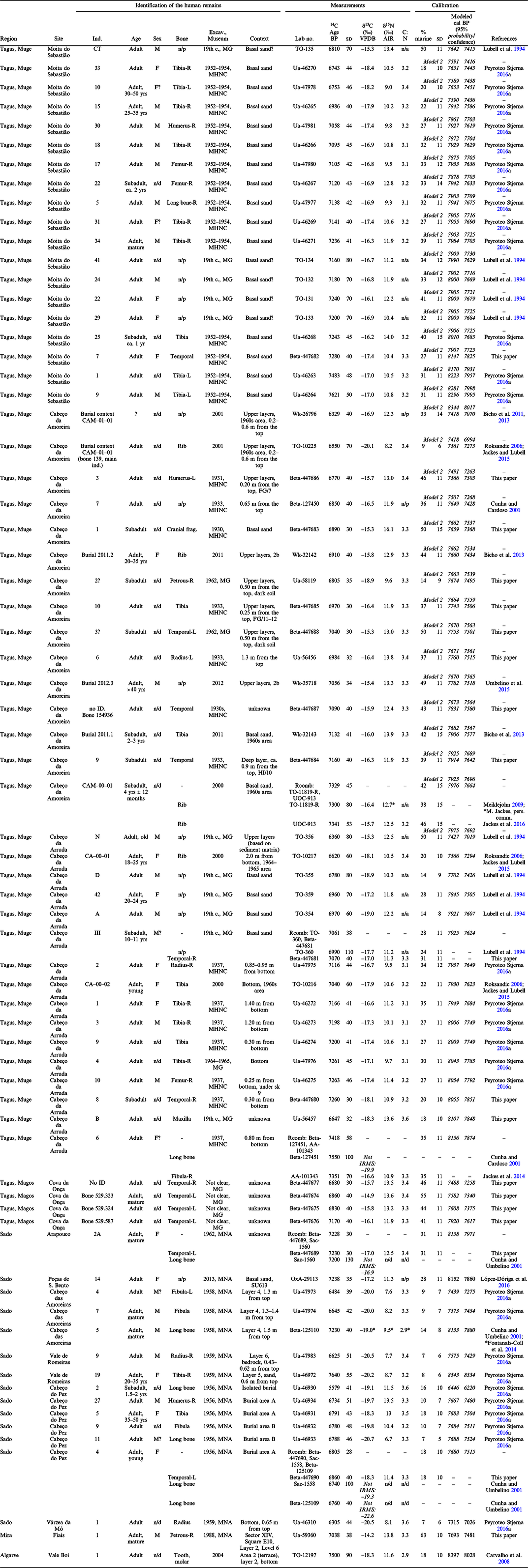
Protein carbon from marine and terrestrial sources in the specimen’s bone collagen are estimated using FRUITS 3.0 (Food Reconstruction Using Transferred Signals, Fernandes et al. Reference Fernandes, Millard, Brabec, Nadeau and Grootes2014). FRUITS introduced the Bayesian mixing model approach to diet reconstruction studies, and it is used to provide more accurate estimates of food intake using simple or complex models, depending on the nature of the data and on the archaeological question. To correct chronologies obtained from 14C dating of human bone collagen that potentially have a reservoir effect, a simple concentration-independent and non-routed model can be defined by using the measured δ13C value of each sample (Fernandes Reference Fernandes2015). This is a powerful method not only because it provides an estimate of the protein carbon from marine and terrestrial foods for each consumer, but also the associated uncertainties, which can be included in the chronological calibration. The output of the model is presented on Table 2 (% marine). See Supplementary Material (S2) for specific details on model parameters and assumptions.
Human bone collagen samples analyzed in this study: 76 samples from 70 individuals. The posterior density estimates derive from Bayesian modeling (95% probability) outlined in OxCal 4.3 (Bronk Ramsey Reference Bronk Ramsey2009). In the case of sites with one 14C date, an independent event calibration is used (95% confidence). Protein carbon contribution of marine foods towards bone collagen and associated uncertainties (% marine, sd) were estimated from the measured δ13C value and outlined in FRUITS 3.0 (Fernandes et al. Reference Fernandes, Millard, Brabec, Nadeau and Grootes2014). Abbreviations: not published (n/p), not determined (n/d), standard deviation (sd), not available (n/a) but reported to be within the accepted quality range of 2.9–3.6 (Lubell et al. Reference Lubell, Jackes, Schwarcz, Knyf and Meiklejohn1994).
Calibration and Modeling
The dataset excludes individuals with 14C measurements published without independently measured isotope-ratio mass spectrometry (IRMS) isotopic values (Table S1.2) because only IRMS-based values can be reliably used for isotopic-based environmental analysis such as reservoir corrections (Millard Reference Millard2014; Taylor and Bar-Yosef Reference Taylor and Bar-Yosef2014). The parameter collagen yield (%C, %N) was not always provided by the laboratories, and for this reason, the atomic carbon and nitrogen ratios (C:N), and δ13C and δ15N were used for quality checks. The acceptance ranges of the atomic ratio of carbon and nitrogen (C:N) are within the 2.9–3.6 range (DeNiro Reference DeNiro1985; van Klinken Reference van Klinken1999), although C:N ratios between 3.4–3.6 may indicate some contamination (Ambrose Reference Ambrose and Sandford1993). See Supplementary Material (S3) for specific details on 14C laboratory protocols.
All chronological models are defined by a Bayesian approach to the analysis and interpretation of 14C measurements in archaeological contexts (Bayliss et al. Reference Bayliss, Ramsey, van der Plicht and Whittle2007; Bayliss Reference Bayliss2009). In the case of sites with one 14C date an independent event calibration is used.
The standardized likelihoods (the dates) consist of 14C dates on human bone collagen. The proportion of protein carbon intake from marine sources is estimated by FRUITS 3.0 (Fernandes et al. Reference Fernandes, Millard, Brabec, Nadeau and Grootes2014), using the Atlantic Iberia endpoint values of –12.0‰ and –20.8‰ for marine (100%) and terrestrial (100%) diets, respectively (Cubas et al. Reference Cubas, Peyroteo-Stjerna, Fontanals-Coll, Llorente-Rodríguez, Lucquin, Craig and Colonese2018). Samples are calibrated using IntCal13 and Marine13 curves (Reimer et al. Reference Reimer, Bard, Bayliss, Beck, Blackwell, Ramsey, Buck, Cheng, Edwards and Friedrich2013), and the regional reservoir offset ca. 7000 BP: ΔRTagus = 140 ± 40 14C yr; ΔRSado= –100 ± 155 14C yr; ΔRWest Coast = 95 ± 15 14C yr; ΔRAlgarve = 69 ± 17 14C yr (Martins et al. Reference Martins, Carvalho and Monge Soares2008; Martins and Monge Soares Reference Martins and Monge Soares2013; Peyroteo Stjerna Reference Peyroteo Stjerna2016a).
The prior beliefs (the archaeology) are limited to the surviving documentation. Stratigraphic relations of the dated material are limited, and the Bayesian models are primarily defined by simply incorporating the information that the dates derived from a coherent archaeological activity (i.e., burial activity). Despite the limitations, the application of the method allows the estimate of posterior densities of the 14C measurements, which are more precise than single date estimates (Bayliss Reference Bayliss2009).
The models are outlined in OxCal 4.3 (Bronk Ramsey Reference Bronk Ramsey2009) which provides the posterior beliefs for each model and event. For this study, the most suitable kind of model is the site-based model. Site-based models are defined as phase models framed by two undated events, i.e. boundaries, for the start and end of activity. The introduction of boundaries in a model is a way to make the events relate statistically to each other by accounting for the scatter of dates due to measurement uncertainty. This approach is particularly useful when we do not have explicit archaeological data indicating a clear order of a group of elements (Bronk Ramsey Reference Bronk Ramsey1995), such as in the case of historical collections with scarce documentation. This is a reliable approach because each sample corresponds to a burial event which is part of the burial activity at the site.
Two statistical criteria produced by OxCal are used for reliability and consistency testing: the index of agreement (A) and convergence (C) (Bronk Ramsey Reference Bronk Ramsey1995). A is high (≥ 60%) when the posterior distribution is situated in a high probability region of the prior distribution. If A is low (< 60%) the result is regarded problematic, or it may indicate the presence of a statistical outlier. The overall index of agreement (Aoverall) provides a measure of the consistency between the prior information and the 14C results. Aoverall is typically ca. 100% with a threshold value of 60%, and models which produce values lower than this should be re-examined (Bronk Ramsey Reference Bronk Ramsey1995; Bayliss et al. Reference Bayliss, Ramsey, van der Plicht and Whittle2007). The index of convergence indicates how quickly the sampler algorithm can produce a representative and stable solution to the model. In practice, a model is unstable when C is poor (< 95%) and the results should not be used (Bronk Ramsey Reference Bronk Ramsey1995).
Calendar ages are reported as “cal BP” (Before Present, where Present is 1950 CE). All calibrated ranges are given at 95% probability. The calibrated ranges quoted in italics derive from mathematical modeling and are posterior density estimates. In each plot, the large square brackets and the OxCal keywords define the overall model. For each of the dates two distributions have been plotted, one in outline which is the result produced by the scientific evidence alone, and a solid one which is based on the chronological model used. Calibrated ranges of 95% and 68% probability are plotted by the lower and higher square brackets, respectively.
RESULTS: SITE-BASED CHRONOLOGY OF THE BURIAL ACTIVITY
Moita do Sebastião
Two chronological models were built on 19 14C dates, one of which is new, on skeletons from all excavation areas (Table 2). One published measurement (Beta-127449) was excluded from the models because its δ13C value was obtained by AMS (C. Umbelino, pers. comm.) (Table S1.2).
Chronological model 1 assumes one general phase of burial activity and does not impose a relative order to the dated events. The model shows good overall agreement and the agreement index for each dated event is high, except for the sample Ua-46264 (9, 1952–1954) which is in poor agreement but in good convergence (Figure 3). This sample is the earliest dated burial in the site and its greater age suggests an earlier event relatively older than the group of events in the considered phase. Its low agreement and the visual observation of the plot suggests the possibility of more than one archaeological phase of burial deposition. As a working hypothesis, and based on the visual observation of the plot, a second model is proposed, by explicitly defining three main periods of burial activity as three phases, with boundaries defined for each phase (Figure 4). Model 2 shows good overall agreement, and the agreement index for each dated event is high, indicating that the 14C dates are in accordance with the model. Sample Ua-46264 which is in poor agreement in model 1 (A = 38%, 8292–7996 cal BP) is in good agreement in model 2 (A = 62%, 8344–8017 cal BP). Nevertheless, model 2 should be considered with caution. The archaeological data is insufficient, and we know only that the burials were excavated from the basal sand layer, at the bottom of the shell midden. This is not to suggest that the burial activity could not have happened in distinct phases, but to caution against the manipulation of the data, which, without a strong archaeological basis, can be significantly misleading.
Chronological model 1 for the burial activity at Moita do Sebastião, Muge, Tagus valley.

Chronological model 2 for the burial activity at Moita do Sebastião, Muge, Tagus valley. This model is a working hypothesis because current archaeological data does not securely allow the construction of a robust second model.

Overall, the available 14C measurements can be considered representative of the burial assemblage. The chronological sequence suggests that the burial activity clustered in three chief moments, possibly discontinuously, with relatively short hiatuses between them without significant burial activity. At Moita do Sebastião the burial activity was frequent and continuous between ca. 8000–7600 cal BP (mod. 1) or 7900–7700 (mod. 2), supporting earlier suggestions of a main group of burials clustering at ca. 7800 cal BP (Jackes and Lubell Reference Jackes, Lubell, Gibaja, Carvalho and Chambon2012). Burials from all excavated areas fall into this time span, indicating that when the burial practice was more frequent, the extent of the burial area was as large as the total burial area known. The earliest mortuary activity is estimated to have been between ca. 8300–7900 cal BP, when the local estuarine environment was expanding, as indicated by burials 9, 1, and 7. The burial activity seems to end ca. 7650–7450 cal BP, while the favorable estuarine ecosystem was still predominant, as illustrated by the dates of individuals 10, 33, and CT.
Cabeço da Amoreira
Two chronological models were built on 16 14C dates, eight of which are new, on skeletons from all excavation areas (Table 2). One published measurement for individual CAM-00-01 (TO-10218) was excluded from the models because it was replaced by a reanalysis (TO-11819–R) (Meiklejohn et al. Reference Meiklejohn, Roksandic, Jackes and Lubell2009; Jackes and Lubell Reference Jackes and Lubell2015) (Table S1.2). Two 14C measurements available for CAM-00-01 (TO-11819-R and UOC-913) were calibrated using the OxCal function R_Combine and the average between the marine carbon estimates.
Chronological model 1 assumes one general phase of burial activity and does not impose a relative order to the dated events. The model shows satisfactory overall agreement and the agreement index for each dated event is high, except for the samples CAM-00-01 (TO-11819–R, UOC-913) and CAM-01-01 (Wk-26796), which are in poor agreement but in good convergence (Figure 5). These are the oldest and youngest dates available and may indicate an earlier event relatively older than the group of events in the considered phase, as well as a more recent event.
Chronological model 1 for the burial activity at Cabeço da Amoreira, Muge, Tagus valley.

Chronological model 2 tests the previously proposed 3-burial phase chronology for Cabeço da Amoreira (Bicho et al. Reference Bicho, Cascalheira, Marreiros, Gonçalves, Pereira and Dias2013), which was based on the stratigraphic sequence as documented in recent excavations, and on AMS measurements on human bone (n = 7), shells (n = 28) and charcoal (n = 1):
-
Phase 1, bottom layer: burials 2011.1 (Wk-32143) and CAM-00-01 (TO-11819–R);
-
Phase 2, upper layers: burials 2011.2 (Wk-32142) and 7, 1933 (Beta-127450);
-
Phase 3, upper layers: burial context CAM-01-01 (Wk-26796, TO-10225, and TO-10218, note that this latter measurement has been rejected, see above).
Model 2 assumes 3-phases by explicitly defining three main periods of burial activity with boundaries defined for each phase as in Bicho et al. Reference Bicho, Cascalheira, Marreiros, Gonçalves, Pereira and Dias2013. The burials newly dated (n = 8) are added to each phase by simply considering their calibrated date ranges, regardless of their known depth in the midden. At Cabeço da Amoreira, burial depth and chronology are not entirely correlated as indicated by burial 1 (1930) in the bottom sand and burial 6 (1933) at 1.3 m from the top, which cluster in time with burials excavated in the upper layers (Figure 5, Table 2). Model 2 shows good overall agreement, and the agreement index for each dated event is ≥ 60%. Samples CAM-00-01 (TO-11819-R, UOC-913) and CAM-01-01 (Wk-26796) which are in poor agreement in model 1 are in good agreement in model 2.
Both models 1 and 2 show that burial activity was more frequent and continuous than previously suggested (Peyroteo Stjerna Reference Peyroteo Stjerna2016a). However, data from the new excavations seems to indicate that the burial activity clustered in three chief moments (mod. 2), possibly discontinuously, with relatively short hiatuses without significant burial activity. While model 2 may be well resolved in the light of the new documentation for the site, it is unclear how it fits with previous archaeological data. The models are comparable at the start and end of the burial activity at the site, but without further examination of the earlier excavations the hiatuses estimated by model 2 should be considered with caution (Figure 6).
Chronological model 2 for the burial activity at Cabeço da Amoreira, Muge, Tagus valley. This 3-phase model estimates hiatuses between phases 1 and 2 of 0–235 years (95% probability) or 28–169 years (68% probability), and between phases 2 and 3 of 0–239 years (95% probability) or 0–142 years (68% probability). Without further archaeological examination of the earlier excavations these hiatuses should be considered with caution.

The earliest burial activity is estimated to have been ca. 8000–7600 cal BP (mod. 1) or ca. 8000–7700 cal BP (mod. 2, phase 1), when the favorable local estuarine environment was well established, as indicated by the burials of individuals CAM-00-01, 9 (1933), and 2011.1. Most burials cluster between ca. 7800–7400 cal BP in model 1, but in model 2, the main burial activity concentrates between ca. 7700–7550 cal BP (mod. 2, phase 2) suggesting high frequency of burial practice at the site. Burials from the upper, middle and bottom layers fall into this time span. The burial activity decreases and seems to end between ca. 7560–7070 cal BP (mod. 1), or ca. 7500–7000 cal BP (mod. 2, phase 3), as indicated by burial 3 (1931), and the individuals in context CAM-01-01. Both models show that the end of the burial activity is coeval with the gradual contraction of estuarine habitats, ca. 7450–5750 cal BP, and with the earliest Neolithic activity in Portugal, ca. 7450–7250 cal BP.
Cabeço da Arruda
The chronological model was built on 18 14C dates, three of which are new, on 16 skeletons excavated from all areas (Table 2). Two published measurements on individuals CA-00-01 (Wk-26795) and CA-00-02 (Wk-26794) were excluded from the model because were measured on dental enamel (Table S1.2). Despite improving methods, dating and calibrating measurements on enamel is problematic (Hedges et al. Reference Hedges, Lee-Thorp and Tuross1995; Hopkins et al. Reference Hopkins, Snoeck and Higham2016). Fortunately, both skeletons were also collagen dated (TO-10217 and TO-10216). Two 14C measurements available for skeleton 6 (Beta-127451 and AA-101343) were calibrated using the OxCal function R_Combine and the IRMS-based δ13C value (AA-101343). Likewise, the two 14C measurements for individual III (Beta-447681 and TO-360) were calibrated using R_Combine and the average between the marine carbon estimates.
The model assumes one general phase of burial activity and does not impose a relative order to the dated events. It shows good overall agreement, and agreement index for each dated event is high, except for skeleton N (TO-356) which is in poor agreement but in good convergence (Figure 7). This individual is the most recent burial known in the site and its younger age may suggest a later event relatively more recent than the group of events in the considered phase.
Chronological model for the burial activity at Cabeço da Arruda, Muge, Tagus valley.

A second chronological model could be proposed by defining the main phases of burial activity in relation to the documented depth of each burial. Nevertheless, the posterior density estimates in model 1 show that depth and antiquity of the burial are not always correlated. This is the case for CA-00-02 (TO-10216) found in the base of the midden. This burial in the bottom sandy layer, presents a relatively more recent 14C date than burial 6 (Beta-127451, AA-101343) which was found 0.8 m from the base of the midden, as well as more recent than individual 3 (UA-46273) at 1.2 m from the bottom. Other dated burials, however, seem to follow a vertical chronology, with individual CA-00-01 (TO-10217) at 2 m from the bottom presenting one of the most recent dates known at the site.
This is a large site with many human burials in a complex stratigraphy. Nevertheless, 14C data indicates that the different burial areas excavated in the 19th century, 1930s, and 1960s were synchronic, and can be analyzed as one series considered representative of the assemblage.
The earliest burial activity at Arruda is estimated to have been between ca. 8150–7850 cal BP, while the estuarine environment was established in the region, as indicated by the 14C dates for individual 6 (Beta-127451, AA-101343). Despite doubts expressed about the early date of this burial (Jackes and Meiklejohn Reference Jackes and Meiklejohn2004; Jackes and Lubell Reference Jackes, Lubell, Gibaja, Carvalho and Chambon2012) the new 14C date on skeleton B (Ua-56457) strengthens the case for the antiquity of these burials. This earlier activity is followed by the main period of burial, where most 14C dates cluster, indicating that burial practice was more frequent between ca. 8000–7500 cal BP. Burials excavated from all areas fall into this time span.
The only date securely attributed to the upper layers of the shell midden corresponds to the later episodes of burial activity at Arruda (TO-10217, 7566–7294 cal BP) which is good agreement with the remaining 14C measurements. Individual N (TO-356, 7427–7019 cal BP) is the latest burial known at the site. It presents a more recent date and is in poor agreement with the remaining dates available, suggesting an episode of later burial activity. Its exact location and depth are unknown, although the enveloping sediment corresponds to the characteristic matrix of the upper layers (Jackes and Lubell Reference Jackes, Lubell, Gibaja, Carvalho and Chambon2012). More dates from the upper layers could clarify this relatively later burial activity, but the only material securely identified from the upper layers was excavated in 1965 and has been mixed with the skeletons excavated in 1964 from the bottom of the midden (Peyroteo Stjerna Reference Peyroteo Stjerna2016a). The end of the activity estimated to ca. 7400–7000 cal BP is coeval with Early Neolithic activity in Portugal.
Cova da Onça
The chronological model was built on four new 14C dates (Figure 8, Table 2). One published measurement (Beta-127448) was excluded from the model because its δ13C value was obtained by AMS (C. Umbelino, pers. comm.) (Table S1.2).
Chronological model for the burial activity at Cova da Onça, Magos, Tagus valley.

Burial activity at Cova da Onça seems to be continuous, possibly with one short hiatus between the earliest and main burial activity, which should be tested with further data. Nevertheless, the current model shows good overall agreement and estimates the main activity to have been between ca. 7600–7350 cal BP, with an earlier moment at 7920–7617 cal BP, when the inner estuarine conditions were highly favorable. The later burial activity at the site, estimated at 7488–7258 cal BP, is coeval with the earliest Neolithic phases in Portugal. More dates are necessary to refine this chronology; however, the new data securely confirms the Late Mesolithic chronology of these burials.
Arapouco
Only skeleton 2A provided 14C measurements within the accepted quality ranges (Sac-1560 and Beta-447689), despite multiple attempts (Cunha and Umbelino Reference Cunha and Umbelino2001; Peyroteo Stjerna Reference Peyroteo Stjerna2016a). The 14C dates were calibrated using the OxCal function R_Combine and the IRMS-based δ13C value (Beta-447689). These measurements do not allow the construction of a chronological model for the burial activity at Arapouco but date the death of individual 2A to have been between 8158–7971 cal BP (Table 2). This is a large site with high density of human burials, and despite the poor collagen preservation further 14C measurements should be tried in the future.
Poças de S. Bento
Two individuals buried at Poças de S. Bento have been 14C measured. One measurement is from the skull excavated in 1986 (Ua-425) which reliability is uncertain because the isotopic values are not available (Table S1.2). The other measurement dates burial 14 excavated in 2013 in the area where all human remains have been found (Diniz et al. Reference Diniz, Arias, Teira, Araújo, Cubas, Neves, Nukushina, Rocha, Cerrillo-Cuenca and Fernádez Sánchez2014; López-Dóriga et al. Reference López-Dóriga, Diniz and Arias2016). The death of this individual is estimated to have been between 8152–7860 cal BP (Table 2). The construction of a chronological model for the burial activity at Poças de S. Bento requires further 14C dates on human bone.
Cabeço das Amoreiras
The chronological model was built on three 14C dates (Figure 9). The measurement Beta-125110 was calibrated with the recently published IRMS-based δ13C value (Table 2). Despite the low number of dates this model can be considered representative of the assemblage, because the six burials from this site were found in one stratigraphic layer and lie in proximity (Peyroteo Stjerna Reference Peyroteo Stjerna2016a). These burials were expected to be coeval, however, the model suggests that the burial episodes were spread over time. Despite the scattering, all dates introduced in the model show good agreement and the model did not consider any outliers. The earliest burial (5, Beta-125110) is estimated to have been between 8153–7880 cal BP, while the most recent use of the site for burial practice is dated several centuries later, 7439–7275 cal BP (4, Ua-47973). At Cabeço das Amoreiras, burials were not frequent, but the practice continued over a long period of time.
Chronological model for the burial activity at Cabeço das Amoreiras, Sado valley.

Vale de Romeiras
Only three skeletons out of 15 provided 14C measurements within the accepted quality ranges (Cunha et al. Reference Cunha, Umbelino and Cardoso2002; Peyroteo Stjerna Reference Peyroteo Stjerna2016a). Furthermore, the chronological model is limited to two 14C dates (Figure 10, Table 2), because one of the skeletons (8, Ua-46968) has a surprising modern age and is out of the scope of this study (Table S1.1). This is a small number of reliable measurements compared with the MNI (26) buried in the site. Although new measurements should be tried in the future, this preliminary model provides valuable indications about the burial activity at Romeiras. The earliest period is estimated to have been between 8543–8334 cal BP, as indicated by the burial of individual 19 (Ua-46972) found on the basal sand outside the shell midden area (Peyroteo Stjerna Reference Peyroteo Stjerna2016a). The second date (9, Ua-47983) is several centuries later, with a posterior density estimate of 7575–7429 cal BP. This burial is in the shell midden area and was excavated in the bedrock. The two measurements indicate a long duration of burial activity but it is unknown if the practice was frequent during certain periods or scattered over a long period of time. Despite the apparent scattering, the two dates show good agreement and the model did not indicate any outliers.
Chronological model for the burial activity at Vale de Romeiras, Sado valley.

These results indicate that the burials at Vale de Romeiras do not represent one coeval group, contra earlier suggestions of a synchronic burial ground, based on the spatial arrangement of the burials, organized in a semicircle (Arnaud Reference Arnaud and Bonsall1989). Nevertheless, these dates do not invalidate this suggestion, which should be reformulated to focus on possible synchronic burial subgroups within the burial ground.
Cabeço do Pez
The chronological model was built on six 14C dates, one of which is new, from skeletons excavated in 1956 from the two main burial areas (Figure 11, Table 2). The three 14C measurements available for individual 4 (Sac-1558, Beta-125109, and Beta-447690) were calibrated using the OxCal function R_Combine and the only IRMS-based δ13C value (Beta-447690). This is a relatively low number of samples when compared with the MNI (32–36) buried in the site. Nevertheless, the 14C measurements obtained from both areas are coeval within a calibrated range of ca. 7680–7500 cal BP. At Cabeço do Pez, during the Mesolithic, the burial activity concentrates in a restricted period, indicating a remarkable high frequency of burial practice at the site, over a relatively short period of time.
Chronological model for the burial activity at Cabeço do Pez, Sado valley.

The site was also active in the Middle Neolithic for burial, as indicated by the date of the isolated burial of a child (2, Ua-46930), 6446–6220 cal BP. The chronology of this burial is a strong argument supporting the already suggested interpretation (Arnaud Reference Arnaud2000) of Cabeço do Pez as a shell midden developing during the Late Mesolithic with later activity at the site, as indicated by the fragments of Neolithic pottery excavated from the upper layers on top of the shell midden (Diniz and Cubas Reference Diniz, Cubas, Bicho, Detry, Price and Cunha2015).
Várzea da Mó
The burial activity at Várzea da Mó is dated by the death of the only individual buried at the site, which is estimated to have been between 7315–7026 cal BP (Table 2).
Fiais
The new 14C measurement dates the death of this individual to have been between 7693–7481 cal BP (Table 2) and confirms the Mesolithic chronology of the human activity.
Vale Boi
The loose human tooth excavated at Vale Boi is dated between 8397–8028 cal BP (Table 2). This date demonstrates the Late Mesolithic activity at the site; but its funerary nature is unknown.
DISCUSSION
Chronological Boundaries
Archaeological and 14C evidence suggest that the burial activity of the last hunter-gatherers of southwestern Iberia started with the first human burials being placed in the Sado valley at Vale de Romeiras between 8543–8334 cal BP, as indicated by the burial of individual 19. This is an isolated early date followed by the first burials in the Tagus valley at Moita do Sebastião, ca. 8300–7900 cal BP. Around this time, hunter-gatherers were active outside these river valleys, as the 14C date on the loose human tooth at Vale Boi suggests (8397–8028 cal BP), however the funerary nature of this activity is unknown.
Remarkably, the burial activity started simultaneously at several sites between ca. 8150–7860 cal BP, both in the Tagus and Sado valleys, as illustrated by the burials at Cabeço da Arruda (6, 8156–7874 cal BP), Arapouco (2A, 8158–7971 cal BP), Poças de S. Bento (14, 8152–7860 cal BP) and Cabeço das Amoreiras (5, 8153–7880 cal BP). The burial activity at Cabeço da Amoreira and Cova da Onça in the Tagus valley does not seem to have started before ca. 7900–7600 cal BP (Figure 12).
Radiocarbon dates on human bone collagen from the 70 individuals discussed in this paper. Shade: highlights the arrival and expansion of the Neolithic in Portugal, ca. 7400–7100 cal BP.

The oldest human burials lie on the sterile sandy layers at the bottom of the shell middens suggesting that the site development was associated with the use of the place for burial practices. Nevertheless, the 14C data also highlights that depth and antiquity of the burial are not always correlated. This is illustrated by older burials in upper layers at Cabeço da Arruda and Amoreira in the Tagus valley, or by the burials with different time ranges but found at the same depth at Cabeço das Amoreiras and Vale de Romeiras in the Sado valley, suggesting a pattern of spatial continuities and discontinuities within the sites.
These early burials were followed by the most active period of burial practice in the Tagus valley. Burial activity was frequent and synchronous at most sites between ca. 7800–7600 cal BP. Around the time the burial activity ended at Moita do Sebastião (ca. 7650–7450 cal BP), it continued at Arruda, Amoreira and Cova da Onça between ca. 7500–7300 cal BP. This activity was coeval with burials in the Sado valley at Vale de Romeiras (9, 7575–7429 cal BP) and at Cabeço das Amoreiras (7, 7573–7434 cal BP). This is also when the burial activity started and was frequent at Cabeço do Pez in the Sado valley between ca. 7680–7500 cal BP. Around this time, hunter-gatherer activity is noted outside the Tagus and Sado valleys, as illustrated by the remains at Fiais in the Mira valley (7693–7481 cal BP). Whether this behavior was related to funerary practice, or other practices involving the manipulation of human remains is unclear.
After ca. 7400 cal BP, the burial activity was less frequent in both Tagus and Sado valleys, ending between 7488–7258 cal BP at Cova da Onça (Tagus, Magos) and between 7439–7275 cal BP at Cabeço das Amoreiras (Sado). The last burials in the Tagus valley range between ca. 7400–7000 cal BP at Amoreira (CAM-01-01) and Arruda (N). This final activity is coeval with the only burial known at Várzea da Mó which is also the last burial event in Mesolithic context in the Sado valley, ranging between 7315–7026 cal BP.
Neolithic Burial Activity?
The last phase of burial activity in the shell middens is contemporary with the earliest Neolithic sites in Portugal and with human remains found in Early Neolithic contexts, mostly in caves, ca. 7400–7100 cal BP, e.g. Caldeirão, Correio-Mor, Cisterna, and Lameiras (López-Dóriga and Simões Reference López-Dóriga, Simões, Gonçalves, Diniz and Sousa2015; Martins et al. Reference Martins, Oms, Pereira, Pike, Rowsell and Zilhão2015; Carvalho Reference Carvalho2018) (Figure 12). It has been argued that the latest burial activity at Cabeço da Amoreira integrated Mesolithic and Neolithic populations (Bicho et al. Reference Bicho, Cascalheira, Gonçalves, Umbelino, Rivero and André2017). This interpretation was based on several observations about the burial context CAM-01-01. Unlike other individuals of the same chronology, the main individual in this context (bone 139, TO-10225) had a terrestrial based diet (Table 2) and was likely non-local as suggested by strontium values (Price Reference Price, Bicho, Detry, Price and Cunha2015). In addition, the allegedly multiple nature of this burial in line with Neolithic practices and the 14C date (7561–7273 cal BP, mod. 1; 7491–7263 cal BP, mod. 2) being coeval with the arrival of the first Neolithic populations in Portugal, would identify this deposition as the burial of Neolithic people. Nevertheless, these arguments do not validate the Neolithic interpretation of this context, in particular if it is analyzed from a multi-site perspective. First, stable isotope values are highly heterogeneous in the Iberian Mesolithic (Cubas et al. Reference Cubas, Peyroteo-Stjerna, Fontanals-Coll, Llorente-Rodríguez, Lucquin, Craig and Colonese2018), with groups of individuals with a varied range of mixed diets based on marine and terrestrial resources, as well as individuals with a predominantly terrestrial diet, as observed in the Sado valley (Table 2). This heterogeneity within Mesolithic populations could also explain the exogenous strontium values of this individual. Second, as argued earlier, the multiple burial interpretation of this context is not supported by the archaeological evidence (see Archaeological Background section above). Finally, this 14C date is coeval with other remains in clear Mesolithic context in the Tagus, Sado and Mira valleys. Also, nothing in any of these recent graves, such as burial position or material culture, indicate that these are the burials of Neolithic individuals instead of Mesolithic hunter-gatherers (Roksandic Reference Roksandic, Bicho and Carvalho2006; Roksandic and Jackes Reference Roksandic, Jackes, Roksandic, Mendonça de Souza, Eggers, Burchell and Klokler2014; Peyroteo Stjerna Reference Peyroteo Stjerna2016a).
Rather than the simultaneous use of these burial grounds by Mesolithic and Neolithic people, the consistency of later dates in several Mesolithic burial contexts strongly indicates that these sites were repeatedly used for mortuary activities by Mesolithic hunter-gatherers at the onset and establishment of the Neolithic lifestyle in southwestern Iberia, ca. 7400–7000 cal BP.
Later burial activity is evident only at Cabeço do Pez in the Sado valley, by the burial of a child between 6446–6220 cal BP (Ua-46930) outside the two areas with Mesolithic burials. This event is coeval with the early stages of the Middle Neolithic in Portugal ca. 6450–5450 cal BP (Neves and Diniz Reference Neves and Diniz2014) and with Neolithic activity at Pez (Arnaud Reference Arnaud2000). This episode requires further exploration as it suggests that some sites may have been used occasionally for burial activity after their abandonment by Mesolithic hunter-gatherer populations.
Environmental and Cultural Explanations
The well-defined chronological and spatial boundaries of the mortuary practice suggest that this relationship with death was particular to these communities. The beginning of the phenomenon coincides with the reconfiguration of the settlement pattern, as well as with other cultural changes in the region that define the Late Mesolithic in the southwestern Iberian Peninsula.
The start of burial activity at the Tagus and Sado valleys corresponds to the first moments of occupation of these sites, ca. 8500–8300 cal BP, and is coeval with sea level rise related environmental changes. In fact, the burial activity was more frequent between ca. 7800–7600 cal BP, when the inner estuarine environments were well established in the valleys. Although the chronological match between environmental changes and the new settlement pattern is not a coincidence, the social mechanisms allowing this territorial and social reconfiguration remain unclear (Araújo Reference Araújo, Bicho, Detry, Price and Cunha2015), and need further research. Likewise, the processes leading to the decline and end of burial activity around 7450–7000 cal BP, at both the Tagus and Sado valleys, are poorly understood, and in this case, the environmental factors seem to play a less important role. The decrease of burial activity in the two valleys is coeval with the first phase of the Early Neolithic in Portugal ca. 7450–7250 cal BP, and coincides with environmental changes documented in the Tagus valleys, defined by the contraction of estuarine habitats ca. 7450–5750 cal BP and the establishment of an open landscape around 6950 cal BP. Nevertheless, the socio-cultural explanation for the end of the phenomenon, defined by the expansion of the Neolithic lifestyle, seems to be more compelling, because despite the decline of the environmental conditions, the inner estuaries were still productive and the same mix of favorable habitats remained until ca. 5750 cal BP in the Tagus valley, and ca. 3300 cal BP in the Sado valley.
CONCLUSION
This chronology of the burial activity of the last hunter-gatherers in southwestern Iberia starts with a paradigm shift contrasting with previous and contemporaneous responses to death in the region. This change in funerary practices emerged in the context of settlement reorganization and cultural transformations that define the Late Mesolithic in the region.
Overall, these sites were used for burial activity more or less synchronously. In both the Tagus and Sado valleys, burial activity was more frequent between ca. 7800 and 7450 cal BP. In both valleys, there were early episodes of human burial activity, around 8500–8300 cal BP, defining the first phases of the Late Mesolithic in Portugal. After 7450 cal BP, the frequency of burial practice decreases dramatically, in both valleys, with a few last episodes not later that ca. 6950 cal BP.
Mechanisms of change that led to the disruption of this paradigm are poorly understood. Archaeological and 14C evidence indicates that local hunter-gatherer burial activity decreases during the expansion of the Neolithic in southwestern Iberia from ca. 7450–7250 cal BP onwards, but hunter-gatherer burial practices continued, though less frequently, showing that diverse social structures and worldviews coexisted for several generations.
The multi-site approach offers a comprehensive perspective, contextualized within regional environmental and cultural developments. This study provides the chronological boundaries for the burial activity of the last hunter-gatherers in southwestern Iberia based on current archaeological and 14C evidence. Burial 14C data suggest a longer chronology for the Late Mesolithic in Portugal than previously suggested, starting around 8500–8300 cal BP and ending ca. 7000 cal BP. This timeframe is based on mortuary activity of Late Mesolithic tradition. The focus on the human burials allows the establishment of chronologies based on strong indicators of human activity, however, other uses of the sites were not considered in the analysis and require further investigation.
ADDENDUM
Since the writing of this manuscript, a new article has been published reporting new 14C dates on two human burials excavated in 1984 at Samouqueira I (Jackes et al. Reference Jackes, Meiklejohn, Schulting and Arias2019), on the Portuguese west coast, north of Fiais. The burials date to 7700–7490 cal BP (Individual H1, OxA-36994, 6995 ± 36 14C BP, δ13C = –15.9 ‰, δ15N = 15.7‰, C:N = 3.3) and 7690–7475 cal BP (Individual H2, OxA-36936, 7015 ± 38 14C BP, δ13C = –15.2 ‰, δ15N = 15.7‰, C:N = 3.3). These burial episodes are coeval with the human remains at Fiais in the Mira valley (7693–7481 cal BP) and with the period of most frequent burial activity in the Tagus and Sado valleys between ca. 7800–7600 cal BP.
ACKNOWLEGMENTS
The National Museum of Archaeology, Lisbon; the Geological Museum, Lisbon; and the Museum of Natural History and Science, University of Porto, provided the support and samples that made this study possible. Ana Cristina Araújo for insight and assistance in the sample selection, Ana Costa for sharing her research and unpublished paleoenvironmental results, Mary Jackes for providing unpublished 15N values, Cláudia Umbelino for unpublished information, and Chris Meiklejohn for comments on Table 2. This study benefited from the use of the Portuguese Infrastructure of Scientific Collections (PRISC.pt).
SUPPLEMENTARY MATERIAL
To view supplementary material for this article, please visit https://doi.org/10.1017/RDC.2020.100


 Open access

