




Introduction
On an early Sunday morning in September 2020, thousands of pro-democracy demonstrators gathered at Sanam Luang in Bangkok. Here, they witnessed protest leaders installing a plaque in the ground. Known as the People’s Plaque, it displayed the three-fingered ‘Hunger Games Salute’, symbolizing the values of freedom, equality, and brother/sisterhood. The plaque also bore the text: ‘The people have expressed the intention that this country belongs to the people, and not the king’. This event was part of the massive pro-democracy demonstrations that appeared in Thailand after the national elections in 2019. Young voters felt betrayed, and the demonstrations called for the reform of the political system and the monarchy. The plaque encapsulated the desire that power should be returned to the people. However, the People’s Plaque had a short lifespan, as it was soon removed by authorities, and the public was no longer allowed access to the area where it had been installed.
The People’s Plaque rearticulated the spirit of the earlier Khana Ratsadon Plaque, which commemorated the end of the absolute monarchy and the introduction of constitutional monarchy in Siam in 1932 (Figure 1). In 1936, the Khana Ratsadon installed this plaque at the site where they are believed to have read their manifesto, proclaiming the overthrow of the absolute monarchy and the dawn of constitutionalism. The plaque read: ‘At this place, on the dawn of June 24, 1932, we Khana Ratsadon have birthed the Constitution for the nation’s progress’. Following the military coup in 2006, this plaque became a central rallying point for an anti-establishment and pro-democracy movement linked with an unprecedented anti-monarchy sentiment. In 2017, the plaque mysteriously disappeared and was replaced with a new plaque reading: ‘May Siam be blessed with prosperity forever. May the people be happy and cheerful and become the strength of the country. The respect for Phra Ratanattaya, the state, one’s family, and the faithfulness towards one’s king will all contribute to the prosperity of one’s state’. There is no mention of the constitution, as the monarchy, religion, and family constitute the pivotal pillars of the nation.
The People’s Plaque (right), designed in 2020, was inspired by the Khana Ratsadon Plaque (left), which commemorated the end of the absolute monarchy and the introduction of a constitutional monarchy in Siam in 1932. Source: The Khana Ratsadon Plaque (left) is reproduced from Thai nai samai patchuban: Thi raluk ngan chalong wanchat 2483 [Thailand Today: Commemorative Publication for the National Day Celebration 1940] (Bangkok: Panichsuphapol Printing House, 1940). The People’s Plaque (right) is reproduced with permission from Prachatai (www.prachatai.com).

The fate of these three plaques encapsulates the theme of this article: the contested nature of the material heritage of Khana Ratsadon in Thailand. On the one hand, for royalist-conservative regimes, the material legacy of Khana Ratsadon represents an inconvenient heritage. For a long time, these regimes have attempted to erase Khana Ratsadon and the 1932 revolution from Thailand’s history, both in textual representations and in the destruction of material heritage. Khana Ratsadon and the revolution have been marginalized in a hegemonic narrative that celebrates the central role of Thai monarchs in the development and protection of democracy. On the other hand, in the first decades of the twenty-first century, objects related to Khana Ratsadon have emerged in political protests against coups and post-coup governments. Concurrently, a revisionist historiography has gained momentum, challenging the dominant narrative that lauds the deeds of past and present kings in the establishment of constitutional rule in Thailand. In this article, we analyse the discursive and material (re)emergence of Khana Ratsadon to demonstrate how text and materiality are intertwined to form a potent counter-memory that challenges the dominant historiography of oblivion. This counter-memory removes Khana Ratsadon and the 1932 revolution from a ‘mnemonic no-man’s land’ and opens up radical new ways of envisioning Thailand’s future.Footnote 1
The concept of ‘counter-memory’ was originally coined by Michel Foucault to describe perceptions of the past that disrupt and reframe authoritative and hegemonic narratives of the past.Footnote 2 In his lectures at the Collège de France in the 1970s, Foucault introduced the concept of ‘counter-history’, referring to forms of historical knowledge that highlight the histories of groups or events excluded from or left atthe margins of official narratives of the past. Counter-history relies on forms of memory and scholarship that identify and articulate divisions, conflicts, and struggles among groups in society that formal histories mask.Footnote 3
Central to the concept of counter-memory is the recognition that not everything in hegemonic narratives of the past is equally memorable. These dominant narratives, which sustain current forms of identity and power relations, deliberately forget or exclude disruptive or unruly elements. Thus, the act of remembering as a society inherently involves forgetting. Ann Rigney expands on this by examining the dynamics through which previously excluded aspects of the past become memorable. Drawing on a constructivist understanding of memory, Rigney proposes that shared memories of the past are collectively constructed and reconstructed in the present, shaped by social dynamics. According to Rigney, ‘key to this model is the existence of a structural tension between imagined communities and actual social formations and, consequently, a continuous feedback loop between narratives about the past and solidarities in the present’.Footnote 4 In other words, counter-memory—or the creation of memorability for people and events excluded from narratives sustaining hegemonic forms of identity—is influenced by social, cultural, or political tensions in present-day society. While Rigney emphasizes the importance of social factors in shaping new forms of memorability, she also highlights the importance of what she calls the ‘transmissible experience’. For something to become part of new forms of memory, it must be mediated through ‘carriers of memory’—such as books, works of art, monuments, and exhibitions. Rigney specifically focuses on the central role of works of art in mediating new forms of memory. While a single work of art is never enough to destabilize hegemonic perceptions and create memorability on its own, Rigney encourages us to pay attention to ‘small qualitative changes’. She argues that ‘systemic change can only be realized through collective processes on the one hand, and the mobilization of individuals on the other’.Footnote 5 Rigney underscores that the remaking of collective memory begins with ‘the disruption of old habits in the micropolitics of reading, viewing and reacting, with repeated small movements gradually acquiring larger-scale consequences’.Footnote 6 In Rigney’s words:
[…] we cannot explain systemic change without taking into account the slow change of social imaginary through creative acts of remembrance that take place at multiple sites and help to shape subjects and publics who are receptive to new voices.Footnote 7
In this article, we propose to analyse and discuss the production of a counter-memory related to the history of Khana Ratsadon, focusing on both discursive and material manifestations. In contemporary Thailand, the materialization of Khana Ratsadon involves both original and new objects. However, previous studies have focused almost exclusively on original objects produced during the Khana Ratsadon era, examining how they have been used to construct contemporary political memory and how they have become powerful symbols in political struggles.Footnote 8 These include the Khana Ratsadon Plaque,Footnote 9 the Democracy Monument,Footnote 10 the Old Supreme Court,Footnote 11 and the Constitution Defence Monument.Footnote 12 In contrast, very little scholarly attention has been paid to new objects, particularly those created for use in everyday life. This is despite the fact that such objects have played a significant role in shaping new memories associated with Khana Ratsadon and serve as key instruments in what this article terms ‘banal revolutionary objects’.
This article responds to this gap in the literature by examining and interpreting new objects inspired by the history and memory of the Khana Ratsadon era, such as calendars, a graphic font, a graphic novel, and augmented reality (AR) models of urban spaces. While such objects may seem small and insignificant in relation to broader demands for political change in Thailand today, they are part of a micropolitics of change. They highlight a moment in contemporary Thailand when a counter-memory is emerging—one that challenges the dominant narrative centred on the monarchy’s pivotal role. We refer to these objects as both ‘banal’ and ‘revolutionary’. They are ‘banal’ in the sense used by Michael Billig, referring to the unnoticed, taken-for-granted, and ordinary markers of nationalism that play a crucial role in mobilizing national sentiment.Footnote 13 Similarly, we view the new everyday objects associated with Khana Ratsadon as key carriers of a potent counter-memory. At the same time, we call them ‘revolutionary’ because they contribute to creating a space for political commentary, allowing for the enactment and reimagination of community and identity. Through this analysis, we present new perspectives on the materialization of Khana Ratsadon in contemporary Thailand.
The birth of constitutional rule in Siam: A royalist hegemonic historiography of oblivion
In Thailand, as noted by Thongchai Winichakul, royalist nationalism is a hegemonic discourse that has shaped the entire production of knowledge about Thai history. The monarchy’s moral supremacy is portrayed as the central force guiding the country’s development over time.Footnote 14 A prominent example of this royalist narrative is the standard account of Siam’s confrontation with European colonial powers at the turn of the twentieth century. According to this royalist historiography, Siam was able to avoid colonial subjugation due to the clever manoeuvrings of King Chulalongkorn (r. 1867–1910), who modernized Siam and thereby protected the country against colonial encroachment. This royalist narrative frames the monarchy as the key player in the creation of a modern, civilized Thailand. This is reflected in the habit of referring to members of the royal family—particularly those related to King Chulalongkorn—as ‘fathers’ of various ‘modern’ institutions and fields of knowledge. For instance, Prince Damrong is hailed as the ‘Father of Thai History’, Prince Mahidol as the ‘Father of Modern Thai Medicine’, and Prince Mahisara as the ‘Father of Banking’.Footnote 15 Modern Siam is thus presented as being ‘fathered’ by royal agency, with members of the royal family depicted as a disinterested elite who operated above politics for the benefit of the nation and its people.
Within this pantheon of royal founding fathers is King Prajadhipok (r. 1925–1935), the king overthrown in the 1932 military coup that ushered in constitutional rule. In the royalist narrative, however, King Prajadhipok is still framed as the principal architect of Thailand’s constitutional monarchy. He is hailed as the ‘Father of Thai Democracy’, a true democrat who had been preparing the country for constitutional and democratic governance—efforts, it is claimed, that were thwarted by the People’s Party, which derailed his vision with their untimely coup.Footnote 16
The tenet of this narrative is strongly conveyed in the exhibition at the King Prajadhipok Museum in Bangkok which opened in 2001. In the exhibit, the king is portrayed as a key architect of constitutional rule in Siam, supported by a range of texts he authored and the administrative reforms he initiated. The central message is that the king was a firm advocate for constitutional rule and democracy in Siam, but he believed that the population was not yet ready for this form of government. As it is expressed at the exhibit:
Briefly, the gist of King Prajadhipok’s political thinking on this matter is that political development toward democratic rule must follow a systematic pattern, taking into account the reality of Siamese society at the time. In his view, for the democracy-tree to send its roots deep into the soil of future, the people must acquire knowledge and understanding of the requirements of that type of government by promoting public participation and familiarity with self-rule at local level first. Otherwise, it is almost impossible to have full democracy working.Footnote 17
Or, as King Prajadhipok framed it in a text on the reform of local government on display at the museum:
I believe sincerely that if reform can be carried out gradually in this way, the regime of democratic government will bring no harm, just like prescribing the proper dosage for the patient, which can only result in curing the disease and improving the health. Should the experiment fail at every stage, the people then will come to realize that democracy is not the right system of government for Siam. The peril lies only in the hurry.Footnote 18
According to the exhibit, the king initiated a reform of the local administration to prepare the Siamese people for democratic rule. The reform was intended as a ‘springboard for teaching the people how to exercise the voting right. The experiment will yield both practical benefits and knowledge on local self-governing at the grassroots level, rather than plunging them into a parliamentary system.’Footnote 19 Similarly, the reorganization of the Privy Council into the Committee of the Privy Council aimed to create a platform for debate on legislative drafts and ‘represented the first step in making preparations for the eventual parliamentary system in the future’.Footnote 20
The exhibition also highlights texts the king wrote in the early years of his reign as evidence of his serious commitment to introducing democratic rule in Siam. His text Problem of Siam (1926) is described as a ‘catechism on the types of democratic regime and constitutionalism’, while Democracy in Siam (1927) is presented as the king’s programmatic statement outlining ‘opinions on the reason and necessities of launching the gradual, yet systematic process of democracy development in Siam without delay’.Footnote 21 In addition to administrative reforms and programmatic statements, the exhibit also highlights how the king supported the preparation of two draft constitutions during his reign. These efforts serve as evidence of a king committed to democratic rule through peaceful and systematic reform, aimed at preparing both the Siamese people and Siam for a new system of government, distinct from the absolute monarchy of the past. From this perspective, the 1932 revolution is represented as a premature intervention in a democratization process already set in motion by a democratic king. The revolution becomes a hindrance to the development of democracy under royal tutelage in Siam. Neither the population at large nor the revolutionaries themselves were prepared to fully understand or practise democracy. The exhibition conveys this point through a passage from the autobiography of Francis Sayre, adviser on foreign affairs to the royal government in Siam and author of the first draft constitution of Siam in 1926:
The deep-rooted and far-reaching conflict between East and West was beginning to beset Siam. Students from England or France or America often were unhappy and disturbed with half-baked ideas about democracy and human liberty; they wanted Siam to adopt Western forms almost overnight, as if these were but outward garments. Many felt that the Siamese culture was outdated, and their minds seethed with modern, Western ideas, often superficial and misunderstood. One of their outspoken demands was for a Parliament and a modern Constitution. Discussing these issues with His Majesty, I had to point out the inherent dangers. In Siam there was not [a] middle class. The Siamese peasant took little or no interest in public affairs but lived their simple lives in secluded rural districts. To set up a legislature without an educated electorate and clothe it with real power overnight without an educated lectorate to control it would be likely, I suggested, to invite trouble and possible corruption. Power uncontrolled was almost bound to breed corruption.Footnote 22
In this hegemonic narrative of the emergence of constitutional rule in Siam, the 1932 revolution is depicted as a setback to the development of democracy in the country. Neither the general population nor members of Khana Ratsadon had a proper understanding of constitutionalism or democracy, which were viewed as foreign political ideals. As a result, democratic rule could not take root in Siam at the time of the revolution, which curtailed King Prajadhipok’s plan for a gradual and orderly transition to democracy.
This narrative emerged after the political decline of Khana Ratsadon following the 1947 coup, which paved the way for the monarchy to reassert itself as a central part of Thai society, culture, and politics after the Second World War and during the Cold War. With significant support from the United States, the monarchy was established as a cornerstone of political legitimacy and the conceptualization of power and moral order in Thailand under the paternalistic and militaristic regime of prime minister Sarit Thanarat (1959–1963).Footnote 23 A standard view of the monarchy developed, portraying it as a timeless institution that transcends past, present, and future—one that protects the nation and serves as a benevolent guardian of democracy, with the king as a moral being above politics.Footnote 24 It is within this context that King Prajadhipok was conceived of as the ‘Father of Thai Democracy’.
This view was reinforced by a wave of publications critical of the 1932 revolution and the role played by Khana Ratsadon. Central to the academic literature on politics in Thailand was the concept of a ‘bureaucratic polity’, which depicted both the civil and military bureaucracies as the primary obstacles to the development of democracy under royal tutelage, both in the past and in contemporary Thailand. In line with this perspective, the members of Khana Ratsadon were portrayed as opportunists driven by self-interest, while the king was cast as a disinterested, non-partisan ruler acting solely for the benefit of the nation and its people.Footnote 25 While some positive portrayals of key leaders of Khana Ratsadon, particularly Pridi Banomyong, were revived after the 1970s, the overall perception of the group remained that of villains in modern Thai history.Footnote 26
The close association between King Prajadhipok and the emergence of constitutional rule is also symbolized by the statue of the king in front of the former government building in Bangkok and by the establishment of the King Prajadhipok Institute dedicated to promoting democratic development. Similarly, in 2021, a Democracy Learning Center was established in a building next to the King Prajadhipok Museum.
However, this narrative of oblivion surrounding the origins of constitutional rule in Thailand has not gone uncontested. Although it has never been officially included in textbooks or the government’s official narrative, traces of the history and memory of Khana Ratsadon—recognized as the group responsible for the birth of the constitution and democracy in Thai society—persist in academic writings and oral histories within the families of Khana Ratsadon leaders. These traces represent a counter-history embedded within the mainstream historical narrative, patiently awaiting the moment of their revival.
A counter-history of the 1932 revolution
In his lectures at the Collège de France in the 1970s, Michel Foucault introduced the concept of counter-history to describe forms of historical knowledge that highlight the histories of groups or events excluded from, or marginalized by, official narratives of the past. According to Foucault, the nature of counter-history can be defined in relation to what he called the ‘principle of heterogeneity’:
The postulate that the history of great men contains, a fortiori, the history of lesser men or that the history of the strong is also the history of the weak, is replaced by a principle of heterogeneity: The history of some is not the history of others.Footnote 27
Following this principle, counter-history identifies and articulates divisions, conflicts, and struggles within society. It places disunity at the heart of its understanding of the social and political body. By emphasizing conflicts and struggles that official histories often obscure, counter-history disrupts the unifying narratives of canonical and hegemonic representations of the past that claim to represent the history of society as a whole. What counter-history uncovers is a form of knowledge that has been hidden ‘not only because it has been neglected, but because it has been carefully, deliberately, and wickedly misrepresented’.Footnote 28 In doing so, counter-history ‘breaks the continuity of glory’:
Basically, what the history is trying to show is that power, the mighty, the kings, and the laws have concealed the fact that they were born out of the contingency and injustices of battles […] The unjust and biased kings tried to make it look as though they were acting on behalf of all and in the name of all; they certainly wanted people to talk of their victories, but they did not want it to be known that their victories were someone else’s defeats: ‘It was our defeat’.Footnote 29
In Thailand, the counter-history of the 1932 revolution breaks the continuity of glory found in the hegemonic royalist narrative by challenging key aspects of its portrayal of King Prajadhipok’s role in the emergence of constitutional rule in Siam. As noted earlier, the royalist narrative argues that, at the time of the 1932 revolution, democratic ideals were largely foreign to Siam. In contrast, a central tenet of the counter-history is its connection to a broader period of social and intellectual change in Siam. Matthew Copeland, for example, in a classic but unpublished dissertation, shows how the official royal nationalism promoted by the Thai monarchy before the 1932 revolution was contested by a middle-class nationalism expressed by the urban literati, who were critical of the monarchy. In doing so, Copeland traces the development of an intellectual movement advocating popular sovereignty in Siam in the 1920s. From this perspective, the 1932 revolution is seen as the culmination of an evolving critique of the dynastic state, in which the monarchy and its policies were ridiculed and regarded as obstacles to the nation’s development.Footnote 30 In the decades leading up to the revolution, an unsuccessful revolt in 1912 aimed at toppling the absolutist monarchy also expressed how critiques of the monarchy were framed in terms of republican ideals.Footnote 31
Although the counter-history of the 1932 revolution occasionally surfaced in earlier periods, it was not until the past two decades that this phenomenon gained significant momentum, particularly within the political activism of civil society. Chatri Prakitnonthakan has argued that, following the 2006 and 2014 coups, there was a vigorous resurgence in the revisiting and reinterpretation of the history and memory of Khana Ratsadon, both within academic circles and among political activist movements in Thailand. This period witnessed the flourishing of a counter-history of the 1932 revolution. Footnote 32 Most of the research produced after the coups has focused on the historical period when Khana Ratsadon played a leading role in Thai politics (1932–1947), in an effort to introduce new perspectives that challenge the state-dominated mainstream narrative shaped by royalist hegemonic historiography. These studies have demonstrated that Khana Ratsadon contributed more significantly to the establishment of democracy in Thai society than has been conventionally acknowledged. Other works have highlighted the crucial role played by Khana Ratsadon in shaping various aspects of Thailand’s modern cultural landscape.Footnote 33
One important element in the counter-history that gained prominence after the coups is the dismantling of the representation of King Prajadhipok as a ‘democratic monarch’. As emphasized in the hegemonic narrative, it is true that King Prajadhipok viewed administrative reforms as central to laying the foundation for democratic rule in Siam and that two constitutional drafts were prepared during his reign. However, the counter-history highlights how the king’s interest in administrative reform and constitutionalism was primarily driven by a desire to establish a system of checks and balances on a ‘bad’ king, while still retaining legislative, executive, and judicial powers for the monarchy. This version of history also emphasizes how the king and royalist factions opposed full democracy and fought to preserve their privileges after the revolution, both within the parliament and through the so-called Boworadet Rebellion in 1933, which is described as a ‘semi-civil war’.Footnote 34
Although the 1932 revolution did not emerge as a mass movement, another element of the counter-history shows how it gave momentum to a popular political movement with aspirations for a more egalitarian society. Sarunyou Thepsongkraow, for instance, demonstrates how information about the constitution and the new political order was disseminated to northeastern Siam after the revolution through radio broadcasts, teaching, and the erection of monuments and festivals celebrating the constitution. His study highlights how constitution monuments were often erected through local initiatives—not directives from Bangkok—and were supported particularly by government officials, teachers, and businesspeople who celebrated the constitution as a means of creating a society where all were equal under the law.Footnote 35 From a broader perspective, Chatri has pointed out that during the People’s Party era, a new form of art called ‘Khana Ratsadon Art’ (The People’s Party Art) emerged. This style blended modern Western art, specifically Art Deco, with local symbols like the ‘Constitution Emblem’ and the ‘Six Principles of the People’s Party’. This art form sought to disseminate the ideals of constitutionalism to a wider audience. Additionally, ‘Khana Ratsadon Art’ became a symbol of artistic resistance against the visual culture of the absolute monarchy. This movement was not confined to Bangkok but spread to various provinces, where many people created artworks and everyday objects inspired by or imitating ‘Khana Ratsadon Art’. This phenomenon serves as another significant example of the counter-history of the 1932 revolution.Footnote 36
In the same vein, Puli Fuwongcharoen has noted how the formation of the Constitution Association marked the first sustained political movement that rallied the masses on a national scale.Footnote 37 As Arjun Subrahmanyan observes, the revolution ‘ignited aspirations among common people for a greater say in government and a more egalitarian society. Making democracy a social good became a task shared by government and society.’Footnote 38 Subrahmanyan links Khana Ratsadon with a democratic idealism that took root among lower-level civil servants, Buddhist monks, the rural bourgeoisie, lawyers, and teachers outside Khana Ratsadon. Over time, he argues, Khana Ratsadon developed a form of democratic paternalism that at times aligned with and at other times diverged from the views of these outside groups.
The royalist standard narrative of the emergence of constitutional rule in Siam has remained hegemonic, contributing to the marginalization of the central role of the 1932 revolution and Khana Ratsadon in this political transformation. However, as shown in this section, a potent counter-history has emerged that challenges this dominant narrative. This counter-history disrupts the silence and undermines the unity and continuity promoted by official history. It highlights the opposition and divisions within the political body, reflecting and producing disunity. It also emphasizes discontinuous moments in the nation’s past that broke up the continuity of the monarchy’s glorified role as the creators of Thailand’s modern history.
In the following section, we will explore how the contested nature of Khana Ratsadon is also reflected in material culture.
Banal revolutionary objects and the re-materialization of Khana Ratsadon
Spanning over 60 years—from the political decline of Khana Ratsadon following the 1947 coup until the 2006 coup that toppled the Thaksin government—the material heritage of Khana Ratsadon, including its art, architecture, and artefacts, became an ‘inconvenient heritage’ for Thai society, particularly in public spaces. The ‘Constitution Pedestal’, a major political symbol of Khana Ratsadon, was no longer used. Once depicted on Thai banknotes as a watermark, it was replaced with royal portraits in 1957.Footnote 39 The Khana Ratsadon Plaque, once an important emblem, became merely an unnoticed metal plate embedded in a road, gradually fading from collective memory.Footnote 40 Similarly, although it never materialized, official documents show that in 1951 there were plans to significantly alter the Democracy Monument; this included the removal of certain structures and the replacement of the Constitution Pedestal with a statue of King Prajadhipok.Footnote 41 The Chalerm Thai Theatre, once a modern cinema in Thailand constructed in the 1940s in the Art Deco style associated with Khana Ratsadon, was demolished in 1989 for the peculiar reason that it was considered ‘vulgar’, lacked Thai cultural identity, and obstructed the scenic view of Wat Ratchanadda, a temple built during the reign of King Nangklao (r. 1824–1851) over 140 years earlier.Footnote 42
Most notably, during this period, Thailand experienced several pro-democracy movements, including the 14 October 1973 uprising and Black May in 1992. Interestingly, none of these movements referenced the history of Khana Ratsadon or utilized it as a symbol of democratic aspirations, despite the group’s pivotal role in introducing democracy to Thai society. The pro-democracy leaders of the later eras largely regarded Khana Ratsadon as a group of dictators rather than as champions of democracy.Footnote 43 Consequently, the art, monuments, and architectural works that once symbolized democracy during the Khana Ratsadon era—such as the Khana Ratsadon Plaque, the Suppression of Rebellion Monument (built as a memorial to the suppression of the Boworadet Rebellion in 1933 to reinstate King Prajadhipok), and the Democracy Monument—remained disconnected from the political struggles for democracy between 1947 and 2006. In essence, the material heritage of Khana Ratsadon became a distorted and forgotten chapter of Thai history. However, this status would change dramatically after the 2006 coup.
While coups are a recurring feature of Thai political history, the 2006 coup differed significantly from its predecessors.Footnote 44 At its core, the political conflicts leading to the coup revolved around the status and role of the monarchy in Thai politics.Footnote 45 Unlike previous coups, where the monarchy might have been a peripheral factor, in 2006, it became central to the political discourse.Footnote 46
The coup marked a pivotal moment in the country’s political history, as it precipitated the unprecedented emergence of two large, ideologically opposed mass movements. The first group, commonly referred to as the Yellow Shirts, rallied in support of the coup. Associated with the People’s Alliance for Democracy (PAD), this movement espoused royalist and nationalist ideals and expressed deep distrust of representative democracy, particularly in its electoral form. They perceived elected politicians as inherently corrupt and susceptible to populist manipulation, especially under the administration of Prime Minister Thaksin Shinawatra. Consequently, the Yellow Shirts advocated for the expansion of royal prerogatives and welcomed military intervention as a legitimate means to preserve national stability and moral order.Footnote 47
In contrast, the second group, known as the Red Shirts, formally the United Front for Democracy Against Dictatorship (UDD), emerged in opposition to the coup. They championed representative democracy and universal suffrage, arguing that electoral mechanisms were essential for resolving Thailand’s social and political inequalities. The Red Shirts rejected the growing influence of unelected institutions, particularly the monarchy and military, in the political sphere. Their activism was grounded in a broader critique of elite dominance and what they saw as a royalist-military alliance undermining democratic norms.Footnote 48
This political bifurcation reflected not merely diverging opinions on the coup itself but a deeper structural conflict between two conceptions of political legitimacy: one rooted in hierarchical, extra-electoral authority and the other in democratic representation and popular sovereignty. Scholars have interpreted this division as a symptom of Thailand’s enduring political malaise, where contestations over the locus of sovereign power remain unresolved.Footnote 49
A novel and intriguing phenomenon arising from this polarization was the creation and use of political symbols by both groups. These symbols, often mundane everyday objects, were reimagined to reflect each group’s political ideology, something previously unseen in Thailand’s political history.
The Yellow Shirts adopted yellow shirts and wristbands as symbols of loyalty to the monarchy as yellow was the colour of King Bhumibol’s birthday. In some cases, blue scarves were added to signify allegiance to Queen Sirikit, blue being her birth colour. Other items included pins bearing royal emblems, portraits of the royal family, and quotes attributed to the king. Conversely, the Red Shirts used the colour red, symbolizing the people, and incorporated it into their clothing, hats, scarves, and other accessories for political rallies. They also utilized images of Thaksin Shinawatra, the prime minister ousted by the 2006 coup, as a political symbol.
However, in the Red Shirt rallies we also encounter a hitherto unprecedented use of objects related to Khana Ratsadon. A key example is the Khana Ratsadon Plaque, a brass disk roughly one foot in diameter, that was set into the road near Dusit Palace in 1936. It marks the spot where Phraya Phahonphon Phayuhasena, the leader of Khana Ratsadon, is believed to have undertaken to overthrow the absolute monarchy on 24 June 1932. As shown by Chatri and Thanavi, despite this historical significance, the plaque remained largely overlooked in political rallies after Khana Ratsadon lost power. It faded from public memory until the 2006 coup, when various political activist groups began to utilize it, eventually making it a central site for anti-coup protests. The plaque also became a logo for several demonstration groups, a development unprecedented in its history.Footnote 50
Another notable example is the Constitution Defence Monument, located in the Bang Khen district, which was the site of a large battle during the Boworadet Rebellion. After Khana Ratsadon lost political power, the monument’s significance diminished steadily, to the point that it became largely unrecognized by the general public. However, as Chatri and Koompong have argued, following the massive Red Shirt rallies in 2010, which culminated in a violent military crackdown and the deaths of nearly a hundred people, the Constitution Defence Monument began to re-emerge as a meaningful political rally site. It was increasingly appropriated by Red Shirt supporters and younger activists, becoming once again a prominent venue for political expression.Footnote 51
Besides these examples, numerous other monuments across the country dating back to the Khana Ratsadon era had never been widely utilized as political symbols until after the 2006 coup. Important dates from the Khana Ratsadon era began to be celebrated by political activities, including the reproduction of images and speeches of members of Khana Ratsadon from the past, representing a novel use of political symbolism.
In summary, Khana Ratsadon has emerged twice in historical memory. Initially, it arose from its revolutionary efforts to overthrow the absolute monarchy in 1932. However, within just 15 years, memories of Khana Ratsadon began to fade and were even reinterpreted negatively to the point where it was almost considered extinct from historical memory. The 2006 coup, however, revitalized the second rebirth of Khana Ratsadon as heroes and symbols of the struggle against the prevailing monarchist sentiment in Thai society.
Why did the history of Khana Ratsadon and the material heritage created during their era emerge as political symbols of resistance against coups in the post-2006 coup period? To address this question, it is necessary to revisit the origins of the 2006 coup.
As previously discussed, the political conflicts leading to the 2006 coup, and subsequent tensions up to the present day, centre on the status and role of the monarchy in Thai politics. These conflicts have significantly transformed the struggle for democracy, prompting the younger generation to increasingly critique the monarchy’s political influence. Notably, in the aftermath of the coup, the history of the Khana Ratsadon era has emerged as a poignant symbol that addresses these ideological divides. It stands in stark opposition to monarchist sentiments, becoming an effective instrument in the fight against Ultra-Royalist, Hyper-Royalist, and Network Monarchy factions.
This symbolic potency stems from Khana Ratsadon’s most defining historical act: its revolutionary efforts to dismantle the absolute monarchy and curtail royal power within the confines of constitutional law. In the current political climate, where conservative forces advocate for expanding royal influence or employing the monarchy as a political tool, Khana Ratsadon’s historical narrative provides a compelling counterbalance.
The legacy of Khana Ratsadon, interpreted through various lenses, consistently highlights its role in overturning the absolute monarchy and weakening royalist dominance. Consequently, those opposed to the coup and monarchist ideologies have gravitated toward Khana Ratsadon as a source of ideological and symbolic inspiration. Historical accounts and imagery—ranging from the 24 June 1932 revolution to the suppression of the Boworadet Rebellion—have been revisited, analysed, and even reinterpreted. These narratives not only serve as symbols of resistance but also offer hope, reminding opponents of monarchist dominance that democratic ideals have prevailed in Thai history, even if temporarily.
The Khana Ratsadon era is unique as the sole historical period in which anti-monarchist sentiment culminated in a decisive, albeit short-lived, triumph. Despite the eventual defeat of the Khana Ratsadon, its revolution ushered Thai society into a political landscape where the concept of democracy became prominent.Footnote 52
However, ‘the second rebirth’ of Khana Ratsadon, which was rekindled after the 2014 coup, has faced intense backlash from conservative factions. As previously outlined, conservative groups have persistently resisted efforts to reconstruct the historical monuments and memories associated with Khana Ratsadon, framing their opposition as a defence of traditional values and national virtue in the post-coup period.
This backlash is evident in the sharp decline of public and academic commemorations of 24 June. While a few events persist, they are far fewer in number compared to those held before the coup. Political activities tied to Khana Ratsadon’s legacy have also nearly vanished.Footnote 53 A pivotal moment in this backlash was the mysterious removal of the Khana Ratsadon Plaque in 2017. The disappearance occurred without explanation or accountability, and marked a significant turning point in the erasure of Khana Ratsadon’s material heritage.
Similarly, in December 2018, the Constitution Defence Monument vanished without trace. Despite its designation as a National Historic Site by the Department of Fine Arts, the department remained conspicuously silent about its removal, offering vague and unsatisfactory responses to public enquiries. The demolition of such a significant monument without explanation raises critical questions about the state’s role in erasing symbols of Khana Ratsadon.
The assault on Khana Ratsadon’s material legacy escalated in early 2020. Statues of prominent figures such as Phraya Phahonphon Phayuhasena and Field Marshal Phibunsongkhram were removed from the Artillery Centre (Fort Phahonyothin) in Lopburi Province under similarly opaque circumstances. Later, the statue of Phibun, located in front of the National Defense Studies Institute, was also removed, with no further information provided. This campaign extended to renaming historical sites: the General Phraya Phahonphon Phayuhasena Museum at the Artillery Centre was rechristened the ‘Artillery Museum’, while Fort Phahonyothin became ‘Fort Bhumibol’, and Fort Phibunsongkhram was renamed ‘Fort Sirikit’ in March 2020.
Despite the escalation of demolitions, if we were to measure the success of erasing historical memories and consigning them to public oblivion, the mission has unequivocally failed. This failure became particularly evident after the 2019 general election and the dissolution of the Future Forward Party, which sparked widespread public dissatisfaction. This discontent catalysed the emergence of new protest groups, primarily composed of younger generations, demanding the restoration of a full democracy in Thailand, opposing military coups, and calling for reforms of the monarchy to align with democratic principles.
These protestors later coalesced into a movement known as the ‘Khana Ratsadon 2020’, a name that clearly draws inspiration from the original Khana Ratsadon.Footnote 54 Notably, political demonstrations frequently incorporated artefacts and symbols directly associated with the original Khana Ratsadon, reinforcing their ideological lineage. A pivotal moment occurred during the mass protest at Sanam Luang on 20 September 2020, when protest leaders conducted a ceremony to install the People’s Plaque. This plaque, newly designed and inspired by the original Khana Ratsadon Plaque that had been removed, was embedded into the ground at Sanam Luang.
The 2020 plaque serves as a powerful symbol connecting the present-day movement to the 1932 revolution led by the original Khana Ratsadon. It simultaneously conveys demands for monarchical reform and makes it clear to those in power that efforts to erase the history of Khana Ratsadon—through the demolition of artefacts and architectural heritage following the 2014 coup—have been unsuccessful.
Moreover, there has been a surge in the reproduction of the plaque in various mediums, including commemorative coins, keychains, T-shirts, pins, watches, and calendars (Figure 2). Paradoxically, its unexplained disappearance has prompted Thai society to revisit and reflect on the significance of the Khana Ratsadon Plaque more profoundly than ever before. Some observers have described this phenomenon as the equivalent of the third emergence of Khana Ratsadon.Footnote 55
An example of the reproduction of the Khana Ratsadon Plaque in various everyday objects. All of them were created after the 2014 coup, especially following the mysterious removal of the Khana Ratsadon Plaque in 2017.

What we see here is a third rebirth of the People’s Party in connection to pro-democracy rallies. This emergence is not limited to a ‘spiritual’ political revival rooted in memory and ideology, as seen after the 2006 coup. It also encompasses a ‘physical’ resurgence through the widespread reproduction of a historical artefact. Despite the destruction of the original plaque, replicas in various forms have emerged and proliferated in ways that are beyond the control of the state. This development highlights that the political significance and power of historical artefacts can extend far beyond their original authenticity.
The replication and mass reproduction of these artefacts play an equally influential role in shaping political symbols. While original objects may carry greater historical value, the distinction between originals and replicas becomes relatively insignificant in terms of their political symbolism. Replicas offer interpretive flexibility, adaptability to contemporary contexts, and the ability to engage a broader audience without necessitating interaction with the original artefact or site. From this perspective, the reconstruction, preservation, and reinterpretation of the history and memory of Khana Ratsadon can be substantially amplified.
More importantly, many of these new political objects and symbols, created after the 2014 coup, were designed as everyday items that could be seamlessly integrated into daily life. Examples include keychains, T-shirts, pins, watches, and calendars. Drawing on Billig’s concept, they can be viewed as ‘banal revolutionary objects’ that play a critical role in mobilizing counter-memory sentiments among those who use, wear, or display them in their everyday practices.Footnote 56 In other words, following Rigney’s framework, these objects represent ‘small qualitative changes’ in the formation of a new political imaginary, achieved through creative acts of remembering and reinterpreting Khana Ratsadon.Footnote 57 In a variety of ways, they offer an alternative frame of understanding with reference to people, events, ideals, and concepts hitherto marginalized in the hegemonic historical narrative of the emergence of democracy in Thailand. In doing so, these objects are pedagogical tools that help users of the objects to retrieve and naturalize conceptual and lexical vocabularies disabled by the hegemonic historiography of oblivion. In this way, the objects are carriers of memory which unsettle not only the representation of King Prajadhipok as a democratic and moral monarch who is above politics, but also the existing standard view of the monarchy.
In the following sections, we provide specific examples of these banal revolutionary objects associated with Khana Ratsadon that have proliferated in Thailand over the past decade.Footnote 58
Banal revolutionary objects 1: Calendars and revolutionary time
Calendars function as practical instruments for temporal organization, enabling individuals to monitor social engagements, professional obligations, anniversaries, and other significant events. Furthermore, official calendars serve as a medium through which governments disseminate prevailing ideologies and historical narratives. This is exemplified by the emphasis placed on certain occurrences deemed socially significant, which are designated as national holidays, while other events that might support alternative historical perspectives are marginalized. Consequently, the calendar becomes a conduit for a dominant commemorative narrative that highlights specific aspects of history while suppressing others. As Zerubavel notes, ‘the act of introducing a unique national calendar is functionally analogous to acts such as introducing a national anthem, flag, costume, or dish’.Footnote 59 Through such an ordering of time with reference to commemorative events, the state established a ‘particular understanding about the historical background of the state or the kind of ideology, which the state seeks to project about itself’.Footnote 60
The predominant historical narrative used for commemoration in Thailand is deeply intertwined with the royal family and Buddhist faith. These institutions are regarded as central to Thai culture, as evidenced by the national holidays that primarily celebrate them. Buddhist festivals such as Makha Bucha and Visakha Bucha honour the Buddha’s teachings to his disciples, and the birth, enlightenment and death of the Buddha, respectively. The current monarch and his queen consort are celebrated on Coronation Day, Queen Suthida’s Birthday, and King Vajiralongkorn’s Birthday. Additionally, commemorations for the previous king and queen remain significant, including the Queen (Mother)’s Birthday, the Anniversary of the Death of King Bhumibol, and King Bhumibol’s Birthday/Father’s Day. Finally, historical roots are acknowledged on Chakri Day, marking the establishment of the present dynasty in 1782, and Chulalongkorn Day, remembering a revered king credited with modernizing Thailand. While Constitution Day on 10 December appears to deviate from this pattern, it actually reinforces it by commemorating King Prajadhipok’s official granting of the nation’s first constitution, rather than emphasizing Khana Ratsadon’s role in this crucial political change.
In recent years, new commemorative narratives have been introduced through calendars issued by the Puey Ungpakorn Project and Sathirakoses-Nagapradipa Foundation. These calendars highlight the significance of Khana Ratsadon and the 1932 revolution (Figure 3). The initial calendar, released in 2020, was named ‘New Thai’ and showcased watercolour depictions of notable art and architecture from the Khana Ratsadon era. The subsequent calendar, published in 2022 to commemorate the 90th anniversary of the successful 1932 revolution and the 110th anniversary of the unsuccessful 1912 revolution against absolute monarchy, was titled ‘The 2475 Vanguard’. It portrayed key figures from these events through text and illustrations, with the calendar’s promotional material stating: ‘Let each passing month on your desk serve as a reminder of these revolutionaries who collectively transformed Thailand into a nation for all people’.Footnote 61 The third calendar, launched in 2023, was called ‘Honouring the Constitution’ and marked the first year of constitutional rule in Thailand. Focusing on key events from 1933, this calendar utilized text and illustrations to emphasize Khana Ratsadon’s successful establishment of constitutional rule despite internal political conflicts and the threat of a royalist countercoup, the Boworadet Rebellion. While the calendars include official holidays, they also present a basic alternative commemorative framework. This framework invites calendar users to remember specific dates, such as 26 June, which marks the 1932 revolution and served as national day from 1939 to 1960. Additionally, it highlights 27 June as the day when Khana Ratsadon proclaimed the first constitution, and 14 October as the date commemorating the suppression of the Boworadet Rebellion.
Left: Calendar entitled ‘The 2475 Vanguard’ to commemorate the 90th anniversary of the successful 1932 revolution and the 110th anniversary of the unsuccessful 1912 revolution against absolute monarchy. Right: Calendar entitled ‘Honouring the Constitution’ to commemorate the first year of constitutional rule in Thailand.

These calendars serve as powerful everyday political tools, challenging the prevailing ideological position in Thai society. They bring Khana Ratsadon back into focus and contest the current dominant historical narrative, which neglects the vital role played by Khana Ratsadon in Thailand’s constitutional history. In doing so, the calendars help to free Khana Ratsadon from the ‘mnemonic no-man’s land’ to which a hegemonic historiography of oblivion has long confined them. Rather than portraying Khana Ratsadon as historical victims, the calendars associate them with historical agency as ‘active citizens’ striving for greater political freedoms and social equity in Thai society. Thus, the calendars remind users that history could have unfolded differently from the commemorative narratives embedded in official calendars, and thereby function as ‘carriers of hope’.Footnote 62
Banal revolutionary objects 2: The ‘Khana Ratsadon’ font
Fonts and typefaces are sets of characters used in written communication, appearing in various printed materials. Beyond their basic role of presenting text on paper, fonts have the power to convey social meanings, making them effective tools for creating specific identities and social structures. Consequently, fonts have come to stand for a nation, a political ideology, or a city, among other things.Footnote 63 In these instances, what is at stake is not the textual messages they convey, but rather how they serve as emblems that articulate ideas of cultural uniqueness and historical rootedness. As Järlehed and Fanni point out in their analysis of two city fonts, ‘there are no neutral graphic or typographical forms; they are always invested with social value and meaning, and thus part of ideological negotiations and reproduction’.Footnote 64 They emphasize the importance of exploring the ‘graphic ideologies’ inherent in fonts, which encompass the social values and beliefs attributed to them.Footnote 65 In Thailand we also see how fonts are part of ideological negotiations and reproductions.
Considering the monarchy’s crucial role in establishing legitimacy and defining power and moral order in Thailand, it is unsurprising that some fonts embody a graphic royalist ideology. For example, the computer fonts created for use on computers by King Bhumibol in the 1980s included several Thai fonts, such as Chitralada and Phuping, as well as the Devanagari font for writing Sanskrit, Pali, Hindi, and Nepali. Beyond their practical use, the mere existence of these fonts is significant, as they contribute to the ideological production and reproduction of the portrait of a monarch actively engaged in ensuring Thailand’s ongoing progress through his personal efforts to address complex ecological, technological, economic, and social issues.Footnote 66 The fonts serve as emblems of the monarchy’s image as one of modernity and progress. They are emblems of ‘Thailand’s IT savvy King’ and how he applied computer and information science for the benefit of his subjects:
His Majesty King Bhumibol Adulyadej (King Rama IX) was a monarch deeply interested in knowledge and studied diligently in the fields of science, engineering, agriculture, irrigation, environmental conservation, and the use of various technological tools. Particularly in the area of information technology, he recognized its immense importance and benefits. He supported research in computer science, and on a personal level, he studied and developed computer programs for data processing. He invented a beautiful Thai font style to display on computer screens and printers. He used computers to record his royal duties and established a computer communication network to support his royal responsibilities. He even created New Year’s cards using computers and distributed them through the media to offer his blessings to the Thai people.Footnote 67
Another example of fonts emblematic of King Bhumibol—and the Thai monarchy more generally—are the fonts designed for the contest ‘Nine Fonts for Dad’. This contest was organized by the Federation of Thai printing after the passing of King Bhumibol in 2016, with the aim of demonstrating gratitude and allegiance to the deceased monarch. These fonts are intended for use in texts related to the late king, but also stand as monuments to a king ‘who was considered the father of many innovations and technology’.Footnote 68
At the same time, fonts became crucial instruments of political protest during the anti-government rallies of 2020–2021. One example is the ‘Missing Head’ (hua hai) font, created by an anonymous designer operating under the name PrachatipaType—‘Font for Democracy’. This font was developed in response to parliament’s dismissal of a constitutional amendment proposal backed by 100,000 signatures. It modifies the government’s standard TH Sarabun PSK font by removing the top portion of each character, symbolizing the government’s disregard for public opinion.Footnote 69 Another example, also designed by PrachatipaType, is the ‘33712’ font, which emerged from graphics used by Bencha Saengchantra, a Move Forward party-list MP, during a June 2021 parliamentary discussion on the monarchy’s budget. Bencha had estimated the budget to be at least 33,712,000,000 baht and advocated for increased transparency in its allocation. PrachatipaType developed this font as a symbol of public outrage over the government’s allocation of such a substantial amount to the monarchy while many citizens were struggling as a result of the Covid-19 pandemic.Footnote 70
The ‘Khana Ratsadon’ font is another illustration of a resistance typeface that counters graphic royalist ideology. It closely replicates the angular lettering of the Khana Ratsadon period, which was systematically eliminated in the 1950s as royalist groups attempted to obliterate the Khana Ratsadon heritage. An unidentified designer created this font, explaining that it was developed to commemorate Khana Ratsadon and is ‘dedicated to the populace, much like how Khana Ratsadon installed the plaque to transform the government and grant ultimate authority to the people. May it act as a reminder that although the initial Khana Ratsadon Plaque has vanished, its “spirit” will endure.’Footnote 71
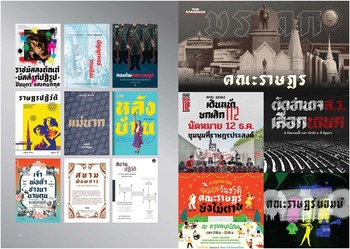
The ‘Khana Ratsadon’ font quickly became popular and was extensively used across various platforms, including social media, academic presentations, and protest signs, particularly during major demonstrations from 2020 to 2021 (Figure 4). It has been incorporated into the design of political seminar posters and covers of books that discuss the history of Khana Ratsadon. As the font was freely distributed, it quickly spread into everyday use, especially among younger people. Its widespread adoption, particularly in academic settings, serves as a subtle yet impactful political statement, allowing users to challenge the prevailing historical narratives promoted by the state through education. At a time when Khana Ratsadon symbols are being removed from public spaces, this font stands as an emblem of both the memory of Khana Ratsadon and of the ongoing erasure of the material heritage of Khana Ratsadon. It embodies a graphic ideology that confronts the official account of Thailand’s constitutional history by decentring the monarchy’s role in a crucial period of the nation’s political development.
Examples of the ‘Khana Ratsadon’ font which was extensively utilized across various platforms, including book covers, social media, academic presentations, and protest signs, particularly during major demonstrations from 2020 to 2021. Source: PrachathipaType.

Banal revolutionary objects 3: 2475—nak khian phi haeng sayam and heirs to the revolution
The formation of historical memory is influenced by a variety of sources, including academic literature, educational materials, personal anecdotes, artistic representations, media productions, public monuments, and cultural celebrations. Among these, the graphic novel and the comic book have emerged as significant contributors to our collective understanding of the past, alongside cinema and literature. Since the Pulitzer Prize was won by Art Spiegelman’s Holocaust narrative Maus in 1992, graphic novels have gained considerable acclaim and popularity as a medium for exploring historical events and figures. These works offer unique insights into the complexities of history and the choices made by historical actors.Footnote 72
In 2021, coinciding with the zenith of the demonstrations for political reform and of the monarchy in Thailand, the Ministry of Culture published a historical account in the form of a comic book, honouring the royal institution. The 237-page book is divided into 10 chapters, each devoted to a presentation of the ten kings of the Chakri dynasty and the defining events of their reigns. The Ministry’s objective in using the comic book format was to foster interest among the younger generation in the royal institution, urging them to remember:
The monarchy has long been the spiritual centre of the Thai people. Every Thai monarch has possessed noble virtues, embodying the Ten Kingly Virtues and extending their compassion to all subjects. They have fostered unity and stability, defended the kingdom from invading enemies, and nurtured its prosperity. Their efforts have elevated the quality of life, enabling the people to live in comfort and well-being. Furthermore, the kings have played a vital role in promoting and sustaining Buddhism as a guiding principle for life. They have also supported and cultivated the arts and culture, leaving behind a rich cultural heritage. As a result, the country has remained peaceful and harmonious under the benevolent rule of the Thai kings throughout history. This is why all Thai people deeply respect and revere the monarchy, holding it in the highest regard with unwavering loyalty.Footnote 73
The chapter that celebrates the merits of King Prajadhipok is entitled ‘Democracy’, and readers learn that the king was a staunch supporter of introducing democracy to Siam. However, it is evident that the narrative presented in this chapter conforms to the hegemonic narrative of oblivion, as evidenced by the opening epigrapgh, which features a celebrated quote from his abdication letter that reflects his perspective on Khana Ratsadon’s revolution as a selfish act that failed to introduce true democracy to Siam:
I am willing to surrender the power that has originally belonged to me to the people as a whole. However, I do not consent to surrender all my power to any individual or any group exclusively, for them to exercise it absolutely and without heeding the true voice of the people.Footnote 74
This perception of Khana Ratsadon is strongly challenged in the graphic novel 2475—nak khian phi haeng sayam (1932—Ghostwriter of Siam) released in Thailand at the beginning of 2024 (Figure 5).Footnote 75 This work, co-written and edited by Podcharakrit To-Im, with artwork and co-writing by Thanis Wirasakdiwong (Sa-ard), centres on Nipa, a young woman employed as a proofreader at a Bangkok newspaper in the period preceding the 1932 revolution. Nipa also serves as a ghostwriter, penning numerous articles that criticize social conditions and the absolute monarchy in Siam. Her strong desire for political transformation in Siam leads her to interact with Khana Ratsadon, whose members are orchestrating the coup that would overthrow the absolute monarchy and shape their vision for Siam’s future. While the novel touches on these historical events, it primarily explores Nipa’s journey—her challenging decisions, the deception she faces, and the growth of her dedication to social justice and radical political change amid a hostile and violent political landscape.
The graphic novel 2475— nak khian phi haeng sayam (1932—Ghostwriter of Siam) is a crowdfunded project that offers a new perspective on Khana Ratsadon and presents a counter-narrative to the dominant account of the emergence of constitutional rule in Siam. Source: Tanis Werasakwong.

The novel presents a counter-narrative to the dominant account of constitutional rule’s emergence in Siam. Although Nipa is a fictional protagonist, her experiences unfold against a carefully constructed historical backdrop, informed by extensive revisionist research and contemporary sources. Through this approach, the novel’s creators introduce and popularize an alternative interpretation of Thai history, depicting the rise of constitutional governance as a result of growing discontent with the absolute monarchy and ruling class. This narrative emphasizes the crucial role of the press and portrays a story of societal struggle, contrasting sharply with accounts that attribute the establishment of constitutional rule to monarchical support.
In the concluding pages of the graphic novel, Nipa contemplates the consequences of the 1932 revolution in a surreal, dream-like sequence. Although the revolution marked the beginning of a new era in many respects, Nipa expresses disappointment that true political freedom remains elusive. The novel portrays the 1932 revolution as incomplete, establishing a connection between generations and suggesting that contemporary efforts for political reform in Thailand are part of an ongoing struggle for change that can be traced back to the events of 1932.
The graphic novel is a crowdfunded project that offers a new perspective on Khana Ratsadon and has received strong public support, which contributed to the project’s success. After its publication, the graphic novel received positive feedback from the public, especially from pro-democracy supporters. Many review articles were published on various websites, and the writers were invited to give talks. Moreover, it was selected by the Ministry of Culture, along with 14 other books, for translation into English.Footnote 76
Banal revolutionary objects 4: AR Ratsadondamnoen—rediscovering the lost memories from the people’s streets
In an era where social media serves as the primary space for human communication and modern technology has become an integral part of daily life, the transmission of historical knowledge and collective social memory has increasingly shifted to these digital platforms. This transformation is particularly evident among younger generations, including in Thai society. Consequently, the primary arena for political struggles among the youth in the post-2014 coup period has also transitioned into social media spaces, where contemporary digital tools are being employed to engage in intellectual and ideological battles. This shift is particularly pronounced in the resurgence and reinterpretation of the history of Khana Ratsadon as a symbol of democratic aspirations and demands for monarchical reform. Various digital media, including social media dissemination of historical narratives, as well as the use of 3D scanning and photogrammetry to reconstruct demolished monuments and artworks associated with Khana Ratsadon, have played a crucial role in this movement.
One of the most compelling examples of this phenomenon is the project ‘AR Ratsadondamnoen: Rediscovering the Lost Memories from the People’s Streets’, initiated and launched in 2022 by ‘Kid Yang’, a collective of young activists advocating democracy and opposing military coups. This Augmented Reality (AR) project provides virtual reconstructions and historical information on eight significant architectural sites along Ratchadamnoen Avenue, some of which have disappeared, while others have been significantly altered, losing their original historical and architectural significance.
The project employs AR technology, which seamlessly integrates virtual elements into real-world environments, to present the architectural heritage of Khana Ratsadon through a curated selection of sites, making these narratives more accessible to the general public. Notably, the term ‘Ratsadondamnoen’ (People Passage) replaces ‘Ratchadamnoen’ (Royal Passage) in the project’s name to underscore the role of the Khana Ratsadon and the common people who once actively shaped these streets.
Accessible via the Urban Ally website, the AR experience includes an interactive map featuring graphic representations of Ratchadamnoen Avenue and the eight selected architectural structures that symbolize the architectural heritage of the Khana Ratsadon era.Footnote 77 These include temporary structures erected for Constitution Day celebrations at Dusit Palace and Sanam Luang, which disappeared alongside the grand commemorations of the Constitution; the Boworadet Rebellion Suppression Crematorium (a temporary structure); the Sam Thaharn (Three Soldiers) Gas Station; the Sala Chalerm Thai Theatre; and the Chalerm Chat Theatre (Figure 6). Additionally, some structures have been altered beyond recognition, such as the Supreme Court Complex and several other buildings along the avenue, with the remaining structures facing the risk of similar transformations.
The reconstructed AR image of Chalerm Thai Theatre from the AR project entitled ‘AR Ratsadondamnoen: Rediscovering the Lost Memories from the People’s Streets’, launched in 2022. This AR project provides virtual reconstructions and historical information on eight significant architectural sites related to the memory of the Khana Ratsadon. Source: Kid Yang.

The project narrates the history, disappearance, and transformation of these architectural elements through two primary methods. First, the AR feature allows users to interact with historical sites by capturing photographs and videos of themselves within these virtual reconstructions using mobile devices in real-world settings. Secondly, historical narratives are supplemented by archival photographs and academic references, providing a scholarly context for the architectural heritage and the sociopolitical activities associated with these sites.
Following its public launch, AR Ratsadondamnoen received widespread attention and a positive reception from younger audiences. Various media outlets reported on the project, and guided walking tours were organized to enable participants to experience the AR application on-site while engaging with historical discussions about the People’s Party.Footnote 78 This project exemplifies a new form of political struggle facilitated by modern technology—one that operates through everyday activities rather than through traditional street protests. AR Ratsadondamnoen can be considered a political artefact emerging from the so-called ‘Third Birth of the Khana Ratsadon’, marking a significant shift in political contestation from offline spaces to online platforms and from physical political gatherings space to subtle forms of resistance space within daily life practices.
Conclusion: Counter-memory, counter-counter memory, and royalist banal objects
This article examines how the discursive and material (re)emergence of Khana Ratsadon represents the formation of a counter-memory, which contributes to the creation of a political arena for commentary and the reimagining of communal possibilities in the aftermath of the 2006 coup. In doing so, it explores the interplay between a hegemonic historiography of oblivion, counter-memory, and what we call ‘banal revolutionary objects’. These objects, which gained prominence following the 2014 coup, are analysed through four case studies: the 2475 calendars, the ‘Khana Ratsadon’ font, the graphic novel 2475, and augmented reality (AR) models of urban spaces. However, as this phenomenon gains traction among younger generations advocating for democracy and opposing military coups, conservative and royalist elites have also started producing similar ‘banal objects’ relating to Khana Ratsadon, but for opposing political purposes. These objects aim to counter Khana Ratsadon and promote a royal-nationalist historical narrative, which we term ‘counter-counter memory’ and ‘royalist banal objects’.
Recently, two productions dealing with the 1932 revolution and Khana Ratsadon appeared on YouTube. The first is a documentary titled ‘Phibun Sawasdee: The Story of the Revolutionary Leader—The Highest Dream’ released in November 2023.Footnote 79 The documentary consists of three episodes and presents a portrait of Phibun Songkhram, one of the key members of Khana Ratsadon, who served as commander of the army and prime minster of Thailand from 1938 to 1944, and again from 1948 to 1957. It portrays Phibun as a political opportunist driven by a desire to undermine the monarchy and establish himself as a supreme ruler, his ‘highest dream’ nurtured by the contemporary fascist leaders in Europe, Hitler and Mussolini. The documentary does not explicitly reveal its creators, but it is widely believed to have been financed by the Internal Security Operations Command, the political arm of the Royal Thai Armed Forces.
The second production is the animation ‘1932—The Dawn of Revolution’, which portrays the 1932 revolution and the individuals behind it.Footnote 80 The central character in this animation is King Prajadhipok, depicted as a ‘democratic king’ who is above politics and solely concerned with the welfare of his people and country. The animation suggests that the coup disrupted his efforts to transition Thailand towards constitutional rule and that, despite political tensions, the king remained committed to negotiating with Khana Ratsadon to exert a positive influence on their policies to guide the country towards democracy. It was with great grief that the king decided to abdicate when conflicts between members of Khana Ratsadon affected the government’s policies in ways he deemed detrimental to the country’s transition to a state of true democracy. It is no secret who is behind this production, as the creators are credited in the animation. They claim that the production is solely motivated by a desire to shed light on an important, though still somewhat obscure, event in Thailand’s history, and that no state agencies are involved. However, it is widely believed to have been financed by the Royal Thai Army.Footnote 81
These two productions, freely available on YouTube, reflect the ongoing contestation of the 1932 revolution in Thailand. They also illustrate how governmental agencies mobilize extensive resources to reinforce the hegemonic narrative linking the roots of constitutional rule to King Prajadhipok, presenting him as a democratic and moral monarch above politics.
Nevertheless, as this article has demonstrated, a discursive and material (re)emergence of Khana Ratsadon and a counter-memory are taking shape in Thailand. This counter-memory highlights the positive impact of the 1932 revolution on the formation of constitutional rule in Thailand, an aspect that has been excluded from the dominant historical narrative. It is sustained through creative acts of remembrance at multiple sites linked with what we have coined ‘banal revolutionary objects’. This counter-memory not only recognizes and challenges the limitations of the existing dominant narrative but also opens up new possibilities for framing the history of democracy in Thailand—one that diminishes the monarchy’s role in the country’s transition to constitutional rule, while creating space for political commentary and radical new visions of the future.
Competing interests
The authors declare none.




 Open access

