Introduction
The 2007–2008 International Polar Year (IPY) was the catalyst for many successful field-based polar education endeavours such as Students on Ice (Students on Ice Foundation, 2019), Schools on Board (ArcticNet, 2019), and ARISE (ANDRILL Research Immersion for Science Educators) (Pound et al., Reference Pound, Huffman, Hubbard, Cattadori, Dahlman, Dooley and Trummel2019). Another IPY Education and Outreach project from the USA was PolarTREC – Teachers and Researchers Exploring and Collaborating, administered by ARCUS (Arctic Research Consortium of the United States). Started as a 3-year NSF-funded program, PolarTREC was designed to advance Science, Technology, Engineering, and Mathematics (STEM) education by improving teacher content knowledge and instructional practices through Teacher Research Experiences (TREs) in the Arctic and the Antarctic. Since IPY, PolarTREC has proved to be successful, providing “hands-on” research experiences for teachers outside of a laboratory setting, frequently in harsh, remote, or unusual settings and continues today with the 2019–2020 field season slated to begin in June 2019. PolarTREC is a pacesetter for teacher engagement in scientific research, the dissemination of scientific knowledge to students and the public, and STEM-focused education reform in the USA.
Between 2007 and 2016, PolarTREC placed 137 US educators with research teams throughout the Arctic and the Antarctic, participating in polar research aboard ships, in remote camps, at Arctic field stations, and at all three US bases in the Antarctic. Beyond bringing diverse educational professionals into the field, PolarTREC serves to improve researchers’ education and outreach efforts while exposing researchers to the methods and means by which science is shared in the classroom. These experiences are changing the face of polar science in classrooms by empowering teachers with first-hand knowledge that is then transformed into original activities and classroom lessons (Garay, Warburton, & Timm, Reference Garay, Warburton and Timm2010; Schwartz, Lederman, & Crawford, Reference Schwartz, Lederman and Crawford2004).
One of the biggest challenges any teacher faces when teaching content to students is relevancy. “Learning outcomes depend not only on the learning environment, but also on the knowledge, purposes and motivations that the learner brings to the task, therefore, learning in science, just as in any other area of the curriculum, must be focused on understanding and making complete sense of ideas and information” (Gunstone, Reference Gunstone and Fensham1988, p. 77). The PolarTREC program has allowed K-12 teachers and informal science educators from the USA to work directly with scientists in the Arctic and the Antarctic, providing teachers with a unique professional development opportunity to increase their teacher content knowledge.
From program evaluation data, there has been a statistically significant improvement in the teacher’s self-assessed ability and confidence to increase the variety of scientific processes in their lessons (ARCUS, 2010, 2012, 2015). As a growing emphasis is placed on Next Generation Science Standards (NGSS) in the USA, teacher content knowledge is essential to student achievement in science, but the practice of science is even more essential (Darling-Hammond, Wise, & Klein, Reference Darling-Hammond, Wise and Klein1995; Wrenn & Wrenn, Reference Wrenn and Wrenn2009). K-12 teacher quality is a major factor influencing students’ decisions about pursuing STEM degrees and occupations (Ashby, Reference Ashby2005).
PolarTREC teacher profiles
This commentary profiles the experiences of four PolarTREC teachers assigned to research projects in the Arctic and Antarctic regions, and their efforts to convey their knowledge and observations of polar science into instructional activities, lessons, and projects – all in an attempt to inspire the next generation of polar researchers. The four teachers profiled in this commentary were chosen:
(1) to reflect the varied backgrounds, teaching assignments, and classroom experiences derived from their TRE, and (2) to provide specific examples of how they communicated their observations in the field to the classroom for the benefit of their students as well as other educators. All four teachers are co-authors of this paper alongside the program director of PolarTREC.
George Hademenos is currently in his 19th year of teaching physics at Richardson High School in Richardson, Texas. In 2017, he was chosen to work with Carol Costanza and Dr. Matthew Lazzara of the University of Wisconsin - Madison Space Science and Engineering Center (SSEC) on Automatic Weather Stations (AWSs) in Antarctica. The AWS group was responsible for the development, construction, assembly, and data analysis of approximately 60 AWS units positioned across the continent. An AWS is a free-standing structure with attached sensors designed to collect data representing the following weather variables: temperature, relative humidity, wind speed and direction, and depth of snow accumulation. The collected sensor data from an AWS is stored and transmitted to external locations in Antarctica and Madison, Wisconsin for data analysis. The primary objective of Hademenos’ TRE was to visit several AWS units and conduct routine maintenance evaluations; work which included helicopter flights, data gathering, and long days in the field, certainly not a typical day in a classroom.
Prior to deploying to Antarctica, Hademenos created infographics detailing the AWS research; prearranged Skype sessions with various classrooms; and scheduled a “real-time” webinar, PolarConnect, from the field. While in Antarctica, the outreach continued with daily blogging (https://www.polartrec.com/expeditions/antarctic-automatic-weather-stations) about the research and responding to questions and comments from his students and the public.
PolarTREC teachers are constantly challenged to think about “how” to bring the TRE into the classroom and make the science in the polar regions relevant to their students. Hademenos took on this challenge by creating the Polar-ympics. Polar-ympics was a competition between two students who competed in four events that might be a common occurrence to a typical polar researcher. The four events were: (1) Speed Dressing, (2) Nighty-Nite Expedite, (3) No Place Like Igloo, and (4) Ice Rescue – STAT.
In Speed Dressing, the students were briefed on the reality of polar research and working in an extreme environment. Each student was presented with an Extreme Cold Weather kit, cold-weather clothing needed in Antarctica (for example, Bunny boots, parka, balaclava, mitts, and snow goggles). At the sound of the signal, the students competed to see who got dressed in full gear in the shortest amount of time.
For Nighty-Nite Expedite, the challenge seemed simple enough – unzip a sleeping bag, get inside the sleeping bag, and then zip it back up. However, this had to be accomplished with all of their Extreme Cold Weather gear on – including the gloves. The competitors didn’t exactly get the sleeping bag zipped up all the way, but they were able to open it up, get in, and have fun along the way.
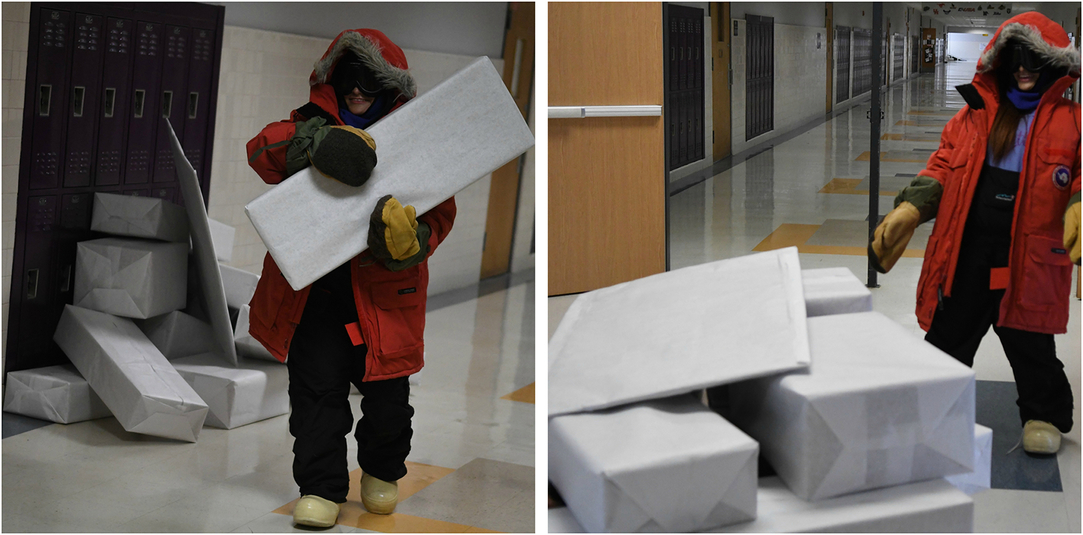
During No Place Like Igloo, the students took on the challenge of being polar researchers out in the field who needed to create shelter. A pile of ice blocks (empty boxes wrapped in white paper) was spotted about 20 yards away; so the competitor trekked to the pile, retrieved the blocks, and then brought them back to start constructing shelter. To simulate heavy ice, competitors could only retrieve one block at a time and return it to home base, all while wearing their ECW gear. The shelter had to totally enclose the researcher but the design was up to the competitor (Fig. 1).
Fig. 1.Student participating in a class project entitled, Polar-ympics, transporting “ice blocks” for construction of an igloo. (Photo by Daphne Lynd.)
In the final event, Ice Rescue – STAT, researchers in the field come across an injured party who needs to be transported to base camp. They were provided a makeshift sled (flattened cardboard box), placed the injured party on the sled, and then returned to base camp, without the injured party falling off the sled.
A primary objective of a PolarTREC teacher is to convey the scientific nature and explanations of observations and engage in a dialogue with various audiences to potentially cultivate a curiosity and spark an interest in polar science (https://www.polartrec.com/about/goals-and-objectives). In an effort to reach out to elementary students, Hademenos collaborated with fashion design students at his high school to help him design and create two fictional characters for his blog. They created a young girl who liked exploring and was curious about everything polar, and a boy penguin who would serve as her ever-inquisitive sidekick. The students engaged in a very deliberate process, creating sketches of the two characters, followed by a detailed identification of possible textile materials that might be used to create cold weather gear. They collaborated in efforts to create models of these two characters, developing the clothing and accessory features for the two characters. The only thing left was to name the two characters, an honour bestowed upon the students. The students chose Anastasia for the girl doll and Kiwi for the boy penguin (Fig. 2). This cross-curricular project successfully engaged secondary students in learning about polar science, as well as helping their teacher reach a younger audience.
Fig. 2.Anastasia and Kiwi are characters in the form of stuffed dolls designed and created by fashion design students at Richardson High School to help engage elementary-aged youth during the expedition. (Photo by George Hademenos.)
Lollie Garay taught Middle School Integrated Science, Robotics, and Engineering at Redd School in Houston, Texas at the time of her polar expeditions. Garay explains, “The most successful aspect of my Polar experiences (www.polartrec.com/expeditions/oden-antarctic-expedition-07) has been the 11 years of continued collaboration with one of the 2007 Antarctic expedition marine scientists, Dr. Patricia Yager from the University of Georgia in Athens”. Initially, they put their ideas together to co-author a classroom activity based on Yager’s research on carbon sequestration. The activity, Pumping Carbon, was first presented to a group of teachers and students at the 2008 Society for Advancement of Chicanos Hispanics and Native Americans in Science (SACNAS) Conference, and in 2011 to classroom students in Utqiagvik (formerly Barrow), Alaska.
Between 2008 and 2011, Garay travelled as a member of the Yager team, conducting research in the Amazon Plume of the Mid-Atlantic as well as the Arctic Ocean. The combined experiences led to the development of a project that would give students their own first-hand experiences in the research processes of science (Fig. 3). In 2011, the Students Monitoring Ocean Response to Eutrophication (SMORE) project, funded through a Toyota Tapestry Grant, partnered schools in Alaska, Texas, and Georgia to compare student-generated data collected from water studies in prospective areas. Understanding the relationship between the ocean, land, and atmosphere increases their awareness of the important role they have in the carbon cycle and its effect on the global climate system (Fig. 4).
Fig. 3.Teacher Lollie Garay and researcher Dr. Patricia Yager conducting polar research in Utqiagvik (formerly Barrow), Alaska. (Photo by Lollie Garay, courtesy of ARCUS.)
Fig. 4.SMORE students in Texas conduct onsite water tests at Smith Point estuary. (Photo by Lollie Garay.)
For six years, the SMORE project provided authentic science experiences for students as they conducted on-site investigations. Students learned about topics and concepts underrepresented in science classroom curricula, as well as developing skills with new tools to collect data. The experiences integrated the STEM principles into learning and gave students the opportunity to network not only with other students but also with researchers as mentors. Moreover, assessment data reflected demonstrated conceptual understanding of science processes – formulating questions, collecting data, using evidence to support answers, and developing skills in scientific argumentation.
The success of working together inspired both the researcher and teacher to promote teacher–researcher collaborations. They have co-authored several published papers (Garay et al., Reference Garay, Wotkyns, Lowry, Warburton, Alderkamp and Yager2014; Yager et al., Reference Yager, Sherrell, Stammerjohn, Alderkamp, Schofield, Abrahamsen and Wilson2012) and have presented together at national and international conferences, focusing on the merits to students, teachers, and researchers engaged in partnerships. More importantly, the middle school students have published their own papers and presented poster sessions at a scientific symposium based on their work with marine scientists.
Using first-hand experiences and the networking resources she has developed, Garay has become more confident in her ability to teach others about critical ocean and climate topics, as well as about the process of scientific research. Her work has also provided a living model for her students about what life-long learning and risk-taking looks like. Speaking to her students, Garay underscored the fact that scientists are humans who have regular lives and families, yet a passion for what they do. Students were able to understand the scientists’ work, and the technology and engineering that helps them achieve their goals. Garay reflects “all of these amazing adventures and opportunities would never have happened without being selected as a PolarTREC teacher.” She continues to advocate for polar and ocean science literacy through educational outreach.
Alex Eilers is the Manager of Education for the Pink Palace, a regional natural and cultural history museum in Memphis, Tennessee. As an informal educator, Eilers regularly seeks opportunities to bring national and international science programs to students, educators, and community members in the Memphis region through partnerships with organisations including NASA MESSENGER, New Horizons, National Oceanic and Atmospheric Association, Chemical Educational Foundation, and PolarTREC. Participating in collaborative projects supports the museum’s mission and provides an outlet for inspiring the next generation of scientists.
In 2012, Eilers was paired with Dr. Daniel Costa of University of California Santa Cruz and Dr. Jennifer Burns of the University of Alaska-Anchorage through the PolarTREC program. Their project goals were to study the overwintering behaviour of Weddell seals in the Ross Sea, winter oceanography, and assess the physiological condition of the animals near McMurdo Station, Antarctica. Their collaboration continued during the 2014 and 2016 Antarctic field seasons with Dr. Jennifer Burns, on The cost of a new fur coat: Interactions between molt and reproduction in Weddell seals. This research project aimed to determine the mechanisms which link reproduction and molt timing in Weddell seals.
Unlike a traditional classroom teacher, whose audience is focused and well defined, informal educators serve wide and diverse audiences. Therefore, a concerted effort was made to create an extensive education and outreach component that could reach varied audiences including elementary students, educators, and museum guests. The team developed and executed educational initiatives highlighting the Weddell seal research project during the 2012, 2014, and 2016 seasons. Their efforts grew from year to year, serving a total of 59,049 individuals, including over 40,000 students, over the course of the three expeditions (Fig. 5).
Fig. 5.Graph showing the impact of community outreach during each expedition by Alex Eilers for three targeted groups: students, educators, and general public. (Image courtesy of the Pink Palace Education Department.)
A significant piece of the team’s education and outreach included regular online journals to connect the expedition with its audience in the Memphis region, and connect the science being studied in the field with the curriculum taught in the classroom. For instance, the Take a Closer Look project began with classroom presentations in which students participated by selecting a polar-related science topic of interest. The students wrote or drew the topic inside a Take a Closer Look magnifier (Fig. 6), and the magnifiers were later photographed in the field and used to lead each online journal entry. The project’s impact was extensive with several hundred student and class entries received, along with dozens of thank-you notes expressing appreciation for the project. One teacher commented, “The students were thrilled to have you {visit} because we had talked about your upcoming trip to Antarctica. Your excitement about going is contagious and the students are now researching other topics on the ‘Closer Look’ page”. A student and aspiring scientist expressed thanks for the postcard, saying “My favorite one was you telling us about the Weddell seal and how it uses its teeth to make a hole and breathe through the ice. I hope I get to do something like this one day!”
Fig. 6.Informal science educator, Alex Eilers, holding “student magnifiers” near a Weddell seal. Magnifiers were brought on the expedition as a part of the team’s outreach programming. (Photo by Alex Eilers, courtesy of ARCUS.)
Besides the outreach in the field, two 45-min museum programs, Animals of the Antarctic and Journey to the Poles, were created in conjunction with this partnership. The latter is still included in the museum’s current programming, highlighting key scientific components from the 2012 expedition. Two object-based travelling kits, Extreme Cold Weather Gear and The Weddell Seal, were developed and continue to circulate through schools 6 years later, allowing hands-on experience working with actual gear and specimens. In 2016, a multi-lesson educational module was developed, targeting 3rd to 8th grade and emphasising strategic methods to assist students in analysing data from PolarTREC expeditions.
The personal and professional impacts of cross-field partnerships are multifaceted, providing a deeper understanding of polar science, additional opportunities to connect with area educators and students, lasting relationships with researchers, and the opportunity to share these collaborative efforts at scientific conferences. The museum benefited, as an institution and in alignment with its mission, by exposing its visitors to current scientific research in an effort to inspire life-long learning, and strengthening its position within the community as a STEM resource. It is the role of all educators, formal and informal, to bridge the gap between today’s classroom and tomorrow’s career.
Jillian Worssam is an 8th grade science teacher at Sinagua Middle School in Flagstaff, Arizona. Worssam had her first educator field experience with PolarTREC in 2008 on the United States Coast Guard Cutter (USCGC) Research Vessel Healy, participating in research in the Bering Sea. Under the guidance of Dr. Ray Sambrotto from Lamont Doherty Earth Observatory, Worssam spent 30 days at sea learning about the scientific complexities of the sea shelf in the eastern Bering Sea. “Looking at krill through a microscope, I knew that my life would never be the same again”, she said.
Based exclusively on the PolarTREC model, Worssam developed the Scientists in the Classroom
tm
Mentorship Program (http://www.scientistsintheclassroom.com/), partnering scientists in the field with students for an entire academic year (Fig. 7). Each year, over 60 students are partnered with a mentor scientist who teaches them the intricacies of their individual science. In addition, Worssam developed an after-school oceanography program in which over 70 students annually work with scientists, allowing the students to participate in a 5-day trip to Monterey, California where they work with the Monterey Bay Aquarium Research Institute, Moss Landing Marine Labs and the aquarium in a fully rounded oceanographic experience.
Fig. 7.Logo for the Scientists in the Classroom
tm
Mentorship Program founded by teacher Jillian Worssam.
Worssam sees science instruction as a partnership between the schools, the community, and the world. As a PolarTREC teacher, she has focused on polar and climate science curriculum, showing Arizona students the importance of these topics and their interdependence in the world. Worssam reflects, “Who would have thought that this educator field experience would impact thousands of students? Scientist field experiences ignite educators to be more involved in real-time data-driven science and to bring real-time science into the classroom”.




 Open access


Introduction
The 2007–2008 International Polar Year (IPY) was the catalyst for many successful field-based polar education endeavours such as Students on Ice (Students on Ice Foundation, 2019), Schools on Board (ArcticNet, 2019), and ARISE (ANDRILL Research Immersion for Science Educators) (Pound et al., Reference Pound, Huffman, Hubbard, Cattadori, Dahlman, Dooley and Trummel2019). Another IPY Education and Outreach project from the USA was PolarTREC – Teachers and Researchers Exploring and Collaborating, administered by ARCUS (Arctic Research Consortium of the United States). Started as a 3-year NSF-funded program, PolarTREC was designed to advance Science, Technology, Engineering, and Mathematics (STEM) education by improving teacher content knowledge and instructional practices through Teacher Research Experiences (TREs) in the Arctic and the Antarctic. Since IPY, PolarTREC has proved to be successful, providing “hands-on” research experiences for teachers outside of a laboratory setting, frequently in harsh, remote, or unusual settings and continues today with the 2019–2020 field season slated to begin in June 2019. PolarTREC is a pacesetter for teacher engagement in scientific research, the dissemination of scientific knowledge to students and the public, and STEM-focused education reform in the USA.
Between 2007 and 2016, PolarTREC placed 137 US educators with research teams throughout the Arctic and the Antarctic, participating in polar research aboard ships, in remote camps, at Arctic field stations, and at all three US bases in the Antarctic. Beyond bringing diverse educational professionals into the field, PolarTREC serves to improve researchers’ education and outreach efforts while exposing researchers to the methods and means by which science is shared in the classroom. These experiences are changing the face of polar science in classrooms by empowering teachers with first-hand knowledge that is then transformed into original activities and classroom lessons (Garay, Warburton, & Timm, Reference Garay, Warburton and Timm2010; Schwartz, Lederman, & Crawford, Reference Schwartz, Lederman and Crawford2004).
One of the biggest challenges any teacher faces when teaching content to students is relevancy. “Learning outcomes depend not only on the learning environment, but also on the knowledge, purposes and motivations that the learner brings to the task, therefore, learning in science, just as in any other area of the curriculum, must be focused on understanding and making complete sense of ideas and information” (Gunstone, Reference Gunstone and Fensham1988, p. 77). The PolarTREC program has allowed K-12 teachers and informal science educators from the USA to work directly with scientists in the Arctic and the Antarctic, providing teachers with a unique professional development opportunity to increase their teacher content knowledge.
From program evaluation data, there has been a statistically significant improvement in the teacher’s self-assessed ability and confidence to increase the variety of scientific processes in their lessons (ARCUS, 2010, 2012, 2015). As a growing emphasis is placed on Next Generation Science Standards (NGSS) in the USA, teacher content knowledge is essential to student achievement in science, but the practice of science is even more essential (Darling-Hammond, Wise, & Klein, Reference Darling-Hammond, Wise and Klein1995; Wrenn & Wrenn, Reference Wrenn and Wrenn2009). K-12 teacher quality is a major factor influencing students’ decisions about pursuing STEM degrees and occupations (Ashby, Reference Ashby2005).
PolarTREC teacher profiles
This commentary profiles the experiences of four PolarTREC teachers assigned to research projects in the Arctic and Antarctic regions, and their efforts to convey their knowledge and observations of polar science into instructional activities, lessons, and projects – all in an attempt to inspire the next generation of polar researchers. The four teachers profiled in this commentary were chosen:
(1) to reflect the varied backgrounds, teaching assignments, and classroom experiences derived from their TRE, and (2) to provide specific examples of how they communicated their observations in the field to the classroom for the benefit of their students as well as other educators. All four teachers are co-authors of this paper alongside the program director of PolarTREC.
George Hademenos is currently in his 19th year of teaching physics at Richardson High School in Richardson, Texas. In 2017, he was chosen to work with Carol Costanza and Dr. Matthew Lazzara of the University of Wisconsin - Madison Space Science and Engineering Center (SSEC) on Automatic Weather Stations (AWSs) in Antarctica. The AWS group was responsible for the development, construction, assembly, and data analysis of approximately 60 AWS units positioned across the continent. An AWS is a free-standing structure with attached sensors designed to collect data representing the following weather variables: temperature, relative humidity, wind speed and direction, and depth of snow accumulation. The collected sensor data from an AWS is stored and transmitted to external locations in Antarctica and Madison, Wisconsin for data analysis. The primary objective of Hademenos’ TRE was to visit several AWS units and conduct routine maintenance evaluations; work which included helicopter flights, data gathering, and long days in the field, certainly not a typical day in a classroom.
Prior to deploying to Antarctica, Hademenos created infographics detailing the AWS research; prearranged Skype sessions with various classrooms; and scheduled a “real-time” webinar, PolarConnect, from the field. While in Antarctica, the outreach continued with daily blogging (https://www.polartrec.com/expeditions/antarctic-automatic-weather-stations) about the research and responding to questions and comments from his students and the public.
PolarTREC teachers are constantly challenged to think about “how” to bring the TRE into the classroom and make the science in the polar regions relevant to their students. Hademenos took on this challenge by creating the Polar-ympics. Polar-ympics was a competition between two students who competed in four events that might be a common occurrence to a typical polar researcher. The four events were: (1) Speed Dressing, (2) Nighty-Nite Expedite, (3) No Place Like Igloo, and (4) Ice Rescue – STAT.
In Speed Dressing, the students were briefed on the reality of polar research and working in an extreme environment. Each student was presented with an Extreme Cold Weather kit, cold-weather clothing needed in Antarctica (for example, Bunny boots, parka, balaclava, mitts, and snow goggles). At the sound of the signal, the students competed to see who got dressed in full gear in the shortest amount of time.
For Nighty-Nite Expedite, the challenge seemed simple enough – unzip a sleeping bag, get inside the sleeping bag, and then zip it back up. However, this had to be accomplished with all of their Extreme Cold Weather gear on – including the gloves. The competitors didn’t exactly get the sleeping bag zipped up all the way, but they were able to open it up, get in, and have fun along the way.
During No Place Like Igloo, the students took on the challenge of being polar researchers out in the field who needed to create shelter. A pile of ice blocks (empty boxes wrapped in white paper) was spotted about 20 yards away; so the competitor trekked to the pile, retrieved the blocks, and then brought them back to start constructing shelter. To simulate heavy ice, competitors could only retrieve one block at a time and return it to home base, all while wearing their ECW gear. The shelter had to totally enclose the researcher but the design was up to the competitor (Fig. 1).
Student participating in a class project entitled, Polar-ympics, transporting “ice blocks” for construction of an igloo. (Photo by Daphne Lynd.)
In the final event, Ice Rescue – STAT, researchers in the field come across an injured party who needs to be transported to base camp. They were provided a makeshift sled (flattened cardboard box), placed the injured party on the sled, and then returned to base camp, without the injured party falling off the sled.
A primary objective of a PolarTREC teacher is to convey the scientific nature and explanations of observations and engage in a dialogue with various audiences to potentially cultivate a curiosity and spark an interest in polar science (https://www.polartrec.com/about/goals-and-objectives). In an effort to reach out to elementary students, Hademenos collaborated with fashion design students at his high school to help him design and create two fictional characters for his blog. They created a young girl who liked exploring and was curious about everything polar, and a boy penguin who would serve as her ever-inquisitive sidekick. The students engaged in a very deliberate process, creating sketches of the two characters, followed by a detailed identification of possible textile materials that might be used to create cold weather gear. They collaborated in efforts to create models of these two characters, developing the clothing and accessory features for the two characters. The only thing left was to name the two characters, an honour bestowed upon the students. The students chose Anastasia for the girl doll and Kiwi for the boy penguin (Fig. 2). This cross-curricular project successfully engaged secondary students in learning about polar science, as well as helping their teacher reach a younger audience.
Anastasia and Kiwi are characters in the form of stuffed dolls designed and created by fashion design students at Richardson High School to help engage elementary-aged youth during the expedition. (Photo by George Hademenos.)
Lollie Garay taught Middle School Integrated Science, Robotics, and Engineering at Redd School in Houston, Texas at the time of her polar expeditions. Garay explains, “The most successful aspect of my Polar experiences (www.polartrec.com/expeditions/oden-antarctic-expedition-07) has been the 11 years of continued collaboration with one of the 2007 Antarctic expedition marine scientists, Dr. Patricia Yager from the University of Georgia in Athens”. Initially, they put their ideas together to co-author a classroom activity based on Yager’s research on carbon sequestration. The activity, Pumping Carbon, was first presented to a group of teachers and students at the 2008 Society for Advancement of Chicanos Hispanics and Native Americans in Science (SACNAS) Conference, and in 2011 to classroom students in Utqiagvik (formerly Barrow), Alaska.
Between 2008 and 2011, Garay travelled as a member of the Yager team, conducting research in the Amazon Plume of the Mid-Atlantic as well as the Arctic Ocean. The combined experiences led to the development of a project that would give students their own first-hand experiences in the research processes of science (Fig. 3). In 2011, the Students Monitoring Ocean Response to Eutrophication (SMORE) project, funded through a Toyota Tapestry Grant, partnered schools in Alaska, Texas, and Georgia to compare student-generated data collected from water studies in prospective areas. Understanding the relationship between the ocean, land, and atmosphere increases their awareness of the important role they have in the carbon cycle and its effect on the global climate system (Fig. 4).
Teacher Lollie Garay and researcher Dr. Patricia Yager conducting polar research in Utqiagvik (formerly Barrow), Alaska. (Photo by Lollie Garay, courtesy of ARCUS.)
SMORE students in Texas conduct onsite water tests at Smith Point estuary. (Photo by Lollie Garay.)
For six years, the SMORE project provided authentic science experiences for students as they conducted on-site investigations. Students learned about topics and concepts underrepresented in science classroom curricula, as well as developing skills with new tools to collect data. The experiences integrated the STEM principles into learning and gave students the opportunity to network not only with other students but also with researchers as mentors. Moreover, assessment data reflected demonstrated conceptual understanding of science processes – formulating questions, collecting data, using evidence to support answers, and developing skills in scientific argumentation.
The success of working together inspired both the researcher and teacher to promote teacher–researcher collaborations. They have co-authored several published papers (Garay et al., Reference Garay, Wotkyns, Lowry, Warburton, Alderkamp and Yager2014; Yager et al., Reference Yager, Sherrell, Stammerjohn, Alderkamp, Schofield, Abrahamsen and Wilson2012) and have presented together at national and international conferences, focusing on the merits to students, teachers, and researchers engaged in partnerships. More importantly, the middle school students have published their own papers and presented poster sessions at a scientific symposium based on their work with marine scientists.
Using first-hand experiences and the networking resources she has developed, Garay has become more confident in her ability to teach others about critical ocean and climate topics, as well as about the process of scientific research. Her work has also provided a living model for her students about what life-long learning and risk-taking looks like. Speaking to her students, Garay underscored the fact that scientists are humans who have regular lives and families, yet a passion for what they do. Students were able to understand the scientists’ work, and the technology and engineering that helps them achieve their goals. Garay reflects “all of these amazing adventures and opportunities would never have happened without being selected as a PolarTREC teacher.” She continues to advocate for polar and ocean science literacy through educational outreach.
Alex Eilers is the Manager of Education for the Pink Palace, a regional natural and cultural history museum in Memphis, Tennessee. As an informal educator, Eilers regularly seeks opportunities to bring national and international science programs to students, educators, and community members in the Memphis region through partnerships with organisations including NASA MESSENGER, New Horizons, National Oceanic and Atmospheric Association, Chemical Educational Foundation, and PolarTREC. Participating in collaborative projects supports the museum’s mission and provides an outlet for inspiring the next generation of scientists.
In 2012, Eilers was paired with Dr. Daniel Costa of University of California Santa Cruz and Dr. Jennifer Burns of the University of Alaska-Anchorage through the PolarTREC program. Their project goals were to study the overwintering behaviour of Weddell seals in the Ross Sea, winter oceanography, and assess the physiological condition of the animals near McMurdo Station, Antarctica. Their collaboration continued during the 2014 and 2016 Antarctic field seasons with Dr. Jennifer Burns, on The cost of a new fur coat: Interactions between molt and reproduction in Weddell seals. This research project aimed to determine the mechanisms which link reproduction and molt timing in Weddell seals.
Unlike a traditional classroom teacher, whose audience is focused and well defined, informal educators serve wide and diverse audiences. Therefore, a concerted effort was made to create an extensive education and outreach component that could reach varied audiences including elementary students, educators, and museum guests. The team developed and executed educational initiatives highlighting the Weddell seal research project during the 2012, 2014, and 2016 seasons. Their efforts grew from year to year, serving a total of 59,049 individuals, including over 40,000 students, over the course of the three expeditions (Fig. 5).
Graph showing the impact of community outreach during each expedition by Alex Eilers for three targeted groups: students, educators, and general public. (Image courtesy of the Pink Palace Education Department.)
A significant piece of the team’s education and outreach included regular online journals to connect the expedition with its audience in the Memphis region, and connect the science being studied in the field with the curriculum taught in the classroom. For instance, the Take a Closer Look project began with classroom presentations in which students participated by selecting a polar-related science topic of interest. The students wrote or drew the topic inside a Take a Closer Look magnifier (Fig. 6), and the magnifiers were later photographed in the field and used to lead each online journal entry. The project’s impact was extensive with several hundred student and class entries received, along with dozens of thank-you notes expressing appreciation for the project. One teacher commented, “The students were thrilled to have you {visit} because we had talked about your upcoming trip to Antarctica. Your excitement about going is contagious and the students are now researching other topics on the ‘Closer Look’ page”. A student and aspiring scientist expressed thanks for the postcard, saying “My favorite one was you telling us about the Weddell seal and how it uses its teeth to make a hole and breathe through the ice. I hope I get to do something like this one day!”
Informal science educator, Alex Eilers, holding “student magnifiers” near a Weddell seal. Magnifiers were brought on the expedition as a part of the team’s outreach programming. (Photo by Alex Eilers, courtesy of ARCUS.)
Besides the outreach in the field, two 45-min museum programs, Animals of the Antarctic and Journey to the Poles, were created in conjunction with this partnership. The latter is still included in the museum’s current programming, highlighting key scientific components from the 2012 expedition. Two object-based travelling kits, Extreme Cold Weather Gear and The Weddell Seal, were developed and continue to circulate through schools 6 years later, allowing hands-on experience working with actual gear and specimens. In 2016, a multi-lesson educational module was developed, targeting 3rd to 8th grade and emphasising strategic methods to assist students in analysing data from PolarTREC expeditions.
The personal and professional impacts of cross-field partnerships are multifaceted, providing a deeper understanding of polar science, additional opportunities to connect with area educators and students, lasting relationships with researchers, and the opportunity to share these collaborative efforts at scientific conferences. The museum benefited, as an institution and in alignment with its mission, by exposing its visitors to current scientific research in an effort to inspire life-long learning, and strengthening its position within the community as a STEM resource. It is the role of all educators, formal and informal, to bridge the gap between today’s classroom and tomorrow’s career.
Jillian Worssam is an 8th grade science teacher at Sinagua Middle School in Flagstaff, Arizona. Worssam had her first educator field experience with PolarTREC in 2008 on the United States Coast Guard Cutter (USCGC) Research Vessel Healy, participating in research in the Bering Sea. Under the guidance of Dr. Ray Sambrotto from Lamont Doherty Earth Observatory, Worssam spent 30 days at sea learning about the scientific complexities of the sea shelf in the eastern Bering Sea. “Looking at krill through a microscope, I knew that my life would never be the same again”, she said.
Based exclusively on the PolarTREC model, Worssam developed the Scientists in the Classroom tm Mentorship Program (http://www.scientistsintheclassroom.com/), partnering scientists in the field with students for an entire academic year (Fig. 7). Each year, over 60 students are partnered with a mentor scientist who teaches them the intricacies of their individual science. In addition, Worssam developed an after-school oceanography program in which over 70 students annually work with scientists, allowing the students to participate in a 5-day trip to Monterey, California where they work with the Monterey Bay Aquarium Research Institute, Moss Landing Marine Labs and the aquarium in a fully rounded oceanographic experience.
Logo for the Scientists in the Classroom tm Mentorship Program founded by teacher Jillian Worssam.
Worssam sees science instruction as a partnership between the schools, the community, and the world. As a PolarTREC teacher, she has focused on polar and climate science curriculum, showing Arizona students the importance of these topics and their interdependence in the world. Worssam reflects, “Who would have thought that this educator field experience would impact thousands of students? Scientist field experiences ignite educators to be more involved in real-time data-driven science and to bring real-time science into the classroom”.
Conclusions
PolarTREC, a program that was initiated during the IPY, continues today as a successful example of the educational outreach potential of TREs in polar science. With the depth and breadth of science that exist in the polar regions, it is critical that teachers have the opportunity to gain practical, first-hand experience in the field in order to convey their experiences to students in classrooms across the nation. This would not have been possible without PolarTREC. This article highlights the efforts and accomplishments of four PolarTREC teachers based on their teaching assignment, background, and expedition. These experiences and the instructional initiatives that followed continue to grow as PolarTREC welcomes a new team of teachers for the 2019–2020 field season.
Acknowledgements
The authors would like to acknowledge the support of their institutions, in particular the families, schools, school administrators, students, parents, and communities. Without their support, they would not have been able to travel to the Arctic or Antarctica for this amazing professional development experience.
Financial Support
This work was supported by the National Science Foundation (Awards 0632401, 0956825, 1525880, and 1630463). Any opinions, findings, and conclusions or recommendations expressed in this article are those of the Principal Investigator and coordinating team and do not necessarily reflect the views of the National Science Foundation.
Conflict of Interest
None.
Ethical Standards
None.
About the Authors
This commentary describes the experiences of four teachers from the USA who participated in the PolarTREC (Teachers and Researchers Exploring and Collaborating) teacher research immersion program between 2014–2017. Two of these authors visited the Arctic and two visited the Antarctic. The fifth author, Janet Warburton, was the Project Manager of PolarTrec during this time, which was an initiative stimulated by the International Polar Year 2007–2008.