





1 Introduction
The purpose of this paper is to present a striking (non-)differentiability property of typical Lipschitz mappings. We show that a typical, in Baire category sense,
$1$
 -Lipschitz mapping between a normed space X and a Banach space Y is not differentiable at a typical point of a given set
$E\subseteq X$
-Lipschitz mapping between a normed space X and a Banach space Y is not differentiable at a typical point of a given set
$E\subseteq X$
 in a most extreme way: its derivative ratios can approximate all linear operators
$X\to Y$
in a most extreme way: its derivative ratios can approximate all linear operators
$X\to Y$
 of norm at most
$1$
of norm at most
$1$
 . Moreover, if the dimension of X is finite and E is
$F_\sigma $
. Moreover, if the dimension of X is finite and E is
$F_\sigma $
 purely
$1$
purely
$1$
 -unrectifiable, the above holds for all (not just residually many) points of E.
Differentiability of Lipschitz mappings is the focus of mathematical research in an array of settings including Euclidean spaces (see, e.g., [Reference Fitzpatrick15, Reference Preiss26, Reference Doré and Maleva7, Reference Preiss and Speight27, Reference Zahorski29]), Hilbert and Banach spaces (see, e.g., [Reference Benyamini and Lindenstrauss5, Reference Lindenstrauss, Preiss and Tišer19, Reference Doré and Maleva8]) and geodesic metric spaces (see, e.g., [Reference Kirchheim18, Reference Pinamonti and Speight25]). A starting point for these investigations is Rademacher’s theorem, which guarantees that the set of non-differentiability points of a Lipschitz mapping
$\mathbb {R}^d\to \mathbb {R}^l$
 is of Lebesgue measure zero. Versions of Rademacher’s Theorem are also available beyond finite-dimensional spaces: under reasonable assumptions on Banach spaces
$X,Y$
is of Lebesgue measure zero. Versions of Rademacher’s Theorem are also available beyond finite-dimensional spaces: under reasonable assumptions on Banach spaces
$X,Y$
 , a Lipschitz mapping
$X\to Y$
, a Lipschitz mapping
$X\to Y$
 is Gâteaux differentiable everywhere except an Aronszajn null set, see [Reference Benyamini and Lindenstrauss5, Theorem 6.42]. Furthermore, a celebrated result by Preiss [Reference Preiss26] says that a Lipschitz function defined on a Banach space X which is Asplund (i.e., every separable subspace has a separable dual) is differentiable on a dense subset of X. Thus, in many settings, Lipschitz mappings constitute a class of mappings which on the whole have good differentiability properties, but crucially have the flexibility of pathological behaviour on a null set. There are various notions of null or exceptional sets, to which this may refer, but even Lebesgue null sets in Euclidean spaces are a diverse class with important tools such as category and fractal dimension which distinguish between them.
Typical differentiability as an object of interest dates back to Banach’s famous 1931 result [Reference Banach4, Satz 1] that a typical continuous function on an interval is nowhere differentiable. Such a result would be impossible for a typical Lipschitz mapping between Euclidean spaces, by Rademacher’s theorem. The extent to which a typical Lipschitz mapping is differentiable has been investigated recently in [Reference Preiss and Tišer28, Reference Loewen and Wang20, Reference Dymond and Maleva13, Reference Dymond10, Reference Merlo24]. Recall also [Reference Preiss26, Reference Doré and Maleva9, Reference Doré and Maleva8, Reference Dymond and Maleva12] that Banach spaces with separable dual of dimension
$2$
 or more have universal differentiability sets (UDS) which are ‘very small’ but contain a point of differentiability of every
$\mathbb {R}$
or more have universal differentiability sets (UDS) which are ‘very small’ but contain a point of differentiability of every
$\mathbb {R}$
 -valued Lipschitz function. One naturally asks how ‘big’ is the set of points where a typical Lipschitz function is not differentiable. In a sense, an opposite of UDS are sets where a typical
$1$
-valued Lipschitz function. One naturally asks how ‘big’ is the set of points where a typical Lipschitz function is not differentiable. In a sense, an opposite of UDS are sets where a typical
$1$
 -Lipschitz
$\mathbb {R}$
-Lipschitz
$\mathbb {R}$
 -valued function is nowhere differentiable. In [Reference Preiss and Tišer28], the class of analytic subsets of
$[0,1]\subseteq \mathbb {R}$
-valued function is nowhere differentiable. In [Reference Preiss and Tišer28], the class of analytic subsets of
$[0,1]\subseteq \mathbb {R}$
 with this property has been shown to coincide with the class of subsets of
$F_\sigma $
with this property has been shown to coincide with the class of subsets of
$F_\sigma $
 null sets, and [Reference Dymond and Maleva13] extended this to the case of
$[0,1]^d\subseteq \mathbb {R}^d$
null sets, and [Reference Dymond and Maleva13] extended this to the case of
$[0,1]^d\subseteq \mathbb {R}^d$
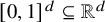 by showing that the relevant condition must be ‘a subset of an
$F_\sigma $
by showing that the relevant condition must be ‘a subset of an
$F_\sigma $
 purely
$1$
purely
$1$
 -unrectifiable’. Against this background, the present paper achieves the following significant advances:
-
• In Theorem 1.1, we establish that inside any given set S the set of non-differentiability points of a typical Lipschitz mapping is a residual subset of S, no matter on what (bounded, normed) domain (containing S) the space of Lipschitz mappings is considered. This holds for vector-valued (Y-valued) mappings. The norms on X and Y are arbitrary, as long as Y is Banach. Non-differentiability can be strengthened to extreme non-differentiability which still holds at residually many points.
-
• In Theorem 1.2 we determine that on an arbitrary subset of any given $F_{\sigma }$
 purely
$1$
-unrectifiable set, a typical Y-valued Lipschitz mapping is nowhere differentiable in the extreme sense.
purely
$1$
-unrectifiable set, a typical Y-valued Lipschitz mapping is nowhere differentiable in the extreme sense.


Versions of these two results were known only in the special case of functions from
$\mathbb {R}^d$
 to
$\mathbb {R}$
to
$\mathbb {R}$
 , see [Reference Loewen and Wang20, Theorem 4] and [Reference Dymond and Maleva13]. We point out straight away that typical behaviour of scalar-valued Lipschitz functions has no direct implications for vector-valued mappings, even from
$\mathbb {R}^d$
, see [Reference Loewen and Wang20, Theorem 4] and [Reference Dymond and Maleva13]. We point out straight away that typical behaviour of scalar-valued Lipschitz functions has no direct implications for vector-valued mappings, even from
$\mathbb {R}^d$
 to
$\mathbb {R}^l$
to
$\mathbb {R}^l$
 when
$l>1$
when
$l>1$
 ; see [Reference Dymond and Maleva13, Theorem 6.1]. The results of the present paper also go significantly beyond the premises of [Reference Dymond and Maleva13] by allowing arbitrary norms into consideration and replacing directional non-differentiability by extreme non-differentiability.
This article further acts as an Erratum to [Reference Dymond and Maleva13, Remarks 2.9 and 3.18]. The authors hereby retract these two remarks, which are shown to be invalid by the present article; see Corollary 2.5. We further note that the content of those two remarks does not affect any of the results or indeed anything at all in the rest of the paper [Reference Dymond and Maleva13].
1.1 Main results
Given a topological space Z, we say that a typical element of Z possesses a certain property if the collection of those elements of Z having that property forms a residual subset of Z. If Z is a complete metric space, then its residual subsets are dense in Z, by the Baire Category theorem, hence a condition satisfied by a typical element is satisfied by elements of a dense
$G_{\delta }$
 subset of the space.
It is therefore important to note that the meaning of ‘typical’ depends on the ambient space. We thus need to clarify, as we do in Section 2.4, whether a typical Lipschitz mapping is to be understood relative to the space of all Lipschitz mappings, or only those with Lipschitz constant bounded by L for certain
$L>0$
 ; whether the mappings are defined on the whole space or on a certain subset; and what topology (or metric) is used on the space of Lipschitz mappings.
We presently state the first main result of this paper; see Sections 2.1 and 2.4 for detailed explanation of the notation involved.
Theorem 1.1. Let X be a normed space, Y be a Banach space, W be a separable subspace of
$\mathcal {L}(X,Y)$
 , Q be a bounded subset of X and
$E\subseteq \operatorname {Int} Q$
, Q be a bounded subset of X and
$E\subseteq \operatorname {Int} Q$
 . Then there is a residual subset
$\mathcal {F}$
. Then there is a residual subset
$\mathcal {F}$
 of
$(\operatorname {Lip}_{1}(Q,Y),\left \|\cdot \right \|_{\infty })$
of
$(\operatorname {Lip}_{1}(Q,Y),\left \|\cdot \right \|_{\infty })$
 such that for every
$f\in \mathcal {F}$
such that for every
$f\in \mathcal {F}$
 the set

is residual in E.
Here
$\mathbb {B}_{W}$
 is the closed unit ball of W,
$\mathcal {L}(X,Y)$
is the closed unit ball of W,
$\mathcal {L}(X,Y)$
 is the space of bounded linear operators
$X\to Y$
is the space of bounded linear operators
$X\to Y$
 and
$\mathcal {D}_{f}(\mathbf {x})$
and
$\mathcal {D}_{f}(\mathbf {x})$
 is the collection of those operators which, in a specific sense, behave like a derivative of f at
$\mathbf {x}$
is the collection of those operators which, in a specific sense, behave like a derivative of f at
$\mathbf {x}$
 ; for the precise definition of
$\mathcal {D}_{f}(\mathbf {x})$
; for the precise definition of
$\mathcal {D}_{f}(\mathbf {x})$
 see (2.1) below. The inclusion
$\mathcal {D}_{f}(\mathbf {x})\supseteq \mathbb {B}_{W}$
see (2.1) below. The inclusion
$\mathcal {D}_{f}(\mathbf {x})\supseteq \mathbb {B}_{W}$
 for non-trivial W and points
$\mathbf {x}\in \mathcal {N}_{f,W}$
for non-trivial W and points
$\mathbf {x}\in \mathcal {N}_{f,W}$
 in Theorem 1.1 implies, in particular, that
$\mathcal {N}_{f,W}$
in Theorem 1.1 implies, in particular, that
$\mathcal {N}_{f,W}$
 is contained in the set of Gâteaux non-differentiability points of f. However, this condition should be interpreted as a very strong form of non-differentiability. We elaborate on this presently.
A particularly strong failure of differentiability of a mapping at a point, considered in [Reference Maleva and Preiss21, Theorem 1.9], happens when many different linear mappings simultaneously behave like a derivative of the mapping. Note that if f is Gâteaux differentiable then either
$\mathcal {D}_{f}(\mathbf {x})$
 is empty, or it is the singleton set containing only the Gâteaux derivative of f; if f is Fréchet differentiable at
$\mathbf {x}$
is empty, or it is the singleton set containing only the Gâteaux derivative of f; if f is Fréchet differentiable at
$\mathbf {x}$
 , then
$\mathcal {D}_{f}(\mathbf {x})=\left \{Df(\mathbf {x})\right \}$
, then
$\mathcal {D}_{f}(\mathbf {x})=\left \{Df(\mathbf {x})\right \}$
 . Accordingly, the size of the set
$\mathcal {D}_{f}(\mathbf {x})$
. Accordingly, the size of the set
$\mathcal {D}_{f}(\mathbf {x})$
 is a measure of the severity of non-differentiability of f at
$\mathbf {x}$
is a measure of the severity of non-differentiability of f at
$\mathbf {x}$
 . In the case when
$\mathcal {L}(X,Y)$
. In the case when
$\mathcal {L}(X,Y)$
 is separable (e.g., when X is finite-dimensional and Y is separable), the most extreme form of non-differentiability of a
$1$
is separable (e.g., when X is finite-dimensional and Y is separable), the most extreme form of non-differentiability of a
$1$
 -Lipschitz f at
$\mathbf {x}$
-Lipschitz f at
$\mathbf {x}$
 occurs if
$\mathcal {D}_{f}(\mathbf {x})=\mathbb {B}_{\mathcal {L}(X,Y)}$
occurs if
$\mathcal {D}_{f}(\mathbf {x})=\mathbb {B}_{\mathcal {L}(X,Y)}$
 , the closed unit ball of
$\mathcal {L}(X,Y)$
, the closed unit ball of
$\mathcal {L}(X,Y)$
 .
.
When
$\mathcal {L}(X,Y)$
 is non-separable, it is impossible to achieve
$\mathcal {D}_f(\mathbf {x})=\mathbb {B}_{\mathcal {L}(X,Y)}$
is non-separable, it is impossible to achieve
$\mathcal {D}_f(\mathbf {x})=\mathbb {B}_{\mathcal {L}(X,Y)}$
 , as we show, in Lemma 2.1 below, that
$\mathcal {D}_{f}(\mathbf {x})$
, as we show, in Lemma 2.1 below, that
$\mathcal {D}_{f}(\mathbf {x})$
 is always separable. Qualitatively, the strongest form of non-differentiability of a
$1$
is always separable. Qualitatively, the strongest form of non-differentiability of a
$1$
 -Lipschitz f that may hold in such case is
$\mathcal {D}_{f}(\mathbf {x})\supseteq \mathbb {B}_{W}$
-Lipschitz f that may hold in such case is
$\mathcal {D}_{f}(\mathbf {x})\supseteq \mathbb {B}_{W}$
 for an infinite-dimensional, separable subspace W of
$\mathcal {L}(X,Y)$
for an infinite-dimensional, separable subspace W of
$\mathcal {L}(X,Y)$
 . For any such W, this is what we achieve for a typical
$1$
. For any such W, this is what we achieve for a typical
$1$
 -Lipschitz f.
In light of [Reference Dymond and Maleva13, Theorem 2.2], concerning non-differentiability of a typical (real-valued) Lipschitz function at every point of an arbitrary subset of any
$F_\sigma $
 purely
$1$
purely
$1$
 -unrectifiable subset of
$\mathbb {R}^{d}$
-unrectifiable subset of
$\mathbb {R}^{d}$
 , one asks if the conclusion of Theorem 1.1, where the settings are much more general, can be strengthened for such sets. We answer this for finite-dimensional domains in the affirmative in our second main result:
Theorem 1.2. Let X be a finite-dimensional normed space, Y be a Banach space, W be a separable subspace of
$\mathcal {L}(X,Y)$
 ,
$Q\subseteq X$
,
$Q\subseteq X$
 be bounded and
$E\subseteq \operatorname {Int}(Q)$
be bounded and
$E\subseteq \operatorname {Int}(Q)$
 be a subset of an
$F_\sigma $
be a subset of an
$F_\sigma $
 purely
$1$
purely
$1$
 -unrectifiable set in X. Then
$\mathcal {D}_{f}(\mathbf {x})\supseteq \mathbb {B}_{W}$
-unrectifiable set in X. Then
$\mathcal {D}_{f}(\mathbf {x})\supseteq \mathbb {B}_{W}$
 for a typical
$f\in (\operatorname {Lip}_{1}(Q,Y),\left \|\cdot \right \|_{\infty })$
for a typical
$f\in (\operatorname {Lip}_{1}(Q,Y),\left \|\cdot \right \|_{\infty })$
 and every
$\mathbf {x}\in E$
and every
$\mathbf {x}\in E$
 .
.
Theorem 1.2 also strengthens previous results in this direction obtained in [Reference Dymond and Maleva13, Theorem 2.7] and in [Reference Merlo24]: significant gains being that it caters for infinite-dimensional spaces Y, any norms on X and Y, as long as Y is Banach, and the derivative ratios ‘see’ all possible linear operators
$T\in W$
 on arbitrarily small scales.
2 Preliminaries and notation
2.1 General notation and differentiability notions
Given a normed vector space X, we let
$\left \|\cdot \right \|_{X}$
 denote its norm,
$\mathbb {B}_{X}$
denote its norm,
$\mathbb {B}_{X}$
 its closed unit ball and
$\mathbb {S}_X$
its closed unit ball and
$\mathbb {S}_X$
 its unit sphere. An open ball in X with centre
$\mathbf {x}$
its unit sphere. An open ball in X with centre
$\mathbf {x}$
 and radius r will be written as
$B_{X}(\mathbf {x},r)$
and radius r will be written as
$B_{X}(\mathbf {x},r)$
 and for closed balls we write
$\overline {B}_{X}$
and for closed balls we write
$\overline {B}_{X}$
 instead of
$B_{X}$
instead of
$B_{X}$
 . The origin in X will be denoted by
$\mathbf {0}_{X}$
. The origin in X will be denoted by
$\mathbf {0}_{X}$
 . If Y is an additional normed vector space, we let
$\mathcal {L}(X,Y)$
. If Y is an additional normed vector space, we let
$\mathcal {L}(X,Y)$
 denote the space of bounded linear operators
$X\to Y$
denote the space of bounded linear operators
$X\to Y$
 . The operator norm on
$\mathcal {L}(X,Y)$
. The operator norm on
$\mathcal {L}(X,Y)$
 is denoted by
$\left \|\cdot \right \|_{\operatorname {op}}$
is denoted by
$\left \|\cdot \right \|_{\operatorname {op}}$
 . For a subset Q of a topological space, we let
$\operatorname {Int} Q$
. For a subset Q of a topological space, we let
$\operatorname {Int} Q$
 denote the interior of Q. For a mapping
$f\colon Q\subseteq X\to Y$
denote the interior of Q. For a mapping
$f\colon Q\subseteq X\to Y$
 and
$\mathbf {x}\in \operatorname {Int} Q$
and
$\mathbf {x}\in \operatorname {Int} Q$
 we let

Observe that if f is
$1$
 -Lipschitz, we have
$\mathcal {D}_{f}(\mathbf {x})\subseteq \mathbb {B}_{\mathcal {L}(X,Y)}$
-Lipschitz, we have
$\mathcal {D}_{f}(\mathbf {x})\subseteq \mathbb {B}_{\mathcal {L}(X,Y)}$
 for every
$\mathbf {x}\in \operatorname {Int} Q$
for every
$\mathbf {x}\in \operatorname {Int} Q$
 .
.
Finally, we will refer to a subset
$\Gamma $
 of a metric space
$(M,d)$
of a metric space
$(M,d)$
 as uniformly separated if
$\inf \left \{d(\mathbf {x},\mathbf {y})\colon \mathbf {x},\mathbf {y}\in \Gamma ,\,\mathbf {x}\neq \mathbf {y}\right \}>0$
as uniformly separated if
$\inf \left \{d(\mathbf {x},\mathbf {y})\colon \mathbf {x},\mathbf {y}\in \Gamma ,\,\mathbf {x}\neq \mathbf {y}\right \}>0$
 . For such a set
$\Gamma $
. For such a set
$\Gamma $
 and
$s>0$
and
$s>0$
 , we call
$\Gamma $
, we call
$\Gamma $
 s-separated if
$\inf \left \{d(\mathbf {x},\mathbf {y})\colon \mathbf {x},\mathbf {y}\in \Gamma ,\,\mathbf {x}\neq \mathbf {y}\right \}\geq s$
s-separated if
$\inf \left \{d(\mathbf {x},\mathbf {y})\colon \mathbf {x},\mathbf {y}\in \Gamma ,\,\mathbf {x}\neq \mathbf {y}\right \}\geq s$
 .
.
2.2 Optimality and comparison with previous results
Taking W in Theorems 1.1 and 1.2 as any non-trivial, separable subspace of
$\mathcal {L}(X,Y)$
 ensures that the set
$\mathcal {N}_{f,W}$
ensures that the set
$\mathcal {N}_{f,W}$
 is contained in the set of points of Gâteaux non-differentiability of f. Moreover, when
$\mathcal {L}(X,Y)$
is contained in the set of points of Gâteaux non-differentiability of f. Moreover, when
$\mathcal {L}(X,Y)$
 is itself separable, we may take
$W=\mathcal {L}(X,Y)$
is itself separable, we may take
$W=\mathcal {L}(X,Y)$
 . In this case we get that for a typical
$f\in \operatorname {Lip}_{1}(Q,Y)$
. In this case we get that for a typical
$f\in \operatorname {Lip}_{1}(Q,Y)$
 the set
$\mathcal {D}_{f}(\mathbf {x})$
the set
$\mathcal {D}_{f}(\mathbf {x})$
 is maximum possible, as it is equal to
$\mathbb {B}_{W}=\mathbb {B}_{\mathcal {L}(X,Y)}$
is maximum possible, as it is equal to
$\mathbb {B}_{W}=\mathbb {B}_{\mathcal {L}(X,Y)}$
 , at a typical point
$\mathbf {x}$
, at a typical point
$\mathbf {x}$
 of E (and at every
$\mathbf {x}\in E$
of E (and at every
$\mathbf {x}\in E$
 in the premises of Theorem 1.2). In the following lemma we show that it is not possible to omit the separability condition on W in Theorems 1.1 and 1.2.
Lemma 2.1. Let X and Y be normed spaces,
$Q\subseteq X$
 ,
$\mathbf {x}\in \operatorname {Int} Q$
,
$\mathbf {x}\in \operatorname {Int} Q$
 and
$f\colon Q\to Y$
and
$f\colon Q\to Y$
 be a mapping. Then the set
$\mathcal {D}_{f}(\mathbf {x})$
be a mapping. Then the set
$\mathcal {D}_{f}(\mathbf {x})$
 is separable and closed in
$(\mathcal {L}(X,Y),\left \|\cdot \right \|_{\operatorname {op}})$
is separable and closed in
$(\mathcal {L}(X,Y),\left \|\cdot \right \|_{\operatorname {op}})$
 .
.
Proof. Let
$r>0$
 be small enough so that
$B_{X}(\mathbf {x},r)\subseteq Q$
be small enough so that
$B_{X}(\mathbf {x},r)\subseteq Q$
 . For each rational
$q\in \mathbb {Q}\cap (0,r)$
. For each rational
$q\in \mathbb {Q}\cap (0,r)$
 and each
$n\in \mathbb {N}$
and each
$n\in \mathbb {N}$
 choose
${T}_{q,n}\in {\mathcal {L}(X,Y)}$
choose
${T}_{q,n}\in {\mathcal {L}(X,Y)}$
 such that

We show that
$\mathcal {D}_{f}(\mathbf {x})\subseteq \overline {\left \{T_{q,n}\colon q\in \mathbb {Q}\cap (0,r),\, n\in \mathbb {N}\right \}}$
 , where the closure is taken with respect to the operator norm.
Indeed, consider arbitrary
${T}_0\in \mathcal {D}_{f}(\mathbf {x})$
 and
$\varepsilon>0$
and
$\varepsilon>0$
 . Let
$n>3/\varepsilon $
. Let
$n>3/\varepsilon $
 and choose
$q\in \mathbb {Q}\cap (0,r)$
and choose
$q\in \mathbb {Q}\cap (0,r)$
 so that

Then, for every
$\mathbf {u}\in \overline {B}_{X}(\mathbf {0}_X,q)$
 we have

which implies
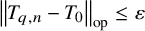
$\left \|{T}_{q,n}-{T}_0\right \|_{\operatorname {op}}\leq \varepsilon $
 .
.
To show that
$\mathcal {D}_{f}(\mathbf {x})$
 is closed, assume
$T_k\in \mathcal {D}_{f}(\mathbf {x})$
is closed, assume
$T_k\in \mathcal {D}_{f}(\mathbf {x})$
 converge in the operator norm to
$T_0$
converge in the operator norm to
$T_0$
 . Fix an arbitrary
$\varepsilon>0$
. Fix an arbitrary
$\varepsilon>0$
 and choose
$n\ge 1$
and choose
$n\ge 1$
 and
$0<\rho <\varepsilon $
and
$0<\rho <\varepsilon $
 such that
$\left \|T_n-T_0\right \|_{\operatorname {op}}<\varepsilon /2$
such that
$\left \|T_n-T_0\right \|_{\operatorname {op}}<\varepsilon /2$
 and
$\frac 1\rho \left \|f(\mathbf {x}+\mathbf {u})-f(\mathbf {x})-T_n\mathbf {u}\right \|_{Y}<\varepsilon /2$
and
$\frac 1\rho \left \|f(\mathbf {x}+\mathbf {u})-f(\mathbf {x})-T_n\mathbf {u}\right \|_{Y}<\varepsilon /2$
 whenever
$\left \|\mathbf {u}\right \|_{X}\le \rho $
whenever
$\left \|\mathbf {u}\right \|_{X}\le \rho $
 . Then for all
$\mathbf {u}\in \overline {B}_X(\mathbf {0}_X,\rho )$
. Then for all
$\mathbf {u}\in \overline {B}_X(\mathbf {0}_X,\rho )$


From the arbitrariness of
$\varepsilon>0$
 we conclude
$T_0\in \mathcal {D}_f(\mathbf {x})$
we conclude
$T_0\in \mathcal {D}_f(\mathbf {x})$
 .
.
Let us record a simple comparison, in the case of real-valued f, of the set
$\mathcal {D}_{f}(\mathbf {x})$
 with the Dini subgradient
$\hat {\partial }f(\mathbf {x})$
with the Dini subgradient
$\hat {\partial }f(\mathbf {x})$
 of f at
$\mathbf {x}$
of f at
$\mathbf {x}$
 , considered in [Reference Loewen and Wang20]. Let
$f\colon X\to \mathbb {R}$
, considered in [Reference Loewen and Wang20]. Let
$f\colon X\to \mathbb {R}$
 be a function,
$\mathbf {x}\in X$
be a function,
$\mathbf {x}\in X$
 and for each
$\mathbf {v}\in X$
and for each
$\mathbf {v}\in X$
 consider the lower Dini directional derivative

The Dini subgradient of f at
$\mathbf {x}$
 is then defined by

Lemma 2.2. Let X be a normed space,
$f\colon X\to \mathbb {R}$
 be a
$1$
be a
$1$
 -Lipschitz function,
$\mathbf {x},\mathbf {v}\in X$
-Lipschitz function,
$\mathbf {x},\mathbf {v}\in X$
 and
$\mathbf {y}^{\ast },\mathbf {z}^{\ast }\in \mathcal {D}_{f}(\mathbf {x})$
and
$\mathbf {y}^{\ast },\mathbf {z}^{\ast }\in \mathcal {D}_{f}(\mathbf {x})$
 be such that
$\mathbf {z}^{\ast }(\mathbf {v})<0<\mathbf {y}^{\ast }(\mathbf {v})$
be such that
$\mathbf {z}^{\ast }(\mathbf {v})<0<\mathbf {y}^{\ast }(\mathbf {v})$
 . Then
$\hat {\partial }f(\mathbf {x})=\emptyset $
. Then
$\hat {\partial }f(\mathbf {x})=\emptyset $
 .
.
Proof. Observe that
$\mathbf {z}^{\ast }\in \mathcal {D}_{f}(\mathbf {x})$
 and
$\mathbf {z}^{\ast }(\mathbf {v})<0$
and
$\mathbf {z}^{\ast }(\mathbf {v})<0$
 implies
$f_{+}(\mathbf {x};\mathbf {v})\leq \mathbf {z}^{\ast }(\mathbf {v})<0$
implies
$f_{+}(\mathbf {x};\mathbf {v})\leq \mathbf {z}^{\ast }(\mathbf {v})<0$
 . Similarly
$\mathbf {y}^{\ast }\in \mathcal {D}_{f}(\mathbf {x})$
. Similarly
$\mathbf {y}^{\ast }\in \mathcal {D}_{f}(\mathbf {x})$
 and
$\mathbf {y}^{\ast }(-\mathbf {v})<0$
and
$\mathbf {y}^{\ast }(-\mathbf {v})<0$
 implies
$f_{+}(\mathbf {x};-\mathbf {v})<0$
implies
$f_{+}(\mathbf {x};-\mathbf {v})<0$
 . Thus, we have
$f_{+}(\mathbf {x};\mathbf {v})<0$
. Thus, we have
$f_{+}(\mathbf {x};\mathbf {v})<0$
 and
$f_{+}(\mathbf {x};-\mathbf {v})<0$
and
$f_{+}(\mathbf {x};-\mathbf {v})<0$
 , which implies
$\hat {\partial }f(\mathbf {x})=\emptyset $
, which implies
$\hat {\partial }f(\mathbf {x})=\emptyset $
 .
.
Remark 2.3. Note that, by the Hahn-Banach theorem, given any
$\mathbf {v}\in X\setminus \left \{\mathbf {0}_X\right \}$
 , we may choose the functionals
$\mathbf {y}^{\ast },\mathbf {z}^*$
, we may choose the functionals
$\mathbf {y}^{\ast },\mathbf {z}^*$
 of norm
$1$
of norm
$1$
 such that
$\mathbf {y}^*(\mathbf {v})=\left \|\mathbf {v}\right \|_{X}$
such that
$\mathbf {y}^*(\mathbf {v})=\left \|\mathbf {v}\right \|_{X}$
 and
$\mathbf {z}^*(\mathbf {v})=-\left \|\mathbf {v}\right \|_{X}$
and
$\mathbf {z}^*(\mathbf {v})=-\left \|\mathbf {v}\right \|_{X}$
 . Therefore, Lemma 2.2 may be applied whenever
$\mathcal {D}_{f}(\mathbf {x})\supseteq \mathbb {S}_{X^{\ast }}$
. Therefore, Lemma 2.2 may be applied whenever
$\mathcal {D}_{f}(\mathbf {x})\supseteq \mathbb {S}_{X^{\ast }}$
 , the unit sphere of
$X^*$
, the unit sphere of
$X^*$
 .
.
It can also be easily seen from the example of
$f(\mathbf {x})=-\left \|\mathbf {x}\right \|\colon X\to \mathbb {R}$
 that a
$1$
that a
$1$
 -Lipschitz function may have
$\mathcal {D}_f(\mathbf {0}_X)=\hat {\partial }f(\mathbf {0}_X)=\emptyset $
-Lipschitz function may have
$\mathcal {D}_f(\mathbf {0}_X)=\hat {\partial }f(\mathbf {0}_X)=\emptyset $
 . Hence, there is no reverse implication to the statement of Lemma 2.2: emptiness of the Dini subgradient
$\hat {\partial }f(\mathbf {x})$
. Hence, there is no reverse implication to the statement of Lemma 2.2: emptiness of the Dini subgradient
$\hat {\partial }f(\mathbf {x})$
 does not imply any type of largeness of the set
$\mathcal {D}_{f}(\mathbf {x})$
does not imply any type of largeness of the set
$\mathcal {D}_{f}(\mathbf {x})$
 .
.
Thus Theorem 1.1, which proves
$\mathcal {D}_{f}(\mathbf {x})\supseteq \mathbb {B}_{X^{\ast }}\supseteq \mathbb {S}_{X^{\ast }}$
 is stronger than [Reference Loewen and Wang20, Theorem 4] even in the case when X is finite-dimensional and
$Y=\mathbb {R}$
is stronger than [Reference Loewen and Wang20, Theorem 4] even in the case when X is finite-dimensional and
$Y=\mathbb {R}$
 .
.
Remark 2.4. We also note that Theorem 1.1 is stronger than results obtained in [Reference Loewen and Wang20] in another aspect. The paper [Reference Loewen and Wang20] requires E to be equal to the whole space X while Theorem 1.1 allows any
$E\subseteq \operatorname {Int}(Q)$
 . This is crucial in order to refute [Reference Dymond and Maleva13, Remarks 2.9 and 3.18] discussed in the Introduction. We do that in the next corollary.
Corollary 2.5. Let
$d\ge 1$
 and
$S\subseteq (0,1)^d$
and
$S\subseteq (0,1)^d$
 be arbitrary. Then there is a residual subset
$\mathcal {F}$
be arbitrary. Then there is a residual subset
$\mathcal {F}$
 of
$\operatorname {Lip}_{1}([0,1]^d,\mathbb {R})$
of
$\operatorname {Lip}_{1}([0,1]^d,\mathbb {R})$
 such that for every
$f\in \mathcal {F}$
such that for every
$f\in \mathcal {F}$
 the set of non-differentiability points of f in S is residual in S.
Proof. Apply Theorem 1.1 to
$X=\mathbb {R}^d$
 equipped with the Euclidean norm,
$Y=\mathbb {R}$
equipped with the Euclidean norm,
$Y=\mathbb {R}$
 ,
$W=\mathcal {L}(\mathbb {R}^d,\mathbb {R})$
,
$W=\mathcal {L}(\mathbb {R}^d,\mathbb {R})$
 ,
$Q=[0,1]^d$
,
$Q=[0,1]^d$
 and
$E=S$
and
$E=S$
 .
.
Results related to Theorems 1.1 and 1.2 for the case of real-valued Lipschitz functions f with Euclidean domains are given in [Reference Marchese and Schioppa22], where the set
$\text {Tan}(f,\mathbf{x})$
 is studied; both
$\text {Tan}(f,\mathbf{x})$
is studied; both
$\text {Tan}(f,\mathbf{x})$
 and the set
$\mathcal {D}_{f}(\mathbf{x})$
and the set
$\mathcal {D}_{f}(\mathbf{x})$
 from the present work may be regarded as generalised versions of derivative of f at the point x. Whereas Theorem 1.1, roughly speaking, says that for typical f at typical
$\mathbf{x}\in E$
from the present work may be regarded as generalised versions of derivative of f at the point x. Whereas Theorem 1.1, roughly speaking, says that for typical f at typical
$\mathbf{x}\in E$
 , the set of linear ‘derivative candidates’
$\mathcal {D}_{f}(\mathbf{x})$
, the set of linear ‘derivative candidates’
$\mathcal {D}_{f}(\mathbf{x})$
 is maximal, the paper [Reference Marchese and Schioppa22] proves the existence, for a Radon measure
$\mu $
is maximal, the paper [Reference Marchese and Schioppa22] proves the existence, for a Radon measure
$\mu $
 on
$\mathbb {R}^d$
on
$\mathbb {R}^d$
 , of one Lipschitz function with prescribed ‘derivative candidates’ (admissible blow-ups) which may also be non-linear Lipschitz, on a
$\mu $
, of one Lipschitz function with prescribed ‘derivative candidates’ (admissible blow-ups) which may also be non-linear Lipschitz, on a
$\mu $
 -large set of
$\mathbf{x}$
-large set of
$\mathbf{x}$
 . A second main result, [Reference Marchese and Schioppa22, Theorem 1.5 (II) and Remark 1.6(ii)] proves that for a singular measure
$\mu $
. A second main result, [Reference Marchese and Schioppa22, Theorem 1.5 (II) and Remark 1.6(ii)] proves that for a singular measure
$\mu $
 on
$\mathbb {R}$
on
$\mathbb {R}$
 , a typical
$1$
, a typical
$1$
 -Lipschitz function
$f\colon \mathbb {R}\to \mathbb {R}$
-Lipschitz function
$f\colon \mathbb {R}\to \mathbb {R}$
 has
$\text {Tan}(f,\mathbf{x})$
has
$\text {Tan}(f,\mathbf{x})$
 maximal at
$\mu $
maximal at
$\mu $
 -a.e.
$\mathbf{x}$
-a.e.
$\mathbf{x}$
 . Of course, in these settings
$E=\operatorname {supp}(\mu )$
. Of course, in these settings
$E=\operatorname {supp}(\mu )$
 is a closed purely
$1$
is a closed purely
$1$
 -unrectifiable set, so this is a similar statement to the restriction of Theorem 1.2 to the special case of
$X=\mathbb {R}$
-unrectifiable set, so this is a similar statement to the restriction of Theorem 1.2 to the special case of
$X=\mathbb {R}$
 and
$Y=\mathbb {R}$
and
$Y=\mathbb {R}$
 . Note, however, some differences in the conclusions:
$\mu $
. Note, however, some differences in the conclusions:
$\mu $
 -a.e.
$\mathbf{x}\in E$
-a.e.
$\mathbf{x}\in E$
 in [Reference Marchese and Schioppa22] versus every
$\mathbf{x}\in E$
in [Reference Marchese and Schioppa22] versus every
$\mathbf{x}\in E$
 in Theorem 1.2 and that [Reference Marchese and Schioppa22] detects non-linear ‘derivative candidates’.
We would also like to mention [Reference Aliaga, Gartland, Petitjean and Procházka3], which proves that a compact metric space M is purely
$1$
 -unrectifiable if and only if the locally flat Lipschitz functions
$M\to \mathbb {R}$
-unrectifiable if and only if the locally flat Lipschitz functions
$M\to \mathbb {R}$
 separate points uniformly, hence showing that these domains possess Lipschitz functions which may grow almost like a distance between points despite having zero derivative on the purely
$1$
separate points uniformly, hence showing that these domains possess Lipschitz functions which may grow almost like a distance between points despite having zero derivative on the purely
$1$
 -unrectifiable domain. We expect that further comparison of our work with [Reference Aliaga, Gartland, Petitjean and Procházka3], especially concerning the behaviour of Lipschitz mappings versus their derivatives, will provide additional insight into pure unrectifiability.
2.3 Purely
$1$
-unrectifiable sets

Let
$(X,\|\cdot \|_X)$
 be a normed space and
$\mathcal {H}^1$
be a normed space and
$\mathcal {H}^1$
 be the
$1$
be the
$1$
 -dimensional Hausdorff measure on X. As usual, see for example [Reference Mattila23], we say that
$E\subseteq X$
-dimensional Hausdorff measure on X. As usual, see for example [Reference Mattila23], we say that
$E\subseteq X$
 is purely
$1$
is purely
$1$
 -unrectifiable if
$\mathcal {H}^1(E\cap \gamma (\mathbb {R}))=0$
-unrectifiable if
$\mathcal {H}^1(E\cap \gamma (\mathbb {R}))=0$
 for any Lipschitz curve
$\gamma \in \operatorname {Lip}(\mathbb {R},X)$
for any Lipschitz curve
$\gamma \in \operatorname {Lip}(\mathbb {R},X)$
 .
.
In terms of methods we employ to prove Theorems 1.1 and 1.2 we use that compact purely
$1$
 -unrectifiable sets satisfy a stronger condition, allowing us to approximate such sets by open neighbourhoods whose intersections with Lipschitz curves have small
$\mathcal {H}^1$
-unrectifiable sets satisfy a stronger condition, allowing us to approximate such sets by open neighbourhoods whose intersections with Lipschitz curves have small
$\mathcal {H}^1$
 measure.
The property we establish in Theorem C.2 is a variant of what is known as uniformly purely
$1$
 -unrectifiable, see [Reference Alberti, Csörnyei and Preiss1, Reference Csörnyei, Preiss and Tiser6, Reference Maleva and Preiss21], where some connections between the
$\sigma $
-unrectifiable, see [Reference Alberti, Csörnyei and Preiss1, Reference Csörnyei, Preiss and Tiser6, Reference Maleva and Preiss21], where some connections between the
$\sigma $
 -ideal of uniformly purely
$1$
-ideal of uniformly purely
$1$
 -unrectifiable subsets of
$\mathbb {R}^d$
-unrectifiable subsets of
$\mathbb {R}^d$
 with non-differentiability sets of Lipschitz functions are described. In [Reference Maleva and Preiss21, Theorem 1.13] it has been shown that for real-valued Lipschitz functions this non-differentiability may hold in an extreme way: the set of limits of differentiability ratios around each
$x\in E$
with non-differentiability sets of Lipschitz functions are described. In [Reference Maleva and Preiss21, Theorem 1.13] it has been shown that for real-valued Lipschitz functions this non-differentiability may hold in an extreme way: the set of limits of differentiability ratios around each
$x\in E$
 contains all
$\mathbb {B}_{\mathbb {R}^d}$
contains all
$\mathbb {B}_{\mathbb {R}^d}$
 for some functions f with
$\operatorname {Lip}(f)=1$
for some functions f with
$\operatorname {Lip}(f)=1$
 .
.
Furthermore, in [Reference Dymond and Maleva13, Theorem 2.2] it is proved that a subcollection of uniformly purely
$1$
 -unrectifiable sets, namely, a
$\sigma $
-unrectifiable sets, namely, a
$\sigma $
 -ideal of sets which can be covered by an
$F_\sigma $
-ideal of sets which can be covered by an
$F_\sigma $
 purely
$1$
purely
$1$
 -unrectifiable, that is, by a countable union of closed purely
$1$
-unrectifiable, that is, by a countable union of closed purely
$1$
 -unrectifiable sets, provides even stronger non-differentiability properties: a typical Lipschitz real-valued function is extremely non-differentiable at every point of such a set. In this paper we further establish that, if E is a subset of an
$F_\sigma $
-unrectifiable sets, provides even stronger non-differentiability properties: a typical Lipschitz real-valued function is extremely non-differentiable at every point of such a set. In this paper we further establish that, if E is a subset of an
$F_\sigma $
 purely
$1$
purely
$1$
 -unrectifiable set in a finite-dimensional domain, then a typical Lipschitz mapping into any Banach space exhibits extreme non-differentiability at every point of E.
Below we introduce notation we require to measure ‘uniformity’ of pure
$1$
 -unrectifiability of subsets of
$(X,\left \|\cdot \right \|_{X})$
-unrectifiability of subsets of
$(X,\left \|\cdot \right \|_{X})$
 . For every
$P\in X^{\ast }$
. For every
$P\in X^{\ast }$
 and
$\alpha \in (0,1)$
and
$\alpha \in (0,1)$
 , define the cone of directions around P with amplitude
$\alpha $
, define the cone of directions around P with amplitude
$\alpha $
 as
as

here
$P(\mathbf {v})$
 replaces the inner product with a direction vector, used in Euclidean settings. We let
$\Gamma _{P,\alpha }$
replaces the inner product with a direction vector, used in Euclidean settings. We let
$\Gamma _{P,\alpha }$
 be the collection of Lipschitz almost everywhere differentiable curves
$\gamma \in \operatorname {Lip}(\mathbb {R},X)$
be the collection of Lipschitz almost everywhere differentiable curves
$\gamma \in \operatorname {Lip}(\mathbb {R},X)$
 such that
$\gamma '(t)\in C_{P,\alpha }$
such that
$\gamma '(t)\in C_{P,\alpha }$
 for almost all t. Finally, the
$(P,\alpha )$
for almost all t. Finally, the
$(P,\alpha )$
 -width of any subset
$G\subseteq X$
-width of any subset
$G\subseteq X$
 is defined as follows:

In Theorem C.2 we prove, for a compact purely
$1$
 -unrectifiable subset E of a finite-dimensional space X, any
$P\in X^*$
-unrectifiable subset E of a finite-dimensional space X, any
$P\in X^*$
 and
$\varepsilon>0$
and
$\varepsilon>0$
 , the existence of an open neighbourhood
$G_\varepsilon \supset E$
, the existence of an open neighbourhood
$G_\varepsilon \supset E$
 , such that
$\xi (G_\varepsilon ,P,\varepsilon )<\varepsilon $
, such that
$\xi (G_\varepsilon ,P,\varepsilon )<\varepsilon $
 . Using that every Lipschitz curve may be covered, up to an
$\mathcal {H}^1$
. Using that every Lipschitz curve may be covered, up to an
$\mathcal {H}^1$
 -null set, by a union of countably many
$C^1$
-null set, by a union of countably many
$C^1$
 -smooth curves, see [Reference Mattila23, Theorem 15.21], one can establish that any set E satisfying this condition is purely
$1$
-smooth curves, see [Reference Mattila23, Theorem 15.21], one can establish that any set E satisfying this condition is purely
$1$
 -unrectifiable. The question about existence of such neighbourhoods for purely
$1$
-unrectifiable. The question about existence of such neighbourhoods for purely
$1$
 -unrectifiable sets which are not necessarily compact, is open in general, see, for example, [Reference Alberti, Csörnyei and Preiss1, Remark 8.12].
2.4 Lipschitz mappings
Given a metric space Q and a Banach space Y, we denote by
$\operatorname {Lip}_{1}(Q,Y)$
 the set of Lipschitz mappings
$f\colon Q\to Y$
the set of Lipschitz mappings
$f\colon Q\to Y$
 with
$\operatorname {Lip}(f)\leq 1$
with
$\operatorname {Lip}(f)\leq 1$
 . If Q is a bounded metric space, then
$\operatorname {Lip}_{1}(Q,Y)$
. If Q is a bounded metric space, then
$\operatorname {Lip}_{1}(Q,Y)$
 is a closed subset of the Banach space
$C_b(Q,Y)$
is a closed subset of the Banach space
$C_b(Q,Y)$
 of Y-valued continuous bounded functions on Q, with the norm

We require completeness of
$(\operatorname {Lip}_{1}(Q,Y),\left \|\cdot \right \|_{\infty })$
 in order for residual subsets of
$\operatorname {Lip}_{1}(Q,Y)$
in order for residual subsets of
$\operatorname {Lip}_{1}(Q,Y)$
 to be dense in
$\operatorname {Lip}_{1}(Q,Y)$
to be dense in
$\operatorname {Lip}_{1}(Q,Y)$
 , see Section 1.1.
Note that if X is a normed space and
$Q\subseteq X$
 is not bounded, one could still consider the space
$\operatorname {Lip}_{1}(Q,Y)$
is not bounded, one could still consider the space
$\operatorname {Lip}_{1}(Q,Y)$
 as a complete metric space with metric

This is the approach chosen in [Reference Loewen and Wang20]. In the present work, we elect to work only with bounded Q in order to be consistent with the papers [Reference Preiss and Tišer28] and [Reference Dymond and Maleva13]. However, we note that the proofs given in the present paper may be easily modified to obtain the same results for
$\operatorname {Lip}_{1}(Q,Y)$
 in the case Q is unbounded.
2.5 The Banach-Mazur game
To prove that a set is residual, that is, the complement of a set of first Baire category, we will make use of the Banach-Mazur game, see [Reference Kechris17, 8.H].
Given a topological space Z and its subset
$H\subseteq Z$
 , the Banach-Mazur game in Z with target H is played by two players, Player I and Player II, as follows: The game starts by Player I selecting a non-empty open subset
$U_{1}$
, the Banach-Mazur game in Z with target H is played by two players, Player I and Player II, as follows: The game starts by Player I selecting a non-empty open subset
$U_{1}$
 of Z. Player II must then respond by nominating a non-empty open subset
$V_{1}$
of Z. Player II must then respond by nominating a non-empty open subset
$V_{1}$
 of Z with
$V_{1}\subseteq U_{1}$
of Z with
$V_{1}\subseteq U_{1}$
 . In the k-th round of the game, with
$k\geq 2$
. In the k-th round of the game, with
$k\geq 2$
 , Player I chooses a non-empty open set
$U_{k}\subseteq V_{k-1}$
, Player I chooses a non-empty open set
$U_{k}\subseteq V_{k-1}$
 and Player II returns a non-empty open set
$V_{k}\subseteq U_{k}$
and Player II returns a non-empty open set
$V_{k}\subseteq U_{k}$
 . Thus, a run of the game is described by an infinite sequence of open sets

where the sets
$U_{k}$
 are the choices of Player I and the sets
$V_{k}$
are the choices of Player I and the sets
$V_{k}$
 are those of Player II. Player II wins the game if

Otherwise Player I wins.
The Banach-Mazur game can be used to determine whether a subset of a topological space is residual. More precisely, for any non-empty topological space Z and any subset H of Z it holds that H is a residual subset of Z if and only if Player II has a winning strategy in the Banach-Mazur game in Z with target set H; see [Reference Kechris17, Theorem 8.33].
In the case that Z is a metric space (as will be the case in our setting), open balls may be used in place of the open sets
$U_{k}$
 and
$V_{k}$
and
$V_{k}$
 above, see also [Reference Dymond and Maleva13, Theorem 3.16]. Thus, the moves of Player I and Player II effectively become a choice of pairs
$(\mathbf {x},r)$
above, see also [Reference Dymond and Maleva13, Theorem 3.16]. Thus, the moves of Player I and Player II effectively become a choice of pairs
$(\mathbf {x},r)$
 where
$\mathbf {x}\in Z$
where
$\mathbf {x}\in Z$
 prescribes the centre of the ball and
$r>0$
prescribes the centre of the ball and
$r>0$
 the radius. In the special case when Player II is always able to ensure that the intersection
$\bigcap _{k\in \mathbb {N}} V_k=\bigcap _{k\in \mathbb {N}}B(\mathbf{y}_k,s_k)$
the radius. In the special case when Player II is always able to ensure that the intersection
$\bigcap _{k\in \mathbb {N}} V_k=\bigcap _{k\in \mathbb {N}}B(\mathbf{y}_k,s_k)$
 of their choices is a singleton
$\mathbf{y}_0\in Z$
of their choices is a singleton
$\mathbf{y}_0\in Z$
 , to conclude that Player II wins it would be enough to verify
$\mathbf{y}_0\in H$
, to conclude that Player II wins it would be enough to verify
$\mathbf{y}_0\in H$
 for any run of the game.
3 A typical Lipschitz mapping is extremely non-differentiable at a typical point of a set
In this section we prove Theorem 1.1. For the proof of subsequent auxiliary lemmata we follow the convention that the infimum of the empty set is
$+\infty $
 . We also note that in any normed space a bounded non-empty subset has a non-empty boundary.
The next lemma is a generalisation of [Reference Dymond11, Lemma 3.1] for normed spaces instead of convex sets.
Lemma 3.1. Let X and Z be normed spaces,
$0<a<b$
 , and let
$f_1,f_2\colon X\to Z$
, and let
$f_1,f_2\colon X\to Z$
 be Lipschitz mappings such that
$\operatorname {Lip}(f_1)+\operatorname {Lip}(f_2)\le 1$
be Lipschitz mappings such that
$\operatorname {Lip}(f_1)+\operatorname {Lip}(f_2)\le 1$
 and
$f_1(\mathbf {0}_{X})=f_2(\mathbf {0}_{X})=\mathbf {0}_{Z}$
and
$f_1(\mathbf {0}_{X})=f_2(\mathbf {0}_{X})=\mathbf {0}_{Z}$
 . Then there exists a Lipschitz mapping
$\Phi =\Phi (a,b,f_1,f_2)\colon X\to Z$
. Then there exists a Lipschitz mapping
$\Phi =\Phi (a,b,f_1,f_2)\colon X\to Z$
 such that
-
(i) $\Phi (\mathbf {x})=f_1(\mathbf {x})$
whenever
$\left \|\mathbf {x}\right \|_{X}\le a$
. -
(ii) $\Phi (\mathbf {x})=f_2(\mathbf {x})$
whenever
$\left \|\mathbf {x}\right \|_{X}\ge b$
. -
(iii) $\operatorname {Lip}(\Phi )\leq 1+\frac {a}{b-a}$
. -
(iv) If $f_1=\mathbf {0}_{Z}$
is the constant
$\mathbf {0}_{Z}$
mapping, then
$\left \|\Phi (\mathbf {x})-f_2(\mathbf {x})\right \|_{Z}\le a\operatorname {Lip}(f_2)$
for all
$\mathbf {x}\in X$
. -
(v) If $f_2=\mathbf {0}_{Z}$
is the constant
$\mathbf {0}_{Z}$
mapping, then
$\left \|\Phi (\mathbf {x})\right \|_{Z}\leq b\operatorname {Lip}(f_1)$
for all
$\mathbf {x}\in X$
.









Proof. Define
$\Phi \colon X\to Z$
 by
by

Clearly,
$\Phi $
 satisfies (i) and (ii). Observe that
$\Phi $
satisfies (i) and (ii). Observe that
$\Phi $
 is a continuous mapping
$X\to Z$
is a continuous mapping
$X\to Z$
 . Moreover, since
$f_1,f_2\in \operatorname {Lip}_{1}$
. Moreover, since
$f_1,f_2\in \operatorname {Lip}_{1}$
 , in order to show that
$\Phi $
, in order to show that
$\Phi $
 is Lipschitz and to check (iii), it is enough to verify

whenever
$\left \|\mathbf {x}\right \|_{X},\left \|\mathbf {y}\right \|_{X}\in (a,b)$
 . To show this, fix such
$\mathbf {x},\mathbf {y}\in X$
. To show this, fix such
$\mathbf {x},\mathbf {y}\in X$
 and note first that

In several estimates that follow we will use that

This holds due to the condition
$f_{i}(\mathbf {0}_{X})=\mathbf {0}_{Z}$
 for
$i=1,2$
for
$i=1,2$
 . Assuming without loss of generality that
$\left \|\mathbf {y}\right \|_{X}\ge \left \|\mathbf {x}\right \|_{X}$
. Assuming without loss of generality that
$\left \|\mathbf {y}\right \|_{X}\ge \left \|\mathbf {x}\right \|_{X}$
 , the first term of (3.2) is bounded above by

The second term of (3.2) is bounded above by

Summing the derived upper bounds for the two terms of (3.2) establishes (3.1).
Finally, if
$f_1=\mathbf {0}_{Z}$
 , then

and if
$f_2=\mathbf {0}_{Z}$
 , then

Applying (3.3) to these formulae, we verify (iv) and (v).
The following lemma provides a construction which will be used to define a winning strategy for Player II in the Banach-Mazur game in Lemma 3.4. The property (3.5) of g ensures that this new
$1$
 -Lipschitz mapping ‘sees’ L as its derivative in a small neighbourhood of the given set
$\Gamma $
-Lipschitz mapping ‘sees’ L as its derivative in a small neighbourhood of the given set
$\Gamma $
 .
.
Lemma 3.2. Let X and Y be normed spaces and
$Q\subseteq X$
 be a bounded set with
$\operatorname {Int} Q\neq \emptyset $
be a bounded set with
$\operatorname {Int} Q\neq \emptyset $
 . Let
$r\in (0,1)$
. Let
$r\in (0,1)$
 ,
$L\in \mathcal {L}(X,Y)$
,
$L\in \mathcal {L}(X,Y)$
 with
$\left \|L\right \|_{\operatorname {op}}\leq 1-r$
with
$\left \|L\right \|_{\operatorname {op}}\leq 1-r$
 and
$f\in \operatorname {Lip}_{1}(Q,Y)$
and
$f\in \operatorname {Lip}_{1}(Q,Y)$
 . Let
$\emptyset \ne \Gamma \subseteq \operatorname {Int} Q$
. Let
$\emptyset \ne \Gamma \subseteq \operatorname {Int} Q$
 be a uniformly separated set with

Then there exist
$\alpha \in (0,r)$
 and
$g\in \operatorname {Lip}_{1}(Q,Y)$
and
$g\in \operatorname {Lip}_{1}(Q,Y)$
 such that
$\left \|g-f\right \|_{\infty }<r$
such that
$\left \|g-f\right \|_{\infty }<r$
 and
and

Proof. The approach we take to modify the mapping f to arrive at g is similar to that taken in [Reference Dymond11, Lemma 3.3].
The conclusion of this lemma is valid for f if and only if it is valid for any mapping of the form
$f+p$
 , where
$p\colon Q\to Y$
, where
$p\colon Q\to Y$
 is a constant mapping. Therefore, we may assume that
$\mathbf {0}_{Y}\in f(\Gamma )$
is a constant mapping. Therefore, we may assume that
$\mathbf {0}_{Y}\in f(\Gamma )$
 . Lipschitz mappings
$h\colon Q\to Y$
. Lipschitz mappings
$h\colon Q\to Y$
 with the property
$\mathbf {0}_{Y}\in h(Q)$
with the property
$\mathbf {0}_{Y}\in h(Q)$
 satisfy
$\left \|h(\mathbf {x})\right \|_{Y}\leq \operatorname {Lip}(h)\operatorname {diam} Q$
satisfy
$\left \|h(\mathbf {x})\right \|_{Y}\leq \operatorname {Lip}(h)\operatorname {diam} Q$
 for all
$\mathbf {x}\in Q$
for all
$\mathbf {x}\in Q$
 . This fact will be used later in the proof.
Fix
$s\in (0,1)$
 small enough so that
$\Gamma $
small enough so that
$\Gamma $
 is
$4s$
is
$4s$
 -separated and the infimum of (3.4) is at least
$4s$
-separated and the infimum of (3.4) is at least
$4s$
 . Choose a parameter

and define a mapping
$g_{0}\colon Q\to Y$
 by
by

where
$\Phi :=\Phi (\beta ,s,\mathbf {0}_{X},\operatorname {Id}_X)\colon X\to X$
 is the mapping given by Lemma 3.1 applied to X,
$Z=X$
is the mapping given by Lemma 3.1 applied to X,
$Z=X$
 ,
$a=\beta $
,
$a=\beta $
 ,
$b=s$
,
$b=s$
 ,
$f_{1}=\mathbf {0}_{X}$
,
$f_{1}=\mathbf {0}_{X}$
 (the constant mapping
$X\to X$
(the constant mapping
$X\to X$
 with value
$\mathbf {0}_{X}$
with value
$\mathbf {0}_{X}$
 ) and
$f_{2}=\operatorname {Id}_{X}$
) and
$f_{2}=\operatorname {Id}_{X}$
 . Here we used Lemma 3.1(v) to conclude
$\left \|\Phi (\mathbf {z}-\mathbf {x})\right \|_{X}\le \beta <s$
. Here we used Lemma 3.1(v) to conclude
$\left \|\Phi (\mathbf {z}-\mathbf {x})\right \|_{X}\le \beta <s$
 , so that
$\mathbf {x}+\Phi (\mathbf {z}-\mathbf {x})\in Q$
, so that
$\mathbf {x}+\Phi (\mathbf {z}-\mathbf {x})\in Q$
 whenever
$\mathbf {x}\in \Gamma $
whenever
$\mathbf {x}\in \Gamma $
 and
$\mathbf {z}\in B_{X}(\mathbf {x},s)$
and
$\mathbf {z}\in B_{X}(\mathbf {x},s)$
 . Using again
$\beta <s$
. Using again
$\beta <s$
 and Lemma 3.1(i), we note that

It follows, in particular,

Further, we note that Lemma 3.1(iii) and (iv) imply
$g_0$
 is Lipschitz,

Let

Note
$\left \|T\right \|_{\operatorname {op}}\le 1$
 using
$\beta <rs$
using
$\beta <rs$
 and
$\left \|L\right \|_{\operatorname {op}}\le 1-r$
and
$\left \|L\right \|_{\operatorname {op}}\le 1-r$
 . Define
$g_{1}\colon Q\to Y$
. Define
$g_{1}\colon Q\to Y$
 by
by

where
$\Psi :=\Phi (\alpha ,\beta ,\operatorname {Id}_{X},\mathbf {0}_{X})\colon X\to X$
 is the mapping given by Lemma 3.1 applied to X,
$Z=X$
is the mapping given by Lemma 3.1 applied to X,
$Z=X$
 ,
$a=\alpha $
,
$a=\alpha $
 ,
$b=\beta $
,
$b=\beta $
 ,
$f_{1}=\operatorname {Id}_{X}$
,
$f_{1}=\operatorname {Id}_{X}$
 and
$f_{2}=\mathbf {0}_{X}$
and
$f_{2}=\mathbf {0}_{X}$
 . The properties of
$g_0$
. The properties of
$g_0$
 ,
$\Psi $
,
$\Psi $
 and (3.7) ensure that
$g_{1}$
and (3.7) ensure that
$g_{1}$
 is Lipschitz. We may estimate its Lipschitz constant as

where we used
$\alpha \leq \frac {\beta ^{2}}{s}$
 in the penultimate inequality. Moreover, we have

To verify the former, it is enough to observe, using (3.7),
$\left \|T\right \|_{\operatorname {op}}\leq 1$
 ,
$\operatorname {Lip}(\operatorname {Id}_X)=1$
,
$\operatorname {Lip}(\operatorname {Id}_X)=1$
 and Lemma 3.1(v), that for any
$\mathbf {z}\in B_{X}(\mathbf {x},\beta )$
and Lemma 3.1(v), that for any
$\mathbf {z}\in B_{X}(\mathbf {x},\beta )$
 with
$\mathbf {x}\in \Gamma $
with
$\mathbf {x}\in \Gamma $


Finally we set

so that
$g\in \operatorname {Lip}_{1} (Q,Y)$
 and
and

using
$\beta <s/2$
 from (3.6). Using the definition of
$\beta $
from (3.6). Using the definition of
$\beta $
 , we conclude that

It is clear that (3.5) is satisfied as
$g_1(\mathbf {x}+\mathbf {u})=g_1(\mathbf {x})+T\mathbf {u}$
 whenever
$\mathbf {x}\in \Gamma $
whenever
$\mathbf {x}\in \Gamma $
 and
$\left \|\mathbf {u}\right \|_{X}\le \alpha $
and
$\left \|\mathbf {u}\right \|_{X}\le \alpha $
 , from (3.8).
Lemma 3.3. Let X be a normed space, Q be a bounded subset of X and
$E\subseteq \operatorname {Int} Q$
 . Then there exists a sequence
$(\Gamma _{k})_{k\in \mathbb {N}}$
. Then there exists a sequence
$(\Gamma _{k})_{k\in \mathbb {N}}$
 of nested sets
$\Gamma _k\subseteq \Gamma _{k+1}\subseteq E$
of nested sets
$\Gamma _k\subseteq \Gamma _{k+1}\subseteq E$
 such that the union
$\bigcup _{k\ge 1}\Gamma _k$
such that the union
$\bigcup _{k\ge 1}\Gamma _k$
 is dense in E and each set
$\Gamma _{k}$
is dense in E and each set
$\Gamma _{k}$
 satisfies the hypothesis of Lemma 3.2, that is,
$\Gamma _k$
satisfies the hypothesis of Lemma 3.2, that is,
$\Gamma _k$
 satisfies (3.4) and is
$\delta _k$
satisfies (3.4) and is
$\delta _k$
 -separated for some
$\delta _k>0$
-separated for some
$\delta _k>0$
 .
.
Proof. If
$E=\emptyset $
 , let
$\Gamma _k=\emptyset $
, let
$\Gamma _k=\emptyset $
 for all
$k\in \mathbb N$
for all
$k\in \mathbb N$
 .
.
Assume
$E\ne \emptyset $
 . Let
$E_k=\left \{\mathbf {x}\in E\colon \operatorname {dist}_{X}(\mathbf {x},\partial Q)\geq 2^{-k}\right \}$
. Let
$E_k=\left \{\mathbf {x}\in E\colon \operatorname {dist}_{X}(\mathbf {x},\partial Q)\geq 2^{-k}\right \}$
 . Since
$E\subseteq \operatorname {Int} Q$
. Since
$E\subseteq \operatorname {Int} Q$
 , we have that
${\bigcup _{k\ge 1}E_k=E}$
, we have that
${\bigcup _{k\ge 1}E_k=E}$
 . Let
$n\ge 1$
. Let
$n\ge 1$
 be the smallest index such that
$E_n\ne \emptyset $
be the smallest index such that
$E_n\ne \emptyset $
 . Set
$\Gamma _k=\emptyset $
. Set
$\Gamma _k=\emptyset $
 for any
$0\le k\le n-1$
for any
$0\le k\le n-1$
 . For any
$k\ge n$
. For any
$k\ge n$
 , let us make an inductive choice of
$\Gamma _k\supseteq \Gamma _{k-1}$
, let us make an inductive choice of
$\Gamma _k\supseteq \Gamma _{k-1}$
 to be a non-empty maximal
$2^{-k}$
to be a non-empty maximal
$2^{-k}$
 -separated subset of
$E_k$
-separated subset of
$E_k$
 . Since for any
$k\ge n$
. Since for any
$k\ge n$
 the set
$\Gamma _k\ne \emptyset $
the set
$\Gamma _k\ne \emptyset $
 is a
$2^{-k}$
is a
$2^{-k}$
 -net of
$E_k$
-net of
$E_k$
 , we conclude that
$\bigcup _{k\ge n}\Gamma _k=\bigcup _{k\ge 1}\Gamma _k$
, we conclude that
$\bigcup _{k\ge n}\Gamma _k=\bigcup _{k\ge 1}\Gamma _k$
 is dense in E.
The following lemma is the final step allowing us to prove Theorem 1.1. It shows that every bounded linear operator L with
$\left \|L\right \|_{\operatorname {op}}<1$
 behaves like a derivative of a typical
$1$
behaves like a derivative of a typical
$1$
 -Lipschitz function, at a typical point of E.
Lemma 3.4. Let X be a normed space and Y be a Banach space, Q be a bounded subset of X with non-empty interior,
$E\subseteq \operatorname {Int} Q$
 and
$T\in \mathcal {L}(X,Y)$
and
$T\in \mathcal {L}(X,Y)$
 with
$\left \|T\right \|_{\operatorname {op}}<1$
with
$\left \|T\right \|_{\operatorname {op}}<1$
 . Then there is a residual subset
$\mathcal {H}_{T}$
. Then there is a residual subset
$\mathcal {H}_{T}$
 of
$(\operatorname {Lip}_{1}(Q,Y),\left \|\cdot \right \|_{\infty })$
of
$(\operatorname {Lip}_{1}(Q,Y),\left \|\cdot \right \|_{\infty })$
 such that for every
$f\in \mathcal {H}_{T}$
such that for every
$f\in \mathcal {H}_{T}$
 the set

is residual in E, where
$\mathcal {D}_{f}(\mathbf {x})$
 is defined according to (2.1).
Proof. We assume that
$E\ne \emptyset $
 . Let
. Let

We prove that the set
$\mathcal {H}_{T}$
 is residual in
$\operatorname {Lip}_{1}(Q,Y)$
is residual in
$\operatorname {Lip}_{1}(Q,Y)$
 by describing a winning strategy for Player II in the relevant Banach-Mazur game in
$(\operatorname {Lip}_{1}(Q,Y),\left \|\cdot \right \|_{\infty })$
by describing a winning strategy for Player II in the relevant Banach-Mazur game in
$(\operatorname {Lip}_{1}(Q,Y),\left \|\cdot \right \|_{\infty })$
 with the target
$\mathcal {H}_T$
with the target
$\mathcal {H}_T$
 , in which Player I’s choices are balls
$B(f_k,r_k)$
, in which Player I’s choices are balls
$B(f_k,r_k)$
 and Player II’s choices are balls
$B(g_k,s_k)$
and Player II’s choices are balls
$B(g_k,s_k)$
 ; see Section 2.5 for details on the Banach-Mazur game. Here and throughout the proof, given a mapping
$\phi \in \operatorname {Lip}_{1}(Q,Y)$
; see Section 2.5 for details on the Banach-Mazur game. Here and throughout the proof, given a mapping
$\phi \in \operatorname {Lip}_{1}(Q,Y)$
 and
$\rho>0$
and
$\rho>0$
 we abbreviate the notation
$B_{\operatorname {Lip}_{1}(Q,Y)}(\phi ,\rho )$
we abbreviate the notation
$B_{\operatorname {Lip}_{1}(Q,Y)}(\phi ,\rho )$
 , for the open ball in the metric space
$(\operatorname {Lip}_{1}(Q,Y),\left \|\cdot \right \|_{\infty })$
, for the open ball in the metric space
$(\operatorname {Lip}_{1}(Q,Y),\left \|\cdot \right \|_{\infty })$
 with centre
$\phi $
with centre
$\phi $
 and radius
$\rho $
and radius
$\rho $
 , to
$B(\phi ,\rho )$
, to
$B(\phi ,\rho )$
 .
.
Before the game starts, let Player II prepare by fixing a nested sequence
$(\Gamma _{k})_{k\in \mathbb {N}}$
 of sets
${\Gamma _k\subseteq \Gamma _{k+1}\subseteq E}$
of sets
${\Gamma _k\subseteq \Gamma _{k+1}\subseteq E}$
 , given by Lemma 3.3.
Let
$k\in \mathbb {N}$
 , assume that
$k-1$
, assume that
$k-1$
 rounds of the game have already completed, giving
$f_i$
rounds of the game have already completed, giving
$f_i$
 ,
$r_i$
,
$r_i$
 ,
$g_i$
,
$g_i$
 and
$s_i$
and
$s_i$
 for
$i\leq k-1$
for
$i\leq k-1$
 and let
$f_{k}\in \operatorname {Lip}_{1}(Q,Y)$
and let
$f_{k}\in \operatorname {Lip}_{1}(Q,Y)$
 and
$r_{k}>0$
and
$r_{k}>0$
 denote the k-th move of Player I. Since nothing prevents Player II from acting as if the radius
$r_{k}$
denote the k-th move of Player I. Since nothing prevents Player II from acting as if the radius
$r_{k}$
 was replaced by a smaller radius
$\tilde r_{k}>0$
was replaced by a smaller radius
$\tilde r_{k}>0$
 , we may assume that

In order to define their response, Player II applies Lemma 3.2 to find a mapping
$g_{k}\in \operatorname {Lip}_{1}(Q,Y)$
 and
$\alpha _{k}\in (0,r_k)$
and
$\alpha _{k}\in (0,r_k)$
 satisfying
$\left \|g_k-f_k\right \|_{\infty }<r_{k}$
satisfying
$\left \|g_k-f_k\right \|_{\infty }<r_{k}$
 and
and

Finally, Player II chooses

small enough so that

and declares
$g_{k}\in \operatorname {Lip}_{1}(Q,Y)$
 and
$s_{k}>0$
and
$s_{k}>0$
 as their k-th move.
Due to the conditions (3.9) and (3.12), the intersection

is a singleton set containing only the Lipschitz mapping
$g:=\lim _{k\to \infty }g_{k}\in \operatorname {Lip}_{1}(Q,Y)$
 .
.
To complete the proof, we show that Player II wins the game, that is, that
$g\in \mathcal {H}_{T}$
 , see Section 2.5. Consider the sequence
$U_{k}:=\bigcup _{\mathbf {x}\in \Gamma _{k}} B_{X}(\mathbf {x},s_{k})$
, see Section 2.5. Consider the sequence
$U_{k}:=\bigcup _{\mathbf {x}\in \Gamma _{k}} B_{X}(\mathbf {x},s_{k})$
 of open sets in X and the set
$J:=E\cap \bigcap _{n=1}^{\infty }\bigcup _{k=n}^{\infty }U_{k}\subseteq E$
of open sets in X and the set
$J:=E\cap \bigcap _{n=1}^{\infty }\bigcup _{k=n}^{\infty }U_{k}\subseteq E$
 . Clearly, J is a relatively
$G_{\delta }$
. Clearly, J is a relatively
$G_{\delta }$
 subset of E. Moreover, for each
$n\ge 1$
subset of E. Moreover, for each
$n\ge 1$
 ,
$\bigcup _{k\ge n}U_{k}\supseteq \bigcup _{k\ge n}\Gamma _{k}=\bigcup _{k\ge 1}\Gamma _{k}$
,
$\bigcup _{k\ge n}U_{k}\supseteq \bigcup _{k\ge n}\Gamma _{k}=\bigcup _{k\ge 1}\Gamma _{k}$
 , as
$\Gamma _k$
, as
$\Gamma _k$
 are nested, and the latter is a dense subset of E by Lemma 3.3; thus
$J\supseteq \bigcup _{k\ge 1}\Gamma _{k}$
are nested, and the latter is a dense subset of E by Lemma 3.3; thus
$J\supseteq \bigcup _{k\ge 1}\Gamma _{k}$
 is dense in E. We conclude that J is a relatively residual subset of E.
To prove
$g\in \mathcal {H}_T$
 , we verify
$J\subseteq \{\mathbf {x}\in E\colon T\in \mathcal {D}_g(\mathbf {x})\}$
, we verify
$J\subseteq \{\mathbf {x}\in E\colon T\in \mathcal {D}_g(\mathbf {x})\}$
 . Let
$\mathbf {x}\in J$
. Let
$\mathbf {x}\in J$
 and
$\varepsilon>0$
and
$\varepsilon>0$
 . Choose
$k\in \mathbb {N}$
. Choose
$k\in \mathbb {N}$
 with
$k\geq {1}/{\varepsilon }$
with
$k\geq {1}/{\varepsilon }$
 such that
$\mathbf {x}\in U_{k}$
such that
$\mathbf {x}\in U_{k}$
 and
$\alpha _{k}<\varepsilon $
and
$\alpha _{k}<\varepsilon $
 . Let
$\mathbf {x}_{k}\in \Gamma _{k}$
. Let
$\mathbf {x}_{k}\in \Gamma _{k}$
 be such that
$\mathbf {x}\in B_{X}(\mathbf {x}_{k},s_{k})$
be such that
$\mathbf {x}\in B_{X}(\mathbf {x}_{k},s_{k})$
 ; let
$\mathbf {u}\in \overline {B}_{X}(\mathbf {0}_{X},\alpha _{k})$
; let
$\mathbf {u}\in \overline {B}_{X}(\mathbf {0}_{X},\alpha _{k})$
 be arbitrary. Then, applying (3.10), we get
$g_{k}(\mathbf {x}_{k}+\mathbf {u})=g_{k}(\mathbf {x}_{k})+T\mathbf {u}$
be arbitrary. Then, applying (3.10), we get
$g_{k}(\mathbf {x}_{k}+\mathbf {u})=g_{k}(\mathbf {x}_{k})+T\mathbf {u}$
 . Using this identity, we derive

where the last inequality is due to Player II’s choice (3.11) of
$s_{k}$
 . This argument verifies

and subsequently
$T\in \mathcal {D}_{g}(\mathbf {x})$
 .
.
We are now ready to prove Theorem 1.1.
Proof of Theorem 1.1.
Fix a dense sequence
$(T_{n})_{n\in \mathbb {N}}$
 in the closed unit ball
$\mathbb {B}_{W}$
in the closed unit ball
$\mathbb {B}_{W}$
 with
$\left \|T_{n}\right \|_{\operatorname {op}}<1$
with
$\left \|T_{n}\right \|_{\operatorname {op}}<1$
 for all
$n\in \mathbb {N}$
for all
$n\in \mathbb {N}$
 . Let the sets
$\mathcal {H}_{T_{n}}\subseteq \operatorname {Lip}_{1}(Q,Y)$
. Let the sets
$\mathcal {H}_{T_{n}}\subseteq \operatorname {Lip}_{1}(Q,Y)$
 be given by the conclusion of Lemma 3.4. Define a residual subset
$\mathcal {F}=\bigcap _{n\in \mathbb {N}}\mathcal {H}_{T_{n}}$
be given by the conclusion of Lemma 3.4. Define a residual subset
$\mathcal {F}=\bigcap _{n\in \mathbb {N}}\mathcal {H}_{T_{n}}$
 of
$\operatorname {Lip}_{1}(Q,Y)$
of
$\operatorname {Lip}_{1}(Q,Y)$
 and let
$f\in \mathcal {F}$
and let
$f\in \mathcal {F}$
 be arbitrary. Let the sets
$\mathcal {P}_{T_{n},f}$
be arbitrary. Let the sets
$\mathcal {P}_{T_{n},f}$
 be given by the conclusion of Lemma 3.4, consider the residual subset
$\mathcal {P}_f=\bigcap _{n\in \mathbb {N}}\mathcal {P}_{T_{n},f}$
be given by the conclusion of Lemma 3.4, consider the residual subset
$\mathcal {P}_f=\bigcap _{n\in \mathbb {N}}\mathcal {P}_{T_{n},f}$
 of E and let
$\mathbf {x}\in \mathcal {P}_f$
of E and let
$\mathbf {x}\in \mathcal {P}_f$
 be arbitrary. Since
$T_n\in \mathcal {D}_{f}(\mathbf {x})$
be arbitrary. Since
$T_n\in \mathcal {D}_{f}(\mathbf {x})$
 for all
$n\ge 1$
for all
$n\ge 1$
 and
$\mathcal {D}_{f}(\mathbf {x})$
and
$\mathcal {D}_{f}(\mathbf {x})$
 is closed in
$(\mathcal {L}(X,Y),\left \|\cdot \right \|_{\operatorname {op}})$
is closed in
$(\mathcal {L}(X,Y),\left \|\cdot \right \|_{\operatorname {op}})$
 , by Lemma 2.1, we have
$\mathcal {D}_{f}(\mathbf {x})\supseteq \overline {\left \{T_n\colon n\in \mathbb {N}\right \}}^{\left \|\cdot \right \|_{\operatorname {op}}}= \mathbb {B}_{W}$
, by Lemma 2.1, we have
$\mathcal {D}_{f}(\mathbf {x})\supseteq \overline {\left \{T_n\colon n\in \mathbb {N}\right \}}^{\left \|\cdot \right \|_{\operatorname {op}}}= \mathbb {B}_{W}$
 .
.
4 Sets in which a typical Lipschitz mapping is everywhere extremely non-differentiable
In this section we prove our second main result, Theorem 1.2. Some of the proofs which appear in this section follow the scheme employed in [Reference Maleva and Preiss21, Sections 2,3], yet a lot of intricate work is required to make the arguments work in the much more general situation where the norm on X is no longer Euclidean, the domain is not the whole space and the mappings are Y-valued for an arbitrary Banach space Y.
Our proof of Theorem 1.2 will proceed as follows. We first replace E with a possibly larger
$F_\sigma $
 purely
$1$
purely
$1$
 -unrectifiable set. Next, since a countable intersection of residual subsets of
$\operatorname {Lip}_{1}(Q,Y)$
-unrectifiable set. Next, since a countable intersection of residual subsets of
$\operatorname {Lip}_{1}(Q,Y)$
 is again residual, we may and do assume that E is a bounded and closed (hence compact) purely
$1$
is again residual, we may and do assume that E is a bounded and closed (hence compact) purely
$1$
 -unrectifiable set. This assumption persists throughout most of the auxiliary lemmas in this section, Lemmas 4.4 – 4.9.
Furthermore, since
$\mathbb {B}_{W}$
 is separable and, by Lemma 2.1,
$\mathcal {D}_{f}(\mathbf {x})$
is separable and, by Lemma 2.1,
$\mathcal {D}_{f}(\mathbf {x})$
 is closed, the proof that
$\mathbb {B}_{W}\subseteq \mathcal {D}_{f}(\mathbf {x})$
is closed, the proof that
$\mathbb {B}_{W}\subseteq \mathcal {D}_{f}(\mathbf {x})$
 for any typical f is reduced to showing that
$T\in \mathcal {D}_{f}(\mathbf {x})$
for any typical f is reduced to showing that
$T\in \mathcal {D}_{f}(\mathbf {x})$
 for a fixed operator T. Hence, in Lemmas 4.4 – 4.9, we only work with one fixed operator.
Similarly to Section 3, to demonstrate
$T\in \mathcal {D}_{f}(\mathbf {x})$
 for a typical
$1$
for a typical
$1$
 -Lipschitz mapping
$f\in \operatorname {Lip}_{1}(Q,Y)$
-Lipschitz mapping
$f\in \operatorname {Lip}_{1}(Q,Y)$
 and every
$\mathbf {x}\in E$
and every
$\mathbf {x}\in E$
 , we employ the Banach-Mazur game. Hence, the main goal of the present section is to prove the Step in the Banach-Mazur game. We achieve this goal in Lemma 4.9: given
$f\in \operatorname {Lip}_{1}(Q,Y)$
, we employ the Banach-Mazur game. Hence, the main goal of the present section is to prove the Step in the Banach-Mazur game. We achieve this goal in Lemma 4.9: given
$f\in \operatorname {Lip}_{1}(Q,Y)$
 and
$\theta>0$
and
$\theta>0$
 , Player II can find
$g\in B_{\operatorname {Lip}_{1}(Q,Y)}(f,\theta )$
, Player II can find
$g\in B_{\operatorname {Lip}_{1}(Q,Y)}(f,\theta )$
 such that
$Dh(\mathbf {x})\approx T$
such that
$Dh(\mathbf {x})\approx T$
 for any h close enough to g and at all
$\mathbf {x}\in E$
for any h close enough to g and at all
$\mathbf {x}\in E$
 . An important difference with Section 3 is that the approximation
$Dh(\mathbf {x})\approx T$
. An important difference with Section 3 is that the approximation
$Dh(\mathbf {x})\approx T$
 is achieved at all
$\mathbf {x}\in E$
is achieved at all
$\mathbf {x}\in E$
 simultaneously. Below we give a quick overview of how we arrive at Lemma 4.9.
Lemma 4.1 works with real-valued functions. For a set G of small
$(P,\alpha )$
 -width, as defined in (2.2), we construct a Lipschitz function with small values, whose differentiability ratios are close to the linear functional P at interior points of G.
The next Lemma 4.4 upgrades the result of Lemma 4.1 to construct a vector-valued Lipschitz mapping g with small values and
$Dg$
 approximating a finite rank linear operator T in a neighbourhood of a purely
$1$
approximating a finite rank linear operator T in a neighbourhood of a purely
$1$
 -unrectifiable set.
The rest of the section is then devoted to constructing, for any T with
$\left \|T\right \|_{\operatorname {op}}<1$
 , a
$1$
, a
$1$
 -Lipschitz mapping g such that not only
$Dg(\mathbf {x})\approx T$
-Lipschitz mapping g such that not only
$Dg(\mathbf {x})\approx T$
 but also
$Dh(\mathbf {x})\approx T$
but also
$Dh(\mathbf {x})\approx T$
 for h close to g and at all
$\mathbf {x}\in E$
for h close to g and at all
$\mathbf {x}\in E$
 . First, Lemma 4.5 produces a globally Lipschitz g, which is
$C^1$
. First, Lemma 4.5 produces a globally Lipschitz g, which is
$C^1$
 -smooth around E, with
$Dg\approx T$
-smooth around E, with
$Dg\approx T$
 . Approximation
$Dh\approx T$
. Approximation
$Dh\approx T$
 for h close to g is then given by Lemma 4.7, which uses
$C^1$
for h close to g is then given by Lemma 4.7, which uses
$C^1$
 -smoothness. Yet g may not be
$1$
-smoothness. Yet g may not be
$1$
 -Lipschitz. To deal with this, we use partition of unity in Lemma 4.9. Ground for that is prepared by approximating
$\psi (\mathbf {x})T$
-Lipschitz. To deal with this, we use partition of unity in Lemma 4.9. Ground for that is prepared by approximating
$\psi (\mathbf {x})T$
 instead of T in Lemma 4.6, where
$\psi (\mathbf {x})$
instead of T in Lemma 4.6, where
$\psi (\mathbf {x})$
 is meant to be a function subordinate to one member of partition of unity, and by designing an iterative process in Lemma 4.8.
Lemma 4.1. Let X be a normed space,
$P\in X^{\ast }$
 be a norm-attaining functional and
$\alpha \in (0,1)$
be a norm-attaining functional and
$\alpha \in (0,1)$
 . Suppose that
$G\subseteq X$
. Suppose that
$G\subseteq X$
 has a finite
$(P,\alpha )$
has a finite
$(P,\alpha )$
 -width
$\xi (G,P,\alpha )$
-width
$\xi (G,P,\alpha )$
 and
$\mathbf {v}_{P}\in \mathbb {S}_{X}$
and
$\mathbf {v}_{P}\in \mathbb {S}_{X}$
 is such that
$P(\mathbf {v}_{P})=\left \|P\right \|_{X^{\ast }}$
is such that
$P(\mathbf {v}_{P})=\left \|P\right \|_{X^{\ast }}$
 . Then there exists a function
$g\colon X\to \mathbb {R}$
. Then there exists a function
$g\colon X\to \mathbb {R}$
 such that
-
(i) $0\leq g(\mathbf {x})\leq \left \|P\right \|_{X^{\ast }}\xi (G,P,\alpha )$
for all
$\mathbf {x}\in X$
. -
(ii) $\left |g(\mathbf {x}+\mathbf {y})-g(\mathbf {x})\right |\leq \frac {\alpha \left \|P\right \|_{X^{\ast }}}{1-\alpha }\left \|\mathbf {y}\right \|_{X}$
for all
$\mathbf {x}\in X$
and
$\mathbf {y}\in \ker P$
. -
(iii) For every pair $\mathbf {x},\mathbf {w}\in X$
there exists
$\lambda =\lambda (\mathbf {x},\mathbf {w})\in [0,1]$
such that $$ \begin{align*} \left|g(\mathbf{x}+\mathbf{w})-(g(\mathbf{x})+\lambda P(\mathbf{w}))\right|\leq \frac{2\alpha \left\|P\right\|_{X^{\ast}}}{1-\alpha}\left\|\mathbf{w}\right\|_{X}. \end{align*} $$Moreover, $\lambda (\mathbf {x},\mathbf {w})=1$
if either
$P=0$
or
$P\neq 0$
and
$\left [\mathbf {x},\mathbf {x}+\frac {P(\mathbf {w})}{\left \|P\right \|_{X^{\ast }}}\mathbf {v}_{P}\right ]\subseteq G$
.
-
(iv) The function $g\colon X\to \mathbb {R}$
is
$\left (1+\frac {2\alpha }{1-\alpha }\right )\left \|P\right \|_{X^*}$
-Lipschitz.





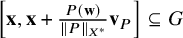


Proof. If
$P=0$
 we may take g as the constant zero function
$X\to \mathbb {R}$
we may take g as the constant zero function
$X\to \mathbb {R}$
 . So we may assume
$P\neq 0$
. So we may assume
$P\neq 0$
 .
.
Observe that if
$g\colon X\to \mathbb {R}$
 satisfies conditions (i)–(iv) for the functional
$P=\frac {Q}{\left \|Q\right \|_{X^{\ast }}}$
satisfies conditions (i)–(iv) for the functional
$P=\frac {Q}{\left \|Q\right \|_{X^{\ast }}}$
 , for some
$Q\in X^{\ast }\setminus \left \{0\right \}$
, for some
$Q\in X^{\ast }\setminus \left \{0\right \}$
 , then the function
$\left \|Q\right \|_{X^{\ast }}g\colon X\to \mathbb {R}$
, then the function
$\left \|Q\right \|_{X^{\ast }}g\colon X\to \mathbb {R}$
 satisfies the conditions (i)–(iv) for
$P=Q$
satisfies the conditions (i)–(iv) for
$P=Q$
 . Hence, we may assume that
$\left \|P\right \|_{X^{\ast }}=1$
. Hence, we may assume that
$\left \|P\right \|_{X^{\ast }}=1$
 .
.
Define
$g\colon X\to \mathbb {R}$
 by
by

We will now check that g satisfies (i)–(iv) and, in addition, the following two properties:
-
(A) $g(\mathbf {x})\leq g(\mathbf {x}+r\mathbf {v}_{P})\leq g(\mathbf {x})+r$
whenever
$\mathbf {x}\in X$
and
$r\geq 0$
. -
(B) $g(\mathbf {x}')-g(\mathbf {x})=t$
whenever
$\mathbf {x}'-\mathbf {x}=t\mathbf {v}_{P}$
,
$t\in \mathbb {R}$
and
$[\mathbf {x},\mathbf {x}']\subseteq G$
.






The fact that g is well-defined and the first inequality of(i) are witnessed by the triple
$\gamma (t)=\mathbf {x}$
 for all
$t\in \mathbb {R}$
for all
$t\in \mathbb {R}$
 ,
$b=0$
,
$b=0$
 and
$s=0$
and
$s=0$
 . The second inequality of (i) is immediate from
$s\ge 0$
. The second inequality of (i) is immediate from
$s\ge 0$
 for any admissible triple
$(\gamma ,b,s)$
for any admissible triple
$(\gamma ,b,s)$
 in the definition of
$g(\mathbf {x})$
in the definition of
$g(\mathbf {x})$
 and the definition of
$(P,\alpha )$
and the definition of
$(P,\alpha )$
 -width of G in (2.2).
In the proof of the remaining parts we will use the following notation. If
$\mathbf {z}\in X$
 and
$\eta>0$
and
$\eta>0$
 then by
$(\gamma _{\mathbf {z}},s_{\mathbf {z}},b_{\mathbf {z}})$
then by
$(\gamma _{\mathbf {z}},s_{\mathbf {z}},b_{\mathbf {z}})$
 we denote an admissible triple in the sense of (4.1), that is, such that
$\gamma _{\mathbf {z}}\in \operatorname {Lip}(\mathbb {R},X)$
we denote an admissible triple in the sense of (4.1), that is, such that
$\gamma _{\mathbf {z}}\in \operatorname {Lip}(\mathbb {R},X)$
 ,
$b_{\mathbf {z}}\in \mathbb {R}$
,
$b_{\mathbf {z}}\in \mathbb {R}$
 ,
$s_{\mathbf {z}}\ge 0$
,
$s_{\mathbf {z}}\ge 0$
 ,
$\gamma _{\mathbf {z}}(b_{\mathbf {z}})=\mathbf {z}+s_{\mathbf {z}}\mathbf {v}_{P}$
,
$\gamma _{\mathbf {z}}(b_{\mathbf {z}})=\mathbf {z}+s_{\mathbf {z}}\mathbf {v}_{P}$
 ,
$P(\gamma _{\mathbf {z}}'(t))\ge \alpha \left \|\gamma _{\mathbf {z}}'(t)\right \|_{X}$
,
$P(\gamma _{\mathbf {z}}'(t))\ge \alpha \left \|\gamma _{\mathbf {z}}'(t)\right \|_{X}$
 whenever
$\gamma _{\mathbf {z}}'(t)$
whenever
$\gamma _{\mathbf {z}}'(t)$
 exists, with the additional property that

If, in addition,
$\mathbf {u}\in \mathbb {S}_{X}$
 and
$P(\mathbf {u})\ge \alpha $
and
$P(\mathbf {u})\ge \alpha $
 , we define

In both cases we suppress
$\eta $
 in the notation although the objects we define also depend on
$\eta $
in the notation although the objects we define also depend on
$\eta $
 . Note that
$\gamma _{\mathbf {z},\mathbf {u}}(t)\in \operatorname {Lip}(\mathbb {R},X)$
. Note that
$\gamma _{\mathbf {z},\mathbf {u}}(t)\in \operatorname {Lip}(\mathbb {R},X)$
 and
$P(\gamma _{\mathbf {z},\mathbf {u}}'(t))\ge \alpha \left \|\gamma _{\mathbf {z},\mathbf {u}}'(t)\right \|_{X}$
and
$P(\gamma _{\mathbf {z},\mathbf {u}}'(t))\ge \alpha \left \|\gamma _{\mathbf {z},\mathbf {u}}'(t)\right \|_{X}$
 whenever
$\gamma _{\mathbf {z},\mathbf {u}}'(t)$
whenever
$\gamma _{\mathbf {z},\mathbf {u}}'(t)$
 exists. In particular, we have that
$P\circ \gamma _{\mathbf {z},\mathbf {u}}$
exists. In particular, we have that
$P\circ \gamma _{\mathbf {z},\mathbf {u}}$
 is monotone increasing and hence

To prove (ii), consider an arbitrary
$\mathbf {x}\in X$
 . Since (ii) is trivially satisfied for
$\mathbf {y}=\mathbf {0}_X$
. Since (ii) is trivially satisfied for
$\mathbf {y}=\mathbf {0}_X$
 , assume
$\mathbf {y}\in \ker P\setminus \{\mathbf {0}_X\}$
, assume
$\mathbf {y}\in \ker P\setminus \{\mathbf {0}_X\}$
 . Fix any
$\eta \in (0,1-\alpha )$
. Fix any
$\eta \in (0,1-\alpha )$
 , an admissible triple
$(\gamma _{\mathbf {x}},s_{\mathbf {x}},b_{\mathbf {x}})$
, an admissible triple
$(\gamma _{\mathbf {x}},s_{\mathbf {x}},b_{\mathbf {x}})$
 and
$\beta \in (0,\infty )$
and
$\beta \in (0,\infty )$
 so that
$\mathbf {u}:={\frac {\alpha }{1-\eta } \mathbf {v}_{P}+\beta \frac {\mathbf {y}}{\left \|\mathbf {y}\right \|_{X}}}\in \mathbb {S}_{X}$
so that
$\mathbf {u}:={\frac {\alpha }{1-\eta } \mathbf {v}_{P}+\beta \frac {\mathbf {y}}{\left \|\mathbf {y}\right \|_{X}}}\in \mathbb {S}_{X}$
 noting

Consider the mapping
${\gamma }_{1}=\gamma _{\mathbf {x},\mathbf {u}}$
 , as defined in (4.3), and let

Observe that
${s}_{1}\geq 0$
 ,
${\gamma }_{1}({b}_{1})=\gamma _{\mathbf {x}}(b_{\mathbf {x}})+\frac {\alpha \left \|\mathbf {y}\right \|_{X} }{\beta (1-\eta )}\mathbf {v}_{P}+\mathbf {y} = \mathbf {x}+\mathbf {y}+s_1\mathbf {v}_{P}$
,
${\gamma }_{1}({b}_{1})=\gamma _{\mathbf {x}}(b_{\mathbf {x}})+\frac {\alpha \left \|\mathbf {y}\right \|_{X} }{\beta (1-\eta )}\mathbf {v}_{P}+\mathbf {y} = \mathbf {x}+\mathbf {y}+s_1\mathbf {v}_{P}$
 and
$P(\mathbf {u})=\frac {\alpha }{1-\eta }>\alpha $
and
$P(\mathbf {u})=\frac {\alpha }{1-\eta }>\alpha $
 , thus we conclude that

using (4.2) and (4.5) for the last inequality. Letting
$\eta \to 0$
 , we obtain
$g(\mathbf {x}+\mathbf {y})\geq g(\mathbf {x})-\frac {\alpha \left \|\mathbf {y}\right \|_{X}}{1-\alpha }$
, we obtain
$g(\mathbf {x}+\mathbf {y})\geq g(\mathbf {x})-\frac {\alpha \left \|\mathbf {y}\right \|_{X}}{1-\alpha }$
 and applying the above argument to the pair
$\mathbf {\widetilde {x}}:=\mathbf {x}+\mathbf {y}$
and applying the above argument to the pair
$\mathbf {\widetilde {x}}:=\mathbf {x}+\mathbf {y}$
 and
$\mathbf {\widetilde {y}}:=-\mathbf {y}$
and
$\mathbf {\widetilde {y}}:=-\mathbf {y}$
 in place of
$\mathbf {x}$
in place of
$\mathbf {x}$
 and
$\mathbf {y}$
and
$\mathbf {y}$
 delivers the reverse inequality
$g(\mathbf {x})\geq g(\mathbf {x}+\mathbf {y})-\frac {\alpha \left \|\mathbf {y}\right \|_{X}}{1-\alpha }$
delivers the reverse inequality
$g(\mathbf {x})\geq g(\mathbf {x}+\mathbf {y})-\frac {\alpha \left \|\mathbf {y}\right \|_{X}}{1-\alpha }$
 . This finishes the proof of (ii).
We now turn our attention to the two additional properties. For (A), fix
$\mathbf {x}\in X$
 and
$r\geq 0$
and
$r\geq 0$
 . Let
$\eta>0$
. Let
$\eta>0$
 be arbitrary, and consider again
$(\gamma _{\mathbf {x}},b_{\mathbf {x}},s_{\mathbf {x}})$
be arbitrary, and consider again
$(\gamma _{\mathbf {x}},b_{\mathbf {x}},s_{\mathbf {x}})$
 ; let
${\gamma }_{2}=\gamma _{\mathbf {x},\mathbf {v}_{P}}$
; let
${\gamma }_{2}=\gamma _{\mathbf {x},\mathbf {v}_{P}}$
 be defined by (4.3).
If
$s_{\mathbf {x}}>r\ge 0$
 , we note
$\gamma _{\mathbf {x}}(b_{\mathbf {x}})=(\mathbf {x}+r\mathbf {v}_{P})+ (s_{\mathbf {x}}-r)\mathbf {v}_{P}$
, we note
$\gamma _{\mathbf {x}}(b_{\mathbf {x}})=(\mathbf {x}+r\mathbf {v}_{P})+ (s_{\mathbf {x}}-r)\mathbf {v}_{P}$
 , so by (4.2)

If
$0\le s_{\mathbf {x}}\leq r$
 , consider
${b}_{2}=b_{\mathbf {x}}+(r-s_{\mathbf {x}})\ge b_{\mathbf {x}}$
, consider
${b}_{2}=b_{\mathbf {x}}+(r-s_{\mathbf {x}})\ge b_{\mathbf {x}}$
 and
${s}_{2}=0$
and
${s}_{2}=0$
 to deduce

Therefore by (4.2)

In either case, letting
$\eta \to 0$
 , we establish the first inequality of (A). To prove the second inequality of (A), let
$\eta>0$
, we establish the first inequality of (A). To prove the second inequality of (A), let
$\eta>0$
 be arbitrary and consider
$({\gamma }_{3},{s}_{3},{b}_{3})= (\gamma _{\mathbf {x}+r\mathbf {v}_{P}},s_{\mathbf {x}+r\mathbf {v}_{P}},b_{\mathbf {x}+r\mathbf {v}_{P}})$
be arbitrary and consider
$({\gamma }_{3},{s}_{3},{b}_{3})= (\gamma _{\mathbf {x}+r\mathbf {v}_{P}},s_{\mathbf {x}+r\mathbf {v}_{P}},b_{\mathbf {x}+r\mathbf {v}_{P}})$
 . We observe
${\gamma }_{3}({b}_{3})=\mathbf {x}+(r+{s}_{3})\mathbf {v}_{P}$
. We observe
${\gamma }_{3}({b}_{3})=\mathbf {x}+(r+{s}_{3})\mathbf {v}_{P}$
 , so using (4.2) we get

which implies the second inequality of (A) when we let
$\eta \to 0$
 .
.
Assume
$\mathbf {x},\mathbf {x}'\in X$
 satisfy the conditions of (B). We may assume without loss of generality that
$\mathbf {x}'-\mathbf {x}=r\mathbf {v}_{P}$
satisfy the conditions of (B). We may assume without loss of generality that
$\mathbf {x}'-\mathbf {x}=r\mathbf {v}_{P}$
 , where
$r\geq 0$
, where
$r\geq 0$
 . In light of (A), it is now enough to show
$g(\mathbf {x}+r\mathbf {v}_{P})\ge g(\mathbf {x})+r$
. In light of (A), it is now enough to show
$g(\mathbf {x}+r\mathbf {v}_{P})\ge g(\mathbf {x})+r$
 . Let us again fix an arbitrary
$\eta>0$
. Let us again fix an arbitrary
$\eta>0$
 and consider
$(\gamma _{\mathbf {x}},b_{\mathbf {x}},s_{\mathbf {x}})$
and consider
$(\gamma _{\mathbf {x}},b_{\mathbf {x}},s_{\mathbf {x}})$
 ,
${\gamma }_{2}=\gamma _{\mathbf {x},\mathbf {v}_{P}}$
,
${\gamma }_{2}=\gamma _{\mathbf {x},\mathbf {v}_{P}}$
 and
$b_2=b_{\mathbf {x}}+(r-s_{\mathbf {x}})$
and
$b_2=b_{\mathbf {x}}+(r-s_{\mathbf {x}})$
 . If
$s_{\mathbf {x}}>r$
. If
$s_{\mathbf {x}}>r$
 , then (4.6) applies to give the desired inequality in the limit
$\eta \to 0$
, then (4.6) applies to give the desired inequality in the limit
$\eta \to 0$
 . If
$0\le s_{\mathbf {x}}\le r$
. If
$0\le s_{\mathbf {x}}\le r$
 , we may improve (4.8). Indeed, using the first line of (4.8) for the first inequality, followed by
${\gamma }_{2}\left ((b_{\mathbf {x}},{b}_{2}]\right )=[\mathbf {x}+s_{\mathbf {x}}\mathbf {v}_{P},\mathbf {x}+r\mathbf {v}_{P}]\subseteq [\mathbf {x},\mathbf {x}+r\mathbf {v}_{P}]\subseteq G$
, we may improve (4.8). Indeed, using the first line of (4.8) for the first inequality, followed by
${\gamma }_{2}\left ((b_{\mathbf {x}},{b}_{2}]\right )=[\mathbf {x}+s_{\mathbf {x}}\mathbf {v}_{P},\mathbf {x}+r\mathbf {v}_{P}]\subseteq [\mathbf {x},\mathbf {x}+r\mathbf {v}_{P}]\subseteq G$
 and (4.4) for the equality, we conclude that

which implies
$g(\mathbf {x}+r\mathbf {v}_{P})\geq g(\mathbf {x})+r$
 if we let
$\eta \to 0$
if we let
$\eta \to 0$
 .
.
To prove part (iii), assume that
$\mathbf {x},\mathbf {w}\in X$
 are given, consider
$\mathbf {y}:=\mathbf {w}-P(\mathbf {w})\mathbf {v}_{P}\in \ker P$
are given, consider
$\mathbf {y}:=\mathbf {w}-P(\mathbf {w})\mathbf {v}_{P}\in \ker P$
 and note that
$\left \|\mathbf {y}\right \|_{X}\leq 2\left \|\mathbf {w}\right \|_{X}$
and note that
$\left \|\mathbf {y}\right \|_{X}\leq 2\left \|\mathbf {w}\right \|_{X}$
 . If
$P(\mathbf {w})=0$
. If
$P(\mathbf {w})=0$
 , then
$\mathbf {w}=\mathbf {y}$
, then
$\mathbf {w}=\mathbf {y}$
 and, setting
$\lambda (\mathbf {x},\mathbf {w}):=1$
and, setting
$\lambda (\mathbf {x},\mathbf {w}):=1$
 , we have that the inequality of (iii) immediately follows from (ii). We may therefore assume
$P(\mathbf {w})\ne 0$
, we have that the inequality of (iii) immediately follows from (ii). We may therefore assume
$P(\mathbf {w})\ne 0$
 . In this case we let

and observe that
$\lambda (\mathbf {x},\mathbf {w})\in [0,1]$
 , as
$g|_{\mathbf {x}+\mathbb {R}\mathbf {v}_{P}}$
, as
$g|_{\mathbf {x}+\mathbb {R}\mathbf {v}_{P}}$
 is a
$1$
is a
$1$
 -Lipschitz increasing function by (A), with
$\lambda (\mathbf {x},\mathbf {w})=1$
-Lipschitz increasing function by (A), with
$\lambda (\mathbf {x},\mathbf {w})=1$
 if
$\left [\mathbf {x},\mathbf {x}+\frac {P(\mathbf {w})}{\left \|P\right \|_{X^{\ast }}}\mathbf {v}_{P}\right ]\subseteq G$
if
$\left [\mathbf {x},\mathbf {x}+\frac {P(\mathbf {w})}{\left \|P\right \|_{X^{\ast }}}\mathbf {v}_{P}\right ]\subseteq G$
 , by (B). We now use (ii) to complete verification of (iii):

To establish (iv), we note that (iii) implies that for any
$\mathbf {x},\mathbf {w}\in X$


Lemma 4.4 below says that for a given compact purely
$1$
 -unrectifiable subset E of a finite-dimensional normed space X, see Section 2.3, and a given bounded linear operator T on X there exists a Lipschitz
$g\colon X\to T(X)$
-unrectifiable subset E of a finite-dimensional normed space X, see Section 2.3, and a given bounded linear operator T on X there exists a Lipschitz
$g\colon X\to T(X)$
 which, on a neighbourhood of the set E, has derivative approximately equal to T and everywhere outside this neighbourhood has derivative zero. In other words, there are Lipschitz mappings which are constant except on a small neighbourhood of the given compact purely
$1$
which, on a neighbourhood of the set E, has derivative approximately equal to T and everywhere outside this neighbourhood has derivative zero. In other words, there are Lipschitz mappings which are constant except on a small neighbourhood of the given compact purely
$1$
 -unrectifiable set, where their derivative is approximately whatever bounded linear operator you wish. It is natural to ask what is the optimal Lipschitz constant with which such a mapping
$g\colon X\to T(X)$
-unrectifiable set, where their derivative is approximately whatever bounded linear operator you wish. It is natural to ask what is the optimal Lipschitz constant with which such a mapping
$g\colon X\to T(X)$
 can be found. The optimal result that could be hoped for is clearly
$\operatorname {Lip}(g)\leq \left \|T\right \|_{\operatorname {op}}+\theta $
can be found. The optimal result that could be hoped for is clearly
$\operatorname {Lip}(g)\leq \left \|T\right \|_{\operatorname {op}}+\theta $
 for an arbitrarily small error term
$\theta>0$
for an arbitrarily small error term
$\theta>0$
 and indeed, in all ‘classical’ settings (e.g., when the norm on
$T(X)$
and indeed, in all ‘classical’ settings (e.g., when the norm on
$T(X)$
 is Euclidean), this is what Lemma 4.4 achieves; see Remark 4.3. However, in the general setting, we identify a constant
$\mathfrak {C}(T)\geq \left \|T\right \|_{\operatorname {op}}$
is Euclidean), this is what Lemma 4.4 achieves; see Remark 4.3. However, in the general setting, we identify a constant
$\mathfrak {C}(T)\geq \left \|T\right \|_{\operatorname {op}}$
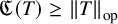 , so that the Lipschitz constant of g may be bounded above by
$\mathfrak {C}(T)+\theta $
, so that the Lipschitz constant of g may be bounded above by
$\mathfrak {C}(T)+\theta $
 . It would be of interest to determine whether this upper bound is optimal.
Definition 4.2. Let X and Y be normed vector spaces and
$T\in \mathcal {L}(X,Y)$
 be a nonzero bounded linear operator of finite rank l. We associate to T the constant

In the above
$\mathbf {w}_{1}^{\ast },\ldots ,\mathbf {w}_{l}^{\ast }\in T(X)^{\ast }$
 is the basis of
$T(X)^*$
is the basis of
$T(X)^*$
 dual to the basis
$\mathbf {w}_{1},\ldots ,\mathbf {w}_{l}$
dual to the basis
$\mathbf {w}_{1},\ldots ,\mathbf {w}_{l}$
 of
$T(X)$
of
$T(X)$
 so that, in particular,
$T=\sum _{i=1}^{l}\mathbf {w}_{i}^{\ast }\circ T(\cdot )\,\mathbf {w}_{i}$
so that, in particular,
$T=\sum _{i=1}^{l}\mathbf {w}_{i}^{\ast }\circ T(\cdot )\,\mathbf {w}_{i}$
 . We also define
$\mathfrak {C}(\mathbf {0}_{\mathcal {L}(X,Y)})=0$
. We also define
$\mathfrak {C}(\mathbf {0}_{\mathcal {L}(X,Y)})=0$
 .
.
Remark 4.3.
-
(i) The constant $\mathfrak {C}(T)$
is well-defined, that is, the minimum of the above set exists, due to Lemma C.1. -
(ii) The identity $T=\sum _{i=1}^{l}(\mathbf {w}_{i}^{\ast }\circ T)(\cdot )\,\mathbf {w}_{i}$
for any choice of
$\mathbf {w}_{1},\ldots ,\mathbf {w}_{l}$
and
$\mathbf {w}_{1}^{\ast },\ldots ,\mathbf {w}_{l}^{\ast }$
as above implies
$\mathfrak {C}(T)\ge \left \|T\right \|_{\operatorname {op}}$
. -
(iii) For any normed space X and $(Y,\left \|\cdot \right \|_{Y})=(\ell _p,\left \|\cdot \right \|_{q})$
,
$1\le p\le q\le \infty $
(in particular, Hilbert and finite-dimensional Euclidean), and for every
$T\in \mathcal {L}(X,Y)$
, one has
$\mathfrak {C}(T)=\left \|T\right \|_{\operatorname {op}}$
. However, for any Y of dimension at least
$3$
there is a norm
$\left \|\cdot \right \|_{Y}$
so that for
$X=Y$
and
$\left \|\cdot \right \|_{X}=\left \|\cdot \right \|_{Y}$
one has
$\mathfrak {C}(\operatorname {Id}_X)>1$
.






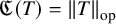


Lemma 4.4. Let X and Y be normed spaces, where X is finite-dimensional. Let
$E\subseteq U\subseteq X$
 be sets, where E is compact and purely
$1$
be sets, where E is compact and purely
$1$
 -unrectifiable and U is open,
$\theta>0$
-unrectifiable and U is open,
$\theta>0$
 ,
$T\in \mathcal {L}(X,Y)$
,
$T\in \mathcal {L}(X,Y)$
 . Then there exist a Lipschitz mapping
$g\colon X\to T(X)$
. Then there exist a Lipschitz mapping
$g\colon X\to T(X)$
 and an open subset H of X such that the following statements hold:
-
(a) $\operatorname {supp} g\subseteq U$
and
$Dg(\mathbf {x})=0$
for all
$\mathbf {x}\in X\setminus U$
. -
(b) $\sup _{\mathbf {x}\in X}\left \|g(\mathbf {x})\right \|_{Y}\leq \theta $
. -
(c) $E\subseteq H\subseteq \overline {H}\subseteq U$
. -
(d) $\left \|Dg(\mathbf {x})-T\right \|_{\operatorname {op}}\leq \theta $
for Lebesgue almost all
$\mathbf {x}\in H$
. -
(e) $\operatorname {Lip}(g)\leq \mathfrak {C}(T)+\theta $
, where the constant
$\mathfrak {C}(T)$
is given by Definition 4.2.








Proof. The statement of the lemma is clear if
$T=0$
 , so assume, without loss of generality, that
$T\ne 0$
, so assume, without loss of generality, that
$T\ne 0$
 . Also, although the proof below will work independently of whether E is an empty or a non-empty set, it might be worth mentioning that in case
$E=\emptyset $
. Also, although the proof below will work independently of whether E is an empty or a non-empty set, it might be worth mentioning that in case
$E=\emptyset $
 , it would be enough to take
$H=\emptyset $
, it would be enough to take
$H=\emptyset $
 and
$g\equiv 0$
and
$g\equiv 0$
 .
.
Let
$1\le l\leq \dim X$
 denote the rank of T and
$\mathbf {w}_{1},\ldots ,\mathbf {w}_{l}\in T(X)\subseteq Y$
denote the rank of T and
$\mathbf {w}_{1},\ldots ,\mathbf {w}_{l}\in T(X)\subseteq Y$
 be a basis of
$T(X)$
be a basis of
$T(X)$
 for which

where we adopt the notation of Definition 4.2; let
$T_{i}=\mathbf {w}_{i}^{\ast }\circ T\in X^*$
 for each
$1\le i\le l$
for each
$1\le i\le l$
 , so that

Let
$U_0$
 be an open set given by Remark C.4, satisfying
$E\subseteq U_0\subseteq \overline {U_0}\subseteq U$
be an open set given by Remark C.4, satisfying
$E\subseteq U_0\subseteq \overline {U_0}\subseteq U$
 and
$\partial U_0$
and
$\partial U_0$
 has Lebesgue measure zero. For each
$i=1,\ldots ,l$
has Lebesgue measure zero. For each
$i=1,\ldots ,l$
 we will construct sequences of smooth functions
$\varphi _{k}^{(i)}\colon X\to \mathbb {R}$
we will construct sequences of smooth functions
$\varphi _{k}^{(i)}\colon X\to \mathbb {R}$
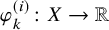 , positive numbers
$\varepsilon _{k}^{(i)}$
, positive numbers
$\varepsilon _{k}^{(i)}$
 , sets
$G_{k}^{(i)}\subseteq X$
, sets
$G_{k}^{(i)}\subseteq X$
 and Lipschitz functions
$g_{k}^{(i)}\colon X\to \mathbb {R}$
and Lipschitz functions
$g_{k}^{(i)}\colon X\to \mathbb {R}$
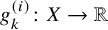 respectively, as well as positive integers
$K_{i}\in \mathbb {N}$
respectively, as well as positive integers
$K_{i}\in \mathbb {N}$
 and open sets
$U_{i}\subseteq X$
and open sets
$U_{i}\subseteq X$
 such that the following conditions hold for each
$i=1,2,\ldots ,l$
such that the following conditions hold for each
$i=1,2,\ldots ,l$
 :
:
-
(A) $(\varphi _{k}^{(i)})_{k\in \mathbb {N}}$
is a smooth, locally finite partition of unity with supports contained in
$U_{i-1}$
. -
(B) For each $k\ge 1$
, we have
$\varepsilon _k^{(i)}\in (0,1)$
and $$ \begin{align*} \sum_{k\in\mathbb{N}}\frac{\varepsilon_{k}^{(i)}\left(1+\operatorname{Lip}(\varphi_{k}^{(i)})\right)}{1-\varepsilon_{k}^{(i)}} \leq \frac{\theta}{4l\left(1+{\left\|T_{i}\right\|_{X^*}} \right)\left(1+\left\|\mathbf{w}_{i}\right\|_{Y}\right)}. \end{align*} $$
-
(C) For each $k\ge 1$
the set
$G_{k}^{(i)}$
is open and satisfies $$ \begin{align*} E\subseteq G_{k}^{(i)}\subseteq U_{i-1} \end{align*} $$and
$$ \begin{align*} \begin{aligned} &\sup\left\{\mathcal{H}^{1}\left(G^{(i)}_{k}\cap \gamma(\mathbb{R})\right)\colon \gamma\in \operatorname{Lip}(\mathbb{R},X),\,\right.\\ &\qquad\qquad\qquad \left.T_{i}\left(\gamma'(t)\right)\geq \varepsilon_{k}^{(i)}\left\|\gamma'(t)\right\|_{X}\left\|T_{i}\right\|_{X^{\ast}}\text{ whenever } \gamma'(t) \text{ exists}\right\}\leq \varepsilon_{k}^{(i)}. \end{aligned} \end{align*} $$
-
(D) For each $k\geq 1$
the function
$g_{k}^{(i)}\colon X\to \mathbb {R}$
satisfies the following conditions:-
(D1) $g^{(i)}_{k}$
is Lipschitz and
$0\leq g^{(i)}_{k}(\mathbf {x})\leq \left \|T_i\right \|_{X^*}\varepsilon _{k}^{(i)}$
for all
$\mathbf {x}\in X$
, -
(D2) For every $\mathbf {x},\mathbf {w}\in X$
and every
$k\ge 1$
there exists
$\lambda _{k}^{(i)}=\lambda _{k}^{(i)}(\mathbf {x},\mathbf {w})\in [0,1]$
such that $$ \begin{align*} \left|g_{k}^{(i)}(\mathbf{x}+\mathbf{w})-g_{k}^{(i)}(\mathbf{x})-\lambda_{k}^{(i)} T_{i}(\mathbf{w})\right|\leq \frac{2\varepsilon_{k}^{(i)}\left\|T_{i}\right\|_{X^{\ast}}}{1-\varepsilon_{k}^{(i)}}\left\|\mathbf{w}\right\|_{X}. \end{align*} $$
-
(D3) Whenever $B(\mathbf {x},r)\subseteq G_{k}^{(i)}$
and
$\left \|\mathbf {w}\right \|_{X}<r$
, the inequality (D2) is satisfied with
$\lambda _{k}^{(i)}(\mathbf {x},\mathbf {w})=1$
.
-
-
(E) $K_{i}\in \mathbb {N}$
and
$U_{i}$
is an open subset of X such that
$\partial U_{i}$
has Lebesgue measure zero, $$ \begin{align*} \operatorname{supp}(\varphi_{k}^{(i)})\cap U_i=\emptyset \quad\text{for all } k>K_i\qquad\text{and}\qquad E\subseteq U_{i}\subseteq\overline{U_{i}}\subseteq U_{i-1}\cap \bigcap_{k=1}^{K_{i}}G_{k}^{(i)}. \end{align*} $$


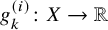






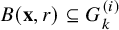


Suppose that
$1\le j\le l$
 and that we have constructed the above listed objects of levels
$i=1,\ldots ,j-1$
and that we have constructed the above listed objects of levels
$i=1,\ldots ,j-1$
 such that conditions (A)–(E) are satisfied for
$i=1,\ldots ,j-1$
such that conditions (A)–(E) are satisfied for
$i=1,\ldots ,j-1$
 . In the case
$j=1$
. In the case
$j=1$
 no objects are yet constructed and all conditions are vacuous and therefore satisfied.
We then proceed to construct the objects of level j as follows: First we choose the sequences
$(\varphi _{k}^{(j)})_{k\in \mathbb {N}}$
 ,
$(\varepsilon _{k}^{(j)})_{k\in \mathbb {N}}$
,
$(\varepsilon _{k}^{(j)})_{k\in \mathbb {N}}$
 and
$(G_{k}^{(j)})_{k\in \mathbb {N}}$
and
$(G_{k}^{(j)})_{k\in \mathbb {N}}$
 , in that order, arbitrarily subject to the conditions (A), (B) and (C) respectively for
$i=j$
, in that order, arbitrarily subject to the conditions (A), (B) and (C) respectively for
$i=j$
 . To choose
$G_{k}^{(j)}$
. To choose
$G_{k}^{(j)}$
 as in (C) we are using that compact purely
$1$
as in (C) we are using that compact purely
$1$
 -unrectifiable sets satisfy a stronger property proved in Theorem C.2 in Appendix C. If
$1\leq j\leq l$
-unrectifiable sets satisfy a stronger property proved in Theorem C.2 in Appendix C. If
$1\leq j\leq l$
 with
$T_{j}=0$
with
$T_{j}=0$
 , we let
$g_{k}^{(j)}\colon X\to \mathbb {R}$
, we let
$g_{k}^{(j)}\colon X\to \mathbb {R}$
 be defined as the constant
$0$
be defined as the constant
$0$
 function for every
$k\in \mathbb {N}$
function for every
$k\in \mathbb {N}$
 . Observe that all parts of (D) are then trivially satisfied for such j. For the remaining
$1\leq j\leq l$
. Observe that all parts of (D) are then trivially satisfied for such j. For the remaining
$1\leq j\leq l$
 , those with
$T_{j}\neq 0$
, those with
$T_{j}\neq 0$
 , we let
$g_{k}^{(j)}\colon X\to \mathbb {R}$
, we let
$g_{k}^{(j)}\colon X\to \mathbb {R}$
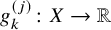 for each
$k\in \mathbb {N}$
for each
$k\in \mathbb {N}$
 be given by the conclusion of Lemma 4.1 for
$G=G_{k}^{(j)}$
be given by the conclusion of Lemma 4.1 for
$G=G_{k}^{(j)}$
 ,
$P=T_{j}$
,
$P=T_{j}$
 and
$\mathbf {v}_{T_j}=\mathbf {v}_{j}\in \mathbb {S}_{X}$
and
$\mathbf {v}_{T_j}=\mathbf {v}_{j}\in \mathbb {S}_{X}$
 is any vector satisfying the condition
$T_{j}(\mathbf {v}_{j})=\left \|T_{j}\right \|_{X^{\ast }}$
is any vector satisfying the condition
$T_{j}(\mathbf {v}_{j})=\left \|T_{j}\right \|_{X^{\ast }}$
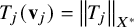 , and
$\alpha =\varepsilon _{k}^{(j)}$
, and
$\alpha =\varepsilon _{k}^{(j)}$
 . Then Lemma 4.1 provides all of the stated properties in (D) for
$i=j$
. Then Lemma 4.1 provides all of the stated properties in (D) for
$i=j$
 . In particular
$\lambda _{k}^{(j)}(\mathbf {x},\mathbf {w})$
. In particular
$\lambda _{k}^{(j)}(\mathbf {x},\mathbf {w})$
 in (D2) can be chosen as
$\lambda (\mathbf {x},\mathbf {w})$
in (D2) can be chosen as
$\lambda (\mathbf {x},\mathbf {w})$
 from Lemma 4.1(iii). Note that
$\lambda _{k}^{(j)}(\mathbf {x},\mathbf {w})=1$
from Lemma 4.1(iii). Note that
$\lambda _{k}^{(j)}(\mathbf {x},\mathbf {w})=1$
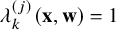 if the additional conditions of (D3) are satisfied, since
$\left \|\frac {T_i(\mathbf {w})}{\left \|T_i\right \|_{X^*}}\mathbf {v}_{j}\right \|_{X}\le \left \|\mathbf {w}\right \|_{X}$
if the additional conditions of (D3) are satisfied, since
$\left \|\frac {T_i(\mathbf {w})}{\left \|T_i\right \|_{X^*}}\mathbf {v}_{j}\right \|_{X}\le \left \|\mathbf {w}\right \|_{X}$
 for all
$\mathbf {w}\in X$
for all
$\mathbf {w}\in X$
 . Finally, we let
$K_{j}$
. Finally, we let
$K_{j}$
 and
$U_{j}$
and
$U_{j}$
 with
$\partial U_{j}$
with
$\partial U_{j}$
 of Lebesgue measure
$0$
of Lebesgue measure
$0$
 be the pair given by the conclusion of Lemma C.5 applied to X, E,
$V=U_{j-1}$
be the pair given by the conclusion of Lemma C.5 applied to X, E,
$V=U_{j-1}$
 ,
$(G_{k})_{k\in \mathbb {N}}:=(G_{k}^{(j)})_{k\in \mathbb {N}}$
,
$(G_{k})_{k\in \mathbb {N}}:=(G_{k}^{(j)})_{k\in \mathbb {N}}$
 and
$(\varphi _{k})_{k\in \mathbb {N}}:=(\varphi _{k}^{(j)})_{k\in \mathbb {N}}$
and
$(\varphi _{k})_{k\in \mathbb {N}}:=(\varphi _{k}^{(j)})_{k\in \mathbb {N}}$
 . Such choice of
$K_{j}$
. Such choice of
$K_{j}$
 and
$U_{j}$
and
$U_{j}$
 ensures that (E) is satisfied for
$i=j$
ensures that (E) is satisfied for
$i=j$
 . This completes the construction of all above mentioned objects for levels
$i=1,\ldots ,l$
. This completes the construction of all above mentioned objects for levels
$i=1,\ldots ,l$
 so that conditions (A)–(E) are satisfied for
$i=1,\ldots ,l$
so that conditions (A)–(E) are satisfied for
$i=1,\ldots ,l$
 .
.
We define the mapping
$g\colon X\to T(X)$
 by
by

and put
$H:=U_{l}$
 . Then we have

due to (A) and the fact, coming from (E), that all
$U_{i}$
 ’s are contained in
$U_{0}\subseteq \overline {U_{0}}\subseteq U$
’s are contained in
$U_{0}\subseteq \overline {U_{0}}\subseteq U$
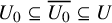 . Moreover,

by the inequalities (D1) and (B). This establishes (a) and (b). Part (c) is clear from the choice
$H=U_{l}$
 , (E) and
$\overline {U_0}\subseteq U$
, (E) and
$\overline {U_0}\subseteq U$
 .
.
In order to show that g is Lipschitz, we argue first that g is a locally Lipschitz mapping. Fix an arbitrary
$\mathbf {x}\in X$
 . For each
$i=1,\dots ,l$
. For each
$i=1,\dots ,l$
 the collection
$(\varphi _{k}^{(i)})_{k\in \mathbb {N}}$
the collection
$(\varphi _{k}^{(i)})_{k\in \mathbb {N}}$
 forms a locally finite partition of unity, hence there is an open ball
$B=B(\mathbf {x},r)$
forms a locally finite partition of unity, hence there is an open ball
$B=B(\mathbf {x},r)$
 and an index
$n\in \mathbb {N}$
and an index
$n\in \mathbb {N}$
 such that
$\sum _{k\in \mathbb {N}}\varphi _{k}^{(i)}(\mathbf {y})g_{k}^{(i)}(\mathbf {y})=\sum _{k=1}^{n}\varphi _{k}^{(i)}(\mathbf {y})g_{k}^{(i)}(\mathbf {y}) $
such that
$\sum _{k\in \mathbb {N}}\varphi _{k}^{(i)}(\mathbf {y})g_{k}^{(i)}(\mathbf {y})=\sum _{k=1}^{n}\varphi _{k}^{(i)}(\mathbf {y})g_{k}^{(i)}(\mathbf {y}) $
 for all
$\mathbf {y}\in B$
for all
$\mathbf {y}\in B$
 and all
$1\le i\le l$
and all
$1\le i\le l$
 . Since by (A) all
$\varphi _{k}^{(i)}$
. Since by (A) all
$\varphi _{k}^{(i)}$
 are Lipschitz and bounded on B, and by (D1) each
$g_{k}^{(i)}$
are Lipschitz and bounded on B, and by (D1) each
$g_{k}^{(i)}$
 is a Lipschitz bounded function as well, we conclude that
$g|_B$
is a Lipschitz bounded function as well, we conclude that
$g|_B$
 is Lipschitz too. We have thus established that g is locally Lipschitz on X.
We now derive bounds on the norm in Y of vectors of the form
$g(\mathbf {x}+\mathbf {z})-g(\mathbf {x})$
 , aiming to get an estimate with the Lipschitz constant given in (e). We will approximate this vector closely with an appropriate linear mapping evaluated at
$\mathbf {z}$
, aiming to get an estimate with the Lipschitz constant given in (e). We will approximate this vector closely with an appropriate linear mapping evaluated at
$\mathbf {z}$
 . The appropriate linear mapping to use will be determined by which sets in the nested sequence
$U_{0}\supseteq U_{1}\supseteq \ldots \supseteq U_{l}=H$
. The appropriate linear mapping to use will be determined by which sets in the nested sequence
$U_{0}\supseteq U_{1}\supseteq \ldots \supseteq U_{l}=H$
 contain the segment
$[\mathbf {x},\mathbf {x}+\mathbf {z}]$
contain the segment
$[\mathbf {x},\mathbf {x}+\mathbf {z}]$
 .
.
For any
$\mathbf {x},\mathbf {z}\in X$
 and any
$\lambda \in \mathbb {R}$
and any
$\lambda \in \mathbb {R}$
 we may use (D1) and (A) to write

Observe that the set
$U_0\setminus \bigcup _{j=1}^{l}\partial U_{j}$
 may be partitioned as a union of open sets

Therefore, to estimate the Lipschitz constant of g locally at every point of this set, we may consider an arbitrary
$\mathbf {x}\in U_0\setminus \bigcup _{j=1}^{l}\partial U_{j}$
 and distinguish two cases:

Let
$r=r(\mathbf {x})>0$
 be sufficiently small so that
$B_{X}(\mathbf {x},r)\subseteq U(\mathbf {x})$
be sufficiently small so that
$B_{X}(\mathbf {x},r)\subseteq U(\mathbf {x})$
 and let
$\mathbf {z}\in B_{X}(\mathbf {0}_X,r)$
and let
$\mathbf {z}\in B_{X}(\mathbf {0}_X,r)$
 be arbitrary. In the former case of (4.13), we have
$\mathbf {x}\in B_X(\mathbf {x},r)\subseteq H\subseteq U_i\subseteq G_k^{(i)}$
be arbitrary. In the former case of (4.13), we have
$\mathbf {x}\in B_X(\mathbf {x},r)\subseteq H\subseteq U_i\subseteq G_k^{(i)}$
 , for every
$i=1,\ldots ,l$
, for every
$i=1,\ldots ,l$
 and
$1\le k\le K_i$
and
$1\le k\le K_i$
 , by (E), so we may apply (D3) and (4.12) with
$\lambda =1$
, by (E), so we may apply (D3) and (4.12) with
$\lambda =1$
 to derive

We also recall that for every
$1\le i\le l$
 and
$k>K_i$
and
$k>K_i$
 , (E) implies

since both
$\mathbf {x},\mathbf {x}+\mathbf {z}\in H\subseteq U_i$
 . Multiplying the expressions under the modulus sign on the left-hand side by
$\mathbf {w}_i$
. Multiplying the expressions under the modulus sign on the left-hand side by
$\mathbf {w}_i$
 and summing over respective ranges for
$k\ge 1$
and summing over respective ranges for
$k\ge 1$
 and then over
$i=1,\ldots ,l$
and then over
$i=1,\ldots ,l$
 we obtain, according to (4.10), (4.9) and
$\sum _{k=1}^\infty \varphi _{k}^{(i)}(\mathbf {x})=1$
we obtain, according to (4.10), (4.9) and
$\sum _{k=1}^\infty \varphi _{k}^{(i)}(\mathbf {x})=1$
 ,
,

where the last inequality holds due to (B). Using that
$g\colon X\to T(X)$
 is a locally Lipschitz mapping between finite-dimensional spaces, and hence
$Dg(\mathbf {u})$
is a locally Lipschitz mapping between finite-dimensional spaces, and hence
$Dg(\mathbf {u})$
 exists for almost all
$\mathbf {u}\in X$
exists for almost all
$\mathbf {u}\in X$
 , and the fact that the inequality above has been obtained for an arbitrary pair of
$\mathbf {x}\in H=U_{l}$
, and the fact that the inequality above has been obtained for an arbitrary pair of
$\mathbf {x}\in H=U_{l}$
 and
$\mathbf {z}\in B_{X}(\mathbf {0}_X,r)$
and
$\mathbf {z}\in B_{X}(\mathbf {0}_X,r)$
 , we establish (d). We also note that the last inequality implies

in the first case from (4.13).
In the remaining case from (4.13),
$\mathbf {x}\in U_{j-1}\setminus \overline {U_{j}}$
 ,
$1\le j\le l$
,
$1\le j\le l$
 , note that
$\mathbf {x},\mathbf {x}+\mathbf {z}\in B_{X}(\mathbf {x},r)\subseteq U_{j-1}\setminus \overline {U_{j}}$
, note that
$\mathbf {x},\mathbf {x}+\mathbf {z}\in B_{X}(\mathbf {x},r)\subseteq U_{j-1}\setminus \overline {U_{j}}$
 . Then, by (A) and (E), we have that
$\varphi ^{(i)}_{k}(\mathbf {x})=\varphi ^{(i)}_{k}(\mathbf {x}+\mathbf {z})=0$
. Then, by (A) and (E), we have that
$\varphi ^{(i)}_{k}(\mathbf {x})=\varphi ^{(i)}_{k}(\mathbf {x}+\mathbf {z})=0$
 for all
$i\geq j+1$
for all
$i\geq j+1$
 and
$k\ge 1$
and
$k\ge 1$
 . Therefore,

For
$i=j$
 and each
$k\in \mathbb {N}$
and each
$k\in \mathbb {N}$
 we may consider the quantity
$\lambda ^{(j)}_{k}=\lambda ^{(j)}_{k}(\mathbf {x},\mathbf {z})$
we may consider the quantity
$\lambda ^{(j)}_{k}=\lambda ^{(j)}_{k}(\mathbf {x},\mathbf {z})$
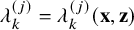 from (D2) and apply inequality (D2) in (4.12) with
$\lambda =\lambda ^{(j)}_{k}$
from (D2) and apply inequality (D2) in (4.12) with
$\lambda =\lambda ^{(j)}_{k}$
 to get, for all
$k\ge 1$
to get, for all
$k\ge 1$
 ,
,

For
$i=1,\ldots ,j-1$
 we again use
$\left \|\mathbf {z}\right \|_{X}<r$
we again use
$\left \|\mathbf {z}\right \|_{X}<r$
 and
$[\mathbf {x},\mathbf {x}+\mathbf {z}]\subseteq B_{X}(\mathbf {x},r)\subseteq U_{j-1}\subseteq U_i\subseteq \bigcap _{k=1}^{K_{i}}G^{(i)}_{k}$
and
$[\mathbf {x},\mathbf {x}+\mathbf {z}]\subseteq B_{X}(\mathbf {x},r)\subseteq U_{j-1}\subseteq U_i\subseteq \bigcap _{k=1}^{K_{i}}G^{(i)}_{k}$
 by (E), to conclude, by (D3) and (4.12) with
$\lambda =1$
by (E), to conclude, by (D3) and (4.12) with
$\lambda =1$
 , that

Moreover, from (E) it follows that
$\varphi ^{(i)}_{k}|_{U_{j-1}}$
 is constant
$0$
is constant
$0$
 for each
$i=1,\ldots ,j-1$
for each
$i=1,\ldots ,j-1$
 and
$k>K_{i}$
and
$k>K_{i}$
 . Therefore

Setting
$\lambda ^{(j)}(\mathbf {x},\mathbf {z}):=\sum _{k\in \mathbb {N}}\lambda ^{(j)}_{k}(\mathbf {x},\mathbf {z})\varphi _{k}^{(j)}(\mathbf {x})\in [0,1]$
 and using
$\sum _{k=1}^{\infty }\varphi _k^{(i)}(\mathbf {x})=1$
and using
$\sum _{k=1}^{\infty }\varphi _k^{(i)}(\mathbf {x})=1$
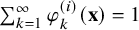 for each
$1\le i\le j-1$
for each
$1\le i\le j-1$
 , from (A), we may now multiply the expressions under the modulus sign on the left-hand sides of (4.15), (4.16), (4.17) and (4.18) by
$\mathbf {w}_i$
, from (A), we may now multiply the expressions under the modulus sign on the left-hand sides of (4.15), (4.16), (4.17) and (4.18) by
$\mathbf {w}_i$
 and sum over respective ranges of
$k\ge 1$
and sum over respective ranges of
$k\ge 1$
 and then over
$i=1,\ldots ,l$
and then over
$i=1,\ldots ,l$
 , to obtain

where the last inequality holds due to (B). Therefore, in the latter case of (4.13),

where the penultimate inequality is due to
$\lambda ^{(j)}(\mathbf {x},\mathbf {z})\in [0,1]$
 and the convexity of the
$\left \|\cdot \right \|_{\operatorname {op}}$
and the convexity of the
$\left \|\cdot \right \|_{\operatorname {op}}$
 norm. Combining (4.14) and (4.19), see also Remark 4.3(ii), we conclude that the inequality

holds in all cases from (4.13) covering all
$\mathbf {x}\in U_0\setminus \bigcup _{j=1}^{l}\partial U_{j}$
 and
$\mathbf {z}\in B(\mathbf {0}_X,r(\mathbf {x}))$
and
$\mathbf {z}\in B(\mathbf {0}_X,r(\mathbf {x}))$
 . Together with (4.11), this proves that g is locally
$(\mathfrak {C}(T)+\theta )$
. Together with (4.11), this proves that g is locally
$(\mathfrak {C}(T)+\theta )$
 -Lipschitz on the complement of the closed Lebesgue null set
$\bigcup _{j=0}^{l}\partial {U_{j}}$
-Lipschitz on the complement of the closed Lebesgue null set
$\bigcup _{j=0}^{l}\partial {U_{j}}$
 , hence
$\left \|Dg(\mathbf {x})\right \|_{\operatorname {op}}\le \mathfrak {C}(T)+\theta $
, hence
$\left \|Dg(\mathbf {x})\right \|_{\operatorname {op}}\le \mathfrak {C}(T)+\theta $
 for almost all
$\mathbf {x}\in X$
for almost all
$\mathbf {x}\in X$
 . Since we have already established that g is also locally Lipschitz on X, we deduce (e), that
$g\colon X\to Y$
. Since we have already established that g is also locally Lipschitz on X, we deduce (e), that
$g\colon X\to Y$
 is a
$(\mathfrak {C}(T)+\theta )$
is a
$(\mathfrak {C}(T)+\theta )$
 -Lipschitz mapping; see Corollary A.2.
In the following lemma we will consider mappings defined on
$Q\subseteq X$
 . Note that although our final aim, Theorem 1.2, is to prove typical non-differentiability within the space of
$1$
. Note that although our final aim, Theorem 1.2, is to prove typical non-differentiability within the space of
$1$
 -Lipschitz mappings defined on a bounded subset Q of X, Lemma 4.5 works for any
$Q\subseteq X$
-Lipschitz mappings defined on a bounded subset Q of X, Lemma 4.5 works for any
$Q\subseteq X$
 , in particular,
$Q=X$
, in particular,
$Q=X$
 . Also, in the proof of Lemma 4.5 we will require a familiar type of smooth approximation result for Lipschitz mappings; the formal statement and proof of this result appears later on, in Section 5.
Lemma 4.5. Let X and Y be normed spaces, where X is finite-dimensional. Let a closed subset
$Q\subseteq X$
 contain an open set V,
$T\in \mathcal {L}(X,Y)$
contain an open set V,
$T\in \mathcal {L}(X,Y)$
 ,
$g\colon Q\to W$
,
$g\colon Q\to W$
 be a Lipschitz mapping, where
$W\supseteq T(X)$
be a Lipschitz mapping, where
$W\supseteq T(X)$
 is a finite-dimensional subspace of Y, functions
$\psi \colon V\to \mathbb {R}$
is a finite-dimensional subspace of Y, functions
$\psi \colon V\to \mathbb {R}$
 ,
$\xi \colon V\to [0,\infty )$
,
$\xi \colon V\to [0,\infty )$
 be continuous and bounded on V, and
$\theta>0$
be continuous and bounded on V, and
$\theta>0$
 . Assume further that

for almost all
$\mathbf {x}\in V$
 . Then there exists a Lipschitz mapping
$f\colon Q\to W$
. Then there exists a Lipschitz mapping
$f\colon Q\to W$
 such that
-
(a) $f(\mathbf {x})=g(\mathbf {x})$
whenever
$\mathbf {x}\in Q\setminus \{\mathbf {y}\in V\colon \xi (\mathbf {y})>0\}$
. -
(b) $\left \|f(\mathbf {x})-g(\mathbf {x})\right \|_{Y}\leq \theta $
for all
$\mathbf {x}\in Q$
. -
(c) $f\in C^{1}(V,Y)$
. -
(d) $\left \|Df(\mathbf {x})-\psi (\mathbf {x})T\right \|_{\operatorname {op}}\leq \xi (\mathbf {x})(1+\theta )$
for all
$\mathbf {x}\in V$
.


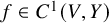


Proof. The statement of the lemma is trivial if
$W=\{\mathbf {0}_{Y}\}$
 . Also, if the open set
$U:=\{\mathbf {x}\in V\colon \xi (\mathbf {x})>0\}$
. Also, if the open set
$U:=\{\mathbf {x}\in V\colon \xi (\mathbf {x})>0\}$
 is empty, then
$Dg$
is empty, then
$Dg$
 coincides, almost everywhere on V, with a continuous mapping
$\psi T$
coincides, almost everywhere on V, with a continuous mapping
$\psi T$
 by (4.20). Therefore
$g\in C^1(V,Y)$
by (4.20). Therefore
$g\in C^1(V,Y)$
 and
$Dg(\mathbf {x})=\psi (\mathbf {x})T$
and
$Dg(\mathbf {x})=\psi (\mathbf {x})T$
 for all
$\mathbf {x}\in V$
for all
$\mathbf {x}\in V$
 (see Theorem B.3), so
$f:=g$
(see Theorem B.3), so
$f:=g$
 satisfies conditions (a)–(d). Hence assume, without loss of generality, that
$W\ne \{\mathbf {0}_{Y}\}$
satisfies conditions (a)–(d). Hence assume, without loss of generality, that
$W\ne \{\mathbf {0}_{Y}\}$
 and
$U\ne \emptyset $
and
$U\ne \emptyset $
 .
.
Let
$\mathbf {w}_{1},\ldots ,\mathbf {w}_{l}\in Y$
 be a basis of W, such that
$\left \|\mathbf {w}_i\right \|_{Y}=1$
be a basis of W, such that
$\left \|\mathbf {w}_i\right \|_{Y}=1$
 for all
$1\le i\le l$
for all
$1\le i\le l$
 and
$\mathbf {w}_{1}^{\ast },\ldots ,\mathbf {w}_{l}^{\ast }\in W^*$
and
$\mathbf {w}_{1}^{\ast },\ldots ,\mathbf {w}_{l}^{\ast }\in W^*$
 be the corresponding biorthogonal functionals; let
$g_i=\mathbf {w}_i^*\circ g$
be the corresponding biorthogonal functionals; let
$g_i=\mathbf {w}_i^*\circ g$
 , so that
$g(\mathbf {x})=\sum _{i=1}^lg_i(\mathbf {x})\mathbf {w}_i$
, so that
$g(\mathbf {x})=\sum _{i=1}^lg_i(\mathbf {x})\mathbf {w}_i$
 for all
$\mathbf {x}\in Q$
for all
$\mathbf {x}\in Q$
 . We also fix a basis of X and use this to identify X with
$\mathbb {R}^{\dim X}$
. We also fix a basis of X and use this to identify X with
$\mathbb {R}^{\dim X}$
 in the standard way. This identification allows us to define the Lebesgue measure on X. Accordingly all integrals on subsets of X which appear in this proof should be understood via this identification. Let also
$C>0$
in the standard way. This identification allows us to define the Lebesgue measure on X. Accordingly all integrals on subsets of X which appear in this proof should be understood via this identification. Let also
$C>0$
 be a constant of equivalence between the norm
$\left \|\cdot \right \|_{X}$
be a constant of equivalence between the norm
$\left \|\cdot \right \|_{X}$
 and the Euclidean norm
$\left \|\cdot \right \|_{\text {E}}$
and the Euclidean norm
$\left \|\cdot \right \|_{\text {E}}$
 on
$\mathbb {R}^{\dim X}=X$
on
$\mathbb {R}^{\dim X}=X$
 so that for all
$\mathbf {z}\in X$
so that for all
$\mathbf {z}\in X$


Let
$\rho \colon X\to [0,\infty )$
 denote the standard smooth (Euclidean) mollifier in
$\mathbb {R}^{\dim X}=X$
denote the standard smooth (Euclidean) mollifier in
$\mathbb {R}^{\dim X}=X$
 and for
$\varepsilon>0$
and for
$\varepsilon>0$
 let
$\rho _{\varepsilon }(\mathbf {x}){:=} \varepsilon ^{-\dim X}\rho (\mathbf {x}/\varepsilon )$
let
$\rho _{\varepsilon }(\mathbf {x}){:=} \varepsilon ^{-\dim X}\rho (\mathbf {x}/\varepsilon )$
 . In what follows we consider, for each
$\mathbf {x}\in U$
. In what follows we consider, for each
$\mathbf {x}\in U$
 and
$\varepsilon \in (0,\varepsilon (\mathbf {x}))$
and
$\varepsilon \in (0,\varepsilon (\mathbf {x}))$
 , where
$\varepsilon (\mathbf {x})>0$
, where
$\varepsilon (\mathbf {x})>0$
 is such that
$\mathbf {x}+\mathbf {y}\in U$
is such that
$\mathbf {x}+\mathbf {y}\in U$
 for any
$\left \|\mathbf {y}\right \|_{\text {E}}\le \varepsilon (\mathbf {x})$
for any
$\left \|\mathbf {y}\right \|_{\text {E}}\le \varepsilon (\mathbf {x})$
 , the convolution

where the integration is with respect to the Lebesgue measure. Note that
$g*\rho _{\varepsilon }(\mathbf {x})\in W$
 for any
$\varepsilon \in (0,\varepsilon (\mathbf {x}))$
for any
$\varepsilon \in (0,\varepsilon (\mathbf {x}))$
 . We also let
${U}_{\varepsilon }=\left \{\mathbf {x}\in U\colon \operatorname {dist}_{\left \|\cdot \right \|_{\text {E}}}(\mathbf {x},X\setminus U)> \varepsilon \right \}$
. We also let
${U}_{\varepsilon }=\left \{\mathbf {x}\in U\colon \operatorname {dist}_{\left \|\cdot \right \|_{\text {E}}}(\mathbf {x},X\setminus U)> \varepsilon \right \}$
 , for
$\varepsilon>0$
, for
$\varepsilon>0$
 .
.
Note that for any
$\varepsilon>0$
 the convolution
$g*\rho _{\varepsilon }$
the convolution
$g*\rho _{\varepsilon }$
 is defined on
${U}_{\varepsilon }$
is defined on
${U}_{\varepsilon }$
 , belongs to
$\operatorname {Lip}({U}_{\varepsilon },Y)\cap C^1({U}_{\varepsilon },Y)$
, belongs to
$\operatorname {Lip}({U}_{\varepsilon },Y)\cap C^1({U}_{\varepsilon },Y)$
 and approximates g well: for any
$\mathbf {x}\in {U}_{\varepsilon }$
and approximates g well: for any
$\mathbf {x}\in {U}_{\varepsilon }$


We note, for future reference, that using
$D(g_i*\rho _\varepsilon )(\mathbf {x}) =(Dg_i*\rho _\varepsilon )(\mathbf {x})$
 and (4.20), we have for all
$\varepsilon>0$
and (4.20), we have for all
$\varepsilon>0$
 ,
$\mathbf {x}\in {U}_{\varepsilon }$
,
$\mathbf {x}\in {U}_{\varepsilon }$
 and
$\left \|\mathbf {v}\right \|_{X}\le 1$
and
$\left \|\mathbf {v}\right \|_{X}\le 1$


We now use (4.20) to estimate the norm of (4.23) from above as

Moreover, for any compact set
$\emptyset \ne K\subseteq U$
 , we may use that
$\xi $
, we may use that
$\xi $
 and
$\psi $
and
$\psi $
 are continuous on U and
$\xi>0$
are continuous on U and
$\xi>0$
 on U to choose
$\delta _{K}>0$
on U to choose
$\delta _{K}>0$
 sufficiently small so that for all
$\varepsilon \in (0,\delta _{K})$
sufficiently small so that for all
$\varepsilon \in (0,\delta _{K})$
 we have
$K\subseteq {U}_{\varepsilon }$
we have
$K\subseteq {U}_{\varepsilon }$
 and
and

Combining this with (4.24) we get

for any compact
$K\subseteq U$
 ,
$\mathbf {x}\in K$
,
$\mathbf {x}\in K$
 and
$\varepsilon \in (0,\delta _{K})$
and
$\varepsilon \in (0,\delta _{K})$
 .
.
Let
$(\varphi _{k})_{k\in \mathbb {N}}$
 be a smooth, locally finite partition of unity on
$U=\{\mathbf {x}\in V\colon \xi (\mathbf {x})>0\}$
be a smooth, locally finite partition of unity on
$U=\{\mathbf {x}\in V\colon \xi (\mathbf {x})>0\}$
 and for each
$k\in \mathbb {N}$
and for each
$k\in \mathbb {N}$
 set
set

where C is fixed in (4.21),
$w=\max _{1\le i\le l}\left \|\mathbf {w}_i^*\right \|_{X^*}$
 and
$\operatorname {SLA}(g,A_{k},Y,\theta _{k})$
and
$\operatorname {SLA}(g,A_{k},Y,\theta _{k})$
 is defined as the class of smooth Lipschitz mappings
$A_{k}\to Y$
is defined as the class of smooth Lipschitz mappings
$A_{k}\to Y$
 which approximate g uniformly within error
$\theta _{k}$
which approximate g uniformly within error
$\theta _{k}$
 ; a precise description of this class is given in Definition 5.2, and
$h_k\in \operatorname {SLA}(g,A_{k},Y,\theta _k)$
; a precise description of this class is given in Definition 5.2, and
$h_k\in \operatorname {SLA}(g,A_{k},Y,\theta _k)$
 follows from (4.22) and the choice of
$\varepsilon _k$
follows from (4.22) and the choice of
$\varepsilon _k$
 above. The desired mapping f may now be defined by
$\sum _{k\in \mathbb {N}}\varphi _{k}h_{k}$
above. The desired mapping f may now be defined by
$\sum _{k\in \mathbb {N}}\varphi _{k}h_{k}$
 in U and set equal to g in
$Q\setminus U$
in U and set equal to g in
$Q\setminus U$
 ; then a ‘smooth approximation result’ for mappings of this form will establish the remaining properties of f. We postpone this result, Lemma 5.3, until Section 5. We now describe precisely how to apply Lemma 5.3. Let
$h:=g$
; then a ‘smooth approximation result’ for mappings of this form will establish the remaining properties of f. We postpone this result, Lemma 5.3, until Section 5. We now describe precisely how to apply Lemma 5.3. Let
$h:=g$
 ,
$P(\mathbf {x}):=\psi (\mathbf {x})T\in \mathcal {L}(X,Y)$
,
$P(\mathbf {x}):=\psi (\mathbf {x})T\in \mathcal {L}(X,Y)$
 and
$\eta (\mathbf {x}):=\xi (\mathbf {x})\left (1+\frac {\theta }{2}\right )$
and
$\eta (\mathbf {x}):=\xi (\mathbf {x})\left (1+\frac {\theta }{2}\right )$
 for each
$\mathbf {x}\in U$
for each
$\mathbf {x}\in U$
 . The conditions of Lemma 5.3, including the additional condition of (ii), are now satisfied, by the definition of U and (4.25), and we may let
$f{:=} \tilde {h}$
. The conditions of Lemma 5.3, including the additional condition of (ii), are now satisfied, by the definition of U and (4.25), and we may let
$f{:=} \tilde {h}$
 be given by the conclusion of Lemma 5.3. Then conditions (a), (b) of the present lemma and
$f\in C^1(U,Y)$
be given by the conclusion of Lemma 5.3. Then conditions (a), (b) of the present lemma and
$f\in C^1(U,Y)$
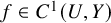 , which is a part of (c), are satisfied. Since all values of g and of
$h_k$
, which is a part of (c), are satisfied. Since all values of g and of
$h_k$
 are in W, we get
$f\colon Q\to W$
are in W, we get
$f\colon Q\to W$
 . Moreover, Lemma 5.3(ii), (4.26) and (4.25) give, for any
$\mathbf {x}\in U$
. Moreover, Lemma 5.3(ii), (4.26) and (4.25) give, for any
$\mathbf {x}\in U$
 ,
,

which proves the inequality of (d) for all
$\mathbf {x}\in U$
 . This implies, in particular, that for all
$\mathbf {x}\in U$
. This implies, in particular, that for all
$\mathbf {x}\in U$


where
$\Psi ,\Xi>0$
 are upper bounds of bounded functions
$\psi ,\xi $
are upper bounds of bounded functions
$\psi ,\xi $
 respectively. Hence we conclude that f is locally L-Lipschitz on U, and so using (a),
$g\in \operatorname {Lip}(Q,W)$
respectively. Hence we conclude that f is locally L-Lipschitz on U, and so using (a),
$g\in \operatorname {Lip}(Q,W)$
 and Lemma A.3, we obtain
$f\in \operatorname {Lip}(Q,W)$
and Lemma A.3, we obtain
$f\in \operatorname {Lip}(Q,W)$
 . We also note from (4.27) that the mapping
$\Phi \colon V\to \mathcal {L}(X,Y)$
. We also note from (4.27) that the mapping
$\Phi \colon V\to \mathcal {L}(X,Y)$
 defined by

is continuous on V, as
$U=\{\mathbf {x}\in V\colon \xi (\mathbf {x})>0\}$
 and
$\xi $
and
$\xi $
 is continuous on V. We may now apply Theorem B.1(ii) to Lipschitz mappings
$f,g\colon V\subseteq X\to W$
is continuous on V. We may now apply Theorem B.1(ii) to Lipschitz mappings
$f,g\colon V\subseteq X\to W$
 between finite-dimensional spaces to conclude that
$Df$
between finite-dimensional spaces to conclude that
$Df$
 and
$Dg$
and
$Dg$
 exist and are equal almost everywhere on
$\{\mathbf {x}\in V\colon f(\mathbf {x})=g(\mathbf {x})\}\supseteq V\setminus U$
exist and are equal almost everywhere on
$\{\mathbf {x}\in V\colon f(\mathbf {x})=g(\mathbf {x})\}\supseteq V\setminus U$
 . This, together with (4.20) and the definitions of
$\Phi $
. This, together with (4.20) and the definitions of
$\Phi $
 and U implies
$Df(\mathbf {x})=\Phi (\mathbf {x})$
and U implies
$Df(\mathbf {x})=\Phi (\mathbf {x})$
 for almost every
$\mathbf {x}\in V$
for almost every
$\mathbf {x}\in V$
 . Therefore, by Theorem B.3,
$f\in C^1(V,Y)$
. Therefore, by Theorem B.3,
$f\in C^1(V,Y)$
 and
$Df(\mathbf {x})=\Phi (\mathbf {x})$
and
$Df(\mathbf {x})=\Phi (\mathbf {x})$
 for all
$\mathbf {x}\in V$
for all
$\mathbf {x}\in V$
 . This verifies (c) and, together with (4.27), implies (d).
Lemma 4.6. Let X and Y be normed spaces, where X is finite-dimensional. Let
$E\subseteq X$
 be compact and purely
$1$
be compact and purely
$1$
 -unrectifiable,
$\eta>0$
-unrectifiable,
$\eta>0$
 , let a function
$\varphi \colon X\to [0,1]$
, let a function
$\varphi \colon X\to [0,1]$
 be continuous and
$T\in \mathcal {L}(X,Y)$
be continuous and
$T\in \mathcal {L}(X,Y)$
 . Then there exist a Lipschitz mapping
$f\colon X\to T(X)$
. Then there exist a Lipschitz mapping
$f\colon X\to T(X)$
 , a function
$\psi \colon X\to [0,1]$
, a function
$\psi \colon X\to [0,1]$
 and an open set
$H\subseteq X$
and an open set
$H\subseteq X$
 such that the following statements hold:
-
(i) $E\subseteq H\subseteq B_{X}(E,\eta )$
. -
(ii) $f\in \operatorname {Lip}(X,Y)\cap C^{1}(H,Y)$
. -
(iii) $\sup _{\mathbf {x}\in X} \left \|f(\mathbf {x})\right \|_{Y}\leq \eta $
and
$\operatorname {supp} f\subseteq \operatorname {supp} \varphi $
. -
(iv) $\left \|Df(\mathbf {x})-\psi (\mathbf {x})T\right \|_{\operatorname {op}}\leq \eta $
for Lebesgue almost every
$\mathbf {x}\in X$
. -
(v) $0\leq \varphi (\mathbf {x})\mathbb {1}_{H}(\mathbf {x})\leq \psi (\mathbf {x})\leq \varphi (\mathbf {x})\mathbb {1}_{B_{X}(E,\eta )}(\mathbf {x})$
for all
$\mathbf {x}\in X$
. -
(vi) $\psi (\mathbf {x})=\varphi (\mathbf {x})$
for all
$\mathbf {x}\in H$
, and so
$\psi |_H$
is continuous.











Proof. The statement of the lemma is clear for
$T=0$
 , so assume, without loss of generality, that
$T\ne 0$
, so assume, without loss of generality, that
$T\ne 0$
 is such that
$\left \|T\right \|_{\operatorname {op}}\le 1$
is such that
$\left \|T\right \|_{\operatorname {op}}\le 1$
 . We may do so as if
$\left \|T\right \|_{\operatorname {op}}>1$
. We may do so as if
$\left \|T\right \|_{\operatorname {op}}>1$
 and the conclusion of this lemma holds for operators of norm less than or equal to
$1$
and the conclusion of this lemma holds for operators of norm less than or equal to
$1$
 , we let
$f_1,\psi $
, we let
$f_1,\psi $
 and H correspond to E,
$\eta _1=\eta /\left \|T\right \|_{\operatorname {op}}$
and H correspond to E,
$\eta _1=\eta /\left \|T\right \|_{\operatorname {op}}$
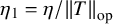 ,
$\varphi $
,
$\varphi $
 and
$T_1=T/\left \|T\right \|_{\operatorname {op}}$
and
$T_1=T/\left \|T\right \|_{\operatorname {op}}$
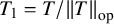 and define
$f=\left \|T\right \|_{\operatorname {op}}f_1$
and define
$f=\left \|T\right \|_{\operatorname {op}}f_1$
 .
.
Let
$C=\mathfrak {C}(T)+5$
 , where
$\mathfrak {C}(T)$
, where
$\mathfrak {C}(T)$
 is the constant given by Definition 4.2,

$G_{1}:=H_{1}:=B_{X}(E,\eta )$
 and note that
$E\subseteq H_{1}$
and note that
$E\subseteq H_{1}$
 . For each
$i=2,\ldots ,k-1$
. For each
$i=2,\ldots ,k-1$
 , whenever the open set
$H_{i-1}$
, whenever the open set
$H_{i-1}$
 containing compact
$E\cap \left \{\mathbf {x}\in X\colon \varphi (\mathbf {x})\geq \frac {i}{k}\right \}$
containing compact
$E\cap \left \{\mathbf {x}\in X\colon \varphi (\mathbf {x})\geq \frac {i}{k}\right \}$
 has been defined, let

Next apply Lemma 4.4 to X, Y, the compact, purely
$1$
 -unrectifiable subset
$E\cap \left \{\mathbf {x}\in X\colon \varphi (\mathbf {x})\geq i/k\right \}$
-unrectifiable subset
$E\cap \left \{\mathbf {x}\in X\colon \varphi (\mathbf {x})\geq i/k\right \}$
 of the open set
$U=G_{i}$
of the open set
$U=G_{i}$
 ,
$\theta $
,
$\theta $
 and T to obtain a mapping
$g_{i}\in \operatorname {Lip}_{C}(X,T(X))$
and T to obtain a mapping
$g_{i}\in \operatorname {Lip}_{C}(X,T(X))$
 , as
$C\geq \mathfrak {C}(T)+\theta $
, as
$C\geq \mathfrak {C}(T)+\theta $
 , and an open set
$H_{i}\subseteq X$
, and an open set
$H_{i}\subseteq X$
 such that
-
(a) $\operatorname {supp} g_{i}\subseteq G_{i}$
and
$Dg_i(\mathbf {x})=0$
for any
$\mathbf {x}\notin G_i$
. -
(b) $\sup _{\mathbf {x}\in X} \left \|g_{i}(\mathbf {x})\right \|_{Y}\leq \theta $
. -
(c) $E\cap \left \{\mathbf {x}\in X\colon \varphi (\mathbf {x})\geq \frac {i}{k}\right \}\subseteq H_{i}\subseteq \overline {H_{i}}\subseteq G_{i}$
. -
(d) $\left \|Dg_{i}(\mathbf {x})-T\right \|_{\operatorname {op}}\leq \theta $
for Lebesgue almost all
$\mathbf {x}\in H_{i}$
.







Note that (c) implies that
$E\cap \left \{\mathbf {x}\in X\colon \varphi (\mathbf {x})\geq \frac {i+1}{k}\right \}\subseteq H_i$
 and hence we construct inductively mappings
$g_{2},\ldots ,g_{k-1}\in \operatorname {Lip}_C(X,T(X))$
and hence we construct inductively mappings
$g_{2},\ldots ,g_{k-1}\in \operatorname {Lip}_C(X,T(X))$
 and nested sequences of open sets
$H_{1}\supseteq \ldots \supseteq H_{k-1}$
and nested sequences of open sets
$H_{1}\supseteq \ldots \supseteq H_{k-1}$
 and
$G_{1}\supseteq \dots \supseteq G_{k-1}$
and
$G_{1}\supseteq \dots \supseteq G_{k-1}$
 such that properties (a)–(d) hold for every
$2\le i\le k-1$
such that properties (a)–(d) hold for every
$2\le i\le k-1$
 . Consider
$g:=\frac {1}{k}\sum _{i=2}^{k-1}g_{i}\in \operatorname {Lip}_C(X,T(X))$
. Consider
$g:=\frac {1}{k}\sum _{i=2}^{k-1}g_{i}\in \operatorname {Lip}_C(X,T(X))$
 . Properties (a) and (b) of
$g_{2},\ldots ,g_{k-1}$
. Properties (a) and (b) of
$g_{2},\ldots ,g_{k-1}$
 , and the nested property of
$G_i$
, and the nested property of
$G_i$
 lead to

and

Define
$j\colon G_{1}\to \left \{1,\ldots ,k-1\right \}$
 by
by

and note that for all
$\mathbf {x}\in G_1$
 we have
$\varphi (\mathbf {x})\ge \frac {j(\mathbf {x})-1}{k}$
we have
$\varphi (\mathbf {x})\ge \frac {j(\mathbf {x})-1}{k}$
 due to the non-negativity of
$\varphi $
due to the non-negativity of
$\varphi $
 when
$j(\mathbf {x})=1$
when
$j(\mathbf {x})=1$
 and to the definitions (4.29) and (4.32) when
$j(\mathbf {x})>1$
and to the definitions (4.29) and (4.32) when
$j(\mathbf {x})>1$
 . Observe also that whenever all
$g_i$
. Observe also that whenever all
$g_i$
 are differentiable at
$\mathbf {x}\in G_{1}$
are differentiable at
$\mathbf {x}\in G_{1}$
 ,
,

because of (a), and the definitions of g and
$j(\mathbf {x})$
 . Let
$\psi \colon X\to [0,1]$
. Let
$\psi \colon X\to [0,1]$
 be given by

Then the last inequality of (v) is satisfied. Note also for future reference that for every
$\mathbf {x}\in G_{1}$
 we have

using
$\varphi (\mathbf {x})\ge \frac {j(\mathbf {x})-1}{k}$
 . Define an open set
$H\subseteq X$
. Define an open set
$H\subseteq X$
 by
by

The second inclusion of (i),
$H\subseteq B_X(E,\eta )=H_{1}$
 , is now clear, due to the nested property of
$H_i$
, is now clear, due to the nested property of
$H_i$
 . We prove the first inclusion: Let
$\mathbf {x}\in E$
. We prove the first inclusion: Let
$\mathbf {x}\in E$
 . Then there is an
$m\in \left \{0,\ldots ,k-1\right \}$
. Then there is an
$m\in \left \{0,\ldots ,k-1\right \}$
 such that
$\frac {m}{k}\leq \varphi (\mathbf {x})\leq \frac {m+1}{k}$
such that
$\frac {m}{k}\leq \varphi (\mathbf {x})\leq \frac {m+1}{k}$
 . If
$m\leq 1$
. If
$m\leq 1$
 , then since
$\mathbf {x}\in E\subseteq H_1$
, then since
$\mathbf {x}\in E\subseteq H_1$
 and
$\varphi (\mathbf {x})\le \frac 2k<\frac 3k$
and
$\varphi (\mathbf {x})\le \frac 2k<\frac 3k$
 , we have
$\mathbf {x}\in S_1$
, we have
$\mathbf {x}\in S_1$
 ; for
$2\le m\le k-1$
; for
$2\le m\le k-1$
 we have
$\mathbf {x}\in E\cap \left \{\mathbf {x}\in X\colon \varphi (\mathbf {x})\geq m/k\right \}\subseteq H_{m}$
we have
$\mathbf {x}\in E\cap \left \{\mathbf {x}\in X\colon \varphi (\mathbf {x})\geq m/k\right \}\subseteq H_{m}$
 by (c) and
$\varphi (\mathbf {x})\leq \frac {m+1}{k}<\frac {m+2}{k}$
by (c) and
$\varphi (\mathbf {x})\leq \frac {m+1}{k}<\frac {m+2}{k}$
 so
$\mathbf {x}\in S_m$
so
$\mathbf {x}\in S_m$
 . This proves the first inclusion of (i).
We now verify (vi) and the remaining inequalities of (v). Note first that from
$H_1=G_1$
 , (4.32) and (c) we have, for any
$1\leq j\leq k-1$
, (4.32) and (c) we have, for any
$1\leq j\leq k-1$
 , that
$\mathbf {x}\in H_{j}$
, that
$\mathbf {x}\in H_{j}$
 implies
$j(\mathbf {x})\geq j$
implies
$j(\mathbf {x})\geq j$
 . Fix any
$\mathbf {x}\in H\subseteq G_{1}$
. Fix any
$\mathbf {x}\in H\subseteq G_{1}$
 and
$j\in \left \{1,\ldots ,k-1\right \}$
and
$j\in \left \{1,\ldots ,k-1\right \}$
 such that
$\mathbf {x}\in S_{j}$
such that
$\mathbf {x}\in S_{j}$
 ; then
$\varphi (\mathbf {x})< \frac {j+2}{k}\le \frac {j(\mathbf {x})+2}{k}$
; then
$\varphi (\mathbf {x})< \frac {j+2}{k}\le \frac {j(\mathbf {x})+2}{k}$
 thus, by (4.34),
$\psi (\mathbf {x})=\varphi (\mathbf {x})$
thus, by (4.34),
$\psi (\mathbf {x})=\varphi (\mathbf {x})$
 proving (vi), which together with (4.34) gives the first two inequalities of (v).
Let now
$\mathbf {x}\in G_{2}$
 be any point such that all
$g_i$
be any point such that all
$g_i$
 are differentiable at
$\mathbf {x}$
are differentiable at
$\mathbf {x}$
 and for any
$1\le i\le k-1$
and for any
$1\le i\le k-1$
 such that
$\mathbf {x}\in H_i$
such that
$\mathbf {x}\in H_i$
 we also have the inequality (d). We remark that almost all points of
$G_{2}$
we also have the inequality (d). We remark that almost all points of
$G_{2}$
 are such. Thus, whenever
$1\leq i\leq j(\mathbf {x})-1$
are such. Thus, whenever
$1\leq i\leq j(\mathbf {x})-1$
 , we have, from (4.32) and (4.29), that
$\mathbf {x}\in G_{j(\mathbf {x})}\subseteq H_{j(\mathbf {x})-1}\subseteq H_i$
, we have, from (4.32) and (4.29), that
$\mathbf {x}\in G_{j(\mathbf {x})}\subseteq H_{j(\mathbf {x})-1}\subseteq H_i$
 , hence the inequality (d) applies. Therefore, we now verify that for almost all
$\mathbf {x}\in G_2$
, hence the inequality (d) applies. Therefore, we now verify that for almost all
$\mathbf {x}\in G_2$
 ,
,

The first equality follows from (4.33); the first inequality of the last line is guaranteed by (d),
$g_{j(\mathbf {x})}\in \operatorname {Lip}_C(X,T(X))$
 and (4.35); finally, we use (4.28),
$\mathbf {x}\in G_2$
and (4.35); finally, we use (4.28),
$\mathbf {x}\in G_2$
 and (4.29) for the remaining inequalities.
Using (a) of the present proof, the nested property of
$G_i$
 and (4.33), we conclude that
$Dg(\mathbf {x})=0$
and (4.33), we conclude that
$Dg(\mathbf {x})=0$
 for every
$\mathbf {x}\in X\setminus G_{2}$
for every
$\mathbf {x}\in X\setminus G_{2}$
 . From (4.29) and the already verified (v) we also have that
$0\le \psi (\mathbf {x})\le \varphi (\mathbf {x})\mathbb {1}_{H_1}(\mathbf {x})\le \frac 1k$
. From (4.29) and the already verified (v) we also have that
$0\le \psi (\mathbf {x})\le \varphi (\mathbf {x})\mathbb {1}_{H_1}(\mathbf {x})\le \frac 1k$
 for all
$\mathbf {x}\in X\setminus G_{2}$
for all
$\mathbf {x}\in X\setminus G_{2}$
 . Hence, for every
$\mathbf {x}\in X\setminus G_{2}$
. Hence, for every
$\mathbf {x}\in X\setminus G_{2}$
 we have
$\left \|Dg(\mathbf {x})-\psi (\mathbf {x})T\right \|_{\operatorname {op}}=\psi (\mathbf {x})\left \|T\right \|_{\operatorname {op}}\le \psi (\mathbf {x})\le \min \left \{\varphi (\mathbf {x}),\frac 1k\right \}$
we have
$\left \|Dg(\mathbf {x})-\psi (\mathbf {x})T\right \|_{\operatorname {op}}=\psi (\mathbf {x})\left \|T\right \|_{\operatorname {op}}\le \psi (\mathbf {x})\le \min \left \{\varphi (\mathbf {x}),\frac 1k\right \}$
 . This, together with (4.36) and
$C>1$
. This, together with (4.36) and
$C>1$
 , establishes

Let
$f\colon X\to T(X)\subseteq Y$
 be the Lipschitz mapping given by the conclusion of Lemma 4.5 applied to X, Y,
$Q=X$
be the Lipschitz mapping given by the conclusion of Lemma 4.5 applied to X, Y,
$Q=X$
 ,
$V=H$
,
$V=H$
 , T,
$W=T(X)$
, T,
$W=T(X)$
 ,
$g\in \operatorname {Lip}(X,T(X))$
,
$g\in \operatorname {Lip}(X,T(X))$
 , continuous bounded functions
$\psi |_H$
, continuous bounded functions
$\psi |_H$
 ,
$\xi (\mathbf {x})=4C\min \Big \{\varphi (\mathbf {x}),\frac 1k\Big \}$
,
$\xi (\mathbf {x})=4C\min \Big \{\varphi (\mathbf {x}),\frac 1k\Big \}$
 for
$\mathbf {x}\in H$
for
$\mathbf {x}\in H$
 and
$\frac {\theta }{4C}$
and
$\frac {\theta }{4C}$
 , where the validity of (4.20) is guaranteed by (4.37). Note that from Lemma 4.5(c) we have
$f\in C^1(H,Y)$
, where the validity of (4.20) is guaranteed by (4.37). Note that from Lemma 4.5(c) we have
$f\in C^1(H,Y)$
 , so (ii) is satisfied.
Combining Lemma 4.5(b) with (4.30) and (4.28), we deduce for every
$\mathbf {x}\in Q=X$


Moreover, we deduce from Lemma 4.5(a) that
$f(\mathbf {x})>0$
 implies either
$g(\mathbf {x})=f(\mathbf {x})>0$
implies either
$g(\mathbf {x})=f(\mathbf {x})>0$
 or
$\xi (\mathbf {x})>0$
or
$\xi (\mathbf {x})>0$
 . In both cases we conclude that
$\mathbf {x}\in \operatorname {supp}(\varphi )$
. In both cases we conclude that
$\mathbf {x}\in \operatorname {supp}(\varphi )$
 , in the former case due to (4.31) and in the latter due to the definition of
$\xi $
, in the former case due to (4.31) and in the latter due to the definition of
$\xi $
 . This establishes (iii) of the present lemma. Finally, we verify the inequality of (iv) for almost every
$\mathbf {x}\in X$
. This establishes (iii) of the present lemma. Finally, we verify the inequality of (iv) for almost every
$\mathbf {x}\in X$
 . First, for every
$\mathbf {x}\in H$
. First, for every
$\mathbf {x}\in H$
 , we may apply Lemma 4.5(d),
$\xi (\mathbf {x})\le 4C/k$
, we may apply Lemma 4.5(d),
$\xi (\mathbf {x})\le 4C/k$
 and (4.28) to obtain

Further, by Lemma 4.5(a) the set
$X\setminus H$
 is contained in the set where f and g, Lipschitz mappings
$X\to T(X)$
is contained in the set where f and g, Lipschitz mappings
$X\to T(X)$
 between finite-dimensional spaces, coincide. Since
$Df=Dg$
between finite-dimensional spaces, coincide. Since
$Df=Dg$
 almost everywhere in the latter set (see Theorem B.1), we have
$Df=Dg$
almost everywhere in the latter set (see Theorem B.1), we have
$Df=Dg$
 almost everywhere in
$X\setminus H$
almost everywhere in
$X\setminus H$
 . Hence, by (4.37) and (4.28), we have for almost every
$\mathbf {x}\in X\setminus H$
. Hence, by (4.37) and (4.28), we have for almost every
$\mathbf {x}\in X\setminus H$


Lemma 4.7. Let X and Y be normed spaces,
$E\subseteq U\subseteq Q\subseteq X$
 , where E is compact and U is open,
$\eta>0$
, where E is compact and U is open,
$\eta>0$
 and
$g\colon Q\to Y$
and
$g\colon Q\to Y$
 be a mapping with
$g\in C^{1}(U,Y)$
be a mapping with
$g\in C^{1}(U,Y)$
 . Then there exists
$\delta \in (0,\eta )$
. Then there exists
$\delta \in (0,\eta )$
 such that for every
$h\colon Q\to Y$
such that for every
$h\colon Q\to Y$
 with
with

every
$\mathbf {x}\in E$
 and every
$\mathbf {y}\in X$
and every
$\mathbf {y}\in X$
 with
$\left \|\mathbf {y}\right \|_{X}\leq \delta $
with
$\left \|\mathbf {y}\right \|_{X}\leq \delta $
 we have

Proof. Because g is a
$C^{1}$
 smooth mapping and E is compact, we have that g is uniformly Fréchet differentiable on E; see Lemma C.3. In other words, we may choose
$\delta \in (0,\eta )$
smooth mapping and E is compact, we have that g is uniformly Fréchet differentiable on E; see Lemma C.3. In other words, we may choose
$\delta \in (0,\eta )$
 small enough so that for all
$\mathbf {x}\in E$
small enough so that for all
$\mathbf {x}\in E$
 and all
$\mathbf {y}\in X$
and all
$\mathbf {y}\in X$
 with
$\left \|\mathbf {y}\right \|_{X}\leq \delta $
with
$\left \|\mathbf {y}\right \|_{X}\leq \delta $
 one has
$B(\mathbf {x},\delta )\subseteq Q$
one has
$B(\mathbf {x},\delta )\subseteq Q$
 and
and

The conclusion of the lemma follows immediately.
Lemma 4.8. Let X and Y be normed spaces, where X is finite-dimensional. Let
$E\subseteq H_{0}\subseteq Q\subseteq X$
 be sets, where E is compact and purely
$1$
be sets, where E is compact and purely
$1$
 -unrectifiable, and
$H_{0}$
-unrectifiable, and
$H_{0}$
 is open. Let
$f_{0}\in \operatorname {Lip}(Q,Y)\cap C^1(H_{0},Y)$
is open. Let
$f_{0}\in \operatorname {Lip}(Q,Y)\cap C^1(H_{0},Y)$
 and
$\eta \in (0,1)$
and
$\eta \in (0,1)$
 . For each
$k\in \mathbb {N}$
. For each
$k\in \mathbb {N}$
 let
$T_{k}\in \mathcal {L}(X,Y)$
let
$T_{k}\in \mathcal {L}(X,Y)$
 ,
$\varphi _{k}\in C(X,[0,1])$
,
$\varphi _{k}\in C(X,[0,1])$
 and
$\theta _k>0$
and
$\theta _k>0$
 . Then there is a sequence of sets
$H_{j}\subseteq H_0$
. Then there is a sequence of sets
$H_{j}\subseteq H_0$
 , Lipschitz mappings
$f_{j}\colon Q\to Y$
, Lipschitz mappings
$f_{j}\colon Q\to Y$
 and functions
$\psi _{j}\colon X\to [0,1]$
and functions
$\psi _{j}\colon X\to [0,1]$
 such that for each
$j\ge 1$
such that for each
$j\ge 1$

-
(i) $H_{j}$
is open,
$E\subseteq H_{j}\subseteq H_{j-1}$
and
$f_{j}\in \operatorname {Lip}(Q, Y)\cap C^1({H}_{j}, Y)$
. -
(ii) $\sup _{\mathbf {x}\in Q}\left \|f_{j}(\mathbf {x})-f_{j-1}(\mathbf {x})\right \|_{ Y}\leq \theta _j$
and
$f_{j}(\mathbf {x})=f_{j-1}(\mathbf {x})$
whenever
$\varphi _{j}(\mathbf {x})=0$
. -
(iii) $\mathbb {1}_{H_{j}}(\mathbf {x})\varphi _{j}(\mathbf {x})\leq \psi _{j}(\mathbf {x})\leq \mathbb {1}_{H_{j-1}}\varphi _{j}(\mathbf {x})$
for all
$\mathbf {x}\in X$
. -
(iv) $f_{j}$
is differentiable Lebesgue a.e. on
$H_{0}$
. -
(v) $\left \|Df_{j}(\mathbf {x})-L\right \|_{\operatorname {op}}\leq \left \|Df_{0}(\mathbf {x})+\sum _{k=1}^{j}\psi _k(\mathbf {x})T_{k}-L\right \|_{\operatorname {op}}+\eta $
for any
$L\in \mathcal {L}(X, Y)$
and Lebesgue almost every
$\mathbf {x}\in H_{0}$
.





Proof. Suppose
$j\geq 1$
 and an open set
$H_{j-1}\supseteq E$
and an open set
$H_{j-1}\supseteq E$
 and a Lipschitz mapping
$f_{j-1}\in \operatorname {Lip}(Q,Y)\cap C^1({H}_{j-1}, Y)$
and a Lipschitz mapping
$f_{j-1}\in \operatorname {Lip}(Q,Y)\cap C^1({H}_{j-1}, Y)$
 have already been defined so that for
$i=j-1$
have already been defined so that for
$i=j-1$


Here we interpret an empty sum as zero, an empty union as the empty set and the linear span of the empty set as
$\left \{0\right \}$
 . Thus the conditions are met for
$j=1$
. Thus the conditions are met for
$j=1$
 . Then we choose

small enough so that
$\overline {B}_{X}(E,\eta _{j})\subseteq H_{j-1}$
 and apply Lemma 4.6 to X, Y, E,
$\eta _j$
and apply Lemma 4.6 to X, Y, E,
$\eta _j$
 ,
$\varphi _j$
,
$\varphi _j$
 , and
$T_{j}$
, and
$T_{j}$
 to get a mapping
$g_{j}\colon X\to T_{j}(X)$
to get a mapping
$g_{j}\colon X\to T_{j}(X)$
 , a function
$\psi _{j}\colon X\to [0,1]$
, a function
$\psi _{j}\colon X\to [0,1]$
 and an open set
$H_{j}\subseteq X$
and an open set
$H_{j}\subseteq X$
 with the following properties:
-
(a) $E\subseteq H_{j}\subseteq B_{X}(E,\eta _{j})\subseteq \overline {B}_{X}(E,\eta _{j})\subseteq H_{j-1}$
. -
(b) $g_{j}\in \operatorname {Lip}(X, Y)\cap C^1({H}_{j}, Y)$
. -
(c) $\sup _{\mathbf {x}\in X}\left \|g_{j}(\mathbf {x})\right \|_{ Y}\leq \eta _{j}$
and
$\operatorname {supp} g_{j}\subseteq \operatorname {supp} \varphi _{j}$
. -
(d) $\left \|Dg_{j}(\mathbf {x})-\psi _j(\mathbf {x})T_{j}\right \|_{\operatorname {op}}\leq \eta _{j}$
for Lebesgue almost every
$\mathbf {x}\in X$
. -
(e) $0\leq \psi _{j}(\mathbf {x})\leq \mathbb {1}_{B_{X}(E,\eta _{j})}\varphi _{j}(\mathbf {x})$
for all
$\mathbf {x}\in X$
and
$\psi _{j}(\mathbf {x})=\varphi _{j}(\mathbf {x})$
for all
$\mathbf {x}\in H_{j}$
.


Let
$f_{j}:=f_{j-1}+g_{j}$
 ; note that
$f_{j}$
; note that
$f_{j}$
 is defined on Q and that (4.39) extends to
$i=j$
is defined on Q and that (4.39) extends to
$i=j$
 . Now we have that (i) and (ii) are implied by (a), (b) and (c), and (iii) follows from (e) and (a). Property (iv) of
$f_{j}$
. Now we have that (i) and (ii) are implied by (a), (b) and (c), and (iii) follows from (e) and (a). Property (iv) of
$f_{j}$
 follows from (4.39), the finite-dimensionality of
$X\supseteq Q$
follows from (4.39), the finite-dimensionality of
$X\supseteq Q$
 and of all
$T_{k}(X)$
and of all
$T_{k}(X)$
 in (4.39), Rademacher’s theorem and
$f_{0}\in C^1(H_{0},Y)$
in (4.39), Rademacher’s theorem and
$f_{0}\in C^1(H_{0},Y)$
 . Finally, we check (v). Let
$j\in \mathbb {N}$
. Finally, we check (v). Let
$j\in \mathbb {N}$
 and
$\mathbf {x}$
and
$\mathbf {x}$
 be any point from
$H_{0}$
be any point from
$H_{0}$
 lying in the intersection of the full measure sets corresponding to the mappings
$g_{1},\ldots ,g_{j}$
lying in the intersection of the full measure sets corresponding to the mappings
$g_{1},\ldots ,g_{j}$
 given by (d). Let
$L\in \mathcal {L}(X, Y)$
given by (d). Let
$L\in \mathcal {L}(X, Y)$
 be arbitrary. Then we have

where, to get the last inequality, we applied (d) and (4.40).
Lemma 4.9. Let X and Y be normed spaces, where X is finite-dimensional. Let
$E\subseteq H \subseteq Q\subseteq X$
 be sets, where E is compact and purely
$1$
be sets, where E is compact and purely
$1$
 -unrectifiable, H is open and Q is bounded and closed. Let
$\theta>0$
-unrectifiable, H is open and Q is bounded and closed. Let
$\theta>0$
 and
$f\in \operatorname {Lip}_1(Q,Y)\cap C^1(H,Y)$
and
$f\in \operatorname {Lip}_1(Q,Y)\cap C^1(H,Y)$
 and
$T\in \mathcal {L}(X,Y)$
and
$T\in \mathcal {L}(X,Y)$
 be such that
$\operatorname {Lip}(f),\left \|T\right \|_{\operatorname {op}}<1$
be such that
$\operatorname {Lip}(f),\left \|T\right \|_{\operatorname {op}}<1$
 . Then there exist an open set
$U\subseteq X$
. Then there exist an open set
$U\subseteq X$
 , a function
$g\in \operatorname {Lip}_1(Q,Y)\cap C^1(U,Y)$
, a function
$g\in \operatorname {Lip}_1(Q,Y)\cap C^1(U,Y)$
 and a positive number
$\delta \in (0,\theta )$
and a positive number
$\delta \in (0,\theta )$
 such that
-
(i) $E\subseteq U\subseteq H$
-
(ii) $\sup _{\mathbf {x}\in Q}\left \|g(\mathbf {x})-f(\mathbf {x})\right \|_{Y}\leq \theta $
-
(iii) For every mapping $h\colon X\to Y$
with
$\sup _{\mathbf {x}\in X}\left \|h(\mathbf {x})-g(\mathbf {x})\right \|_{Y}\leq \theta \delta /8$
, every
$\mathbf {x}\in E$
and every
$\mathbf {y}\in X$
with
$\left \|\mathbf {y}\right \|_{X}\leq \delta $
we have $$ \begin{align*} \left\|h(\mathbf{x}+\mathbf{y})-h(\mathbf{x})-T(\mathbf{y})\right\|_{Y}\leq \theta\delta. \end{align*} $$


Proof. Choose
$\rho>0$
 so that
$\overline {B}_{X}(E,\rho )\subseteq H$
so that
$\overline {B}_{X}(E,\rho )\subseteq H$
 . Next, exploit the uniform continuity of the partial derivatives of f on the compact set
$\overline {B}_{X}(E,\rho )$
. Next, exploit the uniform continuity of the partial derivatives of f on the compact set
$\overline {B}_{X}(E,\rho )$
 to find
$\tau \in (0,\rho )$
to find
$\tau \in (0,\rho )$
 such that

where

Let
$(\gamma _{k})_{k\in \mathbb {N}}$
 be a locally finite, smooth partition of unity subordinated to the family
$\left \{B_{X}(\mathbf {x},\tau )\colon \mathbf {x}\in E\right \}$
be a locally finite, smooth partition of unity subordinated to the family
$\left \{B_{X}(\mathbf {x},\tau )\colon \mathbf {x}\in E\right \}$
 and for each
$k\in \mathbb {N}$
and for each
$k\in \mathbb {N}$
 choose
$\mathbf {x}_{k}\in E$
choose
$\mathbf {x}_{k}\in E$
 such that
$\operatorname {supp} \gamma _{k}\subseteq B_{X}(\mathbf {x}_{k},\tau )$
such that
$\operatorname {supp} \gamma _{k}\subseteq B_{X}(\mathbf {x}_{k},\tau )$
 . Apply Lemma 4.8 to
$X,\ Y,\ E,\ H_0=H,\ Q,\ f_{0}=f,\ \eta =\zeta $
. Apply Lemma 4.8 to
$X,\ Y,\ E,\ H_0=H,\ Q,\ f_{0}=f,\ \eta =\zeta $
 ,
$T_{2k}=T$
,
$T_{2k}=T$
 ,
$T_{2k-1}=-Df(\mathbf {x}_{k})$
,
$T_{2k-1}=-Df(\mathbf {x}_{k})$
 ,
$\varphi _{2k-1}=\varphi _{2k}=\gamma _{k}$
,
$\varphi _{2k-1}=\varphi _{2k}=\gamma _{k}$
 and
$\theta _k=2^{-k}\theta $
and
$\theta _k=2^{-k}\theta $
 for each
$k\in \mathbb {N}$
for each
$k\in \mathbb {N}$
 to obtain sequences of open sets
$(H_{j})_{j\in \mathbb {N}}$
to obtain sequences of open sets
$(H_{j})_{j\in \mathbb {N}}$
 , Lipschitz mappings
$(f_{j}\colon Q\to Y)_{j\in \mathbb {N}}$
, Lipschitz mappings
$(f_{j}\colon Q\to Y)_{j\in \mathbb {N}}$
 and functions
$(\psi _{j}\colon X\to [0,1])_{j\in \mathbb {N}}$
and functions
$(\psi _{j}\colon X\to [0,1])_{j\in \mathbb {N}}$
 . By Lemma 4.8(ii) and by the choice of
$\theta _j$
. By Lemma 4.8(ii) and by the choice of
$\theta _j$
 , the sequence of Lipschitz mappings
$(f_{j})_{j\in \mathbb {N}}$
, the sequence of Lipschitz mappings
$(f_{j})_{j\in \mathbb {N}}$
 converges, in
$(C(Q),\left \|\cdot \right \|_{\infty })$
converges, in
$(C(Q),\left \|\cdot \right \|_{\infty })$
 , to a continuous mapping
$g\colon Q\to Y$
, to a continuous mapping
$g\colon Q\to Y$
 satisfying (ii) of the present lemma. For each
$\mathbf {x}\in H$
satisfying (ii) of the present lemma. For each
$\mathbf {x}\in H$
 and for each
$j\ge 1$
and for each
$j\ge 1$
 we may write

where

and

We now derive a bound on
$\left \|P_j(\mathbf {x})\right \|_{\operatorname {op}}$
 . From Lemma 4.8(iii),

If the mth term of the latter sum is not equal to
$0$
 , then
$\mathbf {x}\in \operatorname {supp} \gamma _{m}\subseteq B_{X}(\mathbf {x}_{m},\tau )$
, then
$\mathbf {x}\in \operatorname {supp} \gamma _{m}\subseteq B_{X}(\mathbf {x}_{m},\tau )$
 and therefore the choice of
$\tau $
and therefore the choice of
$\tau $
 implies an upper bound of
$\gamma _m(\mathbf {x})\zeta $
implies an upper bound of
$\gamma _m(\mathbf {x})\zeta $
 for the mth term. Using that
$\gamma _m$
for the mth term. Using that
$\gamma _m$
 is a partition of unity, we conclude that

To estimate the norms of remaining terms on the right hand side of (4.42) we first show that

It is easy to see
$b_j\ge 0$
 as
$\psi _{2m}(\mathbf {x})\ge 0$
as
$\psi _{2m}(\mathbf {x})\ge 0$
 for all m and all
$\mathbf {x}$
for all m and all
$\mathbf {x}$
 . Moreover,
$a_j\ge 0$
. Moreover,
$a_j\ge 0$
 holds because
$\gamma _m$
holds because
$\gamma _m$
 form a partition of unity, hence
$\sum _{m=1}^j\psi _{2m-1}(\mathbf {x})\le \sum _{m=1}^j\varphi _{2m-1}(\mathbf {x})=\sum _{m=1}^j\gamma _{m}(\mathbf {x})\le 1$
form a partition of unity, hence
$\sum _{m=1}^j\psi _{2m-1}(\mathbf {x})\le \sum _{m=1}^j\varphi _{2m-1}(\mathbf {x})=\sum _{m=1}^j\gamma _{m}(\mathbf {x})\le 1$
 . To see
$a_j+b_j\le 1$
. To see
$a_j+b_j\le 1$
 , we use both inequalities of Lemma 4.8(iii) and
$\varphi _{2m}(\mathbf {x})=\varphi _{2m-1}(\mathbf {x})$
, we use both inequalities of Lemma 4.8(iii) and
$\varphi _{2m}(\mathbf {x})=\varphi _{2m-1}(\mathbf {x})$
 for each
$m\ge 1$
for each
$m\ge 1$
 to obtain from (4.43)

Next, we apply Lemma 4.8(iv) and (v) with
$L=0$
 , followed by (4.42), (4.45), (4.44) and (4.41) to get, for Lebesgue almost all
$\mathbf {x}\in H$
, followed by (4.42), (4.45), (4.44) and (4.41) to get, for Lebesgue almost all
$\mathbf {x}\in H$
 ,
,

Since
$\left \|Df_{2j}(\mathbf {x})\right \|_{\operatorname {op}}\le 1$
 for almost every
$\mathbf {x}\in H$
for almost every
$\mathbf {x}\in H$
 and
$f_{2j}\in \operatorname {Lip}(Q,Y)$
and
$f_{2j}\in \operatorname {Lip}(Q,Y)$
 we have that
$f_{2j}$
we have that
$f_{2j}$
 is
$1$
is
$1$
 -Lipschitz on each open ball
$B\subseteq H$
-Lipschitz on each open ball
$B\subseteq H$
 ; see Corollary A.2. Hence
$f_{2j}$
; see Corollary A.2. Hence
$f_{2j}$
 is locally
$1$
is locally
$1$
 -Lipschitz on the open set H. Moreover,
$f_{2j}|_{Q\setminus H}=f_{0}=f$
-Lipschitz on the open set H. Moreover,
$f_{2j}|_{Q\setminus H}=f_{0}=f$
 by Lemma 4.8(ii) and the fact that
$\operatorname {supp} \varphi _{2m-1}=\operatorname {supp}\varphi _{2m}=\operatorname {supp} \gamma _{m}\subseteq B_{X}(\mathbf {x}_{m},\tau )\subseteq B_{X}(E,\rho )\subseteq H$
by Lemma 4.8(ii) and the fact that
$\operatorname {supp} \varphi _{2m-1}=\operatorname {supp}\varphi _{2m}=\operatorname {supp} \gamma _{m}\subseteq B_{X}(\mathbf {x}_{m},\tau )\subseteq B_{X}(E,\rho )\subseteq H$
 for each
$1\le m\le j$
for each
$1\le m\le j$
 . Therefore
$\operatorname {Lip}(f_{2j}|_{Q\setminus H})\leq \operatorname {Lip}(f|_{Q\setminus H})\leq 1$
. Therefore
$\operatorname {Lip}(f_{2j}|_{Q\setminus H})\leq \operatorname {Lip}(f|_{Q\setminus H})\leq 1$
 . Since Q is closed, it follows that
$f_{2j}\in \operatorname {Lip}_1(Q,Y)$
. Since Q is closed, it follows that
$f_{2j}\in \operatorname {Lip}_1(Q,Y)$
 ; see Lemma A.3. Since
$j\in \mathbb {N}$
; see Lemma A.3. Since
$j\in \mathbb {N}$
 was arbitrary, we deduce that
$g=\lim f_{2j}\in \operatorname {Lip}_1(Q,Y)$
was arbitrary, we deduce that
$g=\lim f_{2j}\in \operatorname {Lip}_1(Q,Y)$
 too.
too.
As
$(\gamma _k)_{k\in \mathbb {N}}$
 is a locally finite partition of unity, for each
$\mathbf {x}\in E$
is a locally finite partition of unity, for each
$\mathbf {x}\in E$
 there exist an open set
$U_{\mathbf {x}}\subseteq H$
there exist an open set
$U_{\mathbf {x}}\subseteq H$
 and a number
$k_{\mathbf {x}}\in \mathbb {N}$
and a number
$k_{\mathbf {x}}\in \mathbb {N}$
 such that
$\mathbf {x}\in U_{\mathbf {x}}$
such that
$\mathbf {x}\in U_{\mathbf {x}}$
 and
$\operatorname {supp} \gamma _{k}\cap U_{\mathbf {x}}=\emptyset $
and
$\operatorname {supp} \gamma _{k}\cap U_{\mathbf {x}}=\emptyset $
 for all
$k>k_{\mathbf {x}}$
for all
$k>k_{\mathbf {x}}$
 . For each
$\mathbf {x}\in E$
. For each
$\mathbf {x}\in E$
 let
$V_{\mathbf {x}}=U_{\mathbf {x}}\cap {H}_{k_{\mathbf {x}}}$
let
$V_{\mathbf {x}}=U_{\mathbf {x}}\cap {H}_{k_{\mathbf {x}}}$
 , where
${H}_{k_{\mathbf {x}}}$
, where
${H}_{k_{\mathbf {x}}}$
 is defined by Lemma 4.8(i). Then
$V_{\mathbf {x}}$
is defined by Lemma 4.8(i). Then
$V_{\mathbf {x}}$
 is an open set containing
${\mathbf {x}}$
is an open set containing
${\mathbf {x}}$
 and contained in
$U_{\mathbf {x}}\subseteq H$
and contained in
$U_{\mathbf {x}}\subseteq H$
 . By the second half of Lemma 4.8(ii),
$g|_{V_{\mathbf {x}}}=f_{k}|_{V_{\mathbf {x}}}=f_{k_{\mathbf {x}}}|_{V_{\mathbf {x}}}$
. By the second half of Lemma 4.8(ii),
$g|_{V_{\mathbf {x}}}=f_{k}|_{V_{\mathbf {x}}}=f_{k_{\mathbf {x}}}|_{V_{\mathbf {x}}}$
 for every
$\mathbf {x}\in E$
for every
$\mathbf {x}\in E$
 and
$k\ge k_{\mathbf {x}}$
and
$k\ge k_{\mathbf {x}}$
 . Therefore,

and
$g\in C^1(U,Y)$
 , where the open set

satisfies
$E\subseteq U\subseteq H$
 . Note now that (i) of the present lemma is satisfied and that we have established
$g\in \operatorname {Lip}_1(Q,Y)\cap C^1(U,Y)$
. Note now that (i) of the present lemma is satisfied and that we have established
$g\in \operatorname {Lip}_1(Q,Y)\cap C^1(U,Y)$
 .
.
Apply now Lemma 4.7 to X, Y,
$E\subseteq U\subseteq Q$
 , the mapping
$g\colon Q\to Y$
, the mapping
$g\colon Q\to Y$
 and
$\eta =\theta /2$
and
$\eta =\theta /2$
 , to find
$\delta \in (0,\theta /2)$
, to find
$\delta \in (0,\theta /2)$
 such that whenever
$h\colon Q\to Y$
such that whenever
$h\colon Q\to Y$
 satisfies
$\sup _{\mathbf {x}\in Q}\left \|h(\mathbf {x})-g(\mathbf {x})\right \|_{Y}\leq \theta \delta /8$
satisfies
$\sup _{\mathbf {x}\in Q}\left \|h(\mathbf {x})-g(\mathbf {x})\right \|_{Y}\leq \theta \delta /8$
 , for every
$\mathbf {x}\in E$
, for every
$\mathbf {x}\in E$
 and every
$\mathbf {y}\in X$
and every
$\mathbf {y}\in X$
 with
$\left \|\mathbf {y}\right \|_{X}\leq \delta $
with
$\left \|\mathbf {y}\right \|_{X}\leq \delta $
 we have

Our aim now is to replace
$Dg(\mathbf {x})$
 , for
$\mathbf {x}\in E$
, for
$\mathbf {x}\in E$
 , by T in (4.47), to get (iii). For this, fix
$\mathbf {x}\in E$
, by T in (4.47), to get (iii). For this, fix
$\mathbf {x}\in E$
 and use
$E\subseteq H_{j}$
and use
$E\subseteq H_{j}$
 for all
$j\ge 0$
for all
$j\ge 0$
 (from Lemma 4.8(i)) and Lemma 4.8(iii) to conclude that

Hence, letting
$j=k_{\mathbf {x}}$
 in (4.43) we get, using
$\sum _{m=1}^{k_{\mathbf {x}}}\gamma _{m}(\mathbf {x})=\sum _{m=1}^{\infty }\gamma _{m}(\mathbf {x}) =1$
in (4.43) we get, using
$\sum _{m=1}^{k_{\mathbf {x}}}\gamma _{m}(\mathbf {x})=\sum _{m=1}^{\infty }\gamma _{m}(\mathbf {x}) =1$
 ,
,

Substituting, for
$\mathbf {x}\in E$
 ,
$a_{k_{\mathbf {x}}}=0$
,
$a_{k_{\mathbf {x}}}=0$
 ,
$b_{k_{\mathbf {x}}}=1$
,
$b_{k_{\mathbf {x}}}=1$
 and (4.48) into (4.42) we obtain

Thus by (4.46), Lemma 4.8(v) applied to
$L=T$
 , (4.48), (4.44) and, finally, (4.41)

which together with (4.47), implies (iii).
We are now ready to prove Theorem 1.2 which we restate again.
Theorem 1.2. Let X be a finite-dimensional normed space, Y be a Banach space, W be a separable subspace of
$\mathcal {L}(X,Y)$
 ,
$Q\subseteq X$
,
$Q\subseteq X$
 be bounded and
$E\subseteq \operatorname {Int}(Q)$
be bounded and
$E\subseteq \operatorname {Int}(Q)$
 be a subset of an
$F_\sigma $
be a subset of an
$F_\sigma $
 purely
$1$
purely
$1$
 -unrectifiable set in X. Then
$\mathcal {D}_{f}(\mathbf {x})\supseteq \mathbb {B}_{W}$
-unrectifiable set in X. Then
$\mathcal {D}_{f}(\mathbf {x})\supseteq \mathbb {B}_{W}$
 for a typical
$f\in (\operatorname {Lip}_{1}(Q,Y),\left \|\cdot \right \|_{\infty })$
for a typical
$f\in (\operatorname {Lip}_{1}(Q,Y),\left \|\cdot \right \|_{\infty })$
 and every
$\mathbf {x}\in E$
and every
$\mathbf {x}\in E$
 .
.
Proof. Let
$\mathbb {L}=\operatorname {Lip}_1(Q,Y)$
 . Since Y is Banach, we may assume without loss of generality that Q is closed; the mapping
$\iota \colon \operatorname {Lip}_{1}(\overline {Q},Y)\to \mathbb {L}$
. Since Y is Banach, we may assume without loss of generality that Q is closed; the mapping
$\iota \colon \operatorname {Lip}_{1}(\overline {Q},Y)\to \mathbb {L}$
 ,
$f\mapsto f|_{Q}$
,
$f\mapsto f|_{Q}$
 defines a surjective isometry
$\operatorname {Lip}_{1}(\overline {Q},Y)\to \mathbb {L}$
defines a surjective isometry
$\operatorname {Lip}_{1}(\overline {Q},Y)\to \mathbb {L}$
 and so a set
$\mathcal {R}\subseteq \operatorname {Lip}_{1}(\overline {Q},Y)$
and so a set
$\mathcal {R}\subseteq \operatorname {Lip}_{1}(\overline {Q},Y)$
 is residual in
$\operatorname {Lip}_{1}(\overline {Q},Y)$
is residual in
$\operatorname {Lip}_{1}(\overline {Q},Y)$
 if and only if
$\iota (\mathcal {R})$
if and only if
$\iota (\mathcal {R})$
 is residual in
$\mathbb {L}$
is residual in
$\mathbb {L}$
 . Note also that
$\mathcal {D}_{f}(\mathbf {x})\supseteq \mathbb {B}_{W}$
. Note also that
$\mathcal {D}_{f}(\mathbf {x})\supseteq \mathbb {B}_{W}$
 for
$f\in \operatorname {Lip}_{1}(\overline {Q},Y)$
for
$f\in \operatorname {Lip}_{1}(\overline {Q},Y)$
 and
$\mathbf {x}\in E$
and
$\mathbf {x}\in E$
 if and only if
$\mathcal {D}_{\iota (f)}(\mathbf {x})\supseteq \mathbb {B}_{W}$
if and only if
$\mathcal {D}_{\iota (f)}(\mathbf {x})\supseteq \mathbb {B}_{W}$
 .
.
As
$\operatorname {Int}(Q)$
 is an
$F_\sigma $
is an
$F_\sigma $
 set, we may replace E with an
$F_\sigma $
set, we may replace E with an
$F_\sigma $
 purely
$1$
purely
$1$
 -unrectifiable set containing E and contained in
$\operatorname {Int}(Q)$
-unrectifiable set containing E and contained in
$\operatorname {Int}(Q)$
 , hence assuming E is
$F_\sigma $
, hence assuming E is
$F_\sigma $
 purely
$1$
purely
$1$
 -unrectifiable. Using that an intersection of countably many residual subsets of
$(\mathbb {L},\left \|\cdot \right \|_{\infty })$
-unrectifiable. Using that an intersection of countably many residual subsets of
$(\mathbb {L},\left \|\cdot \right \|_{\infty })$
 is residual, we may assume without loss of generality that E is a compact purely
$1$
is residual, we may assume without loss of generality that E is a compact purely
$1$
 -unrectifiable set. Further, since
$\mathcal {D}_{f}(\mathbf {y})$
-unrectifiable set. Further, since
$\mathcal {D}_{f}(\mathbf {y})$
 is closed by Lemma 2.1 and contained in
$\mathbb {B}_{\mathcal {L}(X,Y)}$
is closed by Lemma 2.1 and contained in
$\mathbb {B}_{\mathcal {L}(X,Y)}$
 for every
$f\in \mathbb {L}$
for every
$f\in \mathbb {L}$
 and
$\mathbf {y}\in \operatorname {Int} Q$
and
$\mathbf {y}\in \operatorname {Int} Q$
 , and
$\operatorname {Int}\mathbb {B}_{\mathcal {L}(X,Y)}$
, and
$\operatorname {Int}\mathbb {B}_{\mathcal {L}(X,Y)}$
 contains a countable subset dense in
$\mathbb {B}_{W}$
contains a countable subset dense in
$\mathbb {B}_{W}$
 , it suffices to prove that the set
$S_{L}=\{f\in \mathbb {L} \colon L\in \mathcal {D}_{f}(\mathbf {x})\text { for each }\mathbf {x}\in E\}$
, it suffices to prove that the set
$S_{L}=\{f\in \mathbb {L} \colon L\in \mathcal {D}_{f}(\mathbf {x})\text { for each }\mathbf {x}\in E\}$
 is residual for each
$L\in \operatorname {Int} \mathbb {B}_{\mathcal {L}(X,Y)}$
is residual for each
$L\in \operatorname {Int} \mathbb {B}_{\mathcal {L}(X,Y)}$
 , that is,
$S_L$
, that is,
$S_L$
 is residual in
$(\mathbb {L},\left \|\cdot \right \|_{\infty })$
is residual in
$(\mathbb {L},\left \|\cdot \right \|_{\infty })$
 whenever
$\left \|L\right \|_{\operatorname {op}}<1$
whenever
$\left \|L\right \|_{\operatorname {op}}<1$
 . So, fixing
$L\in {\mathcal {L}(X,Y)}$
. So, fixing
$L\in {\mathcal {L}(X,Y)}$
 with
$\left \|L\right \|_{\operatorname {op}}<1$
with
$\left \|L\right \|_{\operatorname {op}}<1$
 , we now describe a winning strategy for Player II for the Banach-Mazur game in
$(\mathbb {L},\left \|\cdot \right \|_{\infty })$
, we now describe a winning strategy for Player II for the Banach-Mazur game in
$(\mathbb {L},\left \|\cdot \right \|_{\infty })$
 with the target set
$S=S_{L}$
with the target set
$S=S_{L}$
 .
.
In the nth round of the game, Player I and Player II will construct open balls
$B_{\mathbb {L}}(f_n,r_n)$
 and
$B_{\mathbb {L}}(g_n,d_n)$
and
$B_{\mathbb {L}}(g_n,d_n)$
 respectively, centred at
$f_n,g_n\in \mathbb {L}$
respectively, centred at
$f_n,g_n\in \mathbb {L}$
 , such that

We define Player II’s winning strategy as follows. Let
$n\ge 1$
 be fixed and assume that Player I has made their nth move
$B_{\mathbb {L}}(f_n,r_n)$
be fixed and assume that Player I has made their nth move
$B_{\mathbb {L}}(f_n,r_n)$
 . Let
$f_{n}^{(1)}\in B_{\mathbb {L}}(f_{n},r_{n})$
. Let
$f_{n}^{(1)}\in B_{\mathbb {L}}(f_{n},r_{n})$
 be such that
$\operatorname {Lip}(f_{n}^{(1)})<1$
be such that
$\operatorname {Lip}(f_{n}^{(1)})<1$
 ; such
$f_{n}^{(1)}$
; such
$f_{n}^{(1)}$
 may be taken of the form
$qf_{n}$
may be taken of the form
$qf_{n}$
 for
$q\in (0,1)$
for
$q\in (0,1)$
 chosen sufficiently close to
$1$
chosen sufficiently close to
$1$
 . Next, we apply a smoothing result for Lipschitz mappings on finite-dimensional spaces, Proposition 5.1, to
$f=f_{n}^{(1)}\in B_{\mathbb {L}}(f_{n},r_{n})$
. Next, we apply a smoothing result for Lipschitz mappings on finite-dimensional spaces, Proposition 5.1, to
$f=f_{n}^{(1)}\in B_{\mathbb {L}}(f_{n},r_{n})$
 to find an open set
$H\subseteq X$
to find an open set
$H\subseteq X$
 with
$E\subseteq H\subseteq Q$
with
$E\subseteq H\subseteq Q$
 and a mapping
$f_n^{(2)}\in \operatorname {Lip}(Q,Y)\cap C^1(H,Y)$
and a mapping
$f_n^{(2)}\in \operatorname {Lip}(Q,Y)\cap C^1(H,Y)$
 such that
$\operatorname {Lip}(f_n^{(2)})<1$
such that
$\operatorname {Lip}(f_n^{(2)})<1$
 , thus
$f_n^{(2)}\in \mathbb {L}$
, thus
$f_n^{(2)}\in \mathbb {L}$
 , and
$f_n^{(2)}\in B_{\mathbb {L}}(f_{n},r_{n})$
, and
$f_n^{(2)}\in B_{\mathbb {L}}(f_{n},r_{n})$
 . Fix any

and apply Lemma 4.9 with X, Y, E, H, Q,
$\theta =\eta _n$
 ,
$f=f_n^{(2)}$
,
$f=f_n^{(2)}$
 and
$T=L$
and
$T=L$
 to find
$g_n{:=}q g\in \operatorname {Lip}_1(Q,Y)$
to find
$g_n{:=}q g\in \operatorname {Lip}_1(Q,Y)$
 and
$\delta _n{:=}q \delta $
and
$\delta _n{:=}q \delta $
 . Then
$g_n\in B_{\mathbb {L}}(f_n^{(2)},\eta _n)\subseteq B_{\mathbb {L}}(f_n,r_n)$
. Then
$g_n\in B_{\mathbb {L}}(f_n^{(2)},\eta _n)\subseteq B_{\mathbb {L}}(f_n,r_n)$
 . Fix
$d_n\in (0,\theta \delta /8)=(0,\eta _n\delta _n/8)$
. Fix
$d_n\in (0,\theta \delta /8)=(0,\eta _n\delta _n/8)$
 such that
$\overline {B}_{\mathbb {L}}(g_n,d_n)\subseteq B_{\mathbb {L}}(f_n,r_n)$
such that
$\overline {B}_{\mathbb {L}}(g_n,d_n)\subseteq B_{\mathbb {L}}(f_n,r_n)$
 . Player II plays
$B_{\mathbb {L}}(g_n,d_n)$
. Player II plays
$B_{\mathbb {L}}(g_n,d_n)$
 as their nth move.
Player II’s strategy ensures that
$\overline {B}_{\mathbb {L}}(g_{i},d_{i+1})\subseteq B_{\mathbb {L}}(g_{i},d_{i})$
 for all
$i\in \mathbb {N}$
for all
$i\in \mathbb {N}$
 , where
$d_{i}\to 0$
, where
$d_{i}\to 0$
 as
$i\to \infty $
as
$i\to \infty $
 . Therefore, the intersection
$\bigcap _{n=1}^\infty {B}_{\mathbb {L}}(g_n,d_n)$
. Therefore, the intersection
$\bigcap _{n=1}^\infty {B}_{\mathbb {L}}(g_n,d_n)$
 is a single function
$h\in \mathbb {L}$
is a single function
$h\in \mathbb {L}$
 . We now show that
$h\in S_L$
. We now show that
$h\in S_L$
 , that is,
$L\in \mathcal {D}_{h}(\mathbf {x})$
, that is,
$L\in \mathcal {D}_{h}(\mathbf {x})$
 for each
$\mathbf {x}\in E$
for each
$\mathbf {x}\in E$
 .
.
For an arbitrary
$\varepsilon>0$
 let
$n\ge 1$
let
$n\ge 1$
 be such that
$\eta _n<\varepsilon $
be such that
$\eta _n<\varepsilon $
 . Since
$h\in B_{\mathbb {L}}(g_n,d_n)\subseteq B_{\mathbb {L}}(g_n,\eta _n\delta _n/8)$
. Since
$h\in B_{\mathbb {L}}(g_n,d_n)\subseteq B_{\mathbb {L}}(g_n,\eta _n\delta _n/8)$
 , we conclude, by Lemma 4.9(iii), that for all
$\mathbf {x}\in E$
, we conclude, by Lemma 4.9(iii), that for all
$\mathbf {x}\in E$


Thus for all
$\mathbf {x}\in E$


and so
$L\in \mathcal {D}_{h}(\mathbf {x})$
 . Thus
$h\in S_L$
. Thus
$h\in S_L$
 , which finishes the proof that
$S_L$
, which finishes the proof that
$S_L$
 is residual in
$\mathbb {L}$
is residual in
$\mathbb {L}$
 .
.
5 Smooth approximation of Lipschitz mappings
The main objective of the present section is to prove the following Proposition, which can be thought of as a form of smooth approximation of Lipschitz mappings:
Proposition 5.1. Let X and Y be Banach spaces, where X is finite-dimensional. Let
$Q\subseteq X$
 ,
$\emptyset \neq E\subseteq \operatorname {Int}(Q)$
,
$\emptyset \neq E\subseteq \operatorname {Int}(Q)$
 be compact,
$f\in \operatorname {Lip}(Q,Y)$
be compact,
$f\in \operatorname {Lip}(Q,Y)$
 and
$\varepsilon>0$
and
$\varepsilon>0$
 . Then there exists an open set H with
$E\subseteq H\subseteq Q$
. Then there exists an open set H with
$E\subseteq H\subseteq Q$
 and a mapping
$g\in \operatorname {Lip}(Q,Y)\cap C^{1}(H,Y)$
and a mapping
$g\in \operatorname {Lip}(Q,Y)\cap C^{1}(H,Y)$
 such that
$g|_{Q\setminus H}=f|_{Q\setminus H}$
such that
$g|_{Q\setminus H}=f|_{Q\setminus H}$
 ,
$\left \|g(\mathbf {y})-f(\mathbf {y})\right \|_{Y}\leq \varepsilon $
,
$\left \|g(\mathbf {y})-f(\mathbf {y})\right \|_{Y}\leq \varepsilon $
 for all
$\mathbf {y}\in Q$
for all
$\mathbf {y}\in Q$
 and
$\operatorname {Lip}(g)\leq \operatorname {Lip}(f)+\varepsilon $
and
$\operatorname {Lip}(g)\leq \operatorname {Lip}(f)+\varepsilon $
 .
.
Proposition 5.1 is an important tool required by Player II in the proof of our second main result Theorem 1.2 via the Banach-Mazur game. The mapping f in its statement corresponds to a move of Player I.
The statements which follow, lead to the proof of Proposition 5.1; we highlight Theorem 5.6, as a widely applicable approximation result of independent interest. Our first step towards the proof of Proposition 5.1 will be to show, in Lemma 5.3, that smooth approximations may be assembled from many pieces related to a partition of unity.
Definition 5.2. Let
$X,Y$
 be normed spaces,
$U\subseteq X$
be normed spaces,
$U\subseteq X$
 be open,
$h\in \operatorname {Lip}(U,Y)$
be open,
$h\in \operatorname {Lip}(U,Y)$
 ,
$\theta>0$
,
$\theta>0$
 . We define the set
$\operatorname {SLA}(h,U,Y,\theta )$
. We define the set
$\operatorname {SLA}(h,U,Y,\theta )$
 of smooth Lipschitz approximations of h over U with error
$\theta $
of smooth Lipschitz approximations of h over U with error
$\theta $
 as the collection of mappings
$g\in \operatorname {Lip}(U,Y)\cap C^1(U,Y)$
as the collection of mappings
$g\in \operatorname {Lip}(U,Y)\cap C^1(U,Y)$
 such that
$\left \|g(\mathbf {x})-h(\mathbf {x})\right \|_{Y}\le \theta $
such that
$\left \|g(\mathbf {x})-h(\mathbf {x})\right \|_{Y}\le \theta $
 for every
$\mathbf {x}\in U$
for every
$\mathbf {x}\in U$
 .
.
Lemma 5.3. Let X and Y be normed spaces. Let
$Q\subseteq X$
 be closed,
$h\in \operatorname {Lip}(Q,Y)$
be closed,
$h\in \operatorname {Lip}(Q,Y)$
 and
$U\subseteq Q$
and
$U\subseteq Q$
 be open and such that it admits a locally finite,
$C^{1}$
be open and such that it admits a locally finite,
$C^{1}$
 -smooth partition of unity
$(\varphi _{k})_{k\in \mathbb {N}}$
-smooth partition of unity
$(\varphi _{k})_{k\in \mathbb {N}}$
 with
$\operatorname {supp}(\varphi _k)\subseteq U$
with
$\operatorname {supp}(\varphi _k)\subseteq U$
 for all
$k\ge 1$
for all
$k\ge 1$
 . Let
$\theta>0$
. Let
$\theta>0$
 and
$\theta _k>0$
and
$\theta _k>0$
 be such that
$\sum _{k\ge 1}(1+\operatorname {Lip}(\varphi _k))\theta _k\le \theta $
be such that
$\sum _{k\ge 1}(1+\operatorname {Lip}(\varphi _k))\theta _k\le \theta $
 . Let
$A_k$
. Let
$A_k$
 be open sets such that
$\operatorname {supp}(\varphi _k)\subseteq A_k\subseteq U$
be open sets such that
$\operatorname {supp}(\varphi _k)\subseteq A_k\subseteq U$
 for all
$k\ge 1$
for all
$k\ge 1$
 , and for each
$k\ge 1$
, and for each
$k\ge 1$
 , let
$h_k\colon U\to Y$
, let
$h_k\colon U\to Y$
 be a mapping such that
$h_{k}\in \operatorname {SLA}(h,A_{k},Y,\theta _{k})$
be a mapping such that
$h_{k}\in \operatorname {SLA}(h,A_{k},Y,\theta _{k})$
 . Then the mapping
$\tilde {h}\colon Q\to Y$
. Then the mapping
$\tilde {h}\colon Q\to Y$
 ,
,

has the following properties.
-
(i) We have $\tilde {h}\in C(Q,Y)\cap C^1(U,Y)$
and
$\left \|\tilde {h}(\mathbf {x})-h(\mathbf {x})\right \|_{Y}\le \theta $
for all
$\mathbf {x}\in Q$
, and
$\operatorname {Lip}(\tilde {h})\le \max (\operatorname {Lip}(h),\theta +\sup _{k\ge 1}\operatorname {Lip}(h_{k}|_{A_k}))$
. In particular, if
$\sup _{k\ge 1}\operatorname {Lip}(h_{k}|_{A_k})$
is finite, then
$\tilde {h}\in \operatorname {Lip}(Q,Y)$
. -
(ii) If, additionally, for each $\mathbf {x}\in U$
there is
$P(\mathbf {x})\in \mathcal {L}(X,Y)$
and
$\eta (\mathbf {x})>0$
such that $$ \begin{align*} \left\|Dh_{k}(\mathbf{x})-P(\mathbf{x})\right\|_{\operatorname{op}}\leq \eta(\mathbf{x})\qquad \text{for all }\mathbf{x}\in A_{k}\text{ and }k\in\mathbb{N}, \end{align*} $$then $\left \|D\tilde {h}(\mathbf {x})-P(\mathbf {x})\right \|_{\operatorname {op}}\leq \eta (\mathbf {x})+\sum _{k\in \mathbb {N}}\operatorname {Lip}(\varphi _{k})\mathbb {1}_{\operatorname {supp} (\varphi _{k})}(\mathbf {x})\theta _{k}$
for all
$\mathbf {x}\in U$
.


Proof. Observe that due to the local finiteness property of the partition of unity, for each point
$\mathbf {x}\in U$
 there is an open neighbourhood
$V(\mathbf {x})\subseteq U$
there is an open neighbourhood
$V(\mathbf {x})\subseteq U$
 such that the set

is finite. Hence for any
$\mathbf {x}\in U$


and thus
$\tilde {h}|_{V(\mathbf {x})}$
 is a finite sum of mappings
$C^1$
is a finite sum of mappings
$C^1$
 -smooth on
$V(\mathbf {x})$
-smooth on
$V(\mathbf {x})$
 . Hence by the arbitrariness of
$\mathbf {x}\in U$
. Hence by the arbitrariness of
$\mathbf {x}\in U$
 we conclude
$\tilde {h}\in C^{1}(U,Y)$
we conclude
$\tilde {h}\in C^{1}(U,Y)$
 . We now show that
$\tilde {h}$
. We now show that
$\tilde {h}$
 is continuous on Q. The only points of the domain at which continuity of
$\tilde {h}$
is continuous on Q. The only points of the domain at which continuity of
$\tilde {h}$
 is unclear are those in
$\partial U$
is unclear are those in
$\partial U$
 . Let
$\mathbf {x}_{0}\in \partial U\cap Q$
. Let
$\mathbf {x}_{0}\in \partial U\cap Q$
 and let
$\varepsilon>0$
and let
$\varepsilon>0$
 be arbitrary. There exists
$N\in \mathbb {N}$
be arbitrary. There exists
$N\in \mathbb {N}$
 large enough so that

Next, choose

sufficiently small so that

which is possible because each
$\operatorname {supp}(\varphi _{i})$
 is contained in the open set U, whilst
$\mathbf {x}_{0}\notin U$
is contained in the open set U, whilst
$\mathbf {x}_{0}\notin U$
 , so
$\mathbf {x}_0\notin \operatorname {supp}(\varphi _i)$
, so
$\mathbf {x}_0\notin \operatorname {supp}(\varphi _i)$
 . Let
$\mathbf {x}\in B_{X}(\mathbf {x}_{0},\eta )\cap Q$
. Let
$\mathbf {x}\in B_{X}(\mathbf {x}_{0},\eta )\cap Q$
 be arbitrary.
If
$\mathbf {x}\in Q\setminus U$
 we have
$\left \|\tilde {h}(\mathbf {x})-\tilde {h}(\mathbf {x}_{0})\right \|_{Y}=\left \|h(\mathbf {x})-h(\mathbf {x}_{0})\right \|_{Y}\leq \operatorname {Lip}(h)\eta \leq \varepsilon $
we have
$\left \|\tilde {h}(\mathbf {x})-\tilde {h}(\mathbf {x}_{0})\right \|_{Y}=\left \|h(\mathbf {x})-h(\mathbf {x}_{0})\right \|_{Y}\leq \operatorname {Lip}(h)\eta \leq \varepsilon $
 . Now assume that
$\mathbf {x}\in U$
. Now assume that
$\mathbf {x}\in U$
 . Then, using (5.6) and that
$(\varphi _{k})_{k\in \mathbb {N}}$
. Then, using (5.6) and that
$(\varphi _{k})_{k\in \mathbb {N}}$
 are a partition of unity on U, we get

Using this with (5.4) and (5.5), as well as
$h_k\in \operatorname {SLA}(h,A_k,Y,\theta _k)$
 which implies
$\left \|h_{k}(\mathbf {x})-h(\mathbf {x})\right \|_{Y}\leq \theta _{k}$
which implies
$\left \|h_{k}(\mathbf {x})-h(\mathbf {x})\right \|_{Y}\leq \theta _{k}$
 for
$\mathbf {x}\in \operatorname {supp}(\varphi _k)\subseteq A_k$
for
$\mathbf {x}\in \operatorname {supp}(\varphi _k)\subseteq A_k$
 , we derive

Thus, we have established
$\left \|\tilde {h}(\mathbf {x})-\tilde {h}(\mathbf {x}_{0})\right \|_{Y}\leq \varepsilon $
 for all
$\mathbf {x}\in B_{X}(\mathbf {x}_{0},\eta )\cap Q$
for all
$\mathbf {x}\in B_{X}(\mathbf {x}_{0},\eta )\cap Q$
 . Since
$\varepsilon>0$
. Since
$\varepsilon>0$
 was arbitrary, this verifies the continuity of
$\tilde {h}$
was arbitrary, this verifies the continuity of
$\tilde {h}$
 at
$\mathbf {x}_{0}$
at
$\mathbf {x}_{0}$
 . This completes the proof that
$\tilde {h}$
. This completes the proof that
$\tilde {h}$
 is continuous on Q.
For each
$\mathbf {x}\in Q\setminus U$
 we have
$\left \|\tilde {h}(\mathbf {x})-h(\mathbf {x})\right \|_{Y}=0$
we have
$\left \|\tilde {h}(\mathbf {x})-h(\mathbf {x})\right \|_{Y}=0$
 and for each
$\mathbf {x}\in U$
and for each
$\mathbf {x}\in U$
 we have, using that
$(\varphi _{k})_{k\in \mathbb {N}}$
we have, using that
$(\varphi _{k})_{k\in \mathbb {N}}$
 is a partition of unity on U,
$\left \|h_{k}(\mathbf {x})-h(\mathbf {x})\right \|_{Y}\leq \theta _{k}$
is a partition of unity on U,
$\left \|h_{k}(\mathbf {x})-h(\mathbf {x})\right \|_{Y}\leq \theta _{k}$
 for
$\mathbf {x}\in \operatorname {supp}(\varphi _k)$
for
$\mathbf {x}\in \operatorname {supp}(\varphi _k)$
 and
$\sum _{k\in \mathbb {N}}\theta _k\le \theta $
and
$\sum _{k\in \mathbb {N}}\theta _k\le \theta $
 ,
,

Therefore
$\left \|\tilde {h}(\mathbf {x})-h(\mathbf {x})\right \|_{Y}\leq \theta $
 for all
$\mathbf {x}\in Q$
for all
$\mathbf {x}\in Q$
 .
.
It only remains to verify the desired bound on the Lipschitz constant of
$\tilde {h}$
 . Consider first
$\mathbf {x}\in U$
. Consider first
$\mathbf {x}\in U$
 . Using that
$(\varphi _{k})_{k\in \mathbb {N}}$
. Using that
$(\varphi _{k})_{k\in \mathbb {N}}$
 is a locally finite smooth partition of unity, so
$\sum _{k\in \mathbb {N}}\varphi _k$
is a locally finite smooth partition of unity, so
$\sum _{k\in \mathbb {N}}\varphi _k$
 is identically
$1$
is identically
$1$
 on U, we conclude
$\sum _{k\in \mathbb {N}}D\varphi _{k}(\mathbf {x})=0$
on U, we conclude
$\sum _{k\in \mathbb {N}}D\varphi _{k}(\mathbf {x})=0$
 . However
$D\varphi _{k}(\mathbf {x})=0$
. However
$D\varphi _{k}(\mathbf {x})=0$
 for each
$k\notin I(\mathbf {x})$
for each
$k\notin I(\mathbf {x})$
 , see (5.2), so we also conclude
$\sum _{k\in I(\mathbf {x})}D\varphi _k(\mathbf {x})=0$
, see (5.2), so we also conclude
$\sum _{k\in I(\mathbf {x})}D\varphi _k(\mathbf {x})=0$
 . Recall that
$\tilde {h}$
. Recall that
$\tilde {h}$
 can be written as a finite sum of
$C^1$
can be written as a finite sum of
$C^1$
 -smooth terms in an open neighbourhood of
$\mathbf {x}$
-smooth terms in an open neighbourhood of
$\mathbf {x}$
 , see (5.3); thus

We deduce, using the properties of
$h_{k}\in \operatorname {SLA}(h,A_k,Y,\theta _k)$
 for each
$k\in I(\mathbf {x})$
for each
$k\in I(\mathbf {x})$
 , that

Since this inequality has been established for an arbitrary point
$\mathbf {x}$
 in the open set U, we conclude that
$\tilde {h}$
in the open set U, we conclude that
$\tilde {h}$
 is locally
$\left (\sup _{k\ge 1}\operatorname {Lip}(h_{k}|_{A_k})+\theta \right )$
is locally
$\left (\sup _{k\ge 1}\operatorname {Lip}(h_{k}|_{A_k})+\theta \right )$
 -Lipschitz on U, if this constant is finite. In summary, we have now established that
$\tilde {h}$
-Lipschitz on U, if this constant is finite. In summary, we have now established that
$\tilde {h}$
 is continuous,
$\tilde {h}$
is continuous,
$\tilde {h}$
 is locally
$\left (\sup _{k\ge 1}\operatorname {Lip}(h_{k}|_{A_k})+\theta \right )$
is locally
$\left (\sup _{k\ge 1}\operatorname {Lip}(h_{k}|_{A_k})+\theta \right )$
 -Lipschitz on U, whilst by definition of
$\tilde {h}$
-Lipschitz on U, whilst by definition of
$\tilde {h}$
 ,
$\operatorname {Lip}(\tilde {h}|_{Q\setminus U})\leq \operatorname {Lip} (h)$
,
$\operatorname {Lip}(\tilde {h}|_{Q\setminus U})\leq \operatorname {Lip} (h)$
 . Therefore,
$\tilde {h}$
. Therefore,
$\tilde {h}$
 is Lipschitz with
$\operatorname {Lip}(\tilde {h})\leq \max (\operatorname {Lip}(h),\sup _{k\ge 1}\operatorname {Lip}(h_{k}|_{A_k})+\theta )$
is Lipschitz with
$\operatorname {Lip}(\tilde {h})\leq \max (\operatorname {Lip}(h),\sup _{k\ge 1}\operatorname {Lip}(h_{k}|_{A_k})+\theta )$
 ; see Lemma A.3. This finishes the proof of (i).
To prove (ii), we use again (5.7) to get, for every
$\mathbf {x}\in U$
 ,
,

Next, we recall the notion of uniform Gâteaux differentiability and establish conditions for when this implies smoothness.
Definition 5.4. If X and Y are normed spaces,
$U\subseteq X$
 is open and
$f\colon U\to Y$
is open and
$f\colon U\to Y$
 is Gâteaux differentiable at every point of U, we say that f is uniformly Gâteaux differentiable on U if for each pair of
$\mathbf {h}\in \mathbb {S}_{X}$
is Gâteaux differentiable at every point of U, we say that f is uniformly Gâteaux differentiable on U if for each pair of
$\mathbf {h}\in \mathbb {S}_{X}$
 and
$\varepsilon>0$
and
$\varepsilon>0$
 there exists
$\delta =\delta (\mathbf {h},\varepsilon )>0$
there exists
$\delta =\delta (\mathbf {h},\varepsilon )>0$
 such that

whenever
$\mathbf {x}\in U$
 and
$\left |t\right |\le \min \left \{\operatorname {dist}(\mathbf {x},X\setminus U),\delta \right \}$
and
$\left |t\right |\le \min \left \{\operatorname {dist}(\mathbf {x},X\setminus U),\delta \right \}$
 .
.
Lemma 5.5. Let X be a finite-dimensional normed space, Y be a Banach space,
$U\subseteq X$
 be open and
$f\colon U\to Y$
be open and
$f\colon U\to Y$
 be a Lipschitz uniformly Gâteaux differentiable mapping. Then
$f\in C^{1}(U,Y)$
be a Lipschitz uniformly Gâteaux differentiable mapping. Then
$f\in C^{1}(U,Y)$
 .
.
Proof. Fix
$\mathbf {x}_{0}\in U$
 and choose
$r>0$
and choose
$r>0$
 so that
$B_{X}(\mathbf {x}_{0},r)\subseteq U$
so that
$B_{X}(\mathbf {x}_{0},r)\subseteq U$
 . We verify continuity of the Gâteaux derivative
$D_{G}f$
. We verify continuity of the Gâteaux derivative
$D_{G}f$
 of f at
$\mathbf {x}_{0}$
of f at
$\mathbf {x}_{0}$
 . By [Reference Benyamini and Lindenstrauss5, Proposition 4.2], this will imply Fréchet differentiability of f on U and therefore that
$f\in C^{1}(U)$
. By [Reference Benyamini and Lindenstrauss5, Proposition 4.2], this will imply Fréchet differentiability of f on U and therefore that
$f\in C^{1}(U)$
 . Fix
$\varepsilon \in (0,1)$
. Fix
$\varepsilon \in (0,1)$
 . Using compactness of
$\mathbb {S}_{X}$
. Using compactness of
$\mathbb {S}_{X}$
 , find a finite collection
$\Gamma \subseteq \mathbb {S}_{X}$
, find a finite collection
$\Gamma \subseteq \mathbb {S}_{X}$
 such that for every
$\mathbf {v}\in \mathbb {S}_{X}$
such that for every
$\mathbf {v}\in \mathbb {S}_{X}$
 there is
$\mathbf {u}\in \Gamma $
there is
$\mathbf {u}\in \Gamma $
 with
$\left \|\mathbf {v}-\mathbf {u}\right \|_{X}<\frac {\varepsilon }{16(\operatorname {Lip}(f)+1)}$
with
$\left \|\mathbf {v}-\mathbf {u}\right \|_{X}<\frac {\varepsilon }{16(\operatorname {Lip}(f)+1)}$
 . Let
$\delta =\min \{\delta (\mathbf {u},\varepsilon /8)\colon {\mathbf {u}\in \Gamma }\}$
. Let
$\delta =\min \{\delta (\mathbf {u},\varepsilon /8)\colon {\mathbf {u}\in \Gamma }\}$
 , where we used the uniform Gâteaux differentiability of f on U, see Definition 5.4, and let
$\delta _1=\min \{r/2,\delta \}$
, where we used the uniform Gâteaux differentiability of f on U, see Definition 5.4, and let
$\delta _1=\min \{r/2,\delta \}$
 .
.
Let arbitrary
$\mathbf {v}\in \mathbb {S}_{X}$
 be fixed. Let
$\mathbf {u}\in \Gamma $
be fixed. Let
$\mathbf {u}\in \Gamma $
 be such that
$\left \|\mathbf {v}-\mathbf {u}\right \|_{X}<\frac {\varepsilon }{16(\operatorname {Lip}(f)+1)}$
be such that
$\left \|\mathbf {v}-\mathbf {u}\right \|_{X}<\frac {\varepsilon }{16(\operatorname {Lip}(f)+1)}$
 . Then for any
$\mathbf {x}\in B_{X}(\mathbf {x}_{0},r/2)$
. Then for any
$\mathbf {x}\in B_{X}(\mathbf {x}_{0},r/2)$
 , using also
$\delta _1\leq \delta (\mathbf {u},\varepsilon /8)$
, using also
$\delta _1\leq \delta (\mathbf {u},\varepsilon /8)$
 and
$\left \|D_{G}f(\mathbf {x})\right \|_{\operatorname {op}}\le \operatorname {Lip}(f)$
and
$\left \|D_{G}f(\mathbf {x})\right \|_{\operatorname {op}}\le \operatorname {Lip}(f)$
 , we get

Using the above inequality, we have for any
$\mathbf {x}\in B_{X}(\mathbf {x}_{0},\frac {\varepsilon \delta _1}{4(\operatorname {Lip}(f)+1)})\subseteq B_{X}(\mathbf {x}_{0},r/2)$


Since
$\mathbf {v}\in \mathbb {S}_{X}$
 was arbitrary, this shows
$\left \|D_{G}f(\mathbf {x})-D_{G}f(\mathbf {x}_{0})\right \|_{\operatorname {op}}\leq \varepsilon $
was arbitrary, this shows
$\left \|D_{G}f(\mathbf {x})-D_{G}f(\mathbf {x}_{0})\right \|_{\operatorname {op}}\leq \varepsilon $
 , for all
$\mathbf {x}\in B_{X}(\mathbf {x}_{0},\frac {\varepsilon \delta _1}{4(\operatorname {Lip}(f)+1)})$
, for all
$\mathbf {x}\in B_{X}(\mathbf {x}_{0},\frac {\varepsilon \delta _1}{4(\operatorname {Lip}(f)+1)})$
 .
.
The next theorem is a generalisation of an approximation result of Johanis [Reference Johanis16]. The difference to [Reference Johanis16] is that the following statement treats Lipschitz mappings defined only on a subset of a Banach space, whereas [Reference Johanis16] provides approximations only for mappings defined on the whole space X, and Lipschitz mappings defined on subsets of Banach spaces may not necessarily be extended to the whole space. In other words, the result of [Reference Johanis16] is the special case of the following theorem, where we set
$Q=X$
 . This local version of Johanis’s approximation is a useful statement, which could have applications beyond the present paper. The proof is an adaptation of the argument of Johanis [Reference Johanis16], see also [Reference Fabián, Whitfield and Zizler14, Theorem 3.1], but for completeness we include the full argument. In view of Lemma 5.5, in case X is finite-dimensional, the approximation g constructed by the next theorem is additionally a
$C^1$
. This local version of Johanis’s approximation is a useful statement, which could have applications beyond the present paper. The proof is an adaptation of the argument of Johanis [Reference Johanis16], see also [Reference Fabián, Whitfield and Zizler14, Theorem 3.1], but for completeness we include the full argument. In view of Lemma 5.5, in case X is finite-dimensional, the approximation g constructed by the next theorem is additionally a
$C^1$
 -smooth mapping.
Theorem 5.6. Let X and Y be Banach spaces, where X is separable,
$Q\subseteq X$
 and
$\varepsilon>0$
and
$\varepsilon>0$
 be such that

and let
$f\colon Q\to Y$
 be a Lipschitz mapping. Then there exists
$g\in \operatorname {Lip}(Q_{\varepsilon },Y)$
be a Lipschitz mapping. Then there exists
$g\in \operatorname {Lip}(Q_{\varepsilon },Y)$
 such that g is uniformly Gâteaux differentiable on
${Q}_{\varepsilon }$
such that g is uniformly Gâteaux differentiable on
${Q}_{\varepsilon }$
 ,
$\operatorname {Lip}(g)\leq \operatorname {Lip}(f)$
,
$\operatorname {Lip}(g)\leq \operatorname {Lip}(f)$
 and
$\left \|g(\mathbf {x})-f(\mathbf {x})\right \|_{Y}\leq \varepsilon $
and
$\left \|g(\mathbf {x})-f(\mathbf {x})\right \|_{Y}\leq \varepsilon $
 for all
$\mathbf {x}\in Q_{\varepsilon }$
for all
$\mathbf {x}\in Q_{\varepsilon }$
 .
.
Proof. We follow the argument of [Reference Johanis16] and make only small adjustments. Let
$(\mathbf {h}_{i})_{i\in \mathbb {N}}$
 be a countable dense subset of
$\mathbb {S}_{X}$
be a countable dense subset of
$\mathbb {S}_{X}$
 ; for each
$i\in \mathbb {N}$
; for each
$i\in \mathbb {N}$
 let
$\varphi _{i}\in C^{\infty }(\mathbb {R})$
let
$\varphi _{i}\in C^{\infty }(\mathbb {R})$
 be such that
$\varphi _{i}(t)\geq 0$
be such that
$\varphi _{i}(t)\geq 0$
 for all
$t\in \mathbb {R}$
for all
$t\in \mathbb {R}$
 ,
$\displaystyle \int _{\mathbb {R}}\varphi _{i}(t)\,dt=1$
,
$\displaystyle \int _{\mathbb {R}}\varphi _{i}(t)\,dt=1$
 and
and

For each
$n\in \mathbb {N}$
 we let
$P_{n}:=\prod _{i=1}^{n}J_{i}$
we let
$P_{n}:=\prod _{i=1}^{n}J_{i}$
 and observe that
$\mathbf {x}-\sum _{i=1}^{n}t_{i}\mathbf {h}_{i}\in Q$
and observe that
$\mathbf {x}-\sum _{i=1}^{n}t_{i}\mathbf {h}_{i}\in Q$
 whenever
$\mathbf {x}\in {Q}_{\varepsilon }$
whenever
$\mathbf {x}\in {Q}_{\varepsilon }$
 and
$(t_{1},\ldots ,t_{n})\in P_{n}$
and
$(t_{1},\ldots ,t_{n})\in P_{n}$
 . For
$n\in \mathbb {N}$
. For
$n\in \mathbb {N}$
 define mappings
$g_{n}\colon {Q}_{\varepsilon }\to Y$
define mappings
$g_{n}\colon {Q}_{\varepsilon }\to Y$
 by
by

where the integral is the Bochner integral and
$\lambda _{n}$
 denotes the n-dimensional Lebesgue measure on
$\mathbb {R}^{n}\supseteq P_{n}$
denotes the n-dimensional Lebesgue measure on
$\mathbb {R}^{n}\supseteq P_{n}$
 . We note, for further reference, that for any
$\mathbf {x}\in {Q}_{\varepsilon }$
. We note, for further reference, that for any
$\mathbf {x}\in {Q}_{\varepsilon }$
 and
$m\ge n$
and
$m\ge n$


For each
$n\in \mathbb {N}$
 , the following inequalities show that
$g_{n}\colon {Q}_{\varepsilon }\to Y$
, the following inequalities show that
$g_{n}\colon {Q}_{\varepsilon }\to Y$
 is Lipschitz with
$\operatorname {Lip}(g_n)\leq \operatorname {Lip}(f)$
is Lipschitz with
$\operatorname {Lip}(g_n)\leq \operatorname {Lip}(f)$
 : whenever
$\mathbf {x},\mathbf {y}\in {Q}_{\varepsilon }$
: whenever
$\mathbf {x},\mathbf {y}\in {Q}_{\varepsilon }$
 ,
,

For any
$m,n\in \mathbb {N}$
 with
$m>n$
with
$m>n$
 and any
$\mathbf {x}\in {Q}_{\varepsilon }$
and any
$\mathbf {x}\in {Q}_{\varepsilon }$
 we observe, using (5.10),

and conclude from this that the sequence of Lipschitz mappings
$(g_{n})_{n\in \mathbb {N}}$
 with
$\operatorname {Lip}(g_{n})\leq \operatorname {Lip}(f)$
with
$\operatorname {Lip}(g_{n})\leq \operatorname {Lip}(f)$
 converges uniformly on
${Q}_{\varepsilon }$
converges uniformly on
${Q}_{\varepsilon }$
 to a Lipschitz mapping
$g\colon {Q}_{\varepsilon }\to Y$
to a Lipschitz mapping
$g\colon {Q}_{\varepsilon }\to Y$
 with
$\operatorname {Lip}(g)\le \operatorname {Lip}(f)$
with
$\operatorname {Lip}(g)\le \operatorname {Lip}(f)$
 and such that
$\left \|g_n(\mathbf {y})-g(\mathbf {y})\right \|_{Y}\le \frac {\varepsilon }{2^{n}}$
and such that
$\left \|g_n(\mathbf {y})-g(\mathbf {y})\right \|_{Y}\le \frac {\varepsilon }{2^{n}}$
 for each
$\mathbf {y}\in {Q}_{\varepsilon }$
for each
$\mathbf {y}\in {Q}_{\varepsilon }$
 and each
$n\in \mathbb {N}$
and each
$n\in \mathbb {N}$
 . To see that g is a good approximation of f, observe for
$\mathbf {x}\in Q_\varepsilon $
. To see that g is a good approximation of f, observe for
$\mathbf {x}\in Q_\varepsilon $
 that
that

We now show that g is Gâteaux differentiable at every
$\mathbf {x}\in {Q}_{\varepsilon }$
 . Let us start by using (5.10) to compute the directional derivatives of
$g_{n}$
. Let us start by using (5.10) to compute the directional derivatives of
$g_{n}$
 at
$\mathbf {x}\in {Q}_{\varepsilon }$
at
$\mathbf {x}\in {Q}_{\varepsilon }$
 in the direction of the vectors
$\mathbf {h}_{i}$
in the direction of the vectors
$\mathbf {h}_{i}$
 for
$i,n\in \mathbb {N}$
for
$i,n\in \mathbb {N}$
 with
$n\geq i$
with
$n\geq i$
 as follows:

The penultimate equality is a standard application of the Dominated Convergence Theorem for the Bochner integral, and the last equality follows from
$\operatorname {supp}\varphi _i'\subseteq J_i$
 . It is also important to observe that for a fixed pair of
$\mathbf {x}\in {Q}_{\varepsilon }$
. It is also important to observe that for a fixed pair of
$\mathbf {x}\in {Q}_{\varepsilon }$
 and
$i\ge 1$
and
$i\ge 1$
 the limits in (5.11) are uniform with respect to n: this may be verified by applying the Mean Value Theorem to
$\varphi _{i}$
the limits in (5.11) are uniform with respect to n: this may be verified by applying the Mean Value Theorem to
$\varphi _{i}$
 and recalling that
$\varphi _{i}'\in C^{\infty }(\mathbb {R})$
and recalling that
$\varphi _{i}'\in C^{\infty }(\mathbb {R})$
 with bounded support and is therefore Lipschitz. For any
$\theta>0$
with bounded support and is therefore Lipschitz. For any
$\theta>0$
 and
$\mathbf {x},i$
and
$\mathbf {x},i$
 as above we let
$\tau _0=\tau _0(\theta ,\mathbf {x},i)>0$
as above we let
$\tau _0=\tau _0(\theta ,\mathbf {x},i)>0$
 be such that
$B_{X}(\mathbf {x},\tau _{0})\subseteq {Q}_{\varepsilon }$
be such that
$B_{X}(\mathbf {x},\tau _{0})\subseteq {Q}_{\varepsilon }$
 and
and

We will now argue that for each
$i\in \mathbb {N}$
 and
$\mathbf {x}\in {Q}_{\varepsilon }$
and
$\mathbf {x}\in {Q}_{\varepsilon }$
 , the sequence of directional derivatives
$g_n'(\mathbf {x};\mathbf {h}_i)$
, the sequence of directional derivatives
$g_n'(\mathbf {x};\mathbf {h}_i)$
 ,
$n\geq i$
,
$n\geq i$
 , computed above, converges to the directional derivative
$g'(\mathbf {x};\mathbf {h}_i)$
, computed above, converges to the directional derivative
$g'(\mathbf {x};\mathbf {h}_i)$
 . To this end, let
$i\in \mathbb {N}$
. To this end, let
$i\in \mathbb {N}$
 and
$\mathbf {x}\in {Q}_{\varepsilon }$
and
$\mathbf {x}\in {Q}_{\varepsilon }$
 and observe, using (5.10), for
$m>n\geq i$
and observe, using (5.10), for
$m>n\geq i$


Hence,
$(g_n'(\mathbf {x};\mathbf {h}_i))_{n\in \mathbb {N}}$
 is a Cauchy sequence in
$(Y,\left \|\cdot \right \|_{Y})$
is a Cauchy sequence in
$(Y,\left \|\cdot \right \|_{Y})$
 ; let
$D_i(\mathbf {x}){:=} \lim _{n\to \infty }g_n'(\mathbf {x};\mathbf {h}_i)$
; let
$D_i(\mathbf {x}){:=} \lim _{n\to \infty }g_n'(\mathbf {x};\mathbf {h}_i)$
 . Fix an arbitrary
$\eta>0$
. Fix an arbitrary
$\eta>0$
 , let
$0<\left |\tau \right |<\tau _0(\eta /3,\mathbf {x},i)$
, let
$0<\left |\tau \right |<\tau _0(\eta /3,\mathbf {x},i)$
 and choose
$N\ge i$
and choose
$N\ge i$
 large enough such that

Then we may combine (5.12) and (5.13) to deduce

This establishes that
$g'(\mathbf {x};\mathbf {h}_i)$
 exists and equals
$D_i(\mathbf {x})=\lim _{n\to \infty } g_n'(\mathbf {x};\mathbf {h}_i)$
exists and equals
$D_i(\mathbf {x})=\lim _{n\to \infty } g_n'(\mathbf {x};\mathbf {h}_i)$
 for all
$\mathbf {x}\in {Q}_{\varepsilon }$
for all
$\mathbf {x}\in {Q}_{\varepsilon }$
 and
$i\ge 1$
and
$i\ge 1$
 , and so inequality (5.12) also holds with
$g_n$
, and so inequality (5.12) also holds with
$g_n$
 replaced by g, for all
$0<\left |\tau \right |<\tau _0(\theta ,\mathbf {x},i)$
replaced by g, for all
$0<\left |\tau \right |<\tau _0(\theta ,\mathbf {x},i)$
 .
.
Let an arbitrary
$\mathbf {x}\in {Q}_{\varepsilon }$
 be fixed. Since
$g\in \operatorname {Lip}({Q}_{\varepsilon },Y)$
be fixed. Since
$g\in \operatorname {Lip}({Q}_{\varepsilon },Y)$
 , the mapping
$g'(\mathbf {x};\cdot )$
, the mapping
$g'(\mathbf {x};\cdot )$
 is Lipschitz on
$\{\mathbf {h}_i\colon i\ge 1\}$
is Lipschitz on
$\{\mathbf {h}_i\colon i\ge 1\}$
 , as for any
$\mathbf {h}_i\ne \mathbf {h}_j$
, as for any
$\mathbf {h}_i\ne \mathbf {h}_j$
 and any
$\eta>0$
and any
$\eta>0$


using (5.12) with
$0<\left |\tau \right |<\tau _0(\eta \left \|\mathbf {h}_{j}-\mathbf {h}_{i}\right \|_{X},\mathbf {x},i)$
 and g instead of
$g_n$
and g instead of
$g_n$
 .
.
Let
$\Phi _{\mathbf {x}}\colon \mathbb {S}_{X}\to Y$
 denote the unique Lipschitz extension to
$\mathbb {S}_{X}$
denote the unique Lipschitz extension to
$\mathbb {S}_{X}$
 of the mapping
${g'(\mathbf {x};\cdot )\colon \left \{\mathbf {h}_i\colon i\ge 1\right \}\to Y}$
of the mapping
${g'(\mathbf {x};\cdot )\colon \left \{\mathbf {h}_i\colon i\ge 1\right \}\to Y}$
 . We now verify that the directional derivative
$g'(\mathbf {x};\mathbf {h})$
. We now verify that the directional derivative
$g'(\mathbf {x};\mathbf {h})$
 exists and equals
$\Phi _{\mathbf {x}}(\mathbf {h})$
exists and equals
$\Phi _{\mathbf {x}}(\mathbf {h})$
 for all
$\mathbf {h}\in \mathbb {S}_{X}$
for all
$\mathbf {h}\in \mathbb {S}_{X}$
 and
${\mathbf {x}\in {Q}_{\varepsilon }}$
and
${\mathbf {x}\in {Q}_{\varepsilon }}$
 . Indeed, given
$\mathbf {h}\in \mathbb {S}_{X}$
. Indeed, given
$\mathbf {h}\in \mathbb {S}_{X}$
 and
$\eta>0$
and
$\eta>0$
 , choose
$i\in \mathbb {N}$
, choose
$i\in \mathbb {N}$
 such that
$\left \|\mathbf {h}_{i}-\mathbf {h}\right \|_{X}\leq \eta /3\left (\operatorname {Lip}(\Phi _{\mathbf {x}})+\operatorname {Lip}(g)+1\right )$
such that
$\left \|\mathbf {h}_{i}-\mathbf {h}\right \|_{X}\leq \eta /3\left (\operatorname {Lip}(\Phi _{\mathbf {x}})+\operatorname {Lip}(g)+1\right )$
 . Then

whenever
$0<\left |\tau \right |<\tau _0(\eta /3,\mathbf {x},i)$
 , using (5.12) for g instead of
$g_n$
, using (5.12) for g instead of
$g_n$
 and
$\Phi _{\mathbf {x}}(\mathbf {h}_i)=g'(\mathbf {x};\mathbf {h}_i)$
and
$\Phi _{\mathbf {x}}(\mathbf {h}_i)=g'(\mathbf {x};\mathbf {h}_i)$
 . Extending
$\Phi _{\mathbf {x}}$
. Extending
$\Phi _{\mathbf {x}}$
 now to the whole of X via the formula
$\Phi _{\mathbf {x}}(t\mathbf {h})=t\Phi _{\mathbf {x}}(\mathbf {h})$
now to the whole of X via the formula
$\Phi _{\mathbf {x}}(t\mathbf {h})=t\Phi _{\mathbf {x}}(\mathbf {h})$
 ,
$t\in \mathbb {R}$
,
$t\in \mathbb {R}$
 ,
$\mathbf {h}\in \mathbb {S}_{X}$
,
$\mathbf {h}\in \mathbb {S}_{X}$
 , it is readily verified that
$\Phi _{\mathbf {x}}$
, it is readily verified that
$\Phi _{\mathbf {x}}$
 remains Lipschitz and we get

We finally verify that
$\Phi _{\mathbf {x}}$
 is a linear operator for each
$\mathbf {x}\in {Q}_{\varepsilon }$
is a linear operator for each
$\mathbf {x}\in {Q}_{\varepsilon }$
 . Together with (5.16) and Lipschitzness of g this will establish that g is Gâteaux differentiable on
${Q}_{\varepsilon }$
. Together with (5.16) and Lipschitzness of g this will establish that g is Gâteaux differentiable on
${Q}_{\varepsilon }$
 , with Gâteaux derivative
$Dg(\mathbf {x})=\Phi _{\mathbf {x}}$
, with Gâteaux derivative
$Dg(\mathbf {x})=\Phi _{\mathbf {x}}$
 of norm
$\left \|\Phi _{\mathbf {x}}\right \|_{\operatorname {op}}\le \operatorname {Lip}(g)$
of norm
$\left \|\Phi _{\mathbf {x}}\right \|_{\operatorname {op}}\le \operatorname {Lip}(g)$
 at every
$\mathbf {x}\in {Q}_{\varepsilon }$
at every
$\mathbf {x}\in {Q}_{\varepsilon }$
 . To show that
$\Phi _{\mathbf {x}}$
. To show that
$\Phi _{\mathbf {x}}$
 is a linear operator, it is enough to check linearity of
$\Phi _{\mathbf {x}}$
is a linear operator, it is enough to check linearity of
$\Phi _{\mathbf {x}}$
 on
$\{\mathbf {h}_i\colon i\ge 1\}$
on
$\{\mathbf {h}_i\colon i\ge 1\}$
 . For this, note that a calculation similar to (5.11) shows, for
$i,j\in \mathbb {N}$
. For this, note that a calculation similar to (5.11) shows, for
$i,j\in \mathbb {N}$
 and
$\alpha _{i},\alpha _{j}\in \mathbb {R}$
and
$\alpha _{i},\alpha _{j}\in \mathbb {R}$
 , that for
$n\ge i,j$
, that for
$n\ge i,j$
 the directional derivative
$g_{n}'(\mathbf {x};{\alpha _{i}\mathbf {h}_{i}+\alpha _{j}\mathbf {h}_{j}})$
the directional derivative
$g_{n}'(\mathbf {x};{\alpha _{i}\mathbf {h}_{i}+\alpha _{j}\mathbf {h}_{j}})$
 exists and equals

and so
$g_{n}'(\mathbf {x};{\alpha _{i}\mathbf {h}_{i}+\alpha _{j}\mathbf {h}_{j}})= \alpha _{i}g_{n}'(\mathbf {x};{\mathbf {h}_{i}})+\alpha _{j}g_{n}'(\mathbf {x};{\mathbf {h}_{j}})$
 . Taking limits in this identity as
$n\to \infty $
. Taking limits in this identity as
$n\to \infty $
 gives, similarly to (5.14),

The only thing left is to check that g is uniformly Gâteaux differentiable on
${Q}_{\varepsilon }$
 . Assume that
$\mathbf {h}\in \mathbb {S}_{X}$
. Assume that
$\mathbf {h}\in \mathbb {S}_{X}$
 and
$\varepsilon>0$
and
$\varepsilon>0$
 are fixed. Choose
$i\ge 1$
are fixed. Choose
$i\ge 1$
 such that
$\left \|\mathbf {h}_i-\mathbf {h}\right \|_{X}<\varepsilon /(4\operatorname {Lip}(g)+1)$
such that
$\left \|\mathbf {h}_i-\mathbf {h}\right \|_{X}<\varepsilon /(4\operatorname {Lip}(g)+1)$
 .
.
Then, for each
$n\geq i$
 and all
$\mathbf {y}_1,\mathbf {y}_2\in {Q}_{\varepsilon }$
and all
$\mathbf {y}_1,\mathbf {y}_2\in {Q}_{\varepsilon }$
 we can use (5.11) to derive

Taking a limit of the above inequality as
$n\to \infty $
 we obtain, for any
$\mathbf {y}_1,\mathbf {y}_2\in {Q}_{\varepsilon }$
we obtain, for any
$\mathbf {y}_1,\mathbf {y}_2\in {Q}_{\varepsilon }$
 ,
,

which implies for every
$\mathbf {x}\in {Q}_{\varepsilon }$
 and any
$0<\left |\tau \right |<\operatorname {dist}(\mathbf {x},X\setminus {Q}_{\varepsilon })$
and any
$0<\left |\tau \right |<\operatorname {dist}(\mathbf {x},X\setminus {Q}_{\varepsilon })$
 ,
,

Let
$\delta =\varepsilon /(L_i+1)$
 ; consider any
$\mathbf {x}\in {Q}_{\varepsilon }$
; consider any
$\mathbf {x}\in {Q}_{\varepsilon }$
 and
$0<\left |\tau \right |<\min (\delta ,\operatorname {dist}(\mathbf {x},X\setminus {Q}_{\varepsilon }))$
and
$0<\left |\tau \right |<\min (\delta ,\operatorname {dist}(\mathbf {x},X\setminus {Q}_{\varepsilon }))$
 . We now verify that condition (5.8) of Definition 5.4 is satisfied. Indeed, we readily have
$\left \|\frac {g(\mathbf {x}+\tau \mathbf {h}_{i})-g(\mathbf {x})}{\tau }-g'(\mathbf {x};{\mathbf {h}_{i}})\right \|_{Y}\le \varepsilon /2$
. We now verify that condition (5.8) of Definition 5.4 is satisfied. Indeed, we readily have
$\left \|\frac {g(\mathbf {x}+\tau \mathbf {h}_{i})-g(\mathbf {x})}{\tau }-g'(\mathbf {x};{\mathbf {h}_{i}})\right \|_{Y}\le \varepsilon /2$
 from above,

and

We are now ready to prove our key smooth approximation result, which was the objective of the present section:
Proof of Proposition 5.1.
Since Y is Banach, we may replace Q with its closure; assume therefore that Q is closed. We will need this assumption when we apply Lemma 5.3 later. Choose
$r>0$
 such that
$B_{X}(E,r)\subseteq Q$
such that
$B_{X}(E,r)\subseteq Q$
 and let
$H=B_{X}(E,r/2)$
and let
$H=B_{X}(E,r/2)$
 . Assume without loss of generality that
$\varepsilon <r/4$
. Assume without loss of generality that
$\varepsilon <r/4$
 so that
$E\subseteq H\subseteq Q_{2\varepsilon }$
so that
$E\subseteq H\subseteq Q_{2\varepsilon }$
 , where
$Q_{2\varepsilon }$
, where
$Q_{2\varepsilon }$
 is defined by (5.9) in Theorem 5.6. Let
$(\varphi _{k})_{k\in \mathbb {N}}$
is defined by (5.9) in Theorem 5.6. Let
$(\varphi _{k})_{k\in \mathbb {N}}$
 be a smooth, locally finite partition of unity on H with
$\operatorname {supp}(\varphi _k)\subseteq H$
be a smooth, locally finite partition of unity on H with
$\operatorname {supp}(\varphi _k)\subseteq H$
 for each
$k\ge 1$
for each
$k\ge 1$
 . Choose any
$\varepsilon _k\in (0,\varepsilon )$
. Choose any
$\varepsilon _k\in (0,\varepsilon )$
 such that
$\sum _{k\ge 1}(1+\operatorname {Lip}(\varphi _k))\varepsilon _k\le \varepsilon $
such that
$\sum _{k\ge 1}(1+\operatorname {Lip}(\varphi _k))\varepsilon _k\le \varepsilon $
 .
.
By Theorem 5.6 and Lemma 5.5 we have that
$\operatorname {SLA}(f,H,Y,\varepsilon _k)\supseteq \operatorname {SLA}(f,Q_{\varepsilon _k},Y,\varepsilon _k)\ne \emptyset $
 for each
$k\ge 1$
for each
$k\ge 1$
 and, moreover, for each
$k\ge 1$
and, moreover, for each
$k\ge 1$
 the set
$\operatorname {SLA}(f,Q_{\varepsilon _k},Y,\varepsilon _k)$
the set
$\operatorname {SLA}(f,Q_{\varepsilon _k},Y,\varepsilon _k)$
 contains a mapping
$h_{k}$
contains a mapping
$h_{k}$
 with
$\operatorname {Lip}(h_{k})\leq \operatorname {Lip}(f)$
with
$\operatorname {Lip}(h_{k})\leq \operatorname {Lip}(f)$
 . To complete the proof, we let
$\theta =\varepsilon $
. To complete the proof, we let
$\theta =\varepsilon $
 ,
$\theta _{k}=\varepsilon _{k}$
,
$\theta _{k}=\varepsilon _{k}$
 ,
$U=H$
,
$U=H$
 and
$A_k=H$
and
$A_k=H$
 for all
$k\ge 1$
for all
$k\ge 1$
 , and finally take g as the mapping
$\tilde {h}$
, and finally take g as the mapping
$\tilde {h}$
 given by the conclusion of Lemma 5.3.
Appendices
A Local to global Lipschitz estimates
Lemma A.1. Let
$X,Y$
 be normed spaces,
$F\subseteq U\subseteq X$
be normed spaces,
$F\subseteq U\subseteq X$
 where U is open and convex, and suppose that for any
$\varepsilon>0$
where U is open and convex, and suppose that for any
$\varepsilon>0$
 and any
$\mathbf {x},\mathbf {y}\in U$
and any
$\mathbf {x},\mathbf {y}\in U$
 there exist
$\mathbf {x}',\mathbf {y}'\in U$
there exist
$\mathbf {x}',\mathbf {y}'\in U$
 such that
$\left \|\mathbf {x}-\mathbf {x}'\right \|_{X},\left \|\mathbf {y}-\mathbf {y}'\right \|_{X}<\varepsilon $
such that
$\left \|\mathbf {x}-\mathbf {x}'\right \|_{X},\left \|\mathbf {y}-\mathbf {y}'\right \|_{X}<\varepsilon $
 and
$[\mathbf {x}',\mathbf {y}']\cap F$
and
$[\mathbf {x}',\mathbf {y}']\cap F$
 has
$1$
has
$1$
 -dimensional Hausdorff measure
$0$
-dimensional Hausdorff measure
$0$
 . Let
$g\colon U\to Y$
. Let
$g\colon U\to Y$
 be locally Lipschitz on U and suppose that g has at least one of the following properties:
-
(i) g is locally L-Lipschitz on $U\setminus F$
. -
(ii) for every $\mathbf {x}\in U\setminus F$
, the derivative
$Dg(\mathbf {x})$
exists and satisfies
$\left \|Dg(\mathbf {x})\right \|_{\operatorname {op}}\leq L$
.


Then
$g\colon U\to Y$
 is L-Lipschitz.
Proof. In order to show that g is L-Lipschitz, we fix an arbitrary
$\mathbf {w}^*\in \mathbb {S}_{Y^*}$
 and show that the function
$g_{\mathbf {w}^*}=\mathbf {w}^*\circ g\colon U\to \mathbb {R}$
and show that the function
$g_{\mathbf {w}^*}=\mathbf {w}^*\circ g\colon U\to \mathbb {R}$
 is L-Lipschitz. Let
$\mathbf {x},\mathbf {y}\in U$
is L-Lipschitz. Let
$\mathbf {x},\mathbf {y}\in U$
 be any pair of distinct points. Let
$\varepsilon \in (0,\left \|\mathbf {y}-\mathbf {x}\right \|_{X}/2)$
be any pair of distinct points. Let
$\varepsilon \in (0,\left \|\mathbf {y}-\mathbf {x}\right \|_{X}/2)$
 be arbitrary; find
$\mathbf {x}',\mathbf {y}'\in U$
be arbitrary; find
$\mathbf {x}',\mathbf {y}'\in U$
 as guaranteed by the hypothesis of the lemma. Then, since
$[\mathbf {x}',\mathbf {y}']\subseteq U$
as guaranteed by the hypothesis of the lemma. Then, since
$[\mathbf {x}',\mathbf {y}']\subseteq U$
 and
$g_{\mathbf {w}^*}|_{[\mathbf {x}',\mathbf {y}']}$
and
$g_{\mathbf {w}^*}|_{[\mathbf {x}',\mathbf {y}']}$
 is locally Lipschitz as a mapping
$[\mathbf {x}',\mathbf {y}']\to Y$
is locally Lipschitz as a mapping
$[\mathbf {x}',\mathbf {y}']\to Y$
 ,
,

where
$\mathbf {v}=\frac {\mathbf {y}'-\mathbf {x}'}{\left \|\mathbf {y}'-\mathbf {x}'\right \|_{X}}$
 ,
$g_{\mathbf {w}^*}'(\mathbf {x}'+t\mathbf {v};\mathbf {v})$
,
$g_{\mathbf {w}^*}'(\mathbf {x}'+t\mathbf {v};\mathbf {v})$
 is the directional derivative of
$g_{\mathbf {w}^*}$
is the directional derivative of
$g_{\mathbf {w}^*}$
 at
$\mathbf {x}'+t\mathbf {v}$
at
$\mathbf {x}'+t\mathbf {v}$
 in the direction of
$\mathbf {v}$
in the direction of
$\mathbf {v}$
 which exists for Lebesgue almost all
$t\in [0,\left \|\mathbf {y}'-\mathbf {y}\right \|_{X}]$
which exists for Lebesgue almost all
$t\in [0,\left \|\mathbf {y}'-\mathbf {y}\right \|_{X}]$
 . Recall that
$\mathcal {H}^{1}$
. Recall that
$\mathcal {H}^{1}$
 -almost every point of
$[\mathbf {x}',\mathbf {y}']$
-almost every point of
$[\mathbf {x}',\mathbf {y}']$
 belongs to
$U\setminus F$
belongs to
$U\setminus F$
 , hence
$|g_{\mathbf {w}^*}'(\mathbf {x}'+t\mathbf {v};\mathbf {v})|\le L$
, hence
$|g_{\mathbf {w}^*}'(\mathbf {x}'+t\mathbf {v};\mathbf {v})|\le L$
 for almost all
$t\in [0,\left \|\mathbf {y}'-\mathbf {x}'\right \|_{X}]$
for almost all
$t\in [0,\left \|\mathbf {y}'-\mathbf {x}'\right \|_{X}]$
 , implying
$\left | g_{\mathbf {w}^*}(\mathbf {y}')-g_{\mathbf {w}^*}(\mathbf {x}') \right |\le L\left \|\mathbf {y}'-\mathbf {x}'\right \|_{X}$
, implying
$\left | g_{\mathbf {w}^*}(\mathbf {y}')-g_{\mathbf {w}^*}(\mathbf {x}') \right |\le L\left \|\mathbf {y}'-\mathbf {x}'\right \|_{X}$
 . Passing to a limit when
$\varepsilon \to 0$
. Passing to a limit when
$\varepsilon \to 0$
 gives
$\left |g_{\mathbf {w}^*}(\mathbf {y})-g_{\mathbf {w}^*}(\mathbf {x}) \right |\le L\left \|\mathbf {y}-\mathbf {x}\right \|_{X}$
gives
$\left |g_{\mathbf {w}^*}(\mathbf {y})-g_{\mathbf {w}^*}(\mathbf {x}) \right |\le L\left \|\mathbf {y}-\mathbf {x}\right \|_{X}$
 which, in turn, due to arbitrariness of
$\mathbf {x},\mathbf {y}\in U$
which, in turn, due to arbitrariness of
$\mathbf {x},\mathbf {y}\in U$
 and
$\mathbf {w}^*\in \mathbb {S}_{Y^*}$
and
$\mathbf {w}^*\in \mathbb {S}_{Y^*}$
 implies the statement.
Corollary A.2. Let X, Y be normed spaces, where X is finite-dimensional, let
$U\subseteq X$
 be open and convex,
$g\colon U\to Y$
be open and convex,
$g\colon U\to Y$
 be locally Lipschitz on U and suppose that
$\left \|Dg(\mathbf {x})\right \|_{\operatorname {op}}\leq L$
be locally Lipschitz on U and suppose that
$\left \|Dg(\mathbf {x})\right \|_{\operatorname {op}}\leq L$
 for Lebesgue a.e.
$\mathbf {x}\in U$
for Lebesgue a.e.
$\mathbf {x}\in U$
 . Then
$g\colon U\to Y$
. Then
$g\colon U\to Y$
 is L-Lipschitz.
Proof. Defining F as a Borel Lebesgue null set containing the Lebesgue null set
$U\setminus S$
 , where S is the set of
$\mathbf {x}\in U$
, where S is the set of
$\mathbf {x}\in U$
 for which
$\left \|Dg(\mathbf {x})\right \|_{\operatorname {op}}\leq L$
for which
$\left \|Dg(\mathbf {x})\right \|_{\operatorname {op}}\leq L$
 . A standard application of Fubini’s Theorem shows that the conditions of Lemma A.1 with (ii) are met.
Lemma A.3. Let X and Y be normed spaces,
$U\subseteq Q\subseteq X$
 be sets where U is open and Q is closed, let
$f\colon Q\to Y$
be sets where U is open and Q is closed, let
$f\colon Q\to Y$
 be a continuous function, which is locally L-Lipschitz on U and is Lipschitz on
$Q\setminus U$
be a continuous function, which is locally L-Lipschitz on U and is Lipschitz on
$Q\setminus U$
 . Then
$f\in \operatorname {Lip}(Q,Y)$
. Then
$f\in \operatorname {Lip}(Q,Y)$
 and
and

Proof. Fix distinct points
$\mathbf {x}_{1},\mathbf {x}_{2}\in Q$
 and set
$L_1:=\max \left \{L,\operatorname {Lip}(f|_{Q\setminus U})\right \}$
and set
$L_1:=\max \left \{L,\operatorname {Lip}(f|_{Q\setminus U})\right \}$
 . We show that

This inequality is clear if both
$\mathbf {x}_1,\mathbf {x}_2\in Q\setminus U$
 . Assume without loss of generality
$\mathbf {x}_1\in U$
. Assume without loss of generality
$\mathbf {x}_1\in U$
 . Let
$\mathbf {e}:=\mathbf {x}_{2}-\mathbf {x}_{1}$
. Let
$\mathbf {e}:=\mathbf {x}_{2}-\mathbf {x}_{1}$
 ,
$U_1=U\cap \left (\mathbf {x}_1+\mathbb {R}\mathbf {e}\right )$
,
$U_1=U\cap \left (\mathbf {x}_1+\mathbb {R}\mathbf {e}\right )$
 and
$Q_1=Q\cap \left (\mathbf {x}_1+\mathbb {R}\mathbf {e}\right )$
and
$Q_1=Q\cap \left (\mathbf {x}_1+\mathbb {R}\mathbf {e}\right )$
 . Then
$\mathbf {x}_1\in U_1\subseteq Q_1\subseteq \left (\mathbf {x}_1+\mathbb {R}\mathbf {e}\right )$
. Then
$\mathbf {x}_1\in U_1\subseteq Q_1\subseteq \left (\mathbf {x}_1+\mathbb {R}\mathbf {e}\right )$
 and
$U_1$
and
$U_1$
 is a relatively open subset of the line
$\left (\mathbf {x}_1+\mathbb {R}\mathbf {e}\right )$
is a relatively open subset of the line
$\left (\mathbf {x}_1+\mathbb {R}\mathbf {e}\right )$
 , hence can be written as a disjoint union of open intervals. Let I be the open interval containing
$\mathbf {x}_1$
, hence can be written as a disjoint union of open intervals. Let I be the open interval containing
$\mathbf {x}_1$
 . If
$\mathbf {x}_2\in I\subseteq U_1$
. If
$\mathbf {x}_2\in I\subseteq U_1$
 , then (A.1) is trivially satisfied, even with L instead of
$L_1$
, then (A.1) is trivially satisfied, even with L instead of
$L_1$
 in the right-hand side. Hence assume I has a right endpoint
$\mathbf {b}\in \mathbf {x}_{1}+\mathbb {R}\mathbf {e}$
in the right-hand side. Hence assume I has a right endpoint
$\mathbf {b}\in \mathbf {x}_{1}+\mathbb {R}\mathbf {e}$
 lying between
$\mathbf {x}_{1}$
lying between
$\mathbf {x}_{1}$
 and
$\mathbf {x}_{2}$
and
$\mathbf {x}_{2}$
 , implying
$\left \|\mathbf {x}_{2}-\mathbf {b}\right \|_{X}+\left \|\mathbf {b}-\mathbf {x}_{1}\right \|_{X}=\left \|\mathbf {x}_{2}-\mathbf {x}_{1}\right \|_{X}$
, implying
$\left \|\mathbf {x}_{2}-\mathbf {b}\right \|_{X}+\left \|\mathbf {b}-\mathbf {x}_{1}\right \|_{X}=\left \|\mathbf {x}_{2}-\mathbf {x}_{1}\right \|_{X}$
 and
$\mathbf {b}\in \overline {U_1}\setminus U_{1}\subseteq Q_1\setminus U_{1}$
and
$\mathbf {b}\in \overline {U_1}\setminus U_{1}\subseteq Q_1\setminus U_{1}$
 . If
$\mathbf {x}_2\notin U_1$
. If
$\mathbf {x}_2\notin U_1$
 , then (A.1) follows from

establishing the
$L_1$
 -Lipschitzness of f between points from
$U_1$
-Lipschitzness of f between points from
$U_1$
 and
$Q_1\setminus U_1$
and
$Q_1\setminus U_1$
 . Therefore if
$\mathbf {x}_2\in U_1\setminus I$
. Therefore if
$\mathbf {x}_2\in U_1\setminus I$
 , then (A.1) follows from

which holds due to
$\mathbf {x}_1,\mathbf {x}_2\in U_1$
 ,
$\mathbf {b}\in Q_1\setminus U_1$
,
$\mathbf {b}\in Q_1\setminus U_1$
 .
.
B Derivatives of Lipschitz mappings
Theorem B.1. Let X and Y be normed spaces, where X is finite-dimensional,
$H\subseteq X$
 be open,
${f,g\colon H\to Y}$
be open,
${f,g\colon H\to Y}$
 be locally Lipschitz mappings and
$A=\left \{\mathbf {x}\in H\colon f(\mathbf {x})=g(\mathbf {x})\right \}$
be locally Lipschitz mappings and
$A=\left \{\mathbf {x}\in H\colon f(\mathbf {x})=g(\mathbf {x})\right \}$
 . Then the following statements hold:
-
(i) At each Lebesgue density point $\mathbf {x}$
of A the mapping f is Fréchet differentiable if and only if the mapping g is Fréchet differentiable and
$Df(\mathbf {x})=Dg(\mathbf {x})$
. -
(ii) If Y is finite-dimensional then $Df(\mathbf {x})$
and
$Dg(\mathbf {x})$
exist and are equal for Lebesgue almost every
$\mathbf {x}\in A$
.


Proof. Statement (ii) is a consequence of (i), Stepanov’s Theorem and the Lebesgue Density Theorem. Indeed, by (i), we have
$Df(\mathbf {x})=Dg(\mathbf {x})$
 everywhere in the set

The first set in this intersection has full Lebesgue measure in A by the Lebesgue Density Theorem and, for finite-dimensional Y, the second set in the intersection is also of full Lebesgue measure in A, by Stepanov’s Theorem.
We now prove (i): Let
$\mathbf {x}$
 be a Lebesgue density point of A, choose
$r>0$
be a Lebesgue density point of A, choose
$r>0$
 such that
$B:=B_{X}(\mathbf {x},r)\subseteq H$
such that
$B:=B_{X}(\mathbf {x},r)\subseteq H$
 and
$f|_{B}$
and
$f|_{B}$
 and
$g|_{B}$
and
$g|_{B}$
 are Lipschitz and assume that f is differentiable at
$\mathbf {x}$
are Lipschitz and assume that f is differentiable at
$\mathbf {x}$
 . Fix
$\varepsilon \in (0,1)$
. Fix
$\varepsilon \in (0,1)$
 . Let
$d:=\dim (X)$
. Let
$d:=\dim (X)$
 , set
, set

and choose
$\delta \in (0,r)$
 so that

and

Let
$\mathbf {y}\in B_{X}(\mathbf {0},\delta /2)\setminus \left \{\mathbf {0}\right \}$
 and set
$t=2\left \|\mathbf {y}\right \|_{X}$
and set
$t=2\left \|\mathbf {y}\right \|_{X}$
 . Observe, using
$\eta <2^{-d-1}$
. Observe, using
$\eta <2^{-d-1}$
 and
$\delta <r$
and
$\delta <r$
 , that

Therefore, by (B.3) we have that
$B_{X}(\mathbf {x}+\mathbf {y},2^{1/d}\eta ^{1/d}t)\cap A\cap B\neq \emptyset $
 . Let
$\mathbf {z}\in B_{X}(\mathbf {x}+\mathbf {y},2^{1/d}\eta ^{1/d}t)\cap A\cap B$
. Let
$\mathbf {z}\in B_{X}(\mathbf {x}+\mathbf {y},2^{1/d}\eta ^{1/d}t)\cap A\cap B$
 and set
$\mathbf {y}':=\mathbf {z}-\mathbf {x}$
and set
$\mathbf {y}':=\mathbf {z}-\mathbf {x}$
 . Then we have

We may now use the hypothesis
$f|_{A}=g|_{A}$
 , (B.4), (B.2) and
$\mathbf {x}+\mathbf {y}'=\mathbf {z},\mathbf {x}\in A\cap B$
, (B.4), (B.2) and
$\mathbf {x}+\mathbf {y}'=\mathbf {z},\mathbf {x}\in A\cap B$
 ,
$\mathbf {x}+\mathbf {y}\in B$
,
$\mathbf {x}+\mathbf {y}\in B$
 to write

where we apply (B.1) to get the final inequality (bound the three coefficients in order by
$1/4$
 ,
$1/2$
,
$1/2$
 and
$1/4$
and
$1/4$
 ). Since
$\varepsilon>0$
). Since
$\varepsilon>0$
 and
$\mathbf {y}\in B_{X}(\mathbf {0},\delta /2)\setminus \left \{\mathbf {0}\right \}$
and
$\mathbf {y}\in B_{X}(\mathbf {0},\delta /2)\setminus \left \{\mathbf {0}\right \}$
 were arbitrary, this establishes the Fréchet differentiability of g at
$\mathbf {x}$
were arbitrary, this establishes the Fréchet differentiability of g at
$\mathbf {x}$
 with
$Dg(\mathbf {x})=Df(\mathbf {x})$
with
$Dg(\mathbf {x})=Df(\mathbf {x})$
 . Since the roles of f and g in the above argument are symmetric, this proves the if and only if statement of (i).
Lemma B.2. Let X and Y be normed spaces,
$H\subseteq X$
 be open,
$L\in \mathcal {L}(X,Y)$
be open,
$L\in \mathcal {L}(X,Y)$
 ,
$f\colon H\to Y$
,
$f\colon H\to Y$
 be a Lipschitz mapping and
$\mathbf {z}\in H$
be a Lipschitz mapping and
$\mathbf {z}\in H$
 . Then the set
$D:=\left \{\mathbf {u}\in \mathbb {S}_{X}\colon f'(\mathbf {z},\mathbf {u})\text { exists and equals }L(\mathbf {u})\right \}$
. Then the set
$D:=\left \{\mathbf {u}\in \mathbb {S}_{X}\colon f'(\mathbf {z},\mathbf {u})\text { exists and equals }L(\mathbf {u})\right \}$
 is closed.
Proof. Let
$(\mathbf {u}_{j})_{j\in \mathbb {N}}$
 be a sequence in D with limit
$\mathbf {u}=\lim _{j\to \infty }\mathbf {u}_{j}\in X$
be a sequence in D with limit
$\mathbf {u}=\lim _{j\to \infty }\mathbf {u}_{j}\in X$
 . We show that
$\mathbf {u}\in D$
. We show that
$\mathbf {u}\in D$
 . Given
$\varepsilon>0$
. Given
$\varepsilon>0$
 we choose choose
$k\in \mathbb {N}$
we choose choose
$k\in \mathbb {N}$
 large enough so that

Next choose
$\delta>0$
 small enough so that

Then, for all
$t\in (0,\delta )$
 we have

We conclude that
$\mathbf {u}\in D$
 .
.
Theorem B.3. Let X, Y be normed spaces, where X is finite-dimensional,
$H\subseteq X$
 be open,
$\Phi \colon H\to \mathcal {L}(X,Y)$
be open,
$\Phi \colon H\to \mathcal {L}(X,Y)$
 be continuous and
$f\colon H\to Y$
be continuous and
$f\colon H\to Y$
 be a Lipschitz mapping such that
$Df(\mathbf {x})=\Phi (\mathbf {x})$
be a Lipschitz mapping such that
$Df(\mathbf {x})=\Phi (\mathbf {x})$
 for Lebesgue almost every
$\mathbf {x}\in H$
for Lebesgue almost every
$\mathbf {x}\in H$
 . Then
$f\in C^{1}(H,Y)$
. Then
$f\in C^{1}(H,Y)$
 and
$Df(\mathbf {x})=\Phi (\mathbf {x})$
and
$Df(\mathbf {x})=\Phi (\mathbf {x})$
 for every
$\mathbf {x}\in H$
for every
$\mathbf {x}\in H$
 .
.
Proof. The proof goes by induction on
$d=\dim X$
 . For
$d=1$
. For
$d=1$
 it suffices to observe that

for all
$y\in H$
 and
$t\in (0,\operatorname {dist}(y,X\setminus H))$
and
$t\in (0,\operatorname {dist}(y,X\setminus H))$
 .
.
Assume now that
$d\geq 2$
 and the theorem is valid whenever the domain space has dimension less than d. Suppose
$\dim X=d$
and the theorem is valid whenever the domain space has dimension less than d. Suppose
$\dim X=d$
 , fix
$\mathbf {x}\in H$
, fix
$\mathbf {x}\in H$
 and
$\mathbf {v}\in \mathbb {S}_{X}$
and
$\mathbf {v}\in \mathbb {S}_{X}$
 . We complete the proof by showing that the directional derivative
$f'(\mathbf {x},\mathbf {v})$
. We complete the proof by showing that the directional derivative
$f'(\mathbf {x},\mathbf {v})$
 exists and equals
$\Phi (\mathbf {x})(\mathbf {v})$
exists and equals
$\Phi (\mathbf {x})(\mathbf {v})$
 . Given any
$(d-1)$
. Given any
$(d-1)$
 -dimensional subspace U of X, not containing
$\mathbf {v}$
-dimensional subspace U of X, not containing
$\mathbf {v}$
 we have, by Fubini’s Theorem, that
$\mathcal {H}^{1}$
we have, by Fubini’s Theorem, that
$\mathcal {H}^{1}$
 -a.e.
$\mathbf {z}\in \left (\mathbf {x}+\mathbb {R}\mathbf {v}\right )\cap H$
-a.e.
$\mathbf {z}\in \left (\mathbf {x}+\mathbb {R}\mathbf {v}\right )\cap H$
 has the property that for
$\mathcal {H}^{d-1}$
has the property that for
$\mathcal {H}^{d-1}$
 -a.e.
$\mathbf {y}\in \left (\mathbf {z}+U\right )\cap H$
-a.e.
$\mathbf {y}\in \left (\mathbf {z}+U\right )\cap H$
 the mapping f is differentiable at
$\mathbf {y}$
the mapping f is differentiable at
$\mathbf {y}$
 and
$Df(\mathbf {y})=\Phi (\mathbf {y})$
and
$Df(\mathbf {y})=\Phi (\mathbf {y})$
 . By the induction hypothesis, we get that
$\mathcal {H}^{1}$
. By the induction hypothesis, we get that
$\mathcal {H}^{1}$
 -a.e.
$\mathbf {z}\in \left (\mathbf {x}+\mathbb {R}\mathbf {v}\right )\cap H$
-a.e.
$\mathbf {z}\in \left (\mathbf {x}+\mathbb {R}\mathbf {v}\right )\cap H$
 is such that the directional derivatives
$f'(\mathbf {y},\mathbf {u})$
is such that the directional derivatives
$f'(\mathbf {y},\mathbf {u})$
 exist and equal
$\Phi (\mathbf {y})(\mathbf {u})$
exist and equal
$\Phi (\mathbf {y})(\mathbf {u})$
 for every
$\mathbf {y}\in \left (\mathbf {z}+U\right )\cap H$
for every
$\mathbf {y}\in \left (\mathbf {z}+U\right )\cap H$
 and every
$\mathbf {u}\in U$
and every
$\mathbf {u}\in U$
 , in particular for
$\mathbf {y}=\mathbf {z}$
, in particular for
$\mathbf {y}=\mathbf {z}$
 . We conclude, by applying this argument to each U from a countable dense subset of the set of
$(d-1)$
. We conclude, by applying this argument to each U from a countable dense subset of the set of
$(d-1)$
 -dimensional subspaces of X not containing
$\mathbf {v}$
-dimensional subspaces of X not containing
$\mathbf {v}$
 , that
$\mathcal {H}^{1}$
, that
$\mathcal {H}^{1}$
 -a.e.
$\mathbf {z}\in \left (\mathbf {x}+\mathbb {R}\mathbf {v}\right )\cap H$
-a.e.
$\mathbf {z}\in \left (\mathbf {x}+\mathbb {R}\mathbf {v}\right )\cap H$
 has the property that all directional derivatives
$f'(\mathbf {z},\mathbf {u}_{j})$
has the property that all directional derivatives
$f'(\mathbf {z},\mathbf {u}_{j})$
 for a dense sequence
$(\mathbf {u}_{j})_{j\in \mathbb {N}}$
for a dense sequence
$(\mathbf {u}_{j})_{j\in \mathbb {N}}$
 in
$\mathbb {S}_{X}\setminus \left \{\mathbf {v},-\mathbf {v}\right \}$
in
$\mathbb {S}_{X}\setminus \left \{\mathbf {v},-\mathbf {v}\right \}$
 exist and are given by the formula
$f'(\mathbf {z},\mathbf {u}_{j}) =\Phi (\mathbf {z})(\mathbf {u}_{j})$
exist and are given by the formula
$f'(\mathbf {z},\mathbf {u}_{j}) =\Phi (\mathbf {z})(\mathbf {u}_{j})$
 . By Lemma B.2 this formula extends to all
$\mathbf {u}\in \overline {\left \{\mathbf {u}_{j}\colon j\in \mathbb {N}\right \}}=\mathbb {S}_{X}$
. By Lemma B.2 this formula extends to all
$\mathbf {u}\in \overline {\left \{\mathbf {u}_{j}\colon j\in \mathbb {N}\right \}}=\mathbb {S}_{X}$
 . In particular, it extends to
$\mathbf {u}=\mathbf {v}$
. In particular, it extends to
$\mathbf {u}=\mathbf {v}$
 , giving
$f'(\mathbf {z},\mathbf {v})=\Phi (\mathbf {z})(\mathbf {v})$
, giving
$f'(\mathbf {z},\mathbf {v})=\Phi (\mathbf {z})(\mathbf {v})$
 for
$\mathcal {H}^{1}$
for
$\mathcal {H}^{1}$
 -a.e.
$\mathbf {z}\in \left (\mathbf {x}+\mathbb {R}\mathbf {v}\right )\cap H$
-a.e.
$\mathbf {z}\in \left (\mathbf {x}+\mathbb {R}\mathbf {v}\right )\cap H$
 . Finally, by the induction hypothesis, this implies
$f'(\mathbf {z},\mathbf {v})=\Phi (\mathbf {z})(\mathbf {v})$
. Finally, by the induction hypothesis, this implies
$f'(\mathbf {z},\mathbf {v})=\Phi (\mathbf {z})(\mathbf {v})$
 for all
$\mathbf {z}\in \left (\mathbf {x}+\mathbb {R}\mathbf {v}\right )\cap H$
for all
$\mathbf {z}\in \left (\mathbf {x}+\mathbb {R}\mathbf {v}\right )\cap H$
 , in particular for
$\mathbf {z}=\mathbf {x}$
, in particular for
$\mathbf {z}=\mathbf {x}$
 .
.
C Miscellaneous
The following lemma verifies that the minimum in the definition of
$\mathfrak {C}(T)$
 , see Definition 4.2, is attained.
Lemma C.1. Let X, Y be normed spaces and
$T\in \mathcal {L}(X,Y)\setminus \{\mathbf {0}_{\mathcal {L}(X,Y)}\}$
 be of finite rank l. Then the infimum

is attained, so it is in fact a minimum.
Proof. Whenever
$(\mathbf {w}_{1},\ldots ,\mathbf {w}_{l})$
 and
$\mathbf {w}_{1}^{\ast },\ldots ,\mathbf {w}_{l}^{\ast }$
and
$\mathbf {w}_{1}^{\ast },\ldots ,\mathbf {w}_{l}^{\ast }$
 contribute to the set over which the infimum defining
$\mathfrak {C}(T)$
contribute to the set over which the infimum defining
$\mathfrak {C}(T)$
 is defined, the operators
$\mathbf {w}_{i}^{\ast }\circ T(\cdot )\mathbf {w}_{i}\in \mathcal {L}(X,Y)$
is defined, the operators
$\mathbf {w}_{i}^{\ast }\circ T(\cdot )\mathbf {w}_{i}\in \mathcal {L}(X,Y)$
 , for
$1\leq i\leq l$
, for
$1\leq i\leq l$
 , are invariant under rescaling of
$\mathbf {w}_{i}$
, are invariant under rescaling of
$\mathbf {w}_{i}$
 . Therefore, the set in the definition of
$\mathfrak {C}(T)$
. Therefore, the set in the definition of
$\mathfrak {C}(T)$
 is unchanged if we only allow contributions from bases W with all vectors
$\mathbf {w}_{i}$
is unchanged if we only allow contributions from bases W with all vectors
$\mathbf {w}_{i}$
 of norm
$1$
of norm
$1$
 for all
$1\leq i\leq l$
for all
$1\leq i\leq l$
 . We will work with this equivalent definition of
$\mathfrak {C}(T)$
. We will work with this equivalent definition of
$\mathfrak {C}(T)$
 in the present proof. Let
$Z:=T(X)\subseteq Y$
in the present proof. Let
$Z:=T(X)\subseteq Y$
 and
$\mathcal {W}\subseteq (\mathbb {S}_{Z})^{l}$
and
$\mathcal {W}\subseteq (\mathbb {S}_{Z})^{l}$
 be the collection of ordered bases of Z, consisting of vectors of norm
$1$
be the collection of ordered bases of Z, consisting of vectors of norm
$1$
 . For each
$1\le s\le l$
. For each
$1\le s\le l$
 and
$W=(\mathbf {w}_{1},\ldots ,\mathbf {w}_{l})\in \mathcal {W}$
and
$W=(\mathbf {w}_{1},\ldots ,\mathbf {w}_{l})\in \mathcal {W}$
 , let
, let

Then
$\mathfrak {C}(T)=\inf _{W\in \mathcal {W}} \mathfrak {C}(T,W,l)$
 . Let
$W_n\in \mathcal {W}$
. Let
$W_n\in \mathcal {W}$
 be such that
$\mathfrak {C}(T,W_n,l)\to \mathfrak {C}(T)$
be such that
$\mathfrak {C}(T,W_n,l)\to \mathfrak {C}(T)$
 . Let
$W=(\mathbf {u}_1,\dots ,\mathbf {u}_l)$
. Let
$W=(\mathbf {u}_1,\dots ,\mathbf {u}_l)$
 be the limit, in
${(\mathbb {S}_{Z})}^{l}$
be the limit, in
${(\mathbb {S}_{Z})}^{l}$
 , of a convergent subsequence of
$W_n$
, of a convergent subsequence of
$W_n$
 . Assume
$W\notin \mathcal {W}$
. Assume
$W\notin \mathcal {W}$
 , that is, the vectors are linearly dependent. Let
$k\le l$
, that is, the vectors are linearly dependent. Let
$k\le l$
 be the smallest index such that
$\mathbf {u}_1,\dots ,\mathbf {u}_k$
be the smallest index such that
$\mathbf {u}_1,\dots ,\mathbf {u}_k$
 are linearly dependent,
$a_{1},\ldots ,a_{k-1}\in \mathbb {R}$
are linearly dependent,
$a_{1},\ldots ,a_{k-1}\in \mathbb {R}$
 be such that
$\mathbf {u}_k=\sum _{1\le i\le k-1} a_i\mathbf {u}_i$
be such that
$\mathbf {u}_k=\sum _{1\le i\le k-1} a_i\mathbf {u}_i$
 and denote
$A=\sum _{1\le i\le k-1}|a_i|$
and denote
$A=\sum _{1\le i\le k-1}|a_i|$
 . Note that
$k\ge 2$
. Note that
$k\ge 2$
 as
$\left \|\mathbf {u}_1\right \|_{Y}=1$
as
$\left \|\mathbf {u}_1\right \|_{Y}=1$
 . For each
$\alpha>0$
. For each
$\alpha>0$
 , let
$W^{(\alpha )}=(\mathbf {w}_i^{(\alpha )})\in \mathcal {W}$
, let
$W^{(\alpha )}=(\mathbf {w}_i^{(\alpha )})\in \mathcal {W}$
 be such that

and
$\left \|\mathbf {w}_i^{(\alpha )}-\mathbf {u}_i\right \|_{Y}<\alpha $
 for all
$1\le i\le l$
for all
$1\le i\le l$
 . Note that each
$W^{(\alpha )}$
. Note that each
$W^{(\alpha )}$
 may be chosen from the sequence
$(W_{n})$
may be chosen from the sequence
$(W_{n})$
 . Letting
$C_{\alpha }=\left \|(\mathbf {w}_k^{(\alpha )})^*\right \|_{Z^*}$
. Letting
$C_{\alpha }=\left \|(\mathbf {w}_k^{(\alpha )})^*\right \|_{Z^*}$
 , we get

Hence
$\left \|(\mathbf {w}_k^{(\alpha )})^*\right \|_{Z^*}=C_{\alpha }\to \infty $
 as
$\alpha \to 0$
as
$\alpha \to 0$
 .
.
Fix a null sequence
$\alpha _n\in (0,1)$
 , let
$s\le k$
, let
$s\le k$
 be the smallest index such that
$\left \|(\mathbf {w}_{s}^{(\alpha _{n})})^*\right \|_{Z^*}$
be the smallest index such that
$\left \|(\mathbf {w}_{s}^{(\alpha _{n})})^*\right \|_{Z^*}$
 is unbounded and let
$\beta _n\to 0$
is unbounded and let
$\beta _n\to 0$
 be a subsequence of
$(\alpha _n)$
be a subsequence of
$(\alpha _n)$
 such that
$\left \|(\mathbf {w}_{s}^{(\beta _n)})^*\right \|_{Z^*}\to \infty $
such that
$\left \|(\mathbf {w}_{s}^{(\beta _n)})^*\right \|_{Z^*}\to \infty $
 . Then
$\left \|{(\mathbf {w}_{s}^{(\beta _n)})^*}\circ T(\cdot ) \mathbf {u}_s\right \|_{\operatorname {op}}=\left \|(\mathbf {w}_{s}^{(\beta _n)})^*\circ T(\cdot )\right \|_{X^*}\to \infty $
. Then
$\left \|{(\mathbf {w}_{s}^{(\beta _n)})^*}\circ T(\cdot ) \mathbf {u}_s\right \|_{\operatorname {op}}=\left \|(\mathbf {w}_{s}^{(\beta _n)})^*\circ T(\cdot )\right \|_{X^*}\to \infty $
 , while
$\left \|{(\mathbf {w}_{i}^{(\beta _n)})^*}\circ T(\cdot ) \mathbf {u}_i\right \|_{\operatorname {op}}$
, while
$\left \|{(\mathbf {w}_{i}^{(\beta _n)})^*}\circ T(\cdot ) \mathbf {u}_i\right \|_{\operatorname {op}}$
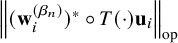 are bounded for each
$1\le i\le s-1$
are bounded for each
$1\le i\le s-1$
 , implying
$\mathfrak {C}(T,W^{(\beta _{n})},s)\to \infty $
, implying
$\mathfrak {C}(T,W^{(\beta _{n})},s)\to \infty $
 . Thus, by (C.1),

a contradiction.
The following theorem is a version of an observation in [Reference Alberti and Marchese2]. However, there are several differences in notation and terminology in [Reference Alberti and Marchese2] compared to the present paper and it requires some careful reading in order to obtain Theorem C.2 from what is written in [Reference Alberti and Marchese2]. Therefore, we explain below how to navigate [Reference Alberti and Marchese2] in order to verify Theorem C.2. Please also note that the quantity in the left-hand side of the main inequality of Theorem C.2 has been referred to as
$\xi (G,T,\varepsilon )$
 in Section 2.3.
Theorem C.2. Let X be a finite-dimensional normed space,
$E\subseteq X$
 be a compact purely
$1$
be a compact purely
$1$
 -unrectifiable set and
$T\in X^{\ast }\setminus \left \{0\right \}$
-unrectifiable set and
$T\in X^{\ast }\setminus \left \{0\right \}$
 . Then for every
$\varepsilon \in (0,1)$
. Then for every
$\varepsilon \in (0,1)$
 there exists an open set
$G\subseteq X$
there exists an open set
$G\subseteq X$
 such that
$E\subseteq G$
such that
$E\subseteq G$
 and
and

Proof. The statement is obtained by applying [Reference Alberti and Marchese2, Step 1 (inside the proof of Lemma 4.12)] to
$K=E$
 . We let
$n:=\dim X$
. We let
$n:=\dim X$
 , identify X and
$X^*$
, identify X and
$X^*$
 with
$\mathbb {R}^{n}$
with
$\mathbb {R}^{n}$
 and write
$\mathbf {e}_{1},\ldots ,\mathbf {e}_{n}$
and write
$\mathbf {e}_{1},\ldots ,\mathbf {e}_{n}$
 for the standard basis vectors of X. Here, we identify
$L\in X^{\ast }$
for the standard basis vectors of X. Here, we identify
$L\in X^{\ast }$
 with the vector
$L\in \mathbb {R}^{n}$
with the vector
$L\in \mathbb {R}^{n}$
 satisfying
$L\mathbf {x}=\langle {L,\mathbf {x}}\rangle $
satisfying
$L\mathbf {x}=\langle {L,\mathbf {x}}\rangle $
 for all
$\mathbf {x}\in X$
for all
$\mathbf {x}\in X$
 . Let
$\left \|\cdot \right \|_{E}$
. Let
$\left \|\cdot \right \|_{E}$
 denote the Euclidean norm on
$X\leftrightarrow \mathbb {R}^{n}\leftrightarrow X^{\ast }$
denote the Euclidean norm on
$X\leftrightarrow \mathbb {R}^{n}\leftrightarrow X^{\ast }$
 . Then, by equivalence of norms on finite-dimensional spaces, there is a constant
$M>0$
. Then, by equivalence of norms on finite-dimensional spaces, there is a constant
$M>0$
 such that

We may assume that
$\varepsilon <1/M^{2}$
 . In the notation of [Reference Alberti and Marchese2] we take
$\alpha =\cos ^{-1}\left (M^{2}\varepsilon \right )$
. In the notation of [Reference Alberti and Marchese2] we take
$\alpha =\cos ^{-1}\left (M^{2}\varepsilon \right )$
 and
$e=\frac {1}{\left \|T\right \|_{E}}(T\mathbf {e}_{1},T\mathbf {e}_{2},\ldots ,T\mathbf {e}_{n})$
and
$e=\frac {1}{\left \|T\right \|_{E}}(T\mathbf {e}_{1},T\mathbf {e}_{2},\ldots ,T\mathbf {e}_{n})$
 . We also note that the notion of C-null for
$C=C(e,\alpha )$
. We also note that the notion of C-null for
$C=C(e,\alpha )$
 , in [Reference Alberti and Marchese2, 4.11, Lemma 4.12], is weaker than pure
$1$
, in [Reference Alberti and Marchese2, 4.11, Lemma 4.12], is weaker than pure
$1$
 -unrectifiability. Applying [Reference Alberti and Marchese2, Step 1, Proof of L. 4.12] we obtain an open set
$G\subseteq X$
-unrectifiability. Applying [Reference Alberti and Marchese2, Step 1, Proof of L. 4.12] we obtain an open set
$G\subseteq X$
 such that
$E\subseteq G$
such that
$E\subseteq G$
 and
$\mathcal {H}^{1}(G\cap \gamma (J))\leq \varepsilon $
and
$\mathcal {H}^{1}(G\cap \gamma (J))\leq \varepsilon $
 for every compact interval
$J\subseteq \mathbb {R}$
for every compact interval
$J\subseteq \mathbb {R}$
 and
$\gamma \in \operatorname {Lip}(J,X)$
and
$\gamma \in \operatorname {Lip}(J,X)$
 with
$T(\gamma '(t))\geq M^{2}\varepsilon \left \|\gamma '(t)\right \|_{E}\left \|T\right \|_{E}\geq \varepsilon \left \|\gamma '(t)\right \|_{X}\left \|T\right \|_{X^*}$
with
$T(\gamma '(t))\geq M^{2}\varepsilon \left \|\gamma '(t)\right \|_{E}\left \|T\right \|_{E}\geq \varepsilon \left \|\gamma '(t)\right \|_{X}\left \|T\right \|_{X^*}$
 . This implies the conclusion of the theorem.
Lemma C.3. Let X and Y be normed spaces,
$E\subseteq U\subseteq X$
 be sets where E is compact and U is open, and let
$g\in C^{1}(U,Y)$
be sets where E is compact and U is open, and let
$g\in C^{1}(U,Y)$
 and
$\theta>0$
and
$\theta>0$
 . Then there exists
$\delta \in (0,\theta )$
. Then there exists
$\delta \in (0,\theta )$
 such that for every
$\mathbf {x}\in E$
such that for every
$\mathbf {x}\in E$
 and every
$\mathbf {y}\in X$
and every
$\mathbf {y}\in X$
 with
$\left \|\mathbf {y}\right \|_{X}\leq \delta $
with
$\left \|\mathbf {y}\right \|_{X}\leq \delta $
 we have

Proof. For each
$\mathbf {x}\in E$
 choose
$\delta _{\mathbf {x}}>0$
choose
$\delta _{\mathbf {x}}>0$
 small enough so that

The collection of sets
$(B_{X}(\mathbf {x},\delta _{\mathbf {x}}))_{\mathbf {x}\in E}$
 is an open cover of the compact set E; it therefore admits a finite subcover
$B_{X}(\mathbf {x}_{1},\delta _{1}),B_{X}(\mathbf {x}_{2},\delta _{2}),\ldots ,B_{X}(\mathbf {x}_{N},\delta _{N})$
is an open cover of the compact set E; it therefore admits a finite subcover
$B_{X}(\mathbf {x}_{1},\delta _{1}),B_{X}(\mathbf {x}_{2},\delta _{2}),\ldots ,B_{X}(\mathbf {x}_{N},\delta _{N})$
 for some
$N\in \mathbb {N}$
for some
$N\in \mathbb {N}$
 , where for
$j=1,\ldots ,N$
, where for
$j=1,\ldots ,N$
 we relabel
$\delta _{\mathbf {x}_{j}}$
we relabel
$\delta _{\mathbf {x}_{j}}$
 as
$\delta _{j}$
as
$\delta _{j}$
 .
.
Let
$\delta :=\min \left \{\delta _{1},\ldots ,\delta _{N}\right \}>0$
 ,
$\mathbf {x}\in E$
,
$\mathbf {x}\in E$
 and
$\mathbf {y}\in X$
and
$\mathbf {y}\in X$
 with
$0<\left \|\mathbf {y}\right \|_{X}\leq \delta $
with
$0<\left \|\mathbf {y}\right \|_{X}\leq \delta $
 . Then there exists
$i\in \left \{1,\ldots ,N\right \}$
. Then there exists
$i\in \left \{1,\ldots ,N\right \}$
 such that
$\mathbf {x}\in B_{X}(\mathbf {x}_{i},\delta _{i})$
such that
$\mathbf {x}\in B_{X}(\mathbf {x}_{i},\delta _{i})$
 and so
$[\mathbf {x},\mathbf {x}+\mathbf {y}]\subseteq B_{X}(\mathbf {x}_{i},2\delta _{i})\subseteq U$
and so
$[\mathbf {x},\mathbf {x}+\mathbf {y}]\subseteq B_{X}(\mathbf {x}_{i},2\delta _{i})\subseteq U$
 . Set
$\mathbf {e}:=\frac {\mathbf {y}}{\left \|\mathbf {y}\right \|_{X}}$
. Set
$\mathbf {e}:=\frac {\mathbf {y}}{\left \|\mathbf {y}\right \|_{X}}$
 and let
$\varphi \in Y^{\ast }$
and let
$\varphi \in Y^{\ast }$
 be a functional with
$\left \|\varphi \right \|_{Y^*}=1$
be a functional with
$\left \|\varphi \right \|_{Y^*}=1$
 . Then

Taking supremums in the above inequality over all
$\varphi \in Y^{\ast }$
 completes the proof.
Remark C.4. If X is a finite-dimensional normed space,
$E\subseteq U\subseteq X$
 are such that E is compact and U is open, then there exists an open
$U_0$
are such that E is compact and U is open, then there exists an open
$U_0$
 such that
$E\subseteq U_0\subseteq \overline {U_0}\subseteq U$
such that
$E\subseteq U_0\subseteq \overline {U_0}\subseteq U$
 and the Lebesgue measure of
$\partial U_0$
and the Lebesgue measure of
$\partial U_0$
 is zero. The latter could be obtained by choosing
$U_0$
is zero. The latter could be obtained by choosing
$U_0$
 in the form of a finite union of open balls with centres in E.
Lemma C.5. Let X be a normed space,
$E\subseteq V\subseteq X$
 be sets where E is compact and V is open,
$(G_{k})_{k\in \mathbb {N}}$
be sets where E is compact and V is open,
$(G_{k})_{k\in \mathbb {N}}$
 be a sequence of open subsets of X which contain E and let
$(\varphi _{k})_{k\in \mathbb {N}}$
be a sequence of open subsets of X which contain E and let
$(\varphi _{k})_{k\in \mathbb {N}}$
 be a smooth, locally finite partition of unity with supports contained in V. Then there is a number
$K\in \mathbb {N}$
be a smooth, locally finite partition of unity with supports contained in V. Then there is a number
$K\in \mathbb {N}$
 and an open set
$U\subseteq X$
and an open set
$U\subseteq X$
 such that

and

In the case that X is finite-dimensional, U may be chosen so that additionally
$\partial U$
 has Lebesgue measure zero.
Proof. For each point
$\mathbf {p}\in E$
 we may choose a radius
$r_{\mathbf {p}}>0$
we may choose a radius
$r_{\mathbf {p}}>0$
 such that
$\overline {B}_{X}(\mathbf {p},r_{\mathbf {p}})\subseteq V$
such that
$\overline {B}_{X}(\mathbf {p},r_{\mathbf {p}})\subseteq V$
 and the set

is finite. The collection of balls
$(B_{X}(\mathbf {p},r_{\mathbf {p}}))_{\mathbf {p}\in E}$
 is then an open cover of the compact set E. Accordingly, it has a finite subcover. In other words, there exists a finite subset F of E such that

Let

and

Finally, we apply Remark C.4 to define
$U\subseteq V'$
 with the required properties. The assertions of the lemma for K and U are now readily verified.

 Open access

