

Ever since Plutarch’s Lives of the Noble Greeks and Romans, written in the early second century, scholars have been inspired by the Greek biographer’s fundamental idea of comparing the lives and ethical choices of people bound to different geographies and moments in time. This book is no exception. It examines the trajectories of transnational war volunteers and their engagement with some of the major conflicts of the twentieth century. In so doing, it compares individual life experiences as a method to explain and understand the consequences of historical events and developments. However, in contrast to Plutarch’s interest in immortal Greeks and Romans, revolving around legendary military commanders such as Alexander the Great, we turn our attention to the biographies of largely unknown soldiers who often led a marginalised existence and had little desire to serve the expansionist designs of empires. Though some volunteers had an inflated sense of their wartime contribution and importance, the majority became soldiers not to realise self-aggrandising visions but to serve their own inner convictions. In this study, they provide a lens through which to explore the historical phenomenon of transnational war volunteering, emphasising its long-term evolution and links with political radicalism.
We follow these volunteer soldiers through a series of military conflicts that were, in most cases, geographically centred on individual countries but nonetheless evinced a crucial transnational dimension: the Spanish Civil War, the European anti-fascist resistance during World War II, the Ethiopian resistance to the Italian fascist empire, the anti-colonial wars in North Africa and Indochina, the Cuban Revolution and, finally, the Nicaraguan Revolution of 1979. Such diverse case studies may initially seem unconnected, but in the pages that follow, they are sewn together by the thread of the extraordinary lives of the men and women who chose to risk their lives for causes that could all too easily have been dismissed as disconnected from their own immediate interests. Rather than focusing on their local circumstances, they took a global view of contemporary conflicts and volunteered to fight on foreign soil, not once but repeatedly, linking different struggles through their experiences and expanding networks. Equipped with their stories, we aim to provide the first archive-based, global history of transnational war volunteering in the twentieth century.
As used here, the term transnational war volunteering refers to volunteering that is organised primarily on a substate level and takes place across state borders. States can and frequently do play an important part in this phenomenon, not least as material sponsors, but the mobilisation and deployment of transnational war volunteers typically involved more extensive sets of actors, answering to more diverse sets of authorities, than seen in the armed forces of one state alone. In accordance with the latest research in the field, we also distinguish transnational war volunteers from professional mercenaries, regardless of whether they served states or private enterprises.Footnote 1 True, the attraction of a steady wage or one-off payments occasionally figured among the bundle of motivations driving transnational war volunteers as conceived here, but the promise of material reward rarely determined whether, where or when they fought. Their fighting formed part of a political trajectory and was understood, fundamentally, as a political intervention.
In the twentieth century, this type of volunteering manifested in various forms across the political spectrum, becoming a recurring phenomenon also on the political right. This is illustrated by transnational participation on the Francoist side in the Spanish Civil War, the Waffen SS, the Rhodesian Bush War and the French Foreign Legion during the early Cold War. But this volume turns the focus to the role and significance of war volunteering within the traditions of the political left. This delimitation is easily justified. Transnational volunteering has often been seen as an expression – perhaps the most extreme expression – of left-wing internationalism, while commemorations of specific episodes of volunteering, such as the Spanish Civil War of 1936–1939, are particularly common among groups who support left-wing agendas. But while the history of transnational war volunteering stands in a unique relation to the traditions of the internationalist left, it would be a mistake to see the former as nothing but a practical expression of the latter, as this book shows. The networks sustaining leftist transnational war volunteers often created opportunities to build solidarities based on diverse and intersectional identities that frequently transcended, if not disrupted, traditional left-wing understandings of key categories such as class. All of the case studies in this volume provide examples of this, but the point is illustrated with particular clarity by the conflicts bookending our period: the Spanish Civil War and the Nicaraguan Revolution of 1979.
The Spanish Civil War of 1936–1939 ought to occupy a special place in any work on transnational war volunteering in the twentieth century, as it attracted contingents of foreign volunteers that remain unique in both diversity and number. No fewer than 35,000 volunteer soldiers from all over the world fought in Spain.Footnote 2 However, scholarly treatments of the International Brigades who fought for the Spanish Republic tend to restrict their analytical scope to the chronological limits of the conflict, frequently leaving readers with the impression that volunteers’ active military contribution to the anti-fascist cause of the mid twentieth century came to a sudden end in September 1938, when the Second Spanish Republic decided to dissolve the International Brigades and repatriate the remaining volunteers. This impression, feeding into a widespread perception that the volunteers had little political and military significance beyond the short, extraordinary period of their service in Spain, has not been sufficiently problematised by historians. When scholars of the Spanish Civil War do extend their analysis to the period after 1939, it is usually for the purpose of showing how the former members of the brigades, and especially communists, were discriminated against or even persecuted by local authorities upon their return to their home countries.Footnote 3 Less frequently do they underline the fact that many former war volunteers soon became members of the national resistance groups during World War II; when they do, they generally fail to assess the qualitative impact of this previous war experience on the configuration and the effectiveness of the European resistance after 1940.Footnote 4
Scholarly explorations of the link between the volunteer experience of the Spanish Civil War and anti-fascist resistance movements during World War II have taken different forms, as variations between different national historiographies show. The historiography on the Italian resistance of 1943–1945, for example, has traditionally made the connection in a clear and unambiguous way.Footnote 5 This is likely due to a widespread national perception of the Italian resistance as primarily an anti-fascist fight dating back to the inter-war period and, perhaps, the elevation of anti-fascism to a value guarded by the 1948 Constitution.Footnote 6 By contrast, in Scandinavia, the importance of this Spanish connection has been minimised or omitted completely by national communist parties, which preferred to present the resistance as the result of primarily ethical choices made during a period of national rebirth.Footnote 7 As shown in the Danish and Norwegian cases, the internationalism of the inter-war years simply did not fit into national communist parties’ post-war strategies, and the first generation of historians after World War II perpetuated this distortion. But the tendency to consciously or unconsciously diminish the influence of International Brigade veterans may also owe something to the diverse nature of the roles they played in subsequent conflicts. As this book will show, the International Brigades exerted a lasting influence that took multiple expressions; expressions that have not, so far, garnered the scholarly attention they deserve.
In the longer term, the experiences in Spain contributed to the development of a new form of internationalist interventionism that formed part of the repertoire of the global left for most of the remainder of the twentieth century. As this book contends, a fruitful way of understanding left-wing military involvements in Cold War conflicts is to consider them in relation to the complex legacies of the Spanish Civil War and, more broadly, the anti-fascist fight of the 1930s and 1940s. This is not to say that there were no other legacies or political and ideological influences of equal or greater importance: the Bolivarian revolutionary tradition in Latin America or the rise of communism in China are but two prominent examples relevant to our case studies. Furthermore, the Spanish Civil War was not the first conflict to witness this kind of internationalist interventionism. Latin America had already established traditions of its own. There were foreign war volunteers involved in the Cuban liberation struggle against Spain in the 1890s, non-Mexican socialists taking part in the Mexican Revolution after 1910 and, as mentioned in Chapter 6, non-Nicaraguan revolutionaries, both from Latin America and Europe, fighting in Sandino’s rebellion against the United States from 1927 to 1933. However, the participation of volunteers in such military endeavours was relatively modest in terms of numbers, and it did not in itself generate defining or instructional narratives for subsequent generations. By contrast, it is striking that the discursive and organisational practices relating to war volunteering in the period covered by this volume all drew on the previous war experiences in Spain and, more broadly, the anti-fascist experience of the inter-war period in Europe. The sacrifice of ordinary men and women during the 1930s generated myths that shaped the political imagination of the Left, just as it provided practical insights from which new generations of left-wing revolutionaries could extract effective military strategies, whether in Europe or in the Global South. Thus, late twentieth-century revolutionaries reframed the lessons of the Spanish Civil War in the light of their own struggles. By so doing, they revealed the extraordinary political versatility of Spanish Civil War memories and, more broadly, the anti-fascist experience of the 1930s as a past that could be mobilised and instrumentalised for political use all over the world. To understand exactly how this influence played out in different wars across geographical space and historical time is another ambition of this book.
From the vantage point of today, it seems clear that the inter-war period set the stage for a particular kind of left-wing volunteering. This took inspiration from earlier volunteer traditions associated with progressive causes, represented perhaps most prominently by the legendary nineteenth-century revolutionary Giuseppe Garibaldi, but was ultimately defined by the specific dynamics of twentieth-century politics. Unlike their nineteenth-century predecessors, left-wing volunteers of the twentieth century supported radical projects inextricably tied to the logic of mass politics: projects premised on the active political engagement of an already existing mass-political subject. In this context, left-wing volunteers typically perceived themselves as grassroots representatives of a loosely defined vanguard, ready to make extraordinary sacrifices for the advancement of their cause. While such notions were often influenced by Leninist conceptions of revolutionary politics, it was in Spain (rather than Russia) that a new left-wing tradition of transnational war volunteering took a distinctive shape.
A further defining characteristic of the radical political projects fuelling left-wing volunteering is a certain circumscribed ideological heterogeneity, first encapsulated by the anti-fascist Popular Front coalitions of the 1930s. As seen in the case studies of this book, left-wing volunteers mobilised in significant numbers when a conflict involved a broad coalition of movements, imparting on the conflict a significance that transcended party political agendas. Finally, left-wing volunteering in the twentieth century characteristically entailed an implicit, if not explicit, challenge to the liberal international order, typically conceived as the structural foundation of the more specific and sinister ideological constellations at which left-wing volunteers trained their guns. Fascism constituted the unifying ideological enemy in the 1930s and 1940s; imperialism, broadly conceived, was that of the 1950s through the 1970s. Militant opposition to these two tendencies provided the ideological fuel that drove the twentieth-century tradition of left-wing war volunteering.
Considering our protagonists’ political heterogeneity, it is necessary to cast the ideological commitment informing their struggles in relatively flexible terms. Broadly speaking, their ideological commitment revolved around anti-fascism and anti-imperialism, understood as ideological master frames rather than descriptors of specific programmatic positions. More narrow categories would make it difficult to explain how two of our protagonists and communist party members could organise a secret anti-fascist cell within the French Foreign Legion in collusion with an anti-Stalinist. In all of these cases, the label prefixed with ‘anti’ was, for most militants, more a matter of collective and individual identity than party political agendas. To expand the scope of Anson Rabinbach’s description of anti-fascism, the label denoted something that was ‘less an ideology than a mentalité, more of a habitus than a doctrine’.Footnote 8 Similarly, both anti-fascism and anti-imperialism have been described as revolving around a ‘shared ethos’, informing a particular ‘way of being in the world’.Footnote 9 Thus understood, ideological master frames imparted a sense of interconnected meaning on the campaigns of broad movements that inspired and mobilised various contingents of foreign volunteers, brought together partly by kindred perceptions of what these campaigns represented in terms of fundamental values.
We end this book with a study of the Nicaraguan Revolution in the late 1970s, which was the last revolutionary left-wing project to mobilise significant and diverse international support, including several hundred military volunteers. After Nicaragua, the kind of transnational war volunteering examined here – that is, war volunteering understood as a form of left-wing internationalism – effectively came to an end. The renewed arms race of the 1980s redirected the focus of the internationalist left from the Global South toward the classic East–West confrontation of the Cold War, and peace movements, dating back to the times of the Vietnam War, became more dominant on the political left. Their outspoken pacifism and demand for disarmament, reinforced by a generalised disenchantment with political utopias, diminished the mobilising power of class-based, militant internationalism.Footnote 10 Neither did the immediate post–Cold War period offer any significant new opportunities for armed internationalist action.
Historiography, Concepts and Analytical Approach
The Spanish Civil War has generated an immense historiography, yet the same cannot be said about the history of transnational war volunteering. In fact, George Mosse’s 1990 lament that the ‘history of volunteers in war has not yet been written’ has only been partially addressed. While there has been growing interest in the history of war volunteering in recent years, generating results such as Nir Arielli’s accomplished work of synthesis, our volume constitutes the first major work on left-wing war volunteering that addresses the legacies of the Spanish Civil War and the broader anti-fascist experience of the inter-war period on a global scale.Footnote 11
The dearth of critical scholarship on the long-term influence of the Spanish Civil War, and the International Brigades in particular, is especially striking in relation to the post-1945 period. There has been no focused study exploring continuities and discontinuities in transnational war volunteering as a political practice from the anti-fascist struggle to the early Cold War period. This is all the more surprising given that historians over the past two decades have identified a need to analyse not only the important societal, political and juridical ruptures occurring in 1945 but also the often overlooked continuities from the inter-war period to the Cold War.Footnote 12 In fact, one does not have to dig deep to find organisational parallels and recurring historical symbols suggesting that the model of transnational mobilisation in the Global South after 1945 drew heavily on the European anti-fascist experience. Transnational recruitment underwritten by a central state actor, attempts to incorporate small transnational units into a national military structure and appeals to the transcendental significance of individual conflicts, even when they superficially appear to be the concern of one nation only, are all hallmarks of the transnational anti-fascist resistance that reappear in the Cold War period. We also find an awareness of the important historical precedent set by the International Brigades in Spain throughout World War II, in the colonial struggles in Africa and Asia and in the anti-imperialist guerrilla wars in the 1950s, 1960s and 1970s Latin America. But the resonance of the Spanish Civil War is not simply confined to the past. More recently, we can also find references to Spain among foreigners fighting with Middle Eastern insurgent groups as well as foreign volunteers in the conflict in Ukraine.Footnote 13 Such echoes do not mean that the tradition of left-wing volunteering, as defined earlier, remains a considerable political force at present, but they still speak volumes of the long-term significance of the Spanish Civil War, which occupies a special place for both symbolic and practical reasons in the history of transnational war volunteering.
Some of the most striking continuities relate to the trajectories of personnel. For many war volunteers in Spain, the fighting did not end in 1938 but lasted until 1945 and, in several cases, continued well into the Cold War. Examples of the latter include veterans of the Spanish Civil War who took part in various transnational military volunteer operations in the post-war Caribbean, including the Cuban Revolution of 1959; we also trace the stories of former partisans who wanted to join the anti-French guerrilla in Indochina and Algeria. With this material at hand, it seems legitimate to ask why so much of the scholarship on the volunteers in the International Brigades has focused almost exclusively on their military actions in Spain, when, for some volunteers, Spain merely marked the beginning of various cycles of transnational mobilisation, recurring over an ever more dispersed geographical area. Mapping out these trajectories – these patterns of demobilisation and remobilisation, beyond the geographical and chronological limits of the war in Spain – enables us to see the many ways in which the Spanish Civil War and the broader anti-fascist engagement of the inter-war period could constitute a life-changing experience; an experience that expanded volunteers’ political horizons and gradually opened up possibilities for border-crossing political engagement in the post-war era. Such trajectories constitute an ideal lens through which to study the Spanish war’s long-term legacy.
To develop this argument, this book follows the trajectories of individual war volunteers across four continents. By applying a predominantly biographical approach, we offer not only captivating stories of life and death in the era of modern warfare, we also seek to provide a way of better understanding the foreign fighter as a political actor responding to global changes and periods of transition.Footnote 14 Even in political contexts that are commonly held to minimise the significance of individual agency, such as communist organisations (especially under Stalinism), a biographical approach, as Kevin Morgan points out, can still shed invaluable light on the multiple facets and complexities of specific political practices.Footnote 15 Crucially, the biographical approach ensures a more profound understanding of the complex motivations behind war volunteering. Numerous works have rightly highlighted the importance of economic remuneration for transnational war volunteering throughout history, yet we argue that in the nineteenth and twentieth centuries, less material motivations such as political idealism increasingly informed the decision to volunteer. As already indicated, such idealism, which often formed part of the volunteers’ discursive strategies of self-legitimation, was often coloured by past volunteer experience. Accordingly, we pay particular attention to ideals and memories that persist across generations and to the ability of networks to reactivate themselves in view of new conflicts.
Like this book, recent works on global histories of anti-fascism have begun to shift the geographical focus from the Global North to the Global South. In this context, they frequently explore the ways in which anti-fascism merged with other ideological constellations, not least anti-imperialism.Footnote 16 Indeed, any scholarly attempt to understand the legacy of 1930s anti-fascism in Africa, Asia and Latin America must consider the multiple ways in which understandings of fascism across the Global South were coloured by experiences of imperialism (its ‘blood brother’, to quote Nehru).Footnote 17 But it is also important to analyse how these experiences shaped relations and potential collaborations between anti-fascists working across the Global North/South divide. By focusing on the relationship between transnational volunteers of both European and non-European origin, these chapters elucidate a problematic relation that remains under-researched and under-analysed in the growing literature taking a global view on anti-fascism and anti-imperialism in the twentieth century.
In our view, internationalism constitutes a fundamental if self-evident ideological outlook shared by our protagonists across the inter-war and cold war periods. Considering the centrality of this outlook, it is striking that the literature on transnational war volunteering has paid it relatively little analytical attention. Typically associated with the left, it may have been considered irrelevant to studies of right-wing volunteers (although international cooperation was and is also a fact of right-wing politics).Footnote 18 In contrast, its importance in the context of left-wing volunteering often seems to be taken for granted. Yet, a more analytical and sustained engagement with internationalism and its relation to left-wing war volunteering is a fruitful way of approaching the broader political and symbolic significance of international war volunteering as a political as well as military phenomenon in the twentieth century. In our definition, internationalism comprises both an ideological value-oriented outlook associated with politically informed solidarity and some of the concrete, strategic and instrumental aspects of mutual assistance pacts. Where solidarity in its own right operates primarily on an emotional or affective level, internationalism, as understood here, derives from political–ideological analysis; it operates with a logical conceptual register and seeks primarily to enable the international coordination of political action.
As Perry Anderson rightly argues, the conceptual and ideological characteristics of internationalism evolved significantly over the nineteenth and twentieth centuries. Inter-war internationalism was predominantly ‘anti-fascist’ and rooted in Enlightenment-era universalism, whereas the dominant internationalism of the post–World War II period is best described as ‘anti-imperialist’, aligning with nationalist movements in Asia, Africa and Latin America and embracing both national and cultural specificities.Footnote 19 Despite these shifts, elements of universalism persisted, exemplified by the global celebration of the principle of popular sovereignty and Che Guevara’s quest for a universal revolutionary method. In other words, significant continuities link left-wing volunteers from the inter-war period through the Cold War, adding further complexity to the history of internationalism as an ideological phenomenon.
We propose the broader term ‘counter-hegemonic internationalism’ to conceptualise mid twentieth-century left-wing internationalism in its entirety, thus highlighting the continuities that unite left-wing war volunteers from the anti-fascist and anti-imperialist periods. This term captures the shared political–cultural dispositions and internationalist elements found in our case studies, emphasising opposition to the dominant international order and adherence to broad progressive political traditions. It helps us compare different instances of left-wing volunteering across time and space, encouraging us to see collaboration and ideological overlap as integral to the phenomenon rather than as a source of external ideological contamination. ‘Counter-hegemonic internationalism’ thus denotes a political outlook and practice that accommodates different political agendas and actors and is characterised by a significant degree of internal diversity.
As agents of counter-hegemonic internationalism, the protagonists of our case studies illustrate how this tendency was built on bonds of solidarity of a particular and frequently heterogeneous nature.Footnote 20 These bonds were diverse and multifaceted, often cutting across barriers of class and nation, time and space. They were often built from the bottom-up, with the aim of supporting progressive mass political projects: projects seeking to redistribute local, national and global power and strengthen political forces fighting for social justice, equality and democracy, broadly understood. Especially when operating on a grassroots level, these bonds of solidarity were frequently more open and expansive than solidarities ‘ordained’ by political leaders at the top. They accommodated temporary alliances between members of organisations with incompatible long-term goals but comparable short-term challenges; they primarily built on the basis of shared principles, only secondarily (and if possible) on detailed blueprints determining how these principles should be implemented.
In concrete historical terms, the Popular Front alliance defending the Republic in the Spanish Civil War offered a lasting template in this respect too, though no one could or can claim that the Front was free of sectarian strife. The sheer size and diversity of the volunteer contingent fighting for the Republic in Spain created a distinct cosmopolitan environment, perceived by some internationals to be exhilarating and liberating. As Lisa Kirschenbaum has suggested, this was felt particularly acutely among the multinational contingent of Comintern cadres trained in Moscow, who noted that experiences and relationships in Spain were less firmly circumscribed by the Party line than in the Soviet Union, then at the peak of the 1930s terror.Footnote 21 Of course, the Comintern ideal took many unflattering if not directly ugly expressions in Spain too, from extrajudicial murders to more mundane manifestations such as the authoritarian attitudes found among some Party leaders, which had a disheartening impact on volunteers believing they were fighting for freedom, as seen in Chapters 2 and 3. But for many who travelled to Spain, the air was freer than at home, an impression noted also by independent-minded Comintern officials. Most of these cadres later continued their service within the networks of the Comintern or returned to national politics within their respective home countries. From these positions, the relatively open, cosmopolitan horizon of the Spanish struggle was quickly transformed into a distant and, in many cases, nostalgia-tinted memory.
By contrast, volunteers who continued to engage in anti-fascist and later anti-imperialist warfare on the ground, like the men and women described in this volume, often found themselves included in transnational networks where the spirit of Spain in some ways persisted. The counter-hegemonic internationalism of these networks retained, in other words, a distinctive character in comparison to the internationalism espoused by more formal, institutionalised political networks.
By mapping out the long afterlives of the volunteer networks forged in Spain, this book also offers an original insight into processes of solidarity building and knowledge transmission that are not only transnational but also intergenerational. Many nationally framed studies of the International Brigades give some account of World War II and post-war trajectories of their subjects, offering crucial reflections on the evolving meaning of the ex-volunteers’ anti-fascism. But apart from a few studies that take debate around the legacy of the Spanish Civil War as their main object of analysis, the extant scholarship on transnational war volunteering has had relatively little to say about what the anti-fascism and anti-imperialism articulated during the inter-war years meant to left-wing volunteers of subsequent generations.Footnote 22 This silence is particularly striking if we look for concrete examples of intergenerational interaction, which are absent even from works that analyse expressions of anti-fascism at different moments across the twentieth century.Footnote 23
Our volume takes a different approach to intergenerational relations. It focuses on the ways in which meetings between different generations of volunteers enabled the exchange, appropriation and adaptation of accumulated knowledge and experience. These processes allow us to capture the transmission and evolution of volunteers’ political and military legacies in their most direct form. Through tracing the evolution of specific multigenerational networks – in some cases spanning over several decades, from the 1930s into the volatile 1960s and 1970s – we hope book will add a new dimension to our appreciation of the long-lasting legacy of the volunteers who fought in the Spanish Civil War.
Finally, this book contributes to recent attempts to analyse war veterans as distinct historical actors from a global comparative perspective.Footnote 24 Such studies have generated helpful conceptual schema for analysing the relationship between war, society and politics from the perspectives of veterans, and some anthologies have even focused specifically on internationalist commitments.Footnote 25 Yet, to date, the main focus of this literature has been veterans and veteran organisations emerging from the world wars and other regular interstate conflicts, fought to some degree with conscript armies. Little has been said about ex-volunteers and even less about veterans who had volunteered to fight in a foreign conflict without the encouragement and perhaps even in defiance of their government. In contrast to veterans of national conscript armies, volunteer veterans could hardly make strong claims on their home state after their return from the battlefield. Consequently, their post-war engagement often took the form of civic campaigning, as shown by some studies focusing on the national contingents of the International Brigades in Spain. This book breaks new ground in highlighting examples of more radical veteran activity among ex-brigade members, that is, examples of continued engagement with irregular military intervention as a means to achieve transnational political goals.
Admittedly, a majority of politically motivated war volunteers did not extend their military service abroad beyond one conflict, as Nir Arielli has pointed out. Even so, we have chosen to focus on the minority who voluntarily continued to serve in new wars, who are deserving of more detailed study for several reasons. First, the fact that most current scholarship focuses entirely on one-off volunteers has implicitly posed – but also left unanswered – the question of whether those who enlisted repeatedly were not, in fact, a distinct kind of volunteer to be studied separately. We believe they were, for reasons that will become clear. Second, and most importantly, the protagonists examined here all played key roles in maintaining and expanding networks and practices of transnational war volunteering across time and space. They served as important channels for the intergenerational transmission of technical expertise and instructive memories of earlier radical struggles. In this sense, they were more influential than their reduced number might suggest. Moreover, this influence may have been overlooked because few of these volunteers occupied clear leadership positions. In organisational terms, they were typically ranked as mid-level cadres, situated in spaces easily missed by the historiographical radar. That said, our decision to focus on these actors stems not from a simple desire to restore their visibility. Zooming in on the long-term movement of transnational agents operating at this level provides rich opportunities to observe the dynamic interplay between structural constraints and individual agency in transnational political networks, and it offers opportunities to uncover connections that transform our understanding of the impact of transnational war volunteers and the volunteers’ own understanding of their contributions to a particular cause.
This book is the result of several years of meticulous research, drawing on fresh primary evidence from across the world in Spanish, Italian, French, British, Swiss, Scandinavian, American, Russian and Nicaraguan, as well as Cuban libraries and archives. The material extracted is rich in its diversity. It includes records from international and national organisations associated with the political left, such as the Comintern, national communist parties and other worker organisations. We have also used reports from international and transnational organisations such as the Red Cross, as well as documentation held in various national archives for state administration. Throughout the book, we furthermore make full use of personal source material – including letters, diaries and memoirs – in order to paint the fullest possible picture of the chapters’ main protagonists. Such documents are, of course, central to any attempt to showcase the benefits of a biographical approach to history. Together with organisational records and various media reports, we have thus gathered a rich tapestry of source material that allows us to explore the dynamics of individual agency against a backdrop of intertwined local, national and global influences.
Structure of the Book
Chapter 2 of this book examines the history of Leo Kari and other Scandinavians in the International Brigades and the resistance movements of Denmark and Norway during World War II, establishing a clear and unequivocal link between the two war experiences. Ultimately, it sheds new light on transnational recruitment processes and network connections across the inter-war and cold war periods.
Chapter 3 highlights the centrality of Spain in the development of a particular kind of ‘professional revolutionary’, deployed globally by the Comintern in the late 1930s and 1940s. It focuses on the life of the Italian communist Ilio Barontini and follows his long militancy within the anti-fascist front, which brought him to the Soviet Union, Spain, Ethiopia and France, before he returned to Italy. In this way, the chapter offers insight into how anti-fascism and anti-imperialism connected during the inter-war period.
Chapter 4 focuses on anti-colonial conflicts involving France. In both Algeria and Indochina, France decided to fight to preserve its colonial empire after 1945, and in both cases, there was a vast international mobilisation in favour of Algerian and Vietnamese independence. By following the trajectory of Ernst Frey and other European anti-fascists, who enlisted in the Vietnamese Army after defecting from the French Foreign Legion, the chapter focuses on the complicated relationship between the soldiers who survived the anti-fascist struggles in Europe and the new generation of soldiers of the anti-colonial wars in the Global South.
Chapter 5 follows a small but diverse group of Cuban Spanish Civil War volunteers, paying particular attention to Rolando Masferrer and Eufemio Fernández. The post-Spain trajectories of these volunteers illustrate with stark clarity the volatile nature of politics in Cuba and the Circum-Caribbean in the 1940s and 1950s, where unlikely coalitions were consistently made and unmade in transnational efforts to topple regional dictators. In this context, Spanish Civil War veterans found numerous opportunities to remobilise and continue to engage with armed revolutionary projects of a transnational or internationalist nature.
Chapter 6 offers an analysis of the Nicaraguan Revolution of the 1970s with a particular focus on Araceli Pérez Darias, a Mexican fighting with the Sandinistas. Using Araceli’s life story as a prism, this chapter offers a unique survey of women’s contribution to transnational warfare in the twentieth century, arguing that their challenges were multiple, as their armed resistance – originally motivated by their opposition to the enemy – eventually became intertwined with their struggle to be accepted as equals by the movement they represented at the front.
Chapter 7, the conclusion, elaborates on the extensive empirical corpus analysed in the preceding chapters. It reinforces the comparative points and clarifies the general patterns emerging in the book. It also expands our reflexions on the meanings of modern transnational war volunteering, especially as seen through the conceptual lens of internationalism. These findings open up new perspectives on mobilisation patterns pertaining to transnational volunteering, potentially moving the discussion away from top-down directives or impersonal indoctrination tools to a greater appreciation of the significance of contingency and horizontal influences shaping volunteer behaviour.
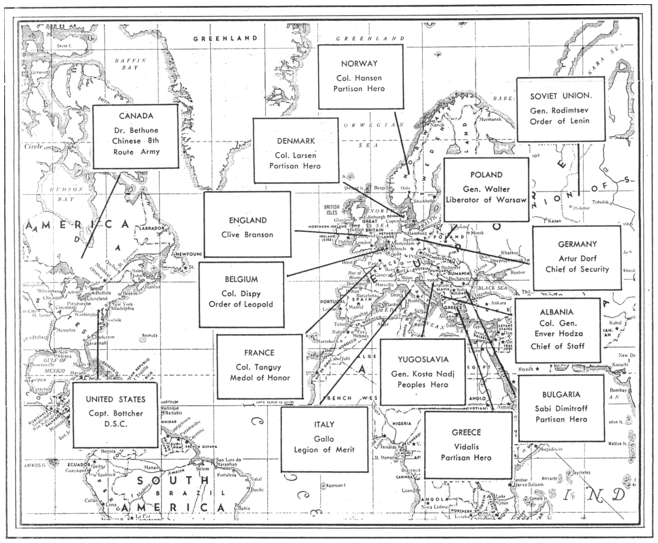
In summary, this volume analyses a phenomenon that has remained under-researched in terms of its complex relationship with twentieth-century modernity. It offers new conceptual registers for understanding a specific era in the history of armed internationalism, spanning from 1936 to 1979, which also transcends conventional historiographical periodisations and understandings of ruptures in contemporary history, in particular that between the end of World War II and the beginning of the Cold War (Figure 1.1).
‘I.B. VETS CARRY ON’, Volunteer for Liberty, November 1946, The Abraham Lincoln Brigade Archives, New York. Magazine cover with a map of the world, showing where former members of the International Brigades in Spain continued the fight against fascism.
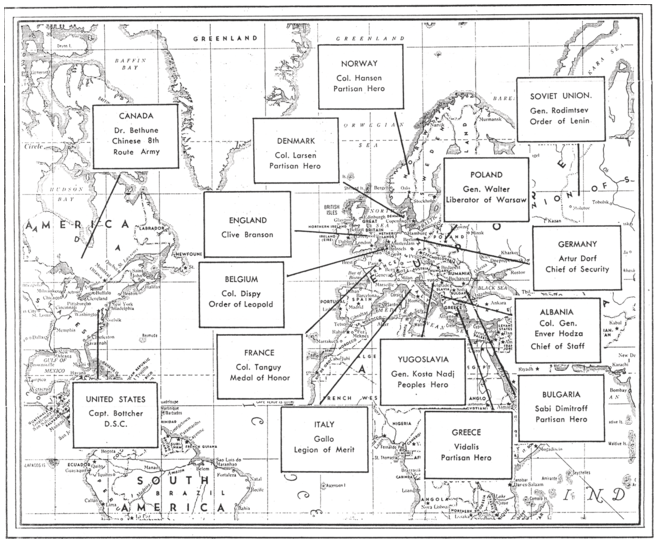
Figure 1.1 Long description
“The world map is showing Europe, the western part of Asia, most of Africa, the northern half of South America, and the eastern North America. Fifteen text boxes with arrows are superimposed on the map. The text boxes contain the name of the country indicated by its arrow, as well as the name, rank, and decoration of several international brigade volunteers from the Second World War. The countries and names included in the boxes are as follows. Canada, Dr. Bethune, Chinese, 8th Route Army; United States, Captain Bottcher, D S C; Norway, Colonel Hansen, Partisan hero; Denmark, Colonel Larsen, Partisan hero; England, Clive Branson; Belgium, Colonel. Disby, Order of Leopold; France, Colonel. Tanguy, Medal of Honor; Italy, Gallo, Legion of Merit; Yugoslavia, Gen. Kosta Nagj, People's Hero; Greece, Vidalis, Partisan Hero; Bulgaria, Sabi Dimitroff, Partisan Hero; Albania, Colonel General. Enver Hodza, Chief of Staff; Germany, Artur Dorf, Chief of Security; Poland, Gen. Walter, Liberator of Warsaw; Soviet Union, General. Rodimtsev, Order of Lenin.”