


This article contributes substantial and novel arguments not only to the history of payment systems but also to the financial history literature. During the 1970s and 1980s, the standardization and globalization of credit cards transformed competition in the European banking market. This transformation occurred primarily through the introduction of a new business model in retail banking based on what has been called plastic money.
In Europe, exceptional conditions arose from the intense competition that was unleashed in the retail banking markets. These were the result of the fast-paced economic recovery of the postwar period and the birth of the European Economic Community (EEC) in 1957, among other factors. One common dynamic throughout the Western world was that the payment innovations introduced in the 1960s and 1970s were closely linked to the promotion of savings and the encouragement of borrowing in societies focused on mass consumption.Footnote 1 However, unlike in American markets, in the European context, retail banking and payment services gained the advantage of providing people with greater mobility among regions and countries for both tourism and business. This was due to shorter distances and better mobility infrastructures, with the added benefit that cards helped solve the currency exchange problem between different countries. As a result, this made the European market potentially more promising, offering a very interesting business opportunity for banks entering this market (mainly European but also US banks). These processes occurred within the diversification of banking services in Western economies, aimed at generating new sources of income through the commissions derived from the use of bank cards. These instruments expanded the customer base of the financial institutions, positioning them as intermediaries between consumers and merchants in the value exchange process, which drove the consolidation of plastic cards.Footnote 2
This was especially evident in Spain, where a new scenario emerged after 1953, following the failure of the autarkic policies of the Franco dictatorship. This was largely prompted by the Pact of Madrid and the arrival of US aid, which established an institutional framework that was favorable to business recovery.Footnote 3 The implementation of the 1959 Stabilization Plan represented a decisive step toward the opening of the Spanish economy. The following decades saw strong growth in the economy and in urbanization, followed by a boom in the service economy (especially mass consumption, retail commerce, and tourism), which benefited the card market.Footnote 4
Ultimately, Europe was moving toward a model of banking that, along with new payment services, was incorporating new products and instruments aimed at risk management and transformation within a highly dynamic evolutionary framework.Footnote 5
Historical scholarship has produced robust studies on the history of plastic cards. In his pioneering work on Visa, David Stearns suggests that the executives who participated in the creation of payment cards changed the mindset of bankers and consumers toward them, transforming a simple local credit instrument into an instrument for accessing a global electronic value exchange network.Footnote 6 The bank credit card system had ramifications across the globe, and this author focuses his analysis on their development in North America. Two recent works expand the horizon of bank payment cards beyond the scope of the United States. Bernardo Bátiz-Lazo and Gustavo del Angel study the genesis and early expansion of the credit card, emphasizing from a historical perspective the initial conditions in Mexico, Spain, the United Kingdom, and the United States, exploring factors that promoted their use during the period 1950–1975.Footnote 7 Meanwhile, my work has identified a cross-industry (retail trade and retail banking) and multi-country (the United States, certain Western European countries, and Japan) approach to the interaction between these industries and the new retail payment systems from the 1970s to the mid-1990s.Footnote 8
Drawing on this background, this article uses historical evidence to analyze how the standardization and globalization of bank credit cards interacted with the emergence of a new business model in retail banking, with significant implications for banks’ income statements. As a result, in Europe, the competitive conditions in the banking market changed. This process occurred in a context characterized by synergies between US and European advances in payment cards. The analysis further explores the strategies and behaviors of the agents involved. This is particularly true of banks, some of which—Banco de Santander and Banco Bilbao Vizcaya Argentaria (BBVA) in Spain for example—would become universal global banks by the mid-1990s. This had a strong impact on foreign markets, especially in Latin America.Footnote 9
From a theoretical standpoint, the two-sided market framework provides a well-established basis for analyzing these markets within the social sciences.Footnote 10 However, the historical evidence reveals a more complex reality. Beyond the initial conditions, a variety of actors played significant roles, together with cooperative and competitive dynamics at both national and international levels and banks’ strategic choices. Moreover, the introduction of these new payment instruments involved high fees and user costs that increased transaction expenses, while automation and computerization in banking and retail further shaped their evolution.Footnote 11 Consequently, understanding these contested means of payment requires situating them within their broader economic and sociohistorical context.Footnote 12 This article contributes new evidence to illuminate the processes that underpinned their emergence and the transformation of a banking industry that evolved from its national roots to a global scale.
These results are based on primary sources taken from banking archives and their industrial associations: the Banco Bilbao Vizcaya Argentaria Historical Archive, Bilbao (AHBBVA); the CaixaBank Historical Archive, Barcelona Archive (AHCB); the Spanish Confederation of Savings Banks Archive, Madrid Archive (ACECA); the Archive of the World Savings and Retail Banks Institute–International Savings Banks Institute, Brussels Archive (AWSBI-ISBI); and contemporary articles in newspapers and magazines, in-house publications, and corporate banking histories. Of particular interest are the internal reports and debates on institutional management committees, which provide unprecedented insight into decision-making processes surrounding plastic cards and the struggle for market share as these instruments gained traction in Europe and around the world.
The following section analyzes the European panorama, indicating the specific differences between the European and North American ecosystems and the impact this new business model had on retail banking in Europe. The Spanish case is then discussed, offering a particularly illustrative example of the processes that unfolded in Europe with the birth of a competitive card market in the 1970s. The vicissitudes of these processes in terms of the fight for market share and the transformation of instruments with global implications in the late 1970s and 1980s are addressed in the following two sections. Finally, the article presents conclusions and reflections on competition in markets with an intense technology base.
Distinctive Features of European Payment Card Systems
An initial analysis helps characterize the deployment of payment cards in the framework of European retail banking, as a preliminary step to understanding how the conditions of competition changed in the European banking market. In Europe, during the second half of the 1960s, a bit later than in the United States, new payment systems rapidly proliferated, driven by the development of international tourism and business travel. European consumers demanded new payment systems other than cash (currencies) or classic bank checks, which were accepted multilaterally across Europe. Certain US products were copied (traveler’s checks and, later, travel and entertainment cards, such as American Express, Diners Club, and Carte Blanche), but they remained niche products owing to their selectivity, which demanded a certain level of economic solvency on the part of cardholders. The leap forward in Europe occurred with check guarantee cards and the early credit cards, both of which were initially developed in Europe.Footnote 13
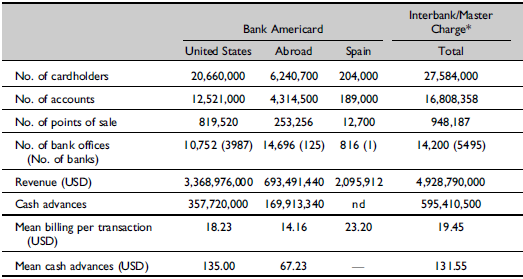
The payment system based on check guarantee cards had purely European roots and never caught on in North America or Latin America.Footnote 14 Indeed, in late 1979, estimates by the International Savings Banks Institute (ISBI) indicated that there were 10 million credit cards in Europe, compared with 30 million check guarantee cards. Meanwhile, at the same time in the United States, there were 80 million credit cards in circulation. This goes to show how deeply rooted check guarantee cards were in Europe, even though by this time the expansion of international credit cards was already making a difference.Footnote 15 Table 1 illustrates the great difference that still existed in the early 1970s between the United States and Europe, especially in the number of credit card holders and their business volume. However, the data highlight key distinctions between the European and US banking systems, in particular, the strengths of the European bank office networks as opposed to those in the United States.
The Card Market in the United States and Europe in 1971

Source: Box 351, Central Services, Commercial Banking, AHBBVA, BB, Bilbao.
Note: nd, no data; No., number.
*Interbank did not publish its results abroad in 1971.
The Eurocheque system of check guarantee cards made its first advances in 1968 as an alternative to traveler’s checks. It was promoted by a consortium of European banks aiming to facilitate retail payments within Europe without the complications of currency exchange.Footnote 16 Three years earlier, the Swedish credit card Eurocard was launched; however, check guarantee cards retained their competitive edge over other emerging instruments in the European market for years to come.
The main market for the Eurocheque was central Europe, especially the Federal Republic of Germany, with Deutsche Bank as its main promoter. This Central European model also extended into Eastern Europe, beyond the “Iron Curtain.” By 1975, it was established in 36 countries, 24 in Western Europe, 7 in Eastern Europe (Russia, Yugoslavia, Romania, Poland, Bulgaria, and Czechoslovakia), and another 5 on the eastern and southern Mediterranean rim (Israel, Turkey, Egypt, Morocco, and Tunisia).Footnote 17 Check guarantee cards (laminated documents) and their corresponding checks formed a pair used to process payments drawn from the holder’s bank account. They enabled the withdrawal of funds from European banks, avoiding the risks inherent to cash transfers, and in addition, they were backed by the banks that adhered to the Eurocheque International Agreement. In this sense, they worked similarly to a debit card.Footnote 18
The check guarantee system, as such, became obsolete in the 1980s. It was gradually transformed into an international debit card system, thanks to an agreement between Eurocheque International and various operators, including Sistema 4B in Spain and Mastercard Maestro, a debit card. The Maestro card allowed cash withdrawals from automated teller machines (ATMs) and payments at point-of-sale (POS) terminals, and it bore the EC logo.Footnote 19 This transition was driven in part by pressure from Germany, the Netherlands, and Belgium, which were eager to delay the inevitable entry of US credit card systems into their areas of influence.
Notably, some banks, such as Deutsche Bank, attempted a mixed policy of supporting the Eurocheque while at the same time issuing the Eurocard credit card of European origin.Footnote 20 The Eurocheque was already functioning as a debit card in Germany long before Mastercard’s Maestro function was launched in 1991. The tradition of check guarantee cards in Europe helps explain the early introduction of debit cards on the continent, which occurred before it did in the United States, where they did not come into use until the 1990s. By the mid-1980s, there were 27 million Eurocheque cards active in Europe, a large part of which had debit card functions.Footnote 21
New systems of bank credit cards also emerged in Europe during the second half of the 1960s and early 1970s. These nationally based cards established their own competitive frameworks. A representative example is the Eurocard system, which emerged in the context of travel and entertainment cards in 1965; this card was issued by a consortium of Swedish banks. The banks that participated in its creation wanted to offer a credit card that could be used on a European level, across national borders. In 1968, Eurocard established a clearing affiliation with the Interbank Card Association (Interbank). This United States–based corporation included bank credit card brands from several different countries.Footnote 22 The renewed consortium with Interbank/Master Charge improved its European projection and, to a certain extent, internationalized the Eurocard.Footnote 23
New European banks gradually joined the Scandinavian consortium. In the United Kingdom, for example, starting in 1967, banks (with the support of the hotel sector) promoted the card as a means of countering competition from the Diners Club card and managed to gain modest ground against the North American card.Footnote 24
The Barclaycard, launched in 1966, was the pioneering bank card in the United Kingdom. Shortly thereafter, in 1968, it allied with BankAmericard, promoted by the Bank of America. Later, in 1970, an agreement was reached among license-holding banks to create National BankAmericard, Inc. (NBI), which was instrumental in its global expansion. The Barclaycard alliance spurred competition among the other large British banks and was one of the factors that triggered the creation of the Access consortium.
In 1972, the National Westminster Bank was the primary promoter of Access, issuing 42% of the network’s cards by 1977.Footnote 25 Although Access eventually surpassed Barclaycard in terms of cards issued in the United Kingdom and was its main competitor, Barclaycard remained significantly more profitable.Footnote 26
Access initiated its international expansion by affiliating with Eurocard in 1973 and Master Charge in 1974, thereby strengthening Master Charge’s presence in Europe, in contrast to banks aligned with BankAmericard. The alliance of Access with Master Charge in 1974 gave the British company the option to acquire 50% of Eurocard, which triggered a competitive crisis with German banks and savings institutions, led by Deutsche Bank. This alliance conflicted with the German strategy, which sought to preserve the widespread use of the Eurocheque, reserving the Eurocard for clients traveling outside Europe.Footnote 27
In summary, for a large part of the 1970s, the European payment system was dominated by Eurocheque and the three bank credit cards: Eurocard, Barclaycard, and the French Carte Bleue.Footnote 28 During this time, the duality of use persisted between the check guarantee card and the true credit cards themselves. Sources suggest that neither clients nor issuers viewed the two systems as mutually exclusive, and furthermore, the check guarantee cards had low administrative and management costs. This is evidenced by the practice of Barclays Bank in the United Kingdom, which in 1969 offered Barclaycard with a dual functionality—as both a check guarantee card and a credit card. Another example is found in the early development of payment cards in Spain, with Tarjeta 6000 from the savings banks and the 4B card, issued by a banking consortium.Footnote 29 In both cases, the cards functioned as check guarantee cards.
Before focusing on the Spanish case, which will allow us to further explore some of the competitive dynamics that were occurring in Europe, it is important to point out that, during the second half of the 1970s, an important strategic change was taking shape in European card systems. In effect, the association of Interbank/Master Charge, Eurocard, and Access, initiated as a trial for clearing and a common point of sale (POS) network, and the European banking alliances with BankAmericard (after 1976, Visa), was the result of a common strategy: the affiliation of European cards with the US Master Charge and Visa networks. In 1977, the two competitors had different profiles: Master Charge was more United States–based (23 of the 28 board members were from the United States), while at Visa, US board members were in the minority, even though 80% of its operations were generated in the United States.Footnote 30 Nonetheless, both had opted for the internationalization of the system. Ultimately, these were two alternatives for the internationalization of the card that led to Visa and Mastercard in the latter half of the decade, or as some Spanish bankers said: “The U.S. system is clearly planning for Europe, especially in Spain and the United Kingdom.”Footnote 31 However, the transformation would go even deeper than this. A globalizing dynamic of the system was occurring, in terms of both scope and governance.
The 1970s: The Dawn of a Competitive Card Market in Spain
The analysis of the Spanish case offers an excellent framework to investigate how the dynamics of the payment card market paved the way for a new business model that modified the competitive conditions in the banking market. The available data and the analysis of events show that rapid changes were occurring in the 1970s, in both the strategic decisions made and the business model of Spanish banks. This foretold a structural change in what so far had been traditional banking.
In the 1970s, Spain underwent significant economic and political changes. The international crisis exposed the rigidity of the Spanish economy, highlighting the urgent need for reform and modernization, which coincided with the country’s transition to democracy after the Franco dictatorship. At the same time, the oil crisis was also affecting European economies. However, in Spain the effects on the banking sector were much more intense than in the rest of Europe since the financial system had remained on the sidelines of the deregulation processes and the wave of mergers and acquisitions that occurred on the Old Continent during the 1960s. This was undoubtedly the result of the significant levels of financial repression under Franco’s policies.Footnote 32
In this context, it is necessary to consider the impact of the Spanish banking crisis and its aftermath. The banking crisis of 1978–1985 affected more than half of Spain’s banking institutions, primarily small and medium-sized banks. It stemmed mainly from three factors: first, the rapid expansion following partial financial liberalization in the early 1970s, which, in a highly inflationary environment with rising interest rates and debt costs, generated substantial instability; second, inexperienced and occasionally unethical management practices, particularly within newly established banks; and third, an inadequately defined legal and regulatory framework.Footnote 33 As a result, industrial banking disappeared (banks were forced to merge with the large universal banks from whence they came), banking concentration increased, retail and commercial banking became dominant, and stated-owned banks were mostly privatized.Footnote 34 In short, retail banking was consolidated during this period.
Finally, by the 1970s, the impact that these structural changes had on Spanish consumers began to be seen. On the one hand, new retail formats were expanding in association with self-service, and on the other hand, mass distribution was introduced, which began in 1973 with the opening of the first French hypermarkets. This was favored by the stream of French tourists to the Spanish Mediterranean coast.Footnote 35 These conditions explain why the new financial products erupted with such force in the Spanish market, albeit a bit later than in more developed European economies, accelerating the transformation of the system.
Preliminary moves: The choice by some banks to opt for “the check guarantee card”
Without a doubt, the factor that prompted the introduction of certain US travel and entertainment cards in Spain in the late 1950s, along with certain credit cards in the 1960s, was the boom in tourism and business travel boosted by the changes in the Spanish economy (Table 2). In this sense, the knowledge transfers in manufacturing, trade, and marketing techniques, and in banking, all played an important role, thanks to the aid from the United States in the 1950s. This can also be attributed to developments that occurred in certain business sectors through the Spanish Productivity Council during the 1950s and early 1960s.Footnote 36
The Payment Card Market in Spain in 1973
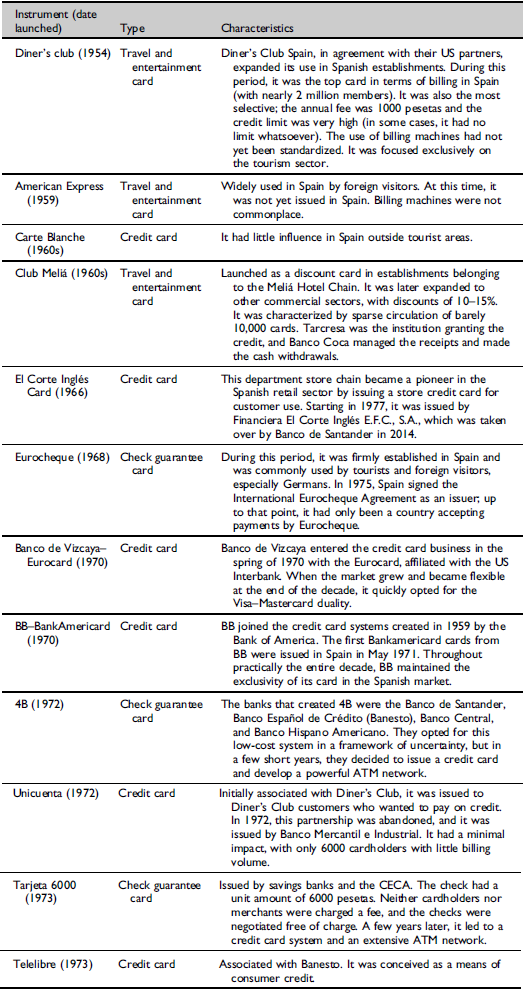
Sources: Box 351, binder 1, subfolder 3, Report by the head of the Central Card Office of Banco de Bilbao on existing cards in the Spanish market, 7 Apr. 1973, Central Services, Commercial Banking, AHBBVA, Banco de Bilbao, Bilbao; Corporate Websites.
Notes: BB, Banco de Bilbao
The Eurocheque system, closely tied to the tourism sector, remained in force in Spain throughout the 1970s and 1980s (Table 2). Around 1975, the Spanish Eurocheque Group consisted of 67 national banks. Likewise, at the start of the decade, the first firm steps were also taken in Spanish banking to promote the use of credit cards. Banco de Vizcaya and Banco de Bilbao chose this card directly between 1970 and 1971, each affiliating with a different network (Eurocard–Master Charge and BankAmericard, respectively). Meanwhile, the banks that were initially 4B members (Banco de Santander, Banco Español de Crédito [Banesto], Banco Central, and Banco Hispano Americano) opted for the check guarantee card system in 1972. Along these lines, the savings banks and the Spanish Confederation of Savings Banks (CECA) also launched their Tarjeta 6000 card one year later.Footnote 37
However, all these choices were made in an environment of uncertainty regarding the future of these instruments. According to internal information from Banco de Bilbao, discreet contacts were made among the banks, looking into both options on an equal basis. The check guarantee card system chosen by some Spanish banks resulted from a lack of information about credit cards, which some bankers considered an overly risky option.Footnote 38 There is little doubt that many banks were drawn to the obviously lower cost of installation, maintenance, and management of the check guarantee card. However, the available documentation suggests one argument in favor of this system: its status as a transit technology on the path toward debit and credit cards.Footnote 39
The position of the Spanish banking institutions was not free of competitive tension. The banks in the 4B group acted as a lobby within the Higher Banking Council, the banking self-regulatory body, to position themselves with regard to the new instruments. In this sense, pressuring for an agreement to be reached with Eurocheque would permit them to internationalize their check guarantee card system. Banco de Bilbao, which had opted for the credit card, strongly opposed this, which effectively neutralized the action of these banks on the self-regulatory body. Another important player in this game of interests was the savings bank industry association, CECA, which participated in the meetings in harmony with the 4B member banks.Footnote 40
Despite its diffusion in Europe, the check guarantee card experienced gradual erosion due to administrative failures and recurring scams involving Eurocheques in tourist areas.Footnote 41 By the middle of the decade, the 4B Group and the savings banks themselves were beginning to recognize the need to reconvert to a credit card system, particularly at Banco de Santander, which had been reluctant to adopt the system since its implementation. The possible clearing agreements with the current networks were on the table, and the 4B group strategically proposed launching a card that would provide access to a network of ATMs with advanced design.
The pioneers in choosing the credit card: Banco de Vizcaya and Banco de Bilbao
In the spring of 1970, Banco de Vizcaya entered the credit card business, issuing a card with international validity.Footnote 42 Initially, the intent was to allow payment for purchases made at certain establishments (hotels, travel agencies, and department stores) and to permit a limited amount of cash credit to be obtained at any bank office. The Eurocard was chosen, which had the support of Master Charge and was widely distributed throughout Europe. The corporate formula adopted was the creation of an independent company in which Banco de Vizcaya and Eurocard International both participated.Footnote 43 Finally, in 1976, Banco de Vizcaya acquired all of the company’s shares. This strategy evidenced its managing capacity in the field of credit cards and confidence in this business model and positioned it alongside the Master Charge–Access alliance, ahead of the Eurocard contenders from the German banks and savings banks.Footnote 44
In turn, Banco de Bilbao signed a commitment with Bank of America in September 1970, thereby becoming a pioneer in introducing credit cards in Spain, alongside Banco de Vizcaya. The first “Banco de Bilbao BankAmericard” cards in Spain were issued in May 1971 at branches in Barcelona, Madrid, and Vizcaya. Shortly thereafter, on September 12, the Central Credit Card Office was created as a department within the bank, reinforcing the strategy that this project must be profitable for the bank. The contract with Bank of America expired every three years and was renewable upon mutual agreement.Footnote 45 In previous meetings, both banks agreed upon exclusive conditions for the issuance of the card in Spain.Footnote 46
Banco de Bilbao played an active part in the processes between 1970 and 1976 that led to the birth of Visa, which occurred simultaneously with the consolidation of the leadership of the Banco de Bilbao card in the Spanish market. In 1974, the banks that formed part of the BankAmericard system at the international level believed they were promoting the system without acquiring any tenure or property rights in it.Footnote 47 This led to intense negotiations during a period in which Banco de Bilbao held the presidency of the International Committee. Finally, in June 1974, these negotiations resulted in the founding of the International Bankcard Company (IBANCO) as a for-profit, non-stock Delaware corporation, made up of all the banks participating in the system. It was also decided that this name could be changed by corporate agreement, in which case the system would ultimately remain the property of the banks within the IBANCO group. Banco de Bilbao became a full member of this corporation, whose board of directors would meet on a rotating basis around the world as a means to show practical evidence of its international nature.Footnote 48
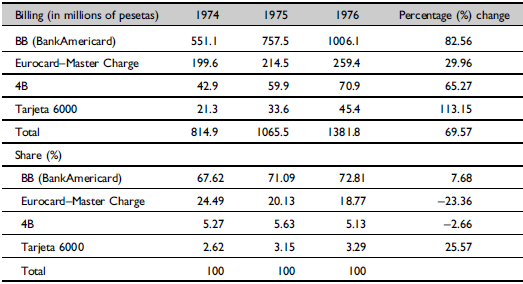
In July 1976, IBANCO approved the name change from BankAmericard to Visa, and the corporation came to be known as the Visa International Services Association. It operated in 110 countries and was also the main competitor of Master Charge.Footnote 49 Banco de Bilbao took advantage of this momentum while maintaining their monopoly on Visa in Spain. There was a sharp difference between it and its competitors in Spain, as can be seen in Table 3, which provides an estimate of the market distribution in the early years through card operations in a representative large department store chain, i.e., El Corte Ingles.Footnote 50 The Eurocard occupied the second position after Banco de Bilbao’s BankAmericard, with a turnover that, on average, was a third of that of its main competitor. This gap was the result of two different strategies: Banco de Vizcaya applied a very selective approach to its card, with a risk limit that was initially high; in contrast, Banco de Bilbao had a less restrictive policy, aimed at earning market share from the very beginning. The 4B and the savings bank card were still far behind, although the market restructuring at the end of the decade would change this status quo. Ultimately, before the end of the decade, the dynamic was consolidated, leading European card systems to form an alliance with Visa and Mastercard. In Spain, the deployment of this new payment instrument initiated an intense fight for market share between the banks and savings banks.
Competing Banking Platforms’ Participation in Credit Card Billing at El Corte Inglés, 1974–1976

Source: Box 8, binder 21, Government (statistical annex), AHBBVA, Banco de Bilbao, Bilbao.
Exclusivity Versus Openness: Toward the Establishment of Two-Sided Markets
At the end of the 1970s, the processes of the standardization and globalization of card systems intensified, with substantial changes occurring in their governance and technical development. On the European scene, the globalization of the system encouraged the development of competition and the expansion of the networks chosen by retail banking.
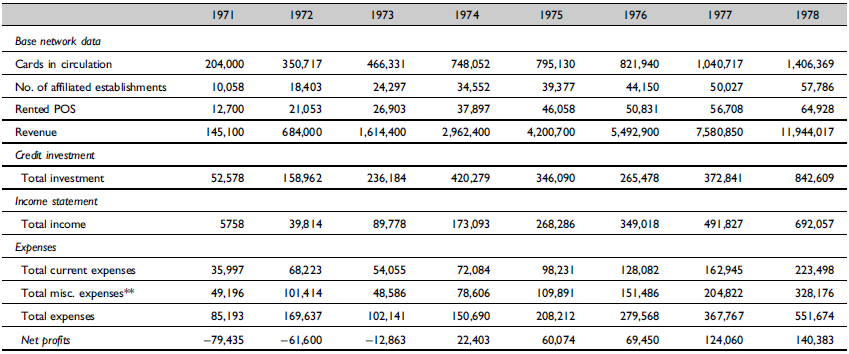
The card systems experienced strong growth, especially BankAmericard, the leader in the United States, with figures above those of the rest of the world. In a 1976 ranking of 22 countries, BankAmericard ranked first in the United States in both absolute and per capita terms. Spain ranked fourth after Canada and the United Kingdom and fifth in per capita terms (Puerto Rico ranked ahead of it).Footnote 51 A few years after its launch, Banco de Bilbao’s BankAmericard was also experiencing very fast growth (Table 4). Between 1971 and 1978, the cards in circulation increased 6.9-fold, and the number of affiliated establishments increased 5.7-fold. Similarly, profitable lending had increased 22.5-fold, and starting in 1974, the card operations began to generate profits for the bank. By 1978, the net profit of the card business had already reached $1,957,649. This was an unequivocal sign that the new business model and the diversification of products were working, just a few short years after their implementation.
Early Stages of the Banco de Bilbao–BankAmericard Credit Card 1971–1978*

Sources: Box 40, Credit Card Center, Central Services, Commercial Banking, AHBBVA, Banco de Bilbao, Bilbao; box 8, binder 21, Government.
Note: Misc., miscellaneous; No., number
*Data as of December 31, with amounts in thousands of pesetas.
**Advertising, financing costs, 24-hour banking, depreciation and amortization, and others.
The king is naked
In strategic terms, Banco de Bilbao accepted that its membership in IBANCO had a great advantage—internationalism—but this also came with a drawback: the anti-exclusivity (rejecting an exclusive franchise) of the organization. During the first quarter of 1976, Banco de Bilbao maintained exclusivity in Spain within the recently created Visa. At this time, the card monopoly in the Spanish market was a non-negotiable issue for the executive leadership, although they considered the possibility of recruiting medium-sized and small banks as distributors for their card, while maintaining the exclusive Banco de Bilbao logo. In this sense, the efforts made by some Executive Committee members were unsuccessful owing to the uncooperative environment of the banks they consulted. The bank executives believed that, “in administrative and organizational practice, our card is bound to the administrative units, so it is very complicated to change this form of management.”Footnote 52 Unfortunately for Banco de Bilbao, in mid-1976 the pressure against exclusivity grew from Visa International and the Spanish banking sector.
One issue that alarmed Banco de Bilbao was the debate raised by Carte Bleue at the IBANCO board meeting held in Osaka, Japan. Even though this institution, made up of 89 important French banks, was affiliated with BankAmericard, it had resisted joining IBANCO, but finally did so in 1976. At the Osaka meeting in November of that year, it formally requested that the corporation take measures in those European countries in which only one bank operated the “tricolor” card so that these banks would relinquish their exclusivity. The majority decided in favor of Carte Bleue’s proposal. Obviously, Banco de Bilbao was one of those potentially affected by this request. Furthermore, Banco de Bilbao was aware of the exploratory contacts in which Banco Hispano Americano (a 4B affiliate) was engaging with IBANCO. This was in addition to pressure from Crédit Lyonnais, a very active Carte Bleue member in Spain that had strong ties through Europartners to Banco Hispano Americano.Footnote 53 However, the position of the Banco de Bilbao Board continued to be unrealistic, criticizing the “proselytism of Visa” and not questioning exclusivity.Footnote 54 It mistakenly speculated that the international corporation would turn against one of its founding members. One year later, in June 1977, while maintaining its position, the bank was already contemplating this possibility:
“However, given the possibility that someday the measure might be imposed upon us [the loss of exclusivity], we must remain vigilant to the movements that occur in this context at home and abroad, to better adapt to any situation of change.”Footnote 55
Internally, the positions were gradually being defined, and conceptually, the thesis of non-exclusivity was starting to be accepted, although its application still remained to be seen.
The 4B offensive
At the same time, in the Spanish means-of-payment market, the movements of the rest of the competition were accelerating. The 4B group was working against the clock to develop a credit card as an alternative to its failing check guarantee card. 4B had taken the first steps in its strategic shift, founding itself as a company in 1974 with capital of 300 million pesetas. The new company was created with the aim of incorporating new banks, together with the four banks that had initiated the 4B project in 1972.
The innovation under design was a system capable of authorizing, controlling, and registering transactions involving the 4B card (with a magnetic stripe) nationwide. Both ATMs and POS terminals were set up for this purpose. The breakthrough occurred when the network of banks integrated into 4B switched from their own computers to those on the public data transmission network (Red Especial de Transmisión de Datos [RETD]) belonging to the National Telephone Company of Spain (CTNE).Footnote 56 Significantly, competitors described it as “too important a project, unprecedented in Western banking, without any experience in terms of its profitability.”Footnote 57 Ultimately, 4B was at the forefront of international innovation by assuming that credit cards should also cover the functions of a bank card—an instrument of access to both traditional and more advanced banking services—all through a solid national network of ATMs accessible with its card.Footnote 58 Contributing to this were an innovative POS terminal used by merchants and new software, products of the group’s joint investment effort.
Therefore, the decisions being made within Visa International regarding exclusivity, which directly affected Banco de Bilbao, and the 4B offensive were occurring simultaneously in the Spanish market. The two phenomena are connected because, as the year 1977 progressed and the Visa brand became internationally established, 4B moved closer to the Visa Europe environment. This first occurred in Switzerland, and later through Santiago Zaldumbide, representing Banco de Bilbao, which acted as Visa’s exclusive bank in Spain. At the start of 1978, Banco de Bilbao considered the 4B offensive as a “serious threat.” The sources consulted suggest that 4B had a greater capacity for negotiation, as it was aware that Banco de Bilbao’s exclusivity was on borrowed time. During the negotiations, 4B suggested a counteroffer allowing Banco de Bilbao to enter its 4B System, aiming for the creation of a card issuance center that would also incorporate Master Charge. However, Banco de Bilbao saw 4B’s proposals as a strategy to neutralize its previous comparative advantages.Footnote 59 It was clear that the exclusivity that had given Barclays and Banco de Bilbao leadership in their respective domestic markets had already been amortized.
Dee Hock and the end of Banco de Bilbao’s exclusivity
The final battle for exclusivity—ultimately lost by Banco de Bilbao—took place in March 1978. Banco de Bilbao played its last card, sending Enrique Más Montañés, a member of the management team, to London and Washington, DC, to meet with Frank Snushell of Barclaycard (Barclays Bank, an early adopter of BankAmericard, had played a central role in the creation of IBANCO) and Dee Hock, president of the NBI.Footnote 60
The agenda of these meetings was clearly defined: exclusivity, negotiating the conditions of non-exclusivity, and card access to automated banking.Footnote 61 The meeting with Snushell from Barclays Bank also had another objective: to learn more about the recent agreement between Barclays and the Trustee Savings Bank (TSB; the British savings banks), which extended the issue of the Barclaycard to the TSB. Snushell informed Más Montañés about the agreement with the TSB and, in this context, recommended the creation of a single center for Spain, similar to Access in the United Kingdom. This would avoid card duplication by a cardholder and protected each bank’s customer base.
Hock’s position was emphatic: He made it clear to Banco de Bilbao’s representative that exclusivity was not negotiable, as it was incompatible with the conception of the system at that time.Footnote 62 According to Hock, Visa needed to consolidate itself as an international bank card, open to all banking institutions. Hock admitted that, if Banco de Bilbao managed to impose its conditions on 4B or any other aspiring member, Visa would not oppose it—although he acknowledged that, in 4B’s position, he would not accept the terms and would instead join Master Charge. Hock’s suggestion to Banco de Bilbao was to renounce exclusivity and transition to a position of leadership. Banco de Bilbao’s strategy would essentially follow these lines, reinforcing its commercial action through the direct debit of customers’ payments from the account linked to the cards.Footnote 63
Finally, Banco de Bilbao had to accept the loss of the exclusivity that it had enjoyed until then, acknowledging the market positioning of its competitor 4B, which, two months after the meeting between Más Montañés and Hock, signed a licensing contract with Visa International on May 15, 1978. In the following months, six banks and three savings banks requested technical assistance from Banco de Bilbao. Banco Occidental and Crédit Lyonnais approached Visa independently; Banco Popular, for example, was admitted as a main member of Visa in September 1978. In addition, four banks and one savings bank, issuers of Master Charge cards, simultaneously entered Visa’s orbit, thus confirming the dual affiliation of many banking institutions. The nexus of these strategies was the creation of Visa España on March 16, 1979, formed by 37 financial institutions (30 banks and 7 savings banks, which at the end of the year comprised 56 institutions).
Meanwhile, the US Interbank system, owner of the Master Charge brand (which, as of January 16, 1979, became known as Mastercard), maintained its agreements with Access and Eurocard and improved its impact in Spain. In early 1979, the Interbank Spain members created the Spanish Credit Card Association, initially made up of nine banks, with others gradually joining. The emerging scenario situated “The Big Seven” (Banesto, Banco Hispano Americano, Banco Central, Banco de Bilbao, Banco de Vizcaya, Banco de Santander, and Banco Popular) within the Visa universe. Within this group, initially only Banco de Vizcaya opted for duality. However, other banks later followed, and this option would gradually become generalized.Footnote 64
By the end of the decade, the Spanish card market had some unique characteristics: The two major franchises (Visa and Mastercard) were administered by corporations—Visa España and the Spanish Credit Card Association—whose members were banking institutions. Affiliation with more than one brand had become more common, and access to the market by non-banking cards such as American Express had finally been formalized.
Interoperability and System Integration in the 1980s
The outlook at the start of the decade showed a well-defined path for the bank card business. On the one hand, it had been established as a core activity in the retail banking business. On the other hand, a model of competition was being developed in which the system’s strong technical foundation influenced business profiles.
In the 1980s, along with new payment systems, innovations were being introduced in electronic banking services and cash management. These were the result of transformations that differentiated between intermediary banking and financial banking. Ultimately, a shift in administrative tasks from companies to banks was taking place in Europe and with particular intensity in Spain. At the same time, banks were noticing changes in the market that resulted in a narrowing of their financial margins and economies of scale that were not proportional to their size.Footnote 65 In the area of payment cards, once Banco de Bilbao’s technical monopoly disappeared, the Spanish banking industry faced a landscape with multiple competitors and multiple coexisting networks, as in North America and Japan. In Europe, the early tendency was to concentrate networks, but in Spain, this concentration of networks did not occur until well after the turn of the century. Indeed, in the Spanish experience, interoperability agreements were of much greater importance among the companies managing the card systems.Footnote 66
In the early 1980s, the automation and digitalization systems applied to card processing in Spain were quite advanced since the development of bank teleprocessing and clearing centers with the cooperation of industry associations in the 1970s had promoted such learning.Footnote 67 The technological changes of the following decade, along with the rise of personal computers and the advantages offered by Host/Mini and minicomputers—such as low cost, network connectivity, processing capacity, and direct user control—revolutionized the electronic communications in businesses and banks in the pre-Internet era. Software protocols were multiplying, and specific telecommunications software was gradually becoming standardized.Footnote 68
By the end of the decade, payment cards were already in common use, with credit and debit functions for transactions.Footnote 69 Magnetic stripes were gradually introduced, accompanied by cards with passive or active memory (smart cards without built-in processors), along with the increasing adoption of electronic funds transfer at the point of sale (EFTPOS).Footnote 70 These technological developments explain the great progress made by cards and automated banking in Spain in the 1980s.
In addition, there were organizational and institutional developments that accelerated the interoperability and integration of the systems, a process that occurred relatively earlier than in the rest of the EEC. Spain was the first country in which Visa was marketed simultaneously by two different companies. It was also the first country in which the card had a logo other than the standard one. By the end of the decade, it was one of the European countries where Visa had the greatest market penetration, alongside France and the United Kingdom. These circumstances contributed to it becoming a sort of testing ground for numerous innovations in the area of cards.Footnote 71
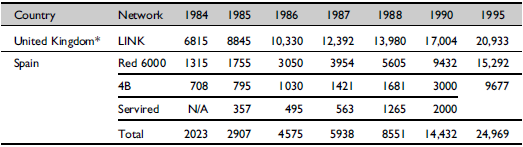
Throughout the decade, various corporate agents were gradually organized into a complex system supporting card payment networks. The intermediary agents, functioning as management companies for the card systems and owners of the telecommunications hubs, were controlled by the issuing banks. They were grouped into four companies: Sistema 4B, Servired, Sociedad Española de Medios de Pago (SEMP), and Sistema 6000 from the savings banks. Sistema 4B and its ATM network had its own debit and credit cards, issued by affiliated banks, and it also marketed the Visa card, along with the Eurocard and Mastercard.Footnote 72 Leading the Servired group, created in 1979, was Banco de Bilbao. It eventually became the largest payment network in the country, encompassing more than 40 financial institutions. The SEMP, created in 1986, was an entity owned by several banks, among them Banco Bilbao Vizcaya (BBV; now BBVA) and Banco de España (Central Bank of Spain). Initially, it only marketed the Visa card, but by the end of the decade, it also marketed Mastercard, Eurocard, and American Express. The savings banks’ ATM network, accessible with the Tarjeta 6000 card, operated through the Sistema de Intercambio de Cajas de Ahorros (SICA) network—the transfer and message-switching system owned by the savings banks’ industry association, CECA.Footnote 73 Table 5 shows the strong expansion of these networks, which in the early 1990s already surpassed the sole network that existed in the United Kingdom.
ATM Networks in the United Kingdom and Spain, 1984–1995

Sources: CECA, Servired, 4B; Bátiz-Lazo and del Angel, The Ascent of Plastic Money: International Adoption of the Bank Credit Card, 1950–1975, Business History Review 92, no. 3 (2018): 120.
Note: N/A, not available.
*Banks and building societies.
The corporate structure of these networks encouraged policies promoting system compatibility, allowing different cards to access multiple network terminals. In March 1988, Visa and Sistema 4B reached an agreement that regulated the transfer of ownership of POS terminals when a merchant decided to change its banking institution. This agreement allowed access to 4B, Visa, Mastercard, Eurocard, Tarjeta 6000, American Express, and other cards that might join in the future. Likewise, the Sistema 4B and Servired systems signed a cooperative agreement in which Servired ATMs would provide cash withdrawal services for any bank card issued by 4B institutions (4B, Visa, and Mastercard), and in turn, all Servired cards (Visa Gold, Classic, and Eurocard) could be used at 4B telebanking ATMs. In summary, 4B, VISA (its entire range), Caixa Oberta (“la Caixa,” now CaixaBank), and Mastercard/Eurocard brand cards could access any ATM on these networks. Altogether, the group comprised the eight major banks within its consortium, along with Caja Postal, Banco de Crédito Agrícola and its affiliated rural cooperative banks, the five medium-sized banks, and several others, including a few foreign institutions. The CECA also joined the agreement, and although commissions were still charged, the parties involved regarded interoperability to be accomplished.
The regulatory processes encouraged these advances, and the Telecommunications Ordinance Law of December 19, 1987, promoted a vast liberalization of the telecommunications systems. In 1989, 90% of all credit card operations were processed electronically. By the end of the same year, there were 100,000 POS terminals installed throughout Spain. Policies were also being implemented in Germany, Italy, and France; however, in Spain, these processes were able to be tested prior to deployment. In addition, the country also saw an expansion of the general services accessible via bank payment cards (gas stations and highways) and numerous pilot projects (taxis, parking, urban transport, and other services).Footnote 74 Finally, in 2005, total interoperability among all the networks was achieved in Spain, and in 2017, the three existing networks merged into a single network.
As a whole, the decade of the 1980s saw the maturity of a historical process that led to the standardization and globalization of the system, thanks to technical, corporate, organizational, and institutional developments that had been gradually occurring. These transformations enabled the mass use of the card, along with the development of automated banking and electronic funds transfer, which were key pieces in the development of banking, with the capacity to offer new products and services. Ultimately, a new business model had been consolidated in retail banking, which had led to a change in the competitive conditions of the European banking market. This established a new model marked by technical cooperation in payment infrastructures and intense competition in terms of products.
Conclusions
The banking credit card model did not experience a linear evolution; rather, it initially adapted to different competitive environments and the specific strategies of the national banking industries. The study of these differences and their process of convergence clearly shows—from a historical perspective—the progressive evolution of the banking credit card toward a globalized business model, both in its scope and its governance, which had repercussions on retail banking. In short, this contributes to the broader narrative of financial markets globalization.
Historical evidence supports the development of homegrown payment card systems in Europe, the launch of which was driven by the rise of continental tourism within the framework of the postwar economic recovery and the birth of the EEC. However, when these models sought internationalization, the dominant strategy was the alliance of clearing centers with networks of US origin, with such synergies encouraging standardization and globalization of the product. In this new context of competition and the proliferation of issuers, a financial product was consolidated with its own identity and objectives, in which banking profitability played a central role. It was a new business model that, without a doubt, changed the conditions of competition in the banking market.
Europe’s economic and social conditions themselves enabled the development of the bank card (e.g., economic growth, tourism development, and the development of infrastructures for mobility and a multiple-currency money market, among other factors). As a result, card operations increased and, in turn, generated a new source of bank income, in addition to interest income. In this way, banks became the necessary intermediaries between individuals and retailers, thanks to the functionality of plastic money, thus changing the competitive conditions in the European banking market. In Spain, this process was accelerated owing to the competitive pressure on the banking system resulting from the banking crisis, the technology adoption strategy of the banks and savings banks, and the growing demand for a service economy.
The European experience allows us to identify the check guarantee card as the predecessor of the debit card and as Europe’s trial run of a transitional technology on the path to the credit card. This alternative, which is lower in cost and more customer-friendly, was adopted by some European bankers, who still viewed the US model as having a certain level of uncertainty. Then, debit cards facilitated access to ATMs and automated banking. These idiosyncrasies were closely linked to certain institutional traditions—for example, the strength of the Eurocheque in the Central European region and its expansion beyond the “Iron Curtain.” In short, these practices explain the early diffusion of the debit card in Europe and the power of the ATM networks on the Old Continent.
Ultimately, the development of markets with a strong technological base, as in the case of bank credit cards, changed the competitive conditions of European retail banking. The sharing of technological and organizational infrastructures was compatible with fierce competition in the banking market. This phenomenon was especially intense in Europe and Japan, in terms of digitalizing the banking and payment systems, generating important network externalities in a less fragmented model than in the United States.Footnote 75 The shift toward service banking unquestionably reshaped the structure of retail financial markets. Consequently, our research highlights how the emergence of technology-driven markets with increasing international synergies, the adoption of new business models, and the role of profit-seeking within banking institutions, among other factors, contribute to our understanding of financial market globalization.
Acknowledgments
I am grateful for the valuable comments provided by the anonymous referees, the editor, and colleagues who participated in the session “Financial Innovation and Banking Inclusion in Europe and Latin America,” held during the 14th Asociación Española de Historia Económica (AEHE) International Congress in Las Palmas de Gran Canaria, Spain, January 21–24, 2025. I thank Gustavo del Ángel for his helpful insights. I also acknowledge the research assistance provided by the archival staff at the AHBBVA in Bilbao and the AWSBI-ISBI in Brussels.
Financial support
The author acknowledges financial support from the Spanish Ministry of Science and Innovation, Grant PID2019-106273RB-I100, MCIN, AEI, DOI: 1013039/501100011033, Fondo Social Europeo Plus (FSE+) and Grant PID2022-139315OB-I100 funded by MCIN/AEI/10.13039/501100011033 by European Regional Development Fund (ERDF) “A way of making Europe.” Funding for open access was provided by the University of A Coruña/ Consorcio Interuniversitario do Sistema Universitario de Galicia (CISUG).
Author Biography
J. Carles Maixé-Altés is full professor of Economic and Business History at University of A Coruña (Spain). His interests are monetary and banking history, retail trade history, and technological innovation in modern retail banking.

 Open access

