


1. Introduction
In contemporary design practice, Generative Artificial Intelligence (GenAI) is rapidly transforming how products and services are conceptualised, developed and delivered by design and engineering teams. As GenAI tools for design and engineering gradually become embedded in everyday design and engineering workflows, design engineers are having to innovate their creative and analytical processes through data-driven approaches. While there is much hype about GenAI’s potential to enhance creativity and efficiency of design and engineering practices, a review of recent research studies reveals that most remains exploratory, with limited insights into how these technologies are being adopted specifically within real-world design and engineering organisations. This paper addresses that gap by presenting an empirical case study on the advanced engineering arm of a European automotive OEM that provides insights into how design engineers in teams perceive, use, and avoid GenAI tools in their early-phase ideation and concept development. The paper concludes by identifying organisational capabilities required to sustain GenAI adoption in practice.
2. Literature review
There is substantial research describing the utilisation of GenAI across different phases and fields of design. In particular, publications on this topic have increased since the popularisation of GenAI text-to-image tools like Midjourney, Dall-E, Stable Diffusion and, more recently, Adobe Firefly, Vizcom and Gemini. For example, a recent article reviewed 78 works describing GenAI utilisation in design fields such as product design, furniture design, creative art and graphic design, fashion design, architectural design, and UX/UI design, most of which were published in the last 3 years (Reference Choudhury, Eisenbart and KuysChoudhury et al., 2025). Some general discussion topics in GenAI for design include productivity, authorship, sustainability (through manufacturing optimisation), and the democratisation of design (Reference AgboolaAgboola, 2024; Reference Di Dio, Inzerillo, Monterosso, Morvillo and RussoDi Dio et al., 2024). Scholars are also exploring the impact of GenAI on design innovation. According to Reference Bouschery, Blazevic and PillerBouschery et al. (2023), GenAI models, specifically transformer-based LLMs, can be used to enhance human innovation teams in new product development (NPD), expanding the problem and solution space for improved innovation outcomes. Meanwhile, Reference Verganti, Vendraminelli and IansitiVerganti et al (2020) observed that when GenAI is tasked with creative problem solving, human design is increasingly becoming an activity of sensemaking. As a consequence, GenAI is evolving how the concepts of radical and incremental innovation are applied in design, as these GenAI learning systems are capable of continually updating solutions (Reference Verganti, Vendraminelli and IansitiVerganti et al., 2020).
More specifically, in product design, studies report that GenAI helps accelerate the problem definition phase by quickly identifying consumer preferences, market trends, and user behaviour (Reference AdeleyeAdeleye, 2024; Reference ÖzsoyÖzsoy, 2025; Reference Sakshi, Verma and ChananaSakshi et al., 2025). Also, using GenAI for big data analysis can help predict consumer reactions to specific design features or material selections (Reference Wang, Zhang and WangWang et al., 2019). In conceptual design phases, generative design can help propose variations of a design that respond to constraints or design specifications (Reference AgboolaAgboola, 2024) and produce alternative product architectures to improve mechanical properties and reduce material use (Reference Kaljun, Cupar and KaljunKaljun et al., 2025). Studies also report that LLMs can quickly generate a vast number of design concepts and automate prototyping stages (Reference Chen, Song, Guo, Sun, Childs and YinChen et al., 2025; Reference FengFeng, 2024; Reference Sakshi, Verma and ChananaSakshi et al., 2025). Hence, authors argue that GenAI enhances creativity by enabling the production of sketches and images beyond the designer’s conventional thinking (Reference Chiarello, Barandoni, Majda Škec and FantoniChiarello et al., 2024; Reference Sakshi, Verma and ChananaSakshi et al., 2025). However, most of these studies explore the benefits of design in a general manner and are not industry-specific.
Among the few industries where research on GenAI in design has been conducted are aircraft and automotive manufacturing. In aircraft manufacturing, Reference Tong, Luo, Ren, Zhang, Xing and DuTong et al (2025) proposed a detailed framework for GenAI integration into the aircraft engineers’ workflow to produce prompts aligned with design requirements, such as fuel quantity, overload, span, wing area, among others. The authors tested their framework using the best models available at the time from OpenAI, Google, Meta, and Alibaba. Based on values across 27 design indicators, the models generated several design alternatives aligned with the engineering constraints. The results, which were compared with those of human engineers using indicators of feasibility, novelty, and usefulness, showed that GenAI concepts often outperformed human concepts. Thus, Reference Tong, Luo, Ren, Zhang, Xing and DuTong et al. (2025) argue that it is possible to rapidly generate aircraft designs comparable to those of human engineers at minimal cost, provided a methodological approach with refined prompting.
In the automotive industry, one study explored the use of ChatGPT for prompting structure, Midjourney for image generation, and Vizcom for refinement to produce alternative commercial vehicle lighting (Reference Lin, Lin, Yang, Stephanidis, Antona, Ntoa and SalvendyLin et al., 2025). The process was conducted in consultation with Taiwanese automotive light manufacturers and showed that AI helped extract styling elements from online data to quickly generate alternatives by combining and modifying styles. However, the company staff involved in the study remarked that GenAI use was still experimental and not part of their commercial workflow. Another study in automotive design proposed a similar framework using ChatGPT for prompting, and Midjourney and Vega GenAI for image generation and visual rendering (Reference Lu, Hsiao, Tang and WuLu et al., 2024). The researchers successfully applied the framework to rapidly design car frontal forms, but, as they noted, skilled designers are imperative to control the process and achieve the intended results.
Li et al. (2024) trained their own GenAI models using Stable Diffusion and professional automotive design images to conduct an experiment with several automotive designers, tailored to their design workflow. Their process for utilising GenAI image generation included a concept definition phase through several inspiration images, a concept refinement phase with perspective views and linework of the car exterior and a concept presentation phase with realistic renders. Although the designers’ efficiency increased, the study concluded that these GenAI models’ effectiveness in grasping semantics and producing images tailored to automotive design remains limited. Also, they argue, designers’ expertise is crucial for decision-making, guiding the process and filtering concepts. Designers’ implicit knowledge in aesthetics, engineering, and functionality is not yet matched by GenAI tools (Li et al., 2024). Another limitation, identified by Damen et al. (2024) in a workshop and surveys with automotive designers, is that designers seek inspiration from unusual, unique, and rare instances during creative conceptualisation, whereas LLMs rely on patterns and data similarities. Designers reported that although GenAI helped visualise 3D designs quickly, which is one of the most time-consuming parts of the automotive design process, the 3D models produced did not yet integrate well with subsequent engineering or refinement phases (Damen et al., 2024).
There is a common trend in the current literature on GenAI implementation in design. Most of the works reviewed are explorative, made by researchers experimenting with GenAI and proposing how practitioners may utilise such tools. However, there is limited empirical evidence on how manufacturing industries and their design teams are using GenAI in their design processes, and the challenges they are facing. Thus, to fill this gap, our study investigates the use of LLMs within a large manufacturing firm guided by the following research questions:
-
• RQ1: How do designers’ and engineers’ perceptions of LLMs shape the preferred parameters and design practices in the early phases of design projects?
-
• RQ2: Which organisational capabilities enable sustained LLM adoption in early-phase ideation, brainstorming, and concept visualisation use cases?
Through these questions, this paper will explore the perceptions and capabilities of GenAI within the context of innovative engineering businesses looking to successfully integrate GenAI in their design processes and practices.
3. Methods
Our case study examined how design engineers used GenAI in the early phases of the design process: brainstorming, visualisation, and integration into existing design workflows. A key selection criterion was that participants had to be practising design engineers, to address the lack of practice-based evidence in current literature. We adopted a single-case study design as it is well-suited to in-depth exploratory, context-rich and reflective research of this nature, enabling rich empirical documentation of GenAI adoption in engineering design, where insights are rarely captured in situ. Further, RQ2 concerns organisational capabilities that enable sustained GenAI use (e.g. governance, tool access, enablement practices, and risk management), so another criterion was that all participants be recruited from a single organisation. The research team intentionally chose to focus on one firm that specialises in engineering design and product development, as this was methodologically necessary to keep the organisational context coherent. Sampling across multiple firms would introduce differences in policy, infrastructure, and culture, making it difficult to attribute observed enablers and constraints to specific organisational capabilities rather than inter-firm variation. As such, this case study aims for depth and analytic insight rather than statistical generalisation. Transferability is supported through the identification of organisational capabilities that other design and engineering teams can assess and adapt.
This study reports on that research, a three-week in-situ investigation with a European automotive OEM. The participating company was founded in 1934, serves products and projects globally, and employs over 5000 people. Our study was conducted within the advanced engineering arm of the company, which functions as the technical “skunkworks” for the parent organisation, employing approximately 400 people in design engineering and associated roles. These highly innovative individuals specialise in lightweight structures, composites, and concept simulation and are focussed on mobility, motorsport, advanced product development, material science and research & development and service both the parent organisation and external customers.
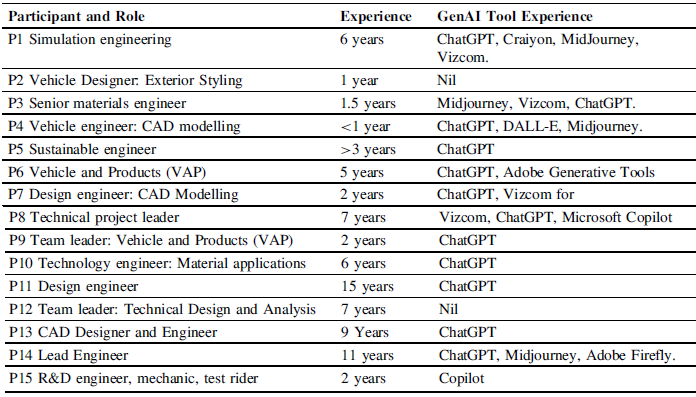
To identify the opportunities, obstacles and practical pathways for GenAI implementation (policies, training, data use), the research team conducted interviews with staff in cross-functional engineering teams (mechanical, electrical, sustainability, material, etc.) and documented their attitudes, needs and expectations toward GenAI. A case study was chosen for this specific group of design engineers because such engineering and technical design development teams often bridge the gap between high-level concepts and technical execution. Semi-structured interviews were conducted with 15 participants in total. A brief description of the participants’ roles and experience is reported in Table 1:
Design and GenAI experience of individual participants

3.1. Data analysis
The interviews were transcribed to text, de-identified, and then imported to NVivo qualitative data analysis computer software. We then conducted reflexive thematic analysis following Reference Braun, Clarke, Cooper, Camic, Long, Panter, Rindskopf and SherBraun & Clarke (2012), progressing through iterative cycles of (1) familiarisation with the data, (2) generating initial codes from the dataset, (3) clustering codes into initial themes, (4) reviewing themes against the dataset (5) defining and naming themes, and (6) writing up. Coding began broadly with 349 initial codes. These codes were then refined by merging overlaps and consolidating into higher-order categories, resulting in four primary themes, which are reported in the findings below.
4. Findings
The 4 primary themes that emerged from the thematic analysis performed on the interview data are as follows:
-
1. Jobs vs Skills - GenAI is evolving the tasks and the roles of design engineers, but adoption is being met with mixed responses.
-
2. Human in the Loop - As GenAI is integrated more and more into human-led activities, barriers are emerging that complicate this process.
-
3. Training Gaps - Whilst generally open-minded to adoption, adequate training is fundamental to the GenAI adoption pathway.
-
4. High-impact use cases - GenAI has the potential to have a high impact on the design process if integrated appropriately.
Each of these themes is explained in greater detail below:
4.1. Jobs vs skills
Of the participants interviewed, only one participant expressed a fear of being replaced by GenAI. P11, a design engineer with 15 years’ experience who had only had a short introduction to ChatGPT by another colleague stated, “Sometimes I’m a little bit scared, hey, will everyone lose this job or maybe many jobs will be not needed anymore because the AI can do it automatically.” Six of the participants (P3, P7, P8, P9, P12 and P14), believed that GenAI would not fundamentally destroy their jobs as designers, but rather change them, serving as a supporting tool to augment their work. Meanwhile, P2, P4, P11 and P12 raised concerns about their roles and the diminishing value of human experience. P3, a senior materials engineer with 1.5 years of experience in the company was a regular user of ChatGPT and had experimented with image-generating tools Midjourney and Vizcom. P3 noted that “we are a very open-minded company” about GenAI adoption and that anxiety was more likely to arise in very specific roles where tasks could be easily automated, stating, ” I could imagine if some position or some colleagues … that GenAI would take over some job tasks or something like that.”
Skill atrophy, reliance on automation, and the potential lack of employee development featured in a third of the interviews, with 5 participants voicing their concerns. P2, an employee new to the job with very little experience with GenAI tools, expressed concern about becoming “too lazy” or too reliant on GenAI tools. They worried that if the tool makes something easier, they might not develop the necessary knowledge or experience. The participant stated that they initially want to learn “to think on my own” before relying on GenAI tools. P5, an experienced sustainability engineer with over 3 years in the firm who had a ChatGPT account but rarely used it, worried about the loss of personal input and control when tools automate fundamental steps. They compared this feeling to the early days of automated simulation processes, which they struggled to accept because they were no longer handling all the steps manually. This participant feared that if they didn’t do the steps manually, even once, they might lose knowledge or integral information.
The participants described a messy picture of risk that did not follow a simple “older = cautious, younger = open” split. P14, a lead engineer with 14 years’ experience who had experimented heavily with ChatGPT, Midjourney and Adobe Firefly, felt older staff were more willing to take organisational risks, such as investing in a GenAI unit. By contrast, newer designers such as P2 were more risk-averse at a personal level: they didn’t want to rely on GenAI before building their own skills and worried it would make them “lazy” or devalue experience. However, P9, an experienced staff member who had been at the company for 2 years and had experimented sparingly with ChatGPT after seeing it deployed in an internal project was highly conservative and rejected the use of GenAI. This was largely due to IP, security, and authorship concerns, showing that risk appetite varied by the type of risk, and not by age and experience alone.
4.2. Human in the loop
Participants revealed that authorship and ownership were significant, unresolved challenges, with P13, a CAD designer of 13 years at the company and whose experience with GenAI was limited to personal use of ChatGPT, deeming it a “big topic” and a “critical” barrier to adopting GenAI. Participants P8, P9 and P13 all worried about the ownership of ideas created by GenAI and the difficulty of securing a patent for new inventions if the source of the generated information is unclear or based on proprietary input data. P9 expressed fear that if their specific inputs were duplicated by a competitor using the same GenAI tool, they could potentially pre-emptively patent the same idea.
Over 50% of participants had real concerns regarding originality, with P3 stating they felt that “real innovations” require the “human brain”. This is complicated further by challenges, including the risk of “target fixation” and employees failing to fully “understand the concepts” that GenAI was producing. P12, a team leader of the technical design and analysis department, and the only participant to report no experience whatsoever with GenAI was particularly vocal, stating the outputs that he had observed were often “bullsh*t technical-wise” and required validation by an expert. P2 re-enforced this point by stating they were unsure if they could “stand behind the ideas” generated by GenAI in the same way that they do with those from their own mind.
Of the 15 participants, 4 acknowledged the potential of GenAI as a support tool, an assistant, or a co-creation partner. P3 explicitly suggested GenAI should act as “some kind of colleague that you’re working with and you’re having a conversation with”, whilst P8, a technical project leader of 7 years who had experimented with ChatGPT, Copilot, and Vizcom stated that GenAI should be a “supportive tool for work we do”. P4, a vehicle engineer specialising in CAD modelling discussed using ChatGPT for feedback on engineering ideas and to generate prompts for image generation using Dall-E. P4 stated a desire for a “smart buddy” to discuss ideas, hoping to visualize “what me and the generative AI thinks together”, indicating a desire for a hybrid/augmented relationship with GenAI. According to P1, a simulation engineer who had been at the company for 6 years and had experimented heavily with ChatGPT, Craiyon, MidJourney and Vizcom, the primary benefits of such a relationship centre around the idea of efficiency, allowing users to gain “more and maybe even better ideas in a shorter time” whilst acting as a “seed” to start projects quickly. P12 also saw value in GenAI filling knowledge gaps and helping people with “less skills” visualize concepts quickly.
4.3. Training gaps
Across the study it was apparent that there was a strong willingness to adopt GenAI tools but weak enablement. All participants expressed a level of openness, acceptance or belief in the future value of utilising GenAI tools, but equally cited current limitations or ethical concerns. Interestingly, four of the participants: P1, P8, P9, and P14, indicated the sheer volume of tools available was problematic, with P1 stating they felt they were “getting flooded with too many tools… too many options.” Of the 15 participants, P1, P2, P11, and P14 mentioned that some internal training had been provided by the employer, but they all felt that it had fallen short. P11 spoke of “a short introduction… and that was all,” which left them unable to judge where GenAI, such as LLMs, would actually help in their workflow. P2 reflected on a company-supported workshop directed by one of their colleagues. The workshop only lasted 1 hour and focussed on the use of ChatGPT, but lacked any exercises or structured learning outcomes. “I think for that, the problem is that I don’t know enough about the tools, so I can’t imagine how the tools could have helped me or us.” The result is a stalled adoption curve, where employees are curious about the capabilities of GenAI tools but are essentially operating in the dark.
The secondary effect of this lack of follow-through was that GenAI uptake decayed quickly, as explained by P6, an employee who had been at the company for 5 years in the Vehicle and Products (VAP) department and had found ChatGPT technical results to be nonsense, whilst having enjoyed some success with Adobe generative fill tools. They said that one-off workshops proved effective at generating interest, but without templates, practice tasks, or office-hours support, employees lacked confidence in tools that could “give false information” instead of “do what I want in easy words.” These insights revealed two issues: 1) the participants lacked a proper education on what these tools are capable of, and 2) the participants lacked the knowledge of how these algorithms operate and how the outputs should be treated in relation to the applications they hoped to use them for. This indicated a need for fundamentals-first, workflow-specific training that should not focus solely on how to use GenAI, but how to use GenAI whilst undertaking their duties in the workplace. A training program that needs to be tailored to the organisation and associated workplace processes.
4.4. High-Impact use cases
The ability of GenAI to quickly visualize and communicate concepts was highlighted by 10 of the 15 participants as a significant and high-impact use case, often addressing existing pain points related to speed, skill requirements, and presentation quality. P12 and P15 valued GenAI for rapidly visualizing concepts, generating “first rough renderings” and “quick sketches” for presentations. According to P12, this capability allows for the visualisation of “more ideas in the same time” and aids those with “less skills”. The expected impact is higher efficiency, yielding “more and maybe even better ideas in a shorter time” as posited by P1. For technical challenges, P11 suggested it would be helpful if LLM’s such as ChatGPT had the ability to fill knowledge gaps by providing quick insights into complex design elements, such as calculating wall thicknesses or performing initial Finite Element Analysis (FEA). P3 expressed a hope that someday the company DNA could be used to train future GenAI models: “it would definitely make sense to have an AI, a company AI that is focusing on these parts that really are our core parts”. Meanwhile, P8 envisioned a GenAI tool capable of creating rapid, optimized 3D models specifically tailored for prototyping methods such as CNC milling or 3D printing.
Information retrieval and summarisation also featured heavily in the data collected, with 11 participants discussing the significant benefits of summarizing complex documents, such as homologation rules, to find a “quick answer” (P15) or just “one thing” (P4) without reading hundreds of pages of technical data. P8 reported that they had successfully used Copilot to summarise copied text whilst P9 hoped GenAI could help replace existing desktop research processes that typically take anywhere from 8 to 12 weeks to complete, stating GenAI could “tremendously speed up the process”. P6 specifically hoped GenAI could make the mundane task of research for benchmarking easier by automatically searching technical data on the internet and placing it into the required company format.
Regarding innovation, multiple participants spoke of the potential of GenAI to aid in both incremental and radical innovation. P1 spoke of the development pressures associated with the industry and stated that whilst “I think this can help us to be more efficient”, they also felt that GenAI tools whilst already capable of “incremental innovation” were “maybe also to figure out some bigger steps, and to come to some ideas which were not possible before.” P8 spoke in a similar vein but questioned if GenAI could aid in “Sprunginnovation” (disruptive or breakthrough innovation). This type of innovation “is so huge that you make the next step for the whole world”. P8 felt you typically “need crazy people” for this type of innovation and postured “I’m not sure if a computer system can be crazy.” P7, a design CAD modelling engineer who has been with the company for 2 years and had been experimenting with ChatGPT and Vizcom touched on a similar sentiment by discussing the idea of GenAI as co-innovation parter. “I think, so to bring up real innovations, it’s still more part of the human, or human users. However, AI can help”. They felt that “AI alone cannot come up with really disruptive innovations.”
5. Discussion
Through an embedded case study approach, our research explored the perceptions and capabilities of GenAI within the context of an innovative, advanced engineering arm of a European automotive OEM that practices engineering design and product development. The organisation was actively seeking to successfully integrate GenAI into their design processes and practice. As such, we undertook this research to better understand the empathetic context for innovation within the firm, how the business could succeed with GenAI and what GenAI can and should do for future products and services in the context of engineering design. Our findings addressed the first research question by shedding light on how participants’ perceptions of risks and benefits of using GenAI influenced the adoption of these technologies within their design and engineering workflows. Answering the second question, our results showed how the organisation studied had attempted to expose its employees to GenAI and highlighted the limitations of its approach. We will discuss how, in each of these two areas, the results contrast with existing literature and highlight research opportunities to further expand our understanding of the implications of GenAI in design practice.
5.1. How GenAI perception influences practitioners’ adoption
Our results showed that although some participants feared GenAI could replace their existing roles, most design and engineering practitioners saw GenAI as a supportive tool that could augment their capabilities, especially helpful for summarising data, searching for information in technical documents, conducting research and organising thoughts, and serving as a companion to quickly start a project. This aligns with findings that GenAI could accelerate the problem-definition phases of design by helping source relevant market data (Reference AdeleyeAdeleye, 2024; Reference ÖzsoyÖzsoy, 2025; Reference Sakshi, Verma and ChananaSakshi et al., 2025). Most participants found other critical benefits in conceptual phases of design related to image generation, as GenAI tools allow visualising many design concepts in a short period of time, matching the benefits highlighted in literature (Reference Lin, Lin, Yang, Stephanidis, Antona, Ntoa and SalvendyLin et al., 2025; Reference Lu, Hsiao, Tang and WuLu et al., 2024; Reference Tong, Luo, Ren, Zhang, Xing and DuTong et al., 2025). Sometimes, helping fill the skill gaps of practitioners who struggled with sketching and rendering, in line with the democratisation of design (Di Dio et al., 2024). On the technical side, these tools proved useful for providing quick insight into complex design elements related to mechanical and structural properties, such as calculating wall thickness and Finite Element Analysis, although one engineer remained sceptical of their value, as he found many of the GenAI-generated concepts lacked technical feasibility, thereby limiting GenAI adoption. The literature shows that, in the field of aircraft design, researchers have addressed this issue by developing a rigorous framework to integrate technical requirements into the prompting structure (Reference Tong, Luo, Ren, Zhang, Xing and DuTong et al., 2025).
Our results indicate that authorship was another significant concern influencing GenAI adoption in practice. These concerns are aligned with those of researchers conducting exploratory research and discussing the authorship of ideas (Reference AgboolaAgboola, 2024; Di Dio et al., 2024). However, the analysis showed a new limiting factor in practitioners’ adoption that has not been thoroughly discussed in the design and engineering literature, but more broadly as a challenge of GenAI in any field (Reference Bender, Gebru, McMillan-Major and ShmitchellBender et al., 2021): the issue of intellectual property and originality due to unclear training data sources of models, as GenAI outputs may hinder the ability to file a patent, thereby affecting a company’s ability to protect inventions. Participants also feared that their inventions could be leaked to competitors using the same tools.
Moreover, participants found that the vast number of GenAI tools on the market makes adoption more difficult, as they don’t know which to choose or for which purpose. The fear of constantly relearning new tools and disrupting workflows seems to limit designers’ and engineers’ openness to using them. Another crucial finding was that GenAI adoption seemed more related to curiosity and risk appetite than age or experience. Two common reasons to avoid GenAI tools were fear of skill atrophy, also identified as a reason in tests with design students (Reference Elal and ÖzsoyElal & Özsoy, 2024), and the loss of control over the design process, which could lead to target fixation. Our results showed that, on the one hand, younger designers feared that, if they delegated too many design tasks to GenAI, they would not be able to develop critical skills themselves or master their jobs. On the other hand, older and more experienced participants feared that relying on GenAI could mean they could not control certain crucial design parameters.
We found that practitioners agreed that expert humans-in-the-loop were crucial to avoid shallow understandings of GenAI outputs, but some still considered that they could not claim ownership of the GenAI-generated concepts or be accountable for them. How design engineers and GenAI co-exist is an important consideration and a sentiment that was supported by participants who suggested co-creation and co-innovation relationships with GenAI tools, which have the potential to evolve existing practices, processes and design thinking into new dimensions. A discussion already started by some scholars (Reference Thoring, Huettemann and MuellerThoring et al., 2023; Reference Verganti, Vendraminelli and IansitiVerganti et al., 2020).
5.2. How organisations enable or limit GenAI adoption
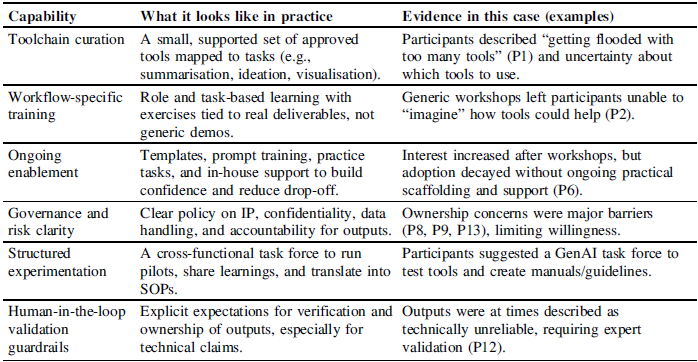
Our results highlight how organisational practices enable or limit GenAI adoption. For RQ2, participants described adoption as constrained less by individual willingness and more by organisational enablement and governance. We identified six organisational capabilities that support sustained GenAI use in early-phase ideation, brainstorming, and concept visualisation, which are reported in Table 2:
Organisational capabilities enabling sustained GenAI adoption

Through the interviews, we found that most participants were curious and willing to understand how GenAI could improve or assist their tasks, but they lacked detailed knowledge about the tools and thus had many concerns. Results showed that the company had organised a few ad-hoc workshops to encourage GenAI adoption, but most participants found them insufficient and too generic. The organisational support seemed limited compared with expectations for GenAI tool adoption. Participants expressed that training tailored to their roles and the types of design they worked on would be a significant enabler of adoption, because the ChatGPT training provided did not clearly address their most pressing needs.
Based on our findings, it seems critical that organisations first identify how GenAI can support their processes before handing this expectation and responsibility to staff, particularly through toolchain curation and workflow-specific enablement (Table 2). Studies align with this, expressing that the lack of integration of GenAI tools with industrial workflows is a significant adoption barrier (Reference Aromaa, Heikkilä, Jurvansuu, Pehlivan, Väärä and JurmuAromaa et al., 2025). Although studies have argued that GenAI implementation costs are an important adoption barrier in design (Reference AdeleyeAdeleye, 2024), our interview participants did not provide insights to validate this, as it did not appear to be a concern.
Some of the most common individual adoption concerns, such as ownership of ideas, accountability, and originality, can be addressed through organisational capabilities, in particular governance, risk clarity and structured experimentation (Table 2). One potential solution to improve staff GenAI adoption could be the creation of a GenAI task force, as suggested by one participant. Such a team could include one member from each design division and lead GenAI experimentation across all company processes. It could help determine which tools to use and how to use them to fit the company’s needs. Once fully tested and understood, operation manuals or standard operating procedures could be created to pass on to the design and engineering teams. We expect that company policy and guidelines would give employees confidence to adopt these tools and push their boundaries.
Another step the organisation could take, as suggested by the results, is to provide more tools to facilitate adoption, such as templates, tutorials, low-risk practice exercises, and office-hours support (Table 2). A good starting point for organisations could be creating evaluation criteria to determine which tasks could be easily automated or improved by using GenAI across several roles. For example, as some participants suggested, GenAI could significantly reduce the 8 to 12-week research cycles. Similarly, participants expressed the potential to automate benchmarking through automated web searches, technical data extraction and formatting of reports and insights into company templates. Together, these capabilities provide a transferable, practice-grounded account of how organisations might enable GenAI adoption beyond an employee’s curiosity, whilst remaining sensitive to context-specific constraints.
5.3. Research Limitations, future work and practical implications
It is important to note that this study focuses on a single organisation within the European context and its design and engineering teams. Although we captured valuable insights and opinions from different roles and levels of experience and found certain patterns previously discussed, other employees’ perceptions may differ. However, by focusing on one organisation in depth, we captured the nuances of how designers and engineers experience the adoption GenAI tools in a professional setting, a topic that hadn’t been deeply understood or analysed in existing research.
Regarding further research, we identified areas that require validation. First, we believe more studies like this one, with individual design and engineering organisations, should be conducted to determine whether teams in other geographical contexts and industries are experiencing the same challenges when adopting GenAI tools. Our results also showed that the studied organisation was taking very limited steps and had few initiatives to adopt GenAI at an organisational level. Research identifying the best organisational adoption practices, with clear examples, would greatly benefit practice. Furthermore, our studies show that identifying the general benefits of GenAI to design does not provide enough confidence for practitioners to adopt these tools. They are more concerned with which tool to use, and when and how to use it to make their specific roles more efficient. Finally, we feel that more industry-based research into how GenAI is evolving design and innovation processes would be highly beneficial to the research community.
Our results also showed some approaches that could greatly improve GenAI adoption and support design and engineering practices. For example, the utilisation of GenAI should be considered a new skill that must be learnt. We believe organisations should have dedicated study programs and support for employees. Expecting staff to be more productive and efficient because tools are available that others are using may exacerbate employees’ fears. There are real, important challenges, such as intellectual property and accountability, that must be addressed to increase adoption confidence.
6. Conclusion
This paper demonstrates how GenAI tools, including large language models (LLMs), can enhance early-phase design activities, particularly ideation, brainstorming, and concept visualisation. Through a three-week embedded case study within the advanced engineering arm of a European automotive OEM, this research examined how designers’ and engineers’ perceptions of Gen AI tools, such as LLMs, influenced their preferred design parameters, creative methods, and decision-making processes. While participants recognised the potential of GenAI to accelerate idea generation, support divergent thinking, and facilitate cross-modal translation, they also expressed concerns regarding reliability, data security, intellectual property, and workflow compatibility. These perceptions directly shaped the extent and manner of tool adoption in everyday design practice. The study further identified organisational behaviours that limit GenAI integration, and based on the results, suggested mechanisms to improve employee adoption through dedicated experimentation and training programs. These include structured GenAI guidelines based on specific roles and processes, continuous training and upskilling supported by the organisation, transparent governance of data protection policies, and a cohesive toolchain that supports responsible experimentation and exploration within professional contexts. Together, these enable an informed and ethical approach to AI-augmented design engineering. Establishing a supportive ecosystem where creative exploration aligns with governance, capability building, and ethical responsibility is essential for realising the long-term value of GenAI in design-led innovation.
 .
. 

 Open access

