








1 Introduction
The notion of K-stability of Fano manifolds is an important concept in algebraic geometry and differential geometry. In [Reference Tian59, Reference Donaldson25] it was introduced to study the existence of Kähler-Einstein metrics on Fano manifolds, which is an important problem in differential geometry. Moreover, K-stability of Fano manifolds has attracted significant attention due to its connections with several important problems in algebraic geometry and related fields.
In algebraic geometry, to construct moduli spaces, which parametrize families of algebraic varieties with certain properties, is an important problem. In the case of Fano varieties, the challenging problem of constructing a well-behaved moduli space has been solved as an outcome of the recent advances in the theory of K-stability. The algebraic construction for K-moduli stacks and spaces of log Fano pairs is completed thanks to many people’s work [Reference Alper, Blum, Halpern-Leistner and Xu1, Reference Blum, Halpern-Leistner, Liu and Xu13, Reference Blum, Liu and Xu16, Reference Blum and Xu18, Reference Codogni and Patakfalvi21, Reference Jiang32, Reference Li, Wang and Xu43, Reference Liu, Xu and Zhuang45, Reference Xu61, Reference Xu and Zhuang63, Reference Xu and Zhuang64]. Although the foundational theory of K-moduli spaces have been established, it remains an important question to understand K-moduli spaces of explicit Fano varieties. There has been much work on this topic, mostly focusing on K-moduli spaces coming from compactifications of smooth Fano varieties. See [Reference Mabuchi and Mukai50, Reference Odaka, Spotti and Sun53, Reference Spotti and Sun58, Reference Liu and Xu44, Reference Liu39, Reference Ascher, DeVleming and Liu6, Reference Abban, Cheltsov, Denisova, Etxabarri-Alberdi, Kaloghiros, Jiao, Martinez-Garcia and Papazachariou3, Reference Cheltsov, Duarte Guerreiro, Fujita, Krylov and Martinez-Garcia19, Reference DeVleming, Ji, Kennedy-Hunt and Hao Quek24, Reference Liu and Zhao48] for a partial list of works along this direction.
In this paper, we consider K-moduli spaces for certain families of weighted projective hypersurfaces that are not necessarily ${\mathbb {Q}}$
-Gorenstein smoothable. More precisely, we consider well-formed weighted projective hypersurfaces
${\mathbb {Q}}$
-Gorenstein smoothable. More precisely, we consider well-formed weighted projective hypersurfaces $H_{2(n+3)}$
of degree
$H_{2(n+3)}$
of degree $2(n+3)$
in
$2(n+3)$
in $\mathbb {P}(1,2,n+2,n+3)$
. By [Reference Kim, Viswanathan and Won36, Theorem 1.0.6], such a hypersurface
$\mathbb {P}(1,2,n+2,n+3)$
. By [Reference Kim, Viswanathan and Won36, Theorem 1.0.6], such a hypersurface $H_{2(n+3)}$
is K-stable if it is quasi-smooth. Our main result gives a description of the K-moduli space
$H_{2(n+3)}$
is K-stable if it is quasi-smooth. Our main result gives a description of the K-moduli space $\mathcal {F}_n$
parameterizing these K-stable quasi-smooth hypersurfaces
$\mathcal {F}_n$
parameterizing these K-stable quasi-smooth hypersurfaces $H_{2(n+3)}$
and their K-polystable limits.
$H_{2(n+3)}$
and their K-polystable limits.
Theorem 1.1. Let n be a positive integer. Then every K-polystable member of $\mathcal {F}_n$
is a weighted hypersurface of degree
$\mathcal {F}_n$
is a weighted hypersurface of degree $2(n+3)$
in
$2(n+3)$
in ${\mathbb {P}}(1,2,n+2,n+3)_{x,y,z,t}$
. Moreover, we have the following detailed description. Let
${\mathbb {P}}(1,2,n+2,n+3)_{x,y,z,t}$
. Moreover, we have the following detailed description. Let

-
(1) If n is odd, then the K-polystable members in the K-moduli space $\mathcal {F}_n$
are precisely all the hypersurfaces such that
$\{a,a_0,a_1,\cdots ,a_{\frac {n+3}{2}}\}$
are not all zero and
$\{a_{\frac {n+3}{2}+1},\cdots ,a_{n+3}\}$
are not all zero.
$\mathcal {F}_n$
are precisely all the hypersurfaces such that
$\{a,a_0,a_1,\cdots ,a_{\frac {n+3}{2}}\}$
are not all zero and
$\{a_{\frac {n+3}{2}+1},\cdots ,a_{n+3}\}$
are not all zero. -
(2) If
$n=2l$
is even, then the K-polystable members in the K-moduli space
$\mathcal {F}_n$
are precisely all the hypersurfaces such that one of the following holds:-
○
$\{a,a_0,\cdots ,a_{l+1}\}$
are not all zero and
$\{a_{l+3},\cdots ,a_{2l+3}\}$
are not all zero; -
○
$a=a_0=\cdots =a_{l+1}=0$
,
$a_{l+2}\neq 0$
and
$a_{l+3}=\cdots =a_{2l+3}=0$
.
-

 such that


 such that one of the following holds:


As Theorem 1.1 suggests, the K-moduli space $\mathcal {F}_n$
parameterizes hypersurfaces of the same degree in the same weighted projective space. There are other families of Fano (weighted) hypersurfaces or complete intersections whose K-moduli compactifications exhibit a similar behavior, see, for example, [Reference Spotti and Sun58, Reference Liu and Xu44, Reference Liu39, Reference Liu and Petracci41]. On the other hand, this phenomenon is far from true in general, see, for example, [Reference Odaka, Spotti and Sun53, Reference Ascher, DeVleming and Liu6, Reference Abban, Cheltsov, Kasprzyk, Liu and Petracci4].
$\mathcal {F}_n$
parameterizes hypersurfaces of the same degree in the same weighted projective space. There are other families of Fano (weighted) hypersurfaces or complete intersections whose K-moduli compactifications exhibit a similar behavior, see, for example, [Reference Spotti and Sun58, Reference Liu and Xu44, Reference Liu39, Reference Liu and Petracci41]. On the other hand, this phenomenon is far from true in general, see, for example, [Reference Odaka, Spotti and Sun53, Reference Ascher, DeVleming and Liu6, Reference Abban, Cheltsov, Kasprzyk, Liu and Petracci4].
To prove Theorem 1.1, we first reduce to K-moduli of log Fano pairs by double cover constructions. It is easy to observe that the projection $H_{2(n+3)}\to {\mathbb {P}}(1,2,n+2)$
by
$H_{2(n+3)}\to {\mathbb {P}}(1,2,n+2)$
by $[x,y,z,t]\mapsto [x,y,z]$
shows that
$[x,y,z,t]\mapsto [x,y,z]$
shows that $H_{2(n+3)}$
is a double cover of
$H_{2(n+3)}$
is a double cover of $W = {\mathbb {P}}(1,2,n+2)$
branched along a divisor D of degree
$W = {\mathbb {P}}(1,2,n+2)$
branched along a divisor D of degree $2n+6$
. This description works well when n is odd. If
$2n+6$
. This description works well when n is odd. If $n=2l$
is even, then the weighted projective space
$n=2l$
is even, then the weighted projective space ${\mathbb {P}}(1,2,n+2)$
is no longer well-formed, so we need to modify the setup. We may treat
${\mathbb {P}}(1,2,n+2)$
is no longer well-formed, so we need to modify the setup. We may treat $W = (W', \frac {1}{2}H)$
as an orbifold, where
$W = (W', \frac {1}{2}H)$
as an orbifold, where $W' = {\mathbb {P}}(1,1,l+1)_{u, y,z}$
and
$W' = {\mathbb {P}}(1,1,l+1)_{u, y,z}$
and $H = (u=0)$
. Then the map
$H = (u=0)$
. Then the map $H_{2(n+2)}\to W'$
by
$H_{2(n+2)}\to W'$
by $[x,y,z,t]\mapsto [x^2, y, z]$
is a double cover branched along the divisor
$[x,y,z,t]\mapsto [x^2, y, z]$
is a double cover branched along the divisor $H+D$
where D has degree
$H+D$
where D has degree $2l+3$
. Since K-polystability is preserved under finite Galois covers [Reference Liu and Zhu46, Reference Zhuang69], we know that K-polystability of
$2l+3$
. Since K-polystability is preserved under finite Galois covers [Reference Liu and Zhu46, Reference Zhuang69], we know that K-polystability of $H_{2(n+3)}$
is equivalent to that of
$H_{2(n+3)}$
is equivalent to that of $(W, \frac {1}{2}D)$
(resp. of
$(W, \frac {1}{2}D)$
(resp. of $(W', \frac {1}{2}(H + D))$
) when n is odd (resp. even). Then without too much effort we can generalize this double cover construction to families and get an isomorphism between
$(W', \frac {1}{2}(H + D))$
) when n is odd (resp. even). Then without too much effort we can generalize this double cover construction to families and get an isomorphism between $\mathcal {F}_n$
and the K-moduli space
$\mathcal {F}_n$
and the K-moduli space $M_{\frac {1}{2}}$
of pairs
$M_{\frac {1}{2}}$
of pairs $(W, \frac {1}{2}D)$
or
$(W, \frac {1}{2}D)$
or $(W', \frac {1}{2}(H+D))$
depending on the parity of n.
$(W', \frac {1}{2}(H+D))$
depending on the parity of n.
Next, we use the wall crossing framework for K-moduli of log Fano pairs developed in [Reference Ascher, DeVleming and Liu7, Reference Zhou67, Reference Zhou66] to study the K-moduli spaces $M_w$
of
$M_w$
of $(W, wD)$
(resp.
$(W, wD)$
(resp. $(W', \frac {1}{2}H+ wD)$
) when n is odd (resp. even) as the coefficient w varies. This framework was initially introduced in [Reference Ascher, DeVleming and Liu7] for
$(W', \frac {1}{2}H+ wD)$
) when n is odd (resp. even) as the coefficient w varies. This framework was initially introduced in [Reference Ascher, DeVleming and Liu7] for ${\mathbb {Q}}$
-Gorenstein smoothable log Fano pairs
${\mathbb {Q}}$
-Gorenstein smoothable log Fano pairs $(X, cD)$
where D is proportional to
$(X, cD)$
where D is proportional to $-K_X$
based on [Reference Li, Wang and Xu42] with analytic inputs from [Reference Chen, Donaldson and Sun20, Reference Tian60]. Later, in [Reference Zhou67] the
$-K_X$
based on [Reference Li, Wang and Xu42] with analytic inputs from [Reference Chen, Donaldson and Sun20, Reference Tian60]. Later, in [Reference Zhou67] the ${\mathbb {Q}}$
-Gorenstein smoothable assumption was removed thanks to the algebraic proof of the K-moduli theorem. Recently, in [Reference Zhou66] this framework was generalized to multiple divisors such that each component is proportional to
${\mathbb {Q}}$
-Gorenstein smoothable assumption was removed thanks to the algebraic proof of the K-moduli theorem. Recently, in [Reference Zhou66] this framework was generalized to multiple divisors such that each component is proportional to $-K_X$
. Since the pairs we consider are not necessarily
$-K_X$
. Since the pairs we consider are not necessarily ${\mathbb {Q}}$
-Gorenstein smoothable and may contain two components, we will follow the setup of [Reference Zhou67, Reference Zhou66]. See also [Reference Fujita28, Reference Gallardo, Martinez-Garcia and Spotti30, Reference Ascher, DeVleming and Liu5, Reference Ascher, DeVleming and Liu6, Reference Zhao65, Reference Stylianos Papazachariou54, Reference Zhou68, Reference Pan, Si and Wu56] for examples on wall crossing for K-moduli spaces.
${\mathbb {Q}}$
-Gorenstein smoothable and may contain two components, we will follow the setup of [Reference Zhou67, Reference Zhou66]. See also [Reference Fujita28, Reference Gallardo, Martinez-Garcia and Spotti30, Reference Ascher, DeVleming and Liu5, Reference Ascher, DeVleming and Liu6, Reference Zhao65, Reference Stylianos Papazachariou54, Reference Zhou68, Reference Pan, Si and Wu56] for examples on wall crossing for K-moduli spaces.
In our setting, the advantage of working with wall crossing of $M_w$
rather than focusing on the single K-moduli
$M_w$
rather than focusing on the single K-moduli $M_{\frac {1}{2}}$
is that usually
$M_{\frac {1}{2}}$
is that usually $M_w$
is simple when w is small, and as w increases to
$M_w$
is simple when w is small, and as w increases to $\frac {1}{2}$
we can break down the complexity in
$\frac {1}{2}$
we can break down the complexity in $M_{\frac {1}{2}}$
into elementary transformations given by a sequence of wall-crossing diagrams. As it turns out, for a majority of the coefficients w, our K-moduli space
$M_{\frac {1}{2}}$
into elementary transformations given by a sequence of wall-crossing diagrams. As it turns out, for a majority of the coefficients w, our K-moduli space $M_w$
is isomorphic to the corresponding variation of GIT moduli space; see Theorems 5.4 and 6.4. Then after the last wall
$M_w$
is isomorphic to the corresponding variation of GIT moduli space; see Theorems 5.4 and 6.4. Then after the last wall $\xi _n$
, the K-moduli wall crossing extracts a divisor that parameterizes pairs of a different form; see Theorem 1.2(6) and Theorem 1.3(6).
$\xi _n$
, the K-moduli wall crossing extracts a divisor that parameterizes pairs of a different form; see Theorem 1.2(6) and Theorem 1.3(6).
We first describe the K-moduli spaces $M_w$
when n is odd.
$M_w$
when n is odd.
Theorem 1.2. Let n be an odd positive integer. For $w\in (0, \frac {n+5}{2n+6})\cap {\mathbb {Q}}$
, let
$w\in (0, \frac {n+5}{2n+6})\cap {\mathbb {Q}}$
, let $M_w$
be the K-moduli space parameterizing K-polystable log Fano pairs
$M_w$
be the K-moduli space parameterizing K-polystable log Fano pairs $(W={\mathbb {P}}(1,2,n+2)_{x,y,z}, wD)$
and their K-polystable limits, where
$(W={\mathbb {P}}(1,2,n+2)_{x,y,z}, wD)$
and their K-polystable limits, where $D= (f=0)$
and
$D= (f=0)$
and
 $$\begin{align*}f:= z^2y + azx^{n+4} + a_0x^{2n+6} + a_1x^{2n+4}y + \cdots + a_{n+3}y^{n+3}. \end{align*}$$
Then the walls for $M_w$
are given by
$M_w$
are given by
 $$\begin{align*}w_{i}:=\frac{(n+2)^2 - (2n+1)i}{(n+2)(2n+6)-(4n+6)i}, \quad \textrm{ where }0\leq i\leq \frac{n+3}{2}, \end{align*}$$
and
 $$\begin{align*}\xi_n:=\frac{n^3 + 11n^2 + 31n + 23}{2n^3 + 18n^2 + 50n + 42}. \end{align*}$$
Moreover, we have the following explicit description of $M_w$
.
$M_w$
.
-
(1) When
$w\in (0, w_{0}=\frac {n+2}{2n+6})$
, the K-moduli space
$M_w$
is empty. -
(2) The K-moduli space
$M_{w_0}$
consists of a single point parameterizing the K-polystable pair
$(W,w_0 D)$
such that
$a=a_0=\cdots =a_{n+2}=0$
and
$a_{n+3}\neq 0$
, that is,
$D:z^2y+a_{n+3}y^{n+3}=0$
. -
(3) The K-moduli space
$M_{w_i}$
parameterizes all pairs
$(W,w_i D)$
from one of the following two cases:-
○
$\{a,a_0,\cdots ,a_{n+2-i}\}$
are not all zero,
$a_{n+3-i}$
is arbitrary and
$\{a_{n+4-i},\cdots ,a_{n+3}\}$
are not all zero; -
○
$a=a_0=\cdots =a_{n+2-i}=0$
,
$a_{n+3-i}\neq 0$
, and
$a_{n+4-i}=\cdots =a_{n+3}=0$
.
-
-
(4) If
$w\in (w_{i},w_{i+1})$
where
$0\leq i\leq \frac {n-1}{2}$
, then
$M_w$
parameterizes all pairs
$(W,wD)$
such that
$\{a,a_0,\cdots ,a_{n+2-i}\}$
are not all zero, and
$\{a_{n+3-i},\cdots ,a_{n+3}\}$
are not all zero. -
(5) If
$w\in (w_{\frac {n+1}{2}},\xi _n)$
, then
$M_w$
parameterizes all pairs
$(W,w D)$
such that
$\{a,a_0,\cdots ,a_{\frac {n+3}{2}}\}$
are not all zero, and
$\{a_{\frac {n+3}{2}+1},\cdots ,a_{n+3}\}$
are not all zero. -
(6) We describe the wall-crossing at
$\xi _n$
. Assume satisfies
$a\neq 0$
,
$a_{n+3}\neq 0$
and has a type
$A_{n+3}$
-singularity (see (4.4) for its equation). Let
$W_0={\mathbb {P}}(1,n+2,\frac {(n+3)^2}{2})_{x_0,x_1,x_2}$
,
$D_0$
be a curve defined by
$x_2^2-x_0x_1^{n+4}=0$
, and
$D_1$
be a curve defined by where coefficients
$$ \begin{align*} x^2_2-x_0x_1^{n+4}+b_{n+2}x_0^{2n+5}x_1^{n+2}+\cdots+b_{1}x_0^{(n+3)(n+2)+1}x_1+b_{0}x_0^{(n+4)(n+2)+1}=0, \end{align*} $$
$b_0,\cdots ,b_{n+2}$
are not all zero. Then there is a wall-crossing diagram for
$$\begin{align*}M_{\xi_n -\epsilon }\xrightarrow[\cong]{\phi^-} M_{\xi_n}\xleftarrow{\phi^+}M_{\xi_n +\epsilon} \end{align*}$$
$0<\epsilon \ll 1$
such that the following hold.
-
(a)
$\phi ^-$
is an isomorphism that only replaces by
$(W_0, D_0)$
. -
(b)
$\phi ^+$
is a divisorial contraction with only one exceptional divisor
$E^+$
. Moreover, we have
$\phi ^+(E^+)= \{[(W_0, D_0)]\}$
, and
$E^+$
parameterizes pairs
$(W_0, D_1)$
.
Moreover,
$M_w \cong M_{\xi _n+\epsilon }$
for
$w\in (\xi _n, \frac {n+5}{2n+6})$
. -


 satisfies


 by
by 


Next, we describe the K-moduli spaces $M_w$
when n is even.
$M_w$
when n is even.
Theorem 1.3. Let $n=2l$
be an even positive integer. For
$n=2l$
be an even positive integer. For $w\in (0, \frac {2l+5}{4l+6})\cap {\mathbb {Q}}$
, let
$w\in (0, \frac {2l+5}{4l+6})\cap {\mathbb {Q}}$
, let $M_w$
be the K-moduli space parameterizing K-polystable log Fano pairs
$M_w$
be the K-moduli space parameterizing K-polystable log Fano pairs $(W'={\mathbb {P}}(1,1,l+1)_{u,y,z}, \frac {1}{2}H +wD)$
and their K-polystable limits, where
$(W'={\mathbb {P}}(1,1,l+1)_{u,y,z}, \frac {1}{2}H +wD)$
and their K-polystable limits, where $H=(u=0)$
,
$H=(u=0)$
, $D= (f=0)$
and
$D= (f=0)$
and
 $$\begin{align*}f:= z^2y + azu^{l+2} + a_0u^{2l+3} + a_1u^{2l+2}y + \cdots + a_{2l+3}y^{2l+3}. \end{align*}$$
Then the walls for $M_w$
are given by
$M_w$
are given by
 $$\begin{align*}w_{i}:=\frac{(n+2)^2 - (2n+1)i}{(n+2)(2n+6)-(4n+6)i}, \quad \textrm{ where }0\leq i\leq l+1, \end{align*}$$
and
 $$\begin{align*}\xi_{2l}:=\frac{2l^2 + 8l + 3}{4l^2 + 12l + 6}. \end{align*}$$
Moreover, we have the following explicit description of $M_w$
.
$M_w$
.
-
(1) When
$w\in (0, w_{0}=\frac {l+1}{2l+3})$
, the K-moduli space
$M_w$
is empty. -
(2) The K-moduli space
$M_{w_0}$
consists of a single point parameterizing the K-polystable pair
$(W',\frac {1}{2}H +w_0 D)$
such that
$a=a_0=\cdots =a_{2l+2}=0$
and
$a_{2l+3}\neq 0$
, that is,
$D:z^2y+a_{2l+3}y^{2l+3}=0$
. -
(3) The K-moduli space
$M_{w_i}$
parameterizes all pairs
$(W',\frac {1}{2}H +w_i D)$
from one of the following two cases:-
○
$\{a,a_0,\cdots ,a_{2l+2-i}\}$
are not all zero,
$a_{2l+3-i}$
is arbitrary, and
$\{a_{2l+4-i},\cdots ,a_{2l+3}\}$
are not all zero; -
○
$a=a_0=\cdots =a_{2l+2-i}=0$
,
$a_{2l+3-i}\neq 0$
and
$a_{{2l+4-i}}=\cdots =a_{2l+3}=0$
.
-
-
(4) If
$w\in (w_{i},w_{i+1})$
where
$0\leq i\leq l$
, then
$M_w$
parameterizes all pairs
$(W',\frac {1}{2}H +wD)$
such that
$\{a,a_0,\cdots ,a_{2l+2-i}\}$
are not all zero, and
$\{a_{2l+3-i},\cdots ,a_{2l+3}\}$
are not all zero. -
(5) If
$w\in (w_{l+1}, \xi _{2l})$
, then
$M_w$
parameterizes all pairs
$(W',\frac {1}{2}H+wD)$
such that
$\{a,a_0,\cdots ,a_{l+1}\}$
are not all zero, and
$\{a_{l+2},\cdots ,a_{2l+3}\}$
are not all zero. -
(6) We describe the wall-crossing at
$\xi _{2l}$
. Assume satisfies
$a\neq 0$
,
$a_{2l+3}\neq 0$
and has a type
$A_{2l+3}$
-singularity (see (4.7) for its equation). Let
$H_0:y=0$
and
$D_1$
be a curve defined by where coefficients
$$ \begin{align*} z^2 y - z u^{l+2} + b_1 u^{2l+2} y + b_2 u^{2l+1} y^2 + \cdots + b_{2l+3} y^{2l+3} = 0, \end{align*} $$
$b_1,\cdots ,b_{2l+3}$
are not all zero. Then there is a wall-crossing diagram for
$$\begin{align*}M_{\xi_{2l} -\epsilon }\xrightarrow[\cong]{\phi^-} M_{\xi_{2l}}\xleftarrow{\phi^+}M_{\xi_{2l} +\epsilon} \end{align*}$$
$0<\epsilon \ll 1$
such that the following hold.
-
(a)
$\phi ^-$
is an isomorphism that only replaces by
$(W', \frac {1}{2}H_0+D_0)$
. -
(b)
$\phi ^+$
is a divisorial contraction with only one exceptional divisor
$E^+$
. Moreover, we have
$\phi ^+(E^+)= \{[(W', \frac {1}{2}H_0+D_0)]\}$
, and
$E^+$
parameterizes pairs
$(W', \frac {1}{2}H_0+D_1)$
.
Moreover, we have
$M_w\cong M_{\xi _{2l}+\epsilon }$
for
$w\in (\xi _{2l},\frac {2l+5}{4l+6})$
. -


 satisfies


 by
by 


Finally, we note that our K-moduli spaces provide new birational models for some natural loci in the moduli space of marked hyperelliptic curves. See Section 7.3 for details.
Organization
Our paper is organized as follows. In Section 2, we review the background, necessary definitions and set-ups about K-stability of log Fano pairs, and K-moduli spaces of log Fano pairs and wall-crossing. In Section 3, we describe our hypersurfaces from the perspective of variation of GIT. Section 4 contains the computation of log canonical thresholds for the log pairs. The results will be used in the proofs in Section 5 and Section 6. In Section 5, we give a description of K-moduli spaces and wall-crossing before $\xi _n$
when n is odd and prove Theorem 1.2(1)-(5). In Section 6, we investigate the K-moduli spaces and wall-crossing before
$\xi _n$
when n is odd and prove Theorem 1.2(1)-(5). In Section 6, we investigate the K-moduli spaces and wall-crossing before $\xi _n$
when n is even and prove Theorem 1.3(1)-(5). In Section 7, we describe the K-moduli spaces after
$\xi _n$
when n is even and prove Theorem 1.3(1)-(5). In Section 7, we describe the K-moduli spaces after $\xi _n$
and prove Theorem 1.2(6) and Theorem 1.3(6). We also discuss the relation of our K-moduli spaces with moduli of marked hyperelliptic curves. In Section 8, we focus on proving K-semistability of
$\xi _n$
and prove Theorem 1.2(6) and Theorem 1.3(6). We also discuss the relation of our K-moduli spaces with moduli of marked hyperelliptic curves. In Section 8, we focus on proving K-semistability of  and
and  for
for $\frac {1}{2}\leq w\leq \xi _n$
. The proof is mainly based on computations using the Abban-Zhuang method [Reference Abban and Zhuang9] (see also Section 2.3).
$\frac {1}{2}\leq w\leq \xi _n$
. The proof is mainly based on computations using the Abban-Zhuang method [Reference Abban and Zhuang9] (see also Section 2.3).
2 Preliminaries
We work over the complex numbers. In this section, we give a brief overview of the K-stability and the K-moduli spaces of log Fano pairs. We also introduce some computation methods about K-stability of a pair of a singular del Pezzo surface and a curve on it. The singular del Pezzo surfaces considered in the paper are weighted projective planes.
2.1 Foundation
In this paper we study log pairs consisting of weighted projective spaces and ${\mathbb {Q}}$
-divisors. We define the weighted projective space. Let N be a positive integer. For positive integers
${\mathbb {Q}}$
-divisors. We define the weighted projective space. Let N be a positive integer. For positive integers $a_0,\ldots , a_N$
, let
$a_0,\ldots , a_N$
, let

be the graded ring where the variable $x_i$
has weight
$x_i$
has weight $\operatorname {wt}(x_i) = a_i$
. We define
$\operatorname {wt}(x_i) = a_i$
. We define
 $$ \begin{align*} {\mathbb {P}}(a_0,\ldots, a_N) = \operatorname{Proj} R[a_0, \ldots, a_N] \end{align*} $$
and call it the weighted projective space with homogeneous coordinates $x_0,\ldots , x_N$
. We sometimes denote
$x_0,\ldots , x_N$
. We sometimes denote
 $$ \begin{align*} {\mathbb {P}}(a_0,\ldots, a_N)_{x_0,\ldots , x_N} \end{align*} $$
in order to make it clear the homogeneous coordinates $x_0,\ldots , x_N$
. For
$x_0,\ldots , x_N$
. For $i=0,\ldots , N$
we denoted by
$i=0,\ldots , N$
we denoted by
 $$ \begin{align*} \mathsf {p}_{x_i}=[0:\cdots :1:\cdots : 0]\in {\mathbb {P}}(a_0,\ldots , a_N) \end{align*} $$
the coordinate point at which only the coordinate $x_i$
does not vanish. For
$x_i$
does not vanish. For $i=0,\ldots , N$
we define
$i=0,\ldots , N$
we define

and

We call $U_{x_i}$
the standard affine open subset of
$U_{x_i}$
the standard affine open subset of ${\mathbb {P}}(a_0,\ldots , a_N)$
containing the point
${\mathbb {P}}(a_0,\ldots , a_N)$
containing the point $\mathsf {p}_{x_i}$
.
$\mathsf {p}_{x_i}$
.
Definition 2.1. Let $(X,\Delta )$
be a pair, D an effective
$(X,\Delta )$
be a pair, D an effective ${\mathbb {Q}}$
-divisor on X, and let
${\mathbb {Q}}$
-divisor on X, and let $\mathsf {p}\in X$
be a point. Assume that
$\mathsf {p}\in X$
be a point. Assume that $(X,\Delta )$
has at most log canonical singularities. We define the log canonical threshold of D at
$(X,\Delta )$
has at most log canonical singularities. We define the log canonical threshold of D at $\mathsf {p}$
with respect to the log pair
$\mathsf {p}$
with respect to the log pair $(X, \Delta )$
and the log canonical threshold of D with respect to the log pair
$(X, \Delta )$
and the log canonical threshold of D with respect to the log pair $(X, \Delta )$
to be the numbers
$(X, \Delta )$
to be the numbers
 $$ \begin{align*} \operatorname{lct}_{\mathsf {p}}(X, \Delta;D) &= \sup\{c\in{\mathbb {Q}}~|~(X,\Delta+cD) \textrm{~is log canonical at~}\mathsf {p}\}, \\ \operatorname{lct}(X, \Delta;D) &= \sup\{c\in{\mathbb {Q}}~|~(X,\Delta+cD) \textrm{~is log canonical}\}, \end{align*} $$
respectively. We set $\operatorname {lct}_{\mathsf {p}} (X, D) = \operatorname {lct}_{\mathsf {p}} (X, 0; D)$
and
$\operatorname {lct}_{\mathsf {p}} (X, D) = \operatorname {lct}_{\mathsf {p}} (X, 0; D)$
and $\operatorname {lct}_{\mathsf {p}} (X, D) = \operatorname {lct}(X, \Delta; D)$
when
$\operatorname {lct}_{\mathsf {p}} (X, D) = \operatorname {lct}(X, \Delta; D)$
when $\Delta = 0$
.
$\Delta = 0$
.
Let S be a surface with at most cyclic quotient singularities and $\mathsf {p}$
a cyclic quotient singular point of type
$\mathsf {p}$
a cyclic quotient singular point of type $\frac {1}{r}(a,b)$
on S, where
$\frac {1}{r}(a,b)$
on S, where $a,b,r$
are pairwise coprime integers. Then there is an orbifold chart
$a,b,r$
are pairwise coprime integers. Then there is an orbifold chart $\phi \colon \widetilde {U}\to U$
for some open set
$\phi \colon \widetilde {U}\to U$
for some open set $\mathsf {p}\in U$
on S such that
$\mathsf {p}\in U$
on S such that $\widetilde {U}$
is smooth and
$\widetilde {U}$
is smooth and $\phi $
is a cyclic cover of degree r branched over
$\phi $
is a cyclic cover of degree r branched over $\mathsf {p}$
. For any
$\mathsf {p}$
. For any ${\mathbb {Q}}$
-divisor B on S we write
${\mathbb {Q}}$
-divisor B on S we write $\operatorname {mult}_{\mathsf {p}}(B)$
for
$\operatorname {mult}_{\mathsf {p}}(B)$
for $\operatorname {mult}_{\mathsf {q}}(\phi ^*(B|_U))$
where
$\operatorname {mult}_{\mathsf {q}}(\phi ^*(B|_U))$
where $\mathsf {q}\in \widetilde {U}$
is a point such that
$\mathsf {q}\in \widetilde {U}$
is a point such that $\phi (\mathsf {q}) = \mathsf {p}$
.
$\phi (\mathsf {q}) = \mathsf {p}$
.
Lemma 2.2. Notation as above. Let D be an effective ${\mathbb {Q}}$
-divisor on S. Suppose that log pair
${\mathbb {Q}}$
-divisor on S. Suppose that log pair $(S, D)$
is not log canonical at the point
$(S, D)$
is not log canonical at the point $\mathsf {p}$
. Let C be an integral curve on S that passes through the point
$\mathsf {p}$
. Let C be an integral curve on S that passes through the point $\mathsf {p}$
. Then
$\mathsf {p}$
. Then
-
(1) the inequality
$\operatorname {mult}_{\mathsf {p}}(D)>1$
holds. -
(2) If C is not contained in the support of D, then the inequality
$C\cdot D> \frac {1}{r}$
holds.


Proof. (1) See [Reference Lazarsfeld37, Proposition 9.5.13], for instance.
(2) This follows from [Reference Kollár34, Proposition 3.16], Lemma 2.2, and [Reference Cheltsov, Park and Shramov22, Lemma 2.2].
2.2 K-stability of log Fano pairs
Definition 2.3. Let $(X,\Delta )$
be a log pair, that is, X is a normal variety and
$(X,\Delta )$
be a log pair, that is, X is a normal variety and $\Delta $
is an effective
$\Delta $
is an effective ${\mathbb {Q}}$
-divisor on X such that
${\mathbb {Q}}$
-divisor on X such that $K_X+\Delta $
is
$K_X+\Delta $
is ${\mathbb {Q}}$
-Cartier. We call
${\mathbb {Q}}$
-Cartier. We call $(X,\Delta )$
a log Fano pair if additionally X is projective and
$(X,\Delta )$
a log Fano pair if additionally X is projective and $-(K_X+\Delta )$
is a
$-(K_X+\Delta )$
is a $\mathbb {Q}$
-Cartier ample
$\mathbb {Q}$
-Cartier ample ${\mathbb {Q}}$
-divisor. A normal projective variety X is called
${\mathbb {Q}}$
-divisor. A normal projective variety X is called $\mathbb {Q}$
-Fano if
$\mathbb {Q}$
-Fano if $(X,0)$
is a klt log Fano pair.
$(X,0)$
is a klt log Fano pair.
Definition 2.4. Let E be a prime divisor over a normal variety X, that is, there is a proper birational morphism $\sigma :Y \rightarrow X$
from a normal variety Y and E is a divisor on Y. For a log pair
$\sigma :Y \rightarrow X$
from a normal variety Y and E is a divisor on Y. For a log pair $(X,\Delta )$
the log discrepancy
$(X,\Delta )$
the log discrepancy $A_{X, \Delta }(E)$
of
$A_{X, \Delta }(E)$
of $(X,\Delta )$
along E is defined to be
$(X,\Delta )$
along E is defined to be
 $$ \begin{align*} A_{X, \Delta}(E) = \operatorname{\mathrm{ord}}_E(K_Y - \sigma^*(K_X + \Delta)) + 1. \end{align*} $$
We define the S-invariant $S_{X, \Delta }(E)$
of the log pair
$S_{X, \Delta }(E)$
of the log pair $(X, \Delta )$
along E as
$(X, \Delta )$
along E as
 $$ \begin{align} S_{X,\Delta}(E)=\frac{1}{\operatorname{\mathrm{vol}}(-(K_X+\Delta))}\int^{\tau}_0\operatorname{\mathrm{vol}}(\sigma^*(-(K_X+\Delta))-tE) \mathop{}\!\mathrm{d} t \end{align} $$
where $\tau =\tau (E)=\mathrm {sup}\{t\in \mathbb {Q}_{\geq 0} \ | \ \sigma ^*(-(K_X+\Delta ))-tE \text { is big }\}$
is the pseudo-effective threshold of E with respect to
$\tau =\tau (E)=\mathrm {sup}\{t\in \mathbb {Q}_{\geq 0} \ | \ \sigma ^*(-(K_X+\Delta ))-tE \text { is big }\}$
is the pseudo-effective threshold of E with respect to $-(K_X+\Delta )$
. We set
$-(K_X+\Delta )$
. We set
 $$ \begin{align*} \beta_{X,\Delta}(E)=A_{X,\Delta}(E)-S_{X,\Delta}(E). \end{align*} $$
We call $\beta _{X,\Delta }(E)$
the
$\beta _{X,\Delta }(E)$
the $\beta $
-invariant of the log pair
$\beta $
-invariant of the log pair $(X, \Delta )$
along E.
$(X, \Delta )$
along E.
Lemma 2.5. Let $X={\mathbb {P}}(a,b,c)$
be a well-form weighted projective plane,
$X={\mathbb {P}}(a,b,c)$
be a well-form weighted projective plane, $E=\mathcal {O}(k)$
for some
$E=\mathcal {O}(k)$
for some $k\in \mathbb {Z}_{>0}$
be a
$k\in \mathbb {Z}_{>0}$
be a $\mathbb {Q}$
-divisors on X, and
$\mathbb {Q}$
-divisors on X, and $\Delta $
be a divisor of degree r on X. Then
$\Delta $
be a divisor of degree r on X. Then $S_{X,\Delta }(E)=\frac {r}{3k}$
.
$S_{X,\Delta }(E)=\frac {r}{3k}$
.
Proof. By (2.1), we have
 $$\begin{align*}S_{X,\mathcal{O}(1)}(E)=\frac{1}{(\mathcal{O}(1))^2}\int^{\frac{1}{k}}_{0}\mathrm{vol}(\mathcal{O}(1)-tE)dt=\int^{\frac{1}{k}}_{0}(1-tk)^2dt=\frac{1}{3k}.\end{align*}$$
Since $\Delta \in |\mathcal {O}(r)|$
, we get
$\Delta \in |\mathcal {O}(r)|$
, we get $S_{X,\Delta }(E)=rS_{X,\mathcal {O}(1)}(E)$
. Hence the result is true.
$S_{X,\Delta }(E)=rS_{X,\mathcal {O}(1)}(E)$
. Hence the result is true.
K-stability of a log Fano pair was originally defined using test configurations (see, e.g., [Reference Xu62, Definition 2.6.]). The following theorem gives the Fujita–Li’s valuation criteria of K-stability which we also take as a definition.
Theorem 2.6 [Reference Fujita27, Reference Li38, Reference Blum and Xu18].
A log Fano pair $(X,\Delta )$
is K-semistable (resp. K-stable) if and only if
$(X,\Delta )$
is K-semistable (resp. K-stable) if and only if $\beta _{X,\Delta }(E) \geq 0 $
(resp.
$\beta _{X,\Delta }(E) \geq 0 $
(resp. $>0$
) for any prime divisors E over X.
$>0$
) for any prime divisors E over X.
We refer reader for to [Reference Ascher, DeVleming and Liu7, Definition 2.3] for the definition of test configuration and specially degeneration. The following theorem is a direct consequence of the openness of K-semistability [Reference Blum, Liu and Xu16, Reference Xu61].
Theorem 2.7 [Reference Blum, Liu and Xu16, Reference Xu61].
Assume $(X,\Delta )$
is a klt log Fano pair which specially degenerates to a log Fano pair
$(X,\Delta )$
is a klt log Fano pair which specially degenerates to a log Fano pair $(X_0, \Delta _0)$
. If
$(X_0, \Delta _0)$
. If $(X_0, \Delta _0)$
is K-semistable, then
$(X_0, \Delta _0)$
is K-semistable, then $(X,\Delta )$
is also K-semistable.
$(X,\Delta )$
is also K-semistable.
We consider a klt log Fano pair $(X,\Delta )$
with an action by the maximal torus
$(X,\Delta )$
with an action by the maximal torus $\mathbb {T}$
in
$\mathbb {T}$
in $\mathrm {Aut}(X,\Delta )$
.
$\mathrm {Aut}(X,\Delta )$
.
Definition 2.8 [Reference Araujo, Castravet, Cheltsov, Fujita, Kaloghiros, Martinez-Garcia, Shramov, Süß and Viswanathan2, Definition 1.3.3.].
We call the divisor F on X vertical if a maximal $\mathbb {T}$
-orbit in F has the same dimension as the torus
$\mathbb {T}$
-orbit in F has the same dimension as the torus $\mathbb {T}$
. Otherwise, the divisor F is said to be horizontal.
$\mathbb {T}$
. Otherwise, the divisor F is said to be horizontal.
The complexity of the $\mathbb {T}$
-action on
$\mathbb {T}$
-action on $(X,\Delta )$
is the number
$(X,\Delta )$
is the number $\mathrm {dim}(X)-\mathrm {dim}(\mathbb {T})$
. When the complexity of the
$\mathrm {dim}(X)-\mathrm {dim}(\mathbb {T})$
. When the complexity of the $\mathbb {T}$
-action on
$\mathbb {T}$
-action on $(X,\Delta )$
is one, we call
$(X,\Delta )$
is one, we call $(X,\Delta )$
a complexity one
$(X,\Delta )$
a complexity one $\mathbb {T}$
-pair. For a complexity one
$\mathbb {T}$
-pair. For a complexity one $\mathbb {T}$
-pair, the following theorem gives a criterion for K-polystability (cf. [Reference Ilten and Süss31], [Reference Araujo, Castravet, Cheltsov, Fujita, Kaloghiros, Martinez-Garcia, Shramov, Süß and Viswanathan2, Theorem 1.3.9], [Reference Liu40, Theorem 3.2]). In our paper, we use the criterion for log Fano surface pairs
$\mathbb {T}$
-pair, the following theorem gives a criterion for K-polystability (cf. [Reference Ilten and Süss31], [Reference Araujo, Castravet, Cheltsov, Fujita, Kaloghiros, Martinez-Garcia, Shramov, Süß and Viswanathan2, Theorem 1.3.9], [Reference Liu40, Theorem 3.2]). In our paper, we use the criterion for log Fano surface pairs $(X,\Delta )$
.
$(X,\Delta )$
.
Theorem 2.9 [Reference Ilten and Süss31, Reference Araujo, Castravet, Cheltsov, Fujita, Kaloghiros, Martinez-Garcia, Shramov, Süß and Viswanathan2, Reference Liu40].
Let $(X,\Delta )$
be a log Fano pair with an algebra torus
$(X,\Delta )$
be a log Fano pair with an algebra torus $\mathbb {T}$
-action of complexity one. Assume in addition that
$\mathbb {T}$
-action of complexity one. Assume in addition that $(X,\Delta )$
is not toric. Then
$(X,\Delta )$
is not toric. Then $(X,\Delta )$
is K-polystable (resp. K-semistable) if and only if all of the following statements are true.
$(X,\Delta )$
is K-polystable (resp. K-semistable) if and only if all of the following statements are true.
-
(1)
$\beta _{X,\Delta }(F)>0$
(resp.
$\beta _{X,\Delta }(F)\geq 0$
) for each vertical
$\mathbb {T}$
-equivariant prime divisor F on X; -
(2)
$\beta _{X,\Delta }(F)=0$
for each horizontal
$\mathbb {T}$
-equivariant prime divisor F on X; -
(3)
$\mathrm {Fut}_{X,\Delta }=0$
on the cocharacter lattice of
$\mathbb {T}$
.


Remark 2.10. For a klt log Fano surface pair $(X,\Delta )$
, the complexity of the
$(X,\Delta )$
, the complexity of the $\mathbb {T}$
-action on
$\mathbb {T}$
-action on $(X,\Delta )$
being one means
$(X,\Delta )$
being one means $\mathbb {T}=\mathbb {G}_m$
. The divisor F on the surface X is horizontal if and only if all
$\mathbb {T}=\mathbb {G}_m$
. The divisor F on the surface X is horizontal if and only if all $\mathbb {G}_m$
-orbits in F are just points, that is,
$\mathbb {G}_m$
-orbits in F are just points, that is, $\mathbb {G}_m$
acts as the identity on the divisor. For a log Fano surface pair
$\mathbb {G}_m$
acts as the identity on the divisor. For a log Fano surface pair $(X,\Delta )$
, the condition (3) in Theorem 2.9 is equivalent to
$(X,\Delta )$
, the condition (3) in Theorem 2.9 is equivalent to $\beta _{X,\Delta }(v)=0$
for the valuation v induced by
$\beta _{X,\Delta }(v)=0$
for the valuation v induced by $\lambda $
.
$\lambda $
.
We introduce another invariant of log Fano pairs which we call $\delta $
-invariant. It serves a criterion for K-stability.
$\delta $
-invariant. It serves a criterion for K-stability.
Definition 2.11 [Reference Fujita and Odaka26, Reference Blum and Jonsson14].
Let $(X,\Delta )$
be a klt log Fano pair, we define the stability threshold to be
$(X,\Delta )$
be a klt log Fano pair, we define the stability threshold to be

where the infimum is taken over all prime divisors E over X.
Theorem 2.12 [Reference Fujita27, Reference Li38, Reference Fujita and Odaka26, Reference Blum and Jonsson14].
A klt log Fano pair $(X,\Delta )$
is K-semistable if and only if
$(X,\Delta )$
is K-semistable if and only if $\delta (X,\Delta )\geq 1$
.
$\delta (X,\Delta )\geq 1$
.
In this paper, we use both local and global methods to check K-stability. We now state local analogues of the stability threshold.
Definition 2.13 [Reference Abban and Zhuang9, Definition 2.5].
Let $(X,\Delta )$
be a log Fano pair and
$(X,\Delta )$
be a log Fano pair and $\mathsf {p}$
be a point in X, we define the
$\mathsf {p}$
be a point in X, we define the $\delta $
-invariant at a point
$\delta $
-invariant at a point $\mathsf {p}$
with respect to
$\mathsf {p}$
with respect to $(X,\Delta )$
to be
$(X,\Delta )$
to be

where infimum is taken all prime divisors E over X whose centers on X contain $\mathsf {p}$
.
$\mathsf {p}$
.
2.3 Abban-Zhuang method
Let $(X,\Delta )$
be a klt log del Pezzo surface pair. We now explain how to apply Abban-Zhuang method to estimate
$(X,\Delta )$
be a klt log del Pezzo surface pair. We now explain how to apply Abban-Zhuang method to estimate $\delta (X,\Delta )$
. Let E be a prime divisor over X. Then there is a birational morphism
$\delta (X,\Delta )$
. Let E be a prime divisor over X. Then there is a birational morphism $\phi \colon Y\to X$
where E is a prime divisor on Y. [Reference Abban and Zhuang9] gives the definition of the number
$\phi \colon Y\to X$
where E is a prime divisor on Y. [Reference Abban and Zhuang9] gives the definition of the number $S(W^E_{\bullet ,\bullet };q)$
for
$S(W^E_{\bullet ,\bullet };q)$
for $q\in E$
which can be calculated by the following theorem.
$q\in E$
which can be calculated by the following theorem.
Theorem 2.14 [Reference Araujo, Castravet, Cheltsov, Fujita, Kaloghiros, Martinez-Garcia, Shramov, Süß and Viswanathan2, Equation (1.7.13)], [Reference Fujita29, Lemma 3.16].
Let $P(u)$
and
$P(u)$
and $N(u)$
be the positive and negative parts respectively of the Zariski Decomposition of the divisor
$N(u)$
be the positive and negative parts respectively of the Zariski Decomposition of the divisor $\pi ^*(-K_X-\Delta )-uE$
. For each point q in E, we denote
$\pi ^*(-K_X-\Delta )-uE$
. For each point q in E, we denote
 $$ \begin{align} h(u):=(P(u)\cdot E)\cdot \mathrm{ord}_q(N(u)|_E)+\int_0^{\infty}\operatorname{\mathrm{vol}}(P(u)|_E-vq)\mathop{}\!\mathrm{d} v. \end{align} $$
Then we have
 $$ \begin{align} S(W^E_{\bullet,\bullet};q)=\frac{2}{\operatorname{\mathrm{vol}}(-(K_X+\Delta))}\int_0^{\tau(E)}h(u) \mathop{}\!\mathrm{d} u. \end{align} $$
We denote the difference of  on E by $\Phi $
such that
$\Phi $
such that  , where
  is the strict transform of $\Delta $
. From [Reference Abban and Zhuang9, Theorems 3.2 and 3.4] we have the following result.
$\Delta $
. From [Reference Abban and Zhuang9, Theorems 3.2 and 3.4] we have the following result.
Theorem 2.15 [Reference Abban and Zhuang9].
We have
 $$ \begin{align*} \delta_{\mathsf {p}}(W, \Delta)\geq \min\left\{\frac{A_{W, \Delta}(E)}{S_{W, \Delta}(E)}, \frac{A_{E, \Phi}(\mathsf {q})}{S(W^E_{\bullet,\bullet};\mathsf {q})}\right\}. \end{align*} $$
The following lemma allows us to compute the S-invariant of toric valuations.
Lemma 2.16. Let ${\mathbb {P}}(m_0,m_1,m_2)$
be a well-formed weighted projective plane with coordinates
${\mathbb {P}}(m_0,m_1,m_2)$
be a well-formed weighted projective plane with coordinates $x_0, x_1, x_2$
, and
$x_0, x_1, x_2$
, and $v_{(a,b)}$
be the toric monomial valuation of weight
$v_{(a,b)}$
be the toric monomial valuation of weight $(a,b)$
in the affine coordinate
$(a,b)$
in the affine coordinate $(x_j, x_k)$
and
$(x_j, x_k)$
and $x_i\neq 0$
, where a and b are two positive rational numbers and
$x_i\neq 0$
, where a and b are two positive rational numbers and $\{i,j,k\}=\{0,1,2\}$
. Then we have
$\{i,j,k\}=\{0,1,2\}$
. Then we have
 $$\begin{align*}S_{\mathcal{O}(1)}(v_{(a,b)}) = \frac{1}{3}\left(\frac{a}{m_j}+\frac{b}{m_k}\right). \end{align*}$$
Proof. Let $s_1, \cdots , s_{N_m}$
be a basis of
$s_1, \cdots , s_{N_m}$
be a basis of $H^0(\mathcal {O}(m))$
. Denote by
$H^0(\mathcal {O}(m))$
. Denote by $v=v_{(a,b)}$
. We have
$v=v_{(a,b)}$
. We have $S_{m,\mathcal {O}(1)}(v)=\mathrm {sup}\frac {1}{mN_m}\sum _{\alpha =1}^{N_m}v(s_\alpha )$
, where the supremum is taken over all the bases of
$S_{m,\mathcal {O}(1)}(v)=\mathrm {sup}\frac {1}{mN_m}\sum _{\alpha =1}^{N_m}v(s_\alpha )$
, where the supremum is taken over all the bases of $H^0(\mathcal {O}(m))$
. The supremum is achieved by taking a basis consisting of monomials as v is a toric valuation. Let
$H^0(\mathcal {O}(m))$
. The supremum is achieved by taking a basis consisting of monomials as v is a toric valuation. Let $s_\alpha =x_0^{p_\alpha }x_1^{q_\alpha }x_2^{r_\alpha }$
such that
$s_\alpha =x_0^{p_\alpha }x_1^{q_\alpha }x_2^{r_\alpha }$
such that $m_0p_\alpha +m_1q_\alpha +m_2q_\alpha =m$
for
$m_0p_\alpha +m_1q_\alpha +m_2q_\alpha =m$
for $\alpha =1,\cdots ,N_m$
be a monomial basis in
$\alpha =1,\cdots ,N_m$
be a monomial basis in $H^0({\mathbb {P}}(m_0, m_1, m_2),\mathcal {O}(m))$
. We have
$H^0({\mathbb {P}}(m_0, m_1, m_2),\mathcal {O}(m))$
. We have $S_{m,\mathcal {O}(1)}(v)=\frac {1}{mN_m}\sum _{\alpha =1}^{N_m}v(x_0^{p_\alpha }x_1^{q_\alpha }x_2^{r_\alpha })$
. Without loss of generality, we take
$S_{m,\mathcal {O}(1)}(v)=\frac {1}{mN_m}\sum _{\alpha =1}^{N_m}v(x_0^{p_\alpha }x_1^{q_\alpha }x_2^{r_\alpha })$
. Without loss of generality, we take $(i,j,k)=(2,0,1)$
and consider in the affine chart
$(i,j,k)=(2,0,1)$
and consider in the affine chart $x_2=1$
. Let
$x_2=1$
. Let $\Delta _{m}\subset {\mathbb {R}}^2$
be the triangle with vertices
$\Delta _{m}\subset {\mathbb {R}}^2$
be the triangle with vertices $(0,0),(\frac {m}{m_0} ,0),(\frac {m}{m_1} ,0)$
and
$(0,0),(\frac {m}{m_0} ,0),(\frac {m}{m_1} ,0)$
and $\Delta ^{\mathbb {Z}}_{m}=\{p,q\in \mathbb {Z}_{\geq 0}\colon m_0p+m_1q\leq m \text { and } m_2| (m_0p+m_1q-m)\}$
be a set of a part of lattice points in
$\Delta ^{\mathbb {Z}}_{m}=\{p,q\in \mathbb {Z}_{\geq 0}\colon m_0p+m_1q\leq m \text { and } m_2| (m_0p+m_1q-m)\}$
be a set of a part of lattice points in $\Delta _{m}$
. We get
$\Delta _{m}$
. We get
 $$ \begin{align*}S_{m,\mathcal{O}(1)}(v)=(\frac{1}{mN_m}\sum_{p,q\in \Delta^{\mathbb{Z}}_{m}}(p,q) )\cdot (a,b).\end{align*} $$
Since $\frac {1}{mN_m}\sum _{p,q\in \Delta ^{\mathbb {Z}}_{m}}(p,q)$
approaches to the centroid of
$\frac {1}{mN_m}\sum _{p,q\in \Delta ^{\mathbb {Z}}_{m}}(p,q)$
approaches to the centroid of $\frac {1}{m}\Delta _m = \Delta _1$
when
$\frac {1}{m}\Delta _m = \Delta _1$
when $m\to \infty $
(see, e.g., [Reference Blum and Jonsson14, Theorem 2.1]), we get
$m\to \infty $
(see, e.g., [Reference Blum and Jonsson14, Theorem 2.1]), we get
 $$ \begin{align*}S_{\mathcal{O}(1)}(v)=\lim\limits_{m\to\infty}S_{m,\mathcal{O}(1)}(v)=( \frac{1}{3m_0},\frac{1}{3m_1} ) \cdot ( a,b)=\frac{a}{3m_0}+\frac{b}{3m_1},\end{align*} $$
where $( \frac {1}{3m_0},\frac {1}{3m_1})$
is the centroid of
$( \frac {1}{3m_0},\frac {1}{3m_1})$
is the centroid of $\Delta _1$
.
$\Delta _1$
.
2.4 K-moduli of log Fano pairs and wall crossing
Now we go over some background about the K-moduli space of log Fano pairs where the boundary divisors are proportional to the anticanonical divisor. The wall crossing for K-moduli spaces of such pairs with a single boundary divisor was first introduced in [Reference Ascher, DeVleming and Liu7] for ${\mathbb {Q}}$
-Gorenstein smoothable case. Later, using the advances from the algebraic K-stability theory, [Reference Zhou67] generalized [Reference Ascher, DeVleming and Liu7] to allow arbitrary klt singularities. Recently, [Reference Zhou66] generalizes the description of wall crossing in [Reference Zhou67, Theorem 1.2.] to log pairs with multiple boundaries. The definition of log pairs with multiple boundaries is stated in [Reference Loginov and Zhou47]. In our paper, we consider log pairs with two boundary divisors. Now we state the definition of log pairs used in the paper.
${\mathbb {Q}}$
-Gorenstein smoothable case. Later, using the advances from the algebraic K-stability theory, [Reference Zhou67] generalized [Reference Ascher, DeVleming and Liu7] to allow arbitrary klt singularities. Recently, [Reference Zhou66] generalizes the description of wall crossing in [Reference Zhou67, Theorem 1.2.] to log pairs with multiple boundaries. The definition of log pairs with multiple boundaries is stated in [Reference Loginov and Zhou47]. In our paper, we consider log pairs with two boundary divisors. Now we state the definition of log pairs used in the paper.
Definition 2.17 [Reference Loginov and Zhou47, Reference Zhou66].
Fix $n\in {\mathbb {N}}$
,
$n\in {\mathbb {N}}$
, $v\in {\mathbb {Q}}_{>0}$
,
$v\in {\mathbb {Q}}_{>0}$
, $h,d\in {\mathbb {Q}}_{>0}$
, let
$h,d\in {\mathbb {Q}}_{>0}$
, let $\theta \in [0,\max \{1, h\})\cap {\mathbb {Q}}$
be a fixed number, we denote
$\theta \in [0,\max \{1, h\})\cap {\mathbb {Q}}$
be a fixed number, we denote $\mathcal {E}:=\mathcal {E}(n, v, h, d,\theta , w)$
to be the set consisting of log pairs
$\mathcal {E}:=\mathcal {E}(n, v, h, d,\theta , w)$
to be the set consisting of log pairs $(X, H+D)$
which satisfies the following conditions:
$(X, H+D)$
which satisfies the following conditions:
-
(1) X is a n-dimensional
${\mathbb {Q}}$
-Fano variety of volume
$(-K_X)^n = v$
; -
(2) H and D are two
${\mathbb {Q}}$
-Cartier Weil divisors on X such that
$-K_X\sim _{{\mathbb {Q}}} h^{-1}H \sim _{{\mathbb {Q}}} d^{-1} D$
; -
(3) there exists a number
$w\in \Delta :=\{w\ |\ {w\in [0,1)\cap {\mathbb {Q}} \textit {and} h\theta + dw < 1}\}$
such that
$(X, \theta H+wD)$
is K-semistable.


The K-semistable domain of $(X, H+D)\in \mathcal {E}$
is defined to be:
$(X, H+D)\in \mathcal {E}$
is defined to be:
 $$ \begin{align*}Kss(X, \theta H+wD):=\overline{\{w\in \Delta | (X, \theta H+wD)\ \textit{is}\ K\text{-}\textit{semistable}\}},\end{align*} $$
where the overline means taking the closure.
From the works of [Reference Jiang32, Reference Xu61, Reference Blum, Liu and Xu16], for $w\in \Delta $
, there is an Artin stack
$w\in \Delta $
, there is an Artin stack $\mathcal {M}^K_{n, v, h, d,\theta , w}$
of finite type, parametrizing the log pairs
$\mathcal {M}^K_{n, v, h, d,\theta , w}$
of finite type, parametrizing the log pairs $(X, H+D)$
such that they satisfy the conditions (1), (2) in Definition 2.17, and
$(X, H+D)$
such that they satisfy the conditions (1), (2) in Definition 2.17, and $(X,\theta H+wD)$
is a K-semistable log Fano pair.
$(X,\theta H+wD)$
is a K-semistable log Fano pair.
Furthermore, the Artin stack $\mathcal {M}^K_{n, v, h, d,\theta , w}$
descends to a projective scheme
$\mathcal {M}^K_{n, v, h, d,\theta , w}$
descends to a projective scheme $M^K_{n, v, h, d,\theta , w}$
as a good moduli space which parametrizes K-polystable log Fano pairs
$M^K_{n, v, h, d,\theta , w}$
as a good moduli space which parametrizes K-polystable log Fano pairs $(X, \theta H + wD)$
where
$(X, \theta H + wD)$
where $h\theta + dw < 1$
[Reference Alper, Blum, Halpern-Leistner and Xu1, Reference Blum, Halpern-Leistner, Liu and Xu13, Reference Codogni and Patakfalvi21, Reference Xu and Zhuang63, Reference Liu, Xu and Zhuang45]. We call
$h\theta + dw < 1$
[Reference Alper, Blum, Halpern-Leistner and Xu1, Reference Blum, Halpern-Leistner, Liu and Xu13, Reference Codogni and Patakfalvi21, Reference Xu and Zhuang63, Reference Liu, Xu and Zhuang45]. We call $\mathcal {M}^K_{n, v, h, d,\theta , w}$
(resp.
$\mathcal {M}^K_{n, v, h, d,\theta , w}$
(resp. $M^K_{n, v, h, d,\theta , w}$
) a K-moduli stack (resp. K-moduli space).
$M^K_{n, v, h, d,\theta , w}$
) a K-moduli stack (resp. K-moduli space).
In this paper, the description of wall crossing is based on the principle in the following theorem [Reference Zhou67, Theorem 1.2.], [Reference Zhou66, Theorem 1.6.].
Theorem 2.18. We have a list of rational numbers
 $$ \begin{align*}0=w_0<w_1<w_2<\cdots<w_k<w_{k+1}=1\end{align*} $$
such that
-
(1) For any
$w\in (w_i,w_{i+1})$
and
$0\leq i\leq k$
, the Artin stacks
$\mathcal {M}^{K}_{n, v, h, d,\theta , w}$
keep the same. Also there are open immersions for very small positive rational number
$$ \begin{align*}\mathcal{M}^{K}_{n, v, h, d,\theta, w_i-\epsilon}\hookrightarrow \mathcal{M}^{K}_{n, v, h, d,\theta, w_i}\hookleftarrow \mathcal{M}^{K}_{n, v, h, d,\theta, w_i+\epsilon}\end{align*} $$
$\epsilon \ll 1$
and
$1\leq i\leq k$
.
-
(2) For any
$w\in (w_i,w_{i+1})$
and
$0\leq i\leq k$
, the good moduli space
$M^{K}_{n, v, h, d,\theta , w}$
keeps the same. Also there are the following projective morphisms among good moduli spaces for very small positive rational number
$$ \begin{align*}M^{K}_{n, v, h, d,\theta, w_i-\epsilon}\stackrel{\phi^-_i}{\rightarrow} M^{K}_{n, v, h, d,\theta, w_i}\stackrel{\phi^+_i}{\leftarrow}M^{K}_{n, v, h, d,\theta, w_i+\epsilon}\end{align*} $$
$\epsilon \ll 1$
and
$1\leq i\leq k$
. which are induced by the following diagram:


The following lemma displays interpolation of K-stability which is a helpful tool for checking K-stability. See [Reference Ascher, DeVleming and Liu7, Proposition 2.13] and [Reference Dervan23, Lemma 2.6] for related results on interpolation.
Lemma 2.19. Let $(X,H+D)\in \mathcal {E}$
. Let
$(X,H+D)\in \mathcal {E}$
. Let $\theta \geq 0$
and
$\theta \geq 0$
and $0<w_1< w_2 $
be rational numbers such that
$0<w_1< w_2 $
be rational numbers such that $h\theta + d w_2\leq 1$
. Assume that both
$h\theta + d w_2\leq 1$
. Assume that both $(X, \theta H + w_1 D)$
and
$(X, \theta H + w_1 D)$
and $(X, \theta H + w_2 D)$
are K-semistable. Then
$(X, \theta H + w_2 D)$
are K-semistable. Then $(X, \theta H+ wD)$
is K-semistable for any
$(X, \theta H+ wD)$
is K-semistable for any $w\in [w_1, w_2]$
. Moreover, if one of the following conditions holds, then
$w\in [w_1, w_2]$
. Moreover, if one of the following conditions holds, then $(X, \theta H+ wD)$
is K-stable for any
$(X, \theta H+ wD)$
is K-stable for any $w\in (w_1, w_2)$
.
$w\in (w_1, w_2)$
.
-
(1)
$(X, \theta H + w_i D)$
is K-stable for some
$i\in \{1,2\}$
. -
(2)
$(X, \theta H + w_1 D)$
has a K-polystable degeneration
$(X_1, \theta H_1 + w_1 D_1)$
such that
$\mathrm {rank}\, \mathrm {Aut}(X_1, \theta H_1 + D_1)=1$
and
$(X_1, \theta H_1 + w_2 D_1)$
is not K-semistable.


Here we use the following terminology for log Calabi-Yau pairs according to [Reference Odaka52]: it is K-stable if it is klt, and K-semistable if it is log canonical.
Proof. By interpolation [Reference Ascher, DeVleming and Liu7, Proposition 2.13], we know that $(X, \theta H + wD)$
is K-semistable for any
$(X, \theta H + wD)$
is K-semistable for any $w\in [w_1, w_2]$
. Moreover, (1) also follows from [Reference Ascher, DeVleming and Liu7, Proposition 2.13]. We shall focus on (2).
$w\in [w_1, w_2]$
. Moreover, (1) also follows from [Reference Ascher, DeVleming and Liu7, Proposition 2.13]. We shall focus on (2).
By Theorem 2.18, there exists $\epsilon>0$
such that the K-polystable degeneration
$\epsilon>0$
such that the K-polystable degeneration $(X_2, \theta H_2 + w D_2)$
of
$(X_2, \theta H_2 + w D_2)$
of $(X, \theta H + w D)$
is independent of the choice of
$(X, \theta H + w D)$
is independent of the choice of $w\in (w_1, w_1+\epsilon )$
. Denote the test configuration associated to this degeneration by
$w\in (w_1, w_1+\epsilon )$
. Denote the test configuration associated to this degeneration by $(\mathcal {X}, \theta \mathcal {H} + w\mathcal {D})/{\mathbb {A}}^1$
. Since
$(\mathcal {X}, \theta \mathcal {H} + w\mathcal {D})/{\mathbb {A}}^1$
. Since $(X_2, \theta H_2 + w D_2)$
is K-polystable for every
$(X_2, \theta H_2 + w D_2)$
is K-polystable for every $w\in (w_1, w_1+\epsilon )$
, we know that
$w\in (w_1, w_1+\epsilon )$
, we know that $\mathrm {Fut}(\mathcal {X}, \theta \mathcal {H} + w\mathcal {D}) = 0$
. By linearity of Futaki invariants, we have
$\mathrm {Fut}(\mathcal {X}, \theta \mathcal {H} + w\mathcal {D}) = 0$
. By linearity of Futaki invariants, we have $\mathrm {Fut}(\mathcal {X}, \theta \mathcal {H} + w\mathcal {D}) = 0$
for every
$\mathrm {Fut}(\mathcal {X}, \theta \mathcal {H} + w\mathcal {D}) = 0$
for every $w\in [w_1, w_2]$
. Thus
$w\in [w_1, w_2]$
. Thus $(X_2, \theta H_2 + w D_2)$
is K-semistable for any
$(X_2, \theta H_2 + w D_2)$
is K-semistable for any $w\in [w_1, w_2]$
by [Reference Li, Wang and Xu43, Lemma 3.1].
$w\in [w_1, w_2]$
by [Reference Li, Wang and Xu43, Lemma 3.1].
Since K-semistable is a closed condition for coefficients, we know that $(X_2, \theta H_2 + w_1 D_2)$
is a K-semistable degeneration of
$(X_2, \theta H_2 + w_1 D_2)$
is a K-semistable degeneration of $(X, \theta H + w_1 D)$
. By [Reference Li, Wang and Xu43, Theorem 1.3] we know that the K-polystable degeneration of
$(X, \theta H + w_1 D)$
. By [Reference Li, Wang and Xu43, Theorem 1.3] we know that the K-polystable degeneration of $(X_2, \theta H_2 + w_1 D_2)$
is also
$(X_2, \theta H_2 + w_1 D_2)$
is also $(X_1, \theta H_1 + w_1 D_1)$
. Thus
$(X_1, \theta H_1 + w_1 D_1)$
. Thus
 $$ \begin{align} 1 = \mathrm{rank}\,\mathrm{Aut}(X_1, \theta H_1 + w_1 D_1)\geq \mathrm{rank}\,\mathrm{Aut}(X_2, \theta H_2 + w_1 D_2). \end{align} $$
If $(X_1, \theta H_1 + D_1)\cong (X_2, \theta H_2 + D_2)$
, then
$(X_1, \theta H_1 + D_1)\cong (X_2, \theta H_2 + D_2)$
, then $(X_1, \theta H_1 + w_2 D_1)$
is K-semistable, a contradiction to our assumption. Thus
$(X_1, \theta H_1 + w_2 D_1)$
is K-semistable, a contradiction to our assumption. Thus $(X_1, \theta H_1 + D_1)$
is not isomorphic to
$(X_1, \theta H_1 + D_1)$
is not isomorphic to $(X_2, \theta H_2 + D_2)$
, which implies that the inequality in (2.4) is strict by [Reference Li, Wang and Xu43, Theorem 1.4]. Thus
$(X_2, \theta H_2 + D_2)$
, which implies that the inequality in (2.4) is strict by [Reference Li, Wang and Xu43, Theorem 1.4]. Thus $\mathrm {Aut}(X_2, \theta H_2 + w D_2)$
is finite for
$\mathrm {Aut}(X_2, \theta H_2 + w D_2)$
is finite for $w\in (w_1, w_2)$
by its rank being zero and reductivity [Reference Alper, Blum, Halpern-Leistner and Xu1]. As a result,
$w\in (w_1, w_2)$
by its rank being zero and reductivity [Reference Alper, Blum, Halpern-Leistner and Xu1]. As a result, $(X_2, \theta H_2 + w D_2)$
is K-stable for any
$(X_2, \theta H_2 + w D_2)$
is K-stable for any $w\in (w_1, w_2)$
and so is
$w\in (w_1, w_2)$
and so is $(X, \theta H + wD)$
by [Reference Blum and Xu18].
$(X, \theta H + wD)$
by [Reference Blum and Xu18].
3 Variation of GIT
Before depicting the K-moduli spaces of the log Fano pairs in Section 5 and Section 6, we will describe the corresponding variation of GIT moduli spaces for curves D on W and $W'$
. Note that we always consider GIT for reductive groups (indeed
$W'$
. Note that we always consider GIT for reductive groups (indeed $\mathbb {G}_m^2$
) as we use the unipotent subgroup of
$\mathbb {G}_m^2$
) as we use the unipotent subgroup of $\mathrm {Aut}(W)$
or
$\mathrm {Aut}(W)$
or $\mathrm {Aut}(W', H)$
to transform the curve in W or
$\mathrm {Aut}(W', H)$
to transform the curve in W or $W'$
to the standard form of D (see (3.1) and (3.4)). Throughout this section, we assume
$W'$
to the standard form of D (see (3.1) and (3.4)). Throughout this section, we assume $w\in (0, \frac {n+5}{2n+6})\cap {\mathbb {Q}}$
.
$w\in (0, \frac {n+5}{2n+6})\cap {\mathbb {Q}}$
.
3.1 Set-up of w-GIT when n is odd
Let D be a curve in $W={\mathbb {P}}(1,2,n+2)_{x,y,z}$
defined by
$W={\mathbb {P}}(1,2,n+2)_{x,y,z}$
defined by
 $$ \begin{align} z^2y + azx^{n+4} + a_0x^{2n+6} + a_1x^{2n+4}y + \cdots + a_{n+3}y^{n+3} = 0. \end{align} $$
We consider an affine space $\mathbb {A}^{n+5}$
with coordinates
$\mathbb {A}^{n+5}$
with coordinates $a,a_0,\cdots ,a_{n+3}$
which parametrizes all curves D of the form (3.1). Consider the action of torus
$a,a_0,\cdots ,a_{n+3}$
which parametrizes all curves D of the form (3.1). Consider the action of torus $(\mathbb {G}_m)_{s_1,s_2}^2$
on W given by
$(\mathbb {G}_m)_{s_1,s_2}^2$
on W given by
 $$\begin{align*}(s_1, s_2) \cdot [x:y:z]:= [x:s_1^{-1} y: s_2^{-1} z]. \end{align*}$$
Then this induces an action of $(\mathbb {G}_m)_{s_1,s_2}^2$
on
$(\mathbb {G}_m)_{s_1,s_2}^2$
on $\mathbb {A}^{n+5}$
by pushforward of D along the torus action. In particular, we have
$\mathbb {A}^{n+5}$
by pushforward of D along the torus action. In particular, we have
 $$\begin{align*}(s_1, s_2) \cdot (a, a_j) = (s_1^{-1}s_2^{-1} a, s_1^{j-1} s_2^{-2} a_j). \end{align*}$$
We have a universal family $\phi :(\mathcal {W},w\mathcal {D})\rightarrow \mathbb {A}^{n+5}$
and the fiber over each point
$\phi :(\mathcal {W},w\mathcal {D})\rightarrow \mathbb {A}^{n+5}$
and the fiber over each point $(a,a_0,\cdots ,a_{n+3})$
is
$(a,a_0,\cdots ,a_{n+3})$
is $(W,wD)$
, where D is given by Equation (3.1). The CM
$(W,wD)$
, where D is given by Equation (3.1). The CM ${\mathbb {Q}}$
-line bundle on
${\mathbb {Q}}$
-line bundle on $(\mathcal {W},w\mathcal {D})$
induces the trivial
$(\mathcal {W},w\mathcal {D})$
induces the trivial ${\mathbb {Q}}$
-line bundle
${\mathbb {Q}}$
-line bundle $L_w$
on
$L_w$
on $\mathbb {A}^{n+5}$
with a
$\mathbb {A}^{n+5}$
with a $\mathbb {G}_m^2$
-linearization.
$\mathbb {G}_m^2$
-linearization.
Definition 3.1. We define the w-GIT (semi/poly)stability on ${\mathbb {A}}^{n+5}$
by the GIT of the
${\mathbb {A}}^{n+5}$
by the GIT of the $\mathbb {G}_m^2$
-action on
$\mathbb {G}_m^2$
-action on ${\mathbb {A}}^{n+5}$
with respect to the linearization
${\mathbb {A}}^{n+5}$
with respect to the linearization $L_{w}$
.
$L_{w}$
.
For each $(d,b)\in {\mathbb {Z}}^2$
we have a one-parameter subgroup
$(d,b)\in {\mathbb {Z}}^2$
we have a one-parameter subgroup $\lambda _{(d,b)}: \mathbb {G}_m \rightarrow \mathbb {G}_m^2$
given by
$\lambda _{(d,b)}: \mathbb {G}_m \rightarrow \mathbb {G}_m^2$
given by $\lambda (t) = (t^d, t^b)$
. Moreover,
$\lambda (t) = (t^d, t^b)$
. Moreover, $\lambda $
acts on
$\lambda $
acts on ${\mathbb {A}}^{n+5}$
as
${\mathbb {A}}^{n+5}$
as
 $$ \begin{align} \lambda(t)\cdot a=t^{-d-b}a \text{ and } \lambda(t)\cdot a_j=t^{(j-1)d-2b}a_j \text{ for } j=0,\cdots,n+3. \end{align} $$
Let
 $$\begin{align*}\beta^{w}_{(d,b)}:=\frac{1-n+2nw}{6}d+\frac{2n+1-w(4n+6)}{3(n+2)}b. \end{align*}$$
Proposition 3.2. A point $p=(a,a_0,\cdots ,a_{n+3})$
is w-GIT semistable if and only if for any one-parameter subgroup
$p=(a,a_0,\cdots ,a_{n+3})$
is w-GIT semistable if and only if for any one-parameter subgroup $\lambda =\lambda _{(d,b)}$
, the existence of
$\lambda =\lambda _{(d,b)}$
, the existence of $\lim \limits _{t \to 0}\lambda (t)\cdot p$
implies
$\lim \limits _{t \to 0}\lambda (t)\cdot p$
implies $\beta ^w_{(d,b)}\geq 0$
. Moreover, a w-GIT semistable point p is w-GIT polystable if and only if for any one-parameter subgroup
$\beta ^w_{(d,b)}\geq 0$
. Moreover, a w-GIT semistable point p is w-GIT polystable if and only if for any one-parameter subgroup $\lambda =\lambda _{(d,b)}$
satisfying that
$\lambda =\lambda _{(d,b)}$
satisfying that $\lim \limits _{t \to 0}\lambda (t)\cdot p$
exists and
$\lim \limits _{t \to 0}\lambda (t)\cdot p$
exists and $\beta ^w_{(d,b)}=0$
, the limit point
$\beta ^w_{(d,b)}=0$
, the limit point $\lim \limits _{t \to 0}\lambda (t)\cdot p$
and p lie in the same orbit of
$\lim \limits _{t \to 0}\lambda (t)\cdot p$
and p lie in the same orbit of $\mathbb {G}_m^2$
.
$\mathbb {G}_m^2$
.
Proof. By Hilbert-Mumford criterion in the affine case (see, e.g., [Reference King33, Proposition 2.5]), it suffices to show that $\beta _{(d,b)}^w$
coincides with the GIT weight
$\beta _{(d,b)}^w$
coincides with the GIT weight $\mu ^{L_w}(q, \lambda )$
of
$\mu ^{L_w}(q, \lambda )$
of $\lambda =\lambda _{(d,b)}$
acting on the fiber of
$\lambda =\lambda _{(d,b)}$
acting on the fiber of $L_w$
at the limit point
$L_w$
at the limit point $q:=\lim _{t\to 0}\lambda (t)\cdot p$
provided the existence of q. Since the
$q:=\lim _{t\to 0}\lambda (t)\cdot p$
provided the existence of q. Since the $\mathbb {G}_m^2$
-action on
$\mathbb {G}_m^2$
-action on ${\mathbb {A}}^{n+5}$
is linear, we know that the fixed locus of every
${\mathbb {A}}^{n+5}$
is linear, we know that the fixed locus of every $\lambda $
is an affine subspace of
$\lambda $
is an affine subspace of ${\mathbb {A}}^{n+5}$
and hence is connected. Therefore, we have
${\mathbb {A}}^{n+5}$
and hence is connected. Therefore, we have $\mu ^{L_w}(q, \lambda ) = \mu ^{L_w}(0, \lambda )$
. Since the weight of the CM
$\mu ^{L_w}(q, \lambda ) = \mu ^{L_w}(0, \lambda )$
. Since the weight of the CM ${\mathbb {Q}}$
-line bundle coincides with the Futaki invariant, which also coincides with the
${\mathbb {Q}}$
-line bundle coincides with the Futaki invariant, which also coincides with the $\beta $
-invariant for product test configurations, we have that
$\beta $
-invariant for product test configurations, we have that
 $$\begin{align*}\mu^{L_w}(q, \lambda_{(d,b)}) = \mu^{L_w}(0, \lambda_{(d,b)}) = \beta_{(W,wD_0)}(v_{(d,b)}), \end{align*}$$
where $v_{(d,b)}$
is the monomial valuation on W where in the affine chart
$v_{(d,b)}$
is the monomial valuation on W where in the affine chart $x=1$
we have
$x=1$
we have $v_{(d,b)}(y) = d$
and
$v_{(d,b)}(y) = d$
and $v_{(d,b)}(z) = b$
.
$v_{(d,b)}(z) = b$
.
Let us assume $d,b\geq 0$
for a moment. Then we can compute
$d,b\geq 0$
for a moment. Then we can compute $\beta _{(W,wD_0)}(v_{(d,b)})$
as follows. By Lemma 2.16, we get the S-invariant for
$\beta _{(W,wD_0)}(v_{(d,b)})$
as follows. By Lemma 2.16, we get the S-invariant for $v=v_{(d,b)}$
:
$v=v_{(d,b)}$
:
 $$ \begin{align*} S_{\mathcal{O}(1)}(v)=\frac{1}{3}\big(\frac{d}{2}+\frac{b}{n+2}\big). \end{align*} $$
We have $-K_{W}-wD_0=\mathcal {O}(n+5-w(2n+6))=r\mathcal {O}(1)$
and
$-K_{W}-wD_0=\mathcal {O}(n+5-w(2n+6))=r\mathcal {O}(1)$
and $S_{(W,wD_0)}(v)=\mathrm {deg}(-K_{W}-wD_0)\cdot S_{\mathcal {O}(1)}(v)=rS_{\mathcal {O}(1)}(v)$
, where
$S_{(W,wD_0)}(v)=\mathrm {deg}(-K_{W}-wD_0)\cdot S_{\mathcal {O}(1)}(v)=rS_{\mathcal {O}(1)}(v)$
, where $r=n+5-w(2n+6)$
. The log discrepancy
$r=n+5-w(2n+6)$
. The log discrepancy $A_{W}(v)=d+b$
and
$A_{W}(v)=d+b$
and $A_{(W,wD_0)}(v)=A_{W}(v)-wv(D_0)=d+b-w(d+2b)$
. Then we have
$A_{(W,wD_0)}(v)=A_{W}(v)-wv(D_0)=d+b-w(d+2b)$
. Then we have $\beta $
-invariant
$\beta $
-invariant
 $$ \begin{align} \beta_{(W,wD_0)}(v_{(d,b)})=A_{(W,wD_0)}(v)-S_{(W,wD_0)}(v)=\frac{1-n+2nw}{6}d+\frac{2n+1-w(4n+6)}{3(n+2)}b. \end{align} $$
Thus this implies that $\mu ^{L_w}(0, \lambda _{(d,b)}) = \beta ^w_{(d,b)}$
whenever
$\mu ^{L_w}(0, \lambda _{(d,b)}) = \beta ^w_{(d,b)}$
whenever $d,b\geq 0$
. By the standard representation theory of torus we know that
$d,b\geq 0$
. By the standard representation theory of torus we know that $\mu ^{L_w}(0, \lambda _{(d,b)}) $
is linear in
$\mu ^{L_w}(0, \lambda _{(d,b)}) $
is linear in $(d,b)$
. Since
$(d,b)$
. Since $\beta ^w_{(d,b)}$
is linear in
$\beta ^w_{(d,b)}$
is linear in $(d,b)$
by definition, we conclude that
$(d,b)$
by definition, we conclude that
 $$\begin{align*}\mu^{L_w}(q, \lambda_{(d,b)}) = \mu^{L_w}(0, \lambda_{(d,b)}) = \beta^w_{(d,b)} \end{align*}$$
for every $(d,b)\in {\mathbb {Z}}^2$
. Thus the proof is finished.
$(d,b)\in {\mathbb {Z}}^2$
. Thus the proof is finished.
3.2 Set-up of w-GIT when n is even
Let $n=2l$
, where l is a positive integer. Let D be a curve in
$n=2l$
, where l is a positive integer. Let D be a curve in $W'={\mathbb {P}}(1,1,l+1)_{u,y,z}$
defined by
$W'={\mathbb {P}}(1,1,l+1)_{u,y,z}$
defined by
 $$ \begin{align} z^2y + azu^{l+2} + a_0u^{2l+3} + a_1u^{2l+2}y + \cdots + a_{2l+3}y^{2l+3} = 0. \end{align} $$
We consider an affine space $\mathbb {A}^{2l+5}$
with coordinates
$\mathbb {A}^{2l+5}$
with coordinates $a,a_0,\cdots ,a_{2l+3}$
which parametrizes all curves D of the form (3.4). We consider the action of torus
$a,a_0,\cdots ,a_{2l+3}$
which parametrizes all curves D of the form (3.4). We consider the action of torus $(\mathbb {G}_m)_{s_1,s_2}^2$
on
$(\mathbb {G}_m)_{s_1,s_2}^2$
on $W'$
given by
$W'$
given by
 $$\begin{align*}(s_1, s_2) \cdot [u:y:z]:= [u:s_1^{-1} y: s_2^{-1} z]. \end{align*}$$
Then this induces an action of $(\mathbb {G}_m)_{s_1,s_2}^2$
on
$(\mathbb {G}_m)_{s_1,s_2}^2$
on $\mathbb {A}^{2l+5}$
by pushforward of D along the torus action. In particular, we have
$\mathbb {A}^{2l+5}$
by pushforward of D along the torus action. In particular, we have
 $$\begin{align*}(s_1, s_2) \cdot (a, a_j) = (s_1^{-1}s_2^{-1} a, s_1^{j-1} s_2^{-2} a_j) \end{align*}$$
for $j=0,1,\cdots ,2l+3.$
We have a universal family $\phi :(\mathcal {W}',\frac {1}{2}\mathcal {H}+w\mathcal {D})\rightarrow \mathbb {A}^{2l+5}$
and the fiber over each point
$\phi :(\mathcal {W}',\frac {1}{2}\mathcal {H}+w\mathcal {D})\rightarrow \mathbb {A}^{2l+5}$
and the fiber over each point $(a,a_0,\cdots ,a_{2l+3})$
is
$(a,a_0,\cdots ,a_{2l+3})$
is $(W',\frac {1}{2}H+wD)$
, where D is given by Equation (3.4). The CM
$(W',\frac {1}{2}H+wD)$
, where D is given by Equation (3.4). The CM ${\mathbb {Q}}$
-line bundle on
${\mathbb {Q}}$
-line bundle on $(\mathcal {W}',\frac {1}{2}\mathcal {H}+w\mathcal {D})$
induces the trivial
$(\mathcal {W}',\frac {1}{2}\mathcal {H}+w\mathcal {D})$
induces the trivial ${\mathbb {Q}}$
-line bundle
${\mathbb {Q}}$
-line bundle $L_w$
on
$L_w$
on $\mathbb {A}^{2l+5}$
with a
$\mathbb {A}^{2l+5}$
with a $\mathbb {G}_m^2$
-linearization.
$\mathbb {G}_m^2$
-linearization.
Definition 3.3. We define the w-GIT (semi/poly)stability on $\mathbb {A}^{2l+5}$
by the GIT of the
$\mathbb {A}^{2l+5}$
by the GIT of the $\mathbb {G}_m^2$
-action on
$\mathbb {G}_m^2$
-action on $\mathbb {A}^{2l+5}$
with respect to the linearization
$\mathbb {A}^{2l+5}$
with respect to the linearization $L_w$
.
$L_w$
.
For each $(d,b)\in {\mathbb {Z}}^2$
we have a one-parameter subgroup
$(d,b)\in {\mathbb {Z}}^2$
we have a one-parameter subgroup $\lambda _{(d,b)}: \mathbb {G}_m \rightarrow \mathbb {G}_m^2$
given by
$\lambda _{(d,b)}: \mathbb {G}_m \rightarrow \mathbb {G}_m^2$
given by $\lambda (t) = (t^d, t^b)$
. Moreover,
$\lambda (t) = (t^d, t^b)$
. Moreover, $\lambda $
acts on
$\lambda $
acts on ${\mathbb {A}}^{2l+5}$
as
${\mathbb {A}}^{2l+5}$
as
 $$ \begin{align} \lambda(t)\cdot a=t^{-d-b}a \text{ and } \lambda(t)\cdot a_j=t^{(j-1)d-2b}a_j \text{ for } j=0,\cdots,2l+3. \end{align} $$
Let
 $$\begin{align*}\beta_{(d,b)}^w:=\frac{1-2l+4lw}{6}d+\frac{4l+1-w(8l+6)}{6(l+1)}b.\end{align*}$$
Proposition 3.4. A point $p=(a,a_0,\cdots ,a_{2l+3})$
is w-GIT semistable if and only if for any one-parameter subgroup
$p=(a,a_0,\cdots ,a_{2l+3})$
is w-GIT semistable if and only if for any one-parameter subgroup $\lambda =\lambda _{(d,b)}$
, the existence of
$\lambda =\lambda _{(d,b)}$
, the existence of $\lim \limits _{t \to 0}\lambda (t)\cdot p$
implies
$\lim \limits _{t \to 0}\lambda (t)\cdot p$
implies $\beta ^w_{(d,b)}\geq 0$
. Moreover, a w-GIT semistable point p is w-GIT polystable if and only if for any one-parameter subgroup
$\beta ^w_{(d,b)}\geq 0$
. Moreover, a w-GIT semistable point p is w-GIT polystable if and only if for any one-parameter subgroup $\lambda =\lambda _{(d,b)}$
satisfying that
$\lambda =\lambda _{(d,b)}$
satisfying that $\lim \limits _{t \to 0}\lambda (t)\cdot p$
exists and
$\lim \limits _{t \to 0}\lambda (t)\cdot p$
exists and $\beta ^w_{(d,b)}=0$
, the limit point
$\beta ^w_{(d,b)}=0$
, the limit point $\lim \limits _{t \to 0}\lambda (t)\cdot p$
and p lie in the same orbit of
$\lim \limits _{t \to 0}\lambda (t)\cdot p$
and p lie in the same orbit of $\mathbb {G}_m^2$
.
$\mathbb {G}_m^2$
.
Proof. By Hilbert-Mumford criterion in the affine case (see, e.g., [Reference King33, Proposition 2.5]), it suffices to show that $\beta _{(d,b)}^w$
coincides with the GIT weight
$\beta _{(d,b)}^w$
coincides with the GIT weight $\mu ^{L_w}(q, \lambda )$
of
$\mu ^{L_w}(q, \lambda )$
of $\lambda =\lambda _{(d,b)}$
acting on the fiber of
$\lambda =\lambda _{(d,b)}$
acting on the fiber of $L_w$
at the limit point
$L_w$
at the limit point $q:=\lim _{t\to 0}\lambda (t)\cdot p$
provided the existence of q. Since the
$q:=\lim _{t\to 0}\lambda (t)\cdot p$
provided the existence of q. Since the $\mathbb {G}_m^2$
-action on
$\mathbb {G}_m^2$
-action on ${\mathbb {A}}^{2l+5}$
is linear, we know that the fixed locus of every
${\mathbb {A}}^{2l+5}$
is linear, we know that the fixed locus of every $\lambda $
is an affine subspace of
$\lambda $
is an affine subspace of ${\mathbb {A}}^{2l+5}$
and hence is connected. Therefore, we have
${\mathbb {A}}^{2l+5}$
and hence is connected. Therefore, we have $\mu ^{L_w}(q, \lambda ) = \mu ^{L_w}(0, \lambda )$
. Since the weight of the CM
$\mu ^{L_w}(q, \lambda ) = \mu ^{L_w}(0, \lambda )$
. Since the weight of the CM ${\mathbb {Q}}$
-line bundle coincides with the Futaki invariant, which also coincides with the
${\mathbb {Q}}$
-line bundle coincides with the Futaki invariant, which also coincides with the $\beta $
-invariant for product test configurations, we have that
$\beta $
-invariant for product test configurations, we have that
 $$\begin{align*}\mu^{L_w}(q, \lambda_{(d,b)}) = \mu^{L_w}(0, \lambda_{(d,b)}) = \beta_{(W',\frac{1}{2}H+wD_0)}(v_{(d,b)}), \end{align*}$$
where $D_0$
is given by
$D_0$
is given by $z^2y=0$
,
$z^2y=0$
, $v_{(d,b)}$
is the monomial valuation on
$v_{(d,b)}$
is the monomial valuation on $W'$
where in the affine chart
$W'$
where in the affine chart $u=1$
we have
$u=1$
we have $v_{(d,b)}(y) = d$
and
$v_{(d,b)}(y) = d$
and $v_{(d,b)}(z) = b$
.
$v_{(d,b)}(z) = b$
.
Let us assume $d,b\geq 0$
for a moment. Then we can compute
$d,b\geq 0$
for a moment. Then we can compute $\beta _{(W',\frac {1}{2}H+wD_0)}(v_{(d,b)})$
as follows. By Lemma 2.16, we get the S-invariant for
$\beta _{(W',\frac {1}{2}H+wD_0)}(v_{(d,b)})$
as follows. By Lemma 2.16, we get the S-invariant for $v=v_{(d,b)}$
:
$v=v_{(d,b)}$
:
 $$ \begin{align*} S_{\mathcal{O}(1)}(v)=\frac{1}{3}\big(d+\frac{b}{l+1}\big). \end{align*} $$
We have $-K_{W'}-\frac {1}{2}H-wD_0=r\mathcal {O}(1)$
and
$-K_{W'}-\frac {1}{2}H-wD_0=r\mathcal {O}(1)$
and $S_{(W',\frac {1}{2}H+wD_0)}(v)=rS_{\mathcal {O}(1)}(v)$
, where
$S_{(W',\frac {1}{2}H+wD_0)}(v)=rS_{\mathcal {O}(1)}(v)$
, where $r=l+3-\frac {1}{2}-w(2l+3)$
. The log discrepancy
$r=l+3-\frac {1}{2}-w(2l+3)$
. The log discrepancy $A_{W'}(v)=d+b$
and
$A_{W'}(v)=d+b$
and $A_{(W',\frac {1}{2}H+wD_0)}(v)=A_{W'}(v)-v(\frac {1}{2}H+wD_0)=d+b-w(d+2b)$
since
$A_{(W',\frac {1}{2}H+wD_0)}(v)=A_{W'}(v)-v(\frac {1}{2}H+wD_0)=d+b-w(d+2b)$
since $v(H)=0$
. Then we have
$v(H)=0$
. Then we have $\beta $
-invariant
$\beta $
-invariant $\beta _{(W',\frac {1}{2}H+wD_0)}(v_{(d,b)})$
equals
$\beta _{(W',\frac {1}{2}H+wD_0)}(v_{(d,b)})$
equals
 $$ \begin{align} A_{(W',\frac{1}{2}H+wD_0)}(v)-S_{(W',\frac{1}{2}H+wD_0)}(v)=\frac{1-2l+4lw}{6}d+\frac{4l+1-w(8l+6)}{6(l+1)}b. \end{align} $$
Thus this implies that $\mu ^{L_w}(0, \lambda _{(d,b)}) = \beta ^w_{(d,b)}$
whenever
$\mu ^{L_w}(0, \lambda _{(d,b)}) = \beta ^w_{(d,b)}$
whenever $d,b\geq 0$
. By the standard representation theory of torus we know that
$d,b\geq 0$
. By the standard representation theory of torus we know that $\mu ^{L_w}(0, \lambda _{(d,b)}) $
is linear in
$\mu ^{L_w}(0, \lambda _{(d,b)}) $
is linear in $(d,b)$
. Since
$(d,b)$
. Since $\beta ^w_{(d,b)}$
is linear in
$\beta ^w_{(d,b)}$
is linear in $(d,b)$
by definition, we conclude that
$(d,b)$
by definition, we conclude that
 $$\begin{align*}\mu^{L_w}(q, \lambda_{(d,b)}) = \mu^{L_w}(0, \lambda_{(d,b)}) = \beta^w_{(d,b)} \end{align*}$$
for every $(d,b)\in {\mathbb {Z}}^2$
. Thus the proof is finished.
$(d,b)\in {\mathbb {Z}}^2$
. Thus the proof is finished.
3.3 w-GIT moduli spaces
In Sections 3.1 and 3.2, we set up w-GIT in the affine case. The goal of this section is to describe the w-GIT moduli spaces $M_w^{GIT}$
. We first give an explicit criterion for w-GIT stability.
$M_w^{GIT}$
. We first give an explicit criterion for w-GIT stability.
Let $(d,b)$
,
$(d,b)$
, $u=( \frac {1-n+2nw}{6},\frac {2n+1-w(4n+6)}{3(n+2)})$
,
$u=( \frac {1-n+2nw}{6},\frac {2n+1-w(4n+6)}{3(n+2)})$
, $v=(-1,-1)$
,
$v=(-1,-1)$
, $v_j=(j-1,-2)$
for
$v_j=(j-1,-2)$
for $j=0,\cdots ,n+3$
be vectors in
$j=0,\cdots ,n+3$
be vectors in $\mathbb {R}^2$
. For a point
$\mathbb {R}^2$
. For a point $p=(a,a_0,\cdots ,a_{n+3})$
, we denote
$p=(a,a_0,\cdots ,a_{n+3})$
, we denote $T_p$
as a subset of
$T_p$
as a subset of $\{v,v_0,\cdots ,v_{n+3}\}$
such that
$\{v,v_0,\cdots ,v_{n+3}\}$
such that $v\in T_p$
if and only if
$v\in T_p$
if and only if $a\neq 0$
, and
$a\neq 0$
, and $v_j\in T_p$
if and only if
$v_j\in T_p$
if and only if $a_j\neq 0$
for
$a_j\neq 0$
for $j=0,\cdots ,n+3$
. That is to say,
$j=0,\cdots ,n+3$
. That is to say,
 $$\begin{align*}T_p:=\begin{cases} \{v_j\mid a_j\neq 0 \text{ for } j=0,\cdots,n+3\} & \textrm{ if } a=0;\\ \{v\}\cup\{v_j\mid a_j\neq 0 \text{ for } j=0,\cdots,n+3\} & \textrm{ if }a\neq 0. \end{cases} \end{align*}$$
Let $\Gamma _p$
be the cone generated by all the vectors in
$\Gamma _p$
be the cone generated by all the vectors in $T_p$
. We denote the dual cone of
$T_p$
. We denote the dual cone of $\Gamma _p$
to be
$\Gamma _p$
to be
 $$ \begin{align*}\Gamma_p^{\vee}=\{r\in\mathbb{R}^2\mid r\cdot r'\geq 0 \text{ for any } r'\in \Gamma_p\}.\end{align*} $$
Now we can reinterpret the conditions for w-GIT stability as follows.
Lemma 3.5. Let n be a positive integer. A point $p=(a,a_0,\cdots ,a_{n+3})$
is w-GIT semistable if and only if
$p=(a,a_0,\cdots ,a_{n+3})$
is w-GIT semistable if and only if $u\in \Gamma _p$
. Moreover, if
$u\in \Gamma _p$
. Moreover, if $\Gamma _p$
has dimension one, then a w-GIT semistable point p is w-GIT polystable. If
$\Gamma _p$
has dimension one, then a w-GIT semistable point p is w-GIT polystable. If $\Gamma _p$
has dimension two, then w-GIT semistable point p is w-GIT polystable if for any one-parameter subgroup
$\Gamma _p$
has dimension two, then w-GIT semistable point p is w-GIT polystable if for any one-parameter subgroup $\lambda =\lambda _{(d,b)}$
such that
$\lambda =\lambda _{(d,b)}$
such that $\beta ^w_{(d,b)}=0$
, then u is in the interior of
$\beta ^w_{(d,b)}=0$
, then u is in the interior of $\Gamma _p$
.
$\Gamma _p$
.
Proof. Let $J=\{j\in \{0,\cdots ,n+3\} \mid a_j\neq 0\}$
. Let
$J=\{j\in \{0,\cdots ,n+3\} \mid a_j\neq 0\}$
. Let $\lambda =\lambda _{(d,b)}$
be a one-parameter subgroup. Note (3.2) and (3.5). When
$\lambda =\lambda _{(d,b)}$
be a one-parameter subgroup. Note (3.2) and (3.5). When $a=0$
, we have
$a=0$
, we have $\lim \limits _{t \to 0}\lambda (t)p$
exists if and only if
$\lim \limits _{t \to 0}\lambda (t)p$
exists if and only if
 $$ \begin{align*} v_j\cdot (d,b)=(j-1)d-2b\geq 0\text{ for } j\in J. \end{align*} $$
When $a\neq 0$
, we have
$a\neq 0$
, we have $\lim \limits _{t \to 0}\lambda (t)p$
exists if and only if
$\lim \limits _{t \to 0}\lambda (t)p$
exists if and only if
 $$ \begin{align*} v\cdot (d,b) =-d-b\geq 0\text{ and } v_j\cdot (d,b)=(j-1)d-2b\geq 0\text{ for } j\in J. \end{align*} $$
Then the existence of $\lim \limits _{t \to 0}\lambda (t)p$
is equivalent to that the vector
$\lim \limits _{t \to 0}\lambda (t)p$
is equivalent to that the vector $(d,b) \in \Gamma _p^{\vee }$
. By Propositions 3.2 and 3.4, if
$(d,b) \in \Gamma _p^{\vee }$
. By Propositions 3.2 and 3.4, if $(d,b)\in \Gamma _p^{\vee }$
, then
$(d,b)\in \Gamma _p^{\vee }$
, then $u\cdot (d,b)=\beta ^w_{(d,b)} \geq 0$
, which is equivalent to
$u\cdot (d,b)=\beta ^w_{(d,b)} \geq 0$
, which is equivalent to $u\in \Gamma _p$
.
$u\in \Gamma _p$
.
Let p be a w-GIT semistable point. If $\Gamma _p$
has dimension one, then
$\Gamma _p$
has dimension one, then $T_p$
contains only one vector which is denoted by r, that is, p has only one nonzero coordinate corresponding to r. Since p is w-GIT semistable, we have
$T_p$
contains only one vector which is denoted by r, that is, p has only one nonzero coordinate corresponding to r. Since p is w-GIT semistable, we have $u\in \Gamma _p$
is proportional to r. By
$u\in \Gamma _p$
is proportional to r. By $(d,b) \cdot u=\beta ^w_{(d,b)}=0$
, we have
$(d,b) \cdot u=\beta ^w_{(d,b)}=0$
, we have $ (d,b) \cdot r=0$
. Thus
$ (d,b) \cdot r=0$
. Thus $\lim \limits _{t \to 0}\lambda (t)p$
is in the same orbit as p. Hence p is w-GIT polystable.
$\lim \limits _{t \to 0}\lambda (t)p$
is in the same orbit as p. Hence p is w-GIT polystable.
Assume $\Gamma _p$
has dimension two, that is to say, p has at least two nonzero coordinates. By Propositions 3.2 and 3.4, the point p is w-GIT polystable if u is in the interior of the cone
$\Gamma _p$
has dimension two, that is to say, p has at least two nonzero coordinates. By Propositions 3.2 and 3.4, the point p is w-GIT polystable if u is in the interior of the cone $\Gamma _p$
. Otherwise, we suppose u is on a bound of
$\Gamma _p$
. Otherwise, we suppose u is on a bound of $\Gamma _p$
. Then u is proportional to a vector
$\Gamma _p$
. Then u is proportional to a vector $r\in T_p$
generating the bound. By
$r\in T_p$
generating the bound. By $( d,b) \cdot u=\beta ^w_{(d,b)}=0$
, we have
$( d,b) \cdot u=\beta ^w_{(d,b)}=0$
, we have $(d,b) \cdot r=0$
and
$(d,b) \cdot r=0$
and $ (d,b) \cdot r'>0$
for all
$ (d,b) \cdot r'>0$
for all $r'\in T_p$
such that
$r'\in T_p$
such that $r'\neq r$
. Under the action of the one-parameter group
$r'\neq r$
. Under the action of the one-parameter group $\lambda _{(d,b)}$
, as t goes to zero, the coordinate corresponding to r goes to a nonzero number, and other nonzero coordinates go to zero. Thus
$\lambda _{(d,b)}$
, as t goes to zero, the coordinate corresponding to r goes to a nonzero number, and other nonzero coordinates go to zero. Thus $\lim \limits _{t \to 0}\lambda (t)p$
is not in the same orbit as p, which leads to a contradiction.
$\lim \limits _{t \to 0}\lambda (t)p$
is not in the same orbit as p, which leads to a contradiction.
Now we describe the w-GIT moduli spaces $M^{GIT}_w:= {\mathbb {A}}^{n+5}//{}_{L_w} \mathbb {G}_m^2$
parameterizing w-GIT polystable points. Recall that we always assume
$M^{GIT}_w:= {\mathbb {A}}^{n+5}//{}_{L_w} \mathbb {G}_m^2$
parameterizing w-GIT polystable points. Recall that we always assume $w\in (0, \frac {n+5}{2n+6})\cap {\mathbb {Q}}$
.
$w\in (0, \frac {n+5}{2n+6})\cap {\mathbb {Q}}$
.
Theorem 3.6. Let n be an odd positive integer. Then the walls for $M^{GIT}_w$
are given by
$M^{GIT}_w$
are given by
 $$\begin{align*}w_{i}:=\frac{(n+2)^2 - (2n+1)i}{(n+2)(2n+6)-(4n+6)i}, \quad \textrm{ where }0\leq i\leq \frac{n+1}{2}. \end{align*}$$
Moreover, we have the following explicit description of $M^{GIT}_w$
.
$M^{GIT}_w$
.
-
(1) When
$w\in (0, w_{0}=\frac {n+2}{2n+6})$
, the w-GIT moduli space
$M^{GIT}_w$
is empty. -
(2) The w-GIT moduli space
$M^{GIT}_{w_0}$
consists of a single point parameterizing the w-GIT polystable points
$(a,a_0,\cdots ,a_{n+3})$
such that
$a=a_0=\cdots =a_{n+2}=0$
and
$a_{n+3}\neq 0$
. -
(3) The w-GIT moduli space
$M^{GIT}_{w_i}$
parameterizes all points
$(a,a_0,\cdots ,a_{n+3})$
from one of the following two cases:-
○
$\{a,a_0,\cdots ,a_{n+2-i}\}$
are not all zero,
$a_{n+3-i}$
is arbitrary and
$\{a_{n+4-i},\cdots ,a_{n+3}\}$
are not all zero; -
○
$a=a_0=\cdots =a_{n+2-i}=0$
,
$a_{n+3-i}\neq 0$
, and
$a_{n+4-i}=\cdots =a_{n+3}=0$
.
-
-
(4) If
$w\in (w_{i},w_{i+1})$
where
$0\leq i\leq \frac {n+1}{2}$
, then
$M^{GIT}_w$
parameterizes all points
$(a,a_0,\cdots ,a_{n+3})$
such that
$\{a,a_0,\cdots ,a_{n+2-i}\}$
are not all zero, and
$\{a_{n+3-i},\cdots ,a_{n+3}\}$
are not all zero. Note that
$w_{\frac {n+3}{2}}=\frac {n+5}{2n+6}$
.


Proof. If $w\in (0,\frac {2n+1}{4n+6}]$
, then
$w\in (0,\frac {2n+1}{4n+6}]$
, then $u=(\frac {1-n+2nw}{6},\text { }\frac {2n+1-w(4n+6)}{3(n+2)})$
is not in the lower half plane of
$u=(\frac {1-n+2nw}{6},\text { }\frac {2n+1-w(4n+6)}{3(n+2)})$
is not in the lower half plane of $\mathbb {R}^2$
. For any nonzero point
$\mathbb {R}^2$
. For any nonzero point $p=(a,a_0,\cdots ,a_{n+3})$
, cone
$p=(a,a_0,\cdots ,a_{n+3})$
, cone $\Gamma _p$
is in the lower half plane of
$\Gamma _p$
is in the lower half plane of $\mathbb {R}^2$
. So u is not in
$\mathbb {R}^2$
. So u is not in $\Gamma _p$
, which implies p is not w-GIT semistable by Lemma 3.5. Now we consider
$\Gamma _p$
, which implies p is not w-GIT semistable by Lemma 3.5. Now we consider $w>\frac {2n+1}{4n+6}$
. Multiplying by
$w>\frac {2n+1}{4n+6}$
. Multiplying by $-2\frac {3(n+2)}{2n+1-w(4n+6)}>0$
, the vector u becomes
$-2\frac {3(n+2)}{2n+1-w(4n+6)}>0$
, the vector u becomes
 $$ \begin{align*}(\frac{(n+2)(n-1)-2n(n+2)w}{2n+1-(4n+6)w}, \text{ } -2)\end{align*} $$
which we still denote by u. For $0\leq i\leq \frac {n+1}{2}$
, we have
$0\leq i\leq \frac {n+1}{2}$
, we have
 $$\begin{align*}\frac{(n+2)(n-1)-2n(n+2)w}{2n+1-(4n+6)w}=n+2-i \text{ if and only if } w=w_i.\end{align*}$$
When $w\in (\frac {2n+1}{4n+6},w_0)$
, we have
$w\in (\frac {2n+1}{4n+6},w_0)$
, we have $\frac {(n+2)(n-1)-2n(n+2)w}{2n+1-(4n+6)w}>n+2$
. Thus u is not in
$\frac {(n+2)(n-1)-2n(n+2)w}{2n+1-(4n+6)w}>n+2$
. Thus u is not in $\Gamma _p$
for any nonzero point
$\Gamma _p$
for any nonzero point $p=(a,a_0,\cdots ,a_{n+3})$
. Hence (1) holds.
$p=(a,a_0,\cdots ,a_{n+3})$
. Hence (1) holds.
If $w=w_0$
, then
$w=w_0$
, then $u=(n+2, -2)=v_{n+3}$
. By (2) of Lemma 3.5, a point
$u=(n+2, -2)=v_{n+3}$
. By (2) of Lemma 3.5, a point $p=(a,a_0,\cdots ,a_{n+3})$
is w-GIT semistable if
$p=(a,a_0,\cdots ,a_{n+3})$
is w-GIT semistable if $T_p$
contains
$T_p$
contains $v_{n+3}$
. If
$v_{n+3}$
. If $T_p=\{v_{n+3}\}$
, then
$T_p=\{v_{n+3}\}$
, then $\Gamma _p$
has dimension one and contains u. So p is w-GIT polystable. If
$\Gamma _p$
has dimension one and contains u. So p is w-GIT polystable. If $T_p$
contains a vector more than
$T_p$
contains a vector more than $v_{n+3}$
, then u is not in the interior of
$v_{n+3}$
, then u is not in the interior of $T_p$
. Thus p is not w-GIT polystable. Hence p is w-GIT polystable iff
$T_p$
. Thus p is not w-GIT polystable. Hence p is w-GIT polystable iff $T_p=\{v_{n+3}\}$
, that is,
$T_p=\{v_{n+3}\}$
, that is, $a=a_0=\cdots =a_{n+2}=0$
and
$a=a_0=\cdots =a_{n+2}=0$
and $a_{n+3}\neq 0$
. Therefore (2) holds.
$a_{n+3}\neq 0$
. Therefore (2) holds.
If $w=w_i$
for
$w=w_i$
for $1\leq i\leq \frac {n+1}{2}$
, then
$1\leq i\leq \frac {n+1}{2}$
, then $u=(n+2-i, -2)=v_{n+3-i}$
. By (2) of Lemma 3.5, a point
$u=(n+2-i, -2)=v_{n+3-i}$
. By (2) of Lemma 3.5, a point $p=(a,a_0,\cdots ,a_{n+3})$
is w-GIT semistable if
$p=(a,a_0,\cdots ,a_{n+3})$
is w-GIT semistable if $T_p$
contains
$T_p$
contains $v_{n+3}$
, that is,
$v_{n+3}$
, that is, $\{a,a_0,\cdots ,a_{n+3-i}\}$
are not all zero and
$\{a,a_0,\cdots ,a_{n+3-i}\}$
are not all zero and $\{a_{n+3-i},\cdots ,a_{n+3}\}$
are not all zero. If p is polystable, then
$\{a_{n+3-i},\cdots ,a_{n+3}\}$
are not all zero. If p is polystable, then $v_{n+3}$
cannot lie on a bound of
$v_{n+3}$
cannot lie on a bound of $\Gamma _p$
, that is,
$\Gamma _p$
, that is, $T_p$
must contain a vector in
$T_p$
must contain a vector in $\{v,v_0,\cdots ,v_{n+2-i}\}$
and a vector in
$\{v,v_0,\cdots ,v_{n+2-i}\}$
and a vector in $\{v_{n+4-i},\cdots ,v_{n+3}\}$
. Thus (3) holds.
$\{v_{n+4-i},\cdots ,v_{n+3}\}$
. Thus (3) holds.
If $w\in (w_{i},w_{i+1})$
for
$w\in (w_{i},w_{i+1})$
for $0\leq i\leq \frac {n+1}{2}$
, then u is between vector
$0\leq i\leq \frac {n+1}{2}$
, then u is between vector $v_{n+3-i}$
and
$v_{n+3-i}$
and $v_{n+2-i}$
. By Lemma 3.5, a point
$v_{n+2-i}$
. By Lemma 3.5, a point $p=(a,a_0,\cdots ,a_{n+3})$
is w-GIT semistable if
$p=(a,a_0,\cdots ,a_{n+3})$
is w-GIT semistable if $T_p$
contains a vector in
$T_p$
contains a vector in $\{v,v_0,\cdots ,v_{n+2-i}\}$
and a vector in
$\{v,v_0,\cdots ,v_{n+2-i}\}$
and a vector in $\{v_{n+3-i},\cdots ,v_{n+3}\}$
. We also have that u is in the interior of
$\{v_{n+3-i},\cdots ,v_{n+3}\}$
. We also have that u is in the interior of $\Gamma _p$
. So p is w-GIT polystable. Hence (4) holds.
$\Gamma _p$
. So p is w-GIT polystable. Hence (4) holds.
With similar arguments, we can describe the w-GIT moduli spaces $M^{GIT}_w$
when n is an even positive integer as follows.
$M^{GIT}_w$
when n is an even positive integer as follows.
Theorem 3.7. Let $n=2l$
be an even positive integer for
$n=2l$
be an even positive integer for $l\leq 1$
. Then the walls for
$l\leq 1$
. Then the walls for $M^{GIT}_w$
are given by
$M^{GIT}_w$
are given by
 $$\begin{align*}w_{i}:=\frac{(n+2)^2 - (2n+1)i}{(n+2)(2n+6)-(4n+6)i}, \quad \textrm{ where }0\leq i\leq l+1. \end{align*}$$
Moreover, we have the following explicit description of $M^{GIT}_w$
.
$M^{GIT}_w$
.
-
(1) When
$w\in (0, w_{0}=\frac {l+1}{2l+3})$
, the w-GIT moduli space
$M^{GIT}_w$
is empty. -
(2) The w-GIT moduli space
$M^{GIT}_{w_0}$
consists of a single point parameterizing the w-GIT polystable points
$(a,a_0,\cdots ,a_{2l+3})$
such that
$a=a_0=\cdots =a_{2l+2}=0$
and
$a_{2l+3}\neq 0$
. -
(3) The w-GIT moduli space
$M^{GIT}_{w_i}$
parameterizes all points
$(a,a_0,\cdots ,a_{2l+3})$
from one of the following two cases:-
○
$\{a,a_0,\cdots ,a_{2l+2-i}\}$
are not all zero,
$a_{2l+3-i}$
is arbitrary, and
$\{a_{2l+4-i},\cdots ,a_{2l+3}\}$
are not all zero; -
○
$a=a_0=\cdots =a_{2l+2-i}=0$
,
$a_{2l+3-i}\neq 0$
and
$a_{{2l+4-i}}=\cdots =a_{2l+3}=0$
.
-
-
(4) If
$w\in (w_{i},w_{i+1})$
, where
$0\leq i\leq l$
, then the w-GIT moduli space
$M^{GIT}_{w}$
parameterizes all points
$(a,a_0,\cdots ,a_{2l+3})$
such that
$\{a,a_0,\cdots ,a_{2l+2-i}\}$
are not all zero, and
$\{a_{2l+3-i},\cdots ,a_{2l+3}\}$
are not all zero. Note that
$w_{l+1}=\frac {1}{2}$
. -
(5) If
$w\in (w_{l+1},\frac {2l+5}{4l+6})$
, then the w-GIT moduli space
$M^{GIT}_{w}$
parameterizes all points
$(a,a_0,\cdots ,a_{2l+3})$
such that
$\{a,a_0,\cdots ,a_{l+1}\}$
are not all zero, and
$\{a_{l+2},\cdots ,a_{2l+3}\}$
are not all zero.


Proof. The proofs for (1)-(4) are the same as the proofs for (1)-(4) in Theorem 3.6.
Now we consider (5). When $w\in (w_{l+1},\frac {2l+5}{4l+6})$
, we have
$w\in (w_{l+1},\frac {2l+5}{4l+6})$
, we have $w>\frac {2n+1}{4n+6}$
. Similar as the proof for Theorem 3.6, multiplying by
$w>\frac {2n+1}{4n+6}$
. Similar as the proof for Theorem 3.6, multiplying by $-2\frac {3(n+2)}{2n+1-w(4n+6)}>0$
, the vector u becomes
$-2\frac {3(n+2)}{2n+1-w(4n+6)}>0$
, the vector u becomes
 $$ \begin{align*}(\frac{(n+2)(n-1)-2n(n+2)w}{2n+1-(4n+6)w}, \text{ } -2)\end{align*} $$
which we still denote by u. Let $h(w)= \frac {(n+2)(n-1)-2n(n+2)w}{2n+1-(4n+6)w}$
. Since
$h(w)= \frac {(n+2)(n-1)-2n(n+2)w}{2n+1-(4n+6)w}$
. Since $h(w_{l+1})=l+1$
,
$h(w_{l+1})=l+1$
, $h(\frac {2l+5}{4l+6})=l+\frac {1}{2}$
and
$h(\frac {2l+5}{4l+6})=l+\frac {1}{2}$
and $h(w)$
decreases when
$h(w)$
decreases when $w\in (w_{l+1},\frac {2l+5}{4l+6})$
, we have
$w\in (w_{l+1},\frac {2l+5}{4l+6})$
, we have $h(w)\in (l+\frac {1}{2},l+1)$
for
$h(w)\in (l+\frac {1}{2},l+1)$
for $w\in (w_{l+1},\frac {2l+5}{4l+6})$
. Thus u is between vectors
$w\in (w_{l+1},\frac {2l+5}{4l+6})$
. Thus u is between vectors $v_{l+1}=(l,-2)$
and
$v_{l+1}=(l,-2)$
and $v_{l+2}=(l+1,-2)$
. By Lemma 3.5, a point
$v_{l+2}=(l+1,-2)$
. By Lemma 3.5, a point $p=(a,a_0,\cdots ,a_{n+3})$
is w-GIT semistable if
$p=(a,a_0,\cdots ,a_{n+3})$
is w-GIT semistable if $T_p$
contains a vector in
$T_p$
contains a vector in $\{v,v_0,\cdots ,v_{l+1}\}$
and a vector in
$\{v,v_0,\cdots ,v_{l+1}\}$
and a vector in $\{v_{l+2},\cdots ,v_{n+3}\}$
. We also have u is in the interior of
$\{v_{l+2},\cdots ,v_{n+3}\}$
. We also have u is in the interior of $\Gamma _p$
, so p is w-GIT polystable. Hence (5) holds.
$\Gamma _p$
, so p is w-GIT polystable. Hence (5) holds.
To conclude this section, we introduce the relevant projective GIT following similar approach as [Reference Ascher, DeVleming and Liu7, Definition 5.7 and Theorem 5.8]. Let n be a positive integer. Let $\lambda _{(0,-1)}$
be the one-parameter subgroup of
$\lambda _{(0,-1)}$
be the one-parameter subgroup of $\mathbb {G}_m^2$
acting on coordinates
$\mathbb {G}_m^2$
acting on coordinates $a,a_1,\cdots ,a_{n+3}$
with positive weights
$a,a_1,\cdots ,a_{n+3}$
with positive weights $1,2,\cdots ,2$
. Taking quotient of
$1,2,\cdots ,2$
. Taking quotient of $\mathbb {A}^{n+5}\setminus \{0\}$
by the action of
$\mathbb {A}^{n+5}\setminus \{0\}$
by the action of $\lambda _{(0,-1)}$
, we get the weight projective stack
$\lambda _{(0,-1)}$
, we get the weight projective stack $\mathcal {P}(1,2^{n+4}):= [(\mathbb {A}^{n+5}\setminus \{0\})/\mathbb {G}_m]$
whose coarse moduli space
$\mathcal {P}(1,2^{n+4}):= [(\mathbb {A}^{n+5}\setminus \{0\})/\mathbb {G}_m]$
whose coarse moduli space ${\mathbb {P}}(1,2^{n+4})$
is isomorphic to
${\mathbb {P}}(1,2^{n+4})$
is isomorphic to ${\mathbb {P}}^{n+4}$
via
${\mathbb {P}}^{n+4}$
via $[a:a_0:\cdots :a_{n+3}]\mapsto [a^2:a_0:\cdots :a_{n+3}]$
. Recall that
$[a:a_0:\cdots :a_{n+3}]\mapsto [a^2:a_0:\cdots :a_{n+3}]$
. Recall that $\phi : (\mathcal {W}, w\mathcal {D})\to {\mathbb {A}}^{n+5}$
(resp.
$\phi : (\mathcal {W}, w\mathcal {D})\to {\mathbb {A}}^{n+5}$
(resp. $\phi : (\mathcal {W}', \frac {1}{2}\mathcal {H} + w\mathcal {D})\to {\mathbb {A}}^{n+5}$
) is the universal family of pairs when n is odd (resp. even). After quotienting out the diagonal action of
$\phi : (\mathcal {W}', \frac {1}{2}\mathcal {H} + w\mathcal {D})\to {\mathbb {A}}^{n+5}$
) is the universal family of pairs when n is odd (resp. even). After quotienting out the diagonal action of $\lambda _{(0,-1)}$
we can descend
$\lambda _{(0,-1)}$
we can descend $\phi $
to a universal family over
$\phi $
to a universal family over $\mathcal {P}(1, 2^{n+4})$
, where the CM
$\mathcal {P}(1, 2^{n+4})$
, where the CM ${\mathbb {Q}}$
-line bundle
${\mathbb {Q}}$
-line bundle $L_w$
over
$L_w$
over ${\mathbb {A}}^{n+5}$
also descends to a CM
${\mathbb {A}}^{n+5}$
also descends to a CM ${\mathbb {Q}}$
-line bundle
${\mathbb {Q}}$
-line bundle $\Lambda _w$
over
$\Lambda _w$
over ${\mathbb {P}}(1, 2^{n+4})$
. By standard GIT we know that the degree of
${\mathbb {P}}(1, 2^{n+4})$
. By standard GIT we know that the degree of $\Lambda _w$
is equal to the GIT weight
$\Lambda _w$
is equal to the GIT weight $\mu ^{L_w}(0, \lambda _{(0,-1)})$
which coincides with
$\mu ^{L_w}(0, \lambda _{(0,-1)})$
which coincides with $\beta _{(0,-1)}^w$
by the proof of Propositions 3.2 and 3.4. Thus we know that
$\beta _{(0,-1)}^w$
by the proof of Propositions 3.2 and 3.4. Thus we know that $\Lambda _w$
is ample if and only if
$\Lambda _w$
is ample if and only if $\beta _{(0,-1)}^w> 0$
which is equivalent to
$\beta _{(0,-1)}^w> 0$
which is equivalent to $w> \frac {2n+1}{4n+6}$
. Thus we can define the projective GIT for the
$w> \frac {2n+1}{4n+6}$
. Thus we can define the projective GIT for the $\mathbb {G}_m^2/\langle \lambda _{(0,-1)}\rangle $
-action on
$\mathbb {G}_m^2/\langle \lambda _{(0,-1)}\rangle $
-action on ${\mathbb {P}}(1,2^{n+4})$
with respect to
${\mathbb {P}}(1,2^{n+4})$
with respect to $\Lambda _w$
.
$\Lambda _w$
.
Proposition 3.8. Let $w\in (\frac {2n+1}{4n+6}, \frac {n+5}{2n+6})\cap {\mathbb {Q}}$
. Then a point
$w\in (\frac {2n+1}{4n+6}, \frac {n+5}{2n+6})\cap {\mathbb {Q}}$
. Then a point $p = (a,a_0, \cdots , a_{n+5})\in {\mathbb {A}}^{n+5}$
is w-GIT (semi/poly)stable if and only if
$p = (a,a_0, \cdots , a_{n+5})\in {\mathbb {A}}^{n+5}$
is w-GIT (semi/poly)stable if and only if $p\neq 0$
and
$p\neq 0$
and $[p]$
is GIT (semi/poly)stable for the
$[p]$
is GIT (semi/poly)stable for the $\mathbb {G}_m^2/\langle \lambda _{(0,-1)}\rangle $
-action on
$\mathbb {G}_m^2/\langle \lambda _{(0,-1)}\rangle $
-action on ${\mathbb {P}}(1,2^{n+4})$
with respect to the ample linearization
${\mathbb {P}}(1,2^{n+4})$
with respect to the ample linearization $\Lambda _w$
. In particular, we have
$\Lambda _w$
. In particular, we have
 $$\begin{align*}M_w^{GIT}\cong {\mathbb {P}}(1,2^{n+4})//{}_{\Lambda_w} (\mathbb{G}_m^2/\langle\lambda_{(0,-1)}\rangle) \end{align*}$$
is a normal projective variety.
Proof. This follows directly from the standard GIT theory relating affine GIT and projective GIT; see, for example, [Reference Mumford, Fogarty and Kirwan49, Reference King33]. The normality of the GIT quotient follows from the smoothness of ${\mathbb {P}}(1,2^{n+4})\cong {\mathbb {P}}^{n+4}$
.
${\mathbb {P}}(1,2^{n+4})\cong {\mathbb {P}}^{n+4}$
.
Remark 3.9. We note that an approach of GIT for nonreductive groups has been developed to construct moduli spaces of various kinds of objects (including weighted projective hypersurfaces); see, for example, [Reference Bérczi, Doran, Hawes and Kirwan10, Reference Bérczi, Doran, Hawes and Kirwan11, Reference Bérczi, Jackson and Kirwan15, Reference Bunnett17]. It is an interesting question to compare this approach to our more traditional approach of reductive GIT.
4 Log canonical thresholds
We consider pairs consisting of a hypersurface defined by a homogeneous polynomial and its ambient weighted projective plane. In this section, we compute the log canonical threshold of the pairs for different cases of coefficients in the polynomial. This will be used to investigate K-semistability and K-polystability in Section 5 and Section 6.
Let $(X, L)$
be a normal polarized variety, B an effective boundary such that
$(X, L)$
be a normal polarized variety, B an effective boundary such that $-(K_X + B) \equiv \lambda L$
where
$-(K_X + B) \equiv \lambda L$
where $\lambda $
is a constant. The log canonicity of the log pair
$\lambda $
is a constant. The log canonicity of the log pair $(X,B)$
is related to the K-semistability of the log pair
$(X,B)$
is related to the K-semistability of the log pair $(X, B;L)$
(see [Reference Boucksom, Hisamoto and Jonsson12, Section 9] and [Reference Odaka51]). Thus we need to calculate the log canonical threshold of the log pair
$(X, B;L)$
(see [Reference Boucksom, Hisamoto and Jonsson12, Section 9] and [Reference Odaka51]). Thus we need to calculate the log canonical threshold of the log pair $(X, B)$
.
$(X, B)$
.
4.1 Odd cases
Let $W= {\mathbb {P}}(1,2,n+2)_{x,y,z}$
be the weighted projective plane where n is a positive odd integer. And let D be an effective divisor on W defined by quasi-homogeneous polynomial
$W= {\mathbb {P}}(1,2,n+2)_{x,y,z}$
be the weighted projective plane where n is a positive odd integer. And let D be an effective divisor on W defined by quasi-homogeneous polynomial
 $$ \begin{align} z^2y + azx^{n+4} + a_0x^{2n+6} + a_1x^{2n+4}y + \cdots + a_{n+3}y^{n+3} = 0 \end{align} $$
of degree $2n+6$
, where a is a constant and
$2n+6$
, where a is a constant and $a_0,\ldots , a_{n+3}$
are not all zero constants. We set
$a_0,\ldots , a_{n+3}$
are not all zero constants. We set $t = \max \{i\in {\mathbb {Z}}\mid a_i \neq 0\}$
. Then the quasi-homogeneous polynomial of the curve D is represented by
$t = \max \{i\in {\mathbb {Z}}\mid a_i \neq 0\}$
. Then the quasi-homogeneous polynomial of the curve D is represented by
 $$ \begin{align*} z^2y + azx^{n+4} + a_0x^{2n+6} + a_1x^{2n+4}y + \cdots + a_tx^{2n+6-2t}y^t = 0. \end{align*} $$
To calculate the log canonical threshold of the log pair $(W, D)$
we need to divide it into two cases whether the constant a is zero or not. We first consider the case that a is nonzero. We have
$(W, D)$
we need to divide it into two cases whether the constant a is zero or not. We first consider the case that a is nonzero. We have $H_y\cap D = \{\mathsf {p}_z, [1:0:-\frac {a_0}{a}]\}$
. On the affine open set
$H_y\cap D = \{\mathsf {p}_z, [1:0:-\frac {a_0}{a}]\}$
. On the affine open set $U_z$
of W given by
$U_z$
of W given by $z=1$
, the divisor D is locally defined by the equation
$z=1$
, the divisor D is locally defined by the equation
 $$ \begin{align*} y + ax^{n+4} + a_0x^{2n+6} + a_1x^{2n+4}y + \cdots + a_tx^{2n+6-2t}y^t = 0. \end{align*} $$
The curve in $\mathbb {C}^2 = \mathrm {Spec}(\mathbb {C}[x,y])$
defined by this equation is smooth at the origin. Since there is an orbifold chart
$\mathbb {C}^2 = \mathrm {Spec}(\mathbb {C}[x,y])$
defined by this equation is smooth at the origin. Since there is an orbifold chart $\mathbb {C}^2\to U_z$
on W, it follows that the log pair
$\mathbb {C}^2\to U_z$
on W, it follows that the log pair $(W, D)$
is log canonical at the point
$(W, D)$
is log canonical at the point $\mathsf {p}_z$
. Similarly, on the affine open set
$\mathsf {p}_z$
. Similarly, on the affine open set $U_x$
of W defined by
$U_x$
of W defined by $x=1$
, the local equation of D is given by
$x=1$
, the local equation of D is given by
 $$ \begin{align*} z^2y + az + a_0 + a_1y + \cdots + a_ty^t = 0. \end{align*} $$
Since the curve in $\mathbb {C}^2=\mathrm {Spec}(\mathbb {C}[y, z])$
defined by this equation is smooth at the point
$\mathbb {C}^2=\mathrm {Spec}(\mathbb {C}[y, z])$
defined by this equation is smooth at the point $(y,z) = (0,-\frac {a_0}{a})$
, it follows that the log pair
$(y,z) = (0,-\frac {a_0}{a})$
, it follows that the log pair $(W, D)$
is log canonical at the corresponding point
$(W, D)$
is log canonical at the corresponding point $[1:0:-\frac {a_0}{a}]$
. Therefore, the log pair
$[1:0:-\frac {a_0}{a}]$
. Therefore, the log pair $(W, D)$
is log canonical along
$(W, D)$
is log canonical along $H_y$
.
$H_y$
.
On the affine open set $U_y$
of W defined by
$U_y$
of W defined by $y=1$
the curve D is defined by
$y=1$
the curve D is defined by
 $$ \begin{align*} & \left(z+\frac{a}{2}x^{n+4}\right)^2 - \frac{a^2}{4}x^{2n+8} + a_0x^{2n+6} + a_1x^{2n+4} + \cdots + a_{t}x^{2n+6-2t}\\ =& \left(z+\frac{a}{2}x^{n+4}\right)^2 - \frac{a^2}{4} x^{2n+6-2t}(x^2 - b_1)^{m_1}\cdots (x^2 - b_k)^{m_k} = 0\\ \end{align*} $$
where $b_1,\ldots , b_k$
are nonzero constants. We set
$b_1,\ldots , b_k$
are nonzero constants. We set
 $$ \begin{align} m = \max\{m_1,\ldots , m_k\}. \end{align} $$
By the definition of the log canonical threshold and [Reference Kuwata35, Theorem 1.1], we have
 $$ \begin{align} \operatorname{lct}(W, D) = \begin{cases} \min\left\{\frac{m+2}{2m}, 1\right\} &\text{ for } t\geq n+2\\ \min\left\{\frac{n+4-t}{2n+6-2t}, \frac{m+2}{2m}, 1\right\} &\text{ for } t<n+2 \end{cases} \end{align} $$
Definition 4.1. Let  be the curve in W defined by

Then in the affine chart $U_y = \{y=1\}$
the curve
$U_y = \{y=1\}$
the curve  can be expressed as
 $$ \begin{align*}\left(z-x^{n+4}\right)^2 - (x^2 -1)^{n+4} =0.\end{align*} $$
We choose the notation  based on the observation that the pair
  will be replaced (at the last wall) by pairs coming from Weierstraß double marked hyperelliptic curves (see Section 7.3).
From the above discussions we obtain the following lemma.
Lemma 4.2. Assume that $a\neq 0$
. The log pair
$a\neq 0$
. The log pair $(W, \frac {n+5}{2n+6}D)$
is log canonical if and only if
$(W, \frac {n+5}{2n+6}D)$
is log canonical if and only if $\frac {n+3}{2}\leq t\leq n+3$
and
$\frac {n+3}{2}\leq t\leq n+3$
and $m\leq n+3$
. Moreover, if
$m\leq n+3$
. Moreover, if $m \geq n+4$
then
$m \geq n+4$
then $t=n+3$
,
$t=n+3$
, $m=n+4$
, D has an
$m=n+4$
, D has an $A_{n+3}$
-singularity at a nontoric point and is projectively equivalent to
$A_{n+3}$
-singularity at a nontoric point and is projectively equivalent to  , and
, and $\operatorname {lct}(W,D) = \frac {n+6}{2n+8}$
.
$\operatorname {lct}(W,D) = \frac {n+6}{2n+8}$
.
Proof. From the above discussion we see that $m\leq \sum _{j=1}^k m_j = t+1 \leq n+4$
. The first statement follows from the lct computations (4.3). For the second statement, if
$m\leq \sum _{j=1}^k m_j = t+1 \leq n+4$
. The first statement follows from the lct computations (4.3). For the second statement, if $m\geq n+4$
then combining with the previous inequality we get
$m\geq n+4$
then combining with the previous inequality we get $m = n+4$
,
$m = n+4$
, $k = 1$
, and
$k = 1$
, and $t = n+3$
. In particular, in the affine open chart
$t = n+3$
. In particular, in the affine open chart $U_y$
one has
$U_y$
one has
 $$\begin{align*}D: \left(z+\frac{a}{2}x^{n+4}\right)^2 - \frac{a^2}{4} (x^2 - b_1)^{n+4} = 0, \end{align*}$$
where a and $b_1$
are both nonzero. Thus by a rescaling of the coordinates we may assume
$b_1$
are both nonzero. Thus by a rescaling of the coordinates we may assume $ a= -2$
and
$ a= -2$
and $b_1=1$
which shows that D and
$b_1=1$
which shows that D and  are projectively equivalent. Clearly
  has an $A_{n+3}$
-singularity at the nontoric point
$A_{n+3}$
-singularity at the nontoric point $[1, 1 , 1]$
. The last statement on lct again follows from (4.3).
$[1, 1 , 1]$
. The last statement on lct again follows from (4.3).
We next consider the case that a is zero. Then the curve D is defined by
 $$ \begin{align*} z^2y + a_0x^{2n+6} + a_1x^{2n+4}y + \cdots + a_{t}x^{2n+6-2t}y^{t} = 0. \end{align*} $$
Under this condition we first consider the case that $a_0$
is not zero. Then D is irreducible. We have
$a_0$
is not zero. Then D is irreducible. We have $H_y\cap D = \{\mathsf {p}_z\}$
. Since the equation of the curve D has the monomial
$H_y\cap D = \{\mathsf {p}_z\}$
. Since the equation of the curve D has the monomial $z^2y$
, the log pair
$z^2y$
, the log pair $(W, D)$
is log canonical at the point
$(W, D)$
is log canonical at the point $\mathsf {p}_z$
. On the affine open set
$\mathsf {p}_z$
. On the affine open set $U_y$
the curve D is defined by
$U_y$
the curve D is defined by
 $$ \begin{align*} z^2 + a_0x^{2n+6-2t}(x^2 - b_1)^{m_1}\cdots (x^2 - b_k)^{m_k} = 0 \end{align*} $$
where $b_1,\ldots , b_k$
are distinct nonzero constants. We set
$b_1,\ldots , b_k$
are distinct nonzero constants. We set $m' = \max \{m_1,\ldots , m_k\}$
. Then we have
$m' = \max \{m_1,\ldots , m_k\}$
. Then we have
 $$ \begin{align*} \operatorname{lct}(W, D) = \begin{cases} \min\left\{\frac{m' + 2}{2m'}, 1\right\} &\text{ for } t\geq n+2\\ \min\left\{\frac{n+4-t}{2n+6-2t}, \frac{m' + 2}{2m'}, 1\right\} &\text{ for }t<n+2 \end{cases} \end{align*} $$
Lemma 4.3. Assume that $a=0$
and
$a=0$
and $a_0\neq 0$
(D is irreducible). Then the log pair
$a_0\neq 0$
(D is irreducible). Then the log pair $(W, \frac {n+5}{2n+6}D)$
is log canonical if and only if
$(W, \frac {n+5}{2n+6}D)$
is log canonical if and only if $\frac {n+3}{2}\leq t\leq n+3$
.
$\frac {n+3}{2}\leq t\leq n+3$
.
Finally we consider the case $a = a_0 = 0$
. Then there is a nonzero nonnegative integer
$a = a_0 = 0$
. Then there is a nonzero nonnegative integer $m_0$
such that
$m_0$
such that $a_{m_0+1}\neq 0$
and
$a_{m_0+1}\neq 0$
and $a_0=\ldots =a_{m_0}=0$
. The curve D is defined by
$a_0=\ldots =a_{m_0}=0$
. The curve D is defined by
 $$ \begin{align*} &y(z^2 + x^{2n+6-2t}y^{m_0}(a_{m_0+1}x^{2t-2m_0-2}+a_{m_0+2}x^{2t-2m_0-4}y+\cdots + a_ty^{t-m_0})) \\ =&y(z^2 + a_t x^{2n+6-2t}y^{m_0}(y - b_1x^2)^{m_1}\cdots (y - b_kx^2)^{m_k} = 0. \end{align*} $$
Since the equation of D is divided by y the curve D is reducible. We set $m" = \max \{m_1,\ldots , m_k\}$
. Then we have
$m" = \max \{m_1,\ldots , m_k\}$
. Then we have
 $$ \begin{align*} \operatorname{lct}(W, D) = \begin{cases} \min\left\{\frac{m_0 + 2}{2m_0+2}, \frac{m" + 2}{2m"}, 1\right\} &\text{ for } t\geq n+2\\ \min\left\{\frac{m_0 + 2}{2m_0+2}, \frac{n+4-t}{2n+6-2t}, \frac{m" + 2}{2m"}, 1\right\} &\text{ for } t<n+2 \end{cases} \end{align*} $$
Then we have the following lemma:
Lemma 4.4. Assume that $a=a_0=0$
(D is reducible). The log pair
$a=a_0=0$
(D is reducible). The log pair $(W, \frac {n+5}{2n+6}D)$
is log canonical if and only if
$(W, \frac {n+5}{2n+6}D)$
is log canonical if and only if $\frac {n+3}{2}\leq t\leq n+3$
and
$\frac {n+3}{2}\leq t\leq n+3$
and $m_0\leq \frac {n+1}{2}$
.
$m_0\leq \frac {n+1}{2}$
.
4.2 Even cases
Let $W' = {\mathbb {P}}(1,1,l+1)_{u,y,z}$
be the weighted projective plane where l is a positive integer. And Let H and D be the effective divisors on
$W' = {\mathbb {P}}(1,1,l+1)_{u,y,z}$
be the weighted projective plane where l is a positive integer. And Let H and D be the effective divisors on $W'$
defined by
$W'$
defined by $u=0$
and
$u=0$
and $z^2y + azu^{l+2} + a_0u^{2l+3} + a_1u^{2l+2}y + \cdots + a_{2l+3}y^{2l+3} = 0$
, respectively, where a is a constant and
$z^2y + azu^{l+2} + a_0u^{2l+3} + a_1u^{2l+2}y + \cdots + a_{2l+3}y^{2l+3} = 0$
, respectively, where a is a constant and $a_0,\ldots , a_{2l+3}$
are not all zero constants. We set
$a_0,\ldots , a_{2l+3}$
are not all zero constants. We set $t = \max \{i\in {\mathbb {Z}}\mid a_i \neq 0\}$
. Then the quasi-homogeneous polynomial of the curve D is represented by
$t = \max \{i\in {\mathbb {Z}}\mid a_i \neq 0\}$
. Then the quasi-homogeneous polynomial of the curve D is represented by
 $$ \begin{align} z^2y + azu^{l+2} + a_0u^{2l+3} + a_1u^{2l+2}y + \cdots + a_tu^{2l+3-t}y^t = 0. \end{align} $$
In this subsection we calculate the log canonical threshold of the divisor D with respect to the log pair $(W', \frac {1}{2}H)$
. We first consider the locus
$(W', \frac {1}{2}H)$
. We first consider the locus $H\cap D$
which is defined by
$H\cap D$
which is defined by $u = z^2y + a_{2l+3}y^{2l+3} = 0$
on
$u = z^2y + a_{2l+3}y^{2l+3} = 0$
on $W'$
. The point
$W'$
. The point $\mathsf {p}_z$
is contained in
$\mathsf {p}_z$
is contained in $H\cap D$
. Since the equation of the effective divisor
$H\cap D$
. Since the equation of the effective divisor $H+D$
has the monomial
$H+D$
has the monomial $uz^2y$
, the log pair
$uz^2y$
, the log pair $(W', H+D)$
is log canonical at
$(W', H+D)$
is log canonical at $\mathsf {p}_z$
. It implies that the log pair
$\mathsf {p}_z$
. It implies that the log pair $(W', \frac {1}{2}H+D)$
is log canonical at
$(W', \frac {1}{2}H+D)$
is log canonical at $\mathsf {p}_z$
. We next consider two cases whether
$\mathsf {p}_z$
. We next consider two cases whether $a_{2l+3}$
is zero or not. If
$a_{2l+3}$
is zero or not. If $a_{2l+3}$
is not zero then we can assume that
$a_{2l+3}$
is not zero then we can assume that $a_{2l+3} = 1$
. It implies that
$a_{2l+3} = 1$
. It implies that $H\cap D = \{\mathsf {p}_z, \mathsf {p}_1, \mathsf {p}_2\}$
where
$H\cap D = \{\mathsf {p}_z, \mathsf {p}_1, \mathsf {p}_2\}$
where $\mathsf {p}_1 = [0:1:i]$
and
$\mathsf {p}_1 = [0:1:i]$
and $\mathsf {p}_2 = [0:1:-i]$
. Since the intersection number
$\mathsf {p}_2 = [0:1:-i]$
. Since the intersection number $H\cdot D$
is
$H\cdot D$
is $\frac {2l+3}{l+1}$
, we have the local intersection numbers
$\frac {2l+3}{l+1}$
, we have the local intersection numbers $(H\cdot D)_{\mathsf {p}_1} = (H\cdot D)_{\mathsf {p}_2} = 1$
and
$(H\cdot D)_{\mathsf {p}_1} = (H\cdot D)_{\mathsf {p}_2} = 1$
and $(H\cdot D)_{\mathsf {p}_z} = \frac {1}{l+1}$
. These imply that H and D intersect transversely. Thus the log pair
$(H\cdot D)_{\mathsf {p}_z} = \frac {1}{l+1}$
. These imply that H and D intersect transversely. Thus the log pair $(W', \frac {1}{2}H+D)$
is log canonical along
$(W', \frac {1}{2}H+D)$
is log canonical along $H\cap D$
. If
$H\cap D$
. If $a_{2l+3}$
is zero then
$a_{2l+3}$
is zero then $H\cap D = \{\mathsf {p}_y, \mathsf {p}_z\}$
. On the affine open set
$H\cap D = \{\mathsf {p}_y, \mathsf {p}_z\}$
. On the affine open set $U_y$
defined by
$U_y$
defined by $y=1$
the equation (4.5) is represented by
$y=1$
the equation (4.5) is represented by
 $$ \begin{align*} \left(z + \frac{a}{2}u^{l+2}\right)^2 + u^{2l+3-t}\left(-\frac{a^2}{4}u^{1+t} + a_0u^t + a_1u^{t-1} + \cdots + a_t\right) = 0. \end{align*} $$
We use the local coordinates $(u',z')=(u, z+ \frac {a}{2}u^{l+2})$
at
$(u',z')=(u, z+ \frac {a}{2}u^{l+2})$
at $\mathsf {p}_y$
. Let
$\mathsf {p}_y$
. Let $\phi \colon Y\to W'$
be the weighted blow-up at
$\phi \colon Y\to W'$
be the weighted blow-up at $\mathsf {p}_y$
with weights
$\mathsf {p}_y$
with weights $\operatorname {wt}(u') = 2$
and
$\operatorname {wt}(u') = 2$
and $\operatorname {wt}(z') = 2l+3-t$
. Then we have the equation
$\operatorname {wt}(z') = 2l+3-t$
. Then we have the equation
 $$ \begin{align*} K_Y + \frac{1}{2}\widetilde{H} + c\widetilde{D} \equiv \phi^*\left(K_W + \frac{1}{2}H + cD\right) + (2l+4-t - 1 - c(4l+6-2t))E, \end{align*} $$
where $\widetilde {H}$
and
$\widetilde {H}$
and $\widetilde {D}$
are the strict transform of H and D, respectively, E is the
$\widetilde {D}$
are the strict transform of H and D, respectively, E is the $\phi $
-exceptional and c is a positive rational number. From this equation we have the following lemma:
$\phi $
-exceptional and c is a positive rational number. From this equation we have the following lemma:
Lemma 4.5. The log canonical threshold of the curve D with respect to the log pair $(W', \frac {1}{2}H)$
along H is either
$(W', \frac {1}{2}H)$
along H is either $1$
for
$1$
for $t \geq 2l+2$
or
$t \geq 2l+2$
or $\frac {2l+4-t}{4l+6-2t}$
for
$\frac {2l+4-t}{4l+6-2t}$
for $t < 2l+2$
.
$t < 2l+2$
.
Finding the log canonical threshold $\operatorname {lct}_{\mathsf {p}}(W', \frac {1}{2}H; D)$
where
$\operatorname {lct}_{\mathsf {p}}(W', \frac {1}{2}H; D)$
where $\mathsf {p}\in W'\setminus H$
is similar to the odd cases. Since
$\mathsf {p}\in W'\setminus H$
is similar to the odd cases. Since $\operatorname {lct}_{\mathsf {p}}(W', D) = \operatorname {lct}_{\mathsf {p}}(W', \frac {1}{2}H; D)$
we calculate the log canonical threshold
$\operatorname {lct}_{\mathsf {p}}(W', D) = \operatorname {lct}_{\mathsf {p}}(W', \frac {1}{2}H; D)$
we calculate the log canonical threshold $\operatorname {lct}_{\mathsf {p}}(W', D)$
instead of
$\operatorname {lct}_{\mathsf {p}}(W', D)$
instead of $\operatorname {lct}_{\mathsf {p}}(W', \frac {1}{2}H; D)$
. We first consider the case that a is not zero. We have
$\operatorname {lct}_{\mathsf {p}}(W', \frac {1}{2}H; D)$
. We first consider the case that a is not zero. We have $H_y\cap D = \{\mathsf {p}_z, [1:0:-\frac {a_0}{a}]\}$
. Since the curve in
$H_y\cap D = \{\mathsf {p}_z, [1:0:-\frac {a_0}{a}]\}$
. Since the curve in $\mathbb {C}^2$
defined by the local equation of D on the affine open set
$\mathbb {C}^2$
defined by the local equation of D on the affine open set $U_z$
of
$U_z$
of $W'$
defined by
$W'$
defined by $z=1$
is smooth at the origin and there is an orbifold chart
$z=1$
is smooth at the origin and there is an orbifold chart $\mathbb {C}^2\to U_z$
on
$\mathbb {C}^2\to U_z$
on $W'$
, the log pair
$W'$
, the log pair $(W', D)$
is log canonical at the point
$(W', D)$
is log canonical at the point $\mathsf {p}_z$
. Similarly, the curve in
$\mathsf {p}_z$
. Similarly, the curve in $\mathbb {C}^2$
defined by the local equation of D on the affine open set
$\mathbb {C}^2$
defined by the local equation of D on the affine open set $U_u$
of
$U_u$
of $W'$
defined by
$W'$
defined by $u=1$
is smooth at the point
$u=1$
is smooth at the point $(y,z) = (0, -a_0/a)$
, the log pair
$(y,z) = (0, -a_0/a)$
, the log pair $(W', D)$
is log canonical at the corresponding point
$(W', D)$
is log canonical at the corresponding point $[1:0:-\frac {a_0}{a}]$
. Therefore,
$[1:0:-\frac {a_0}{a}]$
. Therefore, $\operatorname {lct}_{\mathsf {p}}(W', \frac {1}{2}H; D) = 1$
where
$\operatorname {lct}_{\mathsf {p}}(W', \frac {1}{2}H; D) = 1$
where $\mathsf {p}\in H_y\setminus H$
. On the affine open set
$\mathsf {p}\in H_y\setminus H$
. On the affine open set $U_y$
defined by
$U_y$
defined by $y=1$
the equation (4.5) of D is represented by
$y=1$
the equation (4.5) of D is represented by
 $$ \begin{align*} \left(z + \frac{a}{2}u^{l+2}\right)^2 - \frac{a^2}{4}u^{2l+3-t}(u - b_1)^{m_1}\cdots (u - b_k)^{m_k} = 0 \end{align*} $$
where $b_1\ldots , b_k$
are nonzero constants. We set
$b_1\ldots , b_k$
are nonzero constants. We set
 $$ \begin{align} m = \max\{m_1,\ldots , m_k\}\leq 2l+4. \end{align} $$
We can obtain the following:
 $$ \begin{align*} \inf\left\{\operatorname{lct}_{\mathsf {p}}(W', D) ~\middle|~ \mathsf {p}\in W'\setminus H\right\} = \min\left\{\frac{m+2}{2m}, 1\right\} \end{align*} $$
Definition 4.6. Let  be the curve in $W'$
defined by
$W'$
defined by

Then in the affine chart $U_y = \{y=1\}$
the curve
$U_y = \{y=1\}$
the curve  can be expressed as
 $$ \begin{align*}\left(z-u^{l+2}\right)^2 - (u -1)^{2l+4} =0.\end{align*} $$
Lemma 4.7. Assume that $a\neq 0$
. The log pair
$a\neq 0$
. The log pair $(W', \frac {1}{2}H + \frac {2l+5}{4l+6}D)$
is log canonical if and only if
$(W', \frac {1}{2}H + \frac {2l+5}{4l+6}D)$
is log canonical if and only if $\frac {2l+3}{2}\leq t\leq 2l+3$
and
$\frac {2l+3}{2}\leq t\leq 2l+3$
and $m\leq 2l+3$
. Moreover, if
$m\leq 2l+3$
. Moreover, if $m \geq 2l +4$
then
$m \geq 2l +4$
then $t= 2l+3$
,
$t= 2l+3$
, $m=2l+4$
,
$m=2l+4$
, $\frac {1}{2}H+D$
is projectively equivalent to
$\frac {1}{2}H+D$
is projectively equivalent to  , D has an $A_{2l+3}$
-singularity at a nontoric point, and
$A_{2l+3}$
-singularity at a nontoric point, and $\operatorname {lct}(W', \frac {1}{2}H;D) = \frac {l+3}{2l+4}$
.
$\operatorname {lct}(W', \frac {1}{2}H;D) = \frac {l+3}{2l+4}$
.
Proof. The proof is very similar to Lemma 4.2 so we omit it.
If $a=0$
and
$a=0$
and $a_0\neq 0$
then the equation (4.5) is presented by
$a_0\neq 0$
then the equation (4.5) is presented by
 $$ \begin{align*} z^2 + a_tu^{2l+3-t}(u - b_1)^{m_1}\cdots (u - b_k)^{m_k} = 0 \end{align*} $$
on the affine open set $U_y$
, where
$U_y$
, where $b_1,\ldots , b_k$
are nonzero constants. We have the following:
$b_1,\ldots , b_k$
are nonzero constants. We have the following:
 $$ \begin{align*} \inf\left\{\operatorname{lct}_{\mathsf {p}}(W', D) ~\middle|~ \mathsf {p}\in W'\setminus H\right\} = \min\left\{\frac{m'+2}{2m'}, 1\right\}\geq \frac{2l+5}{4l+6} \end{align*} $$
where $m' = \max \{m_1,\ldots , m_k\}\leq 2l+3$
.
$m' = \max \{m_1,\ldots , m_k\}\leq 2l+3$
.
Lemma 4.8. Assume that $a=0$
and
$a=0$
and $a_0\neq 0$
(D is irreducible). Then the log pair
$a_0\neq 0$
(D is irreducible). Then the log pair $(W', \frac {1}{2}H + \frac {2l+5}{4l+6}D)$
is log canonical if and only if
$(W', \frac {1}{2}H + \frac {2l+5}{4l+6}D)$
is log canonical if and only if $\frac {2l+3}{2}\leq t\leq 2l+3$
.
$\frac {2l+3}{2}\leq t\leq 2l+3$
.
Finally we consider the case $a=a_0=0$
. Then there is a nonzero nonnegative integer
$a=a_0=0$
. Then there is a nonzero nonnegative integer $m_0$
such that
$m_0$
such that $a_{m_0+1}\neq 0$
and
$a_{m_0+1}\neq 0$
and $a_0=\ldots =a_{m_0}=0$
. The curve D is defined by
$a_0=\ldots =a_{m_0}=0$
. The curve D is defined by
 $$ \begin{align*} &y(z^2 + u^{2l+3-t}y^{m_0}(a_{m_0+1}u^{t-m_0-1}+a_{m_0+2}x^{t-m_0-2}y+\cdots + a_ty^{t-m_0})) \\ =&y(z^2 + a_t u^{2l+3-t}y^{m_0}(y + b_1u)^{m_1}\cdots (y + b_ku)^{m_k}) = 0, \end{align*} $$
where $b_1,\ldots , b_k$
are nonzero constants. We have the following:
$b_1,\ldots , b_k$
are nonzero constants. We have the following:
 $$ \begin{align*} \inf\left\{\operatorname{lct}_{\mathsf {p}}(W', D) ~\middle|~ \mathsf {p}\in W'\setminus H\right\} = \min\left\{\frac{m_0+2}{2m_0 + 2}, \frac{m"+2}{2m"}, 1\right\}, \end{align*} $$
where $m" = \max \{m_1,\ldots , m_k\}\leq 2l+3$
. Then we have the following lemma:
$m" = \max \{m_1,\ldots , m_k\}\leq 2l+3$
. Then we have the following lemma:
Lemma 4.9. Assume that $a=a_0=0$
(D is reducible). The log pair
$a=a_0=0$
(D is reducible). The log pair $(W', \frac {1}{2}H + \frac {2l+5}{4l+6}D)$
is log canonical if and only if
$(W', \frac {1}{2}H + \frac {2l+5}{4l+6}D)$
is log canonical if and only if $\frac {2l+3}{2}\leq t\leq 2l+3$
and
$\frac {2l+3}{2}\leq t\leq 2l+3$
and $m_0\leq \frac {2l+1}{2}$
.
$m_0\leq \frac {2l+1}{2}$
.
5 K-moduli space when n is odd
Let $\mathbb {P}:=\mathbb {P}(1,2,n+2,n+3)$
be a weighted projective space with coordinates
$\mathbb {P}:=\mathbb {P}(1,2,n+2,n+3)$
be a weighted projective space with coordinates $x,y,z,t$
of weights
$x,y,z,t$
of weights $1,2,n+2,n+3$
respectively and
$1,2,n+2,n+3$
respectively and $H_{2(n+2)}$
be a hypersurface of degree
$H_{2(n+2)}$
be a hypersurface of degree $2(n+2)$
in
$2(n+2)$
in $\mathbb {P}$
. The group of automorphisms of
$\mathbb {P}$
. The group of automorphisms of $\mathbb {P}$
preserving
$\mathbb {P}$
preserving $H_{2(n+2)}$
is generated by scalings of x, y or z and unipotent elements mapping y to y plus a degree
$H_{2(n+2)}$
is generated by scalings of x, y or z and unipotent elements mapping y to y plus a degree $2$
polynomial of x, mapping z to z plus a degree
$2$
polynomial of x, mapping z to z plus a degree $n+2$
polynomial of x and y, or mapping t to t plus a degree
$n+2$
polynomial of x and y, or mapping t to t plus a degree $n+3$
polynomial of
$n+3$
polynomial of $x,y$
and z. Note that
$x,y$
and z. Note that $\dim {H}^0(W,\mathcal {O}_W(2(n+3)))=2(n+3)+5$
. Hence the moduli space parametrizing the degree
$\dim {H}^0(W,\mathcal {O}_W(2(n+3)))=2(n+3)+5$
. Hence the moduli space parametrizing the degree $2(n+3)$
hypersurfaces in
$2(n+3)$
hypersurfaces in $\mathbb {P}$
has dimension
$\mathbb {P}$
has dimension $n+9$
.
$n+9$
.
By Theorem 1.0.6 in [Reference Kim, Viswanathan and Won36], a quasi-smooth, well-formed hypersurface of degree $2(n+3)$
in
$2(n+3)$
in $\mathbb {P}$
is K-polystable. We are interested in the K-moduli space
$\mathbb {P}$
is K-polystable. We are interested in the K-moduli space $\mathcal {F}_n$
parameterizing these K-stable quasi-smooth hypersurfaces
$\mathcal {F}_n$
parameterizing these K-stable quasi-smooth hypersurfaces $H_{2(n+3)}$
and their K-polystable limits. By Lemma 5.1, it reduces to the K-moduli of log Fano pairs
$H_{2(n+3)}$
and their K-polystable limits. By Lemma 5.1, it reduces to the K-moduli of log Fano pairs $(W:=\mathbb {P}(1,2,n+2), \frac {1}{2}D)$
by double cover constructions, where D is given by
$(W:=\mathbb {P}(1,2,n+2), \frac {1}{2}D)$
by double cover constructions, where D is given by $f:=z^2y + azx^{n+4} + \nu (x,y)$
and
$f:=z^2y + azx^{n+4} + \nu (x,y)$
and $\nu (x,y)$
is a polynomial of degree
$\nu (x,y)$
is a polynomial of degree $2n+6$
.
$2n+6$
.
Lemma 5.1. Let $H_{2(n+3)}$
be the hypersurface of degree
$H_{2(n+3)}$
be the hypersurface of degree $2(n+3)$
given by a homogenous polynomial
$2(n+3)$
given by a homogenous polynomial

where $g(x,y), h(x,y)$
and
$g(x,y), h(x,y)$
and $\nu (x,y)$
are homogenous polynomials of degree
$\nu (x,y)$
are homogenous polynomials of degree $n+3$
,
$n+3$
, $n+4$
and
$n+4$
and $2(n+3)$
respectively. Then
$2(n+3)$
respectively. Then $H_{2(n+3)}$
is K-semistable iff
$H_{2(n+3)}$
is K-semistable iff $(W,\frac {1}{2}D)$
is K-semistable, where
$(W,\frac {1}{2}D)$
is K-semistable, where $W=\mathbb {P}(1,2,n+2)$
and D is the curve given by
$W=\mathbb {P}(1,2,n+2)$
and D is the curve given by $f=z^2y + zx^{n+4} + \nu (x,y)$
for some homogenous polynomial
$f=z^2y + zx^{n+4} + \nu (x,y)$
for some homogenous polynomial $\nu (x,y)$
of degree
$\nu (x,y)$
of degree $2n+6$
.
$2n+6$
.
Proof. Under automorphisms of $\mathbb {P}$
preserving
$\mathbb {P}$
preserving $H_{2(n+3)}$
, the polynomial
$H_{2(n+3)}$
, the polynomial  can be rewrite as ${t}^2+z^2y + zx^{n+4} + \nu (x,y)$
. We consider the double cover
${t}^2+z^2y + zx^{n+4} + \nu (x,y)$
. We consider the double cover
 $$ \begin{align*}\sigma:H_{2(n+3)}\rightarrow W=\mathbb{P}(1,2,n+2)\end{align*} $$
mapping $[x;y;z;t]$
to
$[x;y;z;t]$
to $[x;y;z]$
with branch locus D defined by
$[x;y;z]$
with branch locus D defined by $f:=z^2y + zx^{n+4} + \nu (x,y)=0$
. We have
$f:=z^2y + zx^{n+4} + \nu (x,y)=0$
. We have $K_{H}=\sigma ^*(K_W+\frac {1}{2}D)$
. Then by Theorem 1.2. in [Reference Liu and Zhu46], the hypersurface
$K_{H}=\sigma ^*(K_W+\frac {1}{2}D)$
. Then by Theorem 1.2. in [Reference Liu and Zhu46], the hypersurface $H_{2(n+3)}$
is K-semistable if and only if the pair
$H_{2(n+3)}$
is K-semistable if and only if the pair $(W,\frac {1}{2}D)$
is K-semistable.
$(W,\frac {1}{2}D)$
is K-semistable.
Definition 5.2. Let D be a curve in $W=\mathbb {P}(1,2,n+2)$
given by
$W=\mathbb {P}(1,2,n+2)$
given by
 $$ \begin{align} f=z^2y+azx^{n+4}+a_0x^{2n+6}+a_1x^{2n+4}y+a_2x^{2n+2}y^2+\cdots+a_{n+2}x^2y^{n+2}+a_{n+3}y^{n+3},\end{align} $$
where $n\geq 1$
. Let
$n\geq 1$
. Let $r=\frac {2n+6}{n+5}$
. We have
$r=\frac {2n+6}{n+5}$
. We have $D\in |\mathcal {O}(2n+6)|$
and
$D\in |\mathcal {O}(2n+6)|$
and $D=-rK_W$
. By the set-up in Section 2.4, we let
$D=-rK_W$
. By the set-up in Section 2.4, we let $v=\frac {(n+5)^2}{2(n+2)}$
and
$v=\frac {(n+5)^2}{2(n+2)}$
and $\theta =0$
, then the parameter h does not affect the moduli space. We have
$\theta =0$
, then the parameter h does not affect the moduli space. We have $M^{K}_{2,v,h,r,0,w}$
is the K-moduli space parametrizing all K-polystable log Fano pairs
$M^{K}_{2,v,h,r,0,w}$
is the K-moduli space parametrizing all K-polystable log Fano pairs $(W, wD)$
for
$(W, wD)$
for $0\leq w<\frac {n+5}{2n+6}$
. Denote
$0\leq w<\frac {n+5}{2n+6}$
. Denote $M_w$
to be the closure of the locus in
$M_w$
to be the closure of the locus in $M^{K}_{2,v,h,r,0,w}$
consisting of pairs of which the surfaces are isomorphic to W. We know
$M^{K}_{2,v,h,r,0,w}$
consisting of pairs of which the surfaces are isomorphic to W. We know $M_w$
is a closed subscheme of
$M_w$
is a closed subscheme of $M^{K}_{2,v,h,r,0,w}$
.
$M^{K}_{2,v,h,r,0,w}$
.
Definition 5.3. For an integer $0\leq i \leq \frac {n+3}{2}$
, we denote
$0\leq i \leq \frac {n+3}{2}$
, we denote
 $$ \begin{align*}w_{i}:=\frac{(n+2+i)(n+5)-3(n+2)(1+i)}{(n+2+i)(2n+6)-6i(n+2)}\end{align*} $$
and $\xi _n:= \frac {n^3 + 11n^2 + 31n + 23}{2n^3 + 18n^2 + 50n + 42}$
. Note that
$\xi _n:= \frac {n^3 + 11n^2 + 31n + 23}{2n^3 + 18n^2 + 50n + 42}$
. Note that $w_{0}=\frac {n+2}{2n+6}$
,
$w_{0}=\frac {n+2}{2n+6}$
, $w_{\frac {n+3}{2}}=\frac {n+5}{2n+6}>\xi _n>\frac {1}{2}$
and
$w_{\frac {n+3}{2}}=\frac {n+5}{2n+6}>\xi _n>\frac {1}{2}$
and $w_{i}<\frac {1}{2}$
for
$w_{i}<\frac {1}{2}$
for $0\leq i \leq \frac {n+3}{2}-1$
.
$0\leq i \leq \frac {n+3}{2}-1$
.
Now we relate the GIT moduli spaces $M^{GIT}_w$
defined in section 3 with
$M^{GIT}_w$
defined in section 3 with $M_w$
. Theorem 5.4 implies that they are isomorphic as long as
$M_w$
. Theorem 5.4 implies that they are isomorphic as long as $w<\xi _n$
.
$w<\xi _n$
.
Theorem 5.4. For $w\in (0,\xi _n)$
, the GIT moduli spaces
$w\in (0,\xi _n)$
, the GIT moduli spaces $M^{GIT}_w$
are isomorphic to the K-moduli spaces
$M^{GIT}_w$
are isomorphic to the K-moduli spaces $M_w$
by the morphism
$M_w$
by the morphism
 $$ \begin{align*} \Phi_w: M^{GIT}_w &\longrightarrow M_w\\(a,a_0,\cdots,a_{n+3}) & \mapsto (W,wD), \end{align*} $$
where D is given by the equation
 $$ \begin{align*} z^2y + azx^{n+4} + a_0x^{2n+6} + a_1x^{2n+4}y + \cdots + a_{n+3}y^{n+3} = 0. \end{align*} $$
In order to prove Theorem 5.4, we need several Lemmas and Propositions as follows to describe an open subset of $M_w$
.
$M_w$
.
We first state a relatively easy direction, that is, K-stability implies GIT as long as the surface does not change.
Theorem 5.5. Let D be a curve in W given by the equation (5.1). Let $w\in (0, \frac {n+5}{2n+6})\cap {\mathbb {Q}}$
. If
$w\in (0, \frac {n+5}{2n+6})\cap {\mathbb {Q}}$
. If $(W,wD)$
is K-semistable (resp. K-polystable), then
$(W,wD)$
is K-semistable (resp. K-polystable), then $(a, a_0, \cdots , a_{n+3})$
is w-GIT semistable (resp. w-GIT polystable).
$(a, a_0, \cdots , a_{n+3})$
is w-GIT semistable (resp. w-GIT polystable).
Proof. When $w> \frac {2n+1}{4n+6}$
, this follows directly from the Paul–Tian criterion [Reference Timothy Paul and Tian57] (see [Reference Ascher, DeVleming and Liu7, Theorem 2.22] for a precise version) applied to the universal family over
$w> \frac {2n+1}{4n+6}$
, this follows directly from the Paul–Tian criterion [Reference Timothy Paul and Tian57] (see [Reference Ascher, DeVleming and Liu7, Theorem 2.22] for a precise version) applied to the universal family over $\mathcal {P}(1, 2^{n+4})$
and Proposition 3.8 as the linearization
$\mathcal {P}(1, 2^{n+4})$
and Proposition 3.8 as the linearization $\Lambda _w$
is the CM
$\Lambda _w$
is the CM ${\mathbb {Q}}$
-line bundle for the universal family of
${\mathbb {Q}}$
-line bundle for the universal family of $(W, wD)$
. When
$(W, wD)$
. When $w< \frac {2n+1}{4n+6}$
, we know that
$w< \frac {2n+1}{4n+6}$
, we know that $\lambda _{(0,-1)}$
induces a test configuration degenerating
$\lambda _{(0,-1)}$
induces a test configuration degenerating $(W,wD)$
to
$(W,wD)$
to $(W,w D_0)$
whose Futaki invariant is equal to
$(W,w D_0)$
whose Futaki invariant is equal to $\beta ^w_{(0,-1)}<0$
, thus
$\beta ^w_{(0,-1)}<0$
, thus $(W,wD)$
is always K-unstable. When
$(W,wD)$
is always K-unstable. When $w = \frac {2n+1}{4n+6}$
, the same argument implies that either
$w = \frac {2n+1}{4n+6}$
, the same argument implies that either $(W,wD)$
is K-unstable or it is K-semistable and
$(W,wD)$
is K-unstable or it is K-semistable and $\lambda _{(0,-1)}$
has Futaki invariant
$\lambda _{(0,-1)}$
has Futaki invariant $\beta ^w_{(0,-1)}=0$
. Since
$\beta ^w_{(0,-1)}=0$
. Since $(W,wD)$
is K-semistable, we are in the latter case. Then by [Reference Li, Wang and Xu43, Lemma 3.1] we know that
$(W,wD)$
is K-semistable, we are in the latter case. Then by [Reference Li, Wang and Xu43, Lemma 3.1] we know that $(W, wD_0)$
is K-semistable which implies that
$(W, wD_0)$
is K-semistable which implies that $\beta _{(d,b)}^w = 0$
for any
$\beta _{(d,b)}^w = 0$
for any $(d,b)\in {\mathbb {Z}}^2$
. This is absurd as
$(d,b)\in {\mathbb {Z}}^2$
. This is absurd as $1-n + 2nw \neq 0$
. Thus the proof is finished.
$1-n + 2nw \neq 0$
. Thus the proof is finished.
The pairs in Proposition 5.6 with a $\mathbb {G}_m$
action have complexity one.
$\mathbb {G}_m$
action have complexity one.
Proposition 5.6. For any integer $\frac {n+3}{2}\leq e\leq n+3$
, where
$\frac {n+3}{2}\leq e\leq n+3$
, where $n\geq 1$
, then
$n\geq 1$
, then $(W,wD_e)$
is K-polystable if and only if
$(W,wD_e)$
is K-polystable if and only if $w=w_{n+3-e}$
, where
$w=w_{n+3-e}$
, where $D_e$
is given by
$D_e$
is given by $z^2y+x^{2n+6-2e}y^e=0$
and
$z^2y+x^{2n+6-2e}y^e=0$
and $\frac {n+2}{2n+6}\leq w_{n+3-e}\leq \frac {n+5}{2n+6}$
. Moreover, when
$\frac {n+2}{2n+6}\leq w_{n+3-e}\leq \frac {n+5}{2n+6}$
. Moreover, when $w\neq w_{n+3-e}$
,
$w\neq w_{n+3-e}$
, $(W,wD_e)$
is K-unstable.
$(W,wD_e)$
is K-unstable.
Proof. We can check that
 $$ \begin{align*}w_{n+3-e}\leq \frac{n+5}{2n+6} \text{ iff } \frac{n+3}{2}\leq e, \text{ and } \frac{n+2}{2n+6}\leq w_{n+3-e} \text{ iff } e\leq n+3 .\end{align*} $$
In the affine chart $y=1$
, we have
$y=1$
, we have $D_e$
is given by
$D_e$
is given by $z^2+x^{2n+6-2e}$
. We use Theorem 2.9 and Remark 2.10 to check K-polysablity. The pair
$z^2+x^{2n+6-2e}$
. We use Theorem 2.9 and Remark 2.10 to check K-polysablity. The pair $(W, wD_0)$
is a complexity one
$(W, wD_0)$
is a complexity one $\mathbb {T}$
-pair with an action by
$\mathbb {T}$
-pair with an action by $\mathbb {T}=\mathbb {G}_m$
:
$\mathbb {T}=\mathbb {G}_m$
: $\lambda [x,y,z]=[\lambda x, y, \lambda ^{n+3-e} z]$
for
$\lambda [x,y,z]=[\lambda x, y, \lambda ^{n+3-e} z]$
for $\lambda \in \mathbb {G}_m$
The monomial valuation $v_{(1,n+3-e)}$
such that
$v_{(1,n+3-e)}$
such that $v(x)=1$
and
$v(x)=1$
and $v(z)=n+3-e$
is induced by the
$v(z)=n+3-e$
is induced by the $\mathbb {G}_m$
-action. We first compute the
$\mathbb {G}_m$
-action. We first compute the $\beta $
-invariant for
$\beta $
-invariant for $v=v_{(1,n+3-e)}$
. Then by Lemma 2.16, we get the S-invariant for v:
$v=v_{(1,n+3-e)}$
. Then by Lemma 2.16, we get the S-invariant for v:
 $$ \begin{align*}S_{\mathcal{O}(1)}(v)=\frac{1}{3}(1+\frac{n+3-e}{n+2})=\frac{2n+5-e}{3(n+2)}.\end{align*} $$
We also have $-K_W-wD_e=\mathcal {O}(n+5-(2n+6)w)$
and
$-K_W-wD_e=\mathcal {O}(n+5-(2n+6)w)$
and $S_{(W,wD_e)}(v)=\mathrm {deg}(-K_W-wD_e)\cdot S_{\mathcal {O}(1)}(v)=(n+5-(2n+6)w)\frac {2n+5-e}{3(n+2)}$
. Also, the log discrepancy
$S_{(W,wD_e)}(v)=\mathrm {deg}(-K_W-wD_e)\cdot S_{\mathcal {O}(1)}(v)=(n+5-(2n+6)w)\frac {2n+5-e}{3(n+2)}$
. Also, the log discrepancy $A_W(v)=n+4-e$
and
$A_W(v)=n+4-e$
and $A_{(W,wD_e)}(v)=A_W(v)-wv(D_e)=n+4-e-w(2n+6-2e)$
. Hence we have
$A_{(W,wD_e)}(v)=A_W(v)-wv(D_e)=n+4-e-w(2n+6-2e)$
. Hence we have $\beta $
-invariant
$\beta $
-invariant
 $$ \begin{align} \beta_{(W,wD_e)}(v)=A_{(W,wD_e)}(v)-S_{(W,wD_e)}(v)=0 \text{ if and only if }w=w_{n+3-e}. \end{align} $$
By Remark 2.10, there is no horizontal $\mathbb {T}$
-invariant prime divisor. If e is odd, We have vertical
$\mathbb {T}$
-invariant prime divisor. If e is odd, We have vertical $\mathbb {T}$
-invariant prime divisors
$\mathbb {T}$
-invariant prime divisors $\{[x;0;z]\}, \{[0;y;z]\}, \{[x;y;0]\}, \{z+ax^{n+3-e}y^{\frac {e-1}{2}}=0,a=\pm i\}, \{z+ax^{n+3-e}y^{\frac {e-1}{2}}=0,a\neq \pm i\}$
under the
$\{[x;0;z]\}, \{[0;y;z]\}, \{[x;y;0]\}, \{z+ax^{n+3-e}y^{\frac {e-1}{2}}=0,a=\pm i\}, \{z+ax^{n+3-e}y^{\frac {e-1}{2}}=0,a\neq \pm i\}$
under the $\mathbb {G}_m$
action
$\mathbb {G}_m$
action $\lambda [x,y,z]=[\lambda x, y, \lambda ^{n+3-e} z]$
, where
$\lambda [x,y,z]=[\lambda x, y, \lambda ^{n+3-e} z]$
, where $i^2=-1$
. If e is even, the vertical
$i^2=-1$
. If e is even, the vertical $\mathbb {T}$
-invariant prime divisors are
$\mathbb {T}$
-invariant prime divisors are $\{[x;0;z]\}, \{[0;y;z]\}, \{[x;y;0]\}, \{z^2+x^{2n-6-2e}y^{e-1}=0\}, \{z+ax^{2n-6-2e}y^{e-1}=0,a\neq 1\}$
. Next, we check
$\{[x;0;z]\}, \{[0;y;z]\}, \{[x;y;0]\}, \{z^2+x^{2n-6-2e}y^{e-1}=0\}, \{z+ax^{2n-6-2e}y^{e-1}=0,a\neq 1\}$
. Next, we check $\beta (E)> 0$
for every vertical
$\beta (E)> 0$
for every vertical $\mathbb {T}$
-invariant prime divisor E. We now deal with the situation e is odd. The same arguments work for the situation that e is even.
$\mathbb {T}$
-invariant prime divisor E. We now deal with the situation e is odd. The same arguments work for the situation that e is even.
Since $-K_W-wD_0=(n+5-w(2n+6))\mathcal {O}(1)$
, by Lemma 2.5, we have
$-K_W-wD_0=(n+5-w(2n+6))\mathcal {O}(1)$
, by Lemma 2.5, we have $S_{W,wD_0}(F)=\frac {n+5}{3k}-w\frac {2n+6}{3k}$
for
$S_{W,wD_0}(F)=\frac {n+5}{3k}-w\frac {2n+6}{3k}$
for $F\in |\mathcal {O}(k)|$
.
$F\in |\mathcal {O}(k)|$
.
If E is $\{[0;y;z]\}$
, then
$\{[0;y;z]\}$
, then $E\in |\mathcal {O}(1)|$
. We have
$E\in |\mathcal {O}(1)|$
. We have $S_{(W,wD_e)}(E)=\frac {n+5}{3}-\frac {2n+6}{3}w$
. Also
$S_{(W,wD_e)}(E)=\frac {n+5}{3}-\frac {2n+6}{3}w$
. Also $A_{(W,wD_e)}(E)=1-\mathrm {Coeff}_E(wD_e)=1$
. Then
$A_{(W,wD_e)}(E)=1-\mathrm {Coeff}_E(wD_e)=1$
. Then $\beta _{(W,wD_e)}(E)>0$
iff
$\beta _{(W,wD_e)}(E)>0$
iff $w>\frac {n+2}{2n+6}$
, which is satisfied by
$w>\frac {n+2}{2n+6}$
, which is satisfied by $w_{n+3-e}$
.
$w_{n+3-e}$
.
If E is $\{[x;y;0]\}$
, then
$\{[x;y;0]\}$
, then $E\in |\mathcal {O}(n+2)|$
. We have
$E\in |\mathcal {O}(n+2)|$
. We have $S_{(W,wD_e)}(E)=\frac {n+5}{3(n+2)}-\frac {2n+6}{3(n+2)}w$
. Also
$S_{(W,wD_e)}(E)=\frac {n+5}{3(n+2)}-\frac {2n+6}{3(n+2)}w$
. Also $A_{(W,wD_e)}(E)=1-\mathrm {Coeff}_E(wD_e)=1-0=1$
. Then
$A_{(W,wD_e)}(E)=1-\mathrm {Coeff}_E(wD_e)=1-0=1$
. Then $\beta _{(W,wD_e)}(E)=A_{(W,wD_e)}(E)-S_{(W,wD_e)}(E)>0$
iff
$\beta _{(W,wD_e)}(E)=A_{(W,wD_e)}(E)-S_{(W,wD_e)}(E)>0$
iff $1> \frac {n+5}{3(n+2)}-\frac {2n+6}{3(n+2)}w$
which is satisfied by any
$1> \frac {n+5}{3(n+2)}-\frac {2n+6}{3(n+2)}w$
which is satisfied by any $w>0$
, so is the constant
$w>0$
, so is the constant $w_{n+3-e}$
.
$w_{n+3-e}$
.
If E is $\{[x;0;z]\}$
, then
$\{[x;0;z]\}$
, then $E\in |\mathcal {O}(2)|$
. We have
$E\in |\mathcal {O}(2)|$
. We have $S_{(W,wD_e)}(E)=\frac {n+5}{6}-\frac {2n+6}{6}w$
. Since
$S_{(W,wD_e)}(E)=\frac {n+5}{6}-\frac {2n+6}{6}w$
. Since $D_e$
is given by
$D_e$
is given by $y(z^2+x^{2n+6-2e}y^{e-1})=0$
, so
$y(z^2+x^{2n+6-2e}y^{e-1})=0$
, so $A_{(W,wD_e)}(E)=1-\mathrm {Coeff}_E(wD_e)=1-w$
. Then
$A_{(W,wD_e)}(E)=1-\mathrm {Coeff}_E(wD_e)=1-w$
. Then $\beta _{(W,wD_e)}(E)=A_{(W,wD_e)}(E)-S_{(W,wD_e)}(E)>0$
iff
$\beta _{(W,wD_e)}(E)=A_{(W,wD_e)}(E)-S_{(W,wD_e)}(E)>0$
iff $w> \frac {n-1}{2n}$
. We have
$w> \frac {n-1}{2n}$
. We have $w_{n+3-e}>\frac {n+2}{2n+6}>\frac {n-1}{2n}$
. So the constant
$w_{n+3-e}>\frac {n+2}{2n+6}>\frac {n-1}{2n}$
. So the constant $w_{n+3-e}$
satisfies this inequality.
$w_{n+3-e}$
satisfies this inequality.
If E is $\{z+ax^{n+3-e}y^{\frac {e-1}{2}}=0\}$
, then
$\{z+ax^{n+3-e}y^{\frac {e-1}{2}}=0\}$
, then $E\in |\mathcal {O}(n+2)|$
. We have
$E\in |\mathcal {O}(n+2)|$
. We have $S_{(W,wD_e)}(E)=\frac {n+5}{3(n+2)}-\frac {2n+6}{3(n+2)}w$
. If
$S_{(W,wD_e)}(E)=\frac {n+5}{3(n+2)}-\frac {2n+6}{3(n+2)}w$
. If $a=\pm i$
, the log discrepancy
$a=\pm i$
, the log discrepancy $A_{(W,wD_e)}(E)$
is
$A_{(W,wD_e)}(E)$
is $1-w$
. Then
$1-w$
. Then $\beta _{(W,wD_e)}(E)=A_{(W,wD_e)}(E)-S_{(W,wD_e)}(E)>0$
iff
$\beta _{(W,wD_e)}(E)=A_{(W,wD_e)}(E)-S_{(W,wD_e)}(E)>0$
iff $\frac {2n+1}{n}>w$
. Since
$\frac {2n+1}{n}>w$
. Since $w_{n+3-e}\leq \frac {n+5}{2n+6}<\frac {2n+1}{n}$
, the constant
$w_{n+3-e}\leq \frac {n+5}{2n+6}<\frac {2n+1}{n}$
, the constant $w_{n+3-e}$
satisfies this inequality. If
$w_{n+3-e}$
satisfies this inequality. If $a\neq \pm i$
, the log discrepancy
$a\neq \pm i$
, the log discrepancy $A_{(W,wD_e)}(E)=1$
. Then
$A_{(W,wD_e)}(E)=1$
. Then $\beta _{(W,wD_e)}(E)=A_{(W,wD_e)}(E)-S_{(W,wD_e)}(E)>0$
iff
$\beta _{(W,wD_e)}(E)=A_{(W,wD_e)}(E)-S_{(W,wD_e)}(E)>0$
iff $1>\frac {n+5}{3(n+2)}-\frac {2n+6}{3(n+2)}w$
which is satisfied by any
$1>\frac {n+5}{3(n+2)}-\frac {2n+6}{3(n+2)}w$
which is satisfied by any $w>0$
, so is the constant
$w>0$
, so is the constant $w_{n+3-e}$
.
$w_{n+3-e}$
.
Therefore, the pair $(W, w_{n+3-e}D_e)$
is K-polystable by Theorem 2.9.
$(W, w_{n+3-e}D_e)$
is K-polystable by Theorem 2.9.
Now we show $(W, wD_e)$
is K-semistable only when
$(W, wD_e)$
is K-semistable only when $w=w_{n+3-e}$
. By Theorem 2.9, if
$w=w_{n+3-e}$
. By Theorem 2.9, if $(W, wD_e)$
is K-semistable, we have
$(W, wD_e)$
is K-semistable, we have $\beta _{(W,wD_e)}(v)=0$
. By (5.2),
$\beta _{(W,wD_e)}(v)=0$
. By (5.2), $\beta _{(W,wD_e)}(v)=0$
is equivalent to
$\beta _{(W,wD_e)}(v)=0$
is equivalent to $w=w_{n+3-e}$
. Hence the conclusion holds.
$w=w_{n+3-e}$
. Hence the conclusion holds.
Remark 5.7. We will use the following degenerations to show K-semistability.
-
(1) Let
$\frac {n+3}{2}+1\leq e\leq n+3$
. Assume D is defined by Equation 5.1 such that
$a_e\neq 0$
,
$a_{e+1}=\cdots =a_{n+3}=0$
and
$\{a,a_0,\cdots ,a_{e-1}\}$
are not all zero. Then the pair
$(W,D)$
degenerate to
$(W,\{z^2y+x^{2n+6-2e}y^{e}=0\})$
by
$\mathbb {G}_m$
action defined by
$\lambda [x:y:z]\mapsto [ x:\lambda ^{-1}y:\lambda ^{\frac {1-e}{2}}z]$
, as
$\lambda \rightarrow 0$
. -
(2) Let
$\frac {n+3}{2}\leq e\leq n+2$
. Assume D is defined by Equation 5.1 such that
$a=a_0=\cdots =a_{e-1}=0$
,
$a_e\neq 0$
and
$\{a_{e+1},\cdots ,a_{n+3}\}$
are not all zero. Then the pair
$(W,D)$
degenerate to
$(W,\{z^2y+x^{2n+6-2e}y^{e}=0\})$
by
$\mathbb {G}_m$
action defined by
$\lambda [x:y:z]\mapsto [\lambda ^{-1}x: y:\lambda ^{-(n+3-e)}z]$
, as
$\lambda \rightarrow 0$
.


Let $n\geq 1$
be an odd integer. We consider the weighted projective plane
$n\geq 1$
be an odd integer. We consider the weighted projective plane  . Let D be an effective divisor on W defined by a quasi-homogeneous polynomial
 $$ \begin{align} z^2y + azx^{n+4} + a_0x^{2n+6} + a_1x^{2n+4}y + \cdots + a_{n+3}y^{n+3} = 0 \end{align} $$
of degree $2n+6$
, where
$2n+6$
, where $a, a_0,\ldots , a_{n+3}$
are constants. When
$a, a_0,\ldots , a_{n+3}$
are constants. When $a_0,\ldots , a_{n+3}$
are not all zero, let
$a_0,\ldots , a_{n+3}$
are not all zero, let $t=\max \{i|a_i\neq 0\}$
. When
$t=\max \{i|a_i\neq 0\}$
. When $a=a_0=0$
and
$a=a_0=0$
and $a_1,\ldots , a_{n+3}$
are not all zero, we denote
$a_1,\ldots , a_{n+3}$
are not all zero, we denote $m_0$
such that
$m_0$
such that $a_1,\ldots , a_{m_0}$
are zero and
$a_1,\ldots , a_{m_0}$
are zero and $a_{m_0+1}$
is not zero. That is to say
$a_{m_0+1}$
is not zero. That is to say $m_0+1=\min \{i|a_i\neq 0\}$
. Then the polynomial for D is
$m_0+1=\min \{i|a_i\neq 0\}$
. Then the polynomial for D is
 $$ \begin{align*} z^2y + a_{m_0+1}x^{2n+6-2(m_0+1)}y^{m_0+1} + \cdots + a_{t}x^{2n+6-2t}y^{t} = 0. \end{align*} $$
Proposition 5.8. Assume a is any integer.
-
(1) If
$a_0=\cdots =a_{n+3}=0$
, then
$(W,wD)$
is not K-semistable for
$\frac {n+2}{2n+6}\leq w\leq \frac {n+5}{2n+6}$
. -
(2) If
$0\leq t\leq \frac {n+3}{2}$
, then
$(W,wD)$
is not K-semistable for
$\frac {n+2}{2n+6}\leq w< \frac {n+5}{2n+6}$
.


Remark 5.9. The lemmas in Section 8 do not rely on the other sections of this paper.
Lemma 5.10. The log Fano pair $(W,wD)$
is not K-semistable if
$(W,wD)$
is not K-semistable if $w<\frac {n+2}{2n+6}$
.
$w<\frac {n+2}{2n+6}$
.
Proof. Let $H_x$
be the prime divisior given by
$H_x$
be the prime divisior given by $x=0$
. Since
$x=0$
. Since $-K_W-wD=(n+5-w(2n+6))\mathcal {O}(1)$
, by Lemma 2.5, we have
$-K_W-wD=(n+5-w(2n+6))\mathcal {O}(1)$
, by Lemma 2.5, we have $S_{(W,wD)}(H_x)=\frac {n+5}{3}-w\frac {2n+6}{3}$
, where D is given by
$S_{(W,wD)}(H_x)=\frac {n+5}{3}-w\frac {2n+6}{3}$
, where D is given by $f=0$
. Since
$f=0$
. Since $A_{(W,wD)}(H_x)=1$
, we have
$A_{(W,wD)}(H_x)=1$
, we have $\beta _{(W,wD)}(H_x)=A_{(W,wD)}(H_x)-S_{(W,wD)}(H_x)\geq 0$
iff
$\beta _{(W,wD)}(H_x)=A_{(W,wD)}(H_x)-S_{(W,wD)}(H_x)\geq 0$
iff $w\geq \frac {n+2}{2n+6}$
.
$w\geq \frac {n+2}{2n+6}$
.
We recall that $\xi _n:= \frac {n^3 + 11n^2 + 31n + 23}{2n^3 + 18n^2 + 50n + 42}$
. Assume
$\xi _n:= \frac {n^3 + 11n^2 + 31n + 23}{2n^3 + 18n^2 + 50n + 42}$
. Assume $a_{n+3}$
is not zero, that is,
$a_{n+3}$
is not zero, that is, $t=n+3$
. By Lemma 4.2, if a is not zero, then the log canonical threshold of the log pair
$t=n+3$
. By Lemma 4.2, if a is not zero, then the log canonical threshold of the log pair $(W, D)$
is greater than or equal to
$(W, D)$
is greater than or equal to $\frac {n+5}{2n+6}$
except in the case
$\frac {n+5}{2n+6}$
except in the case $m = n+4$
, where m is the number defined in (4.2). The curve D has a type
$m = n+4$
, where m is the number defined in (4.2). The curve D has a type $A_{n+3}$
-singularity iff
$A_{n+3}$
-singularity iff $m = n+4$
.
$m = n+4$
.
Proposition 5.11. The K-semistability (K-polystability) of $(W,wD)$
depends on whether the coefficients in the polynomial (5.3) are zero or not. We list all the cases as follows (Table 1):
$(W,wD)$
depends on whether the coefficients in the polynomial (5.3) are zero or not. We list all the cases as follows (Table 1):
-
(1) Assume
$a_{n+3}\neq 0$
and
$a\neq 0$
. If the curve D has a type
$A_{n+3}$
-singularity, then the log pair
$(W, wD)$
is K-semistable if and only if
$w\in [\frac {n+2}{2n+6}, \xi _n]$
; is K-polystable if and only if
$w\in (\frac {n+2}{2n+6}, \xi _n)$
. -
(2) Assume
$a_t\neq 0$
,
$a_{t+1}=\cdots =a_{n+3}=0$
and
$\{a,a_0,\cdots ,a_{m_0+1}\}$
are not all zero, where
$\frac {n+3}{2}+1\leq t\leq n+3$
and
$0\leq m_0\leq \frac {n+1}{2}$
. When
$t=n+3$
and
$a\neq 0$
, we assume that the curve D does not has a type
$A_{n+3}$
-singularity. Then the log pair
$(W, wD)$
is K-semistable if and only if
$w\in [w_{n+3-t},\frac {n+5}{2n+6}]$
; is K-polystable if and only if
$w\in (w_{n+3-t},\frac {n+5}{2n+6})$
. -
(3) Assume
$a=a_0=\cdots =a_{m_0}=0$
,
$a_{m_0+1}\neq 0$
,
$a_t\neq 0$
and
$a_{t+1}=\cdots =a_{n+3}=0$
, where
$\frac {n+3}{2}+1\leq t\leq n+3$
and
$\frac {n+3}{2}\leq m_0\leq t-1$
. Then the log pair
$(W, wD)$
is K-semistable if and only if
$w\in [w_{n+3-t},w_{n+3-(m_0+1)}]$
; is K-polystable if and only if
$w\in (w_{n+3-t},w_{n+3-(m_0+1)})$
.


List of cases of coefficients

Proof. Under the $\mathbb {G}_m$
action
$\mathbb {G}_m$
action $\lambda [x:y:z]=[x:\lambda ^{-1}y: \lambda ^{\frac {1-(n+3)}{2}}z],$
the curve D degenerates to
$\lambda [x:y:z]=[x:\lambda ^{-1}y: \lambda ^{\frac {1-(n+3)}{2}}z],$
the curve D degenerates to $D_0$
as
$D_0$
as $\lambda \rightarrow 0,$
where
$\lambda \rightarrow 0,$
where $D_0$
is defined by
$D_0$
is defined by $z^2y + y^{n+3} = 0$
. By Proposition 5.6, the pair
$z^2y + y^{n+3} = 0$
. By Proposition 5.6, the pair $(W,\frac {n+2}{2n+6}D_0)$
is K-polystable. Then
$(W,\frac {n+2}{2n+6}D_0)$
is K-polystable. Then $(W,\frac {n+2}{2n+6}D)$
is K-semistable by Theorem 2.7.
$(W,\frac {n+2}{2n+6}D)$
is K-semistable by Theorem 2.7.
We first show (1). By Proposition 8.1 we see that the log pair $(W, \xi _n D)$
is K-semistable. Therefore, by the first claim of Lemma 2.19, the pair
$(W, \xi _n D)$
is K-semistable. Therefore, by the first claim of Lemma 2.19, the pair $(W,wD)$
is K-semistable iff
$(W,wD)$
is K-semistable iff $w\in [\frac {n+2}{2n+6}, \xi _n]$
. We have rank
$w\in [\frac {n+2}{2n+6}, \xi _n]$
. We have rank $\mathrm {Aut}(W,D_0)=1$
since the pair
$\mathrm {Aut}(W,D_0)=1$
since the pair $(W,D_0)$
has complexity one. By Proposition 5.6, the pair
$(W,D_0)$
has complexity one. By Proposition 5.6, the pair $(W,\xi _nD_0)$
is not K-semistable. Then we have
$(W,\xi _nD_0)$
is not K-semistable. Then we have $(W,wD)$
is K-polystable iff
$(W,wD)$
is K-polystable iff $w\in (\frac {n+2}{2n+6}, \xi _n)$
by (2) in Lemma 2.19.
$w\in (\frac {n+2}{2n+6}, \xi _n)$
by (2) in Lemma 2.19.
We now prove (2). Assume $t=n+3$
,
$t=n+3$
, $a\neq 0$
, and the curve D does not has a type
$a\neq 0$
, and the curve D does not has a type $A_{n+3}$
-singularity. This corresponding to
$A_{n+3}$
-singularity. This corresponding to $t=n+3$
and
$t=n+3$
and $m\leq n+3$
in Lemma 4.2. So
$m\leq n+3$
in Lemma 4.2. So $(W,\frac {n+5}{2n+6}D)$
is log canonical. Assume
$(W,\frac {n+5}{2n+6}D)$
is log canonical. Assume $t=n+3$
,
$t=n+3$
, $a=0$
and
$a=0$
and $a_0\neq 0$
. This corresponding to
$a_0\neq 0$
. This corresponding to $t=n+3$
in Lemma 4.3. So
$t=n+3$
in Lemma 4.3. So $(W,\frac {n+5}{2n+6}D)$
is log canonical. Assume
$(W,\frac {n+5}{2n+6}D)$
is log canonical. Assume $\frac {n+3}{2}< t\leq n+2$
,
$\frac {n+3}{2}< t\leq n+2$
, $\{a,a_0\}$
are not all zero, by Lemma 4.2 and Lemma 4.3, the pair
$\{a,a_0\}$
are not all zero, by Lemma 4.2 and Lemma 4.3, the pair $(W,\frac {n+5}{2n+6}D)$
is log canonical. Assume
$(W,\frac {n+5}{2n+6}D)$
is log canonical. Assume $\frac {n+3}{2}< t\leq n+3$
and
$\frac {n+3}{2}< t\leq n+3$
and $a=a_0=0$
and
$a=a_0=0$
and $0\leq m_0\leq \frac {n+1}{2}$
, by Lemma 4.4, the log pair
$0\leq m_0\leq \frac {n+1}{2}$
, by Lemma 4.4, the log pair $\left (W, \frac {n+5}{2n+6}D\right )$
is log canonical. Therefore, for each curve D satisfying the condition in (2), we have
$\left (W, \frac {n+5}{2n+6}D\right )$
is log canonical. Therefore, for each curve D satisfying the condition in (2), we have $(W,\frac {n+5}{2n+6}D)$
is K-semistable.
$(W,\frac {n+5}{2n+6}D)$
is K-semistable.
On the other hand, under the $\mathbb {G}_m$
action
$\mathbb {G}_m$
action $\lambda [x:y:z]=[x:\lambda ^{-1}y:\lambda ^{\frac {1-t}{2}}z],$
the curve D degenerates to
$\lambda [x:y:z]=[x:\lambda ^{-1}y:\lambda ^{\frac {1-t}{2}}z],$
the curve D degenerates to $D_t:z^2y+y^{2n+6-2t}y^t=0$
as
$D_t:z^2y+y^{2n+6-2t}y^t=0$
as $\lambda \rightarrow 0.$
By Proposition 5.6, the pair
$\lambda \rightarrow 0.$
By Proposition 5.6, the pair $(W, w_{n+3-t}D_t)$
is K-polystable. Then
$(W, w_{n+3-t}D_t)$
is K-polystable. Then $(W,w_{n+3-t}D)$
is K-semistable by Theorem 2.7. Therefore, by the first claim of Lemma 2.19, the pair
$(W,w_{n+3-t}D)$
is K-semistable by Theorem 2.7. Therefore, by the first claim of Lemma 2.19, the pair $(W,wD)$
is K-semistable iff
$(W,wD)$
is K-semistable iff $w\in [w_{n+3-t},\frac {n+5}{2n+6}]$
. We have rank
$w\in [w_{n+3-t},\frac {n+5}{2n+6}]$
. We have rank $\mathrm {Aut}(W,D_t)=1$
since the pair
$\mathrm {Aut}(W,D_t)=1$
since the pair $(W,D_t)$
has complexity one. By Proposition 5.6, the pair
$(W,D_t)$
has complexity one. By Proposition 5.6, the pair $(W,\frac {n+5}{2n+6}D_t)$
is not K-semistable. Then we have
$(W,\frac {n+5}{2n+6}D_t)$
is not K-semistable. Then we have $(W,wD)$
is K-polystable iff
$(W,wD)$
is K-polystable iff $w\in (w_{n+3-t},\frac {n+5}{2n+6})$
by (2) in Lemma 2.19.
$w\in (w_{n+3-t},\frac {n+5}{2n+6})$
by (2) in Lemma 2.19.
We now prove (3). Under the $\mathbb {G}_m$
action
$\mathbb {G}_m$
action $\lambda [x:y:z]\mapsto [\lambda ^{-1}x: y:\lambda ^{-(n+3-(m_0+1))}z]$
, the curve D degenerates to
$\lambda [x:y:z]\mapsto [\lambda ^{-1}x: y:\lambda ^{-(n+3-(m_0+1))}z]$
, the curve D degenerates to $D_{m_0+1}$
given by
$D_{m_0+1}$
given by $z^2y+a_{m_0+1}x^{2n+6-2(m_0+1)}y^{m_0+1}=0$
. On the other hand, under the
$z^2y+a_{m_0+1}x^{2n+6-2(m_0+1)}y^{m_0+1}=0$
. On the other hand, under the $\mathbb {G}_m$
action
$\mathbb {G}_m$
action $\lambda [x:y:z]=[x:\lambda ^{-1}y:\lambda ^{\frac {1-t}{2}}z],$
the curve D degenerates to
$\lambda [x:y:z]=[x:\lambda ^{-1}y:\lambda ^{\frac {1-t}{2}}z],$
the curve D degenerates to $D_t:z^2y+y^{2n+6-2t}y^t=0$
as
$D_t:z^2y+y^{2n+6-2t}y^t=0$
as $\lambda \rightarrow 0.$
Proposition 5.6 shows that the pairs
$\lambda \rightarrow 0.$
Proposition 5.6 shows that the pairs $(W, w_{n+3-t}D_t)$
and
$(W, w_{n+3-t}D_t)$
and $(W, w_{n+3-(m_0+1)}D_{m_0+1})$
are K-polystable, so are K-semistable by Theorem 2.7. Therefore, by the first claim of Lemma 2.19, the pair
$(W, w_{n+3-(m_0+1)}D_{m_0+1})$
are K-polystable, so are K-semistable by Theorem 2.7. Therefore, by the first claim of Lemma 2.19, the pair $(W,wD)$
is K-semistable iff
$(W,wD)$
is K-semistable iff $w\in [w_{n+3-t},w_{n+3-(m_0+1)}]$
. We have rank
$w\in [w_{n+3-t},w_{n+3-(m_0+1)}]$
. We have rank $\mathrm {Aut}(W,D_t)=1$
since the pair
$\mathrm {Aut}(W,D_t)=1$
since the pair $(W,D_t)$
has complexity one. By Proposition 5.6, the pair
$(W,D_t)$
has complexity one. By Proposition 5.6, the pair $(W,w_{n+3-(m_0+1)}D_t)$
is not K-semistable. Then we have
$(W,w_{n+3-(m_0+1)}D_t)$
is not K-semistable. Then we have $(W,wD)$
is K-polystable iff
$(W,wD)$
is K-polystable iff $w\in (w_{n+3-t},w_{n+3-(m_0+1)})$
by (2) in Lemma 2.19.
$w\in (w_{n+3-t},w_{n+3-(m_0+1)})$
by (2) in Lemma 2.19.
Proof of Theorem 5.4.
By Proposition 5.11, we get (2)-(5) as follows.
-
(1) If
$w\in (0,\frac {n+2}{2n+6})$
, the K-moduli space
$M_w$
is empty. This is implied by Lemma 5.10. -
(2) If
$w=w_0=\frac {n+2}{2n+6}$
, then the K-moduli space
$M_w$
contains the K-polystable pair
$(W,wD)$
such that
$a=a_0=\cdots =a_{n+2}=0$
and
$a_{n+3}\neq 0$
, that is,
$D:z^2y+a_{n+3}y^{n+3}=0$
. -
(3) If
$w=w_{n+3-e}$
, where
$\frac {n+3}{2}+1\leq e\leq n+2$
, then
$M_w$
contains all pairs
$(W,wD)$
from one of the following two cases:-
○
$\{a,a_0,\cdots ,a_{e-1}\}$
are not all zero,
$a_e$
is arbitrary, and
$\{a_{e+1},\cdots ,a_{n+3}\}$
are not all zero; -
○
$a=a_0=\cdots =a_{e-1}=0$
,
$a_e\neq 0$
and
$a_{e+1}=\cdots =a_{n+3}=0$
(K-polystable).
-
-
(4) If
$w\in (w_{n+3-e},w_{n+3-(e-1)})$
, where
$\frac {n+3}{2}+2\leq e\leq n+3$
, then
$M_w$
contains all pairs
$(W,wD)$
such that
$\{a,a_0,\cdots ,a_{e-1}\}$
are not all zero, and
$\{a_e,a_{e+1},\cdots ,a_{n+3}\}$
are not all zero. -
(5) If
$c\in (w_{\frac {n+1}{2}},\xi _n)$
, then
$M_w$
contains all pairs
$(W,wD)$
such that
$\{a,a_0,\cdots ,a_{\frac {n+3}{2}}\}$
are not all zero, and
$\{a_{\frac {n+3}{2}+1},\cdots ,a_{n+3}\}$
are not all zero.


We replace $n+3-e$
by i. Then we know
$n+3-e$
by i. Then we know $\Phi _{w_0}$
maps the GIT moduli space
$\Phi _{w_0}$
maps the GIT moduli space $M^{GIT}_{w_0}$
described in Theorem 3.6(2) onto the open subset of
$M^{GIT}_{w_0}$
described in Theorem 3.6(2) onto the open subset of $M_{w_0}$
described in (2). Note that
$M_{w_0}$
described in (2). Note that $i=n+3-e$
. For
$i=n+3-e$
. For $1\leq i\leq \frac {n+1}{2}$
, the morphism
$1\leq i\leq \frac {n+1}{2}$
, the morphism $\Phi _{w_i}$
maps the GIT moduli space
$\Phi _{w_i}$
maps the GIT moduli space $M^{GIT}_{w_i}$
described in Theorem 3.6(3) onto the open subset of
$M^{GIT}_{w_i}$
described in Theorem 3.6(3) onto the open subset of $M_{w_i}$
described in (3). If
$M_{w_i}$
described in (3). If $w\in (w_i,w_{i+1})$
, where
$w\in (w_i,w_{i+1})$
, where $0\leq i\leq \frac {n-1}{2}$
, the morphism
$0\leq i\leq \frac {n-1}{2}$
, the morphism $\Phi _{w}$
maps the GIT moduli space
$\Phi _{w}$
maps the GIT moduli space $M^{GIT}_{w}$
described in Theorem 3.6(4) onto the open subset of
$M^{GIT}_{w}$
described in Theorem 3.6(4) onto the open subset of $M_{w}$
described in (4). When
$M_{w}$
described in (4). When $w\in (w_{\frac {n+1}{2}},\xi _n)$
, the morphism
$w\in (w_{\frac {n+1}{2}},\xi _n)$
, the morphism $\Phi _{w}$
maps the GIT moduli space
$\Phi _{w}$
maps the GIT moduli space $M^{GIT}_{w}$
described in Theorem 3.6(4) onto the open subset of
$M^{GIT}_{w}$
described in Theorem 3.6(4) onto the open subset of $M_{w}$
described in (5).
$M_{w}$
described in (5).
We have $\Phi _w$
is a birational morphism since it is also injective. Since GIT moduli space is compact, the image of
$\Phi _w$
is a birational morphism since it is also injective. Since GIT moduli space is compact, the image of $\Phi _w$
is also compact, so equals the whole K-moduli space. Thus
$\Phi _w$
is also compact, so equals the whole K-moduli space. Thus $\Phi _w$
gives the isomorphism.
$\Phi _w$
gives the isomorphism.
Then we descibe the K-moduli spaces $M_w$
in Theorem 1.2. Example 5.14 gives the description when
$M_w$
in Theorem 1.2. Example 5.14 gives the description when $n=3$
.
$n=3$
.
Now we can describe the K-moduli space $\mathcal {F}_n$
parameterizing these K-stable quasi-smooth hypersurfaces
$\mathcal {F}_n$
parameterizing these K-stable quasi-smooth hypersurfaces $H_{2(n+3)}$
in
$H_{2(n+3)}$
in $\mathbb {P}(1,2,n+2,n+3)_{t,x,y,z}$
and their K-polystable limits. By the double cover construction in Lemma 5.1 and its generalization to families, we have
$\mathbb {P}(1,2,n+2,n+3)_{t,x,y,z}$
and their K-polystable limits. By the double cover construction in Lemma 5.1 and its generalization to families, we have $\mathcal {F}_n$
is isomorphic to
$\mathcal {F}_n$
is isomorphic to $M_{\frac {1}{2}}$
. Since
$M_{\frac {1}{2}}$
. Since $w_{\frac {n+3}{2}-1}<\frac {1}{2}< \xi _n$
, then by Theorem 1.2 (5), we get the following corollary.
$w_{\frac {n+3}{2}-1}<\frac {1}{2}< \xi _n$
, then by Theorem 1.2 (5), we get the following corollary.
Corollary 5.12 (=Theorem 1.1(1)).
Let n be a positive odd integer. Then the K-polystable members in the K-moduli space $\mathcal {F}_n$
are precisely all the hypersurfaces
$\mathcal {F}_n$
are precisely all the hypersurfaces $H_{2(n+3)}$
in
$H_{2(n+3)}$
in $\mathbb {P}(1,2,n+2,n+3)_{t,x,y,z}$
given by
$\mathbb {P}(1,2,n+2,n+3)_{t,x,y,z}$
given by

such that $\{a,a_0,a_1,\cdots ,a_{\frac {n+3}{2}}\}$
are not all zero and
$\{a,a_0,a_1,\cdots ,a_{\frac {n+3}{2}}\}$
are not all zero and $\{a_{\frac {n+3}{2}+1},\cdots ,a_{n+3}\}$
are not all zero.
$\{a_{\frac {n+3}{2}+1},\cdots ,a_{n+3}\}$
are not all zero.
We describe the wall-crossing of the K-moduli space $M_w$
for
$M_w$
for $w_{0}=\frac {n+2}{2n+6}\leq w< \xi _n$
.
$w_{0}=\frac {n+2}{2n+6}\leq w< \xi _n$
.
Theorem 5.13. When $w\in (w_0,\xi _n)$
, the surface of each pair in
$w\in (w_0,\xi _n)$
, the surface of each pair in $M_w$
is isomorphic to W. The wall crossing of moduli spaces happens at
$M_w$
is isomorphic to W. The wall crossing of moduli spaces happens at $w_i$
for
$w_i$
for $1\leq i \leq \frac {n+3}{2}-1$
. (Figure 1).
$1\leq i \leq \frac {n+3}{2}-1$
. (Figure 1).
-
(1) We look at the first wall
$w_{0}=\frac {n+2}{2n+6}$
. Let
$\Sigma _{\frac {n+2}{2n+6}+\epsilon }$
be the locus parameterizing the pairs
$(W,(\frac {n+2}{2n+6}+\epsilon )D)$
such that
$a_{n+3}\neq 0$
and
$\{a,a_0,\cdots ,a_{n+2}\}$
are not all zero. The morphism
$\psi ^+_{0}: M_{\frac {n+2}{2n+6}+\epsilon } \rightarrow M_{\frac {n+2}{2n+6}}$
contracts
$\Sigma _{\frac {n+2}{2n+6}+\epsilon }$
to a K-polystable point
$(W,\frac {n+2}{2n+6}\{z^2y+y^{n+3}=0\})$
. -
(2) For
$1\leq i \leq \frac {n+3}{2}-1$
, the birational morphism
$\psi ^-_i: M_{w_{i}-\epsilon } \rightarrow M_{w_{i}}$
is isomorphic away from the locus
$\Sigma _{w_{i}-\epsilon }$
parameterizing the pairs
$(W,(w_{i}-\epsilon )D)$
such that
$a=a_0=\cdots =a_{n+2-i}=0$
,
$a_{n+3-i}\neq 0$
, and
$\{a_{n+4-i},\cdots ,a_{n+3}\}$
are not all zero. Moreover, the morphism
$\psi ^-_i$
contracts
$\Sigma _{w_{i}-\epsilon }$
to a point
$(W,w_{i}\{z^2y+x^{2i}y^{n+3-i}=0\})$
. -
(3) For
$1\leq i \leq \frac {n+3}{2}-1$
, the birational morphism
$\psi ^+_i: M_{w_{i}+\epsilon } \rightarrow M_{w_{i}}$
is isomorphic away from the locus
$\Sigma _{w_{i}+\epsilon }$
parameterizing the pairs
$(W,(w_{i}+\epsilon )D)$
such that
$\{a,a_0,\cdots ,a_{n+2-i}\}$
are not all zero,
$a_{n+3-i}\neq 0$
and
$a_{n+4-i}=\cdots =a_{n+3}=0$
. Moreover, the morphism
$\psi ^+_i$
contracts
$\Sigma _{w_{i}+\epsilon }$
to a point
$(W,w_{i}\{z^2y+x^{2i}y^{n+3-i}=0\})$
.


Wall crossing for K-moduli spaces at $w_{n,i}$
.
$w_{n,i}$
.

Proof. Then (1) is implied by Remark 5.7 and Theorem 1.2. And (2) and (3) are implied by Remark 5.7 and Theorem 1.2.
Example 5.14. We consider the case of $n=3$
. Note that
$n=3$
. Note that $W=\mathbb {P}(1,2,5)$
, D is given by
$W=\mathbb {P}(1,2,5)$
, D is given by
 $$ \begin{align} f=z^2y+azx^7+a_0x^{12}+a_1x^{10}y+a_2x^8y^2+a_3x^6y^3+a_4x^4y^4+a_5x^2y^5+a_6y^6, \end{align} $$
and $\xi _3=\frac {121}{204}$
. Before
$\xi _3=\frac {121}{204}$
. Before $\frac {1}{2}$
, all the walls are
$\frac {1}{2}$
, all the walls are $w_{0},w_{1}, w_{2}$
. And wall
$w_{0},w_{1}, w_{2}$
. And wall $\xi _3$
and
$\xi _3$
and $w_{3}$
are behind
$w_{3}$
are behind $\frac {1}{2}$
. We have
$\frac {1}{2}$
. We have
 $$ \begin{align*}w_{0}=\frac{5}{12}<w_{1}=\frac{3}{7}<w_{2}=\frac{11}{24}<\frac{1}{2}<\xi_3=\frac{121}{204}<\frac{2}{3}=w_{3}.\end{align*} $$
We have the following description of Moduli spaces by Theorem 1.2. When $\frac {5}{12}\leq w\leq \xi _n$
, each pair in
$\frac {5}{12}\leq w\leq \xi _n$
, each pair in $M_w$
has surface isomorphic to W (Table 2). When
$M_w$
has surface isomorphic to W (Table 2). When $\xi _3\leq w<\frac {2}{3}$
, some pairs are replaced by new pairs of which the surface are not isomorphic to W and with worse singularity than W; see Theorem 1.2(6) or Section 7.
$\xi _3\leq w<\frac {2}{3}$
, some pairs are replaced by new pairs of which the surface are not isomorphic to W and with worse singularity than W; see Theorem 1.2(6) or Section 7.
Explicit description of $M_w$
for
$M_w$
for $w<\xi _3$
when
$w<\xi _3$
when $n=3$
$n=3$

6 K-moduli space when n is even
Let $S\subset {\mathbb {P}}(1, 2, n+2, n+3)_{x,y,z,t}$
be a singular del Pezzo hypersurface of degree
$S\subset {\mathbb {P}}(1, 2, n+2, n+3)_{x,y,z,t}$
be a singular del Pezzo hypersurface of degree $2n+6$
defined by a quasi-homogeneous polynomial
$2n+6$
defined by a quasi-homogeneous polynomial
 $$ \begin{align*} t^2 + z^2y + azx^{n+4} + a_0x^{2n+6} + a_1x^{2n+4}y + \cdots + a_{n+3}y^{n+3} = 0, \end{align*} $$
where n is an even integer and a, $a_0,\ldots , a_{n+3}$
are constants, and let
$a_0,\ldots , a_{n+3}$
are constants, and let $T\subset {\mathbb {P}}(1, 1, l+1, n+3)_{u,y,z,v}$
be the hypersurface defined by the quasi-homogeneous polynomial
$T\subset {\mathbb {P}}(1, 1, l+1, n+3)_{u,y,z,v}$
be the hypersurface defined by the quasi-homogeneous polynomial
 $$ \begin{align*} v + z^2y + azu^{l+2} + a_0u^{2l+3} + a_1u^{2l+2}y + \cdots + a_{2l+3}y^{2l+3} = 0 \end{align*} $$
with $2l = n$
. Then there is the double covering
$2l = n$
. Then there is the double covering $\phi \colon S\to T$
defined by
$\phi \colon S\to T$
defined by $[x:y:z:t]\mapsto [x^2:y:z:t^2]$
with the ramification divisors
$[x:y:z:t]\mapsto [x^2:y:z:t^2]$
with the ramification divisors $H_r$
and
$H_r$
and $D_r$
defined by
$D_r$
defined by $x=0$
and
$x=0$
and $t=0$
, respectively. We have
$t=0$
, respectively. We have
 $$ \begin{align*} K_S \equiv \phi^*(K_T) + H_r + D_r \equiv \phi^*\left(K_T + \frac{1}{2}H_b + \frac{1}{2}D_b\right), \end{align*} $$
where $H_b$
and
$H_b$
and $D_b$
the branch divisors defined by
$D_b$
the branch divisors defined by $u=0$
and
$u=0$
and $v=0$
in T, respectively.
$v=0$
in T, respectively.
By the isomorphism $\psi \colon {\mathbb {P}}(1,1,l+1)_{u, y, z}\to T$
defined by
$\psi \colon {\mathbb {P}}(1,1,l+1)_{u, y, z}\to T$
defined by $[u:y:z]\mapsto [u:y:z:z^2y + azu^{l+2} + a_0u^{2l+3} + a_1u^{2l+2}y + \cdots + a_{2l+3}y^{2l+3}]$
we can see that the log Fano pair
$[u:y:z]\mapsto [u:y:z:z^2y + azu^{l+2} + a_0u^{2l+3} + a_1u^{2l+2}y + \cdots + a_{2l+3}y^{2l+3}]$
we can see that the log Fano pair $(T, \frac {1}{2}(H_b + D_b))$
is isomorphic to the log Fano pair
$(T, \frac {1}{2}(H_b + D_b))$
is isomorphic to the log Fano pair $({\mathbb {P}}(1,1,l+1), \frac {1}{2}(H+ D))$
where H and D are the divisors defined by
$({\mathbb {P}}(1,1,l+1), \frac {1}{2}(H+ D))$
where H and D are the divisors defined by $u=0$
and
$u=0$
and $z^2y + azu^{l+2} + a_0u^{2l+3} + a_1u^{2l+2}y + \cdots + a_{2l+3}y^{2l+3} = 0$
in
$z^2y + azu^{l+2} + a_0u^{2l+3} + a_1u^{2l+2}y + \cdots + a_{2l+3}y^{2l+3} = 0$
in ${\mathbb {P}}(1,1,l+1)$
, respectively. Then by [Reference Liu and Zhu46, Theorem 1.2], we have the following result.
${\mathbb {P}}(1,1,l+1)$
, respectively. Then by [Reference Liu and Zhu46, Theorem 1.2], we have the following result.
Lemma 6.1. For $n=2l$
, where l is a positive integer. The singular del Pezzo hypersurface S is K-semistable if and only if the log Fano pair
$n=2l$
, where l is a positive integer. The singular del Pezzo hypersurface S is K-semistable if and only if the log Fano pair $({\mathbb {P}}(1,1,l+1), \frac {1}{2}(H+ D))$
is K-semistable.
$({\mathbb {P}}(1,1,l+1), \frac {1}{2}(H+ D))$
is K-semistable.
Definition 6.2. Recall that D is a curve in $W'=\mathbb {P}(1,1,l+1)$
given by
$W'=\mathbb {P}(1,1,l+1)$
given by
 $$ \begin{align} f=z^2y + azu^{l+2} + a_0u^{2l+3} + a_1u^{2l+2}y + \cdots + a_{2l+3}y^{2l+3} = 0, \end{align} $$
where $l\geq 1$
. Let
$l\geq 1$
. Let $r=\frac {4l+6}{2l+5}$
. We have
$r=\frac {4l+6}{2l+5}$
. We have $D=\mathcal {O}(2l+3)$
and
$D=\mathcal {O}(2l+3)$
and $\frac {1}{r}D+\frac {1}{2}H=K_{W'}$
. We use the set-ups in section 2.4. We fix a fano variety
$\frac {1}{r}D+\frac {1}{2}H=K_{W'}$
. We use the set-ups in section 2.4. We fix a fano variety $W'$
and two boundary divisors
$W'$
and two boundary divisors $D_1=D$
and
$D_1=D$
and $D_2=H$
. Let
$D_2=H$
. Let $d=2$
,
$d=2$
, $v=(-K_{W'})^2=\frac {(l+3)^2}{l+1}$
,
$v=(-K_{W'})^2=\frac {(l+3)^2}{l+1}$
, $I=\{1\}$
and
$I=\{1\}$
and $\vec {w}=(\frac {1}{2},w)$
. We have
$\vec {w}=(\frac {1}{2},w)$
. We have $M_{2,v,I,\vec {w}}$
is the K-moduli space parametrizing all K-polystable log pairs
$M_{2,v,I,\vec {w}}$
is the K-moduli space parametrizing all K-polystable log pairs $(W', \frac {1}{2}H+wD)$
for
$(W', \frac {1}{2}H+wD)$
for $0\leq w<\frac {2l+5}{4l+6}$
. Denote
$0\leq w<\frac {2l+5}{4l+6}$
. Denote $M_w$
to be the closure of the locus in
$M_w$
to be the closure of the locus in $M_{2,v,I,\vec {w}}$
consisting of pairs of which the surfaces are isomorphic to
$M_{2,v,I,\vec {w}}$
consisting of pairs of which the surfaces are isomorphic to $W'$
. We know
$W'$
. We know $M_w$
is a closed subscheme of
$M_w$
is a closed subscheme of $M_{2,v,I,\vec {w}}$
.
$M_{2,v,I,\vec {w}}$
.
Definition 6.3. Let $l\geq 1$
be an integer, for any integer
$l\geq 1$
be an integer, for any integer $0\leq i \leq l+1$
, we denote
$0\leq i \leq l+1$
, we denote
 $$ \begin{align*}w_{i}:=\frac{(l+3-\frac{1}{2})(2l+2+i)-3(l+1)(1+i)}{(2l+3)(2l+2+i)-6i(l+1)},\end{align*} $$
and $\xi _{2l}:=\frac {2l^2+8l+3}{4l^2+12l+6}$
. Note that
$\xi _{2l}:=\frac {2l^2+8l+3}{4l^2+12l+6}$
. Note that $w_{0}=\frac {l+1}{2l+3}$
,
$w_{0}=\frac {l+1}{2l+3}$
, $w_{l+1}=\frac {1}{2}$
, and
$w_{l+1}=\frac {1}{2}$
, and $\frac {l+1}{2l+3}\leq w_{i}\leq \frac {1}{2}<\xi _{2l}<\frac {2l+5}{4l+6}$
for any integer
$\frac {l+1}{2l+3}\leq w_{i}\leq \frac {1}{2}<\xi _{2l}<\frac {2l+5}{4l+6}$
for any integer $0\leq i \leq l+1$
.
$0\leq i \leq l+1$
.
Now we relate the GIT moduli spaces $M^{GIT}_w$
defined in section 3 with
$M^{GIT}_w$
defined in section 3 with $M_w$
. Theorem 6.4 implies that they are isomorphic as long as
$M_w$
. Theorem 6.4 implies that they are isomorphic as long as $w<\xi _{2l}$
.
$w<\xi _{2l}$
.
Theorem 6.4. For $w\in (0,\xi _n)$
, the GIT moduli spaces
$w\in (0,\xi _n)$
, the GIT moduli spaces $M^{GIT}_w$
are isomorphic to the K-moduli spaces
$M^{GIT}_w$
are isomorphic to the K-moduli spaces $M_w$
by the morphism
$M_w$
by the morphism
 $$ \begin{align*} \Phi_w: M^{GIT}_w &\longrightarrow M_w\\(a,a_0,\cdots,a_{2l+3}) & \mapsto (W',\frac{1}{2}H+wD), \end{align*} $$
where D is given by the equation
 $$ \begin{align*} z^2y + azu^{l+2} + a_0u^{2l+3} + a_1u^{2l+2}y + \cdots + a_{2l+3}y^{2l+3} = 0. \end{align*} $$
In order to prove Theorem 6.4, we need several Lemmas and Propositions as follows to describe an open subset of $M_w$
.
$M_w$
.
We first state a relatively easy direction, that is, K-stability implies GIT as long as the surface $W'$
together with the curve H does not change.
$W'$
together with the curve H does not change.
Theorem 6.5. Let D be a curve in $W'$
given by the equation (6.1). Let
$W'$
given by the equation (6.1). Let $w\in (0, \frac {2l+5}{4l+6})\cap {\mathbb {Q}}$
. If
$w\in (0, \frac {2l+5}{4l+6})\cap {\mathbb {Q}}$
. If $(W',\frac {1}{2}H + wD)$
is K-semistable (resp. K-polystable), then
$(W',\frac {1}{2}H + wD)$
is K-semistable (resp. K-polystable), then $(a, a_0, \cdots , a_{2l+3})$
is w-GIT semistable (resp. w-GIT polystable).
$(a, a_0, \cdots , a_{2l+3})$
is w-GIT semistable (resp. w-GIT polystable).
Proof. When $w> \frac {2n+1}{4n+6}$
, this follows directly from the Paul–Tian criterion [Reference Timothy Paul and Tian57] (see [Reference Ascher, DeVleming and Liu7, Theorem 2.22] for a precise version) applied to the universal family over
$w> \frac {2n+1}{4n+6}$
, this follows directly from the Paul–Tian criterion [Reference Timothy Paul and Tian57] (see [Reference Ascher, DeVleming and Liu7, Theorem 2.22] for a precise version) applied to the universal family over $\mathcal {P}(1, 2^{n+4})$
and Proposition 3.8 as the linearization
$\mathcal {P}(1, 2^{n+4})$
and Proposition 3.8 as the linearization $\Lambda _w$
is the CM
$\Lambda _w$
is the CM ${\mathbb {Q}}$
-line bundle for the universal family of
${\mathbb {Q}}$
-line bundle for the universal family of $(W', \frac {1}{2}H+wD)$
. When
$(W', \frac {1}{2}H+wD)$
. When $w\leq \frac {2n+1}{4n+6}$
, we know that
$w\leq \frac {2n+1}{4n+6}$
, we know that $\lambda _{(0,-1)}$
induces a test configuration degenerating
$\lambda _{(0,-1)}$
induces a test configuration degenerating $(W',\frac {1}{2}H + wD)$
to
$(W',\frac {1}{2}H + wD)$
to $(W',\frac {1}{2}H + w D_0)$
whose Futaki invariant is equal to
$(W',\frac {1}{2}H + w D_0)$
whose Futaki invariant is equal to $\beta ^w_{(0,-1)}<0$
, thus
$\beta ^w_{(0,-1)}<0$
, thus $(W',\frac {1}{2}H + wD)$
is always K-unstable. When
$(W',\frac {1}{2}H + wD)$
is always K-unstable. When $w = \frac {2n+1}{4n+6}$
, the same argument implies that either
$w = \frac {2n+1}{4n+6}$
, the same argument implies that either $(W',\frac {1}{2}H+wD)$
is K-unstable or it is K-semistable and
$(W',\frac {1}{2}H+wD)$
is K-unstable or it is K-semistable and $\lambda _{(0,-1)}$
has Futaki invariant
$\lambda _{(0,-1)}$
has Futaki invariant $\beta ^w_{(0,-1)}=0$
. Since
$\beta ^w_{(0,-1)}=0$
. Since $(W',\frac {1}{2}H+wD)$
is K-semistable, we are in the latter case. Then by [Reference Li, Wang and Xu43, Lemma 3.1] we know that
$(W',\frac {1}{2}H+wD)$
is K-semistable, we are in the latter case. Then by [Reference Li, Wang and Xu43, Lemma 3.1] we know that $(W',\frac {1}{2}H+wD_0)$
is K-semistable which implies that
$(W',\frac {1}{2}H+wD_0)$
is K-semistable which implies that $\beta _{(d,b)}^w = 0$
for any
$\beta _{(d,b)}^w = 0$
for any $(d,b)\in {\mathbb {Z}}^2$
. This is absurd as
$(d,b)\in {\mathbb {Z}}^2$
. This is absurd as $1-n + 2nw \neq 0$
. Thus the proof is finished.
$1-n + 2nw \neq 0$
. Thus the proof is finished.
The pairs in Proposition 6.6 with a $\mathbb {G}_m$
action have complexity one.
$\mathbb {G}_m$
action have complexity one.
Proposition 6.6. For any integer $l+2\leq e \leq 2l+3$
, where
$l+2\leq e \leq 2l+3$
, where $l\geq 1$
, the pair
$l\geq 1$
, the pair $(W',\frac {1}{2}H+wD_e)$
is K-polystable if and only if
$(W',\frac {1}{2}H+wD_e)$
is K-polystable if and only if $w=w_{2l+3-e}$
, where
$w=w_{2l+3-e}$
, where $D_e$
is given by
$D_e$
is given by $z^2y+u^{2l+3-e}y^e=0$
,
$z^2y+u^{2l+3-e}y^e=0$
, $H:=\{u=0\}$
, and
$H:=\{u=0\}$
, and $\frac {l+1}{2l+3}\leq w_{2l+3-e}\leq \frac {1}{2}<\frac {2l+5}{4l+6}$
. Moreover, when
$\frac {l+1}{2l+3}\leq w_{2l+3-e}\leq \frac {1}{2}<\frac {2l+5}{4l+6}$
. Moreover, when $w\neq w_{2l+3-e}$
,
$w\neq w_{2l+3-e}$
, $(W',\frac {1}{2}H+wD_e)$
is K-unstable.
$(W',\frac {1}{2}H+wD_e)$
is K-unstable.
Proof. We can check that
 $$ \begin{align*}w_{2l+3-e}\leq\frac{1}{2} \text{ iff } l+2\leq e, \text{ and } \frac{l+1}{2l+3}\leq w_{2l+3-e} \text{ iff } e \leq 2l+3.\end{align*} $$
The pair $(W', \frac {1}{2}H+wD_e)$
is a complexity one
$(W', \frac {1}{2}H+wD_e)$
is a complexity one $\mathbb {T}$
-pair with an action by
$\mathbb {T}$
-pair with an action by $\mathbb {T}=\mathbb {G}_m$
:
$\mathbb {T}=\mathbb {G}_m$
: $\lambda [u,y,z]=[\lambda ^2 u, y, \lambda ^{2l+3-e} z]$
for
$\lambda [u,y,z]=[\lambda ^2 u, y, \lambda ^{2l+3-e} z]$
for $\lambda \in \mathbb {G}_m$
. In the affine open set
$\lambda \in \mathbb {G}_m$
. In the affine open set $U_y$
defined by
$U_y$
defined by $y=1$
, we have
$y=1$
, we have $D_e$
is given by
$D_e$
is given by $z^2+u^{2l+3-e}=0$
. We use Theorem 2.9 and Remark 2.10 to check K-polysablity.
$z^2+u^{2l+3-e}=0$
. We use Theorem 2.9 and Remark 2.10 to check K-polysablity.
The monomial valuation $v_{(2,2l+3-e)}$
such that
$v_{(2,2l+3-e)}$
such that $v(u)=2$
and
$v(u)=2$
and $v(z)=2l+3-e$
is induced by the
$v(z)=2l+3-e$
is induced by the $\mathbb {G}_m$
-action. We first compute the
$\mathbb {G}_m$
-action. We first compute the $\beta $
-invariant for
$\beta $
-invariant for $v=v_{(2,2l+3-e)}$
. Then by Lemma 2.16, we get the S-invariant for v:
$v=v_{(2,2l+3-e)}$
. Then by Lemma 2.16, we get the S-invariant for v:
 $$ \begin{align*}S_{\mathcal{O}(1)}(v)=\frac{1}{3}(2+\frac{2l+3-e}{l+1})=\frac{4l+5-e}{3(l+1)}.\end{align*} $$
We also have $-K_W'-(\frac {1}{2}H+wD_e)=\mathcal {O}(l+3-\frac {1}{2}-w(2l+3))$
and
$-K_W'-(\frac {1}{2}H+wD_e)=\mathcal {O}(l+3-\frac {1}{2}-w(2l+3))$
and $S_{(W',\frac {1}{2}H+wD_e)}(v)=\mathrm {deg}(-K_{W'}-(\frac {1}{2}H+wD_e))\cdot S_{\mathcal {O}(1)}(v)=(l+3-\frac {1}{2}-w(2l+3))\frac {4l+5-e}{3(l+1)}.$
We also have the log discrepancies
$S_{(W',\frac {1}{2}H+wD_e)}(v)=\mathrm {deg}(-K_{W'}-(\frac {1}{2}H+wD_e))\cdot S_{\mathcal {O}(1)}(v)=(l+3-\frac {1}{2}-w(2l+3))\frac {4l+5-e}{3(l+1)}.$
We also have the log discrepancies $A_{W'}(v)=2l+5-e$
and
$A_{W'}(v)=2l+5-e$
and
 $$ \begin{align*} A_{(W',\frac{1}{2}H+wD_e)}(v)=A_{W'}(v)-v(\frac{1}{2}H+wD_e)=2l+4-e-2w(2l+3-e). \end{align*} $$
Then the $\beta $
-invariant
$\beta $
-invariant
 $$ \begin{align} \beta_{(W',\frac{1}{2}H+wD_e)}(v)=A_{(W',\frac{1}{2}H+wD_e)}(v)-S_{(W',\frac{1}{2}H+wD_e)}(v)=0 \text{ if and only if } w=w_{2l+3-e}. \end{align} $$
By Remark 2.10, there is no horizontal $\mathbb {T}$
-invariant prime divisor. If e is even, We have vertical
$\mathbb {T}$
-invariant prime divisor. If e is even, We have vertical $\mathbb {T}$
-invariant prime divisors
$\mathbb {T}$
-invariant prime divisors $\{[u;0;z]\}, \{[0;y;z]\}, \{[u;y;0]\}, \{z^2+u^{2l+3-e}y^{e-1}=0\}, \{z^2+au^{2l+3-e}y^{e-1}=0,a\neq 1\}$
under the
$\{[u;0;z]\}, \{[0;y;z]\}, \{[u;y;0]\}, \{z^2+u^{2l+3-e}y^{e-1}=0\}, \{z^2+au^{2l+3-e}y^{e-1}=0,a\neq 1\}$
under the $\mathbb {G}_m$
action
$\mathbb {G}_m$
action $\lambda [u,y,z]=[\lambda ^2 u, y, \lambda ^{2l+3-e} z]$
. If e is odd, the vertical
$\lambda [u,y,z]=[\lambda ^2 u, y, \lambda ^{2l+3-e} z]$
. If e is odd, the vertical $\mathbb {T}$
-invariant prime divisors are
$\mathbb {T}$
-invariant prime divisors are $\{[u;0;z]\}, \{[0;y;z]\}, \{[u;y;0]\}, \{z+ au^{\frac {2l+3-e}{2}}y^{\frac {e-1}{2}}=0,a=\pm i\}, \{z+au^{\frac {2l+3-e}{2}}y^{\frac {e-1}{2}}=0,a\neq \pm i\}$
, where
$\{[u;0;z]\}, \{[0;y;z]\}, \{[u;y;0]\}, \{z+ au^{\frac {2l+3-e}{2}}y^{\frac {e-1}{2}}=0,a=\pm i\}, \{z+au^{\frac {2l+3-e}{2}}y^{\frac {e-1}{2}}=0,a\neq \pm i\}$
, where $i^2=-1$
. Next, we check
$i^2=-1$
. Next, we check $\beta (E)> 0$
for every vertical
$\beta (E)> 0$
for every vertical $\mathbb {T}$
-invariant prime divisor E.
$\mathbb {T}$
-invariant prime divisor E.
Since $-K_{W'}-\frac {1}{2}H-wD_0=\big (l+3-(\frac {1}{2}+w(2l+3))\big )\mathcal {O}(1)$
, by Lemma 2.5, we have
$-K_{W'}-\frac {1}{2}H-wD_0=\big (l+3-(\frac {1}{2}+w(2l+3))\big )\mathcal {O}(1)$
, by Lemma 2.5, we have
 $$ \begin{align*}S_{(W',\frac{1}{2}H+wD_0)}(F)=\frac{l+3}{3k}-\frac{\frac{1}{2}+w(2l+3)}{3k}\end{align*} $$
for $F\in |\mathcal {O}(k)|$
.
$F\in |\mathcal {O}(k)|$
.
If E is $\{[u;0;z]\}$
, then
$\{[u;0;z]\}$
, then $E\in |\mathcal {O}(1)|$
. We have
$E\in |\mathcal {O}(1)|$
. We have $S_{(W',\frac {1}{2}H+wD_e)}(E)=\frac {l+3}{3}-\frac {1}{3}(\frac {1}{2}+w(2l+3))$
. Since
$S_{(W',\frac {1}{2}H+wD_e)}(E)=\frac {l+3}{3}-\frac {1}{3}(\frac {1}{2}+w(2l+3))$
. Since $D_e$
is given by
$D_e$
is given by $y(z^2+u^{2l+3-e}y^{e-1})=0$
, so
$y(z^2+u^{2l+3-e}y^{e-1})=0$
, so $A_{(W',\frac {1}{2}H+wD_e)}(E)=1-\mathrm {Coeff}_E(\frac {1}{2}H+wD_e)=1-w$
. Then
$A_{(W',\frac {1}{2}H+wD_e)}(E)=1-\mathrm {Coeff}_E(\frac {1}{2}H+wD_e)=1-w$
. Then $\beta _{(W',\frac {1}{2}H+wD_e)}(E)=A_{(W',\frac {1}{2}H+wD_e)}(E)-S_{(W',\frac {1}{2}H+wD_e)}(E)>0$
iff
$\beta _{(W',\frac {1}{2}H+wD_e)}(E)=A_{(W',\frac {1}{2}H+wD_e)}(E)-S_{(W',\frac {1}{2}H+wD_e)}(E)>0$
iff $w> \frac {l-\frac {1}{2}}{2l}$
. Since
$w> \frac {l-\frac {1}{2}}{2l}$
. Since $w_{2l+3-e}>\frac {l+1}{2l+3}>\frac {l-\frac {1}{2}}{2l}$
, the constant
$w_{2l+3-e}>\frac {l+1}{2l+3}>\frac {l-\frac {1}{2}}{2l}$
, the constant $w_{2l+3-e}$
satisfies this inequality.
$w_{2l+3-e}$
satisfies this inequality.
If E is $\{[0;y;z]\}$
, then
$\{[0;y;z]\}$
, then $E\in |\mathcal {O}(1)|$
. We have
$E\in |\mathcal {O}(1)|$
. We have $S_{(W',\frac {1}{2}H+wD_e)}(E)=\frac {l+3}{3}-\frac {1}{3}(\frac {1}{2}+w(2l+3))$
. We have
$S_{(W',\frac {1}{2}H+wD_e)}(E)=\frac {l+3}{3}-\frac {1}{3}(\frac {1}{2}+w(2l+3))$
. We have $A_{(W',\frac {1}{2}H+wD_e)}(E)=1-\mathrm {Coeff}_E(\frac {1}{2}H+wD_e)=1-\frac {1}{2}$
. Then
$A_{(W',\frac {1}{2}H+wD_e)}(E)=1-\mathrm {Coeff}_E(\frac {1}{2}H+wD_e)=1-\frac {1}{2}$
. Then $\beta _{(W',\frac {1}{2}H+wD_e)}(E)>0$
iff
$\beta _{(W',\frac {1}{2}H+wD_e)}(E)>0$
iff $w> \frac {l+1}{2l+3}$
. So
$w> \frac {l+1}{2l+3}$
. So $w_{2l+3-e}$
satisfies this inequality.
$w_{2l+3-e}$
satisfies this inequality.
If E is $\{[u;y;0]\}$
, then
$\{[u;y;0]\}$
, then $E\in |\mathcal {O}(l+1)|$
. We have
$E\in |\mathcal {O}(l+1)|$
. We have $S_{(W',\frac {1}{2}H+wD_e)}(E)=\frac {l+3}{3(l+1)}-\frac {1}{3(l+1)}(\frac {1}{2}+w(2l+3))$
. We have
$S_{(W',\frac {1}{2}H+wD_e)}(E)=\frac {l+3}{3(l+1)}-\frac {1}{3(l+1)}(\frac {1}{2}+w(2l+3))$
. We have $A_{(W',\frac {1}{2}H+wD_e)}(E)=1-\mathrm {Coeff}_E(\frac {1}{2}H+wD_e)=1$
. Then we get
$A_{(W',\frac {1}{2}H+wD_e)}(E)=1-\mathrm {Coeff}_E(\frac {1}{2}H+wD_e)=1$
. Then we get $\beta _{(W',\frac {1}{2}H+wD_e)}(E)>0$
iff
$\beta _{(W',\frac {1}{2}H+wD_e)}(E)>0$
iff $(2l+3)w>-2l-\frac {1}{2}$
which is satisfied by any
$(2l+3)w>-2l-\frac {1}{2}$
which is satisfied by any $w>0$
, so is the constant
$w>0$
, so is the constant $w_{2l+3-e}$
.
$w_{2l+3-e}$
.
When e is even, we consider $E:z^2+au^{2l+3-e}y^{e-1}=0$
. We have
$E:z^2+au^{2l+3-e}y^{e-1}=0$
. We have $E\in |\mathcal {O}(2l+2)|$
and
$E\in |\mathcal {O}(2l+2)|$
and $S_{(W',\frac {1}{2}H+wD_e)}(E)=\frac {l+3}{6(l+1)}-\frac {1}{6(l+1)}(\frac {1}{2}+w(2l+3))$
. If
$S_{(W',\frac {1}{2}H+wD_e)}(E)=\frac {l+3}{6(l+1)}-\frac {1}{6(l+1)}(\frac {1}{2}+w(2l+3))$
. If $a=1$
, then
$a=1$
, then $A_{(W',\frac {1}{2}H+wD_e)}(E)=1-\mathrm {Coeff}_E(\frac {1}{2}H+wD_e)=1-w$
. Then
$A_{(W',\frac {1}{2}H+wD_e)}(E)=1-\mathrm {Coeff}_E(\frac {1}{2}H+wD_e)=1-w$
. Then $\beta _{(W',\frac {1}{2}H+wD_e)}(E)>0$
iff
$\beta _{(W',\frac {1}{2}H+wD_e)}(E)>0$
iff $w<\frac {5l+3+\frac {1}{2}}{4l+3}$
which is satisfied by
$w<\frac {5l+3+\frac {1}{2}}{4l+3}$
which is satisfied by $w_{2l+3-e}$
since
$w_{2l+3-e}$
since $w_{2l+3-e}<\frac {2l+5}{4l+6}<\frac {5l+3+\frac {1}{2}}{4l+3}$
. If
$w_{2l+3-e}<\frac {2l+5}{4l+6}<\frac {5l+3+\frac {1}{2}}{4l+3}$
. If $a\neq 1$
, then
$a\neq 1$
, then $A_{(W',\frac {1}{2}H+wD_e)}(E)=1-\mathrm {Coeff}_E(\frac {1}{2}H+wD_e)=1$
. Then
$A_{(W',\frac {1}{2}H+wD_e)}(E)=1-\mathrm {Coeff}_E(\frac {1}{2}H+wD_e)=1$
. Then $\beta _{(W',\frac {1}{2}H+wD_e)}(E)>0$
iff
$\beta _{(W',\frac {1}{2}H+wD_e)}(E)>0$
iff $(2l+3)w>-5l-\frac {1}{2}-3$
which is satisfied by any
$(2l+3)w>-5l-\frac {1}{2}-3$
which is satisfied by any $w>0$
, so is the constant
$w>0$
, so is the constant $w_{2l+3-e}$
.
$w_{2l+3-e}$
.
When e is odd, we consider $E:z+au^{\frac {2l+3-e}{2}}y^{\frac {e-1}{2}}=0$
. We have
$E:z+au^{\frac {2l+3-e}{2}}y^{\frac {e-1}{2}}=0$
. We have $E\in |\mathcal {O}(l+1)|$
and
$E\in |\mathcal {O}(l+1)|$
and $S_{(W',\frac {1}{2}H+wD_e)}(E)=\frac {l+3}{3(l+1)}-\frac {1}{3(l+1)}(\frac {1}{2}+w(2l+3))$
. If
$S_{(W',\frac {1}{2}H+wD_e)}(E)=\frac {l+3}{3(l+1)}-\frac {1}{3(l+1)}(\frac {1}{2}+w(2l+3))$
. If $a=\pm i$
, then
$a=\pm i$
, then $A_{(W',\frac {1}{2}H+wD_e)}(E)=1-\mathrm {Coeff}_E(\frac {1}{2}H+wD_e)=1-w$
. Then
$A_{(W',\frac {1}{2}H+wD_e)}(E)=1-\mathrm {Coeff}_E(\frac {1}{2}H+wD_e)=1-w$
. Then $\beta _{(W',\frac {1}{2}H+wD_e)}(E)>0$
iff
$\beta _{(W',\frac {1}{2}H+wD_e)}(E)>0$
iff $w<\frac {2l+\frac {1}{2}}{l}$
which is satisfied by
$w<\frac {2l+\frac {1}{2}}{l}$
which is satisfied by $w_{2l+3-e}$
since
$w_{2l+3-e}$
since $w_{2l+3-e}<\frac {2l+5}{4l+6}<\frac {2l+\frac {1}{2}}{l}$
. If
$w_{2l+3-e}<\frac {2l+5}{4l+6}<\frac {2l+\frac {1}{2}}{l}$
. If $a\neq \pm i$
, then
$a\neq \pm i$
, then $A_{(W',\frac {1}{2}H+wD_e)}(E)=1-\mathrm {Coeff}_E(\frac {1}{2}H+wD_e)=1$
. Then
$A_{(W',\frac {1}{2}H+wD_e)}(E)=1-\mathrm {Coeff}_E(\frac {1}{2}H+wD_e)=1$
. Then $\beta _{(W',\frac {1}{2}H+wD_e)}(E)>0$
iff
$\beta _{(W',\frac {1}{2}H+wD_e)}(E)>0$
iff $(2l+3)w>-2l-\frac {1}{2}$
which is satisfied by any
$(2l+3)w>-2l-\frac {1}{2}$
which is satisfied by any $w>0$
, so is the constant
$w>0$
, so is the constant $w_{2l+3-e}$
.
$w_{2l+3-e}$
.
Thus $(W',\frac {1}{2}H+w_{2l+3-e}D_e)$
is K-polystable by Theorem 2.9.
$(W',\frac {1}{2}H+w_{2l+3-e}D_e)$
is K-polystable by Theorem 2.9.
Now we show $(W',\frac {1}{2}H+wD_e)$
is K-semistable only when
$(W',\frac {1}{2}H+wD_e)$
is K-semistable only when $w=w_{2l+3-e}$
. By Theorem 2.9, if
$w=w_{2l+3-e}$
. By Theorem 2.9, if $(W',\frac {1}{2}H+wD_e)$
is K-semistable, we have
$(W',\frac {1}{2}H+wD_e)$
is K-semistable, we have $\beta _{(W',\frac {1}{2}H+wD_e)}(v)=0$
. By (6.2),
$\beta _{(W',\frac {1}{2}H+wD_e)}(v)=0$
. By (6.2), $\beta _{(W',\frac {1}{2}H+wD_e)}(v)=0$
is equivalent to
$\beta _{(W',\frac {1}{2}H+wD_e)}(v)=0$
is equivalent to $w=w_{2l+3-e}$
. Hence the conclusion holds.
$w=w_{2l+3-e}$
. Hence the conclusion holds.
Remark 6.7. We will use the following degenerations to show K-semistability.
-
(1) Let
$l+2\leq e\leq 2l+3$
. Assume D is defined by Equation 6.1 such that
$a_{e}\neq 0$
,
$a_{e+1}=\cdots =a_{2l+3}=0$
and
$\{a,a_0,\cdots ,a_{e-1}\}$
are not all zero. Then the pairs
$(W',\frac {1}{2}H+D)$
degenerate to
$(W',\frac {1}{2}H+\{z^2y+u^{2l+3-e}y^{e}=0\})$
under the
$\mathbb {G}_m$
action defined by
$\lambda [u:y:z]=[u:\lambda ^{-1}y:\lambda ^{\frac {1-t}{2}}z]$
, as
$\lambda \rightarrow 0$
. -
(2) Let
$l+1\leq e\leq 2l+2$
. Assume D is defined by Equation 6.1 such that
$a=a_0=\cdots =a_{e-1}=0$
,
$a_{e}\neq 0$
and
$\{a_{e+1},\cdots ,a_{2l+3}\}$
are not all zero. Then the pairs
$(W',\frac {1}{2}H+D)$
degenerate to
$(W',\frac {1}{2}H+\{z^2y+u^{2l+3-e}y^{e}=0\})$
under the
$\mathbb {G}_m$
action defined by
$\lambda [u:y:z]\mapsto [\lambda ^{-1}u:y:\lambda ^{\frac {-(2l+3-e)}{2}}z]$
, as
$\lambda \rightarrow 0$
.


We set $W' = {\mathbb {P}}(1,1,l+1)_{u,y,z}$
, where
$W' = {\mathbb {P}}(1,1,l+1)_{u,y,z}$
, where $l\geq 1$
. Let H and D be the effective divisors on
$l\geq 1$
. Let H and D be the effective divisors on $W'$
defined by
$W'$
defined by $u=0$
and
$u=0$
and
 $$ \begin{align} z^2y + azu^{l+2} + a_0u^{2l+3} + a_1u^{2l+2}y + \cdots + a_{2l+3}y^{2l+3} = 0, \end{align} $$
respectively, where $a, a_0,\ldots , a_{2l+3}$
are constants. Finding the log canonical threshold
$a, a_0,\ldots , a_{2l+3}$
are constants. Finding the log canonical threshold $\operatorname {lct}(W', \frac {1}{2}H; D)$
is similar to the odd case. When
$\operatorname {lct}(W', \frac {1}{2}H; D)$
is similar to the odd case. When $a_0,\ldots , a_{2l+3}$
are not all zero, let
$a_0,\ldots , a_{2l+3}$
are not all zero, let $t=\max \{i|a_i\neq 0\}$
. When
$t=\max \{i|a_i\neq 0\}$
. When $a=a_0=0$
and
$a=a_0=0$
and $a_1,\ldots , a_{2l+3}$
are not all zero, we denote
$a_1,\ldots , a_{2l+3}$
are not all zero, we denote $m_0$
such that
$m_0$
such that $a_1,\ldots , a_{m_0}$
are zero and
$a_1,\ldots , a_{m_0}$
are zero and $a_{m_0+1}$
is not zero. That is to say
$a_{m_0+1}$
is not zero. That is to say $m_0+1=\min \{i|a_i\neq 0\}$
. Then the polynomial for D is
$m_0+1=\min \{i|a_i\neq 0\}$
. Then the polynomial for D is
 $$ \begin{align*} z^2y + a_{m_0+1}u^{2l+3-(m_0+1)}y^{m_0+1} + \cdots + a_{t}u^{2l+3-t}y^{t} = 0. \end{align*} $$
Proposition 6.8. Assume a is any integer.
-
(1) If
$a_0=\cdots =a_{2l+3}=0$
, then
$(W',\frac {1}{2}H+wD)$
is not K-semistable for
$\frac {l+1}{2l+3}\leq w\leq \frac {2l+5}{4l+6}$
. -
(2) If
$0\leq t\leq l+1$
, then
$(W',\frac {1}{2}H+wD)$
is not K-semistable for
$\frac {l+1}{2l+3}\leq w \leq \frac {2l+5}{4l+6}$
.


Lemma 6.9. The log Fano pair $(W', \frac {1}{2}H+wD)$
is not K-semistable if
$(W', \frac {1}{2}H+wD)$
is not K-semistable if $w<\frac {l+1}{2l+3}$
.
$w<\frac {l+1}{2l+3}$
.
Proof. Since $-K_{W'}-\frac {1}{2}H-wD=\big (l+3-(\frac {1}{2}+w(2l+3))\big )\mathcal {O}(1)$
, by Lemma 2.5, we have
$-K_{W'}-\frac {1}{2}H-wD=\big (l+3-(\frac {1}{2}+w(2l+3))\big )\mathcal {O}(1)$
, by Lemma 2.5, we have $S_{(W',\frac {1}{2}H+wD)}(H)=\frac {1}{3}(l+3-\frac {1}{2}-w(2l+3))$
. Thus the
$S_{(W',\frac {1}{2}H+wD)}(H)=\frac {1}{3}(l+3-\frac {1}{2}-w(2l+3))$
. Thus the $\beta $
-invariant
$\beta $
-invariant
 $$ \begin{align*} \beta_{(W',\frac{1}{2}H+wD)}(H) = A_{(W',\frac{1}{2}H+wD)}(H)-S_{(W',\frac{1}{2}H+wD)}(H)= \frac{1}{2} - \frac{1}{3}\left(l+3-\frac{1}{2}-w(2l+3)\right). \end{align*} $$
We have $\beta _{(W',\frac {1}{2}H+wD)}(H)\geq 0$
iff
$\beta _{(W',\frac {1}{2}H+wD)}(H)\geq 0$
iff $w\geq \frac {l+1}{2l+3}$
.
$w\geq \frac {l+1}{2l+3}$
.
We recall that $\xi _{2l}:=\frac {2l^2+8l+3}{4l^2+12l+6}$
. Assume
$\xi _{2l}:=\frac {2l^2+8l+3}{4l^2+12l+6}$
. Assume $a_{2l+3}$
is not zero, that is,
$a_{2l+3}$
is not zero, that is, $t=2l+3$
. By Lemma 4.7, when a is not zero, then the log Calabi-Yau pair
$t=2l+3$
. By Lemma 4.7, when a is not zero, then the log Calabi-Yau pair $(W', \frac {1}{2}H + \frac {2l+5}{4l+6}D)$
is log canonical if and only if
$(W', \frac {1}{2}H + \frac {2l+5}{4l+6}D)$
is log canonical if and only if $m\leq 2l+3$
, where m is the number defined in (4.6). The curve D has a type
$m\leq 2l+3$
, where m is the number defined in (4.6). The curve D has a type $A_{2l+3}$
-singularity iff
$A_{2l+3}$
-singularity iff $m = 2l+4$
.
$m = 2l+4$
.
Proposition 6.10. The K-stability of $(W',\frac {1}{2}H+wD)$
depends on whether the coefficients in the polynomial (6.3) are zero or not. We list all the cases as follows (Table 3):
$(W',\frac {1}{2}H+wD)$
depends on whether the coefficients in the polynomial (6.3) are zero or not. We list all the cases as follows (Table 3):
-
(1) Assume
$a_{2l+3}\neq 0$
and
$a\neq 0$
. if the curve D has a type
$A_{2l+3}$
-singularity, then the log pair
$(W',\frac {1}{2}H+ wD)$
is K-semistable if and only if
$w\in [\frac {l+1}{2l+3},\xi _{2l}]$
; is K-polystable if and only if
$w\in (\frac {l+1}{2l+3},\xi _{2l})$
. -
(2) Assuem
$a_t\neq 0$
,
$a_{t+1}=\cdots =a_{2l+3}=0$
and
$\{a,a_0,\cdots ,a_{m_0+1}\}$
are not all zero, where
$l+2\leq t\leq 2l+3$
and
$0\leq m_0\leq l$
. When
$t=2l+3$
and
$a\neq 0$
, we assume that the curve D does not has a type
$A_{2l+3}$
-singularity. Then
$(W',\frac {1}{2}H+ wD)$
is K-semistable if and only if
$w\in [w_{2l+3-e},\frac {2l+5}{4l+6}]$
; is K-polystable if and only if
$w\in (w_{2l+3-e},\frac {2l+5}{4l+6})$
. -
(3) Assume
$a=a_0=\cdots =a_{m_0}=0$
,
$a_{m_0+1}\neq 0$
,
$a_t\neq $
and
$a_{t+1}=\cdots =a_{2l+3}=0$
, where
$l+2\leq t\leq 2l+3$
and
$l+1\leq m_0\leq t-1$
. Then
$(W',\frac {1}{2}H+wD)$
is K-semistable for
$w\in [w_{2l+3-t},w_{2l+3-(m_0+1)}]$
; is K-polystable for
$w\in (w_{2l+3-t},w_{2l+3-(m_0+1)})$
.


List of cases of coefficients

Proof. $\lambda [u:y:z]=[u:\lambda ^{-1}y:\lambda ^{\frac {1-(2l+3)}{2}}z],$
the curve D degenerates to
$\lambda [u:y:z]=[u:\lambda ^{-1}y:\lambda ^{\frac {1-(2l+3)}{2}}z],$
the curve D degenerates to $D_0$
as
$D_0$
as $\lambda \rightarrow 0$
, where
$\lambda \rightarrow 0$
, where $D_0$
is defined by
$D_0$
is defined by $z^2y + y^{2l+3} = 0$
. By Proposition 6.10, the log pair
$z^2y + y^{2l+3} = 0$
. By Proposition 6.10, the log pair $(W',\frac {1}{2}H+\frac {l+1}{2l+3}D_0)$
is K-polystable. Then
$(W',\frac {1}{2}H+\frac {l+1}{2l+3}D_0)$
is K-polystable. Then $(W',\frac {1}{2}H + \frac {l+1}{2l+3}D)$
is K-semistable by Theorem 2.7.
$(W',\frac {1}{2}H + \frac {l+1}{2l+3}D)$
is K-semistable by Theorem 2.7.
We first show (1). By Proposition 8.1, the log pair $(W', \frac {1}{2}H+\xi _{2l} D)$
is K-semistable. Therefore by the first claim of Lemma 2.19, the pair
$(W', \frac {1}{2}H+\xi _{2l} D)$
is K-semistable. Therefore by the first claim of Lemma 2.19, the pair $(W', \frac {1}{2}H+wD)$
is K-semistable iff
$(W', \frac {1}{2}H+wD)$
is K-semistable iff $w\in [\frac {l+1}{2l+3},\xi _{2l}].$
We have rank
$w\in [\frac {l+1}{2l+3},\xi _{2l}].$
We have rank $\mathrm {Aut}(W',\frac {1}{2}H+D_0)=1$
since the pair
$\mathrm {Aut}(W',\frac {1}{2}H+D_0)=1$
since the pair $(W',\frac {1}{2}H+D_0)$
has complexity one. By Proposition 6.10, the pair
$(W',\frac {1}{2}H+D_0)$
has complexity one. By Proposition 6.10, the pair $(W',\frac {1}{2}H+\xi _{2l}D_0)$
is not K-semistable. Then we have
$(W',\frac {1}{2}H+\xi _{2l}D_0)$
is not K-semistable. Then we have $(W',\frac {1}{2}H+wD)$
is K-polystable iff
$(W',\frac {1}{2}H+wD)$
is K-polystable iff $w\in (\frac {l+1}{2l+3},\xi _{2l})$
by (2) in Lemma 2.19.
$w\in (\frac {l+1}{2l+3},\xi _{2l})$
by (2) in Lemma 2.19.
We now prove (2). Assume $t=2l+3$
,
$t=2l+3$
, $a\neq 0$
and the curve D does not has a type
$a\neq 0$
and the curve D does not has a type $A_{2l+3}$
-singularity. This corresponding to
$A_{2l+3}$
-singularity. This corresponding to $t=2l+3$
and
$t=2l+3$
and $m\leq 2l+3$
in Lemma 4.7. So
$m\leq 2l+3$
in Lemma 4.7. So $(W', \frac {1}{2}H+\frac {2l+5}{4l+6}D)$
is log canonical. Assume
$(W', \frac {1}{2}H+\frac {2l+5}{4l+6}D)$
is log canonical. Assume $t=2l+3$
,
$t=2l+3$
, $a=0$
and
$a=0$
and $a_0\neq 0$
. This corresponding to
$a_0\neq 0$
. This corresponding to $t=2l+3$
in Lemma 4.8. So
$t=2l+3$
in Lemma 4.8. So $(W', \frac {1}{2}H+\frac {2l+5}{4l+6}D)$
is log canonical. Assume
$(W', \frac {1}{2}H+\frac {2l+5}{4l+6}D)$
is log canonical. Assume $l+2\leq t\leq 2l+2$
and
$l+2\leq t\leq 2l+2$
and $\{a,a_0\}$
are not all zero, by Lemma 4.7 and Lemma 4.8, the pair
$\{a,a_0\}$
are not all zero, by Lemma 4.7 and Lemma 4.8, the pair $(W',\frac {1}{2}H+\frac {2l+5}{4l+6}D)$
is log canonical. Assume
$(W',\frac {1}{2}H+\frac {2l+5}{4l+6}D)$
is log canonical. Assume $l+2\leq t\leq 2l+3$
,
$l+2\leq t\leq 2l+3$
, $a=a_0=0$
and
$a=a_0=0$
and $0\leq m_0\leq l$
, by Lemma 4.9, the log pair
$0\leq m_0\leq l$
, by Lemma 4.9, the log pair $\left (W',\frac {1}{2}H+\frac {2l+5}{4l+6}D\right )$
is log canonical. Therefore, for each curve D satisfying the condition in (2), we have
$\left (W',\frac {1}{2}H+\frac {2l+5}{4l+6}D\right )$
is log canonical. Therefore, for each curve D satisfying the condition in (2), we have $(W',\frac {1}{2}H+\frac {2l+5}{4l+6}D)$
is K-semistable.
$(W',\frac {1}{2}H+\frac {2l+5}{4l+6}D)$
is K-semistable.
On the other hand, under the $\mathbb {G}_m$
action
$\mathbb {G}_m$
action $\lambda [u:y:z]=[u:\lambda ^{-1}y:\lambda ^{\frac {1-t}{2}}z],$
the curve D degenerates to
$\lambda [u:y:z]=[u:\lambda ^{-1}y:\lambda ^{\frac {1-t}{2}}z],$
the curve D degenerates to $D_t:z^2y+u^{2l+3-t}y^t$
as
$D_t:z^2y+u^{2l+3-t}y^t$
as $\lambda \rightarrow 0.$
By Proposition 6.6, the pair
$\lambda \rightarrow 0.$
By Proposition 6.6, the pair $(W',\frac {1}{2}H+w_{2l+3-t}D_t)$
is K-polystable. Then
$(W',\frac {1}{2}H+w_{2l+3-t}D_t)$
is K-polystable. Then $(W',\frac {1}{2}H+w_{2l+3-t}D)$
is K-semistable by Theorem 2.7. Therefore, by the first claim of Lemma 2.19, the pair
$(W',\frac {1}{2}H+w_{2l+3-t}D)$
is K-semistable by Theorem 2.7. Therefore, by the first claim of Lemma 2.19, the pair $(W', \frac {1}{2}H+wD)$
is K-semistable iff
$(W', \frac {1}{2}H+wD)$
is K-semistable iff $w\in [w_{2l+3-t},\frac {2l+5}{4l+6}].$
We have rank
$w\in [w_{2l+3-t},\frac {2l+5}{4l+6}].$
We have rank $\mathrm {Aut}(W',\frac {1}{2}H+D_t)=1$
since the pair
$\mathrm {Aut}(W',\frac {1}{2}H+D_t)=1$
since the pair $(W',\frac {1}{2}H+D_t)$
has complexity one. By Proposition 6.6, the pair
$(W',\frac {1}{2}H+D_t)$
has complexity one. By Proposition 6.6, the pair $(W',\frac {1}{2}H+\frac {2l+5}{4l+6}D_t)$
is not K-semistable. Then we have
$(W',\frac {1}{2}H+\frac {2l+5}{4l+6}D_t)$
is not K-semistable. Then we have $(W',\frac {1}{2}H+wD)$
is K-polystable iff
$(W',\frac {1}{2}H+wD)$
is K-polystable iff $w\in (w_{2l+3-t},\frac {2l+5}{4l+6})$
by (2) in Lemma 2.19.
$w\in (w_{2l+3-t},\frac {2l+5}{4l+6})$
by (2) in Lemma 2.19.
We now prove (3). Under the $\mathbb {G}_m$
action
$\mathbb {G}_m$
action $\lambda [u:y:z]=[\lambda ^{-1}u: y:\lambda ^{\frac {-(2l+3-(m_0+1))}{2}}z]$
, the curve D degenerates to
$\lambda [u:y:z]=[\lambda ^{-1}u: y:\lambda ^{\frac {-(2l+3-(m_0+1))}{2}}z]$
, the curve D degenerates to $D_{m_0+1}$
given by
$D_{m_0+1}$
given by $z^2y+a_{m_0+1}x^{2l+3-(m_0+1)}y^{m_0+1}=0$
as
$z^2y+a_{m_0+1}x^{2l+3-(m_0+1)}y^{m_0+1}=0$
as $\lambda \rightarrow 0.$
On the other hand, under the
$\lambda \rightarrow 0.$
On the other hand, under the $\mathbb {G}_m$
action
$\mathbb {G}_m$
action $\lambda [u:y:z]=[u:\lambda ^{-1}y:\lambda ^{\frac {1-t}{2}}z],$
the curve D degenerates to
$\lambda [u:y:z]=[u:\lambda ^{-1}y:\lambda ^{\frac {1-t}{2}}z],$
the curve D degenerates to $D_t:z^2y+u^{2l+3-t}y^t=0$
as
$D_t:z^2y+u^{2l+3-t}y^t=0$
as $\lambda \rightarrow 0.$
Proposition 6.6 shows that the pairs
$\lambda \rightarrow 0.$
Proposition 6.6 shows that the pairs $(W',\frac {1}{2}H+w_{2l+3-t}D_t) $
and
$(W',\frac {1}{2}H+w_{2l+3-t}D_t) $
and $(W',\frac {1}{2}H+w_{2l+3-(m_0+1)}D_{m_0+1})$
are K-polystable, so are K-semistable by Theorem 2.7. Therefore, by the first claim of Lemma 2.19, the pair
$(W',\frac {1}{2}H+w_{2l+3-(m_0+1)}D_{m_0+1})$
are K-polystable, so are K-semistable by Theorem 2.7. Therefore, by the first claim of Lemma 2.19, the pair $(W', \frac {1}{2}H+wD)$
is K-semistable iff
$(W', \frac {1}{2}H+wD)$
is K-semistable iff $w\in [w_{2l+3-t},w_{2l+3-(m_0+1)}].$
We have rank
$w\in [w_{2l+3-t},w_{2l+3-(m_0+1)}].$
We have rank $\mathrm {Aut}(W',\frac {1}{2}H+D_t)=1$
since the pair
$\mathrm {Aut}(W',\frac {1}{2}H+D_t)=1$
since the pair $(W',\frac {1}{2}H+D_t)$
has complexity one. By Proposition 6.6, the pair
$(W',\frac {1}{2}H+D_t)$
has complexity one. By Proposition 6.6, the pair $(W',\frac {1}{2}H+w_{2l+3-(m_0+1)}D_t)$
is not K-semistable. Then we have
$(W',\frac {1}{2}H+w_{2l+3-(m_0+1)}D_t)$
is not K-semistable. Then we have $(W',\frac {1}{2}H+wD)$
is K-polystable iff
$(W',\frac {1}{2}H+wD)$
is K-polystable iff $w\in (w_{2l+3-t},w_{2l+3-(m_0+1)})$
by (2) in Lemma 2.19.
$w\in (w_{2l+3-t},w_{2l+3-(m_0+1)})$
by (2) in Lemma 2.19.
Proof of Theorem 6.4.
By Proposition 6.10, we get (2)-(5) as follows.
-
(1) If
$w\in (0,\frac {l+1}{2l+3})$
, the K-moduli space
$M_w$
is empty. This is implied by Lemma 6.9. -
(2) If
$w=w_0=\frac {l+1}{2l+3}$
, then
$M_w$
parameterizes the K-polystable pair
$(W',\frac {1}{2}H+wD)$
such that
$a=a_0=\cdots =a_{2l+2}=0$
and
$a_{2l+3}\neq 0$
, that is,
$D:z^2y+a_{2l+3}y^{2l+3}=0$
. -
(3) If
$w=w_{2l+3-e}$
, where
$l+2\leq e\leq 2l+2$
, then
$M_w$
contains all pairs
$(W',\frac {1}{2}H+wD)$
such that-
○
$\{a,a_0,\cdots ,a_{e-1}\}$
are not all zero,
$a_e$
is arbitrary, and
$\{a_{e+1},\cdots ,a_{2l+3}\}$
are not all zero; -
○
$a=a_0=\cdots =a_{e-1}=0$
,
$a_e\neq 0$
and
$a_{e+1}=\cdots =a_{2l+3}=0$
(K-polystable).
-
-
(4) If
$w\in (w_{2l+3-e},w_{2l+3-(e-1)})$
, where
$l+3\leq e\leq 2l+3$
, then
$M_w$
contains all pairs
$(W',\frac {1}{2}H+wD)$
such that
$\{a,a_0,\cdots ,a_{e-1}\}$
are not all zero,
$\{a_e,a_{e+1},\cdots ,a_{2l+3}\}$
are not all zero. -
(5) If
$w\in (w_{l+1},\xi _{2l})$
, then
$M_w$
contains all pairs
$(W',\frac {1}{2}H+wD)$
such that
$\{a,a_0,\cdots ,a_{l+1}\}$
are not all zero,
$\{a_{l+2},\cdots ,a_{2l+3}\}$
are not all zero.


We replace $2l+3-e$
by i. Then we know
$2l+3-e$
by i. Then we know $\Phi _{w_0}$
maps the GIT moduli space
$\Phi _{w_0}$
maps the GIT moduli space $M^{GIT}_{w_0}$
described in Theorem 3.7(2) onto the open subset of
$M^{GIT}_{w_0}$
described in Theorem 3.7(2) onto the open subset of $M_{w_0}$
described in (2). Note that
$M_{w_0}$
described in (2). Note that $i=2l+3-e$
. For
$i=2l+3-e$
. For $1\leq i\leq l+1$
, the morphism
$1\leq i\leq l+1$
, the morphism $\Phi _{w_i}$
maps the GIT moduli space
$\Phi _{w_i}$
maps the GIT moduli space $M^{GIT}_{w_i}$
described in Theorem 3.7(3) onto the open subset of
$M^{GIT}_{w_i}$
described in Theorem 3.7(3) onto the open subset of $M_{w_i}$
described in (3). If
$M_{w_i}$
described in (3). If $w\in (w_i,w_{i+1})$
, where
$w\in (w_i,w_{i+1})$
, where $0\leq i\leq l$
, the morphism
$0\leq i\leq l$
, the morphism $\Phi _{w}$
maps the GIT moduli space
$\Phi _{w}$
maps the GIT moduli space $M^{GIT}_{w}$
described in Theorem 3.7(4) onto the open subset of
$M^{GIT}_{w}$
described in Theorem 3.7(4) onto the open subset of $M_{w}$
described in (4). When
$M_{w}$
described in (4). When $w\in (w_{l+1},\xi _{2l})$
, the morphism
$w\in (w_{l+1},\xi _{2l})$
, the morphism $\Phi _{w}$
maps the GIT moduli space
$\Phi _{w}$
maps the GIT moduli space $M^{GIT}_{w}$
described in Theorem 3.7(5) onto the open subset of
$M^{GIT}_{w}$
described in Theorem 3.7(5) onto the open subset of $M_{w}$
described in (5).
$M_{w}$
described in (5).
We have $\Phi _{w}$
is a birational morphism since it is also injective. Since GIT moduli space is compact, the image of
$\Phi _{w}$
is a birational morphism since it is also injective. Since GIT moduli space is compact, the image of $\Phi _w$
is also compact, so equals the whole K-moduli space. Thus
$\Phi _w$
is also compact, so equals the whole K-moduli space. Thus $\Phi _w$
gives the isomorphism.
$\Phi _w$
gives the isomorphism.
Now we describe the K-moduli space $M_w$
in Theorem 1.3. Example 6.13 gives the description when
$M_w$
in Theorem 1.3. Example 6.13 gives the description when $l=1$
.
$l=1$
.
Now for any even positive integer $n=2l$
, we can describe the K-moduli space
$n=2l$
, we can describe the K-moduli space $\mathcal {F}_{2l}$
parameterizing these K-stable quasi-smooth hypersurfaces
$\mathcal {F}_{2l}$
parameterizing these K-stable quasi-smooth hypersurfaces $H_{2(n+3)}$
in
$H_{2(n+3)}$
in $\mathbb {P}(1,2,n+2,n+3)_{t,x,y,z}$
and their K-polystable limits. By the double cover construction in Lemma 6.1 and its generalization to families, we have
$\mathbb {P}(1,2,n+2,n+3)_{t,x,y,z}$
and their K-polystable limits. By the double cover construction in Lemma 6.1 and its generalization to families, we have $\mathcal {F}_{2l}$
is isomorphic to
$\mathcal {F}_{2l}$
is isomorphic to $M_{\frac {1}{2}}$
. Since
$M_{\frac {1}{2}}$
. Since $w_{l+1}=\frac {1}{2}< \xi _{2l}$
, then by Theorem 1.3 (3), we get the following corollary.
$w_{l+1}=\frac {1}{2}< \xi _{2l}$
, then by Theorem 1.3 (3), we get the following corollary.
Corollary 6.11 (=Theorem 1.1(2)).
Let $n=2l$
be an even positive integer. Then the K-polystable members in the K-moduli space
$n=2l$
be an even positive integer. Then the K-polystable members in the K-moduli space $\mathcal {F}_n$
are precisely all the hypersurfaces
$\mathcal {F}_n$
are precisely all the hypersurfaces $H_{2(n+3)}$
in
$H_{2(n+3)}$
in $\mathbb {P}(1,2,n+2,n+3)_{t,x,y,z}$
given by
$\mathbb {P}(1,2,n+2,n+3)_{t,x,y,z}$
given by
 $$ \begin{align*} t^2 + z^2y + azx^{n+4} + a_0x^{2n+6} + a_1x^{2n+4}y + \cdots + a_{n+3}y^{n+3}=0 \end{align*} $$
such that one of the following holds
-
○
$\{a,a_0,\cdots ,a_{l+1}\}$
are not all zero,
$a_{l+2}$
is arbitrary, and
$\{a_{l+3},\cdots ,a_{2l+3}\}$
are not all zero; -
○
$a=a_0=\cdots =a_{l+1}=0$
,
$a_{l+2}\neq 0$
and
$a_{l+3}=\cdots =a_{2l+3}=0$
.


We describe the wall-crossing of the K-moduli space $M_w$
for
$M_w$
for $w_{0}=\frac {l+1}{2l+3}\leq w< \xi _{2l}$
.
$w_{0}=\frac {l+1}{2l+3}\leq w< \xi _{2l}$
.
Theorem 6.12. When $w\in (w_0,\xi _{2l})$
, the surface of each pair in
$w\in (w_0,\xi _{2l})$
, the surface of each pair in $M_w$
is isomorphic to
$M_w$
is isomorphic to $W'$
. The wall crossing happens at
$W'$
. The wall crossing happens at $w_{i}$
for
$w_{i}$
for $1\leq i\leq l+1$
(Figure 2).
$1\leq i\leq l+1$
(Figure 2).
-
(1) We look at the first wall
$w_{0}=\frac {l+1}{2l+3}$
. Let
$\Sigma _{\frac {l+1}{2l+3}+\epsilon }$
be the locus parameterizing the pairs
$(W',\frac {1}{2}H+(\frac {l+1}{2l+3}+\epsilon )D)$
such that
$a_{2l+3}\neq 0$
and
$\{a,a_0,\cdots ,a_{2l+2}\}$
are not all zero. The morphism
$\psi ^+_{0}: M_{\frac {l+1}{2l+3}+\epsilon } \rightarrow M_{\frac {l+1}{2l+3}}$
contracts
$\Sigma _{\frac {l+1}{2l+3}+\epsilon }$
to a K-polystable point
$(W',\frac {1}{2}H+\frac {l+1}{2l+3}\{z^2y+y^{2l+3}=0\})$
. -
(2) The birational morphism
$\psi ^-_i: M_{w_{i}-\epsilon } \rightarrow M_{w_{i}}$
is isomorphic away from the locus
$\Sigma _{w_{i}-\epsilon }$
parameterizing the pairs
$(W',\frac {1}{2}H+(w_{i}-\epsilon )D)$
such that
$a=a_0=\cdots =a_{2l+2-i}=0$
,
$a_{2l+3-i}\neq 0$
,
$\{a_{2l+4-i},\cdots ,a_{2l+3}\}$
are not all zero. Moreover, the morphism
$\psi ^-_i$
contracts
$\Sigma _{w_{i}-\epsilon }$
to a K-polystable point
$(W',\frac {1}{2}H+w_{i}\{z^2y+u^iy^{2l+3-i}=0\})$
. -
(3) The birational morphism
$\psi ^+_i: M_{w_{i}+\epsilon } \rightarrow M_{w_{i}}$
is isomorphic away from the locus
$\Sigma _{w_{i}+\epsilon }$
parameterizing the pairs
$(W',\frac {1}{2}H+(w_{i}+\epsilon )D)$
such that
$\{a,a_0,\cdots ,a_{2l+2-i}\}$
are not all zero,
$a_{2l+3-i}\neq 0$
and
$a_{2l+4-i}=\cdots =a_{2l+3}=0$
. Moreover, the morphism
$\psi ^+_i$
contracts
$\Sigma _{w_{i}+\epsilon }$
to a K-polystable point
$W',\frac {1}{2}H+w_{i}\{z^2y+u^{i}y^{2l+3-i}=0\}$
.


Wall crossing for K-moduli spaces at $c_{l,e}$
.
$c_{l,e}$
.

Proof. We have $e=2l+3-i$
. Then (1) is implied by Remark 6.7 and Theorem 1.3. And (2) and (3) are implied by Remark 6.7 and Theorem 1.3.
$e=2l+3-i$
. Then (1) is implied by Remark 6.7 and Theorem 1.3. And (2) and (3) are implied by Remark 6.7 and Theorem 1.3.
Example 6.13. We consider the case $l=1$
. Note that
$l=1$
. Note that $W'=\mathbb {P}(1,1,l+1)$
and D is a curve in
$W'=\mathbb {P}(1,1,l+1)$
and D is a curve in $W'$
given by
$W'$
given by
 $$ \begin{align*}f=z^2y + azu^3 + a_0u^5 + a_1u^4y + a_2u^3y^2+a_3u^2y^3+a_4uy^4 + a_5y^5 = 0.\end{align*} $$
We have $\frac {2l+5}{4l+6}=\frac {7}{10}$
and
$\frac {2l+5}{4l+6}=\frac {7}{10}$
and $\xi _{2l}=\frac {13}{22}$
. Before
$\xi _{2l}=\frac {13}{22}$
. Before $\xi _{2l}$
, all the walls are
$\xi _{2l}$
, all the walls are $w_{0}$
,
$w_{0}$
, $w_{1}$
and
$w_{1}$
and $w_{2}$
. We have
$w_{2}$
. We have
 $$ \begin{align*}\frac{2}{5}=w_{0}<w_{1}=\frac{11}{26}<w_{2}=\frac{1}{2}<\xi_1<\frac{7}{10}.\end{align*} $$
We have the following description of Moduli spaces by Theorem 1.3. When $\frac {2}{5}\leq c<\xi _{2l}$
, each pair in
$\frac {2}{5}\leq c<\xi _{2l}$
, each pair in $M_w$
has surface isomorphic to
$M_w$
has surface isomorphic to $W'$
(Table 4). When
$W'$
(Table 4). When $\xi _{2l}\leq w<\frac {7}{10}$
, we still have the same surface
$\xi _{2l}\leq w<\frac {7}{10}$
, we still have the same surface $W'$
but different curve equations; see Theorem 1.3(6) or Section 7.
$W'$
but different curve equations; see Theorem 1.3(6) or Section 7.
Explicit description of $M_w$
for
$M_w$
for $w<\xi _{2l}$
when
$w<\xi _{2l}$
when $l=1$
$l=1$

7 The last wall crossing for K-moduli spaces
In this section we will describe the moduli spaces $M_w$
for
$M_w$
for $w\geq \xi _n$
where the last wall crossing happens.
$w\geq \xi _n$
where the last wall crossing happens.
7.1 n is odd
Let $(W,D)$
be a pair such that the Equation (5.2) defining D satisfies
$(W,D)$
be a pair such that the Equation (5.2) defining D satisfies $a_{n+3}\neq 0$
,
$a_{n+3}\neq 0$
, $a\neq 0$
and curve D has a type
$a\neq 0$
and curve D has a type $A_{n+3}$
-singularity. By Lemma 4.2, such a curve D is projectively equivalent to the curve
$A_{n+3}$
-singularity. By Lemma 4.2, such a curve D is projectively equivalent to the curve  as in Definition 4.1. By Proposition 8.1, the pairs
  is K-semistable, but it is not K-polystable. As we shall see in Proposition 7.5, the K-polystable degeneration of
  is
is $(W_0, \xi _n D_0)$
where
$(W_0, \xi _n D_0)$
where $W_0={\mathbb {P}}(1,n+2, \frac {(n+3)^2}{2})_{x_0,x_1,x_2}$
and
$W_0={\mathbb {P}}(1,n+2, \frac {(n+3)^2}{2})_{x_0,x_1,x_2}$
and $D_0: x^2_2-x_0x^{n+4}_1=0$
.
$D_0: x^2_2-x_0x^{n+4}_1=0$
.
Proposition 7.1.
W admits a ${\mathbb {Q}}$
-Gorenstein isotrivial degeneration to
${\mathbb {Q}}$
-Gorenstein isotrivial degeneration to $W_0:={\mathbb {P}}(1,n+2, \frac {(n+3)^2}{2})$
.
$W_0:={\mathbb {P}}(1,n+2, \frac {(n+3)^2}{2})$
.
Proof. By [Reference Akhtar and Kasprzyk8], there exists a one-step mutation from W to $W_0$
by taking
$W_0$
by taking $(\lambda _0, \lambda _1, \lambda _2):=(2,1,n+2)$
. Here we use the fact that the cyclic quotient singularity of type
$(\lambda _0, \lambda _1, \lambda _2):=(2,1,n+2)$
. Here we use the fact that the cyclic quotient singularity of type $\frac {1}{2}(1, n+2)$
is an
$\frac {1}{2}(1, n+2)$
is an $A_1$
-singularity and hence a T-singularity. Then by [Reference Portakal55, Theorem 4.2] we know that W admits a
$A_1$
-singularity and hence a T-singularity. Then by [Reference Portakal55, Theorem 4.2] we know that W admits a ${\mathbb {Q}}$
-Gorenstein isotrivial degeneration to
${\mathbb {Q}}$
-Gorenstein isotrivial degeneration to $W_0$
.
$W_0$
.
Recall that
 $$ \begin{align*}\xi_n=\frac{n^3 + 11n^2 + 31n + 23}{2n^3 + 18n^2 + 50n + 42}.\end{align*} $$
Lemma 7.2. Let $n>0$
be an odd integer, then
$n>0$
be an odd integer, then $(W_0,wD_0)$
is K-polystable if and only if
$(W_0,wD_0)$
is K-polystable if and only if $w=\xi _n$
, where
$w=\xi _n$
, where $W_0={\mathbb {P}}(1,n+2, \frac {(n+3)^2}{2})_{x_0,x_1,x_2}$
and
$W_0={\mathbb {P}}(1,n+2, \frac {(n+3)^2}{2})_{x_0,x_1,x_2}$
and $D_0$
is defined by
$D_0$
is defined by $x^2_2-x_0x^{n+4}_1=0$
. Moreover, when
$x^2_2-x_0x^{n+4}_1=0$
. Moreover, when $w\neq \xi _n$
,
$w\neq \xi _n$
, $(W_0,wD_0)$
is K-unstable.
$(W_0,wD_0)$
is K-unstable.
Proof. We use Theorem 2.9 to check K-polystability and look at curve $D_0$
in the affine chart
$D_0$
in the affine chart $x_0\neq 0$
in
$x_0\neq 0$
in $W_0$
. The pair
$W_0$
. The pair $(W_0, \xi _nD_0)$
is a complexity one
$(W_0, \xi _nD_0)$
is a complexity one $\mathbb {T}$
-pair with an action by
$\mathbb {T}$
-pair with an action by $\mathbb {T}=\mathbb {G}_m$
:
$\mathbb {T}=\mathbb {G}_m$
: $\lambda [x_0,x_1,x_2]=[x_0,\lambda ^2x_1,\lambda ^{n+4}x_2]$
for
$\lambda [x_0,x_1,x_2]=[x_0,\lambda ^2x_1,\lambda ^{n+4}x_2]$
for $\lambda \in \mathbb {G}_m$
.
$\lambda \in \mathbb {G}_m$
.
The monomial valuation $v_{(2,n+4)}$
such that
$v_{(2,n+4)}$
such that $v(x_1)=2$
and
$v(x_1)=2$
and $v(x_2)=n+2$
is induced by the
$v(x_2)=n+2$
is induced by the $\mathbb {T}$
-action. We first compute the
$\mathbb {T}$
-action. We first compute the $\beta $
-invariant for
$\beta $
-invariant for $v_{(2,n+4)}$
. Then by Lemma 2.16, we get the S-invariant for v:
$v_{(2,n+4)}$
. Then by Lemma 2.16, we get the S-invariant for v:
 $$ \begin{align*} S_{\mathcal{O}(1)}(v)=\frac{1}{3}(\frac{2}{n+2}+\frac{2(n+2)}{(n+3)^2})=\frac{2(2n^2+12n+17)}{3(n+3)^2(n+2)}. \end{align*} $$
We have $-K_{W_0}-wD_0=\mathcal {O}(n+3+\frac {(n+3)^2}{2}-w(n+3)^3)=r\mathcal {O}(1)$
and
$-K_{W_0}-wD_0=\mathcal {O}(n+3+\frac {(n+3)^2}{2}-w(n+3)^3)=r\mathcal {O}(1)$
and $S_{(W_0,wD_0)}(v)=\mathrm {deg}(-K_{W_0}-wD_0)\cdot S_{\mathcal {O}(1)}(v)=rS_{\mathcal {O}(1)}(v)$
, where
$S_{(W_0,wD_0)}(v)=\mathrm {deg}(-K_{W_0}-wD_0)\cdot S_{\mathcal {O}(1)}(v)=rS_{\mathcal {O}(1)}(v)$
, where $r=\frac {(n+3)(n+5)}{2}-w(n+3)^2$
. Also, the log discrepancy
$r=\frac {(n+3)(n+5)}{2}-w(n+3)^2$
. Also, the log discrepancy $A_{W_0}(v)=2+(n+4)=n+6$
and
$A_{W_0}(v)=2+(n+4)=n+6$
and $A_{(W_0,wD_0)}(v)=A_{W_0}(v)-wv(D_0)=n+6-c(2n+8)$
. Then we have
$A_{(W_0,wD_0)}(v)=A_{W_0}(v)-wv(D_0)=n+6-c(2n+8)$
. Then we have $\beta $
-invariant
$\beta $
-invariant
 $$ \begin{align} \beta_{(W_0,wD_0)}(v)=A_{(W_0,wD_0)}(v)-S_{(W_0,wD_0)}(v)=0 \end{align} $$
if and only if $w=\xi _n$
.
$w=\xi _n$
.
There is no horizontal $\mathbb {T}$
-invariant prime divisor by Remark 2.10. Next, we check
$\mathbb {T}$
-invariant prime divisor by Remark 2.10. Next, we check $\beta _{(W_0,\xi _nD_0)}(E)> 0$
for every vertical
$\beta _{(W_0,\xi _nD_0)}(E)> 0$
for every vertical $\mathbb {T}$
-invariant prime divisor E. All the vertical
$\mathbb {T}$
-invariant prime divisor E. All the vertical $\mathbb {T}$
-invariant prime divisors are
$\mathbb {T}$
-invariant prime divisors are $\{[0;x_1;x_2]\},\{[x_0;0;x_2]\}, \{[x_0;x_1;0]\}, \{x^2_2-x_0x^{n+4}_1=0\}, \{x^2_2-ax_0x^{n+4}_1=0,a\neq 1\}$
under the
$\{[0;x_1;x_2]\},\{[x_0;0;x_2]\}, \{[x_0;x_1;0]\}, \{x^2_2-x_0x^{n+4}_1=0\}, \{x^2_2-ax_0x^{n+4}_1=0,a\neq 1\}$
under the $\mathbb {G}_m$
action
$\mathbb {G}_m$
action $\lambda [x_0,x_1,x_2]=[x_0,\lambda ^2x_1,\lambda ^{n+4}x_2]$
.
$\lambda [x_0,x_1,x_2]=[x_0,\lambda ^2x_1,\lambda ^{n+4}x_2]$
.
Since $-K_{W_0}-wD_0=r\mathcal {O}(1)$
, by Lemma 2.5, we have
$-K_{W_0}-wD_0=r\mathcal {O}(1)$
, by Lemma 2.5, we have $S_{(W_0,wD_0)}(\mathcal {O}(k))=\frac {r}{3k}$
.
$S_{(W_0,wD_0)}(\mathcal {O}(k))=\frac {r}{3k}$
.
If E is $\{[0;x_1;x_2]\}$
, then
$\{[0;x_1;x_2]\}$
, then $E=\mathcal {O}(1)$
. Thus
$E=\mathcal {O}(1)$
. Thus $S_{(W_0, wD_0)}(E)=\frac {r}{3}$
. Note that
$S_{(W_0, wD_0)}(E)=\frac {r}{3}$
. Note that $A_{(W_0,wD_0)}(E)=1-\mathrm {Coeff}_E(wD_0)=1-0=1$
. Thus
$A_{(W_0,wD_0)}(E)=1-\mathrm {Coeff}_E(wD_0)=1-0=1$
. Thus $\beta _{(W_0,wD_0)}(E)=A_{(W,wD_0)}(E)-S_{(W,wD_0)}(E)>0$
iff
$\beta _{(W_0,wD_0)}(E)=A_{(W,wD_0)}(E)-S_{(W,wD_0)}(E)>0$
iff $w>\frac {n^2+8n+9}{2(n^2+6n+9)}$
which is satisfied by
$w>\frac {n^2+8n+9}{2(n^2+6n+9)}$
which is satisfied by $w=\xi _n$
.
$w=\xi _n$
.
If E is $\{[x_0;0;x_2]\}$
, then
$\{[x_0;0;x_2]\}$
, then $E=\mathcal {O}(n+2)$
. Thus
$E=\mathcal {O}(n+2)$
. Thus $S_{(W_0, wD_0)}(E)=rS_{\mathcal {O}(1)}(E)=\frac {r}{3(n+2)}$
. Note that
$S_{(W_0, wD_0)}(E)=rS_{\mathcal {O}(1)}(E)=\frac {r}{3(n+2)}$
. Note that $A_{(W_0,wD_0)}(E)=1-\mathrm {Coeff}_E(wD_0)=1-0=1$
. Thus
$A_{(W_0,wD_0)}(E)=1-\mathrm {Coeff}_E(wD_0)=1-0=1$
. Thus $\beta _{(W_0,wD_0)}(E)=A_{(W,wD_0)}(E)-S_{(W,wD_0)}(E)>0$
iff
$\beta _{(W_0,wD_0)}(E)=A_{(W,wD_0)}(E)-S_{(W,wD_0)}(E)>0$
iff $w>\frac {n^2+2n-15}{2(n^2+6n+9)}$
which is satisfied by
$w>\frac {n^2+2n-15}{2(n^2+6n+9)}$
which is satisfied by $w=\xi _n$
.
$w=\xi _n$
.
If E is $\{[x_0;x_1;0]\}$
, then
$\{[x_0;x_1;0]\}$
, then $E=\mathcal {O}(\frac {(n+3)^2}{2})$
. Thus
$E=\mathcal {O}(\frac {(n+3)^2}{2})$
. Thus $S_{(W_0, wD_0)}(E)=rS_{\mathcal {O}(1)}(E)=\frac {2r}{3(n+3)^2}=\frac {n+5}{3(n+3)}-\frac {2w}{3}$
. Note that
$S_{(W_0, wD_0)}(E)=rS_{\mathcal {O}(1)}(E)=\frac {2r}{3(n+3)^2}=\frac {n+5}{3(n+3)}-\frac {2w}{3}$
. Note that $A_{(W_0,wD_0)}(E)=1-\mathrm {Coeff}_E(wD_0)=1-0=1$
. Thus
$A_{(W_0,wD_0)}(E)=1-\mathrm {Coeff}_E(wD_0)=1-0=1$
. Thus $\beta _{(W_0,wD_0)}(E)=A_{(W,wD_0)}(E)-S_{(W,wD_0)}(E)>0$
when
$\beta _{(W_0,wD_0)}(E)=A_{(W,wD_0)}(E)-S_{(W,wD_0)}(E)>0$
when $w>0$
which is satisfied by
$w>0$
which is satisfied by $w=\xi _n$
.
$w=\xi _n$
.
If E is $\{x^2_2-ax_0x^{n+4}_1=0\}$
, then
$\{x^2_2-ax_0x^{n+4}_1=0\}$
, then $E=\mathcal {O}((n+3)^2)$
. Thus
$E=\mathcal {O}((n+3)^2)$
. Thus $S_{(W_0, wD_0)}(E)=rS_{\mathcal {O}(1)}(E)=\frac {r}{3(n+3)^2}=\frac {n+5}{6(n+3)}-\frac {w}{3}$
. If
$S_{(W_0, wD_0)}(E)=rS_{\mathcal {O}(1)}(E)=\frac {r}{3(n+3)^2}=\frac {n+5}{6(n+3)}-\frac {w}{3}$
. If $a\neq 1$
, we have
$a\neq 1$
, we have $A_{(W_0,wD_0)}(E)=1-\mathrm {Coeff}_E(wD_0)=1-0=1$
. Thus
$A_{(W_0,wD_0)}(E)=1-\mathrm {Coeff}_E(wD_0)=1-0=1$
. Thus $\beta _{(W_0,wD_0)}(E)>0$
when
$\beta _{(W_0,wD_0)}(E)>0$
when $c>0$
which is satisfied by
$c>0$
which is satisfied by $c=\xi _n$
. If
$c=\xi _n$
. If $a=1$
, we have
$a=1$
, we have $A_{(W_0,wD_0)}(E)=1-\mathrm {Coeff}_E(wD_0)=1-c$
. Thus
$A_{(W_0,wD_0)}(E)=1-\mathrm {Coeff}_E(wD_0)=1-c$
. Thus $\beta _{(W,wD_0)}(E)=A_{(W,wD_0)}(E)-S_{(W,wD_0)}(E)>0$
iff
$\beta _{(W,wD_0)}(E)=A_{(W,wD_0)}(E)-S_{(W,wD_0)}(E)>0$
iff $w<\frac {5n+13}{4n+12}$
which is satisfied by
$w<\frac {5n+13}{4n+12}$
which is satisfied by $w=\xi _n$
.
$w=\xi _n$
.
Hence $(W_0, \xi _nD_0)$
is K-polystable by Theorem 2.9.
$(W_0, \xi _nD_0)$
is K-polystable by Theorem 2.9.
Now we show $(W_0, wD_0)$
is K-semistable only when
$(W_0, wD_0)$
is K-semistable only when $w=\xi _n$
. By Theorem 2.9, if
$w=\xi _n$
. By Theorem 2.9, if $(W_0, wD_0)$
is K-semistable, we have
$(W_0, wD_0)$
is K-semistable, we have $\beta _{(W_0, wD_0)}(v)=0$
. By (7.1),
$\beta _{(W_0, wD_0)}(v)=0$
. By (7.1), $\beta _{(W_0, wD_0)}(v)=0$
is equivalent to
$\beta _{(W_0, wD_0)}(v)=0$
is equivalent to $w=\xi _n$
. Hence the conclusion holds.
$w=\xi _n$
. Hence the conclusion holds.
We aim to find all the new K-polystable pairs parametrized in $M_w$
for
$M_w$
for $w\in (\xi _n, \frac {n+5}{2n+6})$
. Let
$w\in (\xi _n, \frac {n+5}{2n+6})$
. Let $D_1$
be the curve in
$D_1$
be the curve in $W_0={\mathbb {P}}(1,n+2, \frac {(n+3)^2}{2})_{x_0,x_1,x_2}$
defined by
$W_0={\mathbb {P}}(1,n+2, \frac {(n+3)^2}{2})_{x_0,x_1,x_2}$
defined by
 $$ \begin{align} x^2_2-x_0x_1^{n+4}+b_{n+2}x_0^{2n+5}x_1^{n+2}+\cdots+b_{1}x_0^{(n+3)(n+2)+1}x_1+b_{0}x_0^{(n+4)(n+2)+1}, \end{align} $$
where coefficients $b_0,\cdots ,b_{n+2}$
are not all zero.
$b_0,\cdots ,b_{n+2}$
are not all zero.
Lemma 7.3. A general curve in $|\mathcal {O}_{W_0}((n+3)^2)|$
is projectively equivalent to some
$|\mathcal {O}_{W_0}((n+3)^2)|$
is projectively equivalent to some $D_1$
from (7.2).
$D_1$
from (7.2).
Proof. A general curve $C\in |\mathcal {O}_{W_0}((n+3)^2)|$
has equation
$C\in |\mathcal {O}_{W_0}((n+3)^2)|$
has equation $C: c_0 x_2^2 + g(x_0,x_1) x_2 + h(x_0,x_1)=0$
where g and h are homogeneous of degree
$C: c_0 x_2^2 + g(x_0,x_1) x_2 + h(x_0,x_1)=0$
where g and h are homogeneous of degree $\frac {(n+3)^2}{2}$
and
$\frac {(n+3)^2}{2}$
and $(n+3)^2$
respectively. Since C is general, we have
$(n+3)^2$
respectively. Since C is general, we have $c_0\neq 0$
and by rescaling we may assume
$c_0\neq 0$
and by rescaling we may assume $c_0 = 1$
. Then after a change of coordinate
$c_0 = 1$
. Then after a change of coordinate $x_2 \mapsto x_2 + \frac {g}{2}$
we eliminate the
$x_2 \mapsto x_2 + \frac {g}{2}$
we eliminate the $g x_2$
-term, so we may assume
$g x_2$
-term, so we may assume $g = 0$
. Then we can write
$g = 0$
. Then we can write $C:x_2^2 + \sum _{i=0}^{n+4} b_i x_0^{(n+3)^2 - (n+2)i} x_1^i = 0$
. Since C is general, we have
$C:x_2^2 + \sum _{i=0}^{n+4} b_i x_0^{(n+3)^2 - (n+2)i} x_1^i = 0$
. Since C is general, we have $b_{n+4}\neq 0$
and we may assume
$b_{n+4}\neq 0$
and we may assume $b_{n+4} = -1$
after a rescaling of
$b_{n+4} = -1$
after a rescaling of $x_1$
. Then after a change of coordinate
$x_1$
. Then after a change of coordinate $x_1\mapsto x_1 - \frac {b_{n+3}}{n+4} x_0^{n+2}$
, we eliminates the
$x_1\mapsto x_1 - \frac {b_{n+3}}{n+4} x_0^{n+2}$
, we eliminates the $x_0^{n+3}x_1^{n+3}$
-term. So we may assume
$x_0^{n+3}x_1^{n+3}$
-term. So we may assume $b_{n+3} = 0$
. Thus C has the form of
$b_{n+3} = 0$
. Thus C has the form of $D_1$
as
$D_1$
as $b_0,\cdots , b_{n+2}$
are not all zero by C being general.
$b_0,\cdots , b_{n+2}$
are not all zero by C being general.
Lemma 7.4. Let $n>0$
be an odd integer. The pair
$n>0$
be an odd integer. The pair $(W_0,wD_1)$
is K-polystable for
$(W_0,wD_1)$
is K-polystable for $w\in (\xi _n,\frac {n+5}{2n+6})$
.
$w\in (\xi _n,\frac {n+5}{2n+6})$
.
Proof. In the affine chart $x_0=1$
, the curve
$x_0=1$
, the curve $D_1$
is given by
$D_1$
is given by
 $$ \begin{align*} x^2_2-x_1^{n+4}+b_{n+2}x_1^{n+2}+b_{n+1}x_1^{n+1}\cdots+b_{1}x_1+b_{0}. \end{align*} $$
Since $b_0,\cdots ,b_{n+2}$
are not all zero, the curve
$b_0,\cdots ,b_{n+2}$
are not all zero, the curve $D_1$
is either smooth or has the singularity of type
$D_1$
is either smooth or has the singularity of type $A_{m}$
for
$A_{m}$
for $0<m\leq n+2$
. Thus
$0<m\leq n+2$
. Thus $\mathrm {lct}(W_0,D_1)=\mathrm {min}\{\frac {m+3}{2m+2},1\}\geq \frac {n+5}{2n+6}$
. This implies
$\mathrm {lct}(W_0,D_1)=\mathrm {min}\{\frac {m+3}{2m+2},1\}\geq \frac {n+5}{2n+6}$
. This implies $(W_0,\frac {n+5}{2n+6}D_1)$
is log canonical, so is K-semistable.
$(W_0,\frac {n+5}{2n+6}D_1)$
is log canonical, so is K-semistable.
Under the $\mathbb {G}_m$
action
$\mathbb {G}_m$
action $\lambda [x_0,x_1,x_2]=[\lambda ^{n+4} x_0,\lambda ^{-1} x_1,x_2],$
the curve
$\lambda [x_0,x_1,x_2]=[\lambda ^{n+4} x_0,\lambda ^{-1} x_1,x_2],$
the curve $D_1$
degenerates to
$D_1$
degenerates to $D_0$
as
$D_0$
as $\lambda \rightarrow 0,$
where
$\lambda \rightarrow 0,$
where $D_0$
is defined by
$D_0$
is defined by $x^2_2-x_0x^{n+4}_1=0$
. By Lemma 7.2, the pair
$x^2_2-x_0x^{n+4}_1=0$
. By Lemma 7.2, the pair $(W_0,\xi _nD_0)$
is K-polystable. Then
$(W_0,\xi _nD_0)$
is K-polystable. Then $(W_0,\xi _nD_1)$
is K-semistable by Theorem 2.7. We have rank
$(W_0,\xi _nD_1)$
is K-semistable by Theorem 2.7. We have rank $\mathrm {Aut}(W_0,D_0)=1$
since the pair
$\mathrm {Aut}(W_0,D_0)=1$
since the pair $(W_0,D_0)$
has complexity one. Also we have
$(W_0,D_0)$
has complexity one. Also we have $(W_0,\frac {n+5}{2n+6}D_0)$
is not K-semistable by Lemma 7.2. Therefore, by Lemma 2.19, the pair
$(W_0,\frac {n+5}{2n+6}D_0)$
is not K-semistable by Lemma 7.2. Therefore, by Lemma 2.19, the pair $(W_0,wD_1)$
is K-stable for
$(W_0,wD_1)$
is K-stable for $w\in (\xi _n,\frac {n+5}{2n+6})$
, so is K-polystable.
$w\in (\xi _n,\frac {n+5}{2n+6})$
, so is K-polystable.
We now show that for $w>\xi _n$
, the K-moduli space
$w>\xi _n$
, the K-moduli space $M_w$
is isomorphic to a weighted blow up of GIT moduli space
$M_w$
is isomorphic to a weighted blow up of GIT moduli space $M^{GIT}_{w}$
with the exceptional divisor parametrizing the pairs
$M^{GIT}_{w}$
with the exceptional divisor parametrizing the pairs $(W_0,wD_1)$
, where
$(W_0,wD_1)$
, where $D_1$
is defined by Equation (7.2).
$D_1$
is defined by Equation (7.2).
Proposition 7.5. There is a wall-crossing diagram
 $$\begin{align*}M_{\xi_n -\epsilon }\xrightarrow[\cong]{\phi^-} M_{\xi_n}\xleftarrow{\phi^+}M_{\xi_n +\epsilon} \end{align*}$$
for $0<\epsilon \ll 1$
such that the following hold.
$0<\epsilon \ll 1$
such that the following hold.
-
(1)
$\phi ^-$
is an isomorphism that only replaces by
$(W_0, D_0)$
. -
(2)
$\phi ^+$
is a divisorial contraction with only one exceptional divisor
$E^+$
. Moreover, we have
$\phi ^+(E^+)= \{[(W_0, D_0)]\}$
, and
$E^+$
parameterizes pairs
$(W_0, D_1)$
as in Lemma 7.4.

 by
by 


Proof. (1) By Theorem 5.4 we know that $M_{\xi _n -\epsilon } \cong M_{\xi _n -\epsilon }^{GIT}$
. Moreover, by Lemmas 4.2, 4.3, and 4.4 we know that a K-polystable pair
$M_{\xi _n -\epsilon } \cong M_{\xi _n -\epsilon }^{GIT}$
. Moreover, by Lemmas 4.2, 4.3, and 4.4 we know that a K-polystable pair $(X, D)\in M_{\xi _n -\epsilon }^{GIT}$
satisfies that
$(X, D)\in M_{\xi _n -\epsilon }^{GIT}$
satisfies that $\operatorname {lct}(X,D)\geq \frac {n+5}{2n+6}$
if and only if
$\operatorname {lct}(X,D)\geq \frac {n+5}{2n+6}$
if and only if $(X,D)$
is not isomorphic to
$(X,D)$
is not isomorphic to  . Therefore, by Lemma 2.19 we know that $\phi ^-$
is an isomorphism away from the point
$\phi ^-$
is an isomorphism away from the point  . By Lemma 7.2 we know that the pair $(W_0, \xi _n D_0)$
is K-polystable. We can compute that
$(W_0, \xi _n D_0)$
is K-polystable. We can compute that $h^0(W_0, \mathcal {O}_{W_0}((n+3)^2)) =\frac {3n+17}{2}= h^0(W, \mathcal {O}_W(2n+6))$
since n is odd. Hence
$h^0(W_0, \mathcal {O}_{W_0}((n+3)^2)) =\frac {3n+17}{2}= h^0(W, \mathcal {O}_W(2n+6))$
since n is odd. Hence $(W_0, \xi _n D_0)$
is a K-polystable pair and a limit of pairs
$(W_0, \xi _n D_0)$
is a K-polystable pair and a limit of pairs $(W, \xi _n D_t)$
in the K-moduli space
$(W, \xi _n D_t)$
in the K-moduli space $M_{\xi _n}$
by Proposition 7.1 and Lemma 7.2. Since
$M_{\xi _n}$
by Proposition 7.1 and Lemma 7.2. Since $\phi ^-$
only replaces
$\phi ^-$
only replaces  , the K-polystable replacement can only be $(W_0, \xi _n D_0)$
.
$(W_0, \xi _n D_0)$
.
(2) From the above argument we know that  admits an open immersion to $M_{\xi _n +\epsilon }$
. It suffices to show that its complement
$M_{\xi _n +\epsilon }$
. It suffices to show that its complement $E^+$
is an irreducible divisor that parameterizes pairs
$E^+$
is an irreducible divisor that parameterizes pairs $(W_0, D_1)$
. By Lemma 7.4 we know that
$(W_0, D_1)$
. By Lemma 7.4 we know that $\{(W_0, D_1)\}$
are parameterized by a weighted projective space
$\{(W_0, D_1)\}$
are parameterized by a weighted projective space $E_1^+$
of dimension
$E_1^+$
of dimension $n+2$
such that
$n+2$
such that $E^+_1\subset E^+$
. Note that
$E^+_1\subset E^+$
. Note that $(W_0, D_0)$
is in
$(W_0, D_0)$
is in $M_{\xi _n}$
and
$M_{\xi _n}$
and  is replaced by $\phi ^-$
which is an isomorphism away from the point
$\phi ^-$
which is an isomorphism away from the point  . Hence $W_0$
is a
$W_0$
is a ${\mathbb {Q}}$
-Gorenstein degeneration of W. Then we know that the locus
${\mathbb {Q}}$
-Gorenstein degeneration of W. Then we know that the locus $E_1^+$
of
$E_1^+$
of $\{(W_0, D_1)\}$
is a prime divisor of
$\{(W_0, D_1)\}$
is a prime divisor of $M_{\xi _n+\epsilon }$
contained in
$M_{\xi _n+\epsilon }$
contained in $E^+$
as the K-moduli space has dimension
$E^+$
as the K-moduli space has dimension $n+3$
. Thus it suffices to show that every pair
$n+3$
. Thus it suffices to show that every pair $[(X,B)]\in (\phi ^+)^{-1}([(W_0, D_0)])$
satisfies
$[(X,B)]\in (\phi ^+)^{-1}([(W_0, D_0)])$
satisfies $[(X,B)]\in E_1^+$
.
$[(X,B)]\in E_1^+$
.
We have a chain of isotrivial degenerations $W\rightsquigarrow X\rightsquigarrow W_0$
. Since the locus
$W\rightsquigarrow X\rightsquigarrow W_0$
. Since the locus $E_1^+$
of
$E_1^+$
of $\{(W_0, D_1)\}$
is a divisor in the K-moduli space
$\{(W_0, D_1)\}$
is a divisor in the K-moduli space $M_{\xi _n+\epsilon }$
, we have
$M_{\xi _n+\epsilon }$
, we have $\dim E_1^++\dim \mathrm {Aut}(W_0)$
equals
$\dim E_1^++\dim \mathrm {Aut}(W_0)$
equals $h^0(W_0, \mathcal {O}_{W_0}((n+3)^2))-1$
. Also the
$h^0(W_0, \mathcal {O}_{W_0}((n+3)^2))-1$
. Also the  equals $h^0(W, \mathcal {O}_W(2n+6))-1$
. Since
$h^0(W, \mathcal {O}_W(2n+6))-1$
. Since  , we have that $\dim \mathrm {Aut}(W_0) = \dim \mathrm {Aut}(W)+1$
. Thus either
$\dim \mathrm {Aut}(W_0) = \dim \mathrm {Aut}(W)+1$
. Thus either $X\cong W$
or
$X\cong W$
or $X\cong W_0$
. If
$X\cong W_0$
. If $X\cong W$
(and for simplicity we assume
$X\cong W$
(and for simplicity we assume $X=W$
), then by Theorem 5.5 we know that
$X=W$
), then by Theorem 5.5 we know that $(W,B) \in M_{\xi _n+\epsilon }^{GIT}$
which implies that
$(W,B) \in M_{\xi _n+\epsilon }^{GIT}$
which implies that $(W, B) \in M_{\xi _n -\epsilon }^{GIT} $
as
$(W, B) \in M_{\xi _n -\epsilon }^{GIT} $
as $\xi _n$
is not a VGIT wall. Hence
$\xi _n$
is not a VGIT wall. Hence $(W, (\xi _n -\epsilon )B)$
is K-polystable by Theorem 5.4. This is a contradiction to Lemma 2.19 as
$(W, (\xi _n -\epsilon )B)$
is K-polystable by Theorem 5.4. This is a contradiction to Lemma 2.19 as $(W, \xi _n B)$
is strictly K-semistable. Thus we have
$(W, \xi _n B)$
is strictly K-semistable. Thus we have $X\cong W_0$
. Since a general curve in
$X\cong W_0$
. Since a general curve in $|\mathcal {O}_{W_0}((n+3)^2)|$
is projectively equivalent to some
$|\mathcal {O}_{W_0}((n+3)^2)|$
is projectively equivalent to some $D_1$
by Lemma 7.3, we can find a (not necessarily isotrivial) one parameter degeneration
$D_1$
by Lemma 7.3, we can find a (not necessarily isotrivial) one parameter degeneration $(W_0, D_{1,t})\rightsquigarrow (X, B)$
where
$(W_0, D_{1,t})\rightsquigarrow (X, B)$
where $[(W_0,D_{1,t})]\in E_1^+$
. By properness of
$[(W_0,D_{1,t})]\in E_1^+$
. By properness of $E_1^+$
we know that
$E_1^+$
we know that $[(X,B)]\in E_1^+$
. This finishes the proof of (2).
$[(X,B)]\in E_1^+$
. This finishes the proof of (2).
Proposition 7.6. For any $w\in (\xi _n, \frac {n+5}{2n+6})$
, we have
$w\in (\xi _n, \frac {n+5}{2n+6})$
, we have $M_w\cong M_{\xi _n+\epsilon }$
with the same universal family.
$M_w\cong M_{\xi _n+\epsilon }$
with the same universal family.
Proof. By Lemma 2.19 it suffices to show that any pair $[(X,B)]\in M_{\xi _n+\epsilon }$
satisfies
$[(X,B)]\in M_{\xi _n+\epsilon }$
satisfies $\operatorname {lct}(X,B)\geq \frac {n+5}{2n+6}$
. By Proposition 7.5, there are two cases: either
$\operatorname {lct}(X,B)\geq \frac {n+5}{2n+6}$
. By Proposition 7.5, there are two cases: either $(X,(\xi _n-\epsilon )B)$
is K-polystable (which implies
$(X,(\xi _n-\epsilon )B)$
is K-polystable (which implies $(X,B)\cong (W,D)$
and
$(X,B)\cong (W,D)$
and  ), or
), or $(X,B) \cong (W_0, D_1)$
. In the former case, this follows from Lemmas 4.2, 4.3, and 4.4. In the latter case, this follows from the fact that
$(X,B) \cong (W_0, D_1)$
. In the former case, this follows from Lemmas 4.2, 4.3, and 4.4. In the latter case, this follows from the fact that $D_1$
has at worst
$D_1$
has at worst $A_{n+2}$
-singularities as
$A_{n+2}$
-singularities as $b_0, \cdots , b_{n+2}$
are not all zero (see also Lemma 7.4).
$b_0, \cdots , b_{n+2}$
are not all zero (see also Lemma 7.4).
7.2 n is even
Let $(W',\frac {1}{2}H+D)$
be a pair such that the Equation (6.3) defining D satisfies
$(W',\frac {1}{2}H+D)$
be a pair such that the Equation (6.3) defining D satisfies $a_{2l+3}\neq 0$
,
$a_{2l+3}\neq 0$
, $a\neq 0$
and D has a type
$a\neq 0$
and D has a type $A_{2l+3}$
-singularity. Similar to the n odd case, by Lemma 4.7 the divisor
$A_{2l+3}$
-singularity. Similar to the n odd case, by Lemma 4.7 the divisor $\frac {1}{2}H+D$
is projectively equivalent to
$\frac {1}{2}H+D$
is projectively equivalent to  where
where  is given by Definition 4.6. By Proposition 8.1, the pair
  is K-semistable, but not K-polystable. We can show the K-polystable degeneration of this pair is $(W',\frac {1}{2}H_0+\xi _{2l}D_0)$
, where
$(W',\frac {1}{2}H_0+\xi _{2l}D_0)$
, where $W'={\mathbb {P}}(1,1,l+1)_{u,y,z}$
and
$W'={\mathbb {P}}(1,1,l+1)_{u,y,z}$
and $H_0:y=0$
and
$H_0:y=0$
and $D_0:z^2y=zu^{l+2}$
.
$D_0:z^2y=zu^{l+2}$
.
Lemma 7.7. Let $l\geq 1$
be an integer. Let
$l\geq 1$
be an integer. Let $W':=\mathbb {P}(1,1,l+1)_{u,y,z}$
,
$W':=\mathbb {P}(1,1,l+1)_{u,y,z}$
, $H:=\{u=0\}$
, and
$H:=\{u=0\}$
, and  satisfies $a_{2l+3}\neq 0$
,
$a_{2l+3}\neq 0$
, $a\neq 0$
, and has a type
$a\neq 0$
, and has a type $A_{2l+3}$
-singularity. Then the pair
$A_{2l+3}$
-singularity. Then the pair $(W',\frac {1}{2}H_0+\xi _{2l}D_0)$
is the K-polystable degeneration of
$(W',\frac {1}{2}H_0+\xi _{2l}D_0)$
is the K-polystable degeneration of  , where $H_0:=\{y=0\}$
and
$H_0:=\{y=0\}$
and $D_0:z^2y=zu^{l+2}$
. Moreover, the pair
$D_0:z^2y=zu^{l+2}$
. Moreover, the pair $(W',\frac {1}{2}H_0+wD_0)$
is K-unstable when
$(W',\frac {1}{2}H_0+wD_0)$
is K-unstable when $w\neq \xi _{2l}$
.
$w\neq \xi _{2l}$
.
Proof. We first show that $(W',\frac {1}{2}H_0+\xi _{2l}D_0)$
is a special degeneration of
$(W',\frac {1}{2}H_0+\xi _{2l}D_0)$
is a special degeneration of  . In the affine coordinate $y=1$
, by Section 8 we can write
$y=1$
, by Section 8 we can write  . After pullback under a change of coordinates $(u,z)\mapsto (u+1, 2z - u^{l+2} + (u+1)^{l+2})$
, we have
$(u,z)\mapsto (u+1, 2z - u^{l+2} + (u+1)^{l+2})$
, we have  where
where $H_1 = \{u+y=0\}$
. Thus under the
$H_1 = \{u+y=0\}$
. Thus under the $\mathbb {G}_m$
-action
$\mathbb {G}_m$
-action $t\cdot [u,y,z] = [tu, y, t^{l+2}z]$
,
$t\cdot [u,y,z] = [tu, y, t^{l+2}z]$
, $H_1$
degenerates to
$H_1$
degenerates to $H_0$
, and
$H_0$
, and $D_0$
is
$D_0$
is $\mathbb {G}_m$
-invariant. Thus the special degeneration part is proved.
$\mathbb {G}_m$
-invariant. Thus the special degeneration part is proved.
Next, we use Theorem 2.9 to check K-polystability of $(W',\frac {1}{2}H_0+wD_0)$
and look at curve
$(W',\frac {1}{2}H_0+wD_0)$
and look at curve $D_0$
in the affine chart
$D_0$
in the affine chart $z\neq 0$
in
$z\neq 0$
in $W'$
. The pair
$W'$
. The pair $(W',\frac {1}{2}H_0+wD_0)$
is a complexity one
$(W',\frac {1}{2}H_0+wD_0)$
is a complexity one $\mathbb {T}$
-pair with an action by
$\mathbb {T}$
-pair with an action by $\mathbb {T}=\mathbb {G}_m$
:
$\mathbb {T}=\mathbb {G}_m$
: $\lambda [u,y,z]=[\lambda u,\lambda ^{l+2} y,z]$
for
$\lambda [u,y,z]=[\lambda u,\lambda ^{l+2} y,z]$
for $\lambda \in \mathbb {G}_m$
.
$\lambda \in \mathbb {G}_m$
.
The monomial valuation $v_{(1,l+2)}$
such that
$v_{(1,l+2)}$
such that $v(u)=1$
and
$v(u)=1$
and $v(y)=l+2$
is induced by the
$v(y)=l+2$
is induced by the $\mathbb {T}$
-action. We first compute the
$\mathbb {T}$
-action. We first compute the $\beta $
-invariant for
$\beta $
-invariant for $v_{(1,l+2)}$
. Then by Lemma 2.16, we get the S-invariant for v:
$v_{(1,l+2)}$
. Then by Lemma 2.16, we get the S-invariant for v:
 $$ \begin{align*} S_{\mathcal{O}(1)}(v)=\frac{1}{3}(1+l+2)=\frac{l+3}{3}. \end{align*} $$
We have $-K_{W'}-\frac {1}{2}H_0-wD_0=r\mathcal {O}(1)$
and
$-K_{W'}-\frac {1}{2}H_0-wD_0=r\mathcal {O}(1)$
and $S_{(W',\frac {1}{2}H_0+wD_0)}(v)=\mathrm {deg}(-K_{W'}-\frac {1}{2}H_0-wD_0)\cdot S_{\mathcal {O}(1)}(v)=r\frac {l+3}{3}$
, where
$S_{(W',\frac {1}{2}H_0+wD_0)}(v)=\mathrm {deg}(-K_{W'}-\frac {1}{2}H_0-wD_0)\cdot S_{\mathcal {O}(1)}(v)=r\frac {l+3}{3}$
, where $r=l+3-\frac {1}{2}-w(2l+3)$
. Also, the log discrepancy
$r=l+3-\frac {1}{2}-w(2l+3)$
. Also, the log discrepancy $A_{W'}(v)=l+3$
and
$A_{W'}(v)=l+3$
and $A_{(W',\frac {1}{2}H_0+wD_0)}(v)=A_{W'}(v)-v(\frac {1}{2}H_0+wD_0)=l+3-\frac {1}{2}(l+2)-w(2l+3)$
since
$A_{(W',\frac {1}{2}H_0+wD_0)}(v)=A_{W'}(v)-v(\frac {1}{2}H_0+wD_0)=l+3-\frac {1}{2}(l+2)-w(2l+3)$
since $v(H_0)=l+2$
. Then we have
$v(H_0)=l+2$
. Then we have $\beta $
-invariant
$\beta $
-invariant
 $$ \begin{align} \beta_{(W',\frac{1}{2}H_0+wD_0)}(v)=A_{(W',\frac{1}{2}H_0+wD_0)}(v)-S_{(W',\frac{1}{2}H_0+wD_0)}(v)=0. \end{align} $$
if and only if $w=\xi _{2l}$
.
$w=\xi _{2l}$
.
There is no horizontal $\mathbb {T}$
-invariant prime divisor by Remark 2.10. Next, we check
$\mathbb {T}$
-invariant prime divisor by Remark 2.10. Next, we check $\beta _{(W',\frac {1}{2}H_0+wD_0)}(E)$
is positive for every vertical
$\beta _{(W',\frac {1}{2}H_0+wD_0)}(E)$
is positive for every vertical $\mathbb {T}$
-invariant prime divisor E. All the vertical
$\mathbb {T}$
-invariant prime divisor E. All the vertical $\mathbb {T}$
-invariant prime divisors are
$\mathbb {T}$
-invariant prime divisors are $\{0;y;z\}$
,
$\{0;y;z\}$
, $\{[u;0;z]\}$
,
$\{[u;0;z]\}$
, $\{u;y;0\}$
,
$\{u;y;0\}$
, $\{zy-u^{l+2}=0\}$
and
$\{zy-u^{l+2}=0\}$
and $\{zy-au^{l+2}=0, a\neq 1\}$
under the
$\{zy-au^{l+2}=0, a\neq 1\}$
under the $\mathbb {G}_m$
action
$\mathbb {G}_m$
action $\lambda [u,y,z]=[\lambda u,\lambda ^{l+2} y,z]$
for
$\lambda [u,y,z]=[\lambda u,\lambda ^{l+2} y,z]$
for $\lambda \in \mathbb {G}_m$
.
$\lambda \in \mathbb {G}_m$
.
Since $-K_{W'}-\frac {1}{2}H_0-wD_0=r\mathcal {O}(1)$
, by Lemma 2.5, we have
$-K_{W'}-\frac {1}{2}H_0-wD_0=r\mathcal {O}(1)$
, by Lemma 2.5, we have $S_{(W',\frac {1}{2}H_0+wD_0)}(\mathcal {O}(k))=\frac {r}{3k}$
.
$S_{(W',\frac {1}{2}H_0+wD_0)}(\mathcal {O}(k))=\frac {r}{3k}$
.
If E is $\{0;y;z\}$
, then
$\{0;y;z\}$
, then $E=\mathcal {O}(1)$
and have
$E=\mathcal {O}(1)$
and have $S_{(W',\frac {1}{2}H_0+wD_0)}(E)=\frac {r}{3}$
. We have
$S_{(W',\frac {1}{2}H_0+wD_0)}(E)=\frac {r}{3}$
. We have $A_{(W',\frac {1}{2}H_0+wD_0)}(E)=1-\mathrm {Coeff}_E(W',\frac {1}{2}H_0+wD_0)=1-0=1$
. Then
$A_{(W',\frac {1}{2}H_0+wD_0)}(E)=1-\mathrm {Coeff}_E(W',\frac {1}{2}H_0+wD_0)=1-0=1$
. Then $\beta _{(W',\frac {1}{2}H_0+wD_0)}(E)>0$
iff
$\beta _{(W',\frac {1}{2}H_0+wD_0)}(E)>0$
iff $w>\frac {2l-1}{4l+6}$
which is satisfied by
$w>\frac {2l-1}{4l+6}$
which is satisfied by $w=\xi _{2l}$
.
$w=\xi _{2l}$
.
If E is $\{u;0;z\}$
, then
$\{u;0;z\}$
, then $E=\mathcal {O}(1)$
and have
$E=\mathcal {O}(1)$
and have $S_{(W',\frac {1}{2}H_0+wD_0)}(E)=\frac {r}{3}$
. We have
$S_{(W',\frac {1}{2}H_0+wD_0)}(E)=\frac {r}{3}$
. We have $A_{(W',\frac {1}{2}H_0+wD_0)}(E)=1-\mathrm {Coeff}_E(W',\frac {1}{2}H_0+wD_0)=1-\frac {1}{2}$
. Then
$A_{(W',\frac {1}{2}H_0+wD_0)}(E)=1-\mathrm {Coeff}_E(W',\frac {1}{2}H_0+wD_0)=1-\frac {1}{2}$
. Then $\beta _{(W',\frac {1}{2}H_0+wD_0)}(E)>0$
iff
$\beta _{(W',\frac {1}{2}H_0+wD_0)}(E)>0$
iff $w>\frac {l+1}{2l+3}$
which is satisfied by
$w>\frac {l+1}{2l+3}$
which is satisfied by $w=\xi _{2l}$
.
$w=\xi _{2l}$
.
If E is $\{u;y;0\}$
, then
$\{u;y;0\}$
, then $E=\mathcal {O}(l+1)$
and have
$E=\mathcal {O}(l+1)$
and have $S_{(W',\frac {1}{2}H_0+wD_0)}(E)=\frac {r}{3(l+1)}$
. Since
$S_{(W',\frac {1}{2}H_0+wD_0)}(E)=\frac {r}{3(l+1)}$
. Since $D_0$
is defined by
$D_0$
is defined by $z(zy-u^{l+2})=0$
, we have
$z(zy-u^{l+2})=0$
, we have $A_{(W',\frac {1}{2}H_0+wD_0)}(E)=1-w$
. Then
$A_{(W',\frac {1}{2}H_0+wD_0)}(E)=1-w$
. Then $\beta _{(W',\frac {1}{2}H_0+wD_0)}(E)>0$
iff
$\beta _{(W',\frac {1}{2}H_0+wD_0)}(E)>0$
iff $w<\frac {4l+1}{2l}$
which is satisfied by
$w<\frac {4l+1}{2l}$
which is satisfied by $w=\xi _{2l}$
.
$w=\xi _{2l}$
.
If E is $\{zy-au^{l+2}=0\}$
, then
$\{zy-au^{l+2}=0\}$
, then $E=\mathcal {O}(l+2)$
and have
$E=\mathcal {O}(l+2)$
and have $S_{(W',\frac {1}{2}H_0+wD_0)}(E)=\frac {r}{3(l+2)}$
. If
$S_{(W',\frac {1}{2}H_0+wD_0)}(E)=\frac {r}{3(l+2)}$
. If $a=1$
, we have
$a=1$
, we have $A_{(W',\frac {1}{2}H_0+wD_0)}(E)=1-w$
. Then
$A_{(W',\frac {1}{2}H_0+wD_0)}(E)=1-w$
. Then $\beta _{(W',\frac {1}{2}H_0+wD_0)}(E)>0$
when
$\beta _{(W',\frac {1}{2}H_0+wD_0)}(E)>0$
when $w>0$
which is satisfied by
$w>0$
which is satisfied by $w=\xi _{2l}$
. If
$w=\xi _{2l}$
. If $a\neq 1$
,
$a\neq 1$
, $A_{(W',\frac {1}{2}H_0+wD_0)}(E)=1$
. Then
$A_{(W',\frac {1}{2}H_0+wD_0)}(E)=1$
. Then $\beta _{(W',\frac {1}{2}H_0+wD_0)}(E)>0$
iff
$\beta _{(W',\frac {1}{2}H_0+wD_0)}(E)>0$
iff $w<\frac {4l+7}{2l+6}$
which is satisfied by
$w<\frac {4l+7}{2l+6}$
which is satisfied by $w=\xi _{2l}$
.
$w=\xi _{2l}$
.
Hence $(W',\frac {1}{2}H_0+\xi _{2l}D_0)$
is K-polystable by Theorem 2.9.
$(W',\frac {1}{2}H_0+\xi _{2l}D_0)$
is K-polystable by Theorem 2.9.
Now we show $(W',\frac {1}{2}H_0+wD_0)$
is K-semistable only when
$(W',\frac {1}{2}H_0+wD_0)$
is K-semistable only when $w=\xi _{2l}$
. By Theorem 2.9, if
$w=\xi _{2l}$
. By Theorem 2.9, if $(W',\frac {1}{2}H_0+wD_0)$
is K-semistable, we have
$(W',\frac {1}{2}H_0+wD_0)$
is K-semistable, we have $\beta _{(W',\frac {1}{2}H_0+wD_0)}(v)=0$
. By (7.3),
$\beta _{(W',\frac {1}{2}H_0+wD_0)}(v)=0$
. By (7.3), $\beta _{(W',\frac {1}{2}H_0+wD_0)}(v)=0$
is equivalent to
$\beta _{(W',\frac {1}{2}H_0+wD_0)}(v)=0$
is equivalent to $w=\xi _{2l}$
. Hence the conclusion holds.
$w=\xi _{2l}$
. Hence the conclusion holds.
We aim to find all the new K-polystable pairs parametrized in $M_w$
. Let
$M_w$
. Let $D_1$
be the curve in
$D_1$
be the curve in $W'$
defined by
$W'$
defined by
 $$ \begin{align} z^2 y - z u^{l+2} + b_1 u^{2l+2} y + b_2 u^{2l+1} y^2 + \cdots + b_{2l+3} y^{2l+3} = 0, \end{align} $$
where coefficients $b_1,\cdots ,b_{2l+3}$
are not all zero.
$b_1,\cdots ,b_{2l+3}$
are not all zero.
Lemma 7.8. Let $n=2l>0$
be an even integer. The pair
$n=2l>0$
be an even integer. The pair $(W', \frac {1}{2}H_0 + wD_1)$
is K-polystable for
$(W', \frac {1}{2}H_0 + wD_1)$
is K-polystable for $w\in (\xi _{2l},\frac {2l+5}{4l+6})$
.
$w\in (\xi _{2l},\frac {2l+5}{4l+6})$
.
Proof. In the affine chart $y=1$
, the curve
$y=1$
, the curve $D_1$
is given by
$D_1$
is given by
 $$ \begin{align*} z^2 - z u^{l+2} + b_1 u^{2l+2} + \cdots + b_{2l+3} = 0 \end{align*} $$
Since $b_1,\cdots ,b_{2l+3}$
are not all zero, the curve
$b_1,\cdots ,b_{2l+3}$
are not all zero, the curve $D_1$
is either smooth or has the singularity of type
$D_1$
is either smooth or has the singularity of type $A_{m}$
for
$A_{m}$
for $0<m\leq 2l+2$
. Thus
$0<m\leq 2l+2$
. Thus $\mathrm {lct}_p(W',\frac {1}{2}H_0,D_1)=\mathrm {min}\{\frac {m+3}{2m+2},1\}\geq \frac {2l+5}{4l+6}$
for
$\mathrm {lct}_p(W',\frac {1}{2}H_0,D_1)=\mathrm {min}\{\frac {m+3}{2m+2},1\}\geq \frac {2l+5}{4l+6}$
for $p\not \in H_0$
. If
$p\not \in H_0$
. If $p\in H_0$
, then one can easily check that
$p\in H_0$
, then one can easily check that $(W',\frac {1}{2}H_0+\frac {2l+5}{4l+6}D_1)$
is lc at p. This implies
$(W',\frac {1}{2}H_0+\frac {2l+5}{4l+6}D_1)$
is lc at p. This implies $(W',\frac {1}{2}H_0+\frac {2l+5}{4l+6}D_1)$
is log canonical, so is K-semistable.
$(W',\frac {1}{2}H_0+\frac {2l+5}{4l+6}D_1)$
is log canonical, so is K-semistable.
Under the $\mathbb {G}_m$
action
$\mathbb {G}_m$
action $\lambda [u,y,z]=[\lambda ^{-1} u, y, \lambda ^{-l-2}z]$
, the curve
$\lambda [u,y,z]=[\lambda ^{-1} u, y, \lambda ^{-l-2}z]$
, the curve $D_1$
degenerates to
$D_1$
degenerates to $D_0$
as
$D_0$
as $\lambda \rightarrow 0,$
where
$\lambda \rightarrow 0,$
where $D_0$
is defined by
$D_0$
is defined by $z^2 y - z u^{l+2}=0$
. By Lemma 7.7, the pair
$z^2 y - z u^{l+2}=0$
. By Lemma 7.7, the pair $(W',\frac {1}{2}H_0+ \xi _{2l} D_0)$
is K-polystable. Then
$(W',\frac {1}{2}H_0+ \xi _{2l} D_0)$
is K-polystable. Then $(W',\frac {1}{2}H_0+ \xi _{2l} D_1)$
is K-semistable by Theorem 2.7. We have rank
$(W',\frac {1}{2}H_0+ \xi _{2l} D_1)$
is K-semistable by Theorem 2.7. We have rank $\mathrm {Aut}(W',\frac {1}{2}H_0+ \xi _{2l} D_0)=1$
since the pair
$\mathrm {Aut}(W',\frac {1}{2}H_0+ \xi _{2l} D_0)=1$
since the pair $(W',H_0+ D_0)$
has complexity one. Also we have
$(W',H_0+ D_0)$
has complexity one. Also we have $(W',\frac {1}{2}H_0+ \frac {2l+5}{4l+6} D_0)$
is not K-semistable by Lemma 7.7. Therefore, by Lemma 2.19, the pair
$(W',\frac {1}{2}H_0+ \frac {2l+5}{4l+6} D_0)$
is not K-semistable by Lemma 7.7. Therefore, by Lemma 2.19, the pair $(W',\frac {1}{2}H_0+wD_1)$
is K-stable for
$(W',\frac {1}{2}H_0+wD_1)$
is K-stable for $w\in (\xi _{2l},\frac {2l+5}{4l+6})$
, so is K-polystable.
$w\in (\xi _{2l},\frac {2l+5}{4l+6})$
, so is K-polystable.
We now show that for $w>\xi _{2l}$
, the K-moduli space
$w>\xi _{2l}$
, the K-moduli space $M_w$
is isomorphic to a weighted blow up of GIT moduli space
$M_w$
is isomorphic to a weighted blow up of GIT moduli space $M^{GIT}_{w}$
with the exceptional divisor parametrizing the pairs
$M^{GIT}_{w}$
with the exceptional divisor parametrizing the pairs $(W',\frac {1}{2}H_0+wD_1)$
, where
$(W',\frac {1}{2}H_0+wD_1)$
, where $D_1$
is defined by Equation (7.4).
$D_1$
is defined by Equation (7.4).
Proposition 7.9. There is a wall-crossing diagram
 $$\begin{align*}M_{\xi_{2l} -\epsilon }\xrightarrow[\cong]{\phi^-} M_{\xi_{2l}}\xleftarrow{\phi^+}M_{\xi_{2l} +\epsilon} \end{align*}$$
for $0<\epsilon \ll 1$
such that the following hold.
$0<\epsilon \ll 1$
such that the following hold.
-
(1)
$\phi ^-$
is an isomorphism that only replaces by
$(W', \frac {1}{2}H_0+D_0)$
. -
(2)
$\phi ^+$
is a divisorial contraction with only one exceptional divisor
$E^+$
. Moreover, we have
$\phi ^+(E^+)= \{[(W', \frac {1}{2}H_0+D_0)]\}$
, and
$E^+$
parameterizes pairs
$(W', \frac {1}{2}H_0+D_1)$
as in Lemma 7.8.

 by
by 


Proof. (1) By Theorem 6.4 we know that $M_{\xi _{2l} -\epsilon } \cong M_{\xi _{2l} -\epsilon }^{GIT}$
. Moreover, by Lemmas 4.7, 4.8, and 4.9 we know that a K-polystable pair
$M_{\xi _{2l} -\epsilon } \cong M_{\xi _{2l} -\epsilon }^{GIT}$
. Moreover, by Lemmas 4.7, 4.8, and 4.9 we know that a K-polystable pair $(W', \frac {1}{2}H+D)\in M_{\xi _{2l} -\epsilon }^{GIT}$
satisfies that
$(W', \frac {1}{2}H+D)\in M_{\xi _{2l} -\epsilon }^{GIT}$
satisfies that $\operatorname {lct}(W',\frac {1}{2}H;D)\geq \frac {2l+5}{4l+6}$
if and only if
$\operatorname {lct}(W',\frac {1}{2}H;D)\geq \frac {2l+5}{4l+6}$
if and only if $(W',\frac {1}{2}H+D)$
is not isomorphic to
$(W',\frac {1}{2}H+D)$
is not isomorphic to  . Therefore, by Lemma 2.19 we know that $\phi ^-$
is an isomorphism away from the point
$\phi ^-$
is an isomorphism away from the point  . Thus (1) follows from Lemma 7.7.
(2) From the above argument we know that  admits an open immersion to $M_{\xi _{2l} +\epsilon }$
. It suffices to show that its complement
$M_{\xi _{2l} +\epsilon }$
. It suffices to show that its complement $E^+$
is an irreducible divisor that parameterizes pairs
$E^+$
is an irreducible divisor that parameterizes pairs $(W', \frac {1}{2}H_0+D_1)$
. By Lemma 7.8 we know that
$(W', \frac {1}{2}H_0+D_1)$
. By Lemma 7.8 we know that $\{(W', \frac {1}{2}H_0+D_1)\}$
are parameterized by a weighted projective space
$\{(W', \frac {1}{2}H_0+D_1)\}$
are parameterized by a weighted projective space $E_1^+$
of dimension
$E_1^+$
of dimension $2l+2$
such that
$2l+2$
such that $E_1^+\subset E^+$
. We know that the locus
$E_1^+\subset E^+$
. We know that the locus $E_1^+$
of
$E_1^+$
of $\{(W', \frac {1}{2}H_0+D_1)\}$
is a prime divisor of
$\{(W', \frac {1}{2}H_0+D_1)\}$
is a prime divisor of $M_{\xi _{2l}+\epsilon }$
contained in
$M_{\xi _{2l}+\epsilon }$
contained in $E^+$
as the K-moduli space has dimension
$E^+$
as the K-moduli space has dimension $2l+3$
. Thus it suffices to show that every pair
$2l+3$
. Thus it suffices to show that every pair $[(X,\frac {1}{2}L+B)]\in (\phi ^+)^{-1}([(W', \frac {1}{2}H_0+D_0)])$
satisfies
$[(X,\frac {1}{2}L+B)]\in (\phi ^+)^{-1}([(W', \frac {1}{2}H_0+D_0)])$
satisfies $[(X,\frac {1}{2}L+B)]\in E_1^+$
.
$[(X,\frac {1}{2}L+B)]\in E_1^+$
.
We have a chain of isotrivial degenerations $W'\rightsquigarrow X\rightsquigarrow W'$
. Hence
$W'\rightsquigarrow X\rightsquigarrow W'$
. Hence $X\cong W'$
, and for simplicity we assume
$X\cong W'$
, and for simplicity we assume $X= W'$
. By the wall crossing morphism, there is a special degeneration
$X= W'$
. By the wall crossing morphism, there is a special degeneration $(W', \frac {1}{2}L+B)\rightsquigarrow (W', \frac {1}{2}H_0 + D_{0})$
. In particular, we have
$(W', \frac {1}{2}L+B)\rightsquigarrow (W', \frac {1}{2}H_0 + D_{0})$
. In particular, we have $L\in |\mathcal {O}_{W'}(1)|$
and
$L\in |\mathcal {O}_{W'}(1)|$
and $B\in |\mathcal {O}_{W'}(2l+3)|$
. Since B specially degenerates to
$B\in |\mathcal {O}_{W'}(2l+3)|$
. Since B specially degenerates to $D_0$
, we know that B contains monomials divisible by
$D_0$
, we know that B contains monomials divisible by $z^2$
. Under a suitable change of projective coordinates, we may assume that
$z^2$
. Under a suitable change of projective coordinates, we may assume that $B: z^2y + zg(u,y) + h(u,y) =0 $
and
$B: z^2y + zg(u,y) + h(u,y) =0 $
and $L: \ell (u,y)=0$
where
$L: \ell (u,y)=0$
where $\ell ,g,h$
have degree
$\ell ,g,h$
have degree $1, l+2, 2l+3$
, respectively. Below we split the discussion into two cases.
$1, l+2, 2l+3$
, respectively. Below we split the discussion into two cases.
Case 1: $\ell $
contains a u-term. Then under a change of projective coordinates
$\ell $
contains a u-term. Then under a change of projective coordinates $u\mapsto \ell (u,y)$
we may assume that
$u\mapsto \ell (u,y)$
we may assume that $L= H = (u=0)$
. Then we see that B has the form of D after a further change of coordinate
$L= H = (u=0)$
. Then we see that B has the form of D after a further change of coordinate $z\mapsto z + \frac {1}{2}g_1(u,y)$
with
$z\mapsto z + \frac {1}{2}g_1(u,y)$
with $\deg (g_1) = l+1$
such that
$\deg (g_1) = l+1$
such that $g-g_1 y$
only contains
$g-g_1 y$
only contains $u^{l+2}$
-term. As a result, we have
$u^{l+2}$
-term. As a result, we have $(W', \frac {1}{2}L + B)\cong (W', \frac {1}{2}H + D)$
for some D of the form (6.1). By Theorem 6.5 we know that
$(W', \frac {1}{2}L + B)\cong (W', \frac {1}{2}H + D)$
for some D of the form (6.1). By Theorem 6.5 we know that $(W', \frac {1}{2}H + D)\in M_{\xi _{2l}+\epsilon }^{GIT}$
which implies that
$(W', \frac {1}{2}H + D)\in M_{\xi _{2l}+\epsilon }^{GIT}$
which implies that $(W', \frac {1}{2}H + D)\in M_{\xi _{2l}-\epsilon }^{GIT}$
as
$(W', \frac {1}{2}H + D)\in M_{\xi _{2l}-\epsilon }^{GIT}$
as $\xi _{2l}$
is not a VGIT wall. Hence
$\xi _{2l}$
is not a VGIT wall. Hence $(W', \frac {1}{2}H+(\xi _{2l}-\epsilon )D)$
is K-polystable. This is a contradiction to Lemma 2.19 as
$(W', \frac {1}{2}H+(\xi _{2l}-\epsilon )D)$
is K-polystable. This is a contradiction to Lemma 2.19 as $(W', \frac {1}{2}H+\xi _{2l}D)$
is strictly K-semistable.
$(W', \frac {1}{2}H+\xi _{2l}D)$
is strictly K-semistable.
Case 2: $\ell $
only contains a y-term. Then we have
$\ell $
only contains a y-term. Then we have $\ell $
divides the coefficient of the
$\ell $
divides the coefficient of the $z^2$
-term in B. Let us consider a more general situation without change of coordinate. We look at the locus
$z^2$
-term in B. Let us consider a more general situation without change of coordinate. We look at the locus $\mathcal {E}$
of
$\mathcal {E}$
of $([\ell '],[f'])\in \mathcal {P}:=|\mathcal {O}_{W'}(1)|\times |\mathcal {O}_{W'}(2l+3)|$
where
$([\ell '],[f'])\in \mathcal {P}:=|\mathcal {O}_{W'}(1)|\times |\mathcal {O}_{W'}(2l+3)|$
where $\ell '$
divides the coefficient of
$\ell '$
divides the coefficient of $z^2$
-term in
$z^2$
-term in $f'$
. Denote by
$f'$
. Denote by $L':=(\ell '=0)$
and
$L':=(\ell '=0)$
and $B':=(f'=0)$
. Let
$B':=(f'=0)$
. Let $\mathcal {E}_y$
be the closed subset of
$\mathcal {E}_y$
be the closed subset of $\mathcal {E}$
where
$\mathcal {E}$
where $[\ell ']=[y]$
and
$[\ell ']=[y]$
and $f'$
has no
$f'$
has no $z^2u$
-term. Clearly
$z^2u$
-term. Clearly $\mathcal {E}_y$
is isomorphic to a projective space, hence a smooth irreducible closed subvariety of
$\mathcal {E}_y$
is isomorphic to a projective space, hence a smooth irreducible closed subvariety of $\mathcal {P}$
, and that
$\mathcal {P}$
, and that $\mathcal {E} = \mathrm {GL}_2 \cdot \mathcal {E}_y$
where the
$\mathcal {E} = \mathrm {GL}_2 \cdot \mathcal {E}_y$
where the $\mathrm {GL}_2$
action is the standard linear action on
$\mathrm {GL}_2$
action is the standard linear action on $(u,y)$
. Thus
$(u,y)$
. Thus $\mathcal {E}$
is an irreducible closed subvariety (indeed a prime divisor) of
$\mathcal {E}$
is an irreducible closed subvariety (indeed a prime divisor) of $\mathcal {P}$
. Since every surface in
$\mathcal {P}$
. Since every surface in $M_{\xi _{2l}+\epsilon }$
is isomorphic to
$M_{\xi _{2l}+\epsilon }$
is isomorphic to $W'$
, we know that the open subset
$W'$
, we know that the open subset $\mathcal {P}^{+}\subset \mathcal {P}$
parameterizing K-semistable pairs
$\mathcal {P}^{+}\subset \mathcal {P}$
parameterizing K-semistable pairs $(W', \frac {1}{2}L'+(\xi _{2l}+\epsilon )B')$
admits a surjective morphism
$(W', \frac {1}{2}L'+(\xi _{2l}+\epsilon )B')$
admits a surjective morphism $\sigma : \mathcal {P}^{+} \to M_{\xi _{2l}+\epsilon }$
. Let
$\sigma : \mathcal {P}^{+} \to M_{\xi _{2l}+\epsilon }$
. Let $\mathcal {E}^{+}:=\mathcal {E}\cap \mathcal {P}^{+}$
. From the discussion of part (1) and Case 1, we know that
$\mathcal {E}^{+}:=\mathcal {E}\cap \mathcal {P}^{+}$
. From the discussion of part (1) and Case 1, we know that $\sigma (\mathcal {P}^{+}\setminus \mathcal {E}^{+}) \subset M_{\xi _{2l}+\epsilon }\setminus E^+$
and
$\sigma (\mathcal {P}^{+}\setminus \mathcal {E}^{+}) \subset M_{\xi _{2l}+\epsilon }\setminus E^+$
and $\sigma (\mathcal {E}^{+})\subset E^+$
. Thus we have
$\sigma (\mathcal {E}^{+})\subset E^+$
. Thus we have $\sigma (\mathcal {E}^{+}) = E^+$
by surjectivity of
$\sigma (\mathcal {E}^{+}) = E^+$
by surjectivity of $\sigma $
, which implies that
$\sigma $
, which implies that $E^+$
is irreducible by irreducibility of
$E^+$
is irreducible by irreducibility of $\mathcal {E}$
. Since
$\mathcal {E}$
. Since $E^+$
contains an irreducible divisor
$E^+$
contains an irreducible divisor $E_1^+$
of
$E_1^+$
of $M_{\xi _n +\epsilon }$
, we conclude that
$M_{\xi _n +\epsilon }$
, we conclude that $E^+ = E_1^+$
. This finishes the proof of (2).
$E^+ = E_1^+$
. This finishes the proof of (2).
Proposition 7.10. For any $w\in (\xi _{2l}, \frac {2l+5}{4l+6})$
, we have
$w\in (\xi _{2l}, \frac {2l+5}{4l+6})$
, we have $M_w\cong M_{\xi _{2l}+\epsilon }$
with the same universal family.
$M_w\cong M_{\xi _{2l}+\epsilon }$
with the same universal family.
Proof. By Lemma 2.19 it suffices to show that any pair $[(X,\frac {1}{2}L+B)]\in M_{\xi _{2l}+\epsilon }$
satisfies
$[(X,\frac {1}{2}L+B)]\in M_{\xi _{2l}+\epsilon }$
satisfies $\operatorname {lct}(X,\frac {1}{2}L;B)\, \geq \frac {2l+5}{4l+6}$
, where
$\operatorname {lct}(X,\frac {1}{2}L;B)\, \geq \frac {2l+5}{4l+6}$
, where $L\in |\mathcal {O}(1)|$
. By Proposition 7.9, there are two cases: either
$L\in |\mathcal {O}(1)|$
. By Proposition 7.9, there are two cases: either $(X,\frac {1}{2}L+(\xi _{2l}-\epsilon )B)$
is K-polystable (which implies
$(X,\frac {1}{2}L+(\xi _{2l}-\epsilon )B)$
is K-polystable (which implies $(X,\frac {1}{2}L+B) \cong (W',\frac {1}{2}H + D)$
and
$(X,\frac {1}{2}L+B) \cong (W',\frac {1}{2}H + D)$
and  ), or
), or $(X,\frac {1}{2}L+B) \cong (W', \frac {1}{2}H_0+D_1)$
. In the former case, this follows from Lemmas 4.7, 4.8, and 4.9. In the latter case, this follows from the fact that
$(X,\frac {1}{2}L+B) \cong (W', \frac {1}{2}H_0+D_1)$
. In the former case, this follows from Lemmas 4.7, 4.8, and 4.9. In the latter case, this follows from the fact that $D_1$
has at worst
$D_1$
has at worst $A_{2l+2}$
-singularities as
$A_{2l+2}$
-singularities as $b_1, \cdots , b_{2l+3}$
are not all zero (see also Lemma 7.8).
$b_1, \cdots , b_{2l+3}$
are not all zero (see also Lemma 7.8).
7.3 Relation with moduli of marked hyperelliptic curves
Here we discuss the relation of our moduli spaces with certain moduli spaces of marked hyperelliptic curves.
7.3.1 n is odd
Let $D\subset W={\mathbb {P}}(1,2,n+2)$
be a general curve of the form (5.1). By analyzing local equations, it is easy to see that a general D is smooth. Consider the projection
$D\subset W={\mathbb {P}}(1,2,n+2)$
be a general curve of the form (5.1). By analyzing local equations, it is easy to see that a general D is smooth. Consider the projection $\mathrm {pr}: D\to {\mathbb {P}}^1$
given by
$\mathrm {pr}: D\to {\mathbb {P}}^1$
given by $\mathrm {pr}([x,y,z]) := [x^2, y]$
. In the affine chart
$\mathrm {pr}([x,y,z]) := [x^2, y]$
. In the affine chart $x=1$
, the map
$x=1$
, the map $\mathrm {pr}$
is simply the projection of
$\mathrm {pr}$
is simply the projection of
 $$\begin{align*}D: z^2 y + az + a_{0} + a_1 y + \cdots + a_{n+3} y^{n+3} = 0 \end{align*}$$
onto the y-axis. Thus we see that $\mathrm {pr}: D\to {\mathbb {P}}^1$
has degree
$\mathrm {pr}: D\to {\mathbb {P}}^1$
has degree $2$
, which implies that D is a hyperelliptic curve. Moreover, there are precisely
$2$
, which implies that D is a hyperelliptic curve. Moreover, there are precisely $n+5$
branch points, which implies that D has genus
$n+5$
branch points, which implies that D has genus $g = \frac {n+3}{2}$
. Now, taking intersection of D with the line
$g = \frac {n+3}{2}$
. Now, taking intersection of D with the line $H_x:(x=0)$
, we obtain two marked points
$H_x:(x=0)$
, we obtain two marked points $p_1 = [0,0,1]$
and
$p_1 = [0,0,1]$
and $p_2 = [0, 1, \sqrt {-a_{n+3}}]$
on D where
$p_2 = [0, 1, \sqrt {-a_{n+3}}]$
on D where $p_1$
is the only singularity of W contained in D. It is also clear that
$p_1$
is the only singularity of W contained in D. It is also clear that $\mathrm {pr}(p_1) = [1,0]$
and
$\mathrm {pr}(p_1) = [1,0]$
and $\mathrm {pr}(p_2) = [0,1]$
and hence
$\mathrm {pr}(p_2) = [0,1]$
and hence $p_2$
is a Weierstraß point of D. Conversely, given a general hyperelliptic curve of genus
$p_2$
is a Weierstraß point of D. Conversely, given a general hyperelliptic curve of genus $g=\frac {n+3}{2}$
and two marked point
$g=\frac {n+3}{2}$
and two marked point $p_1$
and
$p_1$
and $p_2$
where
$p_2$
where $p_2$
is a Weierstraß point, we can embed D inside W using the
$p_2$
is a Weierstraß point, we can embed D inside W using the ${\mathbb {Q}}$
-divisor
${\mathbb {Q}}$
-divisor $L:=\frac {1}{n+2}p_1 + p_2$
, where
$L:=\frac {1}{n+2}p_1 + p_2$
, where $x,y,z$
corresponds to a generating set of the graded algebra
$x,y,z$
corresponds to a generating set of the graded algebra $\oplus _{m= 0}^{\infty } H^0(D, \mathcal {O}_D(\lfloor mL\rfloor ))$
. Therefore, we see that the K-moduli space
$\oplus _{m= 0}^{\infty } H^0(D, \mathcal {O}_D(\lfloor mL\rfloor ))$
. Therefore, we see that the K-moduli space $M_w$
for
$M_w$
for $w\in (\frac {n+2}{2n+6}, \frac {n+5}{2n+6})$
is birational to the divisor
$w\in (\frac {n+2}{2n+6}, \frac {n+5}{2n+6})$
is birational to the divisor $H_{g,2}^{\mathrm {W}}$
in
$H_{g,2}^{\mathrm {W}}$
in $H_{g,2}$
parameterizing marked hyperelliptic curves
$H_{g,2}$
parameterizing marked hyperelliptic curves $(D,p_1+p_2)$
where the second marked point
$(D,p_1+p_2)$
where the second marked point $p_2$
is Weierstraß, where
$p_2$
is Weierstraß, where $H_{g,k}$
denotes the coarse moduli space of smooth hyperelliptic curve of genus g with k distinct marked points.
$H_{g,k}$
denotes the coarse moduli space of smooth hyperelliptic curve of genus g with k distinct marked points.
After the last K-moduli wall, that is, for $w\in (\xi _n, \frac {n+5}{2n+6})$
, we have new pairs
$w\in (\xi _n, \frac {n+5}{2n+6})$
, we have new pairs $(W_0,D_1)$
in the K-moduli space
$(W_0,D_1)$
in the K-moduli space $M_w$
where
$M_w$
where $W_0={\mathbb {P}}(1, n+2, \frac {(n+3)^2}{2})$
and
$W_0={\mathbb {P}}(1, n+2, \frac {(n+3)^2}{2})$
and $D_1$
is given by (7.2). The projection
$D_1$
is given by (7.2). The projection $\mathrm {pr}_0: D_1\to {\mathbb {P}}^1$
defined by
$\mathrm {pr}_0: D_1\to {\mathbb {P}}^1$
defined by $[x_0, x_1, x_2]\mapsto [x_0^{n+2}, x_1]$
is clearly a degree
$[x_0, x_1, x_2]\mapsto [x_0^{n+2}, x_1]$
is clearly a degree $2$
map. Thus
$2$
map. Thus $D_1$
is also a hyperelliptic curve. Then the line
$D_1$
is also a hyperelliptic curve. Then the line $H_x$
on W degenerates to the divisor
$H_x$
on W degenerates to the divisor $(x_0^{\frac {n+3}{2}} = 0)$
. Thus both
$(x_0^{\frac {n+3}{2}} = 0)$
. Thus both $p_1$
and
$p_1$
and $p_2$
on D degenerate to the point
$p_2$
on D degenerate to the point $p_0=[0,1,0]$
on
$p_0=[0,1,0]$
on $D_1$
. Since this point is a Weierstraß point on
$D_1$
. Since this point is a Weierstraß point on $D_1$
, we call the marked curve
$D_1$
, we call the marked curve $(D_1, 2p_0)$
a Weierstraß double marked hyperelliptic curve. Although this marked curve is not Deligne-Mumford stable, it has a unique stable replacement by gluing a rational tail with two marked points to
$(D_1, 2p_0)$
a Weierstraß double marked hyperelliptic curve. Although this marked curve is not Deligne-Mumford stable, it has a unique stable replacement by gluing a rational tail with two marked points to $D_1$
at
$D_1$
at $p_0$
. These stable replacements form a divisor in the closure
$p_0$
. These stable replacements form a divisor in the closure $\overline {H}_{g,2}^{\mathrm {W}}$
of
$\overline {H}_{g,2}^{\mathrm {W}}$
of $H_{g,2}^{\mathrm {W}}$
in the Deligne-Mumford compactification
$H_{g,2}^{\mathrm {W}}$
in the Deligne-Mumford compactification $\overline {H}_{g,2}$
, which coincides with the K-moduli wall crossing description from Proposition 7.5.
$\overline {H}_{g,2}$
, which coincides with the K-moduli wall crossing description from Proposition 7.5.
It is an interesting problem to relate our K-moduli wall crossing results to some form of Hassett-Keel program for the moduli space $\overline {H}_{g,2}^{\mathrm { W}}$
.
$\overline {H}_{g,2}^{\mathrm { W}}$
.
7.3.2 n is even
Let $n = 2l$
. Let
$n = 2l$
. Let $D\subset W'={\mathbb {P}}(1,1,l+1)$
be a general curve of the form (6.1). By analyzing local equations, it is easy to see that a general D is smooth. Consider the projection
$D\subset W'={\mathbb {P}}(1,1,l+1)$
be a general curve of the form (6.1). By analyzing local equations, it is easy to see that a general D is smooth. Consider the projection $\mathrm {pr}: D\to {\mathbb {P}}^1$
given by
$\mathrm {pr}: D\to {\mathbb {P}}^1$
given by $\mathrm {pr}([u,y,z]) := [u, y]$
. In the affine chart
$\mathrm {pr}([u,y,z]) := [u, y]$
. In the affine chart $u=1$
, the map
$u=1$
, the map $\mathrm {pr}$
is simply the projection of
$\mathrm {pr}$
is simply the projection of
 $$\begin{align*}D: z^2 y + az + a_{0} + a_1 y + \cdots + a_{2l+3} y^{2l+3} = 0 \end{align*}$$
onto the y-axis. Thus we see that $\mathrm {pr}: D\to {\mathbb {P}}^1$
has degree
$\mathrm {pr}: D\to {\mathbb {P}}^1$
has degree $2$
, which implies that D is a hyperelliptic curve. Moreover, there are precisely
$2$
, which implies that D is a hyperelliptic curve. Moreover, there are precisely $2l+4$
branch points, which implies that D has genus
$2l+4$
branch points, which implies that D has genus $g = l+1$
. Now, taking intersection of D with the line
$g = l+1$
. Now, taking intersection of D with the line $H:(u=0)$
, we obtain three marked points
$H:(u=0)$
, we obtain three marked points $p_1 = [0,0,1]$
,
$p_1 = [0,0,1]$
, $p_2 = [0, 1, \sqrt {-a_{2l+3}}]$
, and
$p_2 = [0, 1, \sqrt {-a_{2l+3}}]$
, and $p_3 = [0, 1, -\sqrt {-a_{2l+3}}]$
on D where
$p_3 = [0, 1, -\sqrt {-a_{2l+3}}]$
on D where $p_1$
is the only singularity of
$p_1$
is the only singularity of $W'$
contained in D. It is also clear that
$W'$
contained in D. It is also clear that $\mathrm {pr}(p_1) = [1,0]$
and
$\mathrm {pr}(p_1) = [1,0]$
and $\mathrm {pr}(p_2) =\mathrm {pr}(p_3) = [0,1]$
and hence
$\mathrm {pr}(p_2) =\mathrm {pr}(p_3) = [0,1]$
and hence $p_2$
and
$p_2$
and $p_3$
are conjugate points of D. Conversely, given a general hyperelliptic curve of genus
$p_3$
are conjugate points of D. Conversely, given a general hyperelliptic curve of genus $g=l+1$
and three marked point
$g=l+1$
and three marked point $p_1,p_2,p_3$
where
$p_1,p_2,p_3$
where $p_2$
and
$p_2$
and $p_3$
are conjugate points, we can embed D inside
$p_3$
are conjugate points, we can embed D inside $W'$
using the
$W'$
using the ${\mathbb {Q}}$
-divisor
${\mathbb {Q}}$
-divisor $L:=\frac {1}{l+1}p_1 + p_2 + p_3$
, where
$L:=\frac {1}{l+1}p_1 + p_2 + p_3$
, where $u,y,z$
corresponds to a generating set of the graded algebra
$u,y,z$
corresponds to a generating set of the graded algebra $\oplus _{m= 0}^{\infty } H^0(D, \mathcal {O}_D(\lfloor mL\rfloor ))$
and
$\oplus _{m= 0}^{\infty } H^0(D, \mathcal {O}_D(\lfloor mL\rfloor ))$
and $(u=0)=p_2+p_3$
.
$(u=0)=p_2+p_3$
.
Therefore, we see that the K-moduli space $M_w$
for
$M_w$
for $w\in (\frac {l+1}{2l+3}, \frac {2l+5}{4l+6})$
is birational to the divisor
$w\in (\frac {l+1}{2l+3}, \frac {2l+5}{4l+6})$
is birational to the divisor $H_{g,3}^{\mathrm {C}}/\boldsymbol {\mu }_2$
in
$H_{g,3}^{\mathrm {C}}/\boldsymbol {\mu }_2$
in $H_{g,3}/\boldsymbol {\mu }_2$
parameterizing marked hyperelliptic curves
$H_{g,3}/\boldsymbol {\mu }_2$
parameterizing marked hyperelliptic curves $(D,p_1+p_2+p_3)$
where the second and third marked points
$(D,p_1+p_2+p_3)$
where the second and third marked points $p_2, p_3$
are conjugate, and the
$p_2, p_3$
are conjugate, and the $\boldsymbol {\mu }_2$
-action swaps
$\boldsymbol {\mu }_2$
-action swaps $p_2$
and
$p_2$
and $p_3$
.
$p_3$
.
After the last K-moduli wall, that is, for $w\in (\xi _{2l}, \frac {2l+5}{4l+6})$
, we have new pairs
$w\in (\xi _{2l}, \frac {2l+5}{4l+6})$
, we have new pairs $(W',\frac {1}{2}H_0 + D_1)$
in the K-moduli space
$(W',\frac {1}{2}H_0 + D_1)$
in the K-moduli space $M_w$
where
$M_w$
where $H_0:(y=0)$
and
$H_0:(y=0)$
and $D_1$
is given by (7.4). The projection
$D_1$
is given by (7.4). The projection $\mathrm {pr}: D_1\to {\mathbb {P}}^1$
defined by
$\mathrm {pr}: D_1\to {\mathbb {P}}^1$
defined by $[u,y,z]\mapsto [u,y]$
is clearly a degree
$[u,y,z]\mapsto [u,y]$
is clearly a degree $2$
map. Thus
$2$
map. Thus $D_1$
is also a hyperelliptic curve. Then the line H on
$D_1$
is also a hyperelliptic curve. Then the line H on $W'$
degenerates to the line
$W'$
degenerates to the line $H_0$
. Thus after possibly swapping
$H_0$
. Thus after possibly swapping $p_2$
and
$p_2$
and $p_3$
, we have that both
$p_3$
, we have that both $p_1$
and
$p_1$
and $p_2$
on D degenerate to the point
$p_2$
on D degenerate to the point $p_{1,0}=[0,0,1]$
on
$p_{1,0}=[0,0,1]$
on $D_1$
, and
$D_1$
, and $p_3$
degenerates to the point
$p_3$
degenerates to the point $p_{3,0} = [1,0,0]$
such that
$p_{3,0} = [1,0,0]$
such that $p_{1,0}$
and
$p_{1,0}$
and $p_{3,0}$
are conjugate. Although this marked curve
$p_{3,0}$
are conjugate. Although this marked curve $(D_1, 2p_{1,0}+p_{3,0})$
is not Deligne-Mumford stable, it has a unique stable replacement by gluing a rational tail with two marked points to
$(D_1, 2p_{1,0}+p_{3,0})$
is not Deligne-Mumford stable, it has a unique stable replacement by gluing a rational tail with two marked points to $D_1$
at
$D_1$
at $p_{1,0}$
. These stable replacements form a divisor in the closure
$p_{1,0}$
. These stable replacements form a divisor in the closure $\overline {H}_{g,3}^{\mathrm {C}}/\boldsymbol {\mu }_2$
of
$\overline {H}_{g,3}^{\mathrm {C}}/\boldsymbol {\mu }_2$
of $H_{g,3}^{\mathrm {C}}/\boldsymbol {\mu }_2$
in the quotient of the Deligne-Mumford compactification
$H_{g,3}^{\mathrm {C}}/\boldsymbol {\mu }_2$
in the quotient of the Deligne-Mumford compactification $\overline {H}_{g,3}/\boldsymbol {\mu }_2$
, which coincides with the K-moduli wall crossing description from Proposition 7.5.
$\overline {H}_{g,3}/\boldsymbol {\mu }_2$
, which coincides with the K-moduli wall crossing description from Proposition 7.5.
It is an interesting problem to relate our K-moduli wall crossing results to some form of Hassett-Keel program for the moduli space $\overline {H}_{g,3}^{\mathrm { C}}/\boldsymbol {\mu }_2$
.
$\overline {H}_{g,3}^{\mathrm { C}}/\boldsymbol {\mu }_2$
.
8 Computations using Abban-Zhuang method
Let $W = {\mathbb {P}}(1,2,n+2)_{x,y,z}$
and
$W = {\mathbb {P}}(1,2,n+2)_{x,y,z}$
and $W'={\mathbb {P}}(1,1,l+1)_{u,y,z}$
be the weighted projective planes where
$W'={\mathbb {P}}(1,1,l+1)_{u,y,z}$
be the weighted projective planes where $n>0$
is an odd integer and l is a positive integer. Subsequently, we use X to represent the weighted projective planes W and
$n>0$
is an odd integer and l is a positive integer. Subsequently, we use X to represent the weighted projective planes W and $W'$
when properties or conditions are satisfied by both the weighted projective planes.
$W'$
when properties or conditions are satisfied by both the weighted projective planes.
Recall that (Definition 4.1 and Definition 4.6) in affine chart $U_y=(y=1)$
, the curve
$U_y=(y=1)$
, the curve  is given by
 $$ \begin{align*} (z - x^{n+4})^2 - (x^2 - 1)^{n+4} = 0 & \qquad \text{on W}\\ (z - u^{l+2})^2 - (u - 1)^{2l+4} = 0 & \qquad \text{on W'}, \end{align*} $$
respectively. Then these curves are only singular at the point $\mathfrak {P} = (1:1:1)$
. We set
$\mathfrak {P} = (1:1:1)$
. We set
 $$ \begin{align} \xi = \begin{cases} \xi_n=\frac{n^3 + 11n^2 + 31n + 23}{2n^3 + 18n^2 + 50n + 42} & \text{ for }W,\\ \xi_{2l}=\frac{2l^2 + 8l + 3}{4l^2 + 12l + 6} & \text{ for } W'. \end{cases} \end{align} $$
We use $\Delta _{w}$
to represent the effective divisors
$\Delta _{w}$
to represent the effective divisors  and
and  , where w is a positive rational number. We set
 $$ \begin{align*} c = \begin{cases} n+5 - w(2n+6) & \text{ for } W,\\ l+\frac{5}{2} - w(2l+3) & \text{ for } W'. \end{cases} \end{align*} $$
Then $-(K_X + \Delta _w)\sim _{{\mathbb {Q}}} \mathcal {O}_X(c)$
.
$-(K_X + \Delta _w)\sim _{{\mathbb {Q}}} \mathcal {O}_X(c)$
.
Proposition 8.1. If $\frac {1}{2}<w\leq \xi $
then the log pair
$\frac {1}{2}<w\leq \xi $
then the log pair $(X, \Delta _w)$
is K-semistable. Moreover, if
$(X, \Delta _w)$
is K-semistable. Moreover, if $w> \xi $
then the log pair
$w> \xi $
then the log pair $(X, \Delta _w)$
is not K-semistable.
$(X, \Delta _w)$
is not K-semistable.
We need several lemmas. In particular, we estimate the $\delta $
-invariant of the log pair
$\delta $
-invariant of the log pair $(X, \Delta _w)$
at the point
$(X, \Delta _w)$
at the point $\mathfrak {P}$
by the following lemma.
$\mathfrak {P}$
by the following lemma.
Lemma 8.2. If $\frac {1}{2} <w\leq \xi $
then
$\frac {1}{2} <w\leq \xi $
then $\delta _{\mathfrak {P}}(X, \Delta _w) \geq 1$
. Moreover, if
$\delta _{\mathfrak {P}}(X, \Delta _w) \geq 1$
. Moreover, if $w> \xi $
then the log pair
$w> \xi $
then the log pair $(X, \Delta _w)$
is not K-semistable.
$(X, \Delta _w)$
is not K-semistable.
Proof. By the coordinate changes  on W and
  on
on $W'$
, we obtain the following:
$W'$
, we obtain the following:

Let $\phi \colon Y\to X$
be the weighted blow-up at the point
$\phi \colon Y\to X$
be the weighted blow-up at the point  with weights
  for W and
  for
for $W'$
. And let
$W'$
. And let $M\in \mathcal {O}_W(\operatorname {wt}(z))$
be the effective divisor defined by
$M\in \mathcal {O}_W(\operatorname {wt}(z))$
be the effective divisor defined by
 $$ \begin{align*} z+\sum_{i=1}^{\frac{n+3}{2}}\binom{\frac{n+3}{2}}{i}(-1)^i x^{n+4-2i} y^{i-1} = 0 & \qquad \text{ on } W\\ z-\sum_{i=1}^{l+2}\binom{l+2}{i}(u-y)^{l+2-i}y^{i-1} = 0 & \qquad \text{ on } W'. \end{align*} $$
On the affine open set $U_y$
defined by
$U_y$
defined by $y=1$
we have
$y=1$
we have


From these equations we obtain the following:
 $$ \begin{align*} \phi^*(M) = \widetilde{M} + mE \end{align*} $$
where m are $n+3$
for W and
$n+3$
for W and $l+2$
for
$l+2$
for $W'$
,
$W'$
, $\widetilde {M}$
is the strict transform of M and E is the
$\widetilde {M}$
is the strict transform of M and E is the $\phi $
-exceptional divisor. Since
$\phi $
-exceptional divisor. Since $\widetilde {M}^2 < 0$
the divisor
$\widetilde {M}^2 < 0$
the divisor $\phi ^*(M) - tE$
is pseudoeffective if and only if
$\phi ^*(M) - tE$
is pseudoeffective if and only if $t\in [0, m]$
. For W the positive and the negative parts of the Zariski decomposition of
$t\in [0, m]$
. For W the positive and the negative parts of the Zariski decomposition of $\phi ^*(M) - tE$
are
$\phi ^*(M) - tE$
are
 $$ \begin{align*} P_n(t) = \begin{cases} \widetilde{M} + (n+3 - t)E & \text{for~} t\leq \frac{(n+2)(n+4)}{n+3},\\ ((n+3)\widetilde{M} + E)(n+3 - t) & \text{for~} \frac{(n+2)(n+4)}{n+3}\leq t\leq n+3, \end{cases} \end{align*} $$
 $$ \begin{align*} N_n(t) = \begin{cases} 0 & \text{for~} t\leq \frac{(n+2)(n+4)}{n+3},\\ (1 - (n+3)(n+3 - t))\widetilde{M} & \text{for~} \frac{(n+2)(n+4)}{n+3}\leq t\leq n+3, \end{cases} \end{align*} $$
respectively. The volume of $\phi ^*(M) - tE$
is
$\phi ^*(M) - tE$
is
 $$ \begin{align*} \operatorname{\mathrm{vol}}(\phi^*(M) - tE) = \begin{cases} \frac{n+2}{2} - \frac{t^2}{2n+8} & \text{for~} t\leq \frac{(n+2)(n+4)}{n+3},\\ (n+3-t)^2\frac{n+2}{2} & \text{for~} \frac{(n+2)(n+4)}{n+3}\leq t\leq n+3. \end{cases} \end{align*} $$
Then the S-invariant in (2.1) is
 $$ \begin{align*} S_{W, \Delta_w}(E) = \frac{c(2n^2 + 12n + 17)}{3(n+2)(n+3)}. \end{align*} $$
Similarly, for $W'$
the positive and the negative parts of the Zariski decomposition of
$W'$
the positive and the negative parts of the Zariski decomposition of $\phi ^*(M) - tE$
are
$\phi ^*(M) - tE$
are
 $$ \begin{align*} P_l(t) = \begin{cases} \widetilde{M} + (l+2 - t)E & \textrm{for~} t\leq l+1,\\ (l+2 - t)(\widetilde{M} + E) & \textrm{for~} l+1 \leq t\leq l+2,\\ \end{cases} \end{align*} $$
 $$ \begin{align*} N_l(t) = \begin{cases} 0 & \textrm{for~} t\leq l+1,\\ (1-(l+2-t))\widetilde{M} & \textrm{for~} l+1 \leq t\leq l+2,\\ \end{cases} \end{align*} $$
respectively. Then the volume of $\phi ^*(M) - tE$
is
$\phi ^*(M) - tE$
is
 $$ \begin{align*} \operatorname{\mathrm{vol}}(\phi^*(M) - tE) = \begin{cases} l+1 - \frac{t^2}{l+2} & \textrm{for~} t\leq l+1,\\ (l+2-t)^2\frac{l+1}{l+2} & \textrm{for~} l+1 \leq t\leq l+2.\\ \end{cases} \end{align*} $$
Then the S-invariant in (2.1) is
 $$ \begin{align*} S_{W', \Delta_w}(E) = \frac{c(2l+3)}{3l+3}. \end{align*} $$
The log discrepancy of the log pair $(X, \Delta _w)$
is
$(X, \Delta _w)$
is
 $$ \begin{align*} A_{X,\Delta_w}(E) = \begin{cases} n+6 - w(2n+8) & \text{on W},\\ l+3 - w(2l+4) & \text{on W'}. \end{cases} \end{align*} $$
We can see that $\frac {A_{X,\Delta _w}(E)}{S_{X,\Delta _w}(E)}\geq 1$
if and only if
$\frac {A_{X,\Delta _w}(E)}{S_{X,\Delta _w}(E)}\geq 1$
if and only if
 $$ \begin{align*} w\leq \xi = \begin{cases} \frac{n^3 + 11n^2 + 31n + 23}{2n^3 + 18n^2 + 50n + 42} & \text{for } W,\\ \frac{2l^2 + 8l + 3}{4l^2 + 12l + 6} & \text{for } W'. \end{cases} \end{align*} $$
Meanwhile, to obtain the function in (2.2) we need the following:
 $$ \begin{align*} P_n(t)\cdot E = \begin{cases} \frac{t}{2n+8}& \text{for~} t\leq \frac{(n+2)(n+4)}{n+3},\\ \frac{n+2}{2}(n+3-t) & \text{for~} \frac{(n+2)(n+4)}{n+3}\leq t\leq n+3, \end{cases} \end{align*} $$
 $$ \begin{align*} P_l(t)\cdot E = \begin{cases} \frac{t}{l+2} & \textrm{for~} t\leq l+1,\\ \frac{l+1}{l+2}(l+2 - t)& \textrm{for~} l+1 \leq t\leq l+2.\\ \end{cases} \end{align*} $$
We first consider a point $\mathsf {q}\in E$
satisfying
$\mathsf {q}\in E$
satisfying $\mathsf {q}\not \in \widetilde {M}$
. It implies that
$\mathsf {q}\not \in \widetilde {M}$
. It implies that $\operatorname {\mathrm {ord}}_{\mathsf {q}}(N(t)|_E) = 0$
. Then we have
$\operatorname {\mathrm {ord}}_{\mathsf {q}}(N(t)|_E) = 0$
. Then we have
 $$ \begin{align*} S(X_{\bullet, \bullet}^E;\mathsf {q}) = \frac{2c}{\operatorname{wt}(z)\operatorname{\mathrm{vol}}(M)}\int_0^{\infty} \frac{1}{2}(P(u)\cdot E)^2\mathop{}\!\mathrm{d} u = \begin{cases} \frac{c}{6(n+3)} & \text{on W},\\ \frac{c}{3(l+2)} & \text{on W'}. \end{cases} \end{align*} $$
We next consider a point $\mathsf {q}\in E\cap \widetilde {M}$
. Since
$\mathsf {q}\in E\cap \widetilde {M}$
. Since $\operatorname {\mathrm {ord}}_{\mathsf {q}}(N(t)|_E) = (N(t)\cdot E)_{\mathsf {q}}$
we have the following:
$\operatorname {\mathrm {ord}}_{\mathsf {q}}(N(t)|_E) = (N(t)\cdot E)_{\mathsf {q}}$
we have the following:
 $$ \begin{align*} (N_n(t)\cdot E)_{\mathsf {q}} = \begin{cases} 0 & \text{for~} t\leq \frac{(n+2)(n+4)}{n+3},\\ (1 - (n+3)(n+3 - t))\frac{n+3}{2n+8} & \text{for~} \frac{(n+2)(n+4)}{n+3}\leq t\leq n+3, \end{cases} \end{align*} $$
 $$ \begin{align*} (N_l(t)\cdot E)_{\mathsf {q}} = \begin{cases} 0 & \textrm{for~} t\leq l+1,\\ (1-(l+2-t)) & \textrm{for~} l+1 \leq t\leq l+2,\\ \end{cases} \end{align*} $$
We have
 $$ \begin{align*} \frac{2c}{\operatorname{wt}(z)\operatorname{\mathrm{vol}}(M)} & \int_0^{\infty}(P_n(u)\cdot E)(\operatorname{\mathrm{ord}}_{\mathsf {q}}(N_n(u)|_E)) \mathop{}\!\mathrm{d} u \\ = &\ \frac{4c}{(n+2)^2}\int_{\frac{(n+2)(n+4)}{n+3}}^{n+3} \frac{(n+2)(n+3)}{4(n+4)}(n+3-u)(1 - (n+3)(n+3 - u)) \mathop{}\!\mathrm{d} u \\ = &\ \frac{c}{6(n+2)(n+3)(n+4)} \end{align*} $$
on W and
 $$ \begin{align*} \frac{2c}{\operatorname{wt}(z)\operatorname{\mathrm{vol}}(M)}&\int_0^{\infty}(P_l(u)\cdot E)(\operatorname{\mathrm{ord}}_{\mathsf {q}}(N_l(u)|_E)) \mathop{}\!\mathrm{d} u \\ = &\ \frac{2c}{(l+1)^2}\int_{l+1}^{l+2} \frac{l+1}{l+2}(l+2 - u)(1-(l+2-u))\mathop{}\!\mathrm{d} u \\ = &\ \frac{c}{3(l+1)(l+2)} \end{align*} $$
on $W'$
. Thus we can obtain the following:
$W'$
. Thus we can obtain the following:
 $$ \begin{align*} S(X_{\bullet, \bullet}^E;\mathsf {q}) = \begin{cases} \frac{c(n+3)}{6(n+2)(n+4)} & \text{on W},\\ \frac{c}{3(l+1)} & \text{on W'}. \end{cases} \end{align*} $$
If $\mathsf {q}$
is a quotient singular point of type
$\mathsf {q}$
is a quotient singular point of type $\frac {1}{r}(a,b)$
then the log discrepancy of the log pair
$\frac {1}{r}(a,b)$
then the log discrepancy of the log pair $(E, \Phi )$
along the divisor
$(E, \Phi )$
along the divisor $\mathsf {q}$
is
$\mathsf {q}$
is
 $$ \begin{align*} A_{E, \Phi}(\mathsf {q}) = \frac{1}{r} - \operatorname{\mathrm{ord}}_{\mathsf {q}}(\Phi) = \frac{1}{r} - (\Delta_w \cdot E)_{\mathsf {q}} \end{align*} $$
where $\Phi $
is the divisor such that
$\Phi $
is the divisor such that $(K_Y + \Delta _w + E)|_E = K_E + \Phi $
. The log discrepancies for the log pairs
$(K_Y + \Delta _w + E)|_E = K_E + \Phi $
. The log discrepancies for the log pairs $(E, \Phi )$
for the cases
$(E, \Phi )$
for the cases $(W, \Delta _w)$
and
$(W, \Delta _w)$
and $(W', \Delta _w)$
are
$(W', \Delta _w)$
are

and

respectively. We can see that, if $w\in (\frac {1}{2}, 1)$
then
$w\in (\frac {1}{2}, 1)$
then
 $$ \begin{align*} \frac{A_{X, \Delta_w}(E)}{S_{X, \Delta_w}(E)}\leq \frac{A_{E, \Phi}(\mathsf {q})}{S(X_{\bullet, \bullet}^E;\mathsf {q})}. \end{align*} $$
It implies that $\delta _{\mathsf {p}}(X, \Delta _w) = \frac {A_{X, \Delta _w}(E)}{S_{X, \Delta _w}(E)}\geq 1$
if
$\delta _{\mathsf {p}}(X, \Delta _w) = \frac {A_{X, \Delta _w}(E)}{S_{X, \Delta _w}(E)}\geq 1$
if $w\leq \xi $
.
$w\leq \xi $
.
Lemma 8.3. If $w>\frac {1}{2}$
then
$w>\frac {1}{2}$
then $\delta _{\mathsf {p}_z}(X, \Delta _w)> 1$
.
$\delta _{\mathsf {p}_z}(X, \Delta _w)> 1$
.
Proof. On the affine open set $U_{\mathsf {p}_z}$
defined by
$U_{\mathsf {p}_z}$
defined by $W\setminus H_z$
, we can choose x and y as orbifold coordinates. On the affine open set
$W\setminus H_z$
, we can choose x and y as orbifold coordinates. On the affine open set $U_{\mathsf {p}_z}$
defined by
$U_{\mathsf {p}_z}$
defined by $W'\setminus H_z$
, we can choose u and y as orbifold coordinates. Let
$W'\setminus H_z$
, we can choose u and y as orbifold coordinates. Let $\phi \colon Y\to X$
be the weighted blow-up at the point
$\phi \colon Y\to X$
be the weighted blow-up at the point $\mathsf {p}_z$
with weights
$\mathsf {p}_z$
with weights $(x,y) = (1,2)$
for W and
$(x,y) = (1,2)$
for W and $(u,y) = (1,1)$
for
$(u,y) = (1,1)$
for $W'$
.
$W'$
.
Let $H_1$
be the hyperplane section cutting out by
$H_1$
be the hyperplane section cutting out by $x=0$
in W and by
$x=0$
in W and by $u=0$
in
$u=0$
in $W'$
. Then we have
$W'$
. Then we have
 $$ \begin{align*} \phi^*(H_1) = \widetilde{H}_1 + \frac{1}{n+2}E & \qquad \text{ for } W,\\ \phi^*(H_1) = \widetilde{H}_1 + \frac{1}{l+1}E & \qquad \text{ for } W' \end{align*} $$
Where E is the $\phi $
-exceptional divisor and
$\phi $
-exceptional divisor and $\widetilde {H}_1$
is the strict transform of
$\widetilde {H}_1$
is the strict transform of $H_1$
.
$H_1$
.
We consider an effective divisor $\phi ^*(H_1) - tE$
where t is a positive constant. Since
$\phi ^*(H_1) - tE$
where t is a positive constant. Since $\widetilde {H}_1^2 = 0$
the pseudoeffective threshold
$\widetilde {H}_1^2 = 0$
the pseudoeffective threshold $\tau (E)$
with respect to
$\tau (E)$
with respect to $-(K_X + \Delta _w)$
is
$-(K_X + \Delta _w)$
is
 $$ \begin{align*} \tau(E) = \begin{cases} \frac{c}{n+2} & \text{for } W,\\ \frac{c}{l+1} & \text{for } W'. \end{cases} \end{align*} $$
We write that the positive and negative parts of the Zariski decomposition of $\phi ^*(-(K_X + \Delta _w)) - tE$
are
$\phi ^*(-(K_X + \Delta _w)) - tE$
are
 $$ \begin{align*} P(t) = \phi^*(cH_1) - tE, \qquad N(t) = 0 \end{align*} $$
for $t\in (0, \tau (E))$
. The S-invariant of E in (2.1) is given by
$t\in (0, \tau (E))$
. The S-invariant of E in (2.1) is given by
 $$ \begin{align*} S_{X, \Delta_w}(E) = \frac{1}{c^2H_1^2}\int_0^{\tau(E)}c^2H_1^2 + u^2E^2 \mathop{}\!\mathrm{d} u = \begin{cases} \frac{2c}{3n+6} & \text{ on } W,\\ \frac{2c}{3l+3} & \text{ on } W'. \end{cases} \end{align*} $$
The function in (2.2) is given by
 $$ \begin{align*} h(u) = \frac{1}{2}(uE^2)^2 = \begin{cases} \frac{(n+2)^2u^2}{8} & \text{ on } W,\\ \frac{(l+1)^2u^2}{2} & \text{ on } W'. \end{cases} \end{align*} $$
Then the function in (2.3) is given by
 $$ \begin{align*} S(X_{\bullet,\bullet}^E;\mathsf {q}) = \begin{cases} \frac{c}{6} & \text{ on } W,\\ \frac{c}{3} & \text{ on } W' \end{cases} \end{align*} $$
for a point $\mathsf {q}\in E$
. Meanwhile, the log discrepancy of E is
$\mathsf {q}\in E$
. Meanwhile, the log discrepancy of E is
 $$ \begin{align*} A_{X, \Delta_w}(E) = \begin{cases} \frac{3-2w}{n+2} & \text{ on } W,\\ \frac{3-2w}{2l+2} & \text{ on } W'. \end{cases} \end{align*} $$
We also have the following:

where $\Phi $
is the different such that
$\Phi $
is the different such that $(K_Y + \widetilde {\Delta }_w + E)|_E = K_E + \Phi $
and
$(K_Y + \widetilde {\Delta }_w + E)|_E = K_E + \Phi $
and $\widetilde {\Delta }_w$
is the strict transform of
$\widetilde {\Delta }_w$
is the strict transform of $\Delta _w$
. Thus we can see that
$\Delta _w$
. Thus we can see that $\frac {A_{X, \Delta _w}(E)}{S_{X, \Delta _w}(E)}>1$
and
$\frac {A_{X, \Delta _w}(E)}{S_{X, \Delta _w}(E)}>1$
and $\frac {A_{E, \Phi }(\mathsf {q})}{S(X_{\bullet ,\bullet }^E;\mathsf {q})}>1$
. By the Abban-Zhuang theorem we see that
$\frac {A_{E, \Phi }(\mathsf {q})}{S(X_{\bullet ,\bullet }^E;\mathsf {q})}>1$
. By the Abban-Zhuang theorem we see that $\delta _{\mathsf {p}_z}(X, \Delta _w)>1$
.
$\delta _{\mathsf {p}_z}(X, \Delta _w)>1$
.
We use $H_1$
to represent the hyperplane section cutting out by
$H_1$
to represent the hyperplane section cutting out by $x=0$
in W and by
$x=0$
in W and by $u=0$
in
$u=0$
in $W'$
.
$W'$
.
Lemma 8.4. For every point $\mathsf {p}\in H_1\setminus \{\mathsf {p}_z\}$
, if
$\mathsf {p}\in H_1\setminus \{\mathsf {p}_z\}$
, if $w>\frac {1}{2}$
then
$w>\frac {1}{2}$
then $\delta _{\mathsf {p}}(X, \Delta _w)\geq 1$
.
$\delta _{\mathsf {p}}(X, \Delta _w)\geq 1$
.
Proof. To obtain a contradiction we assume that $\delta _{\mathsf {p}}(X, \Delta _w)< 1$
for a point
$\delta _{\mathsf {p}}(X, \Delta _w)< 1$
for a point $\mathsf {p}\in H_1\setminus \{\mathsf {p}_z\}$
. Then there is a m-basis type divisor M such that the log pair
$\mathsf {p}\in H_1\setminus \{\mathsf {p}_z\}$
. Then there is a m-basis type divisor M such that the log pair $(X, \Delta _w + M)$
is not log canonical at the point
$(X, \Delta _w + M)$
is not log canonical at the point $\mathsf {p}$
. We write
$\mathsf {p}$
. We write

where $\Xi $
is an effective
$\Xi $
is an effective ${\mathbb {Q}}$
-divisor such that the support of
${\mathbb {Q}}$
-divisor such that the support of $\Xi $
does not contain
$\Xi $
does not contain $H_1$
. Since
$H_1$
. Since $-(K_X + \Delta _w) - tH_1 \equiv (c-t)H_1$
for a positive constant t, the pseudoeffective threshold
$-(K_X + \Delta _w) - tH_1 \equiv (c-t)H_1$
for a positive constant t, the pseudoeffective threshold $\tau (H_1)$
of
$\tau (H_1)$
of $H_1$
with respect to
$H_1$
with respect to $-(K_X + \Delta _w)$
is c. From the function in (2.1) the S-invariant of
$-(K_X + \Delta _w)$
is c. From the function in (2.1) the S-invariant of $H_1$
is given by
$H_1$
is given by
 $$ \begin{align*} S_{X, \Delta_w}(H_1) = \frac{1}{c^2H_1^2}\int_0^{\tau(H_1)} (c-u)^2H_1^2 \mathop{}\!\mathrm{d} u = \frac{c}{3}. \end{align*} $$
It implies that $\alpha < 1$
and
$\alpha < 1$
and $\frac {1}{2}+\alpha ' < 1$
. By the inversion of adjunction formula we have
$\frac {1}{2}+\alpha ' < 1$
. By the inversion of adjunction formula we have

They imply that $w<\frac {1}{2}$
. It is a contradiction.
$w<\frac {1}{2}$
. It is a contradiction.
Lemma 8.5. For every point $\mathsf {p}\in X\setminus H_1\cup \{\mathsf {P}\}$
if
$\mathsf {p}\in X\setminus H_1\cup \{\mathsf {P}\}$
if $w>\frac {1}{2}$
then
$w>\frac {1}{2}$
then $\delta _{\mathsf {p}}(X, \Delta _w)>1$
.
$\delta _{\mathsf {p}}(X, \Delta _w)>1$
.
Proof. By a suitable coordinate change we can assume that $\mathsf {p} = (1:0:0)$
. We use
$\mathsf {p} = (1:0:0)$
. We use $\mathcal {L}\subset |\mathcal {O}_X(\operatorname {wt}(z))|$
to represent the sublinear system defined by
$\mathcal {L}\subset |\mathcal {O}_X(\operatorname {wt}(z))|$
to represent the sublinear system defined by $ax^{\operatorname {wt}(z)-\operatorname {wt}(y)}y + bz = 0$
on W and the sublinear system defined by
$ax^{\operatorname {wt}(z)-\operatorname {wt}(y)}y + bz = 0$
on W and the sublinear system defined by $au^{\operatorname {wt}(z)-\operatorname {wt}(y)}y + bz = 0$
on
$au^{\operatorname {wt}(z)-\operatorname {wt}(y)}y + bz = 0$
on $W'$
, where
$W'$
, where $(a:b)\in {\mathbb {P}}^1$
. There is an effective divisor
$(a:b)\in {\mathbb {P}}^1$
. There is an effective divisor $M\in \mathcal {L}$
such that
$M\in \mathcal {L}$
such that  . Since $-(K_X + \Delta ) \equiv \frac {c}{\operatorname {wt}(z)}M$
, the function in (2.1) is given by
$-(K_X + \Delta ) \equiv \frac {c}{\operatorname {wt}(z)}M$
, the function in (2.1) is given by
 $$ \begin{align*} S_{X, \Delta_w}(M) = \frac{\operatorname{wt}(z)^2}{c^2M^2}\int_0^{\frac{c}{\operatorname{wt}(z)}} \left(\frac{c}{\operatorname{wt}(z)} - t\right)^2M^2 \mathop{}\!\mathrm{d} t = \frac{c}{3\operatorname{wt}(z)} = \begin{cases} \frac{c}{3n+6} & \text{on W},\\ \frac{c}{3l+3} & \text{on W'}. \end{cases} \end{align*} $$
The function in (2.2) is given by
 $$ \begin{align*} h(u) = \frac{1}{2}\left(\left(\frac{c}{\operatorname{wt}(z)} - u\right)M^2\right)^2. \end{align*} $$
Then the function in (2.3) is given by
 $$ \begin{align*} S(X_{\bullet,\bullet}^C;\mathsf {p}) = \frac{2\operatorname{wt}(z)^2}{c^2M^2}\int_0^{\frac{c}{\operatorname{wt}(z)}}\frac{1}{2}\left(\left(\frac{c}{\operatorname{wt}(z)} - u\right)M^2\right)^2 \mathop{}\!\mathrm{d} u = \begin{cases} \frac{c}{6} & \text{on W},\\ \frac{c}{3} & \text{on W'}. \end{cases} \end{align*} $$
Meanwhile, we have $A_{X, \Delta _w}(M) = 1$
and
$A_{X, \Delta _w}(M) = 1$
and  where
where $\Phi $
is an effective divisor on M such that
$\Phi $
is an effective divisor on M such that $(K_X + \Delta _w + M)|_M = K_M + \Phi $
. Thus we can see that
$(K_X + \Delta _w + M)|_M = K_M + \Phi $
. Thus we can see that $\frac {A_{X, \Delta _w}(M)}{S_{X, \Delta _w}(M)}>1$
and
$\frac {A_{X, \Delta _w}(M)}{S_{X, \Delta _w}(M)}>1$
and $\frac {A_{M, \Phi }(\mathsf {p})}{S(X_{\bullet ,\bullet }^C;\mathsf {p})}>1$
. By Theorem 2.15 we see that
$\frac {A_{M, \Phi }(\mathsf {p})}{S(X_{\bullet ,\bullet }^C;\mathsf {p})}>1$
. By Theorem 2.15 we see that $\delta _{\mathsf {p}}(X, \Delta _w)>1$
.
$\delta _{\mathsf {p}}(X, \Delta _w)>1$
.
Proof of Proposition 8.1.
By Lemma 8.2, Lemma 8.3, Lemma 8.4 and Lemma 8.5. For every point $\mathsf {p}\in W$
we see that
$\mathsf {p}\in W$
we see that $\delta _{\mathsf {p}}(X, \Delta _w)\geq 1$
if
$\delta _{\mathsf {p}}(X, \Delta _w)\geq 1$
if $\frac {1}{2}<w\leq \xi $
. By Lemma 8.2, if
$\frac {1}{2}<w\leq \xi $
. By Lemma 8.2, if $w> \xi $
, the log pair
$w> \xi $
, the log pair $(X, \Delta _w)$
is not K-semistable. Therefore, we obtain the result.
$(X, \Delta _w)$
is not K-semistable. Therefore, we obtain the result.
Now we prove Proposition 5.8. We need Lemma 8.6, Lemma 8.7 and Lemma 8.8. Recall that $W = {\mathbb {P}}(1,2,n+2)_{x,y,z}$
where n is a positive odd number.
$W = {\mathbb {P}}(1,2,n+2)_{x,y,z}$
where n is a positive odd number.
Lemma 8.6. Assume D is a curve in W defined by $z^2y = 0.$
Then the log pair
$z^2y = 0.$
Then the log pair $(W, wD)$
is not K-semistable for any
$(W, wD)$
is not K-semistable for any $\frac {n+2}{2n+6}\leq w\leq \frac {n+5}{2n+6}$
.
$\frac {n+2}{2n+6}\leq w\leq \frac {n+5}{2n+6}$
.
Proof. We have $A_{W, wD}(H_z) = 1 - 2w$
and
$A_{W, wD}(H_z) = 1 - 2w$
and $S_{H_x}(H_x)=\frac {1}{3}$
by Lemma 2.5. Then
$S_{H_x}(H_x)=\frac {1}{3}$
by Lemma 2.5. Then $S_{W, wD}(H_z) = \frac {n+5 - w(2n+6)}{3(n+2)}$
. Therefore, the
$S_{W, wD}(H_z) = \frac {n+5 - w(2n+6)}{3(n+2)}$
. Therefore, the $\beta $
-invariant
$\beta $
-invariant
 $$ \begin{align*} \beta_{W, wD}(H_z) = 1 - 2w - \frac{n+5 - w(2n+6)}{3(n+2)} = \frac{2n+1}{3(n+2)} - \frac{4n+6}{3(n+2)}w. \end{align*} $$
We have $\beta _{W, wD}(H_z))\geq 0$
if and only if
$\beta _{W, wD}(H_z))\geq 0$
if and only if $\frac {2n+1}{4n+6}\geq w$
. Since
$\frac {2n+1}{4n+6}\geq w$
. Since $\frac {n+2}{2n+6}>\frac {2n+1}{4n+6}$
, the log pair
$\frac {n+2}{2n+6}>\frac {2n+1}{4n+6}$
, the log pair $(W, wD)$
is not K-semistable for any
$(W, wD)$
is not K-semistable for any $\frac {n+2}{2n+6}\leq w\leq \frac {n+5}{2n+6}$
.
$\frac {n+2}{2n+6}\leq w\leq \frac {n+5}{2n+6}$
.
Lemma 8.7. Assume D is a curve in W defined by $z^2y+azx^{n+4}= 0,$
where
$z^2y+azx^{n+4}= 0,$
where $a\neq 0$
. Then the log pair
$a\neq 0$
. Then the log pair $(W, wD)$
is not K-semistable for any
$(W, wD)$
is not K-semistable for any $\frac {n+2}{2n+6}\leq w\leq \frac {n+5}{2n+6}$
.
$\frac {n+2}{2n+6}\leq w\leq \frac {n+5}{2n+6}$
.
Proof. Let $v_{(1,n+4)}$
be a monomial valuation such that
$v_{(1,n+4)}$
be a monomial valuation such that $v(x)=1$
and
$v(x)=1$
and $v(z)=n+4$
. By Lemma 2.16, we get the S-invariant for v:
$v(z)=n+4$
. By Lemma 2.16, we get the S-invariant for v:
 $$ \begin{align*} S_{\mathcal{O}(1)}(v)=\frac{1}{3}(1+\frac{n+4}{n+2})=\frac{2n+6}{3(n+2)}. \end{align*} $$
Since $-K_W-wD=\mathcal {O}(r)$
, where
$-K_W-wD=\mathcal {O}(r)$
, where $r=n+5-w(2n+6)$
, we have
$r=n+5-w(2n+6)$
, we have $S_{W,wD}(v)=\frac {2n+6}{3(n+2)}r$
. The log discrepancy
$S_{W,wD}(v)=\frac {2n+6}{3(n+2)}r$
. The log discrepancy $A_{W,wD}(v)=A_W(v)-wv(D)=n+5-2w(n+4)$
. Then
$A_{W,wD}(v)=A_W(v)-wv(D)=n+5-2w(n+4)$
. Then
 $$ \begin{align*} \beta_{W, wD}(E) = A_{W, wD}(E) - S_{W, wD}(E) = \frac{n(n+5)}{6(n+2)} - w\frac{n^2 + 6n + 6}{3(n+2)} \end{align*} $$
Note that $\beta (E)\geq 0$
if and only if
$\beta (E)\geq 0$
if and only if
 $$ \begin{align*} \frac{n^2 + 5n}{2n^2 + 12n + 12} \geq w. \end{align*} $$
Since $\frac {n+2}{2n+6}>\frac {n^2 + 5n}{2n^2 + 12n + 12}$
, the log pair
$\frac {n+2}{2n+6}>\frac {n^2 + 5n}{2n^2 + 12n + 12}$
, the log pair $(W, wD)$
is not K-semistable for any
$(W, wD)$
is not K-semistable for any $\frac {n+2}{2n+6}\leq w\leq \frac {n+5}{2n+6}$
.
$\frac {n+2}{2n+6}\leq w\leq \frac {n+5}{2n+6}$
.
Lemma 8.8. Let the curve D in W is defined by
 $$ \begin{align*} z^2y + azx^{n+4}+a_0x^{2n+6}+\cdots +a_t x^{2n+6-2t}y^t = 0, \end{align*} $$
where $0\leq t\leq \frac {n+3}{2}$
,
$0\leq t\leq \frac {n+3}{2}$
, $a_t\neq 0$
and
$a_t\neq 0$
and $a,a_0,\cdots ,a_{t-1}$
are arbitrary constants. Then the log pair
$a,a_0,\cdots ,a_{t-1}$
are arbitrary constants. Then the log pair $(W, wD)$
is not K-semistable for
$(W, wD)$
is not K-semistable for $\frac {n+2}{2n+6}\leq w<\frac {n+5}{2n+6}$
.
$\frac {n+2}{2n+6}\leq w<\frac {n+5}{2n+6}$
.
Proof. Let $v=v_{(1,n+3-t)}$
be a monomial valuation such that
$v=v_{(1,n+3-t)}$
be a monomial valuation such that $v(x)=1$
and
$v(x)=1$
and $v(z)=n+3-t$
. By Lemma 2.16, we get the S-invariant for v:
$v(z)=n+3-t$
. By Lemma 2.16, we get the S-invariant for v:
 $$ \begin{align*} S_{\mathcal{O}(1)}(v)=\frac{1}{3}(1+\frac{n+3-t}{n+2})=\frac{2n+5-t}{3(n+2)}. \end{align*} $$
Since $-K_W-wD=\mathcal {O}(r),$
where
$-K_W-wD=\mathcal {O}(r),$
where $r=n+5-w(2n+6)$
, we get
$r=n+5-w(2n+6)$
, we get $S_{W,wD}(v)=\frac {2n+5-t}{3(n+2)}r$
. Since
$S_{W,wD}(v)=\frac {2n+5-t}{3(n+2)}r$
. Since $v(D)=v(z^2y)=2(n+3-t)$
, the log discrepancy
$v(D)=v(z^2y)=2(n+3-t)$
, the log discrepancy
 $$ \begin{align*} A_{W, wD}(v) =A_{W}(v)-wv(D)= n+4-t-2w(n+3-t). \end{align*} $$
Let $w_1=\frac {n+4-t}{2(n+3-t)}$
. Since
$w_1=\frac {n+4-t}{2(n+3-t)}$
. Since $0\leq t\leq \frac {n+3}{2}$
, we have
$0\leq t\leq \frac {n+3}{2}$
, we have $\frac {n+2}{2n+6}<w_1\leq \frac {n+5}{2n+6}$
. The log discrepancy
$\frac {n+2}{2n+6}<w_1\leq \frac {n+5}{2n+6}$
. The log discrepancy $A_{W, wD}(v)\geq 0$
iff
$A_{W, wD}(v)\geq 0$
iff $w_1\geq w$
. Then if
$w_1\geq w$
. Then if $w>w_1$
, the log pair
$w>w_1$
, the log pair $(W, wD)$
is not log canonical, thus not K-semistable.
$(W, wD)$
is not log canonical, thus not K-semistable.
We first consider the case $t=0$
. Then
$t=0$
. Then
 $$ \begin{align*} \beta_{W, wD}(v) = n+4-2w(n+3)-\frac{2n+5}{3(n+2)}r= \frac{n^2 + 3n -1}{6(n+2)} - \frac{(n+3)(n+1)}{3(n+2)}w. \end{align*} $$
We have $\beta _{W, wD}(v)\geq 0$
iff
$\beta _{W, wD}(v)\geq 0$
iff $w\leq \frac {n^2 + 3n -1}{2(n+3)(n+1)}$
. Since
$w\leq \frac {n^2 + 3n -1}{2(n+3)(n+1)}$
. Since $\frac {n^2 + 3n -1}{2(n+3)(n+1)} < \frac {n+2}{2n+6}$
, thus if
$\frac {n^2 + 3n -1}{2(n+3)(n+1)} < \frac {n+2}{2n+6}$
, thus if $t=0$
, the log pair
$t=0$
, the log pair $(W, wD)$
is not K-semistable for
$(W, wD)$
is not K-semistable for $\frac {n+2}{2n+6}\leq w\leq \frac {n+5}{2n+6}$
.
$\frac {n+2}{2n+6}\leq w\leq \frac {n+5}{2n+6}$
.
We next consider the case that $t\geq 1$
. Then
$t\geq 1$
. Then
 $$ \begin{align*} \beta_{W, wD}(v) = \frac{n^2 - 2nt + 3n -t -1}{6(n+2)} - \frac{n^2 - 2nt + 4n -3t +3}{3(n+2)}w. \end{align*} $$
We set $a(w) = \frac {n+4-t}{2} - w(n+3-t)$
and
$a(w) = \frac {n+4-t}{2} - w(n+3-t)$
and $s(w) = \frac {2n-t+5}{6(n+2)}(n+5 - w(2n+6))$
. Let
$s(w) = \frac {2n-t+5}{6(n+2)}(n+5 - w(2n+6))$
. Let $t_1=\frac {n^2+3n-1}{2n+1}$
and
$t_1=\frac {n^2+3n-1}{2n+1}$
and $t_2=\frac {n^2+4n+3}{2n+3}.$
We have
$t_2=\frac {n^2+4n+3}{2n+3}.$
We have $n^2-2nt+3n-t-1\geq 0$
iff
$n^2-2nt+3n-t-1\geq 0$
iff $t\leq t_1, $
and
$t\leq t_1, $
and $n^2-2nt+4n-3t+3\geq 0$
iff
$n^2-2nt+4n-3t+3\geq 0$
iff $t\leq t_2.$
Note that
$t\leq t_2.$
Note that $t_1<t_2<(n+3)/2.$
When $t_1<t\leq t_2$
, we get
$t_1<t\leq t_2$
, we get $\beta _{W, wD}(v)<0$
for all
$\beta _{W, wD}(v)<0$
for all $w\geq 0$
. Hence
$w\geq 0$
. Hence $(W, wD)$
is not K-semistable for
$(W, wD)$
is not K-semistable for $\frac {n+2}{2n+6}\leq w\leq \frac {n+5}{2n+6}$
.
$\frac {n+2}{2n+6}\leq w\leq \frac {n+5}{2n+6}$
.
When $t_2<t\leq \frac {n+3}{2}$
, we have
$t_2<t\leq \frac {n+3}{2}$
, we have $\beta _{W, wD}(v)$
increase as w increase. We assume
$\beta _{W, wD}(v)$
increase as w increase. We assume $t_2<t< \frac {n+3}{2}$
. Recall, if
$t_2<t< \frac {n+3}{2}$
. Recall, if $t<\frac {n+3}{2}$
, we have
$t<\frac {n+3}{2}$
, we have $s(w_1)<0$
and
$s(w_1)<0$
and $\frac {n+2}{2n+6}<w_1<\frac {n+5}{2n+6}$
. So
$\frac {n+2}{2n+6}<w_1<\frac {n+5}{2n+6}$
. So $\beta _{W, wD}(v)\leq \beta _{W, w_1D}(v)=a(w_1)-s(w_1)<0$
for
$\beta _{W, wD}(v)\leq \beta _{W, w_1D}(v)=a(w_1)-s(w_1)<0$
for $w\leq w_1$
. Moreover, if
$w\leq w_1$
. Moreover, if $w>w_1$
, the log discrepancy
$w>w_1$
, the log discrepancy $A_{W, wD}(v)< 0$
. So the log pair
$A_{W, wD}(v)< 0$
. So the log pair $(W, wD)$
is not log canonical. Thus
$(W, wD)$
is not log canonical. Thus $(W, wD)$
is not K-semistable for
$(W, wD)$
is not K-semistable for $\frac {n+2}{2n+6}\leq w< \frac {n+5}{2n+6}$
.
$\frac {n+2}{2n+6}\leq w< \frac {n+5}{2n+6}$
.
When $t=\frac {n+3}{2}$
, we have
$t=\frac {n+3}{2}$
, we have $w_1=\frac {n+5}{2n+6}$
and
$w_1=\frac {n+5}{2n+6}$
and $s(w_1)=0$
. So
$s(w_1)=0$
. So $\beta _{W, wD}(v)< \beta _{W, w_1D}(v)=a(w_1)-s(w_1)=0$
for
$\beta _{W, wD}(v)< \beta _{W, w_1D}(v)=a(w_1)-s(w_1)=0$
for $w<w_1$
. Thus
$w<w_1$
. Thus $(W, wD)$
is not K-semistable for
$(W, wD)$
is not K-semistable for $\frac {n+2}{2n+6}\leq w< \frac {n+5}{2n+6}$
.
$\frac {n+2}{2n+6}\leq w< \frac {n+5}{2n+6}$
.
When $1\leq t \leq t_1$
, we have
$1\leq t \leq t_1$
, we have $a(0)>s(0)$
. Thus
$a(0)>s(0)$
. Thus $\beta _{W, wD}(v)\geq 0$
only holds for
$\beta _{W, wD}(v)\geq 0$
only holds for
 $$ \begin{align*} w\in \left[0, \frac{n^2 - 2nt + 3n -t -1}{2(n^2 - 2nt + 4n -3t +3)}\right]. \end{align*} $$
We have
 $$ \begin{align*} \frac{n^2 - 2nt + 3n -t -1}{2(n^2 - 2nt + 4n -3t +3)} < \frac{n+2}{2n+6} \qquad\text{iff} \qquad 0<\frac{3n-3t+9}{2(n+3)(n^2 - 2nt + 4n -3t +3)}, \end{align*} $$
which is true since $1\leq t \leq t_1<t_2$
. This implies
$1\leq t \leq t_1<t_2$
. This implies $w<\frac {n+2}{2n+6}$
. Therefore the log pair
$w<\frac {n+2}{2n+6}$
. Therefore the log pair $(W, wD)$
is not K-semistable for
$(W, wD)$
is not K-semistable for $\frac {n+2}{2n+6}\leq w\leq \frac {n+5}{2n+6}$
.
$\frac {n+2}{2n+6}\leq w\leq \frac {n+5}{2n+6}$
.
Now we prove Proposition 6.8. We need Lemma 8.9, Lemma 8.10 and Lemma 8.11. Recall that $W' = {\mathbb {P}}(1,1,l+1)_{u,y,z}$
and H is the hyperplane section defined by
$W' = {\mathbb {P}}(1,1,l+1)_{u,y,z}$
and H is the hyperplane section defined by $u=0$
, where l is a positive integer.
$u=0$
, where l is a positive integer.
Lemma 8.9. Assume D is a curve in $W'$
defined by
$W'$
defined by $z^2y = 0.$
Then the log pair
$z^2y = 0.$
Then the log pair $(W', \frac {1}{2}H + wD)$
is not K-semistable for
$(W', \frac {1}{2}H + wD)$
is not K-semistable for $\frac {l+1}{2l+3}\leq w\leq \frac {2l+5}{4l+6}$
.
$\frac {l+1}{2l+3}\leq w\leq \frac {2l+5}{4l+6}$
.
Proof. By Lemma 2.5, we have
 $$ \begin{align*} S_{W',\frac{1}{2}H + wD}(H_z) = \frac{1}{3(l+1)}\left(l+\frac{5}{2} - w(2l+3)\right) \end{align*} $$
Meanwhile, the log discrepancy of $H_z$
is
$H_z$
is $A_{W',\frac {1}{2}H + wD}(H_z) = 1 - 2w$
. Then we have
$A_{W',\frac {1}{2}H + wD}(H_z) = 1 - 2w$
. Then we have
 $$ \begin{align*} \beta_{W',\frac{1}{2}H + wD}(H_z) = \frac{4l+1}{6l+6} -\frac{4l+3}{3l+3}w\geq0 \end{align*} $$
if and only if $w\leq \frac {4l+1}{8l+6}$
holds. The conclusion holds since
$w\leq \frac {4l+1}{8l+6}$
holds. The conclusion holds since $\frac {4l+1}{8l+6}<\frac {l+1}{2l+3}$
.
$\frac {4l+1}{8l+6}<\frac {l+1}{2l+3}$
.
Lemma 8.10. Assume D is a curve in $W'$
defined by
$W'$
defined by $z^2y+azu^{l+2}= 0,$
where
$z^2y+azu^{l+2}= 0,$
where $a\neq 0$
. Then the log pair
$a\neq 0$
. Then the log pair $(W', \frac {1}{2}H + wD)$
is not K-semistable for any
$(W', \frac {1}{2}H + wD)$
is not K-semistable for any $\frac {l+1}{2l+3}\leq w\leq \frac {2l+5}{4l+6}$
.
$\frac {l+1}{2l+3}\leq w\leq \frac {2l+5}{4l+6}$
.
Proof. Let $v_{(1,l+2)}$
be a monomial valuation such that
$v_{(1,l+2)}$
be a monomial valuation such that $v(u)=1$
and
$v(u)=1$
and $v(z)=l+2$
. By Lemma 2.16, we get the S-invariant for v:
$v(z)=l+2$
. By Lemma 2.16, we get the S-invariant for v:
 $$ \begin{align*} S_{\mathcal{O}(1)}(v)=\frac{1}{3}(1+\frac{l+2}{l+1})=\frac{2l+3}{3(l+1)}. \end{align*} $$
Since $-K_{W'}-(\frac {1}{2}H+wD)=\mathcal {O}(r)$
, where
$-K_{W'}-(\frac {1}{2}H+wD)=\mathcal {O}(r)$
, where $r=l+3-(\frac {1}{2}+w(2l+3))=l+\frac {5}{2}-w(2l+3)$
, we have
$r=l+3-(\frac {1}{2}+w(2l+3))=l+\frac {5}{2}-w(2l+3)$
, we have $S_{W',\frac {1}{2}H+wD}(v)=\frac {2l+3}{3(l+1)}r$
. Since
$S_{W',\frac {1}{2}H+wD}(v)=\frac {2l+3}{3(l+1)}r$
. Since $v(\frac {1}{2}H+wD)=\frac {1}{2}+w(2l+4)$
, the log discrepancy
$v(\frac {1}{2}H+wD)=\frac {1}{2}+w(2l+4)$
, the log discrepancy $A_{W',\frac {1}{2}H+wD}(v)=A_{W'}(v)-v(\frac {1}{2}H+wD)=l+\frac {5}{2}-w(2l+4)$
. Then
$A_{W',\frac {1}{2}H+wD}(v)=A_{W'}(v)-v(\frac {1}{2}H+wD)=l+\frac {5}{2}-w(2l+4)$
. Then
 $$ \begin{align*} \beta_{W',\frac{1}{2}H + wD}(v) = A_{W',\frac{1}{2}H + wD}(v) - S_{W',\frac{1}{2}H + wD}(v) = \frac{2l^2+5l}{6l+6} - \frac{(2l^2 + 6l + 3)w}{3l+3}. \end{align*} $$
Note that $\beta (v)\geq 0$
if and only if
$\beta (v)\geq 0$
if and only if
 $$ \begin{align*} w\leq \frac{2l^2 + 5l}{4l^2 + 12l + 6}. \end{align*} $$
Thus the conclusion holds since $\frac {2l^2 + 5l}{4l^2 + 12l + 6} < \frac {l+1}{2l+3}$
.
$\frac {2l^2 + 5l}{4l^2 + 12l + 6} < \frac {l+1}{2l+3}$
.
Lemma 8.11. Let the curve D in $W'$
is defined by
$W'$
is defined by
 $$ \begin{align*} z^2y + azu^{l+2} + a_0u^{2l+3} + \cdots + a_tu^{2l+3-t}y^t=0, \end{align*} $$
where $t\leq l+1$
is a nonnegative integer,
$t\leq l+1$
is a nonnegative integer, $a_t\neq 0$
and
$a_t\neq 0$
and $a,a_0,\cdots ,a_{t-1}$
are arbitrary constants. Then the log pair
$a,a_0,\cdots ,a_{t-1}$
are arbitrary constants. Then the log pair $(W', \frac {1}{2}H + wD)$
is not K-semistable for
$(W', \frac {1}{2}H + wD)$
is not K-semistable for $\frac {l+1}{2l+3}\leq w\leq \frac {2l+5}{4l+6}$
.
$\frac {l+1}{2l+3}\leq w\leq \frac {2l+5}{4l+6}$
.
Proof. Let $v_{(2,2l+3-t)}$
be a monomial valuation such that
$v_{(2,2l+3-t)}$
be a monomial valuation such that $v(u)=2$
and
$v(u)=2$
and $v(z)=2l+3-t$
. By Lemma 2.16, we get the S-invariant for v:
$v(z)=2l+3-t$
. By Lemma 2.16, we get the S-invariant for v:
 $$ \begin{align*} S_{\mathcal{O}(1)}(v)=\frac{1}{3}(2+\frac{2l+3-t}{l+1})=\frac{4l+5-t}{3(l+1)}. \end{align*} $$
Since $-K_{W'}-(\frac {1}{2}H+wD)=\mathcal {O}(r)$
, where
$-K_{W'}-(\frac {1}{2}H+wD)=\mathcal {O}(r)$
, where $r=l+3-(\frac {1}{2}+w(2l+3))=l+\frac {5}{2}-w(2l+3)$
, we have
$r=l+3-(\frac {1}{2}+w(2l+3))=l+\frac {5}{2}-w(2l+3)$
, we have $S_{W',\frac {1}{2}H+wD}(v)=\frac {4l+5-t}{3(l+1)}r$
. Since
$S_{W',\frac {1}{2}H+wD}(v)=\frac {4l+5-t}{3(l+1)}r$
. Since $v(\frac {1}{2}H + wD)=1+wv(D)=1+2w(2l+3-t)$
, the log discrepancy is
$v(\frac {1}{2}H + wD)=1+wv(D)=1+2w(2l+3-t)$
, the log discrepancy is
 $$ \begin{align*} A_{W',\frac{1}{2}H + wD}(v) = 2l+5-t-1-2w(2l+3-t)=2l+4-t-2w(2l+3-t). \end{align*} $$
Then we have the $\beta $
-invariant
$\beta $
-invariant
 $$ \begin{align*} \beta_{W',\frac{1}{2}H + wD}(v) = \frac{-8l^2 - 4lt + 6l - t + 11}{6(l + 1)} +\frac{(-4l^2 + 4lt - 8l + 3t - 3)w}{3(l + 1)}. \end{align*} $$
Since $1\leq t\leq l+1$
, the inequality
$1\leq t\leq l+1$
, the inequality
 $$ \begin{align*} -4l^2 + 4lt - 8l + 3t - 3<0 \end{align*} $$
holds. Let $t_1=\frac {-8l^2+6l+11}{4l+1}$
. We have
$t_1=\frac {-8l^2+6l+11}{4l+1}$
. We have $-8l^2 - 4lt + 6l - t + 11<0$
iff
$-8l^2 - 4lt + 6l - t + 11<0$
iff $t_1<t$
. We have
$t_1<t$
. We have $t_1<1$
for
$t_1<1$
for $1<l$
, and
$1<l$
, and $t_1\geq 1$
only when
$t_1\geq 1$
only when $t=1$
. Thus for
$t=1$
. Thus for $1<l$
, we have
$1<l$
, we have $t_1<1\leq t$
. Hence
$t_1<1\leq t$
. Hence $\beta _{W',\frac {1}{2}H + wD}(v)<0$
for any
$\beta _{W',\frac {1}{2}H + wD}(v)<0$
for any $w\geq 0$
.
$w\geq 0$
.
If $l=1$
, then
$l=1$
, then $t=1$
or
$t=1$
or $2$
. We have
$2$
. We have $ \beta _{W',\frac {1}{2}H + wD}(v) = \frac {9-5t}{12} + \frac {-15+7t}{6}w<0$
for
$ \beta _{W',\frac {1}{2}H + wD}(v) = \frac {9-5t}{12} + \frac {-15+7t}{6}w<0$
for $\frac {l+1}{2l+3}\leq w\leq \frac {2l+5}{4l+6}$
. Therefore when
$\frac {l+1}{2l+3}\leq w\leq \frac {2l+5}{4l+6}$
. Therefore when $1\leq t\leq l+1$
, the log pair
$1\leq t\leq l+1$
, the log pair $(W', \frac {1}{2}H + wD)$
is not K-semistable for
$(W', \frac {1}{2}H + wD)$
is not K-semistable for $\frac {l+1}{2l+3}\leq w\leq \frac {2l+5}{4l+6}$
.
$\frac {l+1}{2l+3}\leq w\leq \frac {2l+5}{4l+6}$
.
We next consider the case that $t=0$
. The log discrepancy is
$t=0$
. The log discrepancy is $A_{W',\frac {1}{2}H + wD}(v) =2l+4-2w(2l+3).$
And
$A_{W',\frac {1}{2}H + wD}(v) =2l+4-2w(2l+3).$
And $S_{W',\frac {1}{2}H+wD}(v)=\frac {4l+5}{3(l+1)}(l+\frac {5}{2}-w(2l+3))$
. Thus the
$S_{W',\frac {1}{2}H+wD}(v)=\frac {4l+5}{3(l+1)}(l+\frac {5}{2}-w(2l+3))$
. Thus the $\beta $
-invariant
$\beta $
-invariant $\beta _{W',\frac {1}{2}H + wD}(v)=A_{W',\frac {1}{2}H + wD}(v)-S_{W',\frac {1}{2}H+wD}(v)\geq 0$
iff
$\beta _{W',\frac {1}{2}H + wD}(v)=A_{W',\frac {1}{2}H + wD}(v)-S_{W',\frac {1}{2}H+wD}(v)\geq 0$
iff $w\leq \frac {4l^2+6l-1}{8l^2+16l+6}$
. Since
$w\leq \frac {4l^2+6l-1}{8l^2+16l+6}$
. Since $\frac {4l^2+6l-1}{8l^2+16l+6}<\frac {l+1}{2l+3}$
for
$\frac {4l^2+6l-1}{8l^2+16l+6}<\frac {l+1}{2l+3}$
for $l\geq 1$
, we have
$l\geq 1$
, we have $\beta _{W',\frac {1}{2}H + wD}(v) < 0$
for
$\beta _{W',\frac {1}{2}H + wD}(v) < 0$
for $\frac {l+1}{2l+3}\leq w\leq \frac {2l+5}{4l+6}$
. Hence we get the conclusion.
$\frac {l+1}{2l+3}\leq w\leq \frac {2l+5}{4l+6}$
. Hence we get the conclusion.
Acknowledgments
We thank Martin Bishop and Burt Totaro for some helpful conversations.
Competing interests
The authors have no competing interests to declare.
Funding statement
IK is supported by the National Research Foundation of Korea (NRF-2023R1A2C1003390). YL is partially supported by NSF CAREER Grant DMS-2237139 and the Alfred P. Sloan Foundation. CW is partially supported by starting grant #53331005425 of Tsinghua University.


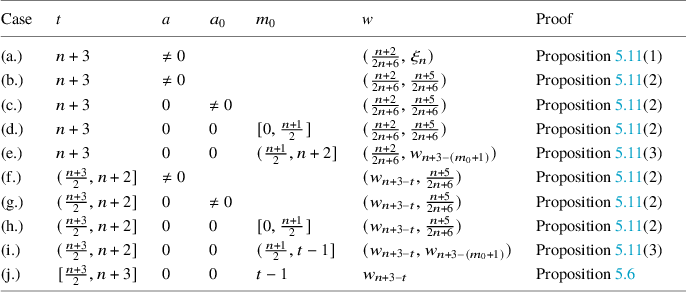
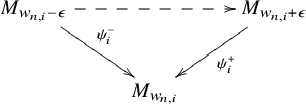

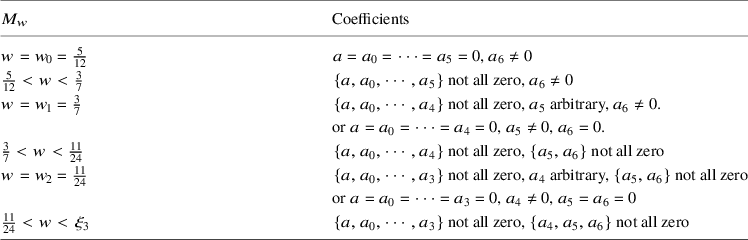


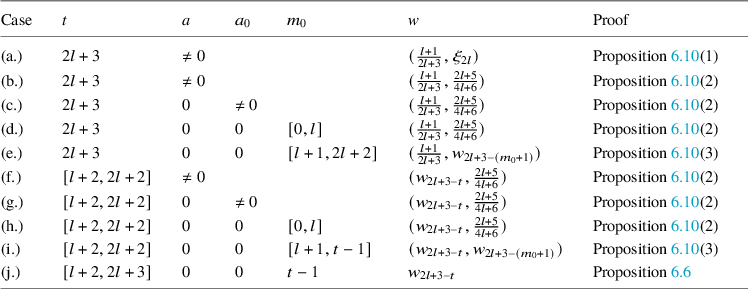
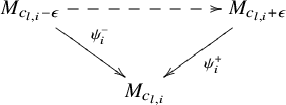

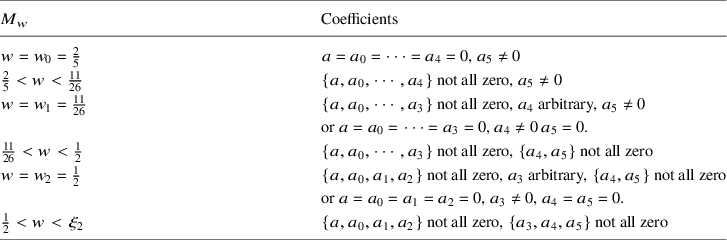


 Open access

