





Background
Obesity is widespread in the western-world population and causes major medical concerns due to its direct link to increased risk of mortality (Flegal et al., Reference Flegal, Graubard, Williamson and Gail2005). In addition to mortality, obesity has been demonstrated to correlate with many medical conditions such as diabetes (Mushcab et al., Reference Mushcab, Kernohan, Wallace, Harper and Martin2017), hypertension, and cardiovascular disease (Flegal et al., Reference Flegal, Carroll, Ogden and Johnson2002). Body mass index (BMI) is a common and effective method to estimate obesity since its components (height and weight) are readily available and easy to measure. The widespread use of BMI enables researchers to compare results in different studies (Flegal et al., Reference Flegal, Kit, Orpana and Graubard2013). Particularly among older population members, very high or very low BMI correlates with higher mortality (Miller and Wolfe, Reference Miller and Wolfe2008) and therefore becomes an indicator that an individual needs to be under close medical observation. Hypertension is the third most influential mortality factor (Ezzati et al., Reference Ezzati, Lopez, Rodgers, Vander Hoorn and Murray2002) and is responsible for at least 45% of deaths due to heart disease and more than 50% of deaths due to stroke (WHO, 2013). Hypertension prevalence rises in the older population, resulting in higher levels of treatment within this group (Ong et al., Reference Ong, Cheung, Man, Lau and Lam2007). Blood pressure measurement is the primary tool for diagnosis, management, treatment, and research of hypertension (O’Brien et al., Reference O’Brien, Asmar, Beilin, Imai, Mancia, Mengden, Myers, Padfield, Palatini, Parati, Pickering, Redon, Staessen, Stergiou and Verdecchia2005).
Self-reported data for height and weight is commonly used, but can lead to underestimating obesity since people tend to report greater heights, and lower weights than actual measurements indicate (Ahima and Lazar, Reference Ahima and Lazar2013; Hattori and Sturm, Reference Hattori and Sturm2013). The credibility of self-reported height and weight can be estimated by the gap between self-reported data and measured data. Self-reporting of blood pressure has also been researched, but the evidence is inconsistent concerning its overall credibility (Goldman et al., Reference Goldman, Lin, Weinstein and Lin2003; Chun et al., Reference Chun, Kim and Min2016). The credibility of self-reported BP can be estimated by the gap between self-reported data and measured data or by comparing patients’ dichotomous (normal\abnormal) self-report of their blood pressure to their actual BP measurement.
As life expectancy keeps rising, and the percentage of elderly, aged 65 and older (Brody et al., Reference Brody, Brock and Williams1987; Kaye et al., Reference Kaye, Baluch and Scott2010), is expected to increase, medical systems will need to treat more and more older patients who require close monitoring and engage in self-management practices (Morgan et al., Reference Morgan, Entwistle, Cribb, Christmas, Owens, Skea and Watt2017). Past studies have shown that the lack of time takes a toll on the ability of physicians to treat their patients (Yarnall et al., Reference Yarnall, Pollak, Østbye, Krause and Michener2003). Self-reporting using digital aids can be another tool in the physician’s arsenal that could help monitor patients (Linderholm et al., Reference Linderholm, Törnvall, Yngman-Uhlin and Hjelm2019; Pereira et al., Reference Pereira, Pedras and Ferreira2019). Self-reporting, while practicing telemedicine, becomes even more essential when patients are encouraged to avoid visiting the clinic as during the COVID-19 pandemic (Hollander and Carr, Reference Hollander and Carr2020). However, this is only useful if self-report credibility can be improved.
The Health Belief Model (HBM) predicts and explains patient decision making related to medical issues (Jones et al., Reference Jones, Jensen, Scherr, Brown, Christy and Weaver2015), for instance, in the context of diabetes (Gillibrand and Stevenson, Reference Gillibrand and Stevenson2006) or breast cancer (Norman and Brain, Reference Norman and Brain2005). The model suggests patients’ decisions correspond to her or his evaluation of the four following factors: perceived benefits, perceived barriers, perceived severity, and perceived susceptibility (Rosenstock, Reference Rosenstock1966, Reference Rosenstock1974).
In general, the model’s ability to predict and explain patterns of behavior has been proven many times (Janz and Becker, Reference Janz and Becker1984). In particular, the HBM model succeeded in predicting medical decision approaches among older population members (Rundall and Wheeler, Reference Rundall and Wheeler1979; Esmaelzadeh et al., Reference Esmaelzadeh, Salehi and Esmaelpour2018) and others (Shafer et al., Reference Shafer, Kaufhold and Luo2018). However, this model was not used to investigate its effectiveness in predicting self-reported health parameters’ credibility.
Our goal in this study is to examine the credibility of self-reported height, weight, and blood pressure by the elderly population living in a retirement residence to a tablet and explore the influence of health beliefs on the self-reporting credibility.
Methods
Population and sample
The study was conducted in a network of three retirement residences. All residents are at least 65 years old. All subjects who volunteered for the study were 70–97 years old, ambulatory, and without any significant cognitive impairment. The residents were invited to participate in the study through advertising inside the retirement residences. The sample size was estimated to be at least 85 participants using Winpepi software (Abramson, Reference Abramson2004), based on 5% significance level and 80% power level and a t-test for correlation between the anthropometric variables and HBM score with a clinical significance of r = 0.30.
Questionnaire
The questionnaire (Appendix 1) was based on questions derived from prior studies that dealt with the relation between HBM and obesity or hypertension (Weissfeld et al., Reference Weissfeld, Kirscht and Brock1990; Desmond et al., Reference Desmond, Price, Roberts and Pituch1992; Park, Reference Park2011; Scotland, Reference Scotland2012). The questions were scored on a 1–5 scale (strongly agree–strongly disagree). The questions were translated and proofread after adaptation to the study population.
The study’s demographic questions included age, gender, education, religious status, hospitalization, and frequency of visiting doctors and nurses in the past year. At the end of the questionnaire, the participants were asked to self-report height, weight, and blood pressure to the best of their knowledge, and to grade their blood pressure as low, normal, or high.
The questionnaire was first executed as a pilot to five participants over the age of 65 years that visited a primary medical clinic. Minor changes to wording resulted.
Data collection
Each study day, residents living in “Bait Balev” retirement residences network were invited to participate in the study. The residents were asked to fill in a digital version of the questionnaire on a tablet. Finally, a team member measured and recorded the participant’s actual parameters. All data were kept anonymous.
Blood pressure measurements were completed according to the Joint National Committee (JNC) recommendations (Chobanian et al., Reference Chobanian, Bakris, Black, Cushman, Green, Izzo, Jones, Materson, Oparil, Wright and Roccella2003). Each participant was measured three times, and the average of the second and third times was recorded. Two of the 90 participants refused to complete the third measurement, and their second measurement was recorded. Systolic blood pressure (SBP) higher than 160 or diastolic blood pressure (DBP) higher than 100 was immediately reported to the medical staff in the retirement residence for further consideration of medical actions.
Data analysis
In the current study, we used three standard adult-elderly population thresholds for systolic blood pressure hypertension (Mancia et al., Reference Mancia, Laurent, Agabiti-Rosei, Ambrosioni, Burnier, Caulfield, Cifkova, Clement, Coca, Dominiczak, Erdine, Fagard, Farsang, Grassi, Haller, Heagerty, Kjeldsen, Kiowski, Mallion, Manolis, Narkiewicz, Nilsson, Olsen, Rahn, Redon, Rodicio, Ruilope, Schmieder, Struijker-Boudier, Van Zwieten, Viigimaa and Zanchetti2009): SBP < 140 – valid for all adult population; SBP > 160 – begin treatment in elderly (>80 yrs); SBP = 140–150 target pressure for elderly (>80 yrs).
Measured and reported BMI were calculated by weight (in kilograms)/height (in meters)2 that were measured or reported, respectively. BMI data were analyzed and broken into categories described as underweight (BMI below 18.5), normal (BMI 18.5–24.9), overweight (BMI 25.0–29.9), and obese (BMI above 30.0). BMI and SBP gaps were defined as the difference between the reported to the measured BMI and SBP, respectively.
Data were presented using descriptive statistics and analyzed by Student t-test and regression model.
All data analyses were completed using SPSS software.
Ethics committee approval
The study was approved by the Bait Balev local ethics committee (IRB) before commencing the trial (BBL-0063-18). A waiver was given for written informed consent from patients as all the questionnaires were fully anonymized.
Results
Between May and August 2018, 90 residents participated in the study. Only two residents that we approached refused to participate. Table 1 shows the demographic and general characteristics of the participants, and Table 2 summarizes the measured and self-reported BMI and BP.
Demographic and general characteristics of participants

a One person who visited the doctor 45 times in the last 90 days was excluded from the sample.
Self-report, actual measurements and gap of height, weight and body mass index
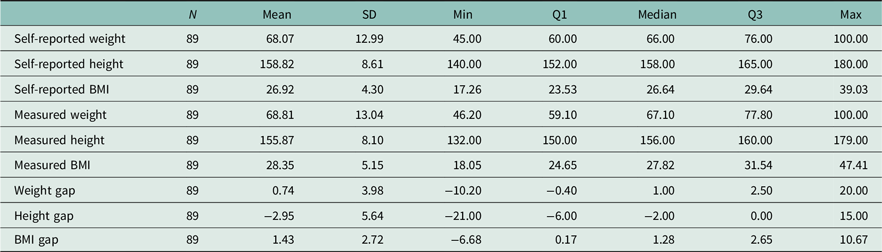
BMI – Body Mass Index.
Self-reported BMI refers to the calculation of the self-reported measurements.
We excluded one self-reported height of a 162 cm woman who said she doesn’t know her height, but because it was mandatory to self-report she wrote she is 115 cm.
The categorized calculated self-reported BMI (underweight 1.14%, normal 34.09%, overweight 44.32%, and obese 20.45%) vs. the measured BMI (1.14%, 28.41%, 31.82%, and 38.63%, respectively) were lower for the obese group and higher for the normal and overweight groups.
Overall, 45.55% of the study participants self-reported their blood pressure while 54.45% did not know their actual blood pressure levels and therefore did not report it. Of those responding, 80.00% of the participants self-reported that their blood pressure was normal, 15.56% self-reported that it was high, none reported low, and 4.44% self-reported they did not know. Self-reported SBP (M = 134.90, SD = 15.70, n = 41) was lower than the measured SBP (M = 150.30, SD = 27.20), which led to a SBP gap (M = 15.88, SD = 27.80). Self-reported DBP (M = 73.30, SD = 8.02, n = 41) was lower than the measured DBP (M = 81.20, SD = 12.90), which led to the DBP gap (M = 7.34, SD = 13.10). Measured and self-reported BP were compared according to the self-reported BP Categories (Table 3).
The relationship between self-reported blood pressure normality to actual blood pressure measurements
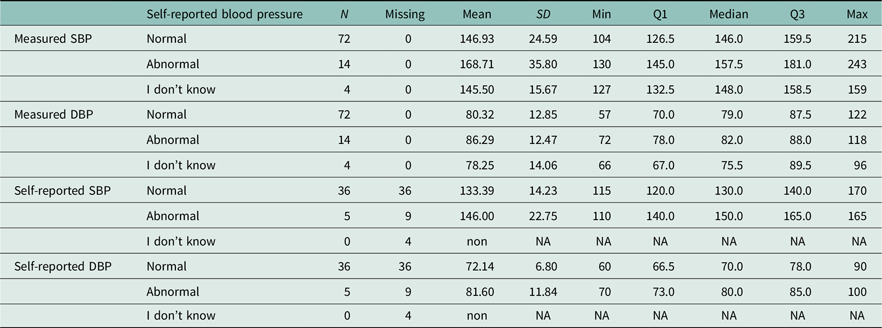
SBM – Systolic Blood Pressure; DBP-Diastolic Blood Pressure.
For participants who reported normal BP (n = 72), a measured SBP of <160 was observed in 56 participants (average BP 137.02/77.46), while 16 participants of this group had an actual high pressure (average BP 181.62/90.31). For participants who reported high pressure (n = 14), a measured SBP of >140 was observed in 11 participants (average BP 178.63/88.64), while only 3 participants of this group had an actual normal BP (average BP 131.13/77.66).
Significant gap comparisons in BMI and SBP were found, and the analysis by different BMI categories is shown in Table 4.
Body mass index and systolic blood pressure gaps explained by different body mass index categories

BMI = Body Mass Index; SBM = Systolic Blood Pressure; DBP = Diastolic Blood Pressure.
Data from the questionnaires were used to calculate HBM scores. Eight of the ten different questionnaire categories had a Cronbach’s Alpha higher than 0.60 (Table 5).
Internal consistency reliability

HBM score
We used a regression analysis to test the correlation between height, weight, and BMI gap and the relationship of these items to gender-adjusted HBM scores. The following results were found:
BMI gap – The results of the regression indicated that the seven variables explained 17.50% of the variance of BMI gap (R 2 = 0.17, F (7,81) = 2.19, p < .05). Perceived severity significantly predicted BMI gap β = −1.32, t(81) = 0.43, p < .001, which indicated when perceived severity increased, the height gap decreased. Gender was also a significant factor affecting the BMI gap, β = 1.67, t(81) = 0.74, p < .05, which indicated that female self-reports had a higher BMI gap than male’s self-reports by 1.67.
Height gap – the results of the regression indicated that the seven variables explained 16.50% of the variance (R 2 = 0.16, F(7,80)= 2.25, p < .05). Perceived severity significantly predicted the height gap, β = 2.71, t(80) = 0.89, p < .01. It indicated when perceived severity increased, the height gap increases.
Weight gap – Perceived Barriers 2 significantly predicted the weight gap, β = −1.53, t(81) = 0.63, p < .05, which indicates when the perceived barriers increases, the weight gap decreased. But the F-statistic was insignificant, which suggests the value of the model is very limited on the weight gap.
In a regression that tested the correlation between BP gap and gender-adjusted HBM score, we determined that perceived susceptibility significantly predicted DBP, β = −6.67, t(34) = 2.95, p < .05, which indicated when the participant perceived susceptibility increased, the DBP gap decreased. Furthermore, we ran a logistic regression and analyzed the self-reported BP status and measured BP status. The results were not significant. The chi-square test may have indicated the self-reported data did not have enough power to infer the measured BP. Since R 2 was relatively low in both cases, even though there were some significant findings, we believe that the HBM score does not explain either the BMI gap or the BP gap. Therefore, generally, we would say that the HBM score was not a good predictor for self-reported data credibility.
Regression analysis was used to test the correlation between height, weight, blood pressure, and BMI gap. The relationships of these items to gender-adjusted HBM score and demographic parameters were not significant.
Discussion
The elderly population is a unique population that requires closer than average monitoring due to their higher incidence of morbidity and mortality (Kennedy et al., Reference Kennedy, Berger, Brunet, Campisi, Cuervo, Epel, Franceschi, Lithgow, Morimoto, Pessin, Rando, Richardson, Schadt, Wyss-Coray and Sierra2014), and BP and BMI measurements can alter the medical approach to this population. Self-reporting of blood pressure and anthropometric parameters can assist triage and simplify a remote approach to the patient. As there is still a lack of data in the literature regarding the elderly population, the current study examined the credibility of self-reporting by the elderly population living in a retirement residence. In the older population, in particular, very high or very low BMI correlates with higher mortality (Miller and Wolfe, Reference Miller and Wolfe2008) and therefore suggests closer monitoring for the patient. From a clinical perspective, the overall BMI gap in the current study (M = 1.43, SD = 2.72), which represents an absolute gap of 0.74 kilograms and 2.95 centimeters, is expected to have only a mild clinical influence, if any, on the physician’s evaluation of the patient’s medical condition. This can allow the physician to estimate their patient’s BMI status before the medical consultation and examination upon the patient self-reporting.
Previous studies showed self-reported heights to be higher and weights to be lower than the actual measurements (Ahima and Lazar, Reference Ahima and Lazar2013; Hattori and Sturm, Reference Hattori and Sturm2013). However, this study shows the anthropometric indices’ credibility to be highest in the normal-weight group (BMI gap: M = −0.02, SD = 2.01), deteriorate through overweight’s (M = 1.52, SD = 1.83) and to be worst in the obese group (M = 2.24, SD = 3.34). Taking into account the actual BMI group levels, these BMI gaps should not make a significant change in the clinical approach to the patient, which makes the height–weight–BMI self-reporting even more credible in the clinical perspective.
Similar to the lower credibility in the BMI self-report, the obese patients were also less credible in BP self-reporting in comparison with the normal-weight group. This could be due to several reasons such as that the individual is not willing to accept their current health risk, society’s general view of obesity, and the pressure that puts on an individual to conform to an `acceptable’ archetype or the individual’s body image as healthy or not. Further studies are needed to address these questions.
In this study, there was a high yield between the participants’ definition of normal vs. high blood pressure and their self-report of blood pressure values (133.38/72.13 vs. 146.00/81.60, respectively).
Target blood pressure for the oldest-old people, aged 85 and older (Rosenwaike, Reference Rosenwaike1985; Rogers, Reference Rogers1999), has long been debated, and inconsistencies regarding the optimal BP for this population exist in different guidelines since there is a lack of clear evidence regarding this issue (Garrison et al., Reference Garrison, Kolber, Korownyk, McCracken, Heran and Allan2017; Anker et al., Reference Anker, Santos-Eggimann, Santschi, Del Giovane, Wolfson, Streit, Rodondi and Chiolero2018). Patients’ dichotomous (normal\abnormal) self-report of their blood pressure condition was relatively credible: positive predictive value of 77.78% for normal BP (SBP < 160) and 78.57% for abnormal BP (SBP > 140). These relatively high PPVs could help physicians identify patients at risk through self-report outside of the medical encounter, e.g., if a patient claims a normal BP, it would be reasonable to assume there is no need for a change in hypertension treatment; while for those who claim a high BP, it warrants a close follow up and BP measurements. Nevertheless, as the PPV is not as accurate as a real measurement, we find this method relevant for monitoring patients from afar, but not as a replacement for actual measurement during the medical encounter.
The HBM was not used previously to investigate its effectiveness in predicting self-reported health parameters’ credibility. In the current study, we also concluded HBM score was not a sufficient predictor for self-report credibility. More research remains to determine if there is better predictability of self-report in other HBM subtypes.
Conclusions
The gap between measured and self-reported BMI has only a mild influence regarding the evaluation of a patient’s metabolic status. Therefore, we recommend considering the use of self-reporting weight and height using a tablet among the elderly population when direct measurements cannot be taken. COVID-19 pandemic emphasizes the need for the physician to monitor his patients from afar due to the current need to minimize physical encounters. Self-reporting has the potential to be an essential tool in the physician’s toolbox while practicing telemedicine. The relatively high PPV of BP self-reporting demonstrates an option for the physician to recognize patients at risk. Further studies could identify the most credible subjects in this area.
Limitations
Membership bias could be present because the population who lives in the retirement residence were generally of higher socioeconomic levels than the general population. Another potential bias is volunteering bias because participation was not mandatory; hence participants might be more aware of their medical condition and might possess better than average medical knowledge. However, in the current study, refusal to participate was negligible. Finally, the use of self-reporting to a tablet was also a potential limitation, especially in the elderly population. However, this issue was shown not to be a significant limitation, as the questionnaire was very intuitive and user friendly. Help was given to few participants who required specific instructions on how to use the tablet.
Acknowledgments
This work was performed in partial fulfillment of the MD thesis requirements of the Sackler Faculty of Medicine, Tel Aviv University.
Authors’ Contribution
All authors have made a substantial, direct, intellectual contribution to this study.
Appendix A


 Open access

