


1. Introduction
Today's companies are navigating a volatile, uncertain, complex, and ambiguous (VUCA) environment. Markets are dynamic and subject to rapid fluctuations, with external economic factors—such as political instability and supply chain disruptions—compounding unpredictability. Product development processes have grown increasingly complex, making it difficult to trace root causes when issues arise. Compounding these challenges, companies face high employee turnover and a persistent shortage of skilled professionals, especially in Germany and Europe. A 2022 McKinsey study reports that 40% of surveyed individuals worldwide are open to leaving their current employers within 3-6 months, underscoring the risk of disruptive talent loss (Reference Smet, De, Dowling, Hancock and SchaningerSmet et al., 2022).
To address these challenges, many companies across diverse sectors have adopted agile project management (APM) methodologies, initially developed for software development, to enhance adaptability and resilience (Reference CooperCooper, 2011). APM is iterative, flexible and has proven effective in software contexts, enabling teams to respond to change swiftly and maintain productivity. However, adapting agile principles to physical product development introduces unique complexities. Unlike software, physical product development involves managing tangible elements, such as physical prototypes, manufacturing processes, and cross-functional coordination, requiring adjustments to traditional agile methods to account for these distinct characteristics (Reference Atzberger and PaetzoldAtzberger & Paetzold, 2019).
Manufacturing companies often lack comprehensive guidelines to support agile integration, including decision-making tools to assess the suitability of APM, evaluation of potential benefits and anticipating implementation challenges. Nevertheless, some enterprises have successfully incorporated agile practices into routine operations, while others remain in experimental stages, testing agile applications across various project types (Reference Atzberger, Nicklas, Schrof and WeissAtzberger et al., 2020). These promising cases highlight the potential of APM to improve outcomes, though widespread adoption in physical product development is still emerging.
This paper investigates the methodological adaptations made during the introduction of agile methodologies in physical product development projects, the value they provide, and the primary challenges faced in this transition. The following research questions will guide our exploration:
1. RQ 1: What does it take to successfully implement agile project management in physical product development?
2. RQ 2: What value does the integration of agile methodologies add to physical product development?
3. RQ 3: What challenges are still encountered in implementing agile methodologies for physical product development?
2. State of the art
Agile project management, established with the Agile Manifesto in 2001, emphasizes collaboration, adaptability, and iterative processes over rigid governance (Reference BeckBeck, 2001). Originally designed for software development, agile promotes flexibility, user involvement, and prioritization of evolving requirements. Its widespread adoption is attributed to benefits like shorter development cycles, improved productivity, customer satisfaction, and higher product quality (Reference Boehm and TurnerBoehm & Turner, 2003). Studies confirm a strong correlation between agile implementation and project success, leading to its expansion into other industries, including hardware development (Reference Serrador and PintoSerrador & Pinto, 2015).
However, implementing agile in hardware projects introduces unique challenges. Prototyping complexities, task segmentation, external dependencies, and rigid corporate cultures or structures often hinder success. Training and mindset shifts are critical, requiring teams to embrace new ways of working and management to provide support. Common challenges fall into four categories: physical constraints, mindset, scaling, and team distribution (Reference Ovesen and DowlenOvesen & Dowlen, 2012). Subsequent studies, including Atzberger & Paetzold (Reference Atzberger and Paetzold2019) and (Reference Muller, Pendzik, Schock, Albers and Paetzold-ByhainMuller et al., 2024) have explored these challenges in depth, highlighting the need for tailored frameworks and context-specific adaptations to realize the full potential of APM in hardware development. Both studies collectively emphasize that while agile project management has proven benefits, its implementation, particularly in hardware development, remains challenging due to physical constraints, organizational inertia, cultural resistance, and a lack of tailored frameworks. Sustainable success requires an evolved mindset, adequate managerial support, and context-specific adaptations supported by academic research and expert guidance (Reference Atzberger and PaetzoldAtzberger & Paetzold, 2019; Muller et al., 2024).
Change management plays a pivotal role in overcoming these barriers, offering structured frameworks to navigate transformations. It addresses resistance, reshapes corporate culture, and aligns processes with agile principles, ensuring smoother adoption and long-term success. Following a structured approach is particularly important to implement organizational transformation with minimal disruption (Reference Bader, Antony, Jayaraman, Swarnakar, Goonetilleke, Maalouf, Garza-Reyes and LindermanBader et al., 2024). Success in such transformation efforts depends on addressing both soft factors, such as culture, leadership, and motivation, and hard factors, including project duration, performance integrity, and management commitment (Reference Bader, Antony, Jayaraman, Swarnakar, Goonetilleke, Maalouf, Garza-Reyes and LindermanBader et al., 2024; Reference Harold, Sirkin and AlanHarold L. Sirkin et al., 2005; Reference Lameijer, Antony, Chakraborty, Does and Garza-ReyesLameijer et al., 2021). Utilizing systematic change management methodologies, such as Lewin’s three-stage model (Reference LewinLewin, 1951) or the McKinsey 7-S Model (Reference GalliGalli, 2018), is essential for integrating these success factors into a cohesive process that ensures sustainable change.
Before embarking on any change, even with a change management methodology in place, an assessment of the suitability of the APM is critical. Several factors can determine whether agile project management is the most suitable approach for a given context. (Reference Dybå and DingsøyrDybå & Dingsøyr, 2008) identify key internal and external context factors that differentiate agile methodologies from conventional development approaches. Agile methodologies excel in environments with small development teams that prioritize continuous design improvement, iterative testing, and adaptability to rapid feedback and change.
Tools such as the Hybrid Model Radar (Reference Cocchi, Dosi and VignoliCocchi et al., 2023) and the Agile Practice Guide (PMI, 2017) provide practical frameworks for evaluating when to implement agile versus plan-driven approaches. These tools help managers assess project characteristics, including complexity, level of innovation, and uncertainty, to determine the most effective project management strategy.
3. Study design
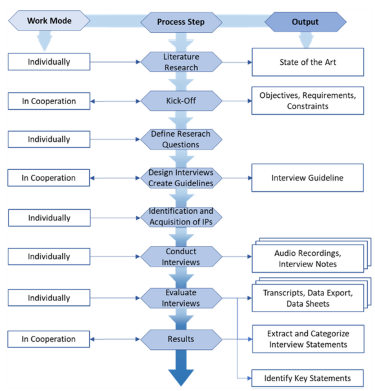
The study was a collaborative effort between the University of Rostock and the University of Berlin, designed to address the aforementioned research questions. Figure 1 illustrates the process steps undertaken during the study, detailing which tasks were performed individually, collaboratively, or with mutual exchange. To thoroughly investigate the subject, the research methodology began with a preliminary literature review to identify and define the problem landscape. This step was the basis for developing the interview guide and helped refine the focus areas for empirical exploration. Following this initial familiarization phase, a collaborative exchange between Rostock and Berlin was conducted to establish consensus on objectives, requirements, and constraints. Subsequently, the research questions and interview guidelines were developed and aligned. The interviews were conducted and analyzed individually. While the majority were held via video conference, four interviews were conducted in person. Each interview lasted approximately one hour on average.
Process steps of the study

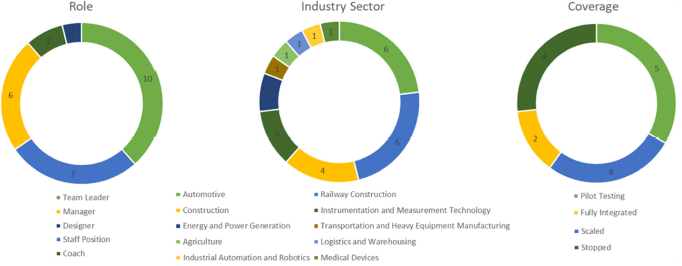
A series of 26 semi-structured interviews was conducted with professionals from diverse positions, company sizes, and industries to gain insights into real-world applications of agile practices in physical product development. The diversity of interview partners (IP) ensured a comprehensive understanding of the topic, allowing the study to capture a broad spectrum of perspectives on agile methodology adaptations (Figure 2).
Interviewees (N=26)

The interview was divided into three main sections: (1) introduction and contextualization, which helped to position the interviewee within the scope of the study. (2) application of agile methods, where questions focused on the interviewee’s direct experiences with agile methodologies, exploring specific adaptations made within the context of physical product development and (3) reflection on agile process implementation, where interviewees were encouraged to reflect on the successes, challenges, and overall impact of introducing agile methodologies within their organizations. To analyse the interview data, the study employed the qualitative content analysis method outlined by Mayring & Fenzl (Reference Mayring and Fenzl2019), which allowed for a systematic, structured examination of the transcripts.
4. Findings
4.1. Favourable conditions and adaptations for agility in product development
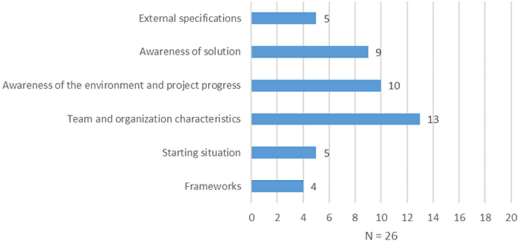
Certain conditions make agile approaches especially advantageous for product development, as highlighted by the interviews (Figure 3). Projects that involve complex or unpredictable problem-solving scenarios, where many initial conditions or the optimal solution path are unknown, benefit significantly from agile methods. For instance, frameworks like the Cynefin Framework and the Stacey Matrix categorize projects into “simple,” “complicated,” “complex,” and “chaotic” types. “Agile approaches are particularly effective in complex environments where external conditions are dynamic and evolving” (IP 2), as they help teams manage uncertainty and stay resilient in the face of change. Additionally, “the introduction of agile methods is often successful when teams already experience dissatisfaction with current processes or a lack of transparency” (IP 5), as this fosters openness to new and unconventional changes.
Other key factors supporting agile methodologies include team and organizational characteristics. In research and development environments, collocated and cross-functional teams, as well as teams with established ownership, self-organization, and high motivation, find agile approaches especially beneficial. Furthermore, “the presence of managerial trust and autonomy”—along with visible support from leadership—“strengthens team adoption of agile practices” (IP 8). Agile methods are also effective in exploring new markets or development initiatives, particularly when multiple interdisciplinary stakeholders are involved, or when ongoing shifts in customer requirements are expected throughout the project (IP 10, IP 11).
Agile methods, however, are less suited to projects where “the solution path is fully known from the start or where the product can be developed through modular assembly” (IP 14). In these cases, traditional methodologies may be more effective. Moreover, projects that involve strict regulatory requirements or require highly reliable outputs, such as safety-critical components, may face constraints that limit the applicability of agile approaches (IP 3). High levels of external dependencies, safety demands, and technological complexity further impact whether agile approaches are feasible. In particular, “projects with high strategic importance to a company are often prioritized for agile application due to the adaptability and responsiveness they offer” (IP 7).
Adapting agile methodologies to the context of physical product development often requires modifications to both team practices and broader organizational structures. Agile frameworks emphasize team transparency, open communication, and specific roles with defined responsibilities. However, these elements can conflict with traditional organizational structures and established team mindsets, leading companies to adjust the methodology itself rather than pursuing deeper organizational changes. For example, some companies adopt agile in pilot projects or specific development areas, while others reframe their entire development departments around agile principles. In such cases, all roles are redefined, and sprint timelines are synchronized across teams (IP 9).
The Shu-Ha-Ri principle—advocating for fully understanding and implementing an agile method before modifying it—is recommended to avoid changes that are based solely on convenience (IP 3, IP 9). “When teams themselves choose techniques they find valuable, such as through workshops, they are more likely to make effective adaptations that maximize the benefits of APM” (IP 12).
Agile tools are also adjusted to meet project-specific needs. For instance, as task complexity increases, Kanban boards can become overly cluttered; many companies then switch to list formats for better clarity. In Scrum, modifications often involve adapting sprint lengths, altering roles, or even combining Scrum with Kanban in “Scrumban” for operational compatibility (IP 15). As one of the interview partners stated: “we work according to agile principles and take a kind of Scrumban approach, but we still have to manage our operational business somehow” (IP 3). The frequency of stand-up meetings is sometimes tailored, with irregular intervals if needed (IP 11, IP 13). Additionally, projects that are constrained by regulatory requirements or customer demands for structured milestones require adjustments to standard agile practices.
Broader organizational changes further enable agility. In companies transitioning entirely to agile, physical workspace transformations—such as creating communal spaces to encourage collaboration and eliminating individual offices—have been implemented. Reducing hierarchical layers is another common adaptation, empowering employees to make their own decisions and fostering a culture more supportive of agile methodologies. Interview partners stated that they had “a flat hierarchy” (IP 1), because when “people think less hierarchically, people can develop better regardless of the function they are in, simply because there is someone there to support them more, and the product owners can really focus on technical management.” (IP 14). These organizational and methodological adjustments enable agile to thrive even in the traditionally structured landscape of physical product development.
Favourable conditions and required adaptations of agile project management

4.2. Benefits
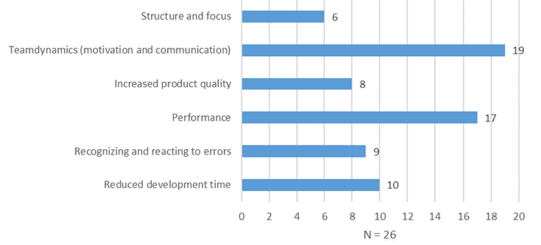
Agile methodologies offer substantial value to organizations by enhancing both development processes and team dynamics (Figure 4). According to interviews with companies that adopted agile approaches, agile methods can reduce development time, improve resilience, and decrease error rates. Many companies reported significant time savings, particularly in the early stages of development, and some noted that agile enabled faster identification and escalation of issues, leading to more resilient and lower-risk processes. Interview partners reported that “what improved significantly was basically the development time. The time-to-market has been reduced by more than a third” (IP 9) and that “our development time has been reduced by up to 50%, which has given us a significant competitive advantage” (IP 22).
Beyond accelerating timelines, agile methods contribute to team productivity and cost savings. Empowering team members to take ownership of their tasks and encouraging iterative cycles in small teams improves productivity and reduces non-conformity costs by identifying issues early in development. Agile approaches also enhance expertise within teams, foster customer focus, and promote stronger client relationships. One of the interview partners reported that they “are very close to the customer in the projects and can get feedback on our initial ideas much more quickly” (IP 16). This efficiency helps teams iterate more quickly and deliver useful interim results, which can increase a company's competitive edge and economic sustainability (IP 3). Focussing on user-centered design ensures that teams not only meet but better understand customer needs, which ultimately results in higher-quality products that align more closely with user expectations.
The potential of APM also lies in fostering a collaborative and motivating work environment. “The most positive thing is the way we deal with each other” (IP 10). All interviewees observed increases in employee motivation, driven by shared responsibility (IP 13), variety in tasks and stronger team cohesion. “Collaboration in the teams has improved a lot, as everyone takes on more responsibility and decisions are made more quickly.” (IP 15) “When I have people who really take ownership and want to make decisions themselves and don't just look at their function, those are the projects that really run much better, simply because it's a unified team that really works together” (IP 14). Agile frameworks also support regular feedback and visibility through retrospectives, which management can use to address dips in motivation proactively. Additionally, the shift from traditional hierarchical structures to supportive leadership styles has fostered a sense of trust and openness, with leaders viewed more as collaborators than superiors (IP 9).
The emphasis on communication and routine meetings provides much-needed structure, especially beneficial for team members who may struggle with organization. This structure boosts team morale and helps new employees integrate smoothly. For projects with high innovation requirements or complex product needs, agile approaches are particularly valuable, as they allow teams to handle and adapt to evolving requirements more effectively than traditional methods. Agile also enhances product quality by enabling teams to conduct additional iterations, integrate feedback, and ensure the product evolves to meet both client and regulatory demands, despite some challenges with rigid regulatory frameworks (IP 12).
Thus, the potential of agile methodologies lies not only in speeding up development but in creating a more resilient, motivated, and customer-focused work environment that can consistently deliver high-quality results and adapt flexibly to changing needs.
Value of agile project management

4.3. Challenges
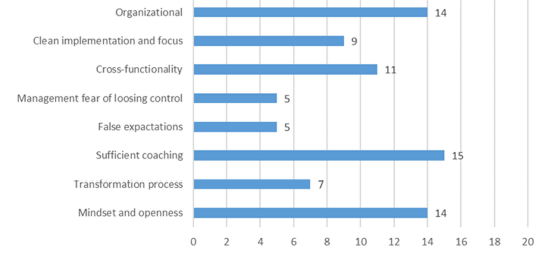
Agile product development offers numerous benefits, but implementing it comes with substantial challenges that organizations must navigate carefully (Figure 5). One major hurdle is the shift in team dynamics and mindset. Agile methods favour transparent and collaborative environments, often requiring team members to leave their comfort zones and assume greater personal accountability. An example was given by one of the interview partners where “extroverted people probably get on better with this way of working together than someone who is very introverted, has problems talking in a group and then has to say—'sorry about the card, I haven't moved it any further because I haven't managed to solve the task in the time I've had so far'— That can be a problem for some people. [...] You have to create a space in which they feel safe.” (IP 1). Introverted individuals may find agile practices like frequent stand-up meetings and open feedback sessions particularly challenging, as these practices are often better suited to more extroverted personalities. For many, especially those accustomed to well-defined roles and hierarchical structures, this adjustment was also difficult: “Of course, that was a huge problem for those affected. The fact that certain status symbols were taken away, I think a lot of things developed from a hierarchy of power to a hierarchy of competence, so it was no longer just that you had something to say because you were sitting two levels higher, but suddenly there were somehow several people at a hierarchy level and for many people who were then really able to do something, I'll say, a hierarchy of competence arose quite quickly because they were simply in demand as experts.” (IP 3) Furthermore, the transition to agile methods can meet resistance, as some team members may be sceptical due to past experiences with agile methodologies that may not have yielded positive results (IP 4).
Another challenge lies in maintaining focus and discipline over time. Agile processes require sustained motivation and consistency, which can diminish as initial enthusiasm fades, as one of the interview partners stated: “It was difficult to maintain [motivation]. At the beginning of a project everyone was still motivated and met in the morning to discuss things. But over time it all crumbled. Then the discipline was gone […] and we often found that we then threw all these things overboard again and went back to working in the traditional way” (IP 7). Additionally, teams often struggle to balance agile project demands with day-to-day operational responsibilities (IP 3). This can result in team members being spread thin, making it difficult to commit fully to agile practices, which rely on dedicated focus to maximize productivity and innovation.
Cross-functional collaboration, a cornerstone of agile development, also presents difficulties. “This cross-functionality meant that all the different specialist perspectives immediately looked at topics. In other words, you actually always had a direct controversial discussion from different perspectives, which was very exhausting at the beginning, where we also needed a lot of facilitation from our coach, because friction arose. But it quickly became clear that this friction was extremely helpful because we were able to quickly identify and kill bad ideas” (IP 3). Bringing together specialists from different domains can lead to friction, as diverse professional backgrounds and approaches collide. Coordinating across functional boundaries can be cumbersome, especially in complex systems, potentially slowing down the pace of work (IP 18).
Management faces its own set of challenges in the agile environment. Agile emphasizes trust and autonomy, requiring managers to relinquish some control and empower teams to make their own decisions. This shift can be unsettling for leaders who are accustomed to more directive roles and it may lead to concerns about a loss of oversight (IP 12). “That's quite problematic because the strategy changes often came about because a higher management level felt that they didn't have control over a project. And as a result, they increased control again by really micromanaging or imposing stricter guidelines, which were then perceived as a change in strategy” (IP 15).
Finally, agile transformation is a lengthy process that requires time, resources, and commitment. Teams need training to adapt to agile principles effectively, often taking months or even years to feel fully proficient (IP 10, IP 15). Misalignment in expectations between management and development teams further complicates this journey, as there is sometimes an unrealistic belief that agile methods alone can solve all organizational challenges (IP 3). To address these obstacles, organizations must invest in targeted coaching, foster a strong agile mindset, and engage in realistic expectation-setting, thus ensuring a smoother transition to agile and maximizing its potential benefits (IP 10).
Challenges along with implementing agile project management

4.4. Agile suitability
Based on the statements made in the interviews, the companies were classified according to the Agile Suitability Tool (PMI, 2017), as it is shown in Figure 6. The diagram highlights the suitability of projects as reported by the interviewees, revealing a significant correlation: unsuccessful projects, or those where companies abandoned their agile transformations, often aligned with assessments from the suitability tool indicating that APM was not appropriate.
From the overview on the left-hand side, two key data sets were extracted. One represents a successful company (IP 13) that reported highly positive outcomes from implementing agile practices. The diagram offers insight into the factors behind this success: although the project itself was classified as highly critical, the organization's culture, team dynamics, and project conditions provided a strong foundation for agile work.
In contrast, another company abandoned its agile transformation at an early stage due to unfavorable initial conditions regarding culture, team, and project suitability (IP 18). Projects in this company were characterized by high product complexity, a large number of involved disciplines and stringent safety requirements. This example underscores the importance of conducting an agile suitability assessment beforehand. Such an assessment could provide valuable foresight, helping organizations or project managers identify whether a project is likely to fail if executed using agile methodologies.
Classification of the interviews with the Agile Suitability Tool

5. Summary and discussion
Agile methodologies, originally developed for software development, have been increasingly adapted for physical product development. However, this transition necessitates substantial methodological and organizational adjustments. Physical product development presents unique challenges, such as regulatory compliance, dependencies on external suppliers, and intricate manufacturing requirements—issues less common in software contexts. To address these challenges, companies often customize agile frameworks to better suit their needs.
In this study, interview participants revealed that sprint lengths were extended, even though prior research suggests that two-week iterations pose no significant hurdles (Reference Schmidt, Atzberger, Gerling, Schrof, Weiss and PaetzoldSchmidt et al., 2019). Other modifications include synchronizing sprint timelines across teams, redefining team roles, and incorporating structured milestone reviews to meet regulatory or customer-specific demands. The Shu-Ha-Ri principle emphasizes the importance of mastering agile methodologies before making context-specific adaptations. Teams also tailor tools like Kanban boards or combine frameworks such as Scrum and Kanban (Scrumban) to manage complex tasks. Beyond methodological changes, organizations often implement broader transformations, such as reducing hierarchical layers or fostering collaborative work environments. These adaptations demonstrate that successful agile adoption in physical product development requires a comprehensive reshaping of both methodologies and organizational structures.
Agile practices offer considerable advantages in physical product development by boosting flexibility, efficiency, and team dynamics. The findings confirm that Agile Project Management (APM) is especially effective in projects characterized by uncertainty, evolving customer requirements, or interdisciplinary collaboration, aligning with previous studies (e.g. Rigby et al. Reference Rigby, Sutherland and Takeuchi2016). shorten development timelines by enabling faster problem identification, iterative cycles, and the ability to pivot swiftly in response to change. These capabilities improve a company's competitive position, enabling quicker delivery of innovative products to market. Rigby et al., (Reference Rigby, Sutherland and Noble2018) and Sommer (Reference Sommer2019) also demonstrate that APM enhances team productivity and reduces time-to-market.
Additionally, agile practices lower costs and error rates. Iterative testing and user-centered design approaches ensure early issue identification and precise alignment with customer needs. Beyond operational improvements, agile methodologies foster collaborative cultures and increase customer satisfaction. Teams operating under agile frameworks report stronger cohesion, greater ownership, and a sharper focus on delivering value, making agile an effective strategy for driving both technical and organizational success.
Despite its benefits, implementing agile methodologies in physical product development introduces significant challenges. The shift to APM demands fundamental changes in team dynamics, emphasizing transparency, collaboration, and self-organization. As noted by Gustavsson (Reference Gustavsson2016) and Sommer (Reference Sommer2019), this shift requires a transformed mindset and a departure from traditional working methods. Resistance to change is common, particularly among employees accustomed to hierarchical structures or those who have experienced failed agile initiatives.
Establishing cross-functional collaboration, a cornerstone of agile, often encounters friction due to differing professional priorities and approaches. Management also faces the challenge of relinquishing control and fostering trust—both critical for agile success. Over time, sustaining focus and motivation can become problematic as initial enthusiasm diminishes. Additionally, adopting agile practices requires significant investments in training and adaptation, which can strain organizational resources. Misaligned expectations between management and teams further complicate the transition, underscoring the need for strategic alignment and sustained commitment.
Despite the inherent uncertainties, there are tools available to aid in predicting project outcomes. The Agile Suitability Tool (PMI, 2017), for instance, provides a structured approach to evaluate whether the conditions of a project are conducive to agile working methods. As illustrated in Figure 6, this tool not only explains and visualizes the reasons behind project success or failure in retrospect but also highlights critical influencing factors. These factors, when assessed proactively, can serve as valuable indicators and increase the likelihood of project success, enabling organizations to avoid potential pitfalls in advance.
Additionally, change management offers effective strategies for addressing the above named challenges. Assessing the conditions and influencing factors before initializing a transformation is an essential part in change management strategies. Further, tackling resistance, providing targeted training, and fostering sustained motivation, play a critical role in change management methodologies that would facilitate smooth transitions to agile practices (Reference Errida and LotfiErrida & Lotfi, 2021; Reference GalliGalli, 2018). However, none of the interview participants reported the application of structured change management strategies or methods during their agile transitions. This gap highlights an important avenue for future research: exploring how integrating change management principles can improve the success rate of agile implementation in physical product development.


 Open access

