





Motion events constitute a considerable part of everyday human life. A motion event can be described as a “situation that involves displacement of an object in relation to a reference point” (Bylund, Reference Bylund and Pavlenko2011, p.109). Although motion events share universal structures (e.g., figure: who performs the action, ground: where the action takes place, path: the trajectory of motion, and manner: how the action takes place), languages vary greatly in how they represent and construe information regarding motion event components (Berman & Slobin, Reference Berman and Slobin1994; Naigles et al., Reference Naigles, Eisenberg, Kako, Highter and McGraw1998; Özçalışkan & Slobin Reference Özçalışkan and Slobin1999; Slobin, Reference Slobin1991, Reference Slobin, Strömqvist and Verhoeven2004). In other words, how semantic elements (i.e., figure, ground, path, and manner) are encoded on surface elements (e.g., prepositions and verbs) differ across languages. According to Talmy (Reference Talmy1991, Reference Talmy2000), languages can be divided into two main typological groups depending on how they lexicalize motion: verb-framed (V-framed) and satellite-framed (S-framed) languages. This typology depends on where the path, the core aspect of a motion event, is encoded. For a given language, if a path is encoded dominantly in the main verb, that language is described as a verb-framed language, whereas if the path information is mostly encoded in a satellite (e.g., preposition), then that language is categorized as a satellite-framed language. Turkish is a verb-framed language that encodes the path of motion mostly in the main verb (e.g., boy exited running, “çocuk koşarak çıktı”). Therefore, Turkish is also regarded as a path-focused language. In contrast, English is a satellite-framed language that conflates the path of motion mostly in a preposition and is regarded as a manner-focused language (e.g., the boy ran out). It is worth noting that within this typological framework, path-focused language speakers can encode manner in the main verb and speakers of manner-focused languages can encode path in the main verb. The difference between these languages lies in the frequency of those instances rather than the possibility of encoding a certain component. This typological dichotomy influences how adult speakers of different languages describe motion events (e.g., Akhavan et al., Reference Akhavan, Nozari and Göksun2017; Bunger et al., Reference Bunger, Papafragou and Trueswell2013; Bunger et al., Reference Bunger, Skordos, Trueswell and Papafragou2016; Özçalışkan & Slobin, Reference Özçalışkan and Slobin1999, Reference Özçalışkan, Slobin, Özsoy, Akar, Nakipoğlu-Demiralp, Taylan and Aksu-Koç2003). The effects are also observed in children (Allen et al., Reference Allen, Özyürek, Kita, Brown, Furman, Ishizuka and Fujii2007; Özyürek et al., Reference Özyürek, Kita, Allen, Brown, Furman and Ishizuka2008; Papafragou et al., Reference Papafragou, Massey and Gleitman2006; Slobin, Reference Slobin, Gentner and Goldin-Meadow2003, Reference Slobin, Strömqvist and Verhoeven2004) as well as bilingual populations (Aktan-Erciyes, Göksun, Tekcan & Aksu-Koç, Reference Aktan-Erciyes, Göksun, Tekcan and Aksu-Koç2021; Brown & Gullberg, Reference Brown and Gullberg2008; Reference Brown and Gullberg2011, Reference Brown and Gullberg2013; Lewandowski & Özçalışkan, Reference Lewandowski and Özçalışkan2021).
Although languages vary in how they emphasize path or manner components during lexicalization due to language typology (e.g., Özçalışkan & Slobin, Reference Özçalışkan, Slobin, Özsoy, Akar, Nakipoğlu-Demiralp, Taylan and Aksu-Koç2003; Slobin, Reference Slobin, Gumperz and Levinson1996, Reference Slobin, Hickman and Robert2006, among others), other factors might influence the lexicalization process as well. We suggest that salience and the ease of expression (henceforth EoE) of path and manner components of a motion event might also have an impact on how speakers lexicalize these events. Salience of path/manner component refers to how prominent a component is. EoE is the degree of ease or effort of lexicalizing that component, in other words it is how easy an individual is able to express the related component in speech. When we ask an individual how salient a path or a manner is, the decision is most probably based first on perceptual properties that are more related to conceptual processing than linguistic processing. Therefore, we suggest that the salience of a path or manner taps more into perceptual processing of events; however, it is not independent of lexicalization, which is also related to linguistic processing. On the other hand, EoE can be more related to linguistic processing. Given the difficulty of disentangling language and conceptual processing in both cases, we argue that salience and EoE both play roles in lexicalization of motion events. In the present study, we first investigated how path and manner components differ in salience and EoE in Turkish (a path-focused language) and how these relate to the number and different types of path and manner expressions produced in a linguistic evaluation task. Types of path and manner expressions provide an indication of the richness of the available lexicon and the degree of consensus between the speakers. In particular, the use of different types for path or manner indicates the richness of the available lexicon, and a lower number of types might indicate a higher consensus on a specific event. On the other hand, tokens indicate how many lexical structures are used to express path and manner components. Higher numbers indicate the inability to encode components economically, and lower numbers indicate the opposite. Overall, types indicate quality, whereas the number of tokens indicates quantity. After investigating the salience and EoE difference in relation to types and tokens, we examined how differences in manner and path salience and EoE across events are reflected in the nonlinguistic evaluation of events.
Effects of salience and ease of expression of semantic elements on surface elements in motion events
Differences in the lexicalization of path (i.e., using the main verb for a path or not) across languages have consequences on the frequency of path or manner use for a given event. The main verb is the obligatory core of an event. In manner-focused languages, the path is mostly encoded outside the main verb, which leaves verbs to convey manner (Slobin, Reference Slobin, Niemeier and Dirven2000) (e.g., the girl ran out). However, path-focused languages express path mainly in the main verb, and to express manner, speakers mostly use subordinate constructions or adverbs (e.g., “kız koşarak çıktı,” the girl exited running-ly). This constitutes an additional processing load for the speakers of path-focused languages, which might result in expressing manner less often (Slobin, Reference Slobin, Strömqvist and Verhoeven2004).
One important issue about path of motion is the difference in lexicalization of boundary-crossing and trajectory paths (Özçalışkan, Reference Özçalışkan2015). For instance, for boundary-crossing paths such as into or out of, speakers of path-focused languages tend to encode path information in the main verb (e.g., enter/exit) while they express manner optionally with a subordinate verb (e.g., skippingly). However, for trajectory paths such as towards, speakers of path-focused languages might be more likely to encode manner in the main verb (e.g., skip and jump) and path as a satellite (e.g., across the street).
Research with adults suggests that manner-focused language speakers encode manners more extensively compared to path-focused language speakers (Gennari et al., Reference Gennari, Sloman, Malt and Fitch2002; Naigles et al., Reference Naigles, Eisenberg, Kako, Highter and McGraw1998; Oh, Reference Oh2003; Özçalışkan & Slobin, Reference Özçalışkan, Slobin, Özsoy, Akar, Nakipoğlu-Demiralp, Taylan and Aksu-Koç2003; Papafragou et al., Reference Papafragou, Massey and Gleitman2002). This has further been supported by novels written in manner-focused languages emphasizing details of the manner of the movements more often compared to written texts in path-focused languages (Özçalışkan & Slobin, Reference Özçalışkan and Slobin1999). In manner-focused languages, manner is suggested to be backgrounded; in other words, it is often encoded in motion event descriptions. In path-focused languages, however, manner is encoded only if it is foregrounded, where manner needs to be mentioned. When manner verbs are used in path-focused languages, they convey more communicative weight compared to when they are used in manner-focused languages (Özçalışkan & Slobin, Reference Özçalışkan and Slobin1999).
How does EoE and salience of each component associate with motion event conceptualization? For instance, expression of manner is harder in path-focused languages as speakers mostly have to use adjuncts to express it (e.g., “kız koşarak çıktı” the girl exited running-ly, manner running-ly is expressed in an adverbial clause in Turkish). The manner salience hypothesis (Slobin, Reference Slobin, Strömqvist and Verhoeven2004, Reference Slobin, Hickman and Robert2006) suggests that in high manner salient languages, speakers are capable of encoding rich information about manner. Therefore, larger manner verb lexicons emerge in manner-focused languages. Verkerk (Reference Verkerk2015) investigated this claim with 20 Indo-European languages and confirmed the relation between the use of satellite-framed constructions (as in manner-focused languages) and the size of the manner verb lexicon. Overall, findings indicate that in path-focused languages, it is easier to express path compared to manner, since path is readily and easily encoded in the main verb. As the main verb is the obligatory structure, EoE occurs for whatever information is encoded in the main verb. Additionally, when manner is expressed in a path-focused language, it has more communicative weight, implying that manner is salient enough to be expressed. These indicate that while the available number of alternatives for path and manner lexicons in a given language will have a direct effect on how these elements are lexicalized, EoE and the salience of event components also contribute to motion event conceptualization and lexicalization.
Relatedly, another important issue is whether specific properties of individual motion elements such as salience and EoE interact with this lexicalization process. Although salience seems to be a property of typological pattern, salience as measured in individual events might give a second tier of specification within the typology. In particular, manner or path salience might differ for different typologies; however, individual event-related properties should not be disregarded in this respect. For instance, a manner (e.g., twirling) or a path (e.g., going backward) can be salient at odds in a path-focused language, which implies that manner or path component is notable or significant, and to lexicalize that event it might be necessary to include the manner/path information. For EoE, a manner or a path can be difficult to lexicalize when a speaker cannot come up with a common word to express that component. Therefore, within the same language, factors such as salience or ease to express manner or path information can be related to event lexicalization, regardless of the typology of the language. Yet, no earlier study investigated both salience and EoE of the path and manner components and their effects on lexical choices simultaneously. The present study aims to fill this gap in the literature.
Effects of lexicalization patterns on nonlinguistic conceptualization of motion events
Effects of different lexicalization patterns of motion events on nonlinguistic conceptualization of motion events have been mostly studied in crosslinguistic contexts with a wide variety of tasks, including similarity judgments, eye-tracking, categorization, and memory for motion events (e.g., Athanasopoulos & Bylund, Reference Athanasopoulos and Bylund2013; Athanasopoulos et al., Reference Athanasopoulos, Bylund, Montero-Melis, Damjanovic, Schartner, Kibbe, Riches and Thierry2015; Bunger et al., Reference Bunger, Trueswell and Papafragou2012; Gennari et al., Reference Gennari, Sloman, Malt and Fitch2002; Kersten et al., Reference Kersten, Meissner, Lechuga, Schwartz, Albrechtsen and Iglesias2010; Montero-Melis & Bylund, Reference Montero-Melis and Bylund2017; Papafragou & Selimis, Reference Papafragou and Selimis2010; Trueswell & Papafragou, Reference Trueswell and Papafragou2010). Previous studies point to the reduced crosslinguistic effect of language for nonlinguistic tasks (Gennari et al., Reference Gennari, Sloman, Malt and Fitch2002, Papafragou & Selimis, Reference Papafragou and Selimis2010; Soroli & Hickmann, Reference Soroli, Hickmann, Marotta, Lenci, Meini and Rovai2010), and even to the lack of difference when language use was blocked (Trueswell & Papafragou, Reference Trueswell and Papafragou2010; Montero-Melis & Bylund, Reference Montero-Melis and Bylund2017).
Earlier studies suggest that memory for motion events may not be influenced by crosslinguistic variation of encoding events. For example, although adult and child speakers of English and Greek lexicalized motion events differently, they did not differ in categorizing or remembering these events (Papafragou et al., Reference Papafragou, Massey and Gleitman2002). In an eye-tracking study, Papafragou and colleagues (Reference Papafragou, Hulbert and Trueswell2008) further investigated crosslinguistic attention allocation to path and manner regions of an event. The participants watched a motion event unfolding, followed by the picture of the last frame of the video. In the linguistic task, participants were asked to describe the event, and both English- and Greek-speaking adults showed the eye gaze patterns in line with their language typology (i.e., manner-focused for English and path-focused for Greek). When the participants were watching the event in the nonlinguistic memory task, speakers of neither Greek nor English differed in their attention allocation during encoding. The difference in eye gaze patterns occurred only after the motion stopped and when the clip froze on the last frame. Participants shifted their attention more to the event component which is not typically encoded in their language (manner for Greek and path for English). These findings indicate that the effect of language on eye gaze patterns occurred in preparation to store the event in memory, not during encoding, guided by the specific linguistic patterns of Greek and English. The differences in attention allocation when the video froze resulted in worse memory performance by Greek speakers for path memory, showing the cost of attending to both path and manner. Nevertheless, a follow-up study comparing English and Greek speakers found no difference between the two languages in memory performance (Trueswell & Papafragou, Reference Trueswell and Papafragou2010).
Other crosslinguistic studies comparing path-focused and manner-focused languages found effects of encoding specific motion event components on later memory performance. For example, ter Bekke and colleagues (Reference ter Bekke, Özyürek, Ünal, Goel, Seifert and Freksa2019) investigated the role of employing either speech or gesture on memory during encoding of motion events, comparing Dutch and Turkish speakers. Although gesture use did not predict the memory for motion event components, path use in speech during encoding resulted in better memory performance at detecting changes to path for both languages. In another study, when motion verbs were available (i.e., when they were heard or produced by participants), path verbs were found to be related to decreased manner memory performance, for both Greek and English (Skordos et al., Reference Skordos, Bunger, Richards, Selimis, Trueswell and Papafragou2020).
Studies incorporating nonverbal measures have reported a reduced effect of language on cognition (Gennari et al., Reference Gennari, Sloman, Malt and Fitch2002; Papafragou & Selimis, Reference Papafragou and Selimis2010). In the case of motion events, Gennari and colleagues (Reference Gennari, Sloman, Malt and Fitch2002) compared English- (manner-focused) and Spanish-speaking (path-focused) adults’ similarity judgments of motion events. A crosslinguistic effect for the similarity judgment task (i.e., English speakers basing their decision more on the manner and Spanish speakers more on the path) was evident only when participants made their choices after they verbally described the events. However, when individuals did not verbally describe the events, there was no effect of language. Similarly, Soroli and Hickmann (Reference Soroli, Hickmann, Marotta, Lenci, Meini and Rovai2010) investigated whether crosslinguistic differences between English (manner-focused) and French (path-focused) affected speakers’ nonverbal categorization of events. Results showed that although English-speaking participants showed no preference for either path or manner, French speakers preferred path over manner for their categorization criteria. This indicates that although linguistic tasks might highlight crosslinguistic differences between typologically different languages more, nonlinguistic tasks might point to those differences to a reduced extent. However, there are inconsistencies in the literature regarding similarity judgment tasks that investigate the effects of language on motion event conceptualization. Some studies found no effect of language on judgments (Cardini, Reference Cardini2010; Loucks & Pederson, Reference Loucks, Pederson, Bohnemeyer and Pederson2011), whereas others indicate language-related preferences for either path or manner (Finkbeiner et al., Reference Finkbeiner, Nicol, Greth and Nakamura2002; Hohenstein, Reference Hohenstein2005). This necessitates a closer investigation of within-language effects. Overall, these findings provide evidence that language might affect nonverbal cognition under specific circumstances.
Crosslinguistic differences and effects of languages with different typologies on nonlinguistic evaluations are important in understanding language–cognition interaction. Given the typological differences in the case of motion events, there might be other factors that influence language–cognition interaction in this context. For a given language, a speaker may not always base a decision of nonlinguistic similarity on the same structure, such as either path or manner. Properties of individual manner and path structures, such as whether they are salient and/or easy to express, also play a role. For instance, in certain situations, the path becomes really difficult to express, but the manner does not, even in a path-focused language (e.g., walking in a zigzag pattern). Aspects such as salience and EoE of path and manner components for a given event might also be determinants in nonlinguistic similarity judgments. This is one of the first studies investigating linguistic evaluation of motion events by taking into account the properties of individual event components within the same language.
The present study
We examine how different event components, namely path and manner, differ in salience and EoE in a path-focused language, Turkish, and how these differences are reflected in linguistic and nonlinguistic evaluation tasks. For this purpose, we asked three research questions in two experiments: (1) How do path and manner components differ in salience and EoE in Turkish? (2) How are path and manner salience and EoE related to the lexicalization patterns (i.e., number of structures and types of paths and manner responses? and (3) How are pairs of high and low salience path or manner changes evaluated in a nonlinguistic similarity judgment task?
Experiment 1
In Experiment 1, we examined the salience and EoE of motion event components and how salience and EoE were related to lexicalization patterns of path and manner in Turkish. Adult participants watched video clips depicting different path and manner combinations of motion events. For each event, participants first evaluated EoE and salience of path and provided a written expression for this component. Then, they completed the same questions for the manner component of the same event. As speakers of a path-focused language, overall, we expected that participants would evaluate the manner component as more salient than the path component. Similarly, the EoE of the path component would be rated higher compared to the manner component as the manner lexicon is limited compared to that of path in path-focused languages.
For people’s expressions of path and manner components, we expected the following: There would be an inverse relation between path types (i.e. different ways of expressing path) and path EoE, as well as between path types and path salience. As path components get easier to express and become more salient, the number of different types used to express might decrease. For the number of paths used, however, we expect that there would be a positive relation between path EoE and the number of tokens. In particular, more tokens might be used for easier to express motion events, since the number of alternatives and structures would increase in a path-focused language. However, salient paths would elicit fewer descriptions as they have more one-to-one correspondence with single expressions. Regarding manners, we expect that as manner EoE and manner salience increase, fewer manners (both type and token) would be expressed, as there is a limited amount of available manner words in Turkish. We also expect that there would be an effect of path EoE and salience on manner expressions, but not vice versa. As the path of an event gets more salient and easier to express, individuals would have a tendency to focus on manners and express them more and with different descriptions. Overall, we expect path salience and EoE to be associated with both path and manner linguistic expressions; however, manner salience and EoE would be related to only manner expressions.
Method
Participants
One hundred and twenty-seven undergraduates (32 males) between ages 18 to 24 years (M=20.46, SD=1.49) participated in the study. All participants were recruited from Koç University and Kadir Has University enrolled in undergraduate psychology courses. Participants were all native speakers of Turkish. All our participants knew English as their second language and were enrolled in English-taught courses. They practiced English as their main language in their education. They were given three course credits for their participation. All participants provided online informed consent. The study was approved by Koç University’s Institutional Review Board (2018.002.IRB3.002).
Materials
Motion event evaluation task
Participants watched 96 movie clips depicting different path and manner combinations in three sessions as the completion of a single session took more than 35–45 min. Participants were sent links after they had completed each online session. We included data from participants who had completed at least ¾ of the survey (i.e., 72 trials). Each movie lasted 5 to 6 s, and all actions were performed by a woman in either an indoor or outdoor area. We used 15 different manners and 13 different paths. We tried to keep the use of different paths and manners similar in number (see Table 1 for the list of different manner and path information, and see the full list of motion events and related properties in Appendix A). We used motion events that could depict different path and manner combinations following the previous research (Aussems et al., Reference Aussems, Kwok and Kita2018). We tried to include as many uncommon manners and paths as possible to tap to extremes. All stimuli and data can be found in this Open Science Framework (OSF) link: https://osf.io/n9y6c/?view_only=21a6c6c9b90b45dba74ac00a25d30131.
Manner and path information depicted in video clips

The majority of the movie clips (n=78) depicted different path trajectories without boundary-crossing constraint (i.e., crossing a spatial boundary), and the remaining (n=18) depicted boundary-crossing. First, participants were introduced to path and manner terms: “In this study, you will watch video clips. These video clips depict motion events. In each video, there will be a representation of path (the direction of the movement) and a manner (the way/style the movement is made). You will be asked to evaluate the motion based on path and manner. For example, walking or running across the pedestrian crossing would change the manner of the event (i.e., walk/run correspond to manner). On the other hand, walking over a bench or walking from right to left would change the path of the motion (i.e., over vs. right to left).” For a given motion event, participants were asked to first evaluate path, followed by manner. For each motion event, participants were asked to answer six questions. Half of the questions were directed to the path of the motion, and the other half was aimed to evaluate the manner of the motion. Participants were asked to evaluate the salience of path/manner of the motion on a 1- to 5-point scale (1-not salient at all – 5-extremely salient). They were asked: “How salient is the path/manner of the motion in the event you have viewed?” (i.e., “Bu hareket olayının yönü/yapılış şekli ne kadar belirgindir?”). Salience was not further defined as the corresponding word in Turkish (i.e., belirgin) clearly explains the concept of salience. Second, participants were asked to evaluate the EoE in Turkish if they were to lexicalize the manner/path of the motion again on a 1- to 5-point scale (1-not easy to express – 5-very easy to express). They were asked: “How easy is it to express the path/manner of the event you have viewed?” (i.e., “Bu hareket olayının yönünü/yapılış şeklini ne kadar rahat anlatabilirsiniz?”). Finally, they were asked to write down the expression they would use to express path/manner.
Procedure
Participants were provided three experiment links to be completed in separate sessions to avoid mental fatigue, which were assigned to them after they completed each one in a counterbalanced order. They completed the online survey on their personal computers. Each session consisted of a randomly chosen list of 32 motion events (a total of 96 events for 3 sessions) and lasted about 35–45 min. In each session, participants were first presented with concepts of path and manner with examples (for manner walking vs. running, for path from left to right vs. from right to left) and were given sample trials to ensure that they can distinguish path and manner components in a given motion event.
Coding
Participants’ expressions of path and manner were coded. For manner expressions, we coded: Manner as a verb (e.g., zıplıyor, is jumping), manner as an adverbial clause (e.g., zıplayarak gitti, went jumpingly), and manner as an adverb (e.g., yavaşça yürüyor, walking slowly). For path information, we coded Path as a verb (e.g., çıkıyor, is exiting), Path as a light verb (e.g., geliyor, is coming), Path as a postposition (e.g., arkasından geçiyor, coming behind), and Path as a suffix (e.g., taş-a çıkıyor, is stepping on a stone). If a motion event incorporated more than one word and category, we coded everything relevant to our coding scheme rather than assigning the response to a single category. For example, the manner in the yavaşça yürüyor (“walking slowly”) was coded both as manner as an adverb (yavaşça, “slowly”) and manner as a verb (yürüyor, “walking”). All path and manner phrases that were written with respect to each motion event were categorized and counted for types and tokens (see the list of verbs corresponding to each path and manner component in Appendix B). For example, if a motion event had elicited “walk, hop, jump, walk, circle” as responses from five participants, that would have counted as four types (because there were four unique responses) and five tokens (because there were five responses in total). The number of tokens corresponded to the total number of words/phrases and the number of types corresponded to the number of different words/phrases used to describe each path and manner component. Although path and manner verb information were asked in separate questions, participants could also include information about path/manner when the other one was asked. For some motion events, it was very difficult to distinguish the information of the path/manner component from the other. For these cases, the lexicalization information was categorized as “path asked/manner produced” or “manner asked/path produced.” These responses were excluded from the main analyses, only reported in the preliminary descriptive and correlation analyses. For the rest of the responses, “path asked/path produced” and “manner asked/manner produced” categorizations were formed.
Reliability
To establish reliability, six independent coders took part in the coding process. For 75% of the data, the agreement between coders was around 98%. We calculated the intraclass correlation coefficient (ICC) between the coders; the average measure ICC was .91 with a 95% confidence interval from .83 to .95. Disagreements were resolved through discussion.
Results
First, we conducted descriptive statistics and bivariate correlations to see the general patterns of responses. Second, to test whether video clips differed in terms of directionality, we conducted analyses on path-trajectory events. Third, to investigate the effect of the event component (manner and path) for salience and EoE, we conducted two one-way repeated measures ANOVAs. Last, we computed regression analyses to find out the contributions of path and manner EoE and salience to the number of path and manner types and tokens used.
Descriptive results
We formed subcategories for tokens and types of words used to express path and manner. For each motion event, participants were asked to write down the words to describe the path/manner of motions separately. Although participants were instructed to write down words to express only the path or manner of motion (depending on the question), there were instances where they reported both components. Of all responses, 2.08% included path structures when in fact, manner structures were requested, and 8.72% of the responses included manner structures when path structures were requested. In all analyses, we took path and manner structure scores depending on the responses given to appropriate structures (e.g., path responses when path is asked, manner responses when manner is asked); however, to provide extra information, we also reported correlations for other scores (e.g., path responses when manner is asked). Table 2 presents descriptive statistics of salience and EoE of path and manner components, as well as path/manner types and tokens. Table 3 presents the relations between salience and EoE of path and manner, along with their links to the number of types and tokens used to describe motion events.
Descriptive statistics of EoE, salience, type, and token for path and manner components

Relations between salience, EoE, type, and token for path and manner

Note. *p < .05, **p < .01, ***p < .001.
Preliminary analyses
To test whether there was a difference in path-trajectory events based on directionality (left-to-right vs. right-to-left direction), we compared 90 out of 96 videos (i.e., the ones having left-to-right or right-to-left trajectories) in terms of salience and ease to lexicalize for path and manner components separately. An independent samples t test showed that videos did not differ with respect to their direction in terms of salience and ease to lexicalize for path and manner. Table 4 shows the results of the t tests conducted to test for the effects of direction on path and manner components.
Results of t tests and descriptive statistics for the direction of motion by path/manner ease of expression and salience

Comparisons of path and manner structures in terms of salience and EoE
We calculated average salience and EoE scores for each event. We performed one-way repeated measures ANOVAs to investigate the effect of the event component (manner and path) on salience and EoE separately. For salience, there was a significant effect of the event component, F(1, 95) = 152.578, p < 0.01, η p 2 = .616. In line with our predictions, manner (M = 4.03, SD = .35) was rated as more salient than path (M = 3.52, SD = .30). For EoE, there was again a significant effect of event component, F(1, 95) = 45.913, p < 0.01, η p² = .326. In line with our predictions, path (M = 4.40, SD = .32) was rated as easier to express than manner (M = 3.91, SD = .35) Footnote 1 .
Relationships between path and manner EoE and salience, and types and tokens of path and manner
We ran four linear regression models to predict the number of types and tokens used for path and manner. The outcome variables were the number of path types, path tokens, manner types, and manner tokens. All types and tokens were divided by the number of responses provided for each event to obtain normalized scores. The predictors were path EoE, path salience, manner EoE, and manner salience in all the models.
Path types and tokens
First, we ran a multiple linear regression to predict the number of path types. The model was significant in explaining 16% of the total variance, F(4,91) = 4.461, p = .002. Path EoE (β = −.470, p = .002) and path salience (β = −.562, p < .001) were the only significant predictors in the model. In line with our predictions, as path EoE and salience increased, fewer path types were used. The model predicting the number of path tokens was also significant in explaining 49% of the variance, F(4,91) = 21.986, p < .001. Path EoE (β = .460, p < .001) and path salience (β = −.315, p = .006) were again significant predictors of path tokens. As path EoE increased, more path tokens were used. In contrast, as path salience increased, fewer path tokens were used (see Table 5).
Types and tokens of path and manner predicted by EoE and salience of path and manner

Manner types and tokens
For the number of manner types, the regression model was significant, explaining 62% of the total variance, F(4,91) = 37.549, p < .001 (see Table 5). Path EoE (β = .226, p = .022), path salience (β = .394, p < .001), and manner EoE (β = −.658, p < .001) were significant predictors. As the path got more salient and easier to express, a higher number of manner types were used. This indicates that in line with our predictions, when the path was easily encoded, participants tended to describe a higher number of manner types. However, as the manner EoE increased, fewer manner types were used. Last, the regression model predicting the number of manner tokens was found to be significant in explaining 17% of the total variance, F(4,91) = 4.793, p = .001. Path EoE (β = .311, p = .033) and manner EoE (β = −.430, p = .011) were significant predictors. As path EoE increased, the number of tokens also increased. However, as the manner EoE increased, fewer manner tokens were used Footnote 2 .
Discussion
In Experiment 1, we investigated the differences of path and manner components of motion events based on salience and EoE. We also examined the relations among path/manner salience, path/manner EoE, and the number and type of paths and manners used in expressions. In line with our expectations, we found that while path was rated easier to express than manner, manner was rated higher in salience compared to path. The EoE and salience of path were related to the number of path types and tokens. For manners, manner EoE, path EoE and path salience were associated with the number of manner types, whereas only path and manner EoE were associated with the number of manner tokens. The analyses of salience and EoE of path and manner supported our predictions. Path-focused languages have more expressions for paths of motion. As Turkish is a path-focused language, we predicted that path would be rated easier to express and manner would be rated more salient. Our results confirmed these predictions.
We predicted that as path EoE and salience increased, the number of path types would decrease, indicating that there would be greater consensus on what expressions are used for specific paths. The results showed that path EoE and salience have an inverse relation with the number of path types, i.e., different path responses. We also expected that path EoE and path tokens would have a positive relationship. We found that as path gets easier to express, speakers added more items to express the same path information with different expressions, such as adding a postpositional phrase to a path verb (e.g., “kız sağa doğru çıktı,” she exited towards the right). We did not find any relation between manner EoE and salience on either path types and tokens in line with our predictions.
For manner types and tokens, we expected to see fewer types and tokens of manner with increased manner EoE and manner salience. Our findings supported this prediction only for EoE. However, we did not find a relation between manner salience and manner types and tokens. When manner gets easier to express in a path-focused language, due to the restricted number of alternatives, speakers have few substitutions to choose the manner of information from. We also expected to see a positive relationship between path EoE and salience and manner expressions, as path is more salient and easier to express in a path-focused language, which would reduce the processing load (Slobin, Reference Slobin, Hickman and Robert2006) and open more possibilities for the manner to be expressed. Our results showed that as path got more salient and easier to express, participants provided more varied (type) manner words.
Our findings regarding the dominance of path properties in lexicalizing both path and manner are further supported by the relation found between the following aspects. Although we asked participants to report manner, they sometimes reported path for manner and vice versa. This difficulty to fulfill the request and error in reporting the wrong component might be related to the salience and EoE of these components. As it would be much easier to express path in a path-focused language, with increased EoE of the path, both the number and type of manner responses decreased when the path was requested. On the other hand, as manner got easier to express, participants had less difficulty with verbalizing the manner, and they gave fewer path responses when manner was requested. However, when manner salience increased, in other words, the manner information was more apparent, participants resorted more to path responses when manner was requested as it got more difficult to verbalize manner. Last, with increased path salience, meaning that as the path got more difficult to lexicalize, participants reported more manner types and tokens when the path was asked.
Our results, particularly the dominance of path responses, might be influenced by the design we have implemented. We did not counterbalance the evaluations, so the participants always provided evaluations and expressions regarding the path of the motion first and then the manner of the motion. Our main motivation was that path and manner were new concepts to naïve participants and were not easily disentangled for all events for the participants. Thus, we did not want to further complicate the task. However, we always asked the linguistic expression for path and manner after they provided their ratings to avoid this lexical choice shadowing their decisions.
Overall, results also reflect the event properties of the stimuli we chose. We included both common and uncommon paths and manners. However, inherently uncommon manners are more pronounced compared to paths in our stimuli. This is because the point that a path can go to an extreme is far more less than a manner could go (e.g., crab walk vs. backward). Therefore, this might have affected both salience and EoE ratings, as the event component was considered more uncommon, its salience was increased, and it became difficult to express. Overall, findings from Experiment 1 indicated that both EoE and salience of path and manner components are related to how individuals describe path and manner in a path-focused language. Given the fact that linguistic typologies give speakers a language-specific way of thinking (Slobin, Reference Slobin, Gumperz and Levinson1996; Slobin et al., Reference Slobin, Hoiting, Kuntze, Lindert, Weinberg, Pyers, Anthony, Biederman, Thumann and Emmorey2003), it is almost impossible to disentangle linguistic and conceptual notions. Our results indicate that linguistic expressions of motion events are not free from how individuals perceive them and vice versa. Thus, conceptualization of motion events is not independent of linguistic typology. Studies show that children acquiring different languages have similar syntactic preferences for motion events in their early utterances, and they display language-specific patterns later (e.g., Bowerman, Reference Bowerman1994 Reference Bowerman; Choi et al., Reference Choi, McDonough, Bowerman and Mandler1999; Allen et al., Reference Allen, Özyürek, Kita, Brown, Furman, Ishizuka and Fujii2007). Salience of the event might be more related to conceptualization of the motion; on the other hand, EoE might be more related to both conceptualization and linguistic processes. However, both processes might not be independent of the linguistic choices that participants provided. We also need to acknowledge that participants provided EoE ratings and lexicalizations for both manner and path components for all events; therefore, our salience evaluations can be shadowed by both. This might further reflect that our salience ratings might be related to perceptual processing of these events. Providing evaluation and expressions regarding path before manner might have eased the process for manner, which might have lifted an extra burden for a speaker of path-focused language. Therefore, overall conceptualization of motion events is a combined product of both linguistic and perceptual/conceptual processes.
In Experiment 1, we used a more linguistic approach in collecting data, where we asked our subjects to express specific event components. However, before providing linguistic descriptions, participants also provided ratings of salience and EoE that could be related to conceptual and linguistic processing at different levels. Bock and Levelt (Reference Bock, Levelt and Gernsbacher1994) suggest that language production consists of three stages: Message Planning, Linguistic Formulation, and Articulation. In the initial stage, Message Planning, speakers decide on the conceptual content they plan to include in their expressions. In the Linguistic Formulation stage, speakers map their conceptual preferences on syntactic structures, and finally in the Articulation stage speakers generate speech. Our salience ratings could convey the Message Planning stage, and ratings of EoE would be related to the Linguistic Formulation stage. The lexicalization of these components involves lexical selection and grammatical encoding that starts during the Linguistic Formulation stage and ends when someone articulates the message. Processing load plays an important role in language production stages. For instance, in the Linguistic Formulation stage, when speakers can easily map semantic elements on syntactic structures, this availability of lexical items may reduce the processing load. To give an example, when the speaker is about to formulate the linguistic output, if there are more alternatives, the load would be reduced, if not, the speaker might have harder time in finding a corresponding lexical choice. Hence, results of Experiment 1 indicate that both the typological encoding (e.g., types/tokens of the components) and the perceptual properties (e.g., salience) of motion events can interact with how speakers conceptualize (e.g., salience and EoE) them.
Our experiment had some shortcomings regarding design and stimuli. First, all participants evaluated the path components of the motion events and followed up with the manner components. We acknowledge the fact that evaluating path first may have influenced manner evaluations, considering that Turkish is a path-focused language. Second, we tried to include as many uncommon paths and manners as we could in our stimuli. We did this to encompass a wide variety of actions, which tap to extremes. However, the manner of an action, by its nature, can get much more bizarre than the path. For example, a person can walk in quite an awkward manner by producing extraordinary bodily movements, but that person can only move in the paths limited by the space and gravity. Thus, the paths and manners in our videos might not tap onto the equivalent extremes, which may have affected the evaluations.
To sum, we provided results about the conceptual and linguistic processing of path and manner in motion events. Moreover, this experiment enabled us to construct a stimuli pool to further delve into the nonlinguistic domain of motion event conceptualization, which we did in Experiment 2.
Experiment 2
In Experiment 2, we used a nonlinguistic similarity task, comparing event movie clips from Experiment 1. We paired events that depicted either the same path with different manners (manner-change condition) or the same manner with different paths (path-change condition). We asked participants to rate the similarity of two events on a 0–100 scale. Using salience ratings of path and manner components from Experiment 1, we arranged the pairs of videos such that there were high salience difference and low salience difference trials for both path and manner conditions. We predicted that for both path and manner change conditions, as salience difference between two event pairs increased, participants’ similarity ratings would decrease, controlling for the EoE differences between pairs (based on results from Experiment 1). Similarly, we also expected that as EoE difference for path and manner components decreased, participants would rate video pairs as more similar, controlling for the salience differences between pairs.
Method
Participants
Eighteen participants (8 males) between the ages 19 and 24 years (M = 20.8, SD = 2.1) participated in Experiment 2. All participants were recruited from Koç University undergraduate courses who did not participate in Experiment 1. They were all native speakers of Turkish. All our participants knew English as their second language and were enrolled in English-taught courses. They practiced English as their main language in their education. These individuals did not participate in Experiment 1. They received one course credit for their participation. All participants provided online informed consent. The study was approved by Koç University’s Institutional Review Board (2018.002.IRB3.002).
Materials
Stimuli
We used the same 96 video clips from Experiment 1. We first paired the videos that were recorded using the same paths with different manners and using the same manners with different paths. That is, in pairs, either manner or path of the actions changed, while the other component remained the same. Thus, we had two conditions: manner-change or path-change condition. Out of 96 videos, we created 39 pairs for Experiment 2. There were 27 manner-change (walking across vs. running across) and 12 path-change (walking towards vs. walking away) trials. For all pairs, we calculated path and manner salience differences as well as path and manner EoE differences.
Procedure
Participants completed the experiment in a silent room. The stimuli were presented 50 cm away (approximately 20 inches) from a 13” laptop screen. Participants were not given any information/description about the manner or path components within an event. We asked the participants to watch the pairs of videos consecutively and indicate how similar the two videos in each pair were by typing a number between 0 and 100 on the screen (0 for no similarity at all, and 100 for 100% similarity). Each participant saw the same pairs, but the order of the pairs was counterbalanced across participants. Each session took about 20–25 min to complete.
Results
The participants completed 39 trials (a total of 18 × 39 = 702 trials). We fitted a linear mixed-effects model in R (version 4.0.2, R Core Team, 2021) using the lmer() function from the lme4 library (version, 1.1-23; Bates et al., Reference Bates, Maechler, Bolker and Walker2015) to investigate the relationship between the differences in path and manner salience and their EoE in trials with the similarity judgments of the participants. In the model, path salience difference, manner salience difference, path EoE difference, and manner EoE difference (henceforth, Δpath salience, Δmanner salience, Δpath EoE, Δmanner EoE, respectively) were the fixed factors, and the similarity judgments of our participants were the outcome variables. ΔManner/ΔPath salience and Δmanner/Δpath EoE corresponded to salience/EoE rating differences between the two events judged for similarity from Experiment 1. We centered all the fixed factors to avoid convergence problems in the model. We incorporated the random effects of the participants and the trials as well. We also added by-participant random slopes for four predictors. However, models having all four and three random slopes indicated singular fit warnings. Thus, we only added manner salience and path EoE as by-participant random slopes, in which we did not receive singular fit warnings. The addition of other two random slopes created singular fit warnings. We used the lmerTest package (Kuznetsova et al., Reference Kuznetsova, Brockhoff and Christensen2017) in R to obtain p values for the fixed effects. The summary of the model can be found in Table 6.
The model summary of similarity judgments

Note. SE = standard error, EoE = ease of expression, Significance codes = ***p < .001, **p < .01, *p < .05, †p < .1.
We found that one-point increase in the manner salience difference of the trials was associated with 16.76 lower similarity ratings as judged by our participants. Other main effects were not significant. We also found an interaction between the difference in manner EoE and the difference in path salience to predict similarity judgments (see Figure 1). We used the probe_interaction() function of the interactions package (Long, Reference Long2019) to probe the two-way interactions with more than one level and obtain t and p values for them. A one-point increase in the manner EoE difference between the videos was associated with 21.97 points lower similarity ratings when the path salience difference was 1 standard deviation or further below the mean, t = −3.19, p < .001. This association was not present for the video pairs with a path salience difference around the mean, t = −.5, p > .05; and when the difference was 1 standard deviation or further above the mean, t = 1.74, p > .05. There was no other significant interaction between the path and manner components as they relate to similarity judgments.
The interaction between manner ease of expression and path salience to predict similarity judgments. The SDs represent path salience on the graph.

Discussion
In Experiment 2, we investigated how differences in salience and EoE of path and manner components of motion events would be related to the participants’ similarity judgments of two motion events in a nonlinguistic task. We expected that the path and manner salience differences, as well as EoE differences, would be associated with how similar the participants rated manner and path change. Although our small sample size prevents us from making far-reaching conclusions and our findings may be viewed as preliminary, they indicate the possibility of some interesting patterns in motion event conceptualization with regard to the components of motion events. We found that larger differences in manner salience were associated with lower similarity between two motion events. Path salience, however, did not yield similar associations. Although contrary to our expectations, this finding is partially in line with previous research when participants did not provide verbal descriptions of events (Gennari et al., Reference Gennari, Sloman, Malt and Fitch2002, Papafragou & Selimis, Reference Papafragou and Selimis2010). In path-focused languages, speakers can base their similarity decisions more on change of the path component rather than the manner component only if they provided verbal descriptions for the events. However, when participants do not verbally describe events, as in the present study, this effect might disappear (Soroli & Hickmann, Reference Soroli, Hickmann, Marotta, Lenci, Meini and Rovai2010).
There was, however, a significant interaction of path salience difference and manner EoE difference. Larger differences in manner EoE were associated with lower similarity only when the path salience difference between them was 1 standard deviation or further below the mean (i.e., when videos were very similar in terms of path salience). In other words, larger manner EoE differences were associated with a decreased perceived similarity between the videos only when the videos did not differ much in terms of path salience. This shows the intertwined structure of path and manner component properties.
We found the main effect of manner salience difference, but we were unable to find the main effect of path salience difference on similarity judgments. Previous studies that investigate path-focused languages found that the path component is more influential in evaluating similarity. Contrary to these findings, we found that as manner salience difference increased, perceived similarity judgments decreased. This might be due to two factors: first, in the present study, we controlled differences of EoE and salience of both path and manner components. We picked up video pairs that showed a considerable and minimal change in path and manner salience (and EoE, based on the results of our first experiment). The change in path and manner salience and EoE components for each pair was calculated as the difference between the corresponding ratings in Experiment 1. None of the previous studies have controlled these variables simultaneously for video pairs. Therefore, stricter control of such properties might have made it possible to observe the manner salience difference effects. We also found the manner salience difference in similarity judgments when EoE and salience of path and manner components were controlled. Another possibility in explaining this finding might be due to the stimuli we have used. Although mixed-effect analyses have taken care of unequal numbers of manner-change and path-change trials, there might still be remnants of this imbalance in individuals’ judgments. Thus, our results could be restricted to our design, and further research should be conducted to assess the role of manner and path salience and EoE on nonlinguistic similarity judgments.
General discussion
In the present study, we investigated Turkish-speaking individuals’ linguistic descriptions (Experiment 1) and nonlinguistic similarity judgments (Experiment 2) of motion events based on path and manner differences in salience and EoE. We asked three questions: (1) Did path and manner components differ in salience and EoE in a path-focused language? (2) Were path and manner salience and EoE related to people’s expressions of events? and (3) How were path or manner changes evaluated in a nonlinguistic similarity judgment task, controlling for salience and EoE differences of event components? Our results yielded both theoretical and practical implications.
Theoretical implications
Overall, in Experiment 1, we found that path salience and path EoE were associated with both different types and tokens of path and manner. As path salience increased, speakers used fewer path types and used fewer structures. However, as path EoE increased, speakers used more items to express the same path since they have more corresponding choices. Additionally, our results indicated that manner EoE was linked to the lexicalization of manner but not to the path of motions. On the other hand, when manner EoE increased, speakers used fewer types as well as fewer linguistic structures. The fact that higher EoE was associated with using more structures for path but fewer structures for manner stems from the combined effect of path being the core component as well as linguistic typology of a path-focused language. Specifically, without path information there is no movement; therefore, it is almost unavoidable to include path. In a path-focused language, path can be encoded in more structures such as a main verb, an adverb, and adverbial. Relatedly, in a path-focused language, where a richer lexicon is available for path than manner, the inverse relation between EoE and manner structures implies that speakers agree on using the structures efficiently. These results highlight the interaction of salience and EoE properties with the available number of path and manner structures in a path-focused language. Supported by the manner salience hypothesis (Slobin, Reference Slobin, Strömqvist and Verhoeven2004, Reference Slobin, Hickman and Robert2006), when salience and EoE of path increase in a path-focused language, processing load declines, allowing more room for manner expressions. Our findings point to the dominance of path properties on lexicalization of both path and manner. This might be due to two reasons: First, the path is the core schema of a given motion event, and this dominance might hold for all languages regardless of the typological variation (Fagard et al., Reference Fagard, Zlatev, Kopecka, Cerruti and Blomberg2013). Second, this dominance might be pronounced in a path-focused language since using the main verb to encode path is more common in those languages. It is worth noting that most of our stimuli represented trajectory paths instead of boundary-crossing path information, which might have dampened the use of path information in the main verb (Özçalışkan, Reference Özçalışkan2015). Therefore, the dominance of path lexicalization might have increased if more boundary-crossing paths had been represented.
In Experiment 2, we tried to investigate how differences in salience and EoE for path and manner components were reflected in a nonlinguistic similarity judgment task. In line with our expectations, manner salience difference was related to similarity judgments. When differences of manner salience increased between the two events, they were evaluated as less similar. However, contrary to our expectations, path salience difference did not have any significant effects. On the other hand, a significant interaction of path salience difference with manner EoE difference indicated that larger differences in manner EoE were associated with lower similarity when path salience difference was small (i.e., 1 SD below the mean). This indicates that it is difficult to disentangle the effects of salience and EoE properties of path and manner in nonlinguistic tasks. Previous literature has shown that speakers of path-focused languages base their similarity judgments or categorization more on path and less on manner, and speakers of manner-focused languages do the opposite (Gennari et al., Reference Gennari, Sloman, Malt and Fitch2002; Hohenstein, Reference Hohenstein2005; Ji & Hohenstein, Reference Ji and Hohenstein2018; Soroli & Hickmann, Reference Soroli, Hickmann, Marotta, Lenci, Meini and Rovai2010). However, when salience and EoE properties were considered, we see that both path and manner properties might have a role in similarity judgments.
Our findings point to an important conclusion given the inconsistent findings for similarity judgments in the literature, with the presence of studies finding no effects of language (Cardini, Reference Cardini2010; Loucks & Pederson, Reference Loucks, Pederson, Bohnemeyer and Pederson2011) as well as ones indicating language-specific preferences for path or manner (Gennari et al., Reference Gennari, Sloman, Malt and Fitch2002; Hohenstein, Reference Hohenstein2005; Papafragou & Selimis, Reference Papafragou and Selimis2010). Bohnemeyer and colleagues (Reference Bohnemeyer, Eisenbeiss and Narasimhan2006) compared similarity judgments by speakers of four manner-focused (Dutch, German, Polish, Tiriyó) and 12 path-focused (Basque, Catalan, French, Italian, Jalonke, Japanese, Hindi, Spanish, Tamil, Tidore, Turkish, and Yucatec) languages. Results indicated both similarities between two groups of languages and a high intra-typological variation. This intra-typological variation that is mostly neglected in the previous research reflects how even within the languages of the same typology, there might be differences in nonlinguistic judgments. The present study puts forth that within the same language, there might be crucial factors (i.e., salience and EoE) influencing both linguistic and nonlinguistic motion event conceptualization. Results from the current study might shed light on inconsistencies for the effects of language on nonlinguistic tasks in literature.
Methodological implications
The results of the present study also have practical contributions to the literature. Almost all studies in motion event conceptualization use path-manner stimuli, assuming similar salience or EoE among stimuli. However, our findings indicate that this is not the case. Future research should take into account these factors in order to control any factors that might be related to the stimuli and reach a clearer conclusion. To our knowledge, there is only one norming study in the case of motion event conceptualization. Aussems et al. (Reference Aussems, Kwok and Kita2018) created 676 videos of 26 manners of human locomotion and iconic gestures that represent these manners. They systematically controlled the similarity of the actions performed by either female or male actors, as well as how accurately and concisely they can be described by English-speaking participants. Their purpose was to create a database of novel and unusual manners for experimental psychologists who work on motion event conceptualization, gesture, language processing, vocabulary development, as well as visual perception and memory. Because the manners were novel/unusual, speakers did not converge on how accurate and concise linguistic expressions they used. Different from Aussems et al. (Reference Aussems, Kwok and Kita2018), our study involves everyday actions with different path and manner combinations. Future research on normed motion events should focus both on highly controlled motion events in lab settings and the ones that occur in everyday life to ensure ecological validity.
Limitations
The present study has a few limitations. First, in Experiment 2, due to the nature of events used in Experiment 1, we could not equate the number of high/low salience changes for manner and path components. Although we controlled these differences in the analyses, this might have created a bias on overall ratings. Another limitation is that due to the small number of participants in Experiment 2, the results regarding nonlinguistic tasks might not be as powerful as Experiment 1. However, performing a linear mixed-effects model enabled us to incorporate every trial (a total of 702 trials) in the analyses.
Conclusion
In two experiments, for a path-focused language, Turkish, we found that manner salience was higher compared to path salience in a linguistic evaluation task. As a result, the salience difference for manner might have attracted more attention in a nonlinguistic similarity judgment task. Findings indicate the importance of considering different properties of path and manner components in both linguistic and nonlinguistic evaluation tasks. In conclusion, both salience and EoE of path and manner components are related to linguistic and nonlinguistic motion event tasks. Therefore, future studies should incorporate these properties when investigating either path or manner-focused languages.
Acknowledgments
The research is supported by James S. McDonnell Foundation – Understanding Human Cognition Award (220020510) given to Tilbe Göksun. We thank Can Çarkoğlu, Şeref Can Esmer, Beste Aydoğan, and Deniz Yağmur Karatepe for their help with the coding process. We also thank Koç University and Kadir Has University students for their participation in the studies.
Appendix A
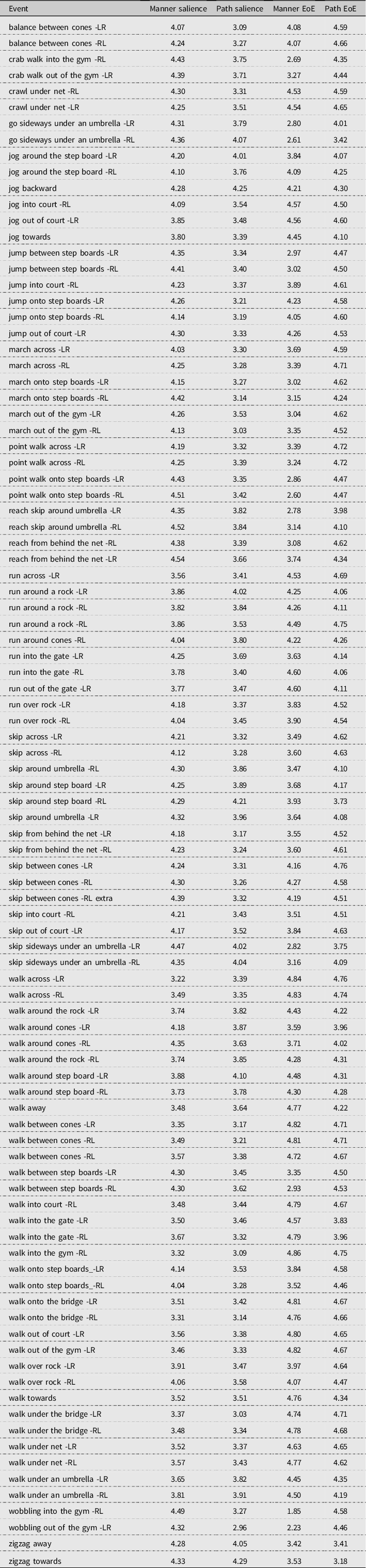
*LR – LR (LR = from left to right/RL = from right to left.
Appendix B
The list of path and manner expressions corresponding to each path and manner information. The first column presents the event provided to the participants. The second column presents the direction of the event in the video. The rest of the columns show path and manner use in different forms by the participants.



 Open access

