








1. Introduction
The observational study of quasars took off rapidly from the back-to-back-to-back papers of Nature’s 1963 March 16 issue, which featured the redshift determinations for 3C 273 and 3C 48 (Schmidt Reference Schmidt1963; Oke Reference Oke1963; Greenstein Reference Greenstein1963). Barely two years later, the quasar 3C 9 became the first known object at a redshift greater than 2 (Schmidt Reference Schmidt1965). But as exemplified by the 5-mag difference in the optical brightness between 3C 273 and 3C 9, the exploration towards higher redshifts became a push to fainter magnitudes.
Fortunately, the early recognition of radio-quiet quasars becoming prominent amongst blue, star-like objects beyond a magnitude of $V=14.5$
(Vega) provided an efficient means of identifying quasars from photometric techniques (Sandage Reference Sandage1965) and known quasars now number in the hundreds of thousands (see, e.g., the Million Quasar Catalogue, v7.5, hereafter Milliquas; Flesch Reference Flesch2021). Despite the proliferation of wide-area surveys across a range of wavelengths over the intervening fifty years, the search for bright quasars remains unfinished.
$V=14.5$
(Vega) provided an efficient means of identifying quasars from photometric techniques (Sandage Reference Sandage1965) and known quasars now number in the hundreds of thousands (see, e.g., the Million Quasar Catalogue, v7.5, hereafter Milliquas; Flesch Reference Flesch2021). Despite the proliferation of wide-area surveys across a range of wavelengths over the intervening fifty years, the search for bright quasars remains unfinished.
Here, we report on a spectroscopic investigation of a bright, blue, point-like source selected from the SkyMapper Southern Survey Data Release 2 (SMSS DR2; Wolf et al. Reference Wolf2018a; Onken et al. Reference Onken2019), which demonstrates that SMSS J114447.77-430859.3 (SMSS DR2 object_idFootnote a 84280208; hereafter, J1144) is a $z=0.83$
quasar. Aside from one blazar object at
$z=0.83$
quasar. Aside from one blazar object at $z=0.6$
(PKS 1424+240), this makes J1144 the optically brightest quasar known above a redshift of 0.4.
$z=0.6$
(PKS 1424+240), this makes J1144 the optically brightest quasar known above a redshift of 0.4.
Spectroscopy of J1144 was first acquired during a search for symbiotic binaries, in which cool giant stars accrete onto smaller companions, using SMSS DR2 (Lucy Reference Lucy2021). While any known active galactic nucleus (AGN, as identified in SIMBAD; Wenger et al. Reference Wenger2000) was excluded, J1144 had only been identified as an AGN candidate by its near-IR and IR colours. It was identified as a candidate by Edelson & Malkan (Reference Edelson and Malkan2012) using the Two Micron All-Sky Survey (2MASS; Skrutskie et al. Reference Skrutskie2006) and the Wide-field Infrared Survey Explorer (WISE; Wright et al. Reference Wright2010; Mainzer et al. 2011). Similarly, Secrest et al. (Reference Secrest2015) utilised the AllWISEFootnote b update to the IR dataset and selected J1144 as a quasar candidate from its IR colours alone. Notably, Shu et al. (Reference Shu2019) even estimated a photometric redshift for J1144 of $z=0.82$
from DR2 of the Gaia satellite mission (Gaia Collaboration et al. Reference Planck Collaboration2016; Gaia Collaboration 2018) and the unWISE (Schlafly, Meisner, & Green Reference Schlafly, Meisner and Green2019) revision to the photometry from WISE.
$z=0.82$
from DR2 of the Gaia satellite mission (Gaia Collaboration et al. Reference Planck Collaboration2016; Gaia Collaboration 2018) and the unWISE (Schlafly, Meisner, & Green Reference Schlafly, Meisner and Green2019) revision to the photometry from WISE.
However, the WISE colours of symbiotic stars sometimes fall in typical AGN selection regimes, which is why such sources were not excluded from the symbiotic star search. In fact, the flickering, accretion-powered symbiotic star EF Aql has an AGN-like $(W1-W2) \approx 0.9$
colour and was discovered via the UV-bright Quasar Survey (UVQS; Monroe et al. Reference Monroe2016; Margon et al. Reference Margon, Prochaska, Tejos and Monroe2016; Zamanov et al. Reference Zamanov2017). Lucy (Reference Lucy2021) explored various SMSS selection mechanisms for different types of symbiotic stars, and J1144, being much bluer than most isolated cool giant stars, was caught by a
$(W1-W2) \approx 0.9$
colour and was discovered via the UV-bright Quasar Survey (UVQS; Monroe et al. Reference Monroe2016; Margon et al. Reference Margon, Prochaska, Tejos and Monroe2016; Zamanov et al. Reference Zamanov2017). Lucy (Reference Lucy2021) explored various SMSS selection mechanisms for different types of symbiotic stars, and J1144, being much bluer than most isolated cool giant stars, was caught by a $(u-g)$
/
$(u-g)$
/ $(u-v)$
colour-only selection. Thus, along with 232 other symbiotic star candidates, optical spectroscopy of J1144 was obtained with the goal of confirming the presence of a cool giant star with emission lines, indicative of symbiotic binarity. J1144 was the only observed source to show AGN emission lines.
$(u-v)$
colour-only selection. Thus, along with 232 other symbiotic star candidates, optical spectroscopy of J1144 was obtained with the goal of confirming the presence of a cool giant star with emission lines, indicative of symbiotic binarity. J1144 was the only observed source to show AGN emission lines.
In Section 2, we describe the observations and data processing. In Section 3, we analyse the spectroscopic data and estimate the mass of the central black hole (BH). We summarise additional data available for J1144 in Section 4 and compare J1144 to other bright quasars in Section 5. Section 6 discusses the outlook to further study and utilisation of J1144, as well as the prospects for additional such discoveries in the future. Throughout the paper, we use Vega magnitudes for Gaia and IR data, and AB magnitudes for the SkyMapper passbands: uvgriz. We adopt a flat $\Lambda$
CDM cosmology with
$\Lambda$
CDM cosmology with $\Omega_{\mathrm{m}}=0.3$
and a Hubble-Lemaître constant of
$\Omega_{\mathrm{m}}=0.3$
and a Hubble-Lemaître constant of $H_0=70\,\mathrm{km\,s}^{-1}\,\mathrm{Mpc}^{-1}$
.
$H_0=70\,\mathrm{km\,s}^{-1}\,\mathrm{Mpc}^{-1}$
.
2. Observations and data processing
The spectroscopic portion of the symbiotic star programme (described in Lucy Reference Lucy2021) principally used the South African Astronomical Observatory (SAAO) 1.9-m telescope and its SpUpNIC instrument (Spectrograph Upgrade: Newly Improved Cassegrain; Crause et al. Reference Crause2019). Following the initial classification of J1144 as an AGN, additional optical spectroscopic data was obtained at higher spectral resolution with the Australian National University (ANU) 2.3-m telescope at Siding Spring Observatory (SSO) using the Wide Field Spectrograph (WiFeS; Dopita et al. Reference Dopita2007; Dopita Reference Dopita2010), and near-IR spectroscopy was obtained with the TripleSpec4.1 instrument (Schlawin et al. Reference Schlawin, Ramsay, McLean and Takami2014) on the Southern Astrophysical Research (SOAR) 4.1-m telescope.
2.1 Optical spectroscopy with SAAO 1.9 m/SpUpNIC
SpUpNIC observations of J1144 were obtained on UT 2019 June 24 with the G7 grating. G7 is a low-resolution grating, which covered 3300–8930 Å with a resolving power $R\sim 500$
. A BG38 filter was manually inserted into the arc beam. The spectroscopic slit width was 2.24 arcsec in seeing of
$R\sim 500$
. A BG38 filter was manually inserted into the arc beam. The spectroscopic slit width was 2.24 arcsec in seeing of ${\sim}2^{\prime\prime}$
, and a spatial binning of 2 pixels was used. The exposure time was 1200 s, with the object at an airmass of 1.2.
${\sim}2^{\prime\prime}$
, and a spatial binning of 2 pixels was used. The exposure time was 1200 s, with the object at an airmass of 1.2.
Flux calibration was performed with observations of the spectrophotometric standard star, CD-32 9927 (Hamuy et al. Reference Hamuy1994),Footnote c obtained on the same night. Data reduction, including bias subtraction and flat-fielding, used the standard tasks in the Image Reduction and Analysis Facility (IRAF; Tody Reference Tody1986). A second pass at flux scaling was performed by processing the spectrophotometric standard in the same way as the science spectra and determining the residual correction needed to align the flux with the model values. The final signal-to-noise ratio (S/N) of the SpUpNIC spectrum was ${\sim}50$
per pixel.
${\sim}50$
per pixel.
2.2 Optical spectroscopy with ANU 2.3 m/WiFeS
WiFeS spectra were obtained on UT 2022 March 11 with two grating configurations. WiFeS is an integral field spectrograph and when used with a spatial binning of 2 pixels, it provides $1\times 1$
arcsec sampling over its
$1\times 1$
arcsec sampling over its $25\times 38$
arcsec field-of-view.
$25\times 38$
arcsec field-of-view.
With the resolving power $R\sim 3000$
gratings, an exposure of 600 s was obtained, covering the wavelength range 3250–9550 Å across the two cameras of the spectrograph (the RT560 beamsplitter was used). For the high-resolution gratings (
$R\sim 3000$
gratings, an exposure of 600 s was obtained, covering the wavelength range 3250–9550 Å across the two cameras of the spectrograph (the RT560 beamsplitter was used). For the high-resolution gratings ( $R\sim 7000$
), an exposure time of 900 s was used. The B7000 grating covered 4180–5540 Å, while the I7000 grating covered 6810–9040 Å. All observations were obtained near an airmass of 1.2 with seeing of 1.8–2 arcsec in the i-band.
$R\sim 7000$
), an exposure time of 900 s was used. The B7000 grating covered 4180–5540 Å, while the I7000 grating covered 6810–9040 Å. All observations were obtained near an airmass of 1.2 with seeing of 1.8–2 arcsec in the i-band.
The spectrophotometric standard star, BD-12 2669 (Heap & Lindler Reference Heap and Lindler2010), was observed immediately after the J1144 spectra. The raw frames were reduced with the Python-based pipeline, PyWiFeS (Childress et al. Reference Childress, Vogt, Nielsen and Sharp2014). We then extracted the spectra from the calibrated 3D data cubes using QFitsView,Footnote d selecting nearby source-free regions for sky subtraction. Variance and data-quality frames were extracted from the same regions. As with the SAAO data, a second iteration of flux scaling was performed by aligning the processed spectrophotometric standard spectrum to the model fluxes. The S/N in the final spectra ranged from 20-60 per pixel.
2.3 Near-IR spectroscopy with SOAR/TripleSpec4.1
We observed J1144 with TripleSpec4.1 on UT 2022 February 13 under NOIRLab programme 2022A-389756 (PI: X. Fan). TripleSpec4.1 utilises a fixed spectroscopic slit of $1.1\times28$
arcsec and produces cross-dispersed spectra that cover a simultaneous wavelength range from 0.95 to 2.47 microns, at a spectral resolution of
$1.1\times28$
arcsec and produces cross-dispersed spectra that cover a simultaneous wavelength range from 0.95 to 2.47 microns, at a spectral resolution of ${\sim}3500$
.
${\sim}3500$
.
The observations were performed in three consecutive ABBA patterns, with 40s exposures at each dither position. The detector was read out with 4-pair Fowler sampling (Fowler & Gatley Reference Fowler and Gatley1990). The seeing was 1 arcsec in J-band. Observations of the A0V star, HIP 56984, were obtained immediately prior to J1144 to serve as a telluric and flux standard. The data were processed with the Spextool software package (Cushing, Vacca, & Rayner Reference Cushing, Vacca and Rayner2004; Cushing, Vacca, & Rayner Reference Cushing, Vacca and Rayner2014) written in the Interactive Data Language (IDLFootnote e), as modified for TripleSpec4.1.Footnote f Telluric correction was applied using the xtellcorr package (Vacca, Cushing, & Rayner Reference Vacca, Cushing and Rayner2003) in IDL. The final S/N was 50–100 per pixel.
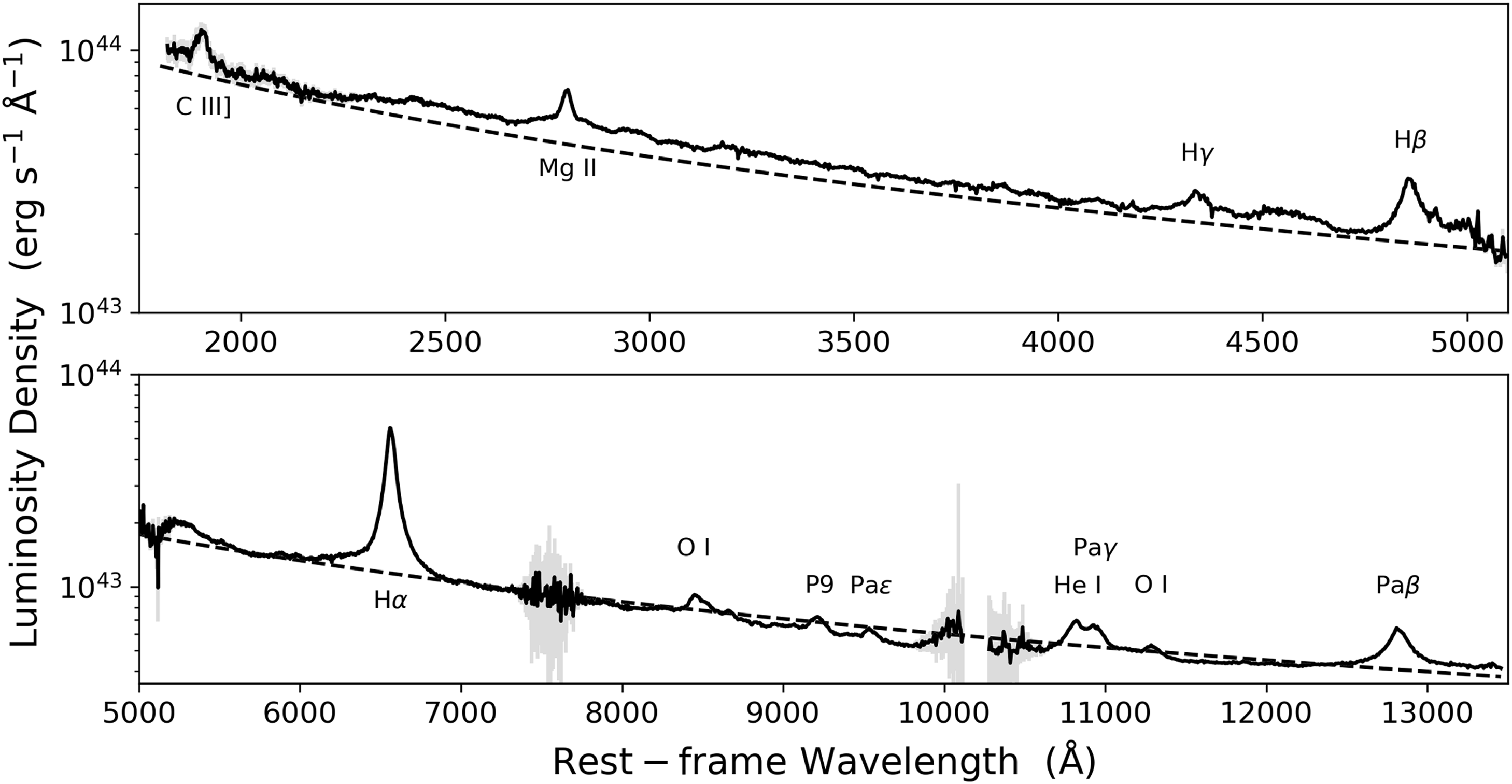
Rest-frame spectrum of J1144, in units of $\mathrm{erg\,s}^{-1}$
Å–1. Uncertainties are shown with grey errorbars, typically smaller than the thickness of the line. The dashed line shows a power-law continuum with slope
$\mathrm{erg\,s}^{-1}$
Å–1. Uncertainties are shown with grey errorbars, typically smaller than the thickness of the line. The dashed line shows a power-law continuum with slope $\unicode{x03B1}_{\lambda}$
=–1.56, which fits the spectrum well up to wavelengths of 7000 Å. The spectrum shown here has been corrected for Galactic reddening, but not for any internal reddening.
$\unicode{x03B1}_{\lambda}$
=–1.56, which fits the spectrum well up to wavelengths of 7000 Å. The spectrum shown here has been corrected for Galactic reddening, but not for any internal reddening.
3. Spectroscopic analysis
We normalise the spectra by anchoring them to the photometric data which best overlap the cleanest wavelength regions of each spectrum. This involves the g, r, and i bands from SMSS DR3 and the 2MASS H-band for the near-IR spectrum. The bandpass details were retrieved from the Spanish Virtual Observatory (SVO) Filter Profile ServiceFootnote g (Rodrigo, Solano, & Bayo Reference Rodrigo, Solano and Bayo2012; Rodrigo & Solano Reference Rodrigo and Solano2020). There is good agreement amongst the calibrations provided by the available photometric bands (typically better than 5%), consistent with the small levels of photometric variability discussed in Section 4.
We correct for Galactic reddening using the Fitzpatrick et al. (Reference Fitzpatrick, Massa, Gordon, Bohlin and Clayton2019) extinction curve, as implemented in the dust_extinction Python package (Gordon Reference Gordon2021). We assume $R_V=3.1$
, and we take the
$R_V=3.1$
, and we take the $E(B-V)=0.123$
mag from Schlegel et al. (Reference Schlegel, Finkbeiner and Davis1998) and additionally apply the
$E(B-V)=0.123$
mag from Schlegel et al. (Reference Schlegel, Finkbeiner and Davis1998) and additionally apply the $\times0.86$
correction factor of Schlafly & Finkbeiner (Reference Schlafly and Finkbeiner2011).Footnote h The spectra are combined as the weighted mean on a new wavelength grid which sampled the spectra in pixels at
$\times0.86$
correction factor of Schlafly & Finkbeiner (Reference Schlafly and Finkbeiner2011).Footnote h The spectra are combined as the weighted mean on a new wavelength grid which sampled the spectra in pixels at $200\,\mathrm{km\,s}^{-1}$
spacing. The strong emission lines in the J1144 spectrum (Mg ii, H
$200\,\mathrm{km\,s}^{-1}$
spacing. The strong emission lines in the J1144 spectrum (Mg ii, H $\unicode{x03B2}$
, H
$\unicode{x03B2}$
, H $\unicode{x03B1}$
, and Pa
$\unicode{x03B1}$
, and Pa $\unicode{x03B2}$
) were used together (weighted mean) to provide a redshift estimate of
$\unicode{x03B2}$
) were used together (weighted mean) to provide a redshift estimate of $0.8314\pm0.0001$
. The observed spectrum is then transformed to rest-frame wavelengths and to luminosity in units of
$0.8314\pm0.0001$
. The observed spectrum is then transformed to rest-frame wavelengths and to luminosity in units of $\mathrm{erg\,s}^{-1}$
Å–1, giving a velocity resolution of
$\mathrm{erg\,s}^{-1}$
Å–1, giving a velocity resolution of $109\, \mathrm{km\,s}^{-1}\,\mathrm{pixel}^{-1}$
and a final S/N between 100 and 250 per pixel. The combined spectrum is shown in Figure 1.
$109\, \mathrm{km\,s}^{-1}\,\mathrm{pixel}^{-1}$
and a final S/N between 100 and 250 per pixel. The combined spectrum is shown in Figure 1.
When fitting the spectrum, we separately consider the wavelength regimes around C iii, Mg ii, H $\unicode{x03B2}$
, H
$\unicode{x03B2}$
, H $\unicode{x03B1}$
, and Pa
$\unicode{x03B1}$
, and Pa $\unicode{x03B2}$
. For each wavelength region, we first fit a combined power-law continuum and iron template. The best power-law slope for the combined UV/optical range is found to be
$\unicode{x03B2}$
. For each wavelength region, we first fit a combined power-law continuum and iron template. The best power-law slope for the combined UV/optical range is found to be $\unicode{x03B1}_{\lambda}=-1.56$
, although a flatter slope of –0.79 is a better fit for the near-IR, likely reflecting the contributions of hot dust in the region longward of
$\unicode{x03B1}_{\lambda}=-1.56$
, although a flatter slope of –0.79 is a better fit for the near-IR, likely reflecting the contributions of hot dust in the region longward of $1\unicode{x03BC}$
m (cf. the WISE photometry in Figure 4). Because of the impact of the iron model on the remaining emission line profiles, we test the systematic effects of adopting various iron emission templates in the UV and optical portions of the spectrum. For the UV iron templates, we use those of Shen & Liu (Reference Shen and Liu2012),Footnote i Tsuzuki et al. (Reference Tsuzuki2006) and Mejia-Restrepo et al. (Reference Mejía-Restrepo, Trakhtenbrot, Lira, Netzer and Capellupo2016), while for the optical templates, we use those of Boroson & Green (Reference Boroson and Green1992; BG92, hereafter), Tsuzuki et al. (Reference Tsuzuki2006), Bruhweiler & Verner (Reference Bruhweiler and Verner2008), and Park et al. (Reference Park, Barth, Ho and Laor2022). The velocity broadening of the template is a free parameter in each fit. On average, the best-fit iron full width at half-maximum (FWHM) was
$1\unicode{x03BC}$
m (cf. the WISE photometry in Figure 4). Because of the impact of the iron model on the remaining emission line profiles, we test the systematic effects of adopting various iron emission templates in the UV and optical portions of the spectrum. For the UV iron templates, we use those of Shen & Liu (Reference Shen and Liu2012),Footnote i Tsuzuki et al. (Reference Tsuzuki2006) and Mejia-Restrepo et al. (Reference Mejía-Restrepo, Trakhtenbrot, Lira, Netzer and Capellupo2016), while for the optical templates, we use those of Boroson & Green (Reference Boroson and Green1992; BG92, hereafter), Tsuzuki et al. (Reference Tsuzuki2006), Bruhweiler & Verner (Reference Bruhweiler and Verner2008), and Park et al. (Reference Park, Barth, Ho and Laor2022). The velocity broadening of the template is a free parameter in each fit. On average, the best-fit iron full width at half-maximum (FWHM) was ${\sim}2500$
km s–1. The systematic errors arising from the iron template choice are square-added to the statistical errors in the fit results below.
${\sim}2500$
km s–1. The systematic errors arising from the iron template choice are square-added to the statistical errors in the fit results below.
Emission line fits to C iii, Mg ii, H $\unicode{x03B2}$
, H
$\unicode{x03B2}$
, H $\unicode{x03B1}$
, and Pa
$\unicode{x03B1}$
, and Pa $\unicode{x03B2}$
, as indicated in each panel. Black lines indicate the data. The model is plotted with progressively added elements: the power-law continuum (orange), then the pseudo-continuum from the broadened iron template (blue), then the emission line fits (red). The red dashed lines indicate the three Gaussian profiles used to fit each line. The particular fits shown here use the Shen & Liu (Reference Shen and Liu2012) and BG92 templates in the UV and optical, respectively.
$\unicode{x03B2}$
, as indicated in each panel. Black lines indicate the data. The model is plotted with progressively added elements: the power-law continuum (orange), then the pseudo-continuum from the broadened iron template (blue), then the emission line fits (red). The red dashed lines indicate the three Gaussian profiles used to fit each line. The particular fits shown here use the Shen & Liu (Reference Shen and Liu2012) and BG92 templates in the UV and optical, respectively.
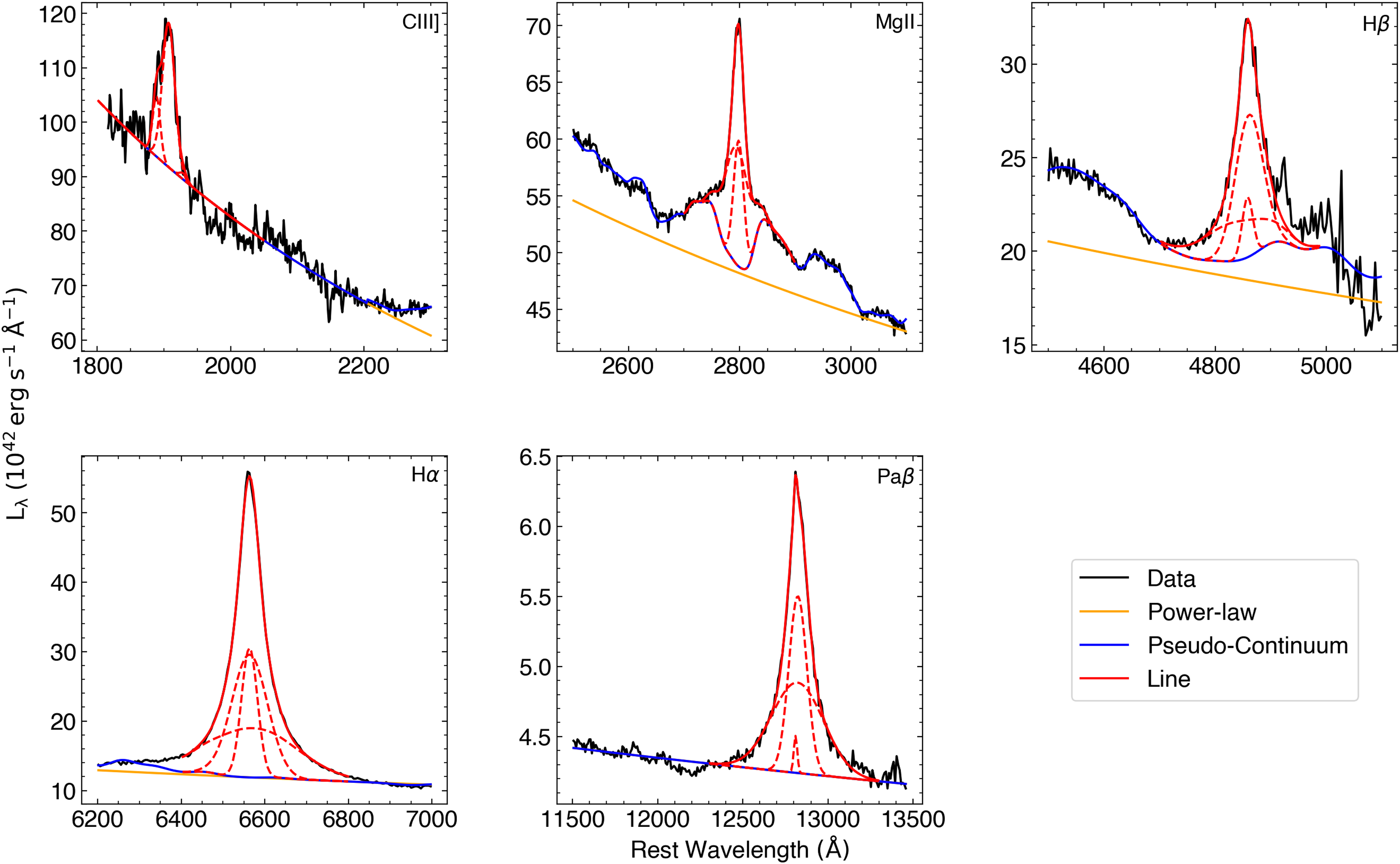
For the subsequent steps of the spectral modelling, the emission lines are each fit with a sum of three Gaussian profiles. We estimate the statistical uncertainties on the fit parameters via a Monte Carlo approach, taking the RMS from 50 realisations in which the flux at each pixel is varied according to the error spectrum. Because of the weak [Oiii] and [Sii] emission and lack of evident narrow-line contribution to the Balmer lines, even in the original $R\sim7000$
spectrum of H
$R\sim7000$
spectrum of H $\unicode{x03B2}$
, no narrow-line subtraction is performed for the Balmer lines or the [Nii] lines near H
$\unicode{x03B2}$
, no narrow-line subtraction is performed for the Balmer lines or the [Nii] lines near H $\unicode{x03B1}$
. Integrating
$\unicode{x03B1}$
. Integrating $3\times$
the error spectrum over spectral windows of
$3\times$
the error spectrum over spectral windows of ${\pm}200\,\mathrm{km\,s}^{-1}$
around [Oiii] 5007 Å and [Sii]
${\pm}200\,\mathrm{km\,s}^{-1}$
around [Oiii] 5007 Å and [Sii] $6716+6731$
Å provides conservative upper limits of
$6716+6731$
Å provides conservative upper limits of $5\times 10^{42}$
and
$5\times 10^{42}$
and $3\times 10^{42}\,\mathrm{erg\,s}^{-1}$
, respectively; however, the blending of H
$3\times 10^{42}\,\mathrm{erg\,s}^{-1}$
, respectively; however, the blending of H $\unicode{x03B1}$
with [Nii] precludes a similar upper limit estimate for the latter.
$\unicode{x03B1}$
with [Nii] precludes a similar upper limit estimate for the latter.
The emission line fits are shown in Figure 2. The C iii fit is poorly constrained, because of limited wavelength coverage, the lower spectral resolution of the SAAO data from which it is principally observed, and lack of de-blending with Aliii and Siiii. As a result, the parameters are omitted from Table 1. The features reward of H $\unicode{x03B2}$
are likely iron lines that have not been well modelled because of errors in the flux calibration at the long-wavelength limit of the optical spectra.
$\unicode{x03B2}$
are likely iron lines that have not been well modelled because of errors in the flux calibration at the long-wavelength limit of the optical spectra.
From the sum of the Gaussian fits, we determine the velocity shift (derived from the peak of the line profile), the integrated line luminosity, the FWHM, and the second moment of the line profile ( $\sigma_{\mathrm{line}}$
). The emission line properties are summarised in Table 1. As was the case for the continuum luminosities, the emission line luminosity errors are dominated by the photometric calibration uncertainties.
$\sigma_{\mathrm{line}}$
). The emission line properties are summarised in Table 1. As was the case for the continuum luminosities, the emission line luminosity errors are dominated by the photometric calibration uncertainties.
3.1 Luminosity of J1144
From the power-law continuum fits, we determine the luminosities at several rest-frame wavelengths of interest: $\log_{10}\! ( \lambda\,\mathrm{L}_{\lambda}(3000$
Å
$\log_{10}\! ( \lambda\,\mathrm{L}_{\lambda}(3000$
Å $)/\mathrm{erg\,s}^{-1} ) = 47.12 \pm 0.04$
,
$)/\mathrm{erg\,s}^{-1} ) = 47.12 \pm 0.04$
, $\log_{10}\! ( \lambda\,\mathrm{L}_{\lambda}(5100$
Å
$\log_{10}\! ( \lambda\,\mathrm{L}_{\lambda}(5100$
Å $)/\mathrm{erg\,s}^{-1} ) = 46.94 \pm 0.04$
, and
$)/\mathrm{erg\,s}^{-1} ) = 46.94 \pm 0.04$
, and $\log_{10}\! ( \lambda\,\mathrm{L}_{\lambda}(1\unicode{x03BC}\,\mathrm{m})/\mathrm{erg\,s}^{-1} )\,\,\,=\,46.67 \pm 0.04$
,
$\log_{10}\! ( \lambda\,\mathrm{L}_{\lambda}(1\unicode{x03BC}\,\mathrm{m})/\mathrm{erg\,s}^{-1} )\,\,\,=\,46.67 \pm 0.04$
,
where the errors are dominated by the 0.1 mag uncertainties in the flux calibration but do not incorporate the small additional factor of source variability (see Section 4). The luminosity at 3000 Å translates into an absolute magnitude of $M_{300\mathrm{nm}} = -28.70$
mag (AB). To aid comparison with higher-redshift samples, we extrapolate the best-fit continuum power-law (with
$M_{300\mathrm{nm}} = -28.70$
mag (AB). To aid comparison with higher-redshift samples, we extrapolate the best-fit continuum power-law (with $\unicode{x03B1}_{\lambda}=-1.56$
) to shorter wavelengths and find
$\unicode{x03B1}_{\lambda}=-1.56$
) to shorter wavelengths and find $\log_{10}\! ( \lambda\,\mathrm{L}_{\lambda}(1450$
Å
$\log_{10}\! ( \lambda\,\mathrm{L}_{\lambda}(1450$
Å $)/\mathrm{erg\,s}^{-1} ) = 47.2$
or
$)/\mathrm{erg\,s}^{-1} ) = 47.2$
or $M_{145\,\mathrm{nm}} = -28.36$
mag (AB). Using the prescription of Richards et al. (Reference Richards2006), we find
$M_{145\,\mathrm{nm}} = -28.36$
mag (AB). Using the prescription of Richards et al. (Reference Richards2006), we find $M_{i}(z=2) = -29.74$
mag (AB).
$M_{i}(z=2) = -29.74$
mag (AB).
We adopt the bolometric correction (BC) for 3000 Å from Runnoe et al. (Reference Runnoe, Brotherton and Shang2012a, Reference Runnoe, Brotherton and Shang2012b), although their BC values for 5100 Å (with spectral slope correction) or the BC values from Netzer (Reference Netzer2019) yield similar results. The bolometric luminosity of J1144 is $(4.7\pm1.0)\times10^{47}\,\mathrm{erg\,s}^{-1}$
, where the uncertainty accounts for the variation arising from different BC assumptions. For the canonical radiative efficiency of 0.1 (e.g., Yu & Tremaine Reference Yu and Tremaine2002), this equates to an accretion rate of
$(4.7\pm1.0)\times10^{47}\,\mathrm{erg\,s}^{-1}$
, where the uncertainty accounts for the variation arising from different BC assumptions. For the canonical radiative efficiency of 0.1 (e.g., Yu & Tremaine Reference Yu and Tremaine2002), this equates to an accretion rate of ${\sim}80\,\mathrm{M}_{\odot}\,\mathrm{yr}^{-1}$
.
${\sim}80\,\mathrm{M}_{\odot}\,\mathrm{yr}^{-1}$
.
3.2 BH Mass of J1144
The wide wavelength coverage of our spectroscopic data provides access to several emission lines from the broad-line region (BLR), which can be used to estimate the mass of the central BH in J1144 through the virial relations. Anchored to the H $\unicode{x03B2}$
reverberation mapping results from the local AGN sample (see Peterson et al. Reference Peterson2004), the virial relations rely on a single epoch of line width and luminosity measurements to infer the velocity of the BLR gas around the BH, as well as the characteristic distance from the BH to the line-emitting gas in question (see, e.g., Cackett, Bentz, & Kara Reference Cackett, Bentz and Kara2021). Each emission line may have its own velocity and distance, which should yield consistent mass estimates under the assumption that the gravity of the BH dominates the gas dynamics. However, we do note that J1144 represents an extrapolation of a factor of
$\unicode{x03B2}$
reverberation mapping results from the local AGN sample (see Peterson et al. Reference Peterson2004), the virial relations rely on a single epoch of line width and luminosity measurements to infer the velocity of the BLR gas around the BH, as well as the characteristic distance from the BH to the line-emitting gas in question (see, e.g., Cackett, Bentz, & Kara Reference Cackett, Bentz and Kara2021). Each emission line may have its own velocity and distance, which should yield consistent mass estimates under the assumption that the gravity of the BH dominates the gas dynamics. However, we do note that J1144 represents an extrapolation of a factor of ${\sim}10$
in luminosity compared to the well measured H
${\sim}10$
in luminosity compared to the well measured H $\unicode{x03B2}$
reverberation mapping sample of Bentz et al. (Reference Bentz2013).
$\unicode{x03B2}$
reverberation mapping sample of Bentz et al. (Reference Bentz2013).
We adopt the $M_{\mathrm{BH}}$
relation parameters indicated in Table 2 for a functional form of
$M_{\mathrm{BH}}$
relation parameters indicated in Table 2 for a functional form of
 \begin{equation} M_{\mathrm{BH}} = 10^{A} \times \left(FWHM / 10^{3}\right)^B \times \left(L_{\mathrm{cont/line}} / 10^{44}\right)^{C}\end{equation}
for the emission line FWHM in units of $\mathrm{km\,s}^{-1}$
, and the luminosity of either continuum or emission line in units of
$\mathrm{km\,s}^{-1}$
, and the luminosity of either continuum or emission line in units of $\mathrm{erg\,s}^{-1}$
. With the relations being primarily drawn from Le et al. (Reference Le, Woo and Xue2020), the A parameters in Table 2 have been renormalised to that paper’s adopted virial factor of
$\mathrm{erg\,s}^{-1}$
. With the relations being primarily drawn from Le et al. (Reference Le, Woo and Xue2020), the A parameters in Table 2 have been renormalised to that paper’s adopted virial factor of $f=1.12$
(from Woo et al. Reference Woo, Yoon, Park, Park and Kim2015) for these FWHM-based measurements.
$f=1.12$
(from Woo et al. Reference Woo, Yoon, Park, Park and Kim2015) for these FWHM-based measurements.
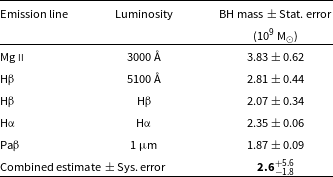
With the emission line measurements of Table 1 and the continuum luminosities indicated above, we derive several complementary BH mass estimates. The $M_{\mathrm{BH}}$
values we estimate are presented in Table 3. For Mg ii, we do not apply the mass correction factors from Le et al. (Reference Le, Woo and Xue2020) for the emission line shape (FWHM/
$M_{\mathrm{BH}}$
values we estimate are presented in Table 3. For Mg ii, we do not apply the mass correction factors from Le et al. (Reference Le, Woo and Xue2020) for the emission line shape (FWHM/ $\sigma_{\mathrm{line}}$
ratio) and spectral slope, which would increase that mass estimate by 0.3 dex and make it more discrepant with the other emission line results. The different emission lines produce BH mass estimates that span the range from
$\sigma_{\mathrm{line}}$
ratio) and spectral slope, which would increase that mass estimate by 0.3 dex and make it more discrepant with the other emission line results. The different emission lines produce BH mass estimates that span the range from $(1.9-3.8)\times 10^{9}\,\mathrm{M}_{\odot}$
. The high S/N of our spectroscopic data mean the statistical errors on the BH mass estimate are small compared to the systematic errors. Dalla Bontà et al. (Reference Dalla Bontà2020) estimate the intrinsic scatter to be 0.371 dex for the best-measured FWHM-based virial relation (using H
$(1.9-3.8)\times 10^{9}\,\mathrm{M}_{\odot}$
. The high S/N of our spectroscopic data mean the statistical errors on the BH mass estimate are small compared to the systematic errors. Dalla Bontà et al. (Reference Dalla Bontà2020) estimate the intrinsic scatter to be 0.371 dex for the best-measured FWHM-based virial relation (using H $\unicode{x03B2}$
and 5100 Å), and the systematic errors for the other estimates are likely to be larger. Thus, we take the mean value of our five measurements as the best estimate for the BH mass in J1144,
$\unicode{x03B2}$
and 5100 Å), and the systematic errors for the other estimates are likely to be larger. Thus, we take the mean value of our five measurements as the best estimate for the BH mass in J1144, $M_{\mathrm{BH}} = 2.6 \times 10^{9}\,\mathrm{M}_{\odot}$
, and conservatively adopt an uncertainty of 0.5 dex (cf. Vestergaard & Osmer Reference Vestergaard and Osmer2009). Our measurements of the bolometric luminosity and BH mass yield an Eddington ratio of
$M_{\mathrm{BH}} = 2.6 \times 10^{9}\,\mathrm{M}_{\odot}$
, and conservatively adopt an uncertainty of 0.5 dex (cf. Vestergaard & Osmer Reference Vestergaard and Osmer2009). Our measurements of the bolometric luminosity and BH mass yield an Eddington ratio of $\approx 1.4$
for J1144.
$\approx 1.4$
for J1144.
Emission line fit results.
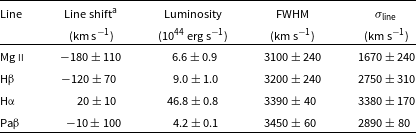
a Measured with the emission line peak.
Virial relations.
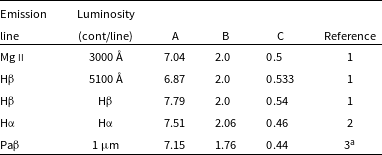
References: 1 - Le et al. (Reference Le, Woo and Xue2020); 2 - Woo et al. (Reference Woo, Yoon, Park, Park and Kim2015); 3 - Landt et al. (Reference Landt2013).
a Rescaled from $f=1.4$
to
$f=1.4$
to $f=1.12$
.
$f=1.12$
.
In Table 4, we present a summary of the observed and derived properties of J1144.
BH mass estimates.
Summary of J1144 properties.
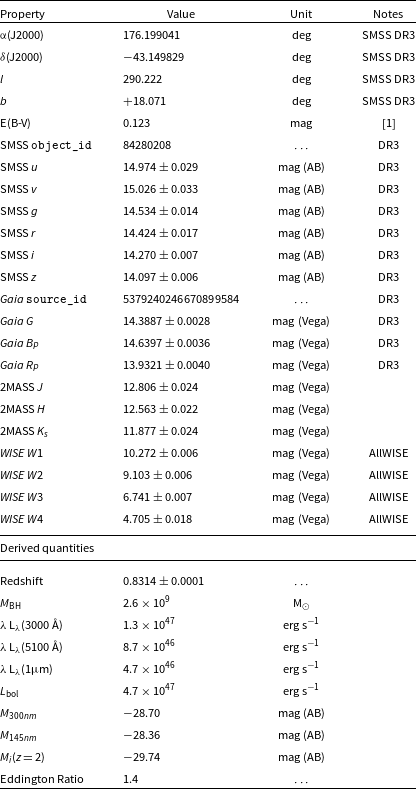
[1] From Schlegel et al. (Reference Schlegel, Finkbeiner and Davis1998).
3.3 Continuum Slope and Internal Reddening
Typical thin disk (Shakura & Sunyaev Reference Shakura and Sunyaev1973) and slim disk (Abramowicz et al. Reference Abramowicz, Czerny, Lasota and Szuszkiewicz1988) models of BH accretion predict UV/optical continuum emission having a power-law slope of $\unicode{x03B1}_{\lambda} \approx -2.3$
(
$\unicode{x03B1}_{\lambda} \approx -2.3$
( $\unicode{x03B1}_{\nu} \approx +0.3$
), though real quasars are rarely observed to be so blue (Xie et al. Reference Xie, Shao, Shen, Liu and Li2016). Taking such a spectral slope as the limiting case, we can assess the maximum amount of internal reddening that may be present in the emitted spectrum of J1144.
$\unicode{x03B1}_{\nu} \approx +0.3$
), though real quasars are rarely observed to be so blue (Xie et al. Reference Xie, Shao, Shen, Liu and Li2016). Taking such a spectral slope as the limiting case, we can assess the maximum amount of internal reddening that may be present in the emitted spectrum of J1144.
For a UV-flat reddening curve like that of (Gaskell & Benker Reference Gaskell and Benker2007, GB07, hereafter), we find that a maximum intrinsic E(B-V) of 0.17 mag provides a reasonable fit to the data. In contrast, a UV-steep reddening curve – one lacking the strong bump at 2175 Å – such as the Gordon et al. (Reference Gordon, Clayton, Misselt, Landolt and Wolff2003) model for the star-forming bar of the Small Magellanic Cloud, implies a maximum E(B-V) of 0.10 mag to avoid over-correcting C iii, but then under-corrects the spectrum near Mg ii. (Reddening curves retaining the 2175 Å bump perform even worse in the regime between C iii and Mg ii.) The GB07 reddening correction would lift the 3000 Å luminosity by 0.34 dex, which might be expected to increase each of the BH mass and the Eddington ratio by roughly half that margin. However, because the sources anchoring the virial relations have not been corrected for internal reddening, the appropriate adjustments for J1144 would be reduced in amplitude.
It is also worth highlighting that the power-law prescription for the rest-frame UV spectrum breaks down in accretion disk models at higher BH masses, as the high-energy turnover migrates to longer wavelengths (e.g., see Campitiello et al. Reference Campitiello, Ghisellini, Sbarrato and Calderone2018). For $M_{\mathrm{BH}} \sim 10^{9}\,\mathrm{M}_{\odot}$
, the departure from a power-law exceeds 0.1 mag between 2000 and 3000 Å, suggesting extreme care must be taken to disentangle the intrinsic spectral shape from any internal reddening. Observed-frame UV spectroscopy of J1144 should contribute to our ability to remove such degeneracies.
$M_{\mathrm{BH}} \sim 10^{9}\,\mathrm{M}_{\odot}$
, the departure from a power-law exceeds 0.1 mag between 2000 and 3000 Å, suggesting extreme care must be taken to disentangle the intrinsic spectral shape from any internal reddening. Observed-frame UV spectroscopy of J1144 should contribute to our ability to remove such degeneracies.
Finally, reddening will lead to an enhancement of the Balmer decrement, that is, the H $\unicode{x03B1}$
/H
$\unicode{x03B1}$
/H $\unicode{x03B2}$
flux ratio. Low-redshift quasars with blue spectral slopes (implying little intrinsic reddening) are often found to have Balmer decrements of 3.1 (Dong et al. Reference Dong2008). Our observed Balmer decrement of 5.1 would imply E(B-V)
$\unicode{x03B2}$
flux ratio. Low-redshift quasars with blue spectral slopes (implying little intrinsic reddening) are often found to have Balmer decrements of 3.1 (Dong et al. Reference Dong2008). Our observed Balmer decrement of 5.1 would imply E(B-V) $\approx 0.4$
mag, depending on the reddening curve adopted. However, Gaskell (Reference Gaskell2017) has argued that quasar Balmer decrements are consistent with an assumption of intrinsic Case B recombination and a flux ratio of 2.72, which would suggest even more reddening in J1144: E(B-V)
$\approx 0.4$
mag, depending on the reddening curve adopted. However, Gaskell (Reference Gaskell2017) has argued that quasar Balmer decrements are consistent with an assumption of intrinsic Case B recombination and a flux ratio of 2.72, which would suggest even more reddening in J1144: E(B-V) $\approx0.5$
mag. In either case, such high reddening appears to be incompatible with the expected spectral slopes, suggesting an intrinsically higher Balmer decrement, which can arise from optical depth effects redistributing H
$\approx0.5$
mag. In either case, such high reddening appears to be incompatible with the expected spectral slopes, suggesting an intrinsically higher Balmer decrement, which can arise from optical depth effects redistributing H $\unicode{x03B2}$
photons into H
$\unicode{x03B2}$
photons into H $\unicode{x03B1}$
and Pa
$\unicode{x03B1}$
and Pa $\unicode{x03B1}$
(Pottasch Reference Pottasch1960; Netzer Reference Netzer1975).
$\unicode{x03B1}$
(Pottasch Reference Pottasch1960; Netzer Reference Netzer1975).
4. Ancillary datasets
The unusually bright nature of J1144 raises the question of whether it has historically been fainter, contributing to its long-standing anonymity.
4.1 Optical data
On UT 1890 May 26, the 8-inch ‘Bache doublet’ telescope at ‘Mount Harvard’ near Chosica, Peru, obtained a 60-min exposure showing J1144. The photographic glass plate (b5269) has been digitised, and astrometrically and photometrically calibrated by the Digital Access to a Sky Century @ Harvard (DASCH) projectFootnote j (Laycock et al. Reference Laycock2008; Tang et al. Reference Tang, Grindlay, Los and Servillat2013). The brightness of J1144 in the 1890 image is estimated to be $14.80\pm0.16$
mag (AB), calibrated to Pan-STARRS g-band using the Asteroid Terrestrial impact Last Alert System (ATLAS) All-Sky Stellar Reference Catalog (Tonry et al. Reference Tonry2018a). Similar plates available through DASCH from more recent epochs show J1144 with estimated g-band magnitudes between 13.9 and 15.1 mag (AB; omitting highly uncertain measurements or those close to the plate’s limiting depth). The heterogeneity of the data precludes a more detailed analysis, but the DASCH photographic archives indicate that the optical brightness of J1144 has not varied by more than a factor of
$14.80\pm0.16$
mag (AB), calibrated to Pan-STARRS g-band using the Asteroid Terrestrial impact Last Alert System (ATLAS) All-Sky Stellar Reference Catalog (Tonry et al. Reference Tonry2018a). Similar plates available through DASCH from more recent epochs show J1144 with estimated g-band magnitudes between 13.9 and 15.1 mag (AB; omitting highly uncertain measurements or those close to the plate’s limiting depth). The heterogeneity of the data precludes a more detailed analysis, but the DASCH photographic archives indicate that the optical brightness of J1144 has not varied by more than a factor of ${\sim}2$
in the last 130 yr.
${\sim}2$
in the last 130 yr.
Considering data focused on the blue end of the optical spectrum, photographic glass plates taken by the UK Schmidt telescope at SSO on UT 1977 March 21, as part of the ESO/SERC Southern Sky Survey, measured $B_{J}=14.7\pm0.4$
mag (Vega), as cataloguedFootnote k by the SuperCOSMOS Sky Survey (Hambly et al. Reference Hambly2001a; Hambly, Irwin, & MacGillivray Reference Hambly, Irwin and MacGillivray2001b). The
$B_{J}=14.7\pm0.4$
mag (Vega), as cataloguedFootnote k by the SuperCOSMOS Sky Survey (Hambly et al. Reference Hambly2001a; Hambly, Irwin, & MacGillivray Reference Hambly, Irwin and MacGillivray2001b). The $B_{J}$
and SMSS g bandpasses are similar (e.g., see the
$B_{J}$
and SMSS g bandpasses are similar (e.g., see the $B_{J}$
throughput compared to the Sloan Digital Sky Survey
$B_{J}$
throughput compared to the Sloan Digital Sky Survey $g_{\rm SDSS}$
in Richards et al. Reference Richards2005) and the (
$g_{\rm SDSS}$
in Richards et al. Reference Richards2005) and the ( $B_{J}-g$
) colours of 3673 quasars in the redshift range 0.6–1.0 from the 2dF and 6dF QSO Redshift Surveys (2QZ/6QZ; Croom et al. Reference Croom2004) show a median of 0.10 mag with a scaled median absolute deviation (SMAD) of 0.38 mag. With an SMSS DR3 g-band magnitude of
$B_{J}-g$
) colours of 3673 quasars in the redshift range 0.6–1.0 from the 2dF and 6dF QSO Redshift Surveys (2QZ/6QZ; Croom et al. Reference Croom2004) show a median of 0.10 mag with a scaled median absolute deviation (SMAD) of 0.38 mag. With an SMSS DR3 g-band magnitude of $14.534\pm0.014$
mag (AB), we conclude there has been no significant variation in the J1144 brightness at rest-frame
$14.534\pm0.014$
mag (AB), we conclude there has been no significant variation in the J1144 brightness at rest-frame ${\sim}2700$
Å compared to 45 yr ago.
${\sim}2700$
Å compared to 45 yr ago.
On more recent timescales, the SMSS DR3 dataset incorporates images of J1144 acquired between 2015 February and 2018 June. Across that time window, each of the six SMSS filters shows a brightening of $\approx0.1$
mag, with 7–9 epochs per filter. Denser time sampling is available from the ATLAS telescopes (Tonry et al. Reference Tonry2018b; Smith et al. Reference Smith2020), which have observed J1144 at a high rate (typically over 200 times per year) since December 2017.Footnote l Both the o (‘orange’; comprising 80% of the data) and c (‘cyan’) filters show a brightening of 0.2 mag relative to the earliest ATLAS epoch (2016 January), with a peak roughly in 2020 May. Together, these datasets provide a consistent picture of modest brightness variations over timescales of days to years.
$\approx0.1$
mag, with 7–9 epochs per filter. Denser time sampling is available from the ATLAS telescopes (Tonry et al. Reference Tonry2018b; Smith et al. Reference Smith2020), which have observed J1144 at a high rate (typically over 200 times per year) since December 2017.Footnote l Both the o (‘orange’; comprising 80% of the data) and c (‘cyan’) filters show a brightening of 0.2 mag relative to the earliest ATLAS epoch (2016 January), with a peak roughly in 2020 May. Together, these datasets provide a consistent picture of modest brightness variations over timescales of days to years.
To probe even shorter timescales, we examined the J1144 data available from two ${\sim}$
month-long visits by the Transiting Exoplanet Survey Satellite (TESS; Ricker et al. Reference Ricker2015), one beginning on UT 2019 March 26 (during the primary mission; Sector 10) and one beginning on 2021 April 02 (first extended mission; Sector 37). In the TESS Input Catalog (TIC; Paegert et al. Reference Paegert2022), J1144 has the designation TIC 61537875, but it was not selected for the Candidate Target List. As a result, photometry is only available from the Full Frame Image (FFI) dataset, which were acquired every 30 min in the primary mission and every 10 min in the first extended mission. The coarse spatial resolution of TESS results in J1144 being heavily blended with TIC 61537878, a star 30 arcsec away that is
${\sim}$
month-long visits by the Transiting Exoplanet Survey Satellite (TESS; Ricker et al. Reference Ricker2015), one beginning on UT 2019 March 26 (during the primary mission; Sector 10) and one beginning on 2021 April 02 (first extended mission; Sector 37). In the TESS Input Catalog (TIC; Paegert et al. Reference Paegert2022), J1144 has the designation TIC 61537875, but it was not selected for the Candidate Target List. As a result, photometry is only available from the Full Frame Image (FFI) dataset, which were acquired every 30 min in the primary mission and every 10 min in the first extended mission. The coarse spatial resolution of TESS results in J1144 being heavily blended with TIC 61537878, a star 30 arcsec away that is ${\sim}1$
mag brighter in TESS’s wide bandpass (600–
${\sim}1$
mag brighter in TESS’s wide bandpass (600– $1000$
nm). As a result, precise photometry is difficult to obtain, but we note no significant fluctuations above 1% in the combined light curve of the quasar and star.
$1000$
nm). As a result, precise photometry is difficult to obtain, but we note no significant fluctuations above 1% in the combined light curve of the quasar and star.
4.2 IR data
Turning to the IR, the NEOWISE 2022 Data ReleaseFootnote m (Mainzer et al. 2014) provides W1 and W2 photometry for J1144 at more than 250 epochs between UT 2014 January 09 and 2021 June 19. At rest-frame equivalents of 1.8 and 2.5 $\unicode{x03BC}$
m for W1 and W2, respectively, the WISE data is dominated by the hot dust near the quasar, rather than the quasar’s accretion disk that is probed at shorter wavelengths. In Figure 3, we show the WISE and ATLAS light curves, binned to 30-d median values.
$\unicode{x03BC}$
m for W1 and W2, respectively, the WISE data is dominated by the hot dust near the quasar, rather than the quasar’s accretion disk that is probed at shorter wavelengths. In Figure 3, we show the WISE and ATLAS light curves, binned to 30-d median values.
ATLAS and WISE light curves for J1144 over the past 8 yr. Photometry was binned to 30-d median values for each bandpass. The ATLAS photometry is in AB magnitudes, while the the IR photometry is in Vega magnitudes and has been shifted vertically for convenience. Any increase in the optical brightness would take a decade to be reflected in the dust luminosity because of the large dust sublimation region around luminous quasars like J1144.
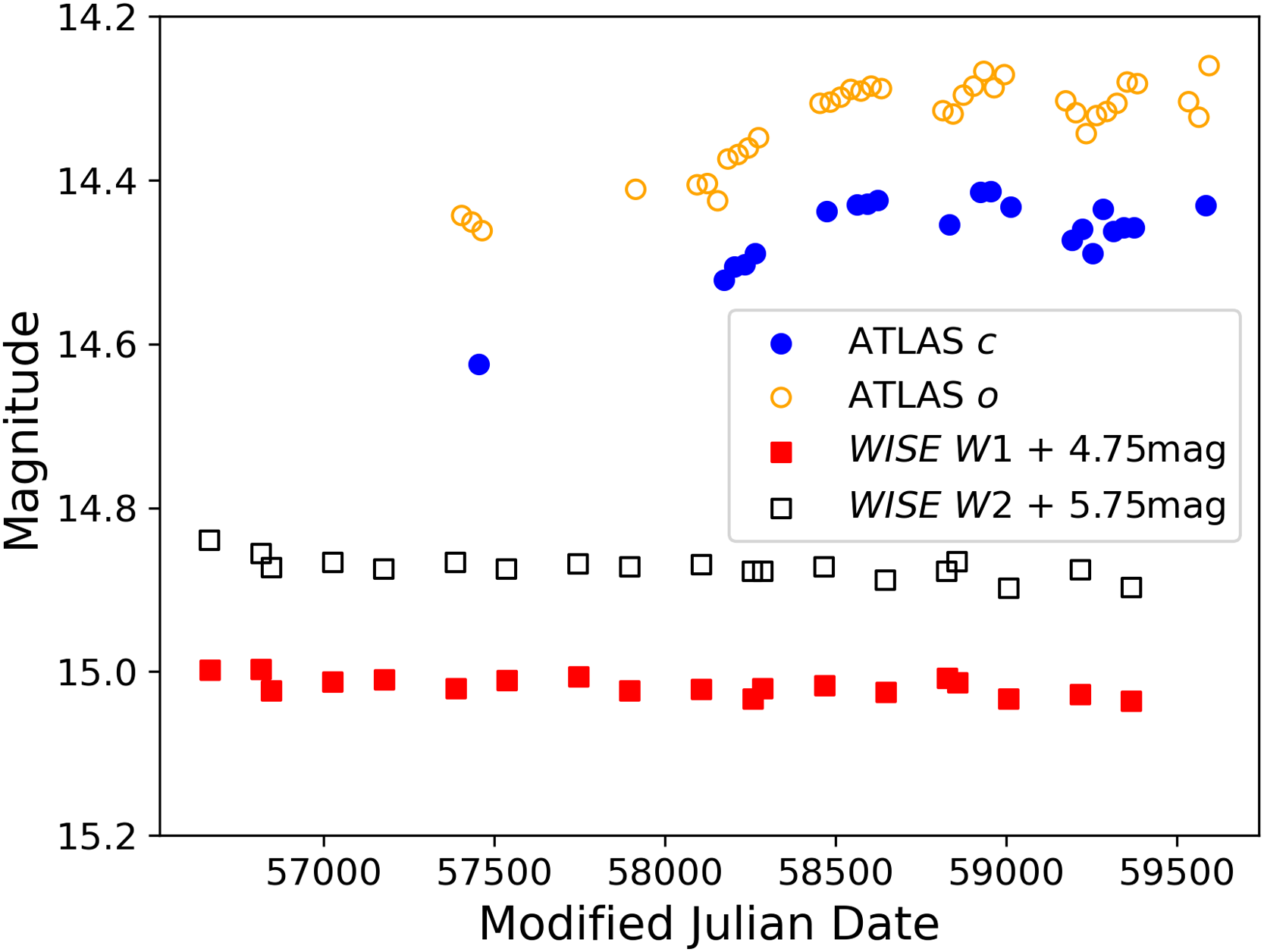
In contrast to the ATLAS photometry, J1144 exhibits a very slight fading in both IR bands over that time period, with an amplitude of ${\sim}0.05$
mag, comparable to the level of intraday photometric scatter. This uncorrelated behaviour can be understood in the context of the multi-year time lags for dust reverberation that would be expected from the large dust sublimation radius implied by the high luminosity of J1144. For the luminosity of J1144 (
${\sim}0.05$
mag, comparable to the level of intraday photometric scatter. This uncorrelated behaviour can be understood in the context of the multi-year time lags for dust reverberation that would be expected from the large dust sublimation radius implied by the high luminosity of J1144. For the luminosity of J1144 ( $1.2 \times 10^{14}\,\mathrm{L}_{\odot}$
), the predicted time lag for the IR response to optical variations would be 9.7 yr (Lyu, Rieke, & Smith Reference Lyu, Rieke and Smith2019), slightly longer than the time span shown in Figure 3. Thus, the steadiness of the IR photometry since the start of WISE operations implies no significant and lengthy changes in the quasar luminosity over the past
$1.2 \times 10^{14}\,\mathrm{L}_{\odot}$
), the predicted time lag for the IR response to optical variations would be 9.7 yr (Lyu, Rieke, & Smith Reference Lyu, Rieke and Smith2019), slightly longer than the time span shown in Figure 3. Thus, the steadiness of the IR photometry since the start of WISE operations implies no significant and lengthy changes in the quasar luminosity over the past ${\sim}$
20 yr.
${\sim}$
20 yr.
As the recent increase in luminosity shown by the ATLAS light curves propagates into the dust surrounding the quasar, we could expect to see the IR similarly brighten within the next decade. However, the relative amplitude of IR variability in response to optical fluctuations is extremely broad, between factors of 0.1 and 10 for high-luminosity, high-time-lag sources (Lyu et al. Reference Lyu, Rieke and Smith2019, cf. their Figure 14). Future monitoring by WISE and the Dynamic REd All-sky Monitoring Survey (DREAMS; Soon et al. Reference Soon2020) may reveal the amplitude of the dust response in J1144.
4.3 X-ray data
In X-rays, there are no point-source counterparts to J1144 catalogued in the Second ROSAT all-sky X-ray Survey (2RXS; Boller et al. Reference Boller2016). Cross-matching confirmed quasars from Milliquas, approximately 75% of the Gaia $G<16$
mag (Vega) quasars in the redshift range
$G<16$
mag (Vega) quasars in the redshift range $z=0.7-0.9$
have 2RXS counterparts. For our extinction-corrected 2500 Å flux of
$z=0.7-0.9$
have 2RXS counterparts. For our extinction-corrected 2500 Å flux of $F_{\nu} = 3.8\times10^{-26}\,\mathrm{erg\,s}^{-1}\,\mathrm{cm}^{-2}\,\mathrm{Hz}^{-1}$
, we would expect a 2 keV X-ray flux of
$F_{\nu} = 3.8\times10^{-26}\,\mathrm{erg\,s}^{-1}\,\mathrm{cm}^{-2}\,\mathrm{Hz}^{-1}$
, we would expect a 2 keV X-ray flux of ${\sim}2\times10^{-30}\,\mathrm{erg\,s}^{-1}\,\mathrm{cm}^{-2}\,\mathrm{Hz}^{-1}$
(Bisogni et al. Reference Bisogni2021), roughly a factor of 10 greater than the nominal 2RXS flux limit (Boller et al. Reference Boller2016). Whether the non-detection is an indication of intrinsic X-ray weakness or absorption (local to the quasar or intervening) may be clarified by forthcoming data releases from SRG/eROSITA (the Spectrum-Roentgen-Gamma satellite’s extended ROentgen Survey with an Imaging Telescope Array; Predehl et al. Reference Predehl2021).
${\sim}2\times10^{-30}\,\mathrm{erg\,s}^{-1}\,\mathrm{cm}^{-2}\,\mathrm{Hz}^{-1}$
(Bisogni et al. Reference Bisogni2021), roughly a factor of 10 greater than the nominal 2RXS flux limit (Boller et al. Reference Boller2016). Whether the non-detection is an indication of intrinsic X-ray weakness or absorption (local to the quasar or intervening) may be clarified by forthcoming data releases from SRG/eROSITA (the Spectrum-Roentgen-Gamma satellite’s extended ROentgen Survey with an Imaging Telescope Array; Predehl et al. Reference Predehl2021).
4.4 Radio data
The closest radio detection in DR1 of the Rapid ASKAP Continuum SurveyFootnote n (RACS; McConnell et al. Reference McConnell2020; Hale et al. Reference Hale2021) is 48 arcsec from J1144, which at $z=0.83$
corresponds to more than 350 kpc projected distance. If we assume an association between J1144 and RACS-DR1 J114451.8-430920, then the flux density of
$z=0.83$
corresponds to more than 350 kpc projected distance. If we assume an association between J1144 and RACS-DR1 J114451.8-430920, then the flux density of $5.1\pm0.5$
mJy at 887.5 MHz implies a rest-frame 5 GHz luminosity density of
$5.1\pm0.5$
mJy at 887.5 MHz implies a rest-frame 5 GHz luminosity density of $7.6\times10^{31}\,\mathrm{erg\,s}^{-1}\,\mathrm{Hz}^{-1}$
(for a spectral index of
$7.6\times10^{31}\,\mathrm{erg\,s}^{-1}\,\mathrm{Hz}^{-1}$
(for a spectral index of $\nu^{-0.6}$
). For an optical (rest-frame 4400 Å) luminosity density of
$\nu^{-0.6}$
). For an optical (rest-frame 4400 Å) luminosity density of $1.4\times10^{32}\,\mathrm{erg\,s}^{-1}\,\mathrm{Hz}^{-1}$
(derived from the global power-law continuum shown in Figure 1), this gives an upper limit to the radio-loudness (using the definition of Kellermann et al. Reference Kellermann, Sramek, Schmidt, Shaffer and Green1989) of
$1.4\times10^{32}\,\mathrm{erg\,s}^{-1}\,\mathrm{Hz}^{-1}$
(derived from the global power-law continuum shown in Figure 1), this gives an upper limit to the radio-loudness (using the definition of Kellermann et al. Reference Kellermann, Sramek, Schmidt, Shaffer and Green1989) of $R < 0.54$
. Thus, even a putative associationFootnote o between the RACS DR1 source and J1144 leaves the quasar in the radio-quiet regime.
$R < 0.54$
. Thus, even a putative associationFootnote o between the RACS DR1 source and J1144 leaves the quasar in the radio-quiet regime.
The absence of strong X-ray and radio emission, in conjunction with the low levels of UV-to-IR variability, make it unlikely for J1144 to have a relativistically beamed jet. Thus, we conclude that J1144 is not a blazar.
4.5 On the possibility of gravitational lensing
Given the high luminosity, it is natural to wonder if the source is gravitationally lensed (e.g., Fan et al. Reference Fan2019). To check for a small-separation galaxy lens, we examine the corrected $B_{P}$
and
$B_{P}$
and $R_{P}$
flux excess,
$R_{P}$
flux excess, $C^{*}$
, from Gaia EDR3 (Riello et al. Reference Riello2021), which makes a standardised comparison between the flux measured in the 0.35-arcsec-wide G-band photometric aperture with the integrated fluxes measured in the 3.5-arcsec-wide apertures for the
$C^{*}$
, from Gaia EDR3 (Riello et al. Reference Riello2021), which makes a standardised comparison between the flux measured in the 0.35-arcsec-wide G-band photometric aperture with the integrated fluxes measured in the 3.5-arcsec-wide apertures for the $B_{P}$
and
$B_{P}$
and $R_{P}$
photometry (integrating along the wavelength dimension of the low-resolution spectra). With
$R_{P}$
photometry (integrating along the wavelength dimension of the low-resolution spectra). With $C^{*} = 0.023$
, the variation in flux measured by the different extraction apertures for the Gaia photometry is within 2
$C^{*} = 0.023$
, the variation in flux measured by the different extraction apertures for the Gaia photometry is within 2 $\sigma$
of the 0-value expected for point sources of the brightness of J1144 (where
$\sigma$
of the 0-value expected for point sources of the brightness of J1144 (where $\sigma = 0.012$
). Amongst the small-separation gravitationally lensed quasarsFootnote p that are associated with a single Gaia EDR3 source, Q1208+101 has the smallest
$\sigma = 0.012$
). Amongst the small-separation gravitationally lensed quasarsFootnote p that are associated with a single Gaia EDR3 source, Q1208+101 has the smallest $C^{*}$
value at 0.168, a factor of 7 times larger than J1144. Similarly, the G-band variability proxy of Mowlavi et al. (Reference Mowlavi2021) has a value of 0.015, suggesting that the Gaia small-aperture measurements across a range of scan directions have found peak-to-peak flux variations of
$C^{*}$
value at 0.168, a factor of 7 times larger than J1144. Similarly, the G-band variability proxy of Mowlavi et al. (Reference Mowlavi2021) has a value of 0.015, suggesting that the Gaia small-aperture measurements across a range of scan directions have found peak-to-peak flux variations of ${\sim}0.05$
mag (cf. their Section 3).
${\sim}0.05$
mag (cf. their Section 3).
While we conclude that there is no indication of gravitational lensing for J1144 in the existing Gaia data, the lack of microlensing-induced flux variations evident in the recent photometric sampling described above cannot fully exclude the existence of a lensing galaxy, as Mosquera & Kochanek (Reference Mosquera and Kochanek2011) found that roughly half of lensed quasars are likely to be in a ‘demagnified valley’ in any given 10-yr period. Thus, a high-spatial-resolution imaging study of J1144 would be of great interest.
5. Comparison with other bright quasars
As the single brightest quasar in the sky, 3C 273 is an important benchmark for luminous quasars, as its long observational history and low redshift have made it a forefront laboratory for exploring accretion processes (e.g., Courvoisier Reference Courvoisier1998; Gravity Collaboration et al. Reference Gravity Collaboration2018). Moreover, the presence of the strong radio jet, with synchrotron emission that extends into the optical regime, has opened a window into the relatively rare class of radio-loud quasars (e.g., Bahcall et al. Reference Bahcall1995; Jester et al. Reference Jester, Röser, Meisenheimer and Perley2005; Uchiyama et al. Reference Uchiyama2006).
In Figure 4, we compare the rest-frame UV-to-IR spectral energy distribution (SED) of J1144 from recent data to the minimum and maximum luminosities of 3C 273 (including synchrotron flares), as observed over a 40-yr spanFootnote q (Türler et al. Reference Türler1999; Soldi et al. Reference Soldi2008), as well as to SMSS J2157-3602, the most luminous known quasar in the Universe, at a redshift of $z=4.692$
(Wolf et al. Reference Wolf2018b; Onken et al. Reference Onken2020). The J1144 SED is derived from a subset of the photometry presented in Table 4, namely, that of SMSS DR3 (u, v, g, r, i, z), 2MASS (J, H, K),Footnote r and AllWISE (W1, W2, W3, W4). The photometry in Figure 4 was corrected for Galactic extinction up to an observed-frame wavelength of 3
$z=4.692$
(Wolf et al. Reference Wolf2018b; Onken et al. Reference Onken2020). The J1144 SED is derived from a subset of the photometry presented in Table 4, namely, that of SMSS DR3 (u, v, g, r, i, z), 2MASS (J, H, K),Footnote r and AllWISE (W1, W2, W3, W4). The photometry in Figure 4 was corrected for Galactic extinction up to an observed-frame wavelength of 3 $\unicode{x03BC}$
m using the Fitzpatrick et al. (Reference Fitzpatrick, Massa, Gordon, Bohlin and Clayton2019) extinction curve, a standard
$\unicode{x03BC}$
m using the Fitzpatrick et al. (Reference Fitzpatrick, Massa, Gordon, Bohlin and Clayton2019) extinction curve, a standard $R_{V}$
=3.1 Milky Way dust model, and the Schlegel et al. (Reference Schlegel, Finkbeiner and Davis1998) E(B-V) values of 0.123, 0.021, and 0.015 mag for J1144, 3C 273, and SMSS J2157, respectively, with the
$R_{V}$
=3.1 Milky Way dust model, and the Schlegel et al. (Reference Schlegel, Finkbeiner and Davis1998) E(B-V) values of 0.123, 0.021, and 0.015 mag for J1144, 3C 273, and SMSS J2157, respectively, with the $\times0.86$
correction factor of Schlafly & Finkbeiner (Reference Schlafly and Finkbeiner2011). As with the spectroscopic calibration above, the bandpass details were retrieved from the SVO. The SMSS u- and v-band photometry were also corrected with the stellar-colour regression method of Huang et al. (Reference Huang2021), which makes them 0.088 and 0.069 mag fainter, respectively. (The corrections for g- and r-band are less than 0.01 mag and are therefore omitted.)
$\times0.86$
correction factor of Schlafly & Finkbeiner (Reference Schlafly and Finkbeiner2011). As with the spectroscopic calibration above, the bandpass details were retrieved from the SVO. The SMSS u- and v-band photometry were also corrected with the stellar-colour regression method of Huang et al. (Reference Huang2021), which makes them 0.088 and 0.069 mag fainter, respectively. (The corrections for g- and r-band are less than 0.01 mag and are therefore omitted.)
Rest-frame SED for J1144 (red circles) compared to the 40-yr range of luminosities of 3C 273 (grey shaded region) from Soldi et al. (Reference Soldi2008), and to SMSS J2157 (blue stars), the most luminous known quasar. All three sources have been corrected for Galactic extinction. Single-epoch uncertainties for the J1144 photometry are smaller than the symbols. Three quasar templates from Lyu et al. (Reference Lyu, Rieke and Shi2017) are also shown: normal (solid), hot-dust-deficient (HDD; dotted), and warm-dust-deficient (WDD; dashed). The inset shows an expanded range in order to include the potential J1144 radio association from RACS DR1 as an upper limit (arrow) and to indicate the difference in long-wavelength slope from radio-loud quasars like 3C 273.
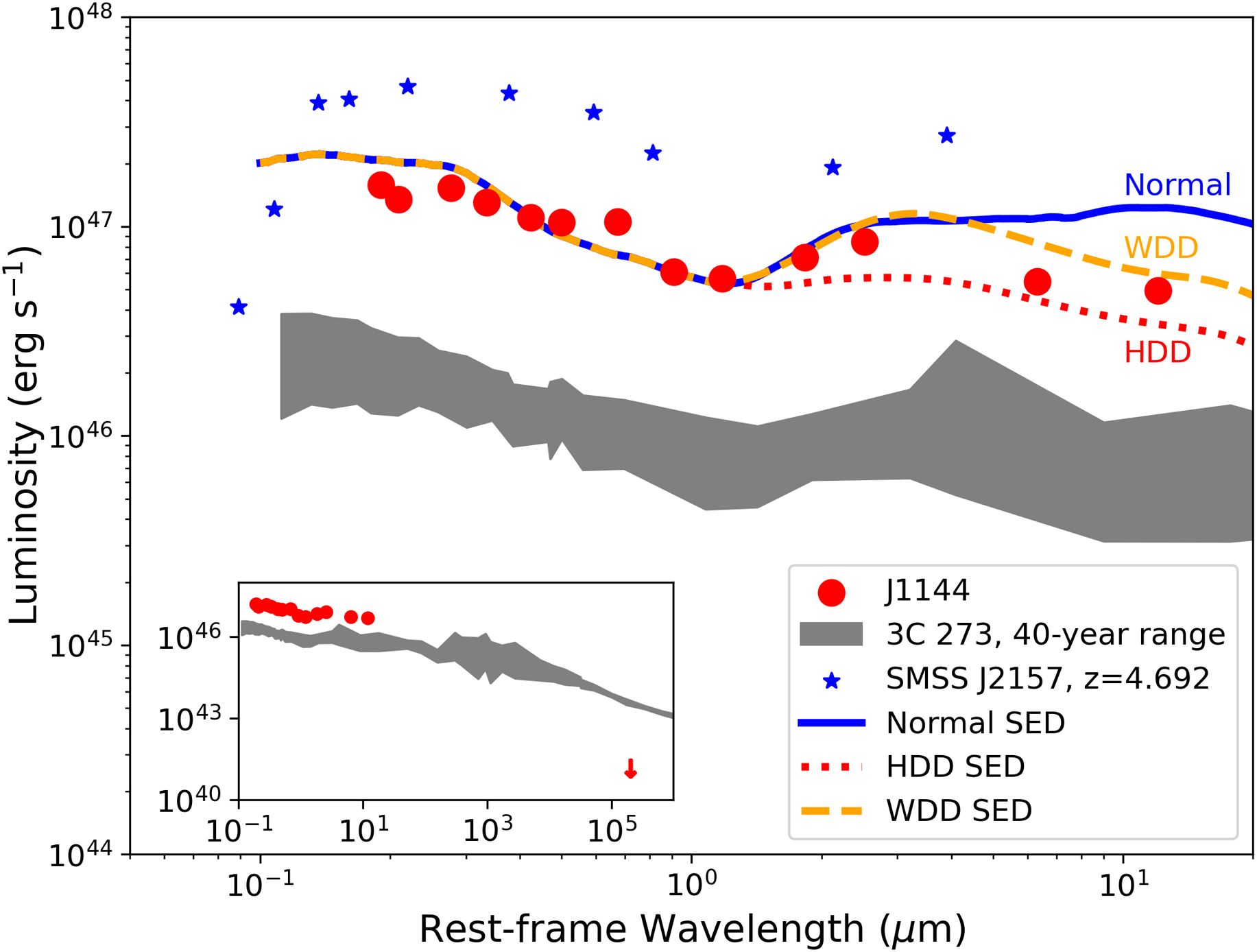
Across the entire observed UV/optical range, J1144 has an intrinsic luminosity that is roughly 8 times greater than the brightest observations of 3C 273, and only about 3 times less than the most luminous quasar known. Even with the occasional synchrotron flares elevating the peak luminosities of 3C 273 in the IR, the blazar has remained ${\sim}5\times$
less luminous than J1144. The inset in Figure 4 includes the maximum potential radio luminosity observed for J1144, on the assumption of the RACS DR1 detection being associated with the quasar, illustrating the dramatic difference in the long-wavelength SED of radio-quiet quasars compared to radio-loud sources such as 3C 273.
${\sim}5\times$
less luminous than J1144. The inset in Figure 4 includes the maximum potential radio luminosity observed for J1144, on the assumption of the RACS DR1 detection being associated with the quasar, illustrating the dramatic difference in the long-wavelength SED of radio-quiet quasars compared to radio-loud sources such as 3C 273.
In Figure 4, we also show three SED templatesFootnote s (Lyu, Rieke, & Shi Reference Lyu, Rieke and Shi2017) exhibiting different mid-IR dust properties. The ‘Normal SED’ represents the typical broad-line quasar SED, while the hot-dust-deficient (HDD) and warm-dust-deficient (WDD) templates show reduced emission at shorter and longer mid-IR wavelengths, respectively. With the templates anchored to match the J1144 SED near 1 $\unicode{x03BC}$
m, the WISE photometry suggests that J1144 is an intermediate case and may be somewhat lacking in dust close to the quasar.
$\unicode{x03BC}$
m, the WISE photometry suggests that J1144 is an intermediate case and may be somewhat lacking in dust close to the quasar.
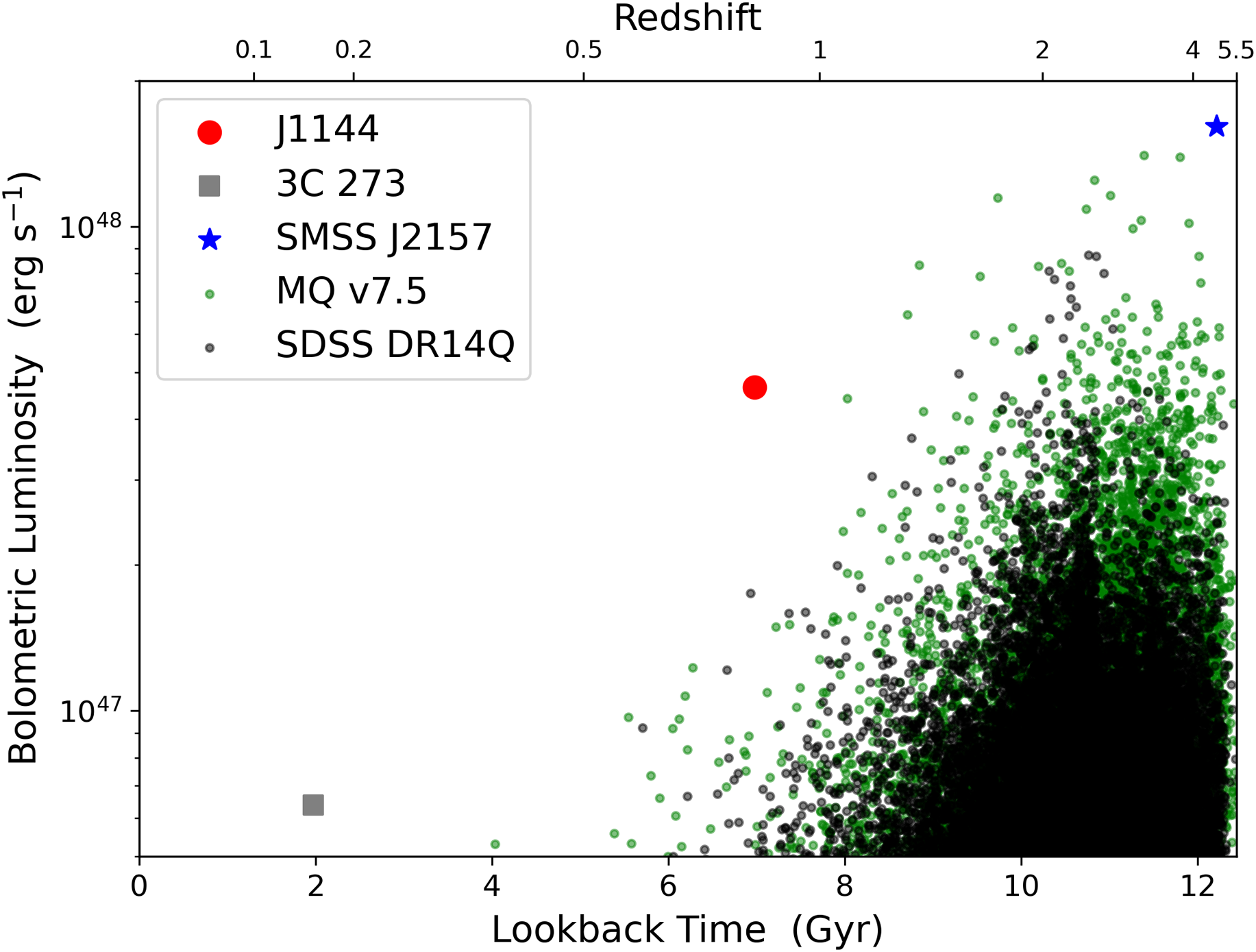
Bolometric luminosity of J1144 (large red point), 3C 273 (grey square), and SMSS J2157 (blue star), compared to sources from the SDSS DR14 quasar catalogue (DR14Q; black points; Rakshit et al. Reference Rakshit, Stalin and Kotilainen2020) and Milliquas (MQ; green points), shown as a function of lookback time (bottom axis) and redshift (top axis). No known quasars are as luminous as J1144 in the last 9 Gyr, and J1144 is only a factor of 2 dimmer than the most luminous known quasar, SMSS J2157.
In addition, we note the similarity between the optical spectra of J1144 (Figures 1 and 2) and 3C 273 (Dietrich et al. Reference Dietrich, Wagner, Courvoisier, Bock and North1999), with prominent Balmer lines and comparatively weak [Oiii] emission, suggesting a commonality in their central engines despite the differences in their radio properties. Compared to the sample of bright quasars analysed by BG92, J1144 is on the strong-Feii/weak-[Oiii] end of their ‘Eigenvector 1’ correlation, although the Feii equivalent widthFootnote t (EW) of ${\sim}40$
Å is typical of radio-quiet quasars. The ratio of Feii-to-H
${\sim}40$
Å is typical of radio-quiet quasars. The ratio of Feii-to-H $\unicode{x03B2}$
EWs of 1.5 is at the high end of their distribution, but J1144 does not exhibit the enhanced blue H
$\unicode{x03B2}$
EWs of 1.5 is at the high end of their distribution, but J1144 does not exhibit the enhanced blue H $\unicode{x03B2}$
asymmetry often seen for such sources.
$\unicode{x03B2}$
asymmetry often seen for such sources.
In Figure 5, we compare the J1144 bolometric luminosity estimated in Section 3.1 to 3C 273, SMSS J2157, and a large number of quasars, drawn from either the SDSS DR14 quasar catalogue (DR14Q; Rakshit, Stalin, & Kotilainen Reference Rakshit, Stalin and Kotilainen2020) or Milliquas, as a function of lookback time. In order to use a consistent bolometric correction, we estimate the continuum luminosities at 3000 Å for the literature sources. For 3C 273, we use the mean U-band flux from the 40-yr dataset of the ISDC. DR14Q values use the 3000 Å luminosity tabulated in the catalogue, or, at higher or lower redshifts, respectively, estimate $\log_{10}$
(
$\log_{10}$
( $\lambda\,L_{\lambda}(3000)$
) from the 1350 Å luminosity as
$\lambda\,L_{\lambda}(3000)$
) from the 1350 Å luminosity as $4.887\,+\,0.89\,\log_{10}$
(
$4.887\,+\,0.89\,\log_{10}$
( $\lambda\,L_{\lambda}(1350)$
) or from the 5100 Å luminosity as
$\lambda\,L_{\lambda}(1350)$
) or from the 5100 Å luminosity as $9.213\,+\,0.792\,\log_{10}$
(
$9.213\,+\,0.792\,\log_{10}$
( $\lambda\,L_{\lambda}(5100)$
), based on the best-fit relations from the DR14Q sources having both luminosities estimated. Sources with non-zero QUALITY_L3000 values were excluded. The varied literature sources compiled in Milliquas were cross-matched to the Gaia catalogue and an empirical scaling from the
$\lambda\,L_{\lambda}(5100)$
), based on the best-fit relations from the DR14Q sources having both luminosities estimated. Sources with non-zero QUALITY_L3000 values were excluded. The varied literature sources compiled in Milliquas were cross-matched to the Gaia catalogue and an empirical scaling from the $R_{p}$
photometry to the 3000 Å luminosity as a function of redshift was applied.Footnote u The Milliquas sample has been restricted to sources with spectroscopic redshifts; cleaned of lensed sources, blazars, and a few spurious objects (including those with
$R_{p}$
photometry to the 3000 Å luminosity as a function of redshift was applied.Footnote u The Milliquas sample has been restricted to sources with spectroscopic redshifts; cleaned of lensed sources, blazars, and a few spurious objects (including those with $>3\sigma$
parallax or proper motion estimates); and has omitted quasars from SDSS (to avoid duplication). Beyond
$>3\sigma$
parallax or proper motion estimates); and has omitted quasars from SDSS (to avoid duplication). Beyond $z=5.5$
, very few Milliquas sources have Gaia photometry.
$z=5.5$
, very few Milliquas sources have Gaia photometry.
As can be seen from Figure 5, J1144 is the most luminous known quasar out to $z=1.29$
, a lookback time of 8.7 Gyr, beyond which the quasar, HS 2154+2228 (Hagen, Engels, & Reimers Reference Hagen, Engels and Reimers1999), is the first of a small sample of quasars found to be more luminous, up to the pinnacle of SMSS J2157. With an extinction-corrected i-band magnitude of 14.059 mag (AB), J1144 is nearly 1 full magnitude brighter than the SDSS cutoff at
$z=1.29$
, a lookback time of 8.7 Gyr, beyond which the quasar, HS 2154+2228 (Hagen, Engels, & Reimers Reference Hagen, Engels and Reimers1999), is the first of a small sample of quasars found to be more luminous, up to the pinnacle of SMSS J2157. With an extinction-corrected i-band magnitude of 14.059 mag (AB), J1144 is nearly 1 full magnitude brighter than the SDSS cutoff at $i_{\mathrm{SDSS}}=15$
mag (AB) and nearly 1.5 mag brighter in
$i_{\mathrm{SDSS}}=15$
mag (AB) and nearly 1.5 mag brighter in $M_{i}(z=2)$
than any source actually found in the SDSS DR3 quasar luminosity function at redshifts below
$M_{i}(z=2)$
than any source actually found in the SDSS DR3 quasar luminosity function at redshifts below $z=0.9$
(Richards et al. Reference Richards2006).
$z=0.9$
(Richards et al. Reference Richards2006).
6. Discussion
The location of J1144 falls within a small gap in the GALEX All-Sky Imaging Survey (AIS; Martin et al. Reference Martin2005), which explains why it did not appear in DR1 of the UVQS (Monroe et al. Reference Monroe2016). Utilising ${\sim}3000$
known quasars from Milliquas in the same redshift range as J1144, for which both GALEX and Gaia photometry exist, we use the
${\sim}3000$
known quasars from Milliquas in the same redshift range as J1144, for which both GALEX and Gaia photometry exist, we use the $FUV-G$
and
$FUV-G$
and $NUV-G$
colours to predict J1144 to have (FUV, NUV) = (17, 16) mag (AB), with uncertainties of roughly 1 mag in each band. With
$NUV-G$
colours to predict J1144 to have (FUV, NUV) = (17, 16) mag (AB), with uncertainties of roughly 1 mag in each band. With $FUV=17$
mag (AB), J1144 would have been amongst the top 10% of the brightest discoveries by UVQS DR1, but at a redshift 0.2 higher than the rest.
$FUV=17$
mag (AB), J1144 would have been amongst the top 10% of the brightest discoveries by UVQS DR1, but at a redshift 0.2 higher than the rest.
The high luminosity of J1144 also implies a large size for its BLR. Extrapolating the radius–luminosity relation of Bentz et al. (Reference Bentz2013) to the 5100 Å luminosity of J1144 suggests an H $\unicode{x03B2}$
-emitting size of
$\unicode{x03B2}$
-emitting size of ${\sim}1200$
light-days. With the additional time-dilation factor of
${\sim}1200$
light-days. With the additional time-dilation factor of ${\sim}2$
, a reverberation mapping campaign would be a long-term endeavour. However, the angular size of the BLR is expected to be in excess of 100 microarcsec. Since J1144 has a K-band magnitude of 11.9 mag (Vega), its BLR will be well within the reach of the upgraded GRAVITY+ instrumentFootnote v at ESO’s Very Large Telescopes. Thus, it may be possible to measure the Pa
${\sim}2$
, a reverberation mapping campaign would be a long-term endeavour. However, the angular size of the BLR is expected to be in excess of 100 microarcsec. Since J1144 has a K-band magnitude of 11.9 mag (Vega), its BLR will be well within the reach of the upgraded GRAVITY+ instrumentFootnote v at ESO’s Very Large Telescopes. Thus, it may be possible to measure the Pa $\unicode{x03B2}$
dynamics in J1144, comparable to the Pa
$\unicode{x03B2}$
dynamics in J1144, comparable to the Pa $\unicode{x03B1}$
measurement for 3C 273 (Gravity Collaboration et al. Reference Gravity Collaboration2018).
$\unicode{x03B1}$
measurement for 3C 273 (Gravity Collaboration et al. Reference Gravity Collaboration2018).
Additional studies may make productive use of an exceptionally bright quasar like J1144 as a background source. For example, UV spectroscopy of J1144 may probe the Milky Way’s circumgalactic medium (Tumlinson, Peeples, & Werk Reference Tumlinson, Peeples and Werk2017; Zheng et al. Reference Zheng, Peek, Putman and Werk2019; Bish et al. Reference Bish, Werk, Peek, Zheng and Putman2021).
Previous searches for quasars and other blue objects in the Southern hemisphere have usually not reached as close to the Galactic Plane as J1144, which lies at $b=+18.1^{\circ}$
. For example, the Edinburgh-Cape Blue Object Survey (Stobie et al. Reference Stobie1997; Kilkenny et al. Reference Kilkenny2016) was restricted to
$b=+18.1^{\circ}$
. For example, the Edinburgh-Cape Blue Object Survey (Stobie et al. Reference Stobie1997; Kilkenny et al. Reference Kilkenny2016) was restricted to $|b|>30^{\circ}$
; the Hamburg/ESO quasar survey (Wisotzki et al. Reference Wisotzki, Koehler, Groote and Reimers1996; Wisotzki et al. Reference Wisotzki2000) searched at
$|b|>30^{\circ}$
; the Hamburg/ESO quasar survey (Wisotzki et al. Reference Wisotzki, Koehler, Groote and Reimers1996; Wisotzki et al. Reference Wisotzki2000) searched at $|b|>25^{\circ}$
; and the Calán-Tololo Survey (Maza et al. Reference Maza, Ruiz, Gonzalez, Wischnjewski, Blanco and Phillips1988; Maza, Wischnjewsky, & Antezana Reference Maza, Wischnjewsky and Antezana1996) observed to
$|b|>25^{\circ}$
; and the Calán-Tololo Survey (Maza et al. Reference Maza, Ruiz, Gonzalez, Wischnjewski, Blanco and Phillips1988; Maza, Wischnjewsky, & Antezana Reference Maza, Wischnjewsky and Antezana1996) observed to $|b|>20^{\circ}$
. Dedicated quasar searches closer to the Galactic Plane (e.g., Im et al. Reference Im2007; Fu et al. Reference Fu2021) may produce samples of objects useful both in their own right and for studies of the gas and dust near the Galactic disk.
$|b|>20^{\circ}$
. Dedicated quasar searches closer to the Galactic Plane (e.g., Im et al. Reference Im2007; Fu et al. Reference Fu2021) may produce samples of objects useful both in their own right and for studies of the gas and dust near the Galactic disk.
Moreover, the discovery power inherent in the recent generation of all-sky surveys like those of Gaia, WISE, and eROSITA motivate a fresh examination of what other bright quasars may have been missed in previous searches across the celestial sphere. A spectroscopic campaign underway at the ANU 2.3 m telescope has already identified ${\sim}80$
new, bright quasars (in addition to J1144), some with Galactic latitudes in excess of 60 deg. Thus, after 60 yr, it would appear we are finally approaching a complete census of bright quasars, with only the discovery of Changing Look Quasars (CLQ; e.g., LaMassa et al. Reference LaMassa2015) from forthcoming surveys likely to add to the sample.
${\sim}80$
new, bright quasars (in addition to J1144), some with Galactic latitudes in excess of 60 deg. Thus, after 60 yr, it would appear we are finally approaching a complete census of bright quasars, with only the discovery of Changing Look Quasars (CLQ; e.g., LaMassa et al. Reference LaMassa2015) from forthcoming surveys likely to add to the sample.
Acknowledgement
We thank the anonymous referee for feedback that helped to improve the manuscript. We thank Mara Salvato and Tom Dwelly for fruitful discussions on the X-ray properties, Lisa Crause for helpful input on SpUpNIC, Elaine Sadler for useful discussions on radio counterparts, and David McConnell and Emil Lenc for stimulating discussions on radio astrometry. ABL thanks the rest of the symbiotic star search team, including K. Mukai, H. Breytenbach, D. Buckley, S. Potter, P. Woudt, P. Groot, B. Paul, N. Nuñez, A. Howell, M. Shara, and D. Zurek, as well as the staff and observers of the American Association of Variable Star Observers and the Astronomical Ring for Access to Spectroscopy. We acknowledge the traditional owners of the land on which the telescopes of Siding Spring Observatory stand, the Kamilaroi people, and pay our respects to their elders, past and present.
CAO was supported by the Australian Research Council (ARC) through Discovery Project DP190100252. ABL and JLS acknowledge support through National Science Foundation (NSF) grant AST-1616646.
The national facility capability for SkyMapper has been funded through ARC LIEF grant LE130100104 from the Australian Research Council, awarded to the University of Sydney, the Australian National University, Swinburne University of Technology, the University of Queensland, the University of Western Australia, the University of Melbourne, Curtin University of Technology, Monash University and the Australian Astronomical Observatory. SkyMapper is owned and operated by The Australian National University’s Research School of Astronomy and Astrophysics. The survey data were processed and provided by the SkyMapper Team at ANU. The SkyMapper node of the All-Sky Virtual Observatory (ASVO) is hosted at the National Computational Infrastructure (NCI). Development and support the SkyMapper node of the ASVO has been funded in part by Astronomy Australia Limited (AAL) and the Australian Government through the Commonwealth’s Education Investment Fund (EIF) and National Collaborative Research Infrastructure Strategy (NCRIS), particularly the National eResearch Collaboration Tools and Resources (NeCTAR) and the Australian National Data Service Projects (ANDS).
This paper uses observations made at the South African Astronomical Observatory (SAAO).
Based on observations obtained at the Southern Astrophysical Research (SOAR) telescope, which is a joint project of the Ministério da Ciência, Tecnologia e Inovações (MCTI/LNA) do Brasil, the US National Science Foundation’s NOIRLab, the University of North Carolina at Chapel Hill (UNC), and Michigan State University (MSU).
This publication makes use of data products from the Wide-field Infrared Survey Explorer, which is a joint project of the University of California, Los Angeles, and the Jet Propulsion Laboratory/California Institute of Technology, and NEOWISE, which is a project of the Jet Propulsion Laboratory/California Institute of Technology. WISE and NEOWISE are funded by the National Aeronautics and Space Administration.
This paper uses data from the VISTA Hemisphere Survey ESO programme ID: 179.A-2010 (PI. McMahon). The VISTA Data Flow System pipeline processing and science archive are described in Irwin et al. (Reference Irwin, Quinn and Bridger2004), Hambly et al. (Reference Hambly2008) and Cross et al. (Reference Cross2012).
IRAF was distributed by the National Optical Astronomy Observatory, which was managed by the Association of Universities for Research in Astronomy (AURA) under a cooperative agreement with the NSF.
We acknowledge use of the International Centre for Radio Astronomy Research (ICRAR) Cosmology Calculator written by Aaron Robotham and Joseph Dunne, and available at https://cosmocalc.icrar.org.
This research has made use of the NASA/IPAC Extragalactic Database (NED), which is funded by the National Aeronautics and Space Administration and operated by the California Institute of Technology. This research has made use of the SIMBAD database, operated at CDS, Strasbourg, France. This research has made use of ‘Aladin sky atlas’ developed at CDS, Strasbourg Observatory, France.
SuperCOSMOS Sky Survey material is based on photographic data originating from the UK, Palomar and ESO Schmidt telescopes and is provided by the Wide-Field Astronomy Unit, Institute for Astronomy, University of Edinburgh.
This work has made use of data from the Asteroid Terrestrial-impact Last Alert System (ATLAS) project. The Asteroid Terrestrial-impact Last Alert System (ATLAS) project is primarily funded to search for near earth asteroids through NASA grants NN12AR55G, 80NSSC18K0284, and 80NSSC18K1575; by-products of the NEO search include images and catalogs from the survey area. This work was partially funded by Kepler/K2 grant J1944/80NSSC19K0112 and HST GO-15889, and STFC grants ST/T000198/1 and ST/S006109/1. The ATLAS science products have been made possible through the contributions of the University of Hawaii Institute for Astronomy, the Queen’s University Belfast, the Space Telescope Science Institute, the South African Astronomical Observatory, and The Millennium Institute of Astrophysics (MAS), Chile.
Funding for the TESS mission is provided by NASA’s Science Mission directorate. This paper includes data collected by the TESS mission, which are publicly available from the Mikulski Archive for Space Telescopes (MAST). This research made use of Lightkurve, a Python package for Kepler and TESS data analysis (Lightkurve Collaboration et al. Reference Gravity Collaboration2018). This research made use of Astropy,Footnote w a community-developed core Python package for Astronomy (Astropy Collaboration et al. Reference Astropy Collaboration2013; Astropy Collaboration et al. Reference Gravity Collaboration2018). This research made use of the astroquery (Ginsburg et al. 2019) and Astrocut (Brasseur et al. Reference Brasseur, Phillip, Fleming, Mullally and White2019) packages for Python.
This project used data obtained with the Dark Energy Camera (DECam), which was constructed by the Dark Energy Survey (DES) collaboration. Funding for the DES Projects has been provided by the US Department of Energy, the US National Science Foundation, the Ministry of Science and Education of Spain, the Science and Technology Facilities Council of the United Kingdom, the Higher Education Funding Council for England, the National Center for Supercomputing Applications at the University of Illinois at Urbana-Champaign, the Kavli Institute for Cosmological Physics at the University of Chicago, Center for Cosmology and Astro-Particle Physics at the Ohio State University, the Mitchell Institute for Fundamental Physics and Astronomy at Texas A&M University, Financiadora de Estudos e Projetos, Fundação Carlos Chagas Filho de Amparo à Pesquisa do Estado do Rio de Janeiro, Conselho Nacional de Desenvolvimento Científico e Tecnológico and the Ministério da Ciência, Tecnologia e Inovação, the Deutsche Forschungsgemeinschaft and the Collaborating Institutions in the Dark Energy Survey. The Collaborating Institutions are Argonne National Laboratory, the University of California at Santa Cruz, the University of Cambridge, Centro de Investigaciones Enérgeticas, Medioambientales y Tecnológicas–Madrid, the University of Chicago, University College London, the DES-Brazil Consortium, the University of Edinburgh, the Eidgenössische Technische Hochschule (ETH) Zürich, Fermi National Accelerator Laboratory, the University of Illinois at Urbana-Champaign, the Institut de Ciències de l’Espai (IEEC/CSIC), the Institut de Fisica d’Altes Energies, Lawrence Berkeley National Laboratory, the Ludwig-Maximilians Universität München and the associated Excellence Cluster Universe, the University of Michigan, the National Science Foundation’s NOIRLab, the University of Nottingham, the Ohio State University, the OzDES Membership Consortium, the University of Pennsylvania, the University of Portsmouth, SLAC National Accelerator Laboratory, Stanford University, the University of Sussex, and Texas A&M University. Based on observations at Cerro Tololo Inter-American Observatory, a programme of NOIRLab (NOIRLab Prop. ID 2017A-0260; PI: M. Soares-Santos; and Prop. ID 2019A-0272; PI: A. Zenteno), which is managed by AURA under a cooperative agreement with the NSF. This research draws upon DECam data as distributed by the Astro Data Archive at NSF’s NOIRLab. NOIRLab is managed by AURA under a cooperative agreement with the NSF.
This work has made use of data from the European Space Agency (ESA) mission Gaia (https://www.cosmos.esa.int/gaia), processed by the Gaia Data Processing and Analysis Consortium (DPAC, https://www.cosmos.esa.int/web/gaia/dpac/consortium). Funding for the DPAC has been provided by national institutions, in particular the institutions participating in the Gaia Multilateral Agreement.
The DASCH project at Harvard is grateful for partial support from NSF grants AST-0407380, AST-0909073, and AST-1313370.



