





Introduction
Understanding the complexity of the factors that lead to place of death is crucial for the provision of good end-of-life care. For many years, home death has been seen as an indicator of high-quality palliative care (Stajduhar and Davies Reference Stajduhar and Davies2005), and the general picture also shows that the majority of people wish to die at home (Ali et al. Reference Ali, Capel and Jones2019; Fereidouni et al. Reference Fereidouni, Rassouli and Salesi2021; García-Sanjuán et al. Reference García-Sanjuán, Fernández-Alcántara and Clement-Carbonell2022; Gomes et al. Reference Gomes, Calanzani and Gysels2013; Hoare et al. Reference Hoare, Morris and Kelly2015; van Doorne et al. Reference van Doorne, van Rijn and Dofferhoff2021; World Health Organization 2011). However, hospital is the most common place of death in Europe (Jarlbæk Reference Jarlbæk2017; Jiang and May Reference Jiang and May2021; Orlovic et al. Reference Orlovic, Marti and Mossialos2017) and Canada (Wilson et al. Reference Wilson, Shen and Errasti-Ibarrondo2018), but the least preferred place to die along with care homes (Calanzani et al. Reference Calanzani, Moens and Cohen2014). Despite preferences for place of death, the number of home deaths is projected to decrease to less than 1 in 10 in 2030 in England and Wales, and the number of institutional deaths, such as deaths at care home or hospital, is expected to increase by 20% (Gomes and Higginson Reference Gomes and Higginson2008). In recent years, there has been a growing emphasis on end-of-life decision-making and advanced care planning, involving discussions among patients, family members, caregivers, and healthcare professionals to anticipate future healthcare choices, including the preferred place of death (Abel et al. Reference Abel, Pring and Rich2013; Burghout et al. Reference Burghout, Nahar-van Venrooij and Bolt2023). A conceptual model developed by Gomes and Higginson identifies several key factors, which are determinants for place of death (Gomes and Higginson Reference Gomes and Higginson2006). This model emphasizes how place of death is influenced by an interplay between illness-related-, individual-, and environmental-factors (Gomes and Higginson Reference Gomes and Higginson2006), and it has inspired other studies within the field (Billingham and Billingham Reference Billingham and Billingham2013; Burge et al. Reference Burge, Lawson and Johnston2015; García-Sanjuán et al. Reference García-Sanjuán, Fernández-Alcántara and Clement-Carbonell2022; Gomes et al. Reference Gomes, Calanzani and Koffman2015). However, the Quality of Death and Dying Index finds that dying in the preferred place is less important than other aspects, for example managing pain or discomfort and being treated in a clean and safe place (Sepulveda et al. Reference Sepulveda, Baid and Johnson2022). This challenges the perception of home death as one of the important indicators of a good death (De Roo et al. Reference De Roo, Miccinesi and Onwuteaka-Philipsen2014; Pollock Reference Pollock2015). With the projected increase in institutional deaths, there is a pressing need for a deeper understanding of the factors influencing place of death to develop sufficient end-of-life care options (Gomes and Higginson Reference Gomes and Higginson2008). Existing literature on factors influencing place of death is often focused on one specific place of death, such as home death (Balasundram et al. Reference Balasundram, Holm and Benthien2023; Bannon et al. Reference Bannon, Cairnduff and Fitzpatrick2018). Accordingly, this review aims to identify factors influencing death at home, hospice, care home and hospital. Hence, this review aims to identify barriers and facilitators affecting place of death and compare the factors across different places of death. By “facilitator” and “barrier,” the review identifies both actor driven factors such as preferences plus contextual and structural factors of importance for place of death such as illness and socioeconomic status.
Methods
Study design and registration
This scoping review is conducted in accordance with PRISMA-ScR guidelines for scoping reviews (PRISMA 2023). It is registered in Open Science Framework, accessible via the link https://doi.org/10.17605/OSF.IO/564ZA. There has been no quality assessment of the included studies.
Eligibility criteria
Studies were eligible for inclusion if they addressed barriers and/or facilitators concerning place of death, included adult patients (≥18 years), and focused regions within Europe, United Kingdom, and Canada. The restriction to these countries is due to their similar welfare systems. Studies were included if they were published between 2013 and 2023, and were written in English, Danish, Norwegian, or Swedish language. There were no exclusion criteria besides not fulfilling the predetermined criteria of inclusion.
Searches and information sources
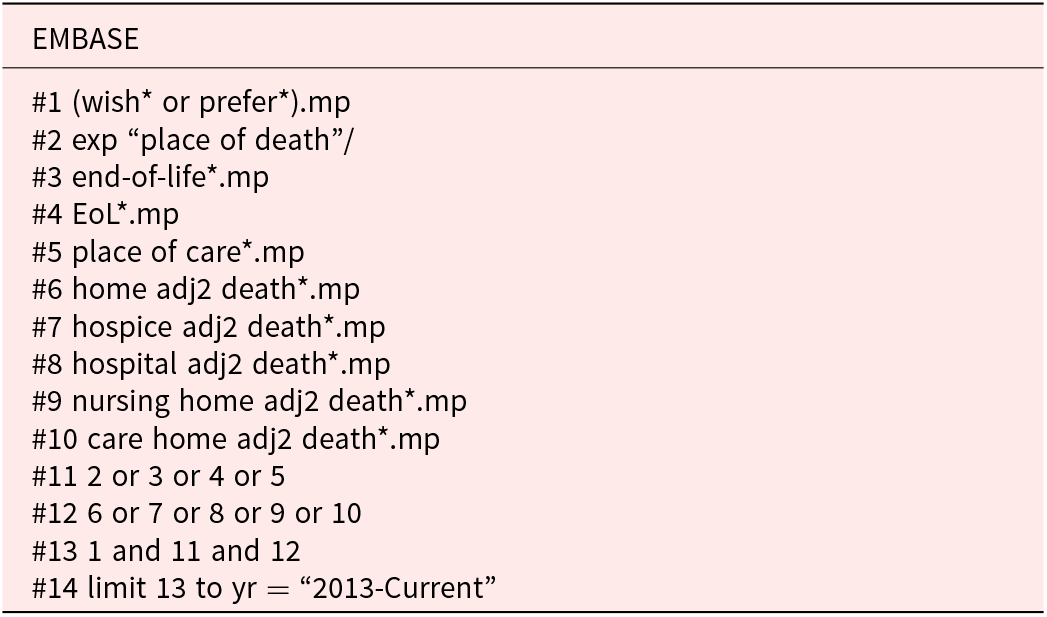
The first author (TP) selected search terms in collaboration with VG and MR. TP conducted the final search with guidance from a librarian between January 2023 and February 2023. The search terms were divided into 3 search blocks. Each search was tailored to the specific database, and MESH terms were used if possible. The first block includes the search terms “wish” or “prefer.” The second includes “place of death,” “end-of-life,” “EoL,” “place of care.” The third block uses proximity operators when possible and includes the following search terms “home death,” “hospice death,” “hospital death,” “nursing home death,” or “care home death.” Each block is combined by the Boolean operator AND. An electronic search was undertaken in PubMed, CINAHL, EMBASE, PsycInfo, and MEDLINE. The searches were initially run on January 9, 2023. The final database searches were conducted on February 9, 2023. An additional search was conducted on December 13, 2023. The search string tailored for EMBASE can be seen in Table 1. The other searches are available on request of the corresponding author.
Key search terms and example of search string

Study selection
For inclusion in the title/abstract screening, consensus between 2 independent reviewers was required. One reviewer (TP) assessed all titles/abstracts, while 2 reviewers (MR and VG) each evaluated half of the titles/abstracts for eligibility. In the full-text phase, TP reviewed all studies and consulted MR or VG in cases of uncertainty. Covidence was utilized during the screening process to remove duplicates, assist with title and abstract screening and register the reason for exclusion of studies. Quantitative, qualitative studies, and reviews were included.
Data charting process and data items
TP performed data extraction using a study specific data extraction form. The following data were extracted: first author and year, title, country of first author, countries discussed, study aim, and study design (Appendix 1). For the analysis data on barriers and facilitators for place of death was extracted.
Synthesis of results
The initial coding of the 95 included studies draws inspiration from Gomes and Higginson’s (Reference Gomes and Higginson2006) conceptual model, categorizing barriers and facilitators into illness-related-, individual-, and environmental factors. Subsequently, these factors for different places of death are further grouped using inductively inspired thematic coding, resulting in various subthemes. The coding of the illness factors yielded the following subthemes: disease type, dying trajectory, treatment, symptoms, and safe environment. Meanwhile, the coding of the individual factors led to the identification the following subthemes: sex, age, ethnicity, and preferences. Similarly, the coding of the environmental factors resulted in the following subthemes: healthcare input, education and employment, social support, economy, and place of residence. Tables 3–5 provide illustrations of the likelihood of each factor being associated with death at different places, along with the number of studies supporting the respective factor and place of death.
Results
Selection of source evidence
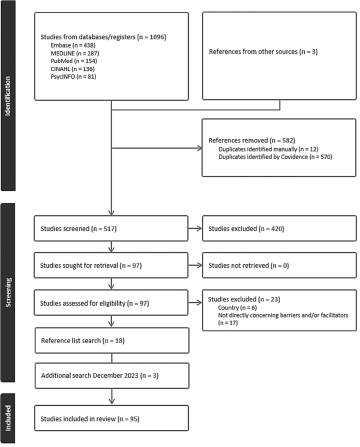
The database search revealed 1096 potential studies; 517 studies were initially screened for the appropriateness of title/abstract, with 97 studies subsequently included for full text screening resulting in 73 included studies. After assessing the reference lists of the included studies, 18 studies were included. The additional search in December resulted in inclusion of 3 studies. A total of 95 studies were included in the review. A PRISMA flow chart (Figure 1) outlines the selection process, including reasons for exclusion.
Flow chart screening process.

Characteristics of included studies
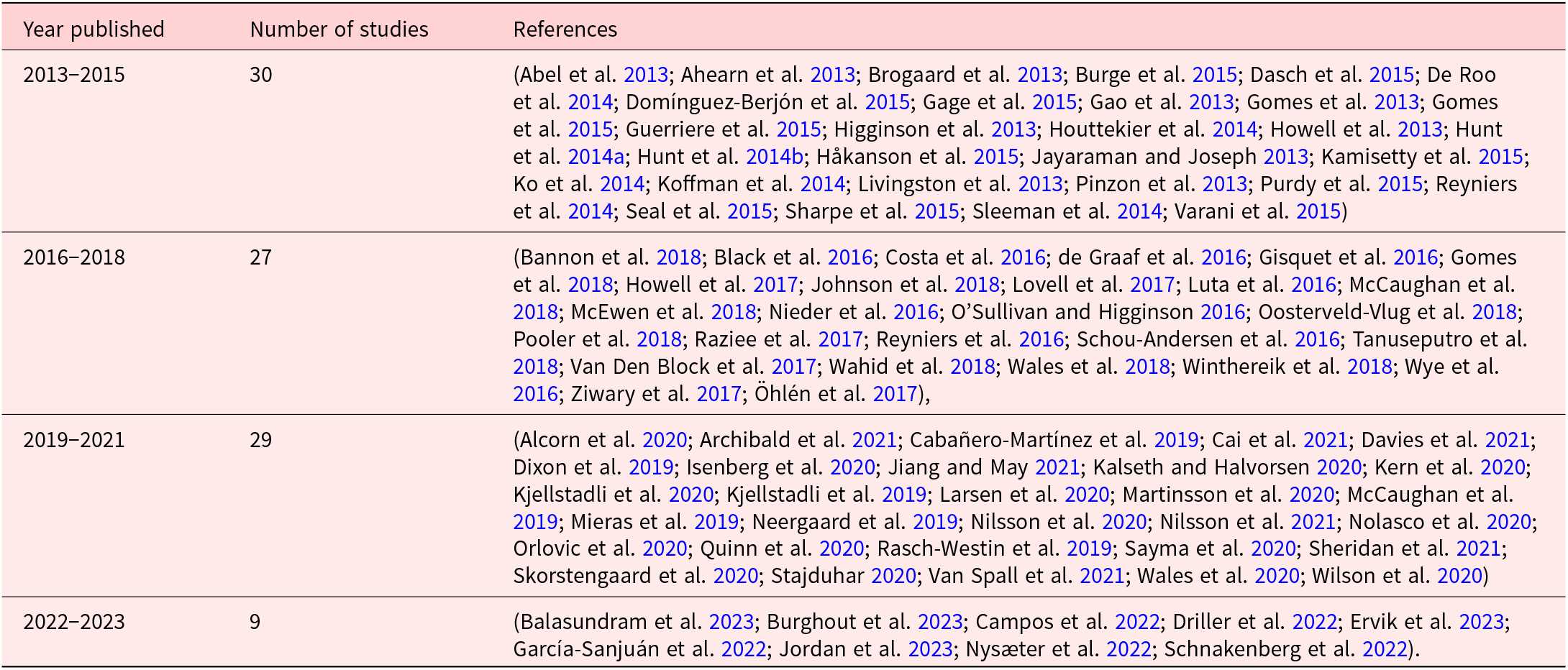
Appendix 1 presents the extracted data from the 95 included studies. Table 2 illustrates year published, number of studies, and the respective references for the included studies. Hence 30 studies were published between 2013 and 2015, 27 studies between 2016 and 2018, 29 studies between 2019 and 2021 and 9 studies between 2022 and 2023. Most of the included studies are quantitative (n = 74), followed by qualitative (n = 11), reviews (n = 8), and mixed methods design (n = 2).
Characteristics of included studies

Synthesis of results
Illness factors
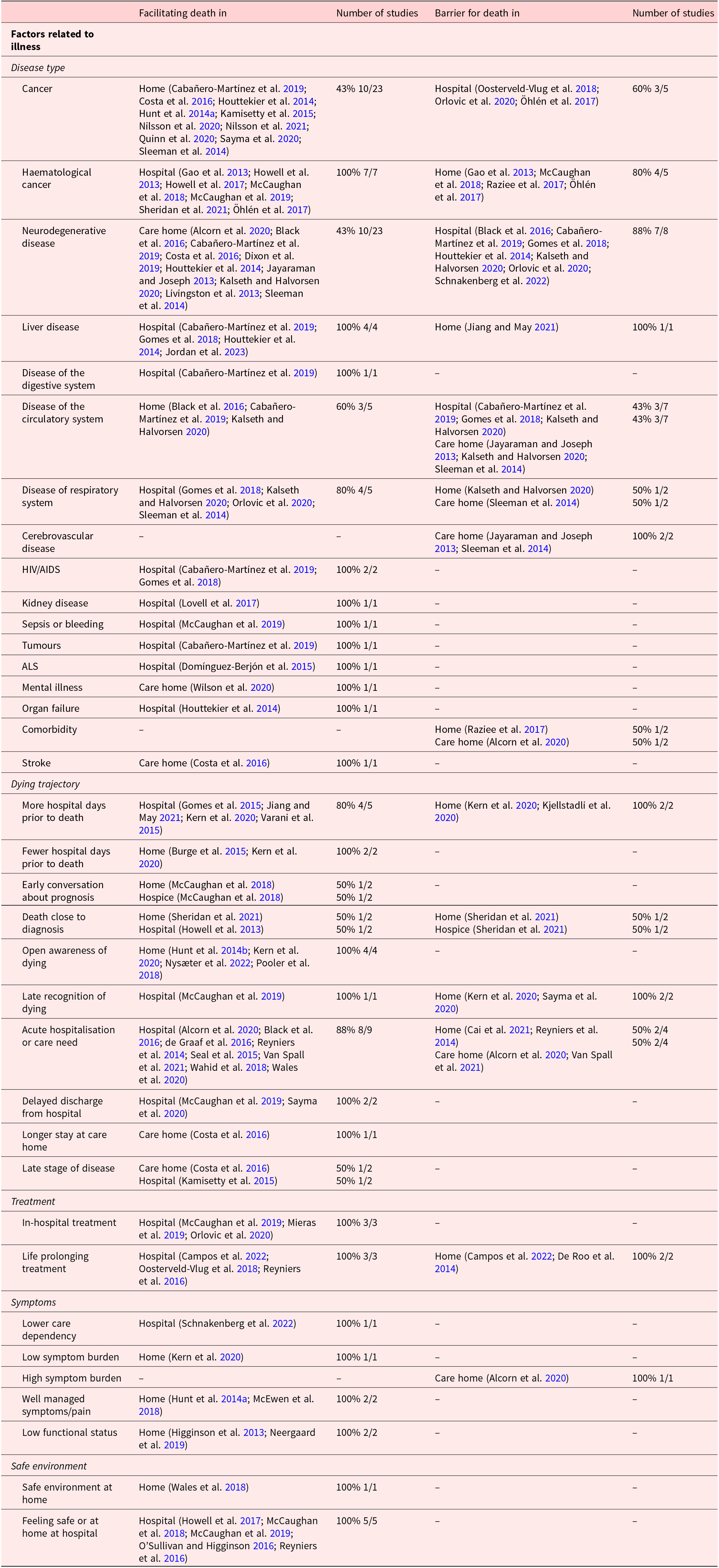
Table 3 illustrates how different types of illness affects place of death. Cancer types, including lung, brain, prostate, and colorectal cancer, are grouped together due to their similar effects on place of death. Overall, the review indicates that having cancer tends to facilitate death at home (Cabañero-Martínez et al. Reference Cabañero-Martínez, Nolasco and Melchor2019; Costa et al. Reference Costa, Earle and Esplen2016; Houttekier et al. Reference Houttekier, Cohen and Pepersack2014; Hunt et al. Reference Hunt, Shlomo and Addington-Hall2014a; Kamisetty et al. Reference Kamisetty, Magennis and Mayland2015; Nilsson et al. Reference Nilsson, Axelsson and Holgersson2020, Reference Nilsson, Holgersson and Ullenhag2021; Quinn et al. Reference Quinn, Hsu and Smith2020; Sayma et al. Reference Sayma, Saleh and Kerwat2020; Sleeman et al. Reference Sleeman, Ho and Verne2014). However, hematological cancer is a barrier for home death (Gao et al. Reference Gao, Ho and Verne2013; McCaughan et al. Reference McCaughan, Roman and Smith2018; Öhlén et al. Reference Öhlén, Cohen and Håkanson2017; Raziee et al. Reference Raziee, Saskin and Barbera2017), but a facilitating factor for hospital death (Gao et al. Reference Gao, Ho and Verne2013; Howell et al. Reference Howell, Wang and Roman2017, Reference Howell, Wang and Smith2013; McCaughan et al. Reference McCaughan, Roman and Smith2018, Reference McCaughan, Roman and Smith2019; Öhlén et al. Reference Öhlén, Cohen and Håkanson2017; Sheridan et al. Reference Sheridan, Roman and Smith2021). The illness trajectory for hematological cancer often involves aggressive treatment up to death (McCaughan et al. Reference McCaughan, Roman and Smith2019). Hematological patients who discuss preferred place of death are more likely not to die in hospital, whereas those who do not discuss preferred place of death, or those who receive hematological treatment close to death are more likely to die in hospital (Howell et al. Reference Howell, Wang and Roman2017). Additionally, hematological patients are less likely to receive palliative care and advanced care planning, which facilitates death in hospital (Howell et al. Reference Howell, Wang and Roman2017; McCaughan et al. Reference McCaughan, Roman and Smith2019). Moreover, diseases of the digestive system (Cabañero-Martínez et al. Reference Cabañero-Martínez, Nolasco and Melchor2019), the respiratory system (Gomes et al. Reference Gomes, Pinheiro and Lopes2018; Kalseth and Halvorsen Reference Kalseth and Halvorsen2020; Orlovic et al. Reference Orlovic, Callender and Riley2020; Sleeman et al. Reference Sleeman, Ho and Verne2014), liver disease (Cabañero-Martínez et al. Reference Cabañero-Martínez, Nolasco and Melchor2019; Gomes et al. Reference Gomes, Pinheiro and Lopes2018; Houttekier et al. Reference Houttekier, Cohen and Pepersack2014; Jordan et al. Reference Jordan, ElMokhallalati and Corless2023), HIV/AIDS (Cabañero-Martínez et al. Reference Cabañero-Martínez, Nolasco and Melchor2019; Gomes et al. Reference Gomes, Pinheiro and Lopes2018), kidney disease (Lovell et al. Reference Lovell, Jones and Baynes2017), tumors, (Cabañero-Martínez et al. Reference Cabañero-Martínez, Nolasco and Melchor2019) and ALS (Domínguez-Berjón et al. Reference Domínguez-Berjón, Esteban-Vasallo and Zoni2015) increase the likelihood of death in hospital. However, irrespective of disease type, close relationships with healthcare staff and feeling safe in hospital are factors leading the patient to prefer care and death in hospital (Howell et al. Reference Howell, Wang and Roman2017, Reference Howell, Wang and Smith2013; McCaughan et al. Reference McCaughan, Roman and Smith2018, Reference McCaughan, Roman and Smith2019; Sheridan et al. Reference Sheridan, Roman and Smith2021). Table 3 also highlights differences in the dying trajectories. For example, having more hospital days prior to death (Gomes et al. Reference Gomes, Calanzani and Koffman2015; Jiang and May Reference Jiang and May2021; Kern et al. Reference Kern, Corani and Huber2020; Varani et al. Reference Varani, Dall’Olio and Messana2015) or receiving life-prolonging treatment (Campos et al. Reference Campos, Isenberg and Lovblom2022; Oosterveld-Vlug et al. Reference Oosterveld-Vlug, Donker and Atsma2018; Reyniers et al. Reference Reyniers, Deliens and Pasman2016) are associated with hospital death. Additionally, patients with open awareness of dying are more likely to die at home (Hunt et al. Reference Hunt, Shlomo and Addington-Hall2014b; Kern et al. Reference Kern, Corani and Huber2020; Nysæter et al. Reference Nysæter, Olsson and Sandsdalen2022; Pooler et al. Reference Pooler, Richman-Eisenstat and Kalluri2018) as opposed to late recognition of dying (McCaughan et al. Reference McCaughan, Roman and Smith2019), they are more likely to die at home rather than hospital.
Illness factors associated with place of death

Individual factors
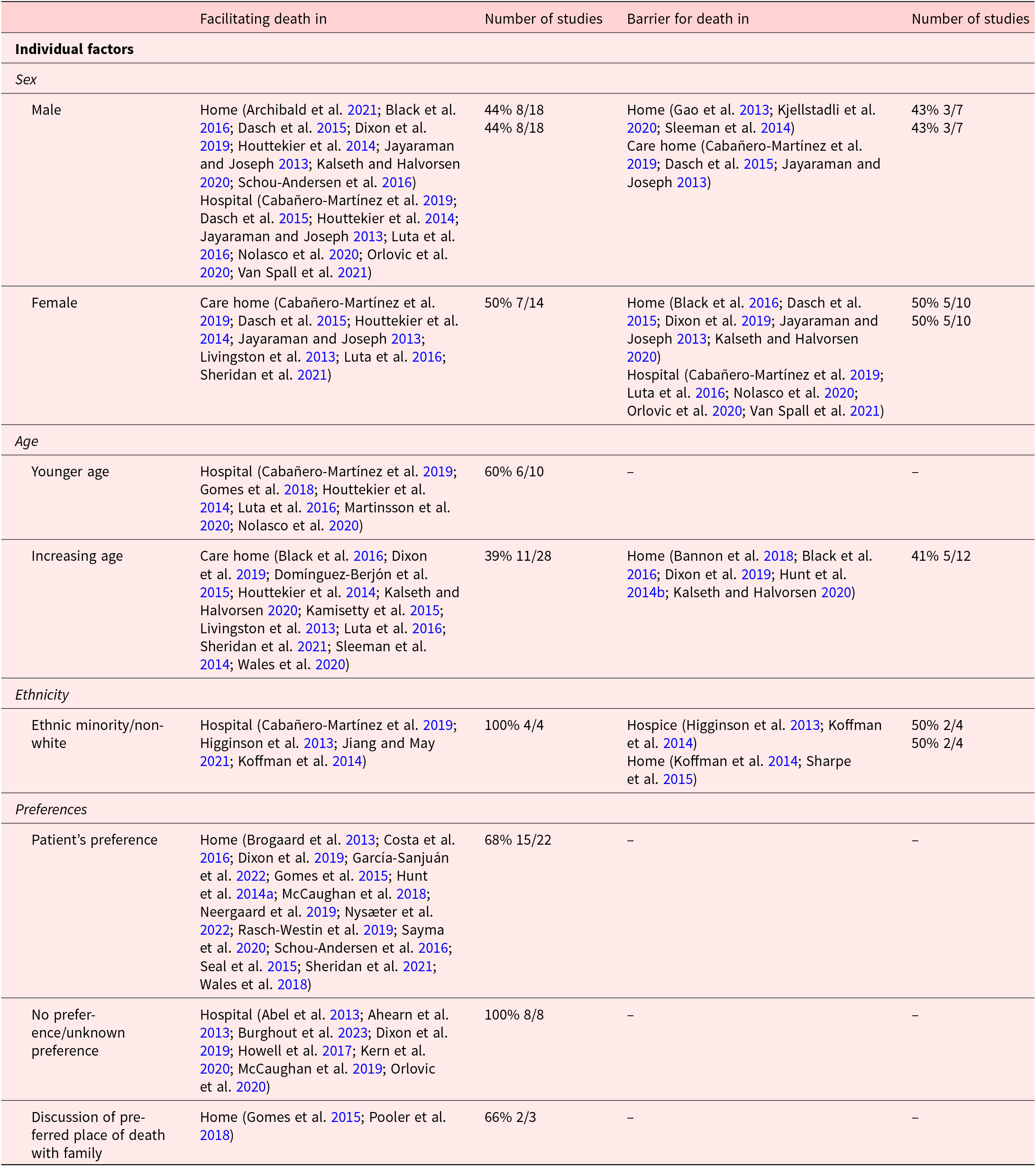
Table 4 presents an inconclusive evidence regarding gender differences in place of death. Concerning age there appears to be a tendency indicating that lower age makes hospital death more likely (Cabañero-Martínez et al. Reference Cabañero-Martínez, Nolasco and Melchor2019; Gomes et al. Reference Gomes, Pinheiro and Lopes2018; Houttekier et al. Reference Houttekier, Cohen and Pepersack2014; Luta et al. Reference Luta, Panczak and Maessen2016; Martinsson et al. Reference Martinsson, Lundström and Sundelöf2020; Nolasco et al. Reference Nolasco, Fernandez-Alcantara and Pereyra-Zamora2020), whereas older age increases the likelihood of death in a care home (Black et al. Reference Black, Waugh and Munoz-Arroyo2016; Dixon et al. Reference Dixon, King and Knapp2019; Domínguez-Berjón et al. Reference Domínguez-Berjón, Esteban-Vasallo and Zoni2015; Houttekier et al. Reference Houttekier, Cohen and Pepersack2014; Kalseth and Halvorsen Reference Kalseth and Halvorsen2020; Kamisetty et al. Reference Kamisetty, Magennis and Mayland2015; Livingston et al. Reference Livingston, Lewis-Holmes and Pitfield2013; Luta et al. Reference Luta, Panczak and Maessen2016; Sheridan et al. Reference Sheridan, Roman and Smith2021; Sleeman et al. Reference Sleeman, Ho and Verne2014; Wales et al. Reference Wales, Kalia and Moineddin2020). Being non-whiteor belonging to an ethnic minority decreases the likelihood of dying at home or in hospice and increases the chance of dying in hospital (Cabañero-Martínez et al. Reference Cabañero-Martínez, Nolasco and Melchor2019; Higginson et al. Reference Higginson, Sarmento and Calanzani2013; Jiang and May Reference Jiang and May2021; Koffman et al. Reference Koffman, Ho and Davies2014). While variations in place of death for different ethnicities are not extensively investigated, they may be attributed to differences in preferences influenced by culture or access to palliative care (Sharpe et al. Reference Sharpe, Cezard and Bansal2015). Overall, expressed preference appears to play a significant role in determining place of death by increasing the likelihood of home death (Brogaard et al. Reference Brogaard, Neergaard and Sokolowski2013; Costa et al. Reference Costa, Earle and Esplen2016; Dixon et al. Reference Dixon, King and Knapp2019; García-Sanjuán et al. Reference García-Sanjuán, Fernández-Alcántara and Clement-Carbonell2022; Gomes et al. Reference Gomes, Calanzani and Koffman2015; Hunt et al. Reference Hunt, Shlomo and Addington-Hall2014a; McCaughan et al. Reference McCaughan, Roman and Smith2018; Neergaard et al. Reference Neergaard, Brunoe and Skorstengaard2019; Nysæter et al. Reference Nysæter, Olsson and Sandsdalen2022; Rasch-Westin et al. Reference Rasch-Westin, Helde-Frankling and Bjorkhem-Bergman2019; Sayma et al. Reference Sayma, Saleh and Kerwat2020; Schou-Andersen et al. Reference Schou-Andersen, Ullersted and Jensen2016; Seal et al. Reference Seal, Murray and Seddon2015; Sheridan et al. Reference Sheridan, Roman and Smith2021; Wales et al. Reference Wales, Kurahashi and Husain2018). Conversely, not having a preference or unknown preference are factors that increase the likelihood of hospital death (Abel et al. Reference Abel, Pring and Rich2013; Ahearn et al. Reference Ahearn, Nidh and Kallat2013; Burghout et al. Reference Burghout, Nahar-van Venrooij and Bolt2023; Dixon et al. Reference Dixon, King and Knapp2019; Howell et al. Reference Howell, Wang and Roman2017; Kern et al. Reference Kern, Corani and Huber2020; McCaughan et al. Reference McCaughan, Roman and Smith2019; Orlovic et al. Reference Orlovic, Callender and Riley2020).
Individual factors associated with place of death

Environmental factors
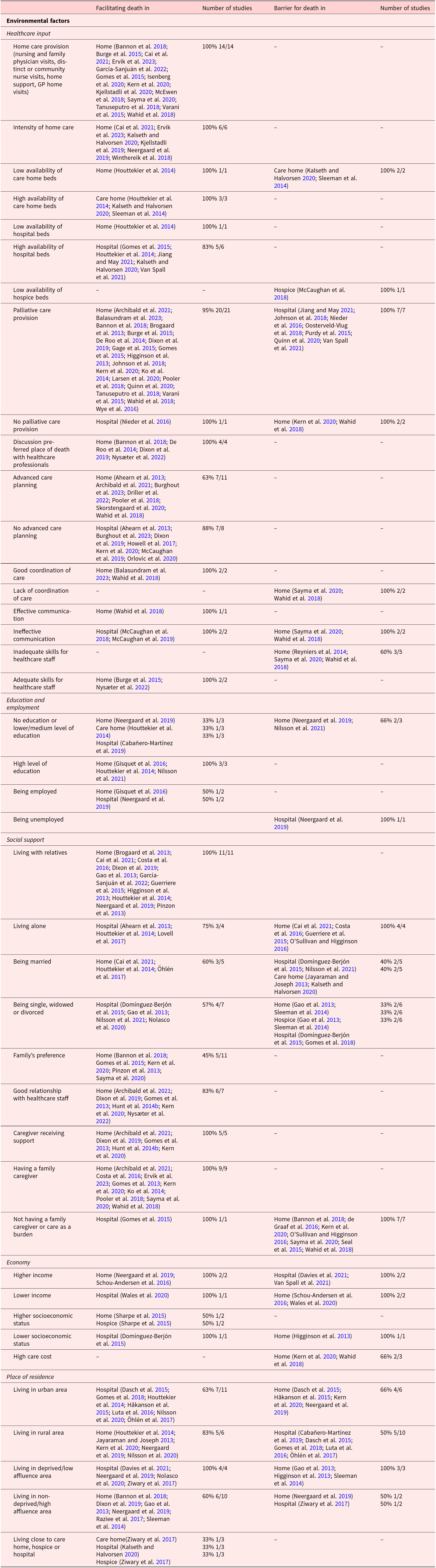
Table 5 identifies various environmental factors impacting the place of death. For instance, receiving palliative care (Archibald et al. Reference Archibald, Bakal and Richman-Eisenstat2021; Balasundram et al. Reference Balasundram, Holm and Benthien2023; Bannon et al. Reference Bannon, Cairnduff and Fitzpatrick2018; Brogaard et al. Reference Brogaard, Neergaard and Sokolowski2013; Burge et al. Reference Burge, Lawson and Johnston2015; De Roo et al. Reference De Roo, Miccinesi and Onwuteaka-Philipsen2014; Dixon et al. Reference Dixon, King and Knapp2019; Gage et al. Reference Gage, Holdsworth and Flannery2015; Gomes et al. Reference Gomes, Calanzani and Koffman2015; Higginson et al. Reference Higginson, Sarmento and Calanzani2013; Johnson et al. Reference Johnson, Allgar and Chen2018; Kern et al. Reference Kern, Corani and Huber2020; Ko et al. Reference Ko, Miccinesi and Beccaro2014; Larsen et al. Reference Larsen, Neergaard and Andersen2020; Pooler et al. Reference Pooler, Richman-Eisenstat and Kalluri2018; Quinn et al. Reference Quinn, Hsu and Smith2020; Tanuseputro et al. Reference Tanuseputro, Beach and Chalifoux2018; Varani et al. Reference Varani, Dall’Olio and Messana2015; Wahid et al. Reference Wahid, Sayma and Jamshaid2018; Wye et al. Reference Wye, Lasseter and Simmonds2016) and/or advanced care planning (Ahearn et al. Reference Ahearn, Nidh and Kallat2013; Archibald et al. Reference Archibald, Bakal and Richman-Eisenstat2021; Burghout et al. Reference Burghout, Nahar-van Venrooij and Bolt2023; Driller et al. Reference Driller, Talseth-Palmer and Hole2022; Pooler et al. Reference Pooler, Richman-Eisenstat and Kalluri2018; Sayma et al. Reference Sayma, Saleh and Kerwat2020; Skorstengaard et al. Reference Skorstengaard, Jensen and Andreassen2020; Wahid et al. Reference Wahid, Sayma and Jamshaid2018) increases the chances of dying at home, whereas not receiving palliative care (Nieder et al. Reference Nieder, Tollali and Haukland2016) and/or advanced care planning (Ahearn et al. Reference Ahearn, Nidh and Kallat2013; Burghout et al. Reference Burghout, Nahar-van Venrooij and Bolt2023; Dixon et al. Reference Dixon, King and Knapp2019; Howell et al. Reference Howell, Wang and Roman2017; Kern et al. Reference Kern, Corani and Huber2020; McCaughan et al. Reference McCaughan, Roman and Smith2019; Orlovic et al. Reference Orlovic, Callender and Riley2020) increases the chance of dying in hospital. Social factors such as living with others (Brogaard et al. Reference Brogaard, Neergaard and Sokolowski2013; Cai et al. Reference Cai, Zhang and Guerriere2021; Costa et al. Reference Costa, Earle and Esplen2016; Dixon et al. Reference Dixon, King and Knapp2019; Gao et al. Reference Gao, Ho and Verne2013; García-Sanjuán et al. Reference García-Sanjuán, Fernández-Alcántara and Clement-Carbonell2022; Guerriere et al. Reference Guerriere, Husain and Marshall2015; Higginson et al. Reference Higginson, Sarmento and Calanzani2013; Houttekier et al. Reference Houttekier, Cohen and Pepersack2014; Neergaard et al. Reference Neergaard, Brunoe and Skorstengaard2019; Pinzon et al. Reference Pinzon, Claus and Perrar2013), being married or having a partner (Cai et al. Reference Cai, Zhang and Guerriere2021; Houttekier et al. Reference Houttekier, Cohen and Pepersack2014; Öhlén et al. Reference Öhlén, Cohen and Håkanson2017), or having a family caregiver (Archibald et al. Reference Archibald, Bakal and Richman-Eisenstat2021; Costa et al. Reference Costa, Earle and Esplen2016; Ervik et al. Reference Ervik, Dønnem and Johansen2023; Gomes et al. Reference Gomes, Calanzani and Gysels2013; Kern et al. Reference Kern, Corani and Huber2020; Ko et al. Reference Ko, Miccinesi and Beccaro2014; Pooler et al. Reference Pooler, Richman-Eisenstat and Kalluri2018; Sayma et al. Reference Sayma, Saleh and Kerwat2020; Wahid et al. Reference Wahid, Sayma and Jamshaid2018) increase the likelihood of home death. Whereas, living alone (Ahearn et al. Reference Ahearn, Nidh and Kallat2013; Houttekier et al. Reference Houttekier, Cohen and Pepersack2014; Lovell et al. Reference Lovell, Jones and Baynes2017), being single, widowed, or divorced (Domínguez-Berjón et al. Reference Domínguez-Berjón, Esteban-Vasallo and Zoni2015; Gao et al. Reference Gao, Ho and Verne2013; Nilsson et al. Reference Nilsson, Holgersson and Ullenhag2021; Nolasco et al. Reference Nolasco, Fernandez-Alcantara and Pereyra-Zamora2020) increase the possibility of hospital death. The absence of a family caregiver or when family caregiving is experienced burdensome decrease the possibility of home death (Bannon et al. Reference Bannon, Cairnduff and Fitzpatrick2018; de Graaf et al. Reference de Graaf, Zweers and Valkenburg2016; Kern et al. Reference Kern, Corani and Huber2020; O’Sullivan and Higginson Reference O’Sullivan and Higginson2016; Sayma et al. Reference Sayma, Saleh and Kerwat2020; Seal et al. Reference Seal, Murray and Seddon2015; Wahid et al. Reference Wahid, Sayma and Jamshaid2018). Residence in rural areas is associated with higher likelihood of dying at home (Houttekier et al. Reference Houttekier, Cohen and Pepersack2014; Jayaraman and Joseph Reference Jayaraman and Joseph2013; Kern et al. Reference Kern, Corani and Huber2020; Neergaard et al. Reference Neergaard, Brunoe and Skorstengaard2019; Nilsson et al. Reference Nilsson, Axelsson and Holgersson2020) as opposed to hospital (Cabañero-Martínez et al. Reference Cabañero-Martínez, Nolasco and Melchor2019; Dasch et al. Reference Dasch, Blum and Gude2015; Gomes et al. Reference Gomes, Pinheiro and Lopes2018; Luta et al. Reference Luta, Panczak and Maessen2016; Öhlén et al. Reference Öhlén, Cohen and Håkanson2017), while urban residents are more likely to die in hospital (Dasch et al. Reference Dasch, Blum and Gude2015; Gomes et al. Reference Gomes, Pinheiro and Lopes2018; Håkanson et al. Reference Håkanson, Öhlén and Morin2015; Houttekier et al. Reference Houttekier, Cohen and Pepersack2014; Luta et al. Reference Luta, Panczak and Maessen2016; Nilsson et al. Reference Nilsson, Axelsson and Holgersson2020; Öhlén et al. Reference Öhlén, Cohen and Håkanson2017) rather than at home (Dasch et al. Reference Dasch, Blum and Gude2015; Håkanson et al. Reference Håkanson, Öhlén and Morin2015; Kern et al. Reference Kern, Corani and Huber2020; Neergaard et al. Reference Neergaard, Brunoe and Skorstengaard2019). Some of these differences might be explained by urban residents living closer to hospital as opposed to rural residents (Kalseth and Halvorsen Reference Kalseth and Halvorsen2020; Ziwary et al. Reference Ziwary, Samad and Johnson2017). Additionally, living in non-deprived or affluent areas increases the chance of dying at home (Bannon et al. Reference Bannon, Cairnduff and Fitzpatrick2018; Dixon et al. Reference Dixon, King and Knapp2019; Gao et al. Reference Gao, Ho and Verne2013; Neergaard et al. Reference Neergaard, Brunoe and Skorstengaard2019; Raziee et al. Reference Raziee, Saskin and Barbera2017; Sleeman et al. Reference Sleeman, Ho and Verne2014), whereas living in deprived or non-affluent areas increases the chance of a hospital death (Davies et al. Reference Davies, Maddocks and Chua2021; Neergaard et al. Reference Neergaard, Brunoe and Skorstengaard2019; Nolasco et al. Reference Nolasco, Fernandez-Alcantara and Pereyra-Zamora2020; Ziwary et al. Reference Ziwary, Samad and Johnson2017), and lowers the chance of home death (Gao et al. Reference Gao, Ho and Verne2013; Higginson et al. Reference Higginson, Sarmento and Calanzani2013; Sleeman et al. Reference Sleeman, Ho and Verne2014). Higher education (Gisquet et al. Reference Gisquet, Julliard and Geoffroy-Perez2016; Houttekier et al. Reference Houttekier, Cohen and Pepersack2014; Nilsson et al. Reference Nilsson, Holgersson and Ullenhag2021), income (Neergaard et al. Reference Neergaard, Brunoe and Skorstengaard2019; Schou-Andersen et al. Reference Schou-Andersen, Ullersted and Jensen2016), and socioeconomic status (Sharpe et al. Reference Sharpe, Cezard and Bansal2015) increases the likelihood of home death, and decreases the chance of hospital death (Davies et al. Reference Davies, Maddocks and Chua2021; Van Spall et al. Reference Van Spall, Hill and Longdi2021), whereas lower income (Wales et al. Reference Wales, Kalia and Moineddin2020) and socioeconomic status (Domínguez-Berjón et al. Reference Domínguez-Berjón, Esteban-Vasallo and Zoni2015) increases the likelihood of hospital death, and decreases the chance of home death (Higginson et al. Reference Higginson, Sarmento and Calanzani2013; Schou-Andersen et al. Reference Schou-Andersen, Ullersted and Jensen2016; Wales et al. Reference Wales, Kalia and Moineddin2020).
Environmental factors associated with place of death

Discussion
This scoping review found evidence for a complex network of factors that impact place of death. It reveals how various diseases, such as hematological cancer or undergoing active treatment, influence where individuals die (McCaughan et al. Reference McCaughan, Roman and Smith2018). However not all the identified diseases were well investigated. The review shows a tendency toward hospital death for people that have not expressed a preference for place of death (Abel et al. Reference Abel, Pring and Rich2013; Ahearn et al. Reference Ahearn, Nidh and Kallat2013; Burghout et al. Reference Burghout, Nahar-van Venrooij and Bolt2023; Dixon et al. Reference Dixon, King and Knapp2019; Howell et al. Reference Howell, Wang and Roman2017; Kern et al. Reference Kern, Corani and Huber2020; McCaughan et al. Reference McCaughan, Roman and Smith2019; Orlovic et al. Reference Orlovic, Callender and Riley2020), have not engaged in advanced care planning (Ahearn et al. Reference Ahearn, Nidh and Kallat2013; Burghout et al. Reference Burghout, Nahar-van Venrooij and Bolt2023; Dixon et al. Reference Dixon, King and Knapp2019; Howell et al. Reference Howell, Wang and Roman2017; Kern et al. Reference Kern, Corani and Huber2020; McCaughan et al. Reference McCaughan, Roman and Smith2019; Orlovic et al. Reference Orlovic, Callender and Riley2020), and have not received palliative care (Nieder et al. Reference Nieder, Tollali and Haukland2016). Conversely, hospital death is more likely for those with an expressed preference for hospital death, those having a good relationship with healthcare staff, and feeling safe at hospital (Howell et al. Reference Howell, Wang and Roman2017, Reference Howell, Wang and Smith2013; McCaughan et al. Reference McCaughan, Roman and Smith2018, Reference McCaughan, Roman and Smith2019; Sheridan et al. Reference Sheridan, Roman and Smith2021). In general patients’ expressed preferences seem to have a strong influence on place of death, especially for home death (Brogaard et al. Reference Brogaard, Neergaard and Sokolowski2013; Costa et al. Reference Costa, Earle and Esplen2016; Dixon et al. Reference Dixon, King and Knapp2019; García-Sanjuán et al. Reference García-Sanjuán, Fernández-Alcántara and Clement-Carbonell2022; Gomes et al. Reference Gomes, Calanzani and Koffman2015; Hunt et al. Reference Hunt, Shlomo and Addington-Hall2014a; McCaughan et al. Reference McCaughan, Roman and Smith2018; Neergaard et al. Reference Neergaard, Brunoe and Skorstengaard2019; Nysæter et al. Reference Nysæter, Olsson and Sandsdalen2022; Rasch-Westin et al. Reference Rasch-Westin, Helde-Frankling and Bjorkhem-Bergman2019; Sayma et al. Reference Sayma, Saleh and Kerwat2020; Schou-Andersen et al. Reference Schou-Andersen, Ullersted and Jensen2016; Seal et al. Reference Seal, Murray and Seddon2015; Sheridan et al. Reference Sheridan, Roman and Smith2021; Wales et al. Reference Wales, Kurahashi and Husain2018). Home death is positively influenced by family caregivers having the same preference as their loved one (Bannon et al. Reference Bannon, Cairnduff and Fitzpatrick2018; Gomes et al. Reference Gomes, Calanzani and Koffman2015; Kern et al. Reference Kern, Corani and Huber2020; Pinzon et al. Reference Pinzon, Claus and Perrar2013; Sayma et al. Reference Sayma, Saleh and Kerwat2020), having a strong social support system and living with others (Brogaard et al. Reference Brogaard, Neergaard and Sokolowski2013; Cai et al. Reference Cai, Zhang and Guerriere2021; Costa et al. Reference Costa, Earle and Esplen2016; Dixon et al. Reference Dixon, King and Knapp2019; Gao et al. Reference Gao, Ho and Verne2013; García-Sanjuán et al. Reference García-Sanjuán, Fernández-Alcántara and Clement-Carbonell2022; Guerriere et al. Reference Guerriere, Husain and Marshall2015; Higginson et al. Reference Higginson, Sarmento and Calanzani2013; Houttekier et al. Reference Houttekier, Cohen and Pepersack2014; Neergaard et al. Reference Neergaard, Brunoe and Skorstengaard2019; Pinzon et al. Reference Pinzon, Claus and Perrar2013). Nonetheless, caring for a loved one at home can be experienced burdensome for family caregivers, causing physical, psychosocial, and financial stress (Stajduhar Reference Stajduhar2013; Wahid et al. Reference Wahid, Sayma and Jamshaid2018). Consequently, home death may not always be a possibility even though home death the preferred place of death.
This review most clearly indicates that being white, having higher income, higher socioeconomic status, higher education, and stronger social support increases the chances of dying at home (Neergaard et al. Reference Neergaard, Brunoe and Skorstengaard2019; Schou-Andersen et al. Reference Schou-Andersen, Ullersted and Jensen2016; Sharpe et al. Reference Sharpe, Cezard and Bansal2015), and that not holding these privileges decreases the chance of a home death (Higginson et al. Reference Higginson, Sarmento and Calanzani2013; Schou-Andersen et al. Reference Schou-Andersen, Ullersted and Jensen2016; Wales et al. Reference Wales, Kalia and Moineddin2020), and increases the possibility of a hospital death (Domínguez-Berjón et al. Reference Domínguez-Berjón, Esteban-Vasallo and Zoni2015; Wales et al. Reference Wales, Kalia and Moineddin2020). The factors linked to these social advantages are also linked with an increased possibility of dying in the preferred place of death. Hence studies find how higher socioeconomic status (Gao et al. Reference Gao, Ho and Verne2013; Gisquet et al. Reference Gisquet, Julliard and Geoffroy-Perez2016; Wales et al. Reference Wales, Kalia and Moineddin2020), living with others (Brogaard et al. Reference Brogaard, Neergaard and Sokolowski2013; Cai et al. Reference Cai, Zhang and Guerriere2021), being in a relationship (García-Sanjuán et al. Reference García-Sanjuán, Fernández-Alcántara and Clement-Carbonell2022) is found positively associated with congruence between preferred and actual place of death. The influence of socioeconomic status can partly be explained by the ability to purchase additional home care services, which enables a preferred death at home (Wales et al. Reference Wales, Kurahashi and Husain2018). Moreover, people with higher socioeconomic status are more likely to have conversations about death and advance care planning directives (Hoare et al. Reference Hoare, Morris and Kelly2015), which may influence the higher levels of congruence between preferred and actual place of death.
Another factor of importance is the impact of ethnicity in relation to place of death. The impact of ethnicity is discussed in a systematic review by Gomes et al., and raises questions about equity and equal access to both palliative care and advanced care planning for vulnerable groups and people from ethnic minority groups (Gomes and Higginson Reference Gomes and Higginson2006). As pointed out by Stajduhar (Reference Stajduhar2020) being privileged increases the chance of receiving palliative and end-of-life care, assistance with advanced care planning, support for family caregivers, and increases the likelihood of dying in the preferred place. Despite the positive association between privilege and preferred place of death, it also needs to be acknowledged that home death is not always the preferred or optimal place of death, even though there has been a tendency to regard home death as the gold standard (De Roo et al. Reference De Roo, Miccinesi and Onwuteaka-Philipsen2014; Pollock Reference Pollock2015). As Pollock (Reference Pollock2015) notes a death is not necessarily good just because it occurs at home. Home death can also be associated with feelings of loneliness, being inadequately supported, having poor symptom control, being distressed and fearful (Pollock Reference Pollock2015). By contrast, death in hospital can be peaceful and with sufficient pain and symptom management (Howell et al. Reference Howell, Wang and Roman2017; McCaughan et al. Reference McCaughan, Roman and Smith2019; Orlovic et al. Reference Orlovic, Callender and Riley2020). The Quality of Death and Dying Index reveals that symptom management is a factor of utmost importance near the end-of-life (Sepulveda et al. Reference Sepulveda, Baid and Johnson2022). Therefore, we suggest that when advance care planning occurs, appropriate consideration should be given to the place in which symptoms can be best managed. As Pollock (Reference Pollock2015) warns, assumptions that home is the best place of death risks denying the patient what might actually be best for them.
Limitations
The categorization of barriers and facilitators into illness-, individual-, and environmental factors is seen in other studies within the field (Burge et al. Reference Burge, Lawson and Johnston2015; García-Sanjuán et al. Reference García-Sanjuán, Fernández-Alcántara and Clement-Carbonell2022; Gomes et al. Reference Gomes, Calanzani and Koffman2015; Neergaard et al. Reference Neergaard, Brunoe and Skorstengaard2019). However, the strength of this review is the investigation of different places of death that sheds light on how vulnerable groups are in risk of experiencing inequities related to access to palliative care and advanced care planning. This potentially denies them the expression of preference and may determine their place of death. Some limitations need to be considered when interpreting the results. First, the review included studies across Europe, United Kingdom, and Canada due to their similar welfare systems, however they are not fully comparable which may cause some of the identified barriers and facilitators to be more or less relevant. Second, the consequence of grouping barriers and facilitators into the most or least likely place of death leaves limited space for showing detailed results of the included studies. However, this is considered helpful to provide a clear picture of this complex field.
Implication for future research
We suggest further research is urgently needed regarding the relationship between socioeconomic status, advanced care planning, palliative care, and place of death. This research should take into account how preference for place of death and actual place of death are determined. In addition, further attention is needed to discuss the ethical imperative behind the ideal of home death as the optimal place to die, and to investigate “good” deaths in other places.
Conclusion
In conclusion, this scoping review has demonstrated the complexity of factors influencing where people die. Several of these factors are rooted in structural conditions that work to restrict the access of underprivileged persons to end-of-life care and an opportunity to express their preferred place of death. Focusing on symptom management in addition to place of death may contribute to allow more people to receive sufficient end-of-life care and death in the best place possible.
Supplementary material
The supplementary material for this article can be found at https://doi.org/10.1017/S1478951524001500.
Acknowledgments
The authors wish to thank PhD Jahan Shabnam for valuable comments during the process.
Funding
This research received no specific grant from any funding agency, commercial, or not-for-profit sectors.
Competing interests
The author(s) declared no potential conflicts of interest with respect to the research, authorship, and/or publication of this study.
Ethical approval
No ethical approval was required for this research as the study is a review of existing, published papers.


 Open access

