


As I said in my speech earlier this week, our decision to leave the European Union was no rejection of our friends in Europe, with whom we share common interests and values and so much else. … It was simply a vote to restore, as we see it, our parliamentary democracy and national self-determination. A vote to take control and make decisions for ourselves.
“We’re fighting for Main Street, not Wall Street. We have rejected globalism and embraced patriotism.”
The 2010s marked a pivotal shift in how political leaders across advanced democracies speak about globalization.Footnote 3 Once celebrated as a driver of prosperity and international cooperation, economic integration has increasingly been cast as the villain in political discourse – blamed for undermining national sovereignty, frustrating democratic mandates, and tying the hands of elected governments. While this rhetorical shift has not amounted to a wholesale rejection of international integration, it reflects mounting unease with the ways that global trade, financial openness, and international rulemaking can tie the hands of elected officials.
One of the most prominent examples of this tension can be found in the United Kingdom. From 2010 to 2017, the Conservative Party repeatedly pledged to reduce net migration to the “tens of thousands,” a promise that resonated with voters but proved impossible to fulfill. By 2015, net migration had risen to over 330,000. Government leaders attributed this failure to the United Kingdom’s relatively deep integration into the European and global economy. The inability to deliver on this signature promise became a flashpoint in the escalating politicization of European integration, which was increasingly blamed for rising migration flows – an unavoidable byproduct of the deep economic interdependence of the European Union’s (EU’s) single market – and ultimately culminated in the United Kingdom’s departure from the EU. In its aftermath, Brexit was framed by Conservative leaders not just as a matter of identity or sovereignty but as a necessary step to restore the government’s ability to make and implement policy promises. “Take back control” was both a campaign slogan and an implicit indictment of globalization’s constraints. Yet, this push for control coexisted with continued praise for globalization’s economic benefits. Even as they championed withdrawal from the EU, thereby significantly decreasing the United Kingdom’s integration into the global economy,Footnote 4 government officials lauded free trade and global integration for boosting prosperity and lifting millions out of poverty.
In the United States, President Donald Trump also sought to tighten control over global economic integration. He imposed sweeping tariffs, withdrew from numerous economic agreements, blocked the appointment of new judges to the World Trade Organization’s Appellate Body, effectively paralyzing the organization’s dispute settlement mechanism, and renegotiated the North American Free Trade Agreement, all under the banner of restoring national sovereignty and economic control. Tariffs became the centerpiece of both of his presidential campaigns, where he promised sweeping protectionist reforms including a universal 10 percent import tax and punitive tariffs on Chinese goods. Upon returning to office in 2025, Trump enacted what he called “Liberation Day” tariffs, including duties of up to 125 percent on certain imports, especially from China. But the ambitious plan soon met resistance. Facing global market volatility, diplomatic backlash, and the realities of America’s global dependencies – including concerns that the escalating trade war with China would disrupt critical supply chains, particularly involving rare earth minerals essential to US defense and technology industries – the administration was forced to partially suspend the measures within weeks.
This tension – relying on globalization’s advantages while lamenting its constraints – captures a central dilemma of contemporary democratic politics in many advanced democracies: How can political parties make, keep, and credibly commit to campaign promises that represent the interests of their citizens in a globalized world? And when they cannot deliver on their promises, how do political leaders manage the political fallout?
This book attempts to shed light on these questions, which are at the heart of one of the most pressing and contentious debates of our time: the impact of economic globalization on the quality of democracy. To do so, we focus on one of the most prominent understandings of how democratic representation works in theory and practice, namely promissory representation, as it applies to democratic representation in established, mainly Western liberal democracies. Promissory representation is encapsulated in the idea that a substantial part of democratic representation consists of politicians making promises to citizens during election campaigns and then keeping or breaking those promises when in government after elections.
Our focus on promissory representation by mainstream parties in established democracies disciplines our inquiry.Footnote 5 Our analysis focuses on a set of implications that map onto a coherent and widely held understanding of the democratic process. It also allows us to consider the effect of globalization on the entire democratic process, rather than simply focusing on one of its aspects, such as voters’ electoral choices or political parties’ policy decisions or some general indicators of democratic quality. Moreover, this approach compels us to examine some important aspects of the democratic process that have received little attention from scholars of globalization in the past, including the impact of globalization on promise keeping by governing political parties, the electoral consequences of promise breaking, shifts in parties’ ideological positions toward the center ground, and political parties’ use of ambiguity and populist rhetoric in their electoral appeals (and the electoral consequences of these strategies).
Drawing on a wide array of original data sources and multimethod analyses – including cross-national comparisons, case studies, and experimental evidence on party strategies, voting behavior, and electoral outcomes – our main findings provide clear evidence of the limits of meaningful democratic representation in the context of intense economic globalization. We demonstrate that in more open economies, governing parties, especially those on the left, are less likely to fulfill the campaign promises they made to voters before the election. The constraining effects of globalization on promise keeping are not without political consequences. Voters punish governing parties more severely for breaking their promises precisely in the contexts of deep international economic integration where fulfilling those promises is most difficult. That is, the very structural conditions that reduce governing parties’ capacity to deliver on their electoral appeals also heighten electoral accountability, compounding the representational challenge. Moreover, even when citizens understand the constraints that globalization imposes on governments and maintain a degree of party loyalty, broken promises are associated with long-term political disillusionment.
Our analysis also shows how political parties adapt strategically to globalization’s constraints in the type of promises they make. Confronted with changing voter expectations and limited room to maneuver, many parties, particularly those of the center-right, moderate their ideological commitments on socioeconomic issues while adopting more populist rhetoric to maintain voter appeal. Across the board, parties also tend to make vaguer electoral appeals, reducing the clarity of their platforms and making it harder for voters to hold them accountable. These adaptive strategies reflect a broader recalibration of democratic competition in the age of globalization. Some of these effects are conditioned by parties’ ideological orientation. For instance, center-left parties, whose traditional goals include expanding social programs and regulating markets, face more acute challenges to fulfilling their promises when operating in highly globalized economies.
These findings lead us to conclude that economic globalization reduces the quality of democratic representation, at least as it is widely understood in the form of promissory representation. This does not mean that citizens and politicians who are exposed to economic globalization believe that campaign promises are unimportant. On the contrary, our evidence clearly shows that politicians who break their campaign promises are punished more harshly by voters when they are deeply embedded in global markets. It does mean that democratic representation no longer works well according to the principles of promissory representation. The significance of promise making and keeping is quite different in relatively closed national contexts compared with those that are highly exposed to the international economy. In closed national contexts, promise making and keeping is much about political parties putting forward clear policy proposals that relate to their ideologically distinct visions for society. In open national contexts that are exposed to international markets, promise making and keeping are more about parties signaling and displaying their governing competence to voters.
These dynamics have serious implications for democracy. When globalization restricts the ability of governments to deliver on promises, it weakens a key aspect of democratic accountability. Voters expect elected officials to implement the policies they campaigned on, but in a globalized context, leaders often find themselves constrained by forces beyond their control. This disconnect leads to voter disillusionment and a decline in trust in democratic institutions, as the promises made during elections no longer serve as reliable signals of future action. Populist and other challenger parties often seize on this gap between promises and outcomes, portraying mainstream parties as untrustworthy or captured by global elites. By blaming globalization for domestic failures, these challengers can gain political ground, even when their own proposals may be equally constrained. Over time, such dynamics risk eroding the foundations of democracy by weakening the bond between citizens and their representatives, and by fostering polarization and distrust. The consequences of globalization on promissory representation, therefore, have far-reaching effects on the health and functioning of democracies around the world.
There are two responses to this far-reaching conclusion, which we discuss more extensively in the concluding chapter. The first is that we are now in an era of deglobalization, where states are reasserting control and withdrawing from international markets. Consequently, the malign effects of globalization on democratic representation will inevitably wane. There are indeed some signs of decoupling from certain markets, such as the US attempts to become less dependent on China in key technologies. But such selective decoupling by no means implies that the constraints of far-reaching economic integration have disappeared. In other words, claims about deglobalization miss the big picture, which is one in which advanced economies are highly integrated into international and regional systems of trade and finance. A second response is that democratic representation never really worked according to the principles of promissory representation, even when countries were less integrated into the international economic system. This is a more persuasive response, as there are sound theoretical and evidence-based reasons to question at least some aspects of promissory representation, but it does not dull the relevance of our key findings. Promissory representation has continued to be a touchstone for political scientists, politicians, and citizens, even as globalization has advanced. It is therefore highly relevant to point out that globalization has further reduced the potential for promissory representation to be enacted in practice.
The Argument in Brief
Representative democracy is a system in which there is a “necessary correspondence between acts of governance and the equally weighted interests of citizens with respect to those acts” (Saward Reference Saward1998: 51). Political parties play a vital mediating role in achieving congruence between public sentiment and public policies according to prominent accounts of mass democracy (Dahl Reference Dahl1956; Downs Reference Downs1957). The traditional, and probably most dominant, form of democratic representation is what many scholars call promissory representation. The idea of promissory representation, variants of which are found in the responsible party model and the mandate theory of democracy, is that this mediating role consists of parties making promises to voters during election campaigns and then keeping those promises after elections if the election results grant them sufficient authority to do so (Mansbridge Reference Mansbridge2003: 515).
Figure 1.1 illustrates the chain of promissory representation. According to this popular understanding of how democracy works, political parties make promises to voters during election campaigns, including promises to enact specific policies or achieve particular outcomes, as well as more general promises to address certain problems or to act in the interests of their constituent groups. To the extent that promises are sufficiently clear and consistent, voters can assess the extent to which parties propose policies that align with their own policy preferences. Citizens vote for parties that promise to implement policies they support, rewarding those that align with their preferences and withholding support from those that do not. This link between campaign promises and voting behavior, which we call prospective accountability, ensures that political parties have incentives to represent their constituents by making promises that are in line with the policies these constituents want them to pursue if they get elected.
The chain of promissory representation
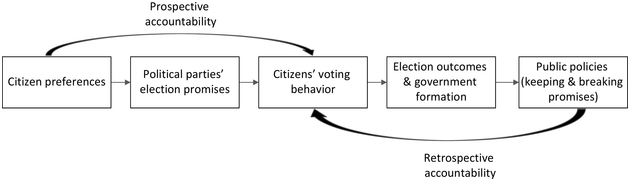
Figure 1.1 Long description
The steps are labeled as follows from left to right. Citizen preferences, political parties' election promises, citizens' voting behavior, election outcomes and government formation, and public policies as keeping and breaking promises. A left-to-right arrow above the boxes is labeled Prospective Accountability, spanning from citizen preferences and political parties' election promises to citizens' voting behavior. A right-to-left arrow below the boxes is labeled Retrospective Accountability, spanning from public policies as keeping and breaking promises and election outcomes and government formation to citizens' voting behavior.
Political parties that gain control over the levers of government after elections, primarily parties that hold executive power, are able to fulfill those promises or can at least attempt to do so. The extent to which parties make, break, and keep their campaign promises is a key characteristic of modern democratic representation in theory and practice. To the extent that promises are sufficiently clear and consistent, voters can use the information entailed in those promises to assess the governing party’s past performance. Voters can hold governments accountable by rewarding those parties that kept their promises, and punishing those that broke their promises. Of course, governing parties may break some promises for good reasons, but consistent promise breaking undermines parties’ reputations and the legitimacy of democracy. This form of retrospective accountability explains why political parties tend to work hard to keep their promises. It imposes political constraints by creating a common understanding of the policies that governments should pursue if conditions do not change in ways that make the implementation of the promises infeasible (Manin Reference Manin1997; Stokes Reference Stokes2001).
When prospective and retrospective accountability work, they provide strong linkages that enable parties to claim that keeping their promises is justifiable based on what citizens want. We argue that globalization impacts both the ability of parties to keep their campaign promises and the kinds of promises they make in the first place. Parties’ responses to these globalization pressures, in turn, undermine the ability of citizens to hold them democratically accountable, with deleterious effects on the quality of democratic representation.
Globalization has deleterious effects on the quality of promissory representation because it imposes constraints on political parties’ capacity to fulfill their campaign promises. Governing parties in countries that are highly internationalized face greater uncertainty about economic business cycles, and they are bound by international agreements that may make some promises hard to keep. Economic integration also strengthens the power of domestic and foreign economic actors who may lobby against the fulfillment of certain promises that threaten their interests. These constraints, combined with uncertainty about how intense they will be at the time of the election campaign, reduces the ability of governing parties to fulfill the promises they made during previous election campaigns. The effects are particularly pronounced for parties on the center-left of the left–right ideological spectrum, which make promises that are more in line with what voters in globalized contexts demand but are furthest away from the policies that market actors generally prefer. The constraining effect of globalization is costly for parties, because citizens retrospectively sanction parties for breaking their promises, making it less likely that parties can hold on to executive power after the next election.
Globalization also puts pressure on parties, particularly those on the center-right, to change the type of campaign promises they make. Voters, who are increasingly exposed to economic risks in a globalized world, demand that parties adopt policies that mitigate those risks. These voter expectations put right-of-center parties under pressure, because they historically relied on the support of coalitions of the relatively wealthy and economic elites, which are often the very actors that favor more open economies. If center-right parties move too far to the left to mitigate the risks globalization imposes on broader swaths of the population, they risk losing support from their primary support coalitions on the right. Center-right parties must delicately balance appeals to their traditional constituents, who continue to favor more open economies and deregulation, and appeals to voters who want protection from the risks and negative distributional effects of economic integration. While center-right parties are able (and willing) to respond to low- and middle-income voters’ economic plight to a limited extent only, they emphasize cultural (or value-based) issues to appeal to voters who are concerned about globalization. This means that many center-right parties are likely to resort to using populist rhetoric in their electoral appeals. In short, globalization encourages center-right parties to shift further to the center of the economic left–right spectrum, as well as to compete on conservative and populist values. This allows them to retain economic liberal positions, while at the same time attracting a sufficiently large voter base.
Parties fear the wrath of their core constituencies who hold them accountable both for the types of promises they make and for keeping or breaking those promises once in office. These pressures lead to a third important way in which globalization undermines promissory representation. Office-seeking parties naturally want to minimize electoral punishments from voters for the types of promises they make and for their failure to keep their promises. These electoral pressures of globalization, both prospective and retrospective, create strong incentives for parties to make more ambiguous campaign statements. The vaguer the campaign promises, so they hope, the more difficult it will become for voters to hold them accountable both for the contents of their promises and for breaking those promises after they are elected.
Parties’ use of vague language may bring short-term electoral gains, but it undermines democratic accountability. By making vague campaign statements that can be interpreted in multiple ways, parties can attract voters from different ideological backgrounds without alienating particular groups. However, as parties continue to employ less specific language, the traditional mechanism by which voters hold their representatives accountable – by assessing the contents of what parties promise and the past records of governing parties in relation to promise keeping – is weakened. Parties’ use of ambiguity may also make voters disillusioned, as they realize parties are avoiding making concrete commitments, further contributing to declining trust in political institutions. This erosion of accountability threatens to weaken the fundamental principles of democratic representation, where clear promises and subsequent fulfillment are essential for maintaining voter confidence and ensuring that elected officials remain responsive to public needs.
In sum, globalization has deleterious effects on the quality of democratic representation because it reduces the ability of parties to keep their promises and brings about strong pressures to make different types of promises, as well as pressures to pursue strategies that undermine democratic accountability. Ultimately, these shifts represent a significant transformation in how parties operate, influenced by the increasing complexity and unpredictability of the global political and economic landscape. This not only reshapes electoral dynamics but also poses a challenge to the very foundations of democratic governance, where accountability and transparency are critical to the health of representative institutions.
A Mixed-Methods Approach
We test our arguments on the effects of globalization on promissory representation using evidence amassed over the last five years and a mixed-methods approach that considers the entire chain of promissory representation, including party strategies and voter responses. We find robust evidence that effective promissory representation is one of the casualties of economic integration. Several core findings support this sobering conclusion.
First, using a large-n observational statistical analysis of the making and breaking of over 7,000 campaign promises made by prospective governing parties in twelve countries prior to the formation of fifty-seven governments, we find robust evidence that political parties are less likely to keep their campaign promises when their country is more deeply integrated into the international economy. The effect is substantively important; increasing economic integration puts serious constraints on political parties’ ability to fulfill a wide range of campaign promises. Supporting our expectations, these constraints are particularly large for promises in relation to economic policy and for parties on the center-left of the ideological spectrum. An in-depth case study of the UK Conservative Party’s now infamous promise in 2010 to cut net migration to the United Kingdom to under 100,000 lends support to the underlying mechanisms of our argument (and also demonstrates that center-right parties are not immune from the constraints of globalization). The case study draws on a range of secondary sources (including academic studies and newspaper articles), primary archival materials (such as election manifestos, consultation reports, and government communications), and interviews with political, administrative, and economic elites who were directly involved in the relevant debates. It provides strong evidence that globalization induces greater uncertainty about future policies and international legal constraints, and it shifts political power to market actors in a way that leads to more broken promises.
Second, in our analysis of ideological shifts along the left–right spectrum and the rise of populist rhetoric in electoral appeals of mainstream political parties across thirty-one countries from 1970 to 2020, we find that parties, particularly those on the right of the ideological center, have not only moderated their economic stances and moved toward the center ground on socioeconomic left–right issues, but they have also increasingly adopted populist rhetoric in their electoral appeals. This shift is particularly notable in how center-right parties, traditionally focused on free markets and limited government intervention, have embraced more interventionist and welfare-oriented promises. The large-n analysis of ideological shifts, combined with evidence showing that center-right parties are making more promises to expand government programs, underscores the pressures globalization has placed on parties to alter their promises in response to changing public demands. These pressures have presented a dilemma for center-right parties: while they must adapt to voter preferences for more economic protection and social support, they simultaneously risk alienating their traditional economic base. This tension helps explain the rise of populist rhetoric, particularly among mainstream center-right parties, as they seek to balance these competing demands in increasingly globalized political environments. The adoption of populist strategies thus reflects a broader response to the challenges globalization poses to traditional party platforms, particularly in maintaining electoral competitiveness while navigating complex economic realities.
Third, using a unique dataset that tracks the levels of ambiguity in 293 English-language party election programs across six countries from 1970 to 2019, we find a significant trend that political parties, regardless of their position on the ideological spectrum, are less inclined to make precise and concrete statements during election campaigns when they are more exposed to the global economy. Parties have shifted toward using more ambiguous, general language in their programs. This trend allows parties to remain flexible in their policy implementation and reduces the potential for being held strictly accountable for specific promises once in office. As a result, voters find it more challenging to evaluate the fulfillment of campaign promises when the next election cycle comes around. The move toward vagueness in election programs reflects a broader strategy of risk management in a politically volatile environment. Faced with the uncertainties brought about by globalization, economic shifts, and rapidly changing public opinion, parties may find it safer to avoid committing to clear policies that could become politically or economically untenable. This trend is not limited to a specific region or type of party; it is a strategy employed by both left-wing and right-wing parties, indicating a structural shift in how electoral competition is conducted.
The argument that parties have incentives to make vaguer promises rests on the assumption that voters punish them for breaking promises or making promises that are unpopular and that vague language helps parties avoid political costs. Testing these assumptions required a range of methods. A survey experiment demonstrates the negative electoral effects of promise breaking, even in the presence of what might be mitigating international economic constraints. We conducted a preregistered survey experiment among US citizens in Spring 2024. The survey experiment presents respondents with a hypothetical politician who made either clear, vague, or ambivalent statements about corporate tax policies, followed by a randomized voting outcome either keeping or breaking their promise. We also introduced a globalization shock condition for half of the respondents to test whether external economic factors influenced voters’ assessments of broken promises. Consistent with the existing literature, our results show strong evidence that voters punish politicians for breaking clear promises. This punishment is even stronger in globalized contexts where economic factors complicate promise keeping. This suggests that voters in internationalized settings are especially attuned to patterns of promise keeping when making their electoral choices.
Observational data from sixty-nine elections across fourteen Western democracies further support this finding. Government parties that break a greater share of their campaign promises tend to suffer electoral losses in subsequent elections. Consistent with our expectations, this sanctioning effect is significantly larger in countries that are more deeply integrated into the global economy. We further explored this statistical association with an in-depth case study of French citizens’ perspectives on the infamous broken promises of the Socialist government in the 1980s. The case study shows that promise breaking has corrosive effects even on citizens with a sophisticated understanding of international economic constraints and who maintain a strong degree of party loyalty; it is frequently associated with people becoming disaffected by politics.
Beyond demonstrating the adverse effects of promise breaking, the present experimental evidence reveals that parties can avoid electoral sanctions by using vague language. Voters inflict less punishment on politicians who make vague promises, even when those politicians’ subsequent actions contradict voters’ preferences. This suggests that ambiguity in campaign language provides a form of insulation, making it harder for voters to hold politicians accountable for policies they do not approve of. In highly globalized contexts, where policy outcomes are increasingly shaped by external forces, such ambiguity is a valuable tool for managing voter expectations and limiting electoral costs. While this may help parties survive in a challenging environment, it ultimately weakens political accountability and undermines the quality of democratic representation.
Core Contributions
The impact of economic globalization on the quality of democracy is a subject that has captivated the attention of political leaders, policymakers, and scholars alike, igniting strong and often clashing opinions. Everyone acknowledges that globalization and democracy are deeply intertwined, but the real battleground is whether this relationship is a blessing or a curse for democratic governance. The scholarly debate on this issue is marked by sharp theoretical divisions (Dahl Reference Dahl, Shapiro and Hacker-Cordon1999; Keohane, Macedo, and Moravcsik Reference Keohane, Macedo and Moravcsik2009; Levitsky and Way Reference Levitsky and Way2006; Mair Reference Mair2013; Mounk Reference Mounk2018, Reference Mounk2022; Rodrik Reference Rodrik2012; Sassen Reference Sassen1996; Stiglitz Reference Stiglitz2003, Reference Stiglitz2018), and empirical research has yielded inconsistent results (Acemoglu and Robinson Reference Acemoglu and Robinson2006; Cerny Reference Cerny1995; Eichengreen and Leblang Reference Eichengreen and Leblang2008; Gao Reference Gao2021; Gasiorowski Reference Gasiorowski1988; Hafner-Burton and Schneider Reference Hafner-Burton and Schneider2023; Hellwig and Samuels Reference Hellwig and Samuels2007; Li and Reuveny Reference Li and Reuveny2003; Mansfield and Pevehouse Reference Mansfield and Pevehouse2006, Reference Mansfield and Pevehouse2008; Meyerrose Reference Meyerrose2020, Reference Meyerrose2024; Milner Reference Milner2021a; Milner and Kubota Reference Milner and Kubota2005; Milner and Mukherjee Reference Milner and Mukherjee2009; Pevehouse Reference Pevehouse2002a, Reference Pevehouse2002b, Reference Pevehouse2005; Rudra Reference Rudra2005; Xie, Zhang, and Yang Reference Xie, Zhang and Yang2021). On one side, critics assert with compelling force that globalization is largely incompatible with meaningful national democracy. They argue that it erodes the sovereignty of democratically elected governments, stripping them of their ability to shape policy and leaving elections as hollow, performative rituals. On the other side, proponents of globalization counter with equal intensity, claiming that international economic integration fosters stronger democracies by increasing national wealth, which governments can use to meet the needs and expectations of their citizens. At first glance, if one considers only one side of the debate, it may appear that the effects of globalization on democracy are well understood and incontrovertible. Yet, when we stand back and examine both sides, the reality is that we know far less than we think, and the uncertainty surrounding this issue is profound.
We aim to move beyond the polarized debate on whether globalization is good or bad for democracy. The problem is partly that the two sides are largely talking past each other. One side says globalization is bad for a particular aspect of democracy, and then the other side says that globalization is good for another, quite different aspect of democracy. The debate is further muddled by the fact that some commentaries refer to the impact of globalization on democracy in developing countries, while others refer to established liberal democracies. The approach we propose is quite different in this respect. Our research joins an emerging body of work that highlights how globalization affects key mechanisms of democratic representation (Alonso and Ruiz-Rufino Reference Alonso and Ruiz-Rufino2018; Ezrow and Hellwig Reference Ezrow and Hellwig2014; Hellwig Reference Hellwig2015; Hellwig and Samuels Reference Hellwig and Samuels2007; Ruiz-Rufino Reference Ruiz-Rufino2025; Ruiz-Rufino and Alonso Reference Ruiz-Rufino and Alonso2017) and extends this work by considering the entire chain of promissory representation, including the effects of globalization on promise making, promise keeping, and voters’ capacity to sanction or reward parties at the ballot box. By empirically examining these interlinked mechanisms, our framework offers a comprehensive understanding of how democratic representation is being disrupted by deep economic integration. It reveals not only how parties adapt their strategies and how voters respond, but also how these dynamics accumulate to weaken democratic responsiveness and accountability. This holistic perspective enables us to assess more precisely when and how globalization undermines core democratic functions and, just as importantly, where opportunities for democratic resilience might still exist.
Our study also contributes to the literature on promissory representation, which emphasizes the importance of campaign promises in the theory and practice of democratic representation. Promissory representation is a key mechanism through which voters hold their representatives accountable, making it essential to the functioning of democracies. Comparative research has extensively documented and analyzed patterns of promise keeping with a range of different research approaches (Klingemann, Hofferbert, and Budge Reference Klingemann, Hofferbert and Budge1994; McDonald and Budge Reference McDonald and Budge2005; Naurin Reference Naurin2011, Reference Naurin2014; Naurin, Royed, and Thomson Reference Naurin, Royed and Thomson2019; Schneider and Thomson Reference Schneider2024; Stokes Reference Stokes2001; Thomson et al. Reference Thomson, Marsh, Farrell and McElroy2017). This body of research provides valuable insights into how domestic political institutions, such as electoral systems, coalition governments, and party competition, influence the extent to which parties fulfill their campaign promises. For instance, using a broad range of approaches to measuring parties’ election campaign appeals, these studies have demonstrated that the existence of power-sharing arrangements, such as the need to form coalition governments, are among the many factors that explain why some parties are better able to keep their promises than others.
While this body of research has significantly advanced our understanding of the domestic institutional factors that influence promise keeping, it has generally overlooked the broader context in which these political processes occur, particularly the growing influence of globalization. As countries become more deeply integrated into the global economy, the traditional frameworks used to explain the fulfillment of campaign promises may no longer be sufficient. Global economic forces, such as trade agreements, international financial markets, and multinational corporations, increasingly constrain the policy options available to national governments, even when they have a mandate from their electorate to implement specific promises. In this globalized context, governing parties may find it more difficult to fulfill their campaign promises, not due to domestic institutional constraints but because of the external pressures that limit their autonomy. By incorporating the role of economic integration, we provide a more comprehensive understanding of the challenges that governing parties face in delivering on their electoral commitments. We argue that globalization complicates the practice of promissory representation, as governments must navigate both domestic political institutions and the constraints imposed by their participation in the global economy. This broader perspective is essential for explaining why, despite the institutional capacity to deliver on promises, governing parties in highly globalized countries may still struggle to keep their commitments, ultimately affecting democratic accountability.
By examining the entire chain of promissory representation, our findings also contribute to the growing body of research on how promise keeping and breaking shape voters’ evaluations of governing parties, and ultimately influence their electoral fortunes (Böhmelt and Ezrow Reference Böhmelt and Ezrow2021; Bonilla Reference Bonilla2022; Born, Van Eck, and Johannesson Reference Born, Van Eck and Johannesson2018; Elinder, Jordahl, and Poutvaara Reference Elinder, Jordahl and Poutvaara2015; Matthieß Reference Matthieß2020; Naurin and Oscarsson Reference Naurin and Oscarsson2017; Simas, Milita, and Ryan Reference Simas, Milita and Ryan2021; Stokes Reference Stokes2001; Thomson Reference Thomson2011; Thomson and Brandenburg Reference Thomson and Brandenburg2019). Our observational and experimental work provides further evidence of the emerging wisdom that voters are not only able to identify party promises but hold their governments accountable for keeping their promises. In addition, our findings provide new insights into the conditions under which promise keeping is punished. Two of our central findings are that voters have become more likely to use promises as a benchmark for accountability as their countries have become more globalized. Furthermore, we find that politicians can successfully limit voters’ punishment for promise breaking if they make more ambiguous statements during election campaigns. Both findings have, as we show in our book, important implications for the promise keeping in globalized environments.
Our findings also emphasize the critical role of promise making in establishing democratic accountability. The act of making specific promises during election campaigns sets the expectations that allow voters to evaluate their representatives’ performance. Without clear promises, accountability becomes harder to measure. In this light, promise making is not only a precondition for democratic accountability but also shapes the nature of political competition. The literature examining the effects of globalization on the ideological shifts of political parties offers insights into how globalization creates both opportunities and constraints for political parties (Adam and Ftergioti Reference Adam and Ftergioti2019; Adams, Haupt, and Stoll Reference Adams, Haupt and Stoll2009; Haupt Reference Haupt2010; Kriesi et al. Reference Kriesi, Grande, Lachat, Dolezal, Bornschier and Frey2008, Reference Kriesi, Grande, Dolezal, Helbling, Höglinger, Hutter and Wüest2012; Milner and Judkins Reference Milner and Judkins2004; Mishra Reference Mishra2000; Sen and Barry Reference Sen and Barry2020; Steiner and Martin Reference Steiner and Martin2012; Ward, Ezrow, and Dorussen Reference Ward, Ezrow and Dorussen2011; Ward et al. Reference Ward, Kim, Graham and Tavits2015). However, much of this research has operated in isolation from studies of promissory representation, with limited integration between the two areas of inquiry. Our approach bridges this gap. By synthesizing findings from both literatures, we provide a more comprehensive understanding of how mainstream parties have responded to the pressures of globalization. This integrated perspective sheds light on why parties have shifted their positions not only along the economic left–right dimension, but also on the non-socioeconomic dimension that includes national cultural themes, while some parties have also adopted more populist rhetoric. These changes are connected parts of parties’ responses to the constraints of globalization.
Finally, our findings reveal insights into the effects of globalization on domestic economic and social governance, which centers on governments’ policy autonomy and ability to compensate the losers of globalization (Adsera and Boix Reference Adsera and Boix2002; Dreher, Gaston, and Martens Reference Dreher, Gaston and Martens2008; Garrett Reference Garrett1998; Iversen and Cusack Reference Iversen and Cusack2000; Mosley Reference Mosley2000; Swank Reference Swank2002). Considering the entire chain of promissory representation, our findings indicate that even if governments want to respond to public demands for compensation, in globalized contexts they are constrained in fulfilling the very promises that would be most responsive to these demands. This insight may explain why scholars find support for the microfoundations of the compensation hypothesis (Walter Reference Walter2010) but present more mixed evidence for the macro-relationship between globalization and welfare policies. The constraints that globalization places on promissory representation are particularly troubling when considering the recent globalization backlash.Footnote 6 Some scholars have suggested that governments should implement policies that would compensate citizens who are negatively affected by globalization (Goodman and Pepinsky Reference Goodman and Pepinsky2021; Mansfield and Rudra Reference Mansfield and Rudra2021; Ruggie Reference Ruggie1982). However, our research shows that these are the very policy measures that governing parties find most difficult to implement due to the constraints of globalization.
Outline of the Book
The remainder of the book closely follows the chain of promissory representation as presented in Figure 1.1. Rather than proceeding linearly from promise making to promise keeping, we begin at the end of the cycle, examining whether, and under what conditions, governing parties keep their promises once in office. We do so because promise keeping offers a clear illustration of the dilemmas parties face. The subsequent chapters turn to promise making and, more broadly, how parties formulate their electoral appeals and how these are shaped by globalization’s constraints. Finally, we examine how parties contend with the accountability pressures that globalization creates, particularly when promise breaking becomes more likely or more visible. In doing so, we engage the full cycle of promissory representation, with attention to how economic integration reshapes its core mechanisms: policy commitment, government action, and electoral sanctioning.
Chapter 2 introduces and elaborates the conceptual framework of promissory representation, arguing that it provides a powerful and analytically tractable lens for understanding democratic accountability under conditions of globalization. At its core, promissory representation views elections as instruments through which political parties seek power by making policy commitments, and voters hold them accountable based on their performance in fulfilling those commitments once in office. This framework places campaign promises at the center of democratic practice, linking preelectoral appeals with postelectoral behavior and allowing for a systematic evaluation of the degree to which governing parties deliver on their electoral mandates. The chapter also clarifies how promissory representation relates to broader concepts of democratic quality, including responsiveness and political accountability. While responsiveness generally captures the extent to which governments align with public preferences, promissory representation sharpens this concept by emphasizing the mechanisms through which preferences are articulated (via party promises) and enforced (through electoral sanctioning). Similarly, political accountability is not treated as a diffuse ideal, but as a structured process rooted in observable behavior: the making, keeping, and evaluation of promises. We also engage directly with key criticisms of the promissory model, including concerns about voter sophistication, the complexity of policy environments, the collective nature of governance, and the strategic ambiguity of party rhetoric. We argue that these criticisms underscore the need to examine how globalization alters the conditions under which promissory representation can function effectively. By embedding promissory representation within a broader theoretical and empirical analysis of global economic constraints, the chapter sets the stage for the rest of the book’s investigation into how democracy works when national policymaking is internationally entangled.
Chapter 3 provides the theoretical foundation for understanding how globalization constrains political parties when making and keeping promises. Building on the conceptual discussion of promissory representation in Chapter 2, we shift the focus to the macro-level institutional and structural conditions under which democratic accountability operates. While Chapter 2 outlines what promissory representation is and why it matters for democratic governance, Chapter 3 develops a theoretical framework on how globalization affects the very conditions that allow this model to function. This framework serves as the basis for both sets of empirical analyses that follow: the analysis of promise keeping in Part II of the book (especially Chapters 4 and 5) and the analysis of promise making in Part III of the book (Chapters 7 and 8).
We argue that four key features of globalization influence the making and keeping of campaign promises. The first and most tangible set of constraints stems from the international legal commitments that governments make to reap the benefits of international economic integration. Such agreements, especially when they contain provisions for monitoring and enforcement, impose constraints on both the making and fulfillment of campaign promises. The second constraint relates to the change in the composition of relevant actors who try to influence national governments and the preferences of those actors. These include national and international actors who gain from globalization. Many of these are market actors, such as national export-oriented firms that thrive on their ability to export their products and services to other countries. These actors pressure governments to implement policies that ensure their continued access to the benefits of globalization, even if it means that governing parties break campaign promises. The third globalization constraint consists of citizens whose interests and demands on government policies shift as a consequence of globalization. Often the interests of the wider population, which demands greater protections from the forces of globalization, clash with the demands of domestic and international market actors who prefer fewer restrictions and protections. Finally, the most pervasive constraint of globalization is uncertainty. Governing parties are limited in the extent to which they can calculate the precise implications of globalization for the feasibility of their campaign promises. These four constraints help understand why and how globalization negatively affects political parties’ ability to fulfill their promises, the focus of Part II of the book, and changes the types of promises they make, the concern of Part III of the book.
Chapter 4 integrates insights about how promissory representation works and how globalization constrains national governments’ room to maneuver by developing an argument about the implications of globalization for promise keeping. We argue that international economic integration reduces parties’ capacity to fulfill their campaign promises if they hold executive power after the elections. We use a data set of over 7,000 specific election pledges in twelve countries in a quantitative analysis of economic integration and its correlation with the promise keeping and breaking. We find that globalization has a strong and significant negative association with promise keeping. Governing parties that operate in countries that are deeply integrated in the global economy are significantly less likely to fulfill their campaign promises. In line with our expectations, we find that the constraining effect of globalization is particularly pronounced for governing parties on the center-left of the left–right ideological spectrum. Those parties’ promises are most likely to conflict with the demands imposed by globalization, making them more vulnerable to pressures to break them.
The analyses in Chapter 4 also show that political parties do not anticipate the constraints of globalization on promise keeping by making fewer election pledges. This nonfinding accords with previous analyses of the frequency of promise making, which concluded that parties make comparable numbers of promises, whether they be left-wing or right-wing parties, incumbents or challengers, or in systems where single-party governments or coalitions are the norm (Naurin, Royed, and Thomson Reference Naurin, Royed and Thomson2019). At the same time, we find evidence that parties have indeed responded to voters’ shifts in expectations. Parties, especially those on the center-right of the ideological spectrum, have become much more likely to make promises to expand social programs as their countries have become more integrated in the international economy. This finding foreshadows some of the arguments and analyses in Part III of the book, namely that globalization has shaped not only the ability of political parties to keep their promises but also the very content and characteristics of the promises they make to get into office.
Chapter 5 complements the quantitative findings from Chapter 4 with qualitative evidence from a case study. The case study approach reveals the mechanisms underlying the statistical association between international economic integration and national promise breaking. We examine the British Conservative Party’s failed promise to reduce net migration to below 100,000 during the 2010–2015 governing period when the party held executive office. Using primary and secondary data, including interviews with political elites, we trace the existence of globalization constraints in this case. The main factors in relation to the net-migration promise align with the mechanisms outlined in the theory. The formulation of the promise itself was in part driven by increasing voter concerns about migration and fueled by party competition and ideology. The rise of a right-wing, anti-immigration challenger party and public opinion that supported curbs on immigration put strong pressure on the party to take a tough stance on this issue. The breaking of the promise was caused by a combination of factors relating to global market movements, international commitments that conflicted with the promise, and effective lobbying by national and international market actors. Economic uncertainty, EU membership, and lobbying efforts by various market actors, both within and outside the United Kingdom, hampered the government’s ability to reduce immigration to a point that would have fulfilled its campaign promise.
Chapter 6 combines large-n observational, experimental data, and a case study to analyze the electoral consequences of promise breaking under globalization. Our analysis of electoral outcomes across a broad sample of Western countries shows that governing parties that fail to keep a large proportion of their campaign promises are likely to receive significantly lower vote shares than political parties that keep their promises. In addition, we find that promise keeping becomes more important with the onset of globalization. We then present the results of a preregistered survey experiment that we fielded in the United States. The survey experiment allows us to establish causality with greater certainty, thereby removing concerns that the observational results might be driven by other factors, such as partisanship. The results show that voters indeed punish politicians if they break their campaign promises, even in the presence of potentially mitigating reasons for promise breaking that stem from international constraints. The case study explores citizens’ perspectives on promise breaking with a series of in-depth interviews with French citizens who voted for a party that famously broke its promises in the 1980s. The qualitative evidence attests to the long-term adverse effects of promise breaking. Demonstrating that promise breaking has electoral consequences is crucial for our argument. We would not expect political parties to adapt to the constraints of globalization on promise keeping if they did not need to worry about being punished by voters for promise breaking.
Part III of the book shifts the focus to prospective accountability and looks at the impact of globalization on the contents of parties’ electoral appeals to voters, both in terms of their positioning on the traditional left–right ideological spectrum (Chapter 7) and in the use of populist rhetoric in their policy appeals (Chapter 8). Chapter 7 begins by examining how parties have shifted the left–right ideological positions they present to voters. We argue that these ideological shifts are part of parties’ response to changes in citizens’ expectations of their governments relating to the risks of globalization. The chapter discusses how ideology is affected by parties’ differential responses to citizens’ rising expectations that their governments protect them from the risks associated with globalization. We theorize that it is predominantly center-right parties that feel the pressure to moderate their traditionally free-market-oriented principles by moving to the center ground on many socioeconomic policy themes, thereby offering some solace to citizens who are negatively affected by globalization. By contrast, left of center parties are not compelled to shift their positions on socioeconomic issues, as their traditional principles already meet citizens’ elevated expectations that governments protect them from economic risks. In other words, we argue that it would be more costly for leftist parties to shift rightward than it would be for rightist parties to shift leftward.
Chapter 7 uses a combination of survey experimental evidence and observational analyses to test this argument. With the survey experiment, we compare citizens’ assessments of a politician who moved rightward, adopting a stance more favorable to big business than previously promised, with those of a politician who moved leftward, adopting a stance less favorable to big business than previously promised. Even after taking into account respondents’ own policy preferences, people liked the rightward-shifting politician a lot less than the leftward-shifting politician. We find the same tendency to punish rightward shifts more than leftward ones, even when there is a globalization shock that justifies the shift in position. The observational analyses also support our argument. We rely on large-n quantitative data on parties’ ideological positions on the left–right socioeconomic dimension to test this argument. The dataset consists of over 1,000 observations of shifts in mainstream parties’ positions from thirty-one liberal democracies between 1970 and 2020. We find that parties have indeed shifted their positions as a consequence of globalization. On the socioeconomic left–right dimension, mainstream parties of the center-right have moved to the center as their national economies have become more integrated. In addition, the chapter explores parties’ ideological positions on the nonsocioeconomic left–right dimension that includes nationalist and cultural themes. The findings suggest that many parties, of both left- and right-wing mainstream party families, have shifted rightward on this dimension, by devoting more attention to rightist themes associated with populist movements.
Chapter 8 examines how globalization affects the adoption of populist issue agendas and framings. We argue that center-right parties are confronted by a distinct dilemma. They face increasing pressure from voters’ heightened expectations that governments should shield them from the economic uncertainty generated by globalization. To address these concerns, many center-right parties moderate their positions on socioeconomic policy and move toward the political center. However, this strategy risks alienating their traditional base on the right, while often falling short of reassuring lower-income voters who bear the brunt of globalization’s dislocations. To solve this dilemma, center-right parties increasingly adopt populist appeals, emphasizing anti-elite, nation-first, or anti-globalist messages. By doing so, they seek to retain core supporters while broadening their appeal to economically anxious constituencies. Chapter 8 uses large-n quantitative analyses of populist rhetoric to show that as globalization has advanced, mainstream parties on the center-right have adopted more populist rhetoric.
Chapters 9 and 10 in Part IV consider mainstream parties’ attempts to avoid the accountability mechanisms of promissory representation. These chapters address the parties’ use of ambiguity in their electoral appeals in response to globalization. Whereas the changes in parties’ ideological positioning and even the use of populist language (Part III) may be understood within the framework of promissory representation, using ambiguous language is an attempt to avoid the risks of electoral punishment associated with making clear commitments that fail to meet citizens’ concerns or that cannot be fulfilled. Chapter 9 argues that both left-wing and right-wing mainstream parties have used ambiguity in their election appeals in response to the political challenges that globalization has presented them with. However, they have done so for different reasons. Parties on the left have found it more difficult to fulfill their campaign promises as economic globalization has deepened and have adopted vaguer language to avoid at least some of the negative electoral consequences of promise breaking. In general, globalization is less of an impediment to center-right parties fulfilling their campaign promises. However, it has been difficult for center-right parties to appeal to citizens’ heightened demands for protections from the risks associated with international economic integration. For right-wing parties, ambiguous language clouds policy stances that do not meet citizens’ concerns. Using data on the ambiguity of election manifestos, we provide comparative evidence that a broad range of mainstream parties in globalized contexts are significantly more likely to use vague language.
Chapter 10 explores the consequences of political ambiguity for democratic accountability. Using evidence from a preregistered experiment, we show that political ambiguity in promise making is an effective strategy to reduce the political consequences of promise breaking. Voters are significantly less likely to reduce their support for parties that break vague as opposed to concrete promises. The drawback is that concrete promises are crucial to allow voters to hold political parties accountable for keeping their promises. As political parties make more vague statements, they limit the ability of voters to hold them accountable. These developments have serious deleterious consequences for the quality of promissory representation.
In Chapter 11, we examine the future of democratic representation in the context of globalization. We argue that globalization has fundamentally weakened the traditional model of promissory representation, in which voters hold parties accountable based on their performance in fulfilling their campaign promises. As economic integration deepens, political parties face significant constraints in keeping their promises, leading to voter dissatisfaction and the rise of populism. We explore whether the recent trend toward selective deglobalization could alleviate some of these pressures, but we conclude that this trend is not far-reaching enough to reverse the effects that our analyses reveal. Instead, we argue that democratic representation needs to evolve, either by adopting new forms of accountability or finding ways to rebuild trust between voters and political parties in an era where fulfilling promises is becoming increasingly difficult. Without such adaptation, the future of democratic representation will remain at risk.
Promissory representation lies at the heart of modern representative democracy. It is also a valuable lens through which to examine the complex interplay between economic globalization and democratic processes. In this chapter, we provide an overview of promissory representation. Promissory representation refers to the idea that during election campaigns, political parties and candidates make promises to voters, which they are then expected to fulfill if elected to office. We explore how this idea is crucial for understanding the relationship between voters and their representatives, as well as the mechanisms of accountability in democratic systems. By focusing on promissory representation, we offer a detailed, nuanced, and policy-relevant understanding of the impact of economic globalization on the core functions of democratic governance. This approach provides a valuable complement to broader studies of democracy, offering insights that might be missed by more general measures or conceptualizations of democratic quality.
We begin by introducing the principles of promissory representation. We draw on the work of influential scholars, including Ian Budge, Jane Mansbridge, Hannah Pitkin, Bingham Powell, and Susan Stokes, who have made significant contributions to understanding promissory representation and its limitations. This form of representation aligns with traditional theories of accountability, creating a forward- and backward-looking principal-agent relationship between voters and their representatives. We will describe the mandate and trustee versions of promissory representation and argue that the former provides stronger accountability. Mandate theory emphasizes the role of political parties in organizing coherent policy proposals and fulfilling campaign promises.
We delve into several critical perspectives on promissory representation, addressing both its assumptions and the challenges it faces. These critiques range from questioning the substantive importance of campaign promises to evaluating voters’ capacity to hold governments accountable. To address these concerns, we present evidence from comparative research, particularly the Comparative Pledges Project (CPP), which highlights the significance of campaign promises in shaping party competition and democratic representation. We also explore how ideology and partisanship influence the relationship between voters and parties, offering insights into how alignment between voters’ preferences and party promises can occur, even when citizens lack detailed policy knowledge. Additionally, we examine how voters assess the fulfillment of promises and how this shapes their voting behavior. Finally, we consider fundamental critiques of mandate theory, especially William Riker’s challenge to the concept of “the will of the people” from social choice theory. In response, we explore adaptations of normative mandate theory, including the median voter theorem and the consensus vision of democracy.
This chapter underscores that while promissory representation is elusively complex and contested, it is a key touchstone for democratic theory and practice (Thomson Reference Thomson, Robert Rohrschneider and Thomassen2020). We set the stage for further exploration of the constraints and variations in promise keeping across different political contexts, providing a solid foundation for our book’s main theoretical arguments about the effect of economic integration on democratic representation and accountability.
The Principle of Promissory Representation
Parties make promises to voters during election campaigns, including promises to enact specific policies or achieve particular outcomes, as well as more general promises to address certain problems or to act in the interests of their constituent groups. Parties that gain control over the levers of government after elections, primarily parties that hold executive power that enables them to initiate legislative and spending proposals, are able to fulfill those promises or can at least attempt to do so. The extent to which parties make, break, and keep their campaign promises are key characteristics of modern democratic representation in theory and practice. Jane Mansbridge, one of the most prominent theorists of contemporary democracy, uses the term promissory representation to denote the idea that “during campaigns representatives made promises to constituents, which they then kept or failed to keep” (Mansbridge Reference Mansbridge2003: 515).
Promissory representation is the form of representation best suited to the traditional theory of accountability, which implies that representatives are morally bound by what they promised to voters and are answerable to voters (Pitkin Reference Pitkin1967). According to Pitkin, the idea that elections impose accountability on representatives is diametrically opposed to the idea that elections confer authority on them. The imposition of accountability places constraints on politicians, while the granting of authority frees them from constraints. Promissory representation also implies a forward-looking principal-agent relationship between voters and representatives. At the time of an election, voters (the principals) send an instruction to representatives (the agents) by casting their vote for the candidate whose promises align closest with their (the voters’) preferences. During the subsequent governing period, the selected representatives are morally obliged to follow this instruction by keeping their campaign promises. In addition to this moral imperative, representatives are compelled to keep their promises by the prospect of future elections. Representatives anticipate rewards and punishment for keeping or breaking their past promises.
Depending on the specificity of the promises made by candidates, promissory representation comes in both mandate and trustee versions (Mansbridge Reference Mansbridge2003). It is the mandate version – also called the mandate theory of democracy and the delegate version of promissory representation – with which we are most concerned here, as this provides the potential for the strongest accountability. In the mandate version, during election campaigns candidates make promises that align with constituents’ preferences on substantive policies. This means that candidates make specific and testable promises to enact policies or achieve outcomes during the subsequent governing period. Because of the specificity of the promises made, candidates who receive sufficient votes to govern are in effect delegates who follow voters’ instructions. “Testable” means that by the end of the governing period following the election, citizens – as well as opposing politicians, relevant civil society organizations, journalists, and even political scientists – can gather relevant evidence and would generally agree on whether those promises had been kept. Specific and testable promises are also called “election pledges,” and as we will discuss, political scientists have created a veritable cottage industry of research on campaign promises in a broad range of countries, some of which is now loosely coordinated in the CPP.
In contrast to the mandate version of promissory representation on which we focus, in the trustee version, candidates confine their promises to general commitments to address certain problems or to act in the interests of particular constituency groups or even in the interests of the country as a whole (Mansbridge Reference Mansbridge2003). While Mansbridge is correct to point out that the trustee version is theoretically compatible with promissory representation, the trustee version is a quite different category of representation, one that gives preeminence to representatives’ freedom, rather than to their constraints, which is the basis of accountability. The trustee version is an antiquated version of representation commonly associated with Edmund Burke, an influential eighteenth-century Irish Member of Parliament and philosopher. When standing for office in Bristol, England, in 1774, Burke famously argued that representatives should exercise their independent judgment on behalf of voters, rather than functioning as mere delegates who are obligated to follow explicit instructions. A semblance of traditional accountability may be possible in the trustee version of promissory representation, but it is a pale reflection of that found in the mandate version. In the trustee version, representatives may still have a moral obligation to act in accordance with their general or vague promises, and voters may still reward and punish them for perceived successes and failures in keeping those promises. But vague promises are at best weak constraints on representatives and cannot effectively bind representatives to voters’ substantive policy preferences. As we discuss in more detail in Chapter 9, vague statements are compatible with a broad range of subsequent policies, which gives representatives considerable room for maneuver. Moreover, vague statements are not only less specific but are also less testable. Consequently, citizens and other observers are unlikely to be able to agree upon relevant evidence with which to assess whether these promises were fulfilled. In short, if representatives are pure trustees rather than delegates, elections grant at least as much authority as accountability on them, which is difficult to reconcile with the original understanding of promissory representation.
The mandate version of promissory representation is also associated with the responsible party model, which gained widespread attention in 1950 following a high-profile and controversial report by the American Political Science Association’s (APSA’s) Committee on Political Parties (American Political Science Association Committee on Political Parties 1950). The most relevant point from this report and subsequent discussion of the responsible party model is that it puts the focus on political parties, as distinct from individual candidates. Modern representative democracies are party democracies, in which most candidates are associated with parties that have comprehensive election platforms, manifestos, or equivalent documents. APSA’s 1950 report was titled Toward a More Responsible Two-Party System and contained a set of sweeping recommendations for reforming and improving American democracy. The report called for political parties with more internal cohesion and clearer and more distinct policy platforms that offered citizens sharp policy alternatives. Moreover, parties should commit themselves to enacting those policy platforms if the election results put them in a position to do so. In other words, parties should follow through on their campaign promises.
APSA’s 1950 report was subsequently criticized, even by some of its authors, for failing to distinguish adequately between empirical and normative statements, as well as failing to engage with some of the existing and emerging research that cast doubt on some of its underlying assumptions (Kirkpatrick Reference Kirkpatrick1971). For instance, Kirkpatrick lamented the fact that the report did not engage directly with research, which indicates that voters’ decisions are often largely shaped by factors other than parties’ policy stances. A more recent report from APSA on the state of American democracy is more circumspect and less proselytizing in tone (APSA Presidential Task Force on Political Parties 2023). Nonetheless, the 2023 report shares the 1950 report’s emphasis on the critical role played by parties in organizing political ideas and policy proposals coherently, including in the form of campaign promises. Given the current state of American democracy, the 2023 report is more sensitive to the dangers of polarization and divisiveness that can accompany the existence of parties with sharply distinct visions for the future of the country. The more recent report is also more attuned to the reality of parties being loose coalitions of diverse interests and to empirical research on voting behavior.
Downs’ influential book, An Economic Theory of Democracy, contains a concise formulation of mandate theory and the responsible party model (Downs Reference Downs1957). The book was an important milestone in empirical democratic theory in several respects: First, in line with modern political science practice, Downs explicitly stated his assumptions concerning the motivations of political parties and voters. Second, he stated these assumptions in empirical rather than normative terms, which was one of the criticisms leveled at APSA’s 1950 report. Third, he outlined a theory that, with some adaptations, has had major impacts on a diverse range of phenomena, including party competition, coalition formation, and policymaking.
In the simple theory formulated by Downs, the political landscape is populated by two sets of actors: voters and parties. Voters hold clear preferences concerning the future trajectories of public policies. In stark contrast, parties are primarily motivated by the pursuit of the material benefits and status associated with holding government office. Parties are therefore characterized as office seekers rather than genuine policy seekers. Parties adopt policy positions strategically to win votes, not out of an intrinsic commitment to certain ideals. Voters, in turn, select the party whose policies align most closely with their preferences, while at the same time holding the governing parties accountable for successes and failures in delivering on their previous campaign promises. In the context of a two-party system, the party securing a majority of votes takes office. Once in power, the governing party has strong incentives to fulfill its campaign promises, not because of an inherent belief in the virtue of those promises, but out of a fear of electoral reprisal in the form of retrospective sanctions at the next election should it fail to do so. The Downsian model demonstrates that one need not have an overly optimistic, some might say naïve, view of politicians’ motivations to expect there to be a robust linkage between campaign promises and subsequent public policies.
To the extent that campaign promises are clear, there are at least two ways in which voters can hold politicians accountable. As illustrated in Figure 1.1, political parties make promises during election campaigns, after which voters assess these promises against their own preferences and typically support parties whose promises align with their views. This creates a strong incentive for parties to craft promises that resonate with their constituents, as citizens reward appealing promises with their vote and punish unappealing ones by withholding their vote. We call this prospective accountability. At the same time, retrospective accountability allows voters to hold governing parties accountable for their past performance. In doing so, voters can evaluate the extent to which the parties’ promises were kept. Voters can reward parties that fulfilled their commitments and punish those that did not. While some promises may be broken for legitimate reasons, consistent failure to deliver on commitments can damage a party’s credibility and the overall legitimacy of the democratic process. This retrospective accountability creates a powerful incentive for parties in power to work diligently on keeping their promises, as their future electoral success depends on it. Both prospective and retrospective accountability are crucial to ensuring that political parties remain responsive to public opinion.
Critiques of and Adjustments to Promissory Representation
We need to consider several critiques of promissory representation in its various forms. These criticisms include direct attacks on mandate theory as well as theories and findings that lead us to question some of the assumptions and propositions outlined herein. None of these criticisms have led to the demise of mandate theory either in political science research or in the practice of democratic representation. Some criticisms, such as the assertion that parties do not make important campaign promises, can be dispatched easily. Other criticisms, such as the demonstration that election results rarely provide unequivocal signals of the will of the people, if such a will exists at all, have led to more fundamental adaptations of the theory.
Is Democratic Representation under Promissory Representation Too Inflexible?
Under promissory representation, the link between voters and government policies is generated through the assumption that political parties in government feel obliged to implement the promises they made before they were elected and that they expect to be voted out of office if they do not fulfill their promises. This view of democratic representation may appear inflexible. To the extent that politicians must adhere to the promises they made before elections, promissory representation can be rigid, limiting a representative’s ability to adapt to new circumstances or changing public opinion. The world is unpredictable, and the needs or priorities of the electorate may shift between elections. Sticking too rigidly to campaign promises might lead to suboptimal outcomes if the context changes.
This could be particularly problematic in globalized environments where opportunities and constraints constantly influence and shift policy priorities. For example, during the 2008 global financial crisis, several European countries, like Greece, were forced to implement harsh austerity measures due to conditions set by international lenders such as the International Monetary Fund and the European Central Bank. In these cases, political parties may have campaigned on promises to increase social spending or reduce taxes, but the economic crisis and bailout terms made it impossible to fulfill these promises. For another example, the Comprehensive and Progressive Agreement for Trans-Pacific Partnership and similar trade agreements require signatory countries to adhere to specific trade and regulatory standards. A political party may promise to protect domestic industries through subsidies or tariffs during an election. However, after coming to power, the government might find that such policies violate existing trade agreements, forcing them to abandon their promises. While often a matter of perspective, cases like these suggest that voters may ultimately be better served when parties break campaign promises that prove infeasible or harmful under changed circumstances.
An alternative concept that is tied to the functioning of representative democracy, but that allows for more flexibility, is the idea of political responsiveness (Arnold, Franklin, and Wlezien Reference Arnold, Franklin and Wlezien2010; Franklin and Wlezien Reference Franklin and Wlezien1997; Hagemann, Hobolt, and Wratil Reference Hagemann, Hobolt and Wratil2016; Hobolt and Klemmensen Reference Hobolt and Klemmensen2005; Hobolt and Wratil Reference Hobolt and Wratil2020; Lax and Phillips Reference Lax and Phillips2009; Meijers, Schneider, and Zhelyazkova Reference Zhelyazkova, Bolstad and Meijers2019; Powell Reference Powell2004; Rauh Reference Rauh2016; Schneider Reference Schneider2019, Reference Schneider2020; Tausanovitch and Warshaw Reference Tausanovitch and Warshaw2014; Wlezien Reference Wlezien1995; Wlezien and Soroka Reference Wlezien and Soroka2011; Wratil Reference Wratil2017; Zhelyazkova, Bolstad, and Meijers Reference Meijers, Schneider and Zhelyazkova2019). In this framework, the quality of representation depends on the ability of elected officials to respond to the preferences and needs of the electorate during their time in office. Rather than being strictly bound to the promises made during campaigns, democratic responsiveness is adaptive and emphasizes the need for representatives to adjust their actions based on evolving public opinion and changing circumstances. It involves both retrospective and prospective elements, where elected officials may adapt policies to reflect changing voter preferences, even if these diverge from the original promises.
Democratic responsiveness emphasizes flexibility and the ability of representatives to respond to changes in public opinion or new circumstances. This can be particularly important in fast-changing global or domestic environments where the priorities of the electorate may evolve after elections. A focus on responsive representation provides justifications for political parties in government to change their policies compared with their previous promises. As long as they align with changing public opinion on this issue, the link between voter preferences and policy outcomes is sustained. In addition, rather than being judged solely on campaign promises, democratic responsiveness requires representatives to continuously engage with and respond to voters throughout their time in office. This fosters a more dynamic and ongoing relationship between voters and representatives. A governing party that adapts to crises and evolving public preferences may be seen as more legitimate than one that sticks steadfastly to what it promised.
We do not argue that promissory representation is superior to democratic responsiveness. Neither promissory representation nor democratic responsiveness is inherently more legitimate in all circumstances, and a balance between promise keeping and responsiveness may offer the most robust model for ensuring both accountability and adaptability in democratic governance. It is important to consider these different approaches to understand both the value and the limitations of analyzing democracy through the lens of promissory representation.
Although a perspective of democratic responsiveness might be seen as more legitimate in environments that value flexibility, ongoing voter engagement, and the ability to adapt to changing circumstances, it can dilute accountability if representatives are constantly shifting their positions based on fluctuating public preferences. Voters may find it difficult to judge their representatives’ performance if there are no clear benchmarks (such as promises) against which to evaluate them. At the same time, representatives might shift their positions opportunistically to gain or maintain power, catering to short-term trends or specific interest groups rather than following a coherent policy agenda aligned with their long-term vision.
These drawbacks also highlight some of the main benefits of analyzing democratic representation through promise making and keeping:
1. Clarity and accountability: Promissory representation creates an implicit contract between voters and representatives. Parties or candidates make explicit promises, and voters can hold them accountable for fulfilling those promises. This strengthens the accountability mechanism, as voters have a concrete basis (the promises) on which to evaluate their representatives.
2. Voter control: Promissory representation offers a straightforward way for voters to influence policy. By voting for the party or candidate whose promises align most closely with their preferences, citizens exercise control over the policy agenda. If representatives don’t deliver, voters can “punish” them in future elections.
3. Predictability: The model of promissory representation ensures a degree of predictability in politics. Voters know what to expect from the parties they vote for, which can contribute to political stability. It also strengthens trust in the system when promises are kept. Promissory representation not only benefits voters but also increases predictability for political parties. When parties commit to a set of promises, they provide a clear roadmap for their policy agenda, which can help strengthen internal party cohesion and strategy. It allows parties to maintain a consistent message and agenda throughout their time in office, reducing internal conflicts over the right policy direction and making it easier to manage party members’ expectations and discipline. Moreover, predictable promises allow parties to build stronger, long-term relationships with their core voter base by delivering on clearly defined commitments.
4. Moderate flexibility: While promissory representation is less flexible in adapting to changing preferences and circumstances, there are at least two reasons to assume that promissory representation offers a balance between consistency, predictability, and flexibility. Promissory representation does not imply that politicians are slaves to all the promises they make. It is generally accepted that political parties may not keep all their campaign promises, especially as public opinion or circumstances change. The accountability constraint only bites when parties consistently fail to keep large shares of their promises. At the same time, the promises provide a benchmark that makes changing policies less arbitrary.
Are Campaign Promises Substantively Important?
A few researchers have claimed incorrectly that campaign promises are unimportant. For instance, Hofferbert and Budge (Reference Hofferbert and Budge1992: 153) argued that “specific pledges are made in peripheral or unimportant areas of policy which are easy to alter. On central areas of policy such as the economy, for example, no specific commitments are made” (see also Klingemann, Hofferbert, and Budge Reference Klingemann, Hofferbert and Budge1994). The claim that promises do not matter is refutable on the basis of evidence that was available in 1992 when it was made and even more so on the basis of comparative evidence that was published in later years. Two important early studies on campaign promises are particularly noteworthy, one on the United States and one on the United Kingdom and Canada. Pomper and Lederman (Reference Pomper and Lederman1980) conducted an authoritative study of campaign promises made by US parties in their platforms for presidential elections from 1944 to 1975. They concluded that the distribution of promises across subject areas corresponded to voters’ concerns, whereby promises were concentrated in more electorally salient policy areas. They found a concentration of promises in economic policy, social policy, and foreign policy in parties’ election platforms (1980). Furthermore, they identified many substantively important promises, such as the Democrats’ 1976 promises to introduce strip-mining legislation in environmental policy, to maintain the value of welfare benefits, and to provide construction workers with new picketing rights (1980). Such policies had significant implications for the groups affected, including businesses, environmentalists, employees, and welfare recipients.
Similarly, Rallings (Reference Rallings, Budge, Robertson and Hearl1987) studied the fulfillment of campaign promises made by parties in the United Kingdom and Canada between 1945 and 1979. He concluded: “Parties clearly feel under some obligation to make promises on action on those matters to which they have given general prominence in their manifestos” (Rallings Reference Rallings, Budge, Robertson and Hearl1987: 5). Manifestos were also replete with substantively important promises, such as the UK Conservative Party’s 1970 promises to reduce numbers of civil servants, to cut income taxes and other taxes, and to implement detailed measures to reduce trade unions’ rights. Specific measures such as these are, of course, means to larger ends, which generally include macroeconomic outcomes. Parties are generally more circumspect about making firm commitments on outcomes over which they have less direct control, such as achieving low inflation, low unemployment, and strong economic growth, and voters undoubtedly evaluate governments based on the extent to which they achieve these greater goals. Rallings (Reference Rallings, Budge, Robertson and Hearl1987) points out that the making and fulfillment of campaign promises may have little to do with the extent to which voters’ expectations in relation to these outcomes are met. This does not, however, mean that promises are of little consequence.
More recently published comparative research on campaign promises confirms the importance of specific campaign promises. Early studies of campaign promises by pioneers such as Pomper and Lederman and Rallings laid the foundation for an international comparative research program on campaign promises known as the CPP. The CPP is now an open and expanding network of researchers who are conducting research on campaign promises in a broad range of countries, including research on the promises that parties make and public opinion on those promises. The book Mandates and Democracy summarizes some of the comparative research into over 20,000 campaign promises made by parties during fifty-seven election campaigns in twelve countries (Naurin, Royed, and Thomson Reference Naurin, Royed and Thomson2019; see also Thomson et al. Reference Thomson, Royed, Naurin, Artés, Costello and Ennser‐Jedenastik2017).
Apart from offering a broader coverage of countries and parties than was available in previous research, CPP researchers have paid closer attention to formulating common standards for defining and coding promises and to calculating measures of inter-coder reliability. Among the key findings from the CPP research are that parties of all kinds make substantial numbers of promises (on average over 100 promises in each manifesto), regardless of their incumbency status, ideological position, and institutional context (Thomson et al. Reference Thomson, Royed, Naurin, Artés, Costello and Ennser‐Jedenastik2017). The contents of parties’ promises are important in that they help give substance to parties’ ideological principles and distinguish parties from each other. Furthermore, detailed descriptions of the promises made by parties reveal many examples of substantively important promises (Naurin, Royed, and Thomson Reference Naurin, Royed and Thomson2019). It also appears that once in government, parties that hold executive power make serious efforts to fulfill the promises they made during the previous election campaigns.
A separate criticism of the Downsian model of party competition – not of mandate theory or the responsible party model more generally – is that parties are not pure office seekers as Downs’ model assumes. Rather, they are policy seekers too. This critique not only questions the accuracy of Downs’ portrayal of party behavior but also suggests an additional rationale for anticipating that parties make important campaign promises and attempt to follow through on those promises if they have the chance to do so. Parties, as historical entities, are deeply embedded in specific societal cleavages, such as the historic division between church and state and the processes of industrialization (Lipset and Rokkan Reference Lipset and Rokkan1967). Consequently, parties are not the malleable entities envisioned by Downs; rather, they are historically rooted organizations that are embedded in historical contexts. Their identities are tied to distinct ideological principles and policy positions that have evolved slowly over time. This policy-seeking perspective on political parties implies that parties receive intrinsic rewards from pursuing and implementing policies associated with their identities. Unlike the transactional approach posited by Downs, which implies a focus solely on gaining power, this perspective suggests that parties derive direct satisfaction from adhering to their policy commitments. This inherent policy-seeking motivation further strengthens the argument for a robust manifesto–policy linkage. It implies that parties, driven by a historical legacy and commitment to specific policies, are likely to make promises in their programs and attempt to fulfill those promises.
The cartel party thesis makes the opposite claim to the policy-seeking critique, by claiming that parties have become estranged from their historical roots (Katz and Mair Reference Katz and Mair1995). The cartel party thesis does not challenge the proposition that parties’ campaign promises are important, but it does suggest a different perspective on why they are important and what we would expect to find in terms of the nature of those promises. The kernel of the cartel party thesis is that mainstream parties in Western democracies have grown simultaneously closer to the state and further from the social groups they were established to represent. The thesis contends that parties have become dominated by elites, whose main concern is the pursuit of government office, in other words with Downs’ office-seeking motivation. The proponents of the thesis argue that modern parties offer little choice in terms of stark ideological alternatives. Electoral competition has been reduced to the selection of which team of government managers appears to be most competent. The cartel party thesis implies that parties need to be programmatic and to offer voters blueprints for government that would include detailed policies on the most important issues facing the country. After all, parties that failed to do so could not credibly claim to offer competent teams of government managers. However, the cartel party thesis implies that parties’ campaign promises, at least those of mainstream parties, should not differ markedly from each other in terms of their respective underlying ideological principles. There are certainly compelling parts to the cartel party thesis, as it is based on a large amount of comparative qualitative evidence on party organization in different countries. However, the claim that parties have become ideologically indistinguishable does not correspond to the increased polarization that characterizes party politics in at least some Western democracies in recent years. We return to this point in Chapter 7, where we examine the possible impact of globalization on political parties’ ideological convergence.
Do Citizens Hold Governments Accountable?
Critics of promissory representation, at least naïve versions of it, contend that voters generally do not have clearly defined policy preferences on many issues, and so their votes for parties cannot be interpreted as clear instructions to those parties to carry out the specific policy proposals they made prior to those votes being cast (Achen and Bartels Reference Achen and Bartels2016; Bartels Reference Bartels1996, Reference Bartels and Leighley2010; Berelson, Lazardsfeld, and McPhee Reference Berelson, Lazardsfeld and McPhee1954; Gabel Reference Gabel1998; Magee, Brock, and Young Reference Magee, Brock and Young1989). In other words, this criticism holds that Downs’ policy-seeking voters do not in fact know which policies they prefer. This line of criticism derives from early work on public opinion, which arguably had unrealistically high expectations of the general public’s knowledge of and interest in politics and policies that most citizens did not live up to (Campbell et al. Reference Campbell, Converse, Miller and Stokes1960; Converse Reference Converse2006). However, Downs’ model is an analytical exercise, an elegant model, and is reduced to a combustible straw man if taken literally. A realistic version of promissory representation recognizes the limits to voters’ ability to formulate nuanced policy preferences, due in part to the constrained time that most people have available to immerse themselves in the intricacies of public policies, as well as their limited interest in grappling with such details.
Leadership, ideology, and partisanship are the main mechanisms through which congruence between voters’ policy preferences and parties’ campaign promises can be achieved even when citizens are not well informed about the details of public policies (Fiorina Reference Fiorina1981; Gabel Reference Gabel1998; Gabel and Scheve Reference Gabel and Scheve2007; McKelvey and Ordeshook Reference McKelvey and Ordeshook1986; Page and Shapiro Reference Page, Gilens and Shapiro1992; Ray Reference Ray2003; Robertson Reference Robertson1976; Wittman Reference Wittman1989). Leadership is a cornerstone of the responsible party model in that parties must take the lead in identifying issues and formulating proposals that voters view as relevant and in line with their interests (Pomper and Lederman Reference Pomper and Lederman1980). Many voters do not know what they want until party leaders tell them what they want. For democratic theory, the alignment between voters’ views and the election platforms of the parties for which they vote is more important than the direction of the causal relationship between the two variables. This does not imply that party leaders could propose any policies and their supporters would blindly follow. Parties are constrained by the bonds of ideology and partisanship.
Ideology plays a vital role in addressing the informational deficits of voters. Ideologies are sets of general principles that help people to interpret the world as it is and how it should be (Denzau and North Reference Denzau, North, Lupia, McCubbins and Popkin2000). While citizens may not have clearly defined policy preferences on specific issues, their ability to cast votes is grounded in perceptions of the ideological proximity between themselves and various political parties (Van Der Eijk, Schmitt, and Binder Reference Van Der Eijk, Schmitt and Binder2005). Ideological congruence between citizens and parties implies agreement between citizens and parties at the more abstract level of principles and a consistency between those general principles and the specific campaign promises made by parties. Similarly, the term macro-polity was coined to denote how shifts in aggregate public sentiment contain signals on the desired direction of policy (Erikson, Mackuen, and Stimson Reference Erikson, Mackuen and Stimson2001). Such shifts in broad sentiment do not require voters to be familiar with the details of policies.
Partisanship or party identification is an affective bond between citizens and the parties with which they have most affinity, and these bonds form voters’ political identities. This offers a complementary linkage between citizens and parties that does not require citizens to be aware of the details of parties’ specific promises. Partisan attachments are linked to expectations that those parties will pursue the interests of particular social groups and related ideological principles. Insofar as parties’ campaign promises align with their general ideological principles and partisan traditions, they are consistent with voters’ expectations about what those parties would do in office. This alignment between voters’ expectations and their parties’ performance is found in the range of different ways in which partisanship has been understood by political scientists. According to the classical conception, party identification is a personal characteristic that changes little over time. People develop partisan attachments in early life, and these remain relatively stable throughout their lifetimes. According to this view, people who identify with a party evaluate the performance of that party in representing their interests more favorably. In accordance with this classical view, Campbell et al. (Reference Campbell, Converse, Miller and Stokes1960: 133) wrote: “Identification with a party raises a perceptual screen through which the individual tends to see what is favorable to his partisan orientation.” The revisionist conception of party identification is that it is a consequence rather than a cause of how citizens evaluate parties. In this revisionist view, citizens’ partisanship is a “running tally” of their present and past evaluations of parties (Fiorina Reference Fiorina1977, Reference Fiorina1981; Johnston Reference Johnston2006). Studies on party identification continue to be framed in terms of the contrast between traditional and revisionist views on party identification (Bartels et al. Reference Bartels, Box-Steffensmeier, Smidt and Smith2011; Thomson Reference Thomson, Marsh, Farrell and McElroy2017). A realistic version of promissory representation recognizes the importance of partisanship in shaping citizens’ support for parties, which is intertwined with their support for those parties’ policies and related campaign promises.
While acknowledging the limits to most citizens’ knowledge of parties’ detailed policy proposals, research suggests that voters often do know which important promises governing parties manage to fulfill or break. In a series of national public opinion surveys, researchers asked citizens to assess the fulfillment of a range of campaign promises made by parties in Ireland (Thomson Reference Thomson2011), Sweden (Naurin and Oscarsson Reference Naurin and Oscarsson2017), Portugal (Belchior Reference Belchior2019), Canada (Duval and Pétry Reference Duval and Pétry2018), and the United Kingdom (Thomson and Brandenburg Reference Thomson and Brandenburg2019). The questions put to voters concerned quite specific promises, such as to increase numbers of police officers, reduce public school class sizes, and implement certain tax cuts. Even though answering such questions requires detailed knowledge, many respondents were able to distinguish accurately between fulfilled and unfulfilled promises. Researchers found that governing parties’ actual records of promise keeping are among the most important factors in shaping citizens’ evaluations of promise keeping.Footnote 1
Research also indicates that the extent to which governing politicians keep their promises significantly affects voters’ evaluations of those politicians and their support for those politicians. The evidence for this insight comes in two broad types: first, macro-level associations between promise keeping and electoral support and, second, detailed micro-level work, including survey experiments, that isolates the causal impact of broken promises on citizens’ evaluations of politicians and their electoral behavior. Matthieß (Reference Matthieß2020, Reference Matthieß2024) provides one of the most comprehensive studies of the macro-level kind. She integrates data on promise fulfillment by governing parties with data on changes in electoral support for those parties between the election year in which they made those promises and the election year at the end of their term in office. The key finding is that voters punish parties that fail to deliver on their campaign promises through lower vote shares in subsequent elections. This relationship holds even after controlling for the range of factors commonly found to influence vote share such as economic performance.
Similarly, other important studies have reported strong relationships between promise keeping and breaking and electoral support. Stokes’ (Reference Stokes2001) work on Latin America uses a broad conception of promise keeping. Her work provides overall qualitative assessments of whether governments’ economic policies were sharp departures from the promises they made during previous election campaigns. Her research concludes that when governing parties, in particular presidents, fail to deliver on their promises, voters perceive this as a breach of democratic trust, leading to electoral punishment. In a related study, Johnson and Ryu (Reference Johnson and Ryu2010) use Stokes’ assessments of promise breaking in seventy-eight Latin American governments to examine the interaction between promise breaking and economic performance. They find that when presidents break their campaign promises, the effect of economic performance has a particularly strong effect on those presidents’ electoral outcomes at the end of their term in office. In other words, when presidents abandon their promised economic policies, often to pursue more liberal market agendas, voters punish them particularly harshly if these unannounced policies do not work out and reward them if they do. This implies that promise breaking is a very risky course of action for governing parties.
Micro-level research that focuses on individual citizens confirms that people generally respond positively to promise keeping and negatively to promise breaking. This micro-level research comes in a variety of forms. One study was based on a large-scale survey experiment in Sweden (Naurin, Soroka, and Markwat Reference Naurin, Soroka and Markwat2019). The researchers developed and tested a sophisticated theory in which voters reward and punish parties for promise keeping and breaking, as well as for carrying out policies they either agree or disagree with. One of the main insights of this study is that governing parties are generally punished for breaking promises, especially if voters agree with the content of the promises that were made. An earlier study uses a more qualitative approach to interview citizens on their perceptions of campaign promises (Naurin Reference Naurin2011). The study finds that voters’ perception of politicians as promise breakers is strongly linked to a lack of trust in politicians and voters’ negative assessments of them.
Survey-based research in other countries also confirms the relevance of governing parties’ records of promise keeping on citizens’ assessments of those parties as well as citizens’ voting behavior. Matthieß (Reference Matthieß2022) followed up on her macro-study of promise breaking and electoral outcomes with a more narrowly focused survey experiment in Germany. When citizens are presented with information that a governing party broke a promise, they lose confidence in that party and are less likely to vote for that party in federal elections. These findings reflect similar findings in other studies about the effects of governing parties’ performance in terms of pledge fulfillment on citizens’ voting behavior both in experimental settings and in fieldwork (Bonilla Reference Bonilla2022; Born, Van Eck, and Johannesson Reference Born, Van Eck and Johannesson2018; Elinder, Jordahl, and Poutvaara Reference Elinder, Jordahl and Poutvaara2015; Simas, Milita, and Ryan Reference Simas, Milita and Ryan2021).
Citizens differ in how strongly they respond to their representatives’ records of promise keeping and breaking. Some of these differences are based on citizens’ attitudes and partisanship. For instance, Naurin, Soroka, and Markwat’s (Reference Naurin, Royed and Thomson2019) survey finds that voters who disagreed with a party’s campaign promise may punish a party even if the party kept its promise. Similarly, another experimental study by Simas et al. (Reference Simas, Milita and Ryan2021) in the United States shows that voters disapprove of politicians who take stances with which they disagree, regardless of whether those stances were foreshadowed by clear or ambiguous language during the election campaign. This dynamic is particularly relevant in polarized political environments, where voters’ preferences are strongly aligned with their ideological positions. Bonilla (Reference Bonilla2022) presents similar results in her experimental study of US citizens. Moreover, she finds that voters object to promise breaking in and of itself, even when breaking a promise results in an outcome they prefer. In other words, some voters simply don’t like promise breakers, regardless of what they think of the content of the promise being broken.
The impact of keeping or breaking promises on citizens’ evaluations of parties is also shaped by partisanship. Bonilla’s (Reference Bonilla2022) experimental work shows that voters evaluate promises through the lens of their partisanship, meaning that co-partisans (those who support the governing party) are more forgiving of broken promises, while out-partisans are less forgiving. This finding aligns with earlier survey research finding that although people are generally able to distinguish between promises that are kept and those that are broken, partisanship leads to systematic biases. People in Ireland (Thomson Reference Thomson2011), Sweden (Naurin and Oscarsson Reference Naurin and Oscarsson2017), Portugal (Belchior Reference Belchior2019), Canada (Duval and Pétry Reference Duval and Pétry2018), and the United Kingdom (Thomson and Brandenburg Reference Thomson and Brandenburg2019) are more likely to say that their favorite parties kept their promises, regardless of those parties’ actual record of promise keeping.
Overall, these studies provide strong evidence in support of a key assumption in our argument, namely that voters can assess whether governing parties kept their campaign promises and that they use these assessments to inform their voting decisions. This does not mean that voters’ assessments are perfect or that their voting decisions are not also informed by factors other than parties’ records of promise keeping and the contents of the promises made in any given election campaign. All that our argument requires is that voters’ capabilities to assess promise keeping and act upon these assessments are sufficiently strong that parties worry about this. Therefore, as globalization reduces the ability of many governing parties to fulfill their pledges, those parties feel pressured to adapt to mitigate the negative electoral consequences. Because this assumption is such a crucial part of our argument, Chapter 6 presents new analyses, based on both observational and experimental data, to show that citizens are indeed capable of holding their governments accountable for promise keeping and breaking. The analyses we present move beyond the existing literature by demonstrating that these accountability mechanisms are even stronger in the context of globalization.
The Arbitrariness of Aggregating Citizen Preferences
Finally, the normative elements of mandate theory have been subject to a sophisticated critique, which questions the existence of “the will of the people,” based on social choice theory (Riker Reference Riker1982). Riker uses Arrow’s (Reference Arrow1963) theorem to demonstrate that election outcomes cannot reliably be interpreted as clear signals of “the will of the people,” as elected representatives often claim they do. Arrow’s theorem shows that, under certain reasonable assumptions, the aggregation of individual citizens’ policy preferences across multiple issues into a single collective outcome is essentially arbitrary and subject to change through endless voting cycles. Furthermore, given that parties make packages of pledges, there is no guarantee that each individual pledge enjoys broad support, even among the parties’ supporters. The problem is compounded in many electoral systems where distinguishing between winning and losing parties is difficult. In first-past-the-post majoritarian systems, the “winning” party often has a minority of votes cast even if those were (usually) more votes than were cast for the next largest party. In more proportional electoral systems, parties’ entry into governing coalitions is as much about their ability to haggle their way into a coalition as it is about the size of their electoral support. All this makes the prescription of normative mandate theory that governing parties “ought to” fulfill as many of their campaign promises as possible seem unconvincing.
In response to the Rikerian critique of normative mandate theory, some scholars have adapted normative mandate theory. One such modification emphasizes the policy preferences of the median voter and the alignment of those preferences with a party’s election platform (Huber and Powell Reference Huber and Bingham Powell1994; Powell Reference Powell2000). McDonald and Budge (Reference McDonald and Budge2005) stress that the median voter has a distinctive claim to hold policy preferences that are the most democratically justifiable policy outcomes. This claim is founded in Black’s (Reference Black1958) median voter theorem, which demonstrates that the position of the median voter stands as the policy triumphing over all others in a series of pairwise competitions, satisfying various theoretically crucial conditions. For this theorem to hold, it must be possible to effectively summarize voters’ policy preferences as points somewhere on a singular ideological dimension. The position of the median voter is the position of the voter who occupies the fiftieth percentile when counting voters from either end of this continuum. This ideological alignment serves as a stabilizing force, mitigating instability and voting cycles. Moreover, as discussed previously, ideology plays a vital role in addressing the cognitive and informational deficits of voters.
An alternative defense of normative mandate theory in response to the Rikerian broadside is contained in the consensus or proportional vision of democracy. This vision broadens the set of parties deemed deserving of a substantial congruence between their election platforms and subsequent policies. Proponents of this vision contend that public policies should, to the greatest extent possible, reflect the proposals and priorities outlined in the election appeals of all parties that secured significant portions of the popular vote in preceding elections. This emphasizes the need for an equitable representation of diverse viewpoints in democratically representative policymaking (Lijphart Reference Lijphart2012; Powell Reference Powell2000). Recognizing that election outcomes seldom yield clear-cut winners and losers, this acknowledges that parties without executive authority can still command substantial electoral support. If the campaign promises of multiple parties are to be translated into tangible public policies, a prerequisite is their compatibility, or at least lack of incompatibility, ensuring that the realization of one party’s manifesto does not inherently hinder the fulfillment of others. This theoretical prerequisite for the consensus vision is at least in part supported by the fact that parties’ campaign promises are mostly either not directly related to those of other parties or essentially agree with other parties’ pledges. Only a small minority of pledges are in direct conflict (Naurin, Royed, and Thomson Reference Naurin, Royed and Thomson2019).
Discussion
The framework of promissory representation provides a lens through which we can focus on the impact of globalization on democracy. Like all lenses, it sharpens our view on certain parts of the process and blurs others. Promissory representation is particularly relevant to the impact of globalization in established democracies with developed party systems consisting of parties that issue relatively sophisticated election programs (manifestos or platforms) that can be considered blueprints for government. These are systems in which the mainstream parties are real contenders for government and feel compelled to outline policies for a comprehensive government agenda. These are also systems with relatively affluent and educated citizens, who can hold governing parties to account not only for broad economic performance but also for the policies those governments implemented to achieve a range of desirable – or undesirable – outcomes. While this boundary condition for our argument still includes a very broad range of democratic political systems and parties, this limits our inquiry to the contexts in which globalization’s effects on promise making and keeping can be observed directly.
While the scope of our argument and empirical inquiry is broad, globalization’s impact on democracy is even broader than the domain of promissory representation in established democracies. Expanding the scope of our study even more would, however, make it excessively shallow. As noted in Chapter 1, the debate on globalization covers a wide spectrum of concerns, which although important, are not part of our focus. For example, some scholars argue that globalization concentrates power in the executive branch, as government leaders and ministers play key roles in negotiating international treaties (Meyerrose Reference Meyerrose2020, Reference Meyerrose2024). This can potentially tip the balance of power away from legislatures, reducing the ability of parliaments to influence or control policy. On the other hand, more optimistic perspectives highlight that international integration can strengthen democracy by promoting the spread of international laws and norms that protect human rights and enhance accountability in countries where these safeguards may be fragile (Keohane, Macedo, and Moravcsik Reference Keohane, Macedo and Moravcsik2009). While these broader debates are noteworthy, they are tangential to what we argue is the core mechanism of modern democratic representation: that parties’ ability to make and keep promises is fundamental to maintaining a strong link between public opinion and policy outcomes.
By focusing the scope of our study on promissory representation in established democracies, we can conduct a detailed and nuanced examination of the full chain of democratic representation. In doing so, our study moves beyond individual dimensions in isolation: such as voters’ evaluations of parties, electoral behavior, governing parties’ performance in terms of promise keeping, and mainstream parties’ adjustments to the content and form of their electoral appeals. Instead, we consider the entire chain of democratic representation with a coherent analytical framework. This holistic approach allows us to examine how each component of the process interacts with others, creating a more comprehensive understanding of the system as a whole and how it is affected by globalization. These interactions involve feedback mechanisms that influence how representation evolves over time in response to globalization. Parties from different ideological traditions are likely to respond in distinct ways to globalization’s constraints, and our research design can detect such distinct responses. Our approach is also flexible enough to capture both short-term effects, such as a party’s ability to fulfill promises within a single electoral cycle, and long-term shifts in party ideologies over multiple elections. In doing so, this integrated perspective gives us a more robust understanding of how globalization is reshaping the process of accountability in established democracies.
With an understanding of promissory representation in hand, we now turn to the structural forces that shape how it functions in practice. This chapter develops the theoretical framework that underpins the book’s analysis of how economic globalization affects promissory representation. We argue that globalization has fundamentally reshaped the autonomy of governing political parties, especially those in executive office, by introducing a set of external constraints that limit their ability to make and fulfill campaign promises. We identify four principal sources of constraint on national governments, which in turn bind the parties that vie for office: (1) international legal commitments that narrow domestic policy discretion; (2) globally integrated market actors that pressure governments to sustain international competitiveness; (3) shifting citizen preferences and expectations in response to globalization; and (4) heightened uncertainty that impedes parties’ ability to anticipate the consequences of their promises. These constraints may be present at the time at which parties formulate their campaign promises and could emerge or take on different forms after elections when governing parties attempt to keep their promises.
This framework forms the basis for the analyses that follow in the rest of the book. It helps explain variation in both retrospective aspects of promissory representation – such as the fulfillment of campaign pledges (Chapters 4 and 5) and voter sanctioning for broken promises (Chapter 6) – and prospective aspects – such as parties’ ideological positioning (Chapter 7), the adoption of populist appeals (Chapter 8), and the clarity or ambiguity of campaign language (Chapters 9 and 10). By anchoring our empirical analyses in a unified theoretical logic, this chapter sets the stage for a multimethod examination of how globalization reconfigures democratic accountability.
This chapter builds on existing research that has emphasized how globalization narrows the policy options and autonomy available to governments in open economies (Rodrik Reference Rodrik1997, Reference Rodrik2012). While we share this general conclusion, our argument requires a more precise account of how these constraints operate. For example, some economists point to the diminished effectiveness of national economic policy tools as monetary systems become more globally interconnected (Broz and Frieden Reference Broz and Frieden2001). While such insights are valuable, our analysis demands a clearer specification of the mechanisms through which globalization limits parties’ ability to uphold the principles of promissory representation.
While this chapter focuses on four primary globalization constraints, these are of course not the only forces at play in limiting national governments’ room to maneuver. Globalization also introduces other constraints that may be relevant in some contexts, such as technological changes, geopolitical pressures, and cultural shifts. While these are not our primary concern, they are related to the constraints we highlight and feature in our discussion. Advancements in technology driven by global market forces can outpace the regulatory capabilities of national governments, limiting their ability to control the spread of information or regulate industries in relation to competition and privacy (Johannessen Reference Johannessen2021; Sachs Reference Sachs2020). Rapid technological changes are part of the economic uncertainty that governments must deal with, which we discuss in this chapter. Cultural globalization, including the diffusion of ideas and values across borders, can create societal divisions and challenge domestic policies aimed at preserving national identity or social cohesion (Hopper Reference Hopper2007; Norris and Inglehart Reference Norris and Inglehart2019; Zajda and Majhanovich Reference Zajda and Majhanovich2024). This is part of the growing phenomenon of populism that we examine in Chapter 8. The interconnectedness of global politics also means that domestic policy decisions are increasingly influenced by the interdependent geopolitical environment (Blouet Reference Blouet2004; Keohane Reference Keohane1984; Woodley Reference Woodley2015). Strategic alliances, foreign policy pressures, and international security concerns may lead to policy shifts that contradict the policies favored by national publics and political parties. Farrell and Newman’s (Reference Farrell and Newman2019a, Reference Farrell and Newmanb) theory of weaponized interdependence, which we discuss later in this chapter, describes how recent technological changes have increased the significance of large technology firms. These firms are among the market actors that constrain national governments.
International Legal Commitments
The first constraint of globalization stems from the growing body of international laws and norms that bind countries together. The most remarkable finding from comparative research on compliance with international laws and norms is the high level of compliance with them. Louis Henkin (Reference Henkin1979: 47) famously stated that “almost all nations observe almost all principles of international law and almost all of their obligations almost all of the time.” Subsequent empirical analyses have largely agreed with this generalization, although different theories have been proposed for the conditions under which states do not comply and the reasons why they generally do (Downs, Rocke, and Barsoom Reference Downs, Rocke and Barsoom1996; Simmons Reference Simmons1998; Von Stein Reference Von Stein2017). The good record of compliance may surprise some readers, particularly as important cases of noncompliance readily come to mind. These cases of noncompliance are important, and they may have significant consequences for the citizens and organizations that are affected by them. They do not, however, call into question the overall tendency toward compliance when considering the vast body of international law as a whole.
An indication of the scale of international law is the sheer volume of international treaties and agreements to which states have agreed. The large scale of international law helps us to understand why Henkin’s observation regarding states’ good record of compliance is compatible with a relatively modest number of cases of noncompliance. The United Nations (UN) Charter that came into effect in 1945 stipulates that “every treaty and every international agreement entered into by any Member of the United Nations after the present Charter comes into force shall as soon as possible be registered with the Secretariat and published by it” (United Nations 1945: Article 102). The UN Treaty Collection now consists of over 560 multilateral treaties and over 250,000 treaties or treaty actions that have been registered with the Secretariat (United Nations 2023). These include broad ranging agreements that have highly significant effects on states, such as the General Agreement on Tariffs and Trade (GATT) that was signed in 1948.Footnote 1 International treaties and agreements also include highly specific agreements between states. These are only the tip of the iceberg of international law, as many of these treaties create legislative and judicial bodies that promulgate more rules and obligations that the states affected generally follow.
An extensive body of research has considered competing and complementary explanations for the fact that states’ records of compliance with international laws are generally good. This body of theoretical and empirical research can be divided into two approaches: instrumentalist and normative (Keohane Reference Keohane1997). According to instrumentalist approaches, states generally comply with their international obligations despite there often being differences between the policies they would enact in the absence of these obligations and the policies they are supposed to enact according to their obligations. In other words, states regularly have incentives to deviate from their obligations. However, the costs of noncompliance generally outweigh the benefits. Normative approaches, by contrast, generally reject the idea that states’ policy preferences and cost–benefit calculations are paramount. Instead, states’ participation in international cooperation is motivated by and in turn further strengthens the norm that international agreements should be obeyed (Koh Reference Koh1997).
Enforcement and the threat of enforcement are instrumentalist explanations for compliance. International laws can be and are regularly enforced by international courts or quasi-judicial bodies. There are numerous cases in which states were prosecuted for failing to abide by their commitments to the treaties and agreements they had signed.Footnote 2 For instance, the WTO’s dispute settlement mechanism involves a quasi-judicial authority consisting of expert panels and the Appellate Body. These bodies hear cases brought against states (usually by other states) in which it is alleged that the defendants are unduly restricting imports of goods or services (or violating international trade law in other respects). Import restrictions are not always illegal, but they must be justified according to accepted legal principles. Cases that come before the WTO are often ambiguous in the sense that compelling arguments can be made. It is therefore the task of the WTO panels and Appellate Body to consider whether the defendant states’ trade restrictions are warranted or “necessary” in pursuit of what may be legitimate national interests to protect domestic industries, health, or cultural practices (Foster Reference Foster2021: Chapter 5). WTO rulings are generally complied with (Bown Reference Bown2004; Sattler, Spilker, and Bernauer Reference Sattler, Spilker and Bernauer2014). Furthermore, such rulings have consequences beyond the cases that the rulings directly concern, because national trade policymakers are guided by these rulings when formulating trade policies in relation to other products and industries. WTO rulings often refer to precedents, such that previous decisions on whether a particular trade policy measure complies with the WTO rule are applied to similar cases in the future, even when the cases involve different states, products, or services (Takechi Reference Takechi2023). This means that the implications of WTO decisions are often far-reaching.
Domestic courts in liberal democracies also compel national governments to adhere to their international obligations (Slaughter Reference Slaughter1995). Part of the definition of liberal democracy is that elected governments’ decisions can be challenged by independent courts. National and subnational courts can refer to their states’ international obligations when making rulings. Citizens and corporate entities may bring court actions against their national governments based on alleged noncompliance with international law. As with the rulings of international courts and quasi-judicial bodies, the rulings of domestic courts and the prospect of such rulings compel national governments to adhere to their international commitments.
A related but distinct instrumentalist argument is that states comply with international law through a reciprocal process to reap the benefits of international cooperation (Fard Reference Fard2015; Keohane Reference Keohane1986). Governments recognize that failing to comply with an international agreement may prompt other parties to renege, either on the same agreement or on others, thereby harming their interests (Koremenos, Lipson, and Snidal Reference Koremenos, Lipson and Snidal2001; Martin Reference Martin1992; Martin and Simmons Reference Martin and Simmons1998; Oye Reference Oye1986; Rosendorff Reference Rosendorff2005; Rosendorff and Milner Reference Rosendorff and Milner2001; Schneider and Slantchev Reference Schneider and Slantchev2013; Snidal Reference Snidal1985).Footnote 3 According to this mechanism, states choose to comply because the costs associated with other states’ retaliation generally outweigh any benefits. Reciprocity need not be confined to bilateral relationships, as sociologists and anthropologists have long recognized (Simpson et al. Reference Simpson, Harrell, Melamed, Heiserman and Negraia2018). Generalized reciprocity means that an individual who helps another person gains a reputation for being kind and cooperative, and as a result that individual is more likely to be helped by other people with whom they had not previously interacted. Likewise, states benefit from accumulating a reputation for being reliable and law-abiding (Keohane Reference Keohane1984). This reputation ensures that other states are more likely to cooperate with them, thereby further increasing the benefits from compliance.
According to the normative lens on compliance, states obey international obligations because national governments generally view compliance as the right thing to do (Franck Reference Franck1990; Hurd Reference Hurd1999). Normative explanations of compliance highlight the concept of legitimacy, which refers to the perceptions of the relevant actors, in this case the perceptions of national policymakers of the states concerned, that an international obligation ought to be obeyed. Such perceptions are part of states’ collective identities as law-abiding entities. Normative explanations of compliance based on the legitimacy of international obligations leave open the possibility that national governments may have a preference-based incentive to deviate from their international obligations. National policymakers may view an international obligation as legitimate in the sense that it should be followed, while at the same time holding policy preferences that differ from the contents of those obligations.
A distinct variant of the normative explanation is that states’ engagement in international fora shapes those states’ policy preferences. In other words, states’ policy preferences are not independent of the international agreements in which they participate but rather are shaped by those agreements. Empirical studies illustrate the role of international networks of technical and legal experts in defining the policy preferences of participating states (Haas Reference Haas1989, Reference Haas2002; Koh Reference Koh1997). Many international agreements are of such a technical nature that elected politicians, who are usually generalists, must rely on specialized experts to understand their implications. When these experts participate in international communities of experts, which Haas (Reference Haas1989) refers to as epistemic communities, their views may converge on desirable policy goals and instruments through regular interactions. These views subsequently inform the policy preferences of national governments, which lead to a convergence of states’ policy preferences and, in turn, natural compliance.
Normative explanations of compliance are particularly relevant to soft law, which refers to rules and processes that are not unequivocally legally binding. A prominent example of such soft law is the Paris Agreement’s pledge and review system under the auspices of the United Nations Framework Convention on Climate Change (UNFCCC). This soft law approach is the international community’s main response to the existential threat of global warming. The Paris Agreement was a marked shift away from the convention-protocol system, which had attempted to impose legally binding obligations on states. It introduced a bottom-up approach in which states determine their own commitments in the form of Nationally Determined Contributions, which are documents in which the parties to the Paris Agreement describe their policies and targets (Keohane and Oppenheimer Reference Keohane and Oppenheimer2016; Leinaweaver and Thomson Reference Leinaweaver and Thomson2021). The Nationally Determined Contributions are regularly reviewed and revised, partly in ongoing expert working groups and partly in the yearly Conferences of the Parties that have become major international media events. These result in significant national and international pressure on states to adhere to their commitments (Tingley and Tomz Reference Tingley and Tomz2022). They also serve to advance the principle contained in the Paris Agreement that states’ commitments should become progressively more ambitious over time. The fact that global action to mitigate and adapt to global warming has been inadequate to date suggests that soft law is not a significant enough constraint on states’ behavior in relation to climate change. It does not, however, indicate that soft law is entirely inconsequential. Close observers of the UNFCCC process document the effects, albeit insufficient to stop global warming, that it is having on national and international institutions and policies in relation to climate change (Boehm et al. Reference Boehm, Jeffery, Hecke, Schumer, Jaeger and Fyson2023; Chasek, Downie, and Brown Reference Chasek, Downie and Brown2014; Robiou Du Pont and Meinshausen Reference Yann and Meinshausen2018; Tingley and Tomz Reference Tingley and Tomz2022; World Resources Institute 2022).
Many of the countries that are the focus of our inquiry are members of the European Union (EU). It is therefore relevant to consider EU laws as a constraint on many of the states included in our study. A small industry of academic studies has examined EU member states’ compliance with EU laws (Börzel Reference Börzel2021; Börzel and Risse Reference Börzel, Risse, Jorgensen, Pollack and Rosamond2007; Falkner et al. Reference Falkner, Treib, Hartlapp and Leiber2005; Schimmelfennig, Engert, and Knobel Reference Schimmelfennig, Engert and Knobel2003; Thomson Reference Thomson2010; Thomson, Torenvlied, and Arregui Reference Thomson, Torenvlied and Arregui2007). Researchers in this field express different views on the severity and significance of the compliance problem in the EU. However, the consensus is that relative to the large corpus of EU law that applies to EU members, there is evidence of noncompliance only on a modest proportion of EU members’ obligations. The European Commission (EC), the EU’s executive branch and bureaucracy, plays an important role in identifying and pursuing cases of noncompliance. The EC may start an infringement proceeding against a member state that it believes is not complying with its obligations. The infringement proceeding starts with a so-called reasoned opinion, which consists of a letter from the EC to the relevant national government. This is usually enough to bring the state into line, and only rarely does the EC need to take the case further to the Court of Justice of the EU to compel compliance. Moreover, any country that wants to become a member of the EU must comply with the entire body of rules and regulations, the so-called acquis communautaire. The desire of outsiders to become members has been an important impetus for many accession states to make significant changes to their domestic laws and policies to comply with EU regulations (Grabbe Reference Grabbe2002; Plümper, Schneider, and Troeger Reference Plümper, Schneider and Troeger2006; Schimmelfennig Reference Schimmelfennig2007, Reference Schimmelfennig2008; Schimmelfennig and Sedelmeier Reference Schimmelfennig and Sedelmeier2002; Schimmelfennig, Engert, and Knobel Reference Schimmelfennig, Engert and Knobel2003; Schneider Reference Schneider2007, Reference Schneider2009). As with Henkin’s observation regarding states in general, in the case of the EU, most member states, most of the time, comply with most EU laws.
Some scholars argue that international law is not much of a constraint on national governments, because states agree only to international obligations that deviate marginally from the policies that they would in any case pursue (Chayes and Chayes Reference Chayes and Chayes1993; Downs, Rocke, and Barsoom Reference Downs, Rocke and Barsoom1996). This view is sometimes associated with the realist school of thought in international relations, which focuses myopically on states’ pursuit of security and the prevalence of international anarchy, in the sense that there is no world government that has the authority to enforce international laws in the same way that state governments can on their citizens. According to realists, states comply simply because they agree with what they signed up to (Mearsheimer Reference Mearsheimer1994; Morgenthau Reference Morgenthau1973). As Von Stein (Reference Von Stein, Dunoff and Pollack2012: 478) succinctly puts it, for many realists “any compliance we observe is coincidence; states abide because it is in their immediate interest to do so.” While realists have provided valuable insights into international security, this framework is less informative when we turn to the effects of international economic interdependence as a constraint on national governments in a range of areas of domestic policies, where much evidence points to high levels of compliance even after considering state interests.
This realist view of compliance is valid in the trivial sense that states themselves sign up to international agreements and are therefore likely to sign up to agreements with which they broadly agree at the time. But it is naïve and unrealistic to suggest that international agreements are not constraints, and that national policies in relation to international agreements would be much the same in the absence of those agreements. There are two reasons why this counterfactual does not hold. First, international agreements are package deals that contain multiple provisions, some of which align more closely to some of the participating states’ preferences than others (Hooghe, Lenz, and Marks Reference Hooghe, Lenz and Marks2019; Panke, Stapel, and Starkmann Reference Panke, Stapel and Starkmann2020). Although it can indeed be assumed that states will sign up to only agreements with which they broadly agree, there are many areas of those agreements in which there are differences between the participating states’ policy preferences and the contents of those agreements. To the extent that there are differences between states’ preferences and the contents of international agreements that apply to those states, the agreements are constraints on what the national governments of those states can legally do. Second, states’ preferences change over time. Economic conditions change, making certain courses of action more or less attractive than they were at the time at which international agreements were written. New governing parties may be elected that have different policy preferences. Indeed, the whole purpose of international agreements is to commit states to certain policies even when incentives to deviate from those policies may emerge.
In sum, while recognizing that states sign up to international agreements that broadly align with their preferences, such agreements still impose significant constraints on the behavior of current and future national governments. As we will see in later chapters, this has significant implications for both promise making and promise keeping. International law significantly constrains the promises parties can make and keep by reducing governments’ autonomy. Parties are limited in what they can pledge to their voters, as any commitment that conflicts with a country’s existing international obligations may not be legally feasible. Moreover, even if a party is uncertain about the compatibility of a proposed policy with international law, this uncertainty itself can cause difficulties in keeping promises. Governments must revise or abandon policies when it becomes clear that they do not align with international commitments, adding an extra layer of complexity to policymaking.
Market Actors
Globalization also imposes constraints on national governments as it empowers and shapes the preferences of market actors. A defining feature of globalization is the growth of multinational enterprises and international financial institutions. Multinational enterprises include major global enterprises such as Walmart, Amazon, Exxon Mobil, Apple, and Shell, which are among the companies with the highest revenues in the world (Fortune 2023). While most are incorporated and therefore owned by shareholders, some are privately owned, such as Cargill, Aldi, Koch Industries, and IKEA. Despite their differences, they share an interest in national laws that are favorable to transnational operations. These include the ways in which national governments regulate domestic industries and tax systems, as well as the openness of national borders to flows of goods, services, finance, and people. Today’s largest multinational corporations are so powerful that they eclipse many national governments in terms of the scale of their revenues and wealth (Rothkopf Reference Rothkopf2012). It can be said of many that “within its jurisdiction, the business corporation exercises powers analogous to those of government, if more limited, including the right to command, regulate, adjudicate, set rules of cooperation, allocate collective resources, educate, discipline and punish” (Ciepley Reference Ciepley2013: 142). In other words, at least in the industries in which they operate, today’s largest firms have as much power as many national governments.
The globalization of financial flows has been accompanied by the rise in influence of investors, who can also shape the behavior of national governments in ways that are distinct from multinational enterprises that trade in goods and services across borders. Piketty (Reference Piketty and Goldhammer2014) famously argues that higher returns on capital investments compared with labor have led to a high concentration of wealth and power within developed economies in recent decades. Investors control financial resources that can be reallocated with relative ease compared with fixed assets. This enables them to move or credibly threaten to move financial resources out of a country when national policy settings are not conducive to adequate investment returns. Moreover, significant proportions of governments’ public expenditures depend on international bond markets, which effectively determine how much it costs national governments to borrow. Bond markets demand higher premiums from governments when investors believe their policies carry risk for their investments.
Market actors pose a threat to democratic representation insofar as their policy preferences differ systematically from citizens’ preferences and they exert an oversized influence on government policy. There are fundamentally different schools of thought on the extent of this threat. Mosley (Reference Mosley2000) succinctly summarizes these schools of thought as the convergence and divergence groups. The convergence group argues that there is a high degree of homogeneity of policy preferences within economic elites and that governments generally follow those policy preferences so that their policies converge. By contrast, the divergence group sees significant heterogeneity of policy preferences within economic elites both within and among countries and therefore considerable scope for national governments to select different policy options.
Some analysts within the convergence school of thought point to the influence of international investors as an important reason for convergence in policies among advanced economies that are deeply embedded in the international financial system (Andrews Reference Andrews1994). The role of financial markets in setting currency exchange rates and interest rates means that globalization “has undercut the policy capacity of the national state in all but a few areas” (Cerny Reference Cerny1995: 612). According to Sassen (Reference Sassen1996: 54), national governments are now accountable to a “global cross-border economic electorate” that consists of “inflation-obsessed bondholders,” rather than to citizens. Other relevant evidence comes from analyses of the World Bank’s World Business Environment Survey, which was administered to owners and managers of over 10,000 firms in eighty countries in 1999 (Broz, Frieden, and Weymouth Reference Broz, Frieden and Weymouth2008). These analyses reveal strong evidence that firms directly involved in international trade are highly concerned with the stability and level of their national currencies.
Comparative evidence also demonstrates substantial differences between economic elites and the general public on questions relating to European integration and related policymaking (Best, Lengyel, and Verzichelli Reference Best, Lengyel and Verzichelli2012; Sanders Reference Sanders2012). European business elites are more favorable toward European integration than are citizens in general. Indeed, in a range of countries elites are more favorable toward international organizations than are citizens (Dellmuth et al. Reference Dellmuth, Scholte, Tallberg and Verhaegen2022). Ezrow and Hellwig (Reference Ezrow and Hellwig2014) also show that economic elites’ policy preferences differ from those of average citizens. When the managers or representatives of large European businesses are asked to place themselves on a left–right scale, they typically place themselves somewhat to the right of center, whereas citizens in the same countries on average place themselves at the center of the same scale. The left–right scale stands for choices between either higher taxes and more generous social policies or lower taxes and more modest social policies. Consequently, if parties and governments listen more to business elites than to average public opinion, they will represent average citizens poorly.
Evidence from the United States also indicates that business leaders’ policy preferences differ markedly from citizens’ average preferences. Gilens and Page (Reference Gilens and Page2014) report significant differences between business interest groups and average citizens on a broad range of detailed policy issues.Footnote 4 This partly reflects business groups’ preferences for lower levels of taxation and regulation as well as lower levels of spending on social services. However, it also reflects business groups’ support for more public spending in areas that directly benefit them. For instance, private healthcare companies favor more public spending on health care when public healthcare providers buy their services. Weapons manufacturers prefer more public military spending. Agricultural industries prefer more agricultural subsidies. It is also notable that Gilens and Page’s research shows that business groups’ policy preferences do not align with those of the richest 10 percent of Americans, as well as being out of sync with the preferences of the average American. While wealthy citizens prefer lower levels of government spending and business groups agree with this as a matter of general principle, the same business groups support increased spending that directly benefits them. Another study found that large majorities of Americans disagree with business leaders on a range of policy issues including taxation, health care, and parental leave (Hersh 2023). Citizens’ disagreement with business leaders on policy issues applies to both Democrats and Republicans, despite the sharp differences between these groups of citizens in the United States.
There are important nuances within the convergence school of thought, but most analysts in this school see a significant degree of convergence in the policy preferences of economic elites as well as a significant difference between the preferences of economic elites and citizens’ average preferences. Given the supposed influence of economic elites over governments (Grossman and Helpman Reference Grossman and Helpman2001; Mitchell and Munger Reference Mitchell and Munger1991; Olson Reference Olson1965), the convergence school expects there to be a convergence of policies toward the preferences of economic elites, which entails weaker social services, lower taxes, and lower levels of regulation of economic activities. In other words, the convergence school expects states to gravitate toward the neoliberal model that was propagated by the conservative governments led by President Reagan in the United States and Prime Minister Thatcher in the United Kingdom in the 1980s (Royed Reference Royed1996).
The divergence school of thought, on the other hand, is generally more sanguine about the threat of elite economic interests preventing national governments from representing citizens effectively. The evidence shows that while internationally oriented financial elites hold clear policy preferences, they hold preferences on only a relatively narrow range of policy outcomes. Mosley (Reference Mosley2000, Reference Mosley2003) conducted sixty-four in-depth interviews with fund managers in London and Frankfurt and found that fund managers pay most attention to broad macro-indicators of the general health of the economy, notably inflation and government deficits. By contrast, the same fund managers pay less attention to how much governments spend, how they spend it, and the details of domestic tax and labor policies. The key point from Mosley’s qualitative interviews is that most investment managers care a lot about a very narrow range of things, which leaves national governments with considerable discretion to pursue policies in line with citizens’ preferences. Subsequent quantitative research supports these qualitative findings. Mosley et al. (Reference Mosley, Paniagua and Wibbels2020) examined daily data on bond markets‘ reactions to the most important domestic reforms to corporate taxation and labor market regulation and found little evidence of systematic market responses. This suggests that while investors care about the general state of the economies in which they are investing, they are agnostic about the specific policies that national governments pursue. This leaves national governments free to pursue a diverse range of policies.
Research on the role of business leaders in the United States suggests that their net influence is often more muted than many people on the left of politics assume. Surveying the relevant literature, Hersh (2023: 97) argues that “while economic elites individually have more power than average citizens, as a group they are fragmented, are unable to coordinate, and fail to achieve many of their core policy goals.” While there are prominent examples of American billionaires who support conservative causes, there are also many who support progressive causes (Hersh Reference Hersh2020). Furthermore, corporate leaders are nowadays closely monitored by owners, who are predominantly institutional investors. Such investors have a laser-like focus on investment returns for their shareholders. This narrows the scope for business leaders to become involved in government policymaking in ways that are not directly related to their own companies’ operations (Hersh 2023; Schiefeling and Mizruchi Reference Schiefeling and Mizruchi2014). Fundamental changes have taken place in the composition of corporate boards since the turn of the twenty-first century. No longer are they dominated by the interlock network of elites who sat on many boards at the same time. Instead, the elite business community is now fragmented. Consequently, some observers argue that their power “is weakened and the prospects for broad-based, moderate political action by corporate elites are lowered” (Chu and Davis Reference Chu and Davis2016: 716). It is notable that these observations regarding the modest scale of business influence pertain mainly to the United States, which is often seen as one of the economic systems in which economic elites have gained most prominence.
A prominent variant of the divergence school of thought is the varieties of capitalism framework (Hall and Soskice Reference Hall and Soskice2001). This influential body of work details how political and economic elites in different national systems use diverse strategies to compete effectively in the global marketplace. The framework distinguishes between liberal market economies, such as the United States and the United Kingdom, and coordinated market economies, such as Sweden and Germany, in which labor, employers, and governments coordinate strategically. The basis of these differences lies in the sources of firm-level competitiveness in these different systems. In liberal market economies, firms produce goods and services in relatively loose supply chains with weak, flexible, and changing relationships among the main market actors. Workers can reskill for new jobs relatively quickly as economic conditions change. Liberal market economies are associated with relatively low levels of regulation, taxes, and social welfare systems. By contrast, in coordinated market economies, the main market actors are highly integrated in long-term relationships. Workers and employers invest in highly specialized expertise that takes significant retraining to adapt as economic conditions change. Coordinated market economies are associated with high levels of regulation, high taxes, and generous social welfare systems.
Although plausible, the simplification offered by the varieties of capitalism dichotomy has been the subject of fierce debate (Feldmann Reference Feldmann2019). The framework does not adequately capture the diverse types of capitalism that exist even within the group of advanced economies. Some major economies, such as France, contain distinct elements of organization that are difficult to place into this typology. For our purposes, however, the main point is that if market actors are indeed a constraint on governments, they are not a uniform constraint that compels all governments to enact the same policies. Similarly, research on the size and generosity of welfare states shows that national governments enact different policies while being similarly exposed to the effects of trade and financial openness (Garrett Reference Garrett1995, Reference Garrett1998; Iversen and Cusack Reference Iversen and Cusack2000).
The idea that private economic interests constrain (and empower) national governments while not exerting uniform pressure toward the same national policies is also implicit in Farrell and Newman’s (Reference Farrell and Newman2019a, b) work on weaponized interdependence. Their theory draws on insights from research on network topography. According to Farrell and Newman, many networks have become asymmetric or imbalanced, with some “nodes,” in this case states, becoming far more central than others. The main source of such network imbalances in the international economic system is the vast economies of scale created by new information technologies. Consequently, many of the world’s largest and most powerful enterprises are in a small number of countries, mainly the United States, some countries of the EU, and China. Large technology firms and other private enterprises have significant influence on the governments of the states in which they operate. However, given the right domestic conditions, the geographical concentration of these economic hubs also gives certain states opportunities to exert new forms of economic coercion on other states; hence the term “weaponized interdependence.” Detailed case studies show that national governments develop quite distinct preferences on issues relating to security and privacy. These differences stem partly from the relative importance of these companies in different jurisdictions, and partly from different domestic institutions – and international institutions in the case of EU member states – that offer counterweights to the influence of big tech.
Notwithstanding their oftentimes diverse preferences, market actors have a range of ways of effectively influencing national governments. Aside from the possibility of relocating capital to more favorable jurisdictions, comparative research highlights four related mechanisms of influence. The first is the expertise that economic elites bring to bear on highly technical policy questions (Klüver Reference Klüver2012). Consequently, policymakers regularly seek out the input of relevant business actors, as well as a range of other interest groups, during the preparatory stages of policy formulation (Bunea and Thomson Reference Bunea and Thomson2015). Second, businesses lobby relevant policymakers relentlessly and effectively throughout the policymaking process (Baumgartner and Leech Reference Baumgartner and Leech2001; Richter, Samphantharak, and Timmons Reference Richter, Samphantharak and Timmons2009). Third, particularly in countries with lax or ineffective campaign finance laws, political parties depend on business elites for campaign finance (Bonica Reference Bonica2016). Fourth, so-called revolving doors practices are commonplace throughout many established democracies (Lazarus, McKay, and Herbel Reference Lazarus, McKay and Herbel2016). This includes instances of national political elites who move from positions in government leadership or the legislature to senior business positions. How widespread this phenomenon is becomes clear when considering that almost two thirds of members of the 115th US Congress took up lobbying positions after leaving their political posts in 2019 (Zibel Reference Zibel2019). And half of the members of the UK Johnson and May governments took up jobs in companies they used to regulate (Norton-Taylor Reference Norton-Taylor2023). It also includes cases in which people move between managerial posts in public agencies and industry positions. Each of these mechanisms serves to strengthen the influence of economic elites on governments (Blanes i Vidal, Draca, and Fons-Rosen Reference Blanes i Vidal, Draca and Fons-Rosen2012; McCrain Reference McCrain2018; Strickland Reference Strickland2020). Public policymakers may be more receptive to the interests of economic elites if they anticipate the prospect of lucrative positions in the private sector (Shepherd and You Reference Shepherd and Young You2020). Former German Chancellor, Gerhard Schroeder, for example, joined the board of directors of the Russian Nord Stream joint venture only a few days after his chancellorship. It is widely believed that his close relationship with Russia’s President Vladimir Putin affected his foreign policy when he was still Chancellor of Germany (Bingener and Wehner Reference Bingener and Wehner2023). Private sector lobbyists’ first-hand experience of governing makes them more effective operators.
This research leads to a nuanced position on the nature of the constraint that market actors impose on national governments. Economic elites’ policy preferences may be relatively narrow and somewhat heterogeneous in nature, but this does not make them inconsequential. Financial elites may indeed care deeply about only a relatively narrow range of economic indicators, notably inflation and public deficits (Mosley Reference Mosley2003), but these concerns weigh heavily on national governments. They potentially limit what governments consider feasible in terms of spending policies. Moreover, business leaders may have diverse policy preferences and be primarily concerned with making money rather than influencing their governments (Hersh 2023). At the same time, governments listen attentively to what business leaders want, even when those leaders express diverse opinions. And the evidence indicates that business elites are consistently to the right of the general population, both in coordinated market economies such as Germany and liberal market economies such as the United Kingdom (Ezrow and Hellwig Reference Ezrow and Hellwig2014). Notwithstanding the narrow focus and diversity of economic elites’ policy preferences, business interests have significant impacts on policymaking and even stronger impacts than average public opinion on issues (Gilens and Page Reference Gilens and Page2014; Goldberg and Maggi Reference Goldberg and Maggi1999; Grossman and Helpman Reference Grossman and Helpman2001). Taken together, these mechanisms mean that economic elites’ policy preferences constrain governments to select from a narrower range of policy options than they would otherwise have.
Voters’ Expectations
Globalization also has increased citizens’ exposure to economic risks, thereby leading to changes in their priorities and expectations about the policies that governments should pursue. To understand how globalization constrains governments through changing voter expectations, we must consider its effect on the economic risks to which voters are exposed. While there is general agreement that globalization affects employment, wages, and economic security, the extent and nature of these effects are contested. Nonetheless, there is a consensus that countries’ exposure to the international economic system brings tangible economic risks for average citizens.
One of the most widely discussed consequences of globalization is its impact on employment and wages. Autor, Dorn, and Hanson (Reference Autor, Dorn and Hanson2013) have shown that increased trade with countries like China has led to significant job losses in sectors such as manufacturing in the United States. These disruptions are particularly acute in areas heavily reliant on industries that are more exposed to international competition. Similarly, Feenstra and Hanson (Reference Feenstra and Hanson1999) note that trade liberalization has reshaped labor markets, making employment more precarious, as workers are forced to change employers or even industries more frequently. Some scholars counter this perspective, suggesting that globalization’s negative effects on employment may be overstated. Bhagwati (Reference Bhagwati2004), for example, argues that technological advances, rather than globalization itself, are the primary drivers of job displacement in advanced economies. He contends that globalization, by expanding trade and creating new opportunities in high-tech and service sectors, can lead to overall economic growth and job creation, which helps offset losses in traditional industries. Despite this more optimistic view, it is clear that globalization creates localized job displacement, especially in less adaptable industries, and that these effects are real for workers in sectors vulnerable to international competition.
It is also generally accepted that globalization has exacerbated economic inequality.Footnote 5 Rodrik (Reference Rodrik1997) and Milanović (Reference Milanović2018) argue that globalization exacerbates income inequality by disproportionately benefiting capital over labor and by sharpening the high-skill and low-skill labor divide (see also Ebenstein et al. Reference Ebenstein, Harrison, McMillan and Phillips2014; Harrison and Hanson Reference Harrison and Hanson1999; Wood Reference Wood1995). This leads to a concentration of wealth among economic elites and corporations, while workers, particularly those in low-skill jobs, are left more vulnerable to market fluctuations. According to this research, globalization increases the volatility of wages and heightens job insecurity, as companies can relocate operations more easily to take advantage of lower labor costs. It is now well documented that globalization, while having positive effects on economic development and growth in many contexts overall, has contributed to a dramatic increase in income inequality (Piketty Reference Piketty and Goldhammer2017). Especially since the latter half of the twentieth century, economic development and growth has disproportionately benefited the wealthy and the highly educated.Footnote 6
The United States is one of the most extreme examples of inequality, where the Gini index of income inequality has increased from 0.36 in 1970 to 0.41 in 2015 (Lahoti, Jayadev, and Reddy Reference Lahoti, Jayadev and Reddy2016). By 2019 the top 1 percent of income earners controlled more of the nation’s wealth than the combined wealth of the entire American middle class (Blanchard and Rodrik Reference Blanchard and Rodrik2021). Inequality in Europe has been less pronounced than in the United States (Blanchet, Chancel, and Gethin Reference Blanchet, Chancel and Gethin2022). Nonetheless, a study of fifteen European countries found that in ten of these countries, the income share of the wealthiest 10 percent has increased significantly since the 1990s, with low and middle-class citizens experiencing stagnating wages (Lupu and Pontusson Reference Lupu and Pontusson2011, Reference Lupu and Pontusson2023). As the middle class fell behind, its members became more concerned about social support and redistributive politics (Lupu and Pontusson Reference Lupu and Pontusson2011).
Rising inequality has also made it less likely for individuals to move up the social ladder (Durlauf and Seshadri Reference Durlauf and Seshadri2018; Durlauf, Kourtellos, and Tan Reference Durlauf, Kourtellos and Tan2022). Members of today’s lower class are significantly less likely to experience upward social mobility. Making matters worse, many families in the middle class have experienced an increased risk of downward social mobility due to increased volatility of family incomes. Hacker (Reference Hacker2019) provides evidence that the volatility of family incomes has more than doubled since the 1970s, thereby also severely increasing the risk of families falling out of the middle class. Inequality and decreasing social mobility have serious negative consequences for people’s lives, including key health outcomes. These include increases in the prevalence of physical and mental health problems, increases in the likelihood of drug and alcohol addictions and a decrease in life expectancy (Case and Deaton Reference Case and Deaton2021; Putnam Reference Putnam2016; Wilkinson and Pickett Reference Wilkinson and Pickett2017).
The 2008 global financial crisis, which was followed by severe austerity measures in many countries, exacerbated the economic suffering of citizens in economically integrated countries. Income inequality rose sharply after the onset of the crisis. Although some governments were more willing to use government spending and other redistributive measures to offset the negative effects of the crisis, incomes in the middle and lower classes have not recovered in many countries (Lupu and Pontusson Reference Lupu and Pontusson2023).
Globalization has also put pressure on public goods provision and social safety nets. Garrett (Reference Garrett1998) and Swank (Reference Swank2002) argue that globalization limits national governments’ ability to provide robust social protections. In this view, the global competition for investment forces governments to reduce taxes and deregulate labor markets, ultimately eroding the welfare state’s capacity to mitigate the risks posed by international economic integration. This “race to the bottom” thesis suggests that globalization undermines the traditional mechanisms through which governments can buffer their citizens against economic shocks. Katzenstein (Reference Katzenstein1985) and Hays (Reference Hays2009) offer a different perspective, arguing that some countries have successfully adapted to globalization while maintaining strong welfare states. They highlight the role of institutional frameworks and political choices, noting that countries with well-established welfare systems have used the wealth generated by globalization to strengthen social protections rather than dismantle them. Still, the ability of governments to balance economic openness with social protections varies, and in many cases, globalization poses a challenge to maintaining welfare state protections.
When citizens face such economic risks, they look to their governments to mitigate these risks and shield them from the uncertainties of open markets, both by regulating markets and by providing social services (Garrett Reference Garrett1998; Rodrik Reference Rodrik1997; Walter Reference Walter2010). When citizens face heightened economic uncertainties due to trade liberalization, job outsourcing, and financial volatility, they demand that governments step in to mitigate these risks through welfare provisions, unemployment protections, and market regulations. Garrett (Reference Garrett1998) and Burgoon (Reference Burgoon2001) support this thesis, showing that voters, particularly on the left, are likely to demand more government intervention in areas like social services, income redistribution, and market regulation when exposed to economic risks stemming from globalization. In this view, left-wing parties, which traditionally advocate for a stronger welfare state, are best positioned to benefit from the political pressures generated by economic integration, as their policy platforms align more closely with voters’ demands for state intervention.
These pressures are no longer confined to the traditional working class or left-wing constituencies. One of the most comprehensive analyses of this phenomenon is Chwieroth and Walter’s (Reference Chwieroth and Walter2019) book The Wealth Effect: How the Great Expectations of the Middle Class Have Changed the Politics of Banking Crises, which explores how exposure to financial risks, particularly those exacerbated by globalization, has heightened citizens’ expectations of their governments, especially citizens belonging to the middle class. As globalization has increased the financialization of economies, middle-class citizens have become more dependent on assets for their economic well-being. This reliance on assets such as real estate, pensions, and stocks has heightened the stakes of economic downturns for average citizens, who now expect governments to intervene actively to prevent crises and to cushion their impact when they occur. The 2008 global financial crisis exemplifies this dynamic: as housing markets collapsed and savings were jeopardized, middle-class citizens in many countries turned to their governments for rescue measures, expecting bailouts, stimulus packages, and economic relief. This shift in expectations has been described as a “political hazard” for governments, as citizens are increasingly unwilling to tolerate economic volatility without state intervention. Globalization thereby altered the implicit social contract between citizens and governments. Where once the middle class might have prioritized limited government intervention in the economy, they now expect a proactive state that mitigates the risks inherent in global markets. The growth of these expectations places additional strain on governments, as they are compelled to navigate the tension between economic liberalization (which globalization promotes) and demands for protection from its discontents.
Economic Uncertainty
Globalization is also commonly associated with uncertainty,Footnote 7 which imposes another constraint on governments. Uncertainty has become the leitmotif of recent years. In January 2020, even before the COVID-19 pandemic devastated the world economy, the managing director of the International Monetary Fund said: “If I had to identify a theme at the outset of the new decade it would be increasing uncertainty” (quoted in Ahir et al. Reference Ahir, Bloom and Furceri2022: 2). The centennial issue of the influential magazine Foreign Affairs was titled The Age of Uncertainty (Foreign Affairs 2022). The lead article of that issue ruminated on whether humankind would find ways to survive the current “era of catastrophic risk,” due to existential threats posed by pandemics, wars, and new technologies, all of which have a global reach due to the interconnectedness of the modern world (Macaskill Reference Macaskill2022). Other commentators focused on threats to the prosperity and security of the United States and its allies posed by the Russian invasion of Ukraine and China’s expansionary ambitions. These risks and uncertainties stand in stark contrast to the end of history predicted by Fukuyama (Reference Fukuyama1992) shortly after the end of the Cold War, according to which most countries would converge toward a harmonious liberal order of stability, peace, prosperity, and expanding individual freedoms. The subsequent three decades have refuted Fukuyama’s predictions decisively.
What precisely is uncertainty, and why does it impose constraints on national governments? For our purposes, uncertainty refers to the possibility of unforeseeable and significant changes in the conditions that are largely outside the control of national policymakers and that negatively affect the feasibility and desirability of policy options. Countries that are open to flows of trade and finance are exposed to shocks that occur overseas and that have significant negative impacts on economic conditions at home. These deteriorating economic conditions generally slow or stall the domestic economy, which reduces the intake of tax revenues that are required to fund many new policies. Depending on the severity of the external shocks to the system, they may also divert national policymakers’ attention to key areas of domestic policy.
Recent global financial crises illustrate how uncertainty associated with globalization imposes severe constraints on national policymakers. Financial crises, many with significant cross-border effects, have occurred regularly if not frequently over the past two centuries, a period in which economic historians have systematically tracked crises (Almunia et al. Reference Almunia, Bénétrix, Eichengreen, O’Rourke and Rua2010; Barro Reference Barro2009; Reinhart and Rogoff Reference Reinhart and Rogoff2009). What distinguishes the most recent financial crises from those of previous eras is that they take place in a more financialized system, in which the quantity of credit in the system far exceeds both the quantity of money and the real size of the economy as measured by gross domestic product. Economists Schularick and Taylor summarize the current situation well: “we have entered an age of unprecedented financial risk and leverage, a new global stylized fact that is not fully appreciated” (Reference Schularick and Taylor2012: 1031). This precarious situation necessitates a larger role for national governments and central banks as lenders of last resort to intervene and stabilize the system when crises occur.
The risks associated with burgeoning financial markets were on display in the 1997–1998 Asian financial crisis, the 2007–2008 US great recession, and the European debt crisis, which were interrelated global phenomena (Koh, Teh, and Tan Reference Koh, Teh and Tan2016). The underlying conditions that set the scene for these crises was an abundance of credit in global financial markets, much of which was held by international investors, the emergence of new information, which had previously been obscured, regarding the financial risks associated with investments, and the ease with which investors could move money to what appeared to be safer havens. Governments have consistently intervened with large amounts of public funds to prop up the failing financial system, which at least in the short-term diverted resources and attention from other policies. These interventions have been criticized for introducing what economists call moral hazards into the financial system; if the actors, be they private or public, who are responsible for making poor choices do not bear the costs of those choices, this reduces the incentives for making sound choices in the future (Blyth Reference Blyth2013).
The 2007–2008 great recession illustrates well some of the uncertainties associated with globalization at work (Sorkin Reference Sorkin2010). The recession followed the collapse of the subprime mortgage market in the United States, which had expanded with the growth of complex financial instruments that obscured the true risks to which investors were exposed. The origins of this market were associated with globalization. Asian investors in the United States, of which the largest was Japan, bought significant quantities of US Treasury bonds, partly in an attempt to find safer investments following the earlier Asian financial crisis. These investments in US bonds reduced yields, which led investors to search for more lucrative investments. Banks responded to this demand for higher investment returns by massively expanding lending to households with relaxed lending criteria, repackaging these loans in complex financial products and selling these products on to other financial institutions. As huge numbers of households began to default on these loans in 2007, the true magnitude of the risks to which investors were exposed was revealed. The value of the related investment products plummeted, leaving some of America’s most respected financial institutions in ruin. The government responded with a massive bailout act, the Emergency Economic Stabilization Act, which was passed into law in 2008 under President George W. Bush a few months before the end of his presidency. It allowed the government to purchase distressed assets from financial institutions at considerable cost to American taxpayers and benefit to investment bankers.
Research on the consequences of trade openness suggests that the relationship between economic openness and uncertainty is complex. Economists have a distinct understanding of uncertainty, and one that differs notably from ours. Economists typically think of and measure uncertainty in terms of the year-to-year volatility in indicators of economic performance, the most general of which refer to growth rates. These are certainly important economic indicators for national policymakers because they affect tax revenues, which in turn affect the feasibility and desirability of many policy options. Haddad et al. (Reference Haddad, Lim, Pancaro and Saborowski2013) conclude that the impact of trade openness on economic volatility depends on how diversified national economies are. For relatively specialized economies, trade openness is associated with more volatility. But for more diversified economies, trade openness is associated with less volatility, partly because international demand may offset fluctuations in domestic demand. Relatedly, economic research has found a negative scaling effect between growth volatility and country size, particularly since the second half of the twentieth century, whereby larger economies, which are generally more diversified, experience less volatility in economic growth than smaller economies, which are generally more specialized (Campi and Dueñas Reference Campi and Dueñas2020).
These findings echo the starting point of Katzenstein’s (Reference Katzenstein1985) classic study of small European states in world markets. He observed that the small European states he studied (Switzerland, the Netherlands, Belgium, Sweden, Denmark, Norway, and Austria) were relatively specialized, open, and exposed to developments in international markets that are almost entirely outside their control. His analytical narrative detailed how these states nonetheless competed effectively by managing these risks with cooperative domestic institutions and practices. These include institutionalized forms of cooperation between employers’ organizations, trade unions, and governments, as well as well-developed welfare states to mitigate the risks associated with open markets.
Research on political business cycles is also relevant to the constraining effect of uncertainty caused by globalization. Nordhaus (Reference Nordhaus1975) was the first economist to specify a formal model in which inflation and unemployment are manipulated by governments for electoral considerations. Prior to Nordhaus’s groundbreaking contribution, most models of the macroeconomy naively assumed that governments were solely interested in the welfare of society as a whole, rather than their own prospects of reelection (Dubois Reference Dubois2016). According to the theory of political business cycles, governments stoke up the economy prior to elections, reducing unemployment and laying the ground for higher rates of inflation, but also improving their prospects of reelection.
A distinct but related phenomenon known as surfing happens too, whereby governments call early elections when favorable macroeconomic conditions emerge (Ito and Park Reference Ito and Park1988). According to Kayser’s (Reference Kayser2005) model, governments decide whether to manipulate the economy prior to elections or to surf favorable economic conditions opportunistically. One of the key conditions that drives governments toward setting the timing of elections opportunistically rather than manipulating the economy is exogenous economic performance. When economic performance is more strongly determined by exogenous factors outside of governments’ control – which is more likely in contexts of deeper economic integration – they are more likely to surf and less likely to manipulate.
In this light, it is notable that globalization has been accompanied with the spread of economic orthodoxy that favors small public sector deficits, manageable levels of public debt, and low levels of inflation. The associated institutional changes have narrowed the scope for governments to pursue political business cycles through manipulation. Central banks have become independent of the executive branches of government in most of the world and in all established liberal democracies. Independence does not eradicate the opportunities for governments to influence the decisions of central banks. It does, however, limit the opportunities for political meddling of the kind foreseen in political business cycle models (Dubois Reference Dubois2016). The extent of profligate fiscal policies prior to elections is also constrained by the possibility of adverse reactions from bond markets. Consequently, the capacity of governments to manipulate the economy prior to elections has weakened significantly.
In sum, unforeseeable and significant changes in conditions that are largely outside the control of national policymakers make it difficult for parties and governments to plan effectively, because policymakers are aware that conditions may change that scupper their plans. At first sight it may seem counterintuitive that this kind of uncertainty is compatible with the observation that globalization is for many countries associated with less volatility in economic growth. The key to understanding this apparent contradiction is that relative stability or reduced volatility does not mean that countries soar smoothly through extended periods of economic growth. Clearly, they do not. Moreover, in countries that are exposed to economic globalization, the sources of instability at the level of the macroeconomy – and in more specific conditions that affect policies – are often outside the control of national policymakers. The uncertainty constraint of globalization therefore refers to national policymakers’ loss of control over the conditions that make policies desirable and feasible.
Discussion
Globalization limits governments’ room to maneuver through international legal obligations, the influence of market actors, the changing expectations of voters, and economic uncertainty. International legal agreements, such as trade and investment treaties, narrow the scope of domestic policies that governments can pursue. Political parties often underestimate the complexity of these legal frameworks during campaigns, leading to unfulfilled promises once they find out that their promises are either incompatible with international law or are at least constrained by it. This constraint is pronounced when international agreements contain strict enforcement mechanisms, limiting the government’s ability to pursue policies at odds with these agreements. Globalization also empowers market actors such as multinational corporations and financial institutions, which often lobby against policies that harm their interests. These powerful actors exert pressure on governments, forcing them to prioritize economic stability and market competitiveness over campaign promises related to welfare expansion or tighter regulation. This constraint is more problematic for center-left parties that typically make promises that diverge from the interests of these market actors, such as higher taxes or stricter labor laws. Governments are also constrained by their citizens through national democratic elections, and the economic risks introduced by globalization have changed voters’ priorities and expectations of government policies. Finally, heightened uncertainty means that unexpected events such as recessions or financial crises can drastically alter a government’s revenue and spending capacity, making it difficult to fund ambitious social programs or tax cuts promised during campaigns.
This chapter provides the foundation for understanding the impact of globalization on promise making and keeping, which we turn to in Parts II and III of the book. Part II focuses on the effects of globalization on promise keeping, which has been the central focus of studies on promissory representation. Chapter 4 builds on this chapter’s insights regarding globalization constraints. We develop a theoretical argument about how the globalization constraints affect the ability of government parties to keep the promises they made during elections. Using large-n observational data, the chapter tests the hypothesis that governing parties are less likely to fulfill their promises in more globalized countries.
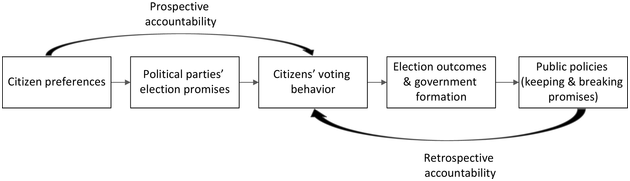

 Open access