Book contents
- Frontmatter
- Contents
- Acknowledgements
- Introduction: beyond the myth of the golden age
- 1 The US quest for legal security
- 2 The US pursuit of legal security through the evolution of the international law of dispute resolution
- 3 The US pursuit of legal security through the evolving regime relating to the use of force
- 4 The US pursuit of legal security in substantive policy arenas
- 5 Techniques through which the United States has reconciled its practice of offensive legal security with the principle of sovereign equality
- 6 The practice of offensive legal security in US diplomacy
- 7 The future of US engagement with international law
- Appendix
- Select bibliography
- Index
- References
2 - The US pursuit of legal security through the evolution of the international law of dispute resolution
Published online by Cambridge University Press: 05 June 2012

Book contents
- Frontmatter
- Contents
- Acknowledgements
- Introduction: beyond the myth of the golden age
- 1 The US quest for legal security
- 2 The US pursuit of legal security through the evolution of the international law of dispute resolution
- 3 The US pursuit of legal security through the evolving regime relating to the use of force
- 4 The US pursuit of legal security in substantive policy arenas
- 5 Techniques through which the United States has reconciled its practice of offensive legal security with the principle of sovereign equality
- 6 The practice of offensive legal security in US diplomacy
- 7 The future of US engagement with international law
- Appendix
- Select bibliography
- Index
- References
Summary
For centuries nations have struggled among each other. But we dream of a world where disputes are settled by law and reason. And we will try to make it so.
Lyndon Johnson, 1965Critical to the US pursuit of legal security has been its involvement with the evolution of what could be referred to as systemic regimes of international law – those relating to the making and enforcement of, and the resolution of disputes in, international law – in an attempt to ensure that the principles, rules, and concepts that constitute those regimes facilitate the US pursuit of legal security. It is arguable that US engagement with the development of codified legal regimes addressing systemic elements of international law tells us more about the US attitude to international law per se than do its actions in relation to specific subject areas addressed by international law, such as human rights, in which it is sometimes difficult to distinguish the nature of the US attitude towards international law from US policy in the particular issue area. This chapter is devoted to the nature of US engagement with the evolution of the law pertaining to dispute resolution in public international law. It will trace US participation in the evolution of treaty law relating to third-party dispute resolution, from its earliest involvement in international arbitration to its more recent stance regarding a permanent international court and a legalized process of third-party dispute resolution in the World Trade Organization (WTO), to reveal a remarkable degree of consistency.
Information
- Type
- Chapter
- Information
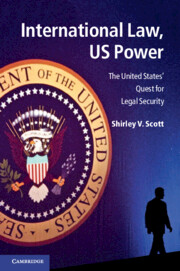
- International Law, US PowerThe United States' Quest for Legal Security, pp. 47 - 91Publisher: Cambridge University PressPrint publication year: 2012
References
ArbitrationEncyclopedia of Public International Law, Instalment 1AmsterdamNorth Holland 1981 16Google Scholar
The Judicial Settlement of International Disputes: Addresses at the Geneva Institute of International Relations, Geneva, August 16th and 17th, 1926LondonOxford University Press 1927 15Google Scholar
History of the Law of Nations: 1815 to World War IEncyclopedia of Public International LawAmsterdamNorth Holland 1984 194Google Scholar
Hamilton Fish: The Inner History of the Grant AdministrationNew YorkFrederick Ungar 1957 xivGoogle Scholar
Papers Relating to the Foreign Relations of the United States, with the Annual Message of the President Transmitted to Congress December 7, 1896, and the Annual Report of the Secretary of StateWashington, DCUS Government Printing Office 1896 238Google Scholar
Russian Circular Note Proposing the Programme of the First ConferenceThe Reports to the Hague Conferences of 1899 and 1907OxfordClarendon 1917 2
An International Tribunal for EuropeLondonBritish and Foreign Arbitration Association 1889 30Google Scholar
The Permanent Court of Arbitration: International Arbitration and Dispute Resolution: Summaries of Awards, Settlement Agreements and ReportsThe HagueKluwer 1999
Treaty of Obligatory Arbitration between Argentine Republic, Bolivia, Dominican Republic, Guatemala, Mexico, Paraguay, Peru, Salvador, Uruguay 1907 1 American Journal of International Law299
Convention for the Establishment of a Central American Court of Justice 1908 2 American Journal of International Law
The Failure of Union: Central America, 1824–1960Chapel HillUniversity of North Carolina Press 1961 199Google Scholar
The Central American Court of Justice 1932 26 American Journal of International Law759CrossRefGoogle Scholar
An International Court of Justice: Letter and Memorandum of January 12, 1914, to the Netherland Minister of Foreign Affairs, in Behalf of the Establishment of an International Court of JusticeNew YorkOUP 1916 25Google Scholar
A Highly Critical Moment: Role and Record of the 1907 Hague Peace Conference 2007 Netherlands International Law Review197CrossRefGoogle Scholar
Proceedings of the Hague Peace Conference: Translation of Official Texts, Conference of 1907New YorkOxford University Press 1920 884Google Scholar
The Real Significance of the Declaration of London – Address of the Honorable Elihu Root at the Sixth Annual Meeting of the American Society of International Law, Washington, April 25, 1912The Declaration of London: February 26, 1909: A Collection of Official Papers and Documents Relating to the International Naval Conference held in London December 1908-February 1909New YorkOxford University Press 1919 1
Convention Relative to the Establishment of an International Prize Court, 18 October 1907 1908 2 American Journal of International Law174
Selections from the Correspondence of Theodore Roosevelt and Henry Cabot Lodge, 1884–1918New YorkC. Scribner’s Sons 1925 111Google Scholar
Who Attempts Too Much Does Nothing Well: The 1920 Advisory Committee of Jurists and the Statute of the Permanent Court of International Justice 2002 73 British Year Book of International Law187CrossRefGoogle Scholar
“A Springboard for the Future”: A Historical Examination of Britain’s Role in Shaping the Optional Clause of the Permanent Court of International Justice 1985 79 American Journal of International Law28CrossRefGoogle Scholar
Discussion on Philip C. Jessup, “The Root Formula for the Accession of the United States to the Permanent Court of International Justice” 1931 25 American Society of International Law Proceedings67Google Scholar
1921 25 Proceedings of the American Society of International Law at Its Annual Meeting, 23–25 April 1931349
General Treaty of Inter-American Arbitration 1929 23 Supplement to the American Journal of International Law82CrossRef
Problems raised by the General Treaty of Inter-American Arbitration 1931 American Journal of International Law447CrossRefGoogle Scholar
The International Conferences of American States, 1889–1928New YorkOxford University Press 1931
International Justice and International Order 1947 22 Proceedings of the Academy of Political Science21CrossRefGoogle Scholar
Declaration on the Part of the United States of America 1946 15 Department of State Bulletin452
Testing Compliance Theories: Towards US Obedience of International Law in the Case 2006 19 Leiden Journal of International Law511CrossRefGoogle Scholar
Contemporary Practice of the United States relating to International Law 2000 94 American Journal of International Law102CrossRefGoogle Scholar
Results of the Rome Conference for an International Criminal Court 1998 ASIL Insightswww.asil.org/insigh23.cfmGoogle Scholar
The New WTO Dispute Settlement Procedure: An Overview of the First Three Years 1999 1 Minnesota Journal of Global Trade1Google Scholar
WTO Dispute Settlement 1995–2009 – A Statistical Analysis 2010 13 Journal of International Economic Law205CrossRefGoogle Scholar
Enforcement and Countermeasures in the WTO: Rules are Rules – Toward a More Collective Approach 2000 94 American Journal of International Law335CrossRefGoogle Scholar
The Business Dynamics of Global Regulatory CompetitionDynamics of Regulatory ChangeBerkeleyUniversity of California Press 2004 84Google Scholar
The WTO Gambling Dispute: Antigua Mulls Retaliation as the U.S. Negotiates Withdrawal of its GATS Commitments 2008 12 ASIL Insightswww.asil.org/insights080408.cfmGoogle Scholar
International Trade: Dispute SettlementResearch Handbook in International Economic LawCheltenhamEdward Elgar 2007 177Google Scholar
Orinoco Steamship Co. ArbitrationEncyclopedia of Public International LawAmsterdamNorth Holland 1981 219Google Scholar
Statement of the US Withdrawal from the Proceedings Initiated by Nicaragua in the International Court of Justice 1985 24 International Legal Materials246CrossRefGoogle Scholar
Discontinuance by Nicaragua of Case against the United States 1992 86 American Journal of International Law173
Vienna Convention on Consular Relations (Paraguay v. United States of America) 1998 ICJ Rep34
Is the International Court of Justice Biased? 2005 34 Journal of Legal Studies599CrossRefGoogle Scholar
The Customs Union Advisory Opinion 1931 25 American Journal of International Law711CrossRefGoogle Scholar
Accessibility standard: Unknown
Why this information is here
This section outlines the accessibility features of this content - including support for screen readers, full keyboard navigation and high-contrast display options. This may not be relevant for you.Accessibility Information
Accessibility compliance for the PDF of this chapter is currently unknown
and may be updated in the future.