


Direct evidence for a neurodevelopmental origin of schizophrenia can only be acquired by comparing individuals at risk with normal controls before illness onset, and following both groups through the period of risk until the psychosis does or does not develop. Several prospective studies have identified high-risk individuals as infants on the grounds that their mothers had schizophrenia (for review, see Reference Tarrant and JonesTarrant & Jones, 1999). These studies encountered difficulties resulting from the 20-year interval before the participants entered the period of maximum risk (Reference AsarnowAsarnow, 1988; Reference Cornblatt and ObuchowskiCornblatt & Obuchowski, 1997). The Edinburgh High-Risk Study (EHRS) (Reference Lawrie, Whalley and KestelmanLawrie et al, 1999; Reference Johnstone, Abukmeil and ByrneJohnstone et al, 2000) is a development of such work. It investigates individuals at enhanced risk because they have two or more affected relatives. These individuals were identified at age 16–24 years as they entered the period of maximum risk and were followed over 10 years, by which time most of those destined to develop schizophrenia would have done so.
METHOD
The purpose of the Edinburgh High-Risk Study is to determine the features that distinguish high-risk individuals who go on to develop schizophrenia from those who do not, and to compare relevant variables in affected and unaffected members of the high-risk sample with matched controls. We sought to acquire a sample of young people aged 16–24 years and considered to be well at ascertainment, who each had at least two first- or second-degree relatives with schizophrenia. To determine the number of high-risk individuals that we would need to study in order to achieve a number who would become ill adequate for relevant comparisons, we considered data on age at onset from 235 families multiply affected with schizophrenia. Two models of inheritance were considered, predicting that from 200 individuals aged 16–24 years 19 and 29 persons, respectively, would develop schizophrenia within 10 years. The actual number would depend upon the ages of the individuals in the sample and the relative frequencies of the stronger and weaker patterns of inheritance, but it appeared reasonable to predict that from 200 such high-risk individuals 20 would develop schizophrenia within 10 years. It is, of course, the case that some individuals from the families who have illnesses of very early onset might be excluded and some might become ill later, but the purpose of our study was not to acquire every case but to acquire sufficient numbers for adequate comparisons. There is little work sufficiently similar to provide a basis for adequate power calculations, but imaging was an important part of our considerations, and the study by Suddath et al (Reference Suddath, Christison and Torrey1990) of monozygotic twins provided clear findings on 15 discordant pairs. We aimed, therefore, to acquire a high-risk sample of 200 persons (Reference Johnstone, Abukmeil and ByrneJohnstone et al, 2000). Control groups comprised well young people and individuals in the first episode of schizophrenia who did not have a family risk of the disorder.
The EHRS examined the pathogenesis of schizophrenia by addressing the hypothesis that individuals from the high-risk sample who eventually develop schizophrenia would, at ascertainment and long before the development of psychosis, differ from high-risk individuals who do not develop schizophrenia and also from the well control group, in terms of the clinical and neurobiological assessments used. We predicted that, although the high-risk sample as a whole would differ from the control groups in terms of these indices, those who went on to develop schizophrenia would show more marked differences than those who did not. Previous comparisons between this high-risk sample and the two control groups have shown differences in clinical, psychopathological, psychological, neurological, developmental and imaging variables (Reference Hodges, Byrne and GrantHodges et al, 1999; Reference Johnstone, Abukmeil and ByrneJohnstone et al, 2000; Lawrie et al, Reference Lawrie, Whalley and Abukmeil2001a ,Reference Lawrie, Byrne and Miller b ; Reference Miller, Byrne and HodgesMiller et al, 2002a ; Reference Byrne, Clafferty and CoswayByrne et al, 2003). One of the central comparisons to be addressed in this data-set is the comparison in terms of baseline data of those who have and those who have not gone on to develop schizophrenia. We are now in a position to examine this issue.
Derivation of the sample
The study began in 1994. High-risk individuals aged 16–25 years with no history of serious psychiatric problems were identified throughout Scotland on the basis that they had at least two first- or second-degree relatives affected with schizophrenia (Reference Hodges, Byrne and GrantHodges et al, 1999). Participants for the well control group were recruited from the social network of the high-risk individuals themselves; they had no personal or family history of psychotic illness, but could have a family history of other psychiatric illness and otherwise were as similar to the high-risk participants as possible (Reference Hodges, Byrne and GrantHodges et al, 1999). Participants for the first-episode case group were recruited from local hospitals and were balanced group-wise for age with the high-risk individuals. Both control groups were planned to consist of approximately 35 persons each, the maximum number of the high-risk sample predicted to develop schizophrenia.
Plan of the study and assessments used
The plan for the period 1994–1999 was to assess all participants at ascertainment in terms of clinical features, neuropsychology and brain structure as determined by structural magnetic resonance imaging (MRI). People in the first-episode control group were assessed only on ascertainment; for clarity, findings in these individuals have been omitted from this report, although their baseline data have been presented elsewhere (Lawrie et al, Reference Lawrie, Whalley and Abukmeil2001a ,Reference Lawrie, Byrne and Miller b ; Reference Byrne, Clafferty and CoswayByrne et al, 2003). In the high-risk and the well control groups psychopathological assessments were repeated every 18 months. The baseline clinical measures included assessments of childhood behavioural traits (Reference Miller, Byrne and HodgesMiller et al, 2002a ), schizotypal features (Miller et al, Reference Miller, Byrne and Hodges2002b ,Reference Miller, Lawrie and Byrne c ), and the neurodevelopmental variables of minor physical anomalies and neurological soft signs (Reference Lawrie, Byrne and MillerLawrie et al, 2001b ), ocular hypertelorism (Reference Boyes, Whalley and LawrieBoyes et al, 2001), dermatoglyphics (Reference Langsley, Miller and ByrneLangsley et al, 2004) and substance use (Reference Miller, Lawrie and HodgesMiller et al, 2001). Mental state was assessed at entry and at all the follow-up points by the Present State Examination (PSE; Reference Wing, Cooper and SartoriusWing et al, 1974), and from this we derived the following five-point psychopathological scale (Reference Johnstone, Abukmeil and ByrneJohnstone et al, 2000): 0, no psychotic or neurotic symptoms; 1, neurotic symptoms only; 2, partially held psychotic symptoms; 3, definite but isolated and/or transient psychotic symptoms; 4, schizophrenia diagnosed by ICD–10 (World Health Organization, 1992) and PSE (CATEGO S+ or O+). Psychotic illness of a non-schizophrenic type is not covered by the scale, but it did not occur. Points 2 and 3 are combined within this study and participants are referred to as having had psychotic or possibly psychotic symptoms.
The neuropsychological test battery (Reference Byrne, Hodges and GrantByrne et al, 1999) consisted of tests of general IQ, attention, motor speed, executive function, verbal learning and memory. Brain structure was assessed (Reference Whalley, Kestelman and RimmingtonWhalley et al, 1999) by MRI scanning on a 1 T Magnetom scanner (Siemens, Erlangen, Germany). In addition to these measures, we assessed the degree of genetic liability of the high-risk participants by both categorical and continuous methods (Reference Lawrie, Whalley and AbukmeilLawrie et al, 2001a ). From 1999 to 2004 the assessments were continued every 18 months, with the addition of functional MRI.
The principal purpose of this study is twofold. First, we wished to determine variables that at baseline (i.e. at initial ascertainment assessment) distinguish between high-risk individuals who will fall ill with schizophrenia, and those who will not do so but who will or will not show psychotic or possibly psychotic symptoms. To do this, we selected all the variables from our previous studies (Lawrie et al, Reference Lawrie, Whalley and Abukmeil2001a ,Reference Lawrie, Byrne and Miller b ; Miller et al, Reference Miller, Lawrie and Hodges2001, Reference Miller, Byrne and Hodges2002a ,Reference Miller, Byrne and Hodges b ,Reference Miller, Lawrie and Byrne c ; Reference Byrne, Clafferty and CoswayByrne et al, 2003; Reference Langsley, Miller and ByrneLangsley et al, 2004) that at baseline either distinguished high-risk individuals from well controls beyond the P<0.01 level of significance, or distinguished high-risk individuals who experienced psychotic symptoms at an early stage from those who did not (P<0.01) (see Table 1). We retested these variables to assess the usefulness of each one in making the distinctions described. The sample retested consisted of all the participants with whom we were still in regular contact. We predicted that there would be a gradation in the effects, from high-risk individuals who fall ill followed by high-risk individuals with psychotic symptoms only, high-risk individuals without psychotic symptoms and well controls, in that order. Our second aim was to describe, for the first time, some of the characteristics of the high-risk participants who became ill with schizophrenia.
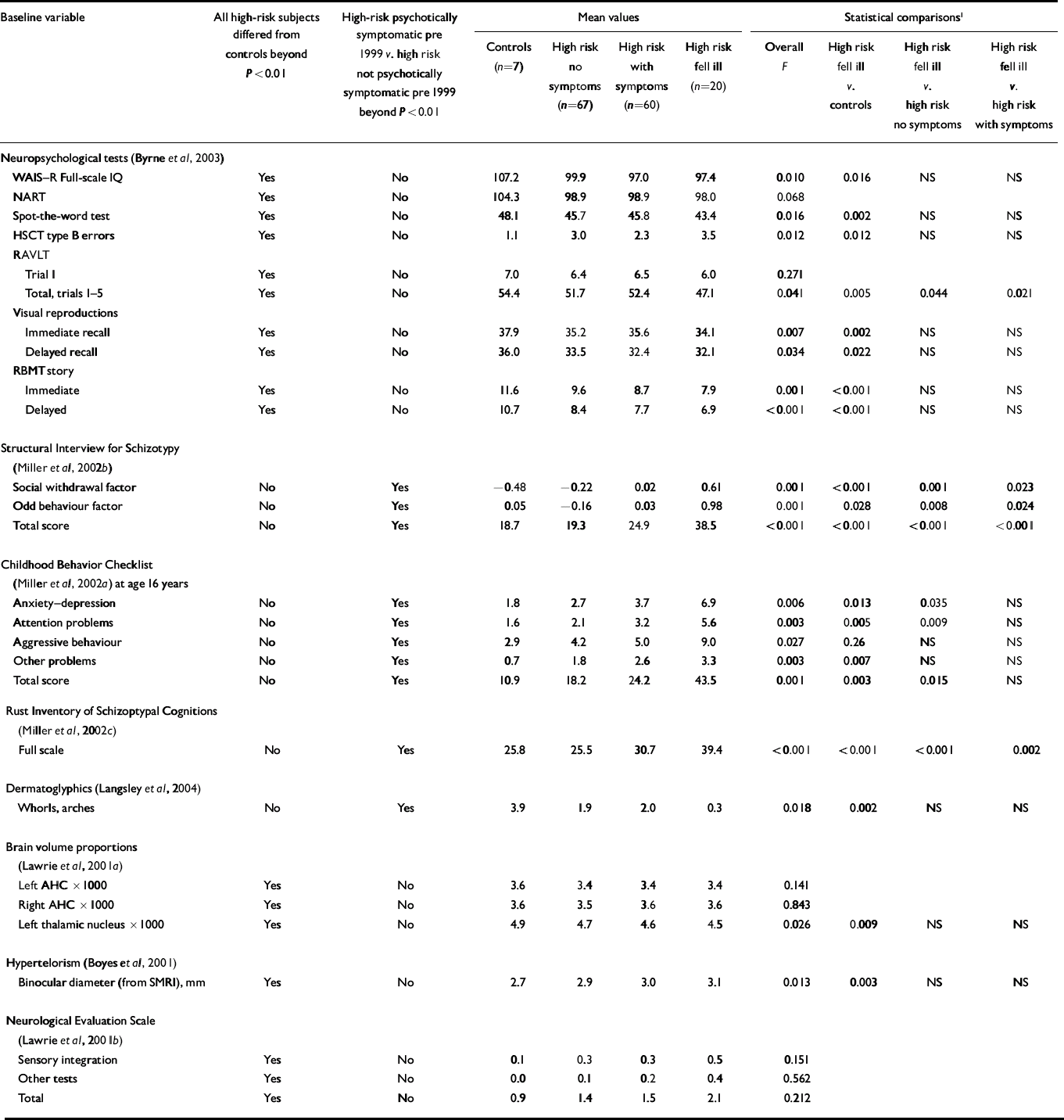
The study variables used and their breakdown at baseline according to current status (other variables assessed did not achieve significance at P < 0.01)
| Baseline variable | All high-risk subjects differed from controls beyond P < 0.01 | High-risk psychotically symptomatic pre 1999 v. high risk not psychotically symptomatic pre 1999 beyond P < 0.01 | Mean values | Statistical comparisons1 | ||||||
|---|---|---|---|---|---|---|---|---|---|---|
| Controls (n=7) | High risk no symptoms (n=67) | High risk with symptoms (n=60) | High risk fell ill (n=20) | Overall F | High risk fell ill v. controls | High risk fell ill v. high risk no symptoms | High risk fell ill v. high risk with symptoms | |||
| Neuropsychological tests (Reference Byrne, Clafferty and CoswayByrne et al, 2003) | ||||||||||
| WAIS-R Full-scale IQ | Yes | No | 107.2 | 99.9 | 97.0 | 97.4 | 0.010 | 0.016 | NS | NS |
| NART | Yes | No | 104.3 | 98.9 | 98.9 | 98.0 | 0.068 | |||
| Spot-the-word test | Yes | No | 48.1 | 45.7 | 45.8 | 43.4 | 0.016 | 0.002 | NS | NS |
| HSCT type B errors | Yes | No | 1.1 | 3.0 | 2.3 | 3.5 | 0.012 | 0.012 | NS | NS |
| RAVLT | ||||||||||
| Trial 1 | Yes | No | 7.0 | 6.4 | 6.5 | 6.0 | 0.271 | |||
| Total, trials 1-5 | Yes | No | 54.4 | 51.7 | 52.4 | 47.1 | 0.041 | 0.005 | 0.044 | 0.021 |
| Visual reproductions | ||||||||||
| Immediate recall | Yes | No | 37.9 | 35.2 | 35.6 | 34.1 | 0.007 | 0.002 | NS | NS |
| Delayed recall | Yes | No | 36.0 | 33.5 | 32.4 | 32.1 | 0.034 | 0.022 | NS | NS |
| RBMT story | ||||||||||
| Immediate | Yes | No | 11.6 | 9.6 | 8.7 | 7.9 | 0.001 | <0.001 | NS | NS |
| Delayed | Yes | No | 10.7 | 8.4 | 7.7 | 6.9 | <0.001 | <0.001 | NS | NS |
| Structural Interview for Schizotypy (Reference Miller, Byrne and HodgesMiller et al, 2002b ) | ||||||||||
| Social withdrawal factor | No | Yes | -0.48 | -0.22 | 0.02 | 0.61 | 0.001 | <0.001 | 0.001 | 0.023 |
| Odd behaviour factor | No | Yes | 0.05 | -0.16 | 0.03 | 0.98 | 0.001 | 0.028 | 0.008 | 0.024 |
| Total score | No | Yes | 18.7 | 19.3 | 24.9 | 38.5 | <0.001 | <0.001 | <0.001 | <0.001 |
| Childhood Behavior Checklist (Reference Miller, Byrne and HodgesMiller et al, 2002a ) at age 16 years | ||||||||||
| Anxiety-depression | No | Yes | 1.8 | 2.7 | 3.7 | 6.9 | 0.006 | 0.013 | 0.035 | NS |
| Attention problems | No | Yes | 1.6 | 2.1 | 3.2 | 5.6 | 0.003 | 0.005 | 0.009 | NS |
| Aggressive behaviour | No | Yes | 2.9 | 4.2 | 5.0 | 9.0 | 0.027 | 0.26 | NS | NS |
| Other problems | No | Yes | 0.7 | 1.8 | 2.6 | 3.3 | 0.003 | 0.007 | NS | NS |
| Total score | No | Yes | 10.9 | 18.2 | 24.2 | 43.5 | 0.001 | 0.003 | 0.015 | NS |
| Rust Inventory of Schizoptypal Cognitions (Reference Miller, Lawrie and ByrneMiller et al, 2002c ) | ||||||||||
| Full scale | No | Yes | 25.8 | 25.5 | 30.7 | 39.4 | < 0.001 | < 0.001 | < 0.001 | 0.002 |
| Dermatoglyphics (Reference Langsley, Miller and ByrneLangsley et al, 2004) | ||||||||||
| Whorls, arches | No | Yes | 3.9 | 1.9 | 2.0 | 0.3 | 0.018 | 0.002 | NS | NS |
| Brain volume proportions (Reference Lawrie, Whalley and AbukmeilLawrie et al, 2001a ) | ||||||||||
| Left AHC × 1000 | Yes | No | 3.6 | 3.4 | 3.4 | 3.4 | 0.141 | |||
| Right AHC × 1000 | Yes | No | 3.6 | 3.5 | 3.6 | 3.6 | 0.843 | |||
| Left thalamic nucleus × 1000 | Yes | No | 4.9 | 4.7 | 4.6 | 4.5 | 0.026 | 0.009 | NS | NS |
| Hypertelorism (Reference Boyes, Whalley and LawrieBoyes et al, 2001) | ||||||||||
| Binocular diameter (from SMRI), mm | Yes | No | 2.7 | 2.9 | 3.0 | 3.1 | 0.013 | 0.003 | NS | NS |
| Neurological Evaluation Scale (Reference Lawrie, Byrne and MillerLawrie et al, 2001b ) | ||||||||||
| Sensory integration | Yes | No | 0.1 | 0.3 | 0.3 | 0.5 | 0.151 | |||
| Other tests | Yes | No | 0.0 | 0.1 | 0.2 | 0.4 | 0.562 | |||
| Total | Yes | No | 0.9 | 1.4 | 1.5 | 2.1 | 0.212 | |||
RESULTS
Predicting illness onset
A total of 229 high-risk participants were ascertained, of whom 163 had provided some data and 156 provided complete data by closure of the recruiting period of the programme in July 1999. There were 36 participants in the well control group. At ascertainment the mean age of the high-risk group was 21.19 years (s.d.=2.97) and it comprised 77 men and 79 women. The well control group's mean age was 21.17 years (s.d.=2.37) and there were 17 men and 19 women. On social class, however, the samples did differ significantly, with 19 (53%) of the control group having fathers in non-manual occupations against only 46 (29.5%) of the high-risk group (χ2=6.9, Fisher's exact test P=0.011).
The updated results reported here concern 173 participants (from both the high-risk and the well control groups) with whom we remain in regular contact. Of these, 27 were members of the well control group, none of whom has developed schizophrenia. The high-risk group was divided into ‘high risk without psychotic or possibly psychotic symptoms ever by July 2003’ (n=66), ‘high risk with psychotic or possibly psychotic symptoms by July 2003’ (n=60) and ‘high risk ill by July 2003’ (n=20). Occasionally the ‘high risk ill’ participants were classified as ill at their planned review, but – as might be expected – most developed schizophrenia between assessments and were admitted to a local service. Consultants in the areas from which these patients came were collaborators in the project. They and the high-risk participants themselves, and their families, knew that we wished to be informed of any deterioration. Through their cooperation we were able to obtain PSE ratings shortly after admission for treatment of the first psychotic episode for 18 of 20 participants. All those rated fulfilled the PSE CATEGO criteria for schizophrenia and paranoid psychoses and all 20 fulfilled ICD–10 criteria for schizophrenia.
We were unable to obtain follow-up data on 10 (6%) of the high-risk group and 9 controls (25%).
Twenty-seven variables assessed at baseline met our criteria for initial inclusion set out above. Baseline scores for each of these were subjected to one-way analysis of variance (ANOVA) (with log transformations where warranted) within our sample of 173 participants divided as above. These ANOVAs were followed up by three planned comparisons:
-
(a) ‘high risk ill’ v. controls;
-
(b) ‘high risk ill’ v. ‘high risk without psychotic or possibly psychotic symptoms’;
-
(c) ‘high risk ill’ v. ‘high risk with psychotic or possibly psychotic symptoms’.
Table 1 sets out these variables, indicates the earlier results that justified their inclusion and gives the mean values and the significance levels for the ANOVAs overall.
On this basis the Structural Interview for Schizotypy (SIS; Reference Miller, Byrne and HodgesMiller et al, 2002b ) social withdrawal score, the SIS total score and the Rust Inventory of Schizotypal Cognitions (RISC; Reference Miller, Lawrie and ByrneMiller et al, 2002c ) distinguish the high-risk group who fall ill from high-risk subjects who do and do not develop psychotic symptoms. Although results of the Rey Auditory Verbal Learning Test (RAVLT) total are just significant (Table 1), it is the behavioural measures that clearly separate high-risk participants who will become ill from the other two high-risk groups. Statistically significant separation of those who will become ill from the controls is, however, additionally achieved on a number of psychological tests, on measures of childhood behaviour, on the developmental measures of ocular hypertelorism and dermatoglyphic variables, and on left thalamic volume.
Clinical significance
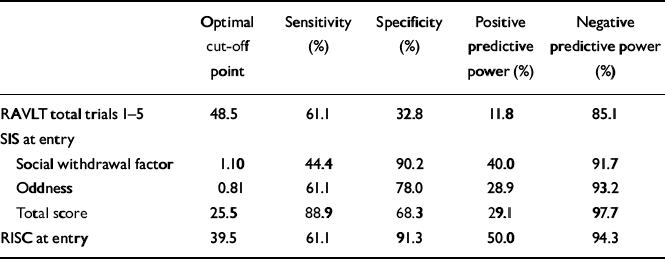
We then went on to consider the adequacy of the measures separating the high-risk group who would become ill from the other two high-risk groups, for predicting schizophrenia within the high-risk sample as a whole (Table 2). Each scale is dichotomised with the cut-off points determined by receiver operating characteristic analyses (Table 2). Negative predictive power is generally greater than positive, being as high as 97%, whereas the best positive predictive value is 50%.
Predictors of schizophrenia dividing the ‘high risk ill’ group from other high-risk participants
| Optimal cut-off point | Sensitivity (%) | Specificity (%) | Positive predictive power (%) | Negative predictive power (%) | |
|---|---|---|---|---|---|
| RAVLT total trials 1-5 | 48.5 | 61.1 | 32.8 | 11.8 | 85.1 |
| SIS at entry | |||||
| Social withdrawal factor | 1.10 | 44.4 | 90.2 | 40.0 | 91.7 |
| Oddness | 0.81 | 61.1 | 78.0 | 28.9 | 93.2 |
| Total score | 25.5 | 88.9 | 68.3 | 29.1 | 97.7 |
| RISC at entry | 39.5 | 61.1 | 91.3 | 50.0 | 94.3 |
Characteristics of high-risk individuals who fell ill
Twelve men and eight women developed schizophrenia. At ascertainment their mean age was 20.3 years (s.d.=2.20) for men and 19.6 years (s.d.=2.73) for women. The mean ages at which they became ill were 22.8 years (s.d.=2.5) for men and 22.8 years (s.d.=2.50) (women) and the mean length of time between ascertainment and diagnosis of schizophrenia was 2.4 years (s.d.=1.9) for men and 3.2 years (s.d.=0.9) for women. There was no significant gender difference on these variables and no significant difference on age at ascertainment between these individuals and the high-risk participants who did not become ill: mean age at ascertainment 21.3 years (s.d.=3.0) for men and 21.4 years (s.d.=3.0) for women.
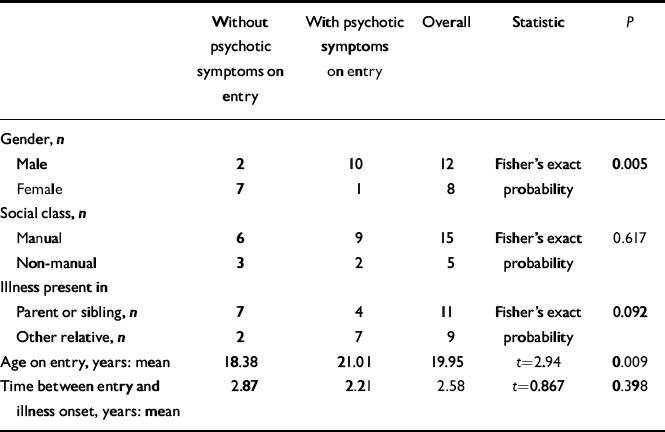
According to our classification, at the time of entry (i.e. at baseline), 11 people who fell ill described having or having had some psychotic or possibly psychotic symptoms, and 9 who fell ill did not. Table 3 gives further details, dividing participants who subsequently fell ill according to their symptom status on entry. A preponderance of men who fell ill showed psychotic or possibly psychotic symptoms on entry, whereas the group without such symptoms contained mostly women. Those with such symptoms were older on entry than those without, and there was a slight tendency for those without such symptoms to have a higher proportion of ill parents or siblings.
Characteristics of individuals at high risk who fell ill, according to presence or absence of psychotic symptoms on entry
| Without psychotic symptoms on entry | With psychotic symptoms on entry | Overall | Statistic | P | |
|---|---|---|---|---|---|
| Gender, n | |||||
| Male | 2 | 10 | 12 | Fisher's exact | 0.005 |
| Female | 7 | 1 | 8 | probability | |
| Social class, n | |||||
| Manual | 6 | 9 | 15 | Fisher's exact | 0.617 |
| Non-manual | 3 | 2 | 5 | probability | |
| Illness present in | |||||
| Parent or sibling, n | 7 | 4 | 11 | Fisher's exact | 0.092 |
| Other relative, n | 2 | 7 | 9 | probability | |
| Age on entry, years: mean | 18.38 | 21.01 | 19.95 | t=2.94 | 0.009 |
| Time between entry and illness onset, years: mean | 2.87 | 2.21 | 2.58 | t=0.867 | 0.398 |
DISCUSSION
First, in this prospective study, the predicted number of participants becoming ill with schizophrenia was arrived at within 8 years. We have been fortunate in succeeding in retaining contact with the great majority of the high-risk participants and a lesser (although still high) proportion of the control group over this time, and can have confidence in our assessments of the clinical status of the individuals concerned. Second, we show that high-risk individuals who developed schizophrenia during the follow-up period clearly differed at ascertainment (some years before the development of the psychosis) from the high-risk participants who remained well and the normal control group on nine clinical measures and to a lesser extent on neuropsychological assessments. On several other variables (see Table 1) trends are shown.
Issues of discrimination and numbers
The idea that people at high risk who will become ill can be clearly distinguished from those who do not become ill is an oversimplification of this situation. Psychopathological symptoms short of psychosis occurred in many more members of the high-risk sample than were ever predicted to develop schizophrenia. It is extremely unlikely that all the high-risk participants who have shown psychotic or possibly psychotic symptoms at some stage will actually develop schizophrenia. If this were to happen, the frequency of the disorder would be greatly in excess of what is usually reported. Most of the men, at least, have now passed through the period of highest risk. Moreover, it has been repeatedly reported that the well-established gender differences in age at onset of schizophrenia are much less in familial cases (Reference Hafner, Maurer and LofflerHafner et al, 1999). The Copenhagen High Risk Study (Reference Parnas, Schulsinger and SchulsingerParnas et al, 1982; Reference Cannon, Mednick and ParnasCannon et al, 1994), which was similar in design to our study, identified children of women with a psychotic disorder when the children were aged between 10–19 years in 1962, and followed them up between 1972 and 1974 when they were about 25 years old (Reference Parnas, Schulsinger and SchulsingerParnas et al, 1982) and again between 1986 and 1989 when their mean age was 39 years (Reference Cannon, Mednick and ParnasCannon et al, 1994); the number of individuals with schizophrenia appeared to increase by four (from 13 to 17) between the two reports. On the basis of the Copenhagen study we would not expect more than a few more of our high-risk participants now to develop schizophrenia. In terms of simple behavioural measures from the SIS and RISC, the high-risk participants who have become ill (Table 1) show obvious and significant differences from those who have not become ill. However, it does not seem likely that there is a clear separation between these two groups in terms of developmental measures, as there seems to be a gradient of impairment.
The strongest discriminators identified in our study between those who fell ill and the other high-risk participants are found on the RISC and the SIS. The 26 items of the RISC are designed to measure schizotypal cognitions rather than overt psychotic symptoms (examples are ‘I never use a lucky charm’ and ‘sometimes I get a weird feeling that I am not really here’). The SIS contains several scales, some of which directly measure near-psychotic symptoms but most of which do not. The elements composing the social withdrawal factor, which gives the strongest result, concern anxiety and introversion rather than anything of a psychotic nature (Reference Miller, Byrne and HodgesMiller et al, 2002b ). However, the question is raised as to whether the individuals who later suffered onset of schizophrenia were in the prodromal phase of the illness on recruitment to the study. There is no easy answer. Just over half of those who fell ill (Table 3) were in the ‘psychotic or possibly psychotic symptoms’ group on entry to the study and some of them progressed to illness quite soon. Those who had psychotic or possibly psychotic symptoms were older than those who did not. On the other hand, there was no difference in the average time between recruitment and illness for those who did and did not have symptoms on entry according to our classification; this average time overall was 2½ years. Furthermore, although there are indeed highly significant differences on the RISC and the SIS between those who fell ill and the other high-risk participants, there is also considerable overlap, i.e. many of the high-risk group who did not fall ill were just as symptomatic on entry as any of those who did.
Possible clinical applications
The data in Table 2 indicate that in a sample of high genetic liability, we could use some of the measures to successfully identify a group who are likely to remain well, and we could also identify a group in whom the chance of development of schizophrenia was 50%, rather than the approximately 10% risk conveyed by their known familial high risk. Although replication would be important before this is applied in clinical practice, and the ethical issues would require careful consideration, the SIS and the RISC are simple measures that could be widely employed, and it is possible that this could be helpful for clinicians, parents and individuals. The findings also have clear implications for the design of genetic studies, as it is apparent that people at high risk who develop schizophrenia closely resemble those who develop symptoms short of the diagnosis. What appears to be inherited is a state of vulnerability rather than psychosis per se. Other factors would seem to be involved in the development of florid schizophrenia. Clearly, such findings could be used to provide a guide to intervention strategies; however, they raise important questions. Why do not all those with the vulnerability factors become ill? What can be done to try to retain more individuals in a state in which florid illness does not occur and functioning remains good, even though abnormalities can be demonstrated on detailed investigation? Details of the progress of symptoms in our high-risk sample over the years are the subject of a separate paper (Reference Owens, Miller and LawrieOwens et al, 2005). These individuals volunteer no complaints, most of them are in work and, to the casual observer, they do not appear dysplastic or in any way impaired and are apparently normal young people who for everyday purposes function well. If they could be held at this stage, their apparent inheritance of a state of vulnerability to schizophrenia need be no real disadvantage to them.
Relationship to other research
It is appropriate to consider these findings in relation to the results of studies that define individuals as being of high risk of schizophrenia on the basis of symptomatic criteria (e.g. Reference Klosterkotter, Hellmich and SteinmeyerKlosterkotter et al, 2001) or a combination of familial risk and symptomatic criteria (Yung et al, Reference Yung, Phillips and Yuen2003, Reference Yung, Phillips and Yuen2004). Such individuals, in contrast to those in our study, present seeking help for symptoms. Much higher rates of transition to psychosis (not necessarily schizophrenia) were found – 36% over 12 months in the Australian study (Reference Yung, Phillips and YuenYung et al, 2004) and 49.4% over 9.6 years in the Cologne study (Reference Klosterkotter, Hellmich and SteinmeyerKlosterkotter et al, 2001) – and the positive predictive value of certain variables was greater than we have found here. In the help-seeking samples described by Yung et al (Reference Yung, Phillips and Yuen2004) and Klosterkotter et al (Reference Klosterkotter, Hellmich and Steinmeyer2001) it is evident that the presence of sub-threshold psychotic symptoms was associated with the later development of psychotic illness, and the suggestion that such symptoms merit active treatment is reasonably made. In members of our study sample, who were not seeking care, it is evident that transient and partial psychotic symptoms and psychotic-like experiences occur in many more people than might be anticipated to develop schizophrenia. The filmed records of the PSE interviews show that such symptoms often appear to have been associated with little distress or functional impairment, and we know that they may be short-lived and followed by years in which they do not occur at all.
What does this tell us about schizophrenia?
The central finding of our study is that it is the simple behavioural measures of the SIS and the RISC that provide the best measure of distinguishing high-risk individuals who will develop schizophrenia from those who will not. None the less, there are a number of other distinguishing measures (particularly in terms of neuropsychology) where highly significant results are obtained, especially on measures of episodic memory. Impairments in this task are suggestive of temporal lobe dysfunction. We know from the serial studies in the EHRS that both memory function and temporal lobe volume, as demonstrated by structural MRI, deteriorate with the passage of time (Reference Cosway, Byrne and Claffei tyCosway et al, 2000; Reference Lawrie, Whalley and AbukmeilLawrie et al, 2002; Reference Job, Whalley and YatesJob et al, 2003) in those with psychotic or possibly psychotic symptoms. We consider that the findings of the study as a whole are consistent with the view that schizophrenia is primarily a disorder of temporal lobe structure and function which develops slowly over several years. The exact nature of the change that pushes an individual into psychosis is not clear at this point, but our continuing studies, particularly of functional imaging, may reveal this.
Final comment
Although imaging is integral to the high-risk study as a whole and is providing exciting findings, the central features that are presented here do not depend on advanced technology. We suggest that this study shows that with a clear hypothesis, a well-characterised sample and an appropriate design, worthwhile new insights into a common and crippling disorder can be obtained using simple clinical methods.
Clinical Implications and Limitations
CLINICAL IMPLICATIONS
-
▪ Among individuals at enhanced genetic risk of schizophrenia, a state of vulnerability, including transient and partial symptoms, will occur in many more individuals than will develop florid schizophrenia.
-
▪ It is possible, using simple behavioural assessments of schizotypal and anxiety cognitions, to predict with some accuracy those of a high-risk group who will (and with considerable accuracy those who will not) develop schizophrenia, some years before the development of the psychosis.
-
▪ Neuropsychological and neurodevelopmental measures are more successful in distinguishing individuals at high risk from healthy controls than they are in distinguishing high-risk individuals who will develop schizophrenia from those who will not.
LIMITATIONS
-
▪ The findings of the study refer to a group of individuals with a substantial family history of schizophrenia who have been willing to participate in repeated assessments over an 8-year period, and thus are not typical of the generality of individuals who may develop schizophrenia.
-
▪ Not all the participants have passed through the principal period of risk of schizophrenia, and some who are currently well may yet develop the psychosis.
-
▪ The control group volunteers are partly selected by their willingness to continue with this ongoing study, despite having no personal interest in the issue; they are, therefore, likely to be more socially responsible and persistent than average.
Acknowledgements
This study was carried out with the approval of the ethical committees of. the relevant areas. It was supported financially by two Programme Grants from. the Medical Research Council. The sustained cooperation of the families. involved is acknowledged with gratitude, as are the consistent efforts of all. staff and collaborators. We also thank Norma Brearley for the careful. preparation of the manuscript.




eLetters
No eLetters have been published for this article.