


In their meta-analysis, Kalu et al. (Reference Kalu, Sexton, Loo and Ebmeier2012) tackled a question that had to date not been comprehensively answered: whether or not the introduction of transcranial direct current stimulation (tDCS) would be of clinical value in the treatment of major depression. For their study, the authors identified relevant existing works with the help of Medline and Embase, the first of which date from 1964. This prevented Kalu et al. from sharing the widespread erroneous belief that tDCS was a newly developed (Brunelin et al. Reference Brunelin, Mondino, Gassab, Haesebaert, Gaha, Suaud-Chagny, Saoud, Mechri and Poulet2012) non-invasive neurostimulating therapeutic option in the treatment of severe mental illnesses. Yet since the above-cited databases mainly comprise works dating from after the mid-20th century, it may be worthwhile to note that severely depressive patients, schizophrenics and patients with auditory verbal hallucinations were subjected to tDCS treatment as early as the 19th century. The historiography of modern brain stimulation therapies has so far concentrated on invasive approaches (lobotomy) and neglected non-invasive electricity-based methods.
In the 1870s and 1880s German psychiatrists Rudolph Gottfried Arndt and Wilhelm Tigges conducted such studies; these were the first ever to be performed on larger groups of depressive and psychotic patients. The method they describe is largely identical to present-day tDCS. Summarizing their studies, Tigges recommended electrical brain stimulation for severe depression with a proneness to chronicity, whereas he reported no or negative results in ‘mad’ patients (Tigges, Reference Tigges1883, Reference Tigges1885). Arndt applied electric brain stimulation in cases of severe psychoses with depressive symptoms to the degree of catatonia, hypochondriac delusion and melancholia. He recommended faradic current (alternate current) as a stimulant against passivity, stupor, weakness and manic-depressive disorder. On the other hand, galvanization (direct current) was to be applied in other forms of affective disorders, psychoses and psychotic symptoms. He claimed that vertical, horizontal and diagonal galvanization of the head, with both electrodes attached to the cranial bone, sometimes supported by simultaneous galvanization of the sympathetic system (vagus nerve stimulation) and the cervical spinal cord, was especially successful in fresh, recently developed psychoses and anxieties. He also recommended galvanization of the head and the ‘auditory centres’ against acoustic hallucinations (Arndt, Reference Arndt1870, Reference Arndt1872, Reference Arndt1878).
In contrast to his colleagues, who mainly described individual cases, Tigges summarized the experience that he and they made and clearly differentiated individual groups of patients with similar illnesses and/or symptoms. He came to the same conclusion as that attained by present-day research: that electric brain stimulation was reasonably effective with patients suffering from depression and hence with those groups that would most probably be recommended this therapy when conventional therapy could no longer help. Similarly, he also found that, in the case of patients suffering from what would today be termed schizophrenia rich in positive symptoms, electrotherapeutic treatment showed little to no effect (Steinberg, Reference Steinberg2013).
What makes these 19th-century sources difficult and maybe less interesting to read today is the fact that exact psychological–psychopathological parameters of brain stimulation in general, and of the application method in particular, are scarce and not easy to follow. Readers are instead explicitly encouraged to adopt an eclectic approach towards electrotherapy; to allow themselves to be guided by their own feelings and by the feedback received from their patients. Despite an ever-persisting general reluctance to give exact measures, Tigges differed from his colleagues in that he at least tried to give rough physical guidelines:
As average strengths of current for applications to the head 6 el.[ements] (with an average 2-minute duration), for applications to the symp[athetic] 8 el. (with a maximum of 3 minutes duration) and for such to the back 12 elements with a duration of 5 minutes or more have been suggested (Tigges, Reference Tigges1883).
This quotation reveals a general problem faced by present-day readers when reviewing electrotherapeutic literature of the 1880s: it is very tough and time-consuming to elaborate the physical and instrumental foundations of this method and then try to correlate these with present-day categories and measures. Even if one were to take the time, correlations of this kind are not always possible. It is hoped that the following shortened description of apparatuses available and used provide insight into the technology and assist in understanding the aforementioned recommendations for technical application.
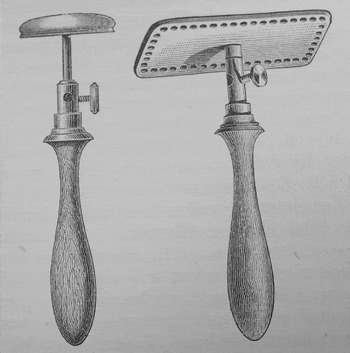
The first point that readers should be aware of is that franklinization, i.e. the application of friction current, was in use alongside the above-mentioned faradization and galvanization. For brain diseases, however, galvanization, i.e. the application of direct current, was the method of choice and regarded as the most effective (Erb, Reference Erb1882; Lewandowski, Reference Lewandowski1887). The galvanic current was mainly produced with the help of zinc–carbon, less frequently zinc–copper, batteries/cells, and then introduced into the human body with the help of one or two electrodes. The sample battery shown in Fig. 1 provides an ample illustration of the physical principle: on each of the three tongues there are 10 zinc (Z) and 10 carbon (K for Kohlenstoff, the German for carbon) bars, each of which can be connected to each other serially. A mixture of hydrochloric or sulphuric acid with potassium dichromate or zinc sulphate, or sometimes just one of these agents alone, served as the electrolyte (or ‘excitement fluid’, as it was called at the time). One of these zinc–carbon bar pairs established one galvanic cell and was equivalent to one element as referred to in the text above by Tigges. Depending on how many elements one wished to cascade, the electrolyte was filled into the appropriate number of ‘basins’ in the drawer below the zinc–carbon bars. In addition, the clamp (depicted as A in Fig. 1) was attached to the appropriate zinc–carbon bar pair as numbered on the three tongues, the other wire already pre-defined at K1, the first zinc–carbon pair. One such galvanic element could produce a current of 1 or a maximum of 1.5 V. When cascaded, the voltage of the individual elements was combined, e.g. a total of 12–18 V for 12 elements connected serially. Although the strength of the current was measured when it left the battery with the help of a galvanometer, it was clear to electrotherapists that this was no measure of the amperage level of the current when it reached the intended diseased body region. They were aware of the fact that the level of the current was no longer equal to what had been applied (or produced), as its strength diminished due to deflection and other resistance (such as that of the skin, tissue or bones, etc.) – phenomena that differed from one patient to another and also depended on the part of the body to which the current was applied. Hence different output voltages were recommended for different places of application. Another important parameter that influenced the active strength of current was the size of the electrode; the surface from which the current was applied to the body influenced what was usually referred to as the current density, and which was equivalent to the quotient of output amperage and electrode surface and given as a simple fraction (e.g. ¼), mostly omitting the measurement unit (mA/cm2). This might likewise make reading these texts more difficult than present-day ones, which use standardized data and always provide the correct measure reference. Depending on the density desired, different sizes and forms of electrodes were used (see Fig. 2). When applying the current, sponges were either attached to or placed on top of the electrodes and then moistened; the electrodes were then applied to the appropriate body region. In applications to the brain or the neck, the electrodes were usually kept at one fixed spot or even firmly attached to the body (so-called stable galvanization). In treatments of the sympathetic system on the other hand, the electrode was moved over the skin alongside the nerve, back and forth, without removing it from the skin surface (instable galvanization). Finally, in a third method of application, the electrodes were moved over the skin in just one direction, removed from the skin's surface and then reapplied at the starting point (intermittent galvanization).
Battery produced by Rudolf Krüger Co. (Berlin, Germany) comprising 30 galvanic elements (length 26 cm, width 22 cm, height 18 cm, weight filled with electrolyte 6 kg). Each hard rubber tongue comprises 10 zinc bars and 10 carbon bars (marked Z and K accordingly). The tongues can be moved up and down in the battery box. The liquid/electrolyte container consists of three rows with 10 hard rubber hutches, each of which can be inserted in the drawer (see rear side of the battery) under the zinc and carbon bars and filled in accordance with the number of elements one wishes to connect serially. ‘G’ marks the galvanometer; the current turner can be seen on the left. Its switch is set to ‘N’ (normal), which means that the carbon bars are the anodes and the zinc bars the cathodes (source: Lewandowski, Reference Lewandowski1887, p. 199).

Plate electrodes with or without hands, the latter used as fixed electrodes (fixed firm to the body), show either round (left) or rectangular (right) application surfaces (source: Lewandowski, Reference Lewandowski1887, p. 214).
After 1890 electrical brain stimulation increasingly became disregarded as a treatment option for mental illnesses, mainly because basic questions surrounding its mode of action and reliable application methods had not been answered; in addition to this came the difficulties involved in verifying its successes (Steinberg, Reference Steinberg2011).
Declaration of Interest
None.



