

Six years have passed since the Government of Colombia and the Revolutionary Armed Forces of Colombia—People's Army (FARC-EP) guerrilla signed a peace agreement in 2016 (OACP, 2016), officially ending decades of violence as a result of one of the world's longest internal armed conflicts during which hundreds of thousands of people died and millions were forcibly displaced from their homes and lands. The signing of the peace agreement came with the hope that people who had been directly and indirectly affected by the conflict could now build a better and safer future for their families. Prior to the COVID pandemic, the country experienced sprouting in national and international tourism. The number of foreign tourists who arrived to the country increased from about 1.9 million in 2015, to about 2.8 million by 2019 (CITUR, 2022). The peace agreement was also hailed by scientists eager to study the ecology and incredible biodiversity in regions that were de-facto off limits to scientists due to the insecurity during the armed conflict (Humboldt, 2018; Negret et al., Reference Negret, Maron, Fuller, Possingham, Watson and Simmonds2021).
Although Colombians in all parts of the country maintain hope for a peaceful future, the transition towards peace is increasingly tainted with violence. Violence over land, resources and political power, leaving shattered promises for communities, a bloody trail of agrarian, social and indigenous leaders who are being murdered, devastated ecosystems and torched forests to make way for extractive industries, roads, coca plantations, agricultural expansion and cattle ranching (Clerici et al., Reference Clerici, Armenteras, Kareiva, Botero, Ramírez-Delgado, Forero-Medina, Ochoa, Pedraza, Schneider, Lora, Gómez, Linares, Hirashiki and Biggs2020; González-González et al., Reference González-González, Clerici and Quesada2021; GW, 2021; Van Dexter & Visseren-Hamakers, Reference Van Dexter and Visseren-Hamakers2019). Yet, violence is not a new phenomenon in the country with armed conflict being rooted in historic inequalities of access to and distribution of land (Guereña, Reference Guereña2017; Potter, Reference Potter2020), having large negative impacts especially on lower-income rural families (Berry, Reference Berry2017).
One of the main causes and a continuous driver of conflict is the access to and the distribution of land (Counter, Reference Counter2019; McKay, Reference McKay2018). Colombia is one of the most unequal countries regarding land-rights and land was one of the key points of the peace agreement (as part of the Integral Rural Reform point in the agreement) (Faguet et al., Reference Faguet, Sánchez and Villaveces2020; Guereña, Reference Guereña2017; McKay, Reference McKay2018). One necessary step is further implementing the Multipurpose Cadastre, which is part of the peace agreement and is an information system that registers updated land data, based on formal and informal properties, including the specification on rights, restrictions, interests on the properties and use. However, data gaps are significant. In 2016, of the 187 municipalities most affected by the conflict, 79% lack cadastral information. Further, even with populated data (Escobar & Cardenas, Reference Escobar and Cardenas2018, p. 47), to what extent the Multipurpose Cadastre has a positive effect on the clarification of land rights and to what extent it can be used to address conflict and injustices regarding the access and sustainable use of lands remains an open question that must be further investigated.
The armed conflict between the Government of Colombia and the FARC may well be over, but the root causes of the conflict persist and have increasingly turned into a war on nature and local and indigenous communities who suffer at the hands of different armed groups that seek to control land and resources. According to the registry of the Care Unit for Comprehensive Reparation for Victims of the 8,989,570 victims of the armed conflict at the national level, around 746,354 correspond to the Amazon region. This means that while about 19% of Colombian population has been a victim of the armed conflict, in the Amazon region close to 75% of the population were affected (Verdad, Reference Verdad2020).
While some previously insecure regions have indeed become more accessible and peaceful, like the rural areas of the Sumapaz region (according to accounts of interviewed locals), other areas, for instance in Catatumbo, Antioquia, Nariño, Caquetá and Putumayo, are experiencing a resurgence of violent clashes between the Colombian military and different armed groups, for instance the ELN, FARC dissidents, criminal groups and international drug cartels (Meger & Sachseder, Reference Meger and Sachseder2020; Nilsson & González Marín, Reference Nilsson and González Marín2020; Van Dexter et al., Reference Van Dexter, Gutierrez Escobar and Ingalls2021).
Agricultural commodities and extractive industries are consolidated drivers of land-use change and deforestation in Colombia which have been present for decades. For instance, the livestock development project, financed by the World Bank since 1966 directed at increasing the production of beef and dairy products, recognizing that economic growth was to a large degree dependent of the modernization of the livestock industry in the country to become an important export commodity after coffee (World Bank, 2010). Similarly, the upswing of the oil industry since 1918 promoted the colonization and road infrastructure expansion in less intervened areas like the Amazon (Etter et al., Reference Etter, McAlpine and Possingham2008), being heavily promoted by the state through attractive tributary and royalty conditions for private investors (Echeverry et al., Reference Echeverry, Navas, Navas and Gomez2008).
The armed conflict has been a key influence on land-use occupation. During the armed conflict the FARC-EP enforced strict rules on natural resources and land use in many of the areas under their control (Betancur-Alarcón & Krause, Reference Betancur-Alarcón and Krause2020; Murillo Sandoval et al., Reference Murillo Sandoval, Van Dexter, Van Den Hoek, Wrathall and Kennedy2020; Ruiz Serna, Reference Ruiz Serna2003). Combined with the associated insecurity during Colombia's armed conflict and the lack of infrastructure, regions like the Amazon remained largely ecologically intact, involuntarily protected from the type of large-scale resource extraction that is driving deforestation, environmental degradation and biodiversity loss around the world. However, political manoeuvring and economic interests among Colombia's leading economic class led to a slow implementation of the peace agreement over the last 5 years (Coronado, Reference Coronado2019; KROC, 2021). The lack of government presence during and after the withdrawal of the FARC-EP from former strongholds, and more importantly a structural problem of effectively addressing and solving underlying social inequalities, widespread corruption and lack of enforcement of existing laws and regulations, led to increasing environmental degradation and deforestation across the country (Isacson, Reference Isacson2021; Murillo-Sandoval et al., Reference Murillo-Sandoval, Gjerdseth, Correa-Ayram, Wrathall, Van Den Hoek, Dávalos and Kennedy2021; Salazar et al., Reference Salazar, Sanchez, Dukes, Salazar, Clerici, Lasso, Sánchez-Pacheco, Rendón, Villegas, Sierra, Poveda, Quesada, Uribe, Rodríguez-Buriticá, Ungar, Pulido-Santacruz, Ruiz-Morato and Arias2022; Vélez-Torres et al., Reference Vélez-Torres, Gough, Larrea-Mejía, Piccolino and Ruette-Orihuela2021). The official end of the conflict with the FARC has turned into an opening for land grabbing and speculation, giving access for cattle pasture expansion to occupy new territories and deforest new areas as material wealth of involved actors is rooted in agrarian rentier economies underpinned by processes of accumulation by dispossession (Richani, Reference Richani2012). Thus, it is not surprising that land grabbing and extensive cattle ranching are two forceful drivers that affect the Amazon region, where 66% of deforestation in 2019 was registered (Valenzuela, Reference Valenzuela2021). According to the Colombian Environmental National Agency (MADS) between 2000 and 2019 the loss of forest cover was approximately 2.8 million hectares, mostly concentrated in the Amazon region (CONPES, 2020).
The slow implementation of the peace agreement has resulted in a slow re-integration of the former FARC-EP fighters who demobilized since 2016 and who continue to face violence. Since 2016, an estimated 315 former FARC-EP fighters have been assassinated (UN, 2022), and official forecasts reveal a further increase (JEP, 2021). Nonetheless, not all FARC-EP fighters demobilized and out of the estimated 13,104 FARC members that formally demobilized during 2017 about 800 rejected the peace accord entirely before the accord was signed in 2016, and refused to disarm (Isacson, Reference Isacson2021). These FARC dissidents, together with numerous criminal gangs and other well-established guerrilla groups like the National Liberation Army (ELN – Ejército de Liberación Nacional) and groups with paramilitary roots, such as Los Pachenca, Los Caparrapos, Los Puntilleros and the Rastrojos, seek to maintain significant territorial influence and play key roles in the illicit economies of profitable resources, for instance gold mines and coca plantations (Insightcrime, 2021). These groups have the country's rural areas once again in the grip of violence and a recrudescence of killings (Isacson, Reference Isacson2021). This development has devastating consequences on local communities, causing spirals of violence against indigenous, campesinos, forest and territorial defenders and forced displacement of communities (GW, 2021; Le Billon & Lujala, Reference Le Billon and Lujala2020; Meger & Sachseder, Reference Meger and Sachseder2020; Nilsson & González Marín, Reference Nilsson and González Marín2020; Witness, Reference Witness2019).
The promise of the ‘Stable and lasting peace’ stipulated in the peace agreement seems to move further away with every social leader, indigenous rights activist, environment and human rights defender who is threatened and killed, and with every farmer and every community displaced by the violence that reaps through the country. This is a sad and worrying trend that only has exacerbated over the past few years, and paradoxically since the peace agreement was signed (GW, 2021). As of today, Colombia has become the most dangerous country worldwide for environmental human rights defenders (GW, 2021) with more than 400 killings recorded since 2016 (UNHCHR, 2022), particularly in marginalized rural areas of the country, where rural economies are heavily controlled by illegal and insurgent groups. It is even more disturbing that Colombia has not ratified the recent Escazú agreement, which is a legal agreement between Latin American and Caribbean states which promotes the protection of environmental defenders and enshrines the right of every person of present and future generations to live in a healthy environment and to sustainable development (ECLAC, 2018; Salazar, Reference Salazar2021). The brute violence against agrarian, social and indigenous leaders who defend the right to food sovereignty, human rights and the environment must be stopped. Ratifying and implementing the Escazú agreement is essential in order to have an additional legal tool to demand better protection and access to information regarding environmental issues. Yet, powerful economic interests remain the main barrier for ratifying it (López-Cubillos et al., Reference López-Cubillos, Muñoz-Ávila, Roberson, Suárez-Castro, Ochoa-Quintero, Crouzeilles, Gallo-Cajiao, Rhodes, Dressler, Martinez-Harms and Runting2021; Salazar, Reference Salazar2021).
The health of the environment many rural Colombians see themselves as part of is itself an integral component for peace, which can only be achieved if the very forests, soils and rivers that communities depend on are being protected and managed sustainably (Van Dexter et al., Reference Van Dexter, Gutierrez Escobar and Ingalls2021). In a landmark sentence, the Colombian Supreme Court declared the Amazon as an entity of rights recognizing the ‘fundamental rights to life’, that are ‘substantially linked and determined by the environment and the ecosystem’ (Surpreme Court of Justice, 2018). Nonetheless, the government has yet to fulfil the sentence of the Colombian Supreme Court (Ardila Sierra, Reference Ardila Sierra2019) and deforestation and forest degradation in Colombia continues, particularly in the former FARC-controlled regions of the Amazon (Clerici et al., Reference Clerici, Armenteras, Kareiva, Botero, Ramírez-Delgado, Forero-Medina, Ochoa, Pedraza, Schneider, Lora, Gómez, Linares, Hirashiki and Biggs2020; EIA, 2019; Murillo-Sandoval et al., Reference Murillo-Sandoval, Gjerdseth, Correa-Ayram, Wrathall, Van Den Hoek, Dávalos and Kennedy2021). The transformation of previously ecologically functional ecosystems and forests for expanding agriculture (of legal and illegal crops), cattle ranching, mining of metals and construction materials, and infrastructure projects is threatening Colombia's remaining forests and other sensitive ecosystems. The ongoing destruction also has serious impacts on ecological corridors connecting the Andean and Amazonian ecosystems, causing increasing fragmentation of forests, gene flow disruption, driving the loss of biological diversity and putting the cultural integrity of indigenous territories at risks (Clerici et al., Reference Clerici, Armenteras, Kareiva, Botero, Ramírez-Delgado, Forero-Medina, Ochoa, Pedraza, Schneider, Lora, Gómez, Linares, Hirashiki and Biggs2020; González-González et al., Reference González-González, Clerici and Quesada2021; Krause, Reference Krause2020).
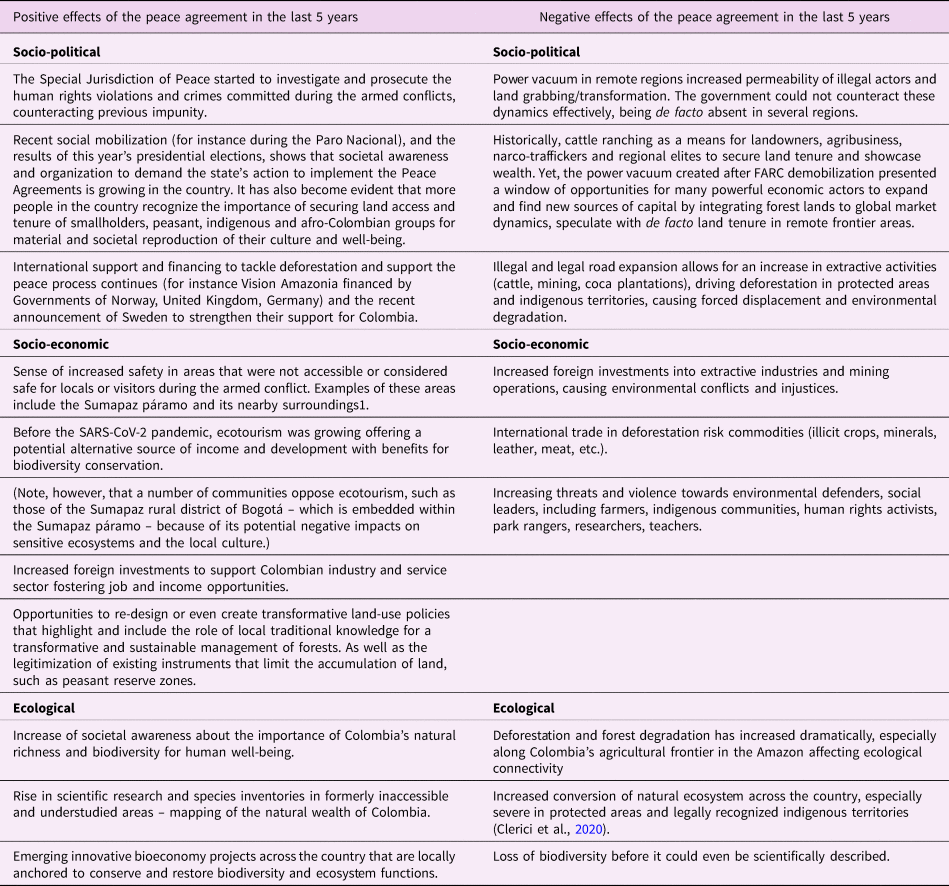
A summary of various positive and negative effects of the peace agreement in the last 5 years is presented in Table 1.
Relevant examples of positive and negative socio-political, socio-economic and ecological effects after the peace agreement of the Colombian government with FARC-EP, based on the author's own experiences and expertise, as well as the literature
1 Information based on primary qualitative research carried out by one of the co-authors not yet published elsewhere.
1. Acknowledging the real problems and asking the important questions
There are many obstacles on the road towards a more peaceful future. One of the most important ones is drug trafficking, which has intensified violence, aggravated human rights violations and corruption, and has had profound negative impacts on social, cultural and ecological dimensions. More than 50 years after the ‘War on Drugs’ started and decades after the multi-billion-dollar plan Colombia failed to stop drug trafficking, it is clear that Colombia needs to conceive and implement a more comprehensive policy. This is crucial, particularly in light of the failure of the plan Colombia and how it has contributed to prolong and intensify the armed conflict (Comisión de la Verdad de Colombia, Reference Colombia2022). To make both realistic and transformative proposals is challenging given the complexity of drug trafficking, its links to the deterioration of democracy and its embeddedness in the wider international regime on drugs that limit Colombia's degree of autonomy. However, as Uprimny (Reference Uprimny2022) highlights, there is urgency in creating a policy that focuses on consumption and seeks alternatives to prohibition in the long term. He shows that ‘legalized regularization’, which is the current approach towards alcohol and tobacco, not only discourages the expansion of the market but also avoids the existence of violent mafias that control production and distribution. Given that the international consensus on prohibition has weakened, there are opportunities for Colombia to openly criticize this approach and promote a discussion on regularization. For example, as a first step, the country could implement the commitment contained in the Peace Agreement to organize an international conference to show the need of overcoming prohibition. Since agreement on legalized regularization may not be easily reached internationally, Uprimny (Reference Uprimny2022) also suggests a pragmatic approach in the short term and look for alternatives within the current framework. Such alternatives include maintaining the decriminalization of consumption (which was both questioned by the governments of Uribe and Duque) and adopt an approach of reducing harm in consumption. Lastly, when it comes to illicit-use crops, the policy should emphasize alternative development and voluntary eradication, as it is contained in the Peace Agreement (OACP, 2016). Aerial spraying should be abandoned, as it has serious impacts on the environment and human health (Van Bruggen et al., Reference Van Bruggen, He, Shin, Mai, Jeong, Finckh and Morris2018). It also negatively affects the legitimacy of state institutions and is not effective to reduce cultivated areas in the medium and long terms. On the contrary, strategies for substitution supported by the creation of rural public goods have shown more sustainable results given that they reduce the vulnerabilities that facilitate the development of illegal activities (Uprimny, Reference Uprimny2022). Despite the recent Congress proposal, aiming to legalize the use of hallucinogenic drugs in the country, might suggest a growing political will to catalyse such transition (Tiempo, Reference Tiempo2019), drug trafficking is still an economic activity benefiting not only narco-trafficker but politicians, elites and old and emergent narco-bourgeois (Richani, Reference Richani2012). Thus, the question of what are the political conditions and changes needed to enable a drug decriminalization approach still needs to be further explored. Yet, such political transition will most likely require a peaceful (re)negotiation and (re)definition of the material conditions and processes sustaining the wealth of these powerful economic actors.
The international trade in primary materials and minerals such as gold, coltan, oil and coal further exacerbates environmental injustices by continuously expanding into forest areas and indigenous territories across Colombia (González-González et al., Reference González-González, Clerici and Quesada2021; López Vega, Reference López Vega2020). Corruption is rampant at all levels of government (Transparencia por Colombia, Reference Colombia2021) and the illegal construction of roads causing deforestation has been linked to local governors and municipal decision-makers (Semana, 2017, 2019). The opening of roads is one of the main engines of deforestation in the Amazon region, and the Troncal Piedemonte de Colombia (Los Pozos – La Macarena – La Leona) would cause a loss of 116,000 hectares of forest (Vilela et al., Reference Vilela, Harb, Bruner, Arruda, Ribeiro, Alencar, Grandez, Rojas, Laina and Botero2020).
The current militarization of conservation needs to stop and operations such as Artemisa, which militarizes forests that coincide with the War on Drugs, result in targeting campesinos as forest destroyers. In the Putumayo region of southern Colombia campesinos were transitioning to ‘licit’ farming and looking to return to or claim land, but the frontier conditions in which campesinos live left them dependent on coca, and now increasingly on cattle. Moreover, it would also be problematic to further stigmatize campesinos as culprits and forest destroyers, even if they expand cattle ranching in the forest frontier. Campesinos are equally caught in the agrarian rentier political economy that has swept over Colombia since the 1950s (Richani, Reference Richani2012). These conditions are overlooked in the implementation of peace, sustainable cattle ranching initiatives and policies that aim to provide alternatives to coca production and coca eradication efforts. There is evidence that the current coca eradication efforts drive coca cultivation and narco-traffickers deeper into the forest, causing further deforestation and forest degradation (Mora, Reference Mora2021; Rincón-Ruiz & Kallis, Reference Rincón-Ruiz and Kallis2013; Vanegas-Cubillos et al., Reference Vanegas-Cubillos, Sylvester, Villarino, Pérez-Marulanda, Ganzenmüller, Löhr, Bonatti and Castro-Nunez2022). This is a reminder of how ‘drug policy is conservation policy’ (McSweeney et al., Reference McSweeney, Nielsen, Taylor, Wrathall, Pearson, Wang and Plumb2014), and that protection of forests depends on tackling this narco-trafficking–deforestation relation. Nonetheless, it is important to keep in mind that the social production of the narco-frontier in Colombia is characterized by what Ballvé (Reference Ballvé2019) termed the extra-legal regimes of rule where the state is simply one actor among others and where the drug trade induces violent agrarian change and deforestation.
In the Putumayo, increasing violence is related to the implementation of coca eradication measures, including confrontations of Colombia's armed forces and campesinos over the forced eradication of coca crops. However, dissident FARC-EP and other groups involved in narco-trafficking in the Amazon are forcing campesinos to cultivate coca at gunpoint, who then have little choices but to comply. The Minga Association and the Somos Defensores Program (2021) reported that Putumayo is among the five departments with the highest number of murders of leaders related to the promotion of the coca crop substitution programme, with seven reported deaths. It is those campesinos and small-scale farmers who were often displaced from their traditional lands and pushed towards frontier regions through conflicts with large-landowners and cattle ranchers – and their involvement in coca production and cattle ranching are often strategies for survival. Although these campesinos and small-scale farmers are often the ones operating the chainsaws, they do so on behalf of large-landowners/speculators connected with narco-trafficking in the Amazon. The political and economic power of large landowners let them get away, while small farmers are being attacked or further displaced by military activities to halt deforestation, for instance the latest Artemisa operations.
Driving forest destruction in the Putumayo is investment from large landowners looking to consolidate land. This investment is connected to narco-profits of coca cultivation and involves dissident FARC-EP and residual and emerging paramilitaries and narco-trafficking groups. Coca cultivation has also increased given that ‘licit’ crops promised with ‘peace’ have not been realized, and due to the growing influence of armed groups. Present deforestation in Colombia is part of ongoing frontier colonization which is intertwined with the country's historic and present conflicts. In the transition towards peace, forests that were protected during the war are increasingly converted to pasture to demonstrate land claims and increased coca cultivation due to the influence of dissident FARC-EP and other groups linked with narco-trafficking (Clerici et al., Reference Clerici, Armenteras, Kareiva, Botero, Ramírez-Delgado, Forero-Medina, Ochoa, Pedraza, Schneider, Lora, Gómez, Linares, Hirashiki and Biggs2020).
The departure of the FARC-EP opened forests to development, including the capitalist interests privileged through rural development implemented within the context of ‘peace’. Oriented towards the capitalist development of Colombia's frontier forests, ‘peace’ compounds existing and underlying conflicts, causing more deforestation. ‘Peace’ in Colombia is framed as ‘reversing the effects of the conflict’ and changing the conditions that ‘facilitated the persistence of violence in the territory’ (OACP, 2016, p. 10). However, the current framing conceals the violence inherent in the neoliberal approach to peace and the capitalist development of Colombia's campo (the ties of agro-industry, whose interests are reflected in and protected through capitalist-oriented land laws in Colombia, where paramilitaries are well-established). The development of agro-industry in Colombia constitutes a ‘transition to unsustainable capitalism’ that is violent in its very nature. Contrary to the claim that ‘war is development in reverse’ (Cramer, Reference Cramer2006), ‘development’ involves transitions that are inherently violent. Hence, there is a need to look at how those ‘violent transitions’ to capitalist-oriented production depend on the consolidation of land, which involves the displacement of communities and generates conflicts; how violent conflict is also compounded in the presence of agro-industry; and how this intertwines with the ‘War on Drugs’.
Colombia's violent peace is also the way in which territories themselves are transformed through the imposition of capitalist development interventions like those implemented through ‘territorial peace’ that do not consider the everyday realities of communities. The imposition of agro-industrial development onto territories that insists on consolidating and controlling campesinos through ‘innovative’ agro-technologies and certified seeds is directly tied to declines in agrobiodiversity and the degradation of soils on which campesinos' lives depend (Van Dexter et al., Reference Van Dexter, Gutierrez Escobar and Ingalls2021). This threatens the possibilities of a ‘stable and lasting peace’ (OACP, 2016). Seen in this way, peace oriented towards capitalist development is itself the greatest challenge to peace in Colombia. It also offers the opportunity to rethink peace and the agrarian negotiations 2014–2018 based on the competitive narratives of food and agriculture from territorial relations. Alternatives are emerging such as those started by campesinos in Putumayo working on their own proposals for peace grounded in a reparative relationality with the Amazon.
2. The need for continuous international support and concerted action to build peace among people and with nature
Colombia is at a crossroad. The peace agreement has led to a transformation of land use making even more visible the historic inequalities of access to land that were a main reason for the armed conflict to begin with (Guereña, Reference Guereña2017; Potter, Reference Potter2020). Moreover, cattle ranching and ‘productive agriculture’ keep displacing agroforestry systems and diverse natural forests that support biodiversity and contribute to human well-being locally and globally. The presence of numerous armed groups seeking to control the profitable drug trade and mineral deposits are a major problem and obstacle for building peace in Colombia. International support and action taken across the global supply chain, for instance in the form of direct financial support for continuous peacebuilding efforts and more sustainable farming practices, violent conflicts and environmental degradation will persist. It has to be recognized that Colombia's land-use trajectory and the socioeconomic and environmental consequences of it are telecoupled with distant consumer countries through policies and the material demands of products, including cocaine. However, proposals such as the European Commission's new law to halt deforestation and minimize the EU's impact on forests worldwide are a step into the right direction increase our understanding of these telecoupled production–consumption networks, but they do not account nor address the specific challenges of Colombia's narco-frontier expansion. Moreover, supply chain management and policies, for instance voluntary standards or certification, may not lead to more systemic changes in supply chains and even further increase the insecurity of rural communities and extending neoliberal practices of governance (Glasbergen, Reference Glasbergen2018; Guthman, Reference Guthman2007). In particular, as we have pointed out, the global trade in illicit drugs is a major challenge and demand-side policies are needed to dry up the flow of illegal drug money that keeps financing violence against people and the environment across the region.
Here we summarize key points at the international, national and regional levels, which we consider essential for a transition towards peace in Colombia, with a focus on the peace–environment nexus. The issues are complex and require a long-term commitment, political will and social support. We therefore do not claim or attempt to provide solutions, but rather raise these crucial points to contribute to a discussion, and to tackle them for a more peaceful future. At the global scale, we argue there is need for: (1) continued international support for the peace agreement and pressure to the Colombian government to implement the points included in it; (2) concerted international efforts focusing on combating narco-trafficking from the consumers and demand-side consumption, moving away from traditional view of prohibition of drugs and (3) acknowledging that current drug policies and law enforcement are not effective and exacerbate violence. At the national level there must be increasing efforts to: (4) tackle land grabbing as a major cause of deforestation and environmental degradation; (5) control the origin of agricultural products and cattle with increased transparency and traceability in supply chains, and the exclusion of cattle coming from protected areas and illegally cleared forest areas; (6) increase the transparency of mineral supply chains, primarily for gold and coltan, in order to control and limit the expansion of illegal mining; (7) combat corruption across levels of government and in public institutions; (8) implement the Supreme Court of Justice decision 2018 to protect the integrity of the Colombian Amazon region and (9) ratify the Escazú agreement. Lastly, at the regional level efforts should procure to: (10) support agroforestry and regenerative agriculture projects on degraded lands and former pastures to restore ecosystem functions and protect soils, store carbon and provide diversified income to farmers; (11) increase attention and support to emerging local processes and demands for food sovereignty in rural areas in Colombia; (12) guarantee the implementation of the planning instruments ‘Plans of Action for Regional Transformation’ considered in the Colombian Decree 893 of 2017, to be adapted to specific local needs; (13) support small-scale farmers and abandon public discourses that targets them as environmental villains, while large-scale extensive agriculture and extractive projects are supported and framed as economic development by the government. We sincerely hope that the political changes and recent shift in government represents an opportunity to reinvigorate the peace agreement and mark the beginning of a transformation for Colombia where peacebuilding also translates into environmental stewardship and a respectful relationship with its tremendous biological and cultural diversity.
Acknowledgements
We thank all participants of the workshop that lead to the writing of this paper.
Author contributions
All authors contributed equally to the conceptualization and writing of this briefing.
Financial support
We acknowledge the Forest, Climate, and Livelihood research network (FOCALI) for funding of the workshop that led to the debate and the writing of this briefing. We also acknowledge the support from the Swedish Research Council for Sustainable Development (FORMAS – Grant number 2018-00453 for funding SV and TK, Grant number 2020-02347 for funding TK).
Conflict of interest
No conflict of interest.


 Open access

