





Management Implications
Land managers have utilized basal bark or cut stump treatment and avoided hack and squirt for invasive shrub control due to difficulties in implementing the technique on multistemmed shrubs. Our data indicate that aminopyralid or aminocyclopyrachlor were effective on three species with a single hack per stem. Making the cuts at 90 cm above the ground line reduces the effort of the applicator to bend down to administer treatments at the base of the tree, and we show that this modified application technique was significantly faster than cut stump treatment and used less carrier and herbicide than basal bark treatment. Efficacy was also comparable to basal bark treatment efficacy. This approach should be examined on several other species to assess whether these patterns remain consistent.
Introduction
Hack and squirt individual plant treatment is a commonly used technique for woody plant control worldwide. The technique involves making a series of downward cuts typically on an approximately 45o angle around the circumference of a woody stem using a hatchet or machete. The cuts penetrate the outer periderm and create a direct opening to the inner bark (phloem), cambium (meristematic tissue), and outer sapwood (xylem). This allows for a small amount of a concentrated herbicide solution to be administered as a metered dose directly to the vascular system of the plant (Miller et al. Reference Miller, Manning and Enloe2010). On susceptible species, the hack and squirt technique delivers sufficient herbicide to the phloem and cambium to kill or suppress the rootstock from resprouting. Hack spacing may vary from continuous (i.e., frill cut) to evenly spaced at short distances between hacks, depending upon the herbicide used. The extremes of the hack and squirt technique range from the girdling approach, in which an approximately 15-cm-wide girdle is created around the circumference of the tree and then thoroughly wetted with a concentrated herbicide solution (Laroche Reference Laroche1998), to the incision point application technique (Leary et al. Reference Leary, Reppun Beachy, Hardman and Gustine Lee2013), in which cuts are very widely spaced and droplet bottles or syringes are used to discriminately apply microliters of concentrated herbicide into each cut. The concept of direct herbicide injection into woody species has been developed over several decades as an efficient and selective herbicide use pattern, particularly in silvicultural release treatments and natural area protection (Kossuth et al. Reference Kossuth, Young, Voeller and Holt1980; Sterrett Reference Sterrett1969; Tu et al. Reference Tu, Hurd and Randall2001). Multiple tree injector technologies have been spawned in this pursuit, such as the Jim-Gem®, Hypo-Hatchet®, and EZ-Ject® lance, which were developed to deliver the herbicide to the target with one combined tool (Bowker and Stringer Reference Bowker, Stringer, Fei, Lhotka, Stringer, Gottschalk and Miller2011). Recommendations for application timings for hack and squirt have generally focused on source-sink relationships when carbohydrates are moving in a basipetal direction in the late summer and fall (Miller et al. Reference Miller, Manning and Enloe2010).
Weed control in forestry and natural areas is often done on an individual plant treatment (IPT) basis due to limited access and remote and rugged terrain. When compared with broadcast herbicide applications, this increases logistical and operational complexity, and there is an expectation from practitioners and managers for highly efficient treatment techniques that are also highly lethal. Expectations for a higher degree of efficacy have limited hack and squirt use on prolific sprouters, and the level of attention paid to hack and squirt from natural area weed scientists has been limited in the peer-reviewed literature. For example, in the complete history of this journal (2008 to the present), there has not been a single research article focused on the hack and squirt technique or any of its variants.
The hack and squirt technique has also exclusively focused on treatment of single-stemmed trees that are too large for basal bark application (generally >15-cm diameter at breast height). Woody shrub species typically occupy forest understory and midstory or create a low-stature overstory following complete stand removal. Multistem species exhibit a wide range of canopy crown dimensions, while many invasive shrubs exhibit basal sprouting or lateral root suckering that proliferates into a sprawl of impenetrable thickets. This multistemmed growth form inherently limits the use of hack and squirt due to the difficulty in making cuts around the circumference of each stem. Additionally, for basal bark application, high stem densities and the need for complete coverage around the circumference of every stem can result in excessive herbicide application rates (Holmes and Berry Reference Holmes and Berry2009).
The hack and squirt technique and its variants have been useful on many woody species using 2,4-D, 2,4,5-T, dicamba, glyphosate, imazapyr, picloram, and triclopyr (Bowker and Stringer Reference Bowker, Stringer, Fei, Lhotka, Stringer, Gottschalk and Miller2011; Leonard Reference Leonard1956; Peevy Reference Peevy1972; Sterrett Reference Sterrett1969). In the last 20 yr, two auxin-type herbicides, aminopyralid and aminocyclopyrachlor, have been developed and are now widely used for invasive plant management. Both have been documented to be effective on many invasive species at rates much lower than other widely used herbicides, including glyphosate and triclopyr (Enloe et al. Reference Enloe, Loewenstein, Streett and Lauer2015, Reference Enloe, Leary, Prince, Sperry and Lauer2020; Marble and Chandler Reference Marble and Chandler2019; Minogue et al. Reference Minogue, Enloe, Osiecka and Lauer2011). However, little research has been published on either herbicide for woody plant control, especially for hack and squirt or any of its variants. In one of the only studies conducted, Leary et al. (Reference Leary, Beachy and Gustine2015) examined both aminopyralid and aminocyclopyrachlor for control of 30 tropical woody species using an incision point application technique. Making as few as one to two hacks per 30 cm of circumference and applying 0.5 ml of herbicide per hack, they found that aminocyclopyrachlor provided at least 80% defoliation of 85% of the species tested and aminopyralid provided at least 80% defoliation of 45% of the species tested. These two herbicides were generally superior to glyphosate and triclopyr, which typically resulted in poor control when applied in a similar reduced hack and squirt manner. However, those authors did not compare the technique to other commonly used methods such as cut stump or basal bark treatments. Therefore, this warrants further investigation to better understand how hack and squirt with these herbicides might compare with widely used IPT methods.
The objective of this research was to evaluate the performance of aminopyralid and aminocyclopyrachlor on three invasive, multistemmed shrub species in Florida using a reduced hack and squirt treatment method with a single cut per stem and compare this with the conventional standard low-volume basal bark and cut stump treatments. We additionally sought to quantify the efficiencies of these IPT techniques by measuring the time required to treat individual shrubs and the herbicide dose administered per individual treated. A better understanding of these factors would inform land managers on the best approaches for tackling difficult to control woody shrub species.
Materials and Methods
The woody species selected for study were Brazilian peppertree (Schinus terebinthifolia Raddi), Surinam cherry (Eugenia uniflora L.), both native to South America, and crape myrtle [Lagerstroemia indica (L.) Pers.], which is native to the Indian subcontinent of Southeast Asia. Today, S. terebinthifolia is one of the most invasive shrubs in Florida, infesting more than 280,000 ha (Cuda et al. Reference Cuda, Ferriter, Manrique and Medal2006). It forms dense monotypic stands composed of multistemmed individuals with drooping lateral branches that create near-impenetrable thickets. Eugenia uniflora is an escaped ornamental shrub that produces multistemmed trunks and frequently sprouts from lateral roots. It has spread across southern peninsular Florida. Lagerstroemia indica is one of the most common landscaping plants in the southern United States and is not considered invasive here. However, it has escaped and naturalized in multiple environments and is listed as invasive in South Africa, Belize, Cuba, Puerto Rico, and the Virgin Islands (Acevedo-Rodríguez and Strong 2012; Balick et al. Reference Balick, Nee and Atha2000; Foxcroft et al. Reference Foxcroft, Richardson and Wilson2007). Basal bark and cut stump treatments with diluted triclopyr are the standard recommendations for effective control of all three species. In Florida, both S. terebinthifolia and E. uniflora retain their leaves and are photosynthetically active throughout the year. Schinus terebinthifolia flowers and produces fruit in the fall. Eugenia uniflora typically flowers and produces fruit in the spring. Lagerstroemia indica flowers throughout the summer and is deciduous and loses it leaves in the late fall.
Individual shrubs served as experimental units for all species with 10 replicate shrubs per treatment. A randomized complete block design was used, as shrubs were blocked by stem diameter. At each site, experimental units were selected along transects with a minimum spacing of 3 m between individuals, to reduce the likelihood of lateral root connections.
The S. terebinthifolia studies were on a South Florida Water Management District Property near Opa-Locka, FL (25.958387°N, 80.418278°W). The site was a 180-ha seasonal wetland on a Dania muck soil (Euic, hyperthermic, shallow Lithic Haplosaprists) with a dense monotypic stand of the target species. Experimental units averaged 4.2 ± 0.6 stems each, with a cumulative diameter at breast height (DBH) of 33.2 ± 5.3 cm (Table 1).
Treatment application rootstock averages and observational SEs for Eugenia uniflora, Lagerstroemia indica, and Schinus terebinthifolia.

a H&S, hack and squirt.
b Total DBH is the sum of individual stem DBH for each experimental unit.
c Total mix includes the herbicide and carrier applied per individual. For each species, the total mix for the basal bark treatment is a composite mean of all 10 experimental units.
d Herbicide is the total herbicide applied per individual.
The E. uniflora studies were conducted in Tree Tops Park in Davie, FL (26.069324°N, 80.276043°W). The site was a 1.3-ha hardwood hammock on a Pomello fine sand (Sandy, siliceous, hyperthermic Oxyaquic Alorthods) with a live oak (Quercus virginiana Mill.) overstory and a subcanopy shrub layer completely dominated by E. uniflora. Experimental units averaged 1.8 ± 0.3 stems with a cumulative DBH of 13.4 ± 1.9 cm (Table 1).
The L. indica site was in San Felasco State Park (29.721180°N, 82.421215°W) in a slash pine (Pinus elliottii Engelm.) flatwood on a mix of Arredondo fine sand (Loamy, siliceous, semiactive, hyperthermic Grossarenic Paleudults) and Kendrick sand (Loamy, siliceous, semiactive, hyperthermic Arenic Paleudults) soil types. This site was an abandoned University of Florida horticultural research site, and L. indica had become naturalized over approximately 1.6 ha and required removal. Experimental units averaged 3.4 ± 0.7 stems with a cumulative DBH of 20.7 ± 4.1 cm (Table 1).
Lagerstroemia indica treatments for experimental runs 1 and 2 were applied on October 29 and November 16, 2015. Lagerstroemia indica is functionally a deciduous shrub in north-central Florida and drops it leaves by December. For both experimental runs, leaves exhibited yellowing typical before abscission occurs. We were limited in site availability for this species. Therefore, we sought to keep the experimental runs independent but phenologically similar, as altering season of application was not our initial focus in these studies.
Schinus terebinthifolia and E. uniflora studies were applied in early December 2015 and repeated in mid-January 2016, approximately 1 mo apart. Both species are evergreen. However, S. terebinthifolia flowers in the fall, producing fruit by December, while E. uniflora flowers and produces fruit in the spring.
A total of five treatments were tested on each species. These included two reduced hack and squirt treatments, basal bark treatment, cut stump treatment, and a nontreated control. Aminocyclopyrachlor (Method® 240SL, Bayer Crop Science, Whippany, NJ 07981) and aminopyralid (Milestone®, Corteva, Indianapolis, IN 46268) were utilized in the hack and squirt treatments. For these, each experimental unit received a single cut per stem with a 45° downward angle at approximately 90 cm above the root collar. A 56-cm steel blade machete was used to create each hack. Each cut was immediately injected with 0.5 ml of 100% concentrated aminocyclopyrachlor (240 g L−1) or aminopyralid (240 g L−1), using a Simcro™ adjustable compact veterinary syringe (Simcro, Hamilton, New Zealand) attached to a 2.5-L backpack reservoir. The 0.5-ml injection volume effectively remained in the hack with no runoff from the sides, emulating recommendations from Leary et al. (Reference Leary, Reppun Beachy, Hardman and Gustine Lee2013). For each experimental unit receiving one of the hack and squirt treatments, all stems with a diameter greater than or equal to 2.5 cm at a height of 90 cm above the ground line were selected to receive a herbicide dose. Hacks were made to each of these stems at the most accessible position to the applicator.
The basal bark treatment used the triclopyr butoxyethyl ester formulation (Garlon® 4 Ultra, Corteva) at 20% v/v (96 g L−1) with Bark Oil Blue (UAP Distribution, Greeley, CO 80634) as the carrier. The herbicide oil mix was applied to the entire circumference of each stem, from groundline to a height of 30 cm. Applications were made with a 1.75-L hand pump-up sprayer with a single adjustable cone nozzle (Viagrow®, Chesterfield, MO 63017).
For cut stump treatments, trees were cut approximately 10 cm above the soil using a chainsaw (Stihl MS 193 T, Stihl, Virginia Beach, VA 23452), leaving a flat stump or multiple stumps if branching occurred below 10 cm. Sawdust and other debris were removed after cutting. Triclopyr amine (Garlon® 3A, Corteva), was immediately applied at 50% v/v (180 g L−1) in water to a 5-cm band around the circumference of the stump top. This ensured coverage of the inner bark (phloem) and cambium. A handheld spray bottle ( HDX™, Home Depot, Atlanta, GA 30339) that delivered 1.2 ml stroke−1 was used to treat each stump.
For all treatments, we recorded the treatment time (i.e., the time to complete the application to each experimental unit). This included the time to make the cuts and deliver the herbicide for the hack and squirt treatments, the time to fell the shrubs and treat the stumps for cut stump treatments, and the time to spray all stems for the basal bark treatment. For the hack and squirt and cut stump treatments, we measured the amount of herbicide applied per experimental unit based upon the known output of each application device per stroke and the number of strokes applied. For the basal bark treatment, we measured the total herbicide mix applied to all 10 experimental units and divided it by the total number of experimental units.
To quantify treatment efficacy, data were collected at multiple times between 90 and 540 d after treatment (DAT). We visually evaluated percent canopy defoliation and counted the presence of root and epicormic sprouts for each experimental unit at the final sampling date.
Statistical Analysis
For each species, experimental run was incorporated as a random effect for ANOVA and analysis of covariance (ANCOVA). The arcsine square-root transformation was used for the analysis of shrub percent defoliation at 90, 180, 360, and 540 DAT to address lower variation for percent data near 0 or 100. The ANOVA for percent mortality, percent of individuals with root sprouts, and percent of individuals with epicormic sprouting at final evaluation were performed as a generalized linear model with sprouting category (sprouts present, sprouts not present) considered a binomial random variable with a logit link function. Treatments with 0% or 100% shrub mortality or sprouting were excluded from the statistical analysis. ANCOVA was used to relate treatment time to stem count (or the natural log of stem count) and total diameter (sum of stem diameters in an experimental unit) as covariates for hack and squirt, basal bark treatment, and cut stump treatments. Nonsignificant covariates were excluded from final models. Cut stump mix volumes used total diameter as a covariate to estimate mix volume as a function of individual shrub size. ANCOVA utilized a generalized linear model approach with the gamma distribution and log link function (Schabenberger and Pierce Reference Schabenberger and Pierce2002) to resolve heterogeneity of residuals (variation increased with stem count or total diameter). Analysis was performed using the PROC GLIMMIX (Littell et al. Reference Littell, Milliken, Stroup, Wolfinger and Schabenberger2006) package of SAS® v. 9.4 software (SAS Institute, Cary, NC 27513). Treatment means were compared using Tukey’s adjustment for multiplicity and Dunnett’s adjustment to compare treatment means with the nontreated check as appropriate.
Results and Discussion
For E. uniflora, application time was only driven by the number of stems for hack and squirt treatment and only by the total stem diameter for basal bark treatment (Table 2). Application time was influenced by both stem number and total stem diameter for cut stump treatment. For L. indica, application time was influenced by both stem number and stem diameter for hack and squirt treatment. Application time was only driven by stem number for basal bark and only by stem diameter for cut stump treatment. For S. terebinthifolia, application time was only driven by stem number for hack and squirt and only by stem diameter for cut stump and basal bark treatments.
Parameters for equations that estimate treatment time per rootstock by species. a

a Equations use stem count per rootstock and total diameter (cm) per rootstock. Stem count or total DBH terms were removed when not significantly different from zero (Pr > |t|).
b Equation 1 is treatment time (s) = exp(a 0 + a 1stem count + a 2total diameter). Equation 2 is treatment time (s) = exp[a 0 + a 1ln(stem count) + a 2total diameter].
c H&S, hack and squirt.
The main consistencies across these covariates for all three species evaluated was the influence of stem number on application time for hack and squirt and the influence of stem diameter on application time for cut stump. These are logical. For hack and squirt, each stem received a single cut, which would inevitably lead to increasing application time for individuals with more stems. For cut stump, increasing total stem diameter should result in longer treatment time due to increased cutting time and herbicide application time for larger stumps when using a manual spray bottle. The significant effect of stem diameter on application time for the hack and squirt treatment for L. indica is somewhat uncertain. We attribute this to the irregular shape of many of the treated shrubs at the hack height used, which resulted in greater time required to select the most appropriate place to make the hack. This should be explored further in future research.
The contrasting covariate effects across species of application time for basal bark were due to the complexity and variation of individual stem size and stem branching height from the ground. For example, trunks with a stem branching pattern above the basal bark treatment zone could require less time to treat, while rootstocks with stems branching in the basal bark treatment zone would increase time for basal bark treatment. However, lateral, sprawling growth of low branches may also influence treatment time simply from an accessibility standpoint. We did not collect quantitative data on stem branching height in relation to stem diameter, especially when branching occurred in the basal bark treatment zone, as stem diameters were measured at breast height (135 cm). Shrub architecture complexity in relation to application methodology and alternatives to stem DBH measurements should be better examined in future research.
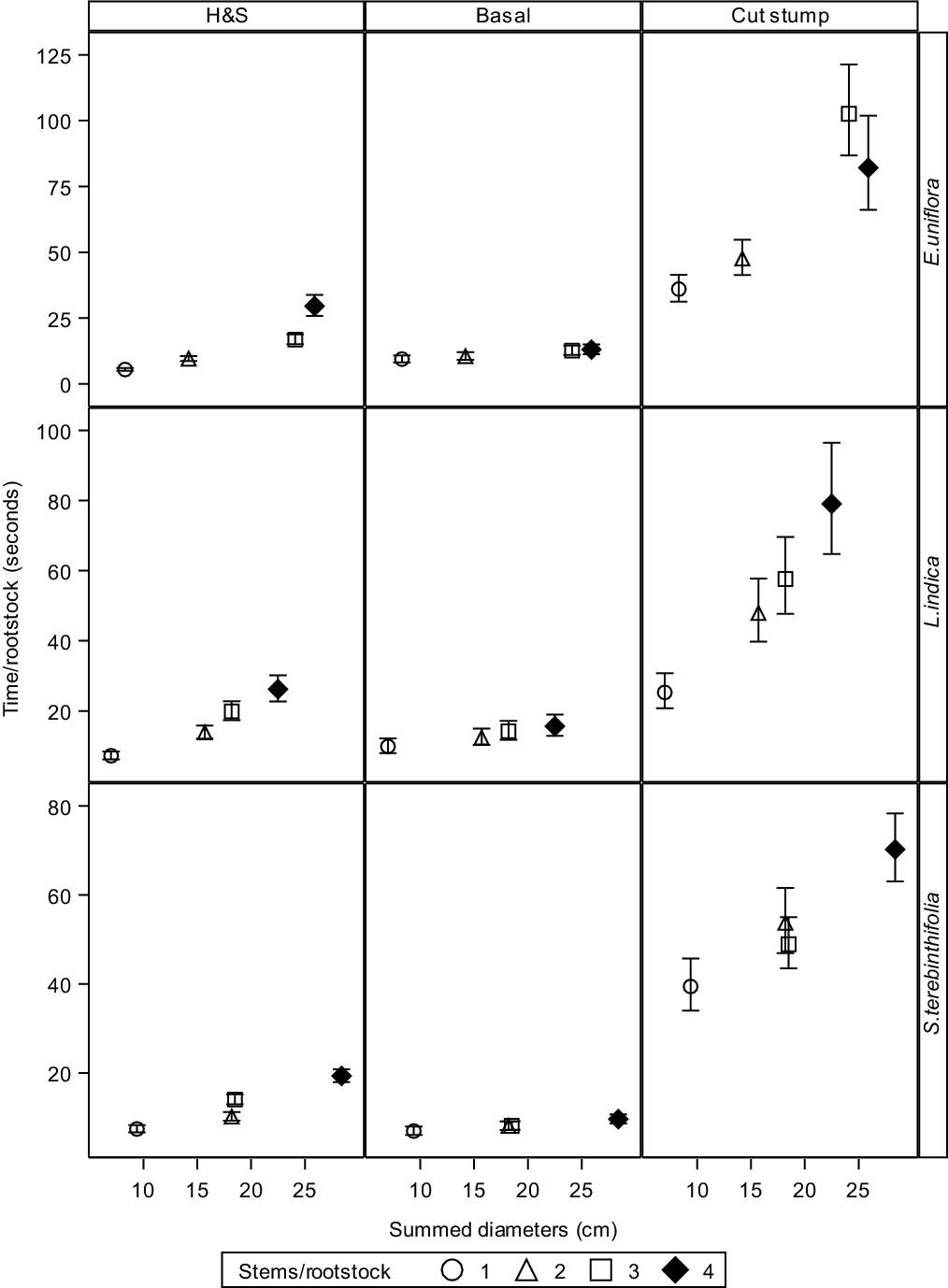
Estimated treatment time ±SE is compared by application method and species for the average sum of stem diameters for each level of stems per rootstock in Figure 1. Across species, cut stump treatment required significantly more time per shrub than hack and squirt or basal bark treatment and this held for single and multistemmed individuals.
Estimated treatment time (±SE) compared by application method for each species. Predictions are shown for the average sum of stem diameters for each level of stems/rootstock.
Additionally, potential differences in treatment time estimated between hack and squirt and basal treatments were compared in terms of stems per rootstock (Figure 2) using the average total diameter for a given number of stems per rootstock in prediction equations. Treatment times were similar for hack and squirt and basal treatments for rootstocks with fewer than four stems per rootstock, but basal treatments required less time than hack and squirt as stem count increased above 3 stems per rootstock (Figure 2). While this held for individual plant treatments across species in these studies, operational studies on larger plots should be conducted to determine whether applicator fatigue from carrying a 15-L backpack for several hours changes this relationship.
Estimated treatment time by number of stems per rootstock for hack and squirt (H&S) and basal application (Basal) for each species. Average time ±SE was predicted using the average summed diameter for a given stem per rootstock level when diameter was significant in the prediction equation.

There were striking differences in herbicide use between treatments for both total herbicide mix and herbicide acid equivalent applied. The low application volume of 0.5 ml per stem with 100% herbicide (no dilution) for the hack and squirt treatments resulted in 95% to 96% less total volume applied compared with basal bark treatment across species (Table 1). This is a tremendous reduction in weight that applicators would need to carry during operations. The hack and squirt treatments also resulted in a 78% to 79% reduction in herbicide acid equivalent applied per individual compared with basal bark treatment. Cut stump treatments also resulted in a 75% to 83% reduction in total volume applied compared with basal bark treatments. For cut stump treatment, there is clearly a trade-off in increased time required to treat versus total herbicide used compared with basal bark application, which is faster but requires more herbicide and carrier to be applied. For hack and squirt treatment, our data suggest there may be a time trade-off with total volume and total herbicide applied compared with basal bark. If reduced herbicide use is the goal, the reduced hack and squirt technique would be a solid alternative to basal bark.
Treatment Efficacy
For all three species the commercial standard cut stump and basal bark treatments were highly effective. This verifies previous recommendations for S. terebinthifolia (Cuda et al. Reference Cuda, Ferriter, Manrique and Medal2006) and E. uniflora (Enloe et al. Reference Enloe, Langeland, Ferrell, Sellers and MacDonald2018) and establishes efficacy of these commonly used techniques on L. indica. For E. uniflora, both hack and squirt treatment and basal bark treatment resulted in greater defoliation than observed in the nontreated control at each evaluation date. By 540 DAT, these treatments averaged 67% to 98% defoliation with no significant differences between them (Table 3). However, the percentage of shrubs with new root sprouts was significantly less for aminocyclopyrachlor hack and squirt (11%) and triclopyr amine cut stump treatment (11%) than the nontreated control (Table 4). Epicormic sprouting was only observed for the hack and squirt treatments with no significant difference between aminocyclopyrachlor and aminopyralid (Table 4). Shrub mortality, characterized by 100% defoliation and no sprouting at 540 DAT, was significantly higher for aminocyclopyrachlor applied by hack and squirt (89%) than that observed for aminopyralid hack and squirt treatment (20%) and basal bark treatment (35%) with triclopyr ester. (Table 4). Cut stump treatment with triclopyr amine was also highly effective, resulting in 89% mortality. Eugenia uniflora has been reported to be difficult to control with basal bark treatment (Enloe et al. Reference Enloe, Langeland, Ferrell, Sellers and MacDonald2018), and aminopyralid is not used for control of any species in the Myrtaceae family. In this study, aminocyclopyrachlor hack and squirt provided significantly better kill of E. uniflora than aminopyralid hack and squirt and basal bark treatment with triclopyr ester and was comparable to cut stump treatment with triclopyr amine.
Species defoliation response to hack and squirt and basal bark treatments over time. a

a DAT, days after treatment.
b H&S, hack and squirt.
c Means within columns followed by the same letter are not significantly different (P = 0.05).
Rootstock response to treatment by lateral root sprouting, epicormic sprouting, and % mortality. a

a Treatments with zero observations in a category in both runs were excluded from the analysis. Means within columns followed by the same letter are not significantly different (P = 0.05). Means followed by an asterisk (*) are significantly different from the nontreated using Dunnett’s test at the 5% level.
b H&S, hack and squirt.
For L. indica, all herbicide treatments were highly effective. All herbicide treatments had greater than 85% defoliation and were significantly different from the nontreated control at 180 DAT (Table 3). Statistical analysis was not performed after 180 DAT assessments, because mortality was 100% for all herbicide treatments and 0% for the nontreated control (Table 4). This species is extremely sensitive to these auxin-type herbicides when they are applied as hack and squirt, basal bark, and cut stump treatments. Although it is not currently classified as invasive in the United States, L. indica has been reported as naturalized in multiple counties across the southeastern United States. These data provide evidence of effective control measures if the species warrants management in the future.
Like L. indica, all herbicide treatments were highly effective for S. terebinthifolia. All treatments resulted in at least 90% defoliation and were significantly different from the nontreated control at all sample dates (Table 3). Mortality was at least 95% for all herbicide treatments, and there was no root or epicormic sprouting for any treatment (Table 4). These data indicate a high degree of sensitivity to both aminocyclopyrachlor and aminopyralid when applied as hack and squirt and confirm the effectiveness of triclopyr for both basal bark and cut stump treatments.
This research indicates that both researchers and applicators should expand their thinking for hack and squirt concepts for invasive plant management with aminopyralid and aminocyclopyrachlor. First, our data indicate that three multistemmed shrubs, two of which are known to be difficult to manage, can be effectively controlled with a single hack per stem when using aminocyclopyrachlor or aminopyralid. Single hacks per stem are an extraordinary deviation from the girdle plus spray approach, which is the most used hack and squirt variant in Florida and is primarily used for melaleuca [Melaleuca quinquenervia (Cav.) S.T. Blake] management (Serbesoff-King 2003). This change in thinking may require extensive educational efforts, including large-scale demonstrations of the technique. Additional operational studies involving applicator crews should be conducted to better understand the nuances, efficiency, and larger-scale efficacy of the technique with these herbicides.
Additionally, the reduced hack and squirt approach with aminocyclopyrachlor and aminopyralid presents the opportunity for significant reductions in total herbicide mix volume and total herbicide active ingredient applied, especially compared with basal bark treatment with triclopyr. Our data indicate that the reduced hack and squirt approach resulted in a greater than 95% reduction in herbicide mix applied and a greater than 87% reduction in herbicide acid equivalent applied per individual shrub without compromising efficacy. These opportunities should be highly desirable to many land managers, to reduce costs while improving or maintaining treatment efficiency and potentially reducing applicator fatigue.
The reduced hack and squirt technique also has the potential to reduce applicator exposure during the treatment process, as the entire herbicide payload per individual shrub can be delivered directly into the plant vascular system. This is the only known herbicide application technique that results in nearly 100% of the herbicide reaching the vascular system of the target. This is in direct contrast to triclopyr absorption into the inner bark (phloem) via basal bark application, which has been shown to be less than 2% of applied (Schneider Reference Schneider1991).
While the potential benefits of the technique are clear, it is also useful to understand its potential limitations. Both aminopyralid and aminocyclopyrachlor have very low maximum use rates of 1.0 and 1.3 L ha−1, respectively. This may result in potential overapplication when stem numbers are greater than 2,000 to 2,600 stems ha−1, when applying 1 ml of a 50% solution into each hack. High shrub stem densities have resulted in overapplication of triclopyr during basal bark treatment (Holmes and Berry Reference Holmes and Berry2009), and this may also be a problem for reduced hack and squirt.
Another potential issue is non-target damage through herbicide flashback following hack and squirt treatment, as this has not been well studied for these herbicides. Flashback is damage to nearby nontreated plants when a herbicide moves from a treated plant to a nontreated plant through root exudation, root grafting, or lateral root connections. Herbicide flashback has been documented for other herbicides such as imazapyr (Kochenderfer et al. Reference Kochenderfer, Zedaker, Johnson, Smith and Miller2001), and this should be examined for these as well, as both have considerable soil activity (Sebastian et al. Reference Sebastian, Nissen, Sebastian, Meiman and Beck2017).
Finally, we acknowledge the need for clearer dose–response relationships for each herbicide with specific woody invasive plants. While that type of research is challenging due to incredible heterogeneity in shrub size and stem numbers per individual, it could assist in refining the technique. The shrubs examined herein also represent a subset of growth forms within the invasive plant spectrum. For example, in our studies, L. indica shrubs were tall with no low branching pattern, while S. terebinthifolia individuals exhibited a low branching pattern, making access more difficult. Clearly, this technique would also not necessarily be appropriate for shrubs with numerous, very small stems. However, this work makes it clear that we should challenge our thinking about the limitations of hack and squirt with these herbicides. Future studies should examine a range of other large-statured invasive shrubs, such as strawberry guava (Psidium cattleianum Sabine) in Florida and Hawaii, invasive privets (Ligustrum spp.) and bush honeysuckles (Lonicera spp.) across much of the eastern United States, and even nuisance natives such as mesquite (Prosopis glandulosa Torr.) and sweet acacia [Vachellia farnesiana (L.) Wight & Arn.] in the southwestern United States.
Acknowledgments
The authors would like to thank Carl Della Torre and Andrew Gocek for technical assistance in experimental setup. Funding was provided by the Florida Fish and Wildlife Conservation Commission. No conflicts of interest are declared.


 Open access

