

China’s corruption is “rising,” “getting worse,” and “spiraling out of control”Footnote 1 – or so the media breathlessly reports. But observers rarely look below the surface. China is not corrupt in the same manner as other notoriously corrupt states, as I showed in Chapter 2. Unlike India and Russia, where petty bribery (what I term speed money) is most rife, or Nigeria, where state elites brazenly looted state coffers (grand theft), China’s corruption is distinguished by an abundance of access money – elite exchanges of money and power.
How did China arrive at its present structure of corruption? This chapter traces the evolution of corrupt practices from the beginnings of market reform in 1978 to the present day. A temporal analysis shows that access money, specifically in the form of bribery, has indeed become not only more widespread but grander, involving larger stakes and more powerful players. At the same time, levels of non-transactional corruption, such as embezzlement, misappropriation of public funds, and bureaucratic extortion, have been declining since the Reference He2000s. Thus, corruption in China is not “rising” across the board – in fact, it is shrinking in some areas even as cronyism and graft flourish.Footnote 2
I highlight two forces driving the present pattern of corruption in China. The first is the leadership’s monumental 1993 decision to replace central planning with a “socialist market economy,” that is, a market economy in which the state plays a dominant role. Communist officials became active promoters of private businesses and new industries, while still maintaining control over key resources.Footnote 3 This gave them considerable power over a massive emerging market, attracting a surging class of private capitalists to buy their favors. The second factor is the central government’s rollout of comprehensive administrative reforms, beginning in 1998, which quietly raised the state’s ability to monitor public finances and deter non-transactional malfeasance. Although the rise of crony capitalism in China is widely known,Footnote 4 this second development is overlooked.Footnote 5
Corruption was both a product and a driver of China’s transition from a command to a market economy. To unpack the coevolution of the economy and corruption, I first review the history of China’s reform process. I then show the evolving patterns of corruption by drawing on the best available source of data for this purpose: official statistics on corruption prosecutions. To supplement this analysis, I also look at media mentions. Jointly, my examination reveals a clear reversal of trends in transactional and non-transactional corruption: after 2000, the former spikes while the latter drops.
China’s Evolving Landscape of Corruption
“China changes too quickly!” is a common refrain among my interviewees. As China has transformed so rapidly and dramatically over the past four decades, any description of the country at any point in time is only a fleeting snapshot.Footnote 6 In the 1980s, 1990s, 2000s, and 2010s, the state’s role in the economy changed, as did the dominant modes of corruption. My analysis will try to capture this moving picture in several distinct stages, each punctuated by a change in national leadership, crisis, or major policy break. By necessity, I focus only on those parts of history relevant to corruption and skip over many details.Footnote 7
The 1980s: Growing Out of the Plan
Corruption existed during the Maoist era, but the scale was small and the forms rudimentary. Petty bribes were given in-kind through food and gifts in exchange for access to state-allocated goods such as ration coupons and housing.Footnote 8 Corruption was limited under Mao not because bureaucrats were morally upright, as fervent Maoists believe, but because people were impoverished and punishments were harsh. As one official recounted, “During the [Maoist era], people were summarily executed for even a bit of corruption. Nobody dared to be corrupt.”Footnote 9 Moreover, although monetary corruption was scarce, abuse of power was rampant, as Bachman points out: “Authorities could extract ‘favors’ – such as sex in exchange for recommendations to attend university – or when quotas came down for people to purge, officials would purge individuals whom they disliked.”Footnote 10 When markets opened and the economy sputtered to life, however, the currency of corruption shifted from brute power to money.
Following Mao’s death in 1976, Deng Xiaoping finally emerged as the nation’s paramount leader, who, in December of 1978, launched the Party’s “second revolution” – reform and opening. As Walder points out, the transition from plan to market generates “new opportunities for elite enrichment,” but how such enrichment occurs and its consequences depend on the extent of regime change.Footnote 11 Unlike the Soviet leadership, who simultaneously unleashed economic and political reform, Deng chose cautiously to embark on market liberalization while maintaining the monopoly rule of the Chinese Communist Party (CCP).Footnote 12 The reformist leadership maintained tight appointment and disciplinary control over officials, even as it extended economic and fiscal autonomy to local governments.Footnote 13 This sent a clear signal to party apparatchiks that they would benefit from market reforms so long as they played by the party’s revised rules.Footnote 14 Thus, whereas market transition in the Soviet Union spawned lawless corruption and rampant looting of state assets, which soon eroded the regime, in China corruption spread but with restraints.Footnote 15
On the economic side, Deng and his compatriots also maintained a gradualist approach by introducing market activities on the margins of a planned economy – also known as “growing out of the plan.”Footnote 16 In the countryside, the CCP partially revived private farming. In the cities, state-owned enterprises (SOEs) could sell goods to consumers once they had met their quotas. Township and village governments set up their own factories, known as Township and Village Enterprises (TVEs), which flourished like “sprouts after a spring rain” once the Party officially endorsed them. The state retained price controls but gradually reduced their scope.Footnote 17 All of these market reforms supplemented rather than replaced central planning.
As markets emerged in the 1980s, so did corruption. The forms of corruption that proliferated were particular to a mixed economy with central planning at its core. For example, managers of state-owned enterprises acquired goods cheaply at planned prices and sold them at higher prices on the market. Another example was the discretionary use of extra-budgetary funds. To incentivize local governments to promote economic growth and industrialization, central authorities allowed them to keep all profits generated by locally based collective enterprises as “extra-budgetary revenue.”Footnote 18 But the absence of central oversight encouraged widespread misuse and illegal diversion of public funds. Within each locality, agencies all of stripes also joined the mad rush to generate extra-budgetary revenue by collecting fees, fines, and levies, and by running side businesses. Their income was stashed away in unauthorized accounts known as “small treasuries.”Footnote 19
During the 1980s and well into the 1990s, the spread of extractive profiteering led to widespread complaints about “the three arbitraries” (sanluan): arbitrary fees, arbitrary fines, and arbitrary levies. The third item – tanpai – refers to various charges that local agencies imposed through coercive means.Footnote 20 For example, in addition to collecting fees and fines, regulatory agencies pressured businesses to pay for overpriced magazines that they published or to sponsor events solely for the purpose of wining and dining. Lu labels these actions “organizational corruption,” that is, collective actions taken by agencies “to achieve monetary or material gains for the agency as a whole.”Footnote 21 Petty bribery among individual bureaucrats spread, too, as an emergent and politically weak class of private entrepreneurs were forced to pay speed money to overcome bureaucratic hurdles and red-tape.Footnote 22
Yet this flourishing of petty corruption did not impede economic growth. Granting local governments and local agencies the right to generate and retain extra-budgetary revenue may be understood as part of a nationwide “profit-sharing” scheme: public employees took a cut of the revenue produced by their organizations, be it taxes, fees, or profits (more details can be found in Chapter 4).Footnote 23 This incentivized the entire bureaucracy to embrace market reforms and dive headlong into making money. It also relieved the state’s formal budgetary burden by allowing Party-state organizations and public service providers to “self-finance,” topping up their own salary at a time when formal pay was abysmally low and state funding was scarce. In this particular context of profit-sharing, it may be said that the economy took off because of – rather than despite – corruption. Yet this system produced clear drawbacks: excessive discretion, bureaucratic extortion, petty bribery, and profiteering. Such corruption also burdened businesses and stoked public resentment.
Even though Deng only partially introduced markets on the margins of a planned economy, the 1980s achieved commendable economic results: GDP per capita grew 7.5 percent annually. But this progress was violently interrupted in 1989 when mass protests broke out in Tiananmen Square in Beijing and then spread to other cities. Corruption was one of the rallying calls for political change. Tragically, the protests ended in a bloody crackdown on 4 June 1989. Shortly afterward, the conservative faction clamped down on liberal policies, and, at this critical juncture, China could have reverted to Maoism.
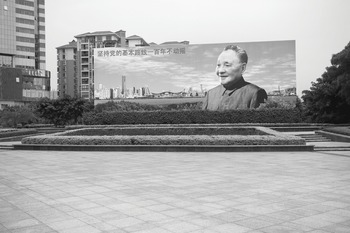
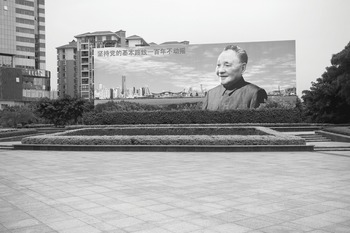
But Deng turned the tide around. In 1992, he went on his famous Southern Tour, urging the nation to continue market reform. Deng’s political maneuvers succeeded in large part because the 1980s was a golden decade of broad-based development that economists termed “reform without losers.”Footnote 24 Living standards improved across all walks of life, particularly among farmers. In other words, there was incipient popular demand for rekindling the flames of reform, and Deng’s swan song was to light the match. By the end of the Southern Tour, the 88-year-old patriarch had set China on a firm path toward an accelerated phase of market liberalization (Figure 3.1).
Banner in Shenzhen, showing Deng Xiaoping and the words “Stick firmly to the Party’s fundamental path for 100 years.”
From 1993 to 2000: Building a Socialist Market Economy
China’s reform is popularly equated with Deng’s slogan of “crossing the river by touching the stones.” In fact, this mantra applies only to the 1980s, when reforms were bottom-up and experimental without a clear vision of what lay across the river. But in 1993, that vision became clear when the new leadership under President Jiang Zemin and Premier Zhu Rongji announced the Party’s decision to establish a “socialist market economy.” It was this post-1993 phase that propelled China to phenomenal growth.
What is a socialist market economy?Footnote 25 Western observers may dismiss the slogan as ceremonial, but the choice of words is revealing: “socialist” is an adjective appended to the goal of achieving a “market economy.” Building a socialist market economy meant replacing central planning with market mechanisms and drastically reducing state ownership in the economy. Beijing scrapped state-allocated production quotas and price controls after 1993. “The orthodox planning system disappeared with barely a whimper, scarcely noticed,” Naughton wrote.Footnote 26 This was accompanied by a massive wave of state enterprise downsizing and reform in the 1990s, known as “grasping the large but letting go of the small.” Tens of thousands of small SOEs shuttered during the 1990s,Footnote 27 while the largest SOEs in strategic sectors consolidated, yielding behemoths such as China Mobile and China National Petroleum Corporation – the poster children of state capitalism today.Footnote 28
Meanwhile, TVEs and collective enterprises, a hybrid between state and private enterprises that proliferated during the 1980s, were privatized en masse. Although this process enabled corruption by allowing political insiders and former managers to buy collective assets cheaply, it also sponsored the first broad wave of private entrepreneurs across the country, especially in rural areas.Footnote 29 Compare this with Russia, where the overnight privatization of SOEs spawned an oligarchic concentration of wealth.Footnote 30
As the state sector receded, the private sector flourished. From 2000 to 2009, the number of registered private companies grew by 30 percent annually. By 2010, non-state-owned enterprises were estimated to account for 70 percent of China’s GDP.Footnote 31 The party leadership bolstered this development with its progressively warmer embrace of private entrepreneurs.Footnote 32 This support was enshrined in 1999, when the Party wrote into the constitution that the private sector is “an important component of the socialist market economy.”
In addition to embracing the private sector, China dramatically opened up to global markets after 1993. Foreign direct investment (FDI), which had previously been allowed only in special economic zones, was now welcomed throughout the country. In 2001, China’s entry into the World Trade Organization (WTO) accelerated the adoption of many international best practices and standards, solidifying China’s integration into the global economy.
As the economy dramatically privatized and opened up, central reformers rebooted the country’s institutions. Unlike the 1980s approach of tinkering on the edges, the post-1993 reform featured the design and implementation of a comprehensive institutional framework, covering fiscal and tax policies, banking and finance, corporate governance, and administrative reforms. For the leadership, reforming governance was a top priority as it needed state capacity to carry out the regulatory functions of the central government, as well as to foster a conducive environment for private businesses.
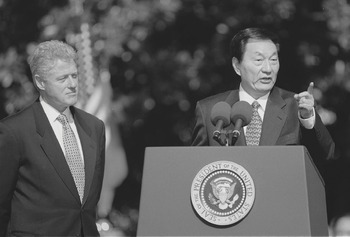
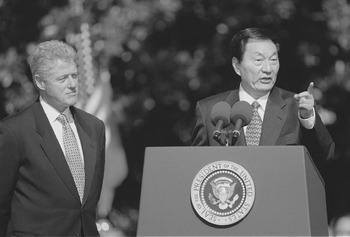
At the helm of this administrative modernization campaign was Zhu Rongji (Figure 3.2), a leader famous for his fiery temper and iron resolve. Starting in 1998, the central government pushed through a wide range of reforms that included standardizing budget planning and implementation, establishing a single treasury account system, adopting procurement rules, separating accounting firms from government agencies, divesting the military of its side businesses, promulgating a new Civil Service Law, and more (see Chapter 4 for more details). Although these technical reforms received scant attention in the scholarly literature and none in the media, they had real effects in “strengthening the fiscal and regulatory sinews of economic governance,” Yang emphasizes.Footnote 33
Why did this modernization drive progress quickly only in the 1990s? Yang argues that it was the combination of “changing economic conditions, leadership, and crises” that catalyzed the process. In 1993, the Jiang–Zhu leadership was under pressure to pull the country forward after the Tiananmen crisis. The preexisting communist bureaucracy was designed for a planned economy; the embrace of a global market economy, however, must be complemented by a modern administrative state. According to Yang, the Asian financial crisis of 1997 “gave the final push for a modern rationalization drive,” as leaders scrambled to stabilize the economic and banking system.Footnote 34 Another key factor I would add is that it was in the interests of local leaders throughout China to cooperate with these reforms. Modernizing administration and controlling petty corruption enhances their ability to attract investments and expand markets, yet these reforms would not restrain them from collecting grand transactional rents.
Taking these developments into account, it is no surprise that China’s economy boomed after 1993. For the next two decades, China clocked up a spectacular average GDP growth rate of 10 percent. In 2010, it surpassed Japan and clinched the spot of the world’s second-largest economy. Given these statistics, one might also expect that the country drastically reduced corruption, but in reality, the opposite occurred. Investigations of corruption spiked from the 1990s onward. And corruption scandals, which previously had involved only a few thousand Yuan of arbitraged goods or petty bribes, morphed into the stuff of political thrillers, featuring massive graft, mistresses, mafia, and even murder. In 2017 these stories were made into a hit TV series called “In the Name of the People.” In the eyes of the public and the leadership, the problem of corruption grew more and more severe.
Why is that? The post-1993 reforms did not diminish the role of the state in the economy; they changed it. During the 1980s, the government’s primary job was still to plan and command, deciding what to produce, how much, and at what price. After central planning was dismantled in 1993, Party-state officials took on new roles: fostering new industries, promoting investment, borrowing funds from the market, urban planning, demolishing and building at a frenzied pace. These roles gave communist officials new sources of power, “in ways that were never possible in the Soviet system,” Walder stresses.Footnote 35
Hence, although centrally led administrative reforms increased state capacity and curbed non-transactional forms of malfeasance, new varieties of corruption flourished, including the stripping of state assets by political insiders,Footnote 36 collusion with smugglers and thugs,Footnote 37 the sale of government offices,Footnote 38 and, above all, extensive networks of massive graft.
The 2000s: Bonanzas and Bubbles
The value of political and regulatory power spiraled further in the 2000s, as land-based public finance proliferated.Footnote 39 Although land cannot be sold, local governments can lease time-limited rights for “land transfer fees” that go directly to local coffers. Nationwide, land-related proceeds ballooned from 51 billion Yuan in 1999 to an estimated 3.2 trillion Yuan in 2012.Footnote 40 This spawned an extremely lucrative market in real estate, where developers readily offered officeholders large kickbacks in exchange for prized parcels of land.
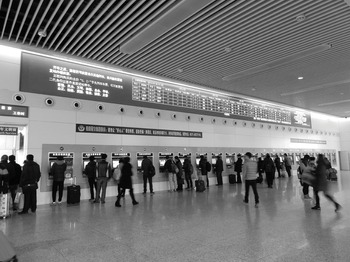
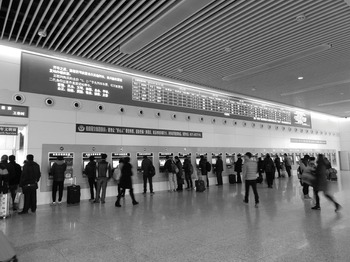
Land proceeds financed a bonanza of public infrastructure construction in the 2000s and onward (Figure 3.3). Between 2007 and 2017, the length of Chinese highways more than doubled from 54,000 to 130,000 kilometers, “enough to go around the world three times,” the State Council boasted on its website.Footnote 41 Every year since 2011, another 10,000 kilometers has been added to this network. The frenzied construction of subways was just as spectacular. In 2009 alone, central regulators approved metro projects in 19 cities totaling 2,100 kilometers, an investment of 800 billion Yuan. Today, the length of subways in Beijing and Shanghai exceeds that of New York City, London and Tokyo.Footnote 42
Land proceeds financed an infrastructure boom in the Reference He2000s, including high-speed rail, as seen here in Hangzhou.
Although the physical expanse of Chinese infrastructure is dazzling, the way it was financed is deeply troubling. Funds for these projects were funneled through a proliferation of non-transparent “investment vehicles” (rongzi pingtai), shell companies set up by local governments and agencies to borrow loans. In 2008, to cushion the blow of the US financial crisis, the Hu–Wen leadership announced a US$586 billion stimulus package, the largest in the country’s history. Much of this capital fell into the hands of SOEs, which invested profligately in local government vehicles and further accelerated the pace of infrastructure construction.Footnote 43 The result was rapidly mounting debt. In 2011 the National Audit Office released the results of its audit for the first time, estimating local government debts, excluding townships, to be 11 trillion Yuan.Footnote 44 In 2018, total debt ballooned to 18.4 trillion Yuan, about 20 percent of gross GDP.Footnote 45
China is often perceived as exceptional, but the situation today closely parallels the “taxless (public) financing” in America during the nineteenth century, when state governments built massive projects such as the Erie Canal by selling bonds through investment companies and charters (monopoly rights) to businesses instead of raising taxes on residents. Taxless financing led to widespread corruption and incurred contingent liabilities (debt that manifests itself when projects fail to generate expected revenue). These accumulated risks eventually imploded in 1837 – America’s first great depression.Footnote 46 China today faces a similar problem. Shadow financing massively increased its stock of physical infrastructure, but it has also created a hotbed of shady deals and graft.
The influence that Chinese officials exercised over a burgeoning economy and new financing instruments was amplified by the concentration of personal power in an authoritarian regime. At the local levels, the making of important development policies need not undergo legislative debates or public consultation. Instead, leaders can “slam the table” (paiban) and make unilateral decisions with far-reaching consequences. Ji Jianye, former party secretary of Yangzhou and later mayor of Nanjing, is an archetypal case (see Chapter 5). Ji’s nickname was “Mayor Bulldozer.” In Nanjing, his “Operation Iron Wrist” razed an astonishing 10 million square meters of unlicensed buildings within a year, equivalent to 66 Forbidden Cities, making it the largest scale of demolition in the city’s history. It is unimaginable for democratically elected politicians to behave as Mayor Bulldozer did without provoking a vigorous public backlash and losing votes.
Authoritarian power paired with a single-minded focus on economic growth spurred rapid urbanization and development, but also created ample room for corruption. As a leader, Ji could designate chosen plots of land for commercial purposes, acquire plots of land cheaply from farmers and resell them at high prices to developers, grant preferential tax breaks, and distribute a bounty of procurement and construction projects to family members and cronies. Because they outrank local banks and financial institutions, local leaders can also direct them to extend credit to favored companies. When Ji was finally netted for corruption in 2013, he was charged for taking more than 10 million Yuan in bribes.
Set against this backdrop of titanic emerging markets, an expansive state role in the economy, and trillions worth of slush funds are extensive personal networks that coagulate around figures of power. Politicians form tight relationships of mutual dependence among themselves, family members, and private capitalists.Footnote 47 The result, Walder incisively notes, is “super-clientelism,” the creation of a “much more powerful, wealthy and resourceful Party elite” than anything imaginable in the previous decades,Footnote 48 a hierarchy where webs of power and wealth extend from the very top down to the lowest level.
From 2012 to the Present: The Post-Reform Era
President Xi Jinping’s coming to power in 2012 marked the beginning of a new era. As Minzner pronounces, “China’s reform era is ending.”Footnote 49 Just a few decades ago, China was one of the poorest countries in the world. Now it is a high-middle-income economy. But, although it commands more resources and greater confidence on the world stage, China faces a daunting set of new development challenges, including rising labor costs, shrinking demographic dividends, and an ongoing trade war with the United States.
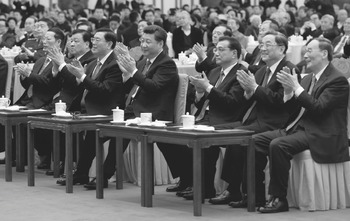
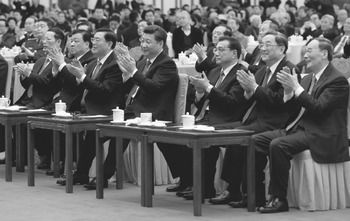
Warning that corruption would “doom the party and the nation,” Xi has made fighting corruption a keystone of his administration. In 2012, he launched the most far-reaching anti-corruption drive in the Party’s history (more details are given in Chapter 6), subjecting more than 1.5 million officials to disciplinary action, including some of the Party’s most senior leaders. The first to head this crackdown was Wang Qishan, a famously competent top official whom admirers nicknamed “the best premier China never had” (Figure 3.4).Footnote 50
Chinese President Xi Jinping and other top leaders. On the far right is Wang Qishan.
Meanwhile, however, his administration’s stance on the state’s role in the economy remains contradictory. In 2013, Xi lifted hopes when he declared that markets should play a “decisive” role in allocating resources, but he also said that the state will maintain the “leading” role. As Yukon Huang incisively concludes, “Squaring that circle can be tricky.”Footnote 51 In fact, under Xi, China saw a deceleration of economic reforms and the resurgence of state dominance in the economy. In 2016 the share of private investment declined relative to state investment in the previous 10 years.Footnote 52 Two years later, profit among private industrial companies shrank 27.9 percent from the previous year while that of SOEs grew by 28.5 percent.Footnote 53 Private investors became increasingly unnerved by instances of illegal state seizures of private assets and Xi’s call for “the Party to exercise leadership over all endeavors in every part of the economy.”Footnote 54 Facing market tremors in 2018, the Chairman held a high-level symposium to assure top private bosses that their property rights would be protected, although it remains to be seen whether he will keep his promise.
China’s Gilded Age
The Western media often portrays China’s political economy as “state capitalism,” characterized by The Economist as state ownership of giant companies.Footnote 55 For the public, this label gives the misimpression of China as still a centrally planned, state-owned economy. In fact, China’s economy is predominantly driven by the private sector, which, according to the latest statistics, accounts for 60 percent of GDP, 70 percent of innovation, 80 percent of employment, and 90 percent of new jobs and businesses.Footnote 56 Moreover, compared with Russia, the looting of state assets was much more restrained and rents less concentrated in China.Footnote 57 Although the Chinese apparatchiks grew richer over the course of market transition, so did millions of newly minted private entrepreneurs. In addition, as described earlier, the central government pushed through vast institutional changes to improve monitoring capacity and align the regulatory apparatus with a capitalist economy.
Perhaps the best way to understand the sources of corruption in contemporary China is to look to America’s Gilded Age. Both countries underwent a wrenching structural conversion from rural to urban and closed to global markets, producing once-in-a-generation opportunities for the politically connected and the enterprising (or, in many cases, those with a combination of both qualities) to acquire fabulous wealth. The excesses of America’s Gilded Age, however, are intensified in China’s single-party autocracy, where the personal powers of elite officials are not checked by elections, civil society, or a free press.
Yet another parallel between the two cases is that their governments did not let all forms of corruption run amok. In the late nineteenth century, the Gilded Age in America gave way to the Progressive Era, a period of sweeping political and administrative reforms that subsequently curtailed petty corruption and embezzlement.Footnote 58 What’s different in China is that a Gilded Age and a Progressive Era collided within a 20-year period. Hence, corruption in China did not rise across the board – it exploded in some areas but shrank in others.
Data and Analysis
In this section, I will trace the patterns of corruption highlighted in the historical review by examining the official statistics on corruption investigations, as reported by the procuratorate,Footnote 59 a source widely used by other China scholars.Footnote 60 In China the two key bodies in charge of investigating corruption are the Party’s discipline inspection committees (jiwei) and the procuratorate (jiancha yuan). Disciplinary actions meted out by the disciplinary committees range in severity from warnings to expulsion from the Party. Where formal criminal charges are pressed, the cases are sent to the procuratorate.
The limitations of official statistics should be acknowledged at the outset. First and foremost, the concept of corruption has changed drastically since market opening. In 1979 as market reforms began, Chinese Criminal Law (CCL) recognized only three acts of corruption: embezzlement, bribery, and dereliction of duty. By 1997, the CCL had expanded its definition of corruption to seven forms and stated that penalties should be linked to the amount of money involved.Footnote 61 But, given how quickly corruption evolved, prosecutors struggled to keep pace with the changes, so they stuffed new species of corruption into ambiguous categories such as “possessing large sums of unaccounted income.”
Complicating matters further, the government changed the definitions used in official statistics. Prior to 1997, “large-sum” corruption cases were defined as embezzlement or bribery involving more than 10,000 Yuan; after 1997, the cut-off point for both categories was raised to 50,000 Yuan, and for misuse of public funds, the threshold was raised from 50,000 to 100,000 Yuan.Footnote 62 This means that official statistics before and after 1997 are not comparable. Another significant concern about this data is that it indicates the level of exposed corruption, rather than actual corruption.Footnote 63 Indeed, periodic cycles of anti-corruption campaigns may influence the official statistics;Footnote 64 my data finds that more cases are reported following Xi’s crackdown on corruption in 2012.
Despite these limitations, however, data compiled by the prosecutorial apparatus still provides a useful indicator of corruption trends over time. Moreover, the objective of my analysis is to unpack the composition of corruption, not to use quantitative measures to run regressions. Although anti-corruption campaigns are likely to affect the number of reported cases, they are unlikely to affect the reported structure of corruption. No leader has expressed a preference for indicting certain types of corruption over others.
Unbundling Corruption Using Official Statistics
Many reports have pointed to China’s “rising corruption.”Footnote 65 In fact, in terms of the total number of prosecuted cases and individuals, corruption displayed a cyclical pattern (see Figure 3.5).Footnote 66 With the onset of Xi’s crackdown in 2012, the figures swept up again. Although only a minority of corruption is committed by high-rank (deputy mayor and above, see Box 3.1) officials, who are few in absolute number, this proportion has steadily risen from 4.5 percent in 1998, to 6 percent in 2011, to 8.4 percent in 2015. Consistently with Wedeman’s observation of “intensification,” corruption has escalated over time to encompass ever larger sums and a higher proportion of high-rank officials.Footnote 67 But we must look beyond aggregate numbers, as they obscure a yet more important feature: changes in the structure of corruption over time.
To examine the evolving structure of corruption, I unbundle the prosecutorial data into different qualitative categories. Another constraint of this data source is that prosecutorial statistics record only acts of corruption that involve sufficiently large monetary value or political impact. This means that they do not capture petty corruption or organizational malfeasance at the agency level, such as street-level bureaucrats taking small bribes, arbitrary extraction of fines and fees, and local agency extortion (tanpai). Following my theoretical framework – which unbundles corruption into petty theft, speed money, grand theft, and access money – the analysis in this section compares just the last two categories, which involve elites (as summarized in Table 3.1.)
| Non-elites | Elites | |
|---|---|---|
| Involves theft | Petty theft | Grand theft |
| Excluded from official statistics | Recorded in official statistics as embezzlement, misuse of public funds, asset stripping | |
| Involves exchanges | Speed money | Access money |
| Excluded from official statistics | Recorded in official statistics as bribery, abuse of office, misuse of office for private gain |
Although this section looks solely at elite corruption, unbundling this category still reveals some structurally significant patterns.
▪ Beginning in 2000, transactional corruption rose sharply and consistently, while non-transactional corruption declined.
▪ By 2006, bribery was the most prevalent mode of elite corruption, exceeding embezzlement and misuse of public funds.
▪ But only high-stakes bribery increased in frequency, while low-stakes bribery declined.
▪ Corruption cases involving large sums of money grew across all categories.
▪ Particularly among officials at the highest ranks (“mega-tigers”), corruption involved big-stakes access money, not grand theft.
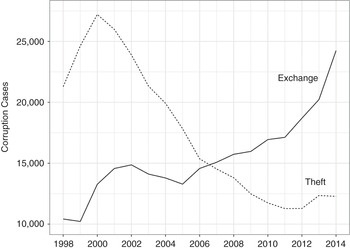
We begin with the theoretically significant comparison of “corruption with exchanges” and “corruption with theft.” As I argue, the latter harms the economy more directly than the latter.Footnote 68 As summarized in Table 3.1, I classify bribery under “corruption with exchange” and embezzlement and misuse of public funds under “corruption with theft.” In Chinese prosecution statistics, these are the three largest categories of corruption, which together made up 78 percent of all cases in 2015. Embezzlement refers to theft of public funds (e.g., diverting disaster relief funds into private accounts), whereas misappropriation involves the unauthorized use, transfer, or borrowing of funds.Footnote 69
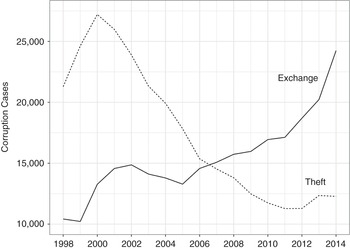
As we can clearly see from Figure 3.6, the trends of corruption with theft and corruption with exchange have reversed since 1998. In 1998, the number of cases involving theft was more than twice that of cases involving exchange. It grew sharply between 1998 and 2000, perhaps reflecting the rollout of administrative reforms in 1998, which enhanced the detection of embezzlement and misuse of public funds through increased internal transparency and precision in tracking fiscal flows. The deterrence effects of these reforms appear to set in after 2000. From then on, cases of corruption with theft progressively declined, hitting their lowest point in 2012, a 59 percent reduction from a peak in 2000. After Xi launched a sweeping anti-corruption drive in 2012, the incidence of corruption with theft picked up modestly, but it still remains far below the level of transactional corruption. By contrast, corruption with exchange began in 1998 at slightly over 10,000 cases, increased 50 percent by 2002, and then doubled by 2013. By 2014, there were almost twice as many cases of transactional corruption as there were of non-transactional corruption.
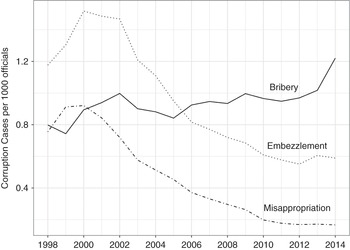
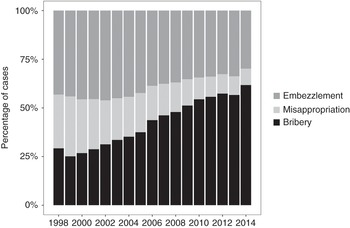
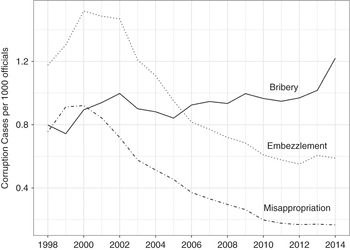
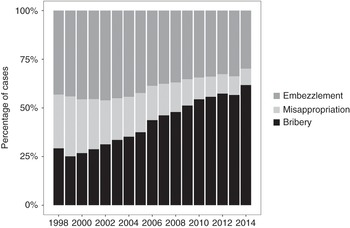
Next, in a modified presentation of the data used in Figure 3.6, I provide a more detailed breakdown of corruption into three forms – embezzlement, misuse of public funds, and bribery – with the total number of cases divided by the number of officials, to account for the bureaucracy’s growing size (see Figure 3.7).Footnote 70 This analysis follows that by Ko and Weng, who examined earlier data from 1998 to 2007.Footnote 71 Extending their analysis to 2014, I find a consistent pattern: embezzlement and misappropriation of funds fell while bribery rose. By 2006, bribery had become the most prevalent mode of elite corruption among the three categories, rising in share from only a quarter in 1998 to 60 percent by 2014 (see Figure 3.8).
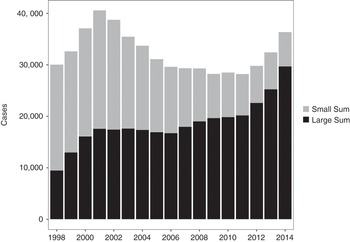
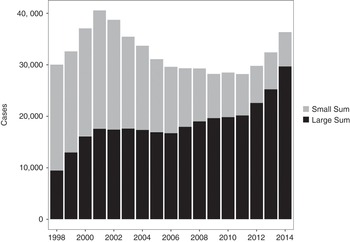
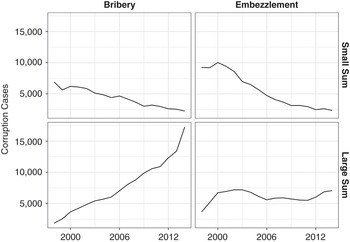
For a finer comparison, Figure 3.9 looks at bribery (a form of transactional corruption) and embezzlement (a form of non-transactional corruption) by monetary size, which the CCL classifies as “small-sum” and “large-sum,” where large-sum corruption involves more than 50,000 Yuan.Footnote 72 This breakdown reveals some interesting patterns. First, from 1998 to 2013, small-sum bribery steadily declined, falling to a third of its starting level, whereas large-sum bribery increased, rising more than ninefold to a peak of 17,435 cases in 2013. In other words, while low-stakes bribery came under control or fell out of fashion, high-stakes bribery exploded.
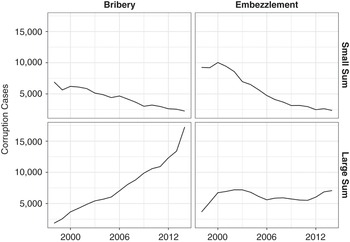
Turning to non-transactional corruption, small-sum embezzlement dropped sharply from its peak in 2000, whereas large-sum embezzlement fluctuated slightly over the years. This suggests that the monitoring and control measures instituted since 1998 are more effective at curtailing petty than grand forms of non-transactional corruption. One reason could be that grand embezzlement is usually committed by high-level officials who are powerful enough to circumvent institutional controls. One example is Chen Liangyu, former Party secretary of Shanghai, who, in addition to taking bribes, was charged for embezzling millions from Shanghai’s social security fund,Footnote 73 through the aid of his network of underlings.
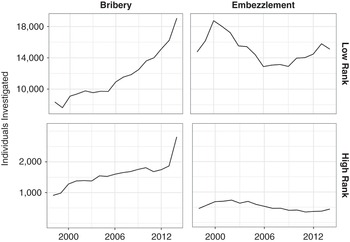
Next, in Figure 3.10, I unbundle bribery and embezzlement by the seniority of officials involved, whom official statistics divide into low-rank and high-rank, or “flies” and “tigers” in Xi’s terminology (see Box 3.1). Bribery spread among both low- and high-rank officials over time. Numerous exposés feature township and even village leaders at the lowest levels who took massive bribes from businesses in exchange for deals.Footnote 74
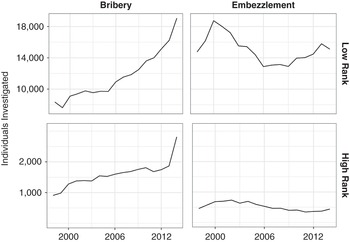
Embezzlement, however, shows a different pattern. Far fewer high-rank officials are involved in embezzlement than low-rank officials. Even at its peak in 2002, only 732 high-rank officials were investigated for the crime, compared with over 17,000 low-rank officials. This suggests that “tigers” engaged much more frequently in bribery than in embezzlement. In 2015, six times more tigers were investigated for bribery (3,145) than for embezzlement (579). In the same year, 15 percent of all officials caught for bribery were tigers, compared with only 4 percent in embezzlement. In the language of my framework (see Table 3.1), for those at the top echelons of China’s political hierarchy, corruption primarily involved big-stakes access money, not grand theft.
One final pattern stands out (Figure 3.5). Across all categories, large-sum corruption has increased. In bribery, the share of large-sum cases leapt from 28 percent in 1998 to 90 percent to 2015. As for embezzlement, its share grew from 28 percent to 77 percent. By 2014, more than three-quarters of all investigated cases involved large sums.
Xi’s anti-corruption campaign is famous for its professed goal of hunting both “tigers” and “flies,” popularly interpreted as high- versus low-level officials. What few realize is that this distinction between tigers and flies is extremely coarse and sometimes misleading because the Chinese bureaucracy has many layers. From the highest to the lowest levels, including Party-state organs and public service providers, the bureaucracy has more than 50 million personnel.Footnote 75
Who are the tigers and the flies? In the Chinese Party-state apparatus, officials who hold leadership positions are divided into 10 ranks, from highest to lowest: guojia zheng, guojia fu, shengbu zheng, shengbu fu, tingju zheng, tingju fu, xianchu zheng, xianchu fu, xiangke zheng, and xiangke fu.
The procuratorate defines “high-rank” as officials at the deputy ting level and above, which includes, for example, the deputy mayor of a city government or the division chief of a central-level ministry. All officials at the chu level and above are directly appointed by the Party and rotated across offices.
By this definition, a fly is any bureaucrat who is not a tiger, which is a massive residual category of officials and civil servants, ranging from as powerful as county Party secretaries (the first-in-command in county governments) to police officers and clerks at the street level. Yet, in reality, not all “flies” are trivial characters. County Party secretaries exercise supreme authority on economic and social affairs in their jurisdictions (see the case of Guo Yongchang in the Appendix to Chapter 5). Some of them are nicknamed “local emperors.”
To distinguish between political elites above chu rank (e.g., deputy mayors and higher) and the remainder, Manion refers to the former as “mega-tigers” and the latter as “tigers.” Others refer to upper-middle-tier officials as “wolves.”Footnote 76
Unbundling Corruption Using Media Mentions
Having reviewed the structural evolution of corruption in China using official statistics, I now turn to the media as a supplementary source of information. In this section, I will report the frequency of media mentions of corruption in the People’s Daily from 1988 to 2012.
One advantage of media mentions over official statistics is that they allow us to approximate agency-level extortion practices (what Lu describes as “organizational corruption”). Recall that official statistics capture only cases of corruption committed by individual bureaucrats that are illegal and sufficiently severe to merit prosecution. Analysis of media mentions also lets us explore longer temporal patterns, going back to as early as 1988 (compared with the prosecutorial statistics that begin in 1998). Of course, this source has limitations, too, as it measures what the media chooses to cover rather than actual levels of corruption. Still, we can have greater confidence about observed trends when they are consistent in both the media and official statistics. Additionally, media mentions in the People’s Daily, the Party’s official outlet, reflect national policy priorities and concerns, allowing us to explore how discussions about corruption evolved.
For this analysis, I searched for the following commonly used terms that fall under the categories of transactional and non-transactional corruption, respectively.
▪ Transactional corruption:Footnote 77 bribery, bribe-giving, hidden rules, rent-seeking, elegant bribery, vote-buying, naked official, money laundering.
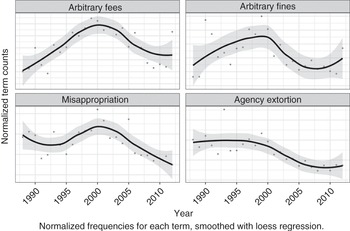
▪ Non-transactional corruption:Footnote 78 bureaucratic extortion, arbitrary extraction of fees, arbitrary extraction of fines, misuse of public funds.
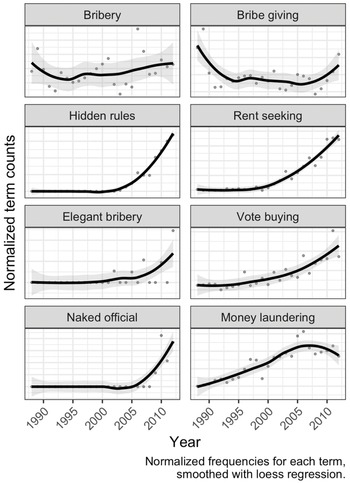
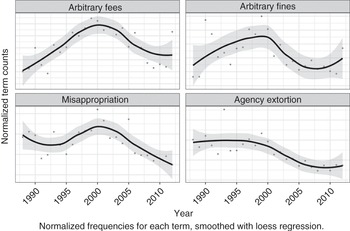
I then produced raw counts of articles that match the term searches, normalized by the number of articles published in that year.Footnote 79 Figures 3.11 and 3.12 illustrate their trends.Footnote 80
Media mentions of transactional corruption, by year and term, 1988–2012.
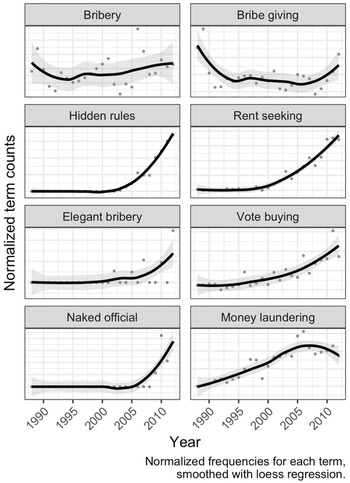
First, let’s look at transactional forms of corruption. Recall that, prior to 1993, markets were only partially liberalized. During this period, there was some discussion of “bribery” and “bribe-giving,” but in a downward direction from 1988. The concepts of “rent-seeking” and “hidden rules” were almost completely absent from the People’s Daily.
The period from 1993 to 2000 saw a qualitative change in the discussion of corruption. During this foundational stage of building a “socialist market economy,” two new corruption terms emerged: “vote-buying” and “money laundering.” Although China does not hold nationally competitive elections, it introduced elections for village leaders in 1988, which continue to this day and were subsequently extended to some townships.Footnote 81 Money laundering also became increasingly relevant, as bribery spread and as the central government began targeting illicit financial flows through administrative reforms.
Recall from Figure 3.6 that 2000 was the year in which non-transactional corruption began to fall and transactional corruption climbed. The words “rent-seeking” and “hidden rules” were first mentioned in 2000, and their frequency has since soared. Although western political economists have used the term “rents” (zu) for more than a century since Weber, it is a new addition to Chinese corruption lingo. “Hidden rules” (qian guize) refers to informal behavioral norms. For example, to cultivate good will within a political network, businesses may be obliged to participate in rigged biddings for government procurement projects. Another example is developers who offer discounts on properties to government officials, which is technically not a cash bribe.Footnote 82
From around 2005 onward, corruption became even more elaborate. While mentions of “bribery” and “bribe-taking” plateaued, those of “rent-seeking” and “hidden rules” climbed. At the same time, two new terms surfaced: “naked official” and “elegant bribery.”Footnote 83 “Naked official” (luoguan) refers to individuals who possess no wealth domestically but whose family members enjoy lavish lifestyles overseas. Instead of giving cash bribes, business sponsors pay for the education of an official’s children and their family members’ expenses abroad (see Chapter 5 for Bo Xilai’s case). Others seeking favors from government officials give works of art in lieu of cash, a practice known as “elegant bribery” (yahui). Art has the advantage of subjective value, making it harder to trace and prosecute as bribery. One notorious example is Wen Qiang, formerly Chongqing’s deputy police chief, who fell in connection with Bo. When the authorities raided his home, they found a museum of collectables, including a painting by the famous Chinese artist Zhang Daqian, worth 3.6 million Yuan, and even fossil dinosaur eggs.Footnote 84
It is also worth noting that mentions of “vote-buying” have steadily increased over the past two decades. This likely reflects the connection of vote-buying with illegal or contested land takings that arose in the Reference He2000s,Footnote 85 where leaders buy votes from villagers in order to sell land and assets to developers and then usurp the lion’s share of the windfall.
On non-transactional forms of corruption (Figure 3.12), the media frequently discussed “bureaucratic extortion” (tanpai) from 1986 to 1998, but mentions sharply dropped off afterward. “Arbitrary extraction of fees” and “arbitrary extraction of fines” peaked in 2000, and then similarly declined. Likewise, “misappropriation of public funds” peaked in 2000 and has since dissipated. This indicates that bureaucratic extortion and “organizational corruption” were nationally rampant only in the 1980s and 1990s, although they are still prevalent in poor localities today.Footnote 86 Clearly, it is high time to update our impressions of Chinese corruption.
What’s Missing in Existing Accounts?
A systematic review of the evolution of corruption allows us to concretely reevaluate some existing accounts. Temporal context matters, especially in a fast-evolving China. As I have shown, China in the 1980s, China in the 1990s, China in the Reference He2000s, and China post-2012 are dramatically different Chinas. Confusion results when observers make arguments about corruption in the present day that are based on outdated impressions or data from the 1980s and 1990s,Footnote 87 which would be the equivalent of testing theories about smartphones using data on landlines.
Consider Fan et al.’s article “Embezzlement vs. Bribery,” which was published by the National Bureau of Economic Research in 2010, and received coverage in the Wall Street Journal.Footnote 88 Proposing a formal model, this article argues that “China’s political leaders deliberately tolerate a great deal of relatively small-scale embezzlement in order to reduce the incentive for officials to extract bribes.”Footnote 89 In other words, they argue that central authorities permit corruption with theft in order to divert officials from bribery. As evidence, they cite Sun’s study set in the 1990s, which reported that the post-1992 period saw a surge of embezzlement and misappropriation whereas bribery was small in scale.Footnote 90
Sun’s observations are correct, but what Fan and his collaborators fail to notice is that her findings are based on prosecutorial data from 1993 to 1997, before the onset of radical administrative reforms and accelerated market expansion. During Sun’s period of study, there were indeed fewer cases of bribery than embezzlement (see Figure 3.7). In the present day, however, the pattern is reversed, as I show in this chapter.
My analysis shows the exact opposite of what Fan et al. argue. China’s leaders do not “tolerate” embezzlement, let alone deliberately so. In fact, since 1998, they have taken strong, methodical measures to combat non-transactional forms of malfeasance.Footnote 91 As a result, although corruption with theft sharply declined over time, bribery has exploded.
My approach in this chapter also highlights the importance of tracing temporal patterns across all types of corruption. For example, Pei highlights the grave problem of “crony capitalism,” but he ignores changes in other types of corruption. As a result, his study fails to note that embezzlement and predatory practices have in fact fallen. Even though the CCP struggles to guard its own elites from exploiting their power for personal enrichment, it is capable of disciplining rank-and-file bureaucrats and deterring outright theft.
Conclusion
Why has China’s economy prospered despite rampant corruption? Building on Chapter 2, this chapter revealed a second key to the puzzle: the structure of corruption changed over time. Starting in 2000, corruption with exchange, particularly bribery, exploded, but corruption with theft steadily fell. Two factors drove this structural evolution: first, the Party’s embrace of a global market economy in 1993, after which the value of political connections multiplied astronomically; and second, the central government’s rollout of modernizing administrative reforms on a scale that parallels America’s Progressive Era.
For comparative political economists, the evolutionary perspective in this chapter cautions against the assumption that countries have stable patterns of corruption – China evidently does not. As I discussed in Chapter 2, the conventional approach in small-n, comparative studies is to classify entire countries into a single typology of corruption.Footnote 92 Not only does this approach suffer from subjectivity, but also it neglects the possibility that a given country may witness dramatically different structures of corruption over time. Analysts, therefore, must specify the time period of observation, especially in fast-evolving nations. China must be unbundled into temporally distinct cases.
This chapter also raises comparative-historical questions for further research. Have other countries also experienced significant structural changes in corruption patterns? The United States experienced transformative structural shifts, from a period of heady growth and rampant corruption in the Gilded Age to a professionalized bureaucracy in the Progressive Era.Footnote 93 If we unbundle corruption over time in countries such as India, Russia, and South Korea, what might we find? Although such a comparative project is outside the scope of this book, I hope the efforts here will stimulate interest among other social scientists to pursue it.

 Open access