





1 Introduction
Statistical Relational Artificial Intelligence (StarAI) (Raedt et al., Reference Raedt, Kersting, Natarajan and Poole2016) is a subfield of Artificial Intelligence aiming at describing complex probabilistic domains with interpretable languages. Such languages are, for example, Markov Logic Networks (Richardson and Domingos, Reference Richardson and Domingos2006), Probabilistic Logic Programs (De Raedt et al., Reference De Raedt, Kimmig, Toivonen and Veloso2007; Riguzzi, Reference Riguzzi2022), and Probabilistic Answer Set Programs (Cozman and Mauá, Reference Cozman and Mauá2020). Here, we focus on the last. Within StarAI, there are many problems that can be considered such as probabilistic inference, MAP inference, abduction, parameter learning, and structure learning. In particular, the task of parameter learning requires, given a probabilistic logic program and a set of observations (often called interpretations), tuning the probabilities of the probabilistic facts such that the likelihood of the observation is maximized. This is often solved by means of Expectation Maximization (EM) (Bellodi and Riguzzi, Reference Bellodi and Riguzzi2013; Dries et al., Reference Dries, Kimmig, Meert, Renkens, Van den Broeck, Vlasselaer and De Raedt2015; Azzolini et al., Reference Azzolini, Bellodi and Riguzzi2024) or Gradient Descent (Gutmann et al., Reference Gutmann, Kimmig, Kersting and Raedt2008).
Recently, Azzolini and Riguzzi (Reference Azzolini and Riguzzi2021) proposed to extract a symbolic equation for the probability of a query posed to a probabilistic logic program. From that equation, it is possible to model and solve complex constrained problems involving the probabilities of the facts (Azzolini, Reference Azzolini2023).
In this paper, we propose two algorithms to learn the parameters of probabilistic answer set programs. Both algorithms are based on the extraction of symbolic equations from a compact representation of the interpretations, but they differ in how they solve the problem. The first casts parameter learning as a nonlinear constrained optimization problem and leverages off-the-shelf solvers, thus bridging the area of probabilistic answer set programming with constrained optimization, while the second solves the problem using EM. Empirical results, also against an existing tool to solve the same task, on four different datasets with multiple configurations show the proposal based on constrained optimization is often significantly faster and more accurate w.r.t. the other approaches.
The paper is structured as follows: Section 2 discusses background knowledge, Section 3 proposes novel algorithms to solve the parameter learning task, that are tested in Section 5. Section 4 surveys related works and Section 6 concludes the paper.
2 Background
An answer set program is composed by a set of normal rules of the form $h\,:\!-\,b_0, \dots, b_m, \ not \ c_0, \dots, \ not\ c_n$
where
$h\,:\!-\,b_0, \dots, b_m, \ not \ c_0, \dots, \ not\ c_n$
where $h$
, the
$h$
, the $b_i$
s, and the
$b_i$
s, and the $c_i$
s are atoms.
$c_i$
s are atoms. $h$
is called head while the conjunction of literals after the “
$h$
is called head while the conjunction of literals after the “ $:\!-$
” symbol is called body. A rule without a head is called constraint while a rule without a body is called fact. The semantics of an answer set program is based on the concept of stable model (Gelfond and Lifschitz, Reference Gelfond and Lifschitz1988), often called answer set. The set of all possible ground atoms for a program
$:\!-$
” symbol is called body. A rule without a head is called constraint while a rule without a body is called fact. The semantics of an answer set program is based on the concept of stable model (Gelfond and Lifschitz, Reference Gelfond and Lifschitz1988), often called answer set. The set of all possible ground atoms for a program $P$
is called Herbrand base and denoted with
$P$
is called Herbrand base and denoted with $B_P$
. The grounding of a program
$B_P$
. The grounding of a program $P$
is obtained by replacing variables with constants in
$P$
is obtained by replacing variables with constants in $B_P$
in all possible ways. An interpretation is a subset of atoms of
$B_P$
in all possible ways. An interpretation is a subset of atoms of $B_P$
and it is called model if it satisfies all the groundings of
$B_P$
and it is called model if it satisfies all the groundings of $P$
. An answer set
$P$
. An answer set $I$
of
$I$
of $P$
is a minimal model under set inclusion of the reduct of
$P$
is a minimal model under set inclusion of the reduct of $P$
w.r.t.
$P$
w.r.t. $I$
, where the reduct w.r.t.
$I$
, where the reduct w.r.t. $I$
is obtained by removing from
$I$
is obtained by removing from $P$
the rules whose body is false in
$P$
the rules whose body is false in $I$
.
$I$
.
2.1 Probabilistic answer set programming
We consider the Credal Semantics (CS) (Lukasiewicz, Reference Lukasiewicz and Godo2005; Cozman and Mauá, Reference Cozman, Mauá, Hommersom and Abdallah2016; Mauá and Cozman, Reference Mauá and Cozman2020) that associates a meaning to Answer Set Programs extended with probabilistic facts (De Raedt et al., Reference De Raedt, Kimmig, Toivonen and Veloso2007) of the form $p::a$
where
$p::a$
where $p$
is the probability associated with the atom
$p$
is the probability associated with the atom $a$
. Intuitively, such notation means that the fact
$a$
. Intuitively, such notation means that the fact $a$
is present in the program with probability
$a$
is present in the program with probability $p$
and absent with probability
$p$
and absent with probability $1-p$
. These programs are called Probabilistic Answer Set Programs (PASP, and we use the same acronym to also indicate Probabilistic Answer Set Programming – the meaning will be clear from the context). A selection for the presence or absence of each probabilistic fact defines a world
$1-p$
. These programs are called Probabilistic Answer Set Programs (PASP, and we use the same acronym to also indicate Probabilistic Answer Set Programming – the meaning will be clear from the context). A selection for the presence or absence of each probabilistic fact defines a world $w$
whose probability is
$w$
whose probability is $P(w) = \prod _{a \in w} p \cdot \prod _{a \not \in w} (1-p)$
, where with
$P(w) = \prod _{a \in w} p \cdot \prod _{a \not \in w} (1-p)$
, where with $a \in w$
we indicate that
$a \in w$
we indicate that $a$
is present in
$a$
is present in $w$
and with
$w$
and with $a \not \in w$
that
$a \not \in w$
that $a$
is absent in
$a$
is absent in $w$
. A program with
$w$
. A program with $n$
probabilistic facts has
$n$
probabilistic facts has $2^n$
worlds. Let us indicate with
$2^n$
worlds. Let us indicate with $W$
the set of all possible worlds. Each world is an answer set program and it may have zero or more answer sets but the CS requires at least one. If this holds, the probability of a query
$W$
the set of all possible worlds. Each world is an answer set program and it may have zero or more answer sets but the CS requires at least one. If this holds, the probability of a query $q$
(a conjunction of ground literals) is defined by a lower and an upper bound. A world
$q$
(a conjunction of ground literals) is defined by a lower and an upper bound. A world $w$
contributes to both the lower and upper probability if each of its answer sets contains the query, that is it is a cautious consequence. If only some answer sets contain the query, that is it is a brave consequence,
$w$
contributes to both the lower and upper probability if each of its answer sets contains the query, that is it is a cautious consequence. If only some answer sets contain the query, that is it is a brave consequence, $w$
only contributes to the upper probability. If the query is not present, we have no contribution to the probability bounds from
$w$
only contributes to the upper probability. If the query is not present, we have no contribution to the probability bounds from $w$
. In formulas,
$w$
. In formulas,
 \begin{align} P(q) = [\underline{P}(q),\overline{P}(q)] = [\sum _{w_i \in W \mid \forall m \in AS(w_i), \ m \models q} P(w_i), \sum _{w_i \in W \mid \exists m \in AS(w_i), \ m \models q} P(w_i)]. \end{align}
The conditional probability of a query $q$
given evidence
$q$
given evidence $e$
, also in the form of conjunction of ground literals, is (Cozman and Mauá, Reference Cozman and Mauá2020):
$e$
, also in the form of conjunction of ground literals, is (Cozman and Mauá, Reference Cozman and Mauá2020):
 \begin{align} \underline{P}(q \mid e) = \frac{\underline{P}(q, e)}{\underline{P}(q, e) + \overline{P}(not \ q, e)}, \ \overline{P}(q \mid e) = \frac{\overline{P}(q, e)}{\overline{P}(q, e) + \underline{P}(not \ q, e)}. \end{align}
For the lower conditional probability $\underline{P}(q \mid e)$
, if
$\underline{P}(q \mid e)$
, if $\underline{P}(q, e) + \overline{P}(not \ q, e) = 0$
and
$\underline{P}(q, e) + \overline{P}(not \ q, e) = 0$
and $\overline{P}(q, e) \gt 0$
, then
$\overline{P}(q, e) \gt 0$
, then $\underline{P}(q \mid e) = 1$
. Similarly, for the upper conditional probability
$\underline{P}(q \mid e) = 1$
. Similarly, for the upper conditional probability $\overline{P}(q \mid e)$
, if
$\overline{P}(q \mid e)$
, if $\overline{P}(q, e) + \underline{P}(not \ q, e) = 0$
and
$\overline{P}(q, e) + \underline{P}(not \ q, e) = 0$
and $\overline{P}(not \ q, e) \gt 0$
, then
$\overline{P}(not \ q, e) \gt 0$
, then $\overline{P}(q \mid e) = 0$
. Both formulas are undefined if
$\overline{P}(q \mid e) = 0$
. Both formulas are undefined if $\overline{P}(q, e)$
and
$\overline{P}(q, e)$
and $\overline{P}(not \ q, e)$
are 0.
$\overline{P}(not \ q, e)$
are 0.
To clarify, consider the following example.
Example 1. The following PASP encodes a simple graph reachability problem.

The first three facts are probabilistic. The rules state that there is a path between $X$
and
$X$
and $Y$
if they are directly connected or if there is a path between
$Y$
if they are directly connected or if there is a path between $Z$
and
$Z$
and $Y$
and
$Y$
and $X$
and
$X$
and $Z$
are connected. Two nodes may or may not be connected if there is an edge between them. There are
$Z$
are connected. Two nodes may or may not be connected if there is an edge between them. There are $2^3 = 8$
worlds to consider, listed in Table 1. If we want to compute the probability of the query
$2^3 = 8$
worlds to consider, listed in Table 1. If we want to compute the probability of the query $q = path(1,4)$
, only
$q = path(1,4)$
, only $w_6$
and
$w_6$
and $w_7$
contribute to the upper bound (no contribution to the lower bound), obtaining
$w_7$
contribute to the upper bound (no contribution to the lower bound), obtaining $P(q) = [0,0.06]$
. If we observe
$P(q) = [0,0.06]$
. If we observe $e = edge(2,4)$
, we get
$e = edge(2,4)$
, we get $P(q,e) = [0,0.06]$
,
$P(q,e) = [0,0.06]$
, $P(not \ q,e) = [0.24,0.3]$
, thus
$P(not \ q,e) = [0.24,0.3]$
, thus $\underline{P}(q \mid e) = 0$
and
$\underline{P}(q \mid e) = 0$
and $\overline{P}(q \mid e) = 0.2$
.
$\overline{P}(q \mid e) = 0.2$
.
Worlds and their probabilities for Example1. The second, third, and fourth columns contain 0 or 1 if the corresponding probabilistic fact is respectively false or true in the considered world. The LP/UP column indicates whether the considered world contributes to the lower (LP) or upper (UP) bound (or does not contribute, marked with a dash) for the probability of the query $path(1,4)$

Inference in PASP can be expressed as a Second Level Algebraic Model Counting Problem (2AMC) (Kiesel et al., Reference Kiesel, Totis and Kimmig2022). Given a propositional theory $T$
where its variables are grouped into two disjoint sets,
$T$
where its variables are grouped into two disjoint sets, $X_o$
and
$X_o$
and $X_i$
, two commutative semirings
$X_i$
, two commutative semirings $R^{i} = (D^i, \oplus ^i, \otimes ^i, n_{\oplus ^i}, n_{\otimes ^i})$
and
$R^{i} = (D^i, \oplus ^i, \otimes ^i, n_{\oplus ^i}, n_{\otimes ^i})$
and $R^{o} = (D^o, \oplus ^o, \otimes ^o, n_{\oplus ^o}, n_{\otimes ^o})$
, two weight functions,
$R^{o} = (D^o, \oplus ^o, \otimes ^o, n_{\oplus ^o}, n_{\otimes ^o})$
, two weight functions, $w_i : lit(X_i) \to D^i$
and
$w_i : lit(X_i) \to D^i$
and $w_o : lit(X_o) \to D^o$
, and a transformation function
$w_o : lit(X_o) \to D^o$
, and a transformation function $f : D^i \to D^o$
, 2AMC is encoded as:
$f : D^i \to D^o$
, 2AMC is encoded as:
 \begin{equation*} 2AMC(T) = \bigoplus \nolimits _{I_{o} \in \mu (X_{o})}^{o} \bigotimes \nolimits ^{o}_{a \in I_{o}} w_{o}(a) \otimes ^{o} f( \bigoplus \nolimits _{I_{i} \in \varphi (T \mid I_{o})}^{i} \bigotimes \nolimits ^{i}_{b \in I_{i}} w_{i}(b) ) \end{equation*}
where $\varphi (T \mid I_{o})$
is the set of assignments to the variables in
$\varphi (T \mid I_{o})$
is the set of assignments to the variables in $X_i$
such that each assignment, together with
$X_i$
such that each assignment, together with $I_o$
, satisfies
$I_o$
, satisfies $T$
and
$T$
and $\mu (X_{o})$
is the set of possible assignments to the variables in
$\mu (X_{o})$
is the set of possible assignments to the variables in $X_{o}$
. In other words, 2AMC requires to solve two Algebraic Model Counting (AMC) (Kimmig et al., Reference Kimmig, Van den Broeck and De Raedt2017) tasks. The outer task focuses on the variables
$X_{o}$
. In other words, 2AMC requires to solve two Algebraic Model Counting (AMC) (Kimmig et al., Reference Kimmig, Van den Broeck and De Raedt2017) tasks. The outer task focuses on the variables $X_o$
, and for each possible assignment to these variables, an inner AMC task is performed by considering
$X_o$
, and for each possible assignment to these variables, an inner AMC task is performed by considering $X_i$
. These two tasks are connected via a transformation function that turns values from the inner task into values for the outer task. Different instantiations of the components allow different tasks to be represented. To perform inference in PASP, Azzolini and Riguzzi (Reference Azzolini, Riguzzi, Basili, Lembo, Limongelli and Orlandini2023a) proposed to consider as innermost semiring
$X_i$
. These two tasks are connected via a transformation function that turns values from the inner task into values for the outer task. Different instantiations of the components allow different tasks to be represented. To perform inference in PASP, Azzolini and Riguzzi (Reference Azzolini, Riguzzi, Basili, Lembo, Limongelli and Orlandini2023a) proposed to consider as innermost semiring $\mathcal{R}^{i} = (\mathbb{N}^2, +, \cdot, (0,0), (1,1))$
with
$\mathcal{R}^{i} = (\mathbb{N}^2, +, \cdot, (0,0), (1,1))$
with $X_i$
containing the atoms of the Herbrand base except the probabilistic facts and
$X_i$
containing the atoms of the Herbrand base except the probabilistic facts and $w_i$
mapping
$w_i$
mapping $not \ q$
to
$not \ q$
to $(0, 1)$
and all other literals to
$(0, 1)$
and all other literals to $(1, 1)$
, as outer semiring the two-dimensional probability semiring, that is,
$(1, 1)$
, as outer semiring the two-dimensional probability semiring, that is, $\mathcal{R}^{o} = ([0, 1]^2, +, \cdot, (0, 0),(1, 1))$
, with
$\mathcal{R}^{o} = ([0, 1]^2, +, \cdot, (0, 0),(1, 1))$
, with $X_o$
containing the atoms of the probabilistic facts and
$X_o$
containing the atoms of the probabilistic facts and $w_o$
associating
$w_o$
associating $(p, p)$
and
$(p, p)$
and $(1 - p, 1 - p)$
to
$(1 - p, 1 - p)$
to $a$
and
$a$
and $not \ a$
, respectively, for every probabilistic fact
$not \ a$
, respectively, for every probabilistic fact $p :: a$
and
$p :: a$
and $(1, 1)$
to all the remaining literals, and as transformation function
$(1, 1)$
to all the remaining literals, and as transformation function $f((n_1,n_2))$
returning the pair
$f((n_1,n_2))$
returning the pair $(v_{lp},v_{up})$
where
$(v_{lp},v_{up})$
where $v_{lp} = 1$
if
$v_{lp} = 1$
if $n_1 = n_2$
, 0 otherwise, and
$n_1 = n_2$
, 0 otherwise, and $v_{up} = 1$
if
$v_{up} = 1$
if $n_1 \gt 0$
, 0 otherwise.
$n_1 \gt 0$
, 0 otherwise.
2AMC can be solved via knowledge compilation (Darwiche and Marquis, Reference Darwiche and Marquis2002), often adopted in probabilistic logical settings, since it allows us to compactly represent the input theory with a tree or graph and then computing the probability of a query by traversing it. aspmc (Eiter et al., Reference Eiter, Hecher and Kiesel2021, Reference Eiter, Hecher and Kiesel2024) is one such tool, that has been proven more effective than other tools based on alternative techniques such as projected answer set enumeration (Azzolini et al., Reference Azzolini, Bellodi and Riguzzi2022; Azzolini and Riguzzi, Reference Azzolini, Riguzzi, Basili, Lembo, Limongelli and Orlandini2023a). aspmc converts the input theory into a negation normal form (NNF) formula, a tree where each internal node is labeled with either a conjunction (and-node) or a disjunction (or-node), and leaves are associated with the literals of the theory. More precisely, aspmc targets sd-DNNFs which are NNFs with three additional properties: (i) the variables of children of and-nodes are disjoint (decomposability property); (ii) the conjunction of any pair of children of or-nodes is logically inconsistent (determinism property); and (iii) children of an or-node consider the same variables (smoothness property). Furthermore, aspmc also requires $X$
-firstness (Kiesel et al., Reference Kiesel, Totis and Kimmig2022), a property that constraints the order of appearance of variables: given two disjoint partitions
$X$
-firstness (Kiesel et al., Reference Kiesel, Totis and Kimmig2022), a property that constraints the order of appearance of variables: given two disjoint partitions $X$
and
$X$
and $Y$
of the variables in an NNF
$Y$
of the variables in an NNF $n$
, a node is termed pure if all variables departing from it are members of either
$n$
, a node is termed pure if all variables departing from it are members of either $X$
or
$X$
or $Y$
. If this does not hold, the node is called mixed. An NNF has the
$Y$
. If this does not hold, the node is called mixed. An NNF has the $X$
-firstness property if for each and-node, all of its children are pure nodes or if one child is mixed and all the other nodes are pure with variables belonging to
$X$
-firstness property if for each and-node, all of its children are pure nodes or if one child is mixed and all the other nodes are pure with variables belonging to $X$
.
$X$
.
2.2 Parameter learning in probabilistic answer set programs
We adopt the same Learning from Interpretations framework of (Azzolini et al., Reference Azzolini, Bellodi and Riguzzi2024), that we recall here for clarity. We denote a PASP with $\mathcal{P}(\Pi )$
, where
$\mathcal{P}(\Pi )$
, where $\Pi$
is the set of parameters that should be learnt. The parameters are the probabilities associated to (a subset of) probabilistic facts. We call such facts as learnable facts. Note that the probabilities of some probabilistic facts can be fixed, that is there can be some probabilistic facts that are not learnable facts. A partial interpretation
$\Pi$
is the set of parameters that should be learnt. The parameters are the probabilities associated to (a subset of) probabilistic facts. We call such facts as learnable facts. Note that the probabilities of some probabilistic facts can be fixed, that is there can be some probabilistic facts that are not learnable facts. A partial interpretation $I = \langle I^+,I^- \rangle$
is composed by two sets
$I = \langle I^+,I^- \rangle$
is composed by two sets $I^+$
and
$I^+$
and $I^-$
that respectively represent the set of true and false atoms. It is called partial since it may specify the truth value of some atoms only. Given a partial interpretation
$I^-$
that respectively represent the set of true and false atoms. It is called partial since it may specify the truth value of some atoms only. Given a partial interpretation $I$
, we call the interpretation query
$I$
, we call the interpretation query $q_I = \bigwedge _{i^+ \in I^+} i^+ \bigwedge _{i^- \in I^-} not \ i^-$
. The probability of an interpretation
$q_I = \bigwedge _{i^+ \in I^+} i^+ \bigwedge _{i^- \in I^-} not \ i^-$
. The probability of an interpretation $I$
,
$I$
, $P(I)$
, is defined as the probability of its interpretation query, which is associated with a probability range since we interpret the program under the CS. Given a PASP
$P(I)$
, is defined as the probability of its interpretation query, which is associated with a probability range since we interpret the program under the CS. Given a PASP $\mathcal{P}(\Pi )$
, the lower and upper probability for an interpretation
$\mathcal{P}(\Pi )$
, the lower and upper probability for an interpretation $I$
are defined as
$I$
are defined as
 \begin{equation*} \overline {P}(I \mid \mathcal {P}(\Pi )) = \sum _{w \in \mathcal {P}(\Pi ) \ \mid \ \exists m \in AS(w), \ m \models I} P(w), \end{equation*}
 \begin{equation*} \underline {P}(I \mid \mathcal {P}(\Pi )) = \sum _{w \in \mathcal {P}(\Pi ) \ \mid \ \forall m \in AS(w), \ m \models I} P(w). \end{equation*}
Definition 1 (Parameter Learning in probabilistic answer set programs) Given a PASP $\mathcal{P}(\Pi )$
and a set of (partial) interpretations
$\mathcal{P}(\Pi )$
and a set of (partial) interpretations $\mathcal{I}$
, the goal of the parameter learning task is to find a probability assignment to the probabilistic facts such that the product of the lower (or upper) probabilities of the partial interpretations is maximized, that is solve:
$\mathcal{I}$
, the goal of the parameter learning task is to find a probability assignment to the probabilistic facts such that the product of the lower (or upper) probabilities of the partial interpretations is maximized, that is solve:
 \begin{equation*} \Pi ^* = \mathrm {arg\,max}_\Pi \underline {P}(\mathcal {I} \mid \mathcal {P}(\Pi )) = \mathrm {arg\,max}_\Pi \prod _{I \in \mathcal {I}} \underline {P}(I \mid \mathcal {P}(\Pi )) \end{equation*}
which can be equivalently expressed as
 \begin{align} \Pi ^* = \mathrm{arg\,max}_\Pi \mathrm{log}(\underline{P}(\mathcal{I} \mid \mathcal{P}(\Pi ))) = \mathrm{arg\,max}_\Pi \sum _{I \in \mathcal{I}} \ \mathrm{log}(\underline{P}(I \mid \mathcal{P}(\Pi ))) \end{align}
also known as log-likelihood (LL). The maximum value of the LL is 0, obtained when all the interpretations have probability 1. The use of log probabilities is often preferred since summations instead of products are considered, thus possibly preventing numerical issues, especially when many terms are close to 0.
Note that, since the probability of a query (interpretation) is described by a range, we need to select whether we maximize the lower or upper probability. A solution that maximizes one of the two bounds may not be a solution that also maximizes the other bound. To see this, consider the program $\{\{q \,{:\!-}\ a, b, not\ nq\}, \{nq \,{:\!-}\ a, b, not\ q\}\}$
where
$\{\{q \,{:\!-}\ a, b, not\ nq\}, \{nq \,{:\!-}\ a, b, not\ q\}\}$
where $a$
and
$a$
and $b$
are both probabilistic with probability
$b$
are both probabilistic with probability $p_a$
and
$p_a$
and $p_b$
, respectively. Suppose we have the interpretation
$p_b$
, respectively. Suppose we have the interpretation $I = \langle \{q\}, \{\} \rangle$
. Here,
$I = \langle \{q\}, \{\} \rangle$
. Here, $\underline{P}(I) = 0$
while
$\underline{P}(I) = 0$
while $\overline{P}(I) = p_a \cdot p_b$
. Thus, any probability assignment to
$\overline{P}(I) = p_a \cdot p_b$
. Thus, any probability assignment to $p_a$
and
$p_a$
and $p_b$
maximizes the lower probability (which is always 0) but only the assignment
$p_b$
maximizes the lower probability (which is always 0) but only the assignment $p_a = 1$
and
$p_a = 1$
and $p_b = 1$
maximizes
$p_b = 1$
maximizes $\overline{P}(I)$
.
$\overline{P}(I)$
.
Example 2. Consider the program shown in Example 1. Suppose we have two interpretations: $I_0 = \langle \{path(1,3)\}, \{path(1,4)\} \rangle$
and
$I_0 = \langle \{path(1,3)\}, \{path(1,4)\} \rangle$
and $I_1 = \langle \{path(1,4)\}, \{\} \rangle$
. Thus, we have two interpretation queries:
$I_1 = \langle \{path(1,4)\}, \{\} \rangle$
. Thus, we have two interpretation queries: $q_{I_0} = path(1,3), \ not \ path(1,4)$
and
$q_{I_0} = path(1,3), \ not \ path(1,4)$
and $q_{I_1} = path(1,4)$
. Suppose that the probabilities of all the four probabilistic facts can be set and call this set
$q_{I_1} = path(1,4)$
. Suppose that the probabilities of all the four probabilistic facts can be set and call this set $\Pi$
. The parameter learning task of Definition 1 involves solving:
$\Pi$
. The parameter learning task of Definition 1 involves solving: $\Pi ^* = \mathrm{arg\,max}_\Pi (\mathrm{log}( P(q_{I_0} \mid \Pi )) + \mathrm{log} (P(q_{I_1} \mid \Pi )))$
.
$\Pi ^* = \mathrm{arg\,max}_\Pi (\mathrm{log}( P(q_{I_0} \mid \Pi )) + \mathrm{log} (P(q_{I_1} \mid \Pi )))$
.
Azzolini et al. (Reference Azzolini, Bellodi and Riguzzi2024) focused on ground probabilistic facts whose probabilities should be learnt and proposed an algorithm based on Expectation Maximization (EM) to solve the task. Suppose that the target is the upper probability. The treatment for the lower probability is analogous and only differs in the considered bound. The EM algorithm alternates an expectation phase and a maximization phase, until a certain criterion is met (usually, the difference between two consecutive iterations is less than a given threshold). This involves computing, in the expectation phase, for each probabilistic fact $a_i$
whose probability should be learnt:
$a_i$
whose probability should be learnt:
 \begin{align} \overline{E}[a_{i0}] = \sum _{I \in \mathcal{I}} \overline{P}(not \ a_{i} \mid I), \ \ \ \overline{E}[a_{i1}] = \sum _{I \in \mathcal{I}} \overline{P}(a_{i} \mid I). \end{align}
These values are used in the maximization step to update each parameter $\Pi _i$
as:
$\Pi _i$
as:
 \begin{align} \Pi _i = \frac{\overline{E}[a_{i1}]}{\overline{E}[a_{i0}] + \overline{E}[a_{i1}]} = \frac{\sum _{I \in \mathcal{I}} \overline{P}(a_{i} \mid I)}{\sum _{I \in \mathcal{I}}\overline{P}(not \ a_{i} \mid I) + \overline{P}(a_{i} \mid I)}. \end{align}
3 Algorithms for parameter learning
We propose two algorithms for solving the parameter learning task, both based on the extraction of symbolic equations from the NNF (Darwiche and Marquis, Reference Darwiche and Marquis2002) representing a query. So, we first describe this common part. In the following, when we consider the probability of a query we focus on the upper probability. The treatment for the lower probability is analogous and only differs in the considered bound.
3.1 Extracting equations from a NNF
The upper probability of a query $q$
is computed as a sum of products (see equation 1). If, instead of using the probabilities of the facts, we keep them symbolic (i.e. with their name), we can extract a nonlinear symbolic equation for the query, where the variables are the parameters associated with the learnable facts. Call this equation
$q$
is computed as a sum of products (see equation 1). If, instead of using the probabilities of the facts, we keep them symbolic (i.e. with their name), we can extract a nonlinear symbolic equation for the query, where the variables are the parameters associated with the learnable facts. Call this equation $f_{up}(\Pi )$
where
$f_{up}(\Pi )$
where $\Pi$
is the set of parameters. Its general form is
$\Pi$
is the set of parameters. Its general form is $f_{up}(\Pi ) = \sum _{w_i}\prod _{a_j \in w_i} p_j \prod _{a_j \not \in w_i} (1-p_j) \cdot k_i$
where
$f_{up}(\Pi ) = \sum _{w_i}\prod _{a_j \in w_i} p_j \prod _{a_j \not \in w_i} (1-p_j) \cdot k_i$
where $k_i$
is the contribution of the probabilistic facts with fixed probability for world
$k_i$
is the contribution of the probabilistic facts with fixed probability for world $w_i$
. We can cast the task of extracting an equation for a query as a 2AMC problem. To do so, we can consider as inner semiring and as transformation function the ones proposed by Azzolini and Riguzzi (Reference Azzolini, Riguzzi, Basili, Lembo, Limongelli and Orlandini2023a) and described in Section 2.1. From this inner semiring we obtain two values, one for the lower and one for the upper probability. The sensitivity semiring by Kimmig et al. (Reference Kimmig, Van den Broeck and De Raedt2017) allows the extraction of an equation from an AMC task. We have two values to consider, so we extend that semiring to
$w_i$
. We can cast the task of extracting an equation for a query as a 2AMC problem. To do so, we can consider as inner semiring and as transformation function the ones proposed by Azzolini and Riguzzi (Reference Azzolini, Riguzzi, Basili, Lembo, Limongelli and Orlandini2023a) and described in Section 2.1. From this inner semiring we obtain two values, one for the lower and one for the upper probability. The sensitivity semiring by Kimmig et al. (Reference Kimmig, Van den Broeck and De Raedt2017) allows the extraction of an equation from an AMC task. We have two values to consider, so we extend that semiring to $R^o = (\mathbb{R}[X], +, -, (0, 0), (1, 1))$
with
$R^o = (\mathbb{R}[X], +, -, (0, 0), (1, 1))$
with
 \begin{equation*} w_o(l) = \begin {cases} (p,p) & \text {for a p.f. } p::a \text { with fixed probability and } l = a \\ (1-p,1-p) & \text {for a p.f. } p::a \text { with fixed probability and } l = not \ a \\ (\pi _a,\pi _a) & \text {for a learnable fact } \pi _a::a \text { and } l = a \\ (1 - \pi _a, 1 - \pi _a) & \text {for a learnable fact } \pi _a::a \text { and } l = not \ a \\ (1,1) & \text {otherwise} \end {cases} \end{equation*}
where p.f. stands for probabilistic fact and $\mathbb{R}[X]$
is the set of real valued functions parameterized by
$\mathbb{R}[X]$
is the set of real valued functions parameterized by $X$
. Variable
$X$
. Variable $\pi _a$
indicates the symbolic probability of the learnable fact
$\pi _a$
indicates the symbolic probability of the learnable fact $a$
. In this way, we obtain a nonlinear equation that represents the probability of a query. When evaluated by replacing variables with actual numerical values, we obtain the probability of the query when the learnable facts have such values. Simplifying the obtained equation is also a crucial step since it might significantly reduce the number of operations needed to evaluate it.
$a$
. In this way, we obtain a nonlinear equation that represents the probability of a query. When evaluated by replacing variables with actual numerical values, we obtain the probability of the query when the learnable facts have such values. Simplifying the obtained equation is also a crucial step since it might significantly reduce the number of operations needed to evaluate it.
Example 3 If we consider Example 1 with query $path(1,4)$
and associate a variable
$path(1,4)$
and associate a variable $\pi _{xy}$
with each
$\pi _{xy}$
with each $edge(x,y)$
probabilistic fact (and consider them as learnable), the symbolic equation for its upper probability, that is
$edge(x,y)$
probabilistic fact (and consider them as learnable), the symbolic equation for its upper probability, that is $f_{up}$
, is
$f_{up}$
, is $\pi _{12} \cdot \pi _{24} \cdot \pi _{13} + \pi _{12} \cdot \pi _{24} \cdot (1 - \pi _{13})$
, that can be simplified to
$\pi _{12} \cdot \pi _{24} \cdot \pi _{13} + \pi _{12} \cdot \pi _{24} \cdot (1 - \pi _{13})$
, that can be simplified to $\pi _{12} \cdot \pi _{24}$
.
$\pi _{12} \cdot \pi _{24}$
.
We now show how to adopt symbolic equations to solve the parameter learning task.
3.2 Solving parameter learning with constrained optimization
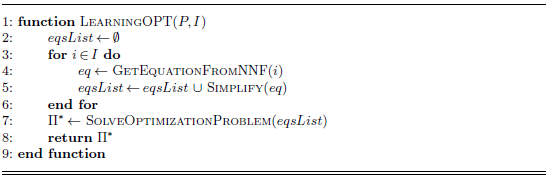
The learning task requires maximizing the sum of the log probabilities of the interpretations equation (3) where the tunable parameters are the facts whose probability should be learnt. Algorithm1 sketches the involved steps. We can extract the equation for the probability of each interpretation from the NNF and consider each parameter of a learnable fact as a variable (function GetEquationFromNNF). To reduce the size of the equation we simplify it (function Simplify). Then, we set up a constrained nonlinear optimization problem where the target is the maximization of the sum of the equations representing the log probabilities of the interpretations (function SolveOptimizationProblem). We need to also impose that the parameters of the learnable facts are between 0 and 1. In this way, we can easily adopt off-the-shelf solvers and do not need to write a specialized one.
Function LearningOPT: solving the parameter learning task targeting the upper probability with constrained optimization in a PASP P with learnable probabilistic facts II and interpretations I.
3.3 Solving parameter learning with expectation maximization
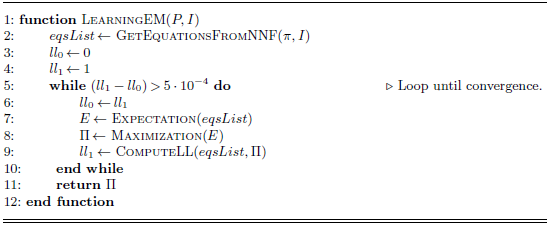
We propose another algorithm that instead performs Expectation Maximization as per equation (4) and (5). It is sketched in Algorithm2. For each interpretation $I$
, we add its interpretation query
$I$
, we add its interpretation query $q_I$
into the program. To compute
$q_I$
into the program. To compute $\overline{P}{(a_j \mid I_k)}$
for each learnable probabilistic fact
$\overline{P}{(a_j \mid I_k)}$
for each learnable probabilistic fact $a_j$
and each interpretation
$a_j$
and each interpretation $I_k$
we proceed as follows: first, we compute
$I_k$
we proceed as follows: first, we compute $\overline{P}{(a_j, I_k)}$
and
$\overline{P}{(a_j, I_k)}$
and $\underline{P}{(not \ a_j, I_k)}$
. Then, equation (2) allows us to compute
$\underline{P}{(not \ a_j, I_k)}$
. Then, equation (2) allows us to compute $\overline{P}(a_j \mid I_k)$
. Similarly for
$\overline{P}(a_j \mid I_k)$
. Similarly for $\underline{P}{(a_j \mid I_k)}$
. We extract an equation for each of these queries (function GetEquationsFromNNF) and iteratively evaluate them until the convergence of the EM algorithm (lines 5–10 that alternates the expectation phase with function Expectation, the maximization phase with function Maximization, and the computation of the log-likelihood with function ComputeLL). We consider as default convergence criterion a variation of the log-likelihood less than
$\underline{P}{(a_j \mid I_k)}$
. We extract an equation for each of these queries (function GetEquationsFromNNF) and iteratively evaluate them until the convergence of the EM algorithm (lines 5–10 that alternates the expectation phase with function Expectation, the maximization phase with function Maximization, and the computation of the log-likelihood with function ComputeLL). We consider as default convergence criterion a variation of the log-likelihood less than $5 \cdot 10^{-4}$
between two subsequent iterations. However, this parameter can be set by the user. If we denote with
$5 \cdot 10^{-4}$
between two subsequent iterations. However, this parameter can be set by the user. If we denote with $n_p$
the number of probabilistic facts whose probabilities should be learnt and
$n_p$
the number of probabilistic facts whose probabilities should be learnt and $n_i$
the number of interpretations, we need to extract equations for
$n_i$
the number of interpretations, we need to extract equations for $2 \cdot n_p \cdot n_i$
queries. However, this is possible with only one pass of the NNF: across different iterations, the structure of the program is the same, only the probabilities, and thus the result of the queries, will change. Thus, we can store the performed operations in memory and use only those to reevaluate the probabilities, without having to rebuild the NNF at each iteration.
$2 \cdot n_p \cdot n_i$
queries. However, this is possible with only one pass of the NNF: across different iterations, the structure of the program is the same, only the probabilities, and thus the result of the queries, will change. Thus, we can store the performed operations in memory and use only those to reevaluate the probabilities, without having to rebuild the NNF at each iteration.
Function LearningEM: solving the parameter learning task targeting the upper probability with Expectation Maximization in a PASP  $P$ with learnable probabilistic facts $\Pi$
and with interpretations
$\Pi$
and with interpretations $I$
.
$I$
.
Example 4 Consider Example 2 and its two interpretation queries, $q_{I_0}$
and
$q_{I_0}$
and $q_{I_1}$
. If we consider their symbolic equations we have
$q_{I_1}$
. If we consider their symbolic equations we have $\pi _{12} \cdot \pi _{24}$
(see Example 3) and
$\pi _{12} \cdot \pi _{24}$
(see Example 3) and $\pi _{13} \cdot (\pi _{12} + \pi _{24} - \pi _{12} \cdot \pi _{24})$
, where with
$\pi _{13} \cdot (\pi _{12} + \pi _{24} - \pi _{12} \cdot \pi _{24})$
, where with $\pi _{xy}$
we indicate the probability of
$\pi _{xy}$
we indicate the probability of $edge(x,y)$
. If we compactly denote with
$edge(x,y)$
. If we compactly denote with $\Pi$
the set of all the probabilities (i.e. all the
$\Pi$
the set of all the probabilities (i.e. all the $\pi _{xy}$
), the optimization problem of equation (3) requires solving
$\pi _{xy}$
), the optimization problem of equation (3) requires solving $\Pi ^* = \mathrm{arg\,max}_\Pi (\mathrm{log}( \pi _{12} \cdot \pi _{24}) + \mathrm{log} (\pi _{13} \cdot (\pi _{12} + \pi _{24} - \pi _{12} \cdot \pi _{24})))$
. The optimal solution is to set the values of all the
$\Pi ^* = \mathrm{arg\,max}_\Pi (\mathrm{log}( \pi _{12} \cdot \pi _{24}) + \mathrm{log} (\pi _{13} \cdot (\pi _{12} + \pi _{24} - \pi _{12} \cdot \pi _{24})))$
. The optimal solution is to set the values of all the $\pi _{xy}$
to 1, obtaining a log-likelihood of 0. Note that, in general, it is not always possible to obtain a LL of 0.
$\pi _{xy}$
to 1, obtaining a log-likelihood of 0. Note that, in general, it is not always possible to obtain a LL of 0.
4 Related work
There are many different techniques available to solve the parameter learning task, but most of them only work for programs with a unique model per world: PRISM (Sato, Reference Sato and Sterling1995) was one of the first tools considering inference and parameter learning in PLP. Its first implementation, which dates back to 1995, offered an algorithm based on EM. The same approach is also adopted in EMBLEM (Bellodi and Riguzzi, Reference Bellodi and Riguzzi2013), which learns the parameters of Logic Programs with Annotated Disjunctions (LPADs) (Vennekens et al., Reference Vennekens, Verbaeten, Bruynooghe, Demoen and Lifschitz2004), that is logic programs with disjunctive rules where each head atom is associated with a probability, and in ProbLog2 (Fierens et al., Reference Fierens, Van den Broeck, Renkens, Shterionov, Gutmann, Thon, Janssens and De Raedt2015) that learn the parameters of ProbLog programs from partial interpretations adopting the LFI-ProbLog algorithm of Gutmann et al. (Reference Gutmann, Thon, De Raedt, Gunopulos, Hofmann, Malerba and Vazirgiannis2011). LeProbLog Gutmann et al. (Reference Gutmann, Kimmig, Kersting and Raedt2008) still considers ProbLog programs but uses gradient descent to solve the task.
Few tools consider PASP and allow multiple models per world. dPASP (Geh et al., Reference Geh, Goncalves, Silveira, Maua and Cozman2023) is a framework to perform parameter learning in Probabilistic Answer Set Programs but targets the max-ent semantics, where the probability of a query is the sum of the probabilities of the models where the query is true. They propose different algorithms based on the computation of a fixed point and gradient ascent. However, they do not target the Credal Semantics. Parameter Learning under the Credal Semantics is also available in PASTA (Azzolini et al., Reference Azzolini, Bellodi and Riguzzi2022, Reference Azzolini, Bellodi and Riguzzi2024). Here, we adopt the same setting (learning from interpretations) but we address the task with an inference algorithm based on 2AMC and extraction of symbolic equations, rather than projected answer set enumeration, which has been empirically proven more effective (Azzolini and Riguzzi, Reference Azzolini, Riguzzi, Basili, Lembo, Limongelli and Orlandini2023a). This is also proved in our experimental evaluation.
Lastly, there are alternative semantics to adopt in the context of Probabilistic Answer Set Programming, namely, P-log (Baral et al., Reference Baral, Gelfond and Rushton2009), LPMLN (Lee and Wang, Reference Lee, Wang, Baral, Delgrande and Wolter2016), and smProbLog (Totis et al., Reference Totis, De Raedt and Kimmig2023). The relation among these has been partially explored by (Lee and Yang, Reference Lee, Yang, Singh and Markovitch2017) but a complete treatment providing a general comparison is still missing. The parameter learning task under these semantics has been partially addressed and an in-depth comparison between all the existing approaches can be an interesting future work.
5 Experiments
We ran the experiments on a computer with 16 GB of RAM running at 2.40 GHz with 8 hours of time limit. The goal of the experiments is many-fold: (i) finding which one of the algorithms is faster; (ii) discovering which one of the algorithms better solves the optimization problem represented by equation (3) (note that the sum of the log probabilities is maximum at 0, and this happens when all the partial interpretations have probability 1); (iii) evaluating whether different initial probability values impact on the execution time; and (iv) comparing our approach against the algorithm based on projected answer set enumeration of Azzolini et al. (Reference Azzolini, Bellodi and Riguzzi2024) called PASTA. We considered only PASTA since it is the only algorithm that currently solves the task of parameter learning in PASP under the credal semantics. We used aspmc (Eiter et al., Reference Eiter, Hecher and Kiesel2021) as backend solver for the computation of the formula, SciPy version 1.13.0 as optimization solver (Virtanen et al., Reference Virtanen, Gommers, Oliphant, Haberland, Reddy, Cournapeau, Burovski, Peterson, Weckesser, Bright, van der Walt, Brett, Wilson, Millman, Mayorov, Nelson, Jones, Kern, Larson, Carey, Polat, Feng, Moore, VanderPlas, Laxalde, Perktold, Cimrman, Henriksen, Quintero, Harris, Archibald, Ribeiro, Pedregosa and van Mulbregt2020), and SymPy (Meurer et al., Reference Meurer, Smith, Paprocki, Čertík, Kirpichev, Rocklin, Kumar, Ivanov, Moore, Singh, Rathnayake, Vig, Granger, Muller, Bonazzi, Gupta, Vats, Johansson, Pedregosa, Curry, Terrel, Roučka, Saboo, Fernando, Kulal, Cimrman and Scopatz2017) version 1.12 to simplify equations. In this way, the tool is completely open source.Footnote 1 In the experiments, for the algorithm based on constrained optimization (Section 3.2) we tested two nonlinear optimization algorithms available in SciPy, namely COBYLA (Powell, Reference Powell, Gomez and Hennart1994) and SLSQP (Kraft, Reference Kraft1994). COBYLA stands for Constrained Optimization BY Linear Approximation and is a derivative-free nonlinear constrained optimization algorithm based on linear approximation of the objective function and constraints during the solving process. On the contrary, SLSQP is based on Sequential Least Squares Programming, which is based on solving, at each iteration, a least square problem equivalent to the original problem. In the results, we denote the algorithm based on Expectation Maximization described in Section 3.3 with EM.
5.1 Datasets descriptions
We considered four datasets. Where not explicitly specified, all the initial probabilities of the learnable facts are set to 0.5. For all the instances, we generated configurations with 5, 10, 15, and 20 interpretations. The atoms to be included in the interpretations are taken uniformly at random from the Herbrand base of each program and some of them are considered as negated, again uniformly at random.
The coloring dataset models the graph coloring problem, where each node is associated with a color and configurations are considered valid only if nodes associated with the same color are not connected. We do not explicitly remove invalid solutions but only mark them as not valid. This makes the following dataset crucial to test our proposal when there are an increasing number of answer sets for each world. All the instances have the following rules:
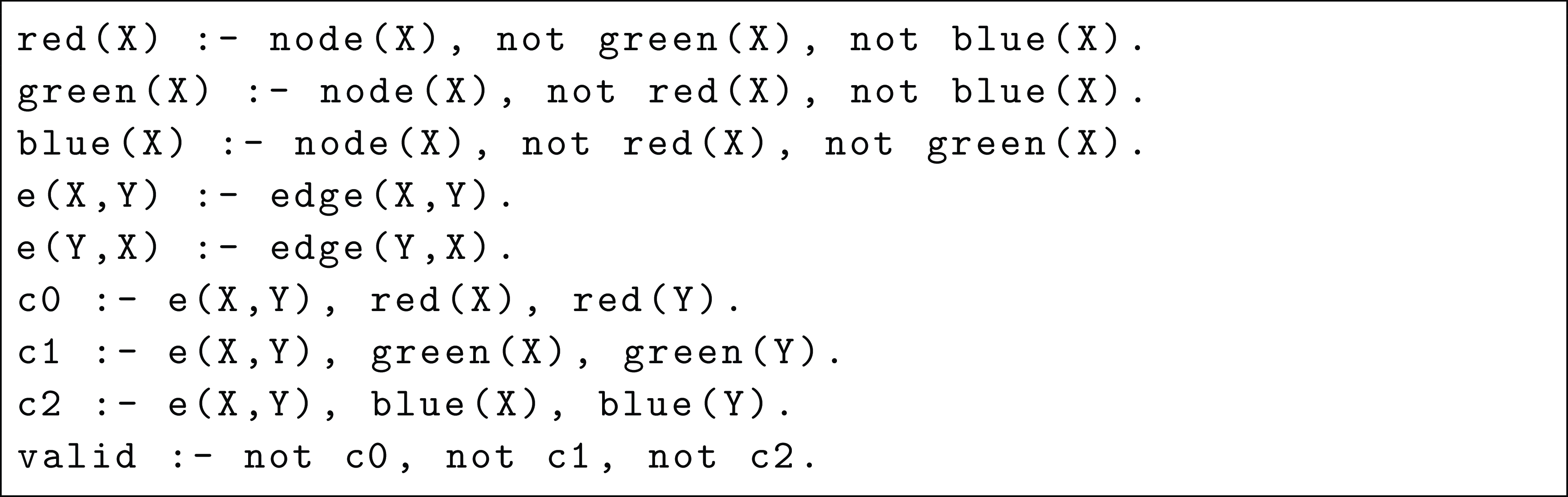
The goal is to learn the probabilities of the $edge/2$
facts given an increasing number of interpretations containing the observed colors for some edges and whether the configuration is
$edge/2$
facts given an increasing number of interpretations containing the observed colors for some edges and whether the configuration is $valid$
or not. We considered complete graphs of size 4 (coloring4) and 5 (coloring5). Here the interpretations have a random length between 3 and 4.
$valid$
or not. We considered complete graphs of size 4 (coloring4) and 5 (coloring5). Here the interpretations have a random length between 3 and 4.
The path dataset models a path reachability problem and every instance has the rules described in Example1. We considered this dataset since it represents a graph structure that can model many problems. The goal is to learn the probabilities of the $edge/2$
facts given that some paths are observed. We considered random connected graphs with 10 (path10) and 15 (path15) edges. Here the interpretations have a random length between 1 and 3.
$edge/2$
facts given that some paths are observed. We considered random connected graphs with 10 (path10) and 15 (path15) edges. Here the interpretations have a random length between 1 and 3.
The shop dataset models the shopping behavior of some people, with different products available where some of them cannot be bought together. An example of instance (with 2 people) is:

The goal is to learn the probabilities of the $shops/1$
learnable facts given an increasing number of products that are observed being bought (or not bought) and an increasing number of people. We considered instances with 4 (shop4), 8 (shop8), 10 (shop10), and 12 (shop12) people. Here the interpretations have a random length between 1 and 10. With this dataset we assess the learning algorithms in programs when constraints prune some solutions.
$shops/1$
learnable facts given an increasing number of products that are observed being bought (or not bought) and an increasing number of people. We considered instances with 4 (shop4), 8 (shop8), 10 (shop10), and 12 (shop12) people. Here the interpretations have a random length between 1 and 10. With this dataset we assess the learning algorithms in programs when constraints prune some solutions.
The smoke dataset, adapted from (Totis et al., Reference Totis, De Raedt and Kimmig2023), models a network where some people smoke and others are influenced by the smoking behavior of their friends. This is a well-known dataset often used to benchmark probabilistic logic programming systems. An example of instance with two people is:

Here, the learnable facts have signature $\mathit{influences}/2$
and the goal is to learn their probabilities given that some
$\mathit{influences}/2$
and the goal is to learn their probabilities given that some $ill/1$
facts are observed. We consider instances with 3 (smoke2), 4 (smoke4), and 6 (smoke6) people. Here the interpretations have a random length between 1 and 3.
$ill/1$
facts are observed. We consider instances with 3 (smoke2), 4 (smoke4), and 6 (smoke6) people. Here the interpretations have a random length between 1 and 3.
5.2 Results
Execution times for EM, constrained optimization solved with COBYLA and SLSQP, and PASTA, by increasing the number of interpretations. For path15 and coloring5 the line for EM is missing since it cannot solve any instance. The initial probabilities for learnable facts are set to 0.5.

Final log-likelihood (LL) values for the tested algorithms on six selected instances with the initial probability of the learnable facts set to 0.5. The column # int. contains the number of interpretations considered, the column EM contains the results obtained with expectation maximization, columns C. COBYLA and C. SLSQP stands for constrained optimization solved with, respectively, COBYLA and SLSQP, and the column PASTA contains the results obtained with the PASTA solver

Execution times of constrained optimization solved with COBYLA and SLSQP on coloring5, path15, shop12, and smoke6 with 0.1, 0.5, and 0.9 as initial values for the learnable facts.

First, we compare the execution times of the four proposed algorithms. Results are reported in Figure 1. COBYLA and SLSQP have comparable execution times while EM and PASTA are often the slowest. The only instances where PASTA is faster are coloring4 and coloring5. Given the imposed time and memory limits, EM cannot solve the instances shop12 with any number of interpretations and shop10 with 15 and 20 interpretations, and shop8 with 20 interpretations, coloring5 with any number of interpretations, and path15 with any number of interpretations (all due to memory limit) while PASTA was not able to solve smoke6 with any number of interpretations and smoke5 with 10, 15, and 20 interpretations (all due to time limit). The two algorithms based on constrained optimization are able to solve every considered instance.
We also evaluated the algorithms in terms of final log-likelihood. Table 2 shows the results on the coloring4, path10, shop4, shop8, smoke3, and smoke4 instances. SLSQP has the best performance: it seems to be able to better maximize the LL in coloring4, shop4, and shop8, while COBYLA cannot reach such maxima. For the other two, the results are equal. EM is also competitive with SLSQP. PASTA has the worst performance for all the datasets and cannot reach a LL of 0 while other algorithms, such as the ones based on constrained optimization, succeed.
Lastly, we also run experiments with the two optimization algorithms by considering different initial probability values. Figure 2 shows the results. In general, the initial probability values have little influence on the execution time for SLSQP. The impact is more evident on COBYLA: for example, for coloring5 with 10 interpretations, setting the initial values to 0.1 requires 100 s of computation while setting them to 0.5 or 0.9 requires 60 s. We extended this evaluation also to EM, but we do not report the results since the initial value makes no difference in terms of execution time. In the current version, PASTA does not allow setting an initial probability value different from 0.5.
Overall, the algorithm based on constrained optimization outperforms in terms of efficiency and in terms of final log-likelihood both the algorithm based on EM and PASTA. EM also outperforms PASTA in terms of final LL but it often requires excessive memory and cannot solve instances solvable by PASTA. Nevertheless, several improvements may be integrated within our approach to possibly increase the scalability: (i) considering different alternatives for the representation of symbolic equations, possibly more compact, also considering symmetries (Azzolini and Riguzzi, Reference Azzolini and Riguzzi2023b); (ii) developing ad-hoc simplification algorithms to reduce the size of the symbolic equations since they are only composed by summations of products. Furthermore, considering higher runtimes could be beneficial for enumeration-based techniques.
6 Conclusions
In this paper, we propose two algorithms to solve the task of parameter learning in PASP. Both are based on the extraction of a symbolic equation from a compact representation of the problem but differ in the solving approach: one is based on Expectation Maximization while the other is based on constrained optimization. For the former, we tested two algorithms, namely COBYLA and SLSQP. We compare them against PASTA, a solver adopting projected answer set enumeration. Empirical results show that the algorithms based on constrained optimization are more accurate and also faster than the ones based on EM and PASTA. Furthermore, the one based on EM is still competitive with PASTA but often requires an excessive amount of memory. As a future work we plan to consider the parameter learning task for other semantics and also theoretically study the complexity of the task in light of existing complexity results for inference (Mauá and Cozman, Reference Mauá and Cozman2020).
Acknowledgements
This work has been partially supported by Spoke 1 “FutureHPC & BigData” of the Italian Research Center on High-Performance Computing, Big Data and Quantum Computing funded by MUR Missione 4 – Next Generation EU (NGEU) and by Partenariato Esteso PE00000013 – “FAIR – Future Artificial Intelligence Research” – Spoke 8 “Pervasive AI”, funded by MUR through PNRR – M4C2 – Investimento 1.3 (Decreto Direttoriale MUR n. 341 of 15th March 2022) under the Next Generation EU (NGEU). All the authors are members of the Gruppo Nazionale Calcolo Scientifico – Istituto Nazionale di Alta Matematica (GNCS-INdAM). Elisabetta Gentili contributed to this paper while attending the PhD program in Engineering Science at the University of Ferrara, Cycle XXXVIII, with the support of a scholarship financed by the Ministerial Decree no. 351 of 9th April 2022, based on the NRRP – funded by the European Union – NextGenerationEU – Mission 4 “Education and Research”, Component 1 “Enhancement of the offer of educational services: from nurseries to universities” – Investment 4.1 “Extension of the number of research doctorates and innovative doctorates for public administration and cultural heritage”.
Competing interests
The authors declare none.


 Open access

