

Introduction
Scholarly interest has increasingly focused on the generational trajectories of voting and other forms of political participation among immigrants and their descendants, extending beyond the second generation (Logan et al., Reference Logan, Oh and Darrah2009, Reference Logan, Darrah and Oh2012; Masuoka et al., Reference Masuoka, Ramanathan and Junn2019; Ramakrishnan and Espenshade, Reference Ramakrishnan and Espenshade2001). Drawing on classic and segmented assimilation theories, previous studies have identified several distinct trajectories of political participation across immigrant generations—straight-line assimilation, first-generation self-selection, second-generation parity, second-generation advantage, second-generation disadvantage, and flat-line stagnation—as a framework for understanding the trajectories and outcomes of immigrant political incorporation (Ramakrishnan Reference Ramakrishnan2005).
Research further shows that generational trajectories of political participation vary significantly across racial and ethnic groups, reflecting differences in group characteristics, modes of incorporation, and contextual factors (Logan et al., Reference Logan, Darrah and Oh2012; Ramakrishnan Reference Ramakrishnan2005). In addition, prior research indicates that generational trajectories of political participation within racial and ethnic groups diverge across political acts (Santoro and Segura, Reference Santoro and Segura2011; Wong et al., Reference Wong, Ramakrishnan, Lee and Junn2011), suggesting that different political activities require “different configurations of participatory factors” such as motivation, resources, and mobilization (Verba et al., Reference Verba, Schlozman and Brady1995, p. 16).
Although this literature has substantially advanced our understanding of the diverse trajectories and outcomes of immigrant political incorporation, several methodological and theoretical challenges remain. These include inconsistent operationalizations of generational status and political participation, as well as competing explanations of the mechanisms underlying immigrant political incorporation. In addition, patterns of political participation beyond voting among Asian Americans across immigrant generations, particularly beyond the second generation, remain understudied (Lien et al., Reference Lien, Conway and Wong2004). More broadly, little empirical research has examined the mechanisms that generate differences in the extent of political participation over length of residence among first-generation immigrants and across successive immigrant generations.
This study aims to fill this gap by systematically examining generational differences in political participation beyond voting among Asian Americans, with particular attention to patterns beyond the second generation. It incorporates five nonvoting political activities—campaigning, making political donations, contacting government officials, working with others to solve a community problem, and protesting—into an overall political participation index. Moving beyond prior research that has focused primarily on documenting generational patterns of political participation, this study advances the literature by empirically assessing social integration as a central mechanism underlying generational differences in political participation among Asian Americans.
Specifically, this study examines the extent to which indicators of social integration account for variation in political participation across immigrant generations of Asian Americans. For the purpose of this study, social integration is defined as a process through which immigrants and their descendants develop social ties and connections in primary groups and civic institutions. In the literature, related concepts—such as structural assimilation, social embeddedness, and social incorporation—are often used interchangeably, highlighting the centrality of social integration as “the keystone of the arch of assimilation” (Gordon Reference Gordon1964, p. 81), “a midwife to political participation” (Kasinitz et al., Reference Kasinitz, Mollenkopf, Waters and Holdaway2008, p. 297), and “the lynchpin to full assimilation” (Bloemraad Reference Bloemraad2007, p. 327). Drawing on this framework, the analysis focuses on two participatory factors—engagement in political discussion with family and friends and involvement in civic organizations in the community—as key indicators of social integration. The findings support the argument that social integration constitutes an important mechanism of political incorporation among immigrants and their descendants (Bloemraad Reference Bloemraad2006; Diaz Reference Diaz2012; Fugita and O’Brien, Reference Fugita and O’Brien1985, Reference Fugita and O’Brien1991; Kim Reference Kim2018; Klandermans et al., Reference Klandermans, van der Toorn and van Stekelenburg2008).
Past Research on the Generational Patterns of Political Participation
A growing body of research has examined generational patterns of political participation as a means of understanding the trajectories and outcomes of political incorporation among immigrants and their descendants. Early studies were largely motivated by efforts to test classic assimilation theory, which predicts a progressive increase in political incorporation across immigrant generations, and relied primarily on data from European immigrants and their descendants.
For example, Lyman A. Kellstedt (Reference Kellstedt1974) examined differences in voting and campaign activity across immigrant generations among Polish, Italian, German, and Irish Americans in Buffalo, New York. He found that adult children of immigrants participated in political activities at higher rates than first-generation immigrants, but that participation declined among later generations. Similarly, Tina W. L. Chui and colleagues (Reference Chui, Curtis and Lambert1991) analyzed generational differences in voting, campaigning, and contacting politicians among Canadian immigrants, most of whom were of European origin, using data from the 1984 Canadian National Election Study. Their results likewise showed heightened political participation among the second generation, followed by a decline in participation among later generations.
Findings from these early studies appear to challenge classic assimilation theory’s prediction of a linear, “straight-line” process of political incorporation across immigrant generations. Moreover, Kellstedt (Reference Kellstedt1974) demonstrated that organizational involvement, measured by the number of organizational memberships, is positively associated with voting and campaign activity, highlighting the importance of organizational embeddedness as a participatory resource. However, these early studies were unable to provide compelling evidence due to data and methodological limitations, including reliance on small or nonrepresentative samples and the absence of controls for alternative explanations.
As the new second generation of post-1965 immigrants from Asia and Latin America came of age in the United States, scholars in the early 1990s began to examine divergent patterns and trajectories of immigrant adaptation across racial and ethnic groups (Gans Reference Gans1992; Portes and Zhou, Reference Portes and Zhou1993). Segmented assimilation theory emerged as a key theoretical framework for understanding these divergent trajectories and outcomes of second-generation incorporation (Zhou Reference Zhou1997). Research on generational patterns of immigrant adaptation across racial and ethnic groups has shown that outcomes of social, cultural, economic, or spatial assimilation, particularly among the second generation, depend on the interplay of factors operating at the individual, family, community, and policy levels (Portes and Rumbaut, Reference Portes and Rumbaut2001). However, most studies in the 1990s rarely examined generational patterns of incorporation beyond the second generation, largely due to data limitations.
Studies examining generational patterns of political participation beyond the second generation among Asian and Hispanic Americans began to emerge in the 2000s. For example, S. Karthick Ramakrishnan and Thomas J. Espenshade (2001) conducted a theory-driven and systematic analysis of generational differences in voting participation across ethnoracial groups using nationally representative data. Their findings show that generational patterns of voting participation vary markedly across ethnoracial groups: “highest participation among long-term immigrants for Latinos, a straight-line pattern among Blacks, a tapering off in participation for Asian Americans, and a second-generation advantage among Whites” (Ramakrishnan and Espenshade, Reference Ramakrishnan and Espenshade2001, p. 888). Notably, voting participation among Asian Americans exhibits a relatively straight-line pattern across immigrant generations, in contrast to the third-generation decline observed among Whites and Latinos (Ramakrishnan and Espenshade, Reference Ramakrishnan and Espenshade2001, p. 882; see also Ramakrishnan Reference Ramakrishnan2005). Consistent with these findings, John R. Logan and colleagues (Logan et al., Reference Logan, Oh and Darrah2009, Reference Logan, Darrah and Oh2012) likewise document a straight-line pattern of voting participation across immigrant generations among Asian Americans.
More recent studies have examined generational patterns not only in voting (Potochnick and Stegmaier, Reference Potochnick and Stegmaier2020; Qi and Gonzales, Reference Qi and Gonzalez2022; Santoro and Segura, Reference Santoro and Segura2011) but also in other forms of political participation, including campaign activity (Potochnick and Stegmaier, Reference Potochnick and Stegmaier2020), ethnic political activity (Santoro and Segura, Reference Santoro and Segura2011), and protest (Martinez Reference Martinez2005), either alongside voting or as distinct forms of participation (Ramakrishnan Reference Ramakrishnan2005). Although these studies consistently document generational differences in political participation within and across racial and ethnic groups, their findings vary depending on factors such as the operationalization of political participation and generational status, model specification, study population, and data source.
Methodological and Theoretical Issues in Previous Studies
Despite a growing body of research on immigrant political participation, generational patterns of political participation beyond voting among Asian Americans—particularly beyond the second generation—have received limited attention in the literature (Lien et al., Reference Lien, Conway and Wong2004). Building on this literature, the present study examines social integration as a key mechanism underlying generational differences in the extent of political participation among Asian Americans. In doing so, it addresses several important methodological and theoretical issues in existing research.
Diverse Forms of Political Participation
Political participation is a multidimensional construct that encompasses voting and a range of other participatory activities (Verba et al., Reference Verba, Schlozman and Brady1995). Different forms of political participation vary in their requirements (e.g., time, money, and civic skills), their capacity to convey policy-oriented messages, and the scope of their political consequences (Verba et al., Reference Verba, Schlozman and Brady1995). The repertoire of political participation has expanded over time to include political consumerism—boycotting companies, products, or services for political or ethical reasons (Stolle et al., Reference Stolle, Hooghe and Micheletti2005)—and online political activism, such as posting about politics on social media (Chan Reference Chan2021). Rather than adopting such an expansive conceptualization that encompasses any action oriented toward influencing others or their decisions, this study defines political participation more narrowly as “activity that is intended to or has the consequence of affecting, either directly or indirectly, government action” (Verba et al., Reference Verba, Schlozman and Brady1995, p. 9).
A cumulative index consisting of multiple items is generally more efficient and reliable than separate single-item measures, particularly when items have dichotomous response categories and when participation rates for some activities (e.g., campaigning or protest) are low. However, the use of an overall political participation index raises important methodological and theoretical concerns (Dylko Reference Dylko2010).
Each form of political participation is theoretically distinct and is initiated and sustained by a unique combination of participatory factors representing motivations, resources, and opportunities (Verba et al., Reference Verba, Schlozman and Brady1995). As a result, generational patterns in specific participatory activities (e.g., protest) may differ from those captured by an aggregate participation index (see Wong Reference Wong, Ramakrishnan, Lee and Junn2011, pp. 60–63). Individuals and groups possessing particular participatory factors are also likely to be concentrated in certain types of political activities (e.g., party-based political participation or protest). Moreover, factors that significantly predict overall political participation may not exert the same influence on specific forms of participation (Dylko Reference Dylko2010). For example, although educational attainment is a strong predictor of overall political participation, it has no significant effect on the likelihood of protesting among Asian Americans (Wong et al., Reference Wong, Ramakrishnan, Lee and Junn2011).
The multidimensional nature of political participation further implies that engagement in one type of political activity is not necessarily tightly linked to engagement in others, even though different forms of participation are often correlated. Some activities are more closely related to one another than to other forms of political participation. For example, individuals who work on political campaigns are also likely to make campaign donations. Moreover, certain activities (e.g., contacting officials or making donations) are less demanding and therefore more common than others (e.g., campaigning or protest). Unlike voting, participation in some activities (e.g., contacting officials or working with others to solve a community problem) may occur repeatedly within a single campaign period.
Because an overall participation index is typically constructed by summing dichotomous indicators of distinct political activities, it cannot capture variation in the intensity or frequency of participation across activities. Nonetheless, existing studies often employ an overall participation index to capture variation in the extent of political participation across activities, a measure that is widely used and well suited to examining generational differences in political participation (Brady et al., Reference Brady, Verba and Schlozman1995; Dylko Reference Dylko2010).
Complexity of Immigrant Generations
Immigrant generation refers to “the ancestral distance from the point of arrival in a society” for immigrants and their descendants (Alba Reference Alba and Riley1988, p. 213). It serves as a “temporal yardstick of change” in studies of adaptation and incorporation among immigrant populations (Alba Reference Alba and Riley1988, p. 213). As an analytical concept for assessing the process and extent of assimilation or integration, generational status has been more stable for European immigrants—who arrived during the Great European Wave—and their descendants than for post-1965 immigrants, owing to greater generational depth, within-generation similarity, and between-generation differentiation (Alba Reference Alba and Riley1988; Waters Reference Waters2014). For Asian Americans, by contrast, individuals who share the same generational status exhibit substantial within-group heterogeneity, including variation in age at arrival, period of arrival, length of residence, and age. Moreover, the continuous influx of immigrants from Asia since the 1965 immigration reform has expanded both the size and diversity of the Asian American population. As a result, the sociodemographic composition of each immigrant generation is not fixed but changes over time.
Defining immigrant generation as “one’s distance from immigrant ancestors” is conceptually straightforward (Waters Reference Waters2014, p. 18; see also Alba Reference Alba and Riley1988; Rumbaut Reference Rumbaut2004). However, operationalizing ancestral distance to classify generational status is far more complex and contested, particularly in the context of globalization, continued immigration flows, and frequent intergroup contact. Immigrant generation is typically classified based on the nativity of individuals and their parents or grandparents: foreign-born immigrants (the first generation), native-born children of immigrants (the second generation), and native-born grandchildren of immigrants (the third generation). In practice, however, the literature has identified multiple intermediate generational categories that complicate this seemingly simple classification scheme.
Based on age at migration in the life stage among the foreign-born (i.e., early childhood, middle childhood, and adolescence), Ruben G. Rumbaut (Reference Rumbaut2004) elaborates several in-between generational cohorts: the 1.75 generation (ages 0–5), the 1.5 generation (ages 6–12), and the 1.25 generation (ages 13–17). Previous research suggests that age at migration, along with length of residence in the United States, is a key factor shaping English-language proficiency, educational attainment, labor market outcomes, residential location, and intermarriage among the foreign-born (Bleakley and Chin, Reference Bleakley and Chin2010; Chiswick and Houseworth, Reference Chiswick and Houseworth2011; Lee and Edmonston, Reference Lee and Edmonston2011). In particular, age at migration is an important determinant of political participation (Tran Reference Tran2017).
Another in-between generational status arises from patterns of cross-nativity intermarriage between immigrants and natives. While Asian immigrants are less likely than Whites and other ethnoracial groups to marry U.S.-born natives, cross-nativity intermarriage is likely to increase due to several factors: expanded opportunities for intergroup interaction between immigrants and natives; the continuous replenishment of coethnic immigrants and the resulting expansion of marriage markets for cross-nativity unions; changing marriage preferences; and the active role of marriage brokers in the global marriage market (Lichter et al., Reference Lichter, Qian and Tumin2015). Previous research has identified marriage migration (Stevens et al., Reference Stevens, Ishizawa and Escandell2012) and cross-generational in-marriage (Min and Kim, Reference Min and Kim2009) as distinct forms of cross-nativity intermarriage. As a result, native-born children with one foreign-born and one native-born parent (i.e., the 2.5 generation) differ from children of two foreign-born parents (i.e., the second generation) in important ways, including their lived experiences and patterns of political socialization in the family (Ramakrishnan Reference Ramakrishnan2004).
Adding further complexity to the definition and measurement of immigrant generational status is the existence of native-born children of immigrant parents who return to their parents’ country of origin (see Fouron and Glick-Schiller, Reference Fouron, Glick-Schiller, Levitt and Waters2002) and later re-migrate to the United States (Edmonston and Passel, Reference Edmonston and Passel1992). In addition, some foreign-born children have native-born parents.Footnote 1 Such anomalous cases of immigrant generational status have been acknowledged in the literature (Oropesa and Landale, Reference Oropesa and Landale1997), but the generational status of transnational adoptees from Asia and elsewhere who have native-born adoptive parents has received far less attention, largely due to limited information on family relationships in available survey data.
Many previous studies of generational patterns of voting and other forms of political participation have defined generational status broadly, often grouping all foreign-born respondents into a single first-generation category. As Ramakrishnan and Espenshade (Reference Ramakrishnan and Espenshade2001) succinctly note, however, an assessment of political incorporation among immigrants and their descendants requires attention to “at least two temporal dimensions—across time within a particular immigrant generation and across generations” (p. 875). Among the first generation, duration of residence in the United States constitutes an important temporal dimension of immigrant political incorporation. At the same time, the selection of cut-off points for years of residence is somewhat arbitrary, as these thresholds are shaped not only by theoretical considerations but also by data limitations. For example, the same researcher has employed different cut-off points (e.g., 0–9, 10–19, 20+ years vs. 0–14, 15–29, 30+ years) across studies (Ramakrishnan Reference Ramakrishnan2005; Ramakrishnan and Espenshade, Reference Ramakrishnan and Espenshade2001).Footnote 2
Multiple Mechanisms of Political Incorporation
Previous studies have examined generational patterns of political participation through the lenses of classic and segmented assimilation theories (e.g., Qi and Gonzalez, Reference Qi and Gonzalez2022; Ramakrishnan and Espenshade, Reference Ramakrishnan and Espenshade2001; Santoro and Segura, Reference Santoro and Segura2011). Classic assimilation theory explains differences in political participation across immigrant generations by emphasizing factors related to immigration (e.g., age at immigration), acculturation (e.g., length of residence in the United States and English proficiency), and assimilation (e.g., U.S. education and income). From this perspective, political participation is expected to increase over time and across generations as immigrants and their descendants acquire knowledge of the American political system, develop political interest, and cultivate a sense of political efficacy (Dahl Reference Dahl1961).
By contrast, segmented assimilation theory explains divergent trajectories and outcomes of political incorporation across racial and ethnic groups by emphasizing differences in group characteristics, modes of incorporation, and contextual factors. Ramakrishnan and Espenshade (Reference Ramakrishnan and Espenshade2001), for example, argue that pathways and outcomes of immigrant political incorporation vary across ethnoracial groups depending on group-specific characteristics and contexts of reception. Their explanatory models of generational patterns in voting participation incorporate demographic characteristics, class resources, and social incorporation, as well as contextual factors such as political regimes in countries of origin, ethnic concentration, institutional barriers, and partisan competition. Recent studies further underscore the importance of contextual factors that “could affect collective responses of group members” in political life (Logan et al., Reference Logan, Darrah and Oh2012, p. 993).
More recent studies suggest that neither the classic assimilation framework nor the segmented assimilation alternative can fully explain the divergent trajectories of immigrant political incorporation across racial and ethnic groups (Luthra et al., Reference Luthra, Soehl and Waldinger2018). Relationships among cultural, economic, civic, and political integration are complex. For example, Philip Kasinitz and colleagues (Reference Kasinitz, Mollenkopf, Waters and Holdaway2008) point out that incorporation in one dimension, such as cultural adaptation or economic mobility, does not necessarily promote incorporation in another, such as “political inclusion or political efficacy” (p. 18). Moreover, racial and ethnic groups differ in how they perceive and respond to the political opportunity structure (e.g., the representation of immigrants and the second generation among officeholders) as well as in how they understand group interests and political participation as a means of advancing or protecting those interests (Kasinitz et al. Reference Kasinitz, Mollenkopf, Waters and Holdaway2008). Thus, political participation among individuals and groups is mediated through social networks and civic organizations that connect them to the political system (Kasinitz et al., Reference Kasinitz, Mollenkopf, Waters and Holdaway2008).
While previous studies have focused primarily on identifying generational patterns of political participation, they have rarely examined the mechanisms through which these patterns emerge within and between groups. Richard D. Alba and Victor Nee (Reference Alba and Nee2003) formulate a new assimilation theory that specifies multiple mechanisms shaping the assimilation and incorporation process. Among these mechanisms influencing trajectories of political incorporation across immigrant generations, social integration emerges as a particularly compelling explanation for variation in immigrant political participation (Bloemraad Reference Bloemraad2006; Diaz Reference Diaz2012; Fugita and O’Brien, Reference Fugita and O’Brien1985; Kim Reference Kim2018; Klandermans et al., Reference Klandermans, van der Toorn and van Stekelenburg2008).
The Present Study
Drawing on prior research, this study examines how differences in social integration help explain observed generational patterns of political participation beyond voting among Asian Americans. Building on existing scholarship, it conceptualizes social integration as a central mechanism of immigrant political incorporation. Specifically, this study measures the overall level of political participation beyond voting across length of residence among first-generation Asian immigrants and across successive immigrant generations. It then demonstrates that these generational differences are largely attenuated after accounting for indicators of social integration, net of marriage patterns and other sociodemographic covariates.
In classic and contemporary assimilation theories, racial intermarriage is widely regarded as a key indicator of social integration or structural assimilation, reflecting reduced social distance and increased incorporation into mainstream social networks (Alba and Nee, Reference Alba and Nee2003; Gordon Reference Gordon1964). Prior research treats racial intermarriage as an analytic indicator of social integration or structural assimilation, rather than as a normative measure of social progress. Beyond racial intermarriage, studies commonly identify political discussion embedded in interpersonal networks and involvement in civic organizations as additional indicators of social integration (Putnam Reference Putnam2000). Interactions within discussion networks and civic organizations can generate “politically relevant social capital” conducive to political participation (La Due Lake and Huckfeldt, Reference La Due Lake and Huckfeldt1998). Drawing on this framework, the present study treats these two participatory factors as key intermediating variables that help explain generational differences in political participation.
Although different forms of political participation are theoretically distinct, participation across activities is facilitated or constrained by a shared set of underlying participatory factors—including resources (e.g., time and organizational skills), motivations (e.g., political interest and efficacy), and recruitment processes (e.g., campaign outreach and mobilization through social networks and civic organizations)—as posited by the civic voluntarism model (Verba et al., Reference Verba, Schlozman and Brady1995). This study argues that, for Asian immigrants and their descendants, social integration operates as a foundational mechanism shaping participation across political activities by facilitating the development of participatory capacities and dispositions, such as communication and organizational skills, political interest, and access to recruitment networks. Moreover, key indicators of social integration—engagement in political discussion with family and friends and involvement in civic organizations in the community—are conceptualized as channels of political socialization, diffusion, and influence, as suggested in previous research (Cho Reference Cho1999; Cho and Rudolph, Reference Cho and Rudolph2008).
Consistent with this research focus, the study constructs an overall political participation index because the central question concerns generational differences in the level of political participation rather than the determinants of specific activities. Given the low prevalence of some activities (e.g., campaigning or protest), aggregating multiple dichotomous participation items provides a more reliable and parsimonious measure of political participation than analyzing activity-specific outcomes separately. This index also facilitates cross-generational comparisons by placing individuals on a common scale of overall participation.
Data and Methods
Data
Data for this study come from the 2008 National Asian American Survey (NAAS). The 2008 NAAS collected data from a nationally representative sample of Asian Americans (N = 5159), ages eighteen and older, by telephone interviews, in languages that the respondents preferred, between August and October in 2008 (for further information about the survey design of the 2008 NAAS, see Wong et al., Reference Wong, Ramakrishnan, Lee and Junn2011). The 2008 NAAS data contain information about nativity of the respondents and their parents, year of immigration for the foreign-born respondents, political discussion, organizational involvement, political activities, and other demographic characteristics relevant to this study. The analytic sample in this study was confined to the six largest Asian groups—Chinese, Asian Indian, Filipino, Vietnamese, Korean, and Japanese—with complete data on all the variables of interest (N = 4153).
Compared to the 2016 Pre- and Post-Election NAAS, the 2008 NAAS provides more detailed information on the race or ethnicity of respondents’ spouses or partners, making it possible to identify marriage patterns such as in-marriage, ethnic intermarriage, and racial intermarriage. Because the analysis controls for marriage patterns and other sociodemographic characteristics, the 2008 NAAS is better suited to the purposes of this study. Another advantage of the 2008 NAAS, compared to the 2016 NAAS data, is its larger sample size. A larger sample facilitates the classification of detailed generational statuses, increases statistical power to detect generational patterns of political participation, and reduces estimation error.
Dependent Variable
The dependent variable is an index counting the number of distinct political activities in which respondents reported participating in the last twelve months. The index is constructed using five nonvoting political activities: working for political campaigns (QC15_2), making campaign donations (QC13_3), contacting government officials (QC15_4), working with others to solve a community problem (QC15_5), and participating in protests and demonstrations (QC15_7). Voting is excluded from the index because recent immigrants are less likely to have acquired U.S. citizenship through naturalization and therefore may not yet be eligible to vote. Each activity is coded as 1 if the respondent reported participation and 0 otherwise. The overall political participation index is calculated as the sum of affirmative responses across the five activities and thus ranges from 0 to 5. The internal consistency of the index is moderate (Cronbach’s α = 0.52).
Independent Variable
Following Ramakrishnan and Espenshade (Reference Ramakrishnan and Espenshade2001), this study examines patterns of political participation by years of residence in the United States among first-generation immigrants, as well as across immigrant generations. Using information on respondents’ nativity (QA4) and their parents’ nativity (QA2, QA3), respondents are classified into generational categories. Foreign-born respondents are classified as the first generation; native-born respondents with two foreign-born parents as the second generation; native-born respondents with one foreign-born and one native-born parent as the 2.5 generation; and native-born respondents with two native-born parents as the third generation.
Additional information on age at immigration (QA6A) and years of residence in the United States (2008 minus year of immigration [QA6], or age minus age at immigration) is used to further distinguish among foreign-born respondents. Those who first arrived in the United States at age twelve or younger are classified as the 1.5 generation, while those who arrived after age twelve are classified as the first generation. First-generation immigrants are further divided into three groups based on length of residence in the United States: fewer than ten years, ten to nineteen years, and twenty or more years. The reference category is first-generation immigrants with fewer than ten years of residence.
Intermediating Variables: Participatory Factors
Political discussion and civic engagement occurring in social contexts (i.e., discussion networks and civic organizations) are treated as distinct indicators of social integration, alongside racial intermarriage. Whereas racial intermarriage reflects reduced social distance and increased interaction across group boundaries through intimate social relationships, these participatory factors capture integration through routine social interaction and participation in civic institutions. This study treats these two participatory factors as intermediating variables that may help explain generational differences in the extent of political participation.
Engaging in political discussion with family and friends is measured using a single item (QC15): “In the last twelve months, have you discussed politics with family and friends?” Responses are coded as 1 if the respondent answered “yes” and 0 if the respondent answered “no.”
Involvement in civic organizations in the community is measured using responses to two questions: (1) “Other than attending services or prayer, do you take part in any activity with people at your place of worship?” (QH2A), and (2) “Other than a religious group or place of worship, is there any other group or organization in your community that you are involved with?” (QH5). Each item is coded as 1 if the respondent answered “yes” and 0 if the respondent answered “no.” The variable is constructed as the sum of affirmative responses to these two items and therefore ranges from 0 to 2.
Control Variables: Sociodemographic Characteristics
Multivariate analyses control for a set of sociodemographic characteristics. These control variables are measured using respondents’ answers to the corresponding survey items and include ethnicity (QA5), gender (QS1), age in years (2008 minus year of birth [QJ10]), age squared (divided by 100 to ease interpretation), marriage patterns, the presence of children in the household (QJ5), educational attainment (QJ1), and U.S. education (QJ2). Both age and the age-squared term are included in the models to account for a nonlinear relationship between age and political participation. Political participation is expected to increase with age, reach a peak, and then decline at older ages.
The measurement of most variables is straightforward, with the exception of educational attainment and marriage patterns. The 2008 NAAS asked respondents to report their highest level of formal education completed using ten categorical response options. An interval measure of educational attainment is constructed by recoding these categories into years of schooling as follows: primary or grammar school = 8; some high school = 10; high school graduate = 12; some college = 14; bachelor’s degree = 16; master’s degree = 18; MBA or law degree = 19; and medical or doctoral degree = 20.
Marriage patterns are classified using information on respondents’ marital status, ethnicity, and the race or ethnicity of their spouse or partner. Respondents’ marital status (QJ3) is categorized as married or living as married, widowed/divorced/separated, or never married. Among respondents who reported being married or living as married, marriage patterns are further distinguished into three categories—in-marriage, ethnic intermarriage, and racial intermarriage—based on respondents’ ethnicity (QA5) and the race or ethnicity of their current spouse or partner (QJ3B1, QJ3B2). Therefore, marriage patterns are ultimately classified into five categories: in-marriage (reference category), ethnic intermarriage, racial intermarriage, divorced/widowed/separated, and never married.
Analytical Strategy
The dependent variable in this study is a count of five dichotomous indicators of nonvoting political activity in which respondents reported engaging in the last twelve months. Count data often exhibit overdispersion, in which the variance exceeds the mean. A likelihood-ratio (LR) test of the dispersion parameter (α) indicates that the data are significantly overdispersed. Accordingly, this study estimates a series of negative binomial regression models to examine patterns of political participation across immigrant generations and to assess the extent to which indicators of social integration account for these generational differences.
Missing values are common in survey data, despite the use of probe questions. In the 2008 NAAS, variables with relatively high levels of missingness (e.g., refusals or “don’t know” responses) include year of birth and age at immigration among the foreign-born, which are used to construct generational status; the race or ethnicity of the spouse, which is used to construct marriage patterns; and the presence of children in the household. After examining the extent and patterns of missing data, this study reports the results based on complete-case analysis. To assess the sensitivity of the findings to this choice, all models are replicated using multiple imputation, as reported in the Robustness and Sensitivity Checks section.
Findings
Descriptive Results: Patterns of Political Participation Across Immigrant Generations
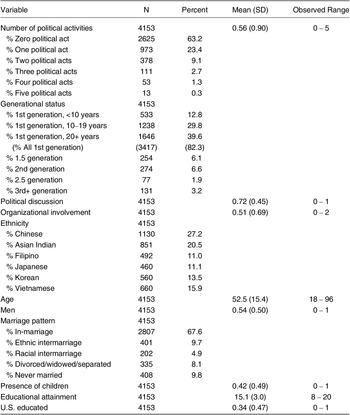
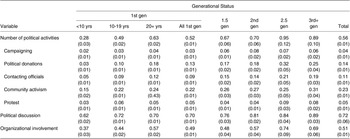
Table 1 presents the characteristics of the analytic sample. Overall levels of political participation in the last twelve months are relatively limited, with a mean participation index of 0.56 and nearly two thirds of respondents (63.2%) reporting no engagement in any political activity. Among those who participated in at least one political activity, the majority (63.5%) engaged in only a single participatory act—most commonly working with others to solve a community problem, making political donations, or contacting public officials (Table 2). Although the 2008 NAAS does not provide information on the intensity or frequency of participation (e.g., hours spent working with others, amount of money contributed, or number of letters sent), these descriptive results suggest that relatively few Asian Americans engage in multiple political activities or exhibit high levels of visible political activism.
Descriptive Statistics for the Analytic Sample

Note: The full sample for the six major Asian groups includes 4977 observations. The analytic sample excludes cases with missing values via listwise deletion (N = 4153).
Differences in Political Participation, Political Discussion, and Organizational Involvement by Generational Status among Asian Americans
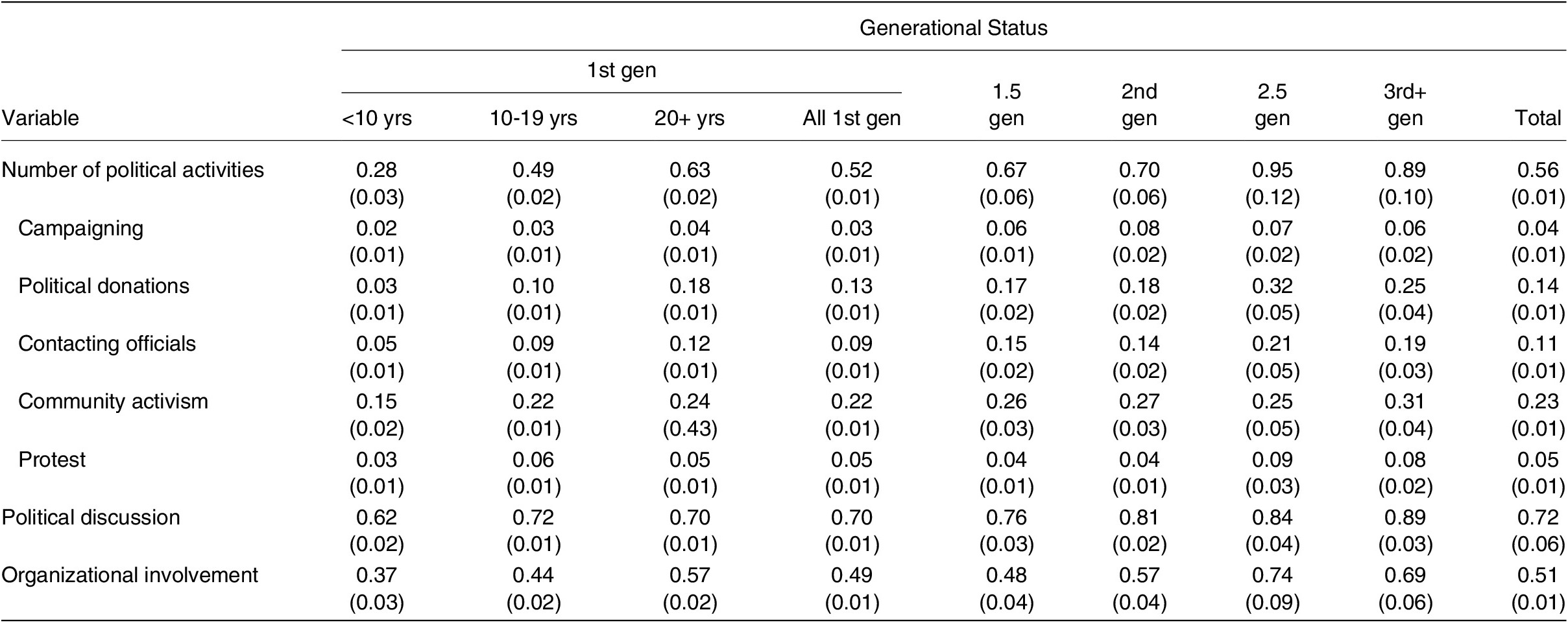
Note: N = 4153. 1) The racial intermarriage rate is the share of married people whose spouse is of a different race. Numbers in parentheses are standard errors. All bivariate relationships are statistically significant at p < 0.001 based on one-way ANOVA tests.
The bivariate relationship between generational status and the number of political activities reported in Table 2 shows a largely linear pattern: political participation increases with length of residence among first-generation immigrants and across successive immigrant generations, before tapering off in the third generation. There is a statistically significant difference in the number of political activities between the first generation overall and the 1.5 generation, but no significant difference between the 1.5 and second generations. In other words, the extent of political incorporation among the 1.5 generation closely resembles that of the second generation, lending support to the analytic distinction between the 1.5 generation and other foreign-born respondents. Similarly, the 2.5 generation appears distinct from the second generation and more closely aligned with the third generation in levels of political participation, justifying its treatment as a separate generational category (see Ramakrishnan Reference Ramakrishnan2004). A caveat is that the relatively small sample sizes for the 1.5 and later generations result in large margins of error, such that some observed differences may not reach statistical significance.
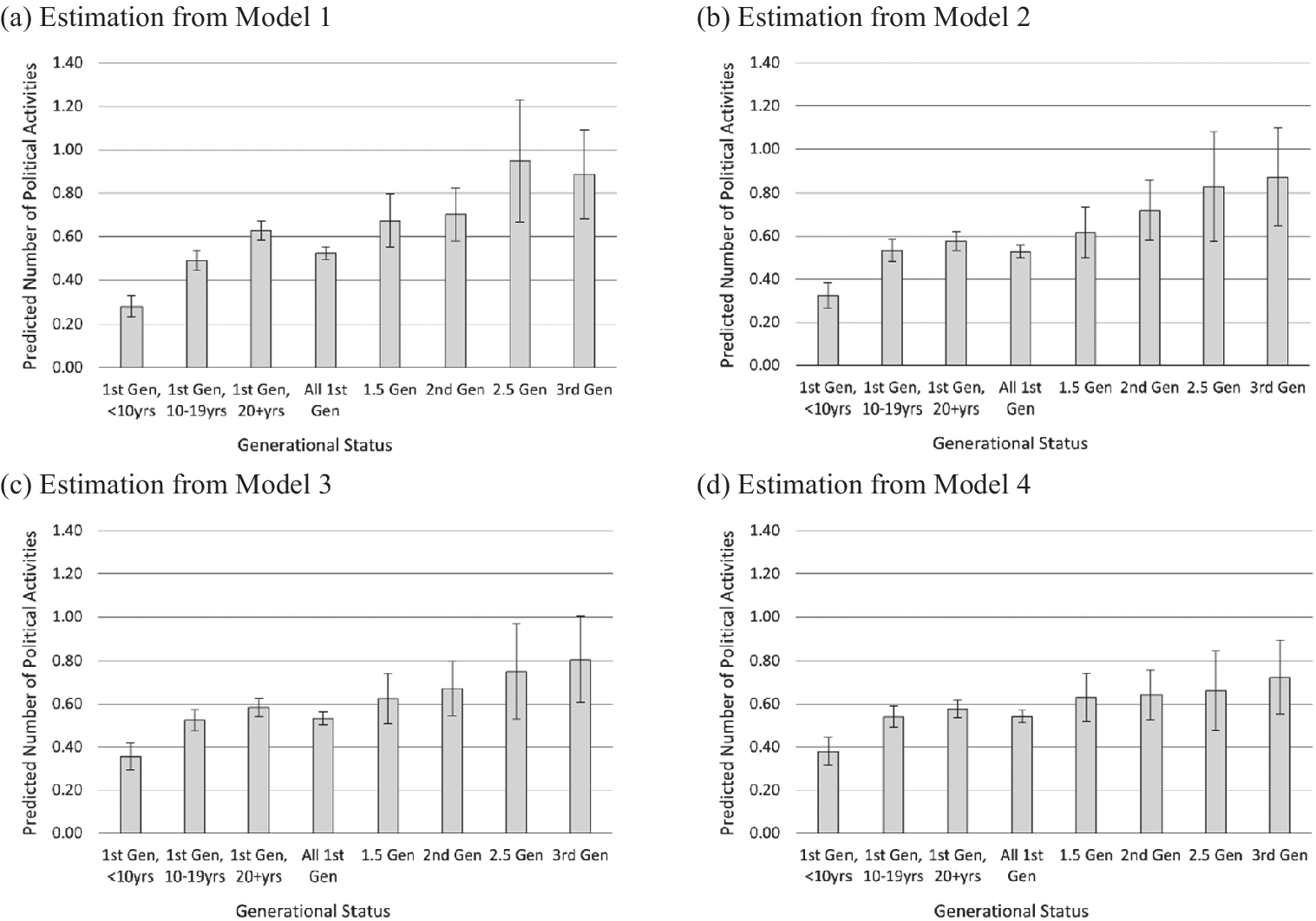
Another notable finding is that, among first-generation immigrants, those who have lived in the United States for twenty years or more exhibit levels of political participation comparable to those of the 1.5 and second generations. The 95% confidence intervals overlap (see Figure 1a below), indicating no significant differences among these groups in the number of political activities. These results underscore the importance of the temporal dimension (i.e., length of residence) in shaping political incorporation among first-generation immigrants.
Predicted Number of Political Activities Across Nested Models.
Note: Error bars represent 95% confidence intervals.

Among the different forms of political participation included in the overall political participation index, community activism is the most common, followed by making political donations and contacting government officials. Generational patterns of participation across individual activities are largely similar, with the exception that community activism is more prevalent among the third generation. Consequently, generational differences in overall political participation do not appear to be driven by generation-specific political styles or by self-selection of particular generations into distinct participatory acts.
This study examines the role of social integration in accounting for observed patterns of political participation across immigrant generations, net of sociodemographic characteristics. Specifically, it focuses on two indicators: engagement in political discussion with family and friends and involvement in civic organizations in the community. These indicators are not isolated determinants of political incorporation; rather, they are interconnected, and their effects depend on the social contexts—such as family relationships, friendship networks, and civic organizations—in which immigrants and their descendants are embedded.
Among these indicators of social integration, engagement in political discussion with family and friends is more prevalent than participation in community-based civic organizations. Engagement in political discussion increases across successive immigrant generations, whereas involvement in civic organizations peaks among the 2.5 generation and then declines slightly among the third generation. Among first-generation immigrants, recent arrivals are less likely than those with long durations of residence to engage in political discussion or participate in civic organizations. Notably, first-generation immigrants with long durations of residence exhibit levels of organizational involvement comparable to those of the second generation.
Results from Negative Binomial Regression Analyses
A series of negative binomial regression models are estimated to assess the independent and relative contributions of engagement in political discussion and involvement in civic organizations to explaining generational patterns of political participation. The baseline model includes dummy variables for generational status. Model 2 adds sociodemographic characteristics to account for differences in sociodemographic composition across immigrant generations. Subsequent models introduce engagement in political discussion (Model 3) and involvement in civic organizations (Model 4) sequentially, net of sociodemographic controls.
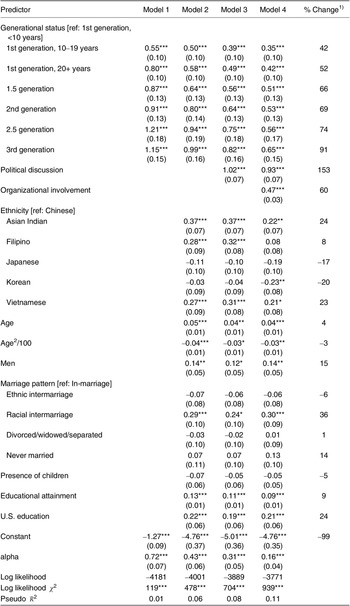
Table 3 reports results from the negative binomial regression analyses. In the baseline model, the expected log count of political activities is significantly higher with greater length of residence among first-generation immigrants and across each successive generation, relative to the reference group of first-generation immigrants with fewer than ten years of residence. The magnitude of these differences generally increases across generational categories before tapering slightly in the third generation. In subsequent models, the expected log count for each generational group remains significantly higher than that of the reference group. However, the magnitude of these generational differences declines across nested models.
Negative Binomial Regression of the Number of Political Activities among Asian Americans
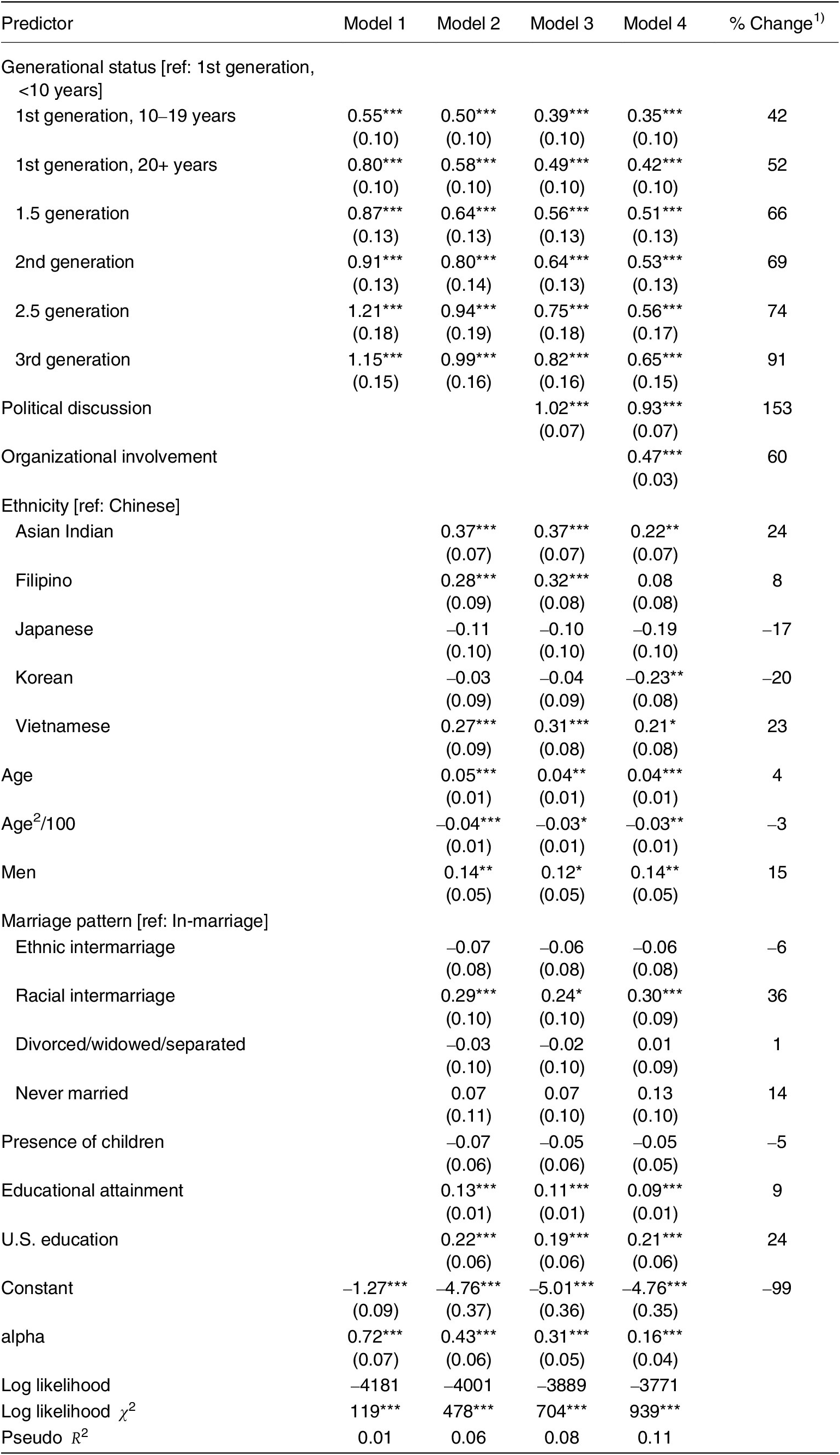
Note: N = 4153. Numbers in parentheses are standard errors. 1) Percentage changes in the expected count of the number of political activities are calculated as (exp(β) − 1) × 100, where β denotes coefficients estimated from Model 4.
* p < 0.05, ** p < 0.01, *** p < 0.001
Both engagement in political discussion and involvement in civic organizations, added sequentially in Models 3 and 4, are statistically significant and contribute to improved model fit. In the full model, engagement in political discussion with family and friends is associated with a 153% increase in the expected number of political activities (i.e., [exp(0.93) − 1] × 100), holding all other variables constant. Similarly, involvement in an additional religious or secular civic organization is associated with an approximately 60% increase in the expected number of political activities, holding other variables constant.
Among the control variables, racially intermarried respondents participate in significantly more political activities—by approximately 36%—than their in-married counterparts, whereas no significant difference is observed between ethnically intermarried and in-married respondents. There are also notable differences in the number of political activities across Asian ethnic groups. Asian Indian and Vietnamese respondents report significantly higher levels of political participation than Chinese respondents, whereas Korean respondents report lower levels of participation. The number of political activities increases with age, but at a decreasing rate. Men participate in more political activities than women. Educational attainment is positively associated with political participation, with U.S. education exerting a stronger effect than foreign education.
Changes in the Predicted Number of Political Activities Across Nested Models
To facilitate interpretation of the results reported in Table 3, the parameter estimates are converted into predicted counts of political activities across immigrant generations and presented in Figure 1. Figure 1a reproduces the observed number of political activities in the sample, as shown in Table 2. Among first-generation immigrants, the predicted number of political activities increases significantly with length of residence in the United States. The predicted level of participation for the 1.5 generation is closer to that of the second generation than to that of the first generation overall. Although there are no statistically significant differences in the predicted number of political activities among the 1.5 and later generations—as indicated by overlapping 95% confidence intervals—the results suggest that the second and later generations participate at significantly higher levels than the first generation overall. Notably, first-generation immigrants with long durations of residence reach parity with the 1.5 and second generations in the predicted number of political activities.
After controlling for sociodemographic characteristics in Model 2, the difference in the predicted number of political activities between first-generation immigrants with ten to nineteen years of residence and those with twenty or more years of residence is no longer statistically significant, reflecting underlying sociodemographic differences—particularly age—between these groups. Moreover, the attenuation of differences in the predicted number of political activities between the first generation overall and the second and later generations is similarly attributable to the inclusion of age, U.S. education, marriage patterns, and other covariates in the model.
After adding engagement in political discussion in Model 3, differences in the predicted number of political activities across immigrant generations are further reduced. This reduction is most pronounced among the second and later generations, reflecting their higher levels of engagement in political discussion with family and friends. After the inclusion of organizational involvement in the full model, differences in the predicted number of political activities across immigrant generations—except for recent immigrants with fewer than ten years of residence—largely disappear. The higher level of political participation observed among the third generation, relative to the first generation overall, is thus partly attributable to greater involvement in community-based civic organizations.
Robustness and Sensitivity Checks
This study conducts a series of robustness and sensitivity checks because variables can be operationalized in different ways, analytical strategies may vary, and results may be sensitive to sample composition and missing data. The results of these analyses are reported in the online supplementary materials. To assess the robustness of the findings to alternative measurement choices, the three first-generation groups are reclassified using different cutoffs for length of residence (i.e., fewer than fifteen years, fifteen to twenty-nine years, and thirty or more years), while all other categories remain unchanged. These results are substantively similar to those reported in Figure 1.
An additional robustness check examines whether the main findings remain stable when the model specification changes. Previous research on political participation often includes political interest and political efficacy as predictors (Masuoka et al., Reference Masuoka, Han, Leung and Zheng2018; Sui and Paul, Reference Sui and Paul2017). Research also suggests that political interest and political efficacy may partly develop through participation in discussion networks and civic organizations (Putnam Reference Putnam2000; Verba et al., Reference Verba, Schlozman and Brady1995). Accordingly, political interest (QB1) and political efficacy (QG5_A, QG5_B, QG5_C, QG5_D) were constructed using the same items employed in previous research (Sui and Paul, Reference Sui and Paul2017) and added to the full model. Although these attitudes may partly represent outcomes of social integration, their inclusion does not substantively alter the estimated effects of generational status, engagement in political discussion, or involvement in civic organizations on political participation.
As a sensitivity check, all models are re-estimated after excluding Vietnamese respondents from the analytic sample. Vietnamese immigrants and their descendants differ from other major Asian American groups primarily because of their distinct immigration history as refugees rather than economic migrants. Because large-scale Vietnamese immigration to the United States began primarily after the Vietnam War, Vietnamese respondents are less represented in the second and later generations. Despite this change in sample composition, the results remain substantively similar to those reported in Figure 1.
As an additional sensitivity check, all models were re-estimated after excluding Japanese respondents from the analytic sample, who constitute approximately 61% of the 2.5 generation and 79% of the third generation in the sample. Excluding Japanese respondents yields similar generational patterns of political participation for the first, 1.5, and second generations but produces substantively different estimates for the 2.5 and later generations. These differences are accompanied by substantially larger standard errors, reflecting reduced sample size and increased imprecision. Despite this sensitivity, the sequential inclusion of engagement in political discussion with family and friends and involvement in civic organizations continues to substantially reduce generational differences in the extent of political participation, consistent with the main findings. Taken together, these results suggest that the sensitivity of estimates for the 2.5 and later generations reflects underlying ethnic composition and sample size constraints rather than substantively different processes of political incorporation.
Finally, the sensitivity of the findings to missing data is assessed by comparing results from complete-case analysis with those obtained using multiple imputation. Given concerns that listwise deletion may introduce sample selection bias when data are not missing completely at random, all models are replicated using multiple imputation with chained equations in Stata 19.5 under a missing-at-random assumption. This approach allows an assessment of whether the substantive findings are sensitive to the treatment of missing data. These analyses reveal no substantive differences from the main findings.
Discussion and Conclusion
This study examines generational differences in political participation beyond voting among Asian Americans using data from the 2008 NAAS, which was fielded during a period of heightened immigration debate and political mobilization. During the 2008 election cycle, Asian Americans participated in some non-voting political activities—such as campaigning and making political donations—at levels comparable to those of non-Hispanic Whites, even as participation in other activities remained lower (Wong et al. Reference Wong, Ramakrishnan, Lee and Junn2011). Previous research further indicates that while political and geographic contexts are theoretically relevant, their empirical effects on individual political participation are relatively modest compared to participatory factors rooted in social networks and organizational involvement (Wong et al., Reference Wong, Ramakrishnan, Lee and Junn2011). These dynamics provide important context for interpreting generational differences in the level of political participation observed in the data.
The findings show that participation increases with length of residence among first-generation immigrants and across immigrant generations, but this upward pattern tapers off in the third generation. Contrary to classic assimilation theory’s expectation of a steady, linear increase in political participation across generations, there are no statistically significant differences in the number of political activities among the second, 2.5, and third generations. More broadly, the observed generational patterns of political participation among Asian Americans are more complex than those suggested by earlier research.
Generational Patterns of Political Participation Beyond Voting
Recent Asian immigrants with fewer than ten years of residence are less likely to participate in political activities than members of successive generational groups. Although this pattern is well documented, the underlying reasons for relatively low levels of political participation among recent arrivals remain less clear. Possible explanations include language barriers; limited access to political information, even among immigrants from English-speaking countries; and lower levels of political interest, as immediate priorities often center on establishing economic stability. Recent arrivals may also lack key resources relevant to political participation, such as civic skills. In addition, political parties and other agents of mobilization are less likely to target recent arrivals for political outreach (Wong Reference Wong2008).
Another plausible explanation for the low rate of political participation among recent arrivals is the context of reception, particularly immigrants’ legal and institutional incorporation. In the sample, approximately seventy percent of recent arrivals are noncitizens. Low rates of naturalization among recent arrivals are largely attributable to immigration laws and naturalization requirements—such as lawful permanent resident status, residency duration, and language and civic knowledge requirements—which constrain both their interest in and capacity to acquire citizenship (Bloemraad Reference Bloemraad2006). Previous research shows that lack of citizenship constitutes a significant barrier to political participation (Bloemraad Reference Bloemraad2006; Masuoka et al., Reference Masuoka, Ramanathan and Junn2019). Although many participatory acts beyond voting are formally open to all U.S. residents—aside from campaign donations, which are restricted to citizens and permanent residents—recent arrivals may nonetheless feel disconnected from politics or possess lower levels of political efficacy because they do not yet possess full and equal rights of political participation.
The observed number of political activities among first-generation immigrants with long durations of residence (twenty or more years) is comparable to that of the second generation, even though the second generation participates in political activities at higher levels than the first generation overall. The difference in the extent of political participation between this group and the second generation disappears after controlling for sociodemographic characteristics. In this sample, long-duration first-generation immigrants are, on average, older than second-generation respondents (sixty vs. forty-five years), and age is positively associated with the number of political activities, albeit at a decreasing rate. At the same time, second-generation respondents possess more favorable participatory characteristics than their long-duration first-generation counterparts, including higher rates of U.S. education. Taken together, these findings suggest that the positive association between length of residence and political participation reflects cumulative processes of acculturation, political socialization, and naturalization through which immigrants acquire political information and participatory resources. Consistent with this interpretation, length of residence is a key predictor of naturalization, pointing to a time-dependent process of political incorporation among immigrants (Ong and Nakanishi, Reference Ong, Nakanishi, Hing and Lee1996).
While long-duration first-generation immigrants are as likely to participate in political activities as the second generation, the second generation participates at higher levels than the first generation overall. Moreover, the extent of political participation among the second generation is comparable to that of the third generation. Ramakrishnan and Espenshade (Reference Ramakrishnan and Espenshade2001) identify a similar pattern of a “second-generation advantage” in voting participation among non-Hispanic Whites. They attribute this advantage to the tendency of second-generation individuals to face fewer linguistic barriers and experiences of societal discrimination than first-generation immigrants, while at the same time maintaining stronger attachment to political institutions than members of the third and later generations.
The results of this study, however, point to an alternative mechanism of political incorporation across immigrant generations among Asian Americans. Differences in the expected number of political activities between the first generation overall and the second generation, as well as between the first generation overall and the third generation, disappear after accounting for engagement in political discussion with family and friends and involvement in civic organizations. These findings suggest that higher levels of political participation among the second and third generations relative to the first generation are largely attributable to their greater embeddedness in discussion networks and civic organizations.
The results show no statistically significant difference in the observed number of political activities between the second and third generations. One plausible explanation for the tapering off in political participation among the third generation is higher levels of political cynicism or distrust toward government and political leaders (Ramakrishnan and Espenshade, Reference Ramakrishnan and Espenshade2001). Prior research indicates that confidence in government and political institutions tends to decline with length of residence among immigrants and across successive immigrant generations (Adman and Strömblad, Reference Adman and Strömblad2015). As more fully assimilated members of society, third-generation individuals may experience greater frustration with the political system if they perceive their voices as ineffective or unheard. At the same time, the relationship between political distrust and political participation remains contested. Political distrust may also serve as a source of mobilization, as individuals with lower levels of trust in political leaders and confidence in political institutions may be more likely to engage in protest and other nontraditional forms of political participation (Wilkins Reference Wilkins2000).
An alternative explanation for the stall in political incorporation among the third generation concerns demographic composition. The sensitivity analysis underscores that, because 2.5- and later-generation Asian Americans in the 2008 NAAS are disproportionately Japanese American, estimates for these generations should be interpreted in light of underlying ethnic composition and should not be assumed to generalize equally across all Asian-origin groups. Scholarship on Asian American political incorporation emphasizes that historical context, trajectories of racial formation, and racialized experiences shape patterns of political engagement across generations (Wong and Ramakrishnan, Reference Wong and Ramakrishnan2023; Wong et al., Reference Wong, Ramakrishnan, Lee and Junn2011). These dynamics are especially salient for Japanese Americans, whose third generation came of age under markedly different institutional and political conditions than earlier cohorts.
The lived experiences of third-generation Japanese Americans—often referred to as Sansei—are historically distinctive. Their parents’ and grandparents’ generations experienced exclusion and marginalization resulting from discriminatory laws and policies, including legal barriers to naturalization (e.g., Takao Ozawa v. United States, 1922) and incarceration during World War II. By contrast, growing up in the post-World War II period, third-generation Japanese Americans were more fully integrated into mainstream society than earlier generations (Fugita and O’Brien, Reference Fugita and O’Brien1985, Reference Fugita and O’Brien1991). As they came of age, many were actively involved in the Japanese American redress movement of the late 1960s and 1970s (Maki et al., Reference Maki, Kitano and Berthold1999; Takahashi Reference Takahashi1997). In more recent decades, however, third-generation Japanese Americans appear to exhibit lower levels of political participation, either relative to earlier periods or in comparison with other Asian American groups, such as Asian Indians. This generational and ethnic composition may therefore contribute to the observed tapering of political participation among the third generation in the aggregate.
If the second-generation advantage primarily stems from a structural position that mediates between ethnic communities and the mainstream (see Kasinitz et al., Reference Kasinitz, Mollenkopf, Waters and Holdaway2008, pp. 342–370), this advantage is likely to fade in the third and later generations as individuals become more fully integrated into the mainstream while losing ties to ethnic networks. The tapering off in political participation observed among the third generation suggests that, contrary to the predictions of classic assimilation theory, the participation gap between Asian Americans and non-Hispanic Whites may persist into the third and later generations (Ramakrishnan and Espenshade, Reference Ramakrishnan and Espenshade2001).
Mechanisms for Political Integration Across Immigrant Generations
Beyond racial intermarriage, this study focuses on engagement in political discussion with family and friends and involvement in civic organizations in the community as key indicators of social integration. The results show that each of these factors is significantly associated with political participation. In the full model, generational differences in political participation largely disappear, with the exception of recent immigrants with fewer than ten years of residence. These findings suggest that individuals who are more deeply embedded in social and organizational networks are more likely to engage in political activities. Family and friendship networks, together with civic organizations, thus constitute critical social contexts in which individuals are exposed to political stimuli and acquire politically relevant resources.
Implications of the Findings
Examining generational patterns of political participation beyond the second generation is crucial for understanding the trajectories and outcomes of political incorporation among Asian Americans. One reason is the continuous influx of Asian immigrants to the United States since the 1965 immigration reforms, which has produced a growing “new third generation”—the grandchildren of post-1965 immigrants (Jiménez et al., Reference Jiménez, Park and Pedroza2008). Both the size and proportion of this group within the Asian American population are expected to increase over time.
Another reason is that many third-generation Asian Americans achieve relatively high levels of social integration, as reflected in high rates of racial intermarriage, participation in discussion networks, and involvement in civic organizations. These indicators of social integration are positively associated with political participation. For the third generation, however, the consequences of social integration may be more complex. The relationship between racial intermarriage and political incorporation provides a useful case in point.
High rates of racial intermarriage—particularly with Whites—and the growing number of multiracial descendants exemplify the “crossing” and “blurring” of racial boundaries (Alba and Nee, Reference Alba and Nee2003). At the same time, ethnic identity and attachments tend to weaken as racial intermarriage and mixed ancestry increase across immigrant generations (Duncan and Trejo, Reference Duncan and Trejo2017). As a result, individuals who are interracially married or have mixed ancestry may be underrepresented in analyses of the third and later generations when ethnic groups are classified using respondents’ self-reported ancestry (Duncan and Trejo, Reference Duncan and Trejo2017; Perlmann and Waters, Reference Perlmann, Waters, Waters and Udea2007). It therefore remains unclear how many interracially married individuals or those with mixed ancestry—particularly among third- and later-generation Asian Americans—do not identify with a specific ethnic group, and how such individuals are incorporated into political life.
Moreover, the “erosion of a politicized ethnic identity” may dampen political participation among third- and later-generation Asian Americans (Santoro and Segura, Reference Santoro and Segura2011). The framework of identity-based politics posits that, in addition to—and independent of—resources such as socioeconomic status and political information, group consciousness plays a critical role in political participation (Segura and Rodrigues, Reference Segura and Rodrigues2006). From this perspective, Asian Americans with mixed ancestry may be less likely to develop a strong sense of group identity and solidarity that can function as a resource for political mobilization (Segura and Rodrigues, Reference Segura and Rodrigues2006). In this way, social integration—while serving as an assimilative force that facilitates political incorporation among immigrants and their descendants—may also operate as a countervailing force that weakens collective political action in the third and later generations.
Taken together, the findings of this study point to nuanced implications for political incorporation beyond the second generation among Asian Americans. At the same time, several limitations should be acknowledged. First, the relatively small sample sizes for the 1.5 and later generations result in larger margins of error, limiting statistical power to detect generational differences in political participation. Second, the relationship between immigrant generation and political participation is complex and dynamic rather than fixed. Because it is difficult to collect longitudinal data that track political participation across immigrant generations, empirical research has largely relied on cross-sectional data that capture generational differences at a particular point in time, often during a specific campaign period. As a result, observed generational patterns may shift as the sociodemographic composition of each immigrant generation changes over time and as levels of political participation fluctuate across election cycles.
Despite its limitations, this study contributes to research on generational patterns of political participation among Asian Americans by highlighting social integration as a key mechanism of political incorporation. Asian Americans have a long history of immigration to the United States, and sustained immigration over recent decades has continually reshaped the generational composition of Asian ethnic groups. Because these groups have distinct experiences of adaptation and settlement, trajectories and outcomes of political incorporation are likely to vary across ethnic groups. However, sample size constraints within ethnic–generational subgroups limit the feasibility of reliable group-specific analyses in this study. Future research examining generational patterns of political participation within and across Asian ethnic groups could provide greater insight into intra- and intergroup disparities in political incorporation, as well as the mechanisms that produce these divergent trajectories.
Supplementary material
The supplementary material for this article can be found at http://doi.org/10.1017/S1742058X26100149.
Acknowledgments
I thank the editors and anonymous reviewers of Du Bois Review for their thoughtful and constructive comments, which greatly improved the manuscript. Artificial intelligence (AI) tools (ChatGPT) were used solely for language editing during the revision process.


 Open access

