





1 Introduction
Helmut Wielandt proved in his habilitation thesis [Reference Wielandt17] that any two subnormal subgroups $H_1$
and
$H_1$
and $H_2$
of a finite group G generate a subnormal subgroup of G, a theorem which is often referred to as Wielandt’s Join Theorem. It is moreover known that
$H_2$
of a finite group G generate a subnormal subgroup of G, a theorem which is often referred to as Wielandt’s Join Theorem. It is moreover known that ${\langle }H_1,H_2{\rangle }\cap S={\langle }H_1\cap S,H_2\cap S{\rangle }$
for any Sylow p-subgroup S of G; as far as we are aware, this is a Lemma due to Ulrich Meierfrankenfeld (see Lemma 2.1). In the present paper we prove versions of these results for regular localities and for fusion systems. The reader is referred to Part I of [Reference Aschbacher, Kessar and Oliver1] for an introduction to the theory of fusion systems.
${\langle }H_1,H_2{\rangle }\cap S={\langle }H_1\cap S,H_2\cap S{\rangle }$
for any Sylow p-subgroup S of G; as far as we are aware, this is a Lemma due to Ulrich Meierfrankenfeld (see Lemma 2.1). In the present paper we prove versions of these results for regular localities and for fusion systems. The reader is referred to Part I of [Reference Aschbacher, Kessar and Oliver1] for an introduction to the theory of fusion systems.
Localities are group–like structures associated to saturated fusion systems which were introduced by Chermak [Reference Chermak2, Reference Chermak3]. Roughly speaking, a locality is a triple $({\mathcal {L}},\Delta ,S)$
, where
$({\mathcal {L}},\Delta ,S)$
, where ${\mathcal {L}}$
is a partial group (i.e., a set
${\mathcal {L}}$
is a partial group (i.e., a set ${\mathcal {L}}$
together with an “inversion” and a “partial multiplication” which is only defined on certain words in
${\mathcal {L}}$
together with an “inversion” and a “partial multiplication” which is only defined on certain words in ${\mathcal {L}}$
), S is a “Sylow p-subgroup” of
${\mathcal {L}}$
), S is a “Sylow p-subgroup” of ${\mathcal {L}}$
, and
${\mathcal {L}}$
, and $\Delta $
is a set of subgroups of S subject to certain axioms. Given a partial group
$\Delta $
is a set of subgroups of S subject to certain axioms. Given a partial group ${\mathcal {L}}$
, there are natural notions of partial normal subgroups of
${\mathcal {L}}$
, there are natural notions of partial normal subgroups of ${\mathcal {L}}$
and of partial subnormal subgroups of
${\mathcal {L}}$
and of partial subnormal subgroups of ${\mathcal {L}}$
. A nice theory of partial subnormal subgroups and of components can be developed for regular localities, which are special kinds of localities introduced by Chermak [Reference Chermak4] (see also [Reference Henke10]). It turns out that partial subnormal subgroups of regular localities form regular localities. The existence and uniqueness of centric linking systems implies that there is an essentially unique regular locality associated to every saturated fusion system.
${\mathcal {L}}$
. A nice theory of partial subnormal subgroups and of components can be developed for regular localities, which are special kinds of localities introduced by Chermak [Reference Chermak4] (see also [Reference Henke10]). It turns out that partial subnormal subgroups of regular localities form regular localities. The existence and uniqueness of centric linking systems implies that there is an essentially unique regular locality associated to every saturated fusion system.
Wielandt’s Join Theorem and Meierfrankenfeld’s Lemma have the following very natural translation to regular localities. The proof uses Wielandt’s Join Theorem and Meierfrankenfeld’s Lemma for groups.
Theorem A. Let $({\mathcal {L}},\Delta ,S)$
be a regular locality. Fix moreover two partial subnormal subgroups
$({\mathcal {L}},\Delta ,S)$
be a regular locality. Fix moreover two partial subnormal subgroups ${\mathcal {H}}_1$
and
${\mathcal {H}}_1$
and ${\mathcal {H}}_2$
of
${\mathcal {H}}_2$
of ${\mathcal {L}}$
. Then
${\mathcal {L}}$
. Then ${\langle }{\mathcal {H}}_1,{\mathcal {H}}_2{\rangle }$
is a partial subnormal subgroup of
${\langle }{\mathcal {H}}_1,{\mathcal {H}}_2{\rangle }$
is a partial subnormal subgroup of ${\mathcal {L}}$
with
${\mathcal {L}}$
with
 $$\begin{align*}{\langle}{\mathcal{H}}_1,{\mathcal{H}}_2{\rangle}\cap S={\langle}{\mathcal{H}}_1\cap S,{\mathcal{H}}_2\cap S{\rangle}.\end{align*}$$
Theorem A is restated and proved in Theorem 4.8.
Finding a formulation of Wielandt’s Join Theorem for fusion systems is slightly more tricky. As we show in Example 5.9, the subsystem generated by two subnormal subsystems of a saturated fusion system $\mathcal {F}$
is in some cases not even saturated (and is thus in particular not a subnormal subsystem of
$\mathcal {F}$
is in some cases not even saturated (and is thus in particular not a subnormal subsystem of $\mathcal {F}$
). However, we are able to prove the following result.
$\mathcal {F}$
). However, we are able to prove the following result.
Theorem B. Let $\mathcal {F}$
be a saturated fusion system, and suppose that
$\mathcal {F}$
be a saturated fusion system, and suppose that $\mathcal {E}_1$
and
$\mathcal {E}_1$
and $\mathcal {E}_2$
are subnormal subsystems of
$\mathcal {E}_2$
are subnormal subsystems of $\mathcal {F}$
over
$\mathcal {F}$
over $S_1$
and
$S_1$
and $S_2$
respectively. Then there is a (with respect to inclusion) smallest saturated subsystem
$S_2$
respectively. Then there is a (with respect to inclusion) smallest saturated subsystem ${\langle }\!{\langle }\mathcal {E}_1,\mathcal {E}_2{\rangle }\!{\rangle }$
of
${\langle }\!{\langle }\mathcal {E}_1,\mathcal {E}_2{\rangle }\!{\rangle }$
of $\mathcal {F}$
in which
$\mathcal {F}$
in which $\mathcal {E}_1$
and
$\mathcal {E}_1$
and $\mathcal {E}_2$
are subnormal. The subsystem
$\mathcal {E}_2$
are subnormal. The subsystem ${\langle }\!{\langle }\mathcal {E}_1,\mathcal {E}_2{\rangle }\!{\rangle }$
is a subnormal subsystem of
${\langle }\!{\langle }\mathcal {E}_1,\mathcal {E}_2{\rangle }\!{\rangle }$
is a subnormal subsystem of $\mathcal {F}$
over
$\mathcal {F}$
over ${\langle }S_1,S_2{\rangle }$
.
${\langle }S_1,S_2{\rangle }$
.
The reader is referred to Theorem 5.4 for more information. It should be pointed out that there is in many cases not a unique smallest saturated subsystem (or a unique smallest subnormal subsystem) of $\mathcal {F}$
containing
$\mathcal {F}$
containing $\mathcal {E}_1$
and
$\mathcal {E}_1$
and $\mathcal {E}_2$
(cf. Example 5.9).
$\mathcal {E}_2$
(cf. Example 5.9).
If $\mathcal {E}_1$
and
$\mathcal {E}_1$
and $\mathcal {E}_2$
are normal subsystems of
$\mathcal {E}_2$
are normal subsystems of $\mathcal {F}$
, then we have introduced a product subsystem
$\mathcal {F}$
, then we have introduced a product subsystem $\mathcal {E}_1\mathcal {E}_2$
already in a joint paper with Chermak [Reference Chermak and Henke5, Theorem C]. In some sense we generalize this construction above, as it turns out that
$\mathcal {E}_1\mathcal {E}_2$
already in a joint paper with Chermak [Reference Chermak and Henke5, Theorem C]. In some sense we generalize this construction above, as it turns out that ${\langle }\!{\langle } \mathcal {E}_1,\mathcal {E}_2{\rangle }\!{\rangle }=\mathcal {E}_1\mathcal {E}_2$
if
${\langle }\!{\langle } \mathcal {E}_1,\mathcal {E}_2{\rangle }\!{\rangle }=\mathcal {E}_1\mathcal {E}_2$
if $\mathcal {E}_1$
and
$\mathcal {E}_1$
and $\mathcal {E}_2$
are normal subsystems. Theorem B implies thus that
$\mathcal {E}_2$
are normal subsystems. Theorem B implies thus that $\mathcal {E}_1\mathcal {E}_2$
is the smallest saturated subsystem of
$\mathcal {E}_1\mathcal {E}_2$
is the smallest saturated subsystem of $\mathcal {F}$
in which
$\mathcal {F}$
in which $\mathcal {E}_1$
and
$\mathcal {E}_1$
and $\mathcal {E}_2$
are subnormal. Thereby, we also obtain a new characterization of
$\mathcal {E}_2$
are subnormal. Thereby, we also obtain a new characterization of $\mathcal {E}_1\mathcal {E}_2$
.
$\mathcal {E}_1\mathcal {E}_2$
.
Let us now say a few words about the proof of Theorem B. As mentioned before, there is an essentially unique regular locality associated to every saturated fusion system. Moreover, if $({\mathcal {L}},\Delta ,S)$
is a regular locality over a saturated fusion system
$({\mathcal {L}},\Delta ,S)$
is a regular locality over a saturated fusion system $\mathcal {F}$
, then it was shown by Chermak and the author of this paper [Reference Chermak and Henke5, Theorem F] that there is a natural one-to-one correspondence between the partial subnormal subgroups of
$\mathcal {F}$
, then it was shown by Chermak and the author of this paper [Reference Chermak and Henke5, Theorem F] that there is a natural one-to-one correspondence between the partial subnormal subgroups of ${\mathcal {L}}$
and the subnormal subsystems of
${\mathcal {L}}$
and the subnormal subsystems of $\mathcal {F}$
. Therefore, if
$\mathcal {F}$
. Therefore, if $\mathcal {E}_1$
and
$\mathcal {E}_1$
and $\mathcal {E}_2$
are two subnormal subsystems of
$\mathcal {E}_2$
are two subnormal subsystems of $\mathcal {F}$
, then Theorem A can be used to show that there is a smallest subnormal subsystem
$\mathcal {F}$
, then Theorem A can be used to show that there is a smallest subnormal subsystem $\mathcal {E}$
of
$\mathcal {E}$
of $\mathcal {F}$
in which
$\mathcal {F}$
in which $\mathcal {E}_1$
and
$\mathcal {E}_1$
and $\mathcal {E}_2$
are subnormal. Showing that
$\mathcal {E}_2$
are subnormal. Showing that $\mathcal {E}$
is the smallest saturated subsystem in which
$\mathcal {E}$
is the smallest saturated subsystem in which $\mathcal {E}_1$
and
$\mathcal {E}_1$
and $\mathcal {E}_2$
are subnormal is however still somewhat difficult. The essential ingredient in the proof of this property is the following group-theoretical result.
$\mathcal {E}_2$
are subnormal is however still somewhat difficult. The essential ingredient in the proof of this property is the following group-theoretical result.
Theorem C. Let G be a finite group and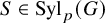 $S\in \operatorname {Syl}_p(G)$
. Let
$S\in \operatorname {Syl}_p(G)$
. Let $H_1$
and
$H_1$
and $H_2$
be two subnormal subgroups of G. Then
$H_2$
be two subnormal subgroups of G. Then $T:={\langle }H_1,H_2{\rangle }\cap S={\langle }H_1\cap S,H_2\cap S{\rangle }$
and
$T:={\langle }H_1,H_2{\rangle }\cap S={\langle }H_1\cap S,H_2\cap S{\rangle }$
and
 $$\begin{align*}\mathcal{F}_T({\langle}H_1,H_2{\rangle})={\langle}\;\mathcal{F}_T({\langle}H_1,T{\rangle}),\;\mathcal{F}_T({\langle}H_2,T{\rangle})\;{\rangle}.\end{align*}$$
We feel that Theorem C might be of independent interest to finite group theorists. Therefore, we seek to keep the proof of this theorem elementary (cf. Subsection 2.2). Theorem C can also be used to show the following Proposition (where we use the notation introduced in Theorem B).
Proposition D. Let G be a finite group and $S\in \operatorname {Syl}_p(G)$
. Suppose
$S\in \operatorname {Syl}_p(G)$
. Suppose $H_1$
and
$H_1$
and $H_2$
are subnormal subgroups of G. Then
$H_2$
are subnormal subgroups of G. Then
 $$\begin{align*}\mathcal{F}_{{\langle}H_1,H_2{\rangle}\cap S}({\langle}H_1,H_2{\rangle})={\langle}\!{\langle}\mathcal{F}_{H_1\cap S}(H_1),\mathcal{F}_{H_2\cap S}(H_2){\rangle}\!{\rangle}.\end{align*}$$
This says in particular that the fusion system $\mathcal {F}_{{\langle }H_1,H_2{\rangle }\cap S}({\langle }H_1,H_2{\rangle })$
is determined by the fusion systems
$\mathcal {F}_{{\langle }H_1,H_2{\rangle }\cap S}({\langle }H_1,H_2{\rangle })$
is determined by the fusion systems $\mathcal {F}_S(G)$
,
$\mathcal {F}_S(G)$
, $\mathcal {F}_{H_1\cap S}(H_1)$
and
$\mathcal {F}_{H_1\cap S}(H_1)$
and $\mathcal {F}_{H_2\cap S}(H_2)$
.
$\mathcal {F}_{H_2\cap S}(H_2)$
.
Organization of the paper
We start by proving the basic group-theoretical results in Section 2. More precisely, Meierfrankenfeld’s Lemma is proved in Subsection 2.1 and building on that, Theorem C is proved in Subsection 2.2. After summarizing some background on partial groups and localities in Section 3, Theorem A and some related results are then proved in Section 4. Finally, Theorem B and Proposition D are shown in Section 5.
Throughout this paper, homomorphisms are written on the right hand side of the argument (and the composition of homomorphisms is defined accordingly). The reader is referred to [Reference Aschbacher, Kessar and Oliver1, Sections I.1-I.7] for basic definitions and results on fusion systems.
2 Group-theoretic results
Throughout this section let G be a finite group and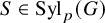 $ {{S}}\in \operatorname {Syl}_p(G)$
.
$ {{S}}\in \operatorname {Syl}_p(G)$
.
2.1 The proof of Meierfrankenfeld’s Lemma
The following lemma and the idea for its proof are due to Ulrich Meierfrankenfeld. We use throughout that two subnormal subgroups generate according to Wielandt’s Join Theorem a subnormal subgroup. Moreover, we use frequently that the intersection of S with a subnormal subgroup H of G is a Sylow p-subgroup of H.
Lemma 2.1 (Meierfrankenfeld).
Let $H_1$
and
$H_1$
and $H_2$
be subnormal subgroups of G. Then
$H_2$
be subnormal subgroups of G. Then
 $$\begin{align*}{\langle}H_1,H_2{\rangle}\cap S={\langle}H_1\cap S,H_2\cap S{\rangle}.\end{align*}$$
Proof. Let $(G,H_1,H_2)$
be a counterexample such that first
$(G,H_1,H_2)$
be a counterexample such that first $|G|$
and then
$|G|$
and then $|G:H_1|+|G:H_2|$
is minimal. The minimality of G implies that
$|G:H_1|+|G:H_2|$
is minimal. The minimality of G implies that $G={\langle }H_1,H_2{\rangle }$
. As
$G={\langle }H_1,H_2{\rangle }$
. As $(G,H_1,H_2)$
is a counterexample, we have moreover
$(G,H_1,H_2)$
is a counterexample, we have moreover $H_1\not \leq H_2$
and
$H_1\not \leq H_2$
and $H_2\not \leq H_1$
. Similarly, one observes that
$H_2\not \leq H_1$
. Similarly, one observes that
 $$ \begin{align} G\neq S\text{ and }p\text{ divides the order of }G. \end{align} $$
Assume $H_1\,{\trianglelefteq }\, G$
. Then
$H_1\,{\trianglelefteq }\, G$
. Then $G={\langle }H_1,H_2{\rangle }=H_1H_2$
,
$G={\langle }H_1,H_2{\rangle }=H_1H_2$
, $H_1\cap S\,{\trianglelefteq }\, S$
and
$H_1\cap S\,{\trianglelefteq }\, S$
and ${\langle }H_1\cap S,H_2\cap S{\rangle }=(H_1\cap S)(H_2\cap S)$
. As
${\langle }H_1\cap S,H_2\cap S{\rangle }=(H_1\cap S)(H_2\cap S)$
. As $S\cap H_1\cap H_2\in \operatorname {Syl}_p(H_1\cap H_2)$
, the order formula for products of subgroups (cf. [Reference Kurzweil and Stellmacher14, 1.1.6]) yields that
$S\cap H_1\cap H_2\in \operatorname {Syl}_p(H_1\cap H_2)$
, the order formula for products of subgroups (cf. [Reference Kurzweil and Stellmacher14, 1.1.6]) yields that $(H_1\cap S)(H_2\cap S)$
is a Sylow p-subgroup of
$(H_1\cap S)(H_2\cap S)$
is a Sylow p-subgroup of $G=H_1H_2$
and thus equal to S. This contradicts the assumption that
$G=H_1H_2$
and thus equal to S. This contradicts the assumption that $(G,H_1,H_2)$
is a counterexample and shows thus that
$(G,H_1,H_2)$
is a counterexample and shows thus that
 $$ \begin{align} H_1\text{ is not normal in }G. \end{align} $$
As $H_i\neq G$
is subnormal in G for each
$H_i\neq G$
is subnormal in G for each $i=1,2$
, there exists
$i=1,2$
, there exists $M_i\,{\trianglelefteq }\, G$
such that
$M_i\,{\trianglelefteq }\, G$
such that $H_i\leq M_i$
and
$H_i\leq M_i$
and $G/M_i$
is simple. Set
$G/M_i$
is simple. Set
 $$\begin{align*}H:={\langle}H_1,H_2\cap M_1{\rangle}\end{align*}$$
Since $H_1$
and
$H_1$
and $H_2\cap M_1$
are subnormal in G, it follows from Wielandt’s Join Theorem that H is subnormal in G and thus
$H_2\cap M_1$
are subnormal in G, it follows from Wielandt’s Join Theorem that H is subnormal in G and thus $ H\cap S\in \operatorname {Syl}_p(H)$
. As
$ H\cap S\in \operatorname {Syl}_p(H)$
. As $H\leq M_1<G$
, the minimality of
$H\leq M_1<G$
, the minimality of $|G|$
implies that
$|G|$
implies that $(H,H_1,H_2\cap M_1)$
is not a counterexample. Hence,
$(H,H_1,H_2\cap M_1)$
is not a counterexample. Hence,
 $$ \begin{align} H\cap S={\langle}H_1\cap S,H_2\cap M_1\cap S{\rangle}. \end{align} $$
Assume now that $H_2\cap M_1\not \leq H_1$
and so
$H_2\cap M_1\not \leq H_1$
and so $|G:H|<|G:H_1|$
. As
$|G:H|<|G:H_1|$
. As $G={\langle }H,H_2{\rangle }$
, the minimality of
$G={\langle }H,H_2{\rangle }$
, the minimality of $|G:H_1|+|G:H_2|$
implies then that
$|G:H_1|+|G:H_2|$
implies then that $S={\langle }H\cap S,H_2\cap S{\rangle }$
. So
$S={\langle }H\cap S,H_2\cap S{\rangle }$
. So $S={\langle }H_1\cap S,H_2\cap S{\rangle }$
by (2.3), contradicting the assumption that
$S={\langle }H_1\cap S,H_2\cap S{\rangle }$
by (2.3), contradicting the assumption that $(G,H_1,H_2)$
is a counterexample. This proves that
$(G,H_1,H_2)$
is a counterexample. This proves that $H_2\cap M_1\leq H_1$
, which yields
$H_2\cap M_1\leq H_1$
, which yields $H_1\cap H_2=H_2\cap M_1\,{\trianglelefteq }\, H_2$
. A symmetric argument shows that
$H_1\cap H_2=H_2\cap M_1\,{\trianglelefteq }\, H_2$
. A symmetric argument shows that $H_1\cap H_2=H_1\cap M_2\,{\trianglelefteq }\, H_1$
and thus
$H_1\cap H_2=H_1\cap M_2\,{\trianglelefteq }\, H_1$
and thus
 $$\begin{align*}H_1\cap H_2=H_1\cap M_2=H_2\cap M_1\,{\trianglelefteq}\, {\langle}H_1,H_2{\rangle}=G.\end{align*}$$
Consider now $\overline {G}:=G/H_1\cap H_2$
. If
$\overline {G}:=G/H_1\cap H_2$
. If $H_1\cap H_2\neq 1$
, then the minimality of
$H_1\cap H_2\neq 1$
, then the minimality of $|G|$
implies that
$|G|$
implies that $(\overline {G},\overline {H_1},\overline {H_2})$
is not a counterexample and hence
$(\overline {G},\overline {H_1},\overline {H_2})$
is not a counterexample and hence
 $$\begin{align*}\overline{S}={\langle}\overline{H_1}\cap \overline{S},\overline{H_2}\cap\overline{S}{\rangle}={\langle}\overline{H_1\cap S},\overline{H_2\cap S}{\rangle}.\end{align*}$$
This implies however that $S={\langle }H_1\cap S,H_2\cap S{\rangle }$
, again a contradiction. Thus, we have
$S={\langle }H_1\cap S,H_2\cap S{\rangle }$
, again a contradiction. Thus, we have
 $$\begin{align*}1=H_1\cap H_2=H_1\cap M_2=H_2\cap M_1.\end{align*}$$
Let $i\in \{1,2\}$
and set
$i\in \{1,2\}$
and set $j:=3-i$
. Recall that
$j:=3-i$
. Recall that $G/M_j$
is simple and has thus no non-trivial subnormal subgroup. Since
$G/M_j$
is simple and has thus no non-trivial subnormal subgroup. Since $H_i\not \leq M_j$
and
$H_i\not \leq M_j$
and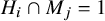 $H_i\cap M_j=1$
, it follows that
$H_i\cap M_j=1$
, it follows that
 $$\begin{align*}G/M_j=H_iM_j/M_j\cong H_i/H_i\cap M_j\cong H_i.\end{align*}$$
In particular, $H_i$
is simple. As
$H_i$
is simple. As $H_i$
is subnormal, it follows that
$H_i$
is subnormal, it follows that $H_i$
is a component of G if
$H_i$
is a component of G if $H_i$
is non-abelian. Otherwise,
$H_i$
is non-abelian. Otherwise, $H_i$
is cyclic of prime order q, and then contained in
$H_i$
is cyclic of prime order q, and then contained in $O_q(G)$
(cf. [Reference Kurzweil and Stellmacher14, 6.3.1]). Since any two distinct components centralize each other, and every component centralizes
$O_q(G)$
(cf. [Reference Kurzweil and Stellmacher14, 6.3.1]). Since any two distinct components centralize each other, and every component centralizes

it follows that $H_1$
and
$H_1$
and $H_2$
either centralize each other, or
$H_2$
either centralize each other, or ${\langle }H_1,H_2{\rangle }\leq O_q(G)$
for some prime q. As
${\langle }H_1,H_2{\rangle }\leq O_q(G)$
for some prime q. As $G={\langle }H_1,H_2{\rangle }$
, we get a contradiction to (2.2) in the first case, and a contradiction to (2.1) in the second case. This proves the assertion.
$G={\langle }H_1,H_2{\rangle }$
, we get a contradiction to (2.2) in the first case, and a contradiction to (2.1) in the second case. This proves the assertion.
2.2 The proof of Theorem C
As before we assume that G is a finite group and $S\in \operatorname {Syl}_p(G)$
. If
$S\in \operatorname {Syl}_p(G)$
. If $\Delta $
is the set of all subgroups of S, then
$\Delta $
is the set of all subgroups of S, then $(G,\Delta ,S)$
is a locality. Thus, we can adopt the usual notation for localities and we could cite theorems on localities. However, since Theorem C might be of independent interest to group theorists, we will keep its proof self-contained. Adopting the usual notation for localities, we define for
$(G,\Delta ,S)$
is a locality. Thus, we can adopt the usual notation for localities and we could cite theorems on localities. However, since Theorem C might be of independent interest to group theorists, we will keep its proof self-contained. Adopting the usual notation for localities, we define for $f\in G$
 $$\begin{align*}S_f:=\{s\in S\colon s^f\in S\}=(S\cap S^f)^{f^{-1}}.\end{align*}$$
Note that $S_f$
is a subgroup of S. If
$S_f$
is a subgroup of S. If $u=(f_1,\dots ,f_n)$
is a word in G, then we set similarly
$u=(f_1,\dots ,f_n)$
is a word in G, then we set similarly
 $$\begin{align*}S_u:=\{s\in S\colon s^{f_1\cdots f_i}\in S\text{ for all }i=1,2,\dots,n\}.\end{align*}$$
Again one observes easily that $S_u$
is a subgroup of S. Notice moreover that the following holds:
$S_u$
is a subgroup of S. Notice moreover that the following holds:
 $$ \begin{align} \text{If }u=(f_1,\dots,f_n)\text{ is a word in } G \text{ and }f=f_1f_2\cdots f_n,\text{ then }S_u\leq S_f. \end{align} $$
Lemma 2.2. Let $N\,{\trianglelefteq }\, G$
and
$N\,{\trianglelefteq }\, G$
and $T:=S\cap N$
. Then for every
$T:=S\cap N$
. Then for every $g\in G$
there exist
$g\in G$
there exist $n\in N$
and
$n\in N$
and $f\in N_G(T)$
with
$f\in N_G(T)$
with $g=nf$
and
$g=nf$
and $S_g=S_{(n,f)}$
. In particular,
$S_g=S_{(n,f)}$
. In particular,
 $$\begin{align*}\mathcal{F}_S(G)={\langle}\mathcal{F}_S(NS),\mathcal{F}_S(N_G(T)){\rangle}.\end{align*}$$
Proof. It is sufficient to prove the first part of the assertion. Indeed, this part is a special case of Stellmacher’s Splitting Lemma for localities [Reference Chermak3, Lemma 3.12], but we give an elementary proof.
Let $g\in G$
. By the Frattini Argument, there exist
$g\in G$
. By the Frattini Argument, there exist $m\in N$
and
$m\in N$
and $h\in N_G(T)$
with
$h\in N_G(T)$
with $g=mh$
. Set
$g=mh$
. Set $P:=S_g$
. As
$P:=S_g$
. As $(P^m)^h=P^g\leq S\leq N_G(T)$
and
$(P^m)^h=P^g\leq S\leq N_G(T)$
and $h\in N_G(T)$
, we have
$h\in N_G(T)$
, we have $P^m\leq N_G(T)$
. Moreover,
$P^m\leq N_G(T)$
. Moreover, $P^m\leq SN$
, so by a Dedekind Argument
$P^m\leq SN$
, so by a Dedekind Argument $P^m\leq N_G(T)\cap SN=SN_N(T)$
. By Sylow’s theorem, there exists thus
$P^m\leq N_G(T)\cap SN=SN_N(T)$
. By Sylow’s theorem, there exists thus $x\in N_N(T)$
with
$x\in N_N(T)$
with $P^{mx}=(P^m)^x\leq S$
. Notice that
$P^{mx}=(P^m)^x\leq S$
. Notice that $n:=mx\in N$
,
$n:=mx\in N$
, $f:=x^{-1}h\in N_G(T)$
and
$f:=x^{-1}h\in N_G(T)$
and $g=mh=nf$
. In particular,
$g=mh=nf$
. In particular, $S_{(n,f)}\leq S_{nf}=P$
by (2.4). As
$S_{(n,f)}\leq S_{nf}=P$
by (2.4). As $P^n\leq S$
and
$P^n\leq S$
and $P^{nf}=P^g\leq S$
, we have also
$P^{nf}=P^g\leq S$
, we have also $P\leq S_{(n,f)}$
. This proves the assertion.
$P\leq S_{(n,f)}$
. This proves the assertion.
Lemma 2.3. Let $M,N\,{\trianglelefteq }\, G$
and
$M,N\,{\trianglelefteq }\, G$
and $g\in MN$
. Then there exist
$g\in MN$
. Then there exist $m\in M$
and
$m\in M$
and $n\in N$
with
$n\in N$
with $g=mn$
and
$g=mn$
and $S_g=S_{(m,n)}$
.
$S_g=S_{(m,n)}$
.
Proof. This is a special case of [Reference Henke8, Theorem 1], but again, we give an elementary proof. Let $g\in MN$
and write
$g\in MN$
and write $g=m'n'$
for some
$g=m'n'$
for some $m'\in M$
and
$m'\in M$
and $n'\in N$
. Notice that
$n'\in N$
. Notice that $Q:=S_g^{m'}\leq S^{m'}\leq {\langle }S,M{\rangle }=SM$
. Moreover,
$Q:=S_g^{m'}\leq S^{m'}\leq {\langle }S,M{\rangle }=SM$
. Moreover, $Q^{n'}=S_g^g\leq S$
and thus
$Q^{n'}=S_g^g\leq S$
and thus $Q\leq S^{(n')^{-1}}\leq {\langle }S,N{\rangle }=SN$
. Hence,
$Q\leq S^{(n')^{-1}}\leq {\langle }S,N{\rangle }=SN$
. Hence, $Q\leq SM\cap SN$
. Notice that
$Q\leq SM\cap SN$
. Notice that $O^p(SM\cap SN)\leq O^p(SM)\cap O^p(SN)\leq M\cap N$
and thus, as S is a Sylow p-subgroup of
$O^p(SM\cap SN)\leq O^p(SM)\cap O^p(SN)\leq M\cap N$
and thus, as S is a Sylow p-subgroup of $SM\cap SN$
, we have
$SM\cap SN$
, we have $SM\cap SN=SO^p(SM\cap SN)=S(M\cap N)$
. It follows now from Sylow’s theorem that there exists
$SM\cap SN=SO^p(SM\cap SN)=S(M\cap N)$
. It follows now from Sylow’s theorem that there exists $x\in M\cap N$
with
$x\in M\cap N$
with $S_g^{m'x}=Q^x\leq S$
. Now
$S_g^{m'x}=Q^x\leq S$
. Now $m:=m'x\in M$
,
$m:=m'x\in M$
, $n:=x^{-1}n'\in N$
,
$n:=x^{-1}n'\in N$
, $g=mn$
,
$g=mn$
, $S_g^m\leq S$
and
$S_g^m\leq S$
and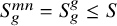 $S_g^{mn}=S_g^g\leq S$
. In particular,
$S_g^{mn}=S_g^g\leq S$
. In particular, $S_g\leq S_{(m,n)}$
. Together with (2.4), we obtain
$S_g\leq S_{(m,n)}$
. Together with (2.4), we obtain $S_g=S_{(m,n)}$
.
$S_g=S_{(m,n)}$
.
Lemma 2.4. Let $H{\,\trianglelefteq \trianglelefteq \,} G$
and
$H{\,\trianglelefteq \trianglelefteq \,} G$
and $M:={\langle }H^G{\rangle }$
. If
$M:={\langle }H^G{\rangle }$
. If $G=MN_G(H)$
, then
$G=MN_G(H)$
, then $H=M\,{\trianglelefteq }\, G$
.
$H=M\,{\trianglelefteq }\, G$
.
Proof. Assume $G=MN_G(H)$
and consider
$G=MN_G(H)$
and consider $K:={\langle }H^M{\rangle }$
. Notice that G acts on the set of normal subgroups of M, and thus
$K:={\langle }H^M{\rangle }$
. Notice that G acts on the set of normal subgroups of M, and thus $N_G(H)$
acts on the set of normal subgroups of M containing H. As K is the smallest normal subgroup of M containing H, it follows that
$N_G(H)$
acts on the set of normal subgroups of M containing H. As K is the smallest normal subgroup of M containing H, it follows that $N_G(H)\leq N_G(K)$
. By construction,
$N_G(H)\leq N_G(K)$
. By construction, $K\,{\trianglelefteq }\, M$
, and so K is normal in
$K\,{\trianglelefteq }\, M$
, and so K is normal in $G=MN_G(H)$
. This implies that
$G=MN_G(H)$
. This implies that $M={\langle }H^G{\rangle }=K$
. Using the definition of K and the fact that H is subnormal in M, we can therefore conclude that
$M={\langle }H^G{\rangle }=K$
. Using the definition of K and the fact that H is subnormal in M, we can therefore conclude that $H=M\,{\trianglelefteq }\, G$
.
$H=M\,{\trianglelefteq }\, G$
.
Lemma 2.5. Let $N\,{\trianglelefteq }\, G$
and
$N\,{\trianglelefteq }\, G$
and $H{\,\trianglelefteq \trianglelefteq \,} G$
such that S normalizes H. Then for every
$H{\,\trianglelefteq \trianglelefteq \,} G$
such that S normalizes H. Then for every $g\in NH$
, there exist
$g\in NH$
, there exist $n\in N$
and
$n\in N$
and $h\in H$
with
$h\in H$
with $g=nh$
and
$g=nh$
and $S_g=S_{(n,h)}$
. In particular,
$S_g=S_{(n,h)}$
. In particular,
 $$\begin{align*}\mathcal{F}_S(NHS)={\langle}\mathcal{F}_S(NS),\mathcal{F}_S(HS){\rangle}.\end{align*}$$
Proof. It is sufficient to show that, for every $g\in NH$
, there exist
$g\in NH$
, there exist $n\in N$
and
$n\in N$
and $h\in H$
with
$h\in H$
with $g=nh$
and
$g=nh$
and $S_g=S_{(n,h)}$
. Let
$S_g=S_{(n,h)}$
. Let $(G,N,H,g)$
be a counterexample to that assertion such that
$(G,N,H,g)$
be a counterexample to that assertion such that $|G|+|N|$
is minimal. Set
$|G|+|N|$
is minimal. Set $M:={\langle }H^G{\rangle }$
.
$M:={\langle }H^G{\rangle }$
.
Notice that $g\in NH\subseteq NM$
. Hence, by Lemma 2.3, there exist
$g\in NH\subseteq NM$
. Hence, by Lemma 2.3, there exist $n'\in N$
and
$n'\in N$
and $m\in M$
such that
$m\in M$
such that $g=n'm$
and
$g=n'm$
and $S_g=S_{(n',m)}$
. In particular, as
$S_g=S_{(n',m)}$
. In particular, as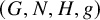 $(G,N,H,g)$
is a counterexample, it follows
$(G,N,H,g)$
is a counterexample, it follows
 $$ \begin{align} H\neq M. \end{align} $$
Write $g=ab$
with
$g=ab$
with $a\in N$
and
$a\in N$
and $b\in H$
. Then
$b\in H$
. Then $ab=n'm$
and so
$ab=n'm$
and so $mb^{-1}=(n')^{-1}a\in M\cap N$
. We obtain thus
$mb^{-1}=(n')^{-1}a\in M\cap N$
. We obtain thus $m\in (M\cap N)b\subseteq (M\cap N)H$
.
$m\in (M\cap N)b\subseteq (M\cap N)H$
.
Assume now that $N\not \leq M$
. Then
$N\not \leq M$
. Then $M\cap N$
is a proper subgroup of N, which is normal in G. The minimality of
$M\cap N$
is a proper subgroup of N, which is normal in G. The minimality of $|G|+|N|$
yields thus that
$|G|+|N|$
yields thus that $(G,M\cap N,H,m)$
is not a counterexample. Hence, there exist
$(G,M\cap N,H,m)$
is not a counterexample. Hence, there exist $y\in M\cap N$
and
$y\in M\cap N$
and $h\in H$
with
$h\in H$
with $m=yh$
and
$m=yh$
and $S_m=S_{(y,h)}$
. This implies
$S_m=S_{(y,h)}$
. This implies $g=n'm=n'yh=(n'y)h$
and
$g=n'm=n'yh=(n'y)h$
and
 $$\begin{align*}S_g=S_{(n',m)}=S_{(n',y,h)}\leq S_{(n'y,h)}\leq S_{(n'y)h}=S_g,\end{align*}$$
where the second equality uses $S_m=S_{(y,h)}$
and the inclusions use (2.4). So
$S_m=S_{(y,h)}$
and the inclusions use (2.4). So $n:=n'y\in N$
with
$n:=n'y\in N$
with $g=nh$
and
$g=nh$
and $S_{(n,h)}=S_g$
. This contradicts the assumption that
$S_{(n,h)}=S_g$
. This contradicts the assumption that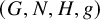 $(G,N,H,g)$
is a counterexample. Hence, we have shown that
$(G,N,H,g)$
is a counterexample. Hence, we have shown that
 $$\begin{align*}N\leq M\leq MS.\end{align*}$$
By (2.5) and Lemma 2.4, we have $G\neq MN_G(H)$
. In particular, as
$G\neq MN_G(H)$
. In particular, as $S\leq N_G(H)$
, it follows
$S\leq N_G(H)$
, it follows $MS\neq G$
. Thus, the minimality of
$MS\neq G$
. Thus, the minimality of $|G|+|N|$
yields that
$|G|+|N|$
yields that $(MS,N,H,g)$
is not a counterexample. However, this implies that
$(MS,N,H,g)$
is not a counterexample. However, this implies that $(G,N,H,g)$
is not a counterexample, contradicting our assumption.
$(G,N,H,g)$
is not a counterexample, contradicting our assumption.
Lemma 2.6. Let $H{\,\trianglelefteq \trianglelefteq \,} G$
. Then there exists a subnormal series
$H{\,\trianglelefteq \trianglelefteq \,} G$
. Then there exists a subnormal series
 $$\begin{align*}H=H_0\,{\trianglelefteq}\, H_1\,{\trianglelefteq}\, \cdots \,{\trianglelefteq}\, H_{n-1}\,{\trianglelefteq}\, H_n=G\end{align*}$$
such that $H_{i-1}={\langle }H^{H_i}{\rangle }$
for
$H_{i-1}={\langle }H^{H_i}{\rangle }$
for $i=1,2,\dots ,n$
. Such a subnormal series is always invariant under conjugation by
$i=1,2,\dots ,n$
. Such a subnormal series is always invariant under conjugation by $N_G(H)$
.
$N_G(H)$
.
Proof. If H is properly contained in a subgroup $H_i$
of G, then
$H_i$
of G, then ${\langle }H^{H_i}{\rangle }$
is a proper subgroup of
${\langle }H^{H_i}{\rangle }$
is a proper subgroup of $H_i$
, as H is subnormal in
$H_i$
, as H is subnormal in $H_i$
. It follows thus by induction on
$H_i$
. It follows thus by induction on $|G:H|$
that we can construct a subnormal series as above.
$|G:H|$
that we can construct a subnormal series as above.
If $i>1$
and
$i>1$
and $H_i$
is
$H_i$
is $N_G(H)$
-invariant, then
$N_G(H)$
-invariant, then $N_G(H)$
acts via conjugation on the set of normal subgroups of
$N_G(H)$
acts via conjugation on the set of normal subgroups of $H_i$
containing H, and thus also on
$H_i$
containing H, and thus also on $H_{i-1}={\langle }H^{H_i}{\rangle }$
, which is the smallest normal subgroup of
$H_{i-1}={\langle }H^{H_i}{\rangle }$
, which is the smallest normal subgroup of $H_i$
containing H. Thus, by induction on
$H_i$
containing H. Thus, by induction on $n-i$
, one proves that
$n-i$
, one proves that $H_i$
is
$H_i$
is $N_G(H)$
-invariant for
$N_G(H)$
-invariant for $i=1,2,\dots ,n$
.
$i=1,2,\dots ,n$
.
We are now in a position to give the proof of Theorem C. In the proof we use the following notation: If X and Y are subgroups of G, then $\operatorname {Aut}_X(Y)$
is the group of automorphisms of Y which are induced by conjugation with an element of
$\operatorname {Aut}_X(Y)$
is the group of automorphisms of Y which are induced by conjugation with an element of $N_X(Y)$
.
$N_X(Y)$
.
Proof of Theorem C.
Let $(G,H_1,H_2)$
be a counterexample to Theorem C such that first
$(G,H_1,H_2)$
be a counterexample to Theorem C such that first $|G|$
and then
$|G|$
and then $|G:H_1|+|G:H_2|$
is minimal. Set
$|G:H_1|+|G:H_2|$
is minimal. Set
 $$\begin{align*}S_1:=S\cap H_1\text{ and }S_2:=S\cap H_2.\end{align*}$$
The minimality of $|G|$
together with Meierfrankenfeld’s Lemma 2.1 yields that
$|G|$
together with Meierfrankenfeld’s Lemma 2.1 yields that
 $$ \begin{align} G={\langle}H_1,H_2{\rangle}\text{ and }S={\langle}S_1,S_2{\rangle}. \end{align} $$
If $H_1\neq H_1^x$
for some
$H_1\neq H_1^x$
for some $x\in S$
, then
$x\in S$
, then $H_1<H_1^*:={\langle }H_1,H_1^x{\rangle }{\,\trianglelefteq \trianglelefteq \,} G$
by Wielandt’s Join Theorem. Hence, it follows from the minimality of
$H_1<H_1^*:={\langle }H_1,H_1^x{\rangle }{\,\trianglelefteq \trianglelefteq \,} G$
by Wielandt’s Join Theorem. Hence, it follows from the minimality of $|G:H_1|+|G:H_2|$
that
$|G:H_1|+|G:H_2|$
that
 $$\begin{align*}\mathcal{F}_S(G)={\langle}\;\mathcal{F}_S({\langle}H_1^*,S{\rangle}),\;\mathcal{F}_S({\langle}H_2,S{\rangle})\;{\rangle}.\end{align*}$$
As ${\langle }H_1^*,S{\rangle }={\langle }H_1,S{\rangle }$
, this contradicts the assumption that
${\langle }H_1^*,S{\rangle }={\langle }H_1,S{\rangle }$
, this contradicts the assumption that $(G,H_1,H_2)$
is a counterexample. So
$(G,H_1,H_2)$
is a counterexample. So $H_1$
is S-invariant. As the situation is symmetric in
$H_1$
is S-invariant. As the situation is symmetric in $H_1$
and
$H_1$
and $H_2$
, we have thus shown that
$H_2$
, we have thus shown that
 $$ \begin{align} S\leq N_G(H_1)\cap N_G(H_2). \end{align} $$
In particular, we need to show that $\mathcal {F}_S(G)={\langle }\mathcal {F}_S(H_1S),\mathcal {F}_S(H_2S){\rangle }$
to obtain a contradiction to the assumption that
$\mathcal {F}_S(G)={\langle }\mathcal {F}_S(H_1S),\mathcal {F}_S(H_2S){\rangle }$
to obtain a contradiction to the assumption that $(G,H_1,H_2)$
is a counterexample. We will use (2.6) and (2.7) throughout this proof, most of the time without further reference.
$(G,H_1,H_2)$
is a counterexample. We will use (2.6) and (2.7) throughout this proof, most of the time without further reference.
Set
 $$\begin{align*}N_i:={\langle}H_i^G{\rangle}\text{ for }i=1,2.\end{align*}$$
As $(G,H_1,H_2)$
is a counterexample, it follows from Lemma 2.5 (applied with
$(G,H_1,H_2)$
is a counterexample, it follows from Lemma 2.5 (applied with $(H_i,H_{3-i})$
in place of
$(H_i,H_{3-i})$
in place of $(N,H)$
) that
$(N,H)$
) that $H_i$
is not normal in G for each
$H_i$
is not normal in G for each $i=1,2$
. In particular, Lemma 2.4 together with (2.7) yields
$i=1,2$
. In particular, Lemma 2.4 together with (2.7) yields
 $$ \begin{align} N_1S\neq G\neq N_2S. \end{align} $$
We prove now that
 $$ \begin{align} H_1\cap N_2=H_1\cap H_2=H_2\cap N_1\,{\trianglelefteq}\, G. \end{align} $$
For the proof assume first that $H_1\cap N_2\not \leq H_2$
. Then
$H_1\cap N_2\not \leq H_2$
. Then
 $$\begin{align*}H_2<\tilde{H}_2:={\langle}H_2,H_1\cap N_2{\rangle}. \end{align*}$$
Notice that $H_1\cap N_2$
is subnormal in G and hence, by Wielandt’s Join Theorem,
$H_1\cap N_2$
is subnormal in G and hence, by Wielandt’s Join Theorem, $\tilde {H}_2$
is subnormal in G. The minimality of
$\tilde {H}_2$
is subnormal in G. The minimality of $|G:H_1|+|G:H_2|$
yields thus
$|G:H_1|+|G:H_2|$
yields thus
 $$\begin{align*}\mathcal{F}_S(G)={\langle}\mathcal{F}_S(H_1S),\mathcal{F}_S(\tilde{H}_2S){\rangle}.\end{align*}$$
Notice that $K_1:=H_1\cap (N_2S){\,\trianglelefteq \trianglelefteq \,} N_2S$
and
$K_1:=H_1\cap (N_2S){\,\trianglelefteq \trianglelefteq \,} N_2S$
and $K_1\cap S=S_1$
. Using (2.6) and a Dedekind argument, observe moreover that
$K_1\cap S=S_1$
. Using (2.6) and a Dedekind argument, observe moreover that
 $$\begin{align*}K_1=H_1\cap (N_2S)=H_1\cap (N_2S_1)=(H_1\cap N_2)S_1.\end{align*}$$
In particular, we can conclude that $\tilde {H}_2S={\langle }K_1,H_2{\rangle }$
and
$\tilde {H}_2S={\langle }K_1,H_2{\rangle }$
and $K_1S=(H_1\cap N_2)S$
. By (2.8) and the minimality of
$K_1S=(H_1\cap N_2)S$
. By (2.8) and the minimality of $|G|$
,
$|G|$
, $(N_2S,K_1,H_2)$
is not a counterexample. Hence,
$(N_2S,K_1,H_2)$
is not a counterexample. Hence,
 $$\begin{align*}\mathcal{F}_S(\tilde{H}_2S)=\mathcal{F}_S({\langle}K_1,H_2{\rangle})={\langle}\mathcal{F}_S(K_1S),\mathcal{F}_S(H_2S){\rangle}\end{align*}$$
where $\mathcal {F}_S(K_1S)=\mathcal {F}_S((H_1\cap N_2)S)\subseteq \mathcal {F}_S(H_1S)$
. Hence,
$\mathcal {F}_S(K_1S)=\mathcal {F}_S((H_1\cap N_2)S)\subseteq \mathcal {F}_S(H_1S)$
. Hence,
 $$\begin{align*}\mathcal{F}_S(G)={\langle}\mathcal{F}_S(H_1S),\mathcal{F}_S(\tilde{H}_2S){\rangle}={\langle}\mathcal{F}_S(H_1S),\mathcal{F}_S(H_2S){\rangle},\end{align*}$$
which contradicts the assumption that $(G,H_1,H_2)$
is a counterexample. This shows that
$(G,H_1,H_2)$
is a counterexample. This shows that $H_1\cap N_2\leq H_2$
and so
$H_1\cap N_2\leq H_2$
and so $H_1\cap N_2=H_1\cap H_2$
. A symmetric argument gives
$H_1\cap N_2=H_1\cap H_2$
. A symmetric argument gives $H_2\cap N_1=H_1\cap H_2$
. Thus,
$H_2\cap N_1=H_1\cap H_2$
. Thus,
 $$\begin{align*}H_1\cap N_2=H_1\cap H_2=H_2\cap N_1\,{\trianglelefteq}\, {\langle}H_1,H_2{\rangle}=G\end{align*}$$
and so (2.9) holds. We argue next that
 $$ \begin{align} H_1=(H_1\cap H_2)N_{H_1}(S_2). \end{align} $$
For the proof recall that $H_1$
is S-invariant by (2.7) and
$H_1$
is S-invariant by (2.7) and $S_2\leq N_2\,{\trianglelefteq }\, G$
. Hence (2.9) yields
$S_2\leq N_2\,{\trianglelefteq }\, G$
. Hence (2.9) yields
 $$\begin{align*}[H_1,S_2]\leq H_1\cap N_2=H_1\cap H_2\,{\trianglelefteq}\, G.\end{align*}$$
Thus, $H_1$
normalizes
$H_1$
normalizes $(H_1\cap H_2)S_2$
. In particular,
$(H_1\cap H_2)S_2$
. In particular, $H_1$
acts on
$H_1$
acts on $\operatorname {Syl}_p((H_1\cap H_2)S_2)$
, and
$\operatorname {Syl}_p((H_1\cap H_2)S_2)$
, and $H_1\cap H_2$
acts transitively on this set as
$H_1\cap H_2$
acts transitively on this set as $S_2\in \operatorname {Syl}_p((H_1\cap H_2)S_2)$
. The general Frattini Argument [Reference Kurzweil and Stellmacher14, 3.1.4] implies thus (2.10). As a next step we prove
$S_2\in \operatorname {Syl}_p((H_1\cap H_2)S_2)$
. The general Frattini Argument [Reference Kurzweil and Stellmacher14, 3.1.4] implies thus (2.10). As a next step we prove
 $$ \begin{align} O^{p^\prime}(H_2)=O^{p^\prime}(N_2)\,{\trianglelefteq}\, G. \end{align} $$
For the proof, Lemma 2.6 allows us to pick a subnormal series
 $$\begin{align*}H_2=M_0\,{\trianglelefteq}\, M_1\,{\trianglelefteq}\,\cdots\,{\trianglelefteq}\, M_k=N_2\,{\trianglelefteq}\, M_{k+1}=G\end{align*}$$
for $H_2$
in G with
$H_2$
in G with $M_i={\langle }H_2^{M_{i+1}}{\rangle }$
for
$M_i={\langle }H_2^{M_{i+1}}{\rangle }$
for $i=0,1,2,\dots ,k$
. Moreover,
$i=0,1,2,\dots ,k$
. Moreover, $M_0,M_1,\dots ,M_k$
are
$M_0,M_1,\dots ,M_k$
are $N_G(H_2)$
-invariant. In particular,
$N_G(H_2)$
-invariant. In particular, $M_0,M_1,\dots ,M_k$
are S-invariant by (2.7). Fix now
$M_0,M_1,\dots ,M_k$
are S-invariant by (2.7). Fix now $i\in \{0,1,2,\dots ,k\}$
minimal with
$i\in \{0,1,2,\dots ,k\}$
minimal with $O^{p^\prime }(M_i)=O^{p^\prime }(N_2)$
. Notice that such i exists as
$O^{p^\prime }(M_i)=O^{p^\prime }(N_2)$
. Notice that such i exists as $M_k=N_2$
. Assume (2.11) fails. Then
$M_k=N_2$
. Assume (2.11) fails. Then $i>0$
and
$i>0$
and $H_2<M_i$
. In particular, the minimality of
$H_2<M_i$
. In particular, the minimality of $|G:H_1|+|G:H_2|$
yields that
$|G:H_1|+|G:H_2|$
yields that $(G,H_1,M_i)$
is not a counterexample and thus
$(G,H_1,M_i)$
is not a counterexample and thus
 $$\begin{align*}\mathcal{F}_S(G)={\langle}\mathcal{F}_S(H_1S),\mathcal{F}_S(M_iS){\rangle}.\end{align*}$$
Note that $S\cap N_2$
is strongly closed in S as
$S\cap N_2$
is strongly closed in S as $N_2\,{\trianglelefteq }\, G$
. So the above equality implies
$N_2\,{\trianglelefteq }\, G$
. So the above equality implies
 $$\begin{align*}\operatorname{Aut}_G(S\cap N_2)={\langle}\operatorname{Aut}_{H_1}(S\cap N_2),\operatorname{Aut}_{M_i}(S\cap N_2),\operatorname{Aut}_S(S\cap N_2){\rangle}.\end{align*}$$
Recall that $M_{i-1}$
is normalized by
$M_{i-1}$
is normalized by $M_i$
and by S. Thus,
$M_i$
and by S. Thus, $M_{i-1}\cap S$
is
$M_{i-1}\cap S$
is $\operatorname {Aut}_{M_i}(S\cap N_2)$
-invariant and
$\operatorname {Aut}_{M_i}(S\cap N_2)$
-invariant and $\operatorname {Aut}_S(S\cap N_2)$
-invariant. Moreover, using (2.9) and that fact that
$\operatorname {Aut}_S(S\cap N_2)$
-invariant. Moreover, using (2.9) and that fact that $H_1$
is S-invariant, we see that
$H_1$
is S-invariant, we see that
 $$\begin{align*}[N_{H_1}(S\cap N_2),S\cap M_{i-1}]\leq [N_{H_1}(S\cap N_2),S\cap N_2]\leq S\cap N_2\cap H_1 =S\cap H_1\cap H_2\leq S_2\leq S\cap M_{i-1}. \end{align*}$$
This implies that $S\cap M_{i-1}$
is
$S\cap M_{i-1}$
is $\operatorname {Aut}_{H_1}(S\cap N_2)$
-invariant. Altogether, we have seen that
$\operatorname {Aut}_{H_1}(S\cap N_2)$
-invariant. Altogether, we have seen that $S\cap M_{i-1}$
is
$S\cap M_{i-1}$
is $\operatorname {Aut}_G(S\cap N_2)$
-invariant and thus
$\operatorname {Aut}_G(S\cap N_2)$
-invariant and thus
 $$\begin{align*}N_G(S\cap N_2)\leq N_G(S\cap M_{i-1}).\end{align*}$$
As $O^{p^\prime }(N_2)$
is normal in G and by assumption contained in
$O^{p^\prime }(N_2)$
is normal in G and by assumption contained in $M_i$
, a Frattini Argument yields now
$M_i$
, a Frattini Argument yields now
 $$\begin{align*}G=O^{p^\prime}(N_2)N_G(S\cap N_2)=M_iN_G(S\cap M_{i-1}).\end{align*}$$
Hence, by a Dedekind Argument, setting $X:=N_{M_{i+1}}(S\cap M_{i-1})$
, we have
$X:=N_{M_{i+1}}(S\cap M_{i-1})$
, we have $M_{i+1}=M_iX$
. As
$M_{i+1}=M_iX$
. As $H_2\leq M_{i-1}\,{\trianglelefteq }\, M_i\,{\trianglelefteq }\, M_{i+1}$
, it follows that
$H_2\leq M_{i-1}\,{\trianglelefteq }\, M_i\,{\trianglelefteq }\, M_{i+1}$
, it follows that
 $$ \begin{align*} M_i&={\langle}H_2^{M_{i+1}}{\rangle}={\langle}M_{i-1}^{M_{i+1}}{\rangle}={\langle}M_{i-1}^X{\rangle}\\ &= \prod_{x\in X}M_{i-1}^x. \end{align*} $$
Notice that, for every $x\in X$
,
$x\in X$
, $M_{i-1}^x$
is a normal subgroup of
$M_{i-1}^x$
is a normal subgroup of $M_i$
with
$M_i$
with $M_{i-1}^x\cap S=(M_{i-1}\cap S)^x=M_{i-1}\cap S$
. Hence, using Lemma 2.1 (or an elementary argument for this special case), one sees that
$M_{i-1}^x\cap S=(M_{i-1}\cap S)^x=M_{i-1}\cap S$
. Hence, using Lemma 2.1 (or an elementary argument for this special case), one sees that
 $$\begin{align*}M_i\cap S=\prod_{x\in X}(M_{i-1}^x\cap S)=M_{i-1}\cap S.\end{align*}$$
As $M_{i-1}\,{\trianglelefteq }\, M_i$
, it follows that
$M_{i-1}\,{\trianglelefteq }\, M_i$
, it follows that $O^{p^\prime }(M_{i-1})=O^{p^\prime }(M_i)=O^{p^\prime }(N_2)$
, contradicting the minimality of i. Thus, (2.11) holds. We show next that
$O^{p^\prime }(M_{i-1})=O^{p^\prime }(M_i)=O^{p^\prime }(N_2)$
, contradicting the minimality of i. Thus, (2.11) holds. We show next that
 $$ \begin{align} S_2\,{\trianglelefteq}\, G. \end{align} $$
For the proof we use that, by (2.9) and (2.11), $H_1\cap H_2$
and
$H_1\cap H_2$
and $O^{p^\prime }(H_2)$
are normal in G. In particular,
$O^{p^\prime }(H_2)$
are normal in G. In particular,
 $$\begin{align*}\hat{H}_2:=(H_1\cap H_2)O^{p^\prime}(H_2)\,{\trianglelefteq}\, G.\end{align*}$$
A Frattini Argument yields $H_2=O^{p^\prime }(H_2)N_{H_2}(S_2)$
and (2.10) gives
$H_2=O^{p^\prime }(H_2)N_{H_2}(S_2)$
and (2.10) gives $H_1=(H_1\cap H_2)N_{H_1}(S_2)$
. Hence,
$H_1=(H_1\cap H_2)N_{H_1}(S_2)$
. Hence,
 $$\begin{align*}G={\langle}H_1,H_2{\rangle}=\hat{H}_2{\langle}N_{H_1}(S_2),N_{H_2}(S_2){\rangle}.\end{align*}$$
Notice that $\hat {H}_2\leq H_2$
and so
$\hat {H}_2\leq H_2$
and so $N_{\hat {H}_2}(S_2)\leq N_{H_2}(S_2)$
. Hence, a Dedekind Argument gives that
$N_{\hat {H}_2}(S_2)\leq N_{H_2}(S_2)$
. Hence, a Dedekind Argument gives that
 $$\begin{align*}N_G(S_2)=N_{\hat{H}_2}(S_2){\langle}N_{H_1}(S_2),N_{H_2}(S_2){\rangle}={\langle}N_{H_1}(S_2),N_{H_2}(S_2){\rangle}.\end{align*}$$
Observe that $S_2\,{\trianglelefteq }\, S$
by (2.7). Assume now that
$S_2\,{\trianglelefteq }\, S$
by (2.7). Assume now that $S_2$
is not normal in G. Then the minimality of
$S_2$
is not normal in G. Then the minimality of $|G|$
yields that
$|G|$
yields that $(N_G(S_2),N_{H_1}(S_2),N_{H_2}(S_2))$
is not a counterexample, that is,
$(N_G(S_2),N_{H_1}(S_2),N_{H_2}(S_2))$
is not a counterexample, that is,
 $$\begin{align*}\mathcal{F}_S(N_G(S_2))={\langle}\;\mathcal{F}_S(N_{H_1}(S_2)S),\;\mathcal{F}_S(N_{H_2}(S_2)S)\;{\rangle}.\end{align*}$$
As $O^{p^\prime }(H_2)$
is normal in G, Lemma 2.2 yields thus that
$O^{p^\prime }(H_2)$
is normal in G, Lemma 2.2 yields thus that
 $$\begin{align*}\mathcal{F}_S(G)={\langle}\mathcal{F}_S(O^{p^\prime}(H_2)S),\mathcal{F}_S(N_G(S_2)){\rangle}={\langle}\mathcal{F}_S(H_1S),\mathcal{F}_S(H_2S){\rangle},\end{align*}$$
which contradicts the assumption that $(G,H_1,H_2)$
is a counterexample. Hence, (2.12) holds.
$(G,H_1,H_2)$
is a counterexample. Hence, (2.12) holds.
The fact that $S_2$
is normal in G implies by Wielandt’s Join Theorem in particular that
$S_2$
is normal in G implies by Wielandt’s Join Theorem in particular that $H_1S_2$
is subnormal in G. If
$H_1S_2$
is subnormal in G. If $S_2\not \leq H_1$
, then the minimality of
$S_2\not \leq H_1$
, then the minimality of $|G:H_1|+|G:H_2|$
yields that
$|G:H_1|+|G:H_2|$
yields that $(G,H_1S_2,H_2)$
is not a counterexample. As
$(G,H_1S_2,H_2)$
is not a counterexample. As $(H_1S_2)S=H_1S$
, this would imply that
$(H_1S_2)S=H_1S$
, this would imply that $(G,H_1,H_2)$
is not a counterexample, a contradiction. Hence,
$(G,H_1,H_2)$
is not a counterexample, a contradiction. Hence, $S_2\leq H_1\cap S=S_1$
. A symmetric argument yields
$S_2\leq H_1\cap S=S_1$
. A symmetric argument yields $S_1\leq S_2$
and thus
$S_1\leq S_2$
and thus
 $$\begin{align*}S=S_1=S_2\,{\trianglelefteq}\, G.\end{align*}$$
It follows now easily that $(G,H_1,H_2)$
is not a counterexample contradicting our assumption.
$(G,H_1,H_2)$
is not a counterexample contradicting our assumption.
3 Some background on partial groups and localities
3.1 Partial groups and localities
We will start by summarizing some basic background on partial groups and localities here, but the reader is referred to Chermak’s original papers [Reference Chermak2, Reference Chermak3] or to the summary in [Reference Chermak and Henke5, Section 3] for a detailed introduction to the required definitions and results concerning partial groups and localities.
Following Chermak’s notation, we write $\mathbf {W}({\mathcal {L}})$
for the set of words in a set
$\mathbf {W}({\mathcal {L}})$
for the set of words in a set ${\mathcal {L}}$
,
${\mathcal {L}}$
, $\emptyset $
for the empty word, and
$\emptyset $
for the empty word, and $v_1\circ v_2\circ \cdots \circ v_n$
for the concatenation of words
$v_1\circ v_2\circ \cdots \circ v_n$
for the concatenation of words $v_1,\dots ,v_n\in \mathbf {W}({\mathcal {L}})$
. Recall that a partial group consists of a set
$v_1,\dots ,v_n\in \mathbf {W}({\mathcal {L}})$
. Recall that a partial group consists of a set ${\mathcal {L}}$
, a “product”
${\mathcal {L}}$
, a “product” $\Pi \colon \mathbf {D}\rightarrow {\mathcal {L}}$
defined on
$\Pi \colon \mathbf {D}\rightarrow {\mathcal {L}}$
defined on $\mathbf {D}\subseteq \mathbf {W}({\mathcal {L}})$
, and an involutory bijection
$\mathbf {D}\subseteq \mathbf {W}({\mathcal {L}})$
, and an involutory bijection ${\mathcal {L}}\rightarrow {\mathcal {L}},f\mapsto f^{-1}$
called an “inversion map”, subject to certain group-like axioms (cf. [Reference Chermak2, Definition 2.1] or [Reference Chermak3, Definition 1.1]). If
${\mathcal {L}}\rightarrow {\mathcal {L}},f\mapsto f^{-1}$
called an “inversion map”, subject to certain group-like axioms (cf. [Reference Chermak2, Definition 2.1] or [Reference Chermak3, Definition 1.1]). If ${\mathcal {L}}$
is a partial group with a product
${\mathcal {L}}$
is a partial group with a product $\Pi \colon \mathbf {D}\rightarrow {\mathcal {L}}$
then, given
$\Pi \colon \mathbf {D}\rightarrow {\mathcal {L}}$
then, given $(x_1,\dots ,x_n)\in \mathbf {D}$
, we write also
$(x_1,\dots ,x_n)\in \mathbf {D}$
, we write also $x_1x_2\cdots x_n$
for
$x_1x_2\cdots x_n$
for $\Pi (x_1,\dots ,x_n)$
. We will moreover use the following definitions.
$\Pi (x_1,\dots ,x_n)$
. We will moreover use the following definitions.
-
• A subset ${\mathcal {H}}\subseteq {\mathcal {L}}$
is called a partial subgroup of
${\mathcal {L}}$
if
$\Pi (w)\in {\mathcal {H}}$
for every
$w\in \mathbf {W}({\mathcal {H}})\cap \mathbf {D}$
and
$h^{-1}\in {\mathcal {H}}$
for every
$h\in {\mathcal {H}}$
.
${\mathcal {H}}\subseteq {\mathcal {L}}$
is called a partial subgroup of
${\mathcal {L}}$
if
$\Pi (w)\in {\mathcal {H}}$
for every
$w\in \mathbf {W}({\mathcal {H}})\cap \mathbf {D}$
and
$h^{-1}\in {\mathcal {H}}$
for every
$h\in {\mathcal {H}}$
. -
• A partial subgroup
${\mathcal {H}}$
of
${\mathcal {L}}$
is called a subgroup of
${\mathcal {L}}$
if
$\mathbf {W}({\mathcal {H}})\subseteq \mathbf {D}$
. Observe that every subgroup of
${\mathcal {L}}$
forms an actual group. We call a subgroup
${\mathcal {H}}$
of
${\mathcal {L}}$
a p-subgroup if it is a p-group. -
• Given
$f\in {\mathcal {L}}$
, we write
$\mathbf {D}(f):=\{x\in {\mathcal {L}}\colon (f^{-1},x,f)\in \mathbf {D}\}$
for the set of elements
$x\in {\mathcal {L}}$
for which the conjugate
$x^f:=\Pi (f^{-1},x,f)$
is defined. This gives us a conjugation map
$c_f\colon \mathbf {D}(f)\rightarrow {\mathcal {L}}$
defined by
$x\mapsto x^f$
. -
• Let S be a p-subgroup of
${\mathcal {L}}$
. Then set
$$\begin{align*}S_f:=\{x\in S\colon x\in\mathbf{D}(f),\;x^f\in S\}\text{ for all }f\in{\mathcal{L}}.\end{align*}$$
More generally, if
$w=(f_1,\dots ,f_n)\in \mathbf {W}({\mathcal {L}})$
, then write
$S_w$
for the subset of S consisting of all elements
$s\in S$
such that there exists a series
$s=s_0,s_1,\dots ,s_n\in S$
with
$s_{i-1}^{f_i}=s_i$
for
$i=1,2,\dots ,n$
. -
• We say that a partial subgroup
$\mathcal {N}$
of
${\mathcal {L}}$
is a partial normal subgroup of
${\mathcal {L}}$
(and write
$\mathcal {N}\,{\trianglelefteq }\,{\mathcal {L}}$
) if
$x^f\in \mathcal {N}$
for every
$f\in {\mathcal {L}}$
and every
$x\in \mathbf {D}(f)\cap \mathcal {N}$
. -
• We call a partial subgroup
${\mathcal {H}}$
of
${\mathcal {L}}$
a partial subnormal subgroup of
${\mathcal {L}}$
(and write
${\mathcal {H}}{\,\trianglelefteq \trianglelefteq \,}{\mathcal {L}}$
) if there is a sequence
${\mathcal {H}}_0,{\mathcal {H}}_1,\dots ,{\mathcal {H}}_k$
of partial subgroups of
${\mathcal {L}}$
such that
$$\begin{align*}{\mathcal{H}}={\mathcal{H}}_0\,{\trianglelefteq}\,{\mathcal{H}}_1\,{\trianglelefteq}\,\cdots\,{\trianglelefteq}\, {\mathcal{H}}_{k-1}\,{\trianglelefteq}\, {\mathcal{H}}_k={\mathcal{L}}.\end{align*}$$
-
• If
$f\in {\mathcal {L}}$
and
$\mathcal {X}\subseteq \mathbf {D}(f)$
set
$\mathcal {X}^f:=\{x^f\colon x\in \mathcal {X}\}$
. For every
$\mathcal {X}\subseteq {\mathcal {L}}$
, call the normalizer of
$$\begin{align*}N_{\mathcal{L}}(\mathcal{X}):=\{f\in{\mathcal{L}}\colon \mathcal{X}\subseteq\mathbf{D}(f)\text{ and }\mathcal{X}^f=\mathcal{X}\}\end{align*}$$
$\mathcal {X}$
in
${\mathcal {L}}$
.
-
• For
$\mathcal {X}\subseteq {\mathcal {L}}$
, we call the centralizer of
$$\begin{align*}C_{\mathcal{L}}(\mathcal{X}):=\{f\in{\mathcal{L}}\colon \mathcal{X}\subseteq\mathbf{D}(f),\;x^f=x\text{ for all }x\in\mathcal{X}\}\end{align*}$$
$\mathcal {X}$
in
${\mathcal {L}}$
.
-
• For any two subsets
$\mathcal {X},\mathcal {Y}\subseteq {\mathcal {L}}$
, their product can be naturally defined by
$$\begin{align*}\mathcal{X}\mathcal{Y}:=\{\Pi(x,y)\colon x\in\mathcal{X},\;y\in\mathcal{Y},\;(x,y)\in\mathbf{D}\}.\end{align*}$$




















A locality is a triple $({\mathcal {L}},\Delta ,S)$
such that
$({\mathcal {L}},\Delta ,S)$
such that ${\mathcal {L}}$
is a partial group, S is maximal among the p-subgroups of
${\mathcal {L}}$
is a partial group, S is maximal among the p-subgroups of ${\mathcal {L}}$
, and
${\mathcal {L}}$
, and $\Delta $
is a set of subgroups of S subject to certain axioms, which imply in particular that
$\Delta $
is a set of subgroups of S subject to certain axioms, which imply in particular that $N_{\mathcal {L}}(P)$
is a subgroup of
$N_{\mathcal {L}}(P)$
is a subgroup of ${\mathcal {L}}$
for every
${\mathcal {L}}$
for every $P\in \Delta $
. As part of the axioms, a word
$P\in \Delta $
. As part of the axioms, a word $w=(f_1,\dots ,f_n)$
is an element of
$w=(f_1,\dots ,f_n)$
is an element of $\mathbf {D}$
if and only if there exist
$\mathbf {D}$
if and only if there exist $P_0,P_1,\dots ,P_n\in \Delta $
such that
$P_0,P_1,\dots ,P_n\in \Delta $
such that
 $$\begin{align*}P_{i-1}\subseteq\mathbf{D}(f_i)\text{ and }P_{i-1}^{f_i}=P_i\text{ for } i=1,2,\dots,n.\end{align*}$$
If the above holds, then we say also that $w\in \mathbf {D}$
via
$w\in \mathbf {D}$
via $P_0,P_1,\dots ,P_n$
or that
$P_0,P_1,\dots ,P_n$
or that $w\in \mathbf {D}$
via
$w\in \mathbf {D}$
via $P_0$
.
$P_0$
.
If $({\mathcal {L}},\Delta ,S)$
is a locality, then [Reference Chermak3, Corollary 2.6] gives that, for every word
$({\mathcal {L}},\Delta ,S)$
is a locality, then [Reference Chermak3, Corollary 2.6] gives that, for every word $w\in \mathbf {W}({\mathcal {L}})$
, the subset
$w\in \mathbf {W}({\mathcal {L}})$
, the subset $S_w$
is a subgroup of S and
$S_w$
is a subgroup of S and
 $$ \begin{align} S_w\in\Delta\text{ if and only if }w\in\mathbf{D}. \end{align} $$
In particular, $S_f$
is a subgroup of S with
$S_f$
is a subgroup of S with $S_f\in \Delta $
, for every
$S_f\in \Delta $
, for every $f\in {\mathcal {L}}$
. We will also frequently use the following property, which follows from [Reference Chermak3, Lemma 2.3(c)]:
$f\in {\mathcal {L}}$
. We will also frequently use the following property, which follows from [Reference Chermak3, Lemma 2.3(c)]:
 $$ \begin{align} S_w\leq S_{\Pi(w)}\text{ and }(\cdots(S_w^{f_1})^{f_2}\cdots)^{f_n}=S_w^{\Pi(w)}\text{ for every }w=(f_1,\dots,f_n)\in\mathbf{D}. \end{align} $$
Fix now a locality $({\mathcal {L}},\Delta ,S)$
. For
$({\mathcal {L}},\Delta ,S)$
. For $f\in {\mathcal {L}}$
, the conjugation map
$f\in {\mathcal {L}}$
, the conjugation map $c_f\colon S_f\rightarrow S,x\mapsto x^f$
is by [Reference Chermak3, Proposition 2.5(b)] an injective group homomorphism. For every partial subgroup
$c_f\colon S_f\rightarrow S,x\mapsto x^f$
is by [Reference Chermak3, Proposition 2.5(b)] an injective group homomorphism. For every partial subgroup ${\mathcal {H}}$
of
${\mathcal {H}}$
of ${\mathcal {L}}$
, we write
${\mathcal {L}}$
, we write $\mathcal {F}_{S\cap {\mathcal {H}}}({\mathcal {H}})$
for the fusion system over
$\mathcal {F}_{S\cap {\mathcal {H}}}({\mathcal {H}})$
for the fusion system over $S\cap {\mathcal {H}}$
which is generated by the conjugation maps
$S\cap {\mathcal {H}}$
which is generated by the conjugation maps $c_h\colon S_h\cap {\mathcal {H}}\rightarrow S\cap {\mathcal {H}},x\mapsto x^h$
with
$c_h\colon S_h\cap {\mathcal {H}}\rightarrow S\cap {\mathcal {H}},x\mapsto x^h$
with $h\in {\mathcal {H}}$
. In particular,
$h\in {\mathcal {H}}$
. In particular, $\mathcal {F}_S({\mathcal {L}})$
is the fusion system over S which is generated by the conjugation maps
$\mathcal {F}_S({\mathcal {L}})$
is the fusion system over S which is generated by the conjugation maps $c_f\colon S_f\rightarrow S$
. We say that
$c_f\colon S_f\rightarrow S$
. We say that $({\mathcal {L}},\Delta ,S)$
is a locality over
$({\mathcal {L}},\Delta ,S)$
is a locality over $\mathcal {F}$
if
$\mathcal {F}$
if $\mathcal {F}=\mathcal {F}_S({\mathcal {L}})$
.
$\mathcal {F}=\mathcal {F}_S({\mathcal {L}})$
.
Lemma 3.1. Let $({\mathcal {L}},\Delta ,S)$
be a locality and
$({\mathcal {L}},\Delta ,S)$
be a locality and $\mathcal {N}\,{\trianglelefteq }\,{\mathcal {L}}$
. Set
$\mathcal {N}\,{\trianglelefteq }\,{\mathcal {L}}$
. Set $T:=S\cap \mathcal {N}$
. Then the following hold:
$T:=S\cap \mathcal {N}$
. Then the following hold:
-
(a) For every
$g\in {\mathcal {L}}$
, there exist
$n\in \mathcal {N}$
and
$h\in N_{\mathcal {L}}(T)$
such that
$(n,h)\in \mathbf {D}$
,
$g=nh$
and
$S_g=S_{(n,h)}$
. -
(b)
$\mathcal {F}_S({\mathcal {L}})={\langle }\mathcal {F}_S(\mathcal {N} S),\mathcal {F}_S(N_{\mathcal {L}}(T)){\rangle }$
.



Proof.
(a) Let $g\in {\mathcal {L}}$
. By the Frattini Lemma [Reference Chermak3, Corollary 3.11], there exist
$g\in {\mathcal {L}}$
. By the Frattini Lemma [Reference Chermak3, Corollary 3.11], there exist $n\in \mathcal {N}$
and
$n\in \mathcal {N}$
and $h\in {\mathcal {L}}$
such that
$h\in {\mathcal {L}}$
such that $(n,h)\in \mathbf {D}$
and h is
$(n,h)\in \mathbf {D}$
and h is $\uparrow $
-maximal with respect to
$\uparrow $
-maximal with respect to $\mathcal {N}$
in the sense of [Reference Chermak3, Definition 3.6]. Then
$\mathcal {N}$
in the sense of [Reference Chermak3, Definition 3.6]. Then $S_g=S_{(n,h)}$
by the Splitting Lemma [Reference Chermak3, Lemma 3.12]. Using first [Reference Chermak3, Proposition 3.9] and then [Reference Chermak3, Lemma 3.1(a)], it follows that
$S_g=S_{(n,h)}$
by the Splitting Lemma [Reference Chermak3, Lemma 3.12]. Using first [Reference Chermak3, Proposition 3.9] and then [Reference Chermak3, Lemma 3.1(a)], it follows that $h\in N_{\mathcal {L}}(T)$
.
$h\in N_{\mathcal {L}}(T)$
.
(b) As $\mathcal {F}_S({\mathcal {L}})$
is generated by maps of the form
$\mathcal {F}_S({\mathcal {L}})$
is generated by maps of the form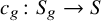 $c_g\colon S_g\rightarrow S$
, it is sufficient to prove that such a map is in
$c_g\colon S_g\rightarrow S$
, it is sufficient to prove that such a map is in ${\langle }\mathcal {F}_S(\mathcal {N} S),\mathcal {F}_S(N_{\mathcal {L}}(T)){\rangle }$
. Fixing
${\langle }\mathcal {F}_S(\mathcal {N} S),\mathcal {F}_S(N_{\mathcal {L}}(T)){\rangle }$
. Fixing $g\in {\mathcal {L}}$
, it follows from (a) that there exist
$g\in {\mathcal {L}}$
, it follows from (a) that there exist $n\in \mathcal {N}$
and
$n\in \mathcal {N}$
and $h\in N_{\mathcal {L}}(T)$
such that
$h\in N_{\mathcal {L}}(T)$
such that $(n,h)\in \mathbf {D}$
,
$(n,h)\in \mathbf {D}$
, $g=nh$
and
$g=nh$
and $S_g=S_{(n,h)}$
. So
$S_g=S_{(n,h)}$
. So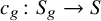 $c_g\colon S_g\rightarrow S$
can be written as a composite of restrictions of the conjugation map
$c_g\colon S_g\rightarrow S$
can be written as a composite of restrictions of the conjugation map $c_n\colon S_n\rightarrow S$
(which is a morphism in
$c_n\colon S_n\rightarrow S$
(which is a morphism in $\mathcal {F}_S(\mathcal {N} S)$
) and of
$\mathcal {F}_S(\mathcal {N} S)$
) and of $c_h\colon S_h\rightarrow S$
(which is a morphism in
$c_h\colon S_h\rightarrow S$
(which is a morphism in $\mathcal {F}_S(N_{\mathcal {L}}(T))$
). This implies (b).
$\mathcal {F}_S(N_{\mathcal {L}}(T))$
). This implies (b).
3.2 Linking localities and regular localities
A finite group G is said to be of characteristic p, if $C_G(O_p(G))\leq O_p(G)$
, where
$C_G(O_p(G))\leq O_p(G)$
, where $O_p(G)$
denotes the largest normal p-subgroup of G. A locality
$O_p(G)$
denotes the largest normal p-subgroup of G. A locality $({\mathcal {L}},\Delta ,S)$
is called a linking locality, if
$({\mathcal {L}},\Delta ,S)$
is called a linking locality, if $\mathcal {F}_S({\mathcal {L}})$
is saturated,
$\mathcal {F}_S({\mathcal {L}})$
is saturated, $\mathcal {F}_S({\mathcal {L}})^{cr}\subseteq \Delta $
and
$\mathcal {F}_S({\mathcal {L}})^{cr}\subseteq \Delta $
and $N_{\mathcal {L}}(P)$
is a group of characteristic p for every
$N_{\mathcal {L}}(P)$
is a group of characteristic p for every $P\in \Delta $
.
$P\in \Delta $
.
For every fusion system $\mathcal {F}$
over S, there is the set
$\mathcal {F}$
over S, there is the set $\mathcal {F}^s$
of
$\mathcal {F}^s$
of $\mathcal {F}$
-subcentric subgroups of S defined in [Reference Henke9, Definition 1]. It is shown in [Reference Henke9, Theorem A] that, for every saturated fusion system
$\mathcal {F}$
-subcentric subgroups of S defined in [Reference Henke9, Definition 1]. It is shown in [Reference Henke9, Theorem A] that, for every saturated fusion system $\mathcal {F}$
, there exists a linking locality
$\mathcal {F}$
, there exists a linking locality $({\mathcal {L}},\Delta ,S)$
over
$({\mathcal {L}},\Delta ,S)$
over $\mathcal {F}$
with
$\mathcal {F}$
with $\Delta =\mathcal {F}^s$
. We call such a linking locality a subcentric locality over
$\Delta =\mathcal {F}^s$
. We call such a linking locality a subcentric locality over $\mathcal {F}$
.
$\mathcal {F}$
.
Regular localities were first introduced by Chermak [Reference Chermak4], but we will refer to the treatment of the subject in [Reference Henke10]. Building on Chermak’s work, we introduced in [Reference Henke10, Definition 9.17] a certain partial normal subgroup $F^*({\mathcal {L}})$
of
$F^*({\mathcal {L}})$
of ${\mathcal {L}}$
, for every linking locality
${\mathcal {L}}$
, for every linking locality $({\mathcal {L}},\Delta ,S)$
. Then for any saturated fusion system
$({\mathcal {L}},\Delta ,S)$
. Then for any saturated fusion system $\mathcal {F}$
over S a set
$\mathcal {F}$
over S a set $\delta (\mathcal {F})$
of subgroups of S was introduced such that, for any linking locality
$\delta (\mathcal {F})$
of subgroups of S was introduced such that, for any linking locality $({\mathcal {L}},\Delta ,S)$
over
$({\mathcal {L}},\Delta ,S)$
over $\mathcal {F}$
, we have
$\mathcal {F}$
, we have
 $$ \begin{align} \delta(\mathcal{F})=\{P\leq S\colon P\cap F^*({\mathcal{L}})\in\mathcal{F}^s\}. \end{align} $$
Indeed, the set $\delta (\mathcal {F})$
is defined in [Reference Henke10, Definition 10.1] by the equation (3.3) if
$\delta (\mathcal {F})$
is defined in [Reference Henke10, Definition 10.1] by the equation (3.3) if $({\mathcal {L}},\Delta ,S)$
is a fixed subcentric linking locality over
$({\mathcal {L}},\Delta ,S)$
is a fixed subcentric linking locality over $\mathcal {F}$
. Then it is shown in [Reference Henke10, Lemma 10.2] that the set
$\mathcal {F}$
. Then it is shown in [Reference Henke10, Lemma 10.2] that the set $\delta (\mathcal {F})$
depends only on
$\delta (\mathcal {F})$
depends only on $\mathcal {F}$
and not on the choice of the subcentric locality
$\mathcal {F}$
and not on the choice of the subcentric locality $({\mathcal {L}},\Delta ,S)$
, and that (3.3) holds actually for every linking locality
$({\mathcal {L}},\Delta ,S)$
, and that (3.3) holds actually for every linking locality $({\mathcal {L}},\Delta ,S)$
.
$({\mathcal {L}},\Delta ,S)$
.
A linking locality $({\mathcal {L}},\Delta ,S)$
is called a regular locality, if
$({\mathcal {L}},\Delta ,S)$
is called a regular locality, if $\Delta =\delta (\mathcal {F})$
. For every saturated fusion system
$\Delta =\delta (\mathcal {F})$
. For every saturated fusion system $\mathcal {F}$
, there exists a regular locality over
$\mathcal {F}$
, there exists a regular locality over $\mathcal {F}$
(cf. [Reference Henke10, Lemma 10.4]). Note that (3.3) holds in particular if
$\mathcal {F}$
(cf. [Reference Henke10, Lemma 10.4]). Note that (3.3) holds in particular if $({\mathcal {L}},\Delta ,S)$
is a regular locality over
$({\mathcal {L}},\Delta ,S)$
is a regular locality over $\mathcal {F}$
. In that case, we have
$\mathcal {F}$
. In that case, we have $\Delta =\delta (\mathcal {F})$
, so (3.3) yields that
$\Delta =\delta (\mathcal {F})$
, so (3.3) yields that $P\in \Delta $
if and only if
$P\in \Delta $
if and only if $P\cap F^*({\mathcal {L}})\in \Delta $
. Thus, if
$P\cap F^*({\mathcal {L}})\in \Delta $
. Thus, if $({\mathcal {L}},\Delta ,S)$
is a regular locality and
$({\mathcal {L}},\Delta ,S)$
is a regular locality and $T^*:=F^*({\mathcal {L}})\cap S$
, then (3.1) yields
$T^*:=F^*({\mathcal {L}})\cap S$
, then (3.1) yields
 $$ \begin{align} w\in\mathbf{D}\text{ if and only if }S_w\cap T^*\in\Delta. \end{align} $$
In particular,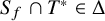 $S_f\cap T^*\in \Delta $
for every
$S_f\cap T^*\in \Delta $
for every $f\in {\mathcal {L}}$
. The next theorem states one of the most important properties of regular localities.
$f\in {\mathcal {L}}$
. The next theorem states one of the most important properties of regular localities.
Theorem 3.2 [Reference Chermak4, Corollary 7.9], [Reference Henke10, Corollary 10.19].
Let $({\mathcal {L}},\Delta ,S)$
be a regular locality and
$({\mathcal {L}},\Delta ,S)$
be a regular locality and ${\mathcal {H}}{\,\trianglelefteq \trianglelefteq \,}{\mathcal {L}}$
. Then
${\mathcal {H}}{\,\trianglelefteq \trianglelefteq \,}{\mathcal {L}}$
. Then $\mathcal {F}_{S\cap {\mathcal {H}}}({\mathcal {H}})$
is saturated and
$\mathcal {F}_{S\cap {\mathcal {H}}}({\mathcal {H}})$
is saturated and $({\mathcal {H}},\delta (\mathcal {F}_{S\cap {\mathcal {H}}}({\mathcal {H}})),S\cap {\mathcal {H}})$
is a regular locality.
$({\mathcal {H}},\delta (\mathcal {F}_{S\cap {\mathcal {H}}}({\mathcal {H}})),S\cap {\mathcal {H}})$
is a regular locality.
The theorem above leads to a natural definition of components of regular localities (cf. [Reference Henke10, Definition 7.9, Definition 11.1]). Let $({\mathcal {L}},\Delta ,S)$
be a regular locality. We will write
$({\mathcal {L}},\Delta ,S)$
be a regular locality. We will write $\operatorname {Comp}({\mathcal {L}})$
for the set of components of
$\operatorname {Comp}({\mathcal {L}})$
for the set of components of ${\mathcal {L}}$
. If
${\mathcal {L}}$
. If $\mathcal {K}_1,\dots ,\mathcal {K}_r\in \operatorname {Comp}({\mathcal {L}})$
, then the product
$\mathcal {K}_1,\dots ,\mathcal {K}_r\in \operatorname {Comp}({\mathcal {L}})$
, then the product $\prod _{i=1}^r\mathcal {K}_i$
does not depend on the order of the factors and is a partial normal subgroup of
$\prod _{i=1}^r\mathcal {K}_i$
does not depend on the order of the factors and is a partial normal subgroup of $F^*({\mathcal {L}})$
(cf. [Reference Henke10, Proposition 11.7]). In particular, for
$F^*({\mathcal {L}})$
(cf. [Reference Henke10, Proposition 11.7]). In particular, for $\mathfrak {C}\subseteq \operatorname {Comp}({\mathcal {L}})$
, the product
$\mathfrak {C}\subseteq \operatorname {Comp}({\mathcal {L}})$
, the product $\prod _{\mathcal {K}\in \mathfrak {C}}\mathcal {K}$
is well-defined.
$\prod _{\mathcal {K}\in \mathfrak {C}}\mathcal {K}$
is well-defined.
The product of all components of ${\mathcal {L}}$
is denoted by
${\mathcal {L}}$
is denoted by $E({\mathcal {L}})$
and turns out to be a partial normal subgroup of
$E({\mathcal {L}})$
and turns out to be a partial normal subgroup of ${\mathcal {L}}$
(cf. [Reference Henke10, Lemma 11.13]). We have moreover
${\mathcal {L}}$
(cf. [Reference Henke10, Lemma 11.13]). We have moreover $F^*({\mathcal {L}})=E({\mathcal {L}})O_p({\mathcal {L}})$
(cf. [Reference Henke10, Lemma 11.9]). Note that Theorem 3.2 makes it possible to consider
$F^*({\mathcal {L}})=E({\mathcal {L}})O_p({\mathcal {L}})$
(cf. [Reference Henke10, Lemma 11.9]). Note that Theorem 3.2 makes it possible to consider $\operatorname {Comp}({\mathcal {H}})$
and
$\operatorname {Comp}({\mathcal {H}})$
and $E({\mathcal {H}})$
for every partial subnormal subgroup
$E({\mathcal {H}})$
for every partial subnormal subgroup ${\mathcal {H}}$
of
${\mathcal {H}}$
of ${\mathcal {L}}$
. By [Reference Henke10, Remark 11.2],
${\mathcal {L}}$
. By [Reference Henke10, Remark 11.2], $\operatorname {Comp}({\mathcal {H}})\subseteq \operatorname {Comp}({\mathcal {L}})$
. In particular,
$\operatorname {Comp}({\mathcal {H}})\subseteq \operatorname {Comp}({\mathcal {L}})$
. In particular, $E({\mathcal {H}})\subseteq E({\mathcal {L}})\subseteq F^*({\mathcal {L}})$
.
$E({\mathcal {H}})\subseteq E({\mathcal {L}})\subseteq F^*({\mathcal {L}})$
.
3.3 Some further properties of regular localities
We state now some slightly more specialized results on regular localities which will be needed in the proof of Theorem A.
Throughout this subsection let $({\mathcal {L}},\Delta ,S)$
be a regular locality and
$({\mathcal {L}},\Delta ,S)$
be a regular locality and $T^*:=S\cap F^*({\mathcal {L}})$
.
$T^*:=S\cap F^*({\mathcal {L}})$
.
By [Reference Henke10, Corollary 10.5], we have $T^*\in \delta (\mathcal {F})=\Delta $
. In particular,
$T^*\in \delta (\mathcal {F})=\Delta $
. In particular, $N_{\mathcal {L}}(T^*)$
is a group of characteristic p.
$N_{\mathcal {L}}(T^*)$
is a group of characteristic p.
Lemma 3.3. For every $f\in N_{\mathcal {L}}(T^*)$
and every
$f\in N_{\mathcal {L}}(T^*)$
and every $g\in {\mathcal {L}}$
, the words
$g\in {\mathcal {L}}$
, the words $(f,g)$
,
$(f,g)$
, $(g,f)$
,
$(g,f)$
,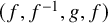 $(f,f^{-1},g,f)$
are in
$(f,f^{-1},g,f)$
are in $\mathbf {D}$
and
$\mathbf {D}$
and $gf=fg^f$
. Moreover,
$gf=fg^f$
. Moreover,
 $$\begin{align*}S_{(f,g)}\cap T^*=S_{fg}\cap T^*\text{ and }S_{(g,f)}\cap T^*=S_{gf}\cap T^*.\end{align*}$$
Proof. It is a special case of (3.4) that $S_g\cap T^*\in \Delta $
. Hence, as
$S_g\cap T^*\in \Delta $
. Hence, as $T^*$
is strongly closed,
$T^*$
is strongly closed, $(g,f)$
,
$(g,f)$
, $u:=(f,f^{-1},g,f)$
and
$u:=(f,f^{-1},g,f)$
and $(g,f,f^{-1})$
are in
$(g,f,f^{-1})$
are in $\mathbf {D}$
via
$\mathbf {D}$
via $S_g\cap T^*$
. In particular, by the axioms of a partial group,
$S_g\cap T^*$
. In particular, by the axioms of a partial group, $gf=\Pi (u)=fg^f$
and
$gf=\Pi (u)=fg^f$
and $(gf)f^{-1}=\Pi (g,f,f^{-1})=g$
. So
$(gf)f^{-1}=\Pi (g,f,f^{-1})=g$
. So
 $$\begin{align*}S_{(g,f)}\cap T^*\leq S_{gf}\cap T^*\leq S_{(gf,f^{-1},f)}\cap T^*\leq S_{((gf)f^{-1},f)}\cap T^*=S_{(g,f)}\cap T^*,\end{align*}$$
where the first and the third inclusion use (3.2) and the second inclusion uses $f\in N_{\mathcal {L}}(T^*)$
. Thus,
$f\in N_{\mathcal {L}}(T^*)$
. Thus, $S_{(g,f)}\cap T^*=S_{gf}\cap T^*$
. Observe also that
$S_{(g,f)}\cap T^*=S_{gf}\cap T^*$
. Observe also that $(f^{-1},f,g)\in \mathbf {D}$
via
$(f^{-1},f,g)\in \mathbf {D}$
via $S_g\cap T^*$
. In particular,
$S_g\cap T^*$
. In particular, $(f,g)\in \mathbf {D}$
and
$(f,g)\in \mathbf {D}$
and $g=\Pi (f^{-1},f,g)=f^{-1}(fg)$
. It follows that
$g=\Pi (f^{-1},f,g)=f^{-1}(fg)$
. It follows that
 $$\begin{align*}S_{(f,g)}\cap T^*\leq S_{fg}\cap T^*\leq S_{(f,f^{-1},fg)}\cap T^*\leq S_{(f,f^{-1}(fg))}\cap T^*= S_{(f,g)}\cap T^*,\end{align*}$$
where again the first and the third inclusion use (3.2) and the second inclusion uses $f\in N_{\mathcal {L}}(T^*)$
. Hence,
$f\in N_{\mathcal {L}}(T^*)$
. Hence, $S_{(f,g)}\cap T^*=S_{fg}\cap T^*$
.
$S_{(f,g)}\cap T^*=S_{fg}\cap T^*$
.
Lemma 3.4. We have $N_{\mathcal {L}}(T^*)=N_{\mathcal {L}}(S\cap E({\mathcal {L}}))$
.
$N_{\mathcal {L}}(T^*)=N_{\mathcal {L}}(S\cap E({\mathcal {L}}))$
.
Proof. By [Reference Henke10, Lemma 11.9], we have
 $$\begin{align*}T^*=S\cap F^*({\mathcal{L}})=(S\cap E({\mathcal{L}}))O_p({\mathcal{L}}).\end{align*}$$
As $E({\mathcal {L}})\,{\trianglelefteq }\, {\mathcal {L}}$
,
$E({\mathcal {L}})\,{\trianglelefteq }\, {\mathcal {L}}$
, $S\cap E({\mathcal {L}})=T^*\cap E({\mathcal {L}})$
and
$S\cap E({\mathcal {L}})=T^*\cap E({\mathcal {L}})$
and ${\mathcal {L}}=N_{\mathcal {L}}(O_p({\mathcal {L}}))$
, the assertion follows.
${\mathcal {L}}=N_{\mathcal {L}}(O_p({\mathcal {L}}))$
, the assertion follows.
Lemma 3.5. $N_{\mathcal {L}}(T^*)$
acts on
$N_{\mathcal {L}}(T^*)$
acts on ${\mathcal {L}}$
and also on the set
${\mathcal {L}}$
and also on the set $\operatorname {Comp}({\mathcal {L}})$
of components of
$\operatorname {Comp}({\mathcal {L}})$
of components of ${\mathcal {L}}$
via conjugation. More precisely, for every
${\mathcal {L}}$
via conjugation. More precisely, for every $f\in {\mathcal {L}}$
, we have
$f\in {\mathcal {L}}$
, we have $\mathbf {D}(f)={\mathcal {L}}$
and
$\mathbf {D}(f)={\mathcal {L}}$
and $c_f$
is an automorphism of
$c_f$
is an automorphism of ${\mathcal {L}}$
.
${\mathcal {L}}$
.
Proof. It is a consequence of Theorem 2 and Lemma 10.11(c) in [Reference Henke10] that, for every $f\in N_{\mathcal {L}}(T^*)$
, we have
$f\in N_{\mathcal {L}}(T^*)$
, we have ${\mathcal {L}}=\mathbf {D}(f)$
and the conjugation map
${\mathcal {L}}=\mathbf {D}(f)$
and the conjugation map $c_f$
is an automorphism of
$c_f$
is an automorphism of ${\mathcal {L}}$
. Moreover, by [Reference Henke12, Lemma 2.13],
${\mathcal {L}}$
. Moreover, by [Reference Henke12, Lemma 2.13], $N_{\mathcal {L}}(T^*)$
acts on the set
$N_{\mathcal {L}}(T^*)$
acts on the set ${\mathcal {L}}$
by conjugation. Thus, by [Reference Henke10, Lemma 11.12],
${\mathcal {L}}$
by conjugation. Thus, by [Reference Henke10, Lemma 11.12], $N_{\mathcal {L}}(T^*)$
acts also on the set of components of
$N_{\mathcal {L}}(T^*)$
acts also on the set of components of ${\mathcal {L}}$
.
${\mathcal {L}}$
.
Lemma 3.6. Let $\mathfrak {C}_1,\mathfrak {C}_2\subseteq \operatorname {Comp}({\mathcal {L}})$
,
$\mathfrak {C}_1,\mathfrak {C}_2\subseteq \operatorname {Comp}({\mathcal {L}})$
, $\mathfrak {C}:=\mathfrak {C}_1\cup \mathfrak {C}_2$
,
$\mathfrak {C}:=\mathfrak {C}_1\cup \mathfrak {C}_2$
, $\mathcal {N}_i:=\prod _{\mathcal {K}\in \mathfrak {C}_i}\mathcal {K}$
for
$\mathcal {N}_i:=\prod _{\mathcal {K}\in \mathfrak {C}_i}\mathcal {K}$
for $i=1,2$
and
$i=1,2$
and $\mathcal {N}:=\prod _{\mathcal {K}\in \mathfrak {C}}\mathcal {K}$
. Then the following hold:
$\mathcal {N}:=\prod _{\mathcal {K}\in \mathfrak {C}}\mathcal {K}$
. Then the following hold:
-
(a)
$\mathcal {N}=\mathcal {N}_1\mathcal {N}_2$
and
$\mathcal {N}\cap S=(\mathcal {N}_1\cap S)(\mathcal {N}_2\cap S)$
. In particular, if
$\mathfrak {C}=\operatorname {Comp}({\mathcal {L}})$
, then
$E({\mathcal {L}})=\mathcal {N}_1\mathcal {N}_2$
and
$E({\mathcal {L}})\cap S=(\mathcal {N}_1\cap S)(\mathcal {N}_2\cap S)$
. -
(b) Suppose
$\mathfrak {C}_1\cap \mathfrak {C}_2=\emptyset $
. Then
$\mathcal {N}_i\subseteq C_{\mathcal {L}}(\mathcal {N}_{3-i})$
for
$i=1,2$
. Moreover, for all
$n\in \mathcal {N}_1$
and
$m\in \mathcal {N}_2$
, we have
$(n,m)\in \mathbf {D}$
and
$S_{nm}\cap T^*=S_{(n,m)}\cap T^*$
. -
(c)
$N_{\mathcal {N}}(T^*)=N_{\mathcal {N}_1}(T^*)N_{\mathcal {N}_2}(T^*)$
.







Proof. By [Reference Henke10, Proposition 11.7], $\mathcal {N}_1$
,
$\mathcal {N}_1$
, $\mathcal {N}_2$
and
$\mathcal {N}_2$
and $\mathcal {N}$
are well-defined and partial normal subgroups of
$\mathcal {N}$
are well-defined and partial normal subgroups of $F^*({\mathcal {L}})$
. As
$F^*({\mathcal {L}})$
. As $F^*({\mathcal {L}})$
forms by Theorem 3.2 a regular locality with Sylow subgroup
$F^*({\mathcal {L}})$
forms by Theorem 3.2 a regular locality with Sylow subgroup $T^*$
, it follows in particular from [Reference Henke9, Theorem 1] applied with
$T^*$
, it follows in particular from [Reference Henke9, Theorem 1] applied with $F^*({\mathcal {L}})$
in place of
$F^*({\mathcal {L}})$
in place of ${\mathcal {L}}$
that
${\mathcal {L}}$
that $(\mathcal {N}_1\mathcal {N}_2)\cap S=(\mathcal {N}_1\mathcal {N}_2)\cap T^*=(\mathcal {N}_1\cap T^*)(\mathcal {N}_2\cap T^*)=(\mathcal {N}_1\cap S)(\mathcal {N}_2\cap S)$
. Thus, for (a), it remains only to prove that
$(\mathcal {N}_1\mathcal {N}_2)\cap S=(\mathcal {N}_1\mathcal {N}_2)\cap T^*=(\mathcal {N}_1\cap T^*)(\mathcal {N}_2\cap T^*)=(\mathcal {N}_1\cap S)(\mathcal {N}_2\cap S)$
. Thus, for (a), it remains only to prove that $\mathcal {N}=\mathcal {N}_1\mathcal {N}_2$
. In fact, as
$\mathcal {N}=\mathcal {N}_1\mathcal {N}_2$
. In fact, as $\mathcal {N}_i\subseteq \mathcal {N}$
for
$\mathcal {N}_i\subseteq \mathcal {N}$
for $i=1,2$
and
$i=1,2$
and $\mathcal {N}$
is a partial subgroup, we have
$\mathcal {N}$
is a partial subgroup, we have $\mathcal {N}_1\mathcal {N}_2\subseteq \mathcal {N}$
. So for (a) it is sufficient to prove that
$\mathcal {N}_1\mathcal {N}_2\subseteq \mathcal {N}$
. So for (a) it is sufficient to prove that
 $$ \begin{align} \mathcal{N}\subseteq \mathcal{N}_1\mathcal{N}_2. \end{align} $$
As $N_{\mathcal {L}}(T^*)$
is a subgroup, we have also
$N_{\mathcal {L}}(T^*)$
is a subgroup, we have also $N_{\mathcal {N}_1}(T^*) N_{\mathcal {N}_2}(T^*)\subseteq N_{\mathcal {N}}(T^*)$
. So for (c) it remains only to show that
$N_{\mathcal {N}_1}(T^*) N_{\mathcal {N}_2}(T^*)\subseteq N_{\mathcal {N}}(T^*)$
. So for (c) it remains only to show that
 $$ \begin{align} N_{\mathcal{N}}(T^*)\subseteq N_{\mathcal{N}_1}(T^*) N_{\mathcal{N}_2}(T^*). \end{align} $$
Observe now that, replacing $\mathfrak {C}_2$
by
$\mathfrak {C}_2$
by $\mathfrak {C}_2\backslash \mathfrak {C}_1$
, we may assume for the proof of (3.5) and (3.6) that
$\mathfrak {C}_2\backslash \mathfrak {C}_1$
, we may assume for the proof of (3.5) and (3.6) that $\mathfrak {C}_1\cap \mathfrak {C}_2=\emptyset $
. So we will assume this property from now on throughout.
$\mathfrak {C}_1\cap \mathfrak {C}_2=\emptyset $
. So we will assume this property from now on throughout.
Applying first [Reference Henke10, Theorem 11.18(a)] and then [Reference Henke10, Lemma 4.5, Lemma 4.8], one sees that ${\mathcal {N}=\mathcal {N}_1\mathcal {N}_2}$
, and that
${\mathcal {N}=\mathcal {N}_1\mathcal {N}_2}$
, and that $\mathcal {N}_i\subseteq C_{\mathcal {L}}(\mathcal {N}_{3-i})$
for
$\mathcal {N}_i\subseteq C_{\mathcal {L}}(\mathcal {N}_{3-i})$
for $i=1,2$
. In particular, (3.5) holds and thus (a).
$i=1,2$
. In particular, (3.5) holds and thus (a).
For the proof of the remaining statement in (b) let now $n\in \mathcal {N}_1$
and
$n\in \mathcal {N}_1$
and $m\in \mathcal {N}_2$
. As
$m\in \mathcal {N}_2$
. As $\mathcal {N}_1\subseteq C_{\mathcal {L}}(\mathcal {N}_2)$
, it follows from [Reference Henke10, Lemma 3.5] that
$\mathcal {N}_1\subseteq C_{\mathcal {L}}(\mathcal {N}_2)$
, it follows from [Reference Henke10, Lemma 3.5] that $(n,m)$
and
$(n,m)$
and $(m,n)$
are in
$(m,n)$
are in $\mathbf {D}$
and that
$\mathbf {D}$
and that $nm=mn$
. In particular,
$nm=mn$
. In particular, $\mathcal {N}_1$
and
$\mathcal {N}_1$
and $\mathcal {N}_2$
commute in the sense of [Reference Henke10, Definition 2], that is, they are commuting partial normal subgroups of
$\mathcal {N}_2$
commute in the sense of [Reference Henke10, Definition 2], that is, they are commuting partial normal subgroups of $F^*({\mathcal {L}})$
. Hence, it follows from [Reference Henke10, Theorem 1(d)] applied with
$F^*({\mathcal {L}})$
. Hence, it follows from [Reference Henke10, Theorem 1(d)] applied with $F^*({\mathcal {L}})$
in place of
$F^*({\mathcal {L}})$
in place of ${\mathcal {L}}$
that
${\mathcal {L}}$
that $S_{nm}\cap T^*=S_{(n,m)}\cap T^*$
. This proves (b).
$S_{nm}\cap T^*=S_{(n,m)}\cap T^*$
. This proves (b).
For the proof of (3.6) let $f\in N_{\mathcal {N}}(T^*)$
. By (a), we may pick
$f\in N_{\mathcal {N}}(T^*)$
. By (a), we may pick $n\in \mathcal {N}_1$
and
$n\in \mathcal {N}_1$
and $m\in \mathcal {N}_2$
with
$m\in \mathcal {N}_2$
with $(n,m)\in \mathbf {D}$
and
$(n,m)\in \mathbf {D}$
and $f=nm$
. It follows then from (b) that
$f=nm$
. It follows then from (b) that $T^*=T^*\cap S_f=T^*\cap S_{nm}\leq S_{(n,m)}$
. As
$T^*=T^*\cap S_f=T^*\cap S_{nm}\leq S_{(n,m)}$
. As $T^*$
is strongly closed in
$T^*$
is strongly closed in $\mathcal {F}_S({\mathcal {L}})$
, it follows that
$\mathcal {F}_S({\mathcal {L}})$
, it follows that $n\in N_{\mathcal {N}_1}(T^*)$
and
$n\in N_{\mathcal {N}_1}(T^*)$
and $m\in N_{\mathcal {N}_2}(T^*)$
. This proves (3.6) and thus (c).
$m\in N_{\mathcal {N}_2}(T^*)$
. This proves (3.6) and thus (c).
Lemma 3.7. Let ${\mathcal {H}}{\,\trianglelefteq \trianglelefteq \,} {\mathcal {L}}$
. Then
${\mathcal {H}}{\,\trianglelefteq \trianglelefteq \,} {\mathcal {L}}$
. Then $N_{\mathcal {H}}(T^*)=N_{\mathcal {H}}(E({\mathcal {H}})\cap S){\,\trianglelefteq \trianglelefteq \,} N_{\mathcal {L}}(T^*)$
and
$N_{\mathcal {H}}(T^*)=N_{\mathcal {H}}(E({\mathcal {H}})\cap S){\,\trianglelefteq \trianglelefteq \,} N_{\mathcal {L}}(T^*)$
and $S\cap {\mathcal {H}}=S\cap N_{\mathcal {H}}(T^*)$
.
$S\cap {\mathcal {H}}=S\cap N_{\mathcal {H}}(T^*)$
.
Proof. Since $T^*\,{\trianglelefteq }\, S$
, we have
$T^*\,{\trianglelefteq }\, S$
, we have $S\cap {\mathcal {H}}\subseteq N_{\mathcal {H}}(T^*)$
and thus
$S\cap {\mathcal {H}}\subseteq N_{\mathcal {H}}(T^*)$
and thus $S\cap {\mathcal {H}}=S\cap N_{\mathcal {H}}(T^*)$
. Since
$S\cap {\mathcal {H}}=S\cap N_{\mathcal {H}}(T^*)$
. Since ${\mathcal {H}}{\,\trianglelefteq \trianglelefteq \,}{\mathcal {L}}$
, it follows moreover easily that
${\mathcal {H}}{\,\trianglelefteq \trianglelefteq \,}{\mathcal {L}}$
, it follows moreover easily that $N_{\mathcal {H}}(T^*)={\mathcal {H}}\cap N_{\mathcal {L}}(T^*)$
is subnormal in
$N_{\mathcal {H}}(T^*)={\mathcal {H}}\cap N_{\mathcal {L}}(T^*)$
is subnormal in $N_{\mathcal {L}}(T^*)$
.
$N_{\mathcal {L}}(T^*)$
.
As mentioned before, it follows from [Reference Henke10, Remark 11.2] that $E({\mathcal {H}})\subseteq E({\mathcal {L}})\subseteq F^*({\mathcal {L}})$
. Thus,
$E({\mathcal {H}})\subseteq E({\mathcal {L}})\subseteq F^*({\mathcal {L}})$
. Thus, $E({\mathcal {H}})\cap S=E({\mathcal {H}})\cap T^*$
. Since
$E({\mathcal {H}})\cap S=E({\mathcal {H}})\cap T^*$
. Since $E({\mathcal {H}})\,{\trianglelefteq }\, {\mathcal {H}}$
by [Reference Henke10, Lemma 11.13], it follows that
$E({\mathcal {H}})\,{\trianglelefteq }\, {\mathcal {H}}$
by [Reference Henke10, Lemma 11.13], it follows that $N_{\mathcal {H}}(T^*)\subseteq N_{\mathcal {H}}(T^*\cap E({\mathcal {H}}))=N_{\mathcal {H}}(S\cap E({\mathcal {H}}))$
. It remains thus only to show that
$N_{\mathcal {H}}(T^*)\subseteq N_{\mathcal {H}}(T^*\cap E({\mathcal {H}}))=N_{\mathcal {H}}(S\cap E({\mathcal {H}}))$
. It remains thus only to show that $N_{\mathcal {H}}(S\cap E({\mathcal {H}}))\subseteq N_{\mathcal {H}}(T^*)$
.
$N_{\mathcal {H}}(S\cap E({\mathcal {H}}))\subseteq N_{\mathcal {H}}(T^*)$
.
Applying first [Reference Henke10, Theorem 11.18(c)] and then [Reference Henke10, Lemma 4.8], one sees that ${\mathcal {H}}$
is in the centralizer of
${\mathcal {H}}$
is in the centralizer of $\mathcal {M}:=\prod _{\mathcal {K}\in \operatorname {Comp}({\mathcal {L}})\backslash \operatorname {Comp}({\mathcal {H}})}\mathcal {K}$
. In particular,
$\mathcal {M}:=\prod _{\mathcal {K}\in \operatorname {Comp}({\mathcal {L}})\backslash \operatorname {Comp}({\mathcal {H}})}\mathcal {K}$
. In particular, ${\mathcal {H}}\subseteq C_{\mathcal {L}}(\mathcal {M}\cap S)$
. Moreover, by Lemma 3.6(a),
${\mathcal {H}}\subseteq C_{\mathcal {L}}(\mathcal {M}\cap S)$
. Moreover, by Lemma 3.6(a), $E({\mathcal {L}})\cap S=(E({\mathcal {H}})\cap S)(\mathcal {M}\cap S)$
. Using Lemma 3.4, we can thus conclude that
$E({\mathcal {L}})\cap S=(E({\mathcal {H}})\cap S)(\mathcal {M}\cap S)$
. Using Lemma 3.4, we can thus conclude that $N_{{\mathcal {H}}}(S\cap E({\mathcal {H}}))\subseteq N_{\mathcal {L}}(S\cap E({\mathcal {L}}))=N_{\mathcal {L}}(T^*)$
. This proves the assertion.
$N_{{\mathcal {H}}}(S\cap E({\mathcal {H}}))\subseteq N_{\mathcal {L}}(S\cap E({\mathcal {L}}))=N_{\mathcal {L}}(T^*)$
. This proves the assertion.
4 Wielandt’s Join Theorem for regular localities
4.1 Some products in regular localities
In this subsection we prove some general results on products in regular localities, which allow us later to reduce the proof of Theorem A to Wielandt’s Join Theorem for groups and to Meierfrankenfeld’s Lemma.
Throughout this subsection let $({\mathcal {L}},\Delta ,S)$
be a regular locality and
$({\mathcal {L}},\Delta ,S)$
be a regular locality and $T^*:=S\cap F^*({\mathcal {L}})$
.
$T^*:=S\cap F^*({\mathcal {L}})$
.
Lemma 4.1. Let $H\leq N_{\mathcal {L}}(T^*)$
and
$H\leq N_{\mathcal {L}}(T^*)$
and $\mathcal {N}\,{\trianglelefteq }\, {\mathcal {L}}$
. Then
$\mathcal {N}\,{\trianglelefteq }\, {\mathcal {L}}$
. Then $\mathcal {N} H=H\mathcal {N}$
is a partial subgroup of
$\mathcal {N} H=H\mathcal {N}$
is a partial subgroup of ${\mathcal {L}}$
. If
${\mathcal {L}}$
. If $H\cap S\in \operatorname {Syl}_p(H)$
, then
$H\cap S\in \operatorname {Syl}_p(H)$
, then $(\mathcal {N} H)\cap S=(\mathcal {N}\cap S)(H\cap S)$
is a maximal p-subgroup of
$(\mathcal {N} H)\cap S=(\mathcal {N}\cap S)(H\cap S)$
is a maximal p-subgroup of $\mathcal {N} H$
.
$\mathcal {N} H$
.
Proof. It is shown in [Reference Grazian and Henke7, Theorem 6.1(a)] that $\mathcal {N} H=H\mathcal {N}$
is a partial subgroup; essentially, the argument uses the property stated in Lemma 3.3. Suppose now
$\mathcal {N} H=H\mathcal {N}$
is a partial subgroup; essentially, the argument uses the property stated in Lemma 3.3. Suppose now $H\cap S\in \operatorname {Syl}_p(H)$
. As
$H\cap S\in \operatorname {Syl}_p(H)$
. As $N_{\mathcal {N}}(T^*)\,{\trianglelefteq }\, N_{\mathcal {L}}(T^*)$
with
$N_{\mathcal {N}}(T^*)\,{\trianglelefteq }\, N_{\mathcal {L}}(T^*)$
with $\mathcal {N}\cap S=N_{\mathcal {N}}(T^*)\cap S\in \operatorname {Syl}_p(N_{\mathcal {N}}(T^*))$
, it follows that
$\mathcal {N}\cap S=N_{\mathcal {N}}(T^*)\cap S\in \operatorname {Syl}_p(N_{\mathcal {N}}(T^*))$
, it follows that
 $$\begin{align*}S_0:=(\mathcal{N}\cap S)(H\cap S)\in\operatorname{Syl}_p(N_{\mathcal{N}}(T^*)H).\end{align*}$$
Thus, it is a consequence of [Reference Grazian and Henke7, Theorem 6.1(c)] that $S_0$
is a maximal p-subgroup of
$S_0$
is a maximal p-subgroup of $\mathcal {N} H$
. Since
$\mathcal {N} H$
. Since $S_0\leq S\cap (\mathcal {N} H)$
and
$S_0\leq S\cap (\mathcal {N} H)$
and $S\cap (\mathcal {N} H)$
is a p-subgroup of
$S\cap (\mathcal {N} H)$
is a p-subgroup of $\mathcal {N} H$
, we can conclude that
$\mathcal {N} H$
, we can conclude that $S\cap \mathcal {N} H=S_0$
is a maximal p-subgroup of
$S\cap \mathcal {N} H=S_0$
is a maximal p-subgroup of $\mathcal {N} H$
.
$\mathcal {N} H$
.
Lemma 4.2. Let $H{\,\trianglelefteq \trianglelefteq \,} N_{\mathcal {L}}(T^*)$
. Then
$H{\,\trianglelefteq \trianglelefteq \,} N_{\mathcal {L}}(T^*)$
. Then $\hat {{\mathcal {H}}}:=E({\mathcal {L}})H=HE({\mathcal {L}}){\,\trianglelefteq \trianglelefteq \,}{\mathcal {L}}$
and
$\hat {{\mathcal {H}}}:=E({\mathcal {L}})H=HE({\mathcal {L}}){\,\trianglelefteq \trianglelefteq \,}{\mathcal {L}}$
and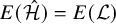 $E(\hat {{\mathcal {H}}})=E({\mathcal {L}})$
.
$E(\hat {{\mathcal {H}}})=E({\mathcal {L}})$
.
Proof. It is a special case of [Reference Henke13, Theorem 2] that $\hat {{\mathcal {H}}}$
is subnormal in
$\hat {{\mathcal {H}}}$
is subnormal in ${\mathcal {L}}$
, but we supply a shorter direct argument here: Let
${\mathcal {L}}$
, but we supply a shorter direct argument here: Let $H=H_0\,{\trianglelefteq }\, H_1\,{\trianglelefteq }\,\cdots \,{\trianglelefteq }\, H_n=N_{\mathcal {L}}(T^*)$
be a subnormal series for H in
$H=H_0\,{\trianglelefteq }\, H_1\,{\trianglelefteq }\,\cdots \,{\trianglelefteq }\, H_n=N_{\mathcal {L}}(T^*)$
be a subnormal series for H in $N_{\mathcal {L}}(T^*)$
. Then by Lemma 4.1,
$N_{\mathcal {L}}(T^*)$
. Then by Lemma 4.1, $E({\mathcal {L}}) H_i=H_i E({\mathcal {L}})$
is a partial subgroup of
$E({\mathcal {L}}) H_i=H_i E({\mathcal {L}})$
is a partial subgroup of ${\mathcal {L}}$
for all
${\mathcal {L}}$
for all $i=0,1,2,\dots ,n$
. By the Frattini Lemma [Reference Chermak3, Corollary 3.11] and Lemma 3.4, we have
$i=0,1,2,\dots ,n$
. By the Frattini Lemma [Reference Chermak3, Corollary 3.11] and Lemma 3.4, we have ${\mathcal {L}}=N_{\mathcal {L}}(S\cap E({\mathcal {L}}))E({\mathcal {L}})=N_{\mathcal {L}}(T^*)E({\mathcal {L}})=H_nE({\mathcal {L}})$
. Thus, it is sufficient to prove that
${\mathcal {L}}=N_{\mathcal {L}}(S\cap E({\mathcal {L}}))E({\mathcal {L}})=N_{\mathcal {L}}(T^*)E({\mathcal {L}})=H_nE({\mathcal {L}})$
. Thus, it is sufficient to prove that $H_{i-1}E({\mathcal {L}})\,{\trianglelefteq }\, H_iE({\mathcal {L}})$
for
$H_{i-1}E({\mathcal {L}})\,{\trianglelefteq }\, H_iE({\mathcal {L}})$
for $i=1,2,\dots ,n$
. So fix
$i=1,2,\dots ,n$
. So fix $i\in \{1,2,\dots ,n\}$
,
$i\in \{1,2,\dots ,n\}$
, $x,y\in E({\mathcal {L}})$
,
$x,y\in E({\mathcal {L}})$
, $h\in H_{i-1}$
and
$h\in H_{i-1}$
and $f\in H_i$
with
$f\in H_i$
with
 $$\begin{align*}w:=((fy)^{-1},hx,fy)\in\mathbf{D}.\end{align*}$$
By [Reference Chermak3, Lemma 1.4(f)], $(fy)^{-1}=y^{-1}f^{-1}$
. Moreover, Lemma 3.3 gives
$(fy)^{-1}=y^{-1}f^{-1}$
. Moreover, Lemma 3.3 gives
 $$\begin{align*}S_{hx}\cap T^*=S_{(h,x)}\cap T^*,\end{align*}$$
 $$\begin{align*}S_{fy}\cap T^*=S_{(f,y)}\cap T^*\text{ and }S_{(fy)^{-1}}\cap T^*=S_{y^{-1}f^{-1}}\cap T^*=S_{(y^{-1},f^{-1})}\cap T^*.\end{align*}$$
Hence, setting $u:=(y^{-1},f^{-1},h,x,f,y)\in \mathbf {D}$
, it follows that
$u:=(y^{-1},f^{-1},h,x,f,y)\in \mathbf {D}$
, it follows that $S_u\cap T^*=S_w\cap T^*$
. As
$S_u\cap T^*=S_w\cap T^*$
. As $w\in \mathbf {D}$
, the property (3.4) yields now first that
$w\in \mathbf {D}$
, the property (3.4) yields now first that $S_u\cap T^*=S_w\cap T^*\in \Delta $
and then
$S_u\cap T^*=S_w\cap T^*\in \Delta $
and then $u\in \mathbf {D}$
. Using
$u\in \mathbf {D}$
. Using $f\in N_{\mathcal {L}}(T^*)$
, we see also that
$f\in N_{\mathcal {L}}(T^*)$
, we see also that
 $$\begin{align*}v:=(y^{-1},f^{-1},h,f,f^{-1},x,f,y)\in\mathbf{D}\end{align*}$$
via $S_w\cap T^*$
. Hence,
$S_w\cap T^*$
. Hence,
 $$\begin{align*}(hx)^{fy}=\Pi(w)=\Pi(u)=\Pi(v)=(h^fx^f)^y.\end{align*}$$
As $h\in H_{i-1}\,{\trianglelefteq }\, H_i$
and
$h\in H_{i-1}\,{\trianglelefteq }\, H_i$
and $f\in H_i$
, we have
$f\in H_i$
, we have $h^f\in H_{i-1}$
. Moreover,
$h^f\in H_{i-1}$
. Moreover, $x\in E({\mathcal {L}})\,{\trianglelefteq }\,{\mathcal {L}}$
implies
$x\in E({\mathcal {L}})\,{\trianglelefteq }\,{\mathcal {L}}$
implies $x^f\in E({\mathcal {L}})$
. Hence,
$x^f\in E({\mathcal {L}})$
. Hence, $h^fx^f\in H_{i-1}E({\mathcal {L}})$
. Since
$h^fx^f\in H_{i-1}E({\mathcal {L}})$
. Since $y\in E({\mathcal {L}})\subseteq H_{i-1}E({\mathcal {L}})$
and
$y\in E({\mathcal {L}})\subseteq H_{i-1}E({\mathcal {L}})$
and $H_{i-1}E({\mathcal {L}})$
is a partial subgroup, it follows
$H_{i-1}E({\mathcal {L}})$
is a partial subgroup, it follows $(hx)^{fy}=(h^fx^f)^y\in H_{i-1}E({\mathcal {L}})$
. This proves
$(hx)^{fy}=(h^fx^f)^y\in H_{i-1}E({\mathcal {L}})$
. This proves $H_{i-1}E({\mathcal {L}})\,{\trianglelefteq }\, H_iE({\mathcal {L}})$
and thus
$H_{i-1}E({\mathcal {L}})\,{\trianglelefteq }\, H_iE({\mathcal {L}})$
and thus $\hat {{\mathcal {H}}}:=E({\mathcal {L}}) H=H E({\mathcal {L}}){\,\trianglelefteq \trianglelefteq \,} {\mathcal {L}}$
. It follows from [Reference Henke10, Remark 11.2] that
$\hat {{\mathcal {H}}}:=E({\mathcal {L}}) H=H E({\mathcal {L}}){\,\trianglelefteq \trianglelefteq \,} {\mathcal {L}}$
. It follows from [Reference Henke10, Remark 11.2] that $\operatorname {Comp}(\hat {{\mathcal {H}}})=\operatorname {Comp}({\mathcal {L}})$
and thus
$\operatorname {Comp}(\hat {{\mathcal {H}}})=\operatorname {Comp}({\mathcal {L}})$
and thus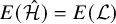 $E(\hat {{\mathcal {H}}})=E({\mathcal {L}})$
.
$E(\hat {{\mathcal {H}}})=E({\mathcal {L}})$
.
Recall that, by Lemma 3.5, $N_{\mathcal {L}}(T^*)$
acts on
$N_{\mathcal {L}}(T^*)$
acts on ${\mathcal {L}}$
and on the set of components of
${\mathcal {L}}$
and on the set of components of ${\mathcal {L}}$
. In particular, if
${\mathcal {L}}$
. In particular, if $H\leq N_{\mathcal {L}}(T^*)$
, then it makes sense to say that a subset of
$H\leq N_{\mathcal {L}}(T^*)$
, then it makes sense to say that a subset of $\operatorname {Comp}({\mathcal {L}})$
is H-invariant.
$\operatorname {Comp}({\mathcal {L}})$
is H-invariant.
Lemma 4.3. Let $H{\,\trianglelefteq \trianglelefteq \,} N_{\mathcal {L}}(T^*)$
and
$H{\,\trianglelefteq \trianglelefteq \,} N_{\mathcal {L}}(T^*)$
and $\mathfrak {C}\subseteq \operatorname {Comp}({\mathcal {L}})$
be H-invariant. Set
$\mathfrak {C}\subseteq \operatorname {Comp}({\mathcal {L}})$
be H-invariant. Set
 $$\begin{align*}\mathcal{N}:=\prod_{\mathcal{K}\in\mathfrak{C}}\mathcal{K}\text{ and }\mathcal{M}:=\prod_{\mathcal{K}\in\operatorname{Comp}({\mathcal{L}})\backslash\mathfrak{C}}\mathcal{K}.\end{align*}$$
Assume $H\subseteq C_{\mathcal {L}}(\mathcal {M})$
. Then
$H\subseteq C_{\mathcal {L}}(\mathcal {M})$
. Then $\mathcal {N} H\,{\trianglelefteq }\, E({\mathcal {L}})H$
, and
$\mathcal {N} H\,{\trianglelefteq }\, E({\mathcal {L}})H$
, and $\mathcal {N} H=H\mathcal {N}$
is a partial subnormal subgroup of
$\mathcal {N} H=H\mathcal {N}$
is a partial subnormal subgroup of ${\mathcal {L}}$
with
${\mathcal {L}}$
with $\mathcal {N} H\cap S=(\mathcal {N}\cap S)(H\cap S)$
. Moreover,
$\mathcal {N} H\cap S=(\mathcal {N}\cap S)(H\cap S)$
. Moreover,
 $$\begin{align*}N_{\mathcal{N} H}(S\cap \mathcal{N})=N_{\mathcal{N}}(S\cap \mathcal{N})H=N_{\mathcal{N}}(T^*)H,\;\operatorname{Comp}(\mathcal{N} H)=\mathfrak{C}\text{ and }E(\mathcal{N} H)=\mathcal{N}\,{\trianglelefteq}\, \mathcal{N} H.\end{align*}$$
Proof. By Lemma 4.2, $\hat {{\mathcal {H}}}:=E({\mathcal {L}})H=HE({\mathcal {L}})$
is a partial subnormal subgroup of
$\hat {{\mathcal {H}}}:=E({\mathcal {L}})H=HE({\mathcal {L}})$
is a partial subnormal subgroup of ${\mathcal {L}}$
with
${\mathcal {L}}$
with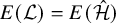 $E({\mathcal {L}})=E(\hat {{\mathcal {H}}})$
. We argue now that
$E({\mathcal {L}})=E(\hat {{\mathcal {H}}})$
. We argue now that
 $$ \begin{align} \mathcal{N}\,{\trianglelefteq}\, \hat{{\mathcal{H}}}. \end{align} $$
For that let $x\in E({\mathcal {L}})$
,
$x\in E({\mathcal {L}})$
, $h\in H$
and
$h\in H$
and $n\in \mathcal {N}$
with
$n\in \mathcal {N}$
with $u:=((xh)^{-1},n,(xh))\in \mathbf {D}$
. By [Reference Chermak3, Lemma 1.4(f)],
$u:=((xh)^{-1},n,(xh))\in \mathbf {D}$
. By [Reference Chermak3, Lemma 1.4(f)], $(xh)^{-1}=h^{-1}x^{-1}$
. Set
$(xh)^{-1}=h^{-1}x^{-1}$
. Set $v:=(h^{-1},x^{-1},n,x,h)$
. It follows from Lemma 3.3 that
$v:=(h^{-1},x^{-1},n,x,h)$
. It follows from Lemma 3.3 that $S_v\cap T^*=S_u\cap T^*$
. Now (3.4) yields first
$S_v\cap T^*=S_u\cap T^*$
. Now (3.4) yields first $S_v\cap T^*=S_u\cap T^*\in \Delta $
and then
$S_v\cap T^*=S_u\cap T^*\in \Delta $
and then $v\in \mathbf {D}$
. Hence,
$v\in \mathbf {D}$
. Hence,
 $$\begin{align*}n^{xh}=\Pi(u)=\Pi(v)=(n^x)^h.\end{align*}$$
By [Reference Henke10, Proposition 11.7], $\mathcal {N}\,{\trianglelefteq }\, F^*({\mathcal {L}})\supseteq E({\mathcal {L}})$
and thus
$\mathcal {N}\,{\trianglelefteq }\, F^*({\mathcal {L}})\supseteq E({\mathcal {L}})$
and thus $n^x\in \mathcal {N}$
. As
$n^x\in \mathcal {N}$
. As $\mathfrak {C}$
is by assumption H-invariant and since H induces automorphisms of
$\mathfrak {C}$
is by assumption H-invariant and since H induces automorphisms of ${\mathcal {L}}$
via conjugation (cf. Lemma 3.5), it follows that
${\mathcal {L}}$
via conjugation (cf. Lemma 3.5), it follows that $\mathcal {N}$
is invariant under conjugation by H. Thus,
$\mathcal {N}$
is invariant under conjugation by H. Thus, $n^{xh}=(n^x)^h\in \mathcal {N}$
. This proves (4.1).
$n^{xh}=(n^x)^h\in \mathcal {N}$
. This proves (4.1).
Since $\hat {{\mathcal {H}}}$
is a subnormal, it is a regular locality with Sylow subgroup
$\hat {{\mathcal {H}}}$
is a subnormal, it is a regular locality with Sylow subgroup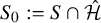 $S_0:=S\cap \hat {{\mathcal {H}}}$
. Note that
$S_0:=S\cap \hat {{\mathcal {H}}}$
. Note that $H\cap S_0=H\cap S\in \operatorname {Syl}_p(H)$
, as
$H\cap S_0=H\cap S\in \operatorname {Syl}_p(H)$
, as $H{\,\trianglelefteq \trianglelefteq \,} N_{\mathcal {L}}(T^*)$
and
$H{\,\trianglelefteq \trianglelefteq \,} N_{\mathcal {L}}(T^*)$
and $S\in \operatorname {Syl}_p(N_{\mathcal {L}}(T^*))$
. Moreover, since
$S\in \operatorname {Syl}_p(N_{\mathcal {L}}(T^*))$
. Moreover, since $E(\hat {{\mathcal {H}}})=E({\mathcal {L}})$
, it follows from Lemma 3.4 that
$E(\hat {{\mathcal {H}}})=E({\mathcal {L}})$
, it follows from Lemma 3.4 that $N_{\hat {{\mathcal {H}}}}(F^*(\hat {{\mathcal {H}}})\cap S)=N_{\hat {{\mathcal {H}}}}(E(\hat {{\mathcal {H}}})\cap S)=N_{\hat {{\mathcal {H}}}}(E({\mathcal {L}})\cap S)=N_{\hat {{\mathcal {H}}}}(T^*)$
and thus
$N_{\hat {{\mathcal {H}}}}(F^*(\hat {{\mathcal {H}}})\cap S)=N_{\hat {{\mathcal {H}}}}(E(\hat {{\mathcal {H}}})\cap S)=N_{\hat {{\mathcal {H}}}}(E({\mathcal {L}})\cap S)=N_{\hat {{\mathcal {H}}}}(T^*)$
and thus $H{\,\trianglelefteq \trianglelefteq \,} N_{\hat {{\mathcal {H}}}}(F^*(\hat {{\mathcal {H}}})\cap S)$
. The property (4.1) allows us now to apply Lemma 4.1 with
$H{\,\trianglelefteq \trianglelefteq \,} N_{\hat {{\mathcal {H}}}}(F^*(\hat {{\mathcal {H}}})\cap S)$
. The property (4.1) allows us now to apply Lemma 4.1 with $\hat {{\mathcal {H}}}$
in place of
$\hat {{\mathcal {H}}}$
in place of ${\mathcal {L}}$
to obtain that
${\mathcal {L}}$
to obtain that
 $$\begin{align*}{\mathcal{H}}:=\mathcal{N} H=H\mathcal{N}\end{align*}$$
is a partial subgroup of ${\mathcal {L}}$
with
${\mathcal {L}}$
with $\mathcal {N} H\cap S=\mathcal {N} H\cap S_0=(\mathcal {N}\cap S_0)(H\cap S_0)=(\mathcal {N}\cap S)(H\cap S)$
. We show next that
$\mathcal {N} H\cap S=\mathcal {N} H\cap S_0=(\mathcal {N}\cap S_0)(H\cap S_0)=(\mathcal {N}\cap S)(H\cap S)$
. We show next that
 $$ \begin{align} {\mathcal{H}}\,{\trianglelefteq}\, \hat{{\mathcal{H}}}\quad\text{and}\quad{\mathcal{H}}{\,\trianglelefteq\trianglelefteq\,}{\mathcal{L}}. \end{align} $$
As $\hat {\mathcal {H}}{\,\trianglelefteq \trianglelefteq \,}{\mathcal {L}}$
, it is indeed sufficient to prove that
$\hat {\mathcal {H}}{\,\trianglelefteq \trianglelefteq \,}{\mathcal {L}}$
, it is indeed sufficient to prove that ${\mathcal {H}}\,{\trianglelefteq }\,\hat {\mathcal {H}}$
. For the proof fix
${\mathcal {H}}\,{\trianglelefteq }\,\hat {\mathcal {H}}$
. For the proof fix $a\in {\mathcal {H}}$
and
$a\in {\mathcal {H}}$
and $f\in \hat {{\mathcal {H}}}$
such that
$f\in \hat {{\mathcal {H}}}$
such that $w:=(f^{-1},a,f)\in \mathbf {D}$
. As
$w:=(f^{-1},a,f)\in \mathbf {D}$
. As ${\mathcal {H}}$
is a partial subgroup, we only need to prove that
${\mathcal {H}}$
is a partial subgroup, we only need to prove that $a^f\in {\mathcal {H}}$
. Write
$a^f\in {\mathcal {H}}$
. Write $f=yh$
with
$f=yh$
with $y\in E({\mathcal {L}})$
and
$y\in E({\mathcal {L}})$
and $h\in H$
. Then [Reference Chermak3, Lemma 1.4(f)] gives
$h\in H$
. Then [Reference Chermak3, Lemma 1.4(f)] gives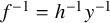 $f^{-1}=h^{-1} y^{-1}$
. Setting
$f^{-1}=h^{-1} y^{-1}$
. Setting $w':=(h^{-1},y^{-1},a,y,h)$
, it follows from Lemma 3.3 that
$w':=(h^{-1},y^{-1},a,y,h)$
, it follows from Lemma 3.3 that $S_{w'}\cap T^*=S_w\cap T^*$
. Hence, (3.4) gives first
$S_{w'}\cap T^*=S_w\cap T^*$
. Hence, (3.4) gives first $S_w\cap T^*\in \Delta $
and then
$S_w\cap T^*\in \Delta $
and then $w'\in \mathbf {D}$
. Using the axioms of a partial group, we can thus conclude that
$w'\in \mathbf {D}$
. Using the axioms of a partial group, we can thus conclude that
 $$\begin{align*}a^f=\Pi(w)=\Pi(w')=(a^y)^h.\end{align*}$$
By part (a) of Lemma 3.6, there exist $n\in \mathcal {N}$
and
$n\in \mathcal {N}$
and $m\in \mathcal {M}$
with
$m\in \mathcal {M}$
with $y=nm$
. Moreover, part (b) of that lemma yields then
$y=nm$
. Moreover, part (b) of that lemma yields then $S_y\cap T^*=S_{nm}\cap T^*=S_{(n,m)}\cap T^*$
. So by (3.4), we have
$S_y\cap T^*=S_{nm}\cap T^*=S_{(n,m)}\cap T^*$
. So by (3.4), we have $(m^{-1},n^{-1},a,n,m)\in \mathbf {D}$
via
$(m^{-1},n^{-1},a,n,m)\in \mathbf {D}$
via $S_{(y^{-1},a,y)}\cap T^*$
and thus
$S_{(y^{-1},a,y)}\cap T^*$
and thus
 $$\begin{align*}a^y=(a^n)^m.\end{align*}$$
Notice that $a,n\in \mathcal {N} H={\mathcal {H}}$
and thus
$a,n\in \mathcal {N} H={\mathcal {H}}$
and thus $a^n\in {\mathcal {H}}$
. Lemma 3.6(b) gives that
$a^n\in {\mathcal {H}}$
. Lemma 3.6(b) gives that $\mathcal {N}\subseteq C_{\mathcal {L}}(\mathcal {M})$
. By assumption we have moreover
$\mathcal {N}\subseteq C_{\mathcal {L}}(\mathcal {M})$
. By assumption we have moreover $H\subseteq C_{\mathcal {L}}(\mathcal {M})$
. As
$H\subseteq C_{\mathcal {L}}(\mathcal {M})$
. As $\mathcal {M}\,{\trianglelefteq }\, F^*({\mathcal {L}})$
is subnormal in
$\mathcal {M}\,{\trianglelefteq }\, F^*({\mathcal {L}})$
is subnormal in ${\mathcal {L}}$
by [Reference Henke10, Proposition 11.7], it follows from [Reference Henke12, Theorem A(f)] that
${\mathcal {L}}$
by [Reference Henke10, Proposition 11.7], it follows from [Reference Henke12, Theorem A(f)] that $C_{\mathcal {L}}(\mathcal {M})$
is a partial subgroup of
$C_{\mathcal {L}}(\mathcal {M})$
is a partial subgroup of ${\mathcal {L}}$
. Hence,
${\mathcal {L}}$
. Hence, ${\mathcal {H}}=\mathcal {N} H\subseteq C_{\mathcal {L}}(\mathcal {M})$
and thus
${\mathcal {H}}=\mathcal {N} H\subseteq C_{\mathcal {L}}(\mathcal {M})$
and thus $\mathcal {M}\subseteq C_{\mathcal {L}}({\mathcal {H}})$
by [Reference Henke10, Lemma 3.5]. It follows that
$\mathcal {M}\subseteq C_{\mathcal {L}}({\mathcal {H}})$
by [Reference Henke10, Lemma 3.5]. It follows that $a^y=(a^n)^m=a^n\in {\mathcal {H}}$
. Recall that
$a^y=(a^n)^m=a^n\in {\mathcal {H}}$
. Recall that $h\in H\subseteq {\mathcal {H}}$
. Hence,
$h\in H\subseteq {\mathcal {H}}$
. Hence, $a^f=(a^y)^h\in {\mathcal {H}}$
. This completes the proof of (4.2). We prove next that
$a^f=(a^y)^h\in {\mathcal {H}}$
. This completes the proof of (4.2). We prove next that
 $$ \begin{align} N_{\mathcal{H}}(S\cap \mathcal{N})=N_{\mathcal{N}}(S\cap \mathcal{N})H\quad\text{and}\quad N_{\mathcal{H}}(S\cap\mathcal{N})=N_{\mathcal{H}}(T^*){\,\trianglelefteq\trianglelefteq\,} N_{\mathcal{L}}(T^*) \end{align} $$
To see this notice that $H\subseteq N_{\mathcal {H}}(T^*)\subseteq N_{\mathcal {H}}(T^*\cap \mathcal {N})=N_{\mathcal {H}}(S\cap \mathcal {N})$
as
$H\subseteq N_{\mathcal {H}}(T^*)\subseteq N_{\mathcal {H}}(T^*\cap \mathcal {N})=N_{\mathcal {H}}(S\cap \mathcal {N})$
as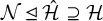 $\mathcal {N}\,{\trianglelefteq }\,\hat {\mathcal {H}}\supseteq {\mathcal {H}}$
by (4.1). Hence, by the Dedekind Lemma [Reference Chermak3, Lemma 1.10], we have
$\mathcal {N}\,{\trianglelefteq }\,\hat {\mathcal {H}}\supseteq {\mathcal {H}}$
by (4.1). Hence, by the Dedekind Lemma [Reference Chermak3, Lemma 1.10], we have $N_{\mathcal {H}}(S\cap \mathcal {N})=N_{\mathcal {N}}(S\cap \mathcal {N})H$
. Applying Lemma 3.7 with
$N_{\mathcal {H}}(S\cap \mathcal {N})=N_{\mathcal {N}}(S\cap \mathcal {N})H$
. Applying Lemma 3.7 with $\mathcal {N}$
in place of
$\mathcal {N}$
in place of ${\mathcal {H}}$
and noting that
${\mathcal {H}}$
and noting that $\mathcal {N}=E(\mathcal {N})$
, we obtain
$\mathcal {N}=E(\mathcal {N})$
, we obtain $N_{\mathcal {N}}(S\cap \mathcal {N})=N_{\mathcal {N}}(T^*)$
. Hence,
$N_{\mathcal {N}}(S\cap \mathcal {N})=N_{\mathcal {N}}(T^*)$
. Hence, $N_{\mathcal {H}}(S\cap \mathcal {N})\leq N_{\mathcal {H}}(T^*)$
. This shows
$N_{\mathcal {H}}(S\cap \mathcal {N})\leq N_{\mathcal {H}}(T^*)$
. This shows $N_{\mathcal {H}}(S\cap \mathcal {N})=N_{\mathcal {H}}(T^*)$
. As
$N_{\mathcal {H}}(S\cap \mathcal {N})=N_{\mathcal {H}}(T^*)$
. As ${\mathcal {H}}{\,\trianglelefteq \trianglelefteq \,}{\mathcal {L}}$
, one sees easily that
${\mathcal {H}}{\,\trianglelefteq \trianglelefteq \,}{\mathcal {L}}$
, one sees easily that $N_{\mathcal {H}}(T^*){\,\trianglelefteq \trianglelefteq \,} N_{\mathcal {L}}(T^*)$
. This completes the proof of (4.3). It remains now only to prove that
$N_{\mathcal {H}}(T^*){\,\trianglelefteq \trianglelefteq \,} N_{\mathcal {L}}(T^*)$
. This completes the proof of (4.3). It remains now only to prove that
 $$ \begin{align} \operatorname{Comp}({\mathcal{H}})=\mathfrak{C}. \end{align} $$
Note first that, by [Reference Henke10, Remark 11.2(a)], we have $\mathfrak {C}\subseteq \operatorname {Comp}({\mathcal {H}})$
. Assuming that (4.4) is false, there exists thus
$\mathfrak {C}\subseteq \operatorname {Comp}({\mathcal {H}})$
. Assuming that (4.4) is false, there exists thus $\mathcal {K}\in \operatorname {Comp}({\mathcal {H}})\backslash \mathfrak {C}$
. Then
$\mathcal {K}\in \operatorname {Comp}({\mathcal {H}})\backslash \mathfrak {C}$
. Then $\mathcal {K}$
centralizes
$\mathcal {K}$
centralizes $\mathcal {N}$
by [Reference Henke10, Theorem 11.18(e)]. In particular,
$\mathcal {N}$
by [Reference Henke10, Theorem 11.18(e)]. In particular, $\mathcal {K}\subseteq C_{\mathcal {H}}(S\cap \mathcal {N})\subseteq N_{\mathcal {H}}(S\cap \mathcal {N})$
. Using (4.3) and the fact that
$\mathcal {K}\subseteq C_{\mathcal {H}}(S\cap \mathcal {N})\subseteq N_{\mathcal {H}}(S\cap \mathcal {N})$
. Using (4.3) and the fact that $\mathcal {K}$
is subnormal in
$\mathcal {K}$
is subnormal in ${\mathcal {H}}$
, we see then that
${\mathcal {H}}$
, we see then that $\mathcal {K}{\,\trianglelefteq \trianglelefteq \,} N_{\mathcal {H}}(S\cap \mathcal {N}){\,\trianglelefteq \trianglelefteq \,} N_{\mathcal {L}}(T^*)$
and so
$\mathcal {K}{\,\trianglelefteq \trianglelefteq \,} N_{\mathcal {H}}(S\cap \mathcal {N}){\,\trianglelefteq \trianglelefteq \,} N_{\mathcal {L}}(T^*)$
and so $\mathcal {K}$
is a subnormal subgroup of the group
$\mathcal {K}$
is a subnormal subgroup of the group $N_{\mathcal {L}}(T^*)$
. As
$N_{\mathcal {L}}(T^*)$
. As $N_{\mathcal {L}}(T^*)$
is a group of characteristic p, it follows from [Reference Meierfrankenfeld and Stellmacher15, Lemma 1.2(a)] that
$N_{\mathcal {L}}(T^*)$
is a group of characteristic p, it follows from [Reference Meierfrankenfeld and Stellmacher15, Lemma 1.2(a)] that $\mathcal {K}$
is a group of characteristic p. As
$\mathcal {K}$
is a group of characteristic p. As $\mathcal {K}$
is quasisimple, [Reference Henke10, Lemma 7.10] gives
$\mathcal {K}$
is quasisimple, [Reference Henke10, Lemma 7.10] gives $Z(\mathcal {K})=O_p(\mathcal {K})\neq \mathcal {K}$
. This yields a contradiction. Hence, (4.4) holds. In particular,
$Z(\mathcal {K})=O_p(\mathcal {K})\neq \mathcal {K}$
. This yields a contradiction. Hence, (4.4) holds. In particular, $E({\mathcal {H}})=\mathcal {N}$
and the proof is complete.
$E({\mathcal {H}})=\mathcal {N}$
and the proof is complete.
4.2 The proof of Theorem A and related results
In this subsection we prove Theorem A as well as some additional properties. Except in Corollary 4.11, we assume throughout this subsection the following hypothesis.
Hypothesis 4.4. Let $({\mathcal {L}},\Delta ,S)$
be a regular locality and set
$({\mathcal {L}},\Delta ,S)$
be a regular locality and set $T^*:=F^*({\mathcal {L}})\cap S$
. Let
$T^*:=F^*({\mathcal {L}})\cap S$
. Let ${\mathcal {H}}_1$
and
${\mathcal {H}}_1$
and ${\mathcal {H}}_2$
be partial subnormal subgroups of
${\mathcal {H}}_2$
be partial subnormal subgroups of ${\mathcal {L}}$
. Set
${\mathcal {L}}$
. Set
 $$\begin{align*}{\mathcal{H}}:={\langle}{\mathcal{H}}_1,{\mathcal{H}}_2{\rangle},\end{align*}$$
 $$\begin{align*}S_i:={\mathcal{H}}_i\cap S,\;T_i=E({\mathcal{H}}_i)\cap S\text{ and }H_i:=N_{{\mathcal{H}}_i}(T_i)\text{ for }i=1,2.\end{align*}$$
Set moreover
 $$\begin{align*}H:={\langle}H_1,H_2{\rangle},\;\mathfrak{C}:=\operatorname{Comp}({\mathcal{H}}_1)\cup\operatorname{Comp}({\mathcal{H}}_2),\;\mathcal{N}:=\prod_{\mathcal{K}\in\mathfrak{C}}\mathcal{K}\text{ and }\mathcal{M}:=\prod_{\mathcal{K}\in\operatorname{Comp}({\mathcal{L}})\backslash\mathfrak{C}}\mathcal{K}.\end{align*}$$
It follows from [Reference Henke10, Remark 11.2(b)] that $\mathfrak {C}\subseteq \operatorname {Comp}({\mathcal {L}})$
. In particular,
$\mathfrak {C}\subseteq \operatorname {Comp}({\mathcal {L}})$
. In particular, $T_i\leq E({\mathcal {L}})\cap S\leq T^*$
for
$T_i\leq E({\mathcal {L}})\cap S\leq T^*$
for $i=1,2$
. Moreover, as remarked before,
$i=1,2$
. Moreover, as remarked before, $\mathcal {N}$
and
$\mathcal {N}$
and $\mathcal {M}$
are well-defined by [Reference Henke10, Proposition 11.7] (i.e., the order of the factors in these products does not matter). We will use these properties throughout without further reference.
$\mathcal {M}$
are well-defined by [Reference Henke10, Proposition 11.7] (i.e., the order of the factors in these products does not matter). We will use these properties throughout without further reference.
Lemma 4.5. We have $H_i=N_{{\mathcal {H}}_i}(T^*){\,\trianglelefteq \trianglelefteq \,} N_{\mathcal {L}}(T^*)$
and
$H_i=N_{{\mathcal {H}}_i}(T^*){\,\trianglelefteq \trianglelefteq \,} N_{\mathcal {L}}(T^*)$
and $S_i=H_i\cap S$
. In particular,
$S_i=H_i\cap S$
. In particular,
 $$\begin{align*}H={\langle}H_1,H_2{\rangle}{\,\trianglelefteq\trianglelefteq\,} N_{\mathcal{L}}(T^*)\text{ and }H\cap S={\langle}S_1,S_2{\rangle}.\end{align*}$$
Proof. Lemma 3.7 implies that $H_i=N_{{\mathcal {H}}_i}(T^*){\,\trianglelefteq \trianglelefteq \,} N_{\mathcal {L}}(T^*)$
and
$H_i=N_{{\mathcal {H}}_i}(T^*){\,\trianglelefteq \trianglelefteq \,} N_{\mathcal {L}}(T^*)$
and $S_i=S\cap H_i$
for each
$S_i=S\cap H_i$
for each $i=1,2$
. In particular, it follows from Wielandt’s Join Theorem for groups that
$i=1,2$
. In particular, it follows from Wielandt’s Join Theorem for groups that $H={\langle }H_1,H_2{\rangle }$
is a subnormal subgroup of
$H={\langle }H_1,H_2{\rangle }$
is a subnormal subgroup of $N_{\mathcal {L}}(T^*)$
and from Meierfrankenfeld’s Lemma 2.1 that
$N_{\mathcal {L}}(T^*)$
and from Meierfrankenfeld’s Lemma 2.1 that $H\cap S={\langle }S_1,S_2{\rangle }$
.
$H\cap S={\langle }S_1,S_2{\rangle }$
.
Recall that $N_{\mathcal {L}}(T^*)$
(and thus also H) acts on the set of components of
$N_{\mathcal {L}}(T^*)$
(and thus also H) acts on the set of components of ${\mathcal {L}}$
by Lemma 3.5.
${\mathcal {L}}$
by Lemma 3.5.
Lemma 4.6. The set $\mathfrak {C}$
is H-invariant.
$\mathfrak {C}$
is H-invariant.
Proof. It is sufficient to argue that $\mathfrak {C}$
is
$\mathfrak {C}$
is $H_i$
-invariant for each
$H_i$
-invariant for each $i=1,2$
. For the proof fix
$i=1,2$
. For the proof fix $i\in \{1,2\}$
. By Lemma 3.5 (applied with
$i\in \{1,2\}$
. By Lemma 3.5 (applied with ${\mathcal {H}}_i$
in place of
${\mathcal {H}}_i$
in place of ${\mathcal {L}}$
),
${\mathcal {L}}$
), $\operatorname {Comp}({\mathcal {H}}_i)$
is
$\operatorname {Comp}({\mathcal {H}}_i)$
is $H_i$
-invariant. Moreover, applying first [Reference Henke10, 11.17] and then [Reference Henke10, Lemma 3.5], one sees that
$H_i$
-invariant. Moreover, applying first [Reference Henke10, 11.17] and then [Reference Henke10, Lemma 3.5], one sees that ${\mathcal {H}}_i\subseteq C_{\mathcal {L}}(\mathcal {K})$
for every
${\mathcal {H}}_i\subseteq C_{\mathcal {L}}(\mathcal {K})$
for every $\mathcal {K}\in \operatorname {Comp}({\mathcal {L}})\backslash \operatorname {Comp}({\mathcal {H}}_i)$
. In particular,
$\mathcal {K}\in \operatorname {Comp}({\mathcal {L}})\backslash \operatorname {Comp}({\mathcal {H}}_i)$
. In particular, $H_i$
centralizes every component in
$H_i$
centralizes every component in $\mathfrak {C}\backslash \operatorname {Comp}({\mathcal {H}}_i)$
. Thus
$\mathfrak {C}\backslash \operatorname {Comp}({\mathcal {H}}_i)$
. Thus $\mathfrak {C}$
is
$\mathfrak {C}$
is $H_i$
-invariant.
$H_i$
-invariant.
Lemma 4.7. We have ${\mathcal {H}}\subseteq C_{\mathcal {L}}(\mathcal {M})$
and so
${\mathcal {H}}\subseteq C_{\mathcal {L}}(\mathcal {M})$
and so $H\subseteq C_{\mathcal {L}}(\mathcal {M})$
.
$H\subseteq C_{\mathcal {L}}(\mathcal {M})$
.
Proof. By [Reference Henke10, Proposition 11.7], $\mathcal {M}\,{\trianglelefteq }\, F^*({\mathcal {L}})$
is subnormal in
$\mathcal {M}\,{\trianglelefteq }\, F^*({\mathcal {L}})$
is subnormal in ${\mathcal {L}}$
. Hence, it follows from [Reference Henke12, Theorem A(f)] that
${\mathcal {L}}$
. Hence, it follows from [Reference Henke12, Theorem A(f)] that $C_{\mathcal {L}}(\mathcal {M})$
is a partial subgroup of
$C_{\mathcal {L}}(\mathcal {M})$
is a partial subgroup of ${\mathcal {L}}$
. Therefore, it is sufficient to show that
${\mathcal {L}}$
. Therefore, it is sufficient to show that ${\mathcal {H}}_i\subseteq C_{\mathcal {L}}(\mathcal {M})$
for each
${\mathcal {H}}_i\subseteq C_{\mathcal {L}}(\mathcal {M})$
for each $i=1,2$
.
$i=1,2$
.
Fix now $i\in \{1,2\}$
and notice that
$i\in \{1,2\}$
and notice that $\mathfrak {C}':=\operatorname {Comp}({\mathcal {L}})\backslash \mathfrak {C}\subseteq \operatorname {Comp}({\mathcal {L}})\backslash \operatorname {Comp}({\mathcal {H}}_i)$
. Hence, it is a special case of [Reference Henke10, Theorem 11.18(c)] that
$\mathfrak {C}':=\operatorname {Comp}({\mathcal {L}})\backslash \mathfrak {C}\subseteq \operatorname {Comp}({\mathcal {L}})\backslash \operatorname {Comp}({\mathcal {H}}_i)$
. Hence, it is a special case of [Reference Henke10, Theorem 11.18(c)] that ${\mathcal {H}}_i\mathcal {M}$
is an internal central product of the elements of
${\mathcal {H}}_i\mathcal {M}$
is an internal central product of the elements of $\{{\mathcal {H}}_i\}\cup \mathfrak {C}'$
(in the sense defined in [Reference Henke10, Definition 4.1]). In particular, by [Reference Henke10, Lemma 4.8], we have
$\{{\mathcal {H}}_i\}\cup \mathfrak {C}'$
(in the sense defined in [Reference Henke10, Definition 4.1]). In particular, by [Reference Henke10, Lemma 4.8], we have ${\mathcal {H}}_i\subseteq C_{\mathcal {L}}(\mathcal {M})$
as required.
${\mathcal {H}}_i\subseteq C_{\mathcal {L}}(\mathcal {M})$
as required.
Note that Theorem A is implied by the following theorem.
Theorem 4.8. We have ${\mathcal {H}}:={\langle }{\mathcal {H}}_1,{\mathcal {H}}_2{\rangle }=\mathcal {N} H=H\mathcal {N}{\,\trianglelefteq \trianglelefteq \,}{\mathcal {L}}$
. Moreover,
${\mathcal {H}}:={\langle }{\mathcal {H}}_1,{\mathcal {H}}_2{\rangle }=\mathcal {N} H=H\mathcal {N}{\,\trianglelefteq \trianglelefteq \,}{\mathcal {L}}$
. Moreover, ${\mathcal {H}}\cap S=H\cap S={\langle }S_1,S_2{\rangle }$
,
${\mathcal {H}}\cap S=H\cap S={\langle }S_1,S_2{\rangle }$
, $\operatorname {Comp}({\mathcal {H}})=\mathfrak {C}$
,
$\operatorname {Comp}({\mathcal {H}})=\mathfrak {C}$
, $E({\mathcal {H}})=\mathcal {N}=E({\mathcal {H}}_1)E({\mathcal {H}}_2)\,{\trianglelefteq }\, {\mathcal {H}}$
and
$E({\mathcal {H}})=\mathcal {N}=E({\mathcal {H}}_1)E({\mathcal {H}}_2)\,{\trianglelefteq }\, {\mathcal {H}}$
and
 $$\begin{align*}N_{\mathcal{H}}(F^*({\mathcal{H}})\cap S)=N_{\mathcal{H}}(\mathcal{N}\cap S)=N_{\mathcal{H}}(T^*)=H.\end{align*}$$
Proof. Recall that $H{\,\trianglelefteq \trianglelefteq \,} N_{\mathcal {L}}(T^*)$
by Lemma 4.5, that
$H{\,\trianglelefteq \trianglelefteq \,} N_{\mathcal {L}}(T^*)$
by Lemma 4.5, that $\mathfrak {C}$
is H-invariant by Lemma 4.6 and that
$\mathfrak {C}$
is H-invariant by Lemma 4.6 and that ${H\subseteq C_{\mathcal {L}}(\mathcal {M})}$
by Lemma 4.7. Hence, it follows from Lemma 4.3 that
${H\subseteq C_{\mathcal {L}}(\mathcal {M})}$
by Lemma 4.7. Hence, it follows from Lemma 4.3 that $\mathcal {N} H=H\mathcal {N}$
is a partial subnormal subgroup of
$\mathcal {N} H=H\mathcal {N}$
is a partial subnormal subgroup of ${\mathcal {L}}$
,
${\mathcal {L}}$
,
 $$\begin{align*}\operatorname{Comp}(\mathcal{N} H)=\mathfrak{C},\;E(\mathcal{N} H)=\mathcal{N}\,{\trianglelefteq}\,\mathcal{N} H,\;(\mathcal{N} H)\cap S=(\mathcal{N}\cap S)(H\cap S)\text{ and }N_{\mathcal{N} H}(\mathcal{N}\cap S)=N_{\mathcal{N}}(T^*)H.\end{align*}$$
It follows from the Frattini Lemma [Reference Chermak3, Corollary 3.11] that ${\mathcal {H}}_i=E({\mathcal {H}}_i)H_i\subseteq \mathcal {N} H$
for every
${\mathcal {H}}_i=E({\mathcal {H}}_i)H_i\subseteq \mathcal {N} H$
for every $i\in \{1,2\}$
. So the fact that
$i\in \{1,2\}$
. So the fact that $\mathcal {N} H$
is a partial subgroup implies
$\mathcal {N} H$
is a partial subgroup implies ${\mathcal {H}}:={\langle }{\mathcal {H}}_1,{\mathcal {H}}_2{\rangle }\subseteq \mathcal {N} H$
. As
${\mathcal {H}}:={\langle }{\mathcal {H}}_1,{\mathcal {H}}_2{\rangle }\subseteq \mathcal {N} H$
. As $\mathcal {N}$
and H are both contained in
$\mathcal {N}$
and H are both contained in ${\mathcal {H}}$
, we can conclude that
${\mathcal {H}}$
, we can conclude that ${\mathcal {H}}=\mathcal {N} H=H\mathcal {N}$
. In particular,
${\mathcal {H}}=\mathcal {N} H=H\mathcal {N}$
. In particular, ${\mathcal {H}}$
is subnormal in
${\mathcal {H}}$
is subnormal in ${\mathcal {L}}$
,
${\mathcal {L}}$
,
 $$\begin{align*}\operatorname{Comp}({\mathcal{H}})=\mathfrak{C},\;E({\mathcal{H}})=\mathcal{N}\,{\trianglelefteq}\,{\mathcal{H}},\;{\mathcal{H}}\cap S=(\mathcal{N}\cap S)(H\cap S)\text{ and }N_{\mathcal{H}}(\mathcal{N}\cap S)=N_{\mathcal{N}}(T^*)H.\end{align*}$$
By Lemma 4.5, $H\cap S={\langle }S_1,S_2{\rangle }$
. It follows moreover from Lemma 3.6(a) that
$H\cap S={\langle }S_1,S_2{\rangle }$
. It follows moreover from Lemma 3.6(a) that
 $$\begin{align*}\mathcal{N}\cap S=(E({\mathcal{H}}_1)\cap S)(E({\mathcal{H}}_2)\cap S)\leq {\langle}S_1,S_2{\rangle}=H\cap S.\end{align*}$$
Hence, ${\mathcal {H}}\cap S=(\mathcal {N}\cap S)(H\cap S)=H\cap S={\langle }S_1,S_2{\rangle }$
. Notice that Lemma 3.6(a) yields also that
${\mathcal {H}}\cap S=(\mathcal {N}\cap S)(H\cap S)=H\cap S={\langle }S_1,S_2{\rangle }$
. Notice that Lemma 3.6(a) yields also that $\mathcal {N}=E({\mathcal {H}}_1)E({\mathcal {H}}_2)$
, that is,
$\mathcal {N}=E({\mathcal {H}}_1)E({\mathcal {H}}_2)$
, that is, $E({\mathcal {H}})=\mathcal {N}=E({\mathcal {H}}_1)E({\mathcal {H}}_2)$
.
$E({\mathcal {H}})=\mathcal {N}=E({\mathcal {H}}_1)E({\mathcal {H}}_2)$
.
As $\mathcal {N}=E({\mathcal {H}})$
, it follows from Lemma 3.4 that
$\mathcal {N}=E({\mathcal {H}})$
, it follows from Lemma 3.4 that $N_{\mathcal {H}}(S\cap F^*({\mathcal {H}}))=N_{\mathcal {H}}(S\cap \mathcal {N})$
and from Lemma 3.7 that
$N_{\mathcal {H}}(S\cap F^*({\mathcal {H}}))=N_{\mathcal {H}}(S\cap \mathcal {N})$
and from Lemma 3.7 that $N_{\mathcal {H}}(\mathcal {N}\cap S)=N_{\mathcal {H}}(T^*)$
. It remains thus only to show that
$N_{\mathcal {H}}(\mathcal {N}\cap S)=N_{\mathcal {H}}(T^*)$
. It remains thus only to show that $N_{\mathcal {H}}(T^*)=H$
. By Lemma 3.6(c), we have
$N_{\mathcal {H}}(T^*)=H$
. By Lemma 3.6(c), we have $N_{\mathcal {N}}(T^*)=N_{E({\mathcal {H}}_1)}(T^*)N_{E({\mathcal {H}}_2)}(T^*)$
. Note that
$N_{\mathcal {N}}(T^*)=N_{E({\mathcal {H}}_1)}(T^*)N_{E({\mathcal {H}}_2)}(T^*)$
. Note that $N_{E({\mathcal {H}}_i)}(T^*)\leq N_{{\mathcal {H}}_i}(T^*)=H_i$
for each
$N_{E({\mathcal {H}}_i)}(T^*)\leq N_{{\mathcal {H}}_i}(T^*)=H_i$
for each $i=1,2$
by Lemma 4.5. Thus, it follows that
$i=1,2$
by Lemma 4.5. Thus, it follows that $N_{\mathcal {N}}(T^*)\leq {\langle }H_1,H_2{\rangle }=H$
. Using the properties above, we obtain therefore that
$N_{\mathcal {N}}(T^*)\leq {\langle }H_1,H_2{\rangle }=H$
. Using the properties above, we obtain therefore that $N_{\mathcal {H}}(T^*)=N_{\mathcal {H}}(\mathcal {N}\cap S)=N_{\mathcal {N}}(T^*)H=H$
. This completes the proof.
$N_{\mathcal {H}}(T^*)=N_{\mathcal {H}}(\mathcal {N}\cap S)=N_{\mathcal {N}}(T^*)H=H$
. This completes the proof.
Lemma 4.9. Set $T:={\mathcal {H}}\cap S=H\cap S$
. Then
$T:={\mathcal {H}}\cap S=H\cap S$
. Then
 $$\begin{align*}\mathcal{F}_T({\mathcal{H}})={\langle}\mathcal{F}_T(\mathcal{N} T),\mathcal{F}_T(H){\rangle}.\end{align*}$$
Proof. Recall that $\mathcal {N}\,{\trianglelefteq }\, {\mathcal {H}}{\,\trianglelefteq \trianglelefteq \,}{\mathcal {L}}$
and
$\mathcal {N}\,{\trianglelefteq }\, {\mathcal {H}}{\,\trianglelefteq \trianglelefteq \,}{\mathcal {L}}$
and $N_{\mathcal {H}}(S\cap \mathcal {N})=H$
by Theorem 4.8. In particular, by Theorem 3.2,
$N_{\mathcal {H}}(S\cap \mathcal {N})=H$
by Theorem 4.8. In particular, by Theorem 3.2, ${\mathcal {H}}$
supports the structure of a regular locality. Hence, the assertion follows from Lemma 3.1(b) applied with
${\mathcal {H}}$
supports the structure of a regular locality. Hence, the assertion follows from Lemma 3.1(b) applied with ${\mathcal {H}}$
in place of
${\mathcal {H}}$
in place of ${\mathcal {L}}$
.
${\mathcal {L}}$
.
When we show Theorem B using Theorem A, we need the following lemma. Note that its proof relies on Theorem C.
Lemma 4.10. Assume that $T:=S\cap {\mathcal {H}}\leq N_S({\mathcal {H}}_1)\cap N_S({\mathcal {H}}_2)$
. Then
$T:=S\cap {\mathcal {H}}\leq N_S({\mathcal {H}}_1)\cap N_S({\mathcal {H}}_2)$
. Then
 $$\begin{align*}\mathcal{F}_T({\mathcal{H}})={\langle}\mathcal{F}_T({\mathcal{H}}_1T),\mathcal{F}_T({\mathcal{H}}_2T){\rangle}.\end{align*}$$
Proof. As $T\leq N_S({\mathcal {H}}_i)$
and
$T\leq N_S({\mathcal {H}}_i)$
and $E({\mathcal {H}}_i)$
is by [Reference Henke10, Lemma 11.12] invariant under automorphisms of
$E({\mathcal {H}}_i)$
is by [Reference Henke10, Lemma 11.12] invariant under automorphisms of ${\mathcal {H}}_i$
, we have
${\mathcal {H}}_i$
, we have
 $$ \begin{align*} T\leq N_S(E({\mathcal{H}}_i))\text{ and }T_i\,{\trianglelefteq}\, T\text{ for }i=1,2. \end{align*} $$
Let $i\in \{1,2\}$
. By [Reference Henke12, Lemma 3.18(a)],
$i\in \{1,2\}$
. By [Reference Henke12, Lemma 3.18(a)], ${\mathcal {H}}_i T$
is a partial subgroup of
${\mathcal {H}}_i T$
is a partial subgroup of ${\mathcal {L}}$
and
${\mathcal {L}}$
and $({\mathcal {H}}_iT,\delta (\mathcal {F}_T({\mathcal {H}}_iT)),T)$
is a regular locality with
$({\mathcal {H}}_iT,\delta (\mathcal {F}_T({\mathcal {H}}_iT)),T)$
is a regular locality with $E({\mathcal {H}}_i)=E({\mathcal {H}}_iT)$
. In particular,
$E({\mathcal {H}}_i)=E({\mathcal {H}}_iT)$
. In particular, $E({\mathcal {H}}_i)=E({\mathcal {H}}_iT)\,{\trianglelefteq }\,{\mathcal {H}}_iT$
by [Reference Henke10, Lemma 11.13]. It follows thus from Lemma 3.1(b) that
$E({\mathcal {H}}_i)=E({\mathcal {H}}_iT)\,{\trianglelefteq }\,{\mathcal {H}}_iT$
by [Reference Henke10, Lemma 11.13]. It follows thus from Lemma 3.1(b) that
 $$\begin{align*}\mathcal{F}_T({\mathcal{H}}_iT)={\langle}\mathcal{F}_T(E({\mathcal{H}}_i)T),\mathcal{F}_T(N_{{\mathcal{H}}_iT}(T_i)){\rangle}\text{ for }i=1,2. \end{align*}$$
By the Dedekind Lemma [Reference Chermak3, Lemma 1.10], $N_{{\mathcal {H}}_iT}(T_i)=N_{{\mathcal {H}}_i}(T_i)T=H_iT$
. Hence,
$N_{{\mathcal {H}}_iT}(T_i)=N_{{\mathcal {H}}_i}(T_i)T=H_iT$
. Hence,
 $$ \begin{align} \mathcal{F}_T({\mathcal{H}}_iT)={\langle}\mathcal{F}_T(E({\mathcal{H}}_i)T),\mathcal{F}_T(H_iT){\rangle}\text{ for }i=1,2. \end{align} $$
As $\mathcal {N}\,{\trianglelefteq }\, {\mathcal {H}}$
by Theorem 4.8, the product
$\mathcal {N}\,{\trianglelefteq }\, {\mathcal {H}}$
by Theorem 4.8, the product $\mathcal {N} T$
is a partial subgroup of
$\mathcal {N} T$
is a partial subgroup of ${\mathcal {L}}$
by [Reference Henke10, Lemma 3.15]. We show next that
${\mathcal {L}}$
by [Reference Henke10, Lemma 3.15]. We show next that
 $$ \begin{align} E({\mathcal{H}}_i)\,{\trianglelefteq}\, \mathcal{N} T \text{ for each }i=1,2. \end{align} $$
For the proof let $i\in \{1,2\}$
,
$i\in \{1,2\}$
, $x\in E({\mathcal {H}}_i)$
and
$x\in E({\mathcal {H}}_i)$
and $f\in \mathcal {N} T$
with
$f\in \mathcal {N} T$
with $u:=(f^{-1},x,f)\in \mathbf {D}$
. Then there exist
$u:=(f^{-1},x,f)\in \mathbf {D}$
. Then there exist $n\in \mathcal {N}$
and
$n\in \mathcal {N}$
and $s\in T$
with
$s\in T$
with $f=ns$
. By [Reference Chermak3, Lemma 1.4(f)],
$f=ns$
. By [Reference Chermak3, Lemma 1.4(f)],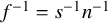 $f^{-1}=s^{-1}n^{-1}$
. Moreover, by [Reference Henke11, Lemma 2.8], we have
$f^{-1}=s^{-1}n^{-1}$
. Moreover, by [Reference Henke11, Lemma 2.8], we have $S_f=S_{(n,s)}$
and
$S_f=S_{(n,s)}$
and $S_{f^{-1}}=S_{(s^{-1},n^{-1})}$
. Hence, for
$S_{f^{-1}}=S_{(s^{-1},n^{-1})}$
. Hence, for $v:=(s^{-1},n^{-1},x,n,s)$
, we have
$v:=(s^{-1},n^{-1},x,n,s)$
, we have $S_v=S_u$
. Applying (3.1) twice, it follows first that
$S_v=S_u$
. Applying (3.1) twice, it follows first that $S_v=S_u\in \Delta $
and then that
$S_v=S_u\in \Delta $
and then that $v\in \mathbf {D}$
. Hence, by the axioms of a partial group, we have
$v\in \mathbf {D}$
. Hence, by the axioms of a partial group, we have $x^f=\Pi (u)=\Pi (v)=(x^n)^s$
. As
$x^f=\Pi (u)=\Pi (v)=(x^n)^s$
. As $E({\mathcal {H}}_i)\,{\trianglelefteq }\, F^*({\mathcal {L}})\supseteq \mathcal {N}$
by [Reference Henke10, Proposition 11.7], we have
$E({\mathcal {H}}_i)\,{\trianglelefteq }\, F^*({\mathcal {L}})\supseteq \mathcal {N}$
by [Reference Henke10, Proposition 11.7], we have $x^n\in E({\mathcal {H}}_i)$
. So
$x^n\in E({\mathcal {H}}_i)$
. So $s\in T\leq N_S(E({\mathcal {H}}_i))$
implies that
$s\in T\leq N_S(E({\mathcal {H}}_i))$
implies that $x^f=(x^n)^s\in E({\mathcal {H}}_i)$
. This shows (4.6). We show next:
$x^f=(x^n)^s\in E({\mathcal {H}}_i)$
. This shows (4.6). We show next:
 $$ \begin{align} \mathcal{F}_T(\mathcal{N} T)={\langle}\mathcal{F}_T(E({\mathcal{H}}_1)T),\mathcal{F}_T(E({\mathcal{H}}_2)T){\rangle} \end{align} $$
As $E({\mathcal {H}}_i)T\subseteq \mathcal {N} T$
for
$E({\mathcal {H}}_i)T\subseteq \mathcal {N} T$
for $i=1,2$
, we have clearly
$i=1,2$
, we have clearly $\mathcal {F}_0:={\langle }\mathcal {F}_T(E({\mathcal {H}}_1)T),\mathcal {F}_T(E({\mathcal {H}}_2)T){\rangle }\subseteq \mathcal {F}_T(\mathcal {N} T)$
and so it remains to show the opposite inclusion. Thus, fixing
$\mathcal {F}_0:={\langle }\mathcal {F}_T(E({\mathcal {H}}_1)T),\mathcal {F}_T(E({\mathcal {H}}_2)T){\rangle }\subseteq \mathcal {F}_T(\mathcal {N} T)$
and so it remains to show the opposite inclusion. Thus, fixing $f\in \mathcal {N} T$
, we need to show that
$f\in \mathcal {N} T$
, we need to show that $c_f|_{S_f\cap T}$
is a morphism in
$c_f|_{S_f\cap T}$
is a morphism in $\mathcal {F}_0$
. Write
$\mathcal {F}_0$
. Write $f=nt$
for some
$f=nt$
for some $n\in \mathcal {N}$
and
$n\in \mathcal {N}$
and $t\in T$
. By [Reference Henke11, Lemma 2.8], we have
$t\in T$
. By [Reference Henke11, Lemma 2.8], we have $S_f=S_{(n,t)}$
, which implies that
$S_f=S_{(n,t)}$
, which implies that $c_f\colon S_f\cap T\rightarrow T$
is a composite of restrictions of
$c_f\colon S_f\cap T\rightarrow T$
is a composite of restrictions of $c_n|_{S_n\cap T}$
and
$c_n|_{S_n\cap T}$
and $c_t|_T$
. As
$c_t|_T$
. As $c_t|_T$
is a morphism in
$c_t|_T$
is a morphism in $\mathcal {F}_0$
, it is thus sufficient to show that
$\mathcal {F}_0$
, it is thus sufficient to show that $c_n|_{S_n\cap T}$
is a morphism in
$c_n|_{S_n\cap T}$
is a morphism in $\mathcal {F}_0$
. By [Reference Henke12, Lemma 3.18(a)]
$\mathcal {F}_0$
. By [Reference Henke12, Lemma 3.18(a)] $(\mathcal {N} T,\delta (\mathcal {F}_T(\mathcal {N} T)),T)$
is a regular locality. Moreover, by Theorem 4.8,
$(\mathcal {N} T,\delta (\mathcal {F}_T(\mathcal {N} T)),T)$
is a regular locality. Moreover, by Theorem 4.8, $\mathcal {N}=E({\mathcal {H}}_1)E({\mathcal {H}}_2)$
and by (4.6),
$\mathcal {N}=E({\mathcal {H}}_1)E({\mathcal {H}}_2)$
and by (4.6), $E({\mathcal {H}}_i)\,{\trianglelefteq }\, \mathcal {N} T$
for each
$E({\mathcal {H}}_i)\,{\trianglelefteq }\, \mathcal {N} T$
for each $i=1,2$
. Therefore, [Reference Henke9, Theorem 1] applied with
$i=1,2$
. Therefore, [Reference Henke9, Theorem 1] applied with $\mathcal {N} T$
in place of
$\mathcal {N} T$
in place of ${\mathcal {L}}$
yields the existence of elements
${\mathcal {L}}$
yields the existence of elements $x\in E({\mathcal {H}}_1)$
and
$x\in E({\mathcal {H}}_1)$
and $y\in E({\mathcal {H}}_2)$
with
$y\in E({\mathcal {H}}_2)$
with $(x,y)\in \mathbf {D}$
,
$(x,y)\in \mathbf {D}$
, $n=xy$
and
$n=xy$
and $S_n\cap T=S_{(x,y)}\cap T$
. So
$S_n\cap T=S_{(x,y)}\cap T$
. So $c_n|_{S_n\cap T}$
is the composite of restrictions of
$c_n|_{S_n\cap T}$
is the composite of restrictions of $c_x|_{S_x\cap T}$
(which is a morphism in
$c_x|_{S_x\cap T}$
(which is a morphism in $\mathcal {F}_T(E({\mathcal {H}}_1)T)$
) and of
$\mathcal {F}_T(E({\mathcal {H}}_1)T)$
) and of $c_y|_{S_y\cap T}$
(which is a morphism in
$c_y|_{S_y\cap T}$
(which is a morphism in $\mathcal {F}_T(E({\mathcal {H}}_2)T)$
). So
$\mathcal {F}_T(E({\mathcal {H}}_2)T)$
). So $c_n|_{S_n\cap T}$
is a morphism in
$c_n|_{S_n\cap T}$
is a morphism in $\mathcal {F}_0$
and (4.7) holds.
$\mathcal {F}_0$
and (4.7) holds.
We use now that $T={\mathcal {H}}\cap S=H\cap S$
by Theorem 4.8. Recall also that
$T={\mathcal {H}}\cap S=H\cap S$
by Theorem 4.8. Recall also that $H_1$
and
$H_1$
and $H_2$
are subnormal in
$H_2$
are subnormal in $N_{\mathcal {L}}(T^*)$
by Lemma 4.5. Our assumption yields moreover that
$N_{\mathcal {L}}(T^*)$
by Lemma 4.5. Our assumption yields moreover that $H_1$
and
$H_1$
and $H_2$
are T-invariant and so
$H_2$
are T-invariant and so ${\langle }H_i,T{\rangle }=H_iT$
for
${\langle }H_i,T{\rangle }=H_iT$
for $i=1,2$
. Hence, it follows from Theorem C that
$i=1,2$
. Hence, it follows from Theorem C that
 $$\begin{align*}\mathcal{F}_T(H)={\langle}\mathcal{F}_T(H_1 T),\mathcal{F}_T(H_2 T){\rangle}.\end{align*}$$
So Lemma 4.9 implies
 $$\begin{align*}\mathcal{F}_T({\mathcal{H}})={\langle}\mathcal{F}_T(\mathcal{N} T),\mathcal{F}_T(H){\rangle}={\langle}\mathcal{F}_T(\mathcal{N} T),\mathcal{F}_T(H_1 T),\mathcal{F}_T(H_2 T){\rangle}.\end{align*}$$
We remove now the standing Hypothesis 4.4 to record the following corollary to Theorem A.
Corollary 4.11. Let $({\mathcal {L}},\Delta ,S)$
be a regular locality and suppose
$({\mathcal {L}},\Delta ,S)$
be a regular locality and suppose ${\mathcal {H}}_1,{\mathcal {H}}_2,\dots ,{\mathcal {H}}_n$
are partial subnormal subgroups of
${\mathcal {H}}_1,{\mathcal {H}}_2,\dots ,{\mathcal {H}}_n$
are partial subnormal subgroups of ${\mathcal {L}}$
. Then
${\mathcal {L}}$
. Then ${\langle }{\mathcal {H}}_1,{\mathcal {H}}_2,\dots ,{\mathcal {H}}_n{\rangle }$
is a partial subnormal subgroup of
${\langle }{\mathcal {H}}_1,{\mathcal {H}}_2,\dots ,{\mathcal {H}}_n{\rangle }$
is a partial subnormal subgroup of ${\mathcal {L}}$
with
${\mathcal {L}}$
with
 $$\begin{align*}{\langle}{\mathcal{H}}_1,{\mathcal{H}}_2,\dots,{\mathcal{H}}_n{\rangle}\cap S={\langle}{\mathcal{H}}_1\cap S,{\mathcal{H}}_2\cap S,\dots,{\mathcal{H}}_n\cap S{\rangle}.\end{align*}$$
Proof. This follows from Theorem A using induction on n.
5 Wielandt’s Join Theorem for fusion systems and related results
After collecting some background, we prove Theorem B in this section. Indeed, Theorem 5.4 below gives some additional information. Some of the difficulties in formulating Wielandt’s Join Theorem for fusion systems are illustrated in Example 5.9. At the end we prove Proposition D.
5.1 Some background
Throughout this subsection let $\mathcal {F}$
be a saturated fusion system over S. Let
$\mathcal {F}$
be a saturated fusion system over S. Let $\mathcal {E}$
be a subsystem of
$\mathcal {E}$
be a subsystem of $\mathcal {F}$
over
$\mathcal {F}$
over $T\leq S$
. Given
$T\leq S$
. Given $\alpha \in \operatorname {Hom}_{\mathcal {F}}(T,S)$
, write
$\alpha \in \operatorname {Hom}_{\mathcal {F}}(T,S)$
, write $\mathcal {E}^\alpha $
for the subsystem of
$\mathcal {E}^\alpha $
for the subsystem of $\mathcal {F}$
over
$\mathcal {F}$
over $T\alpha $
such that
$T\alpha $
such that $\operatorname {Hom}_{\mathcal {E}^\alpha }(P\alpha ,Q\alpha )=\{\alpha ^{-1}{\varphi }\alpha \colon {\varphi }\in \operatorname {Hom}_{\mathcal {E}}(P,Q)\}$
for all
$\operatorname {Hom}_{\mathcal {E}^\alpha }(P\alpha ,Q\alpha )=\{\alpha ^{-1}{\varphi }\alpha \colon {\varphi }\in \operatorname {Hom}_{\mathcal {E}}(P,Q)\}$
for all $P,Q\leq T$
. For
$P,Q\leq T$
. For $a\in S$
set
$a\in S$
set $\mathcal {E}^a:=\mathcal {E}^\alpha $
where
$\mathcal {E}^a:=\mathcal {E}^\alpha $
where $\alpha =c_a$
is the conjugation map
$\alpha =c_a$
is the conjugation map $T\rightarrow S$
. Set
$T\rightarrow S$
. Set
 $$\begin{align*}N_S(\mathcal{E}):=\{a\in N_S(T)\colon \mathcal{E}^a=\mathcal{E}\}.\end{align*}$$
One observes easily that $N_S(\mathcal {E})$
is a subgroup of S.
$N_S(\mathcal {E})$
is a subgroup of S.
The reader might want to recall the definition of $O^p(\mathcal {F})$
from [Reference Aschbacher, Kessar and Oliver1, Definition I.7.3, Theorem I.7.4]. If
$O^p(\mathcal {F})$
from [Reference Aschbacher, Kessar and Oliver1, Definition I.7.3, Theorem I.7.4]. If $\mathcal {E}$
is a subnormal subsystem of
$\mathcal {E}$
is a subnormal subsystem of $\mathcal {F}$
over
$\mathcal {F}$
over $T\leq S$
and
$T\leq S$
and $P\leq N_S(\mathcal {E})$
, then a concrete description of a subsystem
$P\leq N_S(\mathcal {E})$
, then a concrete description of a subsystem $\mathcal {E} P=(\mathcal {E} P)_{\mathcal {F}}$
of
$\mathcal {E} P=(\mathcal {E} P)_{\mathcal {F}}$
of $\mathcal {F}$
is given in [Reference Henke12, Definition 2.7]. The subsystem
$\mathcal {F}$
is given in [Reference Henke12, Definition 2.7]. The subsystem $\mathcal {E} P$
should be thought of as a product of
$\mathcal {E} P$
should be thought of as a product of $\mathcal {E}$
with P. It depends however not only on
$\mathcal {E}$
with P. It depends however not only on $\mathcal {E}$
and P, but also on
$\mathcal {E}$
and P, but also on $\mathcal {F}$
. We write
$\mathcal {F}$
. We write $(\mathcal {E} P)_{\mathcal {F}}$
if we want to emphasize that dependence. It is shown in [Reference Henke12, Theorem B(a)] that
$(\mathcal {E} P)_{\mathcal {F}}$
if we want to emphasize that dependence. It is shown in [Reference Henke12, Theorem B(a)] that $\mathcal {E} P=(\mathcal {E} P)_{\mathcal {F}}$
is the unique saturated subsystem of
$\mathcal {E} P=(\mathcal {E} P)_{\mathcal {F}}$
is the unique saturated subsystem of $\mathcal {F}$
over
$\mathcal {F}$
over $TP$
with
$TP$
with $O^p(\mathcal {E} P)=O^p(\mathcal {E})$
. This characterization implies immediately the following remark:
$O^p(\mathcal {E} P)=O^p(\mathcal {E})$
. This characterization implies immediately the following remark:
Remark 5.1. Let $\mathcal {E}$
be a subnormal subsystem of the saturated fusion system
$\mathcal {E}$
be a subnormal subsystem of the saturated fusion system $\mathcal {F}$
, and let
$\mathcal {F}$
, and let $\mathcal {G}$
be a saturated subsystem of
$\mathcal {G}$
be a saturated subsystem of $\mathcal {F}$
over
$\mathcal {F}$
over $S'\leq S$
such that
$S'\leq S$
such that $\mathcal {E}$
is also subnormal in
$\mathcal {E}$
is also subnormal in $\mathcal {G}$
. If
$\mathcal {G}$
. If $P\leq N_{S'}(\mathcal {E})$
, then
$P\leq N_{S'}(\mathcal {E})$
, then $(\mathcal {E} P)_{\mathcal {G}}=(\mathcal {E} P)_{\mathcal {F}}$
.
$(\mathcal {E} P)_{\mathcal {G}}=(\mathcal {E} P)_{\mathcal {F}}$
.
The following lemma will be used in the proof of Proposition D. Part (a) goes back to Puig.
Lemma 5.2. Let G be a finite group, $S\in \operatorname {Syl}_p(G)$
and
$S\in \operatorname {Syl}_p(G)$
and $\mathcal {F}=\mathcal {F}_S(G)$
. Then the following hold:
$\mathcal {F}=\mathcal {F}_S(G)$
. Then the following hold:
-
(a)
$\mathcal {F}_{S\cap O^p(G)}(O^p(G))=O^p(\mathcal {F})$
. -
(b) Let
$H{\,\trianglelefteq \trianglelefteq \,} G$
,
$T=S\cap H$
and
$\mathcal {E}:=\mathcal {F}_T(H)$
. Then
$\mathcal {E}{\,\trianglelefteq \trianglelefteq \,}\mathcal {F}$
and
$N_S(H)\leq N_S(\mathcal {E})$
. Moreover,
$(\mathcal {E} P)_{\mathcal {F}}=\mathcal {F}_{TP}(HP)$
for every
$P\leq N_S(H)$
.





Proof.
(a) It was first observed by Puig [Reference Puig16, $\S$
1.1] that
$\S$
1.1] that $S\cap O^p(G)=\mathfrak {hyp}(\mathcal {F})$
; a detailed proof can be found in [Reference David6, Theorem 1.33]. Thus
$S\cap O^p(G)=\mathfrak {hyp}(\mathcal {F})$
; a detailed proof can be found in [Reference David6, Theorem 1.33]. Thus $\mathcal {F}_{S\cap O^p(\mathcal {F})}(O^p(\mathcal {F}))$
is a saturated subsystem of
$\mathcal {F}_{S\cap O^p(\mathcal {F})}(O^p(\mathcal {F}))$
is a saturated subsystem of $\mathcal {F}$
over
$\mathcal {F}$
over $\mathfrak {hyp}(\mathcal {F})$
. As
$\mathfrak {hyp}(\mathcal {F})$
. As $O^p(\mathcal {F})$
is characterized in [Reference Aschbacher, Kessar and Oliver1, Theorem I.7.4] as the unique saturated subsystem of
$O^p(\mathcal {F})$
is characterized in [Reference Aschbacher, Kessar and Oliver1, Theorem I.7.4] as the unique saturated subsystem of $\mathcal {F}$
over
$\mathcal {F}$
over $\mathfrak {hyp}(\mathcal {F})$
, part (a) follows.
$\mathfrak {hyp}(\mathcal {F})$
, part (a) follows.
(b) It follows from [Reference Aschbacher, Kessar and Oliver1, Proposition I.6.2] that $\mathcal {E}$
is subnormal in
$\mathcal {E}$
is subnormal in $\mathcal {F}$
, and one observes easily that
$\mathcal {F}$
, and one observes easily that $N_S(H)\leq N_S(\mathcal {E})$
. For
$N_S(H)\leq N_S(\mathcal {E})$
. For $P\leq N_S(H)$
notice that
$P\leq N_S(H)$
notice that $O^p(HP)=O^p(H)$
and so (a) yields
$O^p(HP)=O^p(H)$
and so (a) yields $O^p(\mathcal {F}_{TP}(HP))=\mathcal {F}_{O^p(H)\cap S}(O^p(H))=O^p(\mathcal {E})$
. As
$O^p(\mathcal {F}_{TP}(HP))=\mathcal {F}_{O^p(H)\cap S}(O^p(H))=O^p(\mathcal {E})$
. As $\mathcal {E} P=(\mathcal {E} P)_{\mathcal {F}}$
is by [Reference Henke12, Theorem B(a)] the unique saturated subsystem of
$\mathcal {E} P=(\mathcal {E} P)_{\mathcal {F}}$
is by [Reference Henke12, Theorem B(a)] the unique saturated subsystem of $\mathcal {F}$
over
$\mathcal {F}$
over $TP$
with
$TP$
with $O^p(\mathcal {E} P)=O^p(\mathcal {E})$
, statement (b) follows.
$O^p(\mathcal {E} P)=O^p(\mathcal {E})$
, statement (b) follows.
5.2 Wielandt’s Join Theorem for fusion systems
In this subsection we assume the following hypothesis:
Hypothesis 5.3. Let $\mathcal {F}$
be a saturated fusion system and
$\mathcal {F}$
be a saturated fusion system and $n\geq 1$
. For
$n\geq 1$
. For $i=1,2,\dots ,n$
let
$i=1,2,\dots ,n$
let $\mathcal {E}_i$
be a subnormal subsystem of
$\mathcal {E}_i$
be a subnormal subsystem of $\mathcal {F}$
over
$\mathcal {F}$
over $S_i\leq S$
.
$S_i\leq S$
.
We will show the following theorem, which implies Theorem B.
Theorem 5.4. Assume Hypothesis 5.3. Then there exists a subsystem
 $$\begin{align*}\mathcal{E}:={\langle}\!{\langle}\mathcal{E}_1,\mathcal{E}_2,\dots,\mathcal{E}_n{\rangle}\!{\rangle}\end{align*}$$
of $\mathcal {F}$
over
$\mathcal {F}$
over $T:={\langle }S_1,S_2,\dots ,S_n{\rangle }$
such that the following hold.
$T:={\langle }S_1,S_2,\dots ,S_n{\rangle }$
such that the following hold.
-
(a)
$\mathcal {E}$
is subnormal in
$\mathcal {F}$
and
$\mathcal {E}_i{\,\trianglelefteq \trianglelefteq \,}\mathcal {E}$
for
$i=1,2,\dots ,n$
. -
(b) If
$\mathcal {G}$
is a saturated subsystem of
$\mathcal {F}$
with
$\mathcal {E}_i{\,\trianglelefteq \trianglelefteq \,}\mathcal {G}$
for
$i=1,2,\dots ,n$
, then
$\mathcal {E}{\,\trianglelefteq \trianglelefteq \,}\mathcal {G}$
. In particular,
$\mathcal {E}$
is the smallest saturated subsystem of
$\mathcal {F}$
in which
$\mathcal {E}_1,\dots ,\mathcal {E}_n$
are subnormal. -
(c) Let
$0=i_0< i_1<i_2<\cdots <i_k=n$
. Then (where for
$$\begin{align*}\mathcal{E}={\langle}\!{\langle} \;{\langle}\!{\langle} \mathcal{E}_1,\dots\mathcal{E}_{i_1}{\rangle}\!{\rangle},{\langle}\!{\langle} \mathcal{E}_{i_1+1},\dots,\mathcal{E}_{i_2}{\rangle}\!{\rangle},\dots,{\langle}\!{\langle} \mathcal{E}_{i_{k-1}+1},\dots ,\mathcal{E}_{i_k}{\rangle}\!{\rangle}\;{\rangle}\!{\rangle}\end{align*}$$
$j=1,\dots ,k$
,
${\langle }\!{\langle } \mathcal {E}_{i_{j-1}+1},\dots ,\mathcal {E}_{i_j}{\rangle }\!{\rangle }$
is the smallest saturated subsystem in which
$\mathcal {E}_{i_{j-1}+1},\dots ,\mathcal {E}_{i_j}$
are subnormal).
-
(d) Let
$({\mathcal {L}},\Delta ,S)$
be a regular locality over
$\mathcal {F}$
. For
$i=1,2,\dots ,n$
let
${\mathcal {H}}_i{\,\trianglelefteq \trianglelefteq \,}{\mathcal {L}}$
with
$S_i={\mathcal {H}}_i\cap S$
and
$\mathcal {F}_{S_i}({\mathcal {H}}_i)=\mathcal {E}_i$
. Then, setting
${\mathcal {H}}:={\langle }{\mathcal {H}}_1,{\mathcal {H}}_2,\dots ,{\mathcal {H}}_n{\rangle }$
, we have
$$\begin{align*}T={\mathcal{H}}\cap S\text{ and }\mathcal{E}=\mathcal{F}_T({\mathcal{H}}).\end{align*}$$








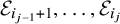


The remainder of this section is devoted to the proof of Theorem 5.4. For that we fix a regular locality $({\mathcal {L}},\Delta ,S)$
over
$({\mathcal {L}},\Delta ,S)$
over $\mathcal {F}$
. Such a regular locality exists always by [Reference Henke10, Lemma 10.4]. By [Reference Chermak and Henke5, Theorem F], for each
$\mathcal {F}$
. Such a regular locality exists always by [Reference Henke10, Lemma 10.4]. By [Reference Chermak and Henke5, Theorem F], for each $i=1,2,\dots ,n$
, there exists a unique partial subnormal subgroup
$i=1,2,\dots ,n$
, there exists a unique partial subnormal subgroup ${\mathcal {H}}_i$
of
${\mathcal {H}}_i$
of ${\mathcal {L}}$
with
${\mathcal {L}}$
with ${\mathcal {H}}_i\cap S=S_i$
and
${\mathcal {H}}_i\cap S=S_i$
and $\mathcal {F}_{S_i}({\mathcal {H}}_i)=\mathcal {E}_i$
. Set now
$\mathcal {F}_{S_i}({\mathcal {H}}_i)=\mathcal {E}_i$
. Set now
 $$\begin{align*}T:={\langle}S_1,S_2,\dots,S_n{\rangle}\text{ and }{\mathcal{H}}:={\langle}{\mathcal{H}}_1,{\mathcal{H}}_2,\dots,{\mathcal{H}}_n{\rangle}.\end{align*}$$
Moreover, define
 $$\begin{align*}\mathcal{E}:={\langle}\!{\langle} \mathcal{E}_1,\mathcal{E}_2,\dots,\mathcal{E}_n{\rangle}\!{\rangle}:=\mathcal{F}_{{\mathcal{H}}\cap S}({\mathcal{H}}).\end{align*}$$
Similarly, we define ${\langle }\!{\langle } \mathcal {D}_1,\dots ,\mathcal {D}_r{\rangle }\!{\rangle }$
whenever
${\langle }\!{\langle } \mathcal {D}_1,\dots ,\mathcal {D}_r{\rangle }\!{\rangle }$
whenever $\mathcal {D}_1,\dots ,\mathcal {D}_r$
are subnormal subsystems of
$\mathcal {D}_1,\dots ,\mathcal {D}_r$
are subnormal subsystems of $\mathcal {F}$
. Note that the definition depends a priori on the choice of the regular locality
$\mathcal {F}$
. Note that the definition depends a priori on the choice of the regular locality $({\mathcal {L}},\Delta ,S)$
. However, we will show below that Theorem 5.4(b) holds for this choice of
$({\mathcal {L}},\Delta ,S)$
. However, we will show below that Theorem 5.4(b) holds for this choice of $\mathcal {E}$
, and thus
$\mathcal {E}$
, and thus $\mathcal {E}$
is in fact uniquely determined by
$\mathcal {E}$
is in fact uniquely determined by $\mathcal {F}$
and
$\mathcal {F}$
and $\mathcal {E}_1,\dots ,\mathcal {E}_n$
.
$\mathcal {E}_1,\dots ,\mathcal {E}_n$
.
Lemma 5.5. The following hold:
-
(a)
${\mathcal {H}}\cap S=T$
and
$\mathcal {E}$
is a subnormal subsystem of
$\mathcal {F}$
over T. Moreover,
$\mathcal {E}_i{\,\trianglelefteq \trianglelefteq \,}\mathcal {E}$
for all
$i=1,2,\dots ,n$
. -
(b) Let
$1\leq i_1<i_2<\cdots <i_k=n$
. Then
$$\begin{align*}\mathcal{E}={\langle}\!{\langle} \;{\langle}\!{\langle} \mathcal{E}_1,\dots\mathcal{E}_{i_1}{\rangle}\!{\rangle},{\langle}\!{\langle} \mathcal{E}_{i_1+1},\dots,\mathcal{E}_{i_2}{\rangle}\!{\rangle},\dots,{\langle}\!{\langle} \mathcal{E}_{i_{k-1}+1},\dots ,\mathcal{E}_{i_k}{\rangle}\!{\rangle}\;{\rangle}\!{\rangle}.\end{align*}$$


Proof.
(a) By Corollary 4.11, we have ${\mathcal {H}}\cap S=T$
and
${\mathcal {H}}\cap S=T$
and ${\mathcal {H}}{\,\trianglelefteq \trianglelefteq \,}{\mathcal {L}}$
. In particular,
${\mathcal {H}}{\,\trianglelefteq \trianglelefteq \,}{\mathcal {L}}$
. In particular, $\mathcal {E}=\mathcal {F}_{{\mathcal {H}}\cap S}({\mathcal {H}})=\mathcal {F}_T({\mathcal {H}})$
is a subsystem over T. Moreover, it follows from [Reference Chermak and Henke5, Proposition 7.1(a)] that
$\mathcal {E}=\mathcal {F}_{{\mathcal {H}}\cap S}({\mathcal {H}})=\mathcal {F}_T({\mathcal {H}})$
is a subsystem over T. Moreover, it follows from [Reference Chermak and Henke5, Proposition 7.1(a)] that $\mathcal {E}$
is subnormal in
$\mathcal {E}$
is subnormal in $\mathcal {F}$
. As
$\mathcal {F}$
. As ${\mathcal {H}}_i\subseteq {\mathcal {H}}$
and
${\mathcal {H}}_i\subseteq {\mathcal {H}}$
and ${\mathcal {H}}_i{\,\trianglelefteq \trianglelefteq \,}{\mathcal {L}}$
, it is a consequence of [Reference Chermak and Henke5, Proposition 7.1(c)] that
${\mathcal {H}}_i{\,\trianglelefteq \trianglelefteq \,}{\mathcal {L}}$
, it is a consequence of [Reference Chermak and Henke5, Proposition 7.1(c)] that $\mathcal {E}_i=\mathcal {F}_{S\cap {\mathcal {H}}_i}({\mathcal {H}}_i){\,\trianglelefteq \trianglelefteq \,}\mathcal {F}_T({\mathcal {H}})=\mathcal {E}$
for all
$\mathcal {E}_i=\mathcal {F}_{S\cap {\mathcal {H}}_i}({\mathcal {H}}_i){\,\trianglelefteq \trianglelefteq \,}\mathcal {F}_T({\mathcal {H}})=\mathcal {E}$
for all $i=1,2,\dots ,n$
.
$i=1,2,\dots ,n$
.
(b) This follows since
 $$\begin{align*}{\mathcal{H}}:={\langle}{\mathcal{H}}_1,{\mathcal{H}}_2,\dots,{\mathcal{H}}_n{\rangle}={\langle}\;{\langle}{\mathcal{H}}_1,\dots{\mathcal{H}}_{i_1}{\rangle},{\langle}{\mathcal{H}}_{i_1+1},\dots,{\mathcal{H}}_{i_2}{\rangle},\dots,{\langle} {\mathcal{H}}_{i_{k-1}+1},\dots ,{\mathcal{H}}_{i_k}{\rangle}\;{\rangle}.\\[-35pt]\end{align*}$$
The next goal is the proof of Theorem 5.4(b). We start with two preliminary results, which will also be used in the proof of Proposition D.
Lemma 5.6. Suppose $n=2$
and
$n=2$
and $T\leq N_S(\mathcal {E}_1)\cap N_S(\mathcal {E}_2)$
. Then
$T\leq N_S(\mathcal {E}_1)\cap N_S(\mathcal {E}_2)$
. Then
 $$\begin{align*}\mathcal{E}={\langle}(\mathcal{E}_1T)_{\mathcal{F}},(\mathcal{E}_2T)_{\mathcal{F}}{\rangle}.\end{align*}$$
Proof. We use throughout that $T={\mathcal {H}}\cap S$
by Lemma 5.5(a). By [Reference Henke12, Lemma 3.8],
$T={\mathcal {H}}\cap S$
by Lemma 5.5(a). By [Reference Henke12, Lemma 3.8], $N_S(\mathcal {E}_i)=N_S({\mathcal {H}}_i)$
for
$N_S(\mathcal {E}_i)=N_S({\mathcal {H}}_i)$
for $i=1,2$
. Hence,
$i=1,2$
. Hence, $T\leq N_S({\mathcal {H}}_1)\cap N_S({\mathcal {H}}_2)$
and so Lemma 4.10 gives
$T\leq N_S({\mathcal {H}}_1)\cap N_S({\mathcal {H}}_2)$
and so Lemma 4.10 gives
 $$\begin{align*}\mathcal{E}={\langle}\mathcal{F}_T({\mathcal{H}}_1T),\mathcal{F}_T({\mathcal{H}}_2T){\rangle}.\end{align*}$$
By [Reference Henke12, Theorem B(b)], $\mathcal {F}_T({\mathcal {H}}_iT)=(\mathcal {E}_iT)_{\mathcal {F}}$
for
$\mathcal {F}_T({\mathcal {H}}_iT)=(\mathcal {E}_iT)_{\mathcal {F}}$
for $i=1,2$
. Hence the assertion holds.
$i=1,2$
. Hence the assertion holds.
Lemma 5.7. Let $x\in T$
. Then
$x\in T$
. Then $\mathcal {E}_1^x{\,\trianglelefteq \trianglelefteq \,}\mathcal {F}$
and
$\mathcal {E}_1^x{\,\trianglelefteq \trianglelefteq \,}\mathcal {F}$
and $\mathcal {E}={\langle }\!{\langle } \mathcal {E}_1,\mathcal {E}_1^x,\mathcal {E}_2,\mathcal {E}_3,\dots ,\mathcal {E}_n{\rangle }\!{\rangle }$
.
$\mathcal {E}={\langle }\!{\langle } \mathcal {E}_1,\mathcal {E}_1^x,\mathcal {E}_2,\mathcal {E}_3,\dots ,\mathcal {E}_n{\rangle }\!{\rangle }$
.
Proof. Since $c_x\in \operatorname {Aut}(S)$
induces an automorphism of
$c_x\in \operatorname {Aut}(S)$
induces an automorphism of $\mathcal {F}$
, we have
$\mathcal {F}$
, we have $\mathcal {E}_1^x{\,\trianglelefteq \trianglelefteq \,}\mathcal {F}$
. Indeed, it is shown in [Reference Henke12, Lemma 3.26(a)] that
$\mathcal {E}_1^x{\,\trianglelefteq \trianglelefteq \,}\mathcal {F}$
. Indeed, it is shown in [Reference Henke12, Lemma 3.26(a)] that ${\mathcal {H}}_1^x{\,\trianglelefteq \trianglelefteq \,}{\mathcal {L}}$
and
${\mathcal {H}}_1^x{\,\trianglelefteq \trianglelefteq \,}{\mathcal {L}}$
and $\mathcal {E}_1^x=\mathcal {F}_{S\cap {\mathcal {H}}_1^x}({\mathcal {H}}_1^x)$
(which implies by [Reference Chermak and Henke5, Theorem 7.1(a)] also that
$\mathcal {E}_1^x=\mathcal {F}_{S\cap {\mathcal {H}}_1^x}({\mathcal {H}}_1^x)$
(which implies by [Reference Chermak and Henke5, Theorem 7.1(a)] also that $\mathcal {E}_1^x{\,\trianglelefteq \trianglelefteq \,}\mathcal {F}$
). As
$\mathcal {E}_1^x{\,\trianglelefteq \trianglelefteq \,}\mathcal {F}$
). As $x\in T\subseteq {\mathcal {H}}={\langle }{\mathcal {H}}_1,{\mathcal {H}}_2,\dots ,{\mathcal {H}}_n{\rangle }$
, we have moreover that
$x\in T\subseteq {\mathcal {H}}={\langle }{\mathcal {H}}_1,{\mathcal {H}}_2,\dots ,{\mathcal {H}}_n{\rangle }$
, we have moreover that ${\mathcal {H}}={\langle }{\mathcal {H}}_1,{\mathcal {H}}_1^x,{\mathcal {H}}_2,\dots ,{\mathcal {H}}_n{\rangle }$
. It follows now from the definitions of
${\mathcal {H}}={\langle }{\mathcal {H}}_1,{\mathcal {H}}_1^x,{\mathcal {H}}_2,\dots ,{\mathcal {H}}_n{\rangle }$
. It follows now from the definitions of $\mathcal {E}$
and of
$\mathcal {E}$
and of ${\langle }\!{\langle } \mathcal {E}_1,\mathcal {E}_1^x,\mathcal {E}_2,\dots ,\mathcal {E}_n{\rangle }\!{\rangle }$
that
${\langle }\!{\langle } \mathcal {E}_1,\mathcal {E}_1^x,\mathcal {E}_2,\dots ,\mathcal {E}_n{\rangle }\!{\rangle }$
that
 $$\begin{align*}\mathcal{E}=\mathcal{F}_{{\mathcal{H}}\cap S}({\mathcal{H}})={\langle}\!{\langle}\mathcal{E}_1,\mathcal{E}_1^x,\mathcal{E}_2,\dots,\mathcal{E}_n{\rangle}\!{\rangle}\\[-42pt]\end{align*}$$
Lemma 5.8. Let $\mathcal {G}$
be a saturated subsystem of
$\mathcal {G}$
be a saturated subsystem of $\mathcal {F}$
with
$\mathcal {F}$
with $\mathcal {E}_i{\,\trianglelefteq \trianglelefteq \,}\mathcal {G}$
for
$\mathcal {E}_i{\,\trianglelefteq \trianglelefteq \,}\mathcal {G}$
for $i=1,2,\dots ,n$
. Then
$i=1,2,\dots ,n$
. Then $\mathcal {E}{\,\trianglelefteq \trianglelefteq \,}\mathcal {G}$
.
$\mathcal {E}{\,\trianglelefteq \trianglelefteq \,}\mathcal {G}$
.
Proof. If $n=1$
, then
$n=1$
, then $\mathcal {E}=\mathcal {E}_1{\,\trianglelefteq \trianglelefteq \,}\mathcal {G}$
. Hence, using Lemma 5.5(b) and induction on n, we can reduce to the case
$\mathcal {E}=\mathcal {E}_1{\,\trianglelefteq \trianglelefteq \,}\mathcal {G}$
. Hence, using Lemma 5.5(b) and induction on n, we can reduce to the case $n=2$
. Thus, we assume from now on that
$n=2$
. Thus, we assume from now on that
 $$\begin{align*}n=2.\end{align*}$$
Suppose moreover that $(\mathcal {F},\mathcal {G},\mathcal {E}_1,\mathcal {E}_2,{\mathcal {L}},\Delta ,S)$
is a counterexample such that first
$(\mathcal {F},\mathcal {G},\mathcal {E}_1,\mathcal {E}_2,{\mathcal {L}},\Delta ,S)$
is a counterexample such that first $|S:T|$
and then
$|S:T|$
and then $|\mathcal {E}_1|+|\mathcal {E}_2|$
is maximal, where
$|\mathcal {E}_1|+|\mathcal {E}_2|$
is maximal, where $T={\langle }S_1,S_2{\rangle }$
as before and
$T={\langle }S_1,S_2{\rangle }$
as before and $|\mathcal {E}_i|$
denotes the number of morphisms in
$|\mathcal {E}_i|$
denotes the number of morphisms in $\mathcal {E}_i$
for
$\mathcal {E}_i$
for $i=1,2$
.
$i=1,2$
.
Let $S'\leq S$
such that
$S'\leq S$
such that $\mathcal {G}$
is a subsystem over
$\mathcal {G}$
is a subsystem over $S'$
. As
$S'$
. As $\mathcal {E}_1$
and
$\mathcal {E}_1$
and $\mathcal {E}_2$
are contained in
$\mathcal {E}_2$
are contained in $\mathcal {G}$
, we have
$\mathcal {G}$
, we have $T\leq S'$
. Fix now a regular locality
$T\leq S'$
. Fix now a regular locality $({\mathcal {L}}',\Delta ',S')$
over
$({\mathcal {L}}',\Delta ',S')$
over $\mathcal {G}$
(which exists by [Reference Henke10, Lemma 10.4]). By [Reference Chermak and Henke5, Theorem E(a)], there exist partial subnormal subgroups
$\mathcal {G}$
(which exists by [Reference Henke10, Lemma 10.4]). By [Reference Chermak and Henke5, Theorem E(a)], there exist partial subnormal subgroups ${\mathcal {H}}_1',{\mathcal {H}}_2'$
of
${\mathcal {H}}_1',{\mathcal {H}}_2'$
of ${\mathcal {L}}'$
such that
${\mathcal {L}}'$
such that $S_i={\mathcal {H}}_i'\cap S'$
and
$S_i={\mathcal {H}}_i'\cap S'$
and $\mathcal {E}_i=\mathcal {F}_{S_i}({\mathcal {H}}_i')$
for
$\mathcal {E}_i=\mathcal {F}_{S_i}({\mathcal {H}}_i')$
for $i=1,2$
. So we may define
$i=1,2$
. So we may define
 $$\begin{align*}{\langle}\!{\langle} \mathcal{E}_1,\mathcal{E}_2{\rangle}\!{\rangle}_{\mathcal{G}}:=\mathcal{F}_{S\cap {\mathcal{H}}'}({\mathcal{H}}')\text{ where }{\mathcal{H}}':={\langle}{\mathcal{H}}_1',{\mathcal{H}}_2'{\rangle}.\end{align*}$$
Notice that ${\langle }\!{\langle } \mathcal {E}_1,\mathcal {E}_2{\rangle }\!{\rangle }_{\mathcal {G}}{\,\trianglelefteq \trianglelefteq \,}\mathcal {G}$
by Lemma 5.5(a) applied with
${\langle }\!{\langle } \mathcal {E}_1,\mathcal {E}_2{\rangle }\!{\rangle }_{\mathcal {G}}{\,\trianglelefteq \trianglelefteq \,}\mathcal {G}$
by Lemma 5.5(a) applied with $(\mathcal {G},{\mathcal {L}}',\Delta ',S')$
in place of
$(\mathcal {G},{\mathcal {L}}',\Delta ',S')$
in place of $(\mathcal {F},{\mathcal {L}},\Delta ,S)$
.
$(\mathcal {F},{\mathcal {L}},\Delta ,S)$
.
Assume now first that $T\leq N_S(\mathcal {E}_1)\cap N_S(\mathcal {E}_2)$
. Then Lemma 5.6 yields
$T\leq N_S(\mathcal {E}_1)\cap N_S(\mathcal {E}_2)$
. Then Lemma 5.6 yields $\mathcal {E}={\langle } (\mathcal {E}_1T)_{\mathcal {F}},(\mathcal {E}_2T)_{\mathcal {F}}{\rangle }$
. As
$\mathcal {E}={\langle } (\mathcal {E}_1T)_{\mathcal {F}},(\mathcal {E}_2T)_{\mathcal {F}}{\rangle }$
. As $T\leq S'$
, we have
$T\leq S'$
, we have $T\leq N_{S'}(\mathcal {E}_1)\cap N_{S'}(\mathcal {E}_2)$
. Hence, Lemma 5.6 applied with
$T\leq N_{S'}(\mathcal {E}_1)\cap N_{S'}(\mathcal {E}_2)$
. Hence, Lemma 5.6 applied with $(\mathcal {G},{\mathcal {L}}',\Delta ',S')$
in place of
$(\mathcal {G},{\mathcal {L}}',\Delta ',S')$
in place of $(\mathcal {F},{\mathcal {L}},\Delta ,S)$
yields also that
$(\mathcal {F},{\mathcal {L}},\Delta ,S)$
yields also that ${\langle }\!{\langle } \mathcal {E}_1,\mathcal {E}_2{\rangle }\!{\rangle }_{\mathcal {G}}={\langle }(\mathcal {E}_1 T)_{\mathcal {G}},(\mathcal {E}_2 T)_{\mathcal {G}}{\rangle }$
. It follows now from Remark 5.1 that
${\langle }\!{\langle } \mathcal {E}_1,\mathcal {E}_2{\rangle }\!{\rangle }_{\mathcal {G}}={\langle }(\mathcal {E}_1 T)_{\mathcal {G}},(\mathcal {E}_2 T)_{\mathcal {G}}{\rangle }$
. It follows now from Remark 5.1 that $(\mathcal {E}_i T)_{\mathcal {G}}=(\mathcal {E}_i T)_{\mathcal {F}}$
for
$(\mathcal {E}_i T)_{\mathcal {G}}=(\mathcal {E}_i T)_{\mathcal {F}}$
for $i=1,2$
and thus
$i=1,2$
and thus
 $$\begin{align*}\mathcal{E}={\langle}\!{\langle} \mathcal{E}_1,\mathcal{E}_2{\rangle}\!{\rangle}_{\mathcal{G}}{\,\trianglelefteq\trianglelefteq\,}\mathcal{G}.\end{align*}$$
This contradicts the assumption that $(\mathcal {F},\mathcal {G},\mathcal {E}_1,\mathcal {E}_2,{\mathcal {L}},\Delta ,S)$
is a counterexample. Hence,
$(\mathcal {F},\mathcal {G},\mathcal {E}_1,\mathcal {E}_2,{\mathcal {L}},\Delta ,S)$
is a counterexample. Hence, $T\not \leq N_S(\mathcal {E}_i)$
for some
$T\not \leq N_S(\mathcal {E}_i)$
for some $i=1,2$
. Since the situation is symmetric in
$i=1,2$
. Since the situation is symmetric in $\mathcal {E}_1$
and
$\mathcal {E}_1$
and $\mathcal {E}_2$
, we may assume without loss of generality that
$\mathcal {E}_2$
, we may assume without loss of generality that
 $$\begin{align*}T\not\leq N_S(\mathcal{E}_1).\end{align*}$$
This means that $T_0:=T\cap N_S(\mathcal {E}_1)<T$
and thus
$T_0:=T\cap N_S(\mathcal {E}_1)<T$
and thus $T_0<N_T(T_0)$
. Fix
$T_0<N_T(T_0)$
. Fix $x\in N_T(T_0)\backslash T_0$
. By Lemma 5.7, we have
$x\in N_T(T_0)\backslash T_0$
. By Lemma 5.7, we have $\mathcal {E}_1^x{\,\trianglelefteq \trianglelefteq \,}\mathcal {F}$
and
$\mathcal {E}_1^x{\,\trianglelefteq \trianglelefteq \,}\mathcal {F}$
and $\mathcal {E}_1^x{\,\trianglelefteq \trianglelefteq \,}\mathcal {G}$
. Set now
$\mathcal {E}_1^x{\,\trianglelefteq \trianglelefteq \,}\mathcal {G}$
. Set now
 $$\begin{align*}\tilde{\mathcal{E}}_1:={\langle}\!{\langle} \mathcal{E}_1,\mathcal{E}_1^x{\rangle}\!{\rangle}.\end{align*}$$
Notice that $\mathcal {E}_1^x$
is a subsystem over
$\mathcal {E}_1^x$
is a subsystem over $S_1^x$
and
$S_1^x$
and $\tilde {S}_1:={\langle }S_1,S_1^x{\rangle }\leq T_0<T$
as
$\tilde {S}_1:={\langle }S_1,S_1^x{\rangle }\leq T_0<T$
as $S_1\leq T_0$
. Thus,
$S_1\leq T_0$
. Thus, $|S:\tilde {S}_1|>|S:T|$
, and so the maximality of
$|S:\tilde {S}_1|>|S:T|$
, and so the maximality of $|S:T|$
yields that
$|S:T|$
yields that $(\mathcal {F},\mathcal {G},\mathcal {E}_1,\mathcal {E}_1^x,{\mathcal {L}},\Delta ,S)$
is not a counterexample. Hence,
$(\mathcal {F},\mathcal {G},\mathcal {E}_1,\mathcal {E}_1^x,{\mathcal {L}},\Delta ,S)$
is not a counterexample. Hence,
 $$\begin{align*}\tilde{\mathcal{E}}_1{\,\trianglelefteq\trianglelefteq\,} \mathcal{G}.\end{align*}$$
By Lemma 5.5(a), $\tilde {\mathcal {E}}_1$
is a subnormal subsystem of
$\tilde {\mathcal {E}}_1$
is a subnormal subsystem of $\mathcal {F}$
over
$\mathcal {F}$
over $\tilde {S}_1$
. As
$\tilde {S}_1$
. As $x\in T$
and
$x\in T$
and $\tilde {S}_1={\langle }S_1,S_1^x{\rangle }$
, it follows that
$\tilde {S}_1={\langle }S_1,S_1^x{\rangle }$
, it follows that $T={\langle }S_1,S_2{\rangle }={\langle }\tilde {S}_1,S_2{\rangle }$
. The choice of x yields that
$T={\langle }S_1,S_2{\rangle }={\langle }\tilde {S}_1,S_2{\rangle }$
. The choice of x yields that $\mathcal {E}_1^x\neq \mathcal {E}_1$
. Since
$\mathcal {E}_1^x\neq \mathcal {E}_1$
. Since $\mathcal {E}_1$
and
$\mathcal {E}_1$
and $\mathcal {E}_1^x$
are contained in
$\mathcal {E}_1^x$
are contained in $\tilde {\mathcal {E}}_1$
, the subsystem
$\tilde {\mathcal {E}}_1$
, the subsystem $\mathcal {E}_1$
is therefore properly contained in
$\mathcal {E}_1$
is therefore properly contained in $\tilde {\mathcal {E}}_1$
. So
$\tilde {\mathcal {E}}_1$
. So $|\tilde {\mathcal {E}}_1|>|\mathcal {E}_1|$
and the maximality of
$|\tilde {\mathcal {E}}_1|>|\mathcal {E}_1|$
and the maximality of $|\mathcal {E}_1|+|\mathcal {E}_2|$
yields that
$|\mathcal {E}_1|+|\mathcal {E}_2|$
yields that $(\mathcal {F},\mathcal {G},\tilde {\mathcal {E}}_1,\mathcal {E}_2,{\mathcal {L}},\Delta ,S)$
is not a counterexample. As
$(\mathcal {F},\mathcal {G},\tilde {\mathcal {E}}_1,\mathcal {E}_2,{\mathcal {L}},\Delta ,S)$
is not a counterexample. As $\tilde {\mathcal {E}}_1$
and
$\tilde {\mathcal {E}}_1$
and $\mathcal {E}_2$
are subnormal in
$\mathcal {E}_2$
are subnormal in $\mathcal {F}$
and in
$\mathcal {F}$
and in $\mathcal {G}$
, this means that
$\mathcal {G}$
, this means that
 $$ \begin{align*} {\langle}\!{\langle} \tilde{\mathcal{E}}_1,\mathcal{E}_2{\rangle}\!{\rangle} {\,\trianglelefteq\trianglelefteq\,}\mathcal{G}. \end{align*} $$
Applying first Lemma 5.7 and then Lemma 5.5(b), we can conclude now that
 $$\begin{align*}\mathcal{E}={\langle}\!{\langle}\mathcal{E}_1,\mathcal{E}_1^x,\mathcal{E}_2{\rangle}\!{\rangle}={\langle}\!{\langle}\tilde{\mathcal{E}}_1,\mathcal{E}_2{\rangle}\!{\rangle}{\,\trianglelefteq\trianglelefteq\,}\mathcal{G}.\end{align*}$$
This contradicts the assumption that $(\mathcal {F},\mathcal {G},\mathcal {E}_1,\mathcal {E}_2,{\mathcal {L}},\Delta ,S)$
is a counterexample and completes thereby the proof.
$(\mathcal {F},\mathcal {G},\mathcal {E}_1,\mathcal {E}_2,{\mathcal {L}},\Delta ,S)$
is a counterexample and completes thereby the proof.
Proof of Theorem 5.4.
Note that Lemma 5.5(a) verifies part (a) and that Lemma 5.8 verifies part (b), if $\mathcal {E}$
is defined as above (a priori in dependence of
$\mathcal {E}$
is defined as above (a priori in dependence of $({\mathcal {L}},\Delta ,S)$
). In particular,
$({\mathcal {L}},\Delta ,S)$
). In particular, $\mathcal {E}$
is the smallest saturated subsystem of
$\mathcal {E}$
is the smallest saturated subsystem of $\mathcal {F}$
in which
$\mathcal {F}$
in which $\mathcal {E}_1,\mathcal {E}_2,\dots ,\mathcal {E}_n$
are subnormal, and
$\mathcal {E}_1,\mathcal {E}_2,\dots ,\mathcal {E}_n$
are subnormal, and $\mathcal {E}$
depends in fact only on
$\mathcal {E}$
depends in fact only on $\mathcal {E}_1,\dots ,\mathcal {E}_n$
and
$\mathcal {E}_1,\dots ,\mathcal {E}_n$
and $\mathcal {F}$
, but not on the choice of the regular locality
$\mathcal {F}$
, but not on the choice of the regular locality $({\mathcal {L}},\Delta ,S)$
. Therefore, part (d) follows from the definition of
$({\mathcal {L}},\Delta ,S)$
. Therefore, part (d) follows from the definition of $\mathcal {E}$
, and (c) follows from Lemma 5.5(b).
$\mathcal {E}$
, and (c) follows from Lemma 5.5(b).
We end this subsection with an example which helps to motivate why we formulate Theorem B and Theorem 5.4 as we do. More precisely, in our example we illustrate that, for two subnormal subsystems $\mathcal {E}_1$
and
$\mathcal {E}_1$
and $\mathcal {E}_2$
of a saturated fusion system
$\mathcal {E}_2$
of a saturated fusion system $\mathcal {F}$
, the subsystem generated by
$\mathcal {F}$
, the subsystem generated by $\mathcal {E}_1$
and
$\mathcal {E}_1$
and $\mathcal {E}_2$
may not be saturated and thus in particular not subnormal. Moreover, our example shows that there is not necessarily a smallest saturated or a smallest subnormal subsystem of
$\mathcal {E}_2$
may not be saturated and thus in particular not subnormal. Moreover, our example shows that there is not necessarily a smallest saturated or a smallest subnormal subsystem of $\mathcal {F}$
containing
$\mathcal {F}$
containing $\mathcal {E}_1$
and
$\mathcal {E}_1$
and $\mathcal {E}_2$
. Thus, it is important to characterize
$\mathcal {E}_2$
. Thus, it is important to characterize ${\langle }\!{\langle } \mathcal {E}_1,\mathcal {E}_2{\rangle }\!{\rangle }$
as the smallest saturated subsystem in which
${\langle }\!{\langle } \mathcal {E}_1,\mathcal {E}_2{\rangle }\!{\rangle }$
as the smallest saturated subsystem in which $\mathcal {E}_1$
and
$\mathcal {E}_1$
and $\mathcal {E}_2$
are subnormal.
$\mathcal {E}_2$
are subnormal.
Example 5.9. Let $G=G_1\times G_2$
with
$G=G_1\times G_2$
with $G_1\cong G_2\cong A_4$
. Setting
$G_1\cong G_2\cong A_4$
. Setting $T_i:=O_p(G_i)$
for
$T_i:=O_p(G_i)$
for $i=1,2$
and
$i=1,2$
and $S:=T_1\times T_2$
, we have
$S:=T_1\times T_2$
, we have $S\in \operatorname {Syl}_p(G)$
. Set
$S\in \operatorname {Syl}_p(G)$
. Set $\mathcal {F}=\mathcal {F}_S(G)$
and
$\mathcal {F}=\mathcal {F}_S(G)$
and $\mathcal {E}_i=\mathcal {F}_{T_i}(G_i)$
for
$\mathcal {E}_i=\mathcal {F}_{T_i}(G_i)$
for $i=1,2$
. Note that
$i=1,2$
. Note that $G_i\,{\trianglelefteq }\, G$
and thus
$G_i\,{\trianglelefteq }\, G$
and thus $\mathcal {E}_i\,{\trianglelefteq }\,\mathcal {F}$
for
$\mathcal {E}_i\,{\trianglelefteq }\,\mathcal {F}$
for $i=1,2$
. In particular,
$i=1,2$
. In particular, $\mathcal {E}_1$
and
$\mathcal {E}_1$
and $\mathcal {E}_2$
are subnormal in
$\mathcal {E}_2$
are subnormal in $\mathcal {F}$
.
$\mathcal {F}$
.
If $\mathcal {E}_1$
is contained in a saturated fusion system
$\mathcal {E}_1$
is contained in a saturated fusion system $\mathcal {D}$
over S, then, by the extension axiom, every element of
$\mathcal {D}$
over S, then, by the extension axiom, every element of $\operatorname {Aut}_{\mathcal {E}_1}(S_1)$
extends to a
$\operatorname {Aut}_{\mathcal {E}_1}(S_1)$
extends to a $\mathcal {D}$
-automorphism of S, which yields
$\mathcal {D}$
-automorphism of S, which yields $\operatorname {Aut}_{\mathcal {D}}(S)\neq \operatorname {Aut}_S(S)$
. In particular, the following holds:
$\operatorname {Aut}_{\mathcal {D}}(S)\neq \operatorname {Aut}_S(S)$
. In particular, the following holds:
 $$ \begin{align} \text{If } \mathcal{D}\ \text{is a saturated subsystem of}\ \mathcal{F}\ \text{containing}\ \mathcal{E}_1\ \text{and}\ \mathcal{E}_2, \text{then}\ \operatorname{Aut}_{\mathcal{D}}(S)\neq\operatorname{Aut}_S(S). \end{align} $$
Note that $\operatorname {Aut}_{{\langle }\mathcal {E}_1,\mathcal {E}_2{\rangle }}(S)=\operatorname {Aut}_S(S)$
. Hence,
$\operatorname {Aut}_{{\langle }\mathcal {E}_1,\mathcal {E}_2{\rangle }}(S)=\operatorname {Aut}_S(S)$
. Hence, ${\langle }\mathcal {E}_1,\mathcal {E}_2{\rangle }$
is by (5.1) not saturated (and is so in particular not subnormal in
${\langle }\mathcal {E}_1,\mathcal {E}_2{\rangle }$
is by (5.1) not saturated (and is so in particular not subnormal in $\mathcal {F}$
).
$\mathcal {F}$
).
We argue now that there is no smallest saturated subsystem of $\mathcal {F}$
containing
$\mathcal {F}$
containing $\mathcal {E}_1$
and
$\mathcal {E}_1$
and $\mathcal {E}_2$
, and indeed also no smallest subnormal subsystem of
$\mathcal {E}_2$
, and indeed also no smallest subnormal subsystem of $\mathcal {F}$
containing
$\mathcal {F}$
containing $\mathcal {E}_1$
and
$\mathcal {E}_1$
and $\mathcal {E}_2$
. Fix
$\mathcal {E}_2$
. Fix $d_i\in G_i$
of order
$d_i\in G_i$
of order $3$
for
$3$
for $i=1,2$
. Set
$i=1,2$
. Set $N_1:=S{\langle }d_1d_2{\rangle }$
,
$N_1:=S{\langle }d_1d_2{\rangle }$
, $N_2:=S{\langle }d_1d_2^2{\rangle }$
and
$N_2:=S{\langle }d_1d_2^2{\rangle }$
and $\mathcal {D}_i:=\mathcal {F}_S(N_i)$
for
$\mathcal {D}_i:=\mathcal {F}_S(N_i)$
for $i=1,2$
. Notice that
$i=1,2$
. Notice that $N_i\,{\trianglelefteq }\, G$
and thus
$N_i\,{\trianglelefteq }\, G$
and thus $\mathcal {D}_i\,{\trianglelefteq }\,\mathcal {F}$
for
$\mathcal {D}_i\,{\trianglelefteq }\,\mathcal {F}$
for $i=1,2$
. In particular,
$i=1,2$
. In particular, $\mathcal {D}_1$
and
$\mathcal {D}_1$
and $\mathcal {D}_2$
are subnormal in
$\mathcal {D}_2$
are subnormal in $\mathcal {F}$
. Observe also that
$\mathcal {F}$
. Observe also that $\mathcal {E}_1$
and
$\mathcal {E}_1$
and $\mathcal {E}_2$
are contained in
$\mathcal {E}_2$
are contained in $\mathcal {D}_i$
for
$\mathcal {D}_i$
for $i=1,2$
. However, if
$i=1,2$
. However, if $\mathcal {D}$
is a saturated fusion system containing
$\mathcal {D}$
is a saturated fusion system containing $\mathcal {E}_1$
and
$\mathcal {E}_1$
and $\mathcal {E}_2$
, then
$\mathcal {E}_2$
, then $\mathcal {D}$
is not contained in
$\mathcal {D}$
is not contained in $\mathcal {D}_1\cap \mathcal {D}_2$
, as otherwise
$\mathcal {D}_1\cap \mathcal {D}_2$
, as otherwise $\operatorname {Aut}_{\mathcal {D}}(S)=\operatorname {Aut}_{\mathcal {D}_1\cap \mathcal {D}_2}(S)=\operatorname {Aut}_S(S)$
, contradicting (5.1). Thus, there is no smallest saturated and no smallest subnormal subsystem of
$\operatorname {Aut}_{\mathcal {D}}(S)=\operatorname {Aut}_{\mathcal {D}_1\cap \mathcal {D}_2}(S)=\operatorname {Aut}_S(S)$
, contradicting (5.1). Thus, there is no smallest saturated and no smallest subnormal subsystem of $\mathcal {F}$
containing
$\mathcal {F}$
containing $\mathcal {E}_1$
and
$\mathcal {E}_1$
and $\mathcal {E}_2$
.
$\mathcal {E}_2$
.
It might also be worth observing that in this example, ${\langle }\!{\langle }\mathcal {E}_1,\mathcal {E}_2{\rangle }\!{\rangle }=\mathcal {F}$
. (One can see this by noting that
${\langle }\!{\langle }\mathcal {E}_1,\mathcal {E}_2{\rangle }\!{\rangle }=\mathcal {F}$
. (One can see this by noting that $(G,\delta (\mathcal {F}),S)$
is a regular locality, and so
$(G,\delta (\mathcal {F}),S)$
is a regular locality, and so ${\langle }\!{\langle } \mathcal {E}_1,\mathcal {E}_2{\rangle }\!{\rangle }$
is by Theorem 5.4(d) realized by
${\langle }\!{\langle } \mathcal {E}_1,\mathcal {E}_2{\rangle }\!{\rangle }$
is by Theorem 5.4(d) realized by ${\langle }G_1,G_2{\rangle }=G$
.) So
${\langle }G_1,G_2{\rangle }=G$
.) So ${\langle }\!{\langle }\mathcal {E}_1,\mathcal {E}_2{\rangle }\!{\rangle }$
is neither contained in
${\langle }\!{\langle }\mathcal {E}_1,\mathcal {E}_2{\rangle }\!{\rangle }$
is neither contained in $\mathcal {D}_1$
nor in
$\mathcal {D}_1$
nor in $\mathcal {D}_2$
, even though both subsystems contain
$\mathcal {D}_2$
, even though both subsystems contain $\mathcal {E}_1$
and
$\mathcal {E}_1$
and $\mathcal {E}_2$
.
$\mathcal {E}_2$
.
5.3 The proof of Proposition D
Throughout this subsection let $\mathcal {F}$
be a saturated fusion system over S. If
$\mathcal {F}$
be a saturated fusion system over S. If $\mathcal {E}_1,\mathcal {E}_2,\dots ,\mathcal {E}_n$
are subnormal subsystems of
$\mathcal {E}_1,\mathcal {E}_2,\dots ,\mathcal {E}_n$
are subnormal subsystems of $\mathcal {F}$
, then
$\mathcal {F}$
, then ${\langle }\!{\langle }\mathcal {E}_1,\mathcal {E}_2,\dots ,\mathcal {E}_n{\rangle }\!{\rangle }$
denotes the subsystem of
${\langle }\!{\langle }\mathcal {E}_1,\mathcal {E}_2,\dots ,\mathcal {E}_n{\rangle }\!{\rangle }$
denotes the subsystem of $\mathcal {F}$
which is characterized by Theorem 5.4(b) as the smallest saturated subsystem of
$\mathcal {F}$
which is characterized by Theorem 5.4(b) as the smallest saturated subsystem of $\mathcal {F}$
in which
$\mathcal {F}$
in which $\mathcal {E}_1,\mathcal {E}_2,\dots ,\mathcal {E}_n$
are subnormal.
$\mathcal {E}_1,\mathcal {E}_2,\dots ,\mathcal {E}_n$
are subnormal.
Lemma 5.10. Let $\mathcal {E}_1$
and
$\mathcal {E}_1$
and $\mathcal {E}_2$
be subnormal subsystems of
$\mathcal {E}_2$
be subnormal subsystems of $\mathcal {F}$
over subgroups
$\mathcal {F}$
over subgroups $S_1$
and
$S_1$
and $S_2$
of S respectively. Set
$S_2$
of S respectively. Set $T:={\langle }S_1,S_2{\rangle }$
. Then the following hold:
$T:={\langle }S_1,S_2{\rangle }$
. Then the following hold:
-
(a) If
$T\leq N_S(\mathcal {E}_1)\cap N_S(\mathcal {E}_2)$
, then
${\langle }\!{\langle } \mathcal {E}_1,\mathcal {E}_2{\rangle }\!{\rangle } ={\langle }(\mathcal {E}_1T)_{\mathcal {F}},(\mathcal {E}_2T)_{\mathcal {F}}{\rangle }$
. -
(b) For every
$x\in T$
, we have
${\langle }\!{\langle } \mathcal {E}_1,\mathcal {E}_2{\rangle }\!{\rangle }={\langle }\!{\langle } \mathcal {E}_1,\mathcal {E}_1^x,\mathcal {E}_2{\rangle }\!{\rangle }$
.


Proof. Using Theorem 5.4(d), part (a) is a restatement of Lemma 5.6 and part (b) follows from Lemma 5.7.
We are now able to prove Proposition D using a similar strategy as in the proof of Lemma 5.8.
Proof of Proposition D.
Set $S_i=S\cap H_i$
and
$S_i=S\cap H_i$
and $\mathcal {E}_i:=\mathcal {F}_{S_i}(H_i)$
for
$\mathcal {E}_i:=\mathcal {F}_{S_i}(H_i)$
for $i=1,2$
. Set moreover
$i=1,2$
. Set moreover $T:={\langle }S_1,S_2{\rangle }$
and
$T:={\langle }S_1,S_2{\rangle }$
and $H:={\langle }H_1,H_2{\rangle }$
. Note that
$H:={\langle }H_1,H_2{\rangle }$
. Note that $\mathcal {E}_1$
and
$\mathcal {E}_1$
and $\mathcal {E}_2$
are subnormal in
$\mathcal {E}_2$
are subnormal in $\mathcal {F}$
as stated in Lemma 5.2(b). Thus, the statement of the proposition makes sense. Assume now that
$\mathcal {F}$
as stated in Lemma 5.2(b). Thus, the statement of the proposition makes sense. Assume now that $(G,S,H_1,H_2)$
is a counterexample to the proposition such that first
$(G,S,H_1,H_2)$
is a counterexample to the proposition such that first $|S:T|$
and then
$|S:T|$
and then $|H_1|+|H_2|$
is maximal.
$|H_1|+|H_2|$
is maximal.
To start with, assume that $T\leq N_S(H_1)\cap N_S(H_2)$
. Then Lemma 5.2(b) gives that
$T\leq N_S(H_1)\cap N_S(H_2)$
. Then Lemma 5.2(b) gives that $T\leq N_S(\mathcal {E}_1)\cap N_S(\mathcal {E}_2)$
and
$T\leq N_S(\mathcal {E}_1)\cap N_S(\mathcal {E}_2)$
and $(\mathcal {E}_iT)_{\mathcal {F}}=\mathcal {F}_T(H_iT)$
for
$(\mathcal {E}_iT)_{\mathcal {F}}=\mathcal {F}_T(H_iT)$
for $i=1,2$
. Thus, Lemma 5.10(a) yields that
$i=1,2$
. Thus, Lemma 5.10(a) yields that
 $$\begin{align*}{\langle}\!{\langle} \mathcal{E}_1,\mathcal{E}_2{\rangle}\!{\rangle}={\langle}(\mathcal{E}_1T)_{\mathcal{F}},(\mathcal{E}_2T)_{\mathcal{F}}{\rangle}={\langle}\mathcal{F}_T(H_1T),\mathcal{F}_T(H_2T){\rangle}.\end{align*}$$
Hence, it follows from Theorem C that ${\langle }\!{\langle }\mathcal {E}_1,\mathcal {E}_2{\rangle }\!{\rangle }=\mathcal {F}_{H\cap S}(H)$
, contradicting the assumption that
${\langle }\!{\langle }\mathcal {E}_1,\mathcal {E}_2{\rangle }\!{\rangle }=\mathcal {F}_{H\cap S}(H)$
, contradicting the assumption that $(G,S,H_1,H_2)$
is a counterexample. Hence,
$(G,S,H_1,H_2)$
is a counterexample. Hence, $T\not \leq N_S(H_1)\cap N_S(H_2)$
. Since the situation is symmetric in
$T\not \leq N_S(H_1)\cap N_S(H_2)$
. Since the situation is symmetric in $H_1$
and
$H_1$
and $H_2$
, we may assume that
$H_2$
, we may assume that
 $$\begin{align*}T\not\leq N_S(H_1).\end{align*}$$
This means that $T_0:=N_T(H_1)<T$
and thus
$T_0:=N_T(H_1)<T$
and thus $T_0<N_T(T_0)$
as T is a p-group. Fix
$T_0<N_T(T_0)$
as T is a p-group. Fix $x\in N_T(T_0)\backslash T_0$
. Note that
$x\in N_T(T_0)\backslash T_0$
. Note that $S_1\leq T_0$
and so
$S_1\leq T_0$
and so $H_1^x\cap S=S_1^x\leq T_0\leq S$
. Hence,
$H_1^x\cap S=S_1^x\leq T_0\leq S$
. Hence, $\tilde {S}_1:={\langle }S_1,S_1^x{\rangle }\leq T_0<T$
and
$\tilde {S}_1:={\langle }S_1,S_1^x{\rangle }\leq T_0<T$
and $|S:\tilde {S}_1|>|S:T|$
. Observe also that
$|S:\tilde {S}_1|>|S:T|$
. Observe also that $\mathcal {F}_{H_1^x\cap S}(H_1^x)=\mathcal {E}_1^x$
. Setting
$\mathcal {F}_{H_1^x\cap S}(H_1^x)=\mathcal {E}_1^x$
. Setting ${\tilde {H}}_1:={\langle }H_1,H_1^x{\rangle }$
, the maximality of
${\tilde {H}}_1:={\langle }H_1,H_1^x{\rangle }$
, the maximality of $|S:T|$
yields thus that
$|S:T|$
yields thus that
 $$\begin{align*}\mathcal{F}_{{\tilde{H}}_1\cap S}({\tilde{H}}_1)={\langle}\!{\langle} \mathcal{E}_1,\mathcal{E}_1^x{\rangle}\!{\rangle}.\end{align*}$$
Recall that x is chosen such that $H_1\neq H_1^x$
and
$H_1\neq H_1^x$
and $x\in T\leq H={\langle }H_1,H_2{\rangle }$
. Hence,
$x\in T\leq H={\langle }H_1,H_2{\rangle }$
. Hence, $H_1<{\tilde {H}}_1$
and
$H_1<{\tilde {H}}_1$
and $H={\langle }{\tilde {H}}_1,H_2{\rangle }$
. By Wielandt’s Join Theorem,
$H={\langle }{\tilde {H}}_1,H_2{\rangle }$
. By Wielandt’s Join Theorem, ${\tilde {H}}_1$
is subnormal in G. Therefore, the maximality of
${\tilde {H}}_1$
is subnormal in G. Therefore, the maximality of $|H_1|+|H_2|$
yields that
$|H_1|+|H_2|$
yields that
 $$\begin{align*}\mathcal{F}_{H\cap S}(H)={\langle}\!{\langle} \;\mathcal{F}_{{\tilde{H}}_1\cap S}({\tilde{H}}_1),\mathcal{F}_{H_2\cap S}(H_2)\;{\rangle}\!{\rangle}={\langle}\!{\langle}\;{\langle}\!{\langle} \mathcal{E}_1,\mathcal{E}_1^x{\rangle}\!{\rangle},\mathcal{E}_2\;{\rangle}\!{\rangle}.\end{align*}$$
Using first Theorem 5.4(c) and then Lemma 5.10(b), we obtain now
 $$\begin{align*}\mathcal{F}_{H\cap S}(H)={\langle}\!{\langle}\mathcal{E}_1,\mathcal{E}_1^x,\mathcal{E}_2{\rangle}\!{\rangle}={\langle}\!{\langle}\mathcal{E}_1,\mathcal{E}_2{\rangle}\!{\rangle},\end{align*}$$
contradicting the assumption that $(G,S,H_1,H_2)$
is a counterexample.
$(G,S,H_1,H_2)$
is a counterexample.
Acknowledgments
The author would like to thank Bernd Stellmacher for pointing out that Meierfrankenfeld’s Lemma (Lemma 2.1) holds. Moreover, the author is very grateful to Ulrich Meierfrankenfeld for allowing her to include his lemma and its proof in this paper.
Competing interests
The author has no Competing interests to declare.
Financial support
The author was funded by the Deutsche Forschungsgemeinschaft (DFG, German Research Foundation) – Projektnummer 511577973.
Ethical standards
The research meets all ethical guidelines, including adherence to the legal requirements of the study country.

 Open access

