


Introduction
As an indispensable element of modern health care services, nursing is responsible for meeting patients’ physical, mental, and social needs, improving their quality of life, and ensuring that individuals receive the most appropriate care during illness.Reference Flaubert, Le Menestrel, Williams, Wakefield, Flaubert, Le Menestrel and Williams 1 Emergency nursing is one of the most complex, fast-paced, and critical subfields of the nursing profession. Emergency care nurses have multifaceted responsibilities, including making split-second decisions, managing crises, optimizing limited resources, and ensuring patient safety.Reference Malak, Al-Faqeer and Yehia 2 , Reference Kim and Oh 3
In this context, triage practices are among the most critical and demanding areas of emergency nursing. The word triage originates from the French verb “trier,” meaning “to sort” or “to select.”Reference Christian 4 , Reference Duran, Koç and Baydın 5 In health care, triage is defined as the process of prioritizing and classifying patients according to the urgency of their clinical condition. The aim is to ensure the most effective use of limited health care resources and to enable the fastest possible intervention for patients in the most critical condition. 6
Triage requires prioritization based not only on patients’ clinical symptoms, but also on multiple factors such as available resources, staffing levels, and the capacity of the health care system.Reference Bazyar, Farrokhi and Khankeh 7 Therefore, triage practices are a complex decision-making process that requires not only medical knowledge and skills but also ethical sensitivity, communication skills, and teamwork.Reference Triyaj, İspir, Şimşek, Şahin, Şen and Karataş 8 Triage practitioners are responsible for rapidly identifying, intervening, and appropriately referring critically ill patients. Incorrect prioritization can negatively affect patient prognosis, misallocate team resources, and jeopardize patient safety.Reference Malak, Al-Faqeer and Yehia 2 The success of triage is directly dependent on the nurse’s up-to-date knowledge and clinical reasoning skills. Simulation-based training, virtual reality applications, and case-based teaching methods are among the modern approaches to developing nurses’ triage skills.Reference Watson, Anderson and Drake 9 , Reference Alhawatmeh, Rawashdeh and Alwidyan 10 Being able to make quick, accurate, and ethical decisions during the triage process both increases patient survival and ensures the efficient use of health care system resources.Reference Han and Yi 11
The increasing patient load in emergency departments, an aging population, the spread of chronic diseases, and limited access to primary care services have further increased the importance of triage practices. For nurses working in crowded and resource-constrained environments, triage requires not only clinical classification but also crisis management, communication strategies, and the ability to address ethical dilemmas.Reference Kim and Oh 3 Emergency nurses must determine the most appropriate priority category by quickly taking the patient’s history, assessing vital signs, and analyzing clinical findings during triage.Reference Bazyar, Farrokhi and Khankeh 7 This process becomes even more complex with special groups such as the elderly, children, and patients with communication difficulties. Therefore, emergency nurses must have both a broad clinical knowledge base and advanced communication skills.Reference Mackway-Jones, Marsden and Windle 12 , Reference Güllerci and Ahmet Bütün 13
Triage practices are not merely a ranking system for prioritizing patients; they are a multidimensional process that ensures patient safety, enhances the quality of health care, optimizes resource utilization, and strengthens inter-team coordination.Reference Watson, Anderson and Drake 9 , Reference Han and Yi 11 Therefore, improving nurses’ knowledge and skills in triage and strengthening continuous education programs are emerging as critical requirements in modern health care.Reference Malak, Al-Faqeer and Yehia 2 , Reference Alhawatmeh, Rawashdeh and Alwidyan 10 Although previous studies have explored triage practices and nurses’ experiences, most have focused on specific contexts or quantitative outcomes. There remains a need for context-specific qualitative studies that explore how triage is experienced within different health care systems. In Turkey, limited evidence exists regarding how organizational factors and emergency department conditions influence nurses’ triage experiences. While most studies focus on measuring knowledge and skill levels, nurses’ own accounts of how they experience the process, the difficulties they encounter in decision-making, and the solutions they develop are often neglected.Reference Malak, Al-Faqeer and Yehia 2 , Reference Alhawatmeh, Rawashdeh and Alwidyan 10
Numerous quantitative studies measuring triage knowledge and skill levels exist in the national and international literature. Malak et al. determined the knowledge, skill, and practice levels of emergency nurses in JordanReference Malak, Al-Faqeer and Yehia 2; Alhawatmeh et al. compared the effects of different simulation methods on knowledge and performance.Reference Alhawatmeh, Rawashdeh and Alwidyan 10 In Turkey, Tarhan and AkınReference Tarhan and Akın 14 measured nurses’ triage knowledge levels and identified training needs, examined nursing students’ triage knowledge levels, and made recommendations for course content.Reference Tarhan 15 However, most of these studies relied on quantitative measurement approaches. They did not examine nurses’ triage experiences from their own perspectives, the challenges they faced, the clinical decision-making processes they used, or the strategies they developed. This gap in the literature necessitates understanding how triage is shaped not only by knowledge and skill dimensions but also by nurses’ lived experiences, ethical dilemmas, communication barriers, intra-team coordination issues, and institutional infrastructure deficiencies.Reference Watson, Anderson and Drake 9 , Reference Han and Yi 11 This study aimed to provide an in-depth understanding of how emergency nurses experience triage within a specific institutional and national context. In Turkey, emergency departments are often characterized by high patient density, time pressure, and limited resources, all of which may shape triage practices. In these settings, nurses generally work in close collaboration with physicians, and triage decisions are influenced by institutional routines, patient flow, and available assessment tools. This study was guided by a clinical decision-making perspective, which emphasizes how professional judgment is shaped by contextual, environmental, and individual factors in complex care settings. The aim of this study was to explore emergency nurses’ lived experiences and perceived challenges during the triage process.
Research Questions:
-
1. What challenges do emergency nurses experience during triage?
-
2. How do nurses describe their decision-making processes in triage?
Materials and Methods
Type of Research
This study was conducted using a descriptive phenomenological design. This approach aims to understand nurses’ experiences of the triage process in an authentic manner and to reveal the underlying meanings of these experiences in depth.Reference Yıldırım and Şimşek 16 During the research reporting process, the COREQ guidelines, which aim to ensure transparency and comprehensive reporting in qualitative studies, were utilized.
Study Population and Sample Selection
The study population consisted of nurses working in the Emergency Department of Atatürk University Research Hospital between January and June 2025. A single-center setting was chosen to allow in-depth exploration of triage experiences within a clearly defined clinical context and organizational structure. Criterion sampling was used to select nurses who had direct triage experience. In this context, nurses who had previously performed triage were selected as the sample. Because criterion sampling ensures that individuals who meet specific criteria are selected, 25 nurses who met the requirements specified in this study and agreed to participate formed the study’s sample.
In qualitative research, sample size is determined by the depth and richness of the data rather than statistical power. Data collection continued until no new meanings or patterns emerged, and data saturation was considered achieved.Reference Yıldırım and Şimşek 16
Inclusion criteria for the study
-
Nurses with prior triage experience,
-
Nurses working in the emergency department between January and June 2025.
Exclusion criteria for the study
-
Nurses who refused to participate in the study,
-
Nurses who are unable to participate in interviews due to physical or mental health issues,
-
Nurses who left the institution or were assigned to a different role during the data collection process.
Data Collection Tools and Characteristics
Data were collected using an Introductory Information Form that included participants’ demographic and professional characteristics, and a semi-structured Interview Form comprising 10 open-ended questions. The interview guide was developed based on the relevant literature on triage, emergency nursing, and qualitative interview studies, and was reviewed for content appropriateness before data collection.
Data Collection
The qualitative data for the study were collected through face-to-face in-depth interviews between January and June 2025. Before the interviews, participants were informed about the purpose, scope, method, and ethical processes of the study; their written and verbal consent was then obtained. All interviews were conducted voluntarily in appropriate settings, with confidentiality ensured. Data were collected using a semi-structured interview form prepared by the researcher. This technique allowed the interview to be guided by predetermined questions while enabling exploration of participants’ statements in greater depth when necessary. Interviews lasted 5-20 minutes and were audio-recorded with the participant’s consent. The collected audio recordings were coded to ensure anonymity and stored in encrypted digital environments. Participants were informed that the tapes would be deleted and personal data destroyed once the analysis process was complete, ensuring full compliance with data security and ethical standards. Although interview duration ranged from 5 to 20 minutes, interviews were conducted in a high-intensity emergency setting. Data saturation was achieved despite the relatively short duration. Data analysis was conducted independently by 2 researchers. Disagreements were resolved through discussion until a consensus was reached. An experienced qualitative researcher reviewed the coding process. The interview questions were developed in line with the study aim and research questions, and were designed to explore nurses’ experiences, perceived challenges, and decision-making processes during triage. Participant quotations are labeled as K1, K2, etc., where “K” represents participant number. Twenty-five nurses working in the emergency department were included in the study.
Data Evaluation
The research data were analyzed using Colaizzi’s (1978)Reference Colaizzi, Valle and King 17 descriptive phenomenological analysis. This method enabled a structured exploration of nurses’ lived experiences of the triage process. The analysis followed Colaizzi’s 7-step process, including the extraction of significant statements, the formulation of meanings, clustering into themes, and validation. During analysis, attention was paid to participants’ lived experiences, and findings were interpreted to reveal the meaning structure of triage experiences rather than merely listing categories.
Research Ethics
Approval to conduct the research was obtained from the Ethics Committee of the Atatürk University Faculty of Medicine. Participants were clearly informed that participation in the study was entirely voluntary and that they could withdraw from the research at any time. All personal information was protected in accordance with the principles of confidentiality and privacy, and the data was used solely for research purposes. The ethical principles of the Declaration of Helsinki were adhered to throughout the research process. Audio recordings of the interviews were used exclusively for analysis and destroyed after analysis was completed.
Results
Twenty-five nurses participated in the study. Participant characteristics are presented in the Methods section and Table 1. Participant quotations are labeled as K1, K2, etc., where “K” represents participant number. Under the heading of sample and setting, participant characteristics were as follows: ages ranged from 24 to 40 years, professional experience ranged from 1 to 18 years, emergency department experience ranged from 1 to 14 years, and triage experience ranged from 6 months to 12 years (Table 1).
Participant characteristics

Table 1. Long description
The table consists of seven columns: Participant, Age, Gender, Marital status, Total years of service, Emergency department work experience, and Triage duration (months-years).
Key data points include:
* Participant 1: 35, Male, Married, 8 years service, 8 years E D experience, 8 years triage.
* Participant 3: 40, Female, Married, 18 years service, 14 years E D experience, 6 years triage.
* Participant 4: 24, Female, Single, 2 years service, 2 years E D experience, 1.5 years triage.
* Participant 15: 25, Female, Single, 1 year service, 1 year E D experience, 6 months triage.
* Participant 20: 32, Male, Married, 13 years service, 10 years E D experience, 12 years triage.
* Participant 25: 29, Female, Married, 5.5 years service, 5.5 years E D experience, 4 years triage.
The age range spans from 24 to 40 years. Total years of service range from 1 year to 18 years. Triage experience varies significantly from 6 months to 12 years.
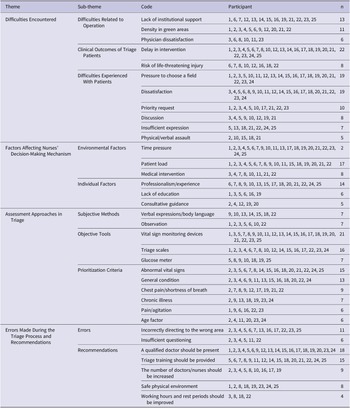
Four main themes were identified:
-
(1) Difficulties Encountered
-
(2) Factors Influencing Decision-Making
-
(3) Assessment Approaches
-
(4) Errors and Recommendations (Table 2)
Themes, sub-themes, and codes obtained from interviews with nurses

Table 2. Long description
The table is organized into five columns: Theme, Sub-theme, Code, Participant, and n.
1. Theme: Difficulties Encountered.
- Sub-theme: Difficulties Related to Operation. Codes include Lack of institutional support (n=13), Density in green areas (n=11), and Physician dissatisfaction (n=6).
- Sub-theme: Clinical Outcomes of Triage Patients. Codes include Delay in intervention (n=22) and Risk of life-threatening injury (n=8).
- Sub-theme: Difficulties Experienced With Patients. Codes include Pressure to choose a field (n=19), Dissatisfaction (n=19), Priority request (n=10), Discussion (n=8), Insufficient expression (n=7), and Physical or verbal assault (n=5).
2. Theme: Factors Affecting Nurses Decision-Making Mechanism.
- Sub-theme: Environmental Factors. Codes include Time pressure (n=2), Patient load (n=17), and Medical intervention (n=8).
- Sub-theme: Individual Factors. Codes include Professionalism or experience (n=14), Lack of education (n=6), and Consultative guidance (n=5).
3. Theme: Assessment Approaches in Triage.
- Sub-theme: Subjective Methods. Codes include Verbal expressions or body language (n=7) and Observation (n=7).
- Sub-theme: Objective Tools. Codes include Vital sign monitoring devices (n=21), Triage scales (n=16), and Glucose meter (n=7).
- Sub-theme: Prioritization Criteria. Codes include Abnormal vital signs (n=15), General condition (n=13), Chest pain or shortness of breath (n=9), Chronic illness (n=7), Pain or agitation (n=6), and Age factor (n=6).
4. Theme: Errors Made During the Triage Process and Recommendations.
- Sub-theme: Errors. Codes include Incorrectly directing to the wrong area (n=11) and Insufficient questioning (n=6).
- Sub-theme: Recommendations. Codes include A qualified doctor should be present (n=18), Triage training should be provided (n=15), The number of doctors or nurses should be increased (n=9), Safe physical environment (n=8), and Working hours and rest periods should be improved (n=4).
Theme 1. Difficulties Encountered
The theme “Difficulties Encountered” consisted of three sub-themes: “Operational Difficulties,” “Clinical Outcomes of Triage Errors,” and “Difficulties Experienced With Patients” (Table 2).
Sub-Theme 1. Difficulties Related to Operation
Three codes were identified under the sub-theme of operational difficulties: “lack of institutional support,” “density in green areas,” and “physician dissatisfaction” (Table 2). Nurses stated that they did not receive sufficient in-service training and structural support for triage, experienced congestion due to insufficient staff and bed capacity in the green area, and that their triage classifications were often not accepted by physicians.
K1: “The institution could provide support by offering training. Apart from that, an ergonomic environment needs to be provided.”
K3: “Doctors generally do not approve of the triage we perform.”
K5: “Due to the shortage of nurses and doctors, problems arise when patients in the green zone have to wait for a long time. In particular, elderly patients who cannot express themselves may be overlooked, and their complaints may increase.”
Sub-Theme 2. Clinical Outcomes of Triage Patients
In the sub-theme of clinical consequences of triage errors, 2 codes were identified: “delay in intervention” and “risk of life-threatening situations” (Table 2). Nurses stated that triage errors arising from time pressure, workload, and the patient’s inability to adequately express their condition can delay intervention and, in some cases, pose a risk to life.
K2: “The patient may describe chest pain as stomach pain. If there are no obvious clinical findings, they are directed to the green zone, but there is a risk of cardiac arrest while waiting.”
K6: “Due to misclassification or delay, the patient may initially be in a life-threatening situation. Of course, no one wants this, but with patient congestion, oversights are inevitable.”
Sub-Theme 3. Difficulties Experienced With Patients
Six codes were defined in the sub-theme of difficulties experienced with patients: “pressure to choose an area,” “dissatisfaction,” “demand for priority,” “argument,” “inadequate expression,” and “physical/verbal aggression” (Table 2). Nurses stated that green zone patients, in particular, exert pressure to be directed to more urgent categories, which leads to arguments and dissatisfaction. It was also said that patients demand priority because they consider their own complaints to be more critical; when their demands are not met, they may react with verbal or physical aggression. Nurses emphasized that patients’ inability to clearly express their complaints and the intervention of patients’ relatives in the process also created significant difficulties.
K10: “Green zone patients mostly dislike triage. Their feedback to us is usually in the form of arguments, noise, and insults. They want priority.”
K18: “Patients either cannot express themselves correctly or try to move to the yellow or red zone by giving false statements to avoid waiting. This situation can directly affect the process.”
K21: “Patients’ refusal to accept their triage is the biggest problem. In their view, everyone is an emergency patient requiring immediate intervention. They do not want to wait in line.”
Theme 2. Factors Affecting Nurses’ Decision-Making Mechanisms
Factors affecting nurses’ decision-making mechanisms have been classified under the sub-themes of “Environmental Factors” and “Individual Factors” (Table 2).
Sub-Theme 4. Environmental Factors
Three codes were identified under the sub-theme of environmental factors: “time pressure,” “patient load,” and “medical intervention” (Table 2). Nurses reported experiencing time pressure during triage due to high patient volume, making it difficult for them to question patients thoroughly. They also stated that physicians’ intervention in triage negatively affected the classification process.
K7: “If the doctors on duty that day constantly intervene in triage decisions, this can cause the nurse to become indecisive; the triage process can change as they think, ‘Should I send this patient there, or here?”
K20: “Because we work in a bustling hospital, we need to use our time wisely. Therefore, it is important to listen carefully to patients and perform a discriminative triage. However, time constraints and patient volume make this process quite difficult.”
Sub-Theme 5. Individual Factors
Three codes were identified in the sub-theme of individual factors affecting nurses’ decision-making mechanisms: “professionalism/experience,” “lack of training,” and “consultation-based referral” (Table 2). Nurses stated that professional experience and professionalism were the most decisive factors in making sound triage decisions. They also noted that inadequate triage training complicates the classification process. In addition, they mentioned that in some cases, they could provide consultation-based guidance to prioritize patients in areas where familiar colleagues were present.
K13: “Experience enables triage to be assessed more quickly based on the patient’s complaints and facilitates a faster transition to the treatment process.”
K19: “A nurse experienced in triage can assess the patient quickly. But a nurse with no triage history and no training may not perform triage logically … Of course, there are exceptions sometimes. Especially if the patient is a relative, we are forced to move them. This is not just the case with us, but everywhere.”
Theme 3. Assessment Approaches in Triage
Nurses’ triage assessment approaches are classified into the sub-themes of “Subjective Methods,” “Objective Tools,” and “Prioritization Criteria” (Table 2).
Sub-Theme 6. Subjective Methods
Two codes were identified in the sub-theme of subjective methods used by nurses in triage assessment: “verbal expressions/body language” and “observation” (Table 2). Nurses stated that they observed patients’ body language along with their verbal expressions, in addition to objective data, when deciding on triage classification.
K14: “We perform triage by communicating with patients and asking questions.”
K22: “We also generally proceed in a question-and-answer format. In addition, we observe the patient; we look at their general condition and behavior.”
Sub-Theme 7. Objective Tools
Three codes were identified in the sub-theme of objective methods used by nurses in triage assessment: “vital sign monitoring devices,” “triage scales,” and “glucometers” (Table 2). Nurses stated that they mostly used measurement tools, such as vital sign monitoring devices and glucometers, when deciding on triage classification; they also used triage scales set by the Ministry of Health.
K17: “We have a triage scale defined for yellow, green, and red zones. The patient’s statement and vital signs also directly influence the zone selection.”
K23: “In triage, we use devices such as a two-lead monitor, a standing monitor, a blood pressure cuff, a saturation probe, and a thermometer.”
K25: “The device we use most definitely is the monitor. We have no other equipment for blood pressure, blood sugar, and vital signs.”
Sub-Theme 8. Prioritization Criteria
The sub-theme concerning the prioritization criteria used by nurses in triage includes 6 codes: “abnormal vital signs,” “general condition,” “chest pain/shortness of breath,” “chronic illness,” “pain/agitation,” and “age factor” (Table 2). Nurses stated that they prioritized patients with vital signs outside normal limits; in addition, based on their experience, they also considered the patient’s general condition, critical complaints such as chest pain and shortness of breath, existing chronic diseases, pain or agitation levels, and age factor in prioritization.
K12: “In patient prioritization, we straightforwardly assign chest pain to the red zone.”
K15: “In prioritization, we look at vital signs, as I said, and the general condition.”
K24: “When prioritizing, the patient’s general condition, age, and chronic illnesses are taken into account. Saturation and pulse are assessed with a pulse oximeter; vital signs and blood pressure measurement are also important criteria in this process.”
Theme 4. Errors Made During the Triage Process and Recommendations
Errors and recommendations in the triage process have been categorized under the sub-themes “Errors” and “Recommendations” (Table 2).
Sub-Theme 9. Errors
Two codes were identified in the sub-theme of errors: “incorrectly directing to the wrong area” and “insufficient questioning” (Table 2). Nurses stated that they could refer patients to the wrong area due to high workload, fatigue, time pressure, and educational and environmental inadequacies; in particular, they stated they could not always clearly distinguish between the green and yellow areas. They also said that when they could not adequately question patients’ complaints, it became difficult to determine the correct clinical priority.
K11: “When the workload increases, we try to direct patients quickly. Under this pressure, we may skip asking some questions.”
K23: “The most challenging part is distinguishing between yellow and green zone patients. The red zone is usually clear, but we can be uncertain about patients in the yellow-green range. This may be because patients either cannot express themselves adequately or give false statements to avoid waiting.”
Sub-Theme 10. Recommendations
Five codes were identified in the sub-theme of recommendations: “a qualified doctor should be present,” “triage training should be provided,” “the number of doctors/nurses should be increased,” “a safe physical environment,” and “working hours and rest periods should be improved” (Table 2). Nurses stated that having triage conducted by a physician or ensuring that a physician is always present in the triage area would improve the process. They also emphasized the need for the triage team to receive regular training, for the number of doctors and nurses to be increased, and for a safer, more secure triage area to be created to reduce patient complaints. It was stated that long working hours increase distraction and raise the risk of errors; therefore, it was recommended that working hours and rest periods be reorganized.
K3: “The number of triage personnel should be increased, and rest and break times should be clearly defined. Because the first nurse is the point of contact in the triage area with the high patient flow, and evaluating each patient is a huge burden.”
K13: “I believe a doctor should perform triage. I think it is their responsibility.”
K20: “Unless nurses receive in-service training, it is doubtful that they will be able to understand, perform, and implement triage… In my opinion, triage should be performed by a doctor, because nurses can make decisions based on their knowledge, but the doctor’s clinical approach is clearer and more comprehensive.”
K25: “The triage area should be in a safer, enclosed structure where there is no direct contact with patients. Additionally, short breaks where we can rest both physically and mentally make the process more sustainable.”
Discussion
In this study, the findings were discussed under four main themes: Difficulties Encountered, Factors Influencing Decision-Making, Assessment Approaches, and Errors and Recommendations. The findings suggest that triage experiences are shaped by intertwined structural, clinical, and interpersonal factors. In this study, these experiences appeared to be influenced not only by patient-related issues but also by institutional conditions and workload.
Under the sub-theme “Operational Difficulties,” nurses identified lack of institutional support, density in green areas, and physician dissatisfaction as significant problems. This situation was similarly addressed by Park et al.; their research indicated that physicians frequently questioned nurses’ triage decisions, and that this situation created pressure not only on their workload but also on their professional autonomy.Reference Park, Kong and Park 18 Furthermore, the study by Wolf et al. stated that the triage process has become a classification not only of patients but also of the system, with nurses caught between clinical uncertainties and systemic pressures.Reference Wolf, Delao and Perhats 19 Andersson et al. found that nurses are affected by time pressure, resource shortages, and communication problems when making decisions, stating that structural deficiencies in the system directly affect triage decisions.Reference Andersson, Omberg and Svedlund 20 A study by Al-Ghabeesh et al. also emphasized that a lack of institutional support, combined with staff shortages and an unsuitable physical environment, makes it difficult to carry out triage effectively.Reference Al-Ghabeesh, Thabet, Rayan and Abu-Snieneh 21 These findings are consistent with the literature and may be related to institutional conditions and workload.
Within the second sub-theme, “Clinical Outcomes of Triage Errors,” nurses indicated that misclassification can lead to delays in intervention and increased risk of life-threatening outcomes. A study by Mohammadi et al. revealed that misdirection and delays frequently occur in pre-hospital telephone triage due to communication inadequacies and information gaps.Reference Mohammadi, Jeihooni and Sabetsarvestani 22 Similarly, Pishkhani et al. emphasized that during triage practices implemented during the COVID-19 pandemic, high volumes and uncertainties threatened patient safety, and misclassifications could lead to serious consequences.Reference Pishkhani, Adib, Amiri and Noveiri 23 These findings suggest that triage-related errors may be associated with both individual and systemic factors.
Under the third sub-theme, “Difficulties Experienced with Patients,” nurses reported facing pressure from patients to choose areas, dissatisfaction, demands for priority, arguments, lack of expression, and physical/verbal attacks. Wolf et al. stated that triage nurses are frequently exposed to verbal abuse due to patient dissatisfaction, which increases their levels of burnout.Reference Wolf, Delao and Perhats 19 Park et al. emphasized that triage is often misunderstood by patients, forcing nurses to engage in a dual struggle with both patients and their relatives.Reference Park, Kong and Park 18 Furthermore, Al-Ghabeesh et al. stated that interference from patients and their relatives, communication gaps, and unrealistic expectations cause conflict during the triage process.Reference Al-Ghabeesh, Thabet, Rayan and Abu-Snieneh 21 Andersson et al. also noted that patients’ expectations and communication deficiencies were the dominant factors influencing nurses’ decisions.Reference Andersson, Omberg and Svedlund 20 These issues, frequently highlighted in the literature, support the findings of this study; in particular, the lack of patient education and low health literacy may underlie communication conflicts between patients and nurses. The findings of this study largely align with the literature. However, in some areas, institution-specific systemic structures appear to exacerbate these problems. Addressing structural issues, particularly the lack of institutional support and the density of green spaces, is essential for the healthier functioning of triage practices.
Furthermore, raising patients’ and relatives’ awareness of the triage process may help reduce verbal and physical attacks against nurses. To prevent triage errors that affect clinical outcomes, it is necessary to establish structures supported not only by in-service training but also by decision support systems, algorithms, and technological solutions. These findings indicate that improvements may be needed at both the individual and institutional levels. These findings suggest that triage practices may be influenced by both individual competencies and organizational conditions.
This study revealed that multiple environmental and individual factors influence nurses’ decision-making mechanisms during triage. The findings show that triage nurses’ decision-making processes depend not only on clinical knowledge and algorithms but also on contextual and personal conditions. Among environmental factors, “time pressure,” “patient density,” and “physician intervention” were among the prominent determinants. Due to high patient volume and limited staffing in emergency departments, nurses are often required to assess many patients in a short time. Wolf et al. described this situation as “triage of the system, not the patient,” noting that the decision-making process prioritizes the needs of the system rather than its functionality.Reference Wolf, Delao and Perhats 19 Similarly, Al-Ghabeesh et al. reported that time pressure limits nurses’ ability to conduct a comprehensive patient assessment and negatively affects decision quality.Reference Al-Ghabeesh, Thabet, Rayan and Abu-Snieneh 21 Physician intervention is another significant factor that undermines nursing autonomy in decision-making. As noted in the study by Andersson et al., nurses are often forced to revise triage decisions based on physician guidance, contrary to their own clinical assessments, and this threatens the objectivity and standardization of the decision.Reference Andersson, Omberg and Svedlund 20
Among individual factors, “professionalism/experience,” “lack of training,” and “consultative guidance” were noteworthy. As the literature frequently emphasizes, professional experience plays a decisive role in triage decisions. Andersson et al. noted that experienced nurses could analyze symptoms more quickly and accurately, whereas inexperienced nurses struggled to interpret subjective data.Reference Andersson, Omberg and Svedlund 20 Similarly, this study suggested that nurses’ decision-making during triage was associated with professional experience and training. Indeed, Mohammadi et al. found that a lack of training increases the risk of misdirection among nurses performing telephone triage and negatively affects patients’ clinical outcomes.Reference Mohammadi, Jeihooni and Sabetsarvestani 22
On the other hand, findings indicating that patient referrals are made through familiar colleagues are ethically noteworthy. This situation has the potential to undermine the objective and fair nature of triage. Pishkhani et al. stated that the influence of personal relationships on triage decisions threatens both institutional trust and patient safety.Reference Pishkhani, Adib, Amiri and Noveiri 23 In the literature, such practices are considered unethical and reported to undermine the standardization of triage systems.Reference Jeong and Lee 24 The findings of this study reveal that the factors influencing nurses’ decisions in triage processes have a multidimensional structure and that decisions are shaped not only algorithmically but also within social, environmental, and ethical contexts. Time pressure, patient volume, and physician interventions external to the nurse’s role influence nurses’ decision-making processes. At the same time, individual factors such as experience, lack of training, and unethical guidance are internal factors that warrant attention.
Taken together, these findings suggest that nurses’ triage decision-making is shaped by contextual demands and professional experience. This may be related to the high-pressure nature of emergency care and the organizational conditions in which triage is performed. In particular, institutional control mechanisms should be strengthened to prevent unethical practices, such as familiarity-based referrals. Structural problems within institutions, inadequate in-service training, and limited decision-making autonomy may have contributed to these findings. These findings may be related to training, experience, and organizational factors. Future studies could further explore these relationships. This approach may help reduce errors caused by subjective decisions and improve patient safety.
This study found that nurses’ triage assessment approaches were grouped into the sub-themes of subjective methods, objective tools, and prioritization criteria. The findings show that nurses value not only algorithmic assessments but also assessments based on clinical intuition and observation. This finding suggests that triage involves both structured assessment and experience-based judgment.
Subjective methods involve assessment processes conducted by nurses through communication with patients and the analysis of their verbal expressions and body language. Participant statements indicate that the impressions nurses form during interactions with patients influence triage decisions. Furthermore, Lee and Kim (2015) reported that nurses’ interpretation of patient behavior is decisive in clinical prioritization decisions.Reference Lee and Kim 25 In this context, subjective data complements objective findings and is particularly important in identifying clinically unstable patients whose vital signs are within normal limits.
Under the objective methods heading, it was observed that nurses performed assessments during triage using measurement tools such as vital sign monitors and glucometers, as well as triage scales set by the Ministry of Health. In the literature, the use of objective measurement tools is considered one of the fundamental elements that increase triage accuracy.Reference Göransson, Persson and Abelsson 26 In particular, monitoring vital parameters facilitates the standardization of triage decisions and contributes to the safe referral of patients.Reference Considine, Shaban and Fry 27 However, some studies have indicated that classification based solely on objective data may increase the margin of error, particularly among nurses without clinical experience.Reference Storm-Versloot, Vermeulen and van Lammeren 28 Therefore, there is a strong consensus that subjective and objective data should be evaluated together.
Prioritization criteria are based on specific clinical indicators that guide triage nurses’ decisions. The most frequently referenced criteria in this study included abnormal vital signs, the patient’s general condition, critical symptoms such as chest pain and shortness of breath, history of chronic disease, agitation, and age. Similarly, Fernandes et al. state that elderly patients and individuals with a history of chronic disease should be assessed more carefully during triage.Reference Fernandes, Tanabe and Gilboy 29 Furthermore, a study conducted among Irish nursesReference O’Connell, Gardner and Coyer 30 highlighted that symptoms such as chest pain and dyspnea are among the conditions given high priority in triage because they require rapid intervention. The assessment of vital signs, particularly respiratory rate, level of consciousness, and blood pressure, plays a critical role in predicting patient risk when linked to early warning systems.Reference Reay, Rankin and Then 31
The findings of this study reveal that nurses base their triage decisions not solely on algorithms, but also on clinical experience, observation, and multifaceted assessment skills. Given that triage is a process that requires clinical reasoning and ethical responsibility rather than a mechanical procedure, the importance of up-to-date, comprehensive training to enhance nurses’ assessment competence becomes clear. Accordingly, triage decisions appear to rely on the combined use of observation, clinical reasoning, and objective tools.
This study examined the errors described by nurses and the recommendations they offered regarding the triage process. The findings revealed that nurses misdirect patients due to factors such as patient density, time pressure, fatigue, lack of training, and insufficient experience. In particular, the inability to clearly distinguish between the yellow and green zones makes it difficult to decide which category to assign. Similarly, Reay et al. reported that nurses working under high pressure in emergency departments made more errors in yellow-green zone classification, and that this situation posed a risk to patient safety.Reference Reay, Smith-MacDonald and Then 32 Chen et al. emphasized that nurses struggle to distinguish between these two areas due to factors such as a lack of clinical experience and patients’ inability to convey their complaints accurately.Reference Chen, Lin and Park 33
This study also found that nurses were unable to gather sufficiently detailed information during patient interviews. In particular, patients who make false statements to avoid waiting or exaggerate the severity of their complaints can lead to misclassification. Travers et al. stated that patients’ subjective statements during the triage process can be misleading and that nurses’ reliance solely on these statements for classification increases the risk of error.Reference Travers, Waller and Bowling 34 The literature emphasizes that patient assessment should not be based solely on symptoms but should involve a systematic approach and open-ended questions.Reference Alshurtan, Alshammari, Almarshadi, Alghaslan and Alqahtani 35 This is considered an essential strategy for improving triage accuracy.
Nurses have made various recommendations to reduce errors in the triage process. One of the most notable of these is the view that doctors should perform triage. Nurses have stated that physicians have more advanced clinical assessment capabilities and therefore make fewer classification errors. Fernandes et al. demonstrated that physician involvement in triage decisions increases accuracy, particularly in patients with complex symptoms.Reference Fernandes, Vieira and Leite 36 However, Wuerz et al. noted that completely removing nurses from this process could negatively affect their professional autonomy and slow patient flow.Reference Wuerz, Milne and Eitel 37 Therefore, enhancing nurses’ triage competence is emerging as a more balanced approach.
Increasing the number of staff working in triage and improving physical environment conditions are among the other recommended elements. Participants stated that nurses working under heavy patient flow experience distraction; therefore, short rest breaks should be scheduled at regular intervals. Bigham et al. stated that long working hours cause both physical and mental fatigue, which negatively affects decision-making processes.Reference Bigham, Chan and Skitch 38 In this context, regulating shift lengths can improve nurses’ performance and decision quality. It has also been stated that triage areas should be safer, more enclosed environments that reduce direct patient contact and protect nurses physically and emotionally, thereby increasing patient safety and staff satisfaction.
The findings of this study show that errors made during the triage process are not only due to individual reasons but also to structural deficiencies. Lack of training, insufficient staffing levels, inadequate physical conditions, and long working hours directly affect nurses’ triage decisions. As noted in the literature, it should not be forgotten that triage is not merely a technical classification process; it is a multidimensional process that also involves environmental, organizational, and communicational elements. Overall, the findings suggest that triage-related errors should be interpreted not only as individual mistakes but also as outcomes shaped by workload, training conditions, and the clinical environment. One strength of this study is that it provides direct accounts from nurses with triage experience and offers a context-specific understanding of how triage is experienced in daily emergency practice.Reference Reay, Rankin and Then 31
Limitations of the Study
This study has some limitations. Since the study was qualitative and conducted solely with nurses working in the emergency department of a university hospital in Erzurum, the results cannot be directly applied to nurses in other provinces or health care settings. Since the sample relied on voluntary participation, there may have been social desirability bias, and some negative experiences might not have been reported. Data were collected only through face-to-face, semi-structured interviews. Although this method yields rich, in-depth qualitative data, participants’ busy work schedules and time constraints may have led some interviews to be shorter and more superficial. The researcher’s interpretive role in data collection and analysis involves a degree of subjectivity, despite the systematic nature of Colaizzi’s phenomenological analysis method. Furthermore, the findings relate to the period from January to June 2025, when the effects of the pandemic had relatively lessened; therefore, studies conducted during exceptional circumstances or at different times may yield different results. Considering these limitations, caution is advised when interpreting and generalizing the research findings. Another limitation is that the phenomenological depth of the findings may have been constrained by the relatively short duration of some interviews. A further limitation is that the analysis drew on contemporary qualitative terminology, which may not fully reflect the original conceptual language of Colaizzi’s method. In addition, the researchers’ prior familiarity with emergency care settings may have influenced interpretation despite efforts to maintain reflexivity.
Conclusion and Recommendations
This study showed that emergency nurses experience triage as a complex process shaped by operational difficulties, decision-making pressures, assessment practices, and the risk of error. The findings suggest that triage is influenced not only by nurses’ professional judgment but also by workload, institutional support, communication challenges, and the clinical environment. These findings should be interpreted in light of nurses’ experiences. Future studies may benefit from longer interviews, stronger phenomenological positioning, and inclusion of different emergency care settings to deepen understanding of triage experiences.
Acknowledgment
The authors express their sincere gratitude to all emergency nurses who shared their experiences and contributed to this study.
Author contribution
Study conception and design: ÇB; Data collection: KD; Data analysis and interpretation: ÇB, KD; Drafting of the article: ÇB, KD; Critical revision of the article: ÇB, KD.
Authorship statement
All listed authors meet the authorship criteria and agree with the content of the manuscript.
Funding statement
The authors received no financial support for the research, authorship, and/or publication of this article.
Competing interests
The authors declare there is no competing interests.
Ethical approval
Ethical approval for this study was obtained from the Atatürk University Non-Interventional Clinical Research Ethics Committee (Date: 27.09.2024, No: B.30.2.ATA.0.01.00/549). Institutional permission was granted by the hospital where the study was conducted. Written informed consent was obtained from all participants. The study was carried out in accordance with the Declaration of Helsinki.


 Open access

