IT was recently shown that tensile ductility in excess of 25% can be imparted to granular, fresh-water ice upon slowly pre-compressing the material to the point that dynamic recrystallization begins (Reference Schulson and KuehnSchulson and Kuehn, 1993). This result was surprising and it raised a question about the generality of the effect. This note shows that the phenomenon also occurs in columnar saline ice, although to a lesser degree, and considers a possible implication for first-year sea ice.
The ice was prepared as described by Reference Kuehn and SchulsonKuehn and Schulson (1994) and by Reference Smith and SchulsonSmith and Schulson (1994). Its average bulk density and salinity were 909 ± 3 kg m−3 and 4.6 ± 0.1 ppt, respectively, and the grain-size (or average equivalent column diameter) was approximately 5 mm. The c axes were confined more or less to the horizontal plane during growth but randomly oriented within this plane. Cylindrical specimens (102 mm diameter × 230 mm) were cut from the parent puck such that the long axes of the columnar grains were oriented normal to the axis of the cylinder; they were fitted with carpet-backed, synthane end caps following the procedure described by Reference LeeLee (1986). The specimens were equilibrated at −10°C and then slowly shortened by about 3.5% by uniaxially compressing along their axis (i.e. across the columnar grains) at a strain rate of about 1 × 10⁻⁵ s−1. Subsequently, the specimens were unloaded. They were then immediately remachined into a dumbbell shape of 67 mm diameter and 89 mm gauge length, and then slowly reloaded at −10°C under tension at a strain rate of either 1.3 × 10⁻⁶ or 1.2 × 10⁻⁷ s−1. The time which elapsed between the unloading and the re-loading was about 30 min. During both the pre-compression and the tension steps, the strains were measured using displacement gauges mounted on the ice, as described elsewhere (Reference Kuehn and SchulsonKuehn and Schulson, 1994).
The experiment revealed that, like the granular freshwater material, the saline ice also was more ductile upon pre-compressing. One specimen, strained in tension at 1.3 × 10⁻⁶ s−1, elongated 5.5% before breaking. Its fracture surface had a somewhat granular appearance (Fig. 1). Two other specimens, strained at the lower rate of 1.2 × 10⁻⁷ s−1, elongated by 5.0% and by 11.6% without breaking. In comparison, virgin material of the same origin and at the same temperature elongated by only about 0.5 ±0.2% and broke more cleanly when pulled at a strain rate of 1 ± 10−7 s−1 (Reference Kuehn, Lee, Nixon and SchulsonKuehn and others, 1990). In all cases, the specimens deformed without necking, again reflecting the behavior of the fresh-water ice.
Photograph showing a broken specimen of columnar, saline ice which had been pre-compressed by about 3.5% at −10°C at ≈ 10−5 s−1 and then strained in tension by 5.5% at −10°C at 1.3 × 10⁻⁶ −−1. Note the absence of necking and the fibrous appearance of the fracture surface. The long axes of the columnar grains are perpendicular to the plane of the photograph. The diameter of the columnar grains is about 5 mm. (Scale: diameter of specimen = 67 mm.)

Although more ductile, the pre-compressed ice was not weaker. The specimen that broke reached a peak tensile stress of 0.27 MPa at a strain of about 1%; it then softened upon further straining. The other two specimens reached a peak stress of 0.25 MPa at similar strains and then softened. These strengths compare favorably with a peak tensile stress of 0.28±0.05 MPa for the virgin material (Reference Kuehn, Lee, Nixon and SchulsonKuehn and others, 1990).
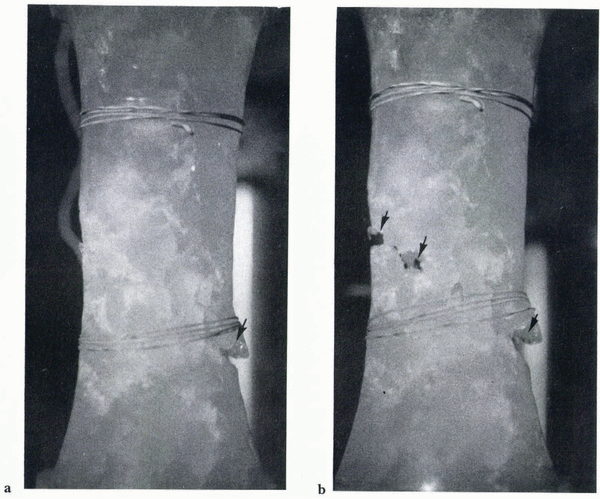
Interestingly, the pre-compressed specimen which elongated 11.6% without breaking developed large, void-like cracks (Fig. 2). The voids grew along a shear plane as the specimen lengthened. Presumably, they would have linked up to cause complete fracture had the ice been strained further. This feature was not seen in the virgin material slowly strained in tension nor was it seen in the granular fresh-water ice. It occurred here, we suggest, because of sliding along the boundaries of freshly created small grains which formed in pockets (Fig. 3), as the result of dynamic recrystallization during the pre-compression. Unfortunately, owing to the crumbling of the ice, it was not possible to obtain a thin section near a void-like crack.
Photographs showing a specimen of columnar, saline ice after pre-compressing by about 3.5% at −10°C at ≈ 10−5 s−1 and then deforming in tension at −10°C at 1.2 × 10⁻⁷ s−1: (a) after an elongation of 7.3%; (b) after an elongation of 11.6%. Note the cracks (arrowed). The long axes of the columnar grains are perpendicular to the plane of the photographs. The rubber bands were used to hold the displacement gauge to the specimen. (Scale: diameter of specimen = 67 mm.)

Thin section of the specimen shown in Figure 2b. Note the localized regions of recrystallized grains (squares). (The numerical scale on the ruler is in centimeters.)

The origin of the enhanced ductility of the columnar, saline ice is probably similar to the origin of the increased ductility of the granular, fresh-water material. As discussed earlier (Reference Schulson and KuehnSchulson and Kuehn, 1993) and in accord with Reference Frost and AshbyFrost and Ashby’s (1982) deformation map for ice, the creation of at least some relatively small, recrystallized grains during the pre-compression step probably allows diffusion creep to contribute to the overall inelastic deformation during the subsequent low-rate, tensile deformation. Indeed, the textured fracture surface and the fact that the largest elongation occurred at the lower strain rate support this view. Thus, the enhancement probably reflects the operation of two independent deformation mechanisms, the other one being dislocation creep. The global ductility of the saline ice was less than that of the fresh-water ice, because a smaller fraction of the matrix recrystallized and the recrystallization occurred less uniformly. The localized plastic strain, however, may have been similar.
An implication of the above observations concerns the structure and the behavior of a cover of first-year, columnar sea ice. Under some loading conditions, ice sufficiently thick to resist buckling may compress sufficiently slowly and to a sufficiently large degree to allow localized recrystallization. Even ice as cold as –40°C may recrystallize upon slowly compressing by about 1%, judging from the behavior of saline ice in the laboratory (Reference Kuehn and SchulsonKuehn and Schulson, 1994). The change in microstructure would then not be restricted to the warmer parts of the cover. As a result, the feature may display mechanical behavior different from that of a virgin cover. In particular, provided that large cracks do not intervene by propagating, the cover may be capable of extending plastically under a slowly applied tensile stress. Whether this scenario actually occurs is not known.
In conclusion, experiments have shown that significant tensile ductility can be imparted to columnar, saline ice by first pre-compressing the material. This effect mirrors that reported earlier for granular fresh-water ice and is attributed to the operation of both diffusion creep and dislocation creep.
Acknowledgement
This work was supported by the U.S. Office of Naval Research, contract No. N00014-92-J-1279.
The accuracy of references in the text and in this list is the responsibility of the authors, to whom queries should be addressed.