





Introduction
This article aims at an empirical reassessment of the transformation of post-socialist civil societies. Its second goal is to discuss existing scholarship on political activism (Jacobsson & Saxonberg, Reference Jacobsson and Saxonberg2013; Koubek, Reference Koubek2020) and contribute to the general analysis of civil society. Analytically, we proceed in two steps.
To begin, we introduce participatory and transactional political activism, as proposed by Petrova and Tarrow (Reference Petrova and Tarrow2007). The differentiation was meant to explain the seemingly low level of mass participation in post-socialist societies, which was widely perceived as their major weakness (Howard, Reference Howard2003). On the other hand, it has also been demonstrated that activism without significant mobilizing capacity may rely on coordination with other collective actors or with political authorities (Císař & Navrátil, Reference Císař and Navrátil2015, Reference Císař and Navrátil2017; Fagan, Reference Fagan2004; Koubek, Reference Koubek2020; Mazák & Diviák, Reference Mazák and Diviák2018). We aim to enhance the analytical value of this differentiation. Instead of identifying activist types with specific organizations or their populations, we reconceptualize them in terms of general activist modes that can be applied in comparative and/or longitudinal contexts. Thus, we consider the participatory and transactional dimensions while adding a third one—the strategic repertoire. These constitute a general activist mode that may vary among different civil society sectors or civil societies. To anchor the concept of activist mode within a broader theoretical background, we link it to H. Kriesi’s conception of the development of political activism.
It has been illustrated that participatory and transactional activism are typically associated with different types of social movements, namely materialist and post-materialist movements (Císař & Navrátil, Reference Císař and Navrátil2015, Reference Císař and Navrátil2017; Jacobsson & Saxonberg, Reference Jacobsson and Saxonberg2013). While materialist movements traditionally rely on the logic of mass collective action and a rather hierarchical structure of organizing, post-materialist activists tend to organize rather small events, prefer building larger coalitions, and select repertoire not based on the logic of aggregation but rather on that of representation. To evaluate the structure of activist modes in two fields expected to differ significantly, we apply the concept to environmental and economic activism across three phases of socio-political evolution in the case of Czechia.
The content and significance of political activism in the Czech Republic over the past three decades have been shaped by changing ideological stakes and political visions that reflected broader social conflicts. During the Transformation period (1989–1997), the political agency of activists was closely linked to the processes of democratization and marketization, during which political freedoms were perceived as inseparable from economic freedoms. In contrast, during the Europeanization/Globalization period (1998–2008), the focus of disputes shifted to institutional anchoring within EU structures, leading to the professionalization of activism and a selective approach to political power that favored expert nongovernmental organizations at the expense of mass participation. The Poly-crisis (2009–2022) brought a fundamental redefinition of meanings, with the previously separate fields of material (economic) and post-material (environmental) activism beginning to merge, ideologically linking environmental threats to the existential socioeconomic impacts of energy crises and inflation. This reintroduced radical demands into the public sphere and renewed civil society’s capacity for mobilization in the face of systemic crises.
Relying on a unique dataset of socioeconomic and environmental events between 1989 and 2023, we empirically demonstrate that the shape of the activist field is partially a result of the intra-organizational evolution of civil society actors and partially a consequence of their broader environment. On the general level, our article shows a co-dependence of the civil society and political activism concepts in terms of both their real-world interaction and analytical conceptualization, which is the way our contribution relates to the general concept of this special issue and the extant literature on the interactions of activism and civil societies in post-communist countries (e.g., Baća, Reference Baća2022, Reference Baća2024; Gagyi & Ivancheva, Reference Gagyi, Ivancheva, Moskalewicz and Przybylski2017; Jacobsson & Korolczuk, Reference Jacobsson and Korolczuk2017; Jacobsson & Saxonberg, Reference Jacobsson and Saxonberg2013).
From transactional/participatory type of activism to activist modes
Despite the enduring importance of spontaneous popular struggles in CEE societies, owing to their role in the democratization protests of the late 1980s, organizational cooperation remains the key factor in the development of civil society infrastructure (Diani, Reference Diani2015). This discrepancy has been the subject of various interpretations of the development of post-socialist civil societies. It targeted criticism that they are too passive, leading to the differentiation between transactional and participatory types of activism as a heuristic tool for studying and explaining the different capacities and shapes of post-socialist civil societies (Císař & Navrátil, Reference Císař and Navrátil2015; Jacobsson & Saxonberg, Reference Jacobsson and Saxonberg2013). In brief, previous research has identified transactional activists as more capable of cooperation and networking than participatory activists, who, on the other hand, tend to excel at involving individuals in collective action. As a result, in terms of providing organizational infrastructure, transactional activists were identified as the true builders of civil society. Previous research also related transactional activists to specific repertoires of collective action: while participatory activism was associated with membership in civic associations, collective mass protest activities such as demonstrations, or voting, transactional activism was linked to negotiation and lobbying, providing expertise, scaling up, or media campaigns (Petrova & Tarrow Reference Petrova and Tarrow2007: 79–80; Císař 2010: 740). Moreover, transactional activism has often been identified with so-called new, or post-materialist, topics such as the environment, gender, and human rights (Císař Reference Císař2010). On the other hand, the concept of participatory activists was most suited to so-called old, or materially oriented, organizations, such as trade unions (e.g., Císař & Navrátil, Reference Císař and Navrátil2015; Ekiert & Kubik, Reference Ekiert and Kubik2001).
Here, we shift our perspective somewhat. First, we aim to identify participatory and transactional activism as distinct capacities of civil society, varying across activist fields, and to compare their intensity within the issue area in which they occur. We propose considering these as two analytically distinct dimensions of a new typology of activist modes, which may vary independently of one another (Petrova & Tarrow, Reference Petrova and Tarrow2007: 79; Císař, Reference Císař, Jacobsson and Saxonberg2013). The participatory dimension refers to the mobilization of political activists. It describes the capacity of civil society to engage ordinary citizens in collective action, that is, to induce them to participate in protest politics. This perspective refers to the traditional account of the strength of civil society as the magnitude of individual participation in civic associations, political events, elections, and the like. The transactional dimension, on the other hand, describes the capacity of civil society organizations to engage in “transactional activism,” that is, to network, cooperate, and communicate with other activists, organizations, and public institutions, and make claims that bear on someone’s interests. Following a relational turn in collective action studies (Diani & McAdam, Reference Diani and McAdam2003; Emirbayer, Reference Emirbayer1997), this conceptualization views the strength of civil society as the capacity of its collective actors to cooperate with others, thereby contributing to the overall integration of civil society. If conceptualized this way, we can study the two dimensions across different issue areas such as environmental and socioeconomic activist fields.
Second, we disentangle activist types and action strategies and add a third dimension in the present article’s analytical framework—strategic repertoire. Repertoire instantly mirrors the basic intention of collective action—either an inclusion and gathering of a multitude of individual participants (such as during a demonstration or march) or a representation of an organization, claim, or grievance (lobbying, performance, and media campaign). Hence, we differentiate between strategies, which are primarily based on the intention to aggregate ordinary citizens, on their inclusion (or based on numbers, see Tilly & Wood, Reference Tilly and Wood2017), and strategies based primarily on the intention to represent citizens or some interest, with no direct relation to mass mobilization (Bolleyer, Reference Bolleyer2024). The repertoire of contention represents a dimension on its own as modern protest strategies are modular and may be employed by multiple different actors depending on the claims, context, situation, and previous experiences with the strategy (Tilly, Reference Tilly2006: 35; Tarrow Reference Tarrow2012: 55). Moreover, repertoire of contention has its own logic of evolution dependent on available cultural and technological knowledge, with general tendencies to compensate for costs of physical face-to-face attendance using new technologies (such as digital participation or individualized coordination) (Earl & Kimport, Reference Earl and Kimport2013).
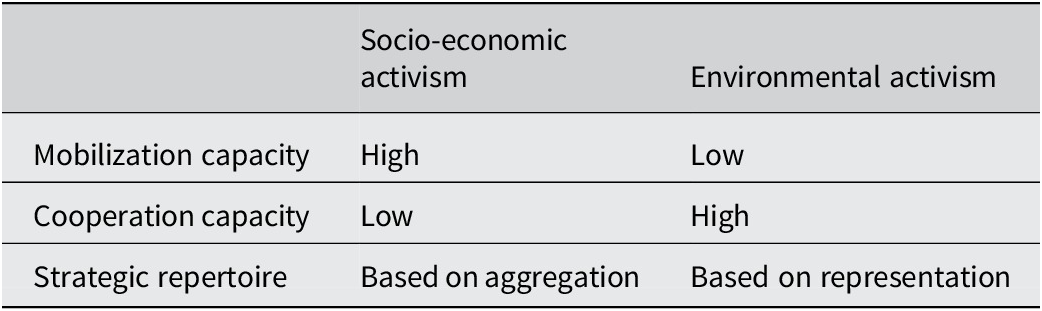
Despite analytical separation of activist types and protest repertoire, some recurring patterns have been identified: while transactional activists (or new social movements) often employ advocacy, dramatic or symbolic repertoires to raise their agenda and mobilize public opinion against unrepresentative democracies (Pichardo, Reference Pichardo1997: 415), traditional participatory but also more recent waves of activism challenging representative conceptions of politics aim at revival of direct forms of politics and participatory protest repertoire (Prentoulis & Thomassen, Reference Prentoulis and Thomassen2013). In the CEE context (and not only there), however, this association has also recently become blurred. While Polish women’s rights movement activists succeeded in upscaling and popularizing protest participation under the imminent threat of a conservative government, Czech trade-unionists, in response to their dramatic membership decline, began to employ new media campaigns to reach the public (Jacobsson & Korolczuk, Reference Jacobsson and Korolczuk2017; Myant & Drahokoupil, Reference Myant and Drahokoupil2017). Despite these overlaps, we expect that the differentiation between participatory (strike, demonstration, boycott, and petition) and representative (direct action, hunger strike, litigation, conference organization, and performance) strategies reflects distinct activist modes. Table 1 summarizes the expected values for the three discussed dimensions across the two activist fields under our empirical analysis.
Expected features of two activist fields

Table 1 Long description
The table has three columns and three rows of features. The header row lists socio-economic activism in the middle column and environmental activism in the right column. The first row compares mobilization capacity: socio-economic activism is high, environmental activism is low. The second row compares cooperation capacity: socio-economic activism is low, environmental activism is high. The third row compares strategic repertoire: socio-economic activism is based on aggregation, environmental activism is based on representation.
Development of activist modes across sets of contentious episodes
In our view, differentiating between transactional and participatory activist modes contributes to the diversity of existing research on post-socialist civil societies. However, we do not consider it a specifically Eastern European phenomenon. On the contrary, these modes may exist with varying intensity across different democratic regimes worldwide, where similar processes and mechanisms operate (Tilly & Tarrow, Reference Tilly and Tarrow2015). Therefore, we align ourselves with recent efforts to evaluate a wide variety of activism, rather than conflating it with a single form, as persuasively argued, for example, by Jehlička and Jacobsson (Reference Jehlička and Jacobsson2021). Decoupling participatory and transactional activism from specific civil society sectors, political contexts, types of organizations, and action repertoires enables us to apply it across various activist fields and to observe its evolution longitudinally across different periods of political and economic development.
The long-term evolution of political activism and its organizational development has been conceptualized by Kriesi (Reference Kriesi, McAdam, McCarthy and Zald1996) who differentiated between organizational growth and decline (changing number of actors in the social movement sector), internal structuration (formalization and professionalization), external structuration (relation of political activists to their constituency and authorities), and goal orientations (commercialization, radicalization, etc.) and linked it to the transformation of cultural, economic, and political context (ibid.). Focusing on the identification of activist mode along three dimensions (mobilizing, cooperation, and repertoire), we restrict our attention to the external and internal structuration processes and their evolution. At the same time, while Kriesi’s scheme was applied to the “new” social movement actors, we also broaden it to include the “old” labor activism.
In the first step, we examine the processes of external structuration related to the mobilizing and cooperative strategies of political activism. These processes refer to the integration of collective actors in their organizational environment: SMOs develop in close interaction with their constituency and (organized) allies (and authorities). Close ties with other collective actors may secure important resources and support for the organization. However, they may also threaten its autonomy, thereby discouraging the support of the constituency and sympathizers (Jasper et al., Reference Jasper, Tramontano, McGarry, Jasper and McGarry2015). Furthermore, inter-organizational alliances compensate for the lack of constituency. Therefore, even if we consider these two dimensions of political activism as autonomous, we expect them to be often negatively correlated.
The integration of political activism into its environment depends, most importantly, on the size and activity of the field (i.e., the availability of allies and opportunities for engagement) and on the political context. In the first step, we focus on the participatory dimension of political activism. The theorized mechanism here is that mobilizing capacity is negatively related to the cooperative/transactional one, as merging collective identities typically requires making political, ideological, and symbolic compromises. However, there is another important factor—grievances. Grievances represent a key condition for collective mobilization: once these are constructed, recognized by many, emphasized by collective action frames, and interpreted as unjust and removable, they provide a key incentive for individuals to join collective action (Snow & Soule, Reference Snow and Soule2010). Therefore, ceteris paribus, the mobilizing capacity of political activism will decline as its networking capacity rises. At the same time, this relationship will weaken during a period of sharply increased grievances in the field. Since the political systems of current democracies are undergoing significant changes related to the recent poly-crisis (climate, pandemic, and migration), the current developments in civil society arenas likely mirror these crises, as illustrated by the recent mobilization of the climate justice movement, or mobilizations around food, energy, and cost of living protests (Císař & Navrátil, Reference Císař and Navrátil2026; Della Porta, Reference Della Porta2020; Della Porta & Portos, Reference Della Porta and Portos2020).
For both economic and environmental activism, we expect the last decade to have been marked by a massive increase in grievances. At the same time, we need to differentiate between the mobilizing capacity of “old” and “new” post-socialist social movements: the point of departure of economic activism after the fall of state socialism was dramatically different from that of environmental activism. The former benefited from certain inertia of quasi-compulsory membership and a massive membership base during state socialism, while the latter was systematically less embedded.
In terms of inter-organizational networking, existing studies have clearly shown that, in a favorable political context and without threats, civil society organizations tend to reduce their cooperation. In contrast, the opposite occurs when opportunities close and threats increase (Van Dyke & Amos, Reference Van Dyke and Amos2017). In other words, ceteris paribus, the number of ties will rise according to the rise of the number of available collective actors in the field. At the same time, this relationship will weaken during periods of low threat and when opportunities are open. Economic activism, which found itself in a hostile political environment right after 1989, and despite having institutionally secured access to the political process (through tripartite commission), the long-term transformation of the Czech political economy into an embedded neoliberal regime has continued through the last three decades (Bohle & Greskovits, Reference Bohle and Greskovits2012; Pokorný, Reference Pokorný2015). On the other hand, environmental activism represents a slightly different case. After the first decade of rather contentious relations with authorities (the campaign against the Temelín nuclear power plant, etc.), environmental activism became more institutionalized, less contentious, and succeeded in securing some access to the political process (Europeanization, regionalization, the Green party in government, etc.). At the same time, the onset of the poly-crisis period brought new actors into the field without pre-existing ties (climate activism).
Finally, we focus on the process of internal structuration, which refers to the formalization, professionalization, internal differentiation, and integration, which are typically associated with the growing reliance on the written rules of internal decision-making, existence of formal positions within the organization, centralization of decision-making, existence of paid staff, internal division of labor, and others (Kriesi Reference Kriesi, McAdam, McCarthy and Zald1996: 157–158). The dynamics of the organizational field determine the process of internal structuration, as it is closely tied to organizations’ resources. As these resources grow, the level of formalization and professionalization increases, and both dimensions are positively correlated (Kriesi Reference Kriesi, McAdam, McCarthy and Zald1996: 173).
We link the process of internal structuration to the strategic repertoires that collective actors use (Doherty & Hayes, Reference Doherty and Hayes2012; Taylor & Van Dyke, Reference Taylor, Van Dyke, Snow, Soule and Kriesi2007). Less formal, professionalized, and internally structured actors tend to orient their activities toward engaging supporters, sympathizers, or citizens in general, and to build on the logic of aggregating and embodying a specific cause, issue, or grievance (Juris, Reference Juris2012). They often rely on volunteers; they aim to attract public support and demonstrate strong popular backing and engagement. Typical tactics include demonstrations, boycotts, and petitions.
On the other hand, professionalized organizations tend to produce both technical and political/ideological expertise, possess communication and presentation skills, and rely on specialists who organize high-profile events targeting specific policies, experts or authorities, or employ theatrical tools to address the message that represent the public, cause, or organization in claim-making (hence, higher use of happenings, conferences, or performances) (Bolleyer, Reference Bolleyer2024; Schmitter & Streeck, Reference Schmitter and Streeck1999). While the process of professionalization clearly occurred in the case of post-socialist new social movements after 1989 (e.g., Carmin & Jehlička, Reference Carmin and Jehlička2005), the same holds for the development of the “old” ones as well. The initial split of the formerly state-controlled trade unionist hierarchy led to the emergence of separate trade union federations, which started to accommodate a new, hostile environment (limiting the previous mechanism of resource acquisition) (Myant, Reference Myant2010). On the other hand, the newly founded trade unionist organizations divided the assets of the old trade union headquarters among themselves. Here, we summarize our expectations regarding mobilizing capacities, cooperation capacities, and strategic repertoire:
-
1. Both economic and environmental activism will decrease their mobilizing capacity over time, but this decrease will not take place during the last period.
-
2. The mobilizing capacity of economic activism will be systematically higher than that of environmental activism.
-
3. Economic activism will increase its networking over time.
-
4. Environmental activism will decrease its protest cooperation during the second period.
-
5. Economic activism will rely more on the strategies of aggregation than environmental activism.
-
6. Both economic and environmental activism will shift their strategies from the logic of aggregation towards the logic of representation.
Data and method
We build our research on an analysis of protest event data retrieved from media databases (cf. Hutter, Reference Hutter2019). The unit of analysis—a protest event—is defined as an actual gathering of at least three people convened in a public space to make claims that bear on the interests of an institution/collective actor (Tilly, Reference Tilly1995). Only actual episodes of collective action are included; threats to resort to collective action, such as strike alerts, are excluded. We use a unique dataset of protest events in Czechia (PEA Czech). There are potential methodological issues related to the method, including source bias, coding validity and reliability, and incomplete media coverage of protest events.
The protest event database was created using the public press agency, the Czech News Agency (Česká tisková kancelář, ČTK), to avoid the political bias of daily newspapers. We have selected and coded protest events in Czechia between November 1989 and December 2022. A total of 2,157 events with dominant social/economic issues, and 1,269 events with dominant environmental issues, were manually identified and coded. Coding reliability and validity were ensured through regular training sessions and inter-coder reliability and validity tests. The potential incompleteness of event coverage (such as low visibility of local protest activities) is mitigated by the longitudinal and comparative design of the analysis, which focuses on overall trends and the relative presence of specific aspects of protest events.
We selected only events where social/economic and environmental issues were raised for the analysis. The dataset was divided by protest issue (social/economic and environmental), and three sets of contentious episodes were identified to summarize and differentiate the main intra-organizational and external developments in Czech political activism.
The Czech case is representative in several aspects. First, it represents civil society with a substantive presence of both transactional and participatory civil society (Císař, Reference Císař2008). Second, it offers well-identifiable periods of economic and political development that were also experienced by other European democracies—neoliberal transformation, globalization, and poly-crisis (e.g., Císař & Navrátil, Reference Císař and Navrátil2017; Ekiert & Kubik, Reference Ekiert and Kubik2014; Jacobsson & Saxonberg, Reference Jacobsson and Saxonberg2013). This sequence of political and economic development is specific to the CEE region; it differs from Southeast European countries such as Croatia and Montenegro (see Baća, Reference Baća2024; Stubbs, Reference Stubbs2012), but periods themselves represent more general social/political/economic context transformations with assumed homogenic causal effect on activist modes:
-
- Transformation period (1989–1997): mostly characterized by the process of democratization in the political sphere and marketization in the sphere of economy (Myant, Reference Myant2003).
-
- Europeanization/globalization (1998–2008): mostly characterized by the impact of increased integration of the country into global production networks, and the process of accession to and political integration with the EU (e.g., Bruszt & Vedres, Reference Bruszt and Vedres2013; Myant, Reference Myant2003).
-
- Poly-crisis (2009–2022): characterized by the economic slowdown after the 2008 financial crisis (Císař & Navrátil, Reference Císař and Navrátil2017), later combined with other types of crises related to migration (Caiani & Císař, Reference Caiani and Císař2019), the COVID-19 pandemic, and the climate crisis, articulated by the climate justice movement (Císař & Navrátil, Reference Císař and Navrátil2026).
The following variables were coded for each event: date, place, duration, collective participants—groups or organizations,Footnote 1 number of individual attendees, main issues and framing, the target of the claim, and repertoire (based on aggregation—strike, demonstration, petition and boycott, or based on representation—direct action, hunger strike, performance, conference, and litigation).
Identification and measurement of relational variables are based on social network analysis (SNA), which was applied to protest event data. We define protest cooperation as ties between two or more collective actors (organizations and groups) through their event co-occurrence (i.e., attendance of more collective actors at the same event, sharing time, place, and attendees). After the two-mode network (actors × events) is constructed, it is transposed into a 1-mode network (actors × actors), and SNA tools are applied to quantify the (non-)cooperation of collective actors (e.g., Wada, Reference Wada2014).
The following main variables were used for analysis:
-
- number of unique collective actors participating in protest events (per month)
-
- share of formal actors within unique collective actors
-
- number of collective actors’ occurrences (event attendances) (per month)
-
- number of protest events per month
-
- average number of attendants per protest event
-
- share of collective actors not engaged in any protest coalition
-
- number of protest alliances per month (identified as a nondirected tie between two collective actors co-present at a protest event)
-
- type of repertoire used at the event (logic of aggregation vs. the logic of representation).
To assess the robustness of the differences between the periods, we used one-way ANOVA and Tukey’s post hoc test to analyze the number of attendants, the presence of a coalition (a binary variable), the size of the coalition, and the repertoire type (also a binary variable).
Development of transactional activism across two activist fields
The analysis is based on the within-case longitudinal logic. First, we analyze the evolution of economic activism, and then we proceed to the analysis of the environmental one. We assess the political context and the broader activist environment, linking them to the mobilizing, participatory, and strategic dimensions of a given activist field.
Field of socioeconomic activism
Transformation period
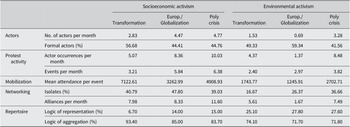
This period was marked by a dramatic opening of political opportunities during the early phase of the polity’s democratization and the implementation of economic liberal principles (deregulation and privatization), as well as a less favorable activist environment—characterized by a variety of collective actors and their activities, and pressing economic grievances. The average number of unique collective actors during the initial period was relatively low, with a relatively high proportion of formal ones. Two types of actors were illustrative here. The first was the Civic Forum—a political platform of noncommunist politicians that became a standard political party and played a key role in mobilizing during the transition period. Its main goal was to mobilize citizens to increase their electoral participation, while maintaining a distance from other organizations and political parties. The second consisted of trade unions from sectors subject to public sector reforms, specifically education and healthcare, which mobilized the “losers” of economic transformation. Additionally, protest activity was relatively low, both in terms of the number of actors’ occurrences and the number of protest events (see Table 2).
Dimensions of transactional activism across two activist fields

Table 2 Long description
The table is organized with columns for socioeconomic activism and environmental activism, each subdivided into Transformation, Europ./Globalization, and Poly-crisis. The first column lists dimensions and metrics. For Actors, the number of actors per month is 2.83, 4.47, and 4.77 for socioeconomic, and 1.53, 0.69, and 3.28 for environmental. Formal actors (percent) are 56.68, 44.41, 44.76 for socioeconomic, and 49.33, 59.34, 41.56 for environmental. For Protest activity, actor occurrences per month are 5.07, 8.36, 10.03 for socioeconomic, and 4.37, 1.37, 8.48 for environmental. Events per month are 3.21, 5.84, 6.38 for socioeconomic, and 2.40, 2.97, 3.82 for environmental. Mobilization shows mean attendance per event as 7122.61, 3262.99, 4908.93 for socioeconomic, and 1743.77, 1245.91, 2702.71 for environmental. Networking includes isolates (percent) at 40.79, 47.80, 39.03 for socioeconomic, and 16.67, 26.37, 36.66 for environmental. Alliances per month are 7.98, 8.33, 11.60 for socioeconomic, and 5.61, 1.67, 7.49 for environmental. Repertoire is divided into logic of representation (percent) at 6.70, 14.00, 15.00 for socioeconomic, and 25.10, 27.80, 27.60 for environmental, and logic of aggregation (percent) at 93.40, 85.00, 83.70 for socioeconomic, and 74.10, 71.70, 71.80 for environmental. Each metric is aligned with its respective field and subcategory.
This picture challenges the notion of spontaneous mobilization and high participation levels, sparked and facilitated by the sudden, dramatic opening of political opportunities during the 1989 democratic revolution. Two factors might be important here. First, political opportunities might be too open to promote protest, as new access points to the political process were established (tripartite, political opposition in parliament), and the power elite became dramatically less homogeneous and less secluded. Second, protests against some outcomes of economic transformation were prevented through preemptive measures of policymakers (Vanhuysse, Reference Vanhuysse2006), and discursive opportunities for protesting against liberalization and privatization were extremely narrow: economic transformation was discursively linked to the process of democratization (political freedoms were intertwined with economic freedoms, alternative visions were labeled as “socialist”) (Rameš, Reference Rameš2021).
This constellation also affected three dimensions of activist modes in the field. Even if the political context limited the quantity of collective actors’ engagement, the presence of strong material grievances and the strategies collective actors employed led to a relatively high level of protest attendance, thereby stimulating the participatory dimension of activism.
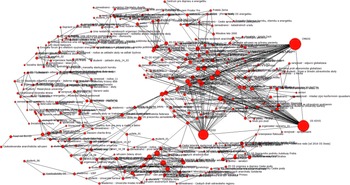
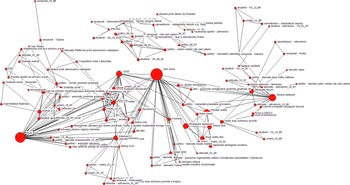
The opposite was true for the transactional dimension, which reflects both fewer available allies and lower cooperation skills, as well as wide-open opportunities. The share of actors that never entered any coalitions and, therefore, had transactions with other actors was rather high, while the number of transactions was relatively low. Some of the actors who entered coalitions, however, were quite willing to use them frequently (see Figure 1). These networking specialists were most notably political parties (Social Democrats, Green party, and minor parties representing extreme right, pensioners, or farmers) and trade unions representing employees in the public sector (healthcare workers) or trade unions in general (a major trade union confederation).
Activity and networking in the field of socioeconomic activism (1989–1997).
Note: Node size denotes the frequency of joint co-organization of an event. Isolates are deleted.

Fig. 1 Long description
At the core upper right, the largest node labeled CSSD connects to numerous medium and small nodes, indicating high co-organization frequency. Surrounding this, other prominent nodes include Strana demokratické levice, Strana přátel piva, and Československý OS pracovníků, each with multiple links radiating to smaller organizations such as OS zdravotních a sociální péče CR, Česká asociace sester, and ZO OS KOVO. The network extends outward with smaller, sparsely connected nodes like Klub přátel Tomase Bati, Zelený kruh, and Český svaz cyklistiky. Lines represent joint event organization, with denser clusters in the central and upper right regions and sparser connections at the periphery. All node labels are in Czech, and isolates are omitted.
The protest repertoire of socioeconomic protest was predominantly based on the logic of aggregation rather than representation, typically expressed through large trade unions and workers’ demonstrations in certain industries.
Europeanization/globalization period
The second period was characterized by institutionalizing some political opportunities (tripartite and EU level) while closing others (growing distance between political elites and trade unions), and rising threats (austerity policies) in combination with lower but continuing emergence of economic grievances (globalization of economy, increase of the economic competition, arrival of foreign multinational companies, etc.). On the other hand, the broader activist environment became more favorable: the average number of unique actors participating in protests nearly doubled, partly due to the rise of informally organized actors (as their share increased) and partly to the increase in the number of formal actors. There was also an increase in the protest activity (see Table 2). Both actor occurrences (over eight per month) and the number of events (nearly six per month) increased. The most active organizations were trade unions (including the major confederation and trade union federations of workers in healthcare, education, and the steel industry), and parliamentary political parties (the Social Democrats and Communists). Relatively less dramatic and more selective—even though still omnipresent—economic grievances contributed to the lower mobilizing capacity of the economic activism (the difference between the two periods was not statistically significant, which means there was a considerable oscillation in the number of attendants). In response to the rising threats, the transaction capacity of the actors increased, but only selectively. In total, the results did not differ significantly from those of the previous period; however, the share of actors without any coalitions increased, and the average number of ties per month rose (see Figure 2). This means that some actors dramatically increased their protest cooperation at the expense of others. Finally, there was a clear and significant increase in the share of repertoire based on the logic representation, at the expense of that based on a logic of aggregation. To conclude, compared with the previous period, we observe a marginal decrease in the field’s mobilizing capacity, a marginal and selective increase in its transactional capacity, and a clear increase in the use of a repertoire based on the logic of representation.
Activity and networking in the field of socioeconomic activism (1998–2008).
Note: Node size denotes the frequency of joint co-organization of an event. Isolates are deleted.

Fig. 2 Long description
Starting at the center, the largest nodes labeled C M K O S, O S K O V O, and C S S D are densely connected to many smaller nodes by straight black lines, indicating frequent joint event co-organization. These central hubs radiate connections outward to medium and small nodes, which are labeled with organization names such as Greenpeace Rakousko, Food not Bombs, and Ceskolovenske anarchisticke sdruzeni. The network forms a dense web, with clusters of nodes grouped by proximity and interconnectedness. Peripheral nodes have fewer connections and are smaller, indicating lower co-organization frequency. Isolated nodes are absent. The overall structure is a complex, multi-nodal network with clear centralization around a few key organizations.
Poly-crisis period
The political context in the third period remained similar—the preparation of austerity policies in the aftermath of the Great Recession at the end of the second period became public policy at the beginning of the third period. Even if the political context became more favorable (with center-left or techno-populist governments), the intensification of the neoliberal economy, combined with the COVID-19 pandemic and the Russian-Ukrainian war, increased political threats, brought new grievances, and exacerbated existing ones (energy prices and inflation). The change in the general activist environment was only partial: the number of unique actors and the share of formally organized actors remained very similar, while protest activity increased both in the average number of actors’ occurrences and in the number of events (see Table 2). The most active actors were mostly those that also occurred during the previous periods: political parties and trade unions. However, two important changes occurred in this period: first, in addition to these two types of actors, interest groups also began to be represented among the most active actors (farmers, people with disabilities). Second, the most active political parties in the economic protest were not only the left-wing parties but also the liberal and environmental ones ( Pirátská strana , Strana zelených ), suggesting a shift of parties with a dominant post-materialist profile into the field of socioeconomic activism.
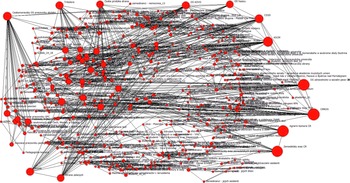
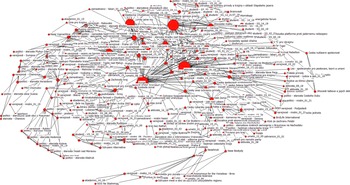
In response to the growing number of new grievances, the mobilization capacity of socioeconomic activism increased compared to the previous period, which may signal a return of mass mobilizations. At the same time, however, the number remains clearly below the first period, and the change was not statistically significant. On the other hand, the transactional capacity of the activism changed significantly in response to the new threats. The number of non-cooperating actors decreased substantially, and protest coalitions increased rapidly and uniformly compared to previous periods (see Figure 3). The shift in the number of coalitions and their size was statistically significant. In terms of protest repertoire, we see another—even if not statistically significant—shift toward the logic of representation. Even if the former remains a dominant logic of protest in the field, it is still decreasing.
Activity and networking in the field of socioeconomic activism (2009–2022).
Note: Node size denotes the frequency of joint co-organization of an event. Isolates are deleted.

Fig. 3 Long description
The diagram is a dense network map with red nodes of varying sizes, each labeled with an organization or group name. Larger nodes such as C M K O S, Agrární komora C R, and Č S S D are positioned at the outer edges, indicating high frequency of joint event co-organization. Smaller nodes are distributed throughout the interior, connected by numerous black lines representing collaborative links. The majority of connections radiate from the largest nodes, forming hubs with high centrality. Labels are in Czech and include political parties, unions, and professional associations. The network is highly interconnected, with few isolated nodes, and the structure suggests a core-periphery pattern where central organizations facilitate most collaborations. All isolates are omitted, emphasizing only active participants.
Field of environmental activism
Transformation period
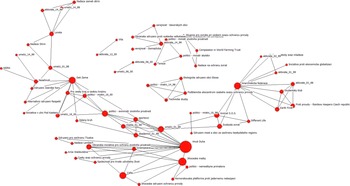
Similarly, as in the case of economic activism, the post-1989 period marked a dramatic opening of political opportunities, even greater than for socioeconomic activists, as environmental grievances were considered a key trigger of the democratization process. Contrary to the economic activists, the role of political threats remained considerably low. The general activist environment was less favorable than in the case of economic activism—the number of unique actors and their activity were lower (see Table 2). The most active actors are civil society organizations with a universal environmental agenda (Hnutí Duha, Děti Země) and a political party ( Strana zelených ). Additionally, the share of formal actors in the field was somewhat lower, accounting for approximately half of all collective actors.
In terms of the mobilizing capacity of the sector, the average number of individuals attending public events was considerably lower than in the case of economic activism, which reflected much lower presence of environmental grievances during the period: these were rather articulated by episodic and mostly professionalized campaigns over nuclear energy or forest preservation (Císař, Reference Císař2008). In terms of transactional capacity, the two indicators show a somewhat different picture: while the share of isolates in the field is remarkably low, the average number of coalitions per month was lower than in the case of economic activism. This suggests that the universal role of threats was less important than the role of available allies—the number of collective actors in the field—and their low occurrence at public events. The protest strategies in the field relied more on transactions than on economic activism (see Figure 4). From the outset, the activists relied on the logic of representation more than in environmental activism; the share of repertoire building based on the logic of aggregation is significantly higher than expected (nearly 75%). This distorts the universal picture, suggesting an automatic association between environmental (post-materialist) activism and transactions.
Activity and networking in the field of environmental activism (1989–1997).
Note: Node size denotes the frequency of joint co-organization of an event. Isolates are deleted.

Fig. 4 Long description
At the center is the largest node labeled Hnutí Duha, connected to many surrounding nodes such as GreenPeace, Ekologická společnost, and Český svaz ochránců přírody, indicating high co-organization frequency. The next largest node, ČSSD, is also centrally located and links to political and civic groups. Other prominent nodes include Ekocentrum and GreenPeace, each with multiple connections. Smaller nodes radiate outward, representing less frequent collaborators, such as students, artists, and local government officials. The network is denser in the center and sparser at the edges, with clusters labeled by group type, such as political, student, and environmental organizations. Isolated nodes are absent, as noted. All text labels are in Czech, and node size visually encodes the frequency of joint event organization.
Europeanization/globalization period
The second period generally posed few threats and further opened political opportunities for environmental activism (including transnational institutions and the Green party in government), even if these were highly selective of moderate, professionalized NGOs rather than of animal rights or deep ecology groups. Also, the grievances were selective, given the field’s thematic scope. This was associated with the transformed general activist environment—a sharp decline in collective actors in the field of environmental protest, combined with a rise in the share of formally organized actors. Additionally, the number of actor occurrences declined significantly during the second period (see Table 2). The most active actors were exclusively civil society organizations. Apart from environmental organizations ( Děti Země, Hnutí Duha, Animal S.O.S.), the most important anarchist organization was active in the field ( Anarchistická federace ). At the same time, however, the average number of public events per month slightly increased, which signals the decline of the public protest activities without the presence of an established activist group or organization, a rise in protest specialists, and hence also growing professionalization of the field, both in terms of specialization and formalization.
The mobilizing capacity of environmental activism declined after the initial period, but the decline was neither substantial nor statistically significant. The number of participants remained significantly lower than that of socioeconomic activism, reflecting the ongoing level of grievances in the field. The transactional capacity of environmental activism was considerably weakened: the number of non-cooperating actors increased, the number of coalitions decreased significantly, and coalition size also dropped significantly (see Figure 5). This reflects the opening political opportunities and lack of more universal threats to the field. The most active brokers of protest coalitions were both NGOs (all of which had a broader environmental agenda— Děti Země , Hnutí Duha , Jihočeské matky ) and radical left groups ( Anarchistická federace ). Finally, there was a slight increase in the use of the logic of representation, but it was not statistically significant.
Activity and networking in the field of environmental activism (1998–2008).
Note: Node size denotes the frequency of joint co-organization of an event. Isolates are deleted.

Fig. 5 Long description
At the center, the largest nodes include Hnutí Duha, Deti Zeme, and Calla, each with multiple connecting lines radiating outward. Hnutí Duha connects to Jihočeské matky, Greenpeace, Občanská iniciativa pro ochranu životního prostředí, and others. Deti Zeme links to Nesehnutí, Sdružení Jizerské hory, Pro cesky kraj a ceskou krajinu, and more. Calla connects to Společnost pro trvale udržitelný život and Jihočeské matky. Peripheral nodes such as Loreta, WERA, and Vita are connected by single lines to central nodes. Clusters are formed around central organizations, with smaller nodes like aktiviste_01_98, Studentský klub, and Earth First! branching from Anarchistická federace. Node size varies, with the largest representing the most frequent co-organizers. Isolated nodes are omitted. The network is denser in the lower center and sparser at the edges, showing core-periphery structure.
Poly-crisis period
The political context in the third period differed dramatically from the previous one—opportunities began to close, while threats increased significantly. Apart from crises related to migration (Caiani & Císař, Reference Caiani and Císař2019) and the COVID-19 pandemic, the issue of climate change entered the public sphere, and related grievances started to be articulated by the climate justice movement (Císař & Navrátil, Reference Císař and Navrátil2026). The general activist environment became more favorable than in the previous period: the number of collective actors increased dramatically, while the share of formal actors decreased. This signals the emergence of new, informally organized actors in the field, reflecting the rise of new types of grievances. This was followed by a steep rise in overall field activity, both in the number of actor occurrences and the number of events. It is clear that the key actors in the field have changed: two of the four most active organizations were recently founded climate activist groups ( Limity jsme my, Fridays for Future), while only one of the remaining two ( Hnutí Duha, Greenpeace) was among the most engaged actors during the previous two periods.
The mobilization dimension of the field increased dramatically, even though the difference was slightly below the threshold of statistical significance. This shift clearly mirrors the rise of new grievances and mobilizations on climate justice issues. The shift in transactional dimension related to the new political threats was also clear: even if the share of non-cooperating actors rose, the number of ties (coalitions) per month increased unevenly but rapidly, reaching a new record (see Figure 6). The shift in both the number and size of the coalitions was statistically significant. The most networking actors were identical with those who were the most active ( Limity jsme my, Fridays for Future, Greenpeace, Hnutí Duha ). Finally, there was almost no shift in the share of representative and aggregative strategies, and reliance on the logic of aggregation remained dominant (see Table 2).
Activity and networking in the field of socio-economic activism (2009–2022).
Note: Node size denotes the frequency of joint co-organization of an event. Isolates are deleted.

Fig. 6 Long description
At the center are the largest nodes, each labeled with organization or actor names such as ‘Fridays for Future’, ‘Jihočeské matky’, and ‘Limity jsme my’, indicating the highest frequency of joint event co-organization. These central nodes are connected by numerous lines to medium and small nodes, representing other organizations, activists, or groups. Node size decreases as one moves outward from the center, with peripheral nodes such as ‘Anonymous for the Voiceless - Brno’, ‘Amika’, and ‘Zelení na venkově’ showing fewer connections. All nodes are labeled in Czech, and connections are depicted as straight black lines. Isolated nodes are omitted, resulting in a dense, interconnected web with the greatest concentration of links and activity at the core. The network spans from the top left to the bottom right, with clusters of related actors grouped by proximity and link density. The overall structure highlights central hubs and the distribution of collaborative activity across the field.
Conclusion and discussion
The concept of transactional, as opposed to participatory, activism was originally developed to identify a special variant of political activism in post-socialist societies. We aimed to elaborate on and operationalize it to make it widely applicable not only across different civil society arenas but also across various civil societies. Hence, we theoretically elaborated and empirically analyzed the conditions affecting the three dimensions of any activist mode: mobilizing, participatory, and strategic.
The article illustrates how various aspects of the political context or internal environment of civil society organizations link with various aspects of their political activism: while mobilizing capacity increases in periods with increased and more universal grievances, their transactional capacity is more a function of rising political threats, which, in accordance with a theory of movement coalitions, make collective actors cooperate and share resources. At the same time, despite the slowly growing share of strategic repertoire based on representation in both activist fields, we did not find any significant differences across periods under study. This is the only one of our expectations that has not been fully confirmed. This aligns with the theoretical expectation that repertoire change is related to intra-organizational processes of professionalization and formalization.
Our reconceptualization and empirical findings brought important results with broader implications. First, it highlights the general contextual determinants of the alleged weakness of post-socialist civil societies, which have stimulated the transactional dimension of activism, weakened its participatory dimension, and led to an increase in protest strategies of representation. It refuses to view transactional activist mode as a historically unique consequence of Communism, but rather as a result of a post-communist combination of general contextual conditions. This aligns with the efforts to develop more comprehensive explanations of the structure and dynamics of political activism (Tilly & Tarrow, Reference Tilly and Tarrow2015). Second, our research focuses on two activist fields, raising the question of their slow convergence across all three dimensions. This raises questions about the general evolution of political activism in a specific institutional environment and its mimetic tendencies (DiMaggio & Powell, Reference DiMaggio and Powell1983). Third, we illustrated both the consistently higher use of participatory strategies in the long-established field of economic activism (compared to the more recent field of environmental activism) and a positive relationship between the share of formal actors and the use of aggregation strategies in the field of economic protest. We also illustrated that environmental (“new”) activism consistently displayed lower levels of inter-organizational networking (transactions) than the economic form, contradicting generalizations about the prior use of the concept of transactional activism (Císař & Navrátil, Reference Císař and Navrátil2017). This difference invites further examination of the role of organizational or sectoral activist cultures and ideas of social change that might be driving practical strategies.
Generally, our analysis demonstrates that a comprehensive understanding of post-socialist civil societies and political activism, grounded in their organizational infrastructures, requires a combination of structural and actor-centered perspectives. Building on research previously published in this journal or elsewhere on the interactions of movements, political activism, and civil societies (e.g., Baća, Reference Baća2022, Reference Baća2024; Della Porta, Reference Della Porta2020; Gagyi & Ivancheva, Reference Gagyi, Ivancheva, Moskalewicz and Przybylski2017; Jacobsson & Korolczuk, Reference Jacobsson and Korolczuk2017; Jacobsson & Saxonberg, Reference Jacobsson and Saxonberg2013), our article aims to contribute to this disciplinary dialogue and cross-fertilization.
Funding statement
Jiří Navrátil’s work on this article was supported by the Czech Science Foundation (project “Between revolution and crisis: Emergence, evolution, and re-structuring of economic protest in post-socialist context,” reg. no. 23-07114S).
Competing interests
The authors declare none.
Ethical standards
Research in this article did not involve human participants and/or animals.
Use of AI
A generative artificial intelligence tool (Grammarly for Windows version 1.2.177.1709) was used to check grammar and improve the clarity of the manuscript. All intellectual content, research design, and data analysis were performed exclusively by the authors.


 Open access

