


The green iguana (Iguana iguana), a large arboreal lizard native to Mexico, Central America and northern South America, has become a globally recognized species due to its striking appearance and adaptability as an exotic pet (Powell Reference Powell2004, van den Burg et al. Reference van den Burg, Van Belleghem and De Jesús Villanueva2020). While its popularity in the pet trade has driven widespread introductions, frequent abandonments and deliberate releases have enabled green iguanas to establish invasive populations in novel ecosystems, including in the USA, Fiji and beyond (Falcón et al. Reference Falcón, Ackerman, Recart and Daehler2013, De Jesús Villanueva et al. Reference De Jesús Villanueva, Falcón, Velez-Zuazo, Papa and Malone2021). Their physiological traits (high fecundity, rapid growth, long lifespan and early sexual maturity) combined with the absence of natural predators in introduced ranges facilitate their explosive population growth, posing significant ecological risks (Sementelli et al. Reference Sementelli, Smith, Meshaka and Engeman2008, Shah et al. Reference Shah, Dayal, Bhat and Ravuiwasa2020). Despite extensive research on invasive species, the green iguana presents a unique paradox: its role as an invasive threat conflicts with its legal protection, creating complex challenges for management. We integrate ecological, economic and policy perspectives to address this paradox, a dimension that is underexplored in the existing literature. The objective is to evaluate the interplay between conservation, pet trade dynamics and ecological security and to propose a balanced framework for managing green iguana populations that mitigates their invasive impacts.
Ecological and socioeconomic impacts: a multi-dimensional threat
Globally, green iguana invasions have triggered systemic ecological and socioeconomic impacts across multiple dimensions. Regarding infrastructure security, the green iguana shows strong burrowing habits, and its large-scale burrowing behaviour leads to increased erosion while posing a direct threat to various human-made structures, including canals, levees and dikes (Kern Reference Kern2004). Public safety is compromised because these large reptiles frequently disrupt traffic, with documented cases of iguanas causing vehicle collisions on highways (Krysko et al. Reference Krysko, Enge, Donlan, Seitz and Golden2007). Their role as disease vectors adds to the risk, as they have been identified as carriers of Escherichia coli pathotypes, and they are therefore considered a potential source of gastrointestinal disease (Bautista-Trujillo et al. Reference Bautista-Trujillo, Gutiérrez-Miceli, Mandujano-García, Oliva-Llaven, Ibarra-Martínez and Mendoza-Nazar2020). Ecologically, they can compete with animals native to the invaded range (Truglio et al. Reference Truglio, Smith and Meshaka2008). As phytophagous creatures, they can damage several native imperilled plants (Claunch et al. Reference Claunch, Jones, Khazan and Kluever2025). Their digestive systems efficiently disperse the seeds of invasive plants (e.g., Schinus terebinthifolius), accelerating their spread in fragile ecosystems. They also damage agricultural production (Govender et al. Reference Govender, Muñoz, Camejo, Puente-Rolón, Cuevas and Sternberg2012). In Puerto Rico, they have been found to infest 34 of 55 surveyed crops, with farmers’ single-season losses reaching USD 7280–32 000 (De Jesús Villanueva et al. Reference De Jesús Villanueva, Massanet Prado, Gould, García-Quijano and Kolbe2022). Genetic pollution through hybridization with native lizards also alters biodiversity at a molecular level. Although many regions have recognized these risks and implemented management strategies, few have documented the successful eradication of established green iguana populations (Knapp et al. Reference Knapp, Grant, Pasachnik, Angin, Boman and Brisbane2021).
The green iguana in China: an emerging invasion
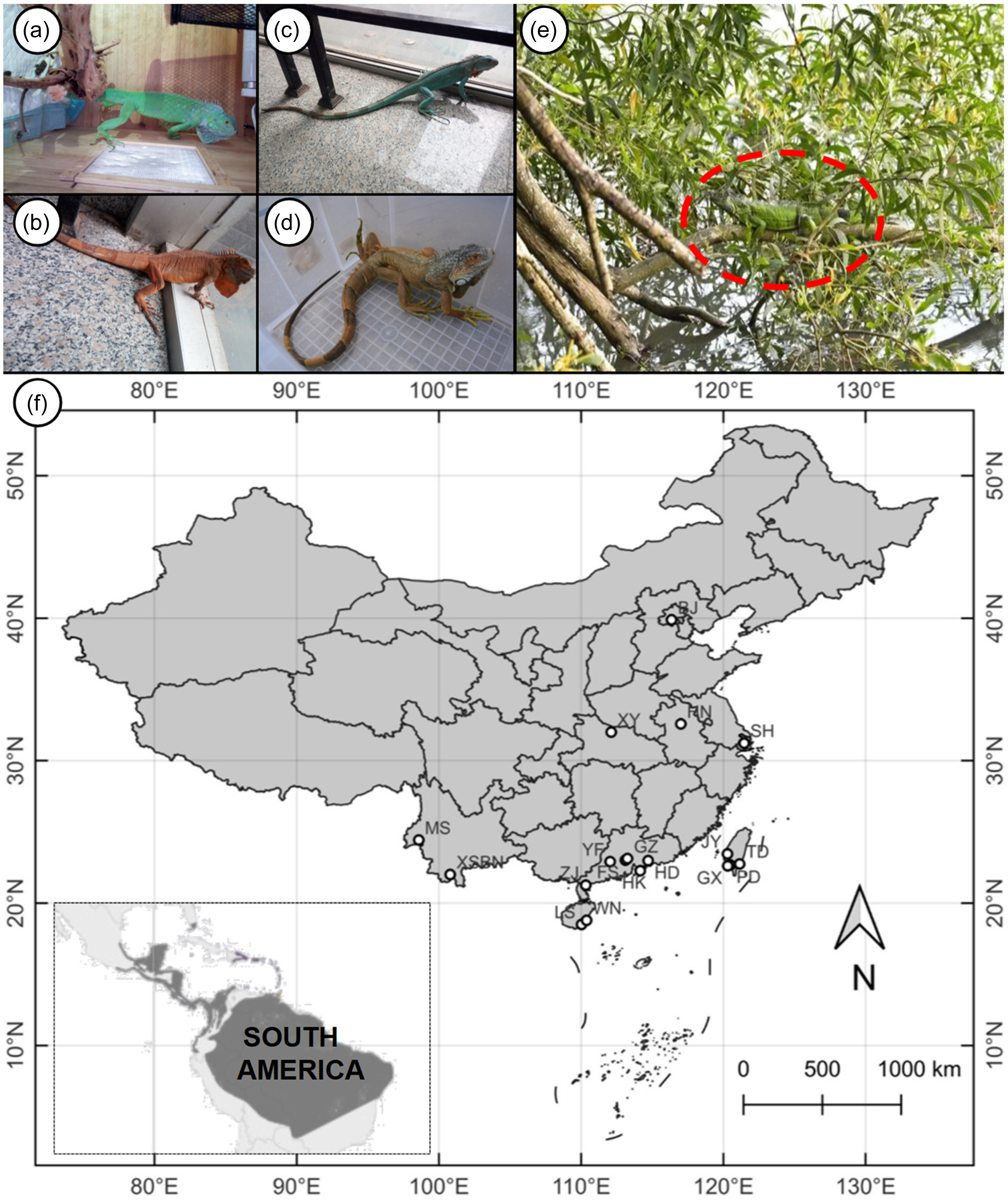
The green iguana has exhibited multi-regional expansion in China. Stable wild populations are established in Taiwan’s Pingtung, Kaohsiung and other regions (Lee et al. Reference Lee, Chen, Shang, Clulow, Yang and Lin2019). Significant sightings are also reported in Hong Kong (Mo & Mo Reference Mo and Mo2023). In 2017, with the approval of the relevant authorities, 10 green iguanas were legally imported into mainland China for breeding purposes (China Daily 2018). Although legal import is theoretically possible under a strict Convention on International Trade in Endangered Species of Wild Fauna and Flora (CITES) and domestic permit system, this pathway is complex and limited. In practice, high market demand has fuelled rampant illegal trade in the green iguana, which violates China’s Wildlife Protection Law and circumvents customs and quarantine controls. Reports of smuggling and illicit trade of this species existed before and persisted after 2017 (Fig. 1a–d).
(a–d) Four illegally traded green iguanas. (e) A green iguana discovered in the wild in Huizhou, Guangdong Province (Xinhuanet 2023). (f) Eighteen sites (BJ = Beijing; FS = Foshan; GX = Kaohsiung; GZ = Guangzhou; HD = Huidong; HK = Hong Kong; HN = Huainan; JY = Chiayi; LS = Lingshui; MS = Mangshi; PD = Pingtung; SH = Shanghai; TD = Taitung; WN = Wanning; XSBN = Xishuangbanna; XY = Xiangyang; YF = Yunfu; ZJ = Zhanjiang) where green iguanas have been reported in mainland China, Hong Kong, and Taiwan. The map in the bottom left corner shows the species’ current distribution in the Americas (IUCN 2025).

Using the Chinese term for ‘green iguana’ as the search keyword on Chinese mainstream search engines (NetEase, The Paper, People’s Daily Online, Xinhua Net, Guangming Net, Sina) revealed that, in recent years, the species has been reported in the wild at 18 sites across nine provinces, including Hainan and Guangdong (Fig. 1e,f). Although large-scale proliferation has not occurred, localized distributions have raised concerns. The unregulated pet trade and reckless release practices are the primary drivers of this invasion; consequently, wild sightings probably represent animals that entered via illegal channels.
The green iguana is listed in the CITES Appendix II. It is critical to clarify that this listing does not indicate that a species is necessarily threatened with extinction, but rather that it is subject to such high volumes of trade that regulation is required to prevent its over-exploitation (CITES 1973). This is precisely the case for the green iguana, which is classified as ‘Least Concern’ on the International Union for Conservation of Nature (IUCN) Red List of Threatened Species (IUCN 2025). As a CITES signatory, China designates the green iguana as Class II protected wildlife under domestic law, prohibiting its unauthorized hunting or killing. This protected status creates a paradox, posing significant ecological threats while legally safeguarding the species. Unlike other established invasive species in China, including the semi-aquatic turtle Trachemys scripta elegans and the freshwater snail Pomacea canaliculata, the green iguana is relatively new to the Chinese mainland, and hence there is low awareness of its ecological risks. This combination of issues creates favourable conditions for the spread of this species through susceptible habitats.
Critically, this regulatory paradox is not an isolated case. By conferring protected status on all CITES-listed species, China – and other CITES signatories – may inadvertently shield non-native species with high invasive potential. The green iguana serves as a salient and timely example of this broader systemic challenge. Its rapid establishment and significant ecological impacts underscore the urgent need to reconcile international conservation commitments with proactive biosecurity risk management for this and other traded species that are potentially invasive.
Proposed governance framework: a multi-tiered approach
A multi-tiered governance system is required to address this potential crisis. At source control levels, it is necessary to reclassify green iguanas from ‘protected wild animals’ to ‘invasive species subject to priority control’ by amending laws to align management measures with the ecological threats posed by such species. A system for farm licensing, import approval and breeding traceability is needed. Penalties, including administrative warnings, fines and even criminal liability, must be imposed for those engaged in the illegal trade of this species or in releasing these animals at will.
While strengthening source management, the construction of technology-driven monitoring and early-warning systems is crucial. Forestry, agriculture, customs and citizen science data can be integrated to achieve real-time monitoring of invasive populations by building a monitoring platform based on artificial intelligence (Ullah et al. Reference Ullah, Saqib and Xiong2025). Drones and motion sensors could be deployed in high-risk areas (e.g., nature reserves and national parks) to conduct early monitoring of the nesting and burrowing activities of green iguanas and to provide data to support rapid responses.
Prevention and control system implementation hinges on social consensus formation (Rodríguez-Rey et al. Reference Rodríguez-Rey, Borrell, Dopico, Muha and Rolla2022). Regarding public participation, emphasis is placed on education dissemination and co-governance (McClendon et al. Reference McClendon, Waliczek, Serenari and Williamson2024). Real-life cases (e.g., damage to Fiji’s agriculture) are disseminated through news media, including short videos and documentaries, to increase awareness regarding the harm caused by species invasions. The prevention and control of alien species is integrated into the educational curricula of schools to cultivate adolescents’ awareness regarding ecological security and a sense of responsibility regarding pet-keeping. Citizen science can support the early detection of invasive alien species (Pocock et al. Reference Pocock, Adriaens, Bertolino, Eschen, Essl and Hulme2024). An app could be developed to monitor alien species, including green iguanas, and the public should be encouraged to report wild individuals, establishing a grassroots prevention and control network.
Considering cross-border spread characteristics, international collaboration is necessary to strengthen the prevention and control chain (Wallace et al. Reference Wallace, Bargeron and Reaser2020). China can establish cooperation mechanisms with green iguana-native countries and invaded regions (e.g., Puerto Rico and Fiji). Joint monitoring networks might be established along trade routes to share intelligence on smuggling trends and to conduct law enforcement operations. China could participate in global research on the ecology of the species, as well as the development of prevention and control technologies; a multilateral biosecurity alliance could be formed to deal with this and other invasive species.
Conclusion
The green iguana’s invasion exemplifies the complex interplay between global pet trade dynamics and biosecurity challenges. Its rapid spread across diverse ecosystems, including China, underscores the urgent need for proactive management to mitigate its ecological, economic and public health impacts. The proposed multi-tiered governance system – encompassing legal reclassification, stringent trade regulations, advanced monitoring technologies, public engagement and international cooperation – offers a comprehensive strategy to curb this invasion. By addressing the root causes of its introduction and enhancing societal awareness, China can transform this crisis into an opportunity to establish a robust framework for invasive species management. Such an approach not only safeguards vulnerable ecosystems but also sets a precedent for global biosecurity, ensuring the sustained protection of biodiversity and human well-being.
Acknowledgements
None.
Data availability
Not applicable.
Author contributions
DL and CX conceived and wrote the original draft; SH conducted the visualization; XX reviewed and edited the manuscript.
Financial support
This research was supported by the National Key Research and Development Program of China (2022YFC2601205).
Competing interests
The authors declare none.
Ethical standards
Not applicable.