

4.1 Introduction
Clear blue skies, reddish-brown soils, and bright yellow jerrycans – the three colours of rural Kitui that symbolise the water stories of these semi-arid landscapes. With extremely low and variable rainfall that disappears quickly upon touching the hot sandy ground, searching for and fetching water often dominates the daily lives of women and children in these hinterlands of Kenya. This is a story that spans the ages in rural Africa from the biblical reference to the ‘drawers of water’ to the more recent critique of ‘watering white elephants’ (Therkildsen, Reference Therkildsen1988). The former captures social inequalities and hardship that have barely changed in centuries despite Kenya’s major investments in ports, railways, roads, and devolution in recent years, leaving the country close to an international debt default in early 2024. The latter is homage to Therkildsen’s detailed critique of ineffective and uncoordinated donor investments in Tanzania in the 1980s, constructing rural water supply ‘white elephants’ that crumbled soon after the projects concluded, and the donors departed. As in Bangladesh, it is convenient to use the climate crisis as the primary villain in rural water insecurity, but the reality is that ineffective governance and weak service accountability provide important clues and responses to breaking a dismal cycle of wasted investments and underdevelopment.
Despite being traversed by the equator and close to the Indian Ocean, the unexpected dryness of East Africa’s climate is intriguing. Recent evidence shows that such dry conditions can be attributed to the region’s topography, whereby the network of valleys interspersing the 6,000 km long East African Rift System cause moisture laden air to be channelled at high speed towards Central Africa leaving an arid landscape in its path (Munday et al., Reference Munday, Savage, Jones and Washington2023). Unlike the tropical monsoon in Bangladesh, spanning across four months between June and September, rainfall in Kenya is bimodal. There are two distinct rainy seasons – the ‘long rains’ from March to May, and the ‘short rains’ from October to December, which have a combined annual average of 900 mm of rainfall (Figure 4.1). With most of the rivers being seasonal, digging out rainwater stored in dry riverbeds has traditionally been the only reliable water source for these sparsely populated rural populations.
Spatial and seasonal variations in rainfall over Kitui county, illustrating the ‘long rainy season’ (March–May) and the ‘short rainy season’ (October–December) separated by a prolonged ‘dry season’ (June–September).

Kitui, together with its neighbouring Machakos and Makueni counties, is largely inhabited by the Kamba people of the Bantu ethnic group. Though traditionally semi-nomadic herders, the Kamba were forced to shift to subsistence cropping along with limited livestock keeping during the British colonial era (Kisovi, Reference Kisovi1992). Water for irrigation and livestock is key to survival, with a natural affinity for people to settle close to sandy riverbeds or valleys where rainwater can be harvested. Since the late twentieth century, there has been growing investments in earth dams, rock catchments and sub-surface sand dams in this region to augment rainwater storage, as part of an overall drive to improve productivity of the arid and semi-arid lands. Donor investments in groundwater technologies such as handpumps, boreholes with submersible pumps, and piped schemes with kiosks or standpipes also gained momentum since the turn of the millennium, as ‘access to improved sources’ gained centre stage in global water policy.
Yet as of 2019, 44 per cent of the 1.1 million residents of Kitui used surface water as their main source of drinking water, compared to the national average of 23 per cent (KNBS, 2019b). With such high reliance on unimproved sources, the global target of safe and affordable drinking water on premises by 2030 seems elusive in these contexts. Despite billions of dollars of investments in rural water infrastructure, why do one in three Kenyans still rely on surface water? How can sector financing and institutions be reformed to improve water security in these drylands with climate uncertainty? In this chapter, we explore the answer to these questions through analysis of the daily water sources and payments of households and schools in Kitui. We situate these behavioural dynamics within the changing political and institutional landscape of rural water service delivery from the colonial era through to the post devolution Kenya.
4.2 From Colonial Times to Harambee Habits
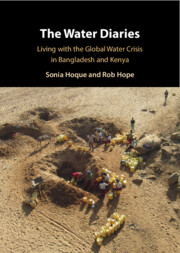
It was late March 2017, just days before President Kenyatta declared a national drought emergency. As we left the highlands of the bustling capital of Nairobi to pilot our water diary method, the signs of water stress became visually conspicuous. The unpaved dusty roads towards Mwingi-North were surrounded by uninhabited stretches of stunted thorn bushes, occasionally punctuated by Baobab trees. Looking down from a bridge, we saw men, women, and children digging scoop holes in the dry riverbed under the scorching sun. As they filled up their jerrycans pint by pint using funnels cut from plastic bottles, the donkeys waited to be loaded before making their long arduous walk back home. This is, in fact, a very common scene in these arid and semi-arid lands of rural Kenya, where sandy riverbeds act as a sub-surface reservoir for months after the last rainy season, preventing water losses through evaporation (Figure 4.2).
People extracting water from scoopholes in a dry sandy riverbed in rural Kitui. The photo was taken in March 2017 just days before the Kenyan President declared a national drought emergency.

Built on impermeable layers of underlying bedrock, sub-surface dams can further augment the storage of rainwater within the highly porous sand collecting behind the dam wall. An audit of water infrastructure in Kitui county identified close to 700 sub-surface sand dams (Nyaga, Reference Nyaga2019), although the total numbers can be as high as 1,500, making Kitui a ‘global leader in sand-storage technology, at least in terms of dam numbers’ (Ertsen and Ngugi, Reference Ertsen and Ngugi2021, p. 4). While most are unequipped, the more productive ones may be fitted with pumps, pipes, and tanks to supply the water off-site. Earthdams and rock catchments are popular rainwater harvesting infrastructure in Kitui. Built to contain surface runoff from valleys and slopes, they usually have water for only a few weeks after rainfall due to high evaporation. Construction of sand and earth dams are never intended for drinking water purpose only. Rather they are vital for small-scale irrigation and livestock, which are the main sources of income and sustenance.
The distribution of water resources and feasibility of different water supply infrastructure are determined by the topography, rainfall, and geology of the region. The Athi and the Tana are the only two perennial rivers in Kitui, with most of the seasonal rivers draining into the Tana River Basin. The topography of the landscape falls from a peak of 1,800 m in the western highlands to about 400 m towards the eastern plains, interspersed with deeply weathered metamorphosed rock outcrops. The lowlands which constitute two-thirds of the county receive less than 500 mm of rainfall a year – that is, a quarter of the tropical monsoon in Khulna. Rainfall amount and distribution is more reliable in the short rainy season from October to December than the March to May long rains’ season. Knowledge of groundwater quality is scattered and limited to individual drilling records, without any systematic aquifer characterisation to aid the siting of boreholes. In general, salinity from naturally occurring chlorides, fluorides and nitrates is a major challenge, particularly in the low-lying plains with colluvial deposits and red soils (Wadira, Reference Wadira2020).
Prior to the colonial era, the Akamba people adapted to the region’s limited and unreliable water resources through their flexible patterns of settlement and mobility, characterised by a mix of private and common property rights that supported integrated crop-livestock systems (Rocheleau et al., Reference Rocheleau, Steinberg and Benjamin1995). The arrival of the British colonial settlers disrupted the traditional land use and settlement patterns, marking a transition from ‘people going to the water’ to ‘water going to the people’ (Nyanchaga, Reference Nyanchaga2016). Construction of the Ugandan railroad from the Mombasa port marked a pivotal shift in Kenya’s water infrastructure development. The first piped systems were built around stations in the early twentieth century to meet the needs of the steam engines and the railway workers. Around the same time, the colonial government also launched extensive land seizure and enclosure operations aimed to limit mobility of livestock of the Akamba herders, whose ‘primitive’ cattle rearing and agricultural practices were framed to be the cause of the devastating soil erosion that plagued the native reserves (Rocheleau et al., Reference Rocheleau, Steinberg and Benjamin1995). The first rural piped schemes and boreholes were drilled by the British colonial administration in the mid twentieth century to facilitate commercial ranching within controlled grazing areas and intensive cultivation of cash crops. However, lack of planning and investment led to subsequent failure of boreholes and piped schemes, and reallocation of funds for constructing small-scale surface and sub-surface dams (Parker, Reference Parker2020). As described by Munger (Reference Munger1950, p. 580), boreholes were ‘entirely outside the native’s traditional knowledge and psychologically … less desirable than dams’.
Since these early interventions by the colonial regime, the rural water sector in Kenya underwent several stages of institutional reforms in line with global water policy discourse and the evolving economic and political situation within the country. Water reforms in post-independence Kenya aimed to correct the colonial injustices by adopting African socialism as the development philosophy, with the concept of self-help, termed as ‘Harambee’ by the first President Jomo Kenyata, being the main vehicle for driving equity in rural areas (Nyanchaga, Reference Nyanchaga2016). Self-help groups, which dominate the management of rural water systems till date, are generally groups of local residents with shared economic and social interests working together for their own betterment. Throughout the 1960s and early 1970s, self-help groups initiated many rural water projects through labour and financial contribution, while donor organisations like UNICEF and WHO supported the government to augment rural water infrastructure development (Mumma, Reference Mumma2005). This philosophy also applied to schools, with the share of Harambee schools in Kenya increasing from 52 per cent in 1969 to 73 per cent in 1989 (Hope et al., Reference Hope, Katuva, Nyaga, Koehler, Charles, Nowicki, Dyer, Olago, Tanui, Trevett, Thomas and Gladstone2021b).
4.3 Limited Reach of Policy Reforms in Rural Areas
The post-independence ideology of water as a ‘social good’ made it increasingly difficult to fund operations and maintenance costs in rural areas with the large distances between waterpoints. At the same time, the government’s ability to finance rural water supplies was significantly constrained in the 1980s, as the country plunged into a debt crisis from accumulation of unpaid loans from the International Monetary Fund and the World Bank. This was further exacerbated by a severe drought that curtailed export revenues from tea and coffee. As with other newly independent states of the global south, the World Bank’s Structural Adjustment Programme led to significant restructuring of Kenya’s economic policies. In line with the overall market-oriented reforms aimed to reduce public spending, the rural water sector saw a push towards decentralisation of service delivery, higher degree of self-financing, and improved operational efficiency. Likewise, the government promoted a cost-sharing policy for schools, with teacher salaries and learning resources being funded by the government while responsibilities for infrastructure and recurrent expenditure being largely borne by communities (Ngware et al., Reference Ngware, Onsomu and Muthaka2007). As Mwiria argues, the emergence and establishment of Harambee schools played a role in the ‘legitimation of inequality in Kenya’ (Mwiria, Reference Mwiria1990, p. 364).
To address financing and maintenance challenges, global water sector policies in the 1980s shifted attention to developing low-cost technologies that can be managed by users with minimal external inputs. This resulted in the design and testing of a variety of handpump technologies that revolutionised rural water services in South Asia and Sub-Saharan Africa. As of 2019, there are close to 700 handpumps in Kitui county (Nyaga, Reference Nyaga2019). Most of these are Afridev handpumps which became the technology of choice for much of rural Africa, compared to the No. 6 handpump popularised in Bangladesh. By the end of the twentieth century, the government took a ‘very hands-off approach to rural water supply in general’ (Harvey et al., Reference Harvey, Ikumi and Mutethia2003, p. 8). Government staff at provincial and district water offices were responsible for coordinating water services in their jurisdiction, providing technical support for borehole siting, issuing drilling permits, and providing ad doc support to communities for water quality monitoring, operation, and maintenance (MWR, 1999).
The enactment of the Water Act 2002 marked the beginning of ‘socially responsible commercialisation’ of the Kenyan water sector, though the focus was predominantly on urban areas. The Act formalised the government’s role in coordination and regulation through establishment of the Water Services Regulatory Board (WASREB) (The Water Act, 2002, Section 46), while the responsibilities for day-to-day service delivery was delegated to water service providers (The Water Act, 2002, Section 55). Water service providers could be commercial companies, NGOs or private entities, licensed to operate in a designated area, and are monitored by WASREB against sector guidelines and standards. Licenses are, however, only applicable for person(s) supplying more than 25 m3 of water per day for domestic purposes, with schools, healthcare centres or other institutions serving their own occupants being exempted (The Water Act, 2002, Section 56).
In Kitui, there are two such water service providers – Kitui Water and Sanitation Company (KITWASCO) and Kiambere-Mwingi Water and Sanitation Company (KIMWASCO) – which serve a third of the county’s population through metered piped water connections on-premises and a network of public kiosks, mostly concentrated in Kitui and Mwingi towns. In fact, almost all the 91 water service providers regulated by WASREB operate in urban growth centres where the population density makes them more commercially viable. Other than these two regulated water service providers, there are 460 rural piped schemes in Kitui, four out of five of which are supplied by groundwater drawn through boreholes using a combination of grid electricity, solar energy, or diesel-operated generators (Nyaga, Reference Nyaga2019).
The adoption of a new constitution in 2010 overhauled the country’s governance structure, forming 47 new county governments with the aim to decentralise political power, public sector functions, and public finances and ensure a more equitable distribution of resources among regions. By explicitly acknowledging access to safe water in adequate quantities as a basic human right (Article 43), the constitution marked a departure from the market-oriented principles of water as an ‘economic good’ and set the foundation for extending services to rural areas that are not commercially viable. Under the Water Act (2016), which repeals the earlier act, county governments are now responsible for providing water services within their jurisdiction (The Water Act, 2016, Section 77). County governments are encouraged to contract private entities, community groups or NGOs to manage and operate rural water systems, while trying to embed these small-scale service providers within the sector’s regulatory framework through various arrangements with existing water service providers (WASREB, 2019).
Despite multiple reshuffling of ideologies, investment modalities and governance arrangements, the rural water sector till date suffers from two major challenges – financing of new water supply infrastructure and sustainable operation and maintenance mechanisms. Investments in rural water infrastructure have mostly been driven by bilateral and multilateral aid programmes, whether the funds are channelled through government ministries or via project with local NGOs. The Water Act 2002 mandated the establishment of the Water Services Trust FundFootnote 1 as a pooled funding mechanism drawing on government, donor and private sector funding to target investments in disadvantaged areas. The Water Services Trust Fund’s legal mandate limits its funding to formal water service providers which largely ignores the 80 per cent of Kenyans who live in rural areas outside the provision of water service providers. In Kitui, the Water Services Trust Fund has invested in large storage tanks to serve piped schemes in Mwingi and Kitui towns. However, the design specification for the motorised pumps to lift the water to the tanks was inaccurate and not one drop of water has been lifted to these elegant white elephants in the Kitui skyline.
A decade has passed since devolution. With two national elections, several major droughts, and a global pandemic, county governments are slowly developing Water Bills to chart their own pathways to water security (Koehler et al., Reference Koehler, Nyaga, Hope, Kiamba, Gladstone, Thomas, Mumma and Trevett2022). While policy documents have progressively encouraged private sector engagement in rural water sector, this is limited in practice both in terms of capital investments and operation and maintenance services. Other than the two regulated water service providers, piped schemes and handpumps are managed by communities through elected representatives or Water Management Committees, individual schools, healthcare centres or churches.
4.4 Seasonal Dynamics of Source Choices and Water Quality
Despite a century of institutional reforms, trying to reallocate responsibilities of infrastructure financing and operational sustainability among the state, user communities, private sector and international donors, it is uncertain to what extent the daily water experiences of Kenya’s rural populations have improved. The scene of men, women, and donkeys on the dry riverbed questions whether millions of dollars of development aid succeeded in bringing water to the people. While the availability of potable piped water services 24/7 within the dwelling is a norm in developed countries, it still remains a distant reality for the scattered settlements in Kitui county.
Our 2018 survey of 1,400 households in Mwingi-North reflect the wide range of water sources that people identify as their ‘main source of drinking water’. Four out of ten households reported dry riverbed scooping as their main source, followed by handpumps, river, piped schemes/ kiosks, and earthdam being used between one to 2 out of 10 households. But as in Khulna, a focus on main source is eclipsed by the seasonal shifts in water sources – a common phenomenon among water-stressed rural populations. While the onset of monsoon in Khulna allows people to shift to rainwater conveniently harvested from own roof catchments, the rains in Kitui drive people towards unimproved community sources, mainly earthdams and surface flows in seasonal rivers, which may not necessarily be closer to home. A week after the last rains, when the surface flows trickle down to the subsurface, there is a sharp increase in dry riverbed scooping. With each filled jerrycan weighing 20 kg, and each donkey being able to carry up to four jerrycans per trip, the amount of water collected is often limited.
Kasembi Mwinzi is a middle-aged woman living with her two teenage sons and one daughter in Kyuso ward of Mwingi North subcounty. Her husband passed away a few years ago. She sells sand or crushes stones for construction work. She gets water from a kiosk, for which she pays KES 2.5 per jerrycanFootnote 2 (USD 1.25 per m3), and also through scooping from the Kamuwongo River. The river is seasonal but the water table is high. Kasembi goes to the kiosk when she has money, because the kiosk water is better quality than that of scooping. She does not have her own donkey and borrows her neighbour’s one. While she does not pay for the donkey she sometimes helps the neighbour in fetching water. When she gets the donkey, she collects 8 jerrycans; however, when she has to carry on her back, she gets only 4 and makes multiple trips. Hence, she reduces water use for laundry and livestock on those days. Only on one occasion she used a private handpump. The owner only allowed her once, because she didn’t have a donkey and couldn’t go far.
While water in Kamuwongo River can be accessed close to the surface all year round, in most seasonal rivers the water table falls as the dry-season progresses, creating a need to shift to shallow wells dug manually along the riverbeds. Digging and maintaining wells is a labour intensive and time-consuming process. Social relations and affordability are important mediators of accessing wells, and those without own wells often end up paying a high price at the peak of the dry season. Well owners often demand full subscription fee before the start of the season as a precautionary measure against those who tend to shift from one well to another leaving payments due. However, those with good personal relations with the well owner can negotiate to pay in instalments (Bukachi et al., Reference Bukachi, Omia, Musyoka, Wambua, Peter and Korzenevica2021).
Kasyoka Mwangangi lives with her three children and husband in Tseikuru, another ward of Mwingi-North subcounty. She runs a canteen at the town, while the husband does casual work, like construction. She normally fetches water from a water tank near her shop at KES 10 per jerrycan (USD 5 per m3). The tank is filled up by a tanker truck every few days. When there is no water at the tank, she goes to a private hand-dug well where she buys water at KES 6 per jerrycan (USD 3 per m3). She prefers the well water compared to the tank, as the latter is often salty and the tank is dirty. But to go to the well she needs to borrow a donkey from her neighbour, and also close her shop for a few hours. Sometimes, when she is really busy and there is no water at the kiosk, she asks a vendor to fetch water for KES 20 per jerrycan (USD 10 per m3). She usually needs six cans a day, of which three are used for her canteen, which is adjacent to her home. In September, her water needs were particularly high as she was constructing her house.
In Kitui, it is quite common for men to stay away from home for weeks for paid employment in urban centres within or outside the county. This effectively makes the woman the head of the household, leaving her responsible for the farm and younger children, while the older ones stay at boarding schools. In times of sickness or other crises, women thus need to draw on their social capital and take help from neighbours for water collection (Bukachi et al., Reference Bukachi, Omia, Musyoka, Wambua, Peter and Korzenevica2021). One of our water diary participants, Grace, gave birth during the study period and was unable to fetch water for a month. Since Grace’s husband works in Garissa town, she had to buy vended water and ration her use as the water was very costly (KES 25 per 20-litre jerrycan or USD 12.5 per m3). When the baby was a few weeks old, Grace borrowed her mother-in-law’s donkey and fetched water from a handpump a couple of kilometres away. She prefers this handpump to the one closer to her home as the latter is saline.
Like Kasyoka and Grace, many people tend to avoid groundwater-based sources such as hand pumps and kiosks fed by boreholes due to salinity. Groundwater salinity in Mwingi-North subcounty is generally low in the western highlands of Mumoni and Tharaka, where the geology is dominated by quartzites, biotite, and hornblende gneisses. Colluvial deposits and red soils in the low-lying Ngomeni and Tseikuru areas towards the east tend to have higher salinity. Analysis of water quality of hand-dug shallow wells (less than 20 m deep) along the seasonal riverbanks, boreholes with handpumps (20–100 m deep) and boreholes with submersible pumps (more than 100 m deep) showed that water salinity in 60–75 per cent of the boreholes exceeded the upper limit for drinking water compared to only 13 per cent for shallow wells Wadira (Reference Wadira2020).Footnote 3 Those living close to saline boreholes, thus, prefer surface water sources for drinking and domestic use, while using the groundwater sources for livestock.
Our water diaries captured these spatial and seasonal dynamics of water source choices and expenditures (Figure 4.3). On average, households used about four different source types in a given year. The shifts from groundwater to rain-fed surface water sources were more pronounced at the start of the short rains (that is, the first week of December in our study) than the long rains (that is, the second week of April). This highlights the cumulative impact of the prolonged dry-season preceding the short rains, measured in terms of the number of days with zero rainfall. There is also a high degree of spatial clustering driven by proximity to different source types and their water quality. For instance, those in Kyuso town use the kiosks throughout the year as these are supplied from the nearby rock catchment or other surface water reservoir, and therefore, have lower salinity than those with motorised boreholes (Figure 4.4).
Map of Mwingi-North subcounty showing the spatial and seasonal changes in water sources by 115 water diary households during 2018–2019.

Monthly variations in water salinity and faecal contamination risks by type of source in Mwingi-North subcounty.

Such seasonal dynamics were also observed across the 1887 day and boarding schools in Kitui county surveyed in 2019 (Hope et al., Reference Hope, Katuva, Nyaga, Koehler, Charles, Nowicki, Dyer, Olago, Tanui, Trevett, Thomas and Gladstone2021b). Three quarters of the schools used two or more water sources, with rainwater being the main source for 30 per cent of schools, followed by piped water on-site (22 per cent), and vended water (18 per cent). Storage capacity constrained use of rainwater, with 61 per cent of schools having storage capacity of a month or less. Usage of vended water followed the bimodal rainfall pattern, rising from 65 per cent to 95 per cent of schools between July and September, with an estimated annual expenditure of over USD 100,000 across the county.
Depending on the source type, households and schools face high risks of pathogen and chemical contamination (Figure 4.4). A water quality monitoring study in Mwingi-North, led by Nowicki et al. (Reference Nowicki, Bukachi, Hoque, Katuva, Musyoka, Sammy, Mwaniki, Omia, Wambua and Charles2022), found very high levels of E. coli in all earthdams and dry riverbed scoop holes. High contamination was also detected in a number of piped water schemes and handpumps, questioning the inherent assumption of these technologies being improved and safe for consumption. Very few piped schemes in Kitui treat the water before supply, and in absence of any water quality monitoring, the health risks to users remain uncertain.
4.5 User Payments and Cost Recovery
The choice of water source has a direct impact on household water expenditures. We analysed the weekly variations in water expenditures among our diary participants and identified four distinct expenditure groups (Figure 4.6). Households like Kasembi’s, which belong to ‘no/low expenditure’ category, mostly use free sources like dry riverbed scoopholes or own hand-dug wells. In contrast, households in ‘high regular expenditure’ category, such as Kasyoka’s, fetch water from others’ hand-dug wells or water vendors, incurring an annual median cost of USD 167. In between these two extremes, are the ‘moderate regular expenditure’ ones with a high proportion of water sourced from kiosks and the ‘seasonal expenditure’ ones who tend to switch from low-cost earthpans in the wet season to high-cost private hand-dug wells in the dry season. While median costs for ‘moderate regular expenditure’ and ‘seasonal expenditure’ categories are similar (USD 63 and USD 58 respectively), the distribution of expenses across the year is relatively uniform for the former (Figure 4.5).
Monthly variation in amount of water fetched from different sources and water expenditures for households in four ‘expenditure categories’.

Household annual water and total expenditures grouped by ‘water expenditure categories’.

There are no significant differences in the amount of water fetched among these four groups. The mean water consumption combining drinking, domestic and productive uses is 4 m3 per household per month, with one in 10 households consuming 2 m3 per month. This equates to 22 litres per capita per day, which falls below the WHO’s recommended standard of 50 litres per capita per day for basic health and hygiene (Howard et al., Reference Howard, Bartram, Williams, Overbo, Fuente and Geere2020). For reference, an individual in a European city is likely to consume 150 litres per capita per day (EurEau, 2020), often rising to 250 litres per capita per day in the United States.
These water source choices and payments raise concerns around ‘affordability’ of water services. Though affordability is an essential criterion for ensuring the human rights to water and SDG target 6.1, there is little consensus on what it means and how it should be measured (WHO/UNICEF, 2020). While economists have proposed a threshold of 3–5 per cent of household income or expenditure for affordability (UN, 2010), such metrics are inadequate and inaccurate for household water expenses in multi-source settings like Kitui or Khulna. For indicators like quality, quantity, or accessibility, risks are often defined regardless of source or context – for instance, drinking water should be free of faecal contamination, maintenance of basic hygiene requires at least 50 litres of water per person per day a person, or sources need to be located on-premises for safely managed services and within 30 minutes of walking distance for basic services. However, affordability eludes simple definitions and needs to be contextualised in relation to other risk factors like quality, quantity, or accessibility, and costs of other goods and services. Measuring affordability may be straightforward for an average household in the UK spending 1 per cent of their annual household expenditures for 24/7 access to potable water inside dwelling. But for households like Kasembi’s, who incur no monetary expenses yet spend several hours a day to fetch a few jerrycans of unsafe surface water, such unidimensional monetary metrics may wrongly signal water services being ‘affordable’.
The human rights for water also explicitly states that paying for water must not limit people’s ability to acquire other basic goods and services (UN, 2015). In Kitui, food and education are two major expenses, accounting for 32 per cent and 13 per cent of household’s overall expenditures which average at only USD 117 per month (or less than USD 1 per person per day). Living on such tight budgets without stable monthly income flows also mean that people need to prioritise their expenses, as well as their time allocated to productive work versus water collection responsibilities. Education expenses constrain budgets in January and September, with some households temporarily reducing the amount of water purchased to balance their budget. Unlike water expenditures that vary widely between households and across seasons, food expenditures exhibit a remarkable steady pattern, peaking only during festival periods. This reveals the difference in market structures between two basic necessities, where demand for food staples is similar across consumers but demand for paid water services vary significantly as part of household needs can be substituted with unpaid sources.
The seasonal dynamics of water source choices have significant implications for financial sustainability of rural water services. Our findings in Kitui mirror previous studies in Africa and Asia where the use of handpumps and piped water schemes in rural areas were found to decrease by 20–30 per cent during wet seasons (Armstrong et al., Reference Armstrong, Hope and Munday2021, Elliott et al., Reference Elliott, Foster, MacDonald, Harris, Schwab and Hadwen2019, Thomson et al., Reference Thomson, Bradley, Katilu, Katuva, Lanzoni, Koehler and Hope2019). Given that nine in ten piped schemes in Kitui administer a pay-as-you-fetch tariff, charging USD 0.03 per 20-litre jerrycan (USD 1.5 per m3) on average, the fall in demand translates to decreased revenues, with one in five piped schemes closing operations during the wet season for not being able to cover operation and maintenance costs (Nyaga, Reference Nyaga2019). Volumetric data from 2018 to 2021 for 32 piped schemes in Mwingi-North also illustrates these behavioural dynamics, whereby water supplied slumped after the rains started in March and November respectively (Figure 4.7).
Boxplot showing monthly variations in water supplied across 32 piped schemes in Mwingi-North during 2018–2021, with red line showing the mean values. The chart highlights the drop in piped scheme usage during the two rainy seasons.

In fact, demand shifts are not just driven by seasons but vary on a weekly or even daily basis depending on localised rainfall. Data from rural piped schemes in Ghana, Rwanda, and Uganda analysed against localised rainfall transitions show that if wet seasons are consistent, operators are more likely to experience seasonal revenue reductions regardless of whether the connections are on or off premises (Armstrong et al., Reference Armstrong, Dyer, Koehler and Hope2022). In other words, if the rainy seasons are interrupted by short periods of dry days, people are less able to buffer their daily consumption with rain-fed sources and hence, tend to use and pay for piped services more consistently. These intra-seasonal variations are becoming particularly important in the face of rainfall uncertainties driven by rising global temperatures. Our analysis of school water supplies in Kitui illustrate the widespread vulnerabilities for 400,000 pupils without professional management and monitoring of water supplies.
The way payments are collected also affects how much people pay for water. While piped schemes generally implement a pay-as-you-fetch tariff, payment structures for handpumps vary across individual waterpoints. Some may administer a flat monthly user subscription fee, while others collect contributions as and when needed. Pay-as-you-fetch payments may generate more revenue than flat fees collected periodically, but they can also lead to more seasonal use of multiple water sources. Multiple studies have confirmed that people are less likely to use and pay for water if the source is far from their homes, especially if there are other water sources nearby. Factors like reliable service delivery, and perceived water quality can encourage people to pay for water. Armstrong et al. (Reference Armstrong, Hope and Munday2021) argues that temporarily shifting from pay-as-you-fetch to monthly or flat fees during periods when domestic water demand falls or rural incomes are reduced may foster affordable access while maintaining a lifeline of revenue to protect local service providers.
Cost recovery is an essential driver for timely repair and maintenance of waterpoints, as unlike most urban utilities, rural water services are not subsidised. The sector norm is such that the user payments should be sufficient to cover the costs of system repair and maintenance by local private technicians or scheme employees, while the county government can support major assets replacement and network extension. Non-functionality is particularly high for mechanised sources like piped schemes and handpumps, with half of these waterpoints in Kitui found to be non-operational during the 2019 infrastructure audit (Nyaga, Reference Nyaga2019). Functionality rates also vary by type of management model, with evidence from Kwale county along the coast showing that handpump downtimes are much higher for community-managed waterpoints (36 days) than for those managed by schools or healthcare centres (20 days) (Koehler et al., Reference Koehler, Rayner, Katuva, Thomson and Hope2018). The community-based management model is based on an ‘egalitarian’ risk-sharing culture, where financial risks of waterpoint repair and maintenance are meant to be equally shared by users. However, only half of community-managed waterpoints have regular user payments, while the rest rely on fund collection upon waterpoint breakdown.
The limits of community-based management have led to experimentation with alternative operation and maintenance models in parts of West and Sub-Saharan Africa, though most are limited in scale (McNicholl et al., Reference McNicholl, Hope, Money, Lane, Armstrong, Dupuis, Harvey, Nyaga, Womble, Allen, Katuva, Barbotte, Lambert, Staub, Thomson and Koehler2020). FundiFix, a professional maintenance service delivery model, has been active in Kitui and Kwale counties since 2015. The FundiFix model reallocates responsibilities for operational risks from voluntary community organisations to a social enterprise guaranteeing repairs within a few days (REACH, 2016). When managed by user communities, broken handpumps and piped schemes take weeks to months to be repaired, with households facing an additional cost burden of USD 0.43 per day when fetching from alternative sources (Foster et al., Reference Foster, Hope, Nyaga, Koehler, Katuva, Thomson and Gladstone2022). This downtime is reduced to two days when maintenance services are professionalised, generating significant social and economic returns. These benefits can be further optimised if users continue to use piped schemes and handpumps during wet periods, instead of shifting to unimproved sources.
Exploiting the observed operational and financial data from FundiFix, our colleagues modelled the potential impacts for Kitui county if professional service providers managed all water supply infrastructure (Chintalapati et al., Reference Chintalapati, Nyaga, Walters, Koehler, Javernick-Will, Hope and Linden2022). The results estimate functionality would increase from 53 to 83 per cent with a 67 per cent increase in water production due to higher reliability. The financial implications for government and donors are also appealing with a 60 per cent reduction in the costs of major repairs due to preventive and rapid maintenance services. While water user payments currently cover 15–20 per cent of FundiFix’s local operation costs, the dramatic improvement in results can crowd in new funding sources.
Since 2016, the Water Services Maintenance Trust Fund has provided a results-based contract to FundiFix as policy experiment in Kitui county.Footnote 4 Initially, research funds from UK Foreign and Commonwealth Development Office were used to incubate the model – demonstrate how results-based contracts may work and how much they would cost. The positive results have attracted corporate funding from national and international partners leading to the majority of subsidy being paid by these partners with minority support from traditional donors (WSMTF, 2023). This presents evidence for Kitui county and the National Water Services Trust Fund that this model could provide more water reliable and safely at lower cost than current practices. Time will tell if there is political leadership and commitment to make these positive changes at scale in Kenya. As we have seen in Bangladesh (Chapter 3), government partners have collaborated in testing and now scaling up a major results-based funding programme for schools in the coastal zone with a government commitment of 50 per cent of the results-based contract from 2024 to 2030. At a cost of less than USD 1 per person per year, it seems a good investment to build the education and health of the next generation.
4.6 Conclusion
It would be simple to conclude that water insecurity in Kitui County is a function of a more unpredictable and punishing climate as rainfall patterns change and temperatures increase. The diaries offer a more nuanced interpretation as the daily water use practices reveal insights into culture and behaviour that is moderated by historical and evolving issues of water governance in managing, coordinating, and delivering safe drinking water services. We consider three findings which may have wider implications for similar remote dryland areas in Africa.
First, the diaries reveal that households choose different water supplies across the seasons. Women will walk past a new kiosk with safe water in favour of a traditional well with uncertain water quality. Even households with ‘high’ water expenditure will blend water bought from vendors delivered to the house with unimproved well water. Of note, is that despite the variation in sources chosen and money spent, the average water use per month is around 4,000 litres per month, or just over 20 litres per person per day. We find no wealth effect in consumption levels, only in source preference and payment level.
These findings do not align well with global monitoring efforts which assume ‘one main water source’ or legal guidance on a minimum water quantity. Policy and investments based on the latter seem unlikely to achieve desired outcomes. Further, the low (less than 2 per cent) or no expenditure on water suggests affordability issues may be compounded by cultural practices influenced over time. The likelihood users will value and pay for higher water quality seems limited based on diary behaviour. This poses multiple issues for governance and policy.
Second, governance issues are multi-scalar from the household to the community, and from the district to the county. Guaranteeing reliable drinking water through a professional service provider has reduced repair times from over 30 days under community management to less than 2 days under a professional service provider (FundiFix). Community uptake has been voluntary, slow, and uneven. Cost recovery is challenging, and a subsidy is required to operate the service effectively. Analysis suggests county uptake of a professional service delivery model would reduce county government expenditure, guarantee reliable water, and increase production (few service breaks) which may also increase revenue. This requires county leadership and donor cooperation.
For decades, rural water schemes have been funded by government or donors and then handed over to communities to fail or be abandoned within a few years. Inevitably, communities have had to find alternatives making their own investments in wells, rainwater harvesting or buying vended water. This has increased the availability of sources though often of uncertain water quality or proximity. Changing this behaviour is unlikely to be quick or straightforward. Droughts create significant hardship leading to expensive tanker trucks being required, draining resources in a short-term fix to a systemic problem. Kitui County Government has introduced regular sector meetings and slowly advanced a common policy and strategic framework. However, large projects from external funders regularly divert from a common plan leading to further wasted resources and embedding a cultural of self-dependency and non-payment.
Third, public facilities such as health clinics and schools face similar problems without a regular revenue stream from paying customers (Nyaga et al., Reference Nyaga, Hope, Charles, Nowicki, Katuva, Mugo, Hoque, Olago, Thomas and Mumma2024). Services are extremely poor leading to high costs for around one-third of county schools paying over USD 100,000 in dry periods after rainwater tanks are used. Unlike communities, schools and clinics are notionally under national management due to policy ambiguity. Despite the increased risks from limited functioning waterpoints during COVID-19, no funded plan has emerged to ensure safe drinking water services are available for these vulnerable groups. While efforts focus on community water supplies, the children in schools and patients in clinics are excluded. Girls are particularly affected both in lower attendance rates without water for menstrual hygiene management and cultural pressures to collect household water when waterpoints fail. Cycles of marginalisation are reinforced causing avoidable harm to individuals, their families, and society at large.
Kitui’s water practices today are a reflection of cumulative decisions from the colonial period until today. Structural inequalities and weak accountability have progressively increased water insecurity. There is no doubt that the changing climate will aggravate the hardship for most rural people. Policy and investments have not had sustained impacts for decades. Donor projects fail without any accountability, national government has transferred a legacy of failure to newly elected county governments. Local people have learnt how to survive with limited trust in external interventions. The seemingly irrational water use behaviour reflects generational knowledge and disappointment. Professional service delivery has shown what is possible through achieving scale depends on leadership by the elected Governor and multi-donor cooperation. With limited capacity and resources, the challenges are significant. However, Kitui has incubated an effective model to guarantee drinking water, with progress to include water safety. The opportunity rests with government and donors to support and cooperate in avoiding the mistakes of the past to deliver a water secure future for all.


 Open access