





Management Implications
A noxious weed is defined as any plant designated by a federal, state, or county government as injurious to public health, agriculture, recreation, wildlife, or property. If not effectively managed, noxious weeds can rapidly reproduce and colonize new land areas. There are currently 27 statewide and locally noxious weeds in South Dakota that require specific management. Understanding how stakeholders currently manage noxious weeds can help extension efforts to increase the effectiveness of management plans. Additionally, different stakeholders may use different management tactics as well across various regions with environmental conditions. South Dakota has distinct geographic regions and stakeholders, which could result in differential management of noxious weed species. We conducted an online survey to capture responses from various stakeholders across South Dakota on how they currently manage and perceive noxious weeds. The survey results showed that management of common noxious weeds is similar across South Dakota and provided information that many stakeholders are currently using an integrated approach to manage noxious weeds (two to three tactics), but satisfaction of control decreased with the implementation of more tactics. In tandem, the implementation of more tactics resulted in an increase in adoption barriers. These results are useful in helping extension efforts to address the social dimension of managing noxious weeds and pitfalls with current noxious weed management plans and how to formulate new, effective management plans.
Introduction
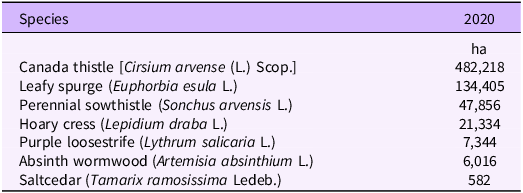
A noxious weed is defined as any plant designated by a federal, state, or county government as injurious to public health, agriculture, recreation, wildlife, or property (Graham Reference Graham2013; Lakoba et al. Reference Lakoba, Brooks, Haak and Barney2020). Noxious weeds can reduce crop yield and pasture production, displace native plants/wildlife, and interfere with recreational activities. Noxious weeds are a serious concern in South Dakota. If not effectively managed, noxious weeds can rapidly reproduce (vegetatively or by seed) and colonize new land areas (DiTomaso Reference DiTomaso2000; Skinner et al. Reference Skinner, Smith and Rice2000). Currently, there are 7 statewide and 27 locally noxious weeds in South Dakota (Supplementary Table 1). Noxious weeds inhabit a relatively large percentage of land area in South Dakota (Table 1), with statewide losses due to noxious weeds amounting to approximately US$100 million annually (South Dakota Department of Agriculture and Natural Resources 2024). Noxious weeds will continue to inhabit more land area and increase control costs and complexity if effective management tactics are not implemented (Westbrooks Reference Westbrooks2004). Various weed species require specific tactics to be implemented for effective management; therefore, depending on the location and weed species present, the specific tactics utilized in South Dakota likely vary.
Current estimate of statewide noxious weed infestation in South Dakota.
Herbicides are commonly the primary tactic to manage noxious weeds (DiTomaso Reference DiTomaso2000; Yung et al. Reference Yung, Chandler and Haverhals2015). However, there are other tactics that can be implemented to manage these weeds. Compared with row-crop annual weeds, biological tactics (i.e., living organisms) used in pasture and rangeland can selectively feed on the weeds and be effective. Leafy spurge beetle (Aphthona spp.) has been released in South Dakota and surrounding states to manage leafy spurge (Euphorbia esula L.) effectively (Butler et al. Reference Butler, Parker and Murphy2006; Nelson and Lym Reference Nelson and Lym2003). Because many of these weeds inhabit pasture and rangeland, livestock grazing is another viable option (Harker et al. Reference Harker, Baron, Chanasyk, Naeth and Stevenson2000; Popay and Field Reference Popay and Field1996). Burning and mowing can destroy the aboveground vegetation, but many weeds can regrow from underground vegetative structures (Sheley et al. Reference Sheley, Goodwin and Rinella2003). None of these tactics alone ensures eradication, but utilizing these tactics together can compound the effectiveness of the individual tactics, amounting to the concept of “many little hammers” (DiTomaso Reference DiTomaso2000; Liebman and Gallandt Reference Liebman and Gallandt1997; Sheley et al. Reference Sheley, Goodwin and Rinella2003). Currently, there is no documentation of how stakeholders manage or perceive noxious weeds in South Dakota. False assumptions about noxious weed management in South Dakota could result in the development of ineffective management programs, further increasing costs.
South Dakota is a diverse state with different climates, ecosystems, weed species, production practices, and management tactics that can influence weed management. Understanding how various stakeholders manage noxious weeds throughout the state can facilitate sound extension efforts and research needs. Surveys have been a valuable tool to gain insight on stakeholder perceptions of noxious weeds (Mangold et al. Reference Mangold, Frame-Martin and Raile2021; Sheley et al. Reference Sheley, Jacobs and Floyd1996; Yung et al. Reference Yung, Chandler and Haverhals2015). Surveys also provide insight into the management tactics of noxious weeds. Therefore, we surveyed South Dakota stakeholders to gauge the current state of perception and management of noxious weeds. The specific objectives were to determine (1) whether noxious weed management differs across South Dakota, (2) what tactics are being utilized for management, and (3) the perceived satisfaction of South Dakota stakeholders of the utilized tactics on noxious weed management.
Materials and Methods
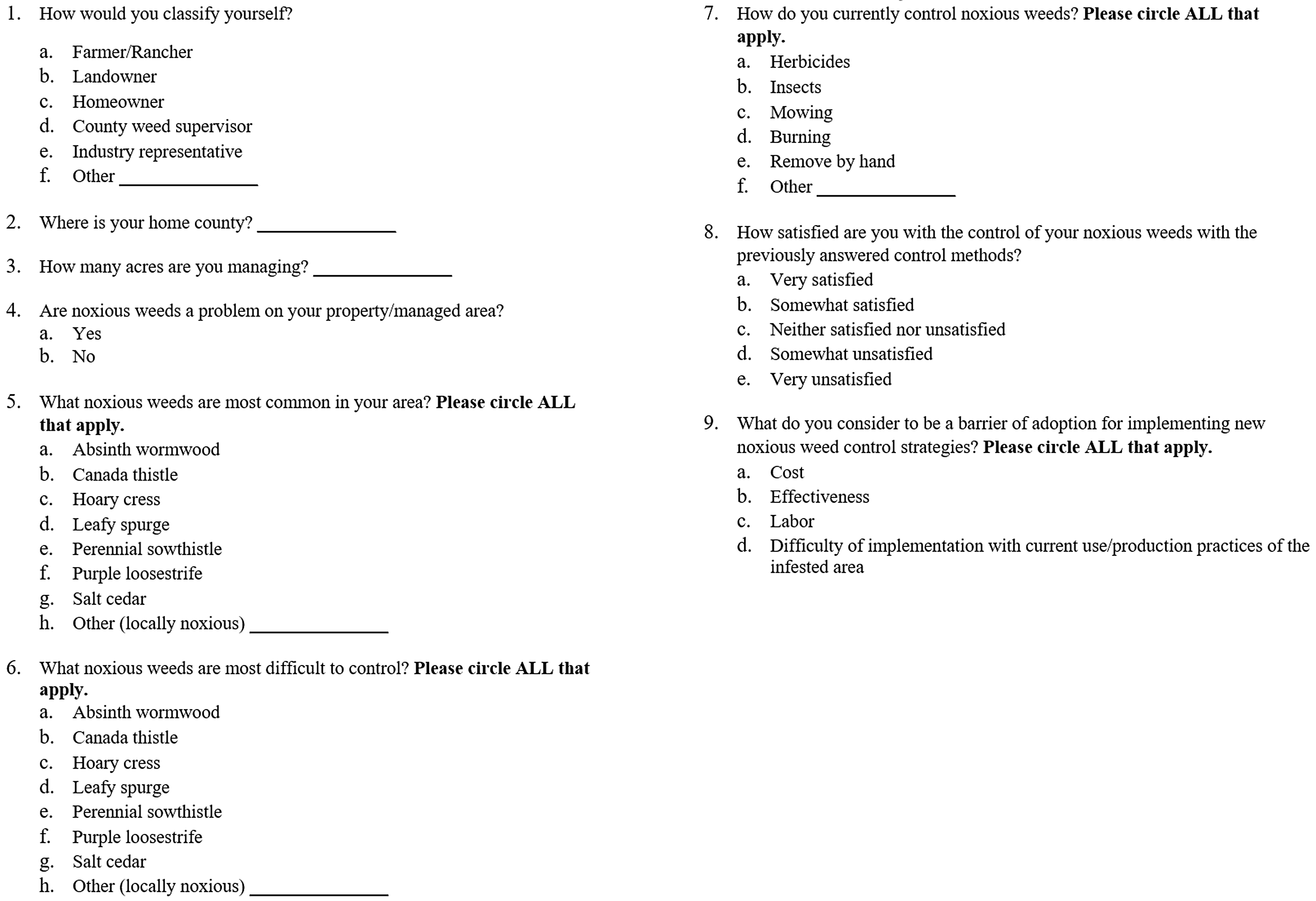
An online survey was distributed via the South Dakota State University (SDSU), Pest and Crop Newsletter and other email Listservs (e.g., Association of County Weed Supervisors and South Dakota Grassland Coalition), through fall 2023 and spring 2024. The survey consisted of nine questions regarding noxious weed control (Figure 1). The responses were prepopulated so the respondent could select the desired response(s). Select questions allowed for the respondent to select “Other” and type in a response to encompass responses not listed. The online format of the survey allowed the respondents to complete the survey at their own convenience. The survey asked respondents to enter their home counties and the counties were later grouped into regions, specifically east and west of the Missouri River, and are hereafter referred to as “East River” and “West River,” common vernacular applied in the state. Stakeholder profiles were county weed supervisor, farmer/rancher, landowner, homeowner, industry representative, and “Other.” The unit of “acres” was used on the survey for respondent clarity but has been converted to hectares.
The stakeholder survey of noxious weed management and perception distributed to South Dakota stakeholders in a prepopulated online survey through the Fall of 2023 and Spring of 2024.
Surveys were considered complete if ≥67% (seven out of nine questions) of questions were answered. Responses were represented with a numeric dummy variable to the corresponding response for each survey question. Response of each survey questions were modeled with a linear regression using the MIXED procedure in SAS software v. 9.4 (Statistical Analysis System, SAS Institute, Cary, NC) to determine whether the independent variables were significant predictors of the dependent variables. The independent variables for the survey were stakeholder profile and region (East River or West River). The distribution of responses for each question was visualized by creating histograms using Proc Univariate in SAS v. 9.4 to report skew, or bimodal distribution. The survey question “How satisfied are you with the control of your noxious weeds with the previously answered control methods?” was analyzed by the question “Are noxious weeds a problem on your property/managed area?” to determine whether responses of stakeholders with or without noxious weed problems differed. The survey questions “What noxious weeds are most common in your area?,” “What noxious weeds are most difficult to control?,” and “How do you currently control noxious weeds?” were used as covariates for the responses for the survey questions of “How satisfied are you with the control of your noxious weeds with the previously answered control methods?” and “What do you consider to be a barrier of adoption for implementing new noxious weed control strategies?” Pearson’s correlation coefficients were determined between the questions “What noxious weeds are most common in your area?” with “What noxious weeds are most difficult to control?” and “How do you currently control noxious weeds?” with “How satisfied are you with the control of your noxious weeds with the previously answered control methods?” using the Corr procedure in SAS v. 9.4 (α ≤ 0.05). The question “How satisfied are you with the control of your noxious weeds with the previously answered control methods?” was analyzed by the question “Are noxious weeds a problem on your property/managed area?” to determine if responses of stakeholders with or without noxious weed problems differed.
Results and Discussion
Four hundred and ninety-one stakeholders opened the survey but only 129 stakeholders completed the survey, resulting in a 26% completion rate.
Stakeholder Profile
Most respondents classified themselves as a “Farmer/Rancher” (47%) or “Landowner” (21%). Seventeen percent of the respondents classified themselves as “Other”; most respondents identified themselves as a government employee (i.e., Natural Resource Conservation Service [NRCS], South Dakota Game, Fish, and Parks [SD GFP], U.S. Forest Service [USFS], South Dakota Department of Agriculture and Natural Resources [SD DANR]). “Homeowner” (5%), “Industry representative” (7%), and “County weed supervisor” (3%) were the next most common classifications.
Home County and Region
Fifty-one out of the 66 counties in South Dakota were represented in the survey responses (Supplementary Table 2). Thirty-three out of the 44 counties in East River provided a response, whereas 16 out of the 22 counties in West River provided a response. Sixty-two percent of the responses came from East River and 38% of the responses came from West River.
Responses to the question “How many acres are you managing?” analyzed by stakeholder profile.
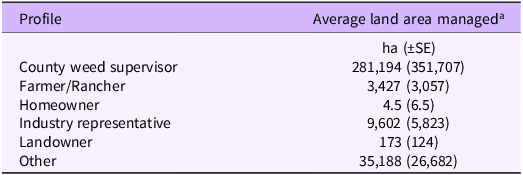
a The unit of acres was used in the survey for respondent clarity but converted to hectares.
Hectares Managed
Stakeholder (P < 0.001) had an influence, while region (P = 0.27) and the interaction (P = 0.26) did not influence the responses for the question “How many acres [hectares] are you managing?” County weed supervisors managed the greatest land area, followed by “Other” (Table 2). Farmers/ranchers and industry representatives managed the next greatest land area, followed by landowners and homeowners (Table 2). Responses across all categories ranged from 0 to 719,240 ha managed, with an average of 17,317 ha. The number of hectares managed is high, likely attributable to the fact that respondents from the government sector (e.g., NRCS, SD GFP, USFS) manage large land areas (i.e., national forests, waterfowl production areas, game production areas) and county weed supervisors are responsible for noxious weed management on a county level, as denoted by the highly significant main effect of “stakeholder.” The median land area managed was 607 ha, which is likely a more realistic land area managed by nongovernmental stakeholders in South Dakota.
Are Noxious Weeds a Problem on Your Property/Managed Area?
Stakeholder (P = 0.96), region (P = 0.18), and the interaction (P = 0.17) did not influence responses to the question “Are noxious weeds a problem on your property/managed area?” Eighty percent of the respondents said “yes” to noxious weeds being a problem on their properties. This response was not unexpected, as noxious weeds are common in South Dakota (South Dakota Department of Agriculture and Natural Resources 2024). It was unexpected that 20% of respondents said “no” to noxious weeds being a problem due to the ubiquity of these weed species (South Dakota Department of Agriculture and Natural Resources 2024).
Common Noxious Weeds
Stakeholder (P = 0.0013) had an influence, while region (P = 0.10) and the interaction (P = 0.86) did not influence the responses for the question “What noxious weeds are most common in your area?” The most common responses were Canada thistle [Cirsium arvense (L.) Scop.] (18%), Canada thistle + leafy spurge (12%), absinth wormwood (Artemisia absinthium L.) + Canada thistle + leafy spurge (9%), and absinth wormwood + Canada thistle + leafy spurge + perennial sowthistle (Sonchus arvensis L.) (9%). All other responses represent less than 8% of the total responses. The full list of common noxious weeds and the various combinations are listed in Table 3. The “Other (locally noxious)” weeds response encapsulated biennial thistles, common mullein (Verbascum thapsus L.), spotted knapweed (Centaurea stoebe L.), St. Johnswort (Hypericum perforatum L.), and yellow (Linaria vulgaris Mill.) and dalmatian toadflax [Linaria dalmatica (L.) Mill.]. Other responses included non-noxious weeds such as pigweed species (Amaranthus spp.) and smooth bromegrass (Bromus inermis Leyss.). The distribution of responses was bimodal, wherein one to two and four species were common. Based on the numeric dummy variable grouping, lower numbers corresponded with lower combinations (i.e., one to two species present), while higher numbers corresponded with higher combinations (i.e., four to five species present). On average, county weed supervisors and “Other” had three to four common species present. Farmers/ranchers and landowners had at least two to three common species present. Homeowners had one to two common species present.
Responses to the question “What noxious weeds are most common in your area?”.

a Response combinations that received no selection have been excluded to increase reader clarity.
What Noxious Weeds Are Most Difficult to Control?
Stakeholder (P = 0.34), region (P = 0.74), and the interaction (P = 0.95) did not influence the responses for the question “What noxious weeds are most difficult to control?” The responses for this question followed a similar pattern as the responses for the question “What noxious weeds are most common in your area?” The questions “What noxious weeds are most common in your area?” and “What noxious weeds are most difficult to control?” were positively correlated (r = 0.31; P = 0.0005). Canada thistle (19%), leafy spurge (16%), and Canada thistle + leafy spurge (15%) were the most common responses. The full list of difficult-to-control noxious weeds and the various combinations are listed in Table 4. The distribution of the questions was skewed left, indicating that one to two species were most difficult to control. This is not unexpected, as weed-infested areas are composed of a few difficult to manage weeds in response to management tactics (i.e., selection pressure) (Buhler et al. Reference Buhler, Liebman and Obrycki2000; Clements et al. Reference Clements, Weise and Swanton1994).
Responses to the question “What noxious weeds are most difficult to control?”.
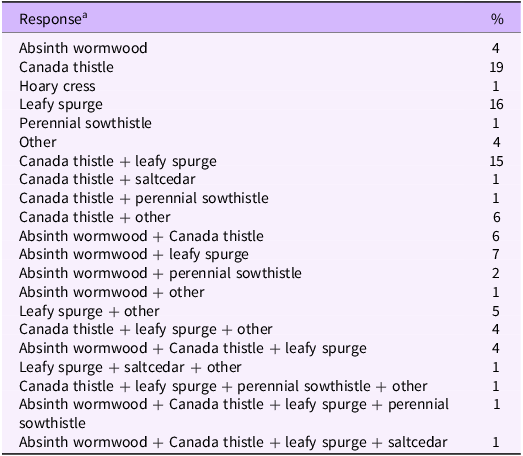
a Response combinations that received no selection have been excluded to increase reader clarity.
How Do You Currently Control Noxious Weeds?
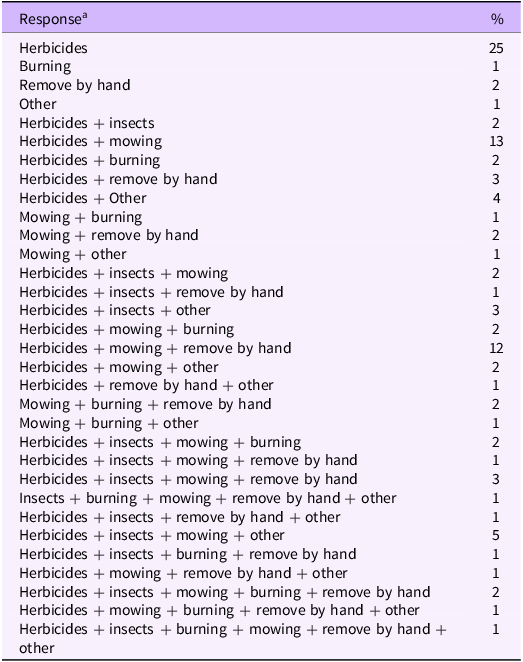
Stakeholder (P = 0.47), region (P = 0.90), and the interaction (P = 0.41) did not influence the responses for the question “How do you currently control noxious weeds?” However, the question “What noxious weeds are common in your area?” (P < 0.0001) was a significant covariate, while the question “What noxious weeds are most difficult to control?” was not (P = 0.16). As the number of common weed species present increased, the number of control tactics used increased. Herbicides (25%) were the most common singular response (Table 5). Herbicides and mowing (13%) and herbicides + hand weeding and burning (11.6%) were the next most common tactics used (Table 5). Remove by hand (2%), burning (0.7%), and other (0.7%) were the only other single tactics utilized. All other responses were combinations of various tactics (Table 5). Utilizing two tactics (27%) was the most common, followed by incorporating three tactics (24%), while combining four (12%), five (7%), or six (0.7%) tactics was less common. The response “Other” consisted mostly of the write-in answer “grazing.” Herbicides were included as a utilized tactic in approximately 90% of all responses (Table 5).
Responses to the question “How do you currently control noxious weeds?”.
a Response combinations that received no selection have been excluded to increase reader clarity.
Management Satisfaction
Stakeholder (P = 0.76), region (P = 0.97), and the interaction (P = 0.73) did not influence the responses for the question “How satisfied are you with the control of your noxious weeds with the previously answered control methods?” The questions “What noxious weeds are most common in your area?” (P = 0.10) and “What noxious weeds are most difficult to control?” (P = 0.84) were not significant covariates. However, “How do you currently control noxious weeds?” was a significant covariate (P < 0.0001) and negatively correlated (r = 0.32; P = 0.0002). The more management tactics a stakeholder utilized, the less satisfaction of control was realized. When the question was analyzed by the question “The question “How satisfied are you with the control of your noxious weeds with the previously answered control methods?” was analyzed by the question “Are noxious weeds a problem on your property/managed area?,” the model (P = 0.68) and covariate (P = 0.76) were no longer significant (data not shown). Forty-seven percent of the respondents were “Somewhat satisfied” with previously answered control methods, while only 9% of the respondents were completely satisfied with the noxious weed control using previously answered control methods (data not shown). Twenty percent and 11% of respondents were “Neither satisfied nor dissatisfied” and “Somewhat dissatisfied,” respectively. Fifteen percent of respondents were “Very unsatisfied” with previously answered control methods.
Barriers of Adoption
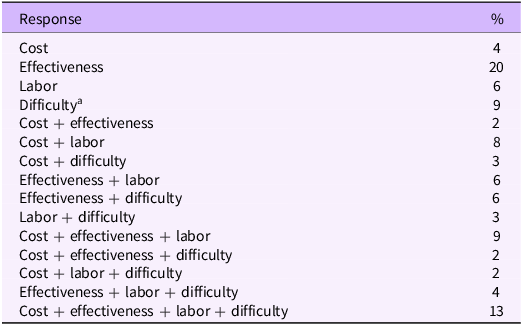
Stakeholder (P = 0.47), region (P = 0.10), and the interaction (P = 0.68) did not influence the responses for the question “What do you consider to be a barrier of adoption for implementing new noxious weed control strategies?” The questions “What noxious weeds are most common in your area?” (P = 0.59) and “What noxious weeds are most difficult to control?” (P = 0.67) were not significant covariates. The questions “How do you currently control noxious weeds?” (P = 0.04) and “How satisfied are you with the control of your noxious weeds with the previously answered control methods?” (P = 0.0003) were significant covariates. The increase of management tactics increased the barriers of adoption. Similarly, increasing the number of barriers of adoption resulted in stakeholders being dissatisfied with control. The most common response for a barrier of adoption was effectiveness (20%) followed by the four-way combination of the responses (13%) (Table 6). On average, most respondents reported at least two barriers of entry to adopting new management tactics (Table 6).
Responses to the question “What do you consider to be a barrier of adoption for implementing new noxious weed control strategies?”.
a “Difficulty of implementation with current use/production practices of the infested area” has been shortened to “Difficulty.”
Management Considerations
The results of the survey suggest that noxious weeds remain a widespread problem in South Dakota (South Dakota Department of Agricultural and Natural Resources 2024). Despite the different regions within the state, similar common and difficult to manage weed species were reported across regions. The most common and difficult to manage weeds encompassed all statewide noxious weeds, further bolstering the fact these species are classified as a statewide problem. Many surrounding states report similar noxious weeds being a problem (Skinner et al. Reference Skinner, Smith and Rice2000). Canada thistle and leafy spurge were the most common and difficult to control species from these surveys as well (Mangold et al. Reference Mangold, Fuller, Davis and Rinella2018; Skinner et al. Reference Skinner, Smith and Rice2000). The number of weed species that were common differed between stakeholders, where stakeholders who managed smaller land areas had fewer weed species than stakeholders who managed larger land areas. Despite the fact that stakeholder did not influence the tactics selected for weed management, the number of control tactics used increased as the number of common weed species present increased. These results likely foreshadow why multiple tactics are implemented to manage several species, as broad-spectrum activity is not present (DiTomaso Reference DiTomaso2000).
Like common and difficult to manage weeds, the management tactics utilized did not differ across the East and West River regions. Herbicides were the primary tactic to manage noxious weeds in South Dakota. Noxious weed management with heavy reliance on herbicides has been shown with other surveys (Mangold et al. Reference Mangold, Fuller, Davis and Rinella2018; Schohr et al. Reference Schohr, Gornish, Woodmansee, Shaw, Tate and Roche2019; Yung et al. Reference Yung, Chandler and Haverhals2015). Managing noxious weeds with herbicides is likely a social norm (Lubeck et al. Reference Lubeck, Metcalf, Beckman, Yung and Angle2019). While herbicides are the primary management tool, the use of other tactics suggests that noxious weeds are being managed with an integrated approach. An integrated weed management approach usually results in more effective control (Miller Reference Miller2016). However, the significant covariate that suggests the more tactics used, the less satisfaction of control was realized. While specific interpretations cannot be derived from the survey respondents, there are various reasons that could explain this result.
Many of these noxious weed species are inherently difficult to manage with multiple tactics, and management needs to be implemented recurrently (DiTomaso Reference DiTomaso2000; Lym Reference Lym1998; Miller Reference Miller2016). Therefore, despite the multiple and various tactics used to manage these weeds, land managers could not be satisfied with the efficacy of the implemented tactics. Stakeholders could also be implementing more tactics to manage weeds due to the previous difficulty of management. Effectiveness (>60%) was included commonly as a singular response or in combination with cost, labor, and difficulty of implementation for a barrier of adopting new management tactics. These responses could also suggest that land managers already using multiple management tactics may be frustrated with adopting new tactics that are not efficacious and require associated monetary and time costs (Lubeck et al. Reference Lubeck, Metcalf, Beckman, Yung and Angle2019; Mangold et al. Reference Mangold, Fuller, Davis and Rinella2018). Yung et al. (Reference Yung, Chandler and Haverhals2015) and Schohr et al. (Reference Schohr, Gornish, Woodmansee, Shaw, Tate and Roche2019) found similar adoption barriers to managing noxious weeds in western Montana and California, respectively. Similarly, the significant covariate that suggests the more tactics used, the more barriers of adoptions are realized. Since stakeholders utilize many different tactics with lowered satisfaction, there could be reluctance to adopt more tactics to continue unsatisfaction (Dentzman and Jussaume Reference Dentzman and Jussaume2017). This result could suggest that the stakeholder has been trying many tactics and eventually ran out of options.
It could also highlight that efforts are needed to educate stakeholders how to effectively implement various combinations of management tactics. Previous surveys have also demonstrated a need for providing noxious weed management education to stakeholders (Ansong and Pickering Reference Ansong and Pickering2015; Mangold et al. Reference Mangold, Frame-Martin and Raile2021). Although the respondents of this survey leveraged two control tactics on average, the incorrect usage of each tactic ultimately resulted in ineffective management. An example may be that a stakeholder sprays weeds at the incorrect growth stage and then mows the herbicide-treated weed once the seedhead is produced; the result is dispersion of seeds and lack of herbicide translocation (DiTomaso Reference DiTomaso2000; Schooler et al. Reference Schooler, Yeates, Wilson and Julien2007). Future research should investigate which specific management tactics are being implemented together (i.e., herbicide application timing and mowing timing) for a given weed species. Extension and outreach efforts could then be made to educate stakeholders on how tactics may be misused, how to appropriately implement different tactics, and what a reasonable control (e.g., success) rate is across stakeholders and regions. While only 15% of the respondents were “Very unsatisfied” with their noxious weed management, efforts need to be made to understand why management efforts are not effective. Graham (Reference Graham2013) underscores the importance of a community approach to noxious weed management and having all stakeholders effectively managing weeds to minimize spread. Lubeck et al. (Reference Lubeck, Metcalf, Beckman, Yung and Angle2019) has shown that stakeholders see noxious weed management as a community problem that requires a collective management approach.
Supplementary material
To view supplementary material for this article, please visit https://doi.org/10.1017/inp.2025.9
Acknowledgements
The authors extend thanks to the SDSU Extension team for helping create and distribute the survey. A special thank you to everyone who responded to the survey. Project funding was provided by the South Dakota Weed and Pest Commission.
Competing interests
The authors declare no competing interests.


 Open access

