





Introduction
The Russian President Vladimir Putin was confident that the actions he was taking would be supported by the citizens of Russia when announcing the war in Ukraine, or what he termed a ‘special military operation’, on 24 February 2022. Footnote 1 As Russia’s invasion of Ukraine unfolded, President Putin continued to express unwavering confidence in his public support. However, the reality of public sentiment in authoritarian regimes during times of conflict is far more complex than such pronouncements suggest. This study delves into the intricate dynamics of Russian public opinion concerning its leader amid the ongoing Russia–Ukraine war. By analysing approval ratings and various socioeconomic factors, we aim to dissect the ‘rally ‘round the flag’ effect in Russia amid the war in Ukraine. By analysing a wealth of survey data, conducting expert interviews and employing rigorous statistical methods, this analysis seeks to understand the factors influencing Russian public sentiment during this critical period.
Theoretically, the ‘rally ‘round the flag’ effect is a notable phenomenon where leaders experience a surge in public approval during times of international crisis or conflict. Rooted in the tenets of national unity and patriotic fervour, this theory suggests that citizens tend to support their leaders when facing external threats. However, the applicability of this effect in authoritarian regimes remains an area warranting further exploration. This study seeks to dissect this effect amid the Russia–Ukraine war, examining whether it holds true within the Russian context and identifying the factors influencing Russian public sentiment during this critical period. The study’s central thesis posits that the Russia–Ukraine war has led to a decline in Russian leader approval, challenging the traditional understanding of the ‘rally ‘round the flag’ effect. Understanding public sentiment in authoritarian regimes during conflict is crucial for assessing political stability, evaluating the effectiveness of state-controlled media, and predicting potential shifts in policy or leadership.
We investigate the impact of the Russia–Ukraine war on Russian leader approval ratings from 2022 to 2024, using data from the Gallup World Poll (GWP). The GWP, a globally representative annual survey, tracks socioeconomic and attitudinal metrics, including citizens’ assessments of their national leadership. The primary analytical approach involves comparing observed approval ratings for 2022–24 with predicted ratings based on prewar trends from 2019 to 2021. To predict the postwar approval ratings, a baseline was established by modelling approval trends using the 2019–21 data, assuming a continuation of prewar trends. This method is inspired by the quasi-experimental time series design articulated by Campbell and Stanley (Reference Campbell and Stanley2015), assessing changes relative to pre-intervention patterns. The core of the analysis relies on a constant model, estimating the average approval rating for 2019–21 and using this mean value as the predicted approval rating for 2022–24. Furthermore, the analysis examines how the war’s impact on approval ratings varies across demographic subgroups, including gender, education level, and age group. Finally, regression analysis was conducted to assess the association between citizen attitudes, socioeconomic factors, and Russian leader approval, incorporating variables such as gender, income, employment, religion, education, age, corruption, media freedom, and confidence in the military. Expert interviews conducted at various research and academic institutes in Russia supplemented the quantitative analysis.
This study contributes to the existing literature by examining the ‘rally ‘round the flag’ effect within the under-researched context of an authoritarian regime: Russia. Unlike previous studies that mostly focus on democratic systems, we explore public sentiment during conflict in a setting characterised by state-controlled media and limited dissent. We provide a more nuanced perspective on the factors influencing leadership approval during crises and shed light on the limitations of the ‘rally ‘round the flag’ effect in such contexts. We begin by examining this effect and then introduce several hypotheses concerning the factors influencing Russian leader approval, focusing on war-related information exposure, perceived corruption, confidence in the military, and demographic variables. The ‘Data and Methodology’ section details the use of the GWP data from 2022 to 2024, comparing observed approval ratings with predicted prewar trends (2019–21). This is followed by the empirical analysis, with subsections exploring overall trends, demographic variations, and the factors influencing approval using regression analysis. Finally, it concludes by summarising the findings, discussing their implications for understanding public opinion in Russia during conflict, and suggesting avenues for further research.
Theoretical motivations
The ‘rally ‘round the flag’ effect, a well-documented phenomenon in international studies, describes the surge in public approval of a leader during times of international crisis or conflict. This concept, rigorously defined by Mueller (Reference Mueller1970), posits that national unity and simple patriotism drive citizens to support their leaders when facing an external threat. The traditional conception of the ‘rally ‘round the flag’ effect, defined by criteria such as dramatic international involvement and typically explained by mechanisms such as genuine patriotism and elite consensus, largely relies on scholarship focused on democratic political systems (Mueller Reference Mueller1970; Murray Reference Murray2017). This foundational framework, however, proves insufficient for analysing public sentiment in authoritarian regimes, where inherent institutional constraints on political discourse and the systematic control of information fundamentally alter the mechanism of public approval (Kanat Reference Kanat2011). Unlike democracies, where a genuine rally effect is limited by the existence of a free press and opposition parties capable of reintroducing partisan criticism (Murray Reference Murray2017), autocracies maintain stability through proactive political control, which involves the comprehensive manipulation of the information environment via traditional and digital media (Hassan, Mattingly, and Nugent Reference Hassan, Mattingly and Nugent2022; Mendoza and Arugay Reference Mendoza, Arugay, Nai, Grömping and Wirz2024). This systemic distortion demands an inquiry beyond simple patriotic mobilisation, as observed support may be coerced, requiring scholars to account for whether public sentiment is genuine or merely an artifact of preference falsification. In contexts such as Russia, this dynamic frequently results in an engineered ‘reputational cascade’, where reported popularity surges because of social desirability bias and the fear of signalling dissent, rather than sincere approval, suggesting a critical limitation to applying the standard paradigm in nondemocratic systems (Hale Reference Hale2022: 581; Chubb and Wang Reference Chubb and Wang2023).
The effect is characterised by specific criteria: It must be international in nature, directly involve the nation and its leader, and be perceived as dramatic and sharply focused. Later theoretical developments have highlighted several explanations for this phenomenon. One perspective suggests that the opposition tends to temper its criticism of the leadership during times of crisis (Brody Reference Brody1991). Another posits that individuals’ evaluations of social institutions tend to increase, subsequently elevating their assessment of leadership performance (Parker Reference Parker1995). Moreover, a leader’s effective deployment of force or skilful execution of foreign policy initiatives can enhance public perceptions of their competence, leading to increased approval ratings (Richards, Morgan, Wilson et al. Reference Richards, Morgan, Wilson, Schwebach and Young1993; Smith Reference Smith1996). This foundational concept provides a framework for examining public sentiment amid geopolitical upheaval.
The ‘rally ‘round the flag’ effect provides critical insights into the dynamic relationship between political leadership, public opinion, and national security crises. This framework is valuable to analyze the potential surge in approval ratings that leaders may experience when their nations face external threats or engage in military actions. By understanding the conditions that foster or hinder this effect, scholars can better assess how leaders leverage national crises to consolidate support, legitimise policies, or divert attention from domestic issues. This is especially pertinent when examining how leaders manage public sentiment during military conflicts. Existing literature indicates that the rally effect can be contingent upon pre-existing economic conditions and the opposition’s response to the leader’s actions (Oneal and Bryan Reference Oneal and Bryan1995). It represents a critical element in reverse second image linkages between international and domestic politics and is thus central to any diversionary theory of war. Ultimately, this framework emphasises the strategic interplay between domestic political considerations and foreign policy decisions.
Empirical studies examining the ‘rally ‘round the flag’ effect have explored various factors influencing its occurrence and magnitude. Chapman and Reiter (Reference Chapman and Reiter2004) find that support from the United Nations (UN) Security Council significantly increases the rally behind the American president during militarised interstate disputes (MIDs). Baker and Oneal (Reference Baker and Oneal2001) highlight the role of media coverage, bipartisan support, and White House spin in shaping public sentiment, rather than just patriotic impulses, leading to the claim that a public follows these cues to formulate their sentiments. These studies employ varied methods, including regression analysis of approval ratings and content analysis of media coverage, to illuminate the complex interplay between international events, leadership actions, and public response. Similarly, Hatuel-Radoshitzky and Yarchi (Reference Hatuel-Radoshitzky and Yarchi2020) analyse whether media coverage of external soft-power threats rallies the incumbent leadership similarly to coverage of hard-power threats, by analysing media articles to determine the absence or existence of a ‘rally ‘round the flag’ effect in relation to the boycott movement against Israel. A variety of case studies and quantitative analyses demonstrate how theoretical mechanisms translate into real-world political dynamics.
Adding to the complexity, the diversionary theory of war assumes that unpopular political leaders may have incentives to initiate MIDs to mobilise public support. Empirical support for this theory, however, is debated as well. In addition, whether attacks are offensive or defensive has subtle implications for public response. Empirical studies, such as those conducted by Jentleson (Reference Jentleson1992) and Jentleson and Britton (Reference Jentleson and Britton1998), suggest that public support in the United States for the use of military force is contingent upon the perceived justification for intervention. In their recent study, along the same line of thought, Seo and Horiuchi (Reference Seo and Horiuchi2023) put these discussions to the test by demonstrating that MIDs do not automatically translate to increased public support. In fact, their crossnational study of 27 countries reveals that MIDs, on average, decrease approval ratings for national leaders. This finding challenges the assumption that leaders can reliably leverage international conflicts for domestic political gain, suggesting that the relationship between international events and public opinion is more complex than previously assumed. Their findings reveal that the public is less likely to support leaders who initiate aggressive actions, while leaders who defend against foreign aggression may not experience any significant change in public support. Secondly, the intensity of the conflict matters, with more aggressive uses of force potentially leading to attenuated criticism of leaders. Acknowledging the existing context, Russian Expert 4 highlighted the Kremlin’s strategic efforts to construct a narrative that frames the war in Ukraine as a defensive and unavoidable action. This narrative is predicated on the asserted absence of Ukrainian nationhood and statehood, coupled with the allegation of a western conspiracy against Russian national security interests.Footnote 2
Applying the ‘rally ‘round the flag’ framework to the context of the 2022 Russia–Ukraine war offers valuable insights into understanding Russian leadership approval. Kizilova and Norris’s (Reference Kizilova and Norris2024) research on the ‘rally ‘round the flag’ effects in Russia during the Russia–Ukraine war reveals a significant initial surge in President Putin’s approval ratings following the invasion. Drawing from various opinion polls, their study identifies an approximate 20-point increase in approval, mirroring similar patterns observed during the annexation of Crimea in 2014. Russian Expert 1 observed ‘a tacit understanding between the government and the opposition, wherein criticism of the Russian leadership was, to a degree, implicitly curtailed’.Footnote 3 Expert 2 further elaborated that ‘Kremlin-aligned war narratives were disseminated widely through Russian media channels, commencing prior to the initiation of the special military operation’. He added that ‘this dissemination occurred within a context of restricted media freedom, characterized by the suspension or prohibition of opposition media outlets’.Footnote 4
Driven by patriotic sentiments, a significant portion of the Russian public, according to Russian Expert 3, largely endorsed the Kremlin’s position in initial phase of war.Footnote 5 The initial surge in leader approval, however, is not without complexities. While a sense of national pride and unity may have contributed, we acknowledge the potential influence of state-controlled media, limiting access to alternative narratives and potentially inflating the perceived support. Over time, factors such as mounting casualties, economic pressures, and limited access to information may erode the initial surge in popularity, suggesting that any long-term rally effects are subject to a myriad of factors shaping public sentiment in Russia. In light of these complexities, our study aims to dissect the applicability of the ‘rally ‘round the flag’ effect, examining whether it holds true within the Russian authoritarian context and identifying the factors influencing Russian public sentiment amid the Russia–Ukraine war.
Hypotheses
The following hypotheses aim to explore the factors influencing Russian leader approval in the context of the Russia–Ukraine war. Drawing upon existing literature on soft power, public opinion, and the impact of exogenous events, these hypotheses examine how exposure to information, perceptions of governance, and demographic factors interact to shape citizens’ attitudes towards their leader during a period of geopolitical upheaval. Each hypothesis is grounded in theoretical considerations and prior empirical findings, providing a strong foundation for understanding the complex dynamics of Russian public sentiment during this critical time.
Hypothesis (H)1 Increased exposure to war-related information has a negative impact on Russian leader approval.
Wider and free access to diverse information sources challenges the official narrative. This exposure leads to scepticism towards the leader because of awareness of casualties, economic hardships, and ethical concerns (Kizilova and Norris Reference Kizilova and Norris2024).
H2 Higher perceived corruption levels are negatively associated with Russian leader approval.
Corruption undermines public trust in government and leadership. Citizens who perceive leaders as legitimate and honest are more likely to support them (Mueller Reference Mueller1970; Reisinger, Zaloznaya, and Claypool Reference Reisinger, Zaloznaya and Claypool2016).
H3 Confidence in the military positively correlates with Russian leader approval.
Several factors contribute to the positive correlation observed between leader approval ratings and perceptions of military strength in Russia. These include genuine expressions of patriotism, anxieties regarding external threats, the influence of state-controlled media narratives, and a historically ingrained emphasis on military power as central to Russian national identity. The leader is often perceived as the architect and the primary beneficiary of a potent military, and consequently, perceived military prowess tends to enhance public approval (Baker and Oneal Reference Baker and Oneal2001).
H4 The negative impact of the war on Russian leader approval is more pronounced among younger demographics (15–29 years) compared with older demographics (50+ years).
Younger generations have different values and information sources from older generations. They may be more sensitive to the human cost of the war, effecting their support for the leader (Seo and Horiuchi Reference Seo and Horiuchi2023).
H5 Higher education levels negatively correlate with Russian leader approval.
Individuals with higher education are generally more critical consumers of information. They may question official narratives and have greater awareness of the war’s implications (Smith Reference Smith1996).
H6 Citizens who highly value religion exhibit lower approval of the Russian leader during the war.
Strong religious values often emphasise peace and compassion, which may conflict with actions taken during war. This conflict with the justifications and actions of the leader could result in citizens disapproving of the leadership (Oneal and Bryan Reference Oneal and Bryan1995).
H7 Higher income levels are associated with stronger approval of the Russian leader, even during the war period.
Higher-income individuals may feel less of a direct economic impact. They may also benefit more from the current structure of the government (Chapman and Reiter Reference Chapman and Reiter2004).
H8 Following the onset of the Russia–Ukraine war, the male population will exhibit a greater decline in approval ratings of the Russian leader compared with the female population.
The male population could show a more pronounced decline in approval because of gender-based differences in risk perception. It is also plausible that a decline would occur because of support for military action or sensitivity to the economic consequences of the conflict (Jentleson Reference Jentleson1992).
Data and methodology
This study leverages data from the GWP to analyse the impact of the Russia–Ukraine war on Russian leader approval ratings from 2022 to 2024. Annually, the GWP conducts a globally representative survey to monitor significant socioeconomic and attitudinal shifts; this includes an analysis of citizens’ views on their respective national leadership.Footnote 6 This analysis uses annual data from the GWP, a survey conducted among 1,000–2,000 respondents within the Russian Federation in each year. This methodology offers a consistent framework for assessing public sentiment across a large and diverse population, rendering it well-suited for studying the impact of the war on approval ratings in Russia. We recognise that GWP data must be interpreted with caution because of the unique challenges inherent to data collection within an authoritarian regime such as Russia. This context, characterised by state-controlled media and limited dissent, raises significant concerns regarding potential response biases. Specifically, the findings may be shaped by social desirability bias and preference falsification, where citizens practice self-censorship or report engineered support because of the fear of signalling dissent. This dynamic can result in an engineered reputational cascade, potentially inflating observed leader approval ratings. Acknowledging these methodological constraints is crucial for a robust analysis, ensuring that the study recognises the inherent complexity in fully capturing the nuances of public sentiment when genuine support may be difficult to distinguish from coerced support.
We analysed GWP survey waves from August 2022, May 2023, and July 2024 to assess the impact of the Russia–Ukraine war – treated here as an exogenous shock – on leader approval. Drawing on Campbell and Stanley’s (Reference Campbell and Stanley2015) quasi-experimental time series design, we compare observed postwar ratings with a predicted counterfactual based on prewar trends (2019–21). This baseline period was selected to capture recent sentiment while minimising earlier geopolitical confounds. The core of the analysis relied on the constant model, estimating the average approval rating for the 2019–21 prewar period, which allowed us to isolate the war’s potential effect by comparing observed approval values to the predicted stability, recognising that this quasi-experimental time series design does not provide a control group. Using this model, we calculated the mean approval rating from 2019 to 2021 and project it as the expected value for the 2022–24 period, assuming a continuation of trends in the absence of war. The magnitude of the war’s impact was quantified by the difference between observed and predicted ratings, with positive deviations indicating a rally effect and negative values signalling a decline.
To ensure the robustness of the analysis, we validated the models using prewar data. This involved predicting the approval rating for the year 2021 on the basis of the data from 2016 to 2018 and then comparing this predicted value with the observed value for 2021. The closer the predicted and observed values, the greater the reliability that can be placed on our model. This step verified that the method is accurate and consistent. A small difference between predicted and observed values supports the validity of the constant model used in the primary analysis. Furthermore, we extended the analysis to examine how the war’s impact on approval ratings varied across demographic subgroups. Specifically, we analysed the difference between observed and predicted approval ratings based on gender, education level, and age group. We examine exceptions to the general trend, which will show the differences in approval ratings across different demographic groups. This allows for an analysis that recognises how war has different effects on the population.
The analysis also assessed the association between citizens’ attitudes and values and Russian leader approval. Analysis 3 built on the results from the preceding analyses by using regression analysis to assess the relationship between citizen attitudes, socioeconomic factors, and confidence indicators. We constructed a model to examine factors influencing approval of the Russian leadership’s job performance. Our dependent variable was Russian leader approval, coded as 0 (disapproval) or 1 (approval). The model also incorporated the following independent variables: gender, income, employment, religion, education, age, perceptions of corruption, freedom of the media, and confidence in the military. The results from this regression analysis help provide a comprehensive picture of how various components are associated with Russian leader approval. To examine multicollinearity, variance inflation factors (VIFs) were calculated to assess how to appropriately account for these variable correlations.
Finally, a significant challenge to identifying the causal effect of the war lies in the presence of potential confounding variables, such as pre-existing trends in approval ratings, economic shocks concurrent with the war, and shifts in domestic political messaging. To mitigate this concern, we supplemented the quantitative analysis with in-depth expert interviews conducted in Russia. Between 14 and 18 April 2025, we conducted 10 interviews, ranging in duration from 30 to 50 minutes, at various academic and research institutions. We acknowledge the temporal difference between the quantitative survey data and the expert interviews. While the GWP data waves used in this analysis span the period up to July 2024, the in-depth expert interviews were conducted subsequently, specifically between 14 and 18 April 2025. This temporal distinction confirms that the qualitative data was not used to generate or validate the quantitative findings derived from the prior survey data. Instead, the interviews served solely as a critical supplement to the analysis, providing crucial insights into the nuances of public opinion, media narratives, and political strategies during the war. This qualitative perspective was essential for aiding in the interpretation of the statistical results and identifying and accounting for alternative explanations for observed changes in approval ratings, such as intensified government propaganda or suppression of dissent. All participants were granted anonymity. By integrating quantitative analysis of large-scale survey data with qualitative insights from expert interviews, this research aims to provide a more robust and nuanced understanding of the ‘rally ‘round the flag’ effect in the context of the war in Ukraine. This structured approach ensures a rigorous assessment of the war’s impact on Russian leader approval ratings, providing valuable insights into the dynamics of public sentiment during geopolitical upheaval.
Empirical analysis
Analysis 1
Understanding public sentiment towards national leaders is crucial, especially during periods of significant geopolitical upheaval. The onset of the Russia–Ukraine war in February 2022 represents a watershed moment, potentially reshaping domestic approval of President Putin. This analysis investigates the war’s impact by comparing predicted approval values, based on prewar trends (2019–21), with observed approval values from 2022 to 2024. Drawing on time series analysis techniques pioneered by Campbell and Stanley (Reference Campbell and Stanley2015) and refined by Thomas, Liang, Sonoda et al. (Reference Thomas, Liang, Sonoda and Xie2025), this method helps us evaluate how the war, acting as an external event, may have affected the Russian leader’s approval ratings.
Table 1 presents the observed and predicted mean approval values for the Russian leader from 2022 to 2024, alongside the difference between these values. The analysis revealed that the observed approval ratings for 2022 (1.342), 2023 (1.330), and 2024 (1.315) were consistently lower than the predicted values of 1.509, based on prewar trends. The negative differences of −0.167, −0.179, and −0.194 for these years, respectively, suggest a decline in approval following the start of the conflict. This indicates that, contrary to expectations of a ‘rally ‘round the flag’ effect, the war and its consequences may have had a negative impact on the Russian leader’s approval. These results are graphically illustrated in Figure 1, which demonstrates the divergence of actual approval from predicted approval beginning from 2022 onward.
Observed and predicted mean values of Russian leader approval, 2022

Note: Based on 2019 – 21 data and constant model; N = 7026.
Russian leader approval, 2010 – 24.

To establish the reliability of the predicted values as a baseline, we can assess the model’s accuracy by examining Table 2, which presents the observed and predicted mean approval values for the Russian leader in 2021, before the war. The difference between the observed (1.500) and predicted (1.519) values was only −0.019, indicating a close fit between the model and prewar data. This strengthens our confidence in the accuracy of the predicted values for 2022–24, providing a more robust basis for inferring the war’s impact.
Observed and predicted mean values of Russian leader approval, 2021

Note: Based on 2018 – 20 data and a constant model; N = 7026.
Analysis 2
Building upon the overall trend of declining Russian leader approval identified in Analysis 1, a more nuanced examination was warranted to understand how this trend varies across key demographic subgroups. Tables 3–5 present a comparative analysis of observed and predicted mean approval values for the years 2022–24, broken down by gender, education level, and age group, respectively. The difference in sample size N observed between Analysis 1 (N = 7026) and the demographic breakdowns in Analysis 2 (N = 12,049) reflects the maximum utilisation of the available data pool across the study period.
Observed and predicted mean values of Russian leader approval by gender, 2022 – 24

Note: Based on 2019 – 21 data and constant model; N = 12,049.
Observed and predicted mean values of Russian leader approval by education, 2022 – 24

Note: Based on 2019 – 21 data and a constant model; N = 12,049. Sec., secondary education; Ter., tertiary education; Univ., university education.
Observed and predicted mean values of Russian leader approval by age, 2022 – 24

Note: Based on 2019 – 21 data and a constant model; N = 12,049.
The analysis reveals a consistent negative impact on approval for male and female genders in the postwar period. Looking at 2024, the difference between predicted and observed approval values was −0.216 for female respondents and −0.267 for male respondents, indicating a greater decline in approval among male respondents. This suggests that the conflict may have disproportionately affected male approval ratings compared with female ratings.
Upon examining Table 4, a consistent decline of the observed values versus expected values can be observed across all education levels. When comparing 2024, those with an elementary education level or less (Elem/Less) saw a decline of −0.174. The secondary/tertiary-education-level (Sec/Ter) group saw a decline of −0.2. The university-education-level (Univ) group saw a decline of −0.188. This suggests that the impact of war was relatively greater on people with less than a university education.
Table 5 disaggregates the approval trends by age group. Negative differences between predicted and observed approval ratings are evident across all age categories. When comparing 2024, the decline for 15–29 years old was −0.256. The decline for 30–49 years old was −0.216. The decline for 50+ years was −0.150. It is observable that the negative impact on the younger demographic was bigger.
Within the demographic analysis, distinct patterns emerge across gender, education, and age groups. For gender, while male and female respondents indicated a decline in approval, the decrease was slightly more pronounced among male respondents, suggesting a potential difference in perception of the conflict or its impacts based on gender. Examining educational categories reveals a gradient, where individuals with higher levels of education demonstrated less of a decline in approval compared with those with less education. Age-wise, the decline in approval appeared relatively consistent across all age brackets, suggesting that the conflict had a greater impact on public sentiment of younger age groups. Russian Expert 9 identified a source of frustration among ‘the young male population in large urban centers stemming from a confluence of socioeconomic factors’. These include ‘the contraction of employment opportunities within the public sector, coupled with the escalating costs of both living and education’. This situation is further exacerbated by ‘the departure or scaling down of international companies in the wake of sanctions, and the unrealized prospects for overseas employment and educational advancement due to prevailing wartime conditions’.Footnote 7 The interplay of these demographic factors potentially shaped nuanced perceptions of the conflict and its implications, highlighting the need for targeted analyses when examining public sentiment towards political figures during periods of geopolitical unrest.
Analysis 3
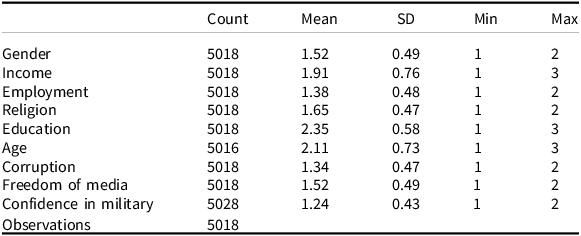
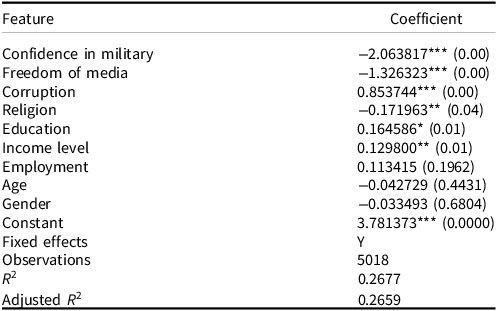
Table 8 presents the results of a regression analysis examining factors influencing Russian leader approval. The dependent variable was Russian leader approval, and the model incorporated, as seen in summary statistics in Table 6, various independent variables related to citizen attitudes, socioeconomic factors, and confidence indicators.
Summary statistics

Notes: Max, maximum; Min, minimum; SD, standard deviation.
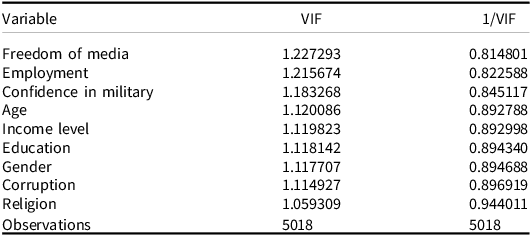
VIFs for variables used in the analysis

Regression results for Russian leader approval

Note: Robust standards, p values in parentheses. ***p < 0.01, **p < 0.05, *p < 0.1.
As mentioned, Table 7 presents the VIFs for each variable used in the regression analysis. VIFs are used to detect multicollinearity. A VIF close to 1 indicates no multicollinearity, while values above 5 or 10 are often considered indicative of high multicollinearity. The VIF scores displayed were close to 1, meaning that there was no multicollinearity that might be interfering with the regression results. The R-squared value of 0.2677 means that the independent variables can explain 26.77% of the variability of the dependent variable. This is a solid score; however, we admit that there are many other factors that may influence a citizen’s perception of Russian leadership. The online Appendix includes a comprehensive summary of the statistical model. To ensure the robustness of our findings, we conducted a probit regression analysis, the results of which are also presented in the Appendix. The outcomes of this supplementary analysis corroborate the conclusions drawn from the primary analysis presented in the article.
The coefficient for Confidence in Military was strongly negative. This suggests that, as citizen confidence in the military increases, their approval of the Russian leader decreases. The negative impact of confidence in the military makes sense because of a possible negative sentiment towards Russian rule stemming from the failures of managing a prolonged war. However, interpretations of this relationship are complex and contested. Russian Expert 3 argued, conversely, that patriotic sentiments in Russia often consider the Russian military an integral part of the state establishment, suggesting that support for the military and the government tend to move in tandem.Footnote 8 Russian Expert 1, further complicating the picture, highlighted the special place of the military within Russian society, often viewed as the ultimate saviour of the country, potentially influencing perceptions of the military and the leadership.Footnote 9
The regression analysis revealing a strongly negative correlation between confidence in the military and leader approval presents a major empirical divergence from traditional expectations of patriotic sentiment during international conflicts. Generally, the surge in public support associated with the ‘rally ‘round the flag’ effect suggests that citizens’ confidence in national security institutions and their trust in the political leadership typically rise in tandem, driven by shared national unity and perceived external threats. Our counterintuitive finding, however, indicates a unique complexity in the Russian authoritarian context: Increased citizen confidence in the military institution appears to decrease approval for the leader. This outcome suggests that the negative sentiment among the public is not directed towards the armed forces themselves, which some experts view as central to national identity, but rather reflects a profound and growing dissatisfaction with the political leadership’s competence and failures in managing the prolonged war. This empirical novelty underlines a critical distinction between support for the state’s capability (the military) and approval for the current administration.
The coefficient for Freedom of Media was also strongly negative. This suggests that, as citizen perception of media freedom decreases, the approval of the leader declines. Restricted access to information may lead to distrust and dissatisfaction. The coefficient for Corruption was strongly positive. As perceived levels of corruption increase (or citizens perceive more corruption), approval increases. This does not align with the expectation that lower corruption correlates with higher leader approval.
The coefficient for Religion was negative and significant, which means that, if a citizen values religion and has ties, they are less likely to approve the Russian leader. Russian Expert 5 contended that, despite the documented connections between the Russian Orthodox Church and the Russian government under Putin, the rhetoric of a holy war failed to resonate within religious segments of Russian society. Evidence of this includes priests’ rejection of mandatory sermons promoting Russian victory in Ukraine, a considerable number of clergy and congregants leaving the Russian Orthodox Church, the imprisonment of dissenting priests, and a significant diminishment of the Russian Orthodox Church’s influence outside of Russia. The coefficient for Education was significant and positive, indicating that higher education levels were associated with increased approval of the Russian leader. However, the difference was minimal. The impact of education level on leader approval, as gleaned from expert interviews, presents a complex and somewhat contradictory picture. Four interviewees posited that higher education correlates with increased approval rates, potentially owing to greater awareness of Russian security interests and a heightened sense of patriotism. Conversely, three other experts suggested a possible inverse relationship, arguing that higher education may facilitate access to alternative information sources, potentially including those in foreign languages, which could lead to decreased approval.Footnote 10
The coefficient for Income Level was significant and positive. As citizen wealth increases, so does trust in the Russian leader during war. Russian Expert 8 highlighted the significant military and construction contracts awarded by the government, which contributed to the affluence of certain segments of Russian society. This expert also concurred that higher-income groups experienced comparatively less economic pressure during the war, as their financial stability buffered them against the impact of inflation, rising rental costs, and the ensuing shifts in living conditions.Footnote 11 The coefficient for Employment was not significant. This suggests that, in this model, employment status did not significantly predict approval of the leader. Expert 9 highlighted ‘the wartime establishment of expansive military-industrial complexes situated outside of major urban centers. These facilities served as considerable engines of economic activity, generating a substantial number of employment opportunities and fostering the development of residential areas both within their immediate vicinities and in surrounding regions’.Footnote 12 The concentration of labour and resources around these sites often spurred the development of supporting infrastructure and services, creating expectations on regional development beyond the immediate wartime context. Age and Gender in the regression analysis were insignificant.
Discussion and conclusion
Contrary to the theoretical expectations of an automatic surge in approval driven by national unity and patriotism, the analysis revealed a more nuanced picture. The overarching trend indicates a decline in the Russian leader’s approval ratings during the Russia–Ukraine war. This decline suggests the limited applicability of the ‘rally ‘round the flag’ effect within the Russian authoritarian context. We disaggregated public opinion by gender, education level, and age groups. The data suggest a disproportionate decline in approval ratings among male respondents, potentially indicative of a gendered difference in the perception of war’s impact or risk assessments. The findings regarding the influence of education levels present a complex picture, supported only partially across the analyses. Analysis 2, which compared predicted versus observed leader approval trends over time, indicated that individuals with higher education levels demonstrated less of a decline in approval than those with less education. Conversely, the regression analysis, which assessed the relationship between education and approval while controlling for other factors, found a positive correlation where higher education levels were associated with increased approval of the Russian leader, though the difference was minimal. This complexity may reflect how greater critical awareness, often associated with higher education, leads to different behavioural outcomes depending on the analytical lens: The time-series comparison showed higher education buffered the negative impact of the war, while the regression suggested that, when controlling for factors such as corruption and media freedom, a small positive association with approval remained. This divergence underscores the difficulty in definitively determining whether education facilitates greater awareness of security interests and patriotism, as posited by some experts, or greater access to alternative information sources that could diminish support, as suggested by other experts.
The analysis also showed that negative differences between predicted and observed approval ratings were evident across all age categories, showcasing that the negative impact on younger demographics during the war was bigger. The analysis has proven that the interplay of such demographic factors shapes nuanced perceptions of the conflict, therefore highlighting the need for targeted analyses to take place when examining public sentiment. We reveal a decline in Russian leader approval amid the Russia–Ukraine war, diverging from the anticipated rally effect. This partially contrasts with Kizilova and Norris (Reference Kizilova and Norris2024), who found an initial surge in approval, though they also highlighted the influence of state-controlled media and potential erosion because of casualties and economic pressures. Seo and Horiuchi (Reference Seo and Horiuchi2023) further complicate the picture, suggesting that militarised disputes, on average, decrease public support, especially in aggressor states, which aligns with our findings. Chapman and Reiter (Reference Chapman and Reiter2004) highlight the role of UN Security Council support in boosting presidential approval during military actions, a factor not directly applicable in the Russian context, given the limited role of international institutions in shaping Russian public opinion. In contrast to the conclusions reached by Reisinger, Zaloznaya, and Claypool et al. (Reference Reisinger, Zaloznaya and Claypool2016), the perception of corruption did not appear to weaken leader support in the context of Russian authoritarianism during wartime.
We contribute to the literature by examining the rally effect in an authoritarian regime, Russia, a context less explored compared with democracies. The findings enrich our understanding of public sentiment during conflict, particularly in scenarios where information is controlled and dissent is suppressed. While Kizilova and Norris (Reference Kizilova and Norris2024) focus on initial approval surges and Hatuel-Radoshitzky and Yarchi (Reference Hatuel-Radoshitzky and Yarchi2020) focus on soft-power threats, this study provides a longer-term analysis, revealing the erosion of the initial rally and the factors driving this decline. Furthermore, by examining demographic subgroups and attitudes, this study offers a more nuanced perspective on the complex dynamics shaping Russian leader approval, extending the scope of Seo and Horiuchi’s (Reference Seo and Horiuchi2023) study. Finally, Baker and Oneal (Reference Baker and Oneal2001) examine patriotism or opinion leadership, while this work demonstrates its application in Russia. This study’s analysis of the Russia–Ukraine war through the rally effect enhances understanding of political support, adding a valuable case study to existing research.
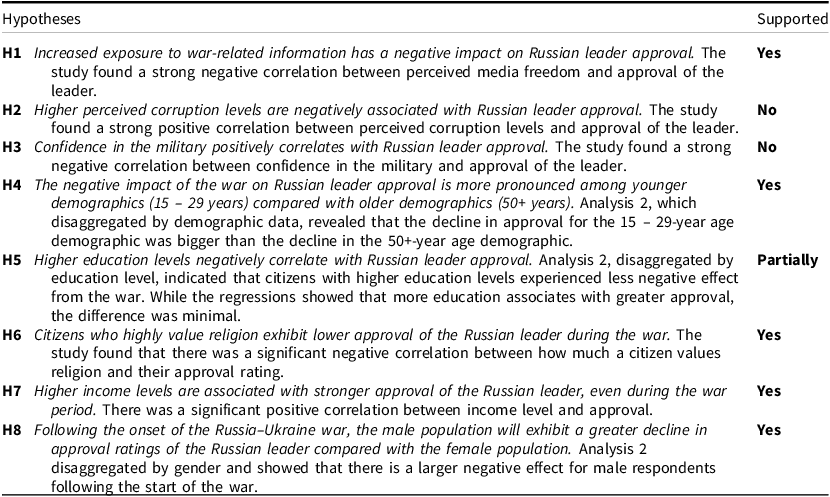
Our findings, as seen in Table 9, also provide insights into potential postwar challenges for the Russian administration. As one interviewee emphasised, the existing tacit agreement between the government and opposition regarding criticism may dissolve in the aftermath of the conflict. The inevitable contraction of the war industry may lead to widespread frustration as individuals face job losses. Furthermore, large segments of society are projected to experience the tangible consequences of ongoing economic problems, potentially weakening the Kremlin’s control over the media landscape.Footnote 13 Drawing upon expert assessments, our analysis indicates a potentially destabilising trend: Postwar disapproval across various demographics within the Russian population is likely to exacerbate existing declines in leadership approval ratings. This possible erosion of approval, crucially, suggests a growing deficit in public trust towards governmental institutions, a development that signals potential sociopolitical instability and necessitates a critical re-evaluation of current policy frameworks. While the presented data underscore the imperative for significant policy adjustments aimed at addressing public discontent and restoring public confidence, they do not currently provide sufficient evidence to suggest a widespread demand for immediate leadership transition in the aftermath of the conflict.
Summary of the results

Limitations of this study include the reliance on the GWP data, which may not fully capture the complexities and nuances of public opinion within the Russian context. It is also important to note that our results were based on the use of the quasi-experimental time series design of Campbell and Stanley (Reference Campbell and Stanley2015) and logistic regression analysis, which provides insights into how the war may have had an impact on Putin’s leadership approval. Future research could benefit from consulting other surveys, incorporating more qualitative data, or conducting focus groups to gain a deeper understanding of individual attitudes and motivations. Furthermore, comparative analyses across different geopolitical events and authoritarian regimes could provide valuable insights into the generalisability of these findings.
Supplementary material
The supplementary material for this article can be found at https://doi.org/10.1017/S1682098326100253.
Data availability statement
All data and python codes are available upon request.
Funding statement
None.
Competing interests
None.
Ethical approval and informed consent statements
Ethical approval for this study was granted by the Center for International Policy Research (CIPR). All participants provided informed consent. Interviews were conducted anonymously, and strict data confidentiality protocols were observed to ensure that no identifying information is revealed.
AI Use
In the preliminary stages of this research, NotebookLM and Gemini 3 were integrated into the analytical workflow to assist with the initial synthesis of the literature review and to facilitate the early structural figuration of the quantitative and qualitative data.








 Open access

