





Unlike earlier editions of the DSM, the fifth edition (DSM-5) includes an anxious distress specifier in the diagnosis of major depressive disorder (MDD), characterised by at least two of five specified symptoms of anxiety.Reference American Psychiatric Association1 Studies before and after the release of the DSM-5 have found that high levels of anxiety are common in MDD.Reference Fava, Rush, Alpert, Balasubramani, Wisniewski and Carmin2–Reference McIntyre, Woldeyohannes, Soczynska, Vinberg, Cha and Lee4 Furthermore, when MDD is comorbid with high levels of anxiety, lower rates of depression remissionReference Fava, Rush, Alpert, Balasubramani, Wisniewski and Carmin2,Reference Davidson, Meoni, Haudiquet, Cantillon and Hackett5 or poorer response to treatmentReference Clayton, Grove, Coryell, Keller, Hirschfeld and Fawcett3,Reference Fava, Uebelacker, Alpert, Nierenberg, Pava and Rosenbaum6 have been observed.
Few studies have examined the effect of ketamine on anxiety disorders and symptoms. Initial case reports described reductions in depression and anxiety symptoms on the Hospital Anxiety and Depression Scale (HADS) in two people receiving hospice care following a single 0.5 mg/kg dose of oral ketamine.Reference Irwin and Iglewicz7 The authors followed up with a small open-label trial of 0.5 mg/kg oral daily ketamine for 28 days in 14 individuals receiving hospice care, finding significant reductions in HADS depression and anxiety subscale scores in all eight participants who completed the study.Reference Irwin, Iglewicz, Nelesen, Lo, Carr and Romero8 A double-blind study that used midazolam as a comparator found ketamine reduced anxiety measures in individuals with treatment-resistant generalised anxiety disorder (GAD) and/or social anxiety disorder (SAD) who were not currently depressed.Reference Glue, Neehoff, Sabadel, Broughton, Le Nedelec and Shadli9 Recently, a much larger open-label study of 1247 patients investigated sublingual ketamine in moderate to severe anxiety and depression, showing a significant antidepressant and anxiolytic effect.Reference Hull, Malgaroli, Gazzaley, Akiki, Madan and Vando10
A small number of studies have examined change in anxiety severity in response to ketamine in individuals with treatment-resistant major depressive disorder (TRD).Reference DiazGranados, Ibrahim, Brutsche, Ameli, Henter and Luckenbaugh11–Reference Daly, Turkoz, Salvadore, Fedgchin, Ionescu and Starr15 A single intravenous infusion of ketamine reduced Hamilton Depression Rating Scale (HDRS) anxiety scores.Reference DiazGranados, Ibrahim, Brutsche, Ameli, Henter and Luckenbaugh11 A randomised double-blind crossover study of 20 individuals with TRD showed ketamine significantly reduced depressive symptoms and Hamilton Anxiety (HAM-A) scores.Reference Lapidus, Levitch, Perez, Brallier, Parides and Soleimani12 Two trials defining anxious depression as meeting DSM-IV criteria for MDD with a HDRS anxiety somatisation factor score of 7 or greater found a response to ketamine.Reference Ionescu, Luckenbaugh, Niciu, Richards, Slonena and Vande Voort13,Reference Salloum, Fava, Freeman, Flynn, Hoeppner and Hock14 In the first of these, a post hoc investigation of 26 patients with TRD, 15 with anxious depression and 11 with non-anxious depression, a better response of depressive symptoms to ketamine was observed at more time points in the anxious depression group.Reference Ionescu, Luckenbaugh, Niciu, Richards, Slonena and Vande Voort13 A more recent study observed a similar improvement in six-item Hamilton Rating Scale for Depression score following a single dose of intravenous ketamine in both anxious (n = 45) and non-anxious (n = 54) TRD groups.Reference Salloum, Fava, Freeman, Flynn, Hoeppner and Hock14 A larger TRD study investigating esketamine nasal spray (114 in the esketamine group) found a reduction in depressive symptoms on the Montgomery–Åsberg Depression Rating Scale (MADRS), in those with and without comorbid anxiety, but no significant interaction of esketamine and comorbid anxiety.Reference Daly, Turkoz, Salvadore, Fedgchin, Ionescu and Starr15 In that study, the authors defined comorbid anxiety as a score of ≥10 on the seven-item GAD scale at screening and baseline, or a current DSM-IV anxiety disorder.Reference Daly, Turkoz, Salvadore, Fedgchin, Ionescu and Starr15
The Ketamine for Adult Depression Study (KADS)Reference Loo, Glozier, Barton, Baune, Mills and Fitzgerald16 randomised controlled trial (RCT) was designed to determine the effect of subcutaneous ketamine in 184 people with TRD. In this examination of a secondary study outcome, we aimed to determine whether ketamine reduced anxiety symptoms in individuals with TRD, as measured by the HAM-A rating scale (primary anxiety measure), and further examined by the MADRS inner tension item (item 3). We also aimed to establish whether the effect on anxiety measures was associated with the effect on depressive symptoms (total MADRS score).
Our hypotheses were as follows: (a) ketamine will be associated with a reduction in total HAM-A and MADRS item 3 scores in individuals with TRD, compared with the control treatment (midazolam); (b) ketamine will be associated with a greater reduction in total HAM-A and MADRS item 3 scores in KADS participants with comorbid anxiety disorders, compared to those not meeting the criteria for an anxiety disorder, with the effect on anxiety independent of the effect on TRD; (c) the effect of ketamine on anxiety will be dose dependent, with higher doses associated with a greater reduction in anxiety measures.
Method
KADS was a multi-centre double-blind RCT in seven centres in Australia and New Zealand investigating subcutaneous ketamine administered twice weekly for 4 weeks for people with TRD. The authors assert that all procedures contributing to this work comply with the ethical standards of the relevant national and institutional committees on human experimentation and with the Helsinki Declaration of 1975, as revised in 2013. All procedures involving human participants/patients were approved by the Sydney Local Health District (RPAH Zone) Human Research Ethics Committee (Australia X16-0146 and HREC/16/RPAH/168) and the Southern Health and Disability Ethics Committee (New Zealand; 16/STH/104). Written informed consent was obtained from all participants. The KADS protocol, including information on the two cohorts, has been published previously.Reference Loo, Glozier, Barton, Baune, Mills and Fitzgerald16 Study participants in cohort 1 received a fixed dose of the study drug (ketamine 0.5 mg/kg, or midazolam 0.025 mg/kg). Following a recommendation from a routine Data Safety Monitoring Board meeting owing to concerns about lack of efficacy (observed in blinded data reports in the whole sample), flexible dose titration of the study drug was used in cohort 2, with dose up-titration guided by MADRS response (ketamine 0.5–0.9 mg/kg; or midazolam 0.025–0.045 mg/kg). The psychoactive placebo (midazolam) was identical in appearance and volume to ketamine and was also administered subcutaneously.
Psychological measures
The HAM-A scale consists of 14 items, with each item rated ‘0’ (none), ‘1’ (mild), ‘2’ (moderate), ‘3’ (severe) or ‘4’ (very severe) for a maximum total score of 56 points.Reference Hamilton17 The HAM-A scale has also been divided into ‘psychic’ and ‘somatic’ factors, with items 1–6 and item 14 comprising the psychic symptoms, and items 7–13 the somatic symptoms.Reference Hamilton17 ‘Psychic’ factor items include features such as feeling restless, irritability and concentration difficulties, while the ‘somatic’ factor items include a range of cardiovascular, respiratory and gastrointestinal symptoms.Reference Hamilton17 The HAM-A scale was administered at baseline, end treatment and 4 weeks after treatment end (Supplementary Figure 1(b) available at https://doi.org/10.1192/bjp.2024.250), with the study rater (blinded to treatment group) assessing anxiety symptoms over the previous 7 days. Changes in total HAM-A score (primary outcome) from baseline to end treatment, and from baseline to 4 weeks after treatment end, were examined. As the psychic and somatic factors of the HAM-A scale each include different symptoms, changes in HAM-A psychic and somatic factors were also examined.
Item 3 of the MADRS assesses inner tension.Reference Montgomery and Asberg18 Scores on this item range from ‘0’ (placid, only fleeting inner tension) to a maximum of ‘6’ (unrelenting dread or anguish, overwhelming panic).Reference Montgomery and Asberg18 The MADRS was administered by blinded study raters before treatment at every study visit, except at RCT treatment 1 (as it had been administered within the 72 h preceding this visit). The rating period during the RCT treatment visits covered the time since the previous visit, while at other visits (baseline and 4 weeks after treatment end) mood symptoms over the previous 7 days were rated. We examined change in MADRS item 3 during the RCT, and from baseline to 4 weeks after treatment end.
At the study screening visit, the clinical interview, conducted by a study site psychiatrist, included assessment for comorbid anxiety disorders. The presence of any comorbid anxiety-based disorder was recorded by DSM-5Reference American Psychiatric Association1 diagnosis during the interview.
Statistical analyses
All analyses were conducted in R (version 4.1.3 for Windows, R Core Team; Vienna, Austria; https://R-project.org/). As the KADS RCT was not designed to explicitly address these analyses, all results are considered exploratory and so are not corrected for multiple comparisons. Future research is required to confirm the findings presented in this study.
Total HAM-A scores
After checking for normality and outliers, we used a mixed effects repeated measures model (MRMM) to assess HAM-A scale outcomes. Fixed effects included in the model were Time (end treatment, 4 weeks after treatment end), Group (ketamine or midazolam) and the Time × Group interaction. Baseline HAM-A score was included as a covariate. We performed the analysis in the combined cohorts, as well as separately for cohorts 1 and 2. In keeping with the analysis of MADRS in our earlier paper,Reference Loo, Glozier, Barton, Baune, Mills and Fitzgerald16 study cohort was not included as an additional fixed effect. Participants were included as a random effect. Study site could not be included because of issues with model convergence. Effect sizes were estimated using raw scores with the ‘effsize’ package (version 0.8.1 for Windows; http://cran.r-project.org/web/packages/effsize/index.html). To investigate whether the effect of ketamine on anxiety was independent of the effect on depression symptom severity, we also conducted mediation analyses for the outcome of total HAM-A score, with change in total MADRS score from baseline to end treatment as a mediator. The mediation analyses included estimation of the proportion of the total effect of ketamine on total HAM-A score that is explained by total MADRS score as a mediator variable (i.e. ‘proportion mediated’). A linear regression model was also used in the combined cohorts to examine the association between depression and anxiety. This regression model determined whether the change in total HAM-A score was dependent on the change in total MADRS score and included the interaction of total MADRS score with treatment Group.
MADRS item 3
We conducted analyses on item 3 of the MADRS. For this ordinal data, a cumulative link mixed model (CLMM) was used with identical fixed and random effects as the MRMM to examine differences between groups and within groups over time.
Subgroup analyses
We conducted subgroup analyses in the combined cohorts to explore potential differences or drivers (such as Time) of the effects of ketamine on anxiety symptoms. Differences in ‘psychic’ and ‘somatic’ factors of the HAM-A scale were estimated using a MRMM, with the respective psychic and somatic HAM-A scores at baseline as a covariate.
Comorbid anxiety disorder analyses
Analyses comparing participants with and without a comorbid anxiety disorder (psychiatrist diagnosis based on detailed clinical interview at screening) were conducted, using a MRMM with baseline HAM-A score total as a covariate. We also conducted mediation analyses (outcome of total HAM-A score) to investigate whether the effect of ketamine on anxiety was independent of the effect on depression symptom severity, with change in total MADRS score from baseline to end treatment as a mediator. For MADRS item 3, a CLMM was used, with MADRS item 3 score at baseline as a covariate.
In those who received ketamine we also compared MADRS scores, but without MADRS item 3, in those with and without a comorbid anxiety disorder. This was done using a MRMM with total MADRS score minus MADRS item 3 score at baseline as a covariate.
Effects of ketamine dose analyses
We conducted exploratory analyses to investigate the effect of ketamine dose (mg/kg and mg) on anxiety measures. To do this, differences in total HAM-A score between cohorts 1 and 2 in the RCT (ketamine group only) using a MRMM were tested, and a linear regression model assessed whether change in total HAM-A score was associated with ketamine dose. The linear regression model included other potential confounding variables of change in total MADRS score (baseline to end treatment), age, gender and comorbid anxiety disorder.
Results
A total of 184 participants were randomised to receive midazolam or ketamine during the RCT phase in cohorts 1 and 2 combined. Of these, 174 participants received at least one dose of the study drug, and 167 were assessed with total HAM-A scores at both baseline and end treatment visits (see Supplementary Figure 1 of CONSORT diagram of the primary outcome paper,Reference Loo, Glozier, Barton, Baune, Mills and Fitzgerald16 also provided in Supplementary Figure 1(a); see Supplementary Figure 1(b) for participant numbers with the HAM-A scale and MADRS item 3). Baseline total HAM-A scores were mostly between 20 and 22 (Table 1), representing the upper end of moderate anxiety.Reference Matza, Morlock, Sexton, Malley and Feltner19
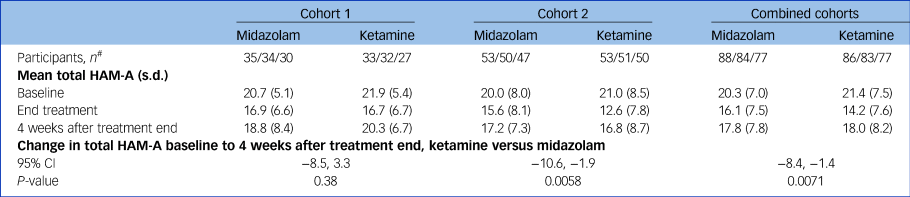
Change in Hamilton Anxiety (HAM-A) from baseline to 4 weeks after treatment end in midazolam and ketamine treatment arms, with group effect across end treatment and 4 weeks after treatment end

n #, number of participants at baseline/end treatment/4 weeks after treatment end.
95% confidence interval baseline to 4 weeks after treatment end. P-value for difference in decrease in HAM-A score between ketamine and midazolam groups baseline to 4 weeks after treatment end.
Cohort 1, cohort 2 and combined cohorts: total HAM-A score
For HAM-A outcomes across the end treatment and 4 weeks after treatment end visits, there was no significant difference in total HAM-A score between midazolam and ketamine treatment groups in cohort 1 (Table 1). The groups differed significantly in change in HAM-A score across end treatment and 4 weeks after treatment end in the combined cohorts (P = 0.0071) and cohort 2 (P = 0.0058), favouring ketamine over midazolam. Post hoc analysis of the combined cohorts found a significant difference between ketamine and midazolam at end treatment (P = 0.0093; Cohen's d = 0.53) but not at 4 weeks after treatment end (P = 0.80; Cohen's d = 0.05). In cohort 2, post hoc analysis for the main effect of Group also found a significant difference between ketamine and midazolam at end treatment (P = 0.004; Cohen's d = 0.77) but not at 4 weeks after treatment end (P = 0.46; Cohen's d = 0.20). A check for heterogeneity bias between cohorts 1 and 2 showed only a possible issue with the factor of Time, likely arising because of differences in dose-dependent effects between cohorts.
We performed additional analyses to determine whether anxiety effects were independent of ketamine's effects on depressive symptoms. When change in total MADRS scores across the end treatment and 4 weeks after treatment end visits were also included as covariates, the main effect of Group for total HAM-A score remained significant both in the combined cohorts (P = 0.010) and in cohort 2 (P = 0.019). Mediation analyses found an indirect effect from change in total MADRS score (baseline to end treatment) in the combined cohorts (average causal mediation effect (ACME): −1.2, 95% CI [−1.9, −0.5], P < 0.0001; average direct effect (ADE): 0.1, 95% CI [−1.4, 1.7], P = 0.90; proportion mediated 1.1, 95% CI [−7.6, 8.8]) and cohort 2 (ACME: −1.4, 95% CI [−2.5, −0.6], P < 0.0001; ADE: −0.5, 95% CI [−2.7, 1.8], P = 0.68; proportion mediated 0.76, 95% CI [−2.5, 5.0]). Therefore, the mediator (total MADRS score) accounts for a large portion of the relationship between ketamine and anxiety symptoms.
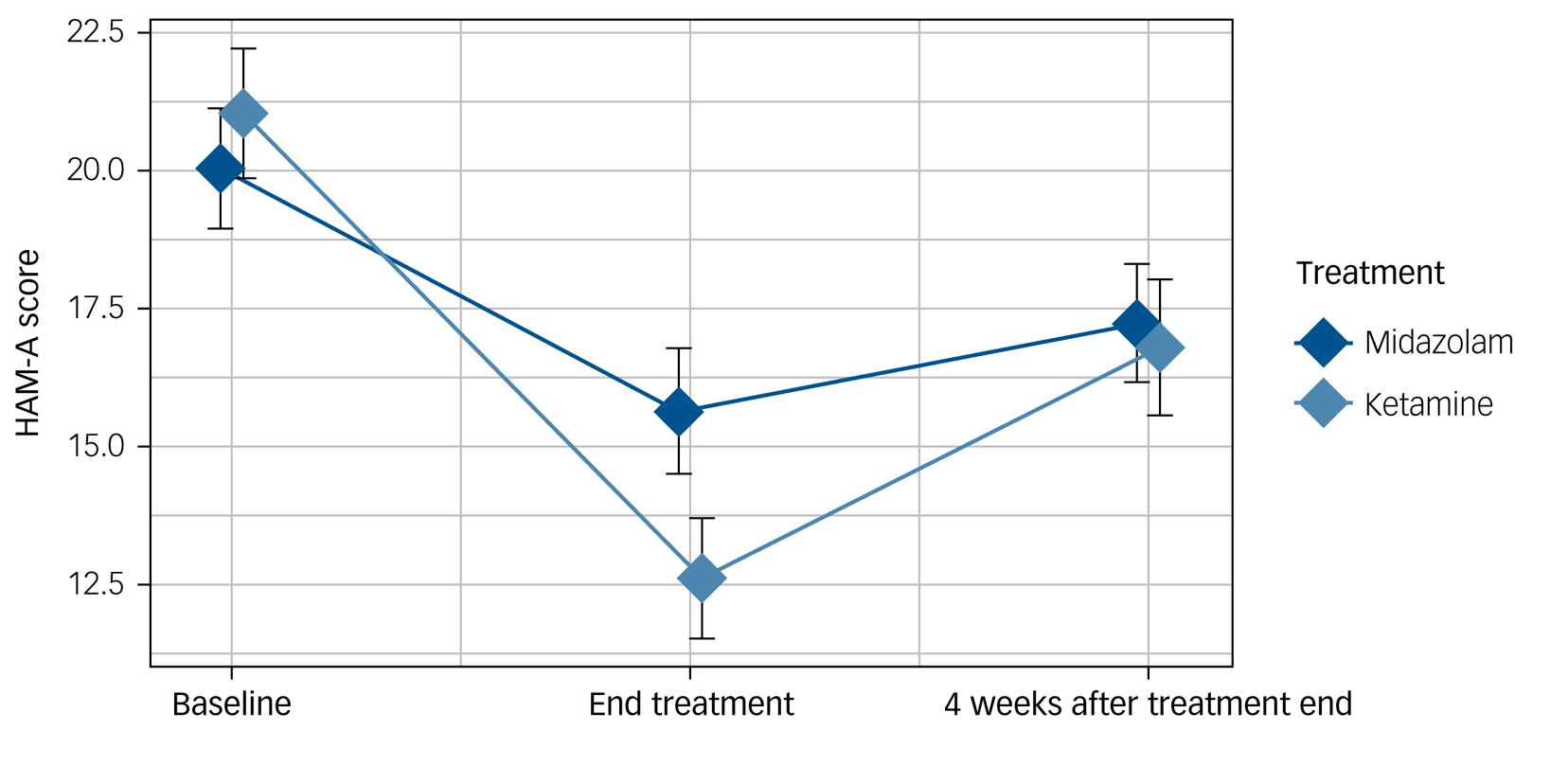
Linear regression models were also used to determine the association between total HAM-A and MADRS scores. These found the reduction in total HAM-A score was associated with a reduction in total MADRS score during the RCT phase: β = 0.48, s.e. = 0.090, P < 0.0001. Treatment group (β = 1.15, s.e. = 1.01, P = 0.26) and the interaction of total MADRS scores and treatment group (β = 0.058, s.e. = 0.11, P = 0.61) were not significant. See Figure 1 for total HAM-A scores from baseline to 4 weeks after treatment end for cohort 2, and Supplementary Figure 2 for the combined cohorts.
Change in Hamilton Anxiety (HAM-A) score from baseline to 4 weeks after treatment end in midazolam and ketamine treatment groups, cohort 2.

Cohort 1, cohort 2 and combined cohorts: MADRS item 3
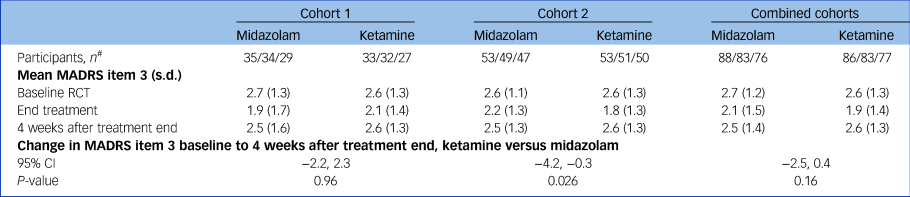
For MADRS item 3 outcomes across the end treatment and 4 weeks after treatment end visit (Table 2, Supplementary Figures 3(a) and (b)), there was no significant difference between ketamine and midazolam arms in cohort 1 (P = 0.96) or in the combined cohorts (P = 0.16); see also Supplementary Table 1 for medians at end treatment. The groups differed significantly in cohort 2 (P = 0.026), favouring ketamine over midazolam (Table 2). Post hoc analyses showed the difference between ketamine and midazolam groups in cohort 2 was driven by differences at end treatment (P = 0.0027), rather than at 4 weeks after treatment end (P = 0.65).
Change in Montgomery–Åsberg Depression Rating Scale (MADRS) item 3 (inner tension) score from baseline to 4 weeks after treatment end in midazolam and ketamine treatment arms, with group effect across end treatment and 4 weeks after treatment end

RCT, randomised controlled trial; n #, number of participants at baseline/end treatment/4 weeks after treatment end.
95% CI baseline to 4 weeks after treatment end. P-value for difference in decrease in MADRS item 3 scores between treatment groups baseline to 4 weeks after treatment end.
Subgroup analyses in combined cohorts: HAM-A scale psychic and somatic factors
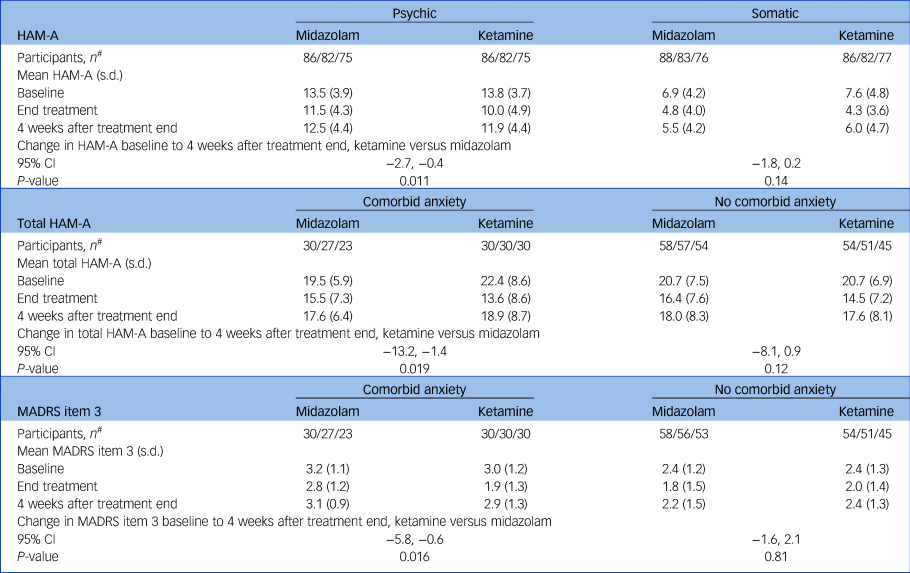
There was a significant difference between treatment groups across the end treatment and 4 weeks after treatment end visits for the change in psychic subscale of the HAM-A scale (P = 0.011), but not the somatic subscale (combined cohorts, Table 3). Post hoc analysis showed the main effect of Group for the psychic subscale was driven by a difference at treatment end (P = 0.011; Cohen's d = 0.54) with no difference at 4 weeks after treatment end (P = 0.45; Cohen's d = 0.17) – see also Supplementary Figure 4.
Change in (a) Hamilton Anxiety (HAM-A) psychic and somatic factors and (b) HAM-A and Montgomery–Åsberg Depression Rating Scale (MADRS) item 3 scores by anxiety disorder comorbidity, from baseline to 4 weeks after treatment end, with group effect across end treatment and 4 weeks after treatment end

n #, number of participants at baseline/end treatment/4 weeks after treatment end (midazolam: one participant missing HAM-A scale item 5, one participant missing HAM-A scale item 14 at baseline; ketamine: two participants missing ‘yes/no’ anxiety disorder).
95% CI baseline to 4 weeks after treatment end. P-value for difference in decrease in HAM-A scores and MADRS item 3 between ketamine and midazolam groups baseline to 4 weeks after treatment end.
Comorbid anxiety disorders
In participants with a comorbid anxiety disorder, for total HAM-A scale outcomes across the end treatment and 4 weeks after treatment end visits, a significant effect of Group was also observed (P = 0.019), favouring ketamine over midazolam (Table 3). Post hoc comparison showed a significant difference between ketamine and midazolam at end treatment (P = 0.016; Cohen's d = 0.82), but not at 4 weeks after treatment end (P = 0.74; Cohen's d = 0.12). Mediation analyses found an indirect effect from change in total MADRS score (baseline to end treatment) in those with comorbid anxiety disorder (ACME: −1.3, 95% CI [−2.8, −0.3], P = 0.008; ADE: 1.0, 95% CI [−2.0, 3.9], P = 0.55; proportion mediated 3.7, 95% CI [−9.9, 11.8]).
For MADRS item 3, there was no significant difference between midazolam and ketamine treatment groups across the end treatment and 4 weeks after treatment end visits in participants without a comorbid anxiety disorder, but there was a significant difference between groups for those with comorbid anxiety, favouring ketamine over midazolam (P = 0.016, Table 3). Post hoc analysis showed the effect of Group in those with a comorbid anxiety disorder was driven by differences at end treatment (P = 0.018), with no difference at 4 weeks after treatment end (P = 0.89).
Excluding MADRS item 3 from total MADRS score, for those who received ketamine, there was no significant difference in depression scores (P = 0.13) between those with and without a comorbid anxiety disorder.
Ketamine dose and anxiety measures
To examine the difference between cohorts further, we tested the difference between cohorts 1 and 2 in those participants in the ketamine treatment group. There was a larger decrease in mean total HAM-A score from baseline to end treatment in the ketamine group of cohort 2 (Table 1, Supplementary Figure 5) compared to the ketamine group of cohort 1, but this difference between cohorts was not statistically significant (β = −4.00, P = 0.14). However, this result was likely limited by reduced statistical power, and as participants were recruited sequentially in each cohort, is not a central finding. Maximum dose of ketamine (both in mg/kg, and in mg) was also not significant when linear regression was used to assess the association between reduction in HAM-A score and ketamine dose in the combined cohorts (P = 0.49 and P = 0.51, respectively).
Discussion
In this randomised, double-blind trial, uncorrected results showed a significant reduction in total HAM-A score at the end of the RCT, favouring the group treated with ketamine. This was evident in the combined cohorts and in cohort 2 (where response-guided titration to higher doses was implemented). This finding that showed evidence of mediation by change in total MADRS score from baseline to end treatment, however, remained significant when change in total MADRS scores across the end treatment and 4 weeks after treatment end was included as a covariate, suggesting the improvement in depression did not completely account for the improvement in anxiety. However, the reduction in total HAM-A score observed in the ketamine group at the end of treatment was not maintained over the 4-week follow-up period (i.e. at the 4 weeks after treatment end visit) with no further treatment. The lower dose used in cohort 1 and the time to achieve an adequate dose in cohort 2 could possibly have contributed to the lack of enduring effects of ketamine.
A significant decrease in MADRS item 3 score across the end treatment and 4 weeks after treatment end was also observed in cohort 2, favouring ketamine. This MADRS item 3 outcome suggests the change in total HAM-A score is unlikely to be entirely because of lower scores for HAM-A items (such as insomnia and mood) that overlap with depressive symptoms. As with total HAM-A score, the reduction in MADRS item 3 score in cohort 2 did not persist to the 4 weeks after treatment end visit.
In our subgroup analyses of HAM-A factors, the decrease in HAM-A score was largely seen in the ‘psychic’ factor, with a significant difference favouring ketamine for this subscale, but no difference between treatment arms for the ‘somatic’ factor during the RCT (uncorrected results). We are unaware of published TRD studies that have examined change in the psychic and somatic subscales of the HAM-A scale in response to ketamine. A study of esketamine in TRD measured total HAM-A scores at baseline, 1 month after treatment commencement and 3 months after treatment commencement.Reference Martinotti, Vita, Fagiolini, Maina, Bertolino and Dell'Osso20 Of the 116 participants,Reference Martinotti, Vita, Fagiolini, Maina, Bertolino and Dell'Osso20 a post hoc analysis of the 30 participants aged 65 years or older found a significant reduction in total HAM-A score at 1 and 3 months after treatment commencement; however, the analysis of HAM-A score did not control for change in total MADRS score.Reference d'Andrea, Chiappini, McIntyre, Stefanelli, Carullo and Andriola21
In the combined cohorts, there was also a significant reduction in total HAM-A and MADRS item 3 scores at the end of the RCT in the group with a comorbid anxiety disorder, favouring ketamine. Few studies with limited samples have investigated ketamine as a potential treatment for anxiety disorders in individuals who are not currently depressed. A double-blind trial in 18 individuals with SAD found an improvement in ratings on the Liebowitz Social Anxiety Scale in the ketamine group.Reference Taylor, Landeros-Weisenberger, Coughlin, Mulqueen, Johnson and Gabriel22 Blinding was an issue, and all but one participant correctly guessed their allocated treatment group of ketamine or placebo.Reference Taylor, Landeros-Weisenberger, Coughlin, Mulqueen, Johnson and Gabriel22 An open-label study of ketamine also found a reduction in anxiety in individuals with SAD and/or treatment-resistant GAD who were not currently depressed, with a greater effect of ketamine observed at higher doses.Reference Glue, Medlicott, Harland, Neehoff, Anderson-Fahey and Le Nedelec23
In our analysis of the effect of ketamine dose on anxiety measures, the difference in total HAM-A score reduction between the ketamine treatment group of cohort 1 and the ketamine group of cohort 2 did not reach statistical significance. However, the significant difference in reduction of HAM-A score in cohort 2 between the midazolam and ketamine groups suggests ketamine was effective in reducing anxiety measures when given at adequate dosage, which potentially has clinical relevance.
Strengths of this study include the large sample, blinding using midazolam as the control group, use of anxiety measures at multiple time points, use of more than one measure of anxiety (HAM-A plus MADRS item 3 scores) and controlling for change in mood. Only a small number of study participants discontinued the RCT phase, so there were few missing data.
There are some limitations regarding our investigation of change in anxiety measures in response to ketamine. Although we did not find evidence to suggest that those with comorbid anxiety were less likely to have an antidepressant response to ketamine, there were relatively few study participants with a comorbid anxiety disorder in some groups. We conducted exploratory analyses of secondary outcomes of the main study, with uncorrected outcomes reported. Therefore, the results should be interpreted with caution, as they are potentially prone to false positives. Further research is needed, including hypothesis-driven validation, to replicate and verify our findings.
Directions for further research to examine the efficacy of ketamine in reducing anxiety measures in individuals with TRD could include trials with longer durations with individualised dosing titration, which also look at outcomes weeks after treatment discontinuation. As we found the benefits to anxiety measures were not maintained at the 4 weeks after treatment end visit, this research could extend to examining potential ways to prolong positive effects of ketamine, such as following a course of ketamine with cognitive–behavioural therapy (CBT)Reference Wilkinson, Rhee, Joormann, Webler, Ortiz Lopez and Kitay24 or psychotherapy during ketamine treatment. It is beyond the scope of the present analysis to speculate more broadly on the maintenance of ketamine effects. Given the exploratory nature of the analyses, further confirmation of our findings from future trials with directional hypotheses is required. If our findings are replicated, further research to examine the use of ketamine as a maintenance treatment could also be considered, with a view to contributing to clinical practice guidelines.
In summary, ketamine was associated with a reduction in total HAM-A score in the RCT phase of this multi-centre study investigating the efficacy of ketamine in treatment of TRD. The decrease in total HAM-A score was seen in the combined cohorts and cohort 2, where response-guided dosing was used, but not in cohort 1, which used a lower fixed dosage. Reduction in anxiety was mediated by decrease in total MADRS score, but remained significant after controlling for this. Results also found significant improvement in anxiety for ketamine compared to midazolam in those with a comorbid anxiety disorder, but not in those without a comorbid anxiety disorder. Overall, this study found that ketamine reduces anxiety in people with TRD when administered subcutaneously in adequate doses.
Supplementary material
Supplementary material is available online at https://doi.org/10.1192/bjp.2024.250.
Data availability
De-identified data from this study may be requested from the corresponding author, subject to approval from the Trial Steering Group and the approving Human Research Ethics Committee.
Acknowledgements
We sincerely thank all the participants who were involved in the study, and all investigators and staff at the study centres.
Author contributions
C.K.L., P.B.M., P.G., P.B.F., N.G., D.H.-P., A.A.S., M.L.H., A.R., B.T.B., C.M., D.B., D.M., G.C., M.B. and S.H. were involved in the grant proposal that led to funding of the study. C.K.L., A.A., V.D., N.G., D.B., B.T.B., N.T.M., P.B.F., P.G., M.L.C. and S.S. were involved in data collection and the investigation. D.H.-P., S.N., D.M. and V.D. were involved in data curation. N.T.M., S.N. and S.H. wrote the early drafts of the manuscript. N.T.M. and S.N. conducted the data analysis. All authors reviewed, edited and approved the manuscript.
Funding
The study was funded by a competitive research grant from the Australian National Health and Medical Research Council (APP1105089). M.B. is supported by a NHMRC Leadership 3 Investigator grant (2017131). C.K.L. is supported by a NHMRC Leadership Investigator grant (1195651).
Declaration of interest
In the past 36 months, N.G. has received speaker's bureau honoraria from Servier Laboratories, Janssen and Lundbeck, and served on advisory boards for Servier Laboratories, Esia, Seqirus and Lundbeck. D.B. is a director and part-owner of Neurotrials Victoria Pty Ltd, trading as Neurocentrix and Neurocentrix TMS Pty Ltd; he serves on the advisory board for Eli Lilly and Janssen, and is currently supported by grant funding from Praxis, Janssen, Eli Lilly, Biogen and NHMRC; he has served on speaker panels for Servier, Janssen and Eli Lilly in the past 12 months; he is an investigator on the Janssen Quality of Life Esketamine study. B.T.B. has received grants and served as consultant, advisor or CME speaker for AstraZeneca, Bristol-Myers Squibb, Janssen, Lundbeck, Otsuka, Servier, the NHMRC, the Fay Fuller Foundation and the James and Diana Ramsay Foundation. In the past 3 years, P.B.F. has received equipment for research from Neurosoft, Nexstim and Brainsway Ltd; he has served on scientific advisory boards for Magstim and LivaNova and received speaker fees from Otsuka; he is a founder and board member for TMS Clinics Australia and Resonance Therapeutics. Within the last 36 months, P.G. has attended a Janssen New Zealand advisory board, and is named on a patent for a controlled release ketamine tablet developed by Douglas Pharmaceuticals. In the past 36 months, D.M. has received research consulting fees from Douglas Pharmaceuticals for a clinical trial involving ketamine. P.B.M. has received remuneration from Janssen (Australia) and Sanofi (Hangzhou) for lectures or advisory board membership within the past 3 years. M.B. has received honoraria from EPA Warsaw, Lundbeck, Controversias Barcelona, Servier, Medisquire, HealthEd, ANZJP, European Psychiatric Association, Janssen, Medplan, Milken Institute, Abbott India, ASCP, Allori for Eisai, Otsuka, St Bio Pharma and Sandoz in the past 3 years. G.C. has received educational and travel support from Servier, Astra Zeneca, Otsuka Australia, Merck Sharp & Dohme and Janssen-Cilag in the past 5 years; he also served on an advisory board for the AFFINITY trial. A.A.S. is a director of the Australian Medicines Handbook Pty Ltd (unpaid) and has received funding support from the Australian and New Zealand College of Anaesthetists to investigate ketamine for chronic postsurgical pain. S.H. has received speaker and consultancy fees from Janssen and Servier and served on advisory boards for Janssen and Lundbeck. C.K.L. is on the Clinical Advisory Board for Douglas Pharmaceuticals and has received fees for the following: Janssen Cilag advisory board, Douglas Pharmaceuticals advisory board. N.T.M, S.N., S.S., A.R., D.H.-P., A.A., V.D., M.L.H., C.M., M.L.C.: None.


 Open access


eLetters
No eLetters have been published for this article.