

Choosing coalition partners is not simply a matter of winning a majority of parliamentary seats, either together with a minimum number of parties, or with the smallest necessary surplus of seats above the majority (Riker Reference Riker1962; Von Neumann and Morgenstern Reference Von Neumann and Morgenstern1944). According to several coalition theories, forming coalition governments also revolves around policy (Axelrod Reference Axelrod1970; De Swaan Reference De Swaan1973). Studies on the national and regional levels show time and again that both the office- and policy-seeking motives of political actors matter when forming coalition governments (see e.g. Bäck et al. Reference Bäck, Debus, Müller and Bäck2013; Glasgow et al. Reference Glasgow, Golder and Golder2012; Martin and Stevenson Reference Martin and Stevenson2001).
However, the extent to which ideology plays a role in coalition formation at the local level is still contested. On the one hand, local politics is often seen as apolitical and technical, involving practical problem-solving rather than clashes between fundamental worldviews (Oliver et al. Reference Oliver, Ha and Callen2012). On the other hand, however, there is the expectation that growing levels of party politicization have led ideological concerns to dominate municipal policy-making (Copus et al. Reference Copus, Wingfield, Steyvers, Reynaert, Clarke, John and Mossberger2012). In an increasing number of policy areas, local parties are required to make difficult choices – and the days of absolute majorities for one party in local councils are over. Consequently, local political actors must build coalitions to constitute executives. Understanding coalition formation at the local level is vital because it converts electoral and parliamentary power into executive power, shapes the government–opposition divide in local councils, and influences policy (Blom-Hansen et al. Reference Blom-Hansen, Monkerud and Sørensen2006; De Winter and Dumont Reference De Winter, Dumont, Katz and Crotty2006).
It therefore comes as no surprise that in recent years coalition formation processes have been increasingly studied at the local level in Europe (Bäck Reference Bäck2003; Debus and Gross Reference Debus and Gross2016; Geys et al. Reference Geys, Heyndels and Vermeir2006; Gross Reference Gross2023; Gross and Debus Reference Gross and Debus2018; Laver et al. Reference Laver, Rallings and Thrasher1998; Olislagers and Steyvers Reference Olislagers and Steyvers2015; Otjes Reference Otjes2024; Skjæveland et al. Reference Skjæveland, Serritzlew and Blom-Hansen2007; Steunenberg Reference Steunenberg1992). Most of these studies show that not only office-seeking, but also policy-seeking factors play an important role in explaining the formation of local coalitions.
We contribute to this literature by examining whether ideology drives coalition formation in 30 municipalities in the Flemish region of Belgium and by going beyond existing studies on local-level coalition formation in Belgium (see Geys et al. Reference Geys, Heyndels and Vermeir2006; Olislagers and Steyvers Reference Olislagers and Steyvers2015). In addition to office-seeking motives and contextual factors, such as incumbency, we test the role of policy-seeking theories and theoretical arguments in political actors’ preference tangentiality by estimating conditional logit (CL) models that include local parties’ policy positions and issue salience.
We expect that potential coalitions are more likely to form, the smaller the ideological distance between the coalition partners, because this means that the coalition’s policies will be closer to the parties’ ideal points (Axelrod Reference Axelrod1970; De Swaan Reference De Swaan1973). Furthermore, we hypothesize that a potential coalition is more likely to form the higher the tangentiality of the parties’ issue emphasis. Preferences are tangential if two or more parties rank the policy issues they care about in a diametrically opposed way. Parties that value different issues may actually be the most compatible partners, because they can grant each other policy-making autonomy in the areas they consider most important (Dumont et al. Reference Dumont, Falcó-Gimeno, Indridason and Bischof2024; Falcó-Gimeno Reference Falcó-Gimeno2014; Luebbert Reference Luebbert1986: 62–64). Lastly, we expect that ideological distance and preference tangentiality relate to each other. By analysing 2,887 potential coalitions following the local elections in 2012 and 2018, we are the first to analyse the association between tangential preferences and coalition formation at the local level.
Our empirical findings demonstrate that ideology only matters to some degree in local politics in Flanders: the closer the policy positions of the respective partners, the more likely potential coalitions are to form. Yet this is only the case to the extent that parties still maintain the cordon sanitaire and do not cooperate with the far-right Vlaams Belang. While preference tangentiality alone does not predict local coalition formation in Flanders, it is an important factor for ideologically coherent executives in which parties must differentiate themselves from their coalition partners. Our findings thus provide novel insights into the relevance of ideology and tangential preferences in the formation of local coalitions.
An overview of policy-seeking coalition theories
Increasing party system fragmentation around the globe and across different layers of multi-level political systems makes coalition governments more common. Power-sharing between multiple parties has become the norm in many European countries, leading to a growing scholarly focus on which coalitions are more likely to form out of the large set of potential combinations political actors have at their disposal following an election.
One core assumption in analysing government formation is that political parties are rational actors, searching to maximize their utility (De Winter and Dumont Reference De Winter, Dumont, Katz and Crotty2006). The first school of coalition theories stated that this utility is mainly conceived as the share of offices in government (Leiserson Reference Leiserson1968; Riker Reference Riker1962; Von Neumann and Morgenstern Reference Von Neumann and Morgenstern1944). Parties prefer minimal winning coalitions, often in combination with the smallest possible number of parties or a minimum number of seats in order not to share too many executive portfolios and to minimize transaction and bargaining costs.
Although the size-related propositions greatly reduce the set of rational outcomes, the overall performance of office-seeking theories remains weak (Martin and Stevenson Reference Martin and Stevenson2001, Reference Martin and Stevenson2010). Consequently, scholars also investigated the role of policy in choosing coalition partners. They predict that political actors consider the policy positions of their own party and their potential coalition partners when forming coalitions. According to this assessment, potential coalitions are more likely to form if the parties have the smallest ideological distance on relevant policy dimensions, such as the left-right scale (Laver and Budge Reference Laver and Budge1992). Particular propositions involve the minimal range and minimal connected winning theories (Axelrod Reference Axelrod1970; De Swaan Reference De Swaan1973). The former assumes that the minimal winning coalition with the smallest ideological range between potential coalition partners will form. The latter proposition is similar, yet more strict – here, coalitions including parties that are ideologically adjacent to each other on the relevant policy dimension should have a higher likelihood of forming than other coalitions.
The theories about ideological compactness are empirically supported by much of the literature (De Winter and Dumont Reference De Winter, Dumont, Katz and Crotty2006), but do not cover the entire role of policy in coalition formation. First, the minimal range and minimal connected winning theories assume that parties only care about positions. However, issue salience – the relative attention given to specific policy areas – is an equally important dimension of party competition (Budge and Farlie Reference Budge and Farlie1983; Stokes Reference Stokes1963). By prioritizing certain issues, parties try to establish a distinctive brand. They can claim ownership over these issues through a long-standing emphasis or demonstrated competence (Dumont et al. Reference Dumont, Falcó-Gimeno, Indridason and Bischof2024; Petrocik Reference Petrocik1996; Walgrave et al. Reference Walgrave, Tresch and Lefevere2015). Parties want to maintain this asset when they enter a coalition government. This is empirically supported for government formations and portfolio allocations in Western and Eastern European democracies at the national level (Krauss and Klüver Reference Krauss and Klüver2023). Second, traditional policy-related theories presuppose a coalition agreement as some form of compromise; that is, it involves a weighted average of the coalition parties’ positions on every relevant issue. Thus, parties’ preferences are compatible if they are ideologically close.
However, a coalition’s policy programme may also result from logrolling; that is, parties exchanging the issues they each emphasize the most and on which they can pursue their own policies. Both Gregory Luebbert (Reference Luebbert1986: 62–64) and Patrick Dumont et al. (Reference Dumont, Falcó-Gimeno, Indridason and Bischof2024) put forward this approach, claiming that parties prioritizing different issues may be a great fit for one another. According to Dumont et al. (Reference Dumont, Falcó-Gimeno, Indridason and Bischof2024: 62): ‘if parties rank the policy issues they care about in a diametrically opposed way – their preferences are tangential – then a simple solution to the coalition formation problem may exist: the parties simply grant each other policy-making autonomy in the issue areas they, and they alone, care about by dividing the ministerial portfolios that match those issue areas accordingly’.
This strategy allows parties to avoid painful compromises in the policy areas they most care about. Moreover, building a coalition based on high levels of preference tangentiality rather than preference proximity helps to prevent a main competitor from gaining access to government resources, as ideologically proximate parties often compete for the support of the same pool of voters (Luebbert Reference Luebbert1986: 62–64). In addition, it allows more decision-making autonomy for individual ministers, reducing the need for extensive intra-coalition control mechanisms, such as cross-party watchdog junior ministers or detailed coalition agreements (Falcó-Gimeno Reference Falcó-Gimeno2014). As Heike Klüver et al. (Reference Klüver, Bäck and Krauss2023: 44) note, writing coalition agreements is not without costs: ‘coalition parties have to invest time and resources to negotiate a coalition agreement and they may be severely punished electorally for making policy compromises’. However, research has found that party supporters are more willing to accept concessions on issues that are less important to them (Hjermitslev Reference Hjermitslev2025; Plescia et al. Reference Plescia, Ecker and Meyer2022).
Why policy-seeking should matter in local coalition formation: ideological distance and preference tangentiality
Coalition theories were mostly developed and tested on multi-party cabinets at the national level (Martin and Stevenson Reference Martin and Stevenson2001, Reference Martin and Stevenson2010). As discussed in the introduction, in recent years, coalition theories have also been increasingly applied to study municipal executives. In addition to the advantage of the large number of observations, it is substantially interesting to test national-level policy-seeking theories at the municipal level, because local politics is often considered an ideology-free arena dealing with practical issues (Oliver et al. Reference Oliver, Ha and Callen2012).
Even though ‘classic’ office-seeking theories explain the formation of local coalitions in Europe to some extent, existing empirical studies conclude that ideological proximity matters as well. General left-right positions are a significant driver of municipal coalition formations in Sweden (Bäck Reference Bäck2003), Denmark (Skjæveland et al. Reference Skjæveland, Serritzlew and Blom-Hansen2007), Germany (Gross Reference Gross2023; Gross and Debus Reference Gross and Debus2018) and the UK (Laver et al. Reference Laver, Rallings and Thrasher1998). Furthermore, for Germany it has been shown in particular that local parties’ cultural policy positions matter for the formation of local council coalitions (Debus and Gross Reference Debus and Gross2016). Therefore, local political actors not only aim to maximize their share of offices, but also seek policy coherence. The policies of the coalition should be as close as possible to their ideal preferences. We will test this claim for the first time in the Flemish region of Belgium by formulating the following hypothesis:
Hypothesis 1 (H1): The smaller the distance between parties’ policy positions, the more likely that potential coalitions will form.
In addition to position-taking, we also test whether parties’ issue salience explains coalition formation at the local level. Contrary to positional proximity, however, previous research regarding the role of preference tangentiality in forming coalitions is lacking. The impact of preference tangentiality has been examined with regards to the duration of government formation bargaining (De Marchi and Laver Reference De Marchi and Laver2020; Ecker and Meyer Reference Ecker and Meyer2020), the prevalence of intra-coalition control mechanisms (Falcó-Gimeno Reference Falcó-Gimeno2014), and attention to issues in coalition agreements (Klüver and Bäck Reference Klüver and Bäck2019), but these studies only target cases at the national level. The only study regarding the role of issue salience in coalition composition to date is by Dumont et al. (Reference Dumont, Falcó-Gimeno, Indridason and Bischof2024), who examined the role of tangential issue preferences in the formation of national coalition governments in postwar Western Europe but did not find the expected relationship. However, it would be unfair to disregard the potential effect of preference tangentiality on coalition formation based on just one study at one political level. Therefore, we are the first to investigate whether parties’ issue salience drives coalition formation at the local level.
There are no inherent obstacles to preference tangentiality serving as a basis for municipal coalition-building specifically. As with national politics, local politics is not only about policy positions but also about emphasizing and de-emphasizing certain issues in both the electoral and parliamentary arenas (see e.g. Breeman et al. Reference Breeman, Scholten and Timmermans2015; Gross et al. Reference Gross, Nyhuis, Block and Velimsky2024; Mortensen et al. Reference Mortensen, Loftis and Seeberg2022; Otjes et al. Reference Otjes, Nagtzaam and van Well2023). It has been demonstrated that issue ownership is also an important asset for parties in local elections (Bouteca and Lefevere Reference Bouteca, Lefevere, Dandoy, Dodeigne, Steyvers and Verthé2020). Furthermore, local parties can engage in logrolling, because municipal governments typically exhibit a high degree of portfolio specialization, with policies divided into distinct issue areas (Ecker and Gross Reference Ecker and Gross2026). We therefore expect parties whose issue preferences do not overlap to have a higher chance of forming a coalition. Instead of making painful compromises on their most important issues, parties can opt for a logrolling strategy in which they exchange issue areas due to preference tangentiality, an argument also made recently by Dumont et al. (Reference Dumont, Falcó-Gimeno, Indridason and Bischof2024: 67) concerning government formations at the national level. Accordingly, our second hypothesis reads as follows:
Hypothesis 2 (H2): The greater the tangentiality of local parties’ issue salience, the more likely that potential coalitions will form.
Finally, we integrate the two policy-seeking theories by studying whether ideological proximity and preference tangentiality interact. Specifically, we expect that the positive effect of tangentiality on the likelihood of a coalition forming is conditional on the policy distance between the parties. Following Dumont et al. (Reference Dumont, Falcó-Gimeno, Indridason and Bischof2024), two competing arguments can underpin this interaction. The first argument, which we formulate in Hypothesis 3a (H3a) below, suggests that tangentiality becomes more important for coalition formation as ideological differences between parties increase. This is because tangentiality creates greater opportunities for logrolling and hence facilitates coalition formation between parties with irreconcilable demands, whereas it is less useful for parties that can easily bridge their policy differences. When parties are ideologically far apart, reaching a comprehensive compromise across key policy areas becomes more difficult, potentially obstructing coalition bargaining. Under such conditions, tangential preferences are more likely to underpin a coalition, allowing each party to secure key policy priorities without demanding major concessions from others.
This view is empirically supported by the research of Dumont et al. (Reference Dumont, Falcó-Gimeno, Indridason and Bischof2024). Furthermore, this perspective is underscored in cross-national research on the time taken to form a coalition government (see Ecker and Meyer Reference Ecker and Meyer2020): the larger the ideological distance between parties, the lower the likelihood that they will start negotiations in the first place (see our first hypothesis). However, if these parties do start negotiations, then the more they emphasized different issues in their manifestos (preference tangentiality), the faster the government will be formed. H3a therefore reads as follows:
Hypothesis 3a (H3a): The effect of preference tangentiality on the formation likelihood of a potential coalition increases as the policy distance between the potential coalition partners increases.
In contrast, Luebbert’s view (Reference Luebbert1986: 62–64) focuses on parties’ need to maintain their distinct identity in the eyes of voters. According to this perspective, tangentiality matters more when parties are ideologically close to each other, as they need to differentiate themselves from coalition partners to preserve their unique profile. Rather than being a source for policy-focused logrolling, tangentiality here serves a symbolic function, enabling parties competing for the support of similar groups of voters to signal their distinctiveness by claiming divergent issues. Research has demonstrated that voters perceive parties in coalition cabinets as more ideologically similar (Fortunato and Stevenson Reference Fortunato and Stevenson2013; Hjermitslev Reference Hjermitslev2025). When parties with significant ideological differences form a coalition, the substantial policy distance between them suffices to maintain distinct identities, reducing the need to emphasize non-overlapping issues. Therefore, H3b reads as follows:
Hypothesis 3b (H3b): The effect of preference tangentiality on the formation likelihood of a potential coalition increases as the policy distance between the potential coalition partners decreases.
The institutional setting of Flanders (Belgium)
The role of policy in coalition formation at the local level will be studied in Flanders, the Dutch-speaking part of Belgium. Belgium is a federal and consociational democracy, characterized by a strong tradition of power-sharing between political parties at various levels. Currently, 565 municipalities act as the first tier of local government, being responsible for important policy areas such as public safety, spatial planning, the public domain, transport, leisure and social affairs. In 2002, Belgium’s regions acquired the competence to set the constitutive framework for and have oversight of the local authorities (Steyvers Reference Steyvers, Gendźwiłł, Kjær and Steyvers2022). Furthermore, the Belgian party system is split along ethno-territorial lines, resulting in varying sets of parties in each region. Belgian municipalities are hence embedded in differing institutional settings and party systems depending on where they are located. This research focuses on Flanders, Belgium’s largest region. Here, predominantly coalitions govern at the local level, in contrast to Wallonia, where single-party executives control 62% of the municipalities (Close and Matagne Reference Close, Matagne, Dodeigne, Close, Jacquet and Matagne2020).
Regarding our hypotheses concerning the role of ideological motivation in coalition formation at the local level, both the institutional setting and the role of political parties make Flanders a most likely context. Institutionally, local government is fully parliamentary in design. Every six years voters elect up to 55 councillors (depending on municipal size) in a single municipality-wide district. Seats are distributed to the parties according to the proportional representation (PR) list system. The council, in turn, chooses amongst its members a collective executive that includes a mayor and from at least 2 to 10 aldermen. The members of the executive are appointed by a formal nomination document submitted at the start of the new council term, requiring the signatures of an absolute majority of councillors (Steyvers, Reference Steyvers, Gendźwiłł, Kjær and Steyvers2022).
For vote-, office- and policy-seeking parties, executive mandates are highly attractive. In contrast to lay councillors who have limited influence, Flanders’ mayors and aldermen are part-time or full-time politicians who hold the most visible and powerful positions in local government. In this setting of strong executive dominance, policy is primarily defined by the Board of Mayor and Aldermen (Verhelst et al. Reference Verhelst, De Ceuninck, Peters and Reynaert2019). The Board of Mayor and Aldermen is a collegial body, which means that individual members cannot make decisions on their own. However, they are assigned specific portfolios, granting them the authority to propose initiatives within their designated areas. Therefore, a logrolling strategy in which every coalition party is allowed to pursue its own policies in the jurisdiction it controls could work here.
The importance of policy for the executive is further reinforced by the high levels of nationalization in local party systems (Dodeigne et al. Reference Dodeigne, Close and Teuber2021). The seven major Flemish parties have established hundreds of municipal branches and therefore obtain the lion’s share of votes and council seats in local elections (Gendźwiłł et al. Reference Gendźwiłł, Kjær, Steyvers, Lackowska, Szmigiel-Rawska and Teles2021; Steyvers Reference Steyvers, Gendźwiłł, Kjær and Steyvers2022). Independent local lists do exist, especially in small municipalities, but they are far less prevalent compared to the situation in Wallonia, where local party systems are relatively more localized (Dodeigne et al. Reference Dodeigne, Close and Teuber2021; Gendźwiłł et al. Reference Gendźwiłł, Kjær, Steyvers, Gendźwiłł, Kjær and Steyvers2022).
Given that national party systems are organized along ideological and societal cleavages (Lipset and Rokkan Reference Lipset and Rokkan1967), we expect that the pursuit of policy is one of the main goals of local parties in coalitions. Furthermore, Flanders and its municipalities are a textbook example of partitocracy (Dewachter Reference Dewachter2003), where parties dominate over all other political players and decision-making processes. This is reflected in the high levels of intra-party discipline and a vigorous majority-opposition dynamic in councils (De Rynck Reference De Rynck, De Rynck and Bouckaert2000). Since governing majorities in Flanders are expected to behave almost as a unitary actor, ideological motivations should matter for the choice of coalition partners.
Data and operationalization
The focus of this study is on the formation of coalitions following the 2012 and 2018 local elections in 30 Flemish municipalities. This selection includes Flanders’ 13 largest cities and the sample of Flemish municipalities that were part of the Belgian Local Elections Study 2018 (Dandoy et al. Reference Dandoy, Dodeigne, Steyvers and Verthé2020) and the PartiRep Exit Poll 2012 (Dassonneville et al. Reference Dassonneville, Hooghe, Marien and Pilet2013). Our sample is thus constrained by the limited availability of data – which is also the reason why we do not include municipalities in Belgium’s second region, Wallonia (in addition to the high degree of single-party executives there) (Close and Matagne Reference Close, Matagne, Dodeigne, Close, Jacquet and Matagne2020). Only localities governed by a coalition and for which we have the manifestos of nearly all parties and independent local lists that gained representation in the council could be selected (see Table A1 in the Supplementary Material online). If a municipality was governed by a coalition in both 2012 and 2018, it is represented twice in the dataset, whereas a municipality governed by a coalition after only one of the two elections is represented once. Therefore, we analyse 49 and not 60 coalition formation opportunities.
We estimate conditional logit (CL) models of coalition-building, using the opportunity to form a government in a given municipality after a given election as the unit of analysis and all potential coalitions that could theoretically be formed as the alternative choices (Martin and Stevenson Reference Martin and Stevenson2001).Footnote 1 We therefore created a dataset that comprises information on the allocations of seats in the local councils, local parties’ policy positions and issue salience, the incumbent coalition, the composition of regional and federal governments, and the outcome of the local coalition formation process.
Our first hypothesis states that potential coalitions are more likely to be formed, the closer potential coalition partners are regarding their policy positions. To operationalize this veto player distance (Tsebelis Reference Tsebelis2002) within potential coalitions, we rely on election manifesto information. Contrary to earlier studies on local-level coalition formation, we are not using indirect measures of local parties’ policy preferences, such as the positions of parties at the national level (Denters, Reference Denters1985; Laver et al. Reference Laver, Rallings and Thrasher1998; Steunenberg Reference Steunenberg1992) or local party elites’ self-positioning (Bäck Reference Bäck2003). Indeed, the latter do not necessarily articulate the preferences of the whole party and may ‘respond strategically, rather than truthfully and transparently’ (Krouwel and van Elfrinkhof Reference Krouwel and van Elfrinkhof2014: 1460).
We measure both the policy positions and the issue salience of local party branches directly by using information from local parties’ election manifestos (Debus and Gross Reference Debus and Gross2016; Gross Reference Gross2023; Gross and Debus Reference Gross and Debus2018; Gross and Jankowski Reference Gross and Jankowski2020; Otjes Reference Otjes2021, Reference Otjes2024; Reuse Reference Reuse2025). Manifestos are collective and authoritative documents that encompass the official position of the entire party. Estimating party preferences using manifestos is a long-standing tradition within political science (Klingemann et al. Reference Klingemann, Volkens, Budge, Bara and McDonald2006; Lehmann et al. Reference Lehmann, Burst, Matthieß, Regel, Volkens, Weßels and Zehnter2022) but has scarcely been applied to local politics (Van de Voorde et al. Reference Van de Voorde, Bouteca, Schamp and Steyvers2018). Consequently, we collect the available manifestos for all parties that gained representation in the local council under study.
If a manifesto is missing, we first make use of the local party’s manifesto at the previous or following election or, secondarily, the nation-wide model manifesto. In Flanders, the central party headquarters assist local branches by drafting model manifestos that involve general positions on local policy areas, often combined with best practices from specific localities (Van de Voorde et al. Reference Van de Voorde, Bouteca, Schamp and Steyvers2018). It is important to note, however, that the model manifestos are designed to support local chapters in developing their own election programme. In other words, they are mainly intended to serve as non-binding inspiration, as local branches are encouraged to adapt them to the conditions of their own municipality. We rely on the model manifestos in 25 cases – mainly for Vlaams Belang, because most local chapters of the far-right party do not write a manifesto themselves. The previous and following manifestos are each used a total of seven times. These adjustments remain exceptional, as there are no fewer than 274 local parties in this study.
Because of the large number of election manifestos, the documents are analysed through computational methods. We use Wordscores to extract local parties’ positions on key policy dimensions from their local election manifestos (Laver et al. Reference Laver, Benoit and Garry2003; Lowe Reference Lowe2008). The basic idea behind this method is that parties with similar ideological beliefs use similar words in their texts (Otjes Reference Otjes2021). Therefore, policy preferences can be estimated by comparing a text’s vocabulary with that of a text whose ideological leaning is already known. Wordscores does exactly this: it compares the frequency distribution of words in virgin texts (documents of which the programmatic positions are unknown) with the frequency distribution of words in reference texts (documents of which the positions are known) on an a priori defined policy scale. In our case, the local manifestos are the virgin texts. As reference texts, we use the manifestos proposed by the different national parties at the elections closest to the local elections under study, namely those of PVDA, Groen, Vooruit, cd&v, Anders., N-VA and Vlaams Belang for the federal election in 2010 and the regional, federal and European elections in 2014 and 2019.Footnote 2
The Flemish party system is primarily organized along a left-right cleavage, including an economic and a cultural subdimension (Reuse Reference Reuse2025; Walgrave et al. Reference Walgrave, van Erkel, Jennart, Lefevere, Baudewyns, Pilet, Baudewyns, Deschouwer, Kern and Lefevere2020). Therefore, the reference texts can be linked with the parties’ general, economic and cultural (namely, green, alternative, libertarian (GAL) vs. traditional, authoritarian, nationalist (TAN)) left-right positions in the Chapel Hill Expert Survey (CHES) of 2010, 2014 and 2019 (Jolly et al. Reference Jolly, Bakker, Hooghe, Marks, Polk, Rovny, Steenbergen and Vachudova2022). This methodology has already been successfully applied to local parties’ positions in Germany (Debus and Gross Reference Debus and Gross2016; Gross and Jankowski Reference Gross and Jankowski2020) and the Netherlands (Otjes Reference Otjes2021, Reference Otjes2024). Once the positions are retrieved, we compute the veto player distance for every potential coalition; that is, the distance between the two parties furthest apart on the general left-right policy dimension (Left-right policy distance), economic policy dimension (Economic policy distance) and cultural policy dimension (Cultural policy distance).
Rather than applying a traditional dictionary approach that involves a highly subjective keyword list (Block Reference Block2024b), we use machine learning classification to measure issue salience in the manifestos. In supervised machine learning, a language model is trained on manually coded data to classify unseen text into predefined categories. We employ a state-of-the-art Bidirectional Encoder Representations from Transformers (BERT) model, namely RobBERT-2023-large (Delobelle et al. Reference Delobelle, Winters and Berendt2020, Reference Delobelle, Winters and Berendt2022). This model, pre-trained on large text corpora in Dutch, was fine-tuned for classification of the manifestos at the sentence level.
The sentences in the local manifestos are assigned to the policy categories of the Comparative Agendas Project (CAP) (see Table A2 in the Supplementary Material). CAP is the leading coding scheme regarding issue salience and agenda-setting in comparative politics, known for high-quality human coding and therefore widely used for supervised classification (Block Reference Block2024b: 50). Its coding scheme applies well to the local level in Flanders, covering the municipalities’ main jurisdictions, such as Law and Crime, Transportation, Housing, Nature (including spatial planning), Social Welfare, and Culture and Sport. Regarding the original CAP scheme, we make two adjustments by omitting the Defence, Foreign Trade, and Technology classes (see also Block Reference Block2024a; Gross et al. Reference Gross, Nyhuis, Block and Velimsky2024) and merging Domestic Commerce and Macroeconomics into a new Economics and Finance class.
We employ a mix of Dutch national party manifestos, Dutch coalition agreements and Dutch/Belgian State-of-the-Union addresses combined with their CAP coding as fine-tuned data (Otjes and de Natris Reference Otjes and de Natris2023). After the model had learned this dataset, it predicted the class of every sentence. We evaluated predictions against a manually coded sample of 489 sentences. Both accuracy and F1-score are 0.77, indicating sufficient levels of performance. To determine the total amount of emphasis on an issue, we count the number of sentences in every category and divide by the total number of sentences. As some sentences are longer, we weigh each sentence by its word count (Otjes and de Natris Reference Otjes and de Natris2023).
Finally, we compute the tangentiality of issue preferences for each potential coalition. We consider the measure originally proposed by Albert Falcó-Gimeno (Reference Falcó-Gimeno2014) as well as the weighted measure in Dumont et al. (Reference Dumont, Falcó-Gimeno, Indridason and Bischof2024). For each issue, we calculate the standard deviation of the salience scores of the parties in the given coalition. We then take the average of the standard deviations across all the issues (Preference tangentiality (unweighted)). In addition, the second measure weighs each issue by the average salience attached by each of the parties in the potential coalition to that issue (Preference tangentiality (weighted)). Following recent recommendations (see Dumont et al. Reference Dumont, Falcó-Gimeno, Indridason and Bischof2024), we use Preference tangentiality (weighted) as the independent variable in the empirical models, whereas we apply the unweighted version as a robustness check. For ease of interpretation and comparison with other independent variables, we multiply both measures by the factor 100.
We control for several office-seeking theories of coalition formation, as well as for the institutional and contextual specificities of Belgium’s multi-level governance system. For the application of office-seeking theories, we use data on local council seat distributions to determine how many local coalitions could have been formed and which potential local coalitions are minimal winning coalitions (MWC), MWC with the smallest number of parties (minparties) and MWC with the smallest number of seats (minseats). Furthermore, we created an additional dummy variable indicating whether a potential coalition includes the largest party in the council (Largest party). Although it was not required to give the lead to the largest party in negotiations, its leader might act as formateur and hence include their party in the new coalition (Olislagers and Steyvers Reference Olislagers and Steyvers2015).
In addition, we assume that parties also take contextual factors into account when choosing coalition partners. Therefore, we first added a dummy variable indicating whether a potential coalition is the incumbent one (Incumbent coalition). Outgoing parties are more likely to coalesce again due to the lower transaction costs of forming a new government: parties that share some experience of governing together know, at least to a certain extent, what to expect from each other (Lupia and Strøm Reference Lupia, Strøm, Strøm, Müller and Bergman2008). This incumbency effect is well-established in the literature and has also been found at the local level (Bäck Reference Bäck2003; Debus and Gross Reference Debus and Gross2016; Olislagers and Steyvers Reference Olislagers and Steyvers2015; Skjæveland et al. Reference Skjæveland, Serritzlew and Blom-Hansen2007). However, the effect is only positive if the coalition did not end prematurely (Martin and Stevenson Reference Martin and Stevenson2010). If the composition of the local coalitions under study changed during the council’s tenure, we code the most recent executive that preceded the elections as the incumbent one.
Second, we include the composition of the coalition at the regional level as a binary-coded variable. Since Flemish local politics is significantly impacted by regional politics, we expect that local coalitions are more likely to form if they mirror the regional cabinet (Congruence to regional government). Congruent coalitions can facilitate joint decision-making and help attract funds and investment for the municipality (Olislagers and Steyvers Reference Olislagers and Steyvers2015). We also code the congruence of potential coalitions with the federal government (Congruence to federal government). However, we consider the composition of the federal coalitions only with regard to the Flemish parties, because the francophone parties do not contest local elections in Flanders. Due to the high correlation between Congruence to regional government and Congruence to federal government (r = 0.66), we substitute the former with the latter as a robustness check.
Results
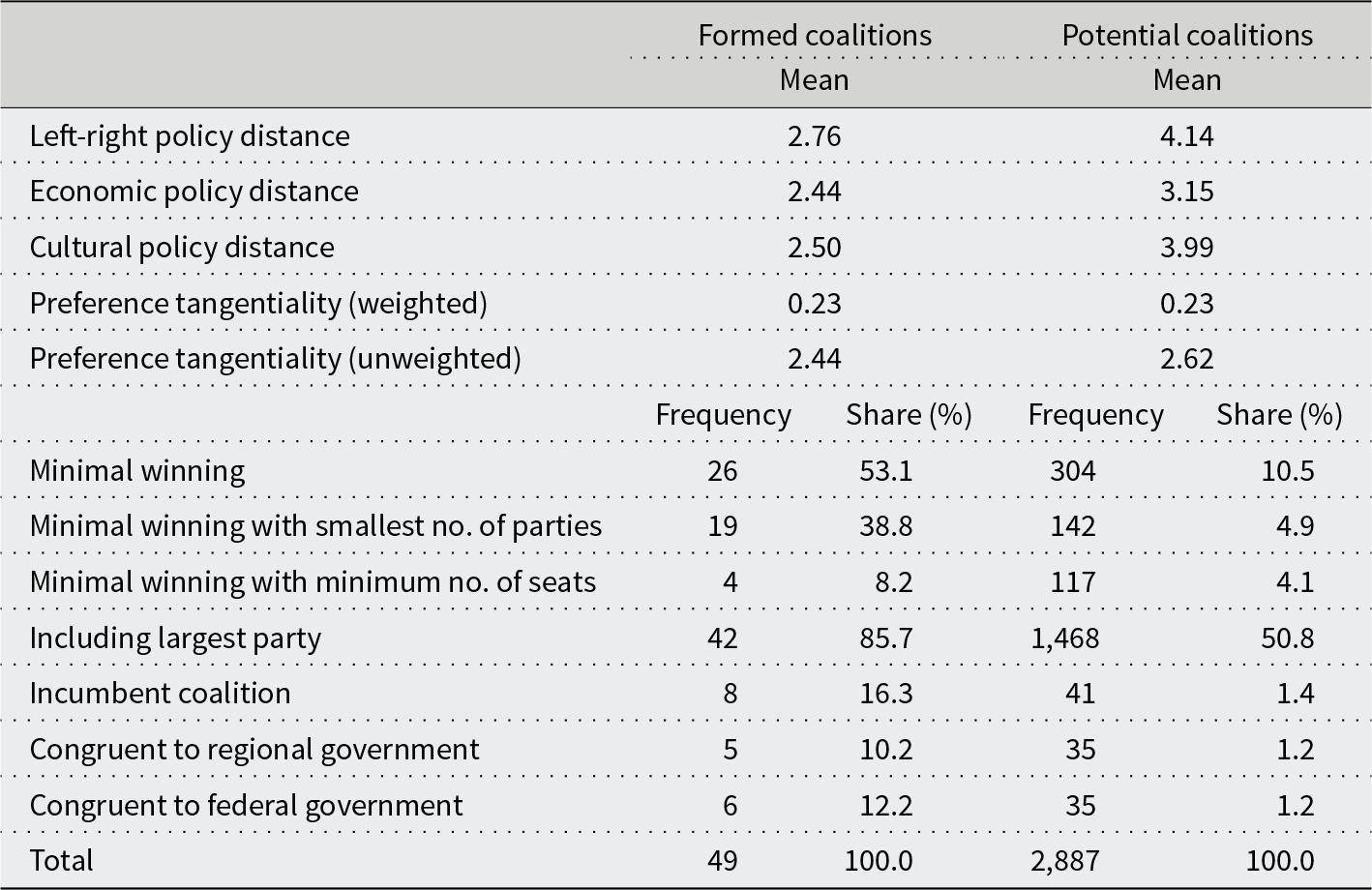
Table 1 provides an overview of the characteristics of the 49 actually formed and 2,887 potential coalitions in our dataset. The descriptive findings lend tentative support for H1 but not for H2: actually formed coalitions have a considerably lower policy distance than potential coalitions. However, we do not see any differences regarding the preference tangentiality between formed and potential coalitions. A first look at the office-seeking, contextual and institutional factors shows that minimal winning coalitions – particularly if comprising the smallest number of parties – seem to be a very attractive option for local political actors in Flanders: their share of actually formed coalitions is much higher than their share of potential coalitions. This is also the case for the incumbent coalition and coalitions that are congruent to the regional or the federal government, which are all approximately 11 times more likely to be formed than if compared to their share of potential coalitions.
Characteristics of Actually Formed and Potential Coalitions in 30 Flemish Municipalities, 2012–2018

Source: Own calculations.
To evaluate our hypotheses, we estimate a series of CL models to assess the impact of policy distance and preference tangentiality on local government formation in Flemish municipalities between 2012 and 2018. Important to note in this regard is that the far-right Vlaams Belang is excluded from entering any coalition in the Belgian multi-level political system through the cordon sanitaire (Olislagers and Steyvers Reference Olislagers and Steyvers2015).Footnote 3 The aim of the cordon sanitaire is to strategically cut off far-right parties – considered to be a threat to liberal democratic institutions – from resources and crucial offices with decision-making competencies, since excluding far-right parties from government or parliamentary decision-making restricts their power (see Akkerman and Rooduijn Reference Akkerman and Rooduijn2015). Although the cordon sanitaire is grounded in ideological considerations, it has developed into an institutional exclusion rule that overrides policy distance. Consequently, all model estimations are presented in two different ways: the first estimation always includes Vlaams Belang in the number of potential coalitions, whereas the second estimation excludes Vlaams Belang from all potential coalitions, thus following the suggestion by Irina Stefuriuc (Reference Stefuriuc2013) on how to deal with parties that are excluded from the coalition game by other political actors.
Additionally, we checked our models for multi-collinearity issues. The correlation matrix heatmaps for office- and policy-seeking variables (see Figures A1 and A2 in the Supplementary Material) demonstrate, first, that the independent variables MWC with the smallest number of parties and MWC with the smallest number of seats strongly correlate with the variable capturing minimal winning coalitions. This is not surprising, since conceptually both minimal winning coalitions with the smallest number of parties and minimal winning coalitions with the smallest number of seats are subsets of the concept of minimal winning coalitions. Therefore, we run the following models by solely using MWC and present an alternative specification using the other two variables as a robustness check. Second, we always present two different model specifications regarding the policy-seeking variables: a one-dimensional policy space (general left-right policy distance) and a two-dimensional policy space (economic and cultural policy distances). The results of the various model estimations are presented in Table A3 in the Supplementary Material online.
Evaluating H1: policy distances
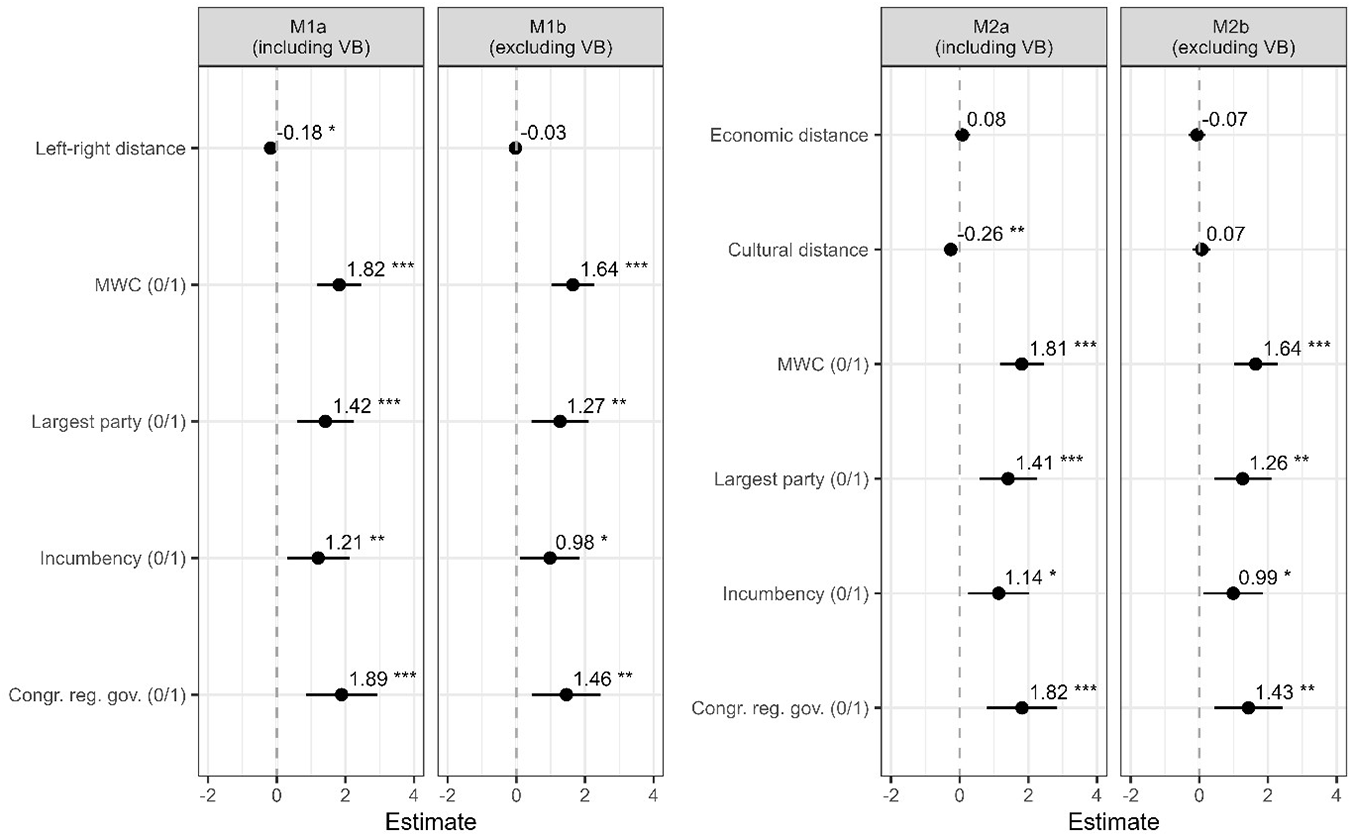
We find empirical support for our first hypothesis. Policy considerations matter for local political actors when forming local coalitions in Flanders. The coefficients of two out of three variables providing information on the veto player distance between the most extreme parties within a potential coalition have the expected negative direction and are statistically significant (see Figure 1). Hence, potential coalitions are more likely to be formed if they comprise parties that are ideologically close to each other in general left-right terms and with regards to the cultural policy positions. The economic policy distance, however, does not matter for local coalition formation in Flanders. These empirical findings on the importance of policy distances for the formation of local coalitions are in line with the results of local coalition formations in Denmark (Skjæveland et al. Reference Skjæveland, Serritzlew and Blom-Hansen2007), Germany (Debus and Gross Reference Debus and Gross2016; Gross and Debus Reference Gross and Debus2018) and Sweden (Bäck Reference Bäck2003).
Coefficient Estimates for Testing H1

Regarding the inclusion or exclusion of potential coalitions with Vlaams Belang, we do not see any substantial changes in the positive and statistically significant effects of office-seeking and institutional factors on the likelihood of potential coalitions being formed. In other words, potential coalitions are more likely if they are minimal winning coalitions, if they include the largest party, if they are the incumbent coalition, and if they are congruent to the regional government. These results are in line with previous findings on local government formation (Bäck Reference Bäck2003; Debus and Gross Reference Debus and Gross2016; Gross and Debus Reference Gross and Debus2018; Olislagers and Steyvers Reference Olislagers and Steyvers2015; Otjes Reference Otjes2024; Skjæveland et al. Reference Skjæveland, Serritzlew and Blom-Hansen2007).
Nonetheless, the exclusion of Vlaams Belang from potential coalitions – the maintenance of the cordon sanitaire – demonstrates that policy distances between potential coalition partners do not play a statistically significant role anymore (see Models 1b and 2b in Figure 1). On the one hand, this demonstrates the effectiveness of the cordon sanitaire in keeping the far-right party out of government at all political levels (see the still positive and statistically significant effect of Congruence to regional government). On the other hand, these results indicate that local political actors in Flanders – at least in 2012 and 2018 – were not concerned about ideological proximity when forming coalitions. In fact, this pattern not only applies to cooperation between parties within the liberal-democratic scope but, to some extent, also to the exclusion of Vlaams Belang, as the cordon sanitaire extends beyond policy distance.
Evaluating H2: preference tangentiality
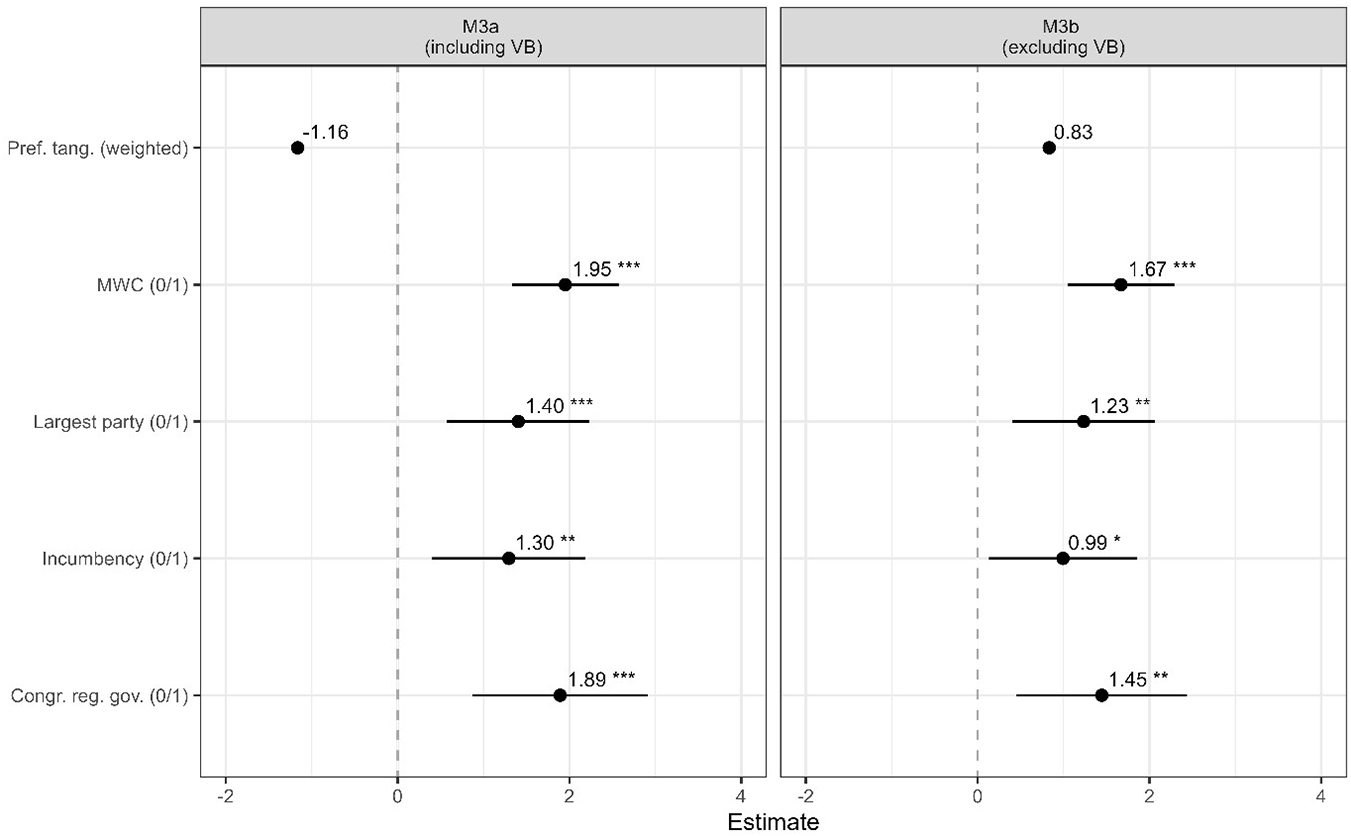
Office-seeking, institutional and contextual factors still display their positive effects on the likelihood of potential coalitions to be formed, even when focusing on local political actors’ preference tangentiality instead of their policy positions (see Figure 2). However, regarding our second hypothesis, we do not find empirical support for our theoretical expectation that preference tangentiality alone matters for local political actors when forming coalitions in Flanders. The respective coefficient of Preference tangentiality (weighted) does not reach conventional levels of statistical significance, and even changes its sign when excluding all potential coalitions with Vlaams Belang. Even though the coefficient is not statistically significant at conventional levels in Model 3a, the negative estimated coefficient is in line with recent findings on national government formation in Western Europe, showing that ‘greater tangentiality reduces the probability that a potential coalition forms’ (Dumont et al. Reference Dumont, Falcó-Gimeno, Indridason and Bischof2024: 73; emphasis in original).
Coefficient Estimates for Testing H2

Evaluating H3: the interaction between policy distances and preference tangentiality
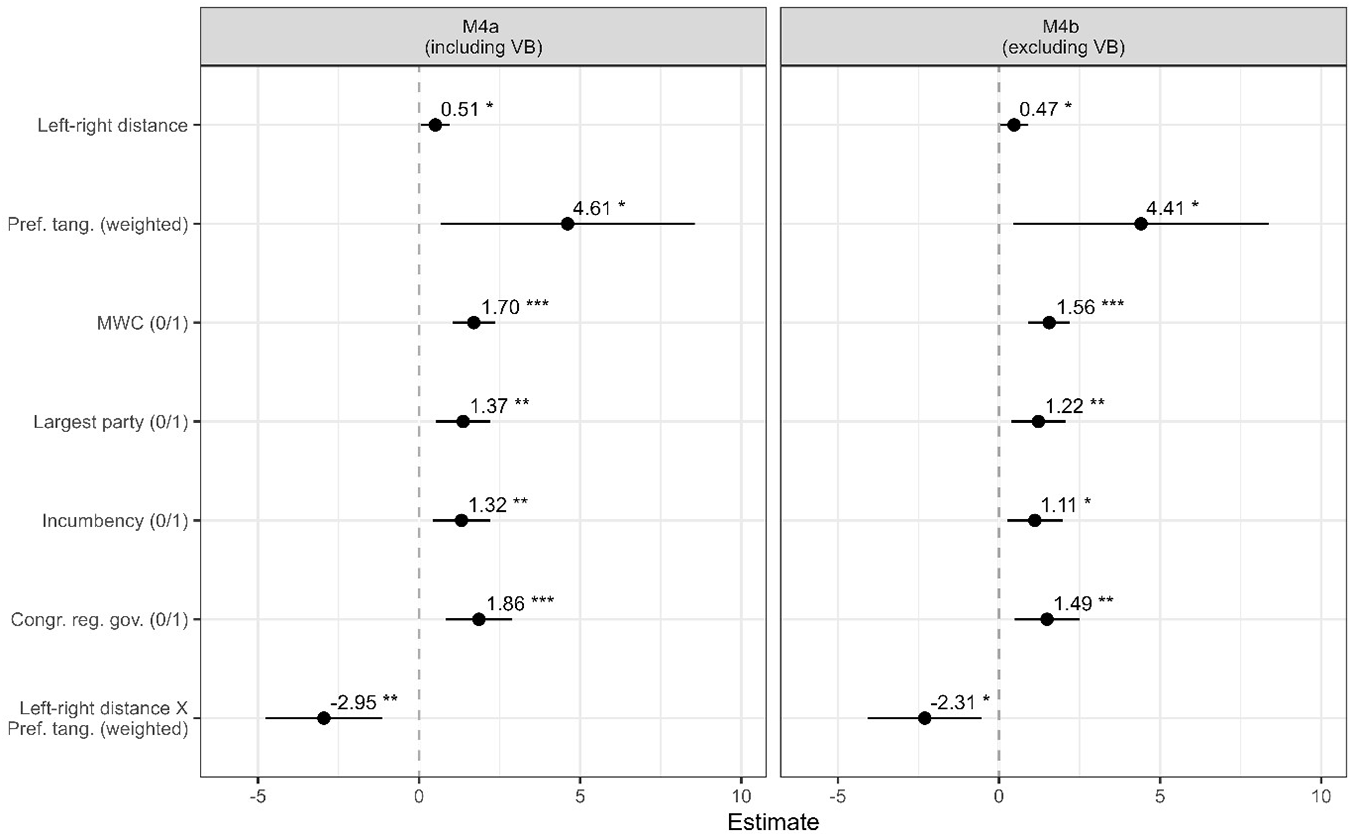
In line with the study by Dumont et al. (Reference Dumont, Falcó-Gimeno, Indridason and Bischof2024), we interact the policy range of potential coalitions with the measurement of local political actors’ preference tangentiality to evaluate our two conflicting hypotheses H3a and H3b. The estimated coefficients presented in Figure 3 demonstrate that preference tangentiality does matter for coalition formation at the local level in Flanders, but only in combination with the left-right policy distance of potential coalitions. The coefficient of the interaction effect is negative and statistically significant. This remains the case regardless of the inclusion (Model 4a) or exclusion (Model 4b) of Vlaams Belang in the set of potential coalitions.
Coefficient Estimates for Testing H3

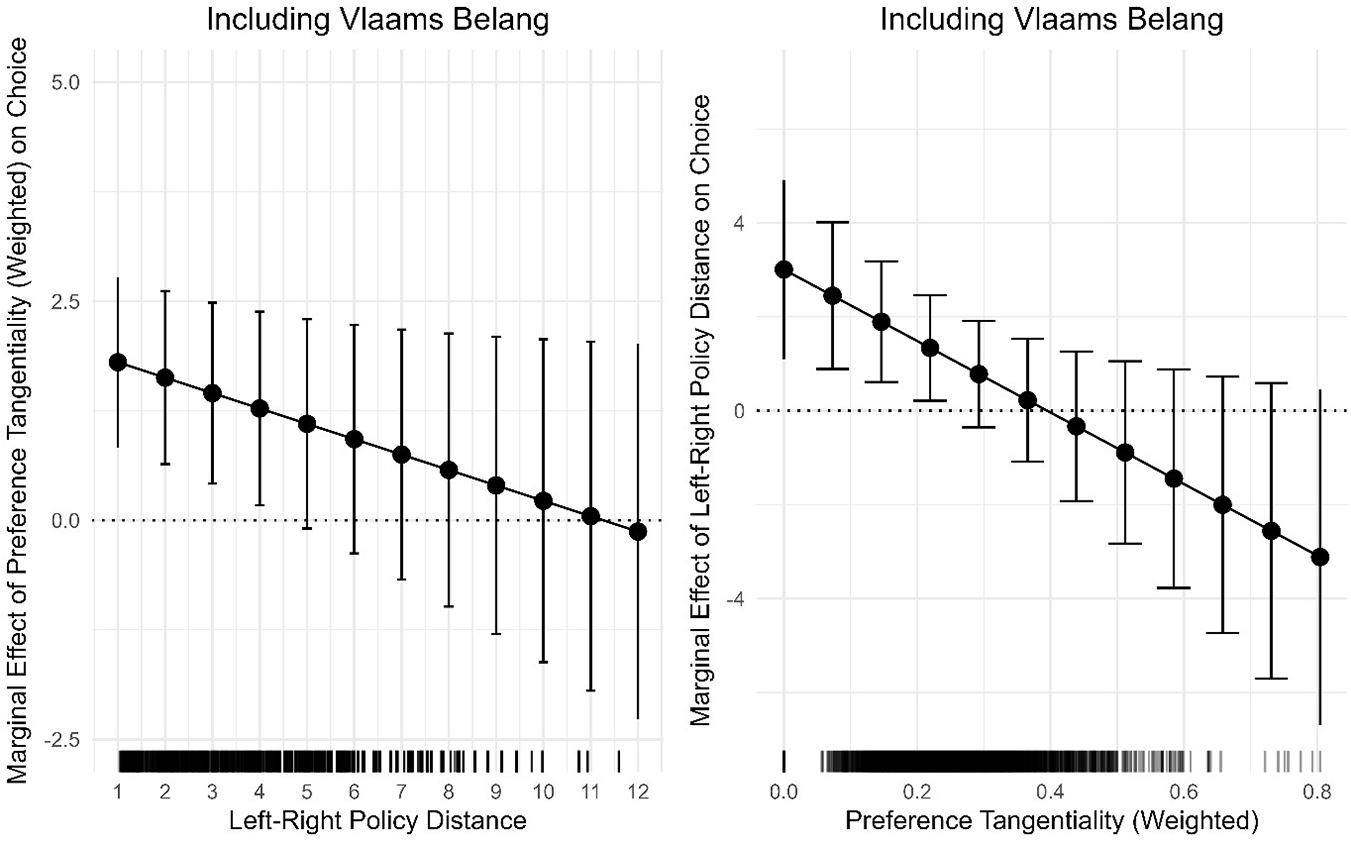
To illustrate this effect better, Figure 4 displays the marginal effects of preference tangentiality on the dependent variable when taking the left-right policy distance between potential coalition partners into account. As can be seen in the left panel of Figure 4, the effect of preference tangentiality is only statistically significant when the ideological distance between potential coalition partners is small. In line with Luebbert’s (Reference Luebbert1986: 62–64) original argument (but counter to the national-level findings by Dumont et al. Reference Dumont, Falcó-Gimeno, Indridason and Bischof2024), amongst ideologically homogenous potential coalitions, those displaying greater levels of preference tangentiality are more likely to be formed. However, this positive effect of preference tangentiality declines as the ideological distance within potential coalitions increases. Around the mean of the left-right policy distance of potential coalitions (4.14; see Table 1), the interaction effect becomes statistically insignificant. Note that 1,508 out of 2,887 potential coalitions are below the mean of left-right policy distance, thus indicating that a statistically significant effect exists for slightly more than half the observations. This fact notwithstanding, the results lend support to H3b.
Conditional Marginal Effect of Weighted Preference Tangentiality (95% CI) and Left-right Policy Distance – Including Vlaams Belang

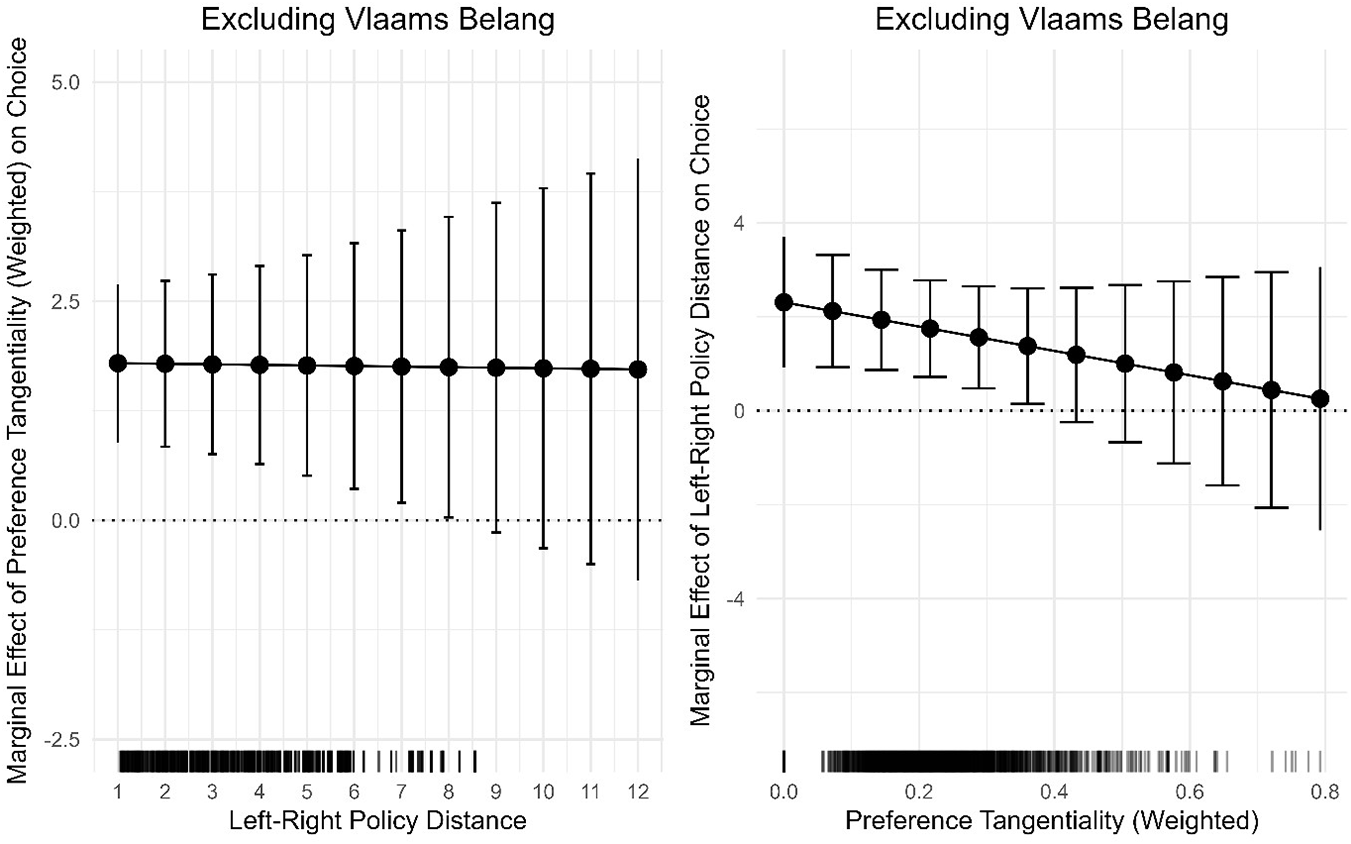
When Vlaams Belang is excluded from all potential coalitions, the positive effect of preference tangentiality on choosing a potential coalition remains more or less the same across most of the empirically observed range of left-right policy distances (see left panel in Figure 5). Note, however, that by excluding Vlaams Belang, the other parties are more willing (or more pressured) to accept a larger left-right policy distance within potential coalitions. The interaction becomes statistically insignificant at a policy distance of between 8 and 9, which is twice the mean left-right policy distance in our sample. Therefore, the institutionalized exclusion rule (the cordon sanitaire) displays a large effect on how local political actors in Flanders behave when forming coalitions.
Conditional Marginal Effect of Weighted Preference Tangentiality (95% CI) and Left-right Policy Distance – excluding Vlaams Belang

Robustness checks
We conducted several robustness checks (see Figures A3–A8 in the Supplementary Material). We re-ran the models using the minimal winning coalitions with the smallest number of parties and smallest number of seats instead of the variable minimal winning coalitions. This showed that local political actors in Flanders want to form minimal winning coalitions with the smallest number of parties instead of minimal winning coalitions with the smallest number of seats. Furthermore, we re-ran the models by including the variable Congruence to federal government instead of the variable Congruence to regional government. The alternative specification similarly displays a positive and statistically significant coefficient. Additionally, we ran models including Preference tangentiality (unweighted) instead of Preference tangentiality (weighted), as proposed by Falcó-Gimeno (Reference Falcó-Gimeno2014). This alternative specification does not substantially change the estimated results either. In all cases, our empirical findings are robust to these alternative specifications.
Conclusion
Empirical analyses investigating the factors influencing the formation of subnational governments at the regional and local levels have gained prominence since the 2000s. Particularly in recent years, various studies on government formation have taken up the early theoretical arguments put forward by Luebbert (Reference Luebbert1986: 62–64), suggesting that parties emphasizing different policy issues may actually be the most compatible partners in government because they can grant each other policy-making autonomy in the areas they consider most important (see e.g. Dumont et al. Reference Dumont, Falcó-Gimeno, Indridason and Bischof2024; Falcó-Gimeno Reference Falcó-Gimeno2014). We contribute to this literature in two ways: first, we transfer theoretical arguments and empirical findings about the effect of political actors’ preference tangentiality from the national to the local level for the first time; and second, we examine whether the combination of political ideology and preference tangentiality drove the choice for coalition partners in 30 municipalities in Flanders after the 2012 and 2018 local elections.
Our results demonstrate that Flemish political actors do not only aim to maximize their share of local offices but also seek policy coherence. The smaller the ideological distance on the general left-right and cultural policy dimension between the coalition partners, the more likely it is that potential coalitions will form. At the same time, however, the peculiarity of politics in Belgium is also apparent at the local level: enforcing the cordon sanitaire – the exclusion of any cooperation with the far-right Vlaams Belang – results in the diminishing effect of ideological proximity between potential coalition partners. Restricting the analysis to liberal-democratic parties eliminates the impact of policy distance, indicating that this institutionalized exclusion rule – rather than general policy-seeking behaviour – accounts for the observed results. This contrasts with previous research – often also conducted in most-likely contexts with high levels of local party system nationalization – showing that left-right ideology plays an important role in municipal coalition formation (Bäck Reference Bäck2003; Debus and Gross Reference Debus and Gross2016; Gross Reference Gross2023; Gross and Debus Reference Gross and Debus2018; Laver et al. Reference Laver, Rallings and Thrasher1998; Otjes Reference Otjes2024; Skjæveland et al. Reference Skjæveland, Serritzlew and Blom-Hansen2007). This article demonstrates that the explanatory power of coalition theories is country-sensitive, and may even be rather low in what we deemed to be a most likely context. Future studies into policy-driven local coalition formation should therefore devote more attention to the mediating role of exclusion rules for anti-system parties.
Nonetheless, policy-seeking does matter, albeit in another way. We argued that a potential coalition is more likely to form, the higher the tangentiality of the parties’ issue emphasis. Although we do not find empirical support for a direct effect – consistent with previous research (Dumont et al. Reference Dumont, Falcó-Gimeno, Indridason and Bischof2024) – coalition formation in Flanders is affected by tangentiality through an interaction with policy distance. In line with Luebbert’s argument (Reference Luebbert1986: 62–64), tangentiality matters more when parties are ideologically similar: by claiming certain policy issues and leaving others aside, they are able to differentiate themselves from their coalition partners. This interaction still holds when excluding all potential coalitions involving the Vlaams Belang.
Our results on the interaction between policy distance and preference tangentiality run counter to the findings of the study by Dumont et al. (Reference Dumont, Falcó-Gimeno, Indridason and Bischof2024), whose analysis of national government formations did find an interaction effect between tangentiality and policy distance, but in the opposite direction. It remains uncertain whether our divergent findings are attributable to the local level as such, the Flemish context, or the particular years examined. In any case, this shows the need for more research into the puzzling role of issue salience in coalition formation.
First, we need more empirical analyses on the interaction between policy positions and preference tangentiality in local government formation. Our study can be a starting point for such an endeavour. Second, future research could further refine the operationalization of preference tangentiality. To classify the policy issues, our study closely followed the CAP coding scheme. Alternative categorizations of policy areas that fit better with the portfolios in local executives or tap into the issue classification in the minds of local elites would be an improvement. It would, however, be extremely challenging in a large-N study.
Lastly, follow-up research could take municipal variation into account, such as the effective number of parties and population size, as these variables can influence local political competition and cooperation (Tsagkroni and Veenendaal Reference Tsagkroni and Veenendaal2024). Furthermore, scholars could also focus on municipalities’ financial situations. Prioritizing very different issues becomes a challenge when a coalition has scarce resources to distribute. As shown in the United States, local politicians understand that budgetary considerations are an important factor when deciding how much attention to give to certain issues on the local policy agenda (Liu et al. Reference Liu, Lindquist, Vedlitz and Vincent2010: 80). Given that most policies require funds, the extent to which parties can logroll is curbed by the budgets of municipal governments (Mortensen and Seeberg Reference Mortensen and Seeberg2016). Analysing how far this behaviour can also be observed in the Flemish municipalities with their many coalitions and varying party system sizes is a worthwhile endeavour for future studies.
Supplementary material
The supplementary material for this article can be found at https://doi.org/10.1017/gov.2026.10036.
Acknowledgements
The authors would like to thank the editors and reviewers for the valuable comments and smooth publication process. The authors are also very grateful to the participants of the 2024 LoPaPol Workshop, the Annual Political Science Workshops of the Low Countries, and the Local Government and Politics EUROLOC Summer School for their insightful feedback on an earlier draft of this article.
Disclosure statement
The authors report that there are no competing interests to declare.


 Open access

