




Introduction
The management of waste and its environmental impacts are among the most pressing challenges of our time, particularly given the growing human population and its consumption (Ang & Yin Reference Ang and Yin2025). Landfills serve as concentration points for both biodegradable and persistent materials. The biodegradable fraction undergoes primary decomposition under anaerobic conditions, yielding methane and carbon dioxide. The emission rates of these gases are governed by the phase of the landfill, its moisture content and the composition of the microbial community (Hilger & Barlaz Reference Hilger, Barlaz, Hurst, Crawford, Garland, Lipson, Mills and Stetzenbach2007, Stamps et al. Reference Stamps, Lyles, Suflita, Masoner, Cozzarelli, Kolpin and Stevenson2016, Njoku et al. Reference Njoku, Piketh, Makungo and Edokpayi2025). Conversely, the presence of plastics, metals and other non-biodegradable materials has been shown to lead to increased deposition of mass, resulting in alterations to the redox and moisture regimes that influence overall degradation dynamics. Consequently, landfills become long-term environmental hotspots that contribute to soil, water and air pollution. Additionally, they present management challenges related to greenhouse gas mitigation and biogas utilization (Vaverková & Koda Reference Vaverková and Koda2023, Gavrila et al. Reference Gavrila, Vasile, Calinescu, Constantin, Tanase and Cirstea2025).
Concurrently, these sites are evolving into novel habitats shaped by distinctly anthropogenic environmental conditions. The vegetation present in landfill sites is indicative of the site-specific abiotic pressures to which it is exposed, such as leachate seepage and altered soils. These pressures give rise to characteristic successional pathways, as evidenced by numerous studies (Winkler et al. Reference Winkler, Koda, Skutnik, Černý, Adamcová, Podlasek and Vaverková2021, Popovych et al. Reference Popovych, Bosak, Skyba and Popovych2024, Skrobala et al. Reference Skrobala, Skyba and Popovych2024, Winkler et al. Reference Winkler, Vaverková and Koda2024, Zhou et al. Reference Zhou, Tian, Sun, Chen, Luo and Tang2024). Invasive and synanthropic taxa frequently dominate, with potential consequences for native community composition and adjacent ecosystems.
Because vegetation on waste-derived substrates develops under persistent disturbance and altered edaphic regimes, it often forms predictable disturbance-adapted assemblages. Although most existing studies in this area address waste-management technologies and vegetation succession separately, this Perspective highlights the need to consider them jointly and articulates conceptual linkages between these domains. By examining both composting and vegetation development in landfill settings, we outline how waste-management practices shape emerging ecological patterns. We discuss key environmental risks in waste-derived habitats, including invasive species spread and vegetation contamination, and we emphasize synanthropic flora as practical indicators of anthropogenic change. These insights support ecologically informed waste-management strategies that mitigate biodiversity risks while strengthening early warning approaches to ecosystem transformation.
The objective of this Perspective is to provide: (1) an overview of interactions between composting and vegetation management; (2) an overview of interactions between landfilling and vegetation management; and (3) a synthesis of vegetation responses to waste-management stressors, with practitioner and research guidance for steering species composition.
Anthropocene framing used in this Perspective
The term ‘Anthropocene’ denotes an epoch characterized by human domination, exhibiting distinct functional and stratigraphic characteristics from the Holocene epoch. This distinction is marked by the presence of enduring technogenic signals in both sediments and biota. Within this paradigm, waste-derived ecosystems function as model systems due to their unique combination of clearly stratified anthropogenic substrates and predictable synanthropic vegetation trajectories. This Perspective operationalizes the framing by linking vegetation indicators to management actions in composting and landfill aftercare.
Vegetation impacts of composting systems
During the twentieth century, the global human population experienced an unprecedented growth rate (Lam Reference Lam2025), which directly amplified the production of waste, including food, kitchen, garden and plant residues, as well as animal manure (Wei et al. Reference Wei, Wang, Lin, Zhan, Ding and Liu2021). Organic wastes have typically been treated by landfilling and incineration, which are costly and provide little exportable energy due to their high moisture content and low calorific value (Xin et al. Reference Xin, Li, Bi, Yan, Wang and Wu2020). The exploration of alternative applications for organic materials has given rise to more environmentally sustainable methods, such as composting (Wei et al. Reference Wei, Li, Shi, Liu, Zhao and Shimaoka2017, Saqib & Sadef Reference Saqib and Sadef2025). Composting is an organic waste recycling method based on the biodegradation of organic matter under aerobic conditions to produce stabilized and sanitized compost (Chorolque et al. Reference Chorolque, Pellejero, Sosa, Palacios, Aschkar, García-Delgado and Jiménez-Ballesta2022, Saqib & Sadef Reference Saqib and Sadef2025). The advantages and disadvantages of composting have been well explored (Zhou et al. Reference Zhou, Xiao, Klammsteiner, Kong, Yan and Mihai2022, Yıldırım Reference Yıldırım2025).
During the composting process, environmental problems can arise, including odorous or toxic gases (Wei et al. Reference Wei, Li, Shi, Liu, Zhao and Shimaoka2017, Elsabbagh et al. Reference Elsabbagh, Sibak, El-Sheltawy and El-Shimi2025), bioaerosols (Ferguson et al. Reference Ferguson, Neath, Nasir, Garcia-Alcega, Tyrrel and Coulon2021, Lu et al. Reference Lu, Zhang, Li and Li2025) and dust (Schlosser et al. Reference Schlosser, Robert, Debeaupuis and Huyard2018), which can create occupational and community nuisance risks (Elsabbagh et al. Reference Elsabbagh, Sibak, El-Sheltawy and El-Shimi2025). Reported outcomes include respiratory and mucosal irritation, allergic responses and infection susceptibility linked to airborne microorganisms, endotoxins, volatile organic compounds and particulate matter (Ferguson et al. Reference Ferguson, Neath, Nasir, Garcia-Alcega, Tyrrel and Coulon2021, Lu et al. Reference Lu, Zhang, Li and Li2025). This is particularly relevant for open-air composting facilities. Biowaste and composting have been studied from different perspectives, and several studies have focused on environmental issues using life cycle analysis methods (Zhou et al. Reference Zhou, Xiao, Klammsteiner, Kong, Yan and Mihai2022) and greenhouse gases accounting and composition (Chen et al. Reference Chen, Huang, Liu, Xie and Abbas2019). In addition to gaseous emissions, composting systems can also produce nutrient-rich leachate with a high organic load, which may require further biological treatment to mitigate its environmental impacts (Tahsini et al. Reference Tahsini, Nikaeen and Nafez2024). Certain management practices, such as leachate reuse in kitchen-waste composting, may contribute to nitrous oxide emissions, adding complexity to greenhouse gas mitigation efforts (Chen et al. Reference Chen, Zhang, Li and Guo2023).
Other risks include the import of biowaste, which contains plant diaspores that can alter the composition of local vegetation species (Winkler et al. Reference Winkler, Koda, Skutnik, Černý, Adamcová, Podlasek and Vaverková2021). Composting facilities have the potential to serve as sites for the dissemination of invasive plant species due to the presence of viable propagules, such as seeds, rhizomes or tubers, in biowaste. These propagules can withstand the conditions associated with improper or incomplete composting processes (Winkler et al. Reference Winkler, Matsui, Filla, Vykydalová, Jiroušek and Vaverková2023).
Given the increasing use of composting to treat the organic fraction of municipal solid waste, large-scale industrial facilities play a critical role in ensuring effective sanitization and preventing the spread of invasive species. Proper management of industrial composting has been demonstrated to effectively neutralize the reproductive potential of numerous invasive species (Tomše et al. Reference Tomše, Resnik, Gorjan and Krajšek2025). However, inadequate temperature maintenance, uneven aeration, insufficient frequency of turning or shortened composting cycles may result in the failure to fully inactivate seeds or vegetative propagules, thereby allowing these species to persist and spread (Winkler et al. Reference Winkler, Matsui, Filla, Vykydalová, Jiroušek and Vaverková2023).
Vegetation response to landfill habitats
Mixed municipal waste is usually landfilled, constituting one of the most prevalent waste management methods worldwide (Wong et al. Reference Wong, Chen, Mo, Man, Ng and Wong2016, Hamid et al. Reference Hamid, Li and Grace2018, Rasapoor et al. Reference Rasapoor, Young, Asadov, Brar, Sarmah, Zhuang and Baroutian2020, Sauve & Van Acker Reference Sauve and Van Acker2020, Vaverková & Koda Reference Vaverková and Koda2023). Landfilling has several negative environmental impacts, including pollutants being released from landfilled waste and leachate. This phenomenon can result in the contamination of soil and water resources (Dąbrowska et al. Reference Dąbrowska, Witkowski and Sołtysiak2018, Koda et al. Reference Koda, Miszkowska, Sieczka and Osiński2018) and subsequent alterations in the composition, health and succession of vegetation growing on or in the vicinity of landfill sites (Iravanian & Ravari Reference Iravanian and Ravari2020, Vaverková et al. Reference Vaverková, Paleologos, Goli, Koda, Mohammad and Podlasek2025).
Depending on the type of waste, three main groups of landfills can be distinguished: (1) municipal solid waste, (2) industrial waste and (3) mixed municipal and industrial waste. Although municipal solid waste landfills are primarily characterized by organic contamination, the origin of contamination in industrial and mixed landfills is much more diverse and, in some cases, hazardous to surrounding ecosystems, particularly vegetation that is exposed to toxic substances and altered soil conditions. This is particularly evident in the context of illegal landfills that lack effective control mechanisms (Vaverková et al. Reference Vaverková, Maxianová, Winkler, Adamcová and Podlasek2019).
Landfills have been identified as a persistent environmental concern in developed countries, including in Germany and Austria (Unegg et al. Reference Unegg, Steininger, Ramsauer and Rivera-Aguilar2023, Clemente et al. Reference Clemente, Domingues, Quinta-Ferreira, Leitão and Martins2024), Ireland (Curran & O’Sullivan Reference Curran and O’Sullivan2022), France (Nicholls et al. Reference Nicholls, Beaven, Stringfellow, Monfort, Le Cozannet and Wahl2021), Italy (Folino et al. Reference Folino, Gentili, Komilis and Calabrò2024), Serbia (Tenodi et al. Reference Tenodi, Krčmar, Agbaba, Zrnić, Radenović, Ubavin and Dalmacija2020) and the USA (Wang et al. Reference Wang, Levis and Barlaz2021). This concern also extends to developing countries (Gupta et al. Reference Gupta, Verma, Rajamani, Anouzla and Souabi2024, Rai et al. Reference Rai, Gurung, Sharma, Ranjan and Cheela2024, Hussain et al. Reference Hussain, Deshwal, Priyadarshi, Pathak, Sambandam, Chand and Shukla2025). Despite the success of methane capture and utilization systems in several countries – including the US Landfill Methane Outreach Program (LMOP), which has enhanced methane recovery efficiency and reduced emissions (Themelis & Bourtsalas Reference Themelis and Bourtsalas2021) – the deployment and performance of such systems exhibit significant variation worldwide. A significant number of landfills, particularly in low- and middle-income regions, continue to operate without the implementation of effective gas control measures. This has led to the persistent release of greenhouse gases and subsequent ecological consequences.
Potentially important signals include the presence of carbonaceous particles in fly ash (Rose Reference Rose2015), plastic residues (Zalasiewicz et al. Reference Zalasiewicz, Waters, Do Sul, Corcoran, Barnosky and Cearreta2016), other technofossils (Zalasiewicz et al. Reference Zalasiewicz, Waters, Do Sul, Corcoran, Barnosky and Cearreta2016, Wagreich et al. Reference Wagreich, Meszar, Lappé, Wolf, Mosser and Hornek2023) and artificial radionuclides (Wagreich et al. Reference Wagreich, Meszar, Lappé, Wolf, Mosser and Hornek2023).
Landfill leachate is a serious potential source of surface and groundwater pollution in the affected area, especially in the case of illegal/non-sanitary landfills that do not have an insulating layer between the deposited waste and the underlying soil. Leachate characteristics depend on factors such as waste composition, decomposition stage and local hydrological and climatic conditions. Metals commonly detected in landfill leachate include As, Cd, Cr, Hg, Cu, Zn and Pb, with concentrations often being greater during early leachate formation because acidification driven by organic acid production during hydrolysis and microbial degradation enhances metal mobilization (Podlasek Reference Podlasek2023, Jakovljević et al. Reference Jakovljević, Mišljenović, Ranđelović and VC2024). Many of these changes leave a durable signal in the stratigraphic record (Waters et al. Reference Waters, Zalasiewicz, Summerhayes, Barnosky, Poirier and Gałuszka2016). An investigation was conducted on soil quality and metal content at 56 sanitary and non-sanitary landfills in China. The investigation revealed that Cr was the dominant metallic pollutant, with a Nemero pollution index ranging from 22.7 to 44.3, indicating an extremely high level of contamination (Wang et al. Reference Wang, Han, Wang, He, Zhou and Hu2022). A number of atypical/ruderal species can be found in areas where landfills are located.
Vegetation growing on landfills evolves over time, and the species composition gradually changes. In the early years following landfill reclamation, differences in plant communities can be observed across various sections of the landfill body. After c. 20 years, a noticeable decline in native and wetland species occurs, whereas drought-tolerant and neophytic taxa become more dominant (Winkler et al. Reference Winkler, Koda, Skutnik, Černý, Adamcová, Podlasek and Vaverková2021, Koda et al. Reference Koda, Winkler, Wowkonowicz, Černý, Kiersnowska, Pasternak and Vaverková2022, Vaverková et al. Reference Vaverková, Paleologos, Goli, Koda, Mohammad and Podlasek2025). The unique and often stressful conditions of landfills contribute to the development of specific plant assemblages. Invasive neophytes (i.e., invasive alien species that arrived in Europe after 1500 CE; Kowalska & Kołaczkowska Reference Kowalska and Kołaczkowska2024), such as Acer negundo L., Solidago canadensis L., Conyza canadensis (L.) Cronquist, Erigeron annuus (L.) Desf., Galinsoga parviflora Cav., Iva xanthiifolia Nutt., Reynoutria sachalinensis (F. Schmidt) Nakai and Robinia pseudoacacia L., tend to be highly represented. In addition, many widespread ruderal species capable of colonizing agricultural areas and other anthropogenic habitats, such as Artemisia vulgaris L., Calamagrostis epigejos (L.) Roth, Elymus repens (L.) Gould, Tanacetum vulgare L. and Oenothera biennis L., tend to be highly represented in Europe (Pyšek et al. Reference Pyšek, Sádlo, Chrtek, Chytrý, Kaplan and Pergl2022). Collectively, these patterns indicate a synanthropic flora characteristic of landfill habitats (Winkler et al. Reference Winkler, Koda, Skutnik, Černý, Adamcová, Podlasek and Vaverková2021) and a consistent trajectory of synanthropic succession shaped by human activities. In this trajectory, the vegetation dynamics are dominated by human-associated (ruderal and invasive) species that progressively replace native or wetland taxa under disturbed conditions.
Positive functional roles of spontaneous vegetation
Spontaneous vegetation has been shown to deliver near-term functional benefits in landfill environments, in parallel with invasion risks (Wong et al. Reference Wong, Chen, Mo, Man, Ng and Wong2016, Winkler et al. Reference Winkler, Koda, Skutnik, Černý, Adamcová, Podlasek and Vaverková2021, Koda et al. Reference Koda, Winkler, Wowkonowicz, Černý, Kiersnowska, Pasternak and Vaverková2022). The aforementioned benefits include: improved soil cover, which serves to reduce erosion; initial slope stabilization on heterogeneous caps; accumulation of organic matter, which supports soil profile development; and microhabitat provisioning for selected invertebrate groups during early succession (Wong et al. Reference Wong, Chen, Mo, Man, Ng and Wong2016, Jakovljević et al. Reference Jakovljević, Mišljenović, Ranđelović and VC2024, Zhou et al. Reference Zhou, Tian, Sun, Chen, Luo and Tang2024). The recognition of these functions facilitates a management approach that is proportionate and context-dependent. The strategic management of high-risk invasive species should be integrated with the preservation of non-problematic assemblages that safeguard the soil, promote ecosystem integrity and facilitate ecosystem maturation (Winkler et al. Reference Winkler, Koda, Skutnik, Černý, Adamcová, Podlasek and Vaverková2021, Zhou et al. Reference Zhou, Tian, Sun, Chen, Luo and Tang2024).
Vegetation management in composting and landfill ecosystems
At composting facilities, vegetation monitoring and control are critical to mitigating ecological risks. Biowaste inputs can introduce viable propagules. If composting is incomplete, invasive species may disseminate into the surrounding environment (Winkler et al. Reference Winkler, Matsui, Filla, Vykydalová, Jiroušek and Vaverková2023, Tomše et al. Reference Tomše, Resnik, Gorjan and Krajšek2025). Failure to address these issues may initiate a cascade of effects, alter species composition and destabilize local biodiversity. Composting facilities underscore the imperative for adopting ecologically sensitive waste management strategies that balance technological advancement with the protection of natural ecosystems.
In the context of landfill ecosystems, the vegetation exhibits characteristics that deviate significantly from those observed in natural, agricultural and urbanized environments (Winkler et al. Reference Winkler, Koda, Skutnik, Černý, Adamcová, Podlasek and Vaverková2021, Koda et al. Reference Koda, Winkler, Wowkonowicz, Černý, Kiersnowska, Pasternak and Vaverková2022, Vaverková et al. Reference Vaverková, Paleologos, Goli, Koda, Mohammad and Podlasek2025). It is crucial for management strategies to acknowledge that practices such as fertilization, fruit tree planting or agricultural utilization of landfill areas are often ill-advised. Soil constraints have been demonstrated to impede the successful establishment of new plantings, whereas nutrient enrichment has been shown to favour competitively strong species and to impede succession. Given the frequent dominance of high-risk neophytes, management should prioritize containment and targeted control to reduce propagule export to adjacent ecosystems.
Although synanthropic and invasive species frequently dominate and can threaten adjacent ecosystems, spontaneous vegetation also contributes structural habitat, soil protection and early productivity. Management should therefore be proportionate and succession informed. Intensive landscaping, fertilization or agricultural planting on landfill bodies can disrupt developing soil profiles and favour competitively strong species with undesirable spread. We recommend three principles: (1) prioritize selective removal of demonstrably problematic taxa while retaining soil-protective assemblages; (2) reduce disturbance to caps and cover soils to avoid reset of succession; and (3) align vegetation control windows with propagule phenology to limit dispersal pressure. Plant-based indicators, combined with simple geochemical screening, enable the early detection of leachate seepage and other pressure gradients.
Environmental context of landfills and the development of vegetation
Vegetation on technogenic substrates develops under persistent anthropogenic pressures, providing a useful system for linking vegetation patterns with waste-site gradients (Fig. 1). The transformation of flora and vegetation in landfills is a critical issue in modern ecology, one that is closely linked to human-induced pressures such as waste leachate seepage, soil salinization and pollutant exposure. For instance, sites exhibiting leachate seepage undergo alterations in plant species composition, characterized by an increase in halophytes and a decline in glycophytes (Koda et al. Reference Koda, Winkler, Wowkonowicz, Černý, Kiersnowska, Pasternak and Vaverková2022). These shifts can function as early indicators of environmental degradation. These factors often trigger secondary autogenic succession, which enables the establishment of non-native or synanthropic plant species that can disrupt native plant communities and accelerate ecological change (Chu & Karr Reference Chu, Karr and SA2013, Rai & Singh Reference Rai and Singh2020, Kim et al. Reference Kim, Choi and Song2021, Vinogradova et al. Reference Vinogradova, Tokhtar, Notov, Mayorov and Danilova2021). Landfill habitats are inherently disturbed environments, and synanthropic succession is especially pronounced in these locations, facilitating phytoinvasion processes (Philippova et al. Reference Philippova, Stroiteleva and Gura2025) that can threaten biodiversity and long-term ecological resilience (Konishchuk et al. Reference Konishchuk, Solomakha, Mudrak, Mudrak and Khodyn2020, Senator et al. Reference Senator, Tretyakova and Vorontsov2020), constituting a global environmental challenge (Philippova et al. Reference Philippova, Stroiteleva and Gura2025).
Interactions between landfilling processes, waste accumulation and vegetation development: (a) demolition and construction waste; (b) vegetation colonizing a landfill body; and (c) municipal solid waste. Field photographs; no scale bars. Photo source: Vaverková (2024).
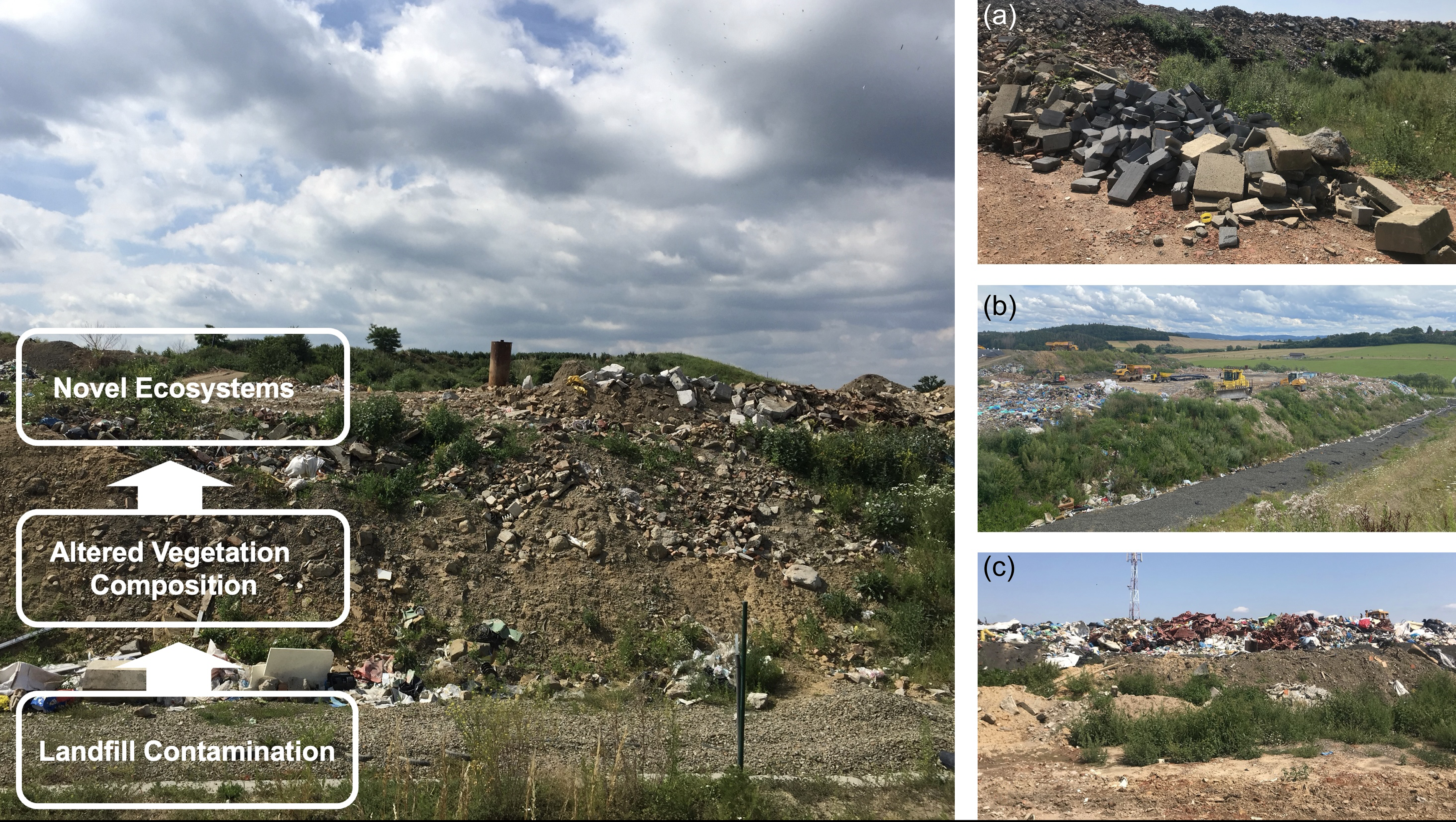
Landfill ecosystems are characterized by vegetation dominated by disturbance-tolerant and invasive taxa, shaped by layered technogenic deposits and chronic exposure to waste-derived stressors. Synanthropic vegetation can pose risks to adjacent ecosystems through propagule pressure and community turnover, and plant tissues may also reflect contamination by hazardous substances released from waste. These deposits influence soil development and vegetation trajectories, providing a stratigraphically distinct, human-generated archive for examining Anthropocene ecological signatures. Vegetation structure and species turnover offer measurable proxies for landfill-related environmental gradients and long-term ecological shifts.
Recommendations
Vegetation-based evidence can be integrated into monitoring, permitting and after-care to improve the detection of stressors and invasion pathways in waste-derived systems. We identify several priorities to tackle these issues:
-
(1) Systematic vegetation monitoring frameworks: development of standardized, plant-based monitoring protocols for landfills and composting sites to detect early signs of ecological stress, leachate effects and invasive species. This includes standardized monitoring of the immediate vicinity of landfills and adjacent land.
-
(2) Evidence-based invasive species management: establishment of operational guidelines for preventing plant propagule escape from composting facilities and for targeted control of invasive taxa in landfills. Blanket landscaping interventions that disrupt natural succession need to be avoided.
-
(3) Succession-informed post-closure strategies: recognition of the role of spontaneous vegetation in soil stabilization and system maturation. Management interventions that support functionally robust, low-risk plant assemblages need to be designed, rather than imposing conventional planting schemes.
-
(4) Implementation pathways for policy, allowing integration of vegetation-based criteria into permitting, monitoring and after-care plans. In the European Union context, this includes: (i) aligning vegetation indicators and invasive species control with after-care obligations under Directive 1999/31/EC; (ii) fulfilling invasive species prevention and management duties under Regulation 1143/2014 by incorporating propagule-pathway controls at composting facilities and post-closure landfills; and (iii) linking biowaste acceptance and compost quality protocols to ecological outcomes near facilities, including buffer vegetation surveillance and propagule interception.
-
(5) Cross-disciplinary research on waste-ecosystem functioning: strengthening of collaboration among waste engineering, plant ecology, invasion biology and environmental geochemistry disciplines to understand waste-site gradients, plant functional traits and long-term ecosystem trajectories.
Vegetation acts as a sensitive bioindicator of anthropogenic pressures, thus offering valuable insights into the dynamics of ecosystem development. Research on the vegetation of landfills and composting facilities highlights conclusions that raise questions regarding the sustainability of waste landfilling and its hidden impacts on ecosystems. The future of the planet will depend on how we respond to these challenges. There is therefore a need to develop and implement innovative strategies for protecting and restoring ecosystems, ensuring effective waste management and finding new ways to sustainably develop human civilization.
Data availability
No data were collected for this study.
Acknowledgements
None.
Financial support
None.
Competing interests
The authors declare none.
Ethical standards
Not applicable.

 Open access

