


Introduction
How do voters react to new political actors? Following the Second World War, centre-right and centre-left parties dominated European democracies (Kitschelt Reference Kitschelt1994; Gidron and Ziblatt Reference Gidron and Ziblatt2019). New parties did not start to have a significant impact until the rise of new Green parties in the 1970s and 1980s (Rohrschneider Reference Rohrschneider1993; de Vries and Hobolt Reference de Vries and Hobolt2020). Green parties emerged from the social movements of the 1960s and 1970s, such as the 1968 student protests and anti-nuclear activism. United in their emphasis of post-material values, Green parties posed a radical alternative to established political norms and policy propositions (Inglehart Reference Inglehart1977; Kitschelt Reference Kitschelt1994; Kitschelt and McGann Reference Kitschelt and McGann1997). They were disruptive in terms of their ideology, but also due to the unconventional ways in which they organized and communicated (de Vries and Hobolt Reference de Vries and Hobolt2020).
When looking at reactions to new parties, recent research focuses mainly on the radical right. Studies have explored the impact of radical right parties (RRPs) on mainstream parties’ positions (Adams Reference Adams2012; Abou-Chadi and Krause Reference Abou-Chadi and Krause2020), turnout (Leininger and Meijers Reference Leininger and Meijers2020), and attitudes (Bischof and Wagner Reference Bischof and Wagner2019). In general, they suggest that the rise of RRPs can trigger responses by both parties and voters.
We argue these reactions are not exclusive to RRPs, but belong to a broader phenomenon of backlash against new actors who challenge the political establishment. We posit that the disruption caused by new political actors can trigger an electoral backlash from voters who perceive these parties as a challenge to the status quo. We test our argument by studying the emergence of the German Greens. While the German Greens have become part of the political establishment (see Rihoux Reference Rihoux and van Haute2016),Footnote 1 they did not start as a rule-abiding, office-seeking party (Bukow Reference Bukow and VH2016). In the 1980s, Green parties emerged in a context of societal unrest, consciously and purposefully challenging existing political norms and expectations. We study the consequences of this initial Green wave.
Empirically, we use first-differences and matched difference-in-differences designs to study the conservative backlash against the Greens’ entry into German state parliaments over a period of nearly five decades. We find that the Greens’ entry into state parliament increases Christian Democratic Union (CDU/CSU) support by 1.3 to 1.5 percentage points at the subsequent federal election. These results are robust to several model specifications and the inclusion of a range of covariates.
We also provide additional individual-level evidence on voter reactions against the Greens. We present analyses using an election survey from 1983, when the Greens first entered the federal parliament. We find that CDU/CSU voters are less likely to approve the Greens entering parliament, that they dislike them right after the election, and that CDU/CSU voters primarily dismiss the Greens’ behaviour rather than their policy positions. Using panel surveys, we also find that Green party state parliament entry increases switches to conservative party identification significantly. Finally, we probe the generalizability of our findings: using public opinion polls from twelve West European democracies, we show increases in vote intentions for centre-right parties following Green party parliamentary entry.
This article makes four main contributions. First, it adds to the literature on the emergence of new political actors. Our findings suggest that voter backlash against challenger parties is part of a broader pattern. When new parties emerge and challenge the political establishment, some voters reinforce their support for the status quo. Second, we contribute to the understanding of Green party formation and its consequences for European party systems. Third, the article also contributes to the literature on how the emergence of (radical-)left and progressive parties shapes political competition. Previous work highlights how the rise of Green parties influenced political dynamics and how new issues and positions introduced by left-leaning parties can create contagion effects, with established parties accommodating such positions (Duverger Reference Duverger1954).Footnote 2 We add to this literature by showing that there was a backlash reaction against Green parties, that this happened earlier than previously thought, and that it was not driven purely by other parties’ reactions nor policy preferences.
Finally, our article contributes to a growing body of work on reactions against pro-environmental or climate positions and policies. Climate policies can create resentment that increases support for the radical right. For example, Voeten (Reference Voeten2025) shows that, in the Netherlands, energy-sensitive voters turned away from the Greens and became more supportive of the radical right as a response to an energy transition policy that increased household energy costs. Likewise, Otteni and Weisskircher (Reference Otteni and Weisskircher2022) show that the construction of windmills in Germany increases local support for both the radical right AfD and the Greens, contributing to political polarization (see also Guber Reference Guber2013). At the party level, this polarization has also been documented. Traditionally, far-right speech conceives the environment as part of the Fatherland and an issue that is limited to the national level (Forchtner and Kolvraa Reference Forchtner and Kolvraa2015; Forchtner Reference Forchtner2019). More recently, Carter and Clements (Reference Carter and Clements2015) document how British conservatives progressively became less pro-environmental during the 2010s. This is part of a broader phenomenon where conservative forces have started to react against environmental protection and other post-materialistic values (see, for example, Norris and Inglehart Reference Norris and Inglehart2019; Dickson and Hobolt Reference Dickson and Hobolt2025). Our article provides a different and complementary contribution. Instead of looking at the stances parties take on specific issues, or how specific policies influence voter backlash, we study how the representation of new political challengers contributes to polarizing responses from voters.
Electoral Backlash against Challenger Parties
How do voters react to new political actors? Recent research on challenger parties focuses on radical right parties (RRPs). These studies show that RRPs increase voter polarization (Bischof and Wagner Reference Bischof and Wagner2019) – which implies a backlash among progressive parts of the electorate. Valentim (Reference Valentim2021, Reference Valentim2024) shows that RRP parliamentary entry changes social norms, legitimizing radical right support among voters who would otherwise prefer not to express those views.
Going beyond the consequences for voters, research shows that political parties adapt their policy positions by accommodating to RRPs (Abou-Chadi and Krause Reference Abou-Chadi and Krause2020)Footnote 3 or react against the rhetoric of RRPs (Valentim and Widmann Reference Valentim and Widmann2023). Looking at the structure of political competition more generally, challenger parties can introduce new political issues and cleavages, making establishment parties change their positions (Meguid Reference Meguid2005; Hobolt and Vries Reference Hobolt and de Vries2015). Overall, most of the existing literature on challenger parties describes reactions by mainstream parties as either policy- or norm-driven.
The notion of electoral backlash against radical challenger parties is not new. Bustikova (Reference Bustikova2014) suggests that RRPs’ success can itself be explained as a backlash against successes of minorities, a phenomenon that is also described by Ignazi (Reference Ignazi1992). Similarly, Ellger (Reference Ellger2024) shows that party system polarization and negative attitudes towards political competitors can boost turnout. We depart from these findings and posit that strong electoral reactions to new competitors should not be limited to pressure from the radical right. Backlash occurs whenever a political force challenges the political mainstream. For example, Walter (Reference Walter2021) finds that when socialist parties became a threat to conservative parties in Imperial Germany, conservative party elites forged alliances to stop the left from gaining power. We investigate backlash effects against progressive challenger parties by focusing on a European democracy, and starting in the 1980s, when political norms were much more conservative than they are today.
We argue that the emergence of a new disruptive political actor – such as the German Greens – creates a potential for electoral backlash by establishment voters. When new political actors challenge the norms and ideology of the status quo, existing parties often react by reinforcing the values and positions on which they claim ownership (see Ignazi Reference Ignazi1992; Meguid Reference Meguid2005; Bustikova Reference Bustikova2014; de Vries and Hobolt Reference de Vries and Hobolt2020). The concept of political backlash has been applied broadly, from the institutional to the individual level (for example, Mansbridge and Shames Reference Mansbridge and Shames2008; Norris and Inglehart Reference Norris and Inglehart2019, f). Our argument focuses on the electoral backlash against new parties who challenge the political establishment. We define electoral backlash as reactionary voting behaviour against a new perceived political threat. In this framework, backlash refers to the phenomenon where a set of the electorate reacts negatively to the rise of new political actors, often resulting in support for parties that uphold the status quo. This reaction is typically driven by a perceived threat to existing values, norms, or socio-economic interests. Backlash manifests as an effort by voters to reinforce the political status quo, seeking stability and continuity when fearing disruptive change brought about by new parties or movements. Importantly, this backlash is not necessarily exclusively driven by a rejection of the newcomer’s policies, but could also be the result of identity-based resistance (see Fouka Reference Fouka2019). Identity-based backlash becomes particularly relevant when new political challengers are seen as threats to existing social identities and values. The resulting response can often manifest as support for parties perceived as defenders of established identities and lifestyles.
Our conceptualization of backlash draws on a range of work in political science (see Mansbridge and Shames Reference Mansbridge and Shames2008; Fouka Reference Fouka2019; Norris and Inglehart Reference Norris and Inglehart2019). We specifically adopt the idea of Mansbridge and Shames (Reference Mansbridge and Shames2008) that backlash is not tied to any specific ideology but refers to any reaction against social or political changes by groups feeling threatened. According to Mansbridge and Shames (Reference Mansbridge and Shames2008), backlash is particularly likely to occur when dominant social groups are threatened by a loss of power or status.
As mentioned earlier, studies on backlash against new parties often focus on the rise of RRPs. Our argument implies that other disruptive parties might trigger comparable reactions. This is significant, as many new parties that emerged in twentieth-century Europe gained popularity by challenging established policies, norms, and conventions (Vries and Hobolt Reference de Vries and Hobolt2020; Walter Reference Walter2021).
We expect similar dynamics to occur when progressive challengers arise. One core contribution of this article is to apply the idea of electoral backlash to new challenger parties and focusing on Green parties. The emergence of the Greens represents one of the most significant waves of new parties in post-war Europe and is arguably the most successful party family to arise during that period (Klimke et al. Reference Klimke, Pekelder and Scharloth2011; Vries and Hobolt Reference de Vries and Hobolt2020).
The Rise of the Greens
In this section, we provide a brief historical account of the emergence and evolution of the German Greens, focusing on their distinct characteristics and organizational development. Importantly, our argument of backlash focuses on voter reactions in democratic contexts, and our empirical analyses are on German states. We therefore study backlash reactions across all West German states, as well as the East German states following German reunification in 1990.Footnote 4
The German Greens emerged from a confluence of social movements and citizen groups in West Germany. These movements were driven by the rise of post-materialist values and emphasized environmental protection, gender equality, and grassroots democracy while opposing nuclear energy and militarization (Inglehart Reference Inglehart1977; Kitschelt Reference Kitschelt1993). The Greens’ foundation in 1980 formalized their entry into party politics, adopting organizational principles and strategies from these social movements (Touraine Reference Touraine1985; Dalton Reference Dalton, Dalton and Kuechler1990; Burchell Reference Burchell2002; de Vries and Hobolt Reference de Vries and Hobolt2020).
The Greens in this period embodied a coalition of activists transitioning from social activism to formal politics, retaining strong ties to their grassroots origins and adopting movement-like strategies – in what is often referred to as a ‘movement party’ (Kitschelt Reference Kitschelt, Richard and Crotty2006; Della Porta et al. Reference Della Porta, Fernández, Kouki and Mosca2017). The Greens’ connection to these movements is a key factor in explaining how they diverged from traditional political norms of the time. Their commitment to Basisdemokratie (basic democracy) and their self-description as an ‘anti-party party’ and a ‘fundamental alternative’ (‘grundlegende Alternative’) to the political establishment underscored their disruptive presence in German politics (see Ignazi Reference Ignazi1996; Klein and Falter Reference Klein and Falter2003; de Vries and Hobolt Reference de Vries and Hobolt2020).
Upon gaining parliamentary representation in 1983, the Greens’ unconventional practices drew significant criticism. These included enforcing gender balance, rotating parliamentary seats,Footnote 5 and disregarding formal dress codes – often attending parliamentary sessions with knitting needles, flowers, and banners (Frankland Reference Frankland1989). In terms of their programme, the Greens continued to focus on issues like ecology, pacifism or gender equality – ideas that were quite unconventional to the political mainstream of the time (Kitschelt Reference Kitschelt1988; Burchell Reference Burchell2002; de Vries and Hobolt Reference de Vries and Hobolt2020).
These actions and features of the Greens did not go unnoticed. Their behaviour caused considerable turmoil in German politics, with many condemning it. For example, established parties denied the Greens the parliament’s vice-presidency and a seat on the intelligence services control subcommittee when they first gained seats in federal elections (Frankland Reference Frankland1989). Likewise, the German media also critically covered the positions and actions of the Greens.Footnote 6 Their association with non-parliamentary radical leftist movements also clashed with established laws and institutions: Bischof and Valentim (Reference Bischof and Valentim2021) show that Green party members with ties to more radical social movements were disproportionately affected by the Anti-Radical Decree – a West German law initially implemented in 1972 to bar extremists from entering public sector jobs.
Despite their radical beginnings, the Greens were ideologically diverse, with important internal divisions and substantive changes over the years (Poguntke Reference Poguntke, Harfst, Poguntke and Kubbe2017). Some of the early internal divisions included a faction in support of combining conservative and green policy positions under the leadership of Herbert Gruhl, a former CDU MP who was involved in the formation of the Greens. However, these conservative factions soon clashed with the Green party’s mainstream. In 1982, before the Greens gained seats in most state parliaments, Gruhl and other right-leaning members broke away to form the Ecological Democratic Party (ÖDP), which became one of the few green parties in Europe to blend environmentalism with right-wing politics (O’Neill Reference O’Neill, Steinberg and Van Deveer2012).Footnote 7
The late 1980s and early 1990s were a period of transformation and increasing professionalization for the Greens. Disappointing electoral results in several states and the 1993 merger with the East German Bündnis 90 prompted both organizational and ideological changes, with significant moderation of some positions (Poguntke Reference Poguntke, Harfst, Poguntke and Kubbe2017). This integration favoured the more dominant West German faction (Bukow Reference Bukow and VH2016).
In 1998, the Greens became the SPD (Social Democratic Party)’s junior coalition partner, which professionalized the party further. The Greens suffered from not having established more efficient organizational structures before joining the governing coalition, especially when they had to commit themselves to supporting the Kosovo war. This changed how the Greens campaigned, making them more moderate and focused on achievable policy pledges (Poguntke Reference Poguntke, Harfst, Poguntke and Kubbe2017).
While the German Greens exemplify a typical European Green party through their social movement roots and issue focus, they also possess unique traits. Notably, their internal divisions and state-level programmatic variations differentiate them from more centralized Green parties (for example, Kitschelt Reference Kitschelt1989). Moreover, their current level of professionalization surpasses that of many European counterparts (Bukow Reference Bukow and VH2016). Although we test electoral effects in other countries in the section ‘Cross-country Patterns of Conservative Backlash’, it is important to consider these similarities and differences when assessing our findings’ generalizability (see also Haute Reference Haute2016).
Electoral Backlash against the Greens
Building on our concept of electoral backlash and the history of the German Greens, we now discuss how this backlash manifests in response to the Greens and why the Christian Democratic Union (CDU/CSU) is likely to benefit the most. In the German case, we expect that Green party entry will increase support for the CDU/CSU. The CDU/CSU is Germany’s main centre-right party, which dominated German post-war politics (Gidron and Ziblatt Reference Gidron and Ziblatt2019). During the 1960s to 1970s, the CDU/CSU was mostly unchallenged as the rightmost party in the German party system. Their conservative policy agenda and political style arguably fuelled the mistrust that social movements of the time had towards established politics. One notable example, which sparked significant controversy among progressive activists, was the CDU/CSU’s ties to former Nazi elites. A particularly notable case was the CDU’s appointment of Kurt Georg Kiesinger as federal chancellor in 1966, despite his early membership in the Nazi party (joining in May 1933), which the conservatives largely downplayed. His figure represents a style of conservative politics that prioritized strengthening ties with the West, showed reluctance towards critically reassessing connections to the Nazi past, and promoted a traditionalist worldview (see Mitchell Reference Mitchell1995; Zolleis Reference Zolleis2008).
The CDU/CSU itself also confronted the Greens directly on various fronts. They criticized the Greens’ public image and behaviour; for example, in 1983, parliamentary president Stücklen (CSU) argued that the Green MPs’ casual attire violated the dignity of the house (Münchner Merkur Reference Münchner2003). In 1986, the CDU’s parliamentary leader Dregger claimed that the Greens’ support for environmental protests threatened German democracy for the first time since the end of Hitler’s dictatorship (Kraatz and Peters Reference Kraatz and Peters2013, p. 136). Furthermore, they also condemned specific policy positions: for example, CDU general secretary Geißler likening the Greens’ pacifist objection to the ‘NATO-Double-Track Decision’ to the appeasement policies of the 1930s that, he argued, enabled Auschwitz (WDR Stichtag Reference WDR2008).
One strategic objective of these attacks from the CDU/CSU may have been to divide the left-leaning electorate by portraying their main rival, the SPD, as potential allies of the Greens. While much criticism stemmed from CDU politicians, its smaller Bavarian sister party CSUFootnote 8 was the source of some of the harshest criticism under its chairman Strauss (1961–1988). For example, in the CDU’s party meeting in October 1986, Strauss warned that a red–green coalition would ‘risk the future of the next generation’ (Christlich Demokratische Union Deutschlands 1986, p. 84).
Over time, the CDU’s approach to the Greens evolved significantly. Under Helmut Kohl’s leadership in the 1980s, the party emphasized traditional values and economic stability to counter the Greens. As environmental concerns gained traction, the CDU began incorporating environmental issues but framed them primarily as opportunities for employment and economic growth, in stark contrast to the Greens’ systemic and activist approach (see Miller and Miller Reference Miller and Miller1988, for a comparison).
The second dominant establishment party, in addition to the CDU/CSU, was the centre-left SPD. We focus on CDU/CSU and not SPD for two key reasons. First, the CDU/CSU is the party most constituents link to a conservative stance. Thus, it is the most likely party voters turn to when seeking a conservative counterbalance to the progressive challenger. Second, while before 1983 there was a clear two-blocks logic in German coalition politics (through the rivalry between CDU/CSU and SPD, with the Free Democratic Party [FDP] often acting as junior partner), the parliamentary entry of the Greens started to change that. The SPD could now coalesce with the Greens to reach power, while the liberal FDP became more aligned with the conservatives (Lohneis Reference Lohneis1983). While these agreements were controversial and not universally accepted within the Greens, collaborations between the SPD and the Greens began to emerge in some states as early as the late 1980s and early 1990s (Frankland Reference Frankland1988). At some point, this makes it unlikely that voters take a potential state-level coalition partner of the Greens as the vehicle to express their discontent with the party. In fact, some SPD members were somewhat aligned with the Greens and their focus on new political issues (Müller-Rommel Reference Müller-Rommel1989). On the other hand, the CDU/CSU remained the main party opposing the Greens on a range of issues, and the two parties barely shared or competed for an electorate (Kolinsky Reference Kolinsky1984).
At a time when CDU/CSU campaigned on fears of a progressive alliance between the SPD and the Greens (Lohneis Reference Lohneis1983), supporting the SPD would not have been a clear signal of Green party condemnation. For these reasons, we believe the CDU/CSU is likely to be seen as a representative of more conservative norms of behaviour and policy positions and, therefore, take CDU/CSU support as our main outcome.
To be clear, we are not arguing that the CDU/CSU is the sole party representing the political establishment. However, we expect voters to perceive it as the principal opposition to the Greens. Although the SPD also initially opposed the Greens, criticizing their policies and behaviour, the CDU/CSU is more likely to benefit from conservative backlash for two reasons. First, as a centre-right party, it is viewed as a defender of conservative values and established norms, standing ideologically opposite to the Greens (for example, Bolstad and Dinas Reference Bolstad and Dinas2016). Second, as the Greens became viable coalition partners for the SPD at both state and federal levels, voters are likely to consider these potential alliances when casting their votes (for example, Gschwend et al. Reference Gschwend, Meffert and Stoetzer2017).
While our focus is on voter reactions and the CDU/CSU, it is important to provide broader context on party dynamics and their relevance to our argument. The emergence of the New Left played a significant role in reshaping political conflict. These movements shifted cultural issues from being centred on religion to a divide between cultural liberal values and traditional or authoritarian ones (Kitschelt Reference Kitschelt1994; Kriesi et al. Reference Kriesi, Edgar Grande, Dolezal, Bornschier and Frey2006; Bornschier Reference Bornschier2010). While the New Left advocated universalistic values, the party-level counter-reaction to these movements developed more slowly and was only fully established in the 1990s with the rise of radical right parties, which represented the opposite end of the spectrum from the Greens on these cultural issues even more sharply than established conservative parties (Flanagan and Lee Reference Flanagan and Rie Lee2003; Bornschier Reference Bornschier2010). The emergence of the new radical right was primarily driven by the elite, unlike the more grassroots nature of the New Left (Bornschier Reference Bornschier2010). In this sense, both the radical right and the Greens can be understood as consequences of the New Left, emerging as results of the broader cultural and political transformations it initiated.
Our argument is distinct, but compatible with discussions of how the Greens contributed to the more fundamental realignment of politics. Several authors have shown that the emergence of green parties has been driven by an emphasis on cultural issues and that their rise contributed to a general shift of the political space that made post-material issues more important (for example, Kitschelt Reference Kitschelt1994). Our backlash argument is distinct, by focusing on short-term, voter reactions following the Greens’ entry into parliament, rather than their impact on long-term, elite-driven party repositioning.
Building on work on the restructuring of political cleavages during that period, our study advances our understanding of the electoral dynamics of this period in two key ways. First, we demonstrate that reactions to the Greens as part of the New Left movements occurred earlier than commonly suggested (for example, Flanagan and Lee Reference Flanagan and Rie Lee2003; Bornschier Reference Bornschier2010). Second, we contend that these earlier effects were less driven by elites and more influenced by mainstream voters.Footnote 9 Moreover, the SPD initially viewed the Greens as a ‘flash party’ that would quickly vanish (Kitschelt Reference Kitschelt1993), making it unlikely that backlash reactions stemmed from a fundamental shift in their party politics. However, this does not preclude the possibility of a later-stage realignment across all parties, which could amplify the backlash we theorize and document.
Channels of Backlash: Policies and Behavioural Norms
We propose two complementary channels of voter backlash: rejection of the challenger’s policy positions and rejection of their norm-breaking behaviour. First, voters can react to radical actors’ policy positions if they are vastly different from the political mainstream. In order to bolster the status quo or create a counterweight, voters support the opposing political camp. Previous research shows that voters punish parties and governments for their policy proposals (Wiedemann Reference Wiedemann2024), for their role in coalitions (Klüver and Spoon Reference Klüver and Spoon2020), or for their policy compromises with other parties (Plescia et al. Reference Plescia, Ecker and Meyer2022). These examples indicate that voters can identify and respond to parties’ policy positions and behaviour once they are elected. Building on these insights, we expect that policy-driven backlash from establishment voters should primarily benefit the CDU/CSU. For example, the Greens’ positions at that time were clearly most distant from conservative platforms. Some of the political demands that fundamentally challenged the status quo were plans to curb economic growth, abandon nuclear energy, and the revision of democratic institutions to allow for more grassroots democracy (Miller and Miller Reference Miller and Miller1988; Bukow Reference Bukow and VH2016; de Vries and Hobolt Reference de Vries and Hobolt2020).
Second, we believe that backlash can also be motivated by a repudiation of the Green party officials’ behaviour, which openly challenged what the established expectation of how politicians ought to behave at the time was. Following social identity theory (Tajfel and Turner Reference Tajfel and Turner1979; Turner et al. Reference Turner, Brown and Tajfel1979) and intergroup threat theory (Stephan and Stephan Reference Stephan, Stephan and Oskamp2000), we argue that new political actors can be perceived as threats to long-established conceptions of politics by voters with conservative predispositions as part of their social or political identity. Social identity theory posits that people are motivated to strive for their group’s positive distinctiveness on dimensions that they value (see Tajfel and Turner Reference Tajfel and Turner1979; Tajfel Reference Tajfel1981). In this regard, threats to a group’s norms and values are particularly relevant (Stephan and Stephan Reference Stephan, Stephan and Oskamp2000). Such threats can motivate voters to act when they perceive their ingroup to be losing status or when threatened by an outgroup. When faced with such a threat, people can engage in strategies to change the positions of these groups or to preserve the status of their ingroup (see Blanz et al. Reference Blanz, Mummendey, Mielke and Klink1998).
Previous studies have shown that voting is a common way of expressing ingroup identity (see Brennan and Hamlin Reference Brennan and Hamlin1998; Huddy et al. Reference Huddy, Bankert and Davies2018), and that voting behaviour can be driven by ingroup bias in the face of political opponents (Schulte-Cloos and Bauer Reference Schulte-Cloos and Bauer2023), or negative emotions towards a disliked party (Ellger Reference Ellger2024). The Greens clearly defied established norms and values of politics at the time (as outlined above and in Section A.1). The emergence of a new, defiant party can then be seen as a threat to voters’ political identity, and influence voting decisions. We expect that this threat could activate already conservative predispositions for voters whose identity is connected to more established and traditional values, and thus make them vote in a way that expresses support for the political status quo. In sum, the threat posed by new challengers can serve as a cue that motivates individuals to act in line with their ingroup bias (see Schulte-Cloos and Bauer Reference Schulte-Cloos and Bauer2023).
Having discussed why voters might backlash, the question of who might do so still persists. From our concept of backlash, we expect voters with strong ideological or personal connections to the status quo to react. Those can be people with conservative preferences, but they do not necessarily have to be prior CDU/CSU supporters. In the context of German politics, we believe there are two distinct relevant groups that can drive backlash towards the conservatives.Footnote 10 First, there are those who are not strongly affiliated with any party. They might have been non-voters or occasionally supported establishment parties, but never felt a deep tie to any of them. The emergence of the Greens could activate existing conservative predispositions among this group. This is particularly true when individuals feel their personal ideology or identity is threatened, such as by the Greens’ progressive positions on cultural issues or their anti-establishment rhetoric.
The second group of voters are those who already identified with another party such as the FDP or SPD. It is possible that liberal or social democratic partisans pivot towards the CDU/CSU if they want to create a counterbalance to the Greens or feel that their preferred party did not distance themselves sufficiently from the Greens. However, given the low malleability of party identification (Green et al. Reference Green, Palmquist and Schickler2004), we expect this to play a smaller role in explaining the increase in CDU/CSU support.
Research Design and Estimation Strategy
Data
We divide our empirical strategy into two parts: first, we look at the aggregated level by testing backlash effects on election outcomes, implementing first-differences and matched difference-in-differences designs. Then, we explore the individual-level patterns underlying our findings, using election surveys from 1983 – the year the Greens first entered the German federal parliament – and panel surveys.
We leverage Germany’s federal structure to study how Green party state parliament entry affects support for CDU/CSU. The different states (Länder) share most of their institutional design, including similar electoral thresholds and electoral systems, following the logic of proportional representation. Despite these commonalities, we still observe considerable variation in terms of Green party success and persistence. In some states, such as Baden-Württemberg, the Greens successfully entered parliament in 1980 and have held mandates in all legislatures ever since. In Saarland, on the other hand, the Greens were voted out of parliament twice over that same forty-year period, spending only eighteen out of forty years in Saarland’s parliament. The Greens of Mecklenburg-Vorpommern struggled most to gain representation, entering state parliament only once in 2011. Figure A.1 in the Appendix illustrates the patterns of the Green party presence in state parliaments within our sample.
Germany is an interesting case for studying the interplay between state and federal elections as both political arenas are largely structured in a similar way and dominated by the same political parties (see Bräuninger et al. Reference Bräuninger, Debus, Müller and Stecker2020). While national politics is highly salient, voters also pay substantial attention to state-level politics (Hildebrandt and Trüdinger Reference Hildebrandt and Trüdinger2021). Moreover, for the reasons we discuss in the previous section, Germany provides a good case study as it – to some extent – exemplifies dynamics around Green party entry which are similar to other democratic contexts (Pepinsky Reference Pepinsky2019).
The German Greens had electoral successes throughout the 1980s, entering state parliaments (Landtage) at different times (see Figure A.1). Our research design leverages the heterogeneous timing of Green party success across the different states to compare conservative backlash in counties that experienced their success with counties that did not. We define entry into state parliament as a binary treatment variable indicative of Green party. We consider a county to be treated if the Green party passed the 5 per cent threshold and entered state parliament in the state election immediately prior to the federal elections.Footnote 11 The main expectation is that Green party entry into state parliament constitutes a shock that provokes a conservative backlash. Entry into parliament has significant consequences for party systems and for voters (for example, Abou-Chadi and Krause Reference Abou-Chadi and Krause2020; Bischof and Wagner Reference Bischof and Wagner2019). It provides small and new parties with more public exposure and material resources (Dinas et al. Reference Dinas, Riera and Roussias2015), making their existence more visible to a broader set of voters and thus more likely to provoke backlash effects.
Our main outcome of interest is a county’s CDU/CSU vote share in federal elections. Since party support tends to be highly stable over time, we operationalize our dependent variable as the change in CDU/CSU support from one election to the next. The data for our analyses are obtained from official election results at the county level. As federal elections are held at the same time across all German counties, the outcome is measured in federal elections instead of state elections because it allows us to compare vote changes in treated versus untreated counties in the same election. Since our treatment is assigned at the state level, not every constituent has previously been exposed to Green parties entering their respective state parliament.
Our panel covers elections between 1969 and 2017. For West German states, federal election results are included from 1969 onward, while for East German states we only consider democratic elections held after 1990. The analysis therefore draws on all German democratic state elections, as well as federal elections, over nearly five decades. To disentangle our results from potentially confounding changes to county boundaries, we project all federal election results to the county boundaries of 2017.Footnote 12 Our data on electoral returns were obtained from the German Federal Returning Officer (Bundeswahlleiter)Footnote 13 and the covariate data were taken from Eurostat’s ARDECO database.Footnote 14
First-Difference Design
Throughout the article, we rely on a first-difference model as our preferred specification. First-difference models are recommended as a design-based solution to difference-in-differences estimation for panels in which treatment occurs in more than one time period (Imai and Kim Reference Imai and Kim2021). This approach has an additional benefit: it can account for multiple changes in and out of treatment throughout the full observation period. Since Green parties tend to drop out of and re-enter state parliament in several states over time (see Figure A.1), these treatment reversals are important in our setting. We adopt the following specification:
 $${\rm{\Delta }}{Y_{c,t}} = {\alpha _c} + {\delta _t} + \gamma {1_{GreensEntr{y_{c,t}}}} + {v_{c,t}} + {\varepsilon _{c,t}}$$
Our outcome variable ${\rm{\Delta }}{Y_{c,t}} = {Y_{c,t}} - {Y_{c,t - 1}}$
measures the change in CDU/CSU vote share for county
${\rm{\Delta }}{Y_{c,t}} = {Y_{c,t}} - {Y_{c,t - 1}}$
measures the change in CDU/CSU vote share for county $c$
between succeeding federal elections.
$c$
between succeeding federal elections. ${\alpha _c}$
and
${\alpha _c}$
and ${\delta _t}$
are county and election-fixed effects, respectively, that account for election- and unit-specific non-variant characteristics.
${\delta _t}$
are county and election-fixed effects, respectively, that account for election- and unit-specific non-variant characteristics. ${v_{it}}$
is a matrix of time-varying covariates at the county level. These include turnout at the previous federal election, population density, share of employed persons among the active population, logged per capita GDP (adjusted for PPP), GDP growth rate, the share of the active population working in agriculture and the manufacturing sector’s share in a county’s gross value added.
${v_{it}}$
is a matrix of time-varying covariates at the county level. These include turnout at the previous federal election, population density, share of employed persons among the active population, logged per capita GDP (adjusted for PPP), GDP growth rate, the share of the active population working in agriculture and the manufacturing sector’s share in a county’s gross value added. $\gamma {1_{GreensEntr{y_{c,t}}}}$
is our main parameter of interest, which captures the effect of Green party entry into state parliament on CDU/CSU vote shares. We cluster standard errors at the state level, where treatment is assigned. Since there are fewer than fifty states in our data, standard errors are biased downward when clustering at the state level. We address this issue by using bootstrapped cluster-robust standard errors (Esarey and Menger Reference Esarey and Menger2019). As a robustness test, we introduce varying slopes for our fixed effects in addition to the simpler state and election-fixed effects specification, outlined above. This allows for treatment and control constituencies to follow different time trends (Angrist and Pischke Reference Angrist and Pischke2008).
$\gamma {1_{GreensEntr{y_{c,t}}}}$
is our main parameter of interest, which captures the effect of Green party entry into state parliament on CDU/CSU vote shares. We cluster standard errors at the state level, where treatment is assigned. Since there are fewer than fifty states in our data, standard errors are biased downward when clustering at the state level. We address this issue by using bootstrapped cluster-robust standard errors (Esarey and Menger Reference Esarey and Menger2019). As a robustness test, we introduce varying slopes for our fixed effects in addition to the simpler state and election-fixed effects specification, outlined above. This allows for treatment and control constituencies to follow different time trends (Angrist and Pischke Reference Angrist and Pischke2008).
Matched Difference-in-Differences Design
While first-difference models are suited for this setting, as they account for the Greens’ entry and exit from state parliament, they do not allow for causal identification. In a setting like ours, in order to provide causal estimates, researchers have traditionally relied on difference-in-differences designs (Angrist and Pischke Reference Angrist and Pischke2008), comparing counties where the Greens have entered to those where they have not. However, recent advances in the literature highlight several issues with difference-in-differences designs when the treatment occurs at different times for different units (see Goodman-Bacon Reference Goodman-Bacon2021), and suggest a series of new estimators (for an overview see Roth et al. Reference Roth, Pedro, Sant’Anna and John2023).
Following these developments, we estimate the effect of the Greens’ entry into parliament on support for the CDU/CSU at federal elections by implementing the difference-in-differences estimator outlined in Imai et al. (Reference Imai, Kim and Wang2023), which combines matching and the logic of difference-in-differences while allowing units to enter and exit treatment.
Imai et al. (Reference Imai, Kim and Wang2023)’s estimator has several advantages that neatly map onto our setting. First, we can create matched sets based on a common treatment history. In concrete terms, we can ensure that treated and control units are assigned not only to counterparts from the same region (that is, West or East Germany), but also that the trajectory of Green party success is comparable (that is, late versus early representation). The latter is important because we argued that early Green party successes are more likely to create backlash. This is also relevant because a central point of debate in the recent difference-in-differences literature is what constitutes an appropriate control group.
A second advantage of this estimator is that we can evaluate the parallel trends assumption and, if needed, refine the matched sets further by making sure that they follow similar developments on important confounders. We do this by applying a range of matching methods to ensure that that treated and control groups are similar in terms of covariate histories. We follow the suggestions in Imai et al. (Reference Imai, Kim and Wang2023) and standardize the mean difference of each covariate at each pre-treatment time period by the standard deviation of each covariate across all treated observations in the data so that the mean difference is measured in terms of standard deviation units.Footnote 15 To refine the matched sets we use Mahalanobis distance matching, propensity score matching, and propensity score weighting for one-election and three-election pre-treatment periods. The covariates we use in constructing the refined matched samples are the same ones used in our main first-difference specification.
Finally, another advantage for our setting is that this estimator allows units to drop in and out of treatment (Imai et al. Reference Imai, Kim and Wang2023). This is helpful for our case, where the Greens entered and exited parliaments several times. For these reasons, we use the matching difference-in-differences estimator by Imai et al. (Reference Imai, Kim and Wang2023) to provide a causal estimate of our key relationship of interest – the effect of the Greens’ success on CDU/CSU support.
Results
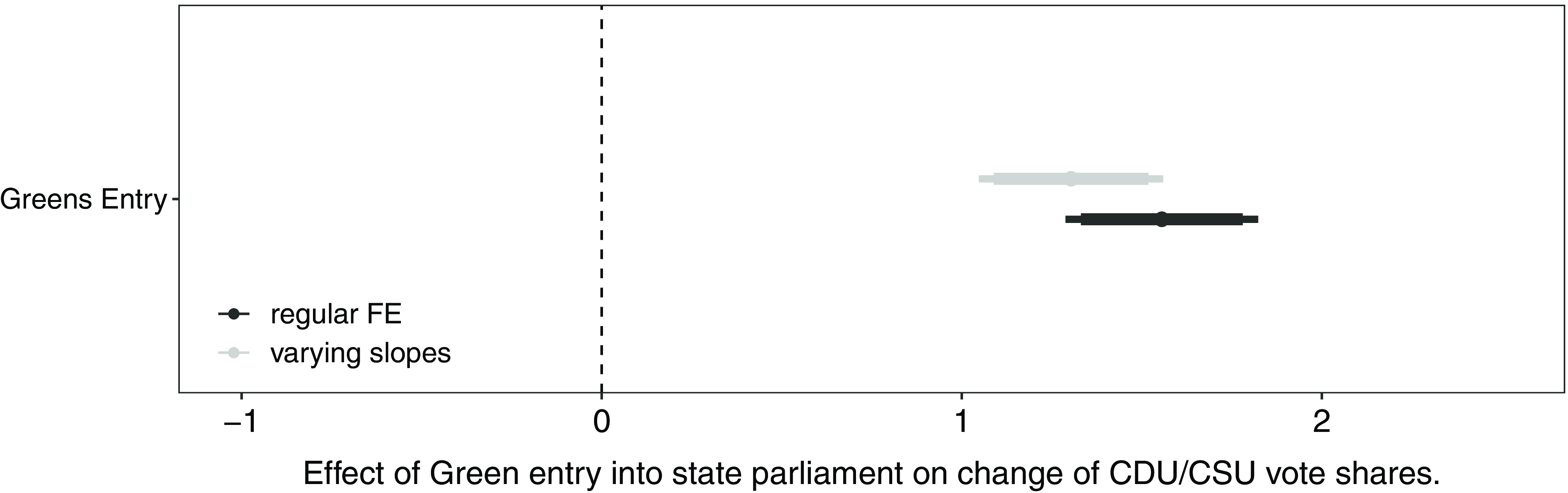
The results of our first-difference specifications are presented in Figure 1. It shows a consistent pattern: across two model specifications, we see a positive effect on the vote share of the CDU/CSU in the election following the Greens’ entry into state parliament. This pattern supports the hypothesized effect of a conservative backlash in response to the Green party’s success. ${\rm{\Delta }}$
CDU/CSU vote after Green party entry to state parliament.
${\rm{\Delta }}$
CDU/CSU vote after Green party entry to state parliament.
Note: the plot shows the effect of Green party entry into parliament on changes in CDU/CSU vote shares at subsequent federal election. Thicker bars represent the bootstrapped 90 per cent confidence intervals and thin bars show bootstrapped 95 per cent confidence intervals. Standard errors are clustered at the state level. Both models include covariates as well as state and election-fixed effects. The light grey model also accounts for state-varying linear time trends.

Concerning the effect size, we find that the Greens entering into state parliament led to a rise in CDU/CSU support of between 1.30 and 1.56 percentage points in subsequent federal elections. These effects are robust to the inclusion of covariates, different configurations of fixed effects, and the inclusion of varying slopes for the fixed effects. The results are statistically significant at the conventional levels of $p \lt 0.05$
.Footnote
16
$p \lt 0.05$
.Footnote
16
One question that our research design needs to address is how independent the effect of Green entry into one Bundesland is relative to its success in another. To deal with these potential issues of spatial autocorrelation, our models use bootstrapped standard errors clustered at the state level. Tables B.3 and B.5 show that our results remain similar.
We now turn to the matched difference-in-differences analyses. First, we construct the matched set for each treated observation based on the treatment history.Footnote 17 It is important to note that the number of matched control units decreases when we adjust for the treatment history of a three-election period rather than that of a one-election period, as expected. Moreover, the pool of control observations with identical treatment histories is significantly smaller in East Germany, which casts doubt on our ability to correctly estimate results for those treated units.
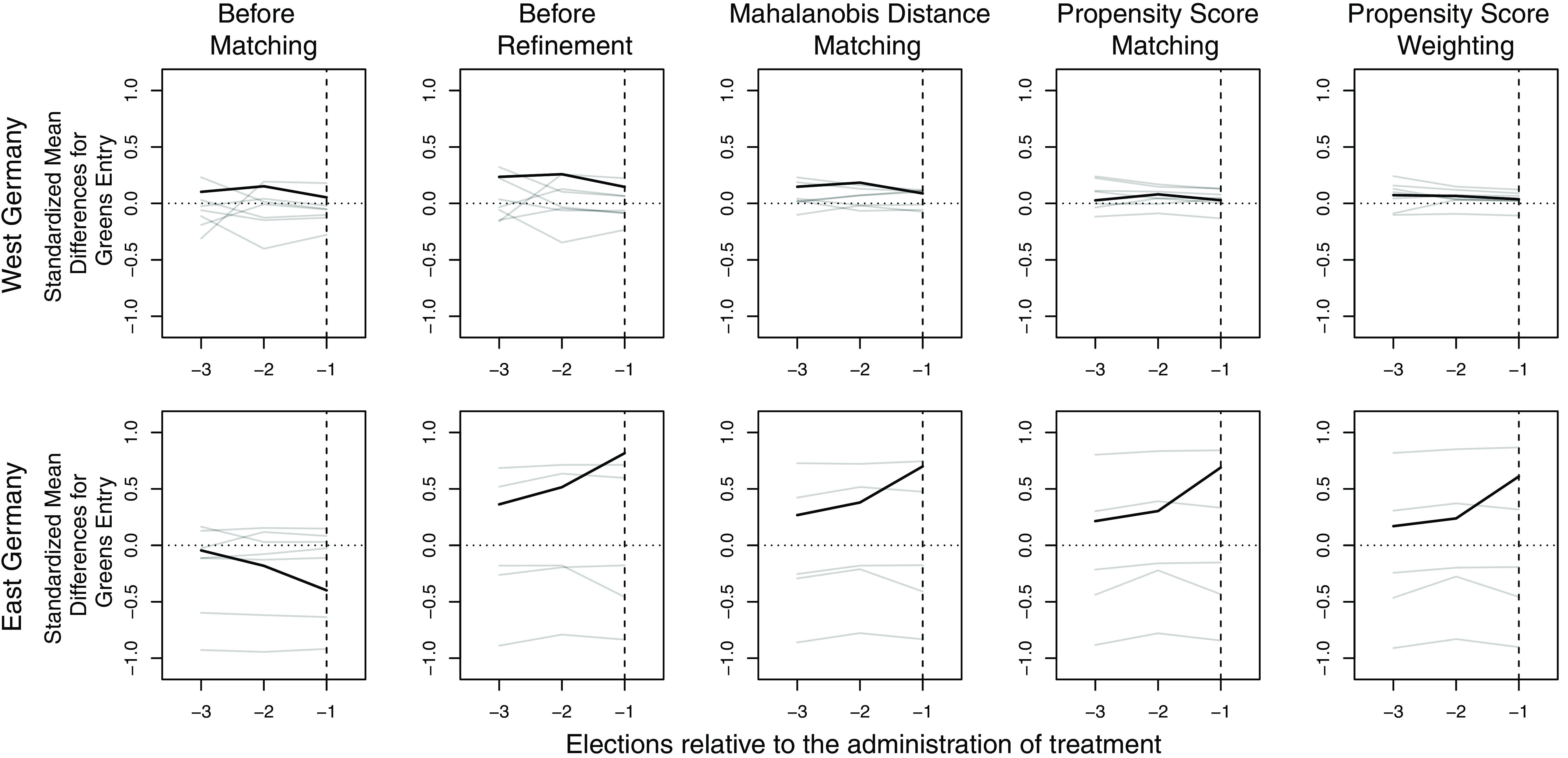
We then proceed to refine the matched sets. We apply the methods outlined previously and refine the balance for up-to-five and up-to-ten matching to ensure that empirical findings are robust to the number of matched observations chosen. The detailed improvements to covariate balance can be found in Section B.5 of the appendix. In general, the refinement of matched sets improves covariate balance for all three methods. However, the improvements to covariate balance are strongest when using propensity score matching or propensity score weighting. In addition, balance is only markedly improved in the West, further throwing doubt on our ability to correctly identify effects in Eastern Germany. Figure 2 illustrates the improvement of covariate balance due to matching over the three-election pre-treatment period when treatment is defined as Greens entering state parliament. The top row shows the balance for matched and refined sets in Western Germany and the bottom row shows it for the East. The black line represents the balance of the lagged CDU/CSU vote shares and the grey lines show the balance of the remaining covariates.
Improved covariate balance due to matching over the pre-treatment time period.
Note: each plot plots the standardized mean difference in the covariate balance (vertical axis) over the pre-treatment time period of three elections (horizontal axis). The left column shows the balance before matching, whereas the next column shows the balance before refinement but after the construction of matched sets. The remaining three columns present the covariate balance after applying different refinement methods. The solid line represents the balance of the lagged outcome variable whereas the grey lines represent that of time-varying covariates.

We find that adjustment for treatment history alone (column 2) does not significantly improve the covariate balance. Conversely, for West Germany (top row), the refinement of those sets based on pre-treatment covariates leads to a substantial improvement in covariate balance. This is particularly true for propensity score matching (column 4) and weighting (column 5), both of which effectively minimize imbalances in the confounding variables. Although some degree of imbalance persists for Mahalanobis distance, the standardized mean difference for lagged CDU/CSU vote shares remains relatively constant over the entirety of the pre-treatment period. This suggests that the assumption of parallel trends for our difference-in-differences estimator should be appropriate. In the East, neither the matching on treatment history nor the refinement on covariates manages to improve covariate balance. If anything, the imbalance becomes greater. The balance of the lagged CDU/CSU vote shares also worsens over the course of the pre-treatment period. This confirms that we cannot reliably estimate the effect of Green entry on CDU/CSU support in Eastern Germany. Below, we refrain from estimating effects in the East since they would have low validity.
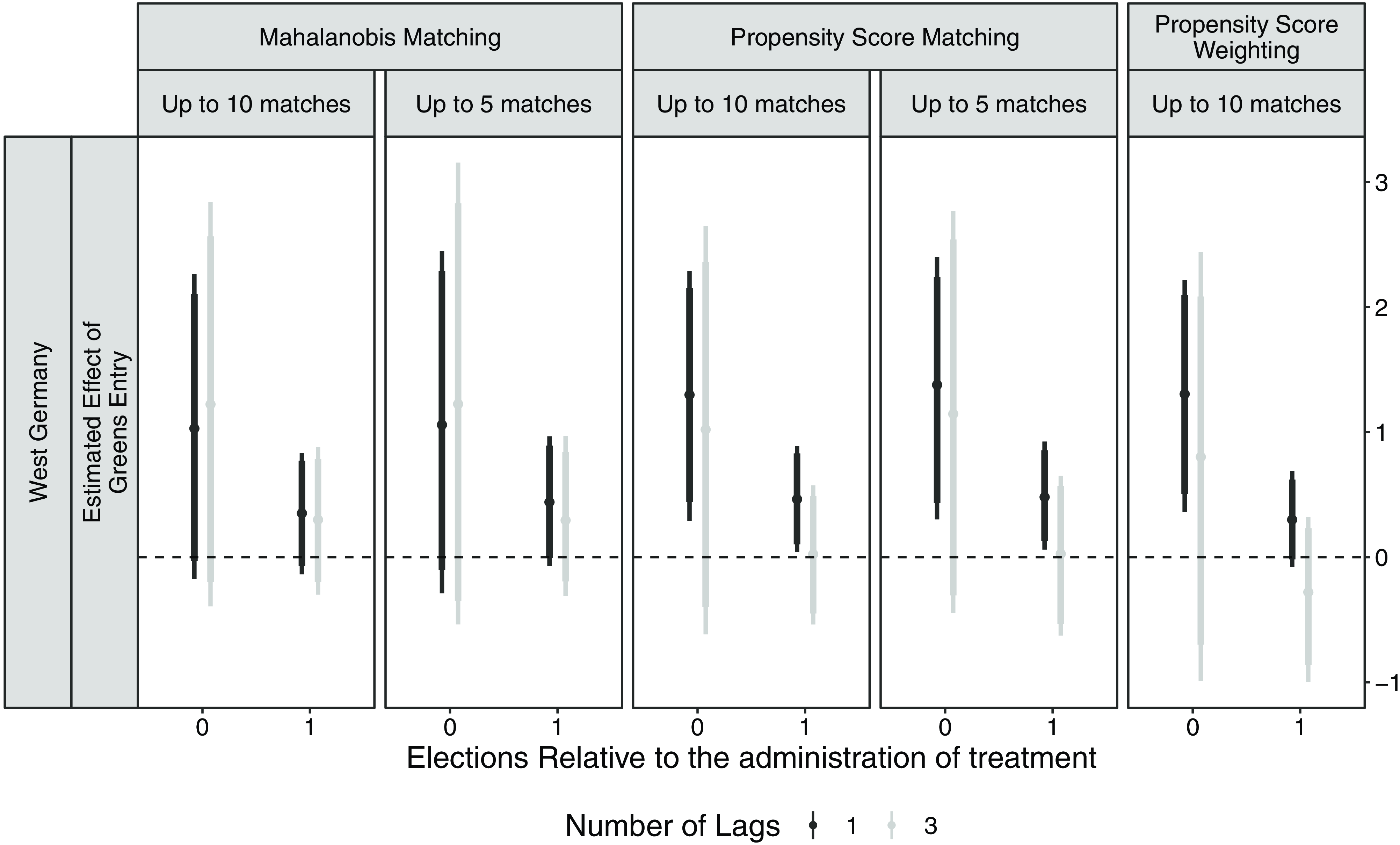
Figure 3 presents the Average Treatment Effect on the Treated (ATT) based on the procedure outlined above. It shows the estimates of the effects of Greens entry on CDU/CSU support for a period of up to three elections after the success. Across all five columns, we find that the effects are less precisely estimated when we construct the matched sets based on three-election pre-treatment histories (light grey). Although the estimated effect is positive for the election immediately following treatment, it is not statistically significant at the conventional $p \lt 0.05$
levels when using three-election lags. This is expected given that potential matches for treated observations are fewer in number. In that regard, using three-election lags is a conservative test of our theory.
$p \lt 0.05$
levels when using three-election lags. This is expected given that potential matches for treated observations are fewer in number. In that regard, using three-election lags is a conservative test of our theory.
Estimated average effects of Green party entry (West Germany only).
Note: the grey (black) estimates are based on the matching method that adjusts for the treatment and covariate histories during the three (one) election year period prior to the treatment. The estimates for the average effects of the Greens’ entry into state parliament on changes to CDU/CSU vote shares are shown for the election immediately following treatment and the subsequent federal election, which means F = 0 and F = 1. The thicker (thin) vertical bars represent the bootstrapped confidence intervals at the 90 per cent (95 per cent) levels. Five different refinement methods are considered and their results are presented in different columns.

In the more dynamic model using one-election lags (black), we observe that the estimated effect of the Greens’ entry on changes in CDU/CSU vote shares is positive for the election immediately after and dissipates in the following election. These effects are statistically significant at the conventional $p \lt 0.05$
levels when using either of the propensity score methods. These are the estimates where the propensity score weighting and propensity score matching produce better pre-treatment covariate. Concerning the point estimates, these range from
$p \lt 0.05$
levels when using either of the propensity score methods. These are the estimates where the propensity score weighting and propensity score matching produce better pre-treatment covariate. Concerning the point estimates, these range from $1.29$
to
$1.29$
to $1.37$
percentage points when using the propensity score methods. These align closely with those from the first-difference models presented in Figure 1.
$1.37$
percentage points when using the propensity score methods. These align closely with those from the first-difference models presented in Figure 1.
Overall, the results from our FD analysis and those using Imai et al. (Reference Imai, Kim and Wang2023)’s estimator support our hypothesis of a conservative backlash: we find that counties where the Greens entered state parliament prior to the federal election increase their support for the CDU/CSU.
Although our second analysis only confirms these results for the subset of West German states, we still believe that this is consistent with our theory for two reasons. First, the Greens encountered their early successes mostly in Western states. By the time of reunification, the Greens had already become a more established part of the German political landscape. Thus we would expect to detect conservative backlash mostly in the early years of the Greens and in the West of Germany. Secondly, our argument is that part of the reason for a backlash against the Greens is their challenge of established political norms. Those norms are much more likely to be present in the Western Germany of the 1980s/1990s than in post-socialist East Germany, where political institutions and culture were remarkably different during the post-war period.
Effect sizes across our models are also meaningful when compared to related research. To put them into perspective, a previous study on the incumbency advantage in Germany finds effect sizes of 1.4 to 1.7 percentage points (Hainmueller and Kern Reference Hainmueller and Lutz Kern2008). Similarly, Ade et al. (Reference Ade, Freier and Odendahl2014) study incumbency and government effects for the CDU/CSU in federal elections during 1976–2005, a time span comparable to ours, and find effects of 1 to 1.8 percentage points for incumbency and of 1.6 to 3 percentage points for government participation.
Exploring Individual-Level Patterns of Backlash
Why did the CDU/CSU gain support after the Greens entered parliament? We now draw on survey data to explore potential mechanisms underlying this finding. Our argument entails two observable implications: first, that rejection of the Greens’ norm-breaking behaviour and radical policy propositions are drivers of backlash. Secondly, we postulate that this rejection of the Greens should activate conservative predispositions. While data limitations do not permit us to conduct a causal test of these mechanisms, we now summarize a series of empirical analyses that explore these observable implications.
Drivers of Backlash
We mentioned that conservative backlash could be driven by the Greens’ norm-breaking behaviour and their policy positions. We test whether these channels explain our results using a pre-post-election survey from 1983 (Berger et al. Reference Berger, Gibowski, Roth and Schulte2016). The year 1983 was the first federal election in which the Greens entered Germany’s federal parliament. In the absence of equivalent surveys at the state level, this provides a compelling case to study voters’ reactions to the Greens entering parliament. The survey contains two pre- and one post-election wave with questions regarding respondents’ preferences and positions on a series of policy issues and political actors.
An observational implication of our theory is that conservative voters are more dissatisfied with the Greens entering parliament. We test whether those who supported the CDU/CSU in 1983 are more likely to dislike the Greens in parliament. To do so, we make use of a binary item in the post-election wave that asks participants if they ‘Approve of the Greens being represented in Parliament’ (Berger et al. Reference Berger, Gibowski, Roth and Schulte2016), where the value one indicates approval and zero indicates disapproval of the Green party just entering national parliament. In Figure E.9 we show that CDU/CSU voters are significantly less likely to approve the Greens’ election into parliament. Specifically, they are around 30 per cent more likely to disapprove of the Greens entering parliament than other voters.
Our argument also rests on the assumption that voter movements towards the CDU/CSU are driven by a dislike of the Greens and their success. The 1983 Election Survey contains a feeling thermometer for the Greens before and after the election. As some respondents are interviewed both before and after the election, we use this panel structure to assess within-respondent changes of Green party likability among those who vote CDU/CSU. We restrict our analyses to CDU/CSU voters. Importantly, we think that immediate shifts in Green party likability scores among conservative respondents should be indicative of backlash driven by non-policy motives. If policy influence were the main concern, a party that had just entered parliament in opposition – with limited time or power to enact major changes – should not have triggered such a backlash. The results we report in Figure E.10 and Table E.11 show that CDU/CSU voters decrease their evaluation of the Greens by almost one point over the course of the election (on a scale from −5 to +5), suggesting that it is indeed the Greens’ representation in parliament driving the effect. Even when the Greens had little time to impact actual policy, their electoral success significantly worsens conservative voter attitudes towards them.
Finally, we attempt the most direct assessment of voters’ motivations to react to Green party success. To do so, we use an open-ended question, fielded in the second pre-election wave that asks voters to list the reasons why they like or dislike each party.Footnote 18 We code these into policy or behaviour-based motivations and use these to explore vote choice using a series of regressions. Results from this analysis are presented in Figure E.11, showing that a respondent mentioning dislike for the behaviour of the Greens is positively associated with CDU/CSU vote intention at the 1983 election. Having negative feelings about the Green party’s behaviour is associated with a thirteen percentage point likelihood increase in support for the CDU/CSU.
On the other hand, respondents that report disliking the Greens’ policies are not more likely to support the CDU/CSU as opposed to any other party. These results provide some support for electoral backlash being driven by dislike of the Greens’ norm-breaking behaviour. In Table E.10, we show that this association is even larger for those respondents for whom the Greens were already in state parliament, a test which more closely mimics our main analysis.
Overall, we find evidence consistent with several important components of our argument. Conservatives dislike the Greens more vigorously than other voters and increasingly do so once the Greens enter parliament. Moreover, there is an association with CDU/CSU support and dislike of the Greens’ behaviour, but not their policy positions.
Panel Evidence on Party Identification Changes
Our argument implies that the backlash is at least partially driven by identity concerns. Here, we briefly summarize additional analyses that show how the emergence of the Greens impacted conservative identities. In Section D.1, we use data from the German SOEP survey (Liebig et al. Reference Liebig2021) to trace respondents’ changes in party identification. As a long-running panel study that covers nearly the entire period of interest, the SOEP allows us to assess over 110,000 observations of party identity shifts reported by more than 41,000 unique respondents across up to nine federal election cycles.
We implement a series of two-way fixed effects models which differentiate between initial and subsequent entries of the Greens to a respondent’s state parliament. In line with our main results, we find that especially the initial entries of the Greens activate conservative party identities. Compared to no change in Green party exposure, the initial entry of the Greens to a respondent’s state parliament increases the likelihood of switching towards a CDU/CSU party identity by two percentage points. We find a similar effect when only considering switches from no prior party identity, hinting at patterns of conservative identity activation among previously unattached voters. This effect persists for East and West German respondents. Conversely, we do not observe that respondents who previously held any other established party identification, or party identities from the left or the right, conduct significant switches towards the CDU/CSU. We also find no consistent effects for subsequent entries or exits of the Greens. Section D.1 includes further details on the data, operationalization of variables, estimation strategy, and results.
We also seek to understand which voters are turning to the CDU/CSU by replicating the main analyses using turnout and other parties as alternative outcomes in Figures C.7 and C.8. We find that the CDU/CSU gains likely came from SPD voters and from an overall increase in turnout. The positive effect on turnout is in line with the findings from the panel survey that emphasize conservative shifts from constituents without strong prior partisan attachments. Likewise, the SPD losing votes after Green party entry is also in line with our discussion earlier. At the same time, the liberal FDP also appears to benefit from Green party entry, albeit to a lesser extent than the conservatives. While a full explanation is beyond the scope of this article, one plausible reason for the FDP’s gains is that it may have also benefited from backlash against the progressive left.
Cross-Country Patterns of Conservative Backlash
Finally, we extend the scope of the analysis beyond the German context. Germany as a case has provided several advantages to test our argument: the German Greens are prototypical with regard to norm-defying behaviour and they have been particularly successful electorally. However, the rise of Green parties was not exclusive to Germany (see Grant and Tilley Reference Grant and Tilley2019). To test whether our findings hold for other Green parties, we collected data on election results from the ParlGov database (Döring and Manow Reference Döring and Manow2020), which we combined with national opinion polls from Kayser and Rehmert (Reference Kayser and Rehmert2021). Using these data for twelve West European countries, we use an interrupted times-series model, and find that when the Greens enter parliament, the main centre-right party gains support in the public opinion polls (further details on the data, empirical strategy, and results in Section F). Our findings suggest that the pattern of conservative backlash can apply to other European contexts.
Conclusion
How do voters react to new political actors? We posit that backlash effects arise when new radical actors challenge the establishment, through both their behaviour and policy agendas. Using the German Greens as a case study of a new political challenger, we find that their success triggered an electoral backlash that benefits the CDU/CSU, Germany’s main conservative party.
We find that Green party entry in German state parliaments increased the CDU/CSU support in national elections by around 1.30 to 1.50 percentage points, which are robust to different designs and empirical approaches. Additionally, we use survey data to conduct a series of analyses exploring the mechanisms underlying this backlash. Using an election survey from 1983 – the first time the Greens entered the national parliament – we find that conservative voters felt substantially more hostile towards the Greens than any other part of the electorate and that disliking their behaviour – not their policies – was most closely associated with voting for the CDU/CSU.
We also find that CDU/CSU voters are less likely to approve the Greens entering parliament, and that they dislike them right after the election (making it unlikely that our findings are driven by policies the Greens influenced).
Using the German SOEP (Liebig et al. Reference Liebig2021), we show that Green party entry to parliaments increased conservative party identification, particularly after the first parliamentary entry and for those with no previous identification. Put simply, after the Greens first entered state politics, the CDU/CSU benefits from new partisans who did not previously possess any party identity, strongly hinting at the activation of conservative political identities. This mobilizing aspect of conservative backlash is further corroborated by an increase in turnout following Green party entry.
Finally, we provide suggestive empirical evidence on patterns of backlash in favour of the main conservative parties across twelve West European countries using national-level polls. The rise of the Greens seems to benefit conservative parties across other European democracies.
Overall, our findings make several contributions. First, they provide evidence that electoral backlash is not exclusive to RRPs. Instead, it can be caused by new radical actors that unsettle the political establishment. This is relevant as European party systems become more fragmented and prone to the entry of challenger parties (Leininger and Meijers Reference Leininger and Meijers2020; de Vries and Hobolt Reference de Vries and Hobolt2020). We do so by adopting a theoretical framework that conceptualizes electoral backlash based on threats to existing norms, policies, and established identities. Secondly, we provide what is – to our knowledge – the first thorough examination of the electoral consequences of Green party success for conservative party voters. While recent work has documented polarization on contemporary climate issues (for example, Otteni and Weisskircher Reference Otteni and Weisskircher2022; Widmann, Reference Widmann2025), we show that conservative backlash can happen in the absence of recent climate debates, as the presence of new (Green) parties can, by itself, create conservative backlash.
However, some limitations persist. Most importantly, our evidence on individual-level motivations for conservative backlash is mostly descriptive and correlational. Future research could test for these questions more directly in an experimental framework. In addition, our findings should motivate further research on backlash against other types of norm-offending political actors. Building on Mansbridge and Shames (Reference Mansbridge and Shames2008), we adopt a conceptualization of electoral backlash that does not prescribe or imply any ideological direction, but rests on the assumption that any credible challenger to the establishment can trigger a backlash reaction by those voters that want to maintain the status quo. Therefore, we deem that backlash can arise irrespective of challenger ideology. What is important – and what we have described in detail with regard to the early Green party – is that the challenger openly undermines existing political norms, identities, or policies and has the potential to become powerful enough to actually threaten the political mainstream.
This of course does not imply that any new party can trigger a backlash. New party formations that clearly cling on to the political mainstream, like the pro-European liberal Volt party, are unlikely to become the causes of substantial backlash. Nonetheless, this ideological impartiality implies that the concept of electoral backlash can travel beyond the Green party family in the 1980s or more recent challenger parties from the radical right (see de Vries and Hobolt Reference de Vries and Hobolt2020). For instance, new and radical socialist parties that openly dismiss political norms and conventions, like Syriza in Greece or the novel BSW party in Germany, could also trigger comparable reactions of voters embracing the status quo.
When we focus on the phenomenon of conservative backlash, future research should also pay attention to other potential triggers. Electoral backlash does not necessarily need to be a limited response against disruptive progressive party families. More importantly, conservative backlash might also be the result of opposition to progressive social movements, such as climate protests in recent years (see Zeitzoff and Gold Reference Zeitzoff and Gold2022; Valentim Reference Valentim2023, for voters’ reactions to these movements and their tactics). Previous research has shown similar patterns when looking at social movements and protests studies – such as the finding that violent protests can decrease support for social movements and politicians aligned with these protests (for example, Wasow Reference Wasow2020), or how progressive movements such as Black Lives Matter can create backlash for whiter and older voters (Mazumder Reference Mazumder2019). Better understanding of these patterns of backlash can contribute to our understanding of rising societal polarization and political divides in established democracies.
Supplementary material
The supplementary material for this article can be found at https://doi.org/10.1017/S0007123425100628
Data availability statement
Replication data for this article can be found in Harvard Dataverse at https://doi.org/10.7910/DVN/O4YLNO
Acknowledgements
We thank Cornelius Erfort and Jochen Rehmert for kindly sharing data with us. We also thank Robin Best, Tarek Jaziri, Mark Kayser, Sascha Riaz and Roi Zur, the HU Comparative Political Behavior Team, the Transformations of Democracy Unit at WZB, and audiences at MPSA, the LSE@Europe seminar, and EPSA 2021 for their comments and feedback. We thank the BJPS editor and three reviewers for their comments on previous versions of this manuscript.
Financial support
António thanks the German Research Foundation (grant number 390285477/GRK2458) and the MacMillan Center for their generous support.
Competing interests
The authors declare none.



 Open access

