


Located in the state of Rio de Janeiro, bordering the states of São Paulo and Minas Gerais, Barra Mansa is a municipality founded in 1832 that flourished due to its strategic location on an important route for agricultural products and people. Between the first and second decades of the 20th century, the city subsisted on agriculture and a handful of industries that were being set up within its territory. The decrease in its population was eventually contrasted with the industrial boom that took place in the 1930s and 1940s, with the foundation of the Companhia Siderúrgica Nacional (CSN) in the neighboring city of Volta Redonda.Footnote 1 The city saw a significant population leap in the 1950s.
Proud of having been “Brazil’s largest coffee producer” in the year of 1862, in 1916, the city had about 20,000 inhabitants, with agriculture as its main economic activity.Footnote 2 At the beginning of the 20th century, the city was experiencing the tensions of a country that had seen the end of slavery as well as of the Empire only a few years before.
On October 17, 1916, in Barra Mansa, Francisco Lopes sold a golden colored mule to Edmundo da Silva. As payment for the “high-quality” animal, Silva pledged to deliver a white mule and 40$000.Footnote 3 Silva delivered the animal but did not pay the stipulated amount. Then, he passed the golden mule on to another person.
Accompanied by his lawyer, on November 13 of the same year, Lopes took two witnesses to the city’s police station, who testified to the deal. The following day, the town marshal ratified the justification demanded by Lopes. Justification, an institute that exists to this day in the 2015 Brazilian Code of Civil Procedure, was a procedure that could be conducted by various authorities at that time. Police chiefs, justices of the peace, and judges of law used to carry out the procedure, which consisted of preparing evidence for a future lawsuit.
This indicates that Lopes had provided proof of the deal he had made with Silva. In a city where parties relied on verbal communication instead of written contracts, individuals used justification as a piece of evidence to present before a judge. In Barra Mansa, a variety of justifications are submitted, including those intended to demonstrate financial hardship or to request civil registration.
At 2 pm on November 15, 1916, 100 kilometers from there, in the district of São José do Picú, present-day Itamonte, state of Minas Gerais, Pedro José Vieira walked into the courtroom of the district courthouse and filed a written request to the justice of the peace. Vieira, an animal trader, also asked the justice of the peace to ratify a justification. He claimed that he had rented a beast of burden from João Fonseca in Campos Elysios de Resende, state of Rio de Janeiro, about 50 kilometers from Barra Mansa, and that the animal had been missing for about 20 days. Vieira also stated that he believed the animal to be in Barra Mansa.
That same day, the justice of the peace signed a decree ordering the two witnesses indicated by Vieira to be summoned. The witnesses were heard on the same day, who confirmed that the beast had been rented and that they suspected it to be in Barra Mansa. Thereafter, on the 15th of November, the justice of the peace ratified the justification so that it could “produce its legal effects.”
In Barra Mansa, on November 30, 1916, Lopes filed a request to the city’s judge through his lawyer, asking for the search and seizure of the golden mule he had negotiated with Silva. The case seemed complicated: in Barra Mansa, Lopes had traded a golden mule and received a white one in return. In São José do Picú, Vieira had rented a white mule that had then disappeared. Apparently, they had both been victims of a scam. The former lost 40$000 and the latter had his white mule delivered to someone else.
In the rural economy of the period, beasts of burden were of great value in both domestic and business spheres. They were used to transport people and cargo and had a significant economic and social value. Hence, the animal dispute appeared to be a complex legal case.
The difference between the justice of the peace and the judge of law was established in Article 290 of the State of Rio de Janeiro’s Code of Judicial Organization and Criminal, Civil, and Commercial Procedure (Law no. 1137 of 1912). The justice of the peace was a temporary and popularly elected judge, while the judge of law was appointed by the state governor. The role of the justice of the peace was basically to perform marriages, safeguard vacant property, substitute for the judge of law and the municipal judge when they were absent, and refer legal demands to them.
On November 30, the case was referred to Judge Cesar Nogueira Torres of Barra Mansa. That same day, he judged the request for search and seizure through a one-line ruling: “Granted and registered.” It was handwritten on the first page of the application. On that same day, the file was also forwarded to the city prosecutor. In urgent cases, it was common for the judge to write on the same page of the application. The court clerk assembled the case, added a new sheet of paper, and sent it to the prosecutor. On December 3, the prosecutor wrote: “This prosecutor’s office believes that the measure requested is not appropriate.” That is, in two handwritten lines, the Rio de Janeiro State Public Prosecutor’s Office affirmed that Lopes’ request should be rejected. The prosecutor did not provide any reason or grounds for the said request. On the 7th of that month, the case was submitted to the judge, and on the 11th, the judge issued his decision, upholding the previous judgment and closing the case. It was a one-line decision, just like the previous one. There were no appeals, and no other acts were recorded. In fact, no information is available on whether the mule was found or not.
Although the Rio de Janeiro State Code of Judicial Organization and Criminal, Civil and Commercial Procedure (Law no. 1137 of 1912) established in its Article 1492 that decisions should include the names of the parties; a brief report of the claim and of the defense and their arguments; and “the precise reasons for the judging, stating, under penalty of liability, the law, usage or style on which it is based”; as I will show in this research, the judicial practice was different. This does not mean that the law was “right” and the practice “wrong,” and certainly not that there was an inherent difference between written law and practice. What I intend to do, on the contrary, is to show who made the judicial decisions and the possibilities of judging making within the dialogue with the law. In other words, I intend to show that the judge both knew the law and also, obviously, knew when to and when not to apply it more “faithfully.”
Looking at it from the perspective of present times, the decision cited above by Torres might seem, at first glance, to be an exception, illegal, or the work of a tired judge or someone in a hurry, or who did not care about the case. I intend to show here that, on the contrary, this decision followed his main pattern of judgment in the city during his time there, from 1911 to 1918. Deciding without citing any norms, case law, or opinion of jurists was the standard practice at the time.
I aimed to transcend the legal and illegal dichotomy, understanding the judge’s actions as possibilities within the legal framework. Instead of asking what the “legal” way of deciding was, I aim to understand the possible ways of deciding. As Herzog and Duve have already questioned: “Who was the person in charge of interpreting the law?” And how does this person change or apply these rules?Footnote 4 I wanted to comprehend the “production of normativity and how it has changed over time,” and I asked how the written law worked in different ways when applied in the same place and by the same judge. Therefore, the idea here is not only to understand the law, but also to understand the person. My intention was “to ask where, how, and why law materializes, who the protagonists are, and what the settings are,” trying to “demonstrate the multiple levels on which law operates and how deeply it is embedded in social, political, cultural, and economic.”Footnote 5
I wanted to understand the connections he established between the laws that governed the judgment and the laws that could be applied to make a judgment in a case. As the Brazilian system used the jury as an exception, and no jury trials took place in the city of Barra Mansa during the research period, Judge Torres’ decisions played a vital role in understanding justice in the city. Investigating the decision-making within a specific city during a defined time frame can provide valuable insights into its manifestation within Brazilian cities.
From the outset, I also want to demonstrate a significant difference between the provisions of the Rio de Janeiro State Judicial Code and other procedural laws and the legal practice in the city of Barra Mansa. However, this is not the sole point of this study. In addition to examining procedural law, which was frequently not adhered to, I aim to understand how a key judge’s rulings evolved over time. I do not intend to investigate or question at this point in my research why the judgment changed—I will not get into those variables—instead, what I aim to explore is how the judgment changed; how its contents transformed over time. The central research question is not why he ruled in specific ways, but rather what the ways were he ruled—in other words, how a judge’s decisions related to what was described in the legal text.
In this introduction, I intend to offer an example of how qualitative research can be conducted within this data. Still, my aim is to demonstrate the complexities of a case as well as the contents of the decision for such a case, which are similar to the ones present in the vast majority of the decisions analyzed in this research. To write this introduction, I used case 33/1916 from Barra Mansa and the Brazilian digital libraryFootnote 6 as sources. I also searched for the judge’s name across all newspapers from the 19th and 20th centuries and mapped his life from the moment he enrolled in law school until he became President of the Rio de Janeiro State Court of Justice.
In the first part of this study, I present the research methodology, the main data, and the theoretical dialogues that will be made during the text. In the second part, I present Judge Torres, the findings of my research, and the relationship between the lack of citations and the scholarly and juristic commentary on the judgment during that period. In addition, I compare the books, laws, codes, and other elements cited by the Barra Mansa judge with the data on the city’s decisions.
In the third part of the study, I show that elements the judge cited in the judgments, presenting in a timeline the most cited authors, norms, and case law. In doing so, I identify the most judged cases, the main standards and books mentioned, as well as the presence of other elements in the decision-making process. I will show, for example, that even after the publication of the first Brazilian Civil Code in 1916, it was not customary to cite it in court decisions, and that the logic of deciding without citing laws or other elements was stronger than adherence to the Civil Code.
Part 1—Methodology, Data, and Theoretical Approaches
There are no studies in the historiography of judging in Brazil that undertake an in-depth analysis of multiple decisions rendered by a single first instance judge. Scholars have focused on judges’ specific decisions and the legal logics of specific cases.Footnote 7 On the other hand, the excellent production of legal scholars on Brazilian procedural law has focused simply on repeating the legislation.Footnote 8
The substantial body of scholarship on judging in Imperial Brazil has primarily focused on the higher courts.Footnote 9 Nevertheless, an analysis of this literature can help shed light on how first-instance decisions were rendered. In examining the transition from colonial Brazil to the independent Empire, Garriga and Slemian demonstrate that the “proper administration of justice” was associated with the image of the “good judge,” rather than with strict compliance with the law. Although the Supreme Court of Justice ordered judges to “state, in judgments they delivered, in a detailed and specific manner, the reasons and grounds thereof,” within an “essentially plural” legal order, the task of determining what constituted “the law” ultimately remained in the hands of the judge.Footnote 10
In other words, the author’s research shows that a logic very similar to that of Judge Torres could be found in both colonial Brazil and the Empire. These conclusions are further supported by studies examining the use of Portuguese legislation in Imperial Brazil and in the early years of the Republic.Footnote 11 On the other hand, research on freedom suits during the nineteenth century, a more complex field of inquiry, indicates that extensive reasoning in judicial decisions was the prevailing practice among judges.Footnote 12
My main argument here is entirely different from what previous scholars have produced. I approached the judicial decisions with the following research questions: How does court judging change over time? Is there any connection between these changes, if they exist, and the citation of elements such as the law, opinion of jurists, and case law in the judgments? Or rather, how do these elements change over time? As these are difficult questions, and their answers depend on the country and historical period under study, I must remind readers that the spatial section here is limited to cases judged in Barra Mansa and preserved in the Fazenda da Posse archives.Footnote 13
During the period under research, the judging decisions were not always the same. There were different types of judgments. On the other hand, my research traced a pattern between them. Judging was succinct, and in the majority of cases, there were no citations to legal norms, case law, or jurists’ opinions.
In the absence of a parameter on how best to describe judgments, I will use the adjective “succinct” whenever a judicial decision does not cite any element (law, case law, or opinion of jurists) and merely describes the claim and the decision, or presents the decision. When the judgment references more elements than these, I will not use this adjective and will instead describe the judgment. As much as reading these documents can lead to adjectives such as “direct,” “simple,” or “objective,” I will not use these words to qualify the judgments in this article.
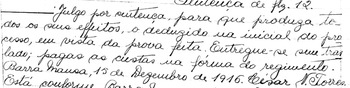
In this sense, I present later two examples of judicial decisions that Torres issued and retrieved by the court clerks from the city’s book of decisions Figures 1 and 2 are two examples of Torres’s decision in Barra Mansa. The first has 2 lines and 12 words, and the second has 4 lines and 30 words.
Example of a succinct judicial decision.Footnote 59

Example of a succinct judicial decision.Footnote 60
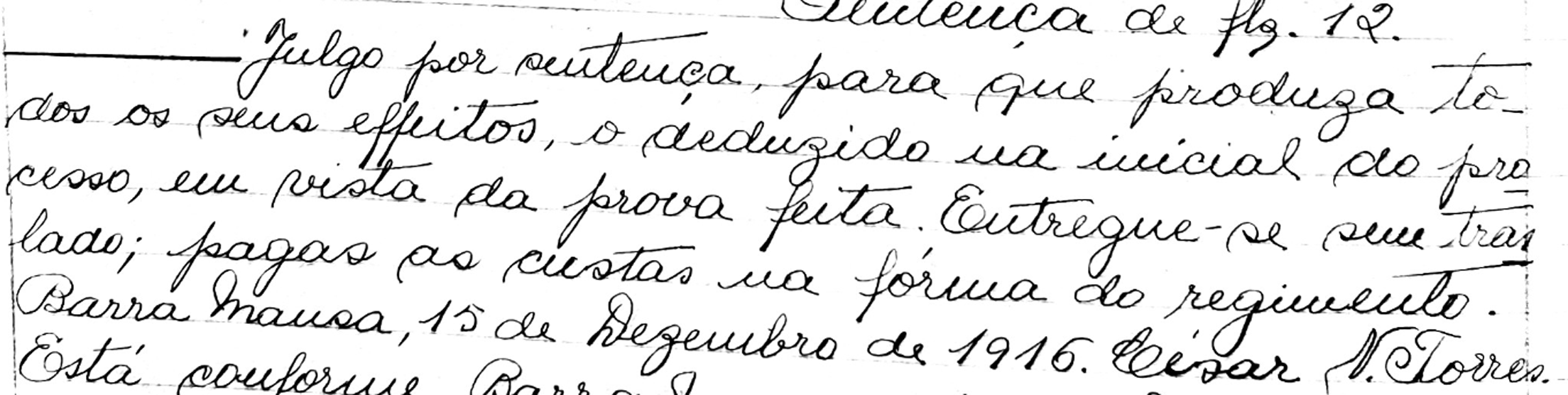
The judicial cases decided between the beginning of the 19th century and the end of the 20th century in Barra Mansa are archived in the city. Given the immensity of the data and the complexity of the subject, in this work, I will analyze the judgments issued between 1911 and 1918—the period when Torres was a judge.Footnote 14 I believe he is an interesting judge to illustrate how judges carried out judging at that time. He was an interesting person: he obtained his law degree in Imperial Brazil, during which period he began his career as a judge. In the Republic, he continued to work as a judge, eventually reaching the most important position in the Rio de Janeiro State Judiciary, that of President of the Court of Justice.
I analyzed 101 court decisions issued between 1911 and 1918. This sample corresponds to all the decisions delivered by Judge César Nogueira Torres during his time in the city. These judgments are my main sources; I did not use lawyers’ petitions, appeals, prosecutors’ pleadings, or information about the parties at this point in my research. I realize that these are important variables, but in this work, the study will focus only on the Barra Mansa judge’s decisions and the elements cited in them.
The inspiration for this research, which some might call its theoretical framework, is the work of António Manuel Hespanha,Footnote 15 particularly the author’s description of the history of institutions and his interrogation of how jurists saw the world.Footnote 16 I have tried to understand here how the judge decided and justified his decisions, while also indirectly trying to comprehend what he read and which norms provided the basis for his decisions. In the same vein, I have in mind the ideas of Herzog and Duve,Footnote 17 when they present their framework for research on the history of law in Latin America. I am not looking for certainties here, but instead trying to understand who the person in charge was of applying the law and how these norms were used to judge.
As with all research, many absences will be noticeable in this text. Absence of procedural documents, data, and questions that will require more detailed answers in the future. However, I do not see this absence as a problem here. It is a natural component of all research and human endeavor. And within these absences, I will write a story of how a person judged and decided the lives of others. Although I recognize that judging experiences only represents a small aspect of life in that society, I believe that understanding what was judged and how it was judged is a valuable way to learn from those experiences and project the debate on the subject into the future.
In this context, I would like to make it clear that my aim here is to understand the judging at that time and what the judge was citing, in order to build a history and/or a memory of it, without, however, any intention of evaluating it or trying to fit it into any theoretical model. I believe that this research’s innovation lies in understanding how the judging worked in terms of what was cited and comparing it with the norms in force during that time, which described how the said acts should be taken. By doing so, I will be able to demonstrate how citations appeared in the decisions of the judge and engage in a dialogue with the sources I have outlined earlier.
Part 2—How did the Barra Mansa Judge Decide?
Cesar Nogueira Torres, the author of the decisions analyzed here, was an experienced judge in 1916. Born in the city of São Paulo on September 9th,Footnote 18 1858,Footnote 19 he enrolled at the São Paulo School of Law in 1879Footnote 20 and graduated in 1883. In 1887, he joined the judiciary as a municipal and orphans’ judge.Footnote 21 By the time he decided the Barra Mansa mules’ case, he already had a long career in the judiciary, having been a judge in Itapeva,Footnote 22 Rio Claro,Footnote 23 Paraty,Footnote 24 Angra dos Reis,Footnote 25 São João Marcos,Footnote 26 and Rezende.Footnote 27 He was a trained magistrate who had first joined the judiciary during the Empire. He witnessed the Proclamation of the Republic as a judge and experienced the changes implemented by the new regime. Therefore, one can assume that Torres knew very well how decisions could and should be made, as well as how to manage legal disputes. As a judge in the city of Barra Mansa between the years 1911 and 1919, he penned various types of decisions, with different levels of complexity and formats. A Catholic, Torres had the habit of placing an image of Jesus Christ in the rooms that lacked one.Footnote 28 For most of his career, he worked under the Republic, retiring in 1931, shortly after the 1930 Revolution.Footnote 29
Torres’ decisions are a good example of the work of a judge in Barra Mansa at that time. A graduate of a law school founded during the Empire—there were only two such schools in Brazil at the time—he built a long career in the judiciary. In 1919, he left the city and was transferred to the Rio de Janeiro State Public Finance Court.Footnote 30 In the same year, he was sworn in as a Justice of the Rio de Janeiro State Court of Appeal.Footnote 31 In 1926, Torres was elected by the other magistrates as president of the Rio de Janeiro State Court of Appeal.Footnote 32
It is worth noting here that he was a member of the Court of Appeal of the State of Rio de Janeiro and not of the Court of Justice of the Federal District, where the city of Rio de Janeiro was located. In other words, he was not a member of the court in the Brazilian capital, but in the city of Niterói, which was the capital of the state of Rio de Janeiro.
His first decision in Barra Mansa dated back to April 19, 1911, and his last to October 19, 1918. In those ninety months, he issued 101 decisions and experienced several essential moments in Brazilian law. It was during his time in the city that the first Brazilian Civil Code was promulgated, in 1916, and Torres was undoubtedly able to witness all the expectations and disappointments that came with it.Footnote 33
Scholars have already shown that the period following the publication of the first Brazilian Civil Code was not marked by extensive citation of the code in judicial decisions.Footnote 34
Understanding the 1910s in Brazil is also essential to understanding the country when Judge Torres was ruling. The army had proclaimed the republic in 1889, replacing the monarchy, a year after the end of slavery, and the strengthening of the states replaced the centralization of the Empire. At the same time as strikes and revolts were exploding in the country, the Republic was trying to organize the new country legally, hastily writing codes and a constitution, while handing over a large amount of tax and procedural powers to the states. The Constitution of the United States of Brazil was promulgated in 1891, the Penal Code in 1890, and the Civil Code in 1916.Footnote 35
At the beginning of the 20th century, Brazil was governed by presidents who shared a similar profile: white men, heirs to the political influence of the states of São Paulo or Minas Gerais, and with legal training. Apart from Hermes da Fonseca, a military officer from Rio Grande do Sul, who served as president between 1910 and 1914, all nine men who held the office during this period fit that description. The country’s economy was heavily dependent on coffee production, mainly localized in those two states, which gave coffee producers a privileged position in national politics.
Immigrants from various countries were arriving in Brazil to substitute for slave labor on farms, while the legal system was still adapting to the new republican regime. The Proclamation of the Republic granted the states authority to legislate on procedural law, leading each state of the federation to adopt its own procedural code. At the same time, slavery continued to influence the legal relationships among Brazilians. The Revolta da Chibata (Revolt of the Lash) in 1910 highlighted how Black free Brazilian sailors were still subjected to corporal punishment reminiscent of slavery, which had been abolished only a few years earlier.Footnote 36
In 1922, to commemorate the centenary of independence, the Instituto Histórico e Geográfico Brasileiro, the most important historical institution in Brazil in the 20th century, published a historical, geographical, and ethnographic dictionary of Brazil. Aurelino Leal, a lawyer and politician who passed away in 1924, authored a chapter on the judicial history of Brazil. In his discussion of the “republic period,” he focused on the legislation enacted in the early years following the Proclamation of the Republic and emphasized the demand for a civil code, which had not been approved in the early republican era.Footnote 37
In a country where women still did not have the right to vote, literacy was a requirement for suffrage. According to data compiled by José Murilo de Carvalho, only between 3% and 5% of the Brazilian population participated in elections from the late 19th century through the 1930s.Footnote 38
At the same time, the Republic was pursuing modernization by enacting a new bankruptcy law in 1908, introducing legislation to modernize the Brazilian army, and authorizing foreign companies to operate in the country. Brazil was undergoing enormous social, legal, and political transformations. It is with this context that I analyze judicial decisions issued in Barra Mansa.
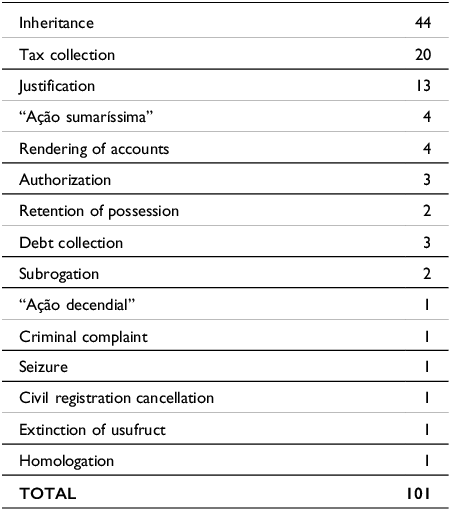
Among the cases decided by Torres were inheritances, justifications, rendering of accounts, and other types of civil and tax cases. During his time in Barra Mansa, he only decided on one criminal case. Here, interestingly, we note that in that rural environment, criminal law seems not to have been a subject brought to the attention of the Judiciary.
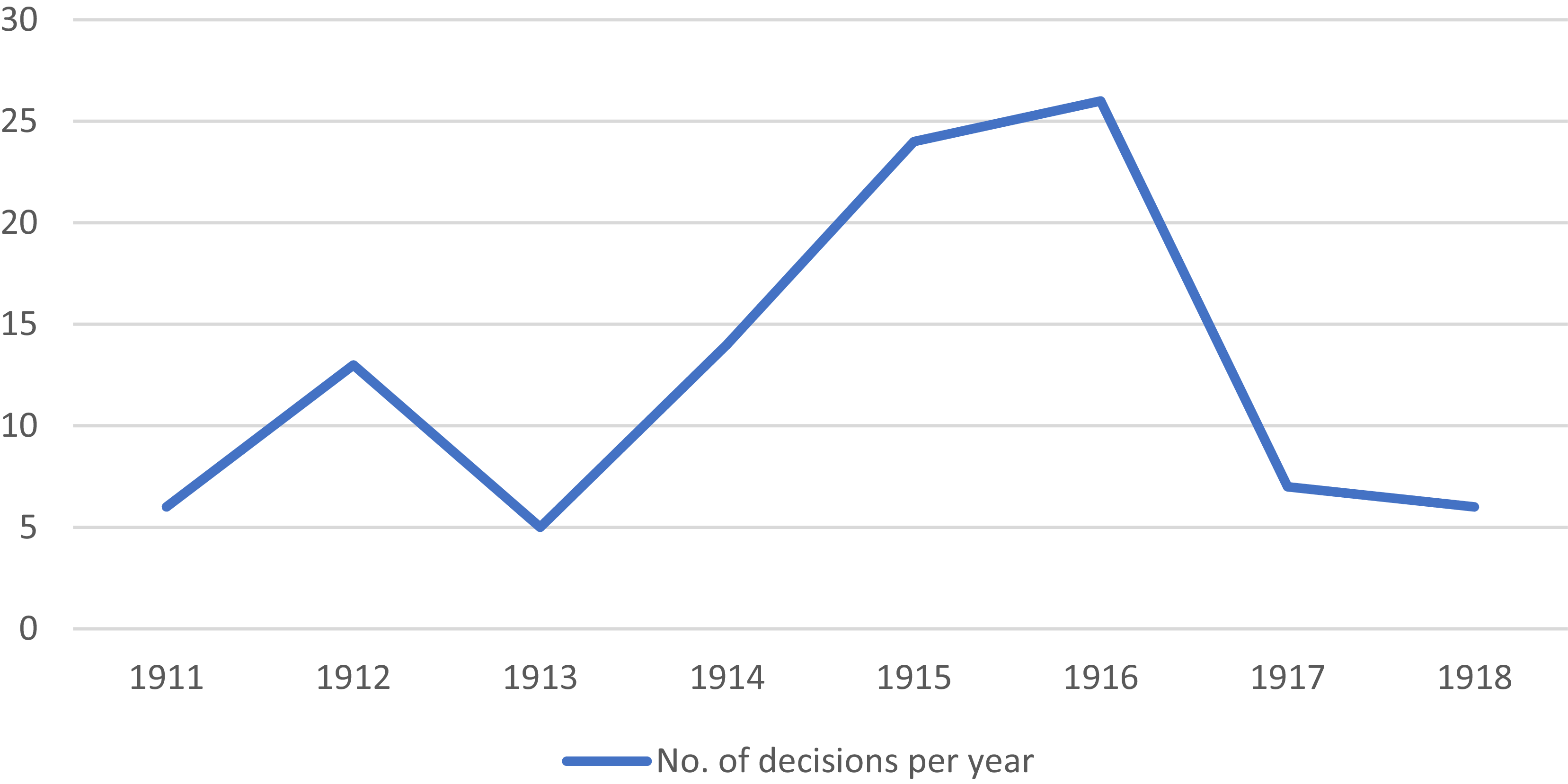
Figure 3 illustrates the number of Torres judges and the frequency of judgments issued each year.
Number of decisions per year.
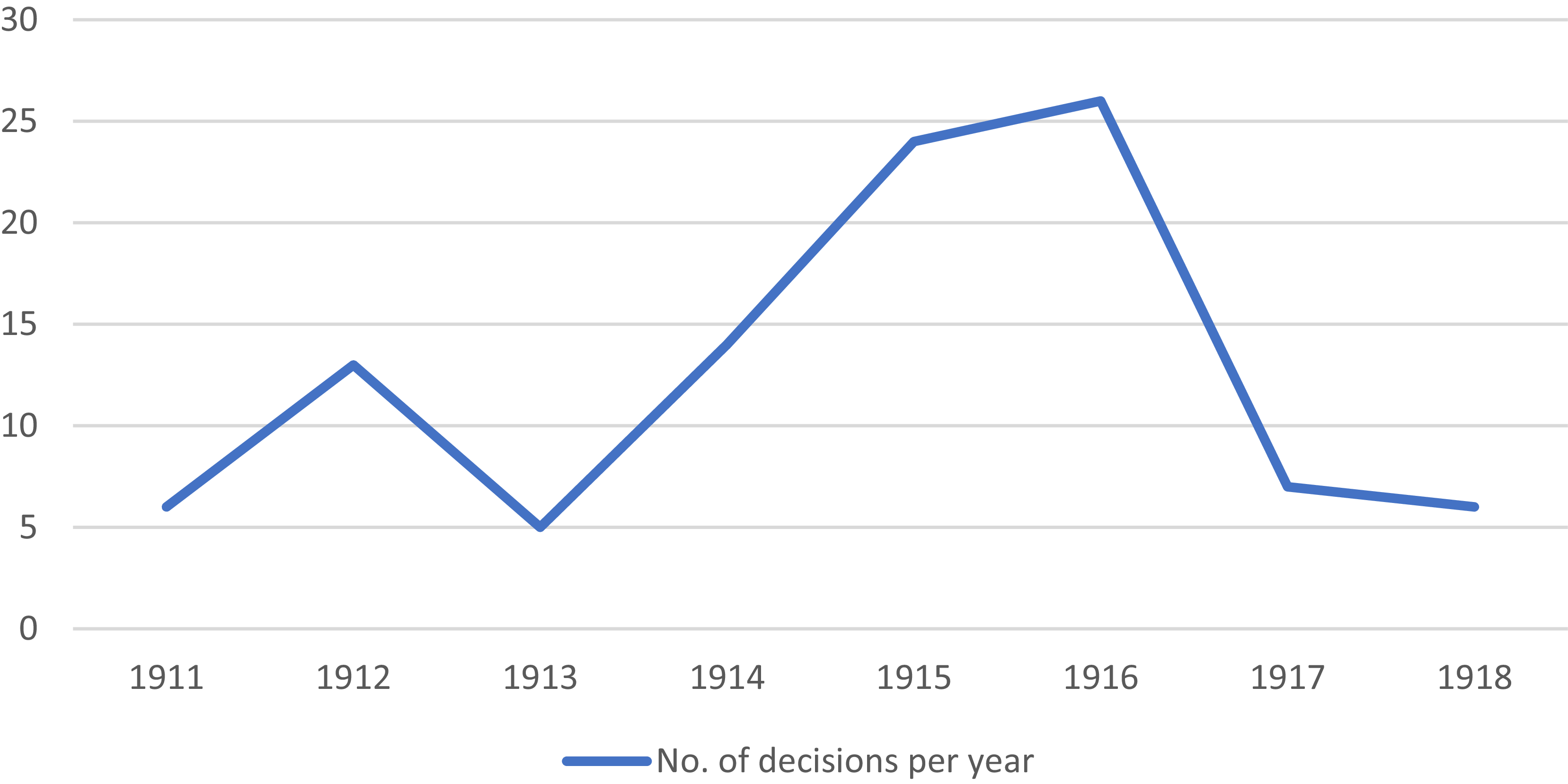
Out of the 101 decisions, 26 cited elements such as laws, opinions of jurists, or decisions from other courts. From reading the decisions, I was able to conclude that the judgment, in Torres’ case, was usually very succinct. Among these decisions, I came across only two agreements, and as there was no citation of any kind in either of them, I took them as important variables at this point in the research.
In 1909, the city’s population amounted to 15,000 people, and in 1921, it was 26,622.Footnote 39 Considering the increase in population and the number of lawsuits in 1911 and 1918, we can see that the number of judgments did not rise in proportion to the population growth.
At the end of the 19th century and the beginning of the 20th, Barra Mansa was a city in economic decline—a scenario directly related to the crisis in the city’s coffee production in the region. The growing infertility of the soil caused dozens of farmers to migrate to the countryside of the state of São Paulo or to the north of the state of Rio de Janeiro. With the abolition of slavery, the formerly enslaved population, which made up one-third of the city, migrated to other regions. Even before the world economic crisis of 1929, the decline of coffee production in Barra Mansa was drastic and blatant.Footnote 40 It was amid this state of decline that Torres was sent to the city. While the city had been a thriving coffee-producing city during the 19th century, in the first decade of the 20th century, it was facing a period of decline.Footnote 41
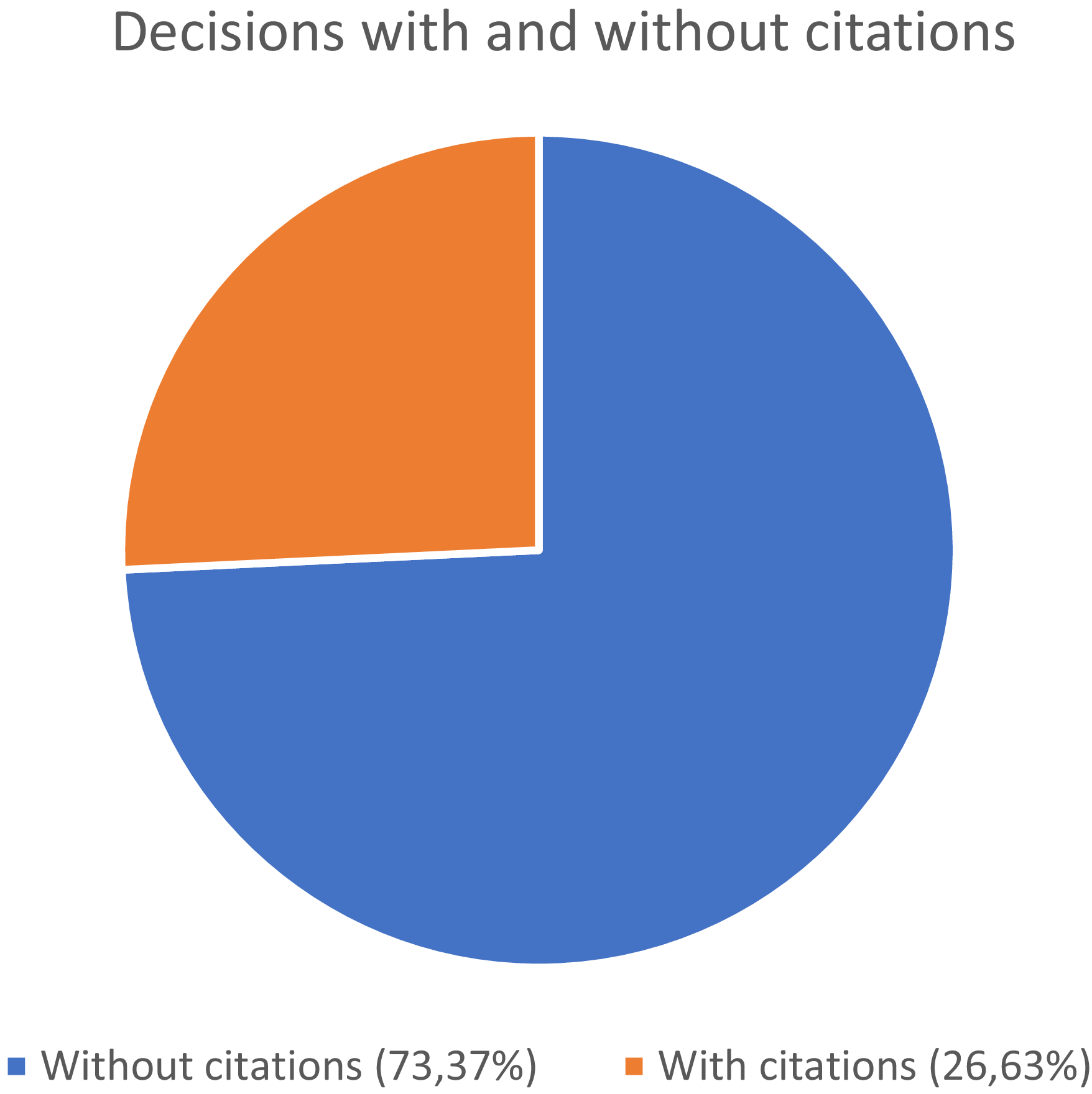
Regarding the Torres’s decisions, I note that in 74.25% of the cases,Footnote 42 the decisions were issued without the inclusion of any citation. In some of them, he gave a longer description of the case, unlike the decision quoted in this text’s introduction, but in general, his decisions were succinct. The data analyzed for the research included civil, criminal, and tax cases. He was the only judge of law in the city and tried all the cases that fell under his jurisdiction.
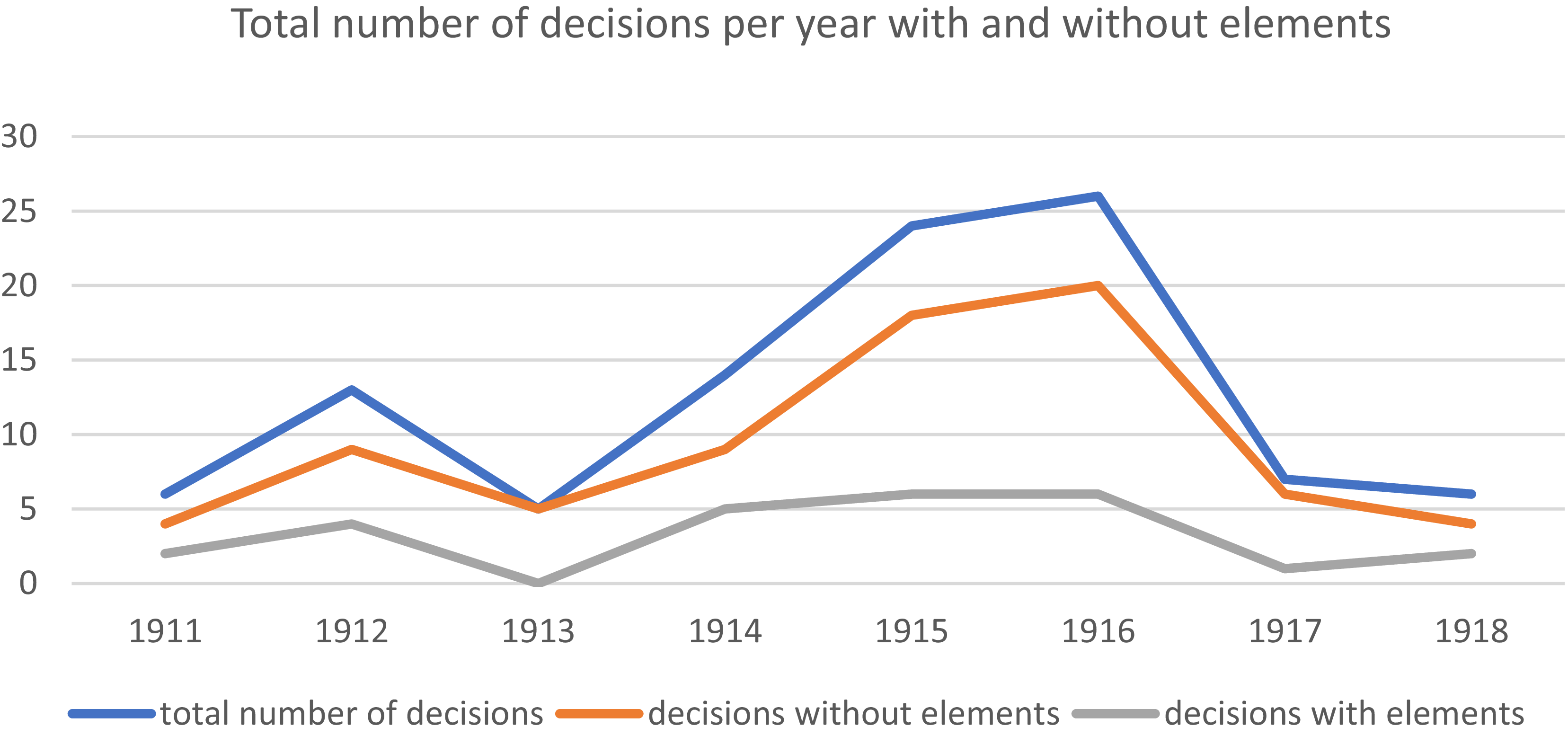
The Figure 4 illustrates the proportion of decisions per year, with and without any citation of elements.
Number of decisions per year with and without elements.
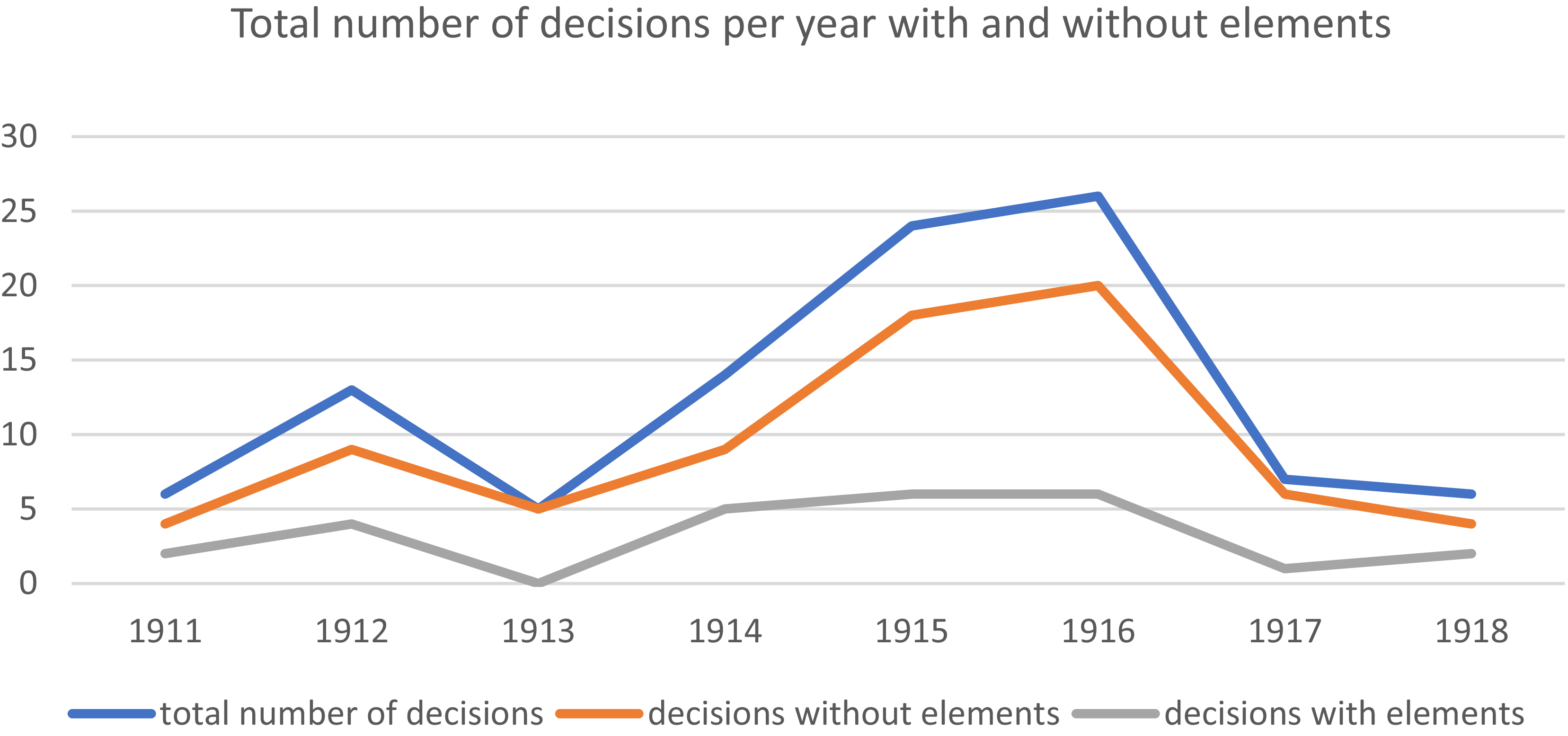
The Figure 5 shows, showing a comparison between the number of decisions that contained citations and those that did not. The data indicate that during the period under study, the majority of decisions had no citation elements. In certain years, such as 1913 and 1917, the number of citations was very low. The percentage only increased between 1914 and 1917.
Decisions with and without elements.

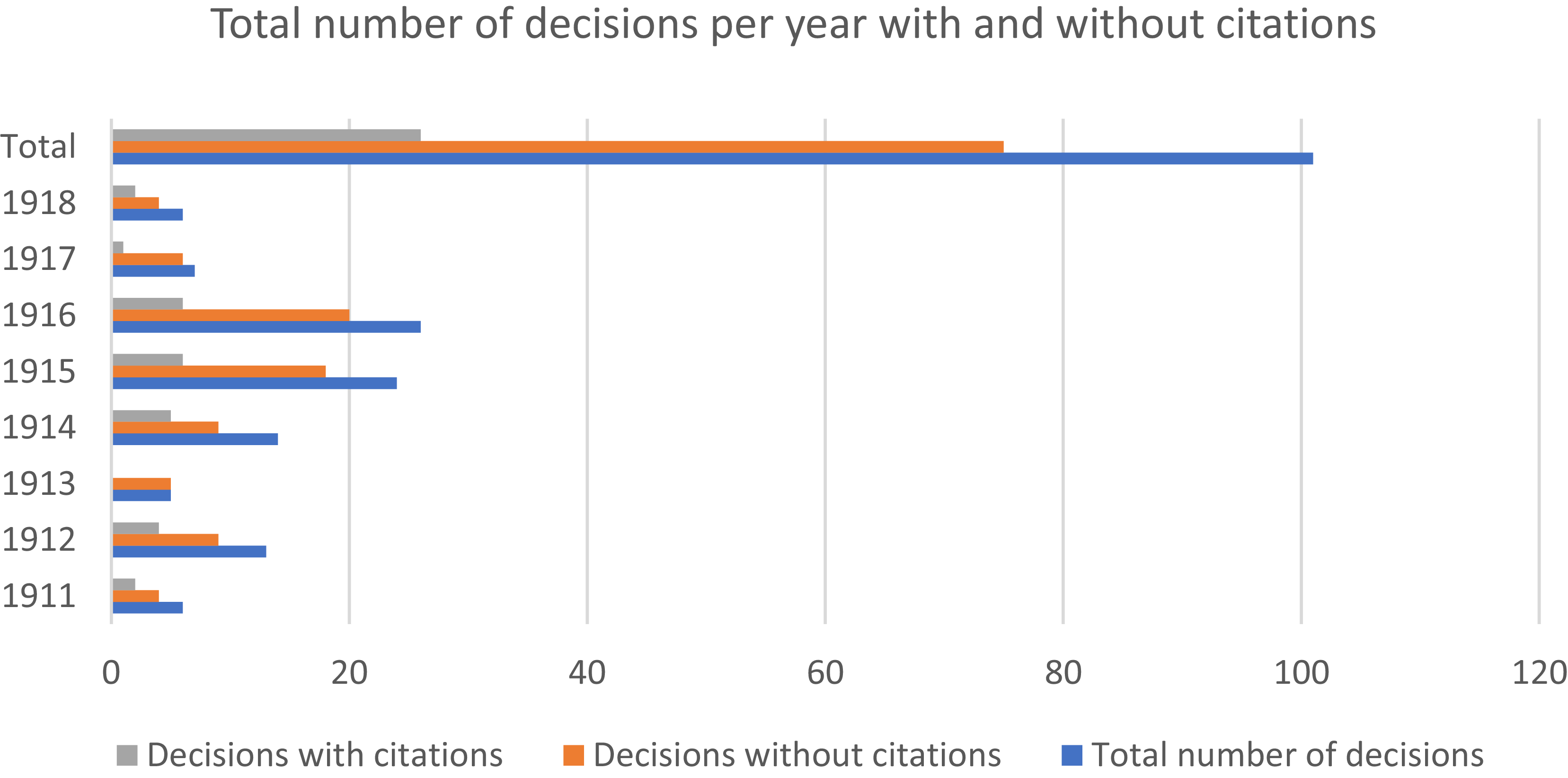
The Figure 6 shows the number of decisions per year, with data on the share of decisions containing citations per year:
Total number of decisions per year with and without citations.

Considering the total number of proceedings, in 74.25% of them, the judge decided without citing any law, case law, or opinion of jurists. In these cases, he identified the parties and issued his judgment. The legal requirements of the Rio de Janeiro State Judicial Organization and Criminal, Civil, and Commercial Procedure Code of 1912 were only met in part in the decisions.
In 1879, the same year Torres began attending the São Paulo Law School, the Brazilian Consolidation of Civil Procedure, written and annotated by Counselor Antonio Ribas at the Emperor’s request, stated that “the court decision must be written with clarity, and the Judge must summarize the plaintiff’s and the defendant’s claims, providing precise grounds for his decision and stating the law on which it is based” (Art. 487). This requirement was also present in Regulation 737 of 1850. It is probable that he was in close contact with these texts during his time as a law student and as a judge.
Ribas, who is quoted by Torres in some decisions, stated in his annotations to the Consolidation that “the judge ought to summarize the plaintiff’s and the defendant’s claims, not only to provide a good reasoning for the decision but also to show that he has carefully examined the whole case.”Footnote 43 It is important to note that he only summarized the plaintiff’s and the defendant’s claims a few times. He did not follow an order or a model to write his decisions. The judge decided on a case-by-case basis, according to what he deemed necessary in the case. Here, I would point out that Ribas did not discuss legal reasoning and did not even mention this word or how the judge should present the information. His book, like the commentators on the state codes that I will show later, was limited to reproducing the text of the law, stating the mandatory items of a judicial decision.
On May 15, 1916, the judge ruled on a debt collection lawsuit filed by José Hyppolito de Oliveira Ramos against the estate of Antonio Joaquim Gomes. In the case summary, Torres noted that the widow and her children had been served, but that no guardian had been appointed for the underage children. He stated that “acts and decisions against a child are null and void unless a legal guardian has been appointed” and ruled that the entire process was overturned. The judge based this decision on several sources, including the Philippine Ordinances,Footnote 44 Book 3, Title 41, paragraph 9; the writings of José Antônio Pimenta Bueno (“Notes on the formalities of civil proceedings”); the May 15, 1885, decision of the “former Supreme Court of Justice”; and the April 18, 1913, decision of the Rio de Janeiro State Court of Justice; and article 1204 of the State Code of Procedure.
Rendering the case null and void at that moment meant that the debt collection lawsuit filed by Ramos would have to start again from scratch if the plaintiff so wished, after he went through all the legal procedures. It was a procedurally impactful decision. Therefore, this decision used a completely different approach than the one cited in the introduction to this paper. Torres overturned the case based on various grounds: the law in force in Brazil at the time, the Philippine Ordinances of 1603, the decisions of the Imperial Supreme Court of Justice—which had been extinguished by Brazil’s Republican Constitution of 1891—and a decision of the Rio de Janeiro State Court of Justice.
This case illustrates that the judge acted differently in certain legal situations. Here, some facts deserve to be highlighted: Torres used all three elements (norms, case law, and opinion of jurists) in only three of the 101 decisions analyzed. Two of them were decisions rendering the entire case null and void. On the other hand, during his time in Barra Mansa, Torres judged several debt collection lawsuits (classified as “ações sumaríssimas”Footnote 45 ), but he only included the three elements listed earlier in one of these decisions. However, in all of them, there were citations of at least one of these elements.
Also striking is his use of various resources to make these decisions. Torres applied norms and court decisions that had theoretically been revoked by the legal system in force. The Supreme Court of Justice had been the largest branch of the Brazilian Empire Judiciary, and the Philippine Ordinances were no longer commonly used in Brazil.Footnote 46 In other words, when necessary, he relied on old arguments to make his decisions. It is worth noting here that this was the only time the judge used the Philippine Ordinances in the years he spent in Barra Mansa.
In this regard, as stated by Paes, it is necessary to understand that “Law is produced in a specific historical context by a variety of historical agents.” Law is not abstract and exact, “but rather it is produced by people on a daily basis and is deeply entangled with local cultural backgrounds, worldviews, social structures, and political struggles.” In other words, by paying attention to the person who produced the norms, Torres, we can understand how the law was created by that agent at that time. This way, the law becomes more perceptible as something changing, inexact, and plural.Footnote 47
The analysis of the decisions shows how citing references or using all the elements of procedural law was seen as an option by the judge. He would make a choice, commanded by rules and feelings that I have yet to grasp, as to whether the decision should be more succinct or not. The impression the data analysis leaves is that the judge’s ruling was not as established by procedural norms, perhaps regulated by unwritten and less objective rules. In other words, as well as knowing when it was necessary to cite references and when it was not, the research also points out that the judge did not issue that many decisions from the time gap between his judgments. The time span from Torres’ first to his last decision in the city covered a period of seven years and six months. Considering the number of decisions issued during that period, we can get to an average—not including vacations or leaves of absence—of one decision per month. This is not a high figure when compared to the performance of Brazilian judges and courts nowadays. However, compared to the judges in the city of Barra Mansa during this period, the number of decisions per year is very similar.
I emphasize again that at no point am I saying that the judge did not know the law; in fact, it is quite the opposite, I am sure he knew the law and the opinion of jurists of the period. However, he also knew in which cases the rules should or should not be cited.
In other words, the data helped me realize the inconsistency of the application of the law and the substantial difference between the changes in legislation and everyday legal practice at the time. Therefore, even though the judge knew and sometimes cited the legislation, only partial compliance with it seemed to be possible at the time. The practice of deciding in a succinct manner and without grounds seemed to be the norm.
In this sense, the succinctness implies that the decisions did not have all the elements required by law, but it did not mean that the decisions were “incorrect or unfair”.Footnote 48 I cannot provide the motives for this approach to decision-making at this point in the research and through the sources I am working with, but I will raise some hypotheses to be developed in the future.
Augusto Teixeira de Freitas, perhaps the most prominent jurist of the Brazilian Empire, wrote that the court decision had to be reasoned and that “national legislation has amended the Ius Commune in this respect.” On the other hand, though, for Freitas, the absence of reasons did not necessarily lead to the nullity of the judicial decision. He also stated that it was “indifferent how” these grounds were presented.Footnote 49 In other words, decisions that did not follow the standard prescribed by law could still exist.
Just by way of example, these recommendations for judges to state in their decisions “the causes on which they were founded in convicting or acquitting, or in confirming or revoking” were already provided for in Book 3, Title LXVI, §7 of the “moldy Philippine Ordinances” of 1603.Footnote 50
In other words, the precept that the judge should state the reasons for his judgment was long-standing. Here, as an example, it is worth remembering once again that the inclusion of the decision’s grounds in its text does not necessarily mean a citation of the elements I looked for in the Barra Mansa court decisions. The judge could, and often did, decide solely on the basis of evidence and/or elements presented in the case itself.
What matters to me here is the possibility of deciding without citing any elements. In other words, either the grounds for the decision were known to everyone and, therefore, there was no need to mention them, or there was simply no need to include citations, as it was not the practice at the time. The data point to the second hypothesis. In the vast majority of judgments, even when no elements were cited, the judge referred to the information already present in the case, for example, “I rule based on the evidence provided on sheet 18” or “I rule in accordance with the evidence in the case and order the party to pay the amount requested.” These phrases were commonly used in the city for decades. Therefore, I believe that citing elements was the exception and only happened in cases where those involved deemed it necessary. For that matter, I understand that providing grounds for the decision can be seen as something succinct. However, this idea coexists with the legal requirement to cite legislation, already present in Ribas’s Consolidation.
That does not mean that all decisions were somehow reasoned. On the contrary, Torres’ decision presented in the introduction to this paper had no grounds whatsoever: the judge issued his decision. That is to say, I have not yet been able to analyze whether all decisions were well-founded or not. To do that, I’d have to establish more objective criteria about what it means to justify a decision and analyze how these criteria change over time and space. That is why I’ve decided to simplify the research at the moment. My question is aimed solely at examining the citation of elements, as stated in the introduction. I have separated out this portion of the research process because I believe it can, in itself, contribute to an understanding of the history of procedural law in Brazil, but also because it provides an insight into the relationship between these elements and the judging.
For this reason, comparing the norms and opinion of jurists with the work of the judge in Barra Mansa shows how imprecise the law was at that time. And I see this imprecision as something normal for a country that was going through enormous changes. This vagueness was also present in the legal debate on civil procedural law at the end of the 19th century and the beginning of the 20th. Expanding on this topic, for example, Alfredo Flores and Gregório Sliwka demonstrate the legal discussion on the “force of law” of the 1878 Consolidation of Civil Procedural Laws by Antonio Ribas.Footnote 51 In other words, in the 19th century, the discussion of which procedural law should be used was a discussion that existed and ended with the procedural codes of the states
This discussion could lead to questions about legal reasoning. The procedural law books of the time, such as Rio de Janeiro, São Paulo, Bahia, and the Federal District, for example, did not discuss what legal reasoning was. Here, it is interesting to note that the authors of the time, especially when analyzing the articles of the state codes that inform how judges should decide, did not bother to describe how the reasoning should be formulated or how the elements of the decision should be described. For them, it was important that the decision had the legal elements, and the authors of the time were not concerned with the legal form or the type of reasoning that was used.
The lack of a national Code of Procedure, which only came into existence in 1939, years after Getúlio Vargas took power in the 1930 revolution, could perhaps explain this absence and imprecision in the manuals.
The Code of Procedure of the Federal District, for example, in its article 273, stated that the court decision should “be clear, mention the names of the parties, summarize the claim and defense with its grounds” and “contain the reasons for the decision, indicating the law, usage or style on which it is based.” Odilon Andrade, commenting on the code, said that the legitimacy of the judiciary was linked to the reasons for the decision and that only these could enable the party to “verify whether justice had been done to them.” The author also questioned how the parties could appeal if they didn’t know the reasons for the decision. Andrade also referred to several other state codes that followed the same logic.Footnote 52
Commenting on the Bahia State Code of Civil and Commercial Procedure, Eduardo Espinola shows that the text prescribed that the decision should be “clear and concise,” “without argumentation by hypothesis,” and “without scientific digressions.” In other words, the legal text of the State of Bahia demanded that the judgment should not leave room for complex questions. On the other hand, the Code also required that the reasons for the decision had to be “scrupulously” written down in the decision.Footnote 53
Antonio Luiz da Camara Leal, commenting on the São Paulo State Code of Procedure, recalled that article 333 obliged the judge, under penalty of nullity, to write in the proceedings the names of the parties, the report of the claim and defense, as well as the grounds for the decision. Leal’s book takes care to cite the law that regulated proceedings in the state before the Code, here citing the Consolidation of Ribas cited earlier, as well as comparative legislation. Leal cited the procedural codes of various states to show the correlation between the articles. In other words, the state codes circulated between the states, and in relation to the judges’ decision, they all had very similar wordings. Leal still believed that the decision should be made by the judge in his own handwriting and that the use of a typewriter was “contrary to the tradition of our law.”
He said that reporting the requests made by the parties was a way for the judge to reveal his study of the case and showed that the court decision was not arbitrary or unjustified. Following Andrade’s logic, he also argued that stating the reasons for the judge’s decision had the function of informing the losing party of the arguments, as well as showing them to the higher court on appeal.Footnote 54
Thomas Pimentel and Ticiano Pimentel, also commenting on the Code of Civil Procedure of the State of São Paulo, argued that a judicial decision was required to include the name of the parties, a report on the procedural development, and the factual and legal grounds for the ruling. According to them, any decision lacking these elements should be considered null and void.Footnote 55
These authors highlight the similarities between the various state legislations in Brazil. Although there were some nuances, as a rule, the state codes required judges to present the legal reason behind their decisions.
Part 3—What did the Judge Cite?
The Barra Mansa judge cited elements in his decisions in 25.75% of the cases analyzed in the research. I have classified the cited elements as “norms” (a category that includes laws, decrees, ordinances, and other elements of written law); “case law” (decisions issued by other judges or courts), and “opinion of jurists” (books or papers written by jurists or legal theorists).
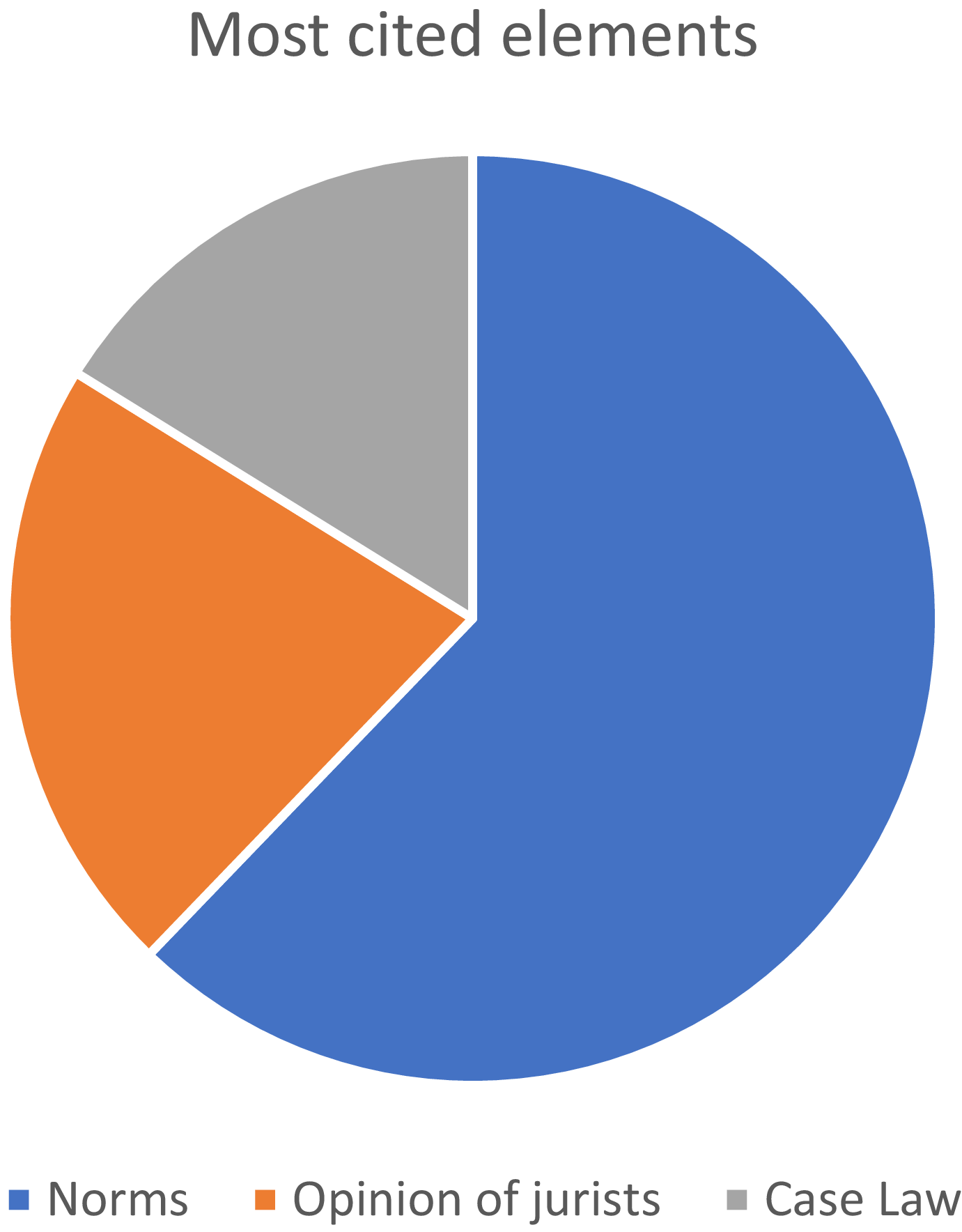
The Figure 7 shows the proportions of the most cited elements between 1911 and 1918. That is, it shows the percentage of decisions that include citations of norms, case law, and opinions of jurists out of the 26 decisions issued with citations during this study’s period.
Most cited elements.

As is evident from the chart, norms are the most cited element. It is worth noting that only three of the decisions quote all three elements, while one decision cites only case law, two cite only opinion of jurists, three cite both norms and opinion of jurists, and eight cite norms and case law.
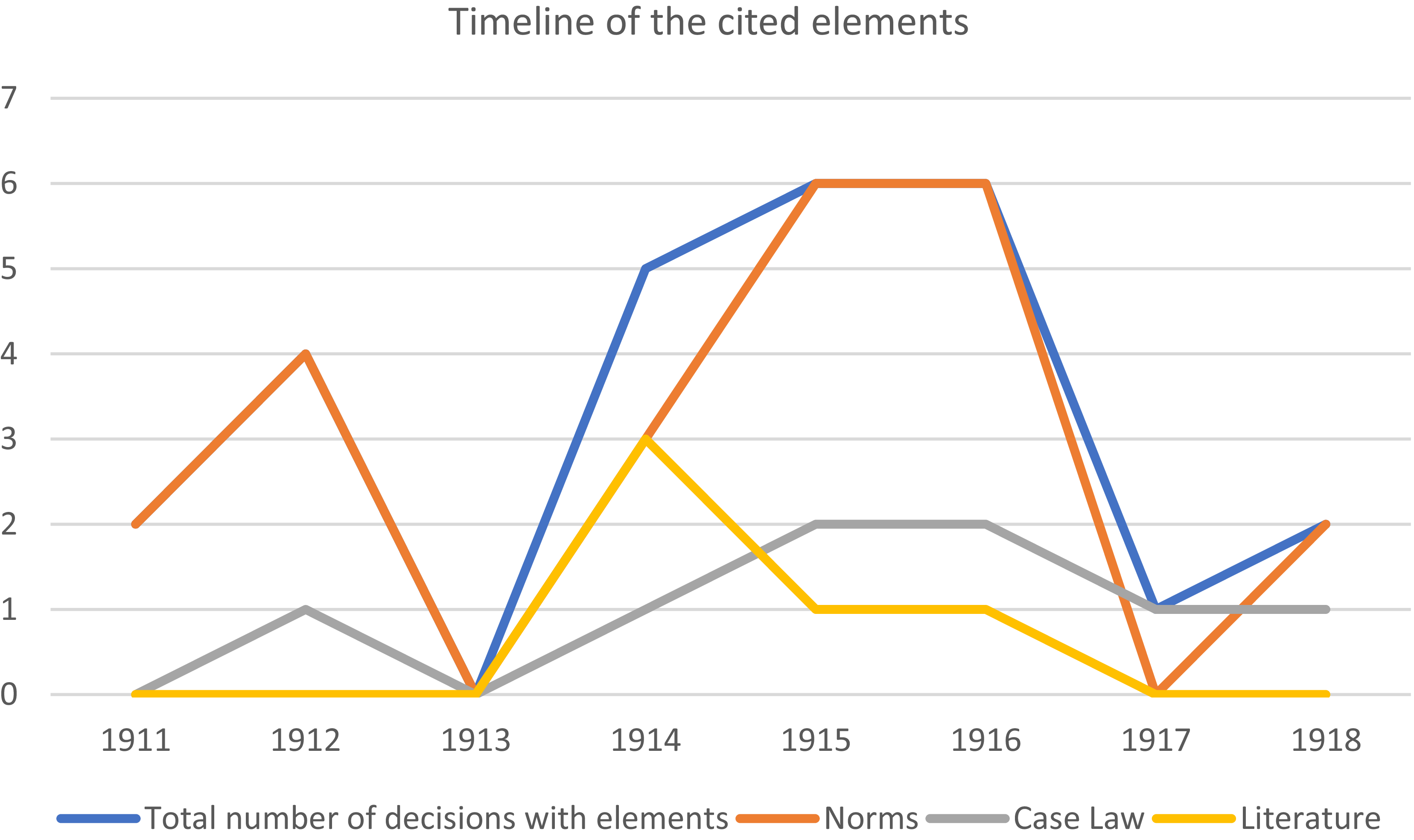
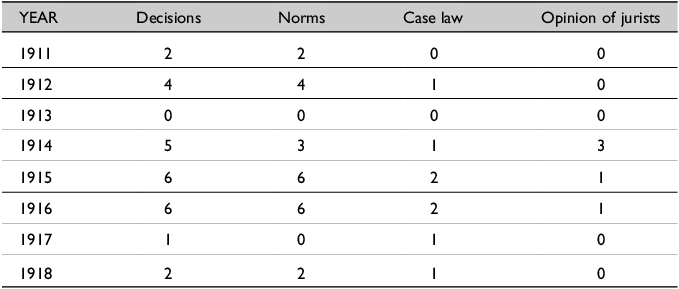
The Figure 8 shows how the citation of elements changed over the period under study. These numbers are also detailed in the following table.
Elements per year (total decisions issued with citations).

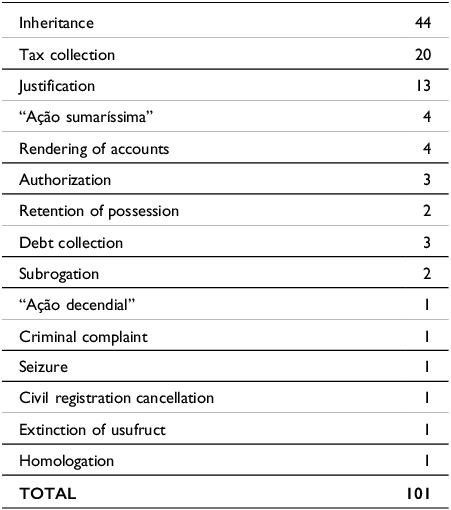
The Table 1 shows the type of lawsuits most often judged by Torres during his time in Barra Mansa:
The Table 2 shows that the cases did not encompass a great variety of topics. Inheritance and tax collection actions accounted for more than 50% of the judgments by the judge in the city. By cross-referencing the cited elements with the types of decisions, I have found citations of norms in the decisions of six inheritance actions. Only one of these included citations of both norms and case law, and none of them had citations of the opinions of jurists. On the other hand, no elements were cited in the 20 tax collection proceedings. Of the total 13 cases of justifications, meanwhile, six included citations of norms.
Decisions, Norms, Case Law, and Opinion of Jurists

Type of lawsuits
The 23 decisions that cited norms included a total of 26 references to specific legal provisions. Among them, the number of procedural laws cited is striking. The judge cited Law no. 2083 of September 20, 1871, enacted during the Brazilian Empire, four times, and the Rio de Janeiro State Judicial Organization and Criminal, Civil, and Commercial Procedure Code of 1912 (Law no. 1137 of 1912) was cited 17 times. The data show, therefore, that Torres rarely cited substantive law to make his decisions. Citing procedural law, on the other hand, was more common. Imperial procedural law and, in particular, the Rio de Janeiro State Code were the main sources used by him. The analysis of decisions evidently shows that the judge rarely cited substantive law in his judgments—only a few sparse laws were cited. The data suggest that Torres based his decisions on personal conviction and authority, and not on the need to cite rules or other elements.
The first Brazilian Civil Code was promulgated in 1916, coming into force on January 1, 1917. In Barra Mansa, however, it was first referred to on April 15, 1918, when he cited a sole paragraph of its 146th article in an inheritance action, which regulated the nullities that were to be declared by the judge. This was the only time Torres ever mentioned the Code.
Considering that the practice of citing norms was not common at the time, it is not surprising that the Code was not cited in 1917. Moreover, research on the city of Rio de Janeiro during the same period also indicates that the references to the Brazilian Civil Code of 1916 were rare at the time.Footnote 56
In eight of his decisions, Torres cites case law from other Brazilian courts. In this context, it is worth highlighting that the judge cited not only decisions from the Courts of the Republic but also from the Courts of the Empire. From the Empire, he cited decisions of the Ouro Preto, Recife, and Rio de Janeiro Courts of Appeal, mentioning decisions issued before the Brazilian Proclamation of the Republic in 1889. He also cited the Republic’s Supreme Court and the São Paulo Court of Justice, once each. The most cited court was the Rio de Janeiro State Court of Justice, which was mentioned four times in his judgments. In these citations, Torres included the respective numbers and dates of each decision. He did not say how he found out about them, nor did he mention whether they were from the official gazette or from legal journals.
The citations of opinion of jurists, on the other hand, occurred in various types of lawsuits, such as the “sumaríssimas,” rendering of accounts, criminal complaints, homologation, and inheritance actions. Torres’s first citation of case law in the city occurred as early as 1912, and, as the number of these citations is lower than the total number of decisions, it is possible to prove that citing case law was not a common practice, nor was it needed in all decisions.
As for the opinion of jurists, Torres only came to cite it in a decision on May 22, 1914. By that point, the judge had already been working in the city for over a year. In its first line, the decision cites the book, “Direito Civil” (“Civil Law”), by the Portuguese author Coelho da Rocha. The case, registered as an “authorization,” concerned the usufruct of UnionFootnote 57 bonds. At first, it seemed striking that the first author cited by the judge was a 19th-century Portuguese writer. Coelho da Rocha was born in 1793 and died in 1850. However, his death did not put a stop to the reprinting of his books, and they continued to be reissued in Portugal throughout the 20th century. As he did not mention the edition used as source for his citation, I cannot tell whether he consulted the copies made for Portuguese law practice in the 19th century or the 20th century editions. In fact, Coelho da Rocha was very well known in Brazil at the time, even being quoted by the famous writer Machado de Assis in his novel, “Quincas Borba,” in 1890.
That same year, Torres also quoted other jurists, such as Lafayette, Ribas, Moraes Carvalho, Paula Batista, and Costa Cirne. Batista was also quoted in 1915, and Pimenta Bueno in 1916. In 1911, 1912, 1913, 1917, and 1918, he did not cite the opinion of jurists in any of his decisions.
The cited book written by Lafayette Rodrigues Pereira, “Direito das Coisas” (“Law of Things”), came out in 1877 (first edition). The “Curso de Direito Civil” (“Civil Law Course”), written by Antonio Joaquim Ribas dates from 1880. The book, “Praxe Forense” (“Forensics Practice”), by author Alberto Antonio de Moraes Carvalho dates from 1850. Finally, the work of Paula Baptista, an important author of Procedural Law during the Brazilian Empire, dates from the 19th century. In other words, most of what the judge cited came from his Law School training and his early years as a magistrate during the Brazilian Empire.
Regarding this point, I must remind the reader that in only six cases did Torres make any reference to the opinion of jurists. These included an authorization as mentioned earlier, two retention of possession actions, a rendering of accounts suit, an “ação sumaríssima,” and an “ação decendial”.Footnote 58 In two of these decisions, the authorization and the retention of possession actions, he only cited the opinion of jurists. In all the others, he also cited the norms, and in three of them, he cited case law.
On June 30, 1914, Torres judged a retention of possession case between Luiz Gonçalves da Rocha and José Fontes. In his decision, the judge claimed that the plaintiff, Rocha, had failed to prove his possession, “as Lafayette teaches in Direito das Coisas” (“Law of Things”), and the defendant’s acts of trespass. In the lawsuit, Rocha requested that Fontes respected his possession of a property which, according to him, was being threatened by the defendant’s actions. Rocha asked the judge to recognize his possession of the property and to order the defendant, José Fontes, to cease the acts he was committing.
Analyzing the evidence presented to the court regarding the possession in question, the judge stated that the plaintiff’s witnesses’ accounts, contradicted by the defendant’s witnesses, were not enough to prove the allegation. At this point, he based his understanding on “Ribas’ conception” and that of “Moraes de Carvalho and other praxists of equal authority.” Finally, the magistrate concluded the decision by quoting Article 1487 of the “judicial reform in force” and dismissed the initial request.
The 25-line handwritten decision was added in the city’s archives on that same day. From reading it, it is evident that the judge did not bother to precisely describe the initial request, focusing only on deciding what was requested. The judgment did not include a report or a more detailed explanation of the litigants’ allegations. However, unlike the one mentioned in this paper’s introduction, this ruling cited various elements, several opinions of jurists, and the Rio de Janeiro State Code of Procedure. In this case, Torres deemed it necessary to reference them. It is also important to note here that the judge used norms and opinions of jurists at different points of this decision. The literature served as the basis for one part of his decision, and the norms for another. The impression is that they are elements of equal importance but used at different moments. At times, he used the opinion of jurists to support his decision; at others, he used the law. It seems he did not find it necessary to use both elements at once. Going against his usual tendency to issue succinct decisions, as mentioned in the introduction, Torres here judged a case where the nature of the claim required additional elements.
Conclusion
To this day, no in-depth research has been conducted in Brazil on the history of judging, and there is little research on the history of judicial proceedings in the country. This article presents part of the data from an ongoing research project and analyzes the judging between the years 1911 and 1918. Therefore, this research serves as a sample of what has been discovered so far and as an encouragement for dialogue among researchers on the subject.
The present text serves as a sample of what has been uncovered thus far and aims to foster dialogue with other scholars on the subject. A review of the judicial records archived at the Centro de Memória da Amazônia, in Belém do Pará, more than 3,000 kilometers from Barra Mansa, reveals that the practices of judges in that region do not differ from those of Judge Torres. Further research may demonstrate that this was perhaps a nationwide practice.
Regarding the initial data presented here and in answering the questions posed in the introduction, I can affirm that in most cases in the history of Barra Mansa, the city’s judge of law made his decisions without citing any elements, whether they were norms, case law, or opinion of jurists. I also prove here that this “absence” of citation of elements was a constant factor, having been steadily maintained for the almost seven years analyzed in this paper. Even though there were changes in codes of law and opinions of jurists during the period under study, the judicial practice remained the same throughout the years. In this context, it is interesting to note that the data did not show any relevant distortions over time. By looking at the total number of decisions that contained citations of elements, 26, and the total number of decisions without citations, 75, the succinctness of judging becomes evident.
In general, these elements were not included in the decisions, but that does not mean they were “less complex” or that “the judges were unprepared.” Moreover, since Barra Mansa was an important allocation district in the career of magistrates, as with Judge Torres, all the judges assigned to its Court had previous legal experience. He remained a judge in Barra Mansa till 1918, which was also the year he became a judge of the Rio de Janeiro Court of Appeal. In 1926, he became its president.
After analyzing the data, I can affirm that the procedural regulations on judging were not absolute rules and that the application of the law was neither exact nor always applied in the same way. This is not a demerit for that period’s procedural law; it was merely different from today’s way of doing things. What I have observed through my research is that the judgment included many unwritten elements and that, perhaps, it is an anachronism to imagine faithful compliance with the written law at various periods in our history. Maybe because I believe that law coexists with a series of other elements that define legal acts—and that jurists need to accept and understand this—I look at the past and Torres as someone looking at a complex, contradictory, and living history.
On the other hand, I also note the thematic variation of what was cited and that the most judged topics did not precisely correspond to the cases where the most laws and legal authors were referenced. The high number of inheritances, for example, contrasts with a higher number of citations on decisions on other topics. Except in criminal cases, the selection of what to cite was not thematic, but essentially chosen at the judge’s own volition.
Based on the research, it is also possible to conclude that, in that period, judging appeared to be a more personal endeavor for the judge. Through experience, sensitivities, and a case’s complexity, the judge would choose when to cite elements such as norms, the opinion of jurists, or decisions from other courts.
Finally, what becomes clear here is that the judge had the option of choosing when and what to cite, according to the particular demands of a case. Even when new laws were enacted, their citation also followed this logic. Thus, looking back at the past has been helpful in understanding that it was different from the present, but that does not mean that it was less complex, just that it was more succinct.


 Open access

