




At its best the press is a servant and guardian of institutions; at its worst it is a means by which a few exploit social disorganization to their own ends. – Walter Lippmann, Public Opinion Footnote 1
On November 11, 1918, a ceasefire ended the deadliest war in human history. Months later, newspapers reported on a wave of crime spreading throughout the East Coast and Midwest. But as crime afflicted New York City, Cleveland, Chicago, Minneapolis, and other cities, Los Angeles appeared immune. Los Angeles Police Department (LAPD) Chief of Police John L. Butler proclaimed with bountiful confidence in the pages of the Los Angeles Times that there was “NO POSTWAR CRIME WAVE HERE.” Readers had “no reason to worry over any crime wave hitting our city.”Footnote 2
By fall 1919, the situation had changed. Butler was gone, replaced with George K. Home when Meredith P. Snyder assumed the mayor’s office in July. Shortly after, the press and police claimed that a crime wave had reached the almost 950,000 Los Angeles (LA) County residents. Reflecting on the delayed appearance of the wave in the year’s Annual Report, Chief Home stated that:
Evidences [sic] of the break down of social restraint following the world war did not manifest themselves in Los Angeles until the fall of 1919. It required a year for the westward moving wave of crime to reach this coast. For six months this city, as well as other cities of the United States, became the scene of an unprecedented crime wave.Footnote 3
Despite “loyal and immediate” policework securing “the greatest number of arrests of criminals ever recorded in the western police annals,” the crime wave narrative persisted in the local press beyond the fall months.Footnote 4 Sociologists and criminologists argue that “crime waves” do not need significant spikes in criminal activity to be perceived as threatening to the public.Footnote 5
The press’s outsized focus on specific, sensationalized crimes or series of crimes can classify as a crime wave. In early twentieth-century New York City, muckraking journalist Lincoln Steffens demonstrated this correlation by creating a crime wave purely out of increased newspaper coverage.Footnote 6 Sociologist Mark Fishman argues that while crime waves are “things of the mind,” they can have “real consequences.”Footnote 7 People might avoid specific areas of town, go out at certain times, or buy a firearm for self-defense. Criminologist Vincent Sacco claims that increases in criminal activity are not a precondition for a crime wave, but that a wave of crime is “under way when there exist widely shared perceptions that a crime wave is under way.”Footnote 8 Put simply, “crime waves are not necessarily a function of ‘real’ crime increases but, rather, may be a function of media and/or police crime-reporting practices.”Footnote 9
Historians of policing and crime have shown that the first quarter of the twentieth century was a period of significant criminal justice reform. Local police departments went through a process of professionalization while experts devised new theories about the causes of and cures for crime.Footnote 10 Scholars contend that professionalism helped redefine the role and responsibilities of the police, as local law enforcement focused more on crime prevention.Footnote 11 While historians have examined Los Angeles’s political maturation, explosive metropolitan and demographic growth, and hostile labor–capital relations, the few works on pre–World War II policing have shown that professionalization in the city proved difficult due to persistent political corruption.Footnote 12 Crime waves and the relationship between war and criminality have been analyzed as historical phenomena, but many studies focus on Europe, and few scholars analyze crime in their histories of American society during and immediately after the Great War.Footnote 13 These historical and historiographical gaps demonstrate the benefit of examining how newspaper crime wave coverage shaped LA County policing during a period when many assumptions about criminal justice and the police were changing.
This article analyzes press crime wave reporting from 1917 to 1920 in LA County, but rather than focusing on a single “wave” of crime, this study examines press crime wave trends. Sometimes crime wave stories emerged from European cities like Paris or London. At other times they came from the streets of Chicago or New York. While LA County newspapers did not represent a single social actor or institution, there was remarkable ideological consistency in their reporting.Footnote 14 In the first quarter of the twentieth century, the LA press and police treated crime waves as the metaphor suggested: a phenomenon that crested every winter and receded in the summer.Footnote 15 Crime waves were therefore temporary, subject to suppression by law enforcement, and typically believed to be driven by out-of-state migrants and other unsavory individuals who did not cohere to the industrious, Anglo, and Protestant populace.
After the November 1918 armistice, papers nationwide started predicting that America would succumb to a postwar wave of criminality, though the press, police, criminal justice experts, and politicians all had different theories about its causes.Footnote 16 Locally, the LA press and police insisted that the region was immune, and that any increases in crime were merely part of the yearly winter wave. Even when the LAPD finally conceded that the city was experiencing a crime wave in late 1919, the police and press argued that it was a short-term “drug fiend” problem. The drug fiend narrative, like many others, began as an East Coast phenomenon that eventually garnered national attention as fear of “narcotics” addiction took on outsized attention on the cusp of Prohibition. But soon, sensational stories about murder and high-profile robberies flooded local papers, as locals weighed in on causes and solutions. However, burglary—a non-violent property crime—remained the number one most reported crime between 1917 and 1920 by a wide margin, according to the LAPD’s own data. By 1920, the end of the war and “lenient” sentencing due to recent progressive criminal justice reforms usurped all other explanations for the postwar wave.
Press crime wave stories served as a force of police institutional development and helped enshrine police power in LA County law enforcement during the corrupt period after the Great War. Because LA County police were slow to professionalize, when chiefs sought to break crime waves, they did so primarily due to public and political pressure and self-preservation rather than a commitment to professionalism. To combat the perceived waves of crime, the LAPD and departments in smaller towns like Long Beach—the second largest in the county—implored their city governments to expand their officer pool, impose restrictive curfews, and form special squads to police threats to societal order. After the Great War, criminal threats were especially identified with people outside respectable society: those engaged in vice, aimless vagabonds, non-industrious migrants, and disillusioned veterans. The press exploited fears of these “criminals,” but these narratives were fluid and highly malleable due to changing contemporary understandings of crime. By spring 1920, the LAPD was setting multiple monthly arrest records while police courts in towns like Long Beach and Pomona took in more fees than ever—largely divorced from reported crime rates.
Politics and Power in Early Twentieth-Century Los Angeles
During the first two decades of the twentieth century, Los Angeles underwent dynamic demographic and political change. Between 1910 and 1920, the city’s population increased 80 percent, from 319,198 to 576,673, surpassing San Francisco as the largest city in California, and the tenth largest nationwide.Footnote 17 Within another three years, it grew another 33 percent to 770,000.Footnote 18 Although the non-white and ethnic white population grew, the city was still an overwhelmingly white, Anglo-Saxon, and Protestant metropolis on a cusp of further explosive growth. For example, despite decades of growth, Los Angeles’s Black community remained less than 3 percent of the total population.Footnote 19 The Mexican population stood around 5.2 percent at the same time.Footnote 20
Boosterism by the Merchants and Manufacturing Association (M&M), Los Angeles Chamber of Commerce (Chamber), and real estate profiteers facilitated the flow of migrant Mexican labor, tuberculosis sufferers, and anyone looking for cheap land and the dream of homeownership.Footnote 21 The physical boundaries of the city expanded as well. Due to consistent and successive annexations, between 1915 and 1925, according to historian Robert Fogelson, LA city increased from 108 to 415 square miles.Footnote 22 Immediately following the end of the war, major tire manufacturers like Goodrich, Goodyear, and Firestone and car companies like Ford opened facilities in the city, enticed by a vast labor pool and weak trade unions.Footnote 23
As people streamed into the city, Los Angeles’s ruling class did everything to ensure that the city remained the “White Spot” of the West Coast: safe for business and antagonistic to unions and other leftist fellow travelers. The city’s elite—best represented by the powerful M&M, Chamber, and the Los Angeles Times’ ultra-conservative owner Harrison Gray Otis until his death in 1917, and then his son-in-law Harry Chandler—wielded the LAPD as a cudgel to suppress labor organizing and protect business interests. This was especially true after the Los Angeles Times building was bombed by members of the International Iron Workers’ Union in 1910, killing twenty-one people. Historian Gerald Woods observed that “a large increase in police strength was a predictable response to social crisis in Los Angeles,” and the same was true after the bombing.Footnote 24 Hysteria and crisis emboldened police power as the LAPD increased its force to 500 from an estimated 300 men. The bombing also contributed to socialist candidate Job Harriman losing his once-hopeful 1913 mayoral bid and to a precipitous decline in successful progressive and leftist municipal political movements. But previous progressive organizing had won significant reforms by the onset of the Great War, including a civil service system, an end to corrupt ward elections—where candidates were elected by a subset of district voters—in favor of the at-large system, election primaries, a more powerful executive, and municipal ownership of city water, the San Pedro Harbor, and the powerplant.Footnote 25
Progressive reform had less luck separating the police from city politics or managing endemic corruption. One historian commented that between the end of World War I and the mayoral reform administration of Fletcher Bowron in 1938, “every mayor and almost every chief of police left office under a cloud of scandal.”Footnote 26 Like most big-city police chiefs of the era, their jobs remained inextricably tied to the current mayoral administration. For example, in September 1916, the Los Angeles Record—perhaps the most pro-labor wide-circulation paper in the city—helped bring down the mayoral administration of Charles E. Sebastian (himself a former LAPD chief). The city council then elevated Frederic T. (F. T.) Woodman to the mayor’s office. In the interim, LAPD Chief Clarence E. Snively attempted to resign but Woodman kept him on for a month before he was forced out and replaced by Captain John L. Butler. Even then, the LAPD served the interests of the business class by infiltrating “subversive” organizations and suppressing labor activism. These actions earned the LAPD the ignominious distinction as “one of the most corrupt police departments in the country.”Footnote 27
As Los Angeles underwent demographic and political change, so too did contemporary understandings of crime. The Progressive quest to better understand modern social problems led criminal justice experts and Progressives to reconceptualize the nature of crime and the criminal. Since the eighteenth century, the classical school of criminology had stressed the individual’s free will in their decision to commit a crime. The lawbreaker, Italian prison doctor Cesare Beccaria and English penal reformer Jeremy Bentham argued, could be shaped by laws that appealed to their inherent rationality. Since people were rational, punishment should fit the crime and not be unnecessarily harsh.Footnote 28 By the late nineteenth century, a new class of reformers—many of whom were Progressives—questioned this accepted orthodoxy. The Progressive trend toward classification and individualization in the study of social issues lent itself well to crime. Criminal acts no longer sprung from people’s free will but were influenced by the environment and heredity.Footnote 29 The environmental explanation of crime resonated during a time of urban congestion and disorder, as wage-earning “new immigrants” filled East Coast and Midwestern cities and high-rise tenements. With the new penology increasingly focused on different classes and types of criminals, less emphasis was placed on specific crimes and instead the emphasis shifted to the individual.Footnote 30 Wartime and postwar press crime wave narratives emerged during this fluid period in criminology and criminal justice understanding.
Even before the United States joined the war, perceived crime waves allowed the LAPD to advocate for more officers. Three months before the U.S. Senate voted to declare war on Germany, the LA City Council considered whether to approve fifty additional LAPD officers to address a reported crime wave. “Are crime conditions any worse now than at this time a year ago? And are conditions such as to warrant the cry of ‘crime wave?’” the councilmembers pondered. Chairman of the Finance Committee Frederick C. Wheeler remained dubious of the proposal since it would mean dipping into the city’s all-important reserve fund.Footnote 31 “This is only stalling,” councilman James Simpson Conwell retorted, “we have the request of the chief and it doesn’t make any difference whether or not crime now is worse than at this time last year. Present conditions are the ones which should interest us now.”Footnote 32 The next day, six of the council’s ten members (and five at-large members) supported the permanent increase of fifty officers and rescinded a previous order for twenty-five temporary policemen. Chief Butler played up the immediate necessity, claiming that he “needs 275 new men, but that with fifty regulars he could do something to stop the crime wave now on.”Footnote 33 Butler got more than he asked for. Days later, according to the Los Angeles Times, fifty-eight new men—part of a planned eighty-three new officers—started their appointments.Footnote 34
Butler’s victory was bittersweet. The Record—the ever-present thorn in the side of the department—published a front-page exposé accusing Butler of fomenting a crime wave by reassigning officers out of their usual districts, including one “ambitious” seven-year veteran who had to quit the dental school he was attending off duty. In solidarity, officers neglected “to do their full duty.”Footnote 35 Councilman Wheeler seized upon the efficiency issue, arguing that when compared to the previous year, “There had been more than 400 fewer arrests … despite the increased crime.”Footnote 36
Despite the Butler controversy, Mayor Woodman expressed confidence in the LAPD’s crime-fighting abilities in his 1917 annual message.Footnote 37 Woodman was cognizant of the “abnormal growth of the city,” but observed “notable decreases in the annual totals of burglaries, hold-ups, homicides, pickpockets and theft of property.” The LAPD deserved recognition. In a turnaround from the beginning of the year, “The total aggregate of arrests,” Mayor Woodman claimed, “has increased above all previous records,” setting a city record of 5,425 in December 1917.Footnote 38 Ending his summary of police department updates for the year, Mayor Woodman said his “sincere hope” was for city officials to increase the size of the LAPD to keep pace with the growth of the city.Footnote 39 The city council took up the request shortly after.
Before and during the war, LA County press often framed crime waves as short-term spikes in criminal activity, most common during the winter months. In late December 1917, the Long Beach Daily Telegram published a United Press (UP) wire detailing a crime wave in Los Angeles. This was portrayed not as a citywide phenomenon but as a sudden yet brief increase in criminal activity: a shooting, beating, and some robberies and looted houses were enough to constitute a wave. This trend continued in 1918.Footnote 40 In January, the Los Angeles Times reported on the arrest of eight Long Beach boys between the ages of twelve and fifteen who had carried out a month-long “reign of juvenile crime unequaled in the police annals of the city,” stealing bicycles and automobiles and crashing two other vehicles.Footnote 41 The Long Beach juvenile crime wave concerned small property crimes like burglary and larceny rather than the months-long persistence of criminal activity afflicting the region.
Days after the arrest of the Long Beach youths, the LA City Council proposed reducing the number of patrol officers by twenty-five. Chief Butler invoked apocalyptic language to denounce the cut. “At no time in the history of the department have we needed more men than we do now,” Butler claimed.Footnote 42 Crime in Los Angeles was “at its apex for the year,” as residents suffered all manner of thefts. Butler predicted that if the council went through with their plan to cut twenty-five officers, “criminals will come to Los Angeles because the police will be fewer, and crime will increase.” Butler also anticipated increased police labor needs due to bootleggers once Los Angeles banned alcohol.Footnote 43 At the time, the city’s alcohol prohibition remained in limbo due to a court injunction following the November 1917 passage of the so-called Gandier anti-saloon ordinance. Named after Reverend Daniel M. Gandier, one of the leaders of the California Anti-Saloon League, the ordinance ordered all saloons closed by April 1918 and established restrictions on when and what types of alcohol could be served. Perhaps to assuage department and citizen fears of a reduced police force amid rising crime, Neal P. Olsen, chairman of the LA City Council’s Public Safety Committee denied the plan to cut the officers and instead proposed an officer pay increase.Footnote 44 After much infighting and debate, the city council voted 6–3 to increase LAPD officer pay 20 percent in late March.Footnote 45 Not only was there no reduction in police labor, but officers received a raise.
In 1917 and 1918, perceived crime waves served as a reliable tool wielded by police and politicians to increase police power, especially through the hiring of additional officers. Still, press coverage generally followed the annual winter pattern, with almost every article mentioning a “crime wave” or “wave of crime” published during January and other winter months. There was a clear, articulated fear that the region suffered this affliction every year. Even the small Monrovia Daily News claimed that its town had “escaped the winter crime wave so far,” but the police still planned to arrest any panhandlers and unhoused people and send them “to the county rock pile for a thirty day term”—a vast exercise of discretionary police power.Footnote 46 That same month, the paper declared Monrovia the “Safest Town in County,” gloating that it “happily escaped the seasonal ‘crime wave’ that seems inevitably to accompany frosty weather.”Footnote 47
Newspapers also placed significant pressure on the police chief and his department to stop crime waves. Besides the accusations leveled at Butler, former LAPD chief Clarence E. Snively sued the Record in June of 1917 for $125,000 in damages after the paper published an unflattering cartoon during his tenure. Under Snively’s leadership, the Record asserted, the city was hit with “one crime wave after another.”Footnote 48 The lack of departmental efficiency in fighting crime as well as the open vice conditions compelled the Record, in their words, to force the resignation of Mayor Sebastian before his successor, F. T. Woodman, secured Snively’s resignation as well. While mayors and police chiefs often left in tandem due to their mutual corruption, news coverage drew a clear correlation between inefficient police work and the public fear of crime waves.
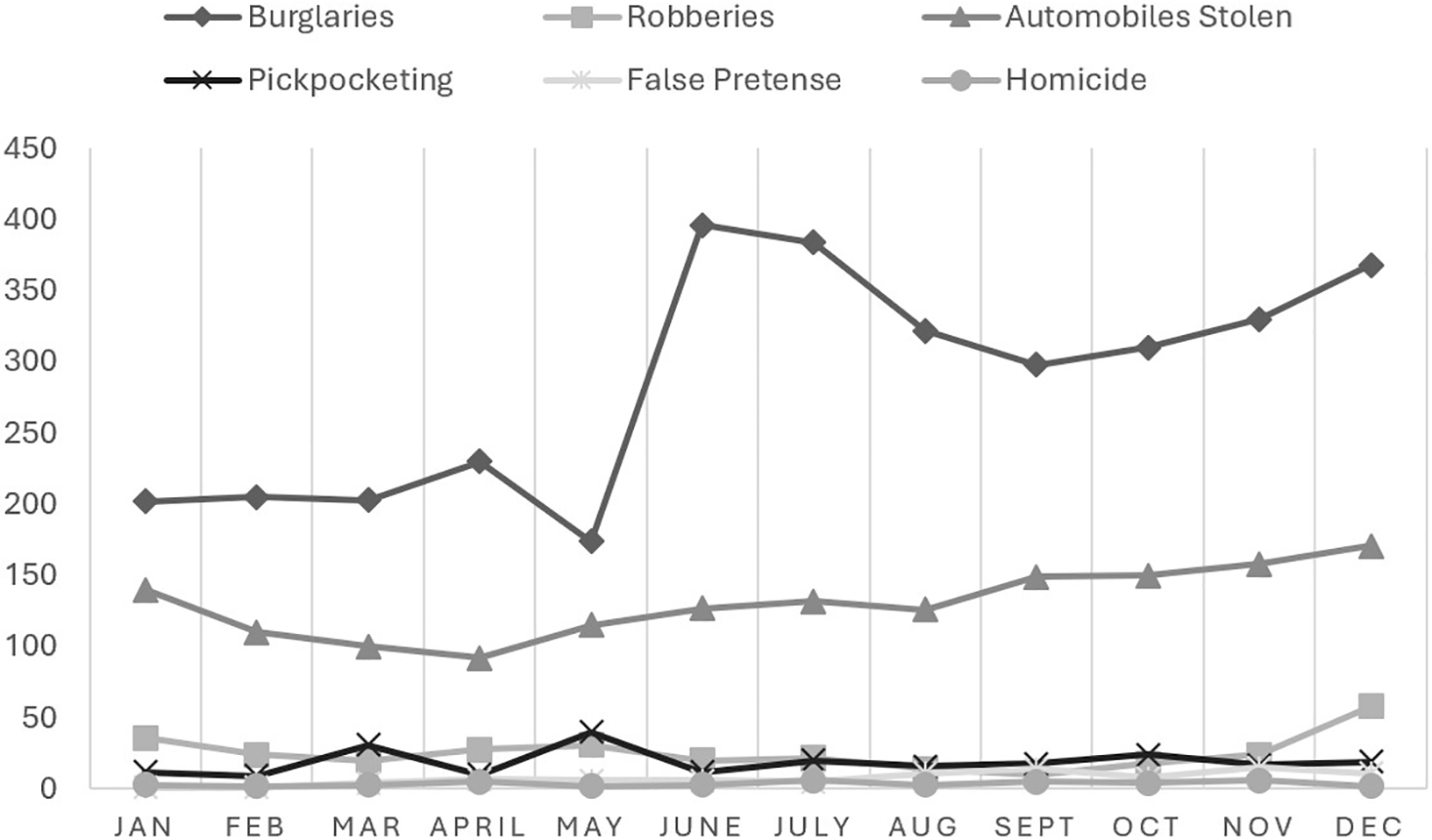
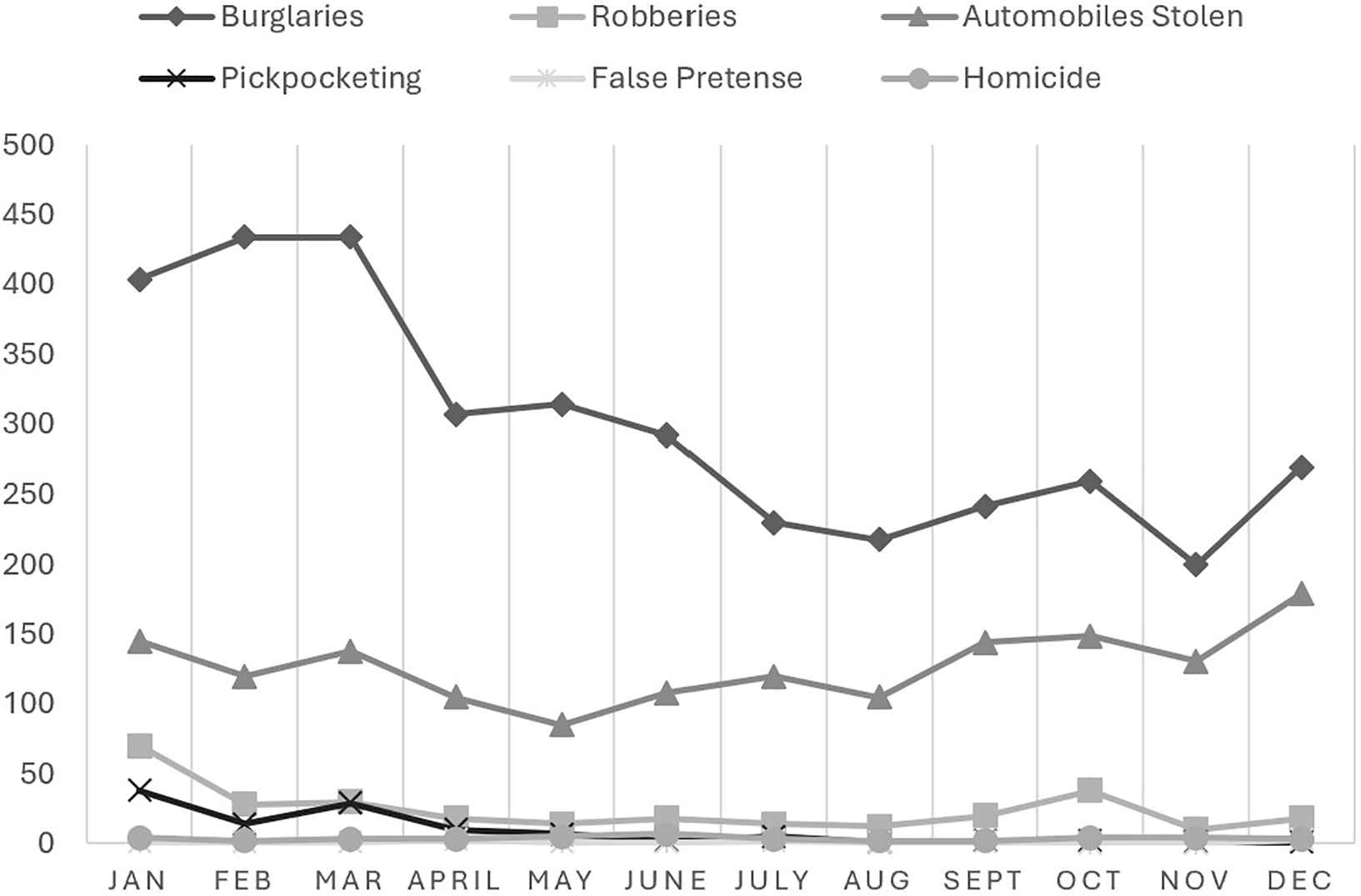
LAPD-reported crime data in 1917 and 1918 does not conclusively demonstrate a consistent increase in crime during the winter months (Figure 1). If any crime increased during winter months, it was reported burglaries—by far the most highly reported crime—but even then, this was not a consistent pattern. For example, in 1917, burglaries peaked in June. Rates then started to climb in December 1917 and continued a steady uptick until they peaked in February and March 1918 (Figure 2).Footnote 49 Stolen automobiles, the next most reported crime (but far lower than burglaries) peaked in December but started its downward trend immediately after. No other crime tracked by the LAPD (robberies, pickpocketing, false pretense, trick, and imposture, and homicide) ever rose above fifty-eight reported cases in 1917. These data show that some reported crimes did increase during winter months, but this was not consistent across all reported crime categories and in many cases the increase was negligible. The closest Los Angeles came to a “wave” of crime was burglary during the summer 1917 months and early winter months of 1918. Nevertheless, the press largely kept to the winter wave narrative.
Select Reported Crimes, 1917. There was not a consistent increase in crime during winter months in 1917. Burglary, the highest reported crime, peaked in June. Source: Annual Report, 1924, folder Police Department, 1924 B, box B-1061, Police Commission Records, Los Angeles City Archives, Los Angeles, CA, 1.

Select Reported Crimes, 1918. Crime did not increase in all categories during the winter months. Burglary continued to outpace all other types of reported crime. Source: Annual Report, 1924, folder Police Department, 1924 B, box B-1061,PDC/01.

The Postwar Crime Wave Moves West
On New Year’s Day 1919, Chief Butler wished his officers happy new year and reflected on the previous year’s victories: an officer wage increase and improved working conditions. But Butler also predicted that “The ending of the war will be characterized by an increase of crime and in the numerical strength of criminal agents.”Footnote 50 While the war had animated the best in some men, it had also brought out the “scum.” Echoing the fears of local politicians and their belief in an annual wave due to out-of-state migration, Butler warned his officers to keep a close eye on “idle men,” as the city “must be protected from vags and hobos.”Footnote 51
For most of 1919, crime remained a specter haunting European cities like Paris, which experienced an American soldier–led crime wave that was widely reported upon—and then debunked—by the American press.Footnote 52 Following the extensive Parisian crime wave coverage, major urban newspapers like the Chicago Tribune and New York Tribune featured criminal justice officials and academics who remained convinced of the inevitability of a postwar wave. Dr. F. Emory Lyons, founder of the prison oversight group, Central Howard Association, in Chicago, predicted a postwar crime wave.Footnote 53 A German criminologist urged readers to expect “a considerable increase in criminality in all the belligerent nations after the war.”Footnote 54 Back in LA County, Sheriff John C. Cline began training twenty-four gunmen to shoot from moving cars and in the dark to “offset the prospective crime wave which sometimes follows wars.”Footnote 55 While President Wilson remained in Paris to finalize the details of the Versailles Treaty, the New York Tribune observed that crime stories had already usurped coverage of the treaty negotiations, prompting the paper to ponder: “Is a wave of crime sweeping over New York, or is it the normal criminal class merely breaking into the front page of peace-time journalism?”Footnote 56 The rhetorical question reflected a demonstrable shift in press reporting in early 1919, as February saw a significant increase in the number of crime wave stories.
The LA press reported on Midwest crime waves with great interest. Like LA law enforcement, Midwestern police departments also used the wave to advocate for an increase in police labor. St. Louis police chief Martin O’Brien requested the hiring of 600 officers due to a citywide wave of crime.Footnote 57 Immediately after a series of high-profile hold-ups, including of the National Biscuit Company’s “pay wagon,” netting the stickup men $3,000, Cleveland’s police department enlisted the help of the American Protective League and hired fifty-four additional officers. Cleveland Mayor Harry Davis implored residents to avoid carrying cash or even keeping cash at home and instead to deposit it in a bank. He also requested an additional 200 officers to stop the supposed months-long crime wave.Footnote 58 Crime had apparently become so dire that the city’s police court held its first night session to process the massive number of cases.Footnote 59
By spring, LA newspapers acknowledged that “crime is on the increase in nearly every large city” due to the war, and published crime wave stories with vigor. Frederic J. Haskin, in a special correspondence with the Los Angeles Times, commented that “Psychologists have long been predicting a crime wave, and police chiefs now say it is here.”Footnote 60 But Richard Spillane, editor of the “Commerce and Finance” section, found reason to be hopeful, stating that the crime wave was “not so great as might be expected” and would soon “subside.”Footnote 61 But crime in the Midwest did not seem to be subsiding. In Minneapolis, after the Champlin State Bank was robbed, Chief J. F. Walker considered reassigning the traffic squad to prevent another nightly crime wave.Footnote 62 Chicago, long in headlines as a uniquely crime-prone city, succumbed to a wave that Chicago Police Department Chief J. J. Garrity called one of the “unavoidable post-war conditions.” The armistice had brought “scores of criminals, ex-convicts, and thugs” to the city, Garrity lamented, but he added that “Chicago’s record … is no different from that of any other large American city” and anticipated that crime would continue to increase in the coming months.Footnote 63 In April, a UP wire declared that a “WAVE OF CRIME IS SWEEPING BIG CITIES.”Footnote 64 In New York City, the wave continued “unabated” while Philadelphia reporters accused the city’s police department of “suppressing facts” after they claimed there was no crime increase. San Francisco’s Captain of Detectives Duncan Matheson stated that “No doubt there is a crime wave in the east due to post war conditions as reported. But this will not affect the [West] coast.”Footnote 65
Following previous trends, from early summer to fall, there was a precipitous drop in crime wave stories. In one of the few exceptions, a Los Angeles Times editorial in early June warned that “every community must be prepared to defend itself” as the wave “sweeps westward.”Footnote 66 Written in the immediate aftermath of a series of bombings by the left and the subsequent April passage of California’s Criminal Syndicalism Act criminalizing the Industrial Workers of the World (Wobblies, or IWW), the anonymous author connected the crime waves sweeping west to leftist political agitation: “Los Angeles is not immune. The seeds of radicalism and terrorism have been sown repeatedly here during the last two years.” It was, in the words of the author, “time that the law-abiding elements of the city prepare to protect our government from the dynamiters of the I.W.W.”Footnote 67 Fears of Wobbly violence and an errant editorial notwithstanding, LA County newspapers largely avoided whipping up a postwar crime wave hysteria during the summer and early fall months.
The “Drug Fiend” Hysteria
Since the new year, Los Angeles papers had published several articles following a disturbing trend: the increase in “drug fiends” looking for narcotics amid nationwide Prohibition. By the end of the year, the “drug fiend” narrative became the dominant explanation for the LA County crime wave. News from London in January warned that “Drug Peril Follows in Wake of Fighting,” as “shell-shocked” soldiers fell “ready victims to the subtle poison.”Footnote 68 New York Health Commissioner Dr. Royal S. Copeland estimated that “MILLIONS OF AMERICANS ARE DOPE FIENDS.”Footnote 69 As the country turned “dry,” Copeland predicted that cocaine would supplant alcohol as America’s next vice. The only way to forestall the spread of these “drug fiends” was through widespread surveillance, including identification cards with pictures, fingerprints, and other biometric information.Footnote 70 After reports that Japan was smuggling morphine and opium into China, the Commissioner to China for the Committee on Public Information warned that China “will soon become a nation of drug fiends.”Footnote 71 One Evening Express columnist suggested a macabre and punitive solution to the “drug fiend” problem:
Over in China, somewhat old-fashioned and set in its ways, traffic in opium was discouraged by the simple process of cutting off the heads of the traffickers. Of course, the enlightened American nation cannot go to such an extreme, but it ought to go just as near to it as possible.Footnote 72
Southern Californians debated whether Prohibition really was the cause of so much crime. One Hollywood resident claimed that “over 90 per cent [sic] of all crimes are caused by the liquor habit.” In his letter to the editor in the Los Angeles Times, Los Angeles native Philip Montgomery testified that the “Persons who prey upon society as gangsters, burglars, pickpockets and gunmen are far more likely to be bone-dry teetotalers or drug fiends.”Footnote 73
Fear and handwringing over the “drug fiend” phenomenon remained a national concern through the summer months, though not necessarily a local LA County crime concern. New York received the lion’s share of coverage, especially in July when Secretary of the Treasury Carter Glass formed a special committee on drug addiction with Representative Henry T. Rainey as its chairman. The committee estimated that there were up to 1.9 million “addicts” in the United States, though more realistically, the number was closer to one million. Although not able to determine definitively whether Prohibition was causing the rise in “drug fiends,” Rainey claimed that the number of addicts increased in “saloon territory.” “Drug addiction and saloons,” Rainey stated, “go along harmoniously hand in hand.”Footnote 74
By the fall months, the “drug fiend” problem became an LA County problem. In November, the Los Angeles Times published a long article that included mug shots and several illustrations of various burglaries and holdups. With interviews from LAPD officers and other officials, the Los Angeles Times embraced the LAPD narrative that the crime wave was due to drug users trying to get their “fix.”
Ninety-nine per cent of the present series of hold-ups, burglaries, armed robberies and other deeds of violence being committed nightly in this city and sometimes referred to as the “crime wave,” are the work of drug fiends seeking to get narcotics either directly or in order to secure money with which to buy them.Footnote 75
Like much of the Los Angeles Times’s crime wave coverage, the story served as a platform for the LAPD’s interpretation of local crime conditions, while also assuring residents that the wave was temporary and due to a specific criminal class.
The drug fiend crime wave narrative developed alongside a broader attack on recent state and federal legislation criminalizing specific drugs and alcohol. LAPD officials and the press claimed that strict enforcement of the state’s 1913 Poison Act criminalizing marijuana, the 1914 federal Harrison Narcotics Act banning recreational use of opiates and cocaine, and coming enforcement of national Prohibition fueled the crime wave by creating new classes of illegal substances. The criminalization and suppression of the sale of “liquid stimulants,” the Los Angeles Times argued, had “enormously increased the demand for narcotics.” So confident were LAPD officials in their drug fiend theory that Captain of Detectives Charles Moffatt predicted that crime would drop by 90 percent if you “Remove our 2,300 drug users from the city.”Footnote 76 The Los Angeles Times grasped for anything to support this theory. Days later, after “six Mexicans” were arrested carrying “several pounds of marahuana [sic] [and] a large number of articles of jewelry,” the Los Angeles Times claimed this supported the “‘crime wave’ theory.”Footnote 77
On the same day as the “six Mexicans” report, the “Most Daring Job in the City’s History” was carried out in Los Angeles.Footnote 78 Stealing $30,000 from the Union Square branch of Hellman Commercial Trust and Savings Bank, two of the “bank bandits” were led by a “drug fiend,” who, according to witnesses, acted like a “hop head.” In response, George K. Home, LAPD chief since July, organized “twenty-seven fast automobiles and ninety-one men [that] will be available at a moment’s notice.” Home hoped to make the units, which were stationed in the central part of the city, “available instantly” in order to handle “the bandit situation recently developed in conjunction with the crime wave.”Footnote 79 Home theorized that the crime wave was due to the “high price of dope,” though the types of crimes being committed spanned “everything from yesterday’s bank robbery to minor hold-ups.”Footnote 80 The Venice Evening Vanguard joked that criminals “Better go back again to the booze that makes a man unfit to do any good job at crime.”Footnote 81 But the jokes did not last.
By December, county newspapers and police officials were on the same page: a postwar crime wave had reached Los Angeles and Southern California. Evidence appeared everywhere; over the course of one night and early morning, nine holdups were committed, sending one person to the hospital. In response, Chief Home called up “Every available man” to fight “the crime wave that is sweeping over California.”Footnote 82 The crime wave narrative convinced Seventh-day Adventist Pastor Francis M. Wilcox from Washington, D.C., that the end times were near: “The Scriptures of truth plainly reveal that the last days will be marked with great moral and spiritual declension.”Footnote 83 Apparently, society was on that downward path.
The discernable shift in newspaper coverage in 1919 toward the general acceptance that Los Angeles was experiencing a crime wave did not shake the belief that law enforcement was effective in fighting crime. At the end of the year, the Los Angeles Times celebrated city and county law enforcement officials for “capably and convincingly demonstrating that lawbreakers do not thrive here [before the] predicted wave of crime in Los Angeles has even got well started.”Footnote 84 Local and county police were so efficient that “the so-called winter crime wave is much less severe here than in most other large cities.” Perhaps published prematurely, the author nevertheless declared that criminals “can’t succeed here.”Footnote 85
At the close of 1919 and one year since the armistice, there remained no consensus as to why American cities had supposedly descended into lawlessness. The weekly magazine Literary Digest tried to make sense of the ubiquitous crime wave reports coming from cities across the nation. While Los Angeles officials blamed drug fiends, Chicago suffered 300 homicides in the first eleven months of 1919. Some speculated that this was the result of the city dimming streetlights due to a coal shortage. One New York Evening Post reporter denied that wartime alcohol Prohibition contributed to the wave, and instead blamed the end of the war. In Portland, the Telegraph believed that “Speedy arrest, reasonable certainty of conviction, and an absolute surety that punishment will follow” would stem the wave.Footnote 86
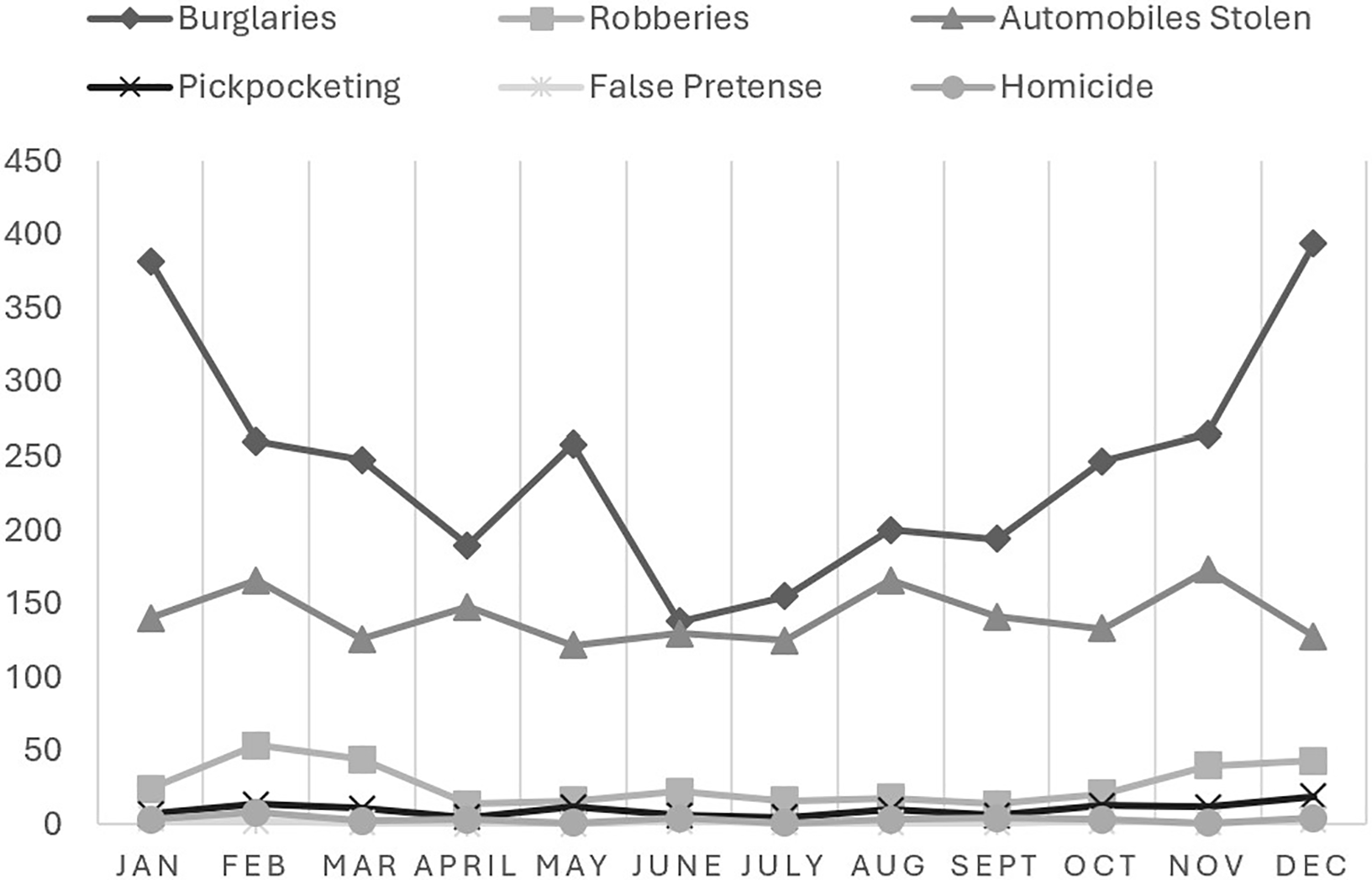
Once again, LAPD-reported crime data contradicted press and police crime wave narratives in 1919. For the third year in a row, property crimes—burglaries and stolen automobiles—were the two most highly reported. Burglaries peaked during winter months in January and December but were below 1918 levels.Footnote 87 Stolen automobiles defied the winter pattern and had far fewer fluctuations, peaking in February, August, and November.Footnote 88 Every other crime remained low, never reaching above fifty-four reported cases. If there was an increase in crime during the winter months, it was only burglary, and even then, rates were lower than the previous year (Figure 3). Hardly a crime wave on par with the frequency of reporting and widespread fear of a postwar wave as reported on in papers around the country.
Select Reported Crimes, 1919. While burglaries peaked in January and December, they were below 1918 levels, despite the increase in crime wave reporting. Source: Annual Report, 1924, folder Police Department, 1924 B, box B-1061, PDC/01.

The Postwar “Orgy of Criminality”
In 1920, crime waves garnered public attention and fierce speculation but remained detached from crime statistics. Coverage in Long Beach became so relentless that the chief of police suggested that newspapers should stop printing crime articles, no doubt due to departmental embarrassment.Footnote 89 But the Daily Telegram refused and one week later reported that the winter crime wave had peaked over the weekend after two hold-ups and eleven burglaries.Footnote 90 The Long Beach Press dubbed the increase in criminal activity an “orgy of criminality” and encouraged citizens to take a more active role in enforcing laws and for judges to embrace harsher sentencing.Footnote 91 While visiting Los Angeles, the head of the U.S. Secret Service, William J. Flynn, insisted that it was “not unusual” for urban crime rates to rise during winter months and that residents had “nothing to fear.”Footnote 92 Chief Home—unable to maintain his highly publicized drug fiend narrative—relied on the familiar theory that rising crime was due to the migration of “idle persons” from other states.Footnote 93 To combat the idle scourge and further entrench police power, Home used the state’s 1872 vagrancy law to its fullest potential by forming a “hobo squad” to round up any loitering, supposedly unemployed persons.Footnote 94
By late February and early March, newspaper coverage shifted blame for the crime wave to the end of the war and lenient sentencing laws. The Pomona Bulletin and Long Beach Daily Telegram gave ample space to the theories of New York City Detective Harry Dougherty and his brother George Dougherty, a former New York police commissioner and Pinkerton detective. Reflecting on his three-month tour of Europe, Harry claimed that “master criminals,” many of whom were veterans, were carrying out the “sensational crime wave … sweeping over the whole world.”Footnote 95 More punishment and harsher sentences were the only solution.Footnote 96 George echoed many of his brother’s observations. As he toured Southern California, the Telegram deemed postwar crime important enough to devote almost an entire page to a story written by “this modern Sherlock Holmes.”Footnote 97 George blamed discharged soldiers, movies, Prohibition, and automobiles for the wave. He also echoed Chief Home’s prior drug fiend narrative, claiming that “Over 70 per cent of confirmed criminals are addicts to the drug” (heroin, cocaine), but argued that 80 percent of major crimes and felonies were committed by novices, not “master criminals.”Footnote 98 To end the crime wave, citizens needed to “Encourage and boost the police.”Footnote 99 In sum, the Dougherty brothers offered little in the way of original analysis or inventive solutions. But they captured the confusion of the moment; no one could answer with any surety why crime seemed to be increasing—just that it was.
A nationwide postwar crime wave slamming into Southern California represented a clear threat to police power and legitimacy that Chief Home had to take seriously. Once again, crime wave narratives spurred a campaign for the hiring of more officers. In February, the LA City Council considered Chief Home’s plan to hire 300 officers “to halt the crime wave that has been sweeping Los Angeles.”Footnote 100 As with previous hiring initiatives, doing so required dipping into the city’s reserve fund to cover the estimated $36,000 in monthly salaries. The plan was taken seriously enough that Chairman of the Finance Committee O. P. Conaway wrote a letter to the city attorney inquiring how the council would go about drawing on the reserve fund, and even proposed selling a piece of property on Broadway to raise funds.Footnote 101 Mayor Snyder stood behind the proposal, arguing that raising the funds would not be that difficult and that the additional officers would only be needed for roughly three months since LA’s crime wave woes “probably will end with the return of summer.” “It is a fact,” Snyder continued, “that there is much less crime here in summer than in winter.”Footnote 102
In LA County, the postwar crime wave narrative remained tied to the regular, though transitory, seasonal wave of lawlessness. Publicly, Chief Home called for 300 more officers but almost certainly never expected such an unreasonable request to be fulfilled. Experience demonstrated that it was better to ask for a significant amount of new officers and settle at a more realistic number than to ask for only a couple of new recruits. Perhaps unsurprisingly, in mid-March the city council came back with a recommendation for twenty-five—not 300—additional officers with fourteen of the fifteen council members voting for the proposal. In his solitary vote against the plan, Ralph Criswell cited a local criminologist who echoed the mayor’s prediction that “winter’s crime wave was about at an end” and that the department could get by without even the twenty-five officers.Footnote 103 Officer strength and effectiveness notwithstanding, the Chamber forwarded a commendation to the Board of Police Commissioners recognizing the department “for the manner in which arrests have been made of robbers, criminals, etc. who have been engaged in hold-ups and bank robberies in Los Angeles during the past few weeks.”Footnote 104 Similar developments occurred in Long Beach as Chief James Butterfield believed that the worst of his city’s crime wave had passed, but he still dismissed eleven special officers to free up funding for more patrol officers.Footnote 105 Soon after, the Long Beach Police Departument (LBPD) also secured funding for an additional twenty-five officers to address a crime wave that the city believed was waning.Footnote 106
While LA County politicians and police remained optimistic that the winter wave was declining, residents expressed consternation about crime conditions. Laboring under the impression that Los Angeles was suffering from “a crime wave unprecedented in the annals of the city,” editorials and letters to the editor speculating about its causes flooded local newspapers.Footnote 107 One resident blamed the onset of Prohibition and the resulting unemployment of “bar boys” who could no longer ply their trade in saloons.Footnote 108 Another took exception to the theory, stating that it was actually the Anti-Saloon League who were—like the saloon owners—now out of business, since the federal ban on alcohol.Footnote 109 One Los Angeles Times reader labeled the wave a normal postwar condition. In the United States, the reader claimed, communities under Prohibition experienced less crime than liquor-selling areas.Footnote 110 Further reflecting the disagreements over the impact of nascent alcohol prohibition on postwar crime, the Daily Telegram quoted police chiefs from San Francisco to New York City, many of whom concluded that the Great Experiment had been “successful from a police view” in stemming crime, though the series of reports painted a more complicated picture. Some cities like San Francisco, St. Louis, Minneapolis, and Cleveland experienced decreases in criminal activity with a corresponding drop in arrests, while others like Minneapolis’s Twin City, St. Paul, Chicago, and New York City saw either no change, more crime but fewer arrests for drunkenness, or the persistence of more serious crimes.Footnote 111 Even with the lack of consensus, Prohibition and the end of the war remained a reliable, if somewhat unproven, explanation for a general public that grasped at anything to explain the postwar criminal condition afflicting American cities.
The LA press, politicians, and police all predicted that the crime wave would pass with winter. But in April, the LAPD announced that they had broken all previous arrest records. In fact, Chief Home’s ten-month tenure had been the most arrest-heavy period in the department’s history with 50,532 arrests. According to the Record, this total included 7,130 arrests in April, which, according to police opinion, broke the previous single-month arrest record set the previous April.Footnote 112 LAPD data dating back to 1916 demonstrates that while the April 1919 arrest number stood at 3,720, the April 1918 arrest rate eclipsed that total with 3,900 arrests.Footnote 113 In 1920, every type of crime except intoxication also increased, leading Chief Home to conclude that Prohibition “in no way” affected crime and that it was instead due to the “abrupt ending of the war,” dispensing of his drug fiend narrative for good.Footnote 114
Although Home admitted that the end of the war led to an increase in criminal activity in Los Angeles, he framed the wave as part of general postwar lawlessness afflicting the United States and Europe. A Los Angeles Times editorial defended Home and the LAPD while excoriating “overheated newspapers and reformers” for attacking the department. Worldwide newspaper coverage, the writer insisted, reveals that the “explosion caused by the war set this wave in motion,” but that it would “recede in due time.”Footnote 115 Unfortunately, the wave did not recede quickly enough; LAPD officer Donald Hathaway was shot and killed in late May while attempting to stop a robbery.Footnote 116 “Crime waves,” the Record’s eulogy lamented, “leave a wake of sorrow.” But the department’s April arrest records compelled the Evening Express to “commend the faithful, intelligent and energetic services” of Chief Home and the LAPD.Footnote 117
In May, arrest rates in LA County cities skyrocketed. The LAPD arrested 9,284 people—another department record, which added to Home’s record-breaking arrest total of 59,816 over his now eleven-month tenure. The Monrovia Daily News claimed that this eclipsed any previous eleven-month span by 20,276. Even drunkenness arrest rates increased, with 216 arrests. There were also seven homicides in Los Angeles in May alone.Footnote 118 These trends were replicated in the small (just over 13,000 residents according to the 1920 census) eastern LA County town of Pomona, where Police Chief A. W. Lyter reported to the city council that arrests more than doubled over the previous year, from 271 to 596.Footnote 119 However, Chief Lyter denied the existence of a crime wave and insisted that the increase was due to rising traffic violations and arrests since the department was taking a more proactive approach to traffic law enforcement. While arrests generally increased, intoxication arrests dropped, with their fiscal year totals going from fifteen in 1919, down to four in 1920.Footnote 120
As arrests spiked across numerous crime categories in the spring and summer, press crime wave coverage decreased as the LAPD fell into scandal. In March, Police Commissioners R. T. Burge and E. Clem Wilson announced an investigation into LAPD corruption. Charges against officers included protecting unsavory locations and individuals, like “gambling dens,” “disorderly houses and lewd women,” and known “confidence men” and “pickpockets.”Footnote 121 The Record continued the story in the summer months, detailing the “rotten, graft-ridden police” conditions afflicting the department. Holding Chief Home responsible for his corrupt officers, the Record encouraged Mayor Snyder to find a new chief if Home “cannot provide Los Angeles with a clean, decent and protective police administration.”Footnote 122 As Home clung to his position, the Los Angeles Times reported on a series of burglaries that appeared to confirm that there was “no evidence that the crime wave, which had been expected to recede during the summer, is on the ebb.”Footnote 123 The weekend spike in robberies experienced in July demonstrated a month-long trend. According to LAPD statistician L. W. Lyons, the city broke its one-month robbery record in July with 492—an increase of more than 200 percent over the previous July. But retrospective monthly data on reported robberies published by the LAPD years later revealed a different picture, with roughly fifteen reported robberies in 1919 and twenty-five in 1920. The 7,080 arrests in July 1920 also exceeded the previous July’s total by 68 percent. Like with previous crime wave narratives, Chief Home used the statistician’s report to demand more officers “before the advent of the winter months, when it is feared a crime wave will sweep over the city”—even as the Los Angeles Times claimed the city was already suffering a wave.Footnote 124
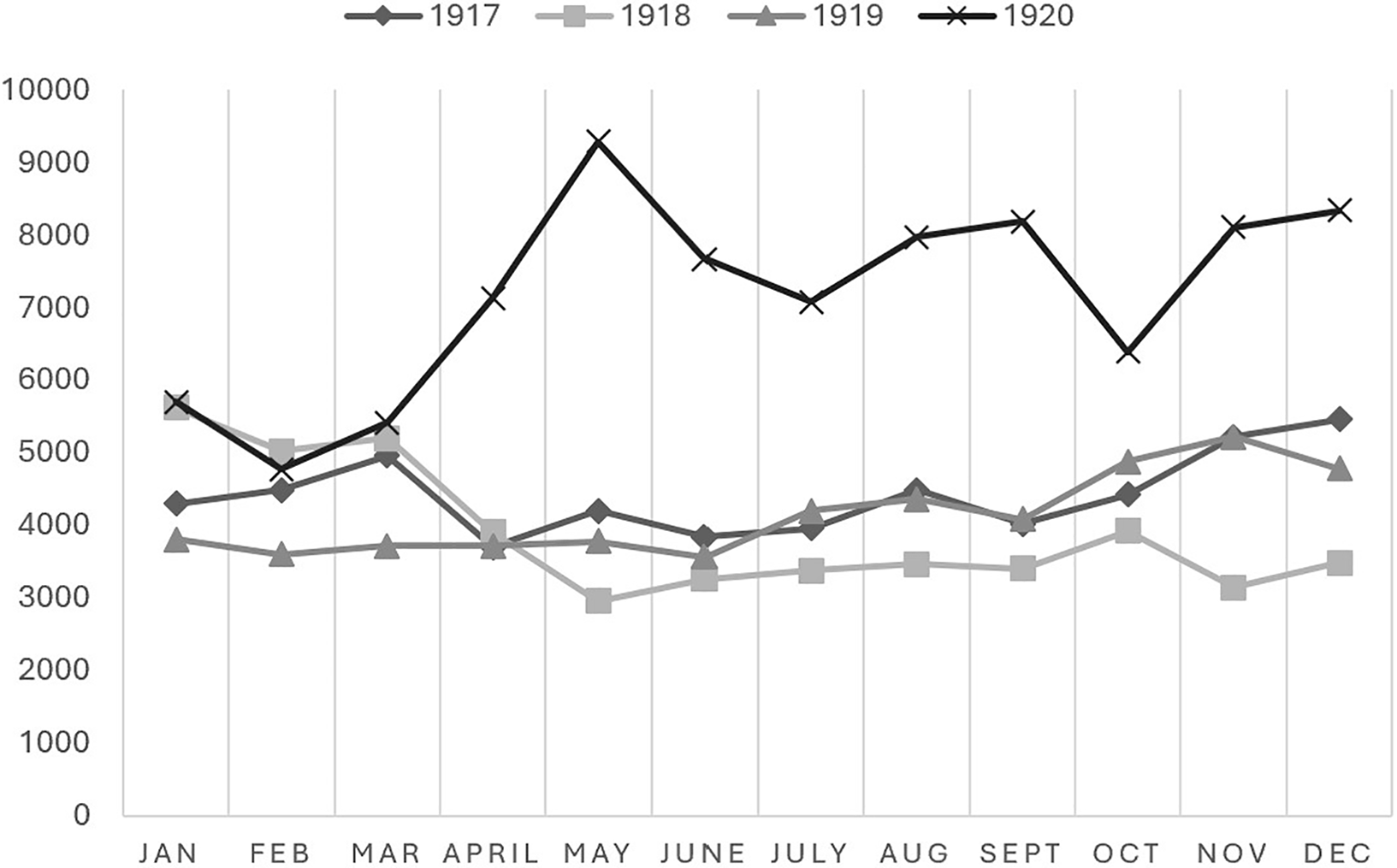
The year 1920 further revealed that there was not a direct correlation between crime, arrests, and press coverage. From 1917 to 1920, crime wave stories reached their peak during winter months, aligning with the theory that winter waves drove press coverage. Expectations assumed that high crime rates led to higher arrest rates and therefore more frequent press coverage. However, monthly arrest and reported crime data demonstrates that April 1920 represented a major point of disjuncture. Monthly arrests from 1917 to 1919 followed similar peaks and valleys, with almost no major deviations. Nineteen-twenty followed this trend from January to March until the major jump in arrests in April, only to be surpassed in May. For the rest of the year, arrests never dipped below their 1917, 1918, and 1919 totals. By this time, the accepted press and police narrative was that the crime wave was nationwide and persisting locally beyond the winter months. But Chief Home still stoked the fear of an impending winter crime wave even as some types of crime remained above their previous year’s levels (Figure 4).
LAPD Monthly Arrests, 1917–1920. Crime, arrests, and newspaper coverage were not necessarily correlated. Despite crime wave coverage peaking in winter months, monthly arrests dramatically increased in April 1920. Source: Annual Report, 1924, folder Police Department, 1924 B, box B-1061, PDC/01.

Chief Home’s high arrest numbers and persistent push for the hiring of more officers did not insulate him from accountability, and he resigned at the end of September. Speculation swirled around his departure, but the Record wrote a detailed breakdown of all the corruption charges associated with the “tedious farce” of Home’s administration, including the rehiring of corrupt and incompetent officers. Perhaps most importantly, the Record charged Home with allowing vice conditions in the city’s Chinatown district to flourish “UNDER the NOSES and WITH the CONNIVANCE of police.”Footnote 125 By October 1, Home was out as chief and within the next year was off to his new career in the Texas oil industry. Even after Home’s departure, the department remained fundamentally corrupt, with high turnover. It took until James E. Davis’s three-year tenure in 1926 for an LAPD chief to stay in the position for more than two consecutive years.Footnote 126 But police corruption proved difficult to excise until Chief William Parker’s sixteen-year tenure beginning in 1950.
As the department cycled through interim and short-term police chiefs, eventually choosing Lyle Pendegast in November 1920, press crime wave coverage followed brief yet sensationalized bursts of criminal activity in the fall months. In Hollywood, twenty robberies were committed on one night in early October.Footnote 127 Later that month, a group of “highwaymen” committed several robberies in as many hours as part of a weeks-long crime spree.Footnote 128 Looking at the crime situation, Fred B. Kutz, head of a local detective bureau, endorsed the seasonal migration narrative. Kutz predicted that criminals from the East Coast would bring “the greatest crime wave” in the region’s history in the coming winter.Footnote 129 But by November, according to statistician Lyons, the wave had “failed to materialize” in Los Angeles. Lyon’s report showed an increase in crimes, but not what the department considered a wave—as murky as that term remained. Details remained sketchy. Once again, the department blamed current crime rates on an “influx of itinerant criminals,” but predicted that a winter wave would not hit Los Angeles due to the proactive efforts of the police. Arrests between September and October even dipped (from 8,190 to 6,392) while the “purity squad,” tasked with enforcing vice laws, arrested 229 people in October.Footnote 130
While Lyons concluded that the city had not yet been hit by a crime wave, a Los Angeles Times survey of major cities, including New York, Philadelphia, and San Francisco, claimed that the entire nation was inundated by a wave of lawlessness. Captain of Detectives for the San Francisco Police Department reported that violent crimes had increased since Prohibition. Even in cities like Cleveland and Detroit where crime rates were generally decreasing, homicides continued to outpace previous years.Footnote 131 Secretary of the Committee on Prisons and Prison Labor blamed “profiteers” for the crime wave but assured readers that postwar crime waves were inevitable.Footnote 132 The general acceptance of a nationwide postwar crime wave did not convince everyone of Los Angeles’s unique position when compared to other cities. In her Evening Express column, Estelle Lawton Lindsey—the first woman elected to the LA City Council in 1915—admitted that while a crime wave had descended on the world since the end of the war, it was not “worse here than elsewhere.”Footnote 133 Even former president William Howard Taft weighed in, commenting that “Homicide, burglary and robbery are so frequent that notice of them loses sensational value.” While crime was a postwar condition, it was “humiliatingly inefficient” state courts and the lack of harsh sentencing that helped crime thrive.Footnote 134
While press interpretations about why crime seemed to be increasing proliferated nationwide, the press and police claimed that the crime situation in Los Angeles was dire. Crime was apparently so bad that the Los Angeles Times dubbed November “The most active [month] in the history of crime in Los Angeles.”Footnote 135 Lyons’s new report showed a spike in drunkenness arrests and burglaries.Footnote 136 The purity squad made 299 arrests in November and secured 255 convictions. Burglaries almost doubled over the previous year while total arrests for the month jumped 55 percent.Footnote 137 A decrease in murders remained the only silver lining. Lyons labeled the number of arrests—the third highest in the department’s history—as “remarkably high.”Footnote 138 What little faith existed that the city would be spared its annual winter wave were quickly dashed as press crime reporting reached its peak in December.
Since U.S. involvement in the Great War in 1917, there was no apt comparison to the frequency of the December 1920 newspaper crime wave coverage. Los Angeles papers published more than fifty crime wave stories in the month alone. Stories also featured more people advocating for harsher punishment and repeal of the state’s Indeterminate Sentence Law passed only three years prior. Even a Sunday School lesson argued that criminals could only be deterred by “a punishment so great.”Footnote 139 After a wave of violence in Northern California, including the shooting of three officers, the state legislature added repeal of the Indeterminate Sentence Law to the 1921 legislative calendar (the law survived until its replacement with the Determinant Sentencing Law in 1976).Footnote 140 Superintendent of the California Bureau of Criminal Identification C. S. Morrill blamed the increase in crime on paroled and probationary “criminals” while claiming that “all forms of crime have increased over 100 per cent in California in the past few months.”Footnote 141 As crime wave coverage captured more attention throughout the state, Los Angeles’s Business Men’s Co-Operative Association forwarded a resolution to the LA Police Commission urging “a more stringent enforcement of the law” to forestall a winter crime wave. Decrying the “laxity of enforcement,” the Association criticized the courts and sentencing laws for granting too much “sympathy to offenders of the law.”Footnote 142 Los Angeles city officials also came out more forcefully against supposedly lenient sentencing. Police Commissioner E. Clem Wilson claimed that Los Angeles was facing “one of the most horrible crime waves since the lawless days of the western gold rush,” and then drew a rosy picture of an era when horse thieves were hanged and suggested doubling the sentences for crimes like robbery and grand larceny. Despite Wilson’s sensational rhetoric, he nevertheless blamed the nationwide crime wave on unemployment due to “industrial readjustment.”Footnote 143
The emergence of a winter wave narrative prompted once again a significant expansion of police power in LA County. Long Beach passed an ordinance approving the immediate hiring of ten additional officers even as LBPD Commissioner W. M. Peek faced a recall effort.Footnote 144 Having already gathered 1,800 signatures, the petition, which ran in the Daily Telegram, invited Long Beach residents “to help clean incompetency out of the Police Department management, stop robberies and a wave of crime.”Footnote 145 After Los Angeles imposed a curfew prohibiting children in public places after 9 p.m., the LBPD encouraged citizens not to leave their homes “unoccupied” at night due to the high number of burglaries.Footnote 146 Meanwhile, the LAPD announced a campaign “to rid the city of crooks, tramps and undesirables.” Reorganizing the “hobo squad” (also referred to as the “riverbed squad” in reference to where many unhoused congregated), the department swept through arriving trains and boats searching for “known thieves, criminals of every type and vagrants.”Footnote 147 Within forty-eight hours, the squad had arrested “more than 150 vagrants and idlers.”Footnote 148 Throughout the city, the department also raided “the cheaper lodging houses” and rounded up seventy-six men while another officer in Lincoln Heights exchanged fire with two alleged burglars before arresting them.Footnote 149 Crime had gotten so bad that the Los Angeles chapter of the American Legion put their 10,000 members at the disposal of the police department. Mayor Snyder “very deeply appreciated” the request and started formulating ways to use the veterans in crime control efforts.Footnote 150
By the end of December, press crime wave reports from around the country reached fever pitch with no sign of abating. Reports from New York City detailed “a rapid succession of murders”; Chicago counted sixty unsolved murders for the year; Pittsburgh was inundated with “bold and successful robberies”; Minneapolis drafted ninety of their firemen into the police reserves to address their crime wave.Footnote 151 Long Beach residents purchased more than fifty pistols in a single week.Footnote 152 For the first time in so many years, California’s Republican Governor William Stephens—who had been targeted for assassination by leftist activists and then signed the state’s Criminal Syndicalism Act—refused to grant the customary Christmas pardons.Footnote 153 The crime wave was just too great.
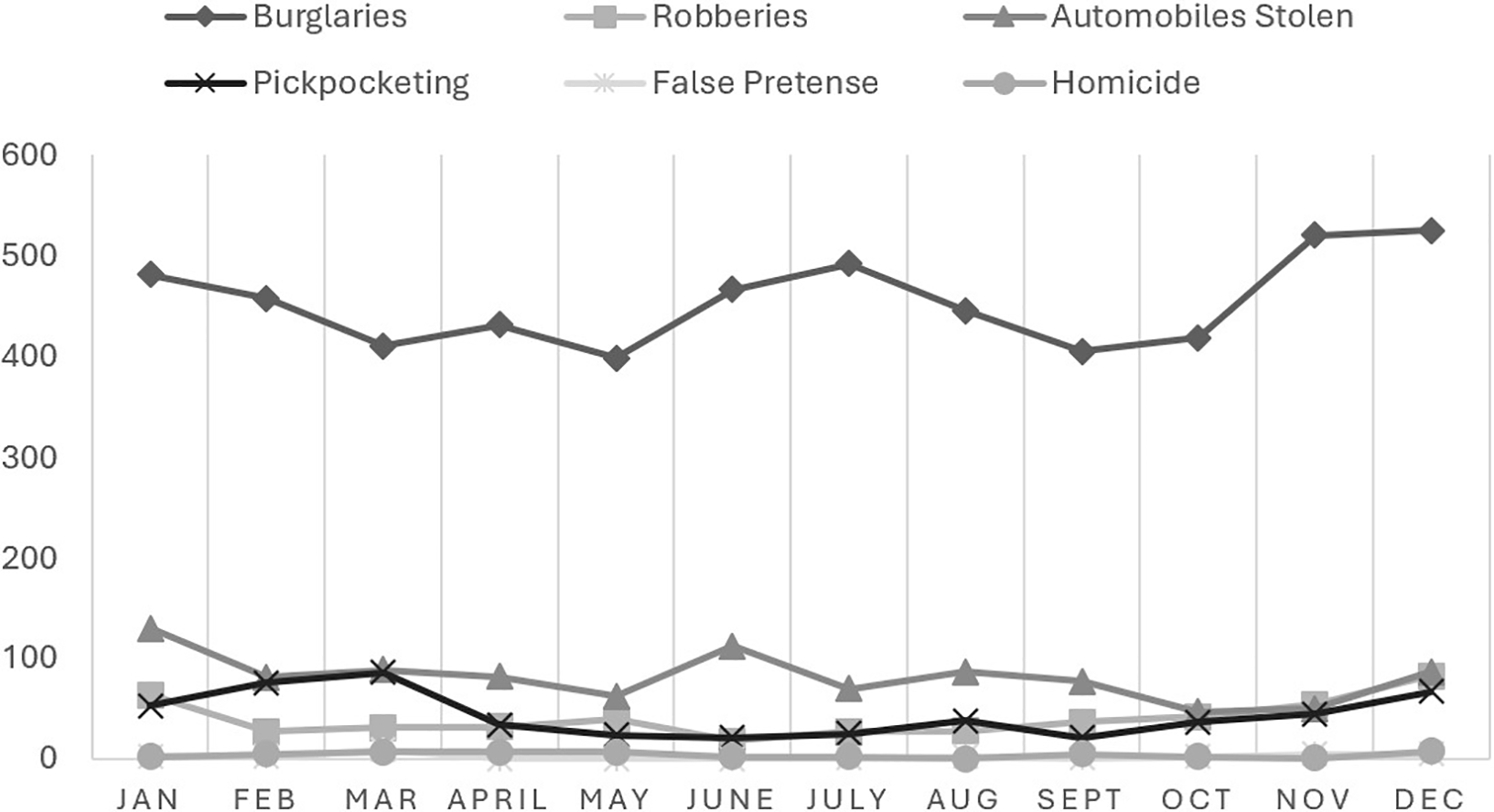
Reported crimes and available LAPD arrest and incarceration data are almost impossible to disaggregate from the fervent campaign of arrests the LAPD embarked upon in the spring and summer of 1920. Despite these methodological challenges, except for in March, reported burglaries for 1920 eclipsed the previous three years, reaching a high in December. Robberies peaked in December as well. Pickpocketing remained high from January until its peak in March. But in a reversal, automobile thefts were at their lowest rates in the four years sampled. Finally, except in December, homicides were highest from March to May, defying the winter wave narrative (Figure 5).
Select Reported Crimes, 1920. Most crimes increased in 1920, often during winter months. However, homicides peaked in spring months, and automobile thefts were the lowest of the four years sampled. Source: Annual Report, 1924, folder Police Department, 1924 B, box B-1061, PDC/01.

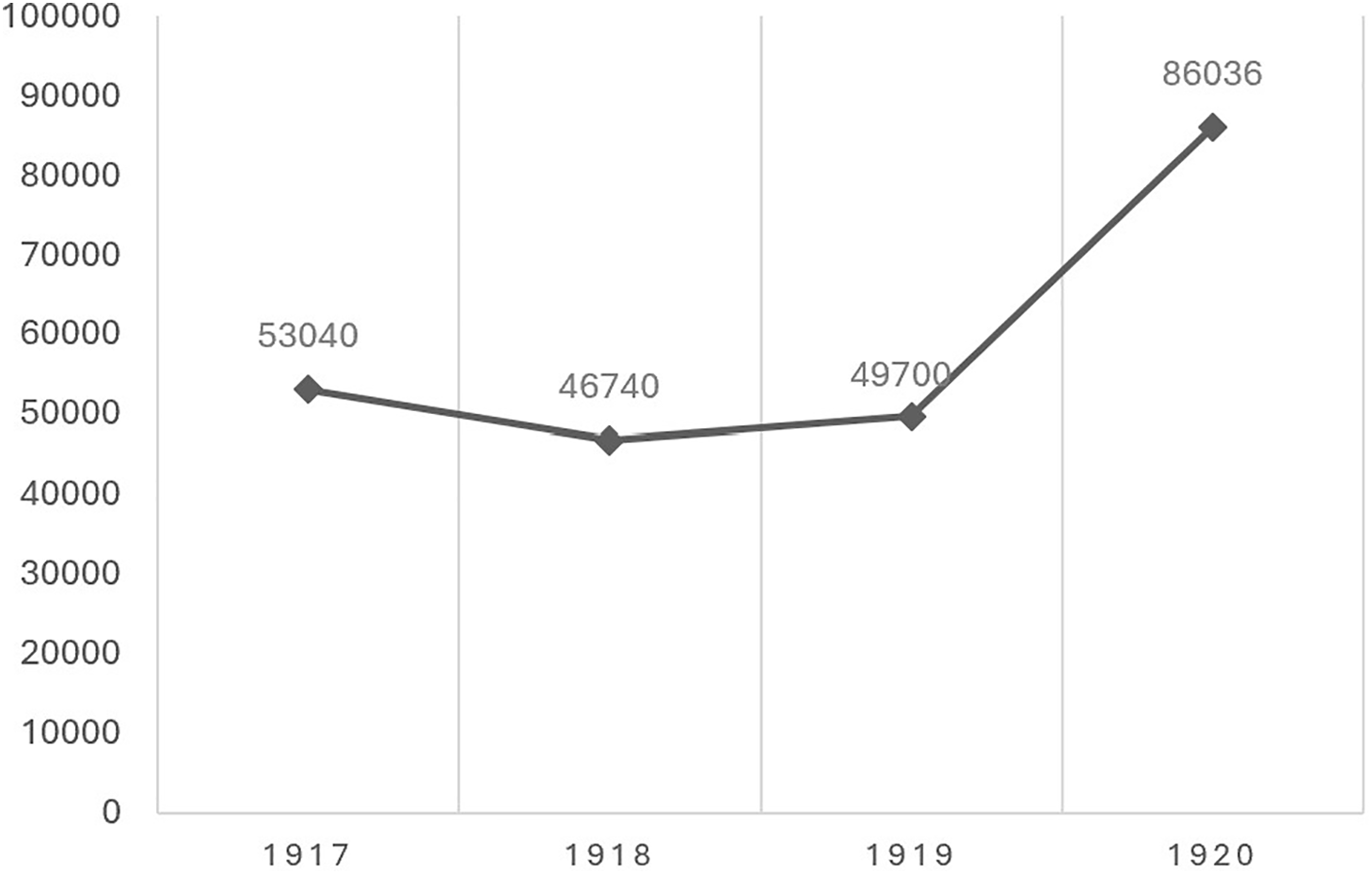
Arrests tracked almost perfectly with their 1918 levels from January to March, before skyrocketing to their highest point in May. In fact, from April to December, monthly arrest numbers often eclipsed 1919 rates by more than a thousand and sometimes by several thousand. Yearly arrest rates set a record in 1920, and these high rates of arrest continued into the mid-1920s. Alongside the massive increase in arrests, there was also a 28 percent increase in the number of felons and misdemeanants taken in by the LAPD between fiscal years 1919–1920 and 1920–1921, when data was available.Footnote 154 The general, though inconsistent, increase in reported crime developed alongside a massive increase in arrests beginning in April 1920. The trend of heavy enforcement and high arrests is further supported by a general rise in fines and forfeitures taken in by Los Angeles’s five police courts. During fiscal year 1915–1916, for example, LA police courts collected $88,845.50 in fines. In 1917–1918, the next year when data was available, the courts took in $195,168.50, an increase of 119 percent. The next fiscal year, 1919–1920, fines collected jumped to $364,055, an 86-percent increase. A similar trend followed in Long Beach during the 1919–1920 fiscal year, as its police court took in $18,862.50, which the Long Beach Press remarked was “almost double” the previous year’s total.Footnote 155 In Pomona, police court fines for the month of June, at the end of the fiscal year, was “the largest amount ever collected in fines during a single month in the city’s history.”Footnote 156 For both Long Beach and Pomona, these records appear to be almost entirely due to the heavy policing of traffic laws.Footnote 157 Taken together, while reported burglaries were higher than previous years, police enforcement and the vast exercise of police power better account for the trends of high arrests and police court forfeitures, rather than a society-wide crime wave as portrayed in local newspapers.
Arrests for all Causes, 1917–1920. Arrests set new records in 1920, a trend that would continue into the 1920s. Source: Annual Report, 1924, folder Police Department, 1924 B, box B-1061, PDC/01.

Breaking the (Crime) Waves
On Christmas Eve 1920, the Long Beach Press painted a graven image of the United States two years after the armistice: “The ghastly chroniclings [sic] of crime in the daily press dispatches go on unchecked. Murders by scores, even by hundreds, have occurred in some of the larger cities in the last few months. Daring robberies and hold-ups are frightfully numerous.”Footnote 158 The columnist insisted that there was only one solution to the spread of criminality: “the law, and those who are considered the enforcers of the law.”Footnote 159 Emboldened by the narrative that society was facing an unprecedented postwar crime wave, law enforcement flexed its power in 1921. Shortly after the new year, in “his first step in cleaning up Los Angeles,” Chief Pendegast combined the Metropolitan, Chinatown, and “hobo” squads into a new “Morals” squad.Footnote 160 That month, the LAPD secured 8,802 arrests, a 45 percent increase over the previous January, and a department record for January arrests.Footnote 161 In spring, the Record reported that the LAPD was launching a “war on L.A. vice” with yet another restructuring of its forces. Reorganizing the purity squad, Chief Pendegast formed a “dip” squad to police pickpocketing and a highly clandestine “secret service squad” independent of the purity squad. Charged with “running down gamblers, bootleggers and underworld characters,” the new squad members’ names would “never appear in police records or otherwise be known.”Footnote 162 By the end of 1921, prompted once again by a reported crime wave that left two officers dead, the LAPD won a 200-officer increase. “It is a pity that it took the killing of two noble, heroic policemen to awaken the Council to the necessity of increasing the police department as a means of stopping the present crime wave,” stated councilman William C. Mushet of the finance committee.Footnote 163 Eventually, this was bumped to 355 additional officers, a 50-percent increase in departmental forces.Footnote 164
Examining press crime wave narratives following the end of the Great War reveals several significant trends in the history of policing and crime. First, press crime wave narratives drove local police institutional development and increased police power during a period of widespread corruption and lack of professionalization. LAPD police chiefs sought to address rising crime—whether real or perceived—not out of a commitment to police professionalism but self-interest and political survival. When the LAPD and other LA County police departments won an officer increase, reorganized their special squads, and imposed curfews, local press crime wave narratives served as the catalyst. These developments allowed local law enforcement to wage public campaigns against crime, vice, and shiftless migrants to demonstrate that they were doing everything to stem the rising tide of lawlessness. Second, newspapers, despite their ideological persuasions, had remarkably consistent crime wave coverage. When one paper reported that crime was rising—whether quoting police sources or not—other papers often echoed these claims. Even when papers like the labor-friendly Record campaigned against police corruption, they still contributed to crime wave narratives propagated by more conservative papers like the Los Angeles Times. Third, there was an identifiable and palpable fear that crime was a winter phenomenon and driven by people who did not align with the industrious, white, and Protestant population of the city. Out-of-state newcomers, destitute and unhoused people, migrant laborers, Mexicans, and even veterans served as effective fearmongering fuel for local papers and law enforcement to claim a current or impending crime wave. But even then, these narratives were remarkably malleable due to the era’s ever-changing explanations for crime and its causes. Finally, though some reported crimes did increase after the Great War, criminal behavior in LA County did not spike in every crime category. Burglary, the highest reported crime each year, for example, was higher in 1918 than in 1919. While burglary was highest in 1920, other reported crimes were at some of their lowest levels of the immediate postwar era. Even then, any spikes in criminal offending must be contextualized alongside Los Angeles’s sizable 27-percent population increase between 1917 and 1920.Footnote 165
Analyzing the dynamic interplay between the press, police, and local politics in post–Great War LA County reveals the contingency behind police professionalism and reform. It also demonstrates that press crime wave narratives shaped police institutional development and power during an era when law enforcement and political corruption remained stubborn and the police unprofessional. Professional or not, LA County law enforcement were expected to break the crime waves after the Great War. The press ensured they were powerful enough to do so.

 Open access

