

INTRODUCTION
Past historical research on Guizhou, a mountainous southwestern province heavily inhabited by non–Han Chinese ethnic minorities, has focused on its historical relationship with the central government before and after it became a Chinese province in the fifteenth century, as well as the rebellion of the Miao or other indigenous peoples after the replacement of local chieftains with regular imperial bureaucracy (gaitu gui liu 改土歸流) in the early eighteenth century.Footnote 1 Overall, the study of Chinese borderlands is dominated by ethnicity, colonization, and the role of the state, e.g., administrative expansion, policymaking, and the Confucian civilizing project.Footnote 2 At the same time, the discussion of Qing intellectual history has paid considerable attention to the academic communities and intellectual schools in lower Yangtze provinces such as Jiangsu or Zhejiang, which had long been well-known for flourishing culture, and indeed produced the largest number of degree holders and influential scholars in the Qing dynasty.Footnote 3 Past research has focused on the “shift” of late Qing scholars during the Daoguang reign (1821–50): the reassertion of Neo-Confucianism (lixue 理學), the rise of statecraft studies (jingshi 經世) and reformism, along with the decline of scholasticism.Footnote 4 Authors of these studies believed that evidential research (kaozheng 考證), the very essence of Qing scholarship, had reached an end during the Jiaqing-Daoguang years, and that most scholars had focused on prose writing or trivial studies of philology before Gong Zizhen 龔自珍 (1792–1841) and Wei Yuan 魏源 (1794–1857) advocated Modern Text learning (Jinwen jingxue 今文經學) and engaged in statecraft and frontier historical geography.Footnote 5
Guizhou's position in late Qing intellectual history merits more attention. In his brief review of Qing intellectual history, the late Qing classical scholar Liu Shipei 劉師培 (1884–1919) coined a term, Qianzhong xuepai 黔中學派 (Guizhou Academic School), to indicate four leading scholars in Zunyi 遵義 of northern Guizhou: philologist Mo Yuchou 莫與儔 (1763–1841), classist, philologist, and poet Zheng Zhen 鄭珍 (1806–64); bibliographer Mo Youzhi 莫友芝 (1811–71); and diplomat Li Shuchang 黎庶昌 (1837–97); seeing them as a distinctive group that upheld the approaches of classical philology and emendation (jiaokan 校勘), i.e. “minor learning” (xiaoxue 小學), to delve into the exegesis of classics in the late Qing.Footnote 6 The leading figure of the group, Zheng Zhen was best known for his accomplishment in poetry composition, which was lauded by late Qing scholar Xu Ke 徐珂 (1869–1928).Footnote 7 Zheng was also known for his study of the missing characters in the process of recopying and reprinting the Han Dynasty classic Analysis of Characters as an Explanation of Writing (Shuowen jiezi 說文解字), titled Missing Characters in Analysis of Characters as an Explanation of Writing (Shuowen yizi 說文逸字), and his careful emendation and exegesis of Etiquette and Ceremonial (Yili 儀禮), which was a “list of rituals,” according to Feng Youlan 馮友蘭.Footnote 8 Zheng Zhen enjoyed such a national reputation that when the famous late Qing official Zheng Xiaoxu 鄭孝胥 (1860–1938) , who was not related to Zheng Zhen, met with the nephew of Li Shuchang in Yokohama, Japan, in June 1891, he immediately inquired about Li's relationship to Zheng Zhen. In a poem written in October 1891, Zheng Xiaoxu praised Zheng Zhen as possessing “astounding talent and fame in the Daoguang and Xianfeng years” (i.e. 1821–61), and he borrowed Zheng Zhen's collection of poetry to read in 1892 in Beijing.Footnote 9
My research demonstrates how these late Qing northern Guizhou scholars, whose scholarship was also known as “Shatan 沙灘 Culture” in China (named after the village where the Li clan lived), interacted with evidential research scholars from other provinces and continued their persistent inquiry into historical philology, canonical exegesis, ancient institutions, and local conditions, as well as its final fusion with statecraft.Footnote 10 According to J.D. Schmidt, Zheng Zhen never mentioned any of the members of the Changzhou School of Modern Text Confucianism.Footnote 11 I agree with Schmidt that the significance of the Changzhou School was elevated because of its connection with late Qing reformism, especially when we look at Qing Chinese culture from the perspective of Zunyi.Footnote 12 The Shatan scholars, whose endeavors covered a broad academic range, including philology, phonology, ancient philosophy, institutions, technology, bibliography, and local history, and extending to an understanding of foreign cultures, provided an alternative, in that they were more committed to concrete scholarly activities and excavation of ancient and local knowledge. At the same time, they also demonstrated an implicit yet deep concern with social reality.Footnote 13
This article thus fills the gap between intellectual history and studies on late imperial Chinese borderlands, demonstrating how the evidential research interests and methodologies of the Ancient Text school of Han Learning (Guwen jingxue古文經學) was transmitted into late Qing Guizhou through a network of local and outside scholars; how Zheng Zhen pursued research on philology, classical studies, and ancient institutions in northern Guizhou; and how he and Mo Youzhi applied the method of evidential research to local geography and history.Footnote 14 I argue that what united and distinguished the Shatan group was a spirit of evidential research, which had been epitomized at an earlier time by scholars such as Jiang Yong 江永 (1681–1762), Dai Zhen 戴震 (1724–77), and Qian Daxin 錢大昕 (1728–1804).Footnote 15 Eventually, the spirit of the Shatan group bore fruit in Li Shuchang, who became an influential modern reformer and diplomat. This article also revisits Guizhou as a robust site of cultural and intellectual exchanges, rather than merely an object of “Chinese conquest and occupation.”Footnote 16
ZHENG ZHEN AND HIS TRANSREGIONAL INTELLECTUAL NETWORK
It is important to position the Shatan scholars in their political and social context and to see the rise of the Shatan group as an outcome of intellectual transmission and exchange through trans-local networks of scholars.Footnote 17 Zheng Zhen and Mo Youzhi were born into a time when not only Han Learning seemingly disintegrated, but also the Qing Empire turned from the internal disorders and reforms of the Jiaqing reign (1796–1820) to foreign invasions starting from the Daoguang period.Footnote 18 All Shatan scholars were the descendants of immigrants who came to Guizhou from other provinces during the Ming period and were later related to each other through a nexus of kinship ties, teacher-student relationships, and friendship. During the Wanli reign of the late Ming dynasty, the Li family migrated to northern Guizhou from Sichuan. In the Qing period, Li Anli 黎安理 (1751–1819) became a degree holder and served later in his life as a district magistrate in Shandong province from 1813 to 1816.Footnote 19 In Zunyi Prefectural Gazetteer (Zunyi fuzhi 遵義府誌), Zheng Zhen and Mo Youzhi portrayed Li Anli as a “master of the Classic of Changes (Yijing 易經) fond of talking about moral meanings and principles (yili 義理).”Footnote 20 Li Anli's third daughter was Zheng Zhen's mother, who deeply influenced Zheng's moral character with her own highly regarded moral integrity.Footnote 21 Zheng Zhen's ancestor also moved to Guizhou during the Wanli reign: a general who stayed on after suppressing the Bozhou 播州 rebellion near today's Zunyi. His father was a hermit-style local doctor and poet. Academically, Zheng Zhen first learned from his maternal uncle Li Xun 黎洵, who earned the metropolitan degree during the Jiaqing reign and served as a district magistrate in Zhejiang province, where he interacted with many local literati, discussing state affairs and playing musical instruments.Footnote 22 Li Xun returned to Guizhou to mourn the death of Li Anli, and when his mother died in 1822, Li Xun decided not to pursue an official career any longer but stayed in his hometown because he felt that there was no one he needed to bring glory to. He shipped all his books back to Zunyi to build a private library, for he felt that Zunyi's culture was backward. This library largely facilitated Zheng Zhen's reading and scholarly studies. With the arrangement of his parents and his maternal uncle Li Xun, Zheng Zhen married Li's eldest daughter, and thus he was not only Li's disciple and his nephew but also his son-in-law. Li Shuchang, a son of Li Xun's younger brother, Li Kai 黎愷 (1788–1844), was the youngest among the talented trio of Zheng, Mo, and Li.
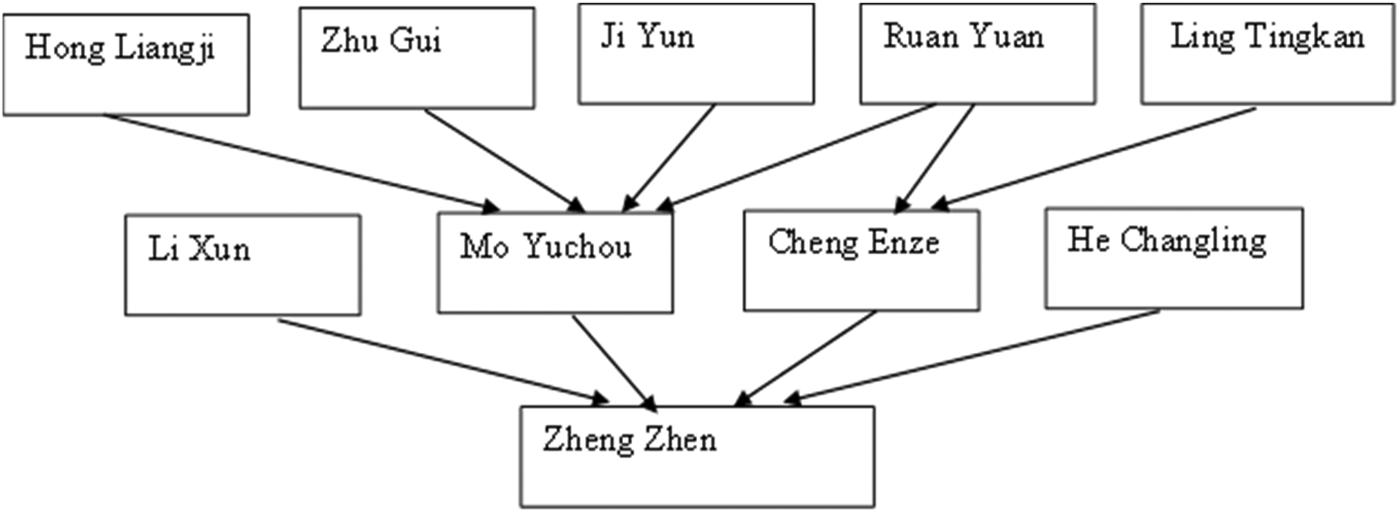
Intellectually, Zheng Zhen’s learning conflated Han Learning and Song Learning. His first mentor, Li Xun, was devoted to the Song philosophers' interpretation of the Confucian canons, as well as Zhu Xi's historical criticism in Outline and Details of the “Comprehensive Mirror to Aid in Government” (Tongjian gangmu 通鑒綱目).Footnote 23 Li Xun ingrained the moral values of Song Learning into the mind of youthful Zheng Zhen, who spent several years immersing himself in the study of the famous five masters of the Song dynasty and practiced their values by pursuing self-cultivation and serving his parents filially. The scholar who formally supervised the academic study of Zheng Zhen was Mo Youzhi's father, Mo Yuchou, from southern Guizhou, whose ancestors were originally from Jiangsu province. Just like the ancestor of Zheng Zhen, the Mo clan stayed in Guizhou after suppressing a Miao insurgency in the Ming period. A jinshi degree holder of the class of 1799, Mo Yuchou studied under leading Han Learning scholars Zhu Gui 朱珪 (1731–1807), Hong Liangji 洪亮吉 (1746–1809), Ji Yun 紀昀 (1724–1805), and Ruan Yuan 阮元 (1764–1849) for three years in the Hanlin Academy in Beijing before he was appointed as a sub-prefect magistrate in Sichuan and eventually returned to Guizhou.Footnote 24 Mo Yuchou redirected Zheng Zhen to Han Learning. In Intellectual Biographies of the Qing Confucian Scholars (Qingru xue'an 清儒學案), Xu Shichang 徐世昌 (1855–1939) highlighted the genealogy from Mo Yuchou to Zheng Zhen when he wrote:
The empirical scholarship in Guizhou was first founded by Mo Youren (Yuchou) and expanded by Zheng Zhen, who deeply inquired into the learning of Xu Shen 許慎 (58–147) and Zheng Xuan 鄭玄 (127–200), yet did not depart from Cheng Yi 程頤 (1033–1107) and Zhu Xi 朱熹 (1130–1200). Zheng Zhen was a master of the Three Ritual Classics (sanli 三禮) and Six Forms of Characters (liushu 六書). With an abundance of works and correct principles, he was recommended by the prestigious late Qing statesman and Neo-Confucianist Zeng Guofan 曾國藩 (1811–72) as a giant-like Confucian scholar in Southwest China.Footnote 25
Zheng Zhen admired Zheng Xuan's scholarship as a Han Learning master, revering Zheng Xuan (no relation) as if he was his remote ancestor. In his intellectual biography of Zheng Xuan, completed in 1859, Zheng Zhen seemed to have been fully convinced that Zheng Xuan had decisively debunked the Modern Text scholar of Later Han, He Xiu 何休.Footnote 26 This intellectual biography was extolled by late Qing scholar Li Ciming 李慈銘 as a “thorough and solid” work that expressed Zheng Zhen's “whole-hearted admiration” of Zheng Xuan's methodology.Footnote 27
In his epitaph dedicated to Mo Yuchou, the late Qing statesman Zeng Guofan emphasized the mentoring relationship between Mo and Ruan Yuan, who was extolled by Hu Shi 胡適 as the “patron god of Dai Zhen's scholarship.”Footnote 28 Zeng also put the scholarship of Mo in the contemporary cultural context, when Han Learning was consciously promoted and pushed to a high point by the Jiaqing emperor. Zeng noted that although the prestige of Mo Yuchou was not as high as another classicist and evidential scholar, Wang Yinzhi 王引之 (1766–1834), the main contribution of Mo was his propagation of classical learning in such a peripheral region as Guizhou.Footnote 29 Indeed, after serving as district magistrate in different locations, Mo Yuchou returned to his hometown in southern Guizhou's Dushan 獨山 district to mourn the death of his father and to attend to his mother in 1804. He spent more than ten years running his private academy and teaching local students until 1822, when he was appointed as professor of Zunyi Prefectural Academy. In Zunyi, his reputation as an important local scholar attracted many students, to whom Mo taught classics and philology. In that the same year, Zheng Zhen first met Mo Yuchou's fifth son Mo Youzhi, both of whom studied under Mo Yuchou, and mastered Han evidential research and philology.Footnote 30 Zheng Zhen and Mo Youzhi became classmates and remained life-long friends and academic collaborators.
The epitaph for Mo Yuchou written by Zeng Guofan reveals how Han Learning was spread from Beijing to the southwest borderland. An affinity between the academic trend of Guizhou and that of Guangdong was perceived by Liu Shipei, who found that both Lingnan (Guangdong) and Guizhou were committed to more exact scholarship such as philology, bibliography, and emendation, in contrast with the Changzhou School's concern with statecraft and its belief in the grand historical theory of three ages: the chaotic age, the age of rising peace, and the age of perpetual peace.Footnote 31 By linking Guangdong to Guizhou, Liu Shipei hinted at the shared approaches between the two geographically distant provinces, but he failed to mention the pivotal role of Ruan Yuan, known as a leading Han Learning scholar as well as an academic organizer who founded the Xuehaitang 學海堂 (Sea of Learning Hall) Academy in Guangzhou in 1820, after he patronized the reprinting of the famous Annotation of the Thirteen Classics (Shisan jing zhushu 十三經注疏).Footnote 32
The local scholars' sojourning outside of the province was complemented by the active exchange between Guizhou and other provinces through the appointment of scholar-officials. These people included the Jiangsu native Hong Liangji, Anhui native Cheng Enze 程恩澤 (1785–1837), and Hunanese statecraft scholar-official He Changling 賀長齡 (1785–1848). Hong Liangji was one of the first persons who seriously promoted classical scholarship in Guizhou after he took his appointment in 1792 as director of education in the province. According to the Qing scholar Jiang Fan 江藩 (1761–1831), “Guizhou was distant and peripheral, [and] there were no books. [Hong] purchased classics, histories, and selected essays and placed them in prefectural academies. Guizhou people began to love antiquity [because of] his teaching.”Footnote 33
Cheng Enze, the director of education in Guizhou beginning in 1825, became Zheng Zhen's second Han Learning mentor. As with Mo Yuchou, Cheng Enze also highly recommended to Zheng Zhen the scholarship of Han Learning, urging him to further delve into historical philology to pursue the exegesis of classics when they saw each other for the last time in 1835.Footnote 34 Cheng Enze himself mastered the knowledge of astronomy, geography, calligraphy, epigraphy, and etymology, and among his other writings was a study of the names of the places mentioned in the Intrigues of the Warring States (Zhanguo ce 戰國策).Footnote 35 While he worked as a complier of the Hanlin Academy, Cheng became an intimate friend of Ruan Yuan.Footnote 36 Cheng had also studied classics under Ruan's friend, a leading classicist, Ling Tingkan 淩廷堪 (1757–1809), also an Anhui native and known for his broad learning on subjects including historical geography, the evolution of the official ranking system, and music, and his in-depth research on the classics of rituals.Footnote 37 While sojourning in Yangzhou, Ling engaged in frequent academic discussions with Ruan Yuan.Footnote 38 Convinced that “rituals” were fundamental and omnipotent, and could be used to replace the metaphysical “principle” advocated by Zhu Xi, Ling Tingkan spent twenty-two years completing his major work, titled Exegesis of the Book of Rit es with Examples (Lijing shili 禮經釋例), which focused on Etiquette and Ceremonial.Footnote 39
With Cheng's introduction of the scholarship of Later Han classists Xu Shen and Zheng Xuan, Zheng Zhen started to embark on the study of philology and the “Three Ritual Classics”: Rit es of Zhou (Zhouli 周禮), Etiquette and Ceremonial, and Book of Rites (Liji 禮記).Footnote 40 In his reminiscence, Zheng Zhen confirmed that Cheng Enze's articulation of opinions was far more solid than “the scholars of the Song and the Ming who relied merely on speculation.”Footnote 41 Liang Qichao was simplistic when he attributed the rise of Han Learning in Guizhou solely to Cheng Enze without mentioning Mo Yuchou: “Since ancient times, Guizhou had been remote and isolated. (Yet) after Cheng Chunhai (Enze) was appointed as Director of Education in Guizhou, he promoted Han Learning, and thus Mo Youzhi from Dushan and Zheng Zhen from Zunyi rose to prominence. Both mastered philology and excelled at emendation.”Footnote 42 Yet Liang was correct in pointing out the indispensable guiding role of Cheng Enze.
Disentangling these intellectual genealogies and networks reveals how classical scholarship spread to Guizhou and how late Qing Guizhou's intellectual climate was closely related to the strong evidential research tradition nationwide (see Figure 1). The Shatan scholars received influences from the most prominent scholars of the time through travel, study away, and officials assigned there, which helped bring the scholarship of other regions to Guizhou. They inherited the legacy of both Ruan Yuan and Ling Tingkan's ritualism, philological purism, and the method of evidential research after purging the Buddhist and Daoist elements in Song/Ming Confucianism.
Genealogy of Zheng Zhen's scholarship.
In 1825, Cheng Enze selected Zheng Zhen as a bagong 拔貢, a specially appointed licentiate, who could directly take the examination in Beijing, but Zheng kept failing the tests from 1826 through 1834. From 1828 to 1829, Zheng Zhen joined the private secretariat of Cheng Enze and worked in Hunan until he returned to Guizhou to take the provincial exam. Zheng stayed in Zunyi for the next seven years where he engaged in farming and studying the Interpreting Words and Characters (Shuowen jiezi 說文解字) of the Han era philologist Xu Shen, and completed a draft of his own Examination of the Lately Added Words in Interpreting Words and Characters (Shuowen xinfu kao 說文新附考) in 1833, which was finalized in 1859. During this period, he started to collect materials for writing another monograph, Missing Characters in “Interpreting Words and Characters” (Shuowen yizi), which was to be completed in 1858.Footnote 43 In 1836, Zheng Zhen got another chance to work as a secretary in Yunnan, but he quit the job soon after when he got a teaching position at Zunyi's Qixiu Academy (Qixiu shuyuan 啓秀書院). Finally, Zheng Zhen obtained his juren degree in 1837. One year before, He Changling had been appointed as Guizhou's provincial governor, and Zheng Zhen began to extend his Song Confucianism studies under He Changling.Footnote 44 A scholar-official inclined to Song Learning and famous for statecraft studies, He Changling graduated from the prestigious Yuelu Academy in Changsha, a cradle of a Hunanese network of bureaucrats focusing on practical learning and statecraft since the post-1799 “Jiaqing Restoration.”Footnote 45 He was most famous for compiling the Collected Writings on Statecraft from the Qing Dynasty (Huangchao jingshi wenbian 皇朝經世文編) in the 1820s and founding academies and printed Confucian works, which greatly benefited local students and helped promote the climate of learning.Footnote 46
RETRIEVING PRE-QIN TECHNOLOGY
Zheng Zhen's intellectual inquiry included the rationality hidden in ancient Chinese technology and institutions. This was manifest in Zheng's evidential study based on the exegesis of the ancient classic Kao gong ji 考工记 (Artificers' Record), a set of specified criteria for handicrafts included in the Rit es of Zhou. For instance, Zheng Zhen carefully examined the shape of pre-Qin Chinese bells, their proportion, their thickness, and how these factors affected the sound, resonance, intonation, and aesthetic value of the bell. His approach was different from the traditional one that focused on the speed and power of striking the bells. Concerned about the overly succinct annotation provided to the Kao gong ji by Jia Gongyan 賈公彥 of the Tang Dynasty, Zheng Zhen hand-drew three pictures (see Figure 2) to illuminate the design and casting of pre-Qin bells.Footnote 47 Since both the original text of Kao gong ji and its annotation by Zheng Xuan were too succinct and obscure, leading scholars in the Qing era such as Ruan Yuan, Cheng Yaotian, and Qian Daxin all engaged in the study of ancient vehicle making based on their skepticism of Zheng Xuan's annotation and the new exegesis of the book.Footnote 48 Although Fang Dongshu 方東樹 (1772–1851), the most outspoken Qing critic of Han Learning, had mocked the “confusion” caused by the multiple research results on pre-Qin vehicle making, Zheng Zhen continued to pursue the research by defending the annotation of Zheng Xuan, based on his own meticulous calculation of the size of the wheels' cross-section and logical reasoning.Footnote 49 In 1861, Zheng Zhen's son Zheng Zhitong 鄭知同 provided eight illustrations to his father's discussion and calculation of the ancient vehicle-making technology. (see Figure 3).
Pre-Qin bell design drafted and annotated by Zheng Zhen. Adapted from Zheng Zhen quanji.

Pre-Qin vehicle design drafted and annotated by Zheng Zhitong. Adapted from Zheng Zhen quanji.

For Zheng Zhen, the investigation of things, or wu 物, was a means of seeking out the higher aesthetic principles behind them; and the ultimate purpose of his research into institutions and customs was to discover the reasons for and meaning of their creation. He expressed his deep respect for the ancient culture and its rationality by saying, “I have said that whenever ancient people created a thing, they must make it accord with the emotion and principle (qingli 情理) of the thing, so that it will be natural and harmonious in the eyes of the people. That was the reason why the method is easy to learn and easy to follow. Its beauty and goodness will not be changed.”Footnote 50 Here Zheng Zhen did demonstrate an antiquarian tendency, but this did not contradict his commitment as a specialist in ritual studies. An object like the bell was studied as a typical pre-Qin “ritual utensil” (liqi 禮器), and the meaning was tackled as such.
RITUALISM, HUMAN EMOTION, AND WOMEN
As an evidential scholar, Zheng Zhen inherited Ling Tingkan's ritual scholarship through the influence of Cheng Enze, trying to comprehend the rituals and the moral wisdom behind them through critically reinterpreting the classics. Yet it is notable that he justified the sanctity of the rituals by emphasizing their connections with human emotions. Zheng argued that “the Sage created rituals by following the human feeling (qing 情), and they created rituals in order to rectify the names. Once the names were rectified, the Way of husband and wife would be straightened out, and thus there would be no more suffering.”Footnote 51 Here Zheng refused to regard ritual propriety as the absolutized norm of human relationship and behavior; instead he emphasized its emotional foundations. The significance of understanding human emotion and dispositions in regulating the process of human socialization had been discussed by pre-Qin Confucian philosopher Xunzi 荀子.Footnote 52 The importance of qing was reiterated by Dai Zhen in various writings, in which Dai warned that people who talk about the “principle” (li 理) without considering “feeling and desire” (qingyu 情欲) would finally lose the principle and degenerate into personal speculation.Footnote 53 For Dai Zhen, desires, feelings, and perceptions were equally good and important in human nature.Footnote 54 Ling Tingkan, Dai's disciple and Ruan Yuan's friend, also agreed that “(human) vision, hearing, speech, and action all grow out of feelings.”Footnote 55 If Dai Zhen attempted to replace Song Confucian philosophers' metaphysical “heavenly principle” (tianli 天理) with a combination of evidential research methodology and human emotions, Ling Tingkan was devoted to using the absolute centrality of rituals to replace principle and pursued a reformist statecraft agenda through promoting institutional studies.Footnote 56 Zheng Zhen's unique contribution, however, lay in his emphasis on the fundamental role of human emotion in rituals and his perception of rituals as ingenious sagely designs with the intentional purpose of not only regulating social behaviors, but also accommodating and honoring human emotions.Footnote 57
For Zheng Zhen, the real goal of ritual studies, while recognizing the importance of emotion, was to restore the authentic and more humane meaning in the classics. In Zheng's understanding, ritual propriety had a primary cultural function of symbolizing civilization. When analyzing the six steps of ancient marriage-proposal and wedding procedures as recorded in Etiquette and Ceremonial, Zheng Zhen admitted that two of them seemed redundant as sheer “decoration,” but he defended the system by saying that ancient Sages made the rituals of marriage overly complicated for they deliberately wanted it to be less simple and straightforward. The Sages' true intention, according to Zheng Zhen, was just letting people cultivate their moral sense during the lengthy process of stepping into wedlock so that they could set themselves apart from barbarians.Footnote 58 However, civilization was incomplete without being combined with human emotions. With more emphasis on the latter, Zheng Zhen found that the ancient Sages stipulated in Etiquette and Ceremonial that before the newly married husband and wife entered the wedding chamber and sat face to face, they were not officially married. In Shuo shi hunli fuzhi zhi ming 說《士昏禮》夫婦之名 (“On the names of wedding and spouse as discussed in the ‘wedding ceremony of elites’”), Zheng argued that before the bridegroom presented a ceremonial wild goose (dianyan 奠雁), which was used as an important betrothal gift, to the bride's parents, the bride was still an unmarried maiden (nü 女) rather than a married woman (fu 婦), and she was not yet obligated to follow him. Only after the wild goose was presented and the newlyweds exchanged bows and oaths in the main hall did the woman become a wife. Why was the wild goose used? Zheng explained that the bird routinely flies between north and south according to the change of seasons, and emphasized that its use in the wedding ceremony applied to all people without class differentiation.Footnote 59 Only after the bridegroom entered the bedroom of the bride and asked for her hand could the groom be called a “husband” because only a husband could enter the bedroom of a maiden. What did this finding imply? Deeply concerned with social reality of his own time, Zheng Zhen was questioning whether maintaining chastity before the wedding (in case the husband died during the process) existed in the Three Dynasties as part of ritual propriety. He argued that with “deep thinking,” the Sages created rituals based on normal human emotion, suggesting that later generations' cult of the “faithful maiden” was a violation of the original and humane principle of emotion and the true intention of the Sage, who respected basic human sentiments.
One contribution of Ling Tingkan's study of Etiquette and Ceremonial was that he clarified that a son's three-year mourning for his mother should also apply when his mother was a concubine or a stepmother.Footnote 60 Zheng Zhen took a big stride forward on this issue when he annotated Etiquette and Ceremonial by touching upon a much more sensitive issue: women's remarriage. He acknowledged that the Sage did discourage women's remarriage to promote the husband-wife bond, but he also pointed out that remarriage was hard to prohibit in real life. As a compromise, as Zheng Zhen pointed out, the Sage struck a balance in a very subtle way in order to maintain both the husband-wife principle and the mother-son bond. He argued that the Sage's meaning was that
if father divorced mother because she offended him, then father and mother were separate thereafter. [Thus] father should not interfere with mother's affairs anymore, knowing only that she had been divorced. Yet there was no way for mother and son to be separate. [For son] mother was mother after the divorce, and mother was still mother even after her remarriage…. Divorce was decided by father, but remarriage was up to mother. The son could lament or resent his mother, but could not criminalize his mother [because of her remarriage].Footnote 61
Zheng emphasized that the Sage permitted the son to mourn the death of a divorced mother because of the assumption that the mother-son bond could never be broken and their emotional ties should be perpetuated.Footnote 62 Following this line of thinking, Zheng Zhen also emphasized that the stepfather should be revered as much as the biological father because of the stepfather's merit and love in raising the fatherless child and perpetuating the family line.Footnote 63 For him, rituals were concrete ancient institutions that were prescriptive yet also human and accommodating, and the discussion on remarriage, as well as on the “faithful maiden,” derived from his concern with contemporary society and his sympathy for women. Against the background of the Qing state's promotion of chastity-centered virtue and the image of the lifelong chaste widow as a moral paragon as part of its civilizing mission, Zheng Zhen's research and argument presented an implicit counter-discourse to challenge the state discourse on gender order.Footnote 64
EMPIRICAL STUDIES OF LOCAL CONDITIONS
Zheng Zhen's contribution to the empirical study of local agriculture needs to receive as much attention as his contributions to poetry, philology, and ritualism. His research on agriculture, based on his local observations and life experiences, grew out of his daily contact with rural life, concerns with the livelihood of local peasants, and an interest in practical knowledge. Except for short sojourns, Zheng Zhen spent most his life in his rural home village studying classics, writing poetry, and collecting books and calligraphy works. One of Zheng's poems depicts corn, a main staple in mountainous Guizhou, which did not grow much rice, praising its convenience in cooking: “falling into the wok and placed in the plate it can fill the stomach, saving the labor of grinding and screening.” In another poem depicting how a locally invented agricultural tool, the stepping rake (caipa 踩耙), works, Zheng compared the operation to the joy of riding a horse.Footnote 65 Zheng Zhen and Mo Youzhi reprinted the Complete Works of Mr. Yangyuan (Yangyuan xiansheng quanji 楊園先生全集) by the early Qing Neo-Confucian philosopher and Ming loyalist Zhang Lüxiang (張履詳 1611–74) because they valued Zhang's discussion of farming technology from the standpoint of a hermit scholar-farmer.Footnote 66
Zheng Zhen paid special attention to sericulture, which was introduced to northern Guizhou by an earlier Zunyi prefect from his home province, Shandong.Footnote 67 Sericulture had been discussed in many ancient Chinese books, and promoting sericulture seemed to be a main commitment of local governors and prefects during the Qianlong reign. Chen Hongmou 陳宏謀 (1669–1771), a mid-Qing scholar-official, was committed to a sericulture drive in Shaanxi from 1745 to 1757.Footnote 68 Similar things were done by another scholar-official, Yan Ruyi 嚴如熤 (1759–1826).Footnote 69 Yet, what makes Zheng Zhen unique was that he was not a decision-making official, and thus his commitment was more intellectualist and private than out of a sense of administrative duty. In 1837, Zheng completed his first book, which was an agricultural technology monograph entitled A Manual of Ailanthus Altissima and Cocoons (Chu jian pu 樗繭譜). With regard to the purpose of writing such a book, Zheng Zhen asserted in the preface that food and clothing were something that ancient sages were dedicated to, and more importantly, “90 percent of the terrain of Guizhou is mountainous, and the yield was not sufficient to feed its people, for it does not have the advantages of regions such as Wu, Chu, Qi, and Qin.”Footnote 70 Thus he wrote the book with the intention in mind that it could help promote sericulture, which could be a sideline for all mountain people, not only those living in Zunyi or Guizhou.Footnote 71 In this book, which seems to be a systemic how-to book directly addressing the farmers, Zheng Zhen detailed a total of forty-nine sets of technology as well as tools for raising silkworms and reeling silk. He cautioned the farmers to be careful and swift when catching silkworms from a tree, for they could stick to it tightly if the catcher was not speedy enough. The book was annotated and supplemented by Mo Youzhi, who sometimes cited other books or more local experiences to enhance it. We do not yet know how the book truly affected the local economy, but it was later reprinted in Sichuan, Henan, and Shanghai, and a modern Chinese bibliography of agronomy and a history of Chinese entomology both mentioned the book or cite its data.Footnote 72
When introducing tobacco in the Zunyi Prefectural Gazetteer, Zheng Zhen, with the collaboration of Mo Youzhi, mentioned that its origin was Luzon and was introduced into Guizhou from the southeastern Chinese province of Fujian. They also explained that tobacco had a medicinal role in curing the “cold illness” in the high-altitude borderland of Guizhou. They continued to attribute the failure of the Ming prohibition of tobacco in Guizhou to its indispensable role in curing the Ming garrison troops' illness.Footnote 73 Zheng and Mo's pro-tobacco attitude based on local conditions and logic was in contrast to that of another Qing scholar, Bao Shichen 包世臣 (1775–1855), who opposed tobacco mainly based on economic concerns.Footnote 74
COMPILING THE ZUNYI PREFECTURAL GAZETTEER
Like literati in other regions, scholars in Zunyi compiled a local gazetter (in which Zheng and Mo's discussion of tobacco appeared). Published in 1841, it was later lauded by Liang Qichao as “number one” among prefectural gazetteers in China.Footnote 75 The book was the outcome of a collaboration between local officials and local scholars, which played a major institutional role in ensuring the gazetteer's success. In 1838, Prefect Ping Han, a Zhejiang native and poet, proposed the compilation of a gazetteer for Zunyi prefecture. He set up a compilation bureau within the compound of the prefectural yamen, which housed Zheng Zhen and Mo Youzhi, his main collaborators.Footnote 76 The lack of extant local history materials was a huge hurdle to overcome. One year passed before Zheng and Mo discovered two earlier yet imperfect local gazetteers of the Ming period and the Kangxi reign of the Qing. They then took field trips, consulted abandoned tombstones and privately collected chronicles, in addition to various historical, philosophical, and literary sources.
The gazetteer reflected a commitment to evidential and empirical study of local culture, geography, and history. In compiling the gazetteer, Zheng Zhen and Mo Youzhi followed the style of gazetteer established by Dai Zhen, which emphasized evidential research and geographical knowledge, evolution of institutions, and practical value to the locality.Footnote 77 Unlike the historical/biographical style advocated by Zhang Xuecheng, the style endorsed by Dai Zhen and adopted by Zheng and Mo allowed more detailed local knowledge under many more sections. Mo Youzhi later stated that they “exhausted all available materials before sending out the manuscript for publication.”Footnote 78
In the gazetteer, Zheng Zhen and Mo Youzhi identified themselves with Han Learning and contextualized their compilation as a continuation of this tradition. In the chapter “School,” they wrote:
The Grand Primogenitor [of the Qing dynasty: Taizu or Nurhaci] and the Sagely Primogenitor [Shengzu or the Kangxi emperor] emphasized unpretentious and solid learning (puxue 樸學), and taught and transformed China with it. Since then, the Confucian scholars inside and outside of the court harshly purged the hollow and glib talk of the Ming dynasty. They prevented the conversion of our Way to Buddhism and Daoism, and tried to retrieve the Way. [They advocated that] the truth must be sought from facts (shi bi qiushi 事必求是), and speech must be honest. [They] thoroughly abandoned the fragmentation and speculation [of the past]. Hence, Han Learning was enormously revived, and the meaning of the Six Classics was as bright as the sun and moon.Footnote 79
It was evident here that Zheng and Mo identified themselves with evidential research and used it to guide their own compiling of the gazetteer. Also, instead of attacking Song Learning, they mainly repudiated the Ming trend of metaphysical speculation and contamination of Confucianism with Buddhism and Daoism. In 1855, Zheng Zhen visited the Temple of the Ming Neo-Confucian philosopher Wang Yangming 王陽明 (1472–1529) in Guiyang and paid his homage. The visit, which seemed to be the only one in Zheng's lifetime, was recorded in his poetry. For Zheng, Wang Yangming impressed him more with personal charisma than with his teaching about intuitive moral sense (liangzhi 良知).Footnote 80
A local gazetteer had multiple functions. It was commissioned and funded by the government and was compiled in order to “serve political, administrative, and military purposes.”Footnote 81 The imperial order was a main driving force of the nationwide upsurge of gazetteer compilation. According to late Qing scholar Luo Zhenyu 羅振玉 (1866–1940), since the Yongzheng emperor had ordered all the provinces to compile provincial general gazetteers, in the following years, “all prefectures, departments, and districts, and even famous mountains and cultural relics had their own gazetteers.”Footnote 82 They were primarily used as a “governing tool” and “reference source” for governments and helped both central government and future officials become familiar with the local conditions.Footnote 83 Governor He Chang ling's comments in his preface to the gazetteer also show the expectations of an administrator: “When examining the territories we should consider how to pacify the area; when checking households we need to think about how to protect the people.”Footnote 84 Yet a local gazetteer might also be consulted by local residents, visiting officials, travelling literati tourists, and merchants.Footnote 85 Since the Southern Song, local men of letters had increasingly participated in the compilation of gazetteers, and there was a rising local consumption of such knowledge.Footnote 86
Aside from fulfilling the needs of knowledge accumulation and administrative governance, the compilation of Zunyi Prefectural Gazetteer stayed distant from the central government. As R. Kent Guy notes, the provincial gazetteers compiled in the early Qing about the borderland provinces such as Yunnan and Guizhou put maps at the beginning of the book, while most other provincial gazetteers began with imperial edicts and official documents.Footnote 87 The Zunyi Prefectural Gazetteer had the same feature of not including any imperial edicts in Chapter One, which usually appeared in other regions' gazetteers as a special chapter after the Qianlong reign.Footnote 88 Instead, the authors provided a substantial bibliography of 358 books ranging from pre-Qin classics, all dynastic histories, research works on philology and ancient institutions, literary works, and books on technology, including Zheng's own book on sericulture, the Chu jian pu. Another feature of Zunyi Prefectural Gazetteer is that its authors were designated by official titles or academic degrees such as “Xunfu 巡撫 [Governor] He Changling” and “Juren Zheng Zhen,” while other Qing local gazetteers such as Yunnan's Continuation of Shunning Prefectural Gazetteer (Xu xiu Shunning fuzhi 續修順寧府志) titled the authors and local patrons as chen 臣 (your [i.e., the emperor's] official).Footnote 89 When He Changling suggested submitting the completed and well-received gazetteer to the imperial court around 1841, Mo Yuchou, on behalf of Zheng Zhen and Mo Youzhi, declined the offer for unknown reasons.Footnote 90 Declining to use the term chen or to submit the completed work to the throne both suggest an attempt to distance the authors from the imperial power center. Some of Zheng's poems that condemned capitulation and extolled the Ming loyalist philosophers such as Gu Yanwu 顧炎武 (1613–82) and Sun Qifeng 孫奇逢 (1585–1675) also hinted at a strong sentiment of Han nationalism, which was influenced by his own background as well as the Li ancestors' self-identity as Ming loyalists.Footnote 91
INTERROGATING LOCAL HISTORY
The gazetteer provided an ideal venue for Zheng and Mo to interrogate local history and position northern Guizhou in the historical and cultural landscapes of China.Footnote 92 Despite the hidden resistance to the Qing regime, Zheng Zhen and Mo Youzhi often showed an eagerness to prove that Zunyi's close relationship with Chinese culture was long and solid. Although the area was renamed Zunyi in 1600 after the former Yang 楊 family domain Bozhou was eliminated by the Ming government, Zheng and Mo traced the Zunyi region's official affiliation with China to the Former Han dynasty, emphasizing that since then, it “had been a part of China (Zhongguo) for ages.” They described the disconnection between Zunyi and the Tang Empire as a “temporary loss,” and the ties were soon recovered by Yang Duan 楊端, a northern Chinese general from Shanxi who was delegated by the Tang to pacify riots in the southwest, and who founded Bozhou, a semi-independent domain of the Yang clan for about 800 years. For Zheng Zhen and Mo Youzhi, the Yang clan's rule of Bozhou from the Song through the Ming did not differ much from “Zhongguo” in terms of its politics and culture (zhengjiao 政教).Footnote 93 They saw the Ming government's expansion to southwest China and the incorporation of Bozhou in 1372 and the appointment of the Yang clan head as “pacification commissioner” (xuanwei shi 宣慰使) as the Yang family's “return and affiliation” (guifu 歸附).Footnote 94 Zunyi's affiliation with Zhongguo was reiterated elsewhere in the gazetteer, when the authors argued that the reference in the Record of Unification under the Great Qing (Da Qing yitong zhi 大清一統誌) to Zunyi's culture as “envying Chinese culture” and “resembling Chinese customs” was because of inadequate information, and Zunyi's scholars had actually been deeply immersed in Book of Odes (Shi 詩) and Book of Documents (Shu 書), and baptized by the notions of etiquette and righteousness for many years.Footnote 95 With this culturalist tendency, Zheng and Mo would give high evaluation of the Bozhou Yang family chieftain Yang Can, who promoted Confucian learning and building schools in Bozhou in the Song dynasty.Footnote 96
Nevertheless, the tension and contradiction due to the authors' dual identities as both distant Guizhou local scholars and Qing Chinese scholars is apparent. Their localist perspective became explicit when they traced the pre-Han history of Zunyi. Looking at China from a distance and pondering their region's relationship with the ancient Chinese empire, they reexamined the classical allusion concerning Guizhou, known as Yelang zida 夜郎自大, i.e. the ignorant and self-aggrandizing king of Yelang who was said to belittle the envoy of the great Han Empire because of his lack of knowledge. Since the story was recorded in the Records of the Grand Historian (Shiji 史記), Yelang zida became an idiom in China to mock isolated and self-important people, while the Yelang Kingdom was part of Guizhou. Zheng Zhen and Mo Yozhi did not dismiss the sardonic idiom but engaged in careful examination of the history of the Yelang Kingdom. After referring to books such as Records of the Grand Historian, History of the Han (Han shu), and Geography and History of the Huayang Kingdom (Huayang guo zhi 華陽國志), the two authors concluded that Yelang Kingdom's history could be traced back to the Spring and Autumn Period (770–476 BCE), when Yelang was a major power among the southern barbarians, with several vassal states such as Qielan 且蘭 and Louwo 漏臥, and thus “the question about which was larger already had an answer before the king met with the Han envoy.”Footnote 97 Zheng and Mo further pointed out that Yelang adjoined Cochin to the east, Dian 滇 Kingdom to the west, and Qiongdu 邛都 to the north, and all these kingdoms had their own monarchs; the extensive territory of the southwest far preceded the imperial expansion of the Qin.Footnote 98 By elaborating on the pre-Qin existence and examining the historical geography of southwestern kingdoms, Zheng and Mo presented a new perspective to view ancient Chinese history, namely, from the southwest non-Chinese peripheral region, to critically reexamine a Sinocentric worldview that took the centrality of the Han Empire for granted and dismissed all questioning of it even in the absence of information.
At the same time, the study of the Yelang should be seen as more empiricist than defensive, however, because Zheng and Mo did not always glorify the local past. They also challenged local myths by using the methodology of evidential research. On one main question of local history concerning whether the great Tang poet Li Bai 李白 had ever set foot in northern Guizhou, Zheng and Mo provided a decisive yet negative answer. In the chapter about local relics of Tongzi 桐梓 district, Zheng and Mo had to deal with historical buildings named “Old House of Li Bai” or “Missing Li Bai Pavilion,” and a local legend that Li Bai had been banished to the Zunyi area. Zheng and Mo included two essays written by sojourning officials in Zunyi who were cautious about the local claim, yet were still willing to make donations to rebuild the pavilion to honor Li Bai. For instance, one author said that the stone tablet that was said to have an inscription of Li Bai's calligraphy had actually been damaged and the inscription was unintelligible. Another author also doubted whether Li Bai truly arrived at this locality since ancient Yelang was so vast. Therefore, when introducing one scenic spot called “Moon Appreciation Deck,” Zheng and Mo only wrote a short sentence in an agonistic tone: “It is located in the Yelang plain of Tongzi district, and legend has it that Li Bai watched the moon here.”Footnote 99 When writing about another scenic spot called “Place Where Li Bai Heard the Nightingale,” Zheng and Mo point out that local people thought Li Bai's poem “Hearing a Nightingale in White Field While Riding a Horse” (Bai tian ma shang wen ying 白田馬上聞鶯) referred to their own “White Field” (Bai tian ba 白田壩). The far-fetched association was enhanced locally by another poem of Li Bai that also mentioned a nightingale, and even Zhang Shu 張澍 (1776–1847), a scholar-official from Gansu who served as a district magistrate in Guizhou around 1801, cited the poem and confirmed Li Bai's arrival in Guizhou in his book titled Continuation of the History of Guizhou (Xu Qian shu 續黔書), published in 1802.Footnote 100 But Zheng and Mo pointed out that this poem was actually written by Northern Song scholar Ouyang Xiu 歐陽脩, and it was mistakenly regarded by a Ming-era poetry editor as Li Bai's work. Zheng and Mo wrote that using this poem to validate Li Bai's stay at Tongzi was “laughable.”Footnote 101 In Chapter Thirty-nine of the gazetteer, Zheng and Mo continued to attack the Li Bai legend in Zunyi as “hearsay for generations and farfetched imagination which have no historical evidence.”Footnote 102
CONCLUSION
Unlike many late Qing scholars, Zheng Zhen, throughout his life, never assumed any administrative roles, and his family was often troubled by poverty. Having failed civil service examinations multiple times, Zheng lamented in a poem of 1832 that his preoccupation with classical studies and evidential research did not fit with the government's need for statecraft.Footnote 103 Yet the meticulous evidential and textual traditions of the Shatan group and its search for meaning continued in Mo Youzhi, who one day ran into Zeng Guofan in a bookstore at Beijing's Liulichang 琉璃廠 cultural district in 1847, and Mo later joined the personal secretariat of Zeng because of this “purely coincidental relationship.”Footnote 104 Under the patronage of Zeng Guofan, Mo focused on the collection of ancient books and compilation of an annotated bibliography, and he was also well known for a wide range of achievements, including philology, calligraphy, and inscription.Footnote 105 In his youth, Li Shuchang studied classics under Zheng Zhen and Mo Youzhi. He firmly believed that the Six Classics were all drafted by Confucius himself, and Etiquette and Ceremonial had not only been perfect in assisting administration in ancient times but was also indispensable to modern people for understanding ancient culture and society.Footnote 106 In 1862, two years before Zheng's death, Li, a student of the Imperial College in Beijing, submitted a reformist treatise to the court in response to the imperial call for advice.Footnote 107 In 1877, Li, also a protégé of Zeng Guofan, became a diplomat in Europe and in 1882 the minister to Japan. While in Japan, he collected and reprinted ancient Chinese books that had been missing in China but were extant in Japan as Collectanea of Lost Chinese Books (Gu yi congshu 古逸叢書). He also published an influential travelogue about European countries.Footnote 108 As Douglas Reynolds and Carol Reynolds suggest, it was this empirical objectivity that helped the first group of Chinese literati-spies-diplomats who set foot on foreign soil to overcome their “Sinocentric bias.”Footnote 109 Because of the contribution of the three generations of Shatan scholars, Guizhou was ahead of Sichuan in evidential research and classical studies. In fact, Sichuan literati had been concerned only with the civil service examination rather than independent and innovative academic inquiry until the founding of Zunjing 尊經 (Revere the Classics) Academy in 1874 by Zhang Zhidong 張之洞 (1837–1909), who invited Zheng Zhitong, Zheng Zhen's son, to teach Han Learning and philology there as one of the instructors.Footnote 110
To summarize, this article intends to pursue the study of late Qing intellectual history in the context of the southwest borderland, emphasizing the legacy of evidential research and classical studies in late Qing Guizhou. First, I call attention to the rise of Zunyi's Shatan scholarly group as a result of the networks of local and outside scholars, kinship, patronage, and friendship. The rise of this intellectual group in Guizhou should be reexamined, for it reminds us that the province was more than merely an object of Qing colonization and imperial expansion, a site of Miao uprisings, or just a receiver of basic Neo-Confucian education. Second, the scholarly orientation of the Shatan group demonstrated a passion for evidence and a broad range of knowledge. It stuck to the approach of the Ancient Text School, which believed in the authenticity and sacredness of the classics such as the Rites of Zhou, in spite of the general climate of politicization and the rise of the Changzhou School. But this commitment was not without balance, synthesis, and reflection. For Zheng Zhen, the fundamental Song Neo-Confucian moral values, if not their methodology and scholarly focuses, had long been internalized since his childhood. He once told Zheng Zhitong that “all the energy of Zhu Xi in his entire lifetime was condensed in Collected Annotations of the Four Books (Sishu jizhu 四書集注) and Reflections on Things at Hand (Jinsi lu 近思錄). I read these two books after fifty and saw the principles rolling over in front of my eyes.”Footnote 111 Zheng Zhen was also critical and honest enough to admit that classical learning in his time became too stuck in “heavy” inquiries.Footnote 112 Third, their combination of intellectual conviction with social concerns facilitated not only their writing on local conditions and agriculture, but also Zheng Zhen's concern with women's plight while pursing ritual studies, as well as Mo Youzhi and Li Shuchang's joining the statecraft and reformist camp outside of Guizhou. This evidential spirit and exacting scholarship enabled them to carefully investigate such concrete issues as local history, ancient institutions, agricultural technology, and non-Chinese customs, as well as Western culture and society.



