

Introduction
How does consumer demand for ethically sourced products affect labor protections in global supply chains? While the competitive forces of globalization can drive a “race to the bottom” for labor rights (Mosley and Uno Reference Mosley and Uno2007; Rodrik Reference Rodrik1997; Rudra Reference Rudra2005), an alternative view theorizes a “trading up” effect, where multinational lead firms can set higher labor standards which result in better social compliance among exporting firms in developing countries (Malesky and Mosley Reference Malesky and Mosley2018; Distelhorst and Locke Reference Distelhorst and Locke2018; Greenhill, Mosley, and Prakash Reference Greenhill, Mosley and Prakash2009; Vogel Reference Vogel1995). Consumers represent a key influence for lead firms, as they can threaten a consumer boycott (Bartley and Child Reference Bartley and Child2014; Kam and Deichert Reference Kam and Deichert2020; King and Soule Reference King and Soule2007) or purchase items manufactured under ethical social and environmental conditions (Bechetti and Rosatti Reference Bechetti and Rosatti2005; Hainmueller and Hiscox Reference Hainmueller and Hiscox2015; Prasad et al. Reference Prasad2004). Yet despite the important role that consumers play in incentivizing companies to adopt certain regulatory standards, there is a limited understanding of which types of labor-related issues consumers are most likely to pressure companies to address. In particular, while baseline labor standards like child labor, forced overtime and minimum wages have been the focus of many public relations campaigns, less is known about whether consumer demand can incentivize companies to address violations of a more expansive set of labor rights (Anner Reference Anner2012).
Our paper addresses this issue with a particular emphasis on the protection of freedom of association and collective bargaining (FACB) rights, which encompass the right to form a union and the right to negotiate collectively over wages and the terms and conditions of employment. Protection of these “enabling rights” is key to improving overall labor conditions in supply chains because they directly impact the ability of workers to advocate for all other rights relating to the welfare and physical security of workers (Anner Reference Anner2020; Kuruvilla and Li Reference Kuruvilla and Li2021).
FACB rights have seldom been the focus of public awareness campaigns around labor issues in supply chains, as most consumer-activist movements choose to focus on workplace safety and basic human rights violations such as child and forced labor (Harrison and Scorse Reference Harrison and Scorse2010; Vogel Reference Vogel2005). This lack of focus may stem from the weakened union rights in the developed world, where neoliberal trends of the 1980s severely diminished the rights to unionize and collectively bargain in most Organization for Economic Co-Operation and Development (OECD) countries (Ahlquist Reference Ahlquist2017). Yet recent marked increases in popular support for unions, as well as the rise of corporate social responsibility campaigns marketing broader sustainability goals, suggest a widening scope for consumers to support collective labor rights through their purchasing practices.
Our research probes the potential for consumers in high-income countries to improve labor conditions in the apparel sector, a key case for examining the impact of consumer preferences in shaping sustainable production. In addition to being the world’s third-largest polluting industry,Footnote 1 the apparel sector has historically faced allegations of child labor, infrastructural safety complaints, and rock-bottom wage payments to workers (Anner Reference Anner2020; Barrientos and Smith Reference Barrientos and Smith2007; Gereffi Reference Gereffi, Gereffi and Krzeniewicz1994). Garment production is, however, also a highly consumer-facing industry, and apparel firms have historically been the subject of remarkably successful activist campaigns to improve labor conditions (Micheletti and Stolle Reference Micheletti and Stolle2008; Harrison and Scorse Reference Harrison and Scorse2010). The apparel sector may therefore offer lessons about the power of consumers to shape industry standards for other consumer-facing industries.
Our data come from a series of three conjoint experiments conducted in the context of a census-balanced sample of 2,014 US consumers. Each experiment tests how messaging about labor standards affects the likelihood of a consumer purchasing a particular garment. Building on the existing research on the power of consumer boycotts, our first experiment looks at “buycotting” behavior by examining whether consumers respond similarly to labor-related messaging in ethical certifications compared to environmental messaging. Our second experiment explores the classic consumer boycott by looking at how negative and positive media framing on various rights issues influences consumer purchasing decisions. The third experiment probes the limits of this consumer demand by exploring consumer willingness to pay (WTP) for various labor-related labeling initiatives and tests how this demand changes in the context of price shocks.
We leverage the flexibility of the conjoint method to test the real world as well as hypothetical treatments and to present consumers with direct choices and trade-offs that would be difficult to replicate in other contexts. Further, we analyze the data from the experiments using Bayesian hierarchical models, which, to our knowledge, have not been previously used to study consumer demand for ethically sourced projects. Bayesian methods enable us to calculate more precise WTP estimates compared to the standard WTP (SWTP) metric and to simulate WTP in various real-world scenarios. Thus, while our approach relies on stated preferences, it gives us greater flexibility to evaluate consumer demand for ethical labels and certifications as it relates to changes in price, cost, and competition than would be possible with other methods. At the same time, we find that many of our results comport with findings from previously conducted field experiments.
Our results highlight the contexts in which consumer demand can improve labor standards in overseas markets. Despite the prevalence of environmental sustainability marketing, consumers often respond strongly to labor-related certifications and show WTP premiums for ethically produced products. These premiums could help supplier factories absorb the costs of labor-related adjustments, thus providing a business case for firms to upgrade labor standards. If consumers can successfully shift the focus of private regulation campaigns toward labor-related issues, this may lead to tangible improvements in labor standards given the lead firms’ ability to set the incentives for supplier firms.
However, there is significant variation in consumer response to different labor rights, thus tempering the enthusiasm for a market-oriented solution toward improving labor rights. Consumers show a high WTP for sweatshop-free garments, but their concern for FACB rights is influenced by issue framing and price. Negative information about union bashing and failure to pay a living wage elicits strong reactions, whereas positive information about global framework agreements (GFA) or living wage payments has less impact. Additionally, when faced with rising prices for garments, consumers quickly lose their enthusiasm for ethically-branded products, with the exception of products free from child exploitation. These results suggest that the business case for improving human rights in supply chains might be limited to just a few issue areas and is highly contingent on the type of framing and information presented to consumers.
By integrating insights from marketing and consumer behavior literature, our study demonstrates that consumers can significantly influence labor standards, although their impact varies depending on the issue and prevailing prices. Our findings suggest that while ethical labeling can improve conditions for certain labor issues, it is not always the most effective tool for protecting worker voice and living wages. Negative press tends to result in immediate sales drops, providing a stronger incentive for companies to address these issues directly rather than merely promoting respect for labor standards. This nuanced understanding of consumer sentiment can enhance the effectiveness of ethical branding and private regulatory initiatives.
Theoretical framework
Public attitudes can play an important role in setting the standards for social compliance in global supply chains. The consumer-regulation link initially focused on citizen engagement with public regulation initiatives. For example, public awareness campaigns were instrumental in setting higher regulations by the government in California, which then led to the adoption of stronger regulations for exporting firms eager to access the state’s large market (Vogel Reference Vogel2018). The rise of private regulation initiatives, where private actors set the rules and standards for governance, has subsequently opened up a new channel of regulation through which consumers can influence firm-level labor practices. Private regulation often supplants the role of the state by setting regulatory standards at the brand level, which then incentivizes compliance from supplier firms (Distelhorst and Locke Reference Distelhorst and Locke2018). Recent research demonstrates that consumer-facing brands are more likely to sign onto private regulation initiatives (Ahlquist and Mosley Reference Ahlquist and Mosley2021), suggesting that consumer preferences are key to understand the design and participation of these governance initiatives.
The effectiveness of such programs varies across institutional contexts (Locke Reference Locke2013), but participation in them has been linked to firms’ desire to maintain positive public reputations (Ahlquist and Mosley Reference Ahlquist and Mosley2021). Previous research shows that the increased visibility and margins associated with ethical sourcing enable activists to target large, socially conscious brands (Baron Reference Baron2009; Bartley and Child Reference Bartley and Child2014). This vulnerability to targeted, negative information has made the standard “name and shame” tactics of labor NGOs an effective tool for mobilizing consumer awareness of social issues against major brands and retailers (Hafner-Burton Reference Hafner-Burton2008).
While harnessing consumer sentiment is crucial for the adoption and success of private regulatory initiatives, multiple factors influence whether consumer perceptions of labor standards translate into material incentives for firms to change their practices. In the following section, we unpack three key factors—issue area, information source, and pricing dynamics—to explore the conditions under which consumer sentiment is most likely to incentivize firms to upgrade their labor practices.
Unpacking the “sustainability” black box
The recent rise in sustainability-related marketing offers firms an opportunity to enhance labor standards. If lead firms adopt stronger labor certifications and regulations, it would incentivize supplier factories to follow suit, thus setting higher labor standards at the industry level. However, standard campaigns often bundle labor rights into broader sustainability initiatives, emphasizing efforts to reduce the company’s environmental footprint. Commonly used third-party certifications reflect this tendency. For example, OEKO-TEX Sustainable Textile Production (STeP) certification demonstrates compliance with both labor and environmental standards, and Fairtrade Certified includes environmental protection alongside the empowerment of workers, farmers, and their communities.
Firm advertising and monitoring arrangements that address labor issues often focus more narrowly on minimal labor standards like workplace safety and child labor, rather than FACB rights that empower unions (Barrientos and Smith Reference Barrientos and Smith2007). This lack of emphasis on FACB rights may be a strategy to reduce negative publicity risks without ceding too much control to unions (Anner Reference Anner2012). However, this could also represent a missed opportunity, as most studies find that consumers are more likely to support labor-oriented messaging over environmental messages in their purchasing decisions.
Numerous studies indicate a keen interest among consumers in labor rights. Store-based field experiments show that fair trade labels boost food product sales and that consumers are willing to pay a premium for ethically sourced garments (Hainmueller and Hiscox Reference Hainmueller and Hiscox2015; Hiscox and Smyth Reference Hiscox and Smyth2011). Survey experiments provide similar evidence of demand for garments produced in factories that respect worker rights (Auger, Burke, et al. Auger, Devinney, et al. Reference Auger and Devinney2008; Devinney Reference Devinney2010). When asked directly, over 80% of survey respondents preferred products manufactured under ethical conditions (Becchetti and Rosati Reference Bechetti and Rosatti2005; Freeman and Elliott Reference Freeman and Elliott2003). Additionally, public support for unions has risen, with 71% of people supporting unions and 40% considering union membership “extremely important.”Footnote 2
Some studies also suggest that labor issues resonate more strongly with consumers than environmental ones. When distinguishing between social and environmental campaigns, consumers tend to prefer anthropocentric concerns. Balderjahn, Peyer, and Paulssen (Reference Balderjahn, Peyer and Paulssen2013) find that consumers inclined to buy fair trade products do not necessarily prefer environmentally friendly products, and Auger, Devinney, et al. (Reference Auger and Devinney2008) find that basic labor standards rank higher for consumers than environmental initiatives. In the first comprehensive study of American consumers, Park (Reference Park2018) finds that consumers show stronger preferences for narratives emphasizing human welfare compared to “green” messaging.
There is also evidence that consumers may place greater importance on some labor standards relative to others. Many studies have noted that child labor and forced labor have universal appeal (Amengual, Mota, and Rustler Reference Amengual, Mota and Rustler2023; Edmonds Reference Edmonds2007; Seidman Reference Seidman2007; White Reference White1994). Using survey-based choice experiments, a series of marketing studies sought to use best-worst scaling techniques to reveal a hierarchy of consumer preferences toward labor and human rights (Auger, Burke, et al. Auger, Devinney, et al. Reference Auger and Devinney2008; Devinney Reference Devinney2010, chap. 4). These studies find that consumers cared the most about child labor followed by safe working conditions. Minimum wages and living conditions were important for a segment of socially conscious consumers, while the ability of workers to join unions did not influence purchasing decisions among non-Western consumers.
While the experimental evidence is suggestive that consumers feel most strongly about certain types of labor rights, little is known about whether labor rights can be effectively marketed in a way that would allow companies to commit to higher labor standards. We anticipate that, as is reflected by recent survey data, consumers do exhibit strong concern about unions and FACB rights relative to other pillars of sustainability, but that their concern is mediated by two factors: the nature of information (messaging) and the price context. These two factors ultimately play a key role in shaping whether consumer demand can effectively be mobilized to strengthen FACB protections in supply chains.
The source and nature of messaging
Consumers can glean information about a company’s respect for labor standards from a variety of sources. Frequently, consumers are in the middle of a tug-of-war between activist groups seeking to call attention to labor rights abuses and the positive information disseminated by firms. Consumers are then faced with the decision of whether to boycott brands known for engaging in labor rights abuses and/or reward firms for taking efforts to improve labor standards in their supply chains via “buycotts” (Zorell Reference Zorell2019).
Previous research demonstrates how the cultural and political underpinnings of boycotting and buycotting behaviors are distinct. Whereas boycotting is motivated by norms of “dutiful citizenship,” buycotting derives from norms of “engaged citizenship” (Copeland Reference Copeland2014). But there is an even simpler difference between the two behaviors: boycotting is based on a reaction to negative information about a company, whereas buycotting is based on positive information. Research suggests that negative information may be the more powerful motivator. For example, in an M-Turk survey experiment, Kam and Deichert (Reference Kam and Deichert2020) show that the effect of negative information about a store’s labor practices on a consumer’s willingness to shop is stronger than positive information, a finding that comports with the notion in popular psychology that it takes three positive stories to counteract one negative story (Fredrickson Reference Fredrickson2009).
The power of negative information may explain why lead firms in the retail sector expend tremendous resources on defending against media exposés through public relations campaigns designed to feature their CSR initiatives. The importance large firms place on their reputations for maintaining high ethical standards in consumer-facing industries has made “name and shame” tactics a particularly effective method for mobilizing awareness of social issues (Hafner-Burton Reference Hafner-Burton2008). An ironic result of this defensiveness is that activists are more likely to target large firms with positive reputations that invest heavily in branding efforts as opposed to small- and mid-sized firms worse labor rights abuses (Bartley and Child Reference Bartley and Child2014).
The threat of a boycott can cause real material damage to firms, not only through a drop in sales revenue but also through other avenues such as stock price drops when they are the target of lengthy media campaigns @King2007. Given this possibility of this material damage, threats of global consumer boycotts have also forced companies to reevaluate their labor practices, often resulting in companies adopting radical supply chain transparency and codes of conduct to improve their damaged reputation with their global consumer base (Locke Reference Locke2013; Stolle, Hooghe, and Micheletti Reference Stolle, Hooghe and Micheletti2005).
The power of positive information and buycotts should not be entirely discounted, however, especially given the findings of earlier studies. Many companies invest large sums into their CSR initiatives and voluntary third-party compliance programs. In some cases, these are simply announced on the company’s website, but in others, they are brought to consumers’ attention through more expensive and elaborate campaigns involving labels that are physically attached to products sold online or in stores. These positive information campaigns appear to have demonstrated effects on consumer purchasing behavior; one of the first studies of consumer demand for labor standards found that a small percentage of consumers were influenced by a “No Sweat” label attached to shirts (Dickson Reference Dickson2001). Other studies using experimental evidence have also confirmed that ethical labeling results in higher sales and price premiums to branded products (Arnot, Boxall, and Cash Reference Arnot, Boxall and Cash2006; Hainmueller, Hiscox, and Sequeira Reference Hainmueller and Hiscox2015), suggesting that positive information in the form of a certification does motivate consumer purchasing decisions.
A modern conjoint framework makes it possible to expand on this type of analysis by randomly varying multiple logos in conjunction with conditional pricing and other relevant treatments. In line with the findings of previous studies, we expect to find that the framing of labor issues in either a positive or negative light significantly impacts consumer demand for a brand and its products. Specifically, we anticipate that negative information about labor rights abuses will strongly induce boycotting behavior, as consumers react more intensely to negative reports. In contrast, positive reporting and ethical labeling are expected to only weakly influence buycotting behavior, consistent with the notion that negative information is a more powerful motivator.
Price
Finally, in addition to issue area and information source, price plays a key role in whether consumers are more likely to support ethically-branded goods. Price premiums make some experts skeptical of consumer power to change global labor standards due to the apparent disconnect between stated preferences and actual purchasing behavior. While upward of 80% of consumers claim that they would be willing to purchase products manufactured under fair labor conditions (Freeman and Elliott Reference Freeman and Elliott2003), the actual market for ethically-certified products remains relatively small. In 2020, the estimated value for Fair Trade retail sales in the United States was 1.4 billion USD (16% of the total market) (Kronthal-Sacco and Whelan Reference Kronthal-Sacco and Whelan2022). While this small but growing market share for sustainable products is non-trivial, rising prices due to inflation and cost of living crises in much of the developed have also tempered expectations that Western consumers would be willing to pay price premiums for products, especially for essential goods. Sustainable marketing thus represents a potential avenue for lead firms to set higher labor standards for suppliers, but the profitability of such efforts can depend on consumer sensitivity to actual price increases.
Recognizing the gap between stated preferences and actual purchasing behavior, many researchers have turned to actual field experiments to gauge consumer demand for ethically labeled products. Many of these field studies demonstrate that consumers are willing to pay a price premium for a variety of goods that are marked with an ethical label, including clothing, towels, coffee, and candles (Arnot, Boxall, and Cash Reference Arnot, Boxall and Cash2006; Hainmueller, Hiscox, and Sequeira Reference Hainmueller and Hiscox2015) indicating that in a real-world purchasing context, consumer demand for ethically labeled products results in rising sales.
An important caveat, however, is that demand for ethically labeled products is highly heterogeneous. While overall sales of products increase with the presence of an ethical label, consumer demand for these products can vary significantly based on the price context. In one of the first randomized, multi-store field experiments, Hainmueller, Hiscox, and Sequeira (Reference Hainmueller and Hiscox2015) examine consumer WTP for coffee with a Fair Trade Certified (FTC) label. They find that overall sales for the Fair Trade coffee increased by 10% compared to the placebo and that consumer demand for the higher-priced coffee did not change even when the price increased; but a similar price increase for the lower-priced coffee resulted in a sales drop of around 30%. The same researchers report a similar finding from a randomized field experiment in Banana Republic outlet stores. On garments labeled with an ethical label indicating their production using safe and fair labor standards, sales of the most expensive women’s garment increased by 14%, while the sales of the other two, less expensive products, did not increase even after being labeled with an ethical label.
These studies highlight two key points. First, consumers do show enthusiasm for ethically labeled products in real-world settings, indicating potential for the “trading up” process through ethical labeling initiatives. Second, demand for these products is highly elastic and sensitive to price, with sustained WTP primarily for higher-priced, luxury items. This suggests that, aside from luxury items, demand for ethically sourced products may be highly price-sensitive.
We apply a similar framework to analyze how social labeling schemes interact with various price dynamics. Consistent with prior studies, we hypothesize that consumer WTP for ethically labeled products will decrease as prices for these products increase. However, we also hypothesize that consumer demand for ethical labels may vary based on the specific labor standards highlighted. Given the evidence from previous research, it is plausible that consumer demand would be stickier for baseline standards like child labor prevention and workplace safety than for more expansive rights such as FACB rights, living wages, or women’s issues.
Conjoint experiments
We examine consumer demand for FACB rights in the context of three conjoint experiments. The first probes the question of issue area to understand whether consumers are more motivated by labor-related or environmentally-oriented messaging. The second explores whether consumers react more strongly to a negative or positive media framing about the violation or protection of freedom of association rights. The third experiment tests the limits of consumer sentiment by exploring how consumers respond to different types of labor-related messaging in the context of different pricing scenarios.
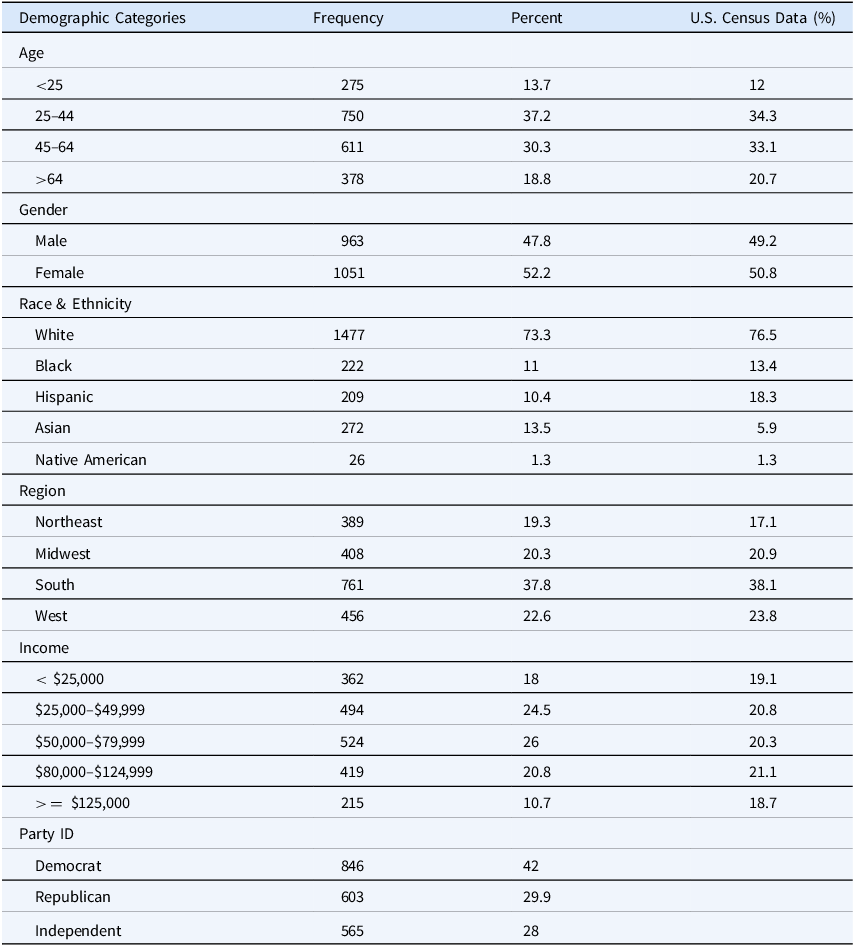
The three experiments were embedded in a web-based survey of 2,014 respondents.Footnote 3 The sample was census-balanced on age, gender, race, region and income (see Table 1). To arrive at the final sample, the data were cleaned for “speeders” and “straight-liners.” Speeders were defined as respondents completing the survey in under four minutes or reading through the news prompts in fewer than 4 to 6 seconds depending on the length of the prompt. Straight-liners were identified as respondents who chose the “none” option in all of the choice experiments. We also automatically discontinued the survey if the respondent answered one of three attention questions incorrectly.
Summary statistics
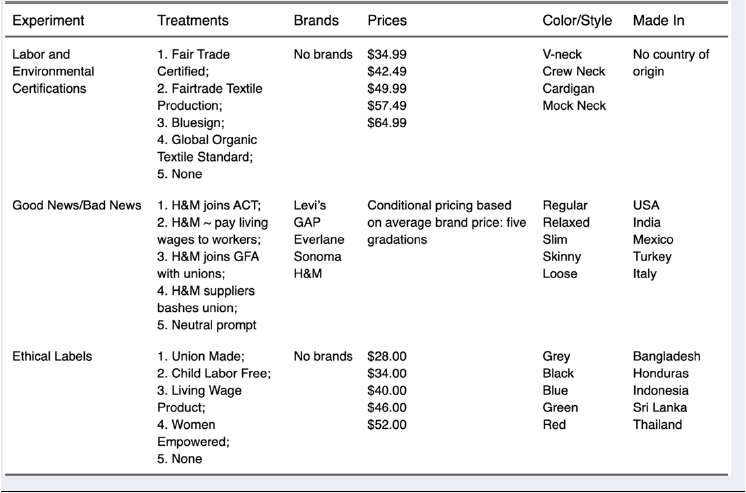
Each experiment consisted of a series of choice tasks in which respondents were presented with three garments of a similar type and a “none” option. Each garment had a series of standard product attributes such as color, style, brand or country of origin and a price. In addition, each garment was assigned a treatment that would make it more or less desirable from the standpoint of an ethical consumer concerned about worker protections. The treatments consisted of prompts and labels describing a company’s practices or steps taken to improve labor standards in its suppliers’ factories. Each experiment is intended to test the relative strength of consumer preferences for different types of labor standards as well as the appeal of different types of messaging. We provide a fuller description of the treatments when we review the results of each experiment below.
Table 2 presents a list of the product attributes and levels used to construct the product profiles in the three experiments. Profile attribute levels were fully randomized (sampled with replacement) except that no task could contain two identical profiles. Each respondent completed three choice tasks per experiment for a total of 12 tasks per respondent. To minimize anchoring bias, we randomly varied the order of the attributes within each choice task as well as the order in which the four experiments were presented.Footnote 4
Summary statistics
One enduring concern regarding survey-based research on ethical consumerism is that respondents may express support for an ethical product when it is relatively costless to do so. To counteract this tendency, respondents were instructed to answer the questions as if they were “actually buying” the garment in question and reminded them of the importance of doing so before each set of choice tasks. We also attempted to inject a degree of realism in our experiments by prompting respondents with real news stories and press releases and incorporated images of real-world certifications and labels, presented consumers with illustrations of garments that vary in style, color and country of origin, and (where relevant) incorporated a wide selection of brands including fast fashion brands, ethical brands and “mall brands.” The tasks included a “none” option in our choice tasks to better simulate consumer choice in the actual marketplace. The full randomization of sensitive and non-sensitive attributes also helps to mitigate concerns about social desirability bias (Horiuchi, Markovich, and Yamamoto Reference Horiuchi, Markovich and Yamamoto2022).
Estimation strategy
There are many well-established methods for using the data from conjoint experiments to quantify respondent preferences. For election studies, political scientists use ordinary least squares to estimate average marginal component effects that represent how various candidate attributes on affect the probability of a voter choosing one candidate over another (Hainmueller, Hopkins, and Yamamoto Reference Hainmueller, Hopkins and Yamamoto2014). In other fields, the dominant approach involves estimating choice probabilities in a logit framework and then using these estimates to derive measures of consumer demand for product features such as attribute “importances” or WTP (Hauber et al. Reference Hauber2016; Orme Reference Orme2014).Footnote 5
Such approaches are fine if we are mainly interested in estimating the relative demand of product attributes in a static context. But apparel is a highly competitive sector in which firms respond to competitors’ marketing strategies by lowering their prices or adopting similar innovations. The price that a consumer would ultimately be willing to pay for ethically made products will largely depend on how competitive dynamics between firms play out.
To analyze such industry dynamics, our analysis draws on innovations in fields of marketing, where scholars have used data from conjoint experiments to establish the value of patented product features (Allenby et al. Reference Allenby2014a) and the cost of patent infringements (Allenby et al. Reference Allenby2014b). This approach uses hierarchical Bayes (HB) to estimate the choice models for each experiment. It then utilizes random draws of the posterior distribution of the hyper-parameters and a Nash equilibrium pricing game to estimate a “true” consumer WTP measure.
These measures can be calculated for a number of specific simulated real-world scenarios, thus providing a highly precise tool for analyzing the appeal of different marketing approaches. For example, such simulations can capture how WTP for products featuring labels that advertise respect for labor standards changes when the consumer is also presented with products featuring environmental labels in the same shopping tasks, how much consumer choice is affected by different types of labor standards, or how consumer demand for ethically sourced products is affected by sudden changes in the price of a product.
The standard logit model for choice applications
To estimate consumer demand for ethically sourced products, we employ the standard logit framework commonly used to analyze choice-based conjoint (McFadden Reference McFadden1981):
 $$Pr\left( {{\rm{choice}} = j} \right) = {{{\rm{exp}}\left( {\beta {\rm{'}}{x_j} - {\beta _p}{p_j}} \right)} \over {\mathop \sum \nolimits_{j = 1}^J {\rm{exp}}\left( {\beta {\rm{'}}{x_j} - {\beta _p}{p_j}} \right)}}$$
where ${x_j}$
is a vector of product (garment) characteristics for alternative
${x_j}$
is a vector of product (garment) characteristics for alternative $j$
,
$j$
, ${p_j}$
is the price of alternative
${p_j}$
is the price of alternative $j$
, and
$j$
, and $j$
is one alternative among a set of
$j$
is one alternative among a set of $J$
alternatives. In the context of our experiments, there were a total of four alternatives for each task (three garments and a “none” option). The garment characteristics
$J$
alternatives. In the context of our experiments, there were a total of four alternatives for each task (three garments and a “none” option). The garment characteristics ${x_j}$
are defined by the levels of the various garment attributes including the experimental treatments, different brands, color, style, and country of origin. Each attribute level was coded “1” if present and “0” otherwise. Similarly, the choice alternative on the left-hand side of the equation is coded “1” for chosen and “0” for not chosen. Price enters linearly into the equation, meaning that we use one price coefficient rather than a series of price dummies.Footnote
6
${x_j}$
are defined by the levels of the various garment attributes including the experimental treatments, different brands, color, style, and country of origin. Each attribute level was coded “1” if present and “0” otherwise. Similarly, the choice alternative on the left-hand side of the equation is coded “1” for chosen and “0” for not chosen. Price enters linearly into the equation, meaning that we use one price coefficient rather than a series of price dummies.Footnote
6
We use HB to estimate the $\beta $
coefficients. HB starts with respondent-level parameter estimates, adaptively pools this information across individuals, and uses it to inform the next round of estimates. HB offers numerous advantages over classical (i.e., frequentest) methods like conditional logit or random parameter logit that have made it the standard for choice applications in most fields. Computationally, HB is generally faster and more efficient because it never gets stuck on a local maximum (Huber and Train Reference Huber and Train2001). Since it estimates individual-level betas for all of the model parameters, HB also provides a superior method for evaluating preference heterogeneity (Allenby, Rossi, and McCulloch Reference Allenby, Rossi and McCulloch2005). Another benefit of HB, which is central to our analysis, is the ability to simulate real-world choice scenarios in the post-estimation context. Simulations afford the researcher the opportunity to explore the market potential for new product features in multiple specific theoretically relevant settings rather than simply looking at average effect sizes.
$\beta $
coefficients. HB starts with respondent-level parameter estimates, adaptively pools this information across individuals, and uses it to inform the next round of estimates. HB offers numerous advantages over classical (i.e., frequentest) methods like conditional logit or random parameter logit that have made it the standard for choice applications in most fields. Computationally, HB is generally faster and more efficient because it never gets stuck on a local maximum (Huber and Train Reference Huber and Train2001). Since it estimates individual-level betas for all of the model parameters, HB also provides a superior method for evaluating preference heterogeneity (Allenby, Rossi, and McCulloch Reference Allenby, Rossi and McCulloch2005). Another benefit of HB, which is central to our analysis, is the ability to simulate real-world choice scenarios in the post-estimation context. Simulations afford the researcher the opportunity to explore the market potential for new product features in multiple specific theoretically relevant settings rather than simply looking at average effect sizes.
We employed the rhierMnlMixture routine from the bayesm package in R to derive our estimates (P. Rossi Reference Rossi2023). For each experiment, we took 100,000 draws using standard diffuse prior settings. We present the summaries of the posterior distributions of the respondent-level betas in the online supplement and use the related hyper-parameters (the mean and variance of the respondent-level betas) in our simulations as discussed below.
Willingness to pay
The SWTP measure in the conjoint literature emerges from difficulties associated with interpreting the $\beta $
coefficients from the standard logit model. Because they have an arbitrary base and scaling, the
$\beta $
coefficients from the standard logit model. Because they have an arbitrary base and scaling, the $\beta $
coefficients cannot be directly compared. This has led to attempts to convert
$\beta $
coefficients cannot be directly compared. This has led to attempts to convert $\beta $
coefficients into market share or dollar equivalents so that they can be directly compared to one another. The SWTP measure is thus the coefficient of the product feature on the dollar ratio scale.
$\beta $
coefficients into market share or dollar equivalents so that they can be directly compared to one another. The SWTP measure is thus the coefficient of the product feature on the dollar ratio scale.
 $${\rm{SWTP}} = {{{\beta _f}} \over {{\beta _p}}}$$
SWTP is little more than a scaling device and consequently bears very little relation to what consumers might actually be willing to pay for a product feature. Consequently, SWTP tends to overestimate actual consumer WTP.
Given the issues with SWTP, we opted to calculate a “true” WTP measure that is based on the logic of compensatory variation in welfare economics (Allenby et al. Reference Allenby2013). In a strict economic sense, compensatory variation refers to the amount of monetary compensation that would need to be awarded to maintain a consumer’s level of utility when prices or other variables change. It assigns a monetary value to the change in well-being associated with a change in price or other economic factors.
While compensatory variation is usually thought of in terms of economic loss, we can also use it as a tool to estimate the value of what is gained when a new feature is added to a choice set. We do this by estimating the expected maximum utility of the choice set with the added feature. Next, we estimate the expected maximum utility of the choice set without the added feature. Then, we scale the two values by a price coefficient to give them a monetary value and subtract the value of the non-augmented choice set from the augmented choice set. The scaled change in the expected maximum utility of a set of products with and without the added feature represents the “true” WTP.
 $${\rm{WTP}} = {{{\rm{ln}}\left[ {\mathop \sum \nolimits_{j = 1}^J \,{\rm{exp}}\left( {\beta {\rm{'}}a_j^{\rm{*}} - {\beta _p}{p_j}} \right)} \right]} \over {{\beta _p}}} - {{{\rm{ln}}\left[ {\mathop \sum \nolimits_{j = 1}^J \,{\rm{exp}}\left( {\beta {\rm{'}}{a_j} - {\beta _p}{p_j}} \right)} \right]} \over {{\beta _p}}}$$
Here ${a^{\rm{*}}}$
represents the product attributes from the enhanced choice set whereas
${a^{\rm{*}}}$
represents the product attributes from the enhanced choice set whereas $a$
represents the product attributes from the original or non-augmented choice set. In this context, true WTP can be thought of as the monetary equivalent of the increase in expected maximum utility achieved by enhancing product attributes to their preferred levels across the considered choice set. This model reflects the idea that consumers make choices to maximize their utility and that this utility can be calculated based on the attributes of the available choices and the consumer’s preferences (represented by
$a$
represents the product attributes from the original or non-augmented choice set. In this context, true WTP can be thought of as the monetary equivalent of the increase in expected maximum utility achieved by enhancing product attributes to their preferred levels across the considered choice set. This model reflects the idea that consumers make choices to maximize their utility and that this utility can be calculated based on the attributes of the available choices and the consumer’s preferences (represented by $\beta {\rm{'}}$
and
$\beta {\rm{'}}$
and ${\beta _p}$
).
${\beta _p}$
).
For example, imagine two choice sets, one in which the first sweater has an ethical label and two sweaters without the certification and the second in which none of the sweaters have an ethical label. Here, the additional choice associated with the ethical label has added value to the consumer’s shopping experience. This is true regardless of whether or not her choice is dominated by other options in the choice set because there is always an element of randomness to consumer choice and because there is value in having an enriched choice set. Thus, while more involved than SWTP, true WTP provides a measure of product feature value that is more reflective of the consumer’s shopping experience.
One advantage of estimating WTP in a Bayesian context is that, in addition to directly calculating true WTP, we can also simulate different shopping and market scenarios and see how they would affect consumer WTP. For example, after estimating our models, we can add additional products with ethical labels to the choice set to see how competition affects WTP. We can also price scenarios to estimate how the costs associated with producing a garment would affect WTP. We elaborate on these methods in the description of our findings below.
Experiment 1: Certifications
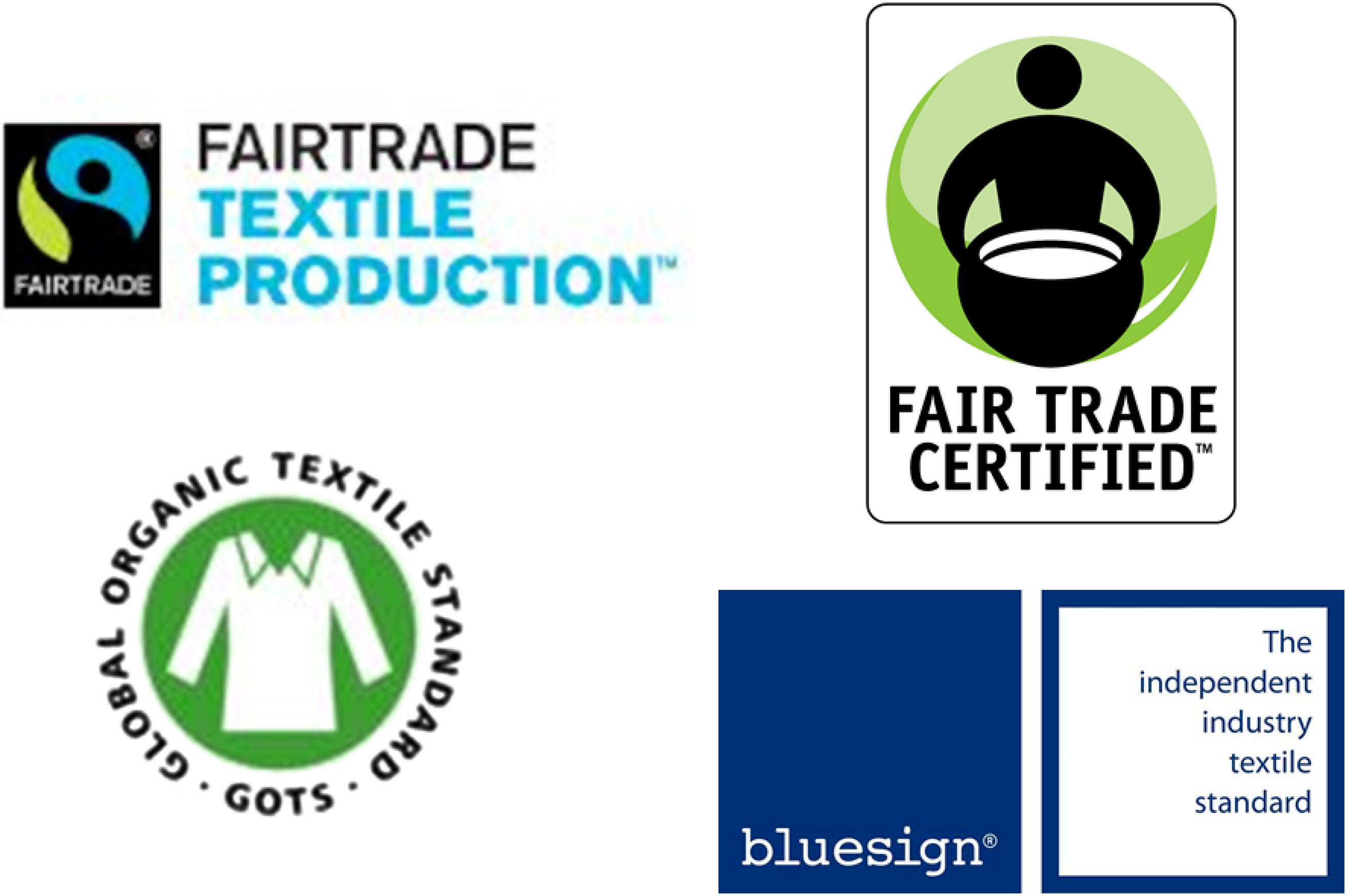
Our first experiment is designed to test the overall relevance of labor rights for consumers. It asked respondents to choose between sweaters with randomly assigned labor and environmental certifications (see Figure 1). The labor certifications include the Fair Trade Foundation’s Textile Production Standard (TPS) and FTC programs. While both of these programs are designed to improve the lives of workers, the former places more emphasis on FACB rights, while the latter incorporates labor standards into a broader sustainability rubric. The environmental certification logos include the Global Organic Textile Standard (GOTS), which certifies a company’s use of organic fibers, and the Bluesign System (BSS), which certifies a company’s environmentally sustainable methods of textile production. All four of these standards are commonly used by garment manufacturers as well as major apparel brands.
Certification logos.
Before completing the choice tasks, respondents were shown an initial prompt describing each certification program, highlighting the differences between them. For example, the descriptor for the FTC program read, “Verifies that companies pay workers a living wage and donate to community projects,” whereas the TPS was described as a program that “ensures respect for unions and collective bargaining.” Respondents were also asked to tick a box next to each descriptor to indicate whether they had heard of each program before. This was done to help ensure that respondents read the descriptors carefully but also to determine whether an initial familiarity with these programs helps to explain their relative popularity.Footnote 7
In Figure 2, we present the results of two simulations based on respondents’ choices in the certifications experiment. The first scenario simulates a market where only one company adopts a certification, while none of its competitors do. The results of this simulation are presented in panel A.
The second scenario, presented in panel B, envisions a competitive landscape where one company adopts either FTC or TPS, the other adopts GOTS or BSS, and a third has no ethical label associated with it. Thus, the estimates here represent the WTP for a labor certification when a competing firm has adopted an environmental certification.
In panel A, we see that all of the product certifications induce a greater WTP but that the WTP for the two labor certifications is greater than the two environmental certifications. The TPS and FTC certifications increased WTP for a sweater by $7.32 and $9.87 respectively. The Bluesign certification increased the likelihood of purchase by a lesser amount ($4.62), and the credible intervals of the estimate do not overlap with those of the two labor certifications. The GOTS certification increased purchase likelihood by $6.12, an effect closer to TPS but markedly lower than FTC.
Certifications TWTP estimates.
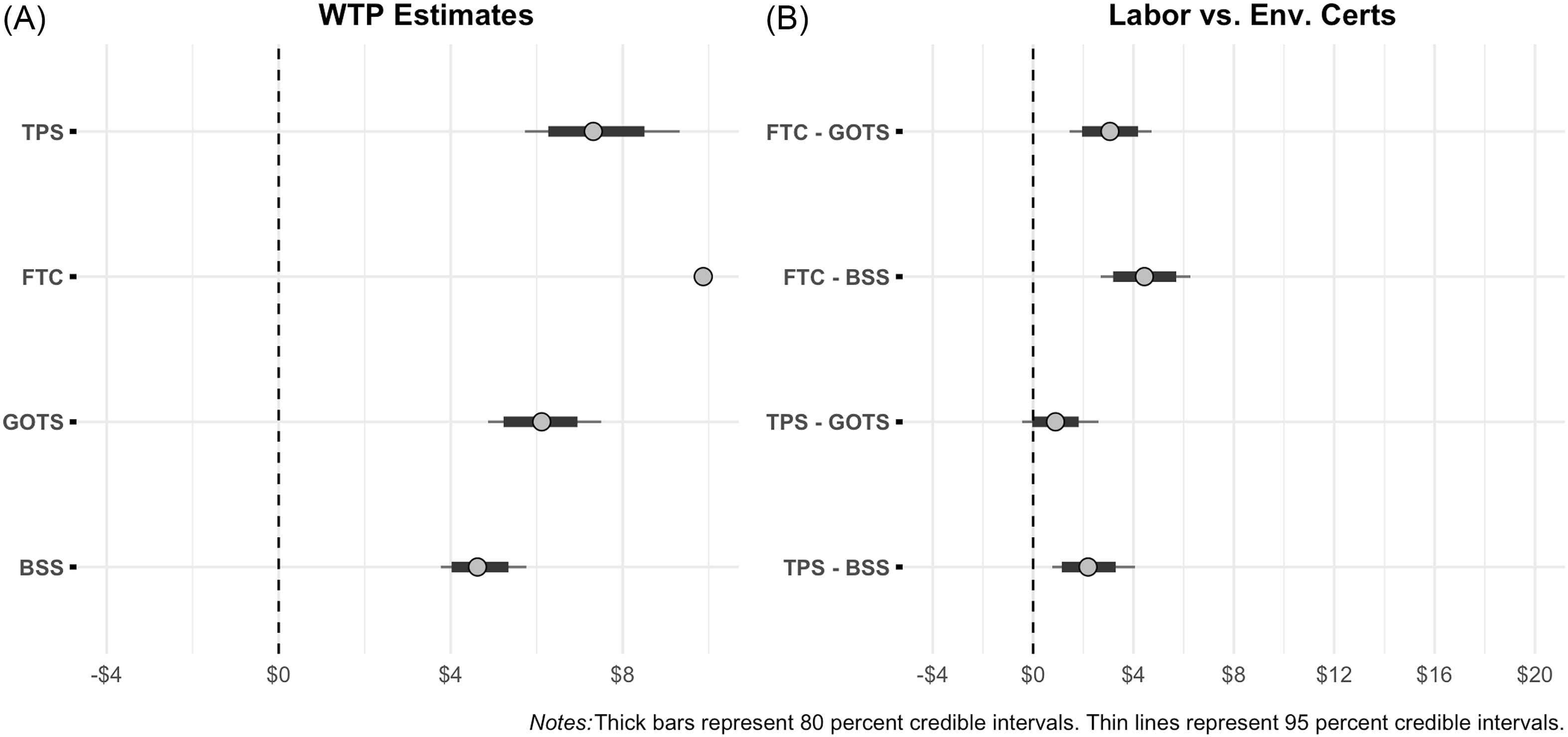
In panel B, we see further evidence that consumers are more heavily influenced by messaging about labor rights than environmental sustainability. In a scenario where a consumer faces a direct choice between a product with an environmental certification and one with a labor certification, they are still willing to pay a premium for the labor certification. In this scenario, the FTC certification increased WTP by $3.06 when paired against a product associated with the GOTS label and $4.44 when paired with a Bluesign-certified product. Similarly, TPS maintained a premium of $0.89 when facing off against the GOTS certification and $2.19 when it was competing with Bluesign.
Experiment 2: Good News/Bad News
Our second experiment explores the effects of positive versus negative media attention on the demand for the products of one specific apparel company. In this experiment, respondents were asked to select a pair of jeans after reading news stories about the Swedish multinational apparel company H&M. The primary goal was to discern the relative salience of a “buycott” or reward mechanism by which consumers purchase more from brands participating in agreements protecting workers rights versus a “boycott” or punishment mechanism by which they withdraw support of brands for the mistreatment of workers.
Prior to the choice tasks, we presented respondents with positive or negative reports about H&M’s respect for freedom of association rights or WTP a living wage. Four-fifths of respondents were randomly presented with a headline and a brief excerpt from one of four news stories, two of them positive in nature and two of them negative. The remaining fifth saw a neutral message. The first positive story was a press release about H&M signing onto ACT (Action, Collaboration, Transformation), a GFA between retailers and unions to achieve living wages in the garment industry. The second positive story was a press release about H&M entering into a permanent GFA with IndustriALL and IF Metall to protect collective bargaining rights in the garment industry. For negative treatments, we showed respondents a story about H&M ignoring efforts by one of its leading suppliers to violently suppress a union and another about H&M reneging on its promise to pay a living wage to workers. The neutral treatment stated that “sometimes apparel companies respond favorably to workers’ demands and other times they respond unfavorably.”
Respondents were then asked to choose between three pairs of jeans, one of which could have been a pair of H&M jeans. In addition to H&M, the brand attribute included two of the biggest selling jeans brands (GAP and Levi’s) as well as a bargain brand (Sonoma by Kohls) and one niche ethical brand (Everlane). We used conditional pricing so that the range of prices for each brand varies by increments of 15 percent from the average price of jeans for that brand. The profiles also included pictures of five styles of jeans and country of origin. The titles of the news stories are presented in Figure 3. The full stories and choice tasks can be viewed in the online supplement.
H&M headlines.
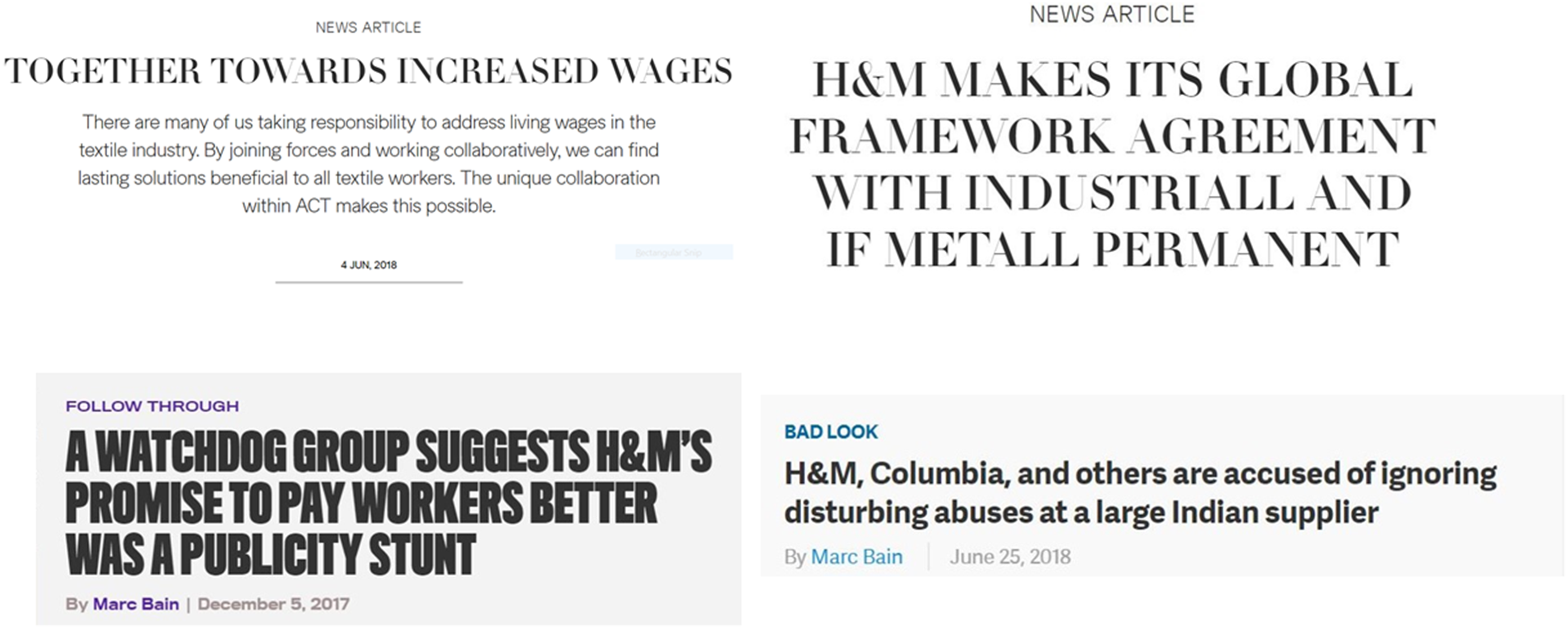
Figure 4 displays the results of Experiment 2. The first set of WTP estimates under the heading “H&M Prompt” represents the interaction of each of the four news stories and the choice of H&M jeans. The two stories about labor rights violations reduced consumer WTP for a pair of H&M jeans. The nonpayment of wages prompts decreased WTP by a little over $2, while the union-bashing prompt reduced it by about $3. Meanwhile, the two positive news stories about joining GFAs had a positive effect on consumer WTP. The predicted influence of H&M joining IndustriALL and IF Metall GFA was about $2. The ACT GFA had a smaller effect on WTP, increasing it by about $1; however, the credible interval for this estimate overlaps with $0 suggesting that the effect of this story was not as powerful for consumers.
Good news/bad news TWTP estimates.
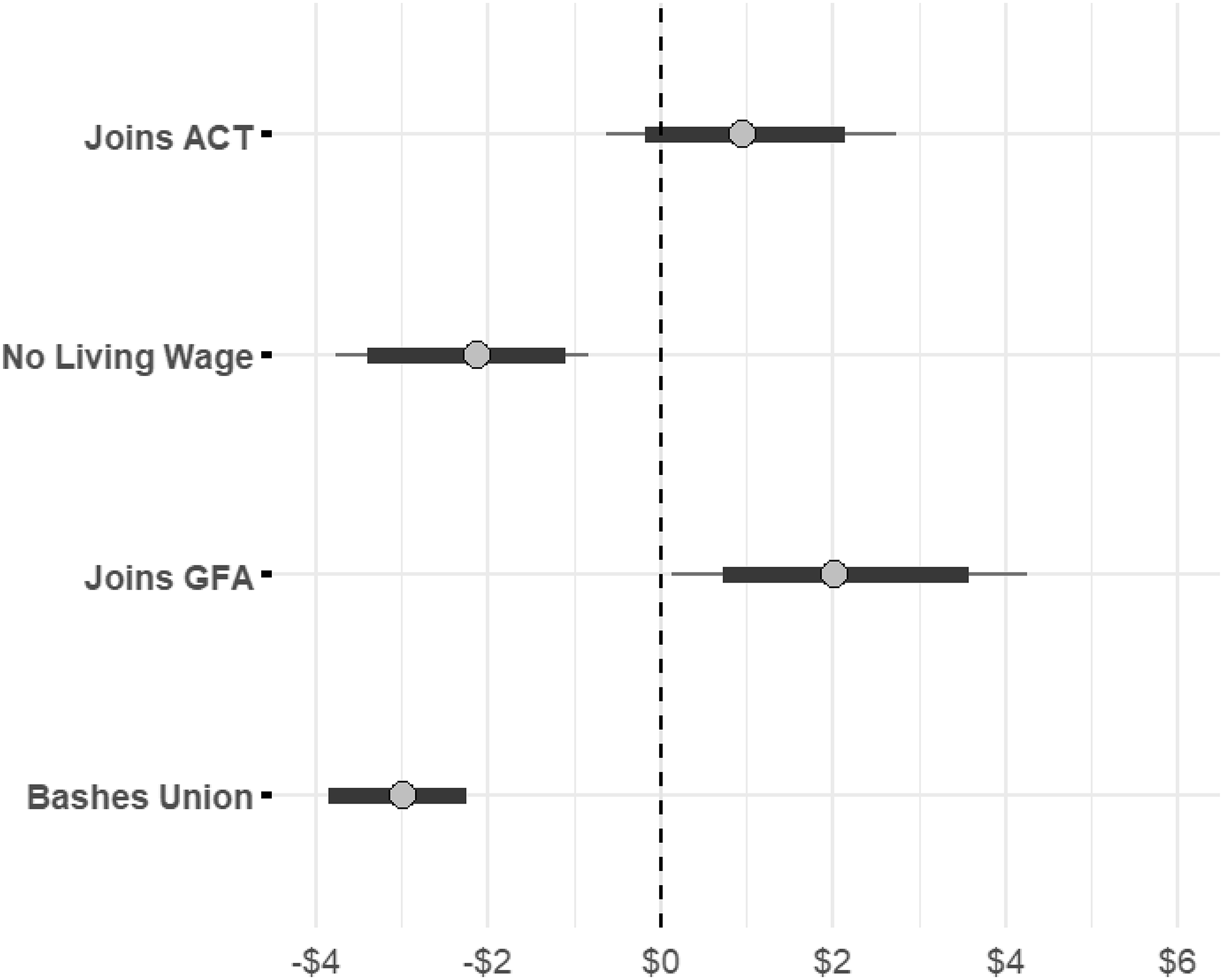
These results are in line with our expectations as well as the findings of previous studies. They suggest that, when it comes to FACB rights, consumers are clearly prepared to boycott a brand based on negative information about its labor practices, whereas the effect of positive information is mixed. One of the treatments pertaining to H&M’s efforts to lead on social compliance induced a buycott response from survey respondents, while the other did not. Yet there appears to be no obvious reason that consumers would prefer the story about one GFA relative to the other.
Experiment 3: Ethical Labels
Our third experiment sought to explore what kinds of labor protections consumers are most likely to endorse and, specifically, to look at whether there is more urgency or enthusiasm related to baseline labor protections relative to enabling rights. It did so by asking respondents to choose between sweaters with product labels, highlighting different labor rights and standards. The labels, displayed in Figure 5, are based on real-world campaigns by unions and NGOs.
Ethical labels.
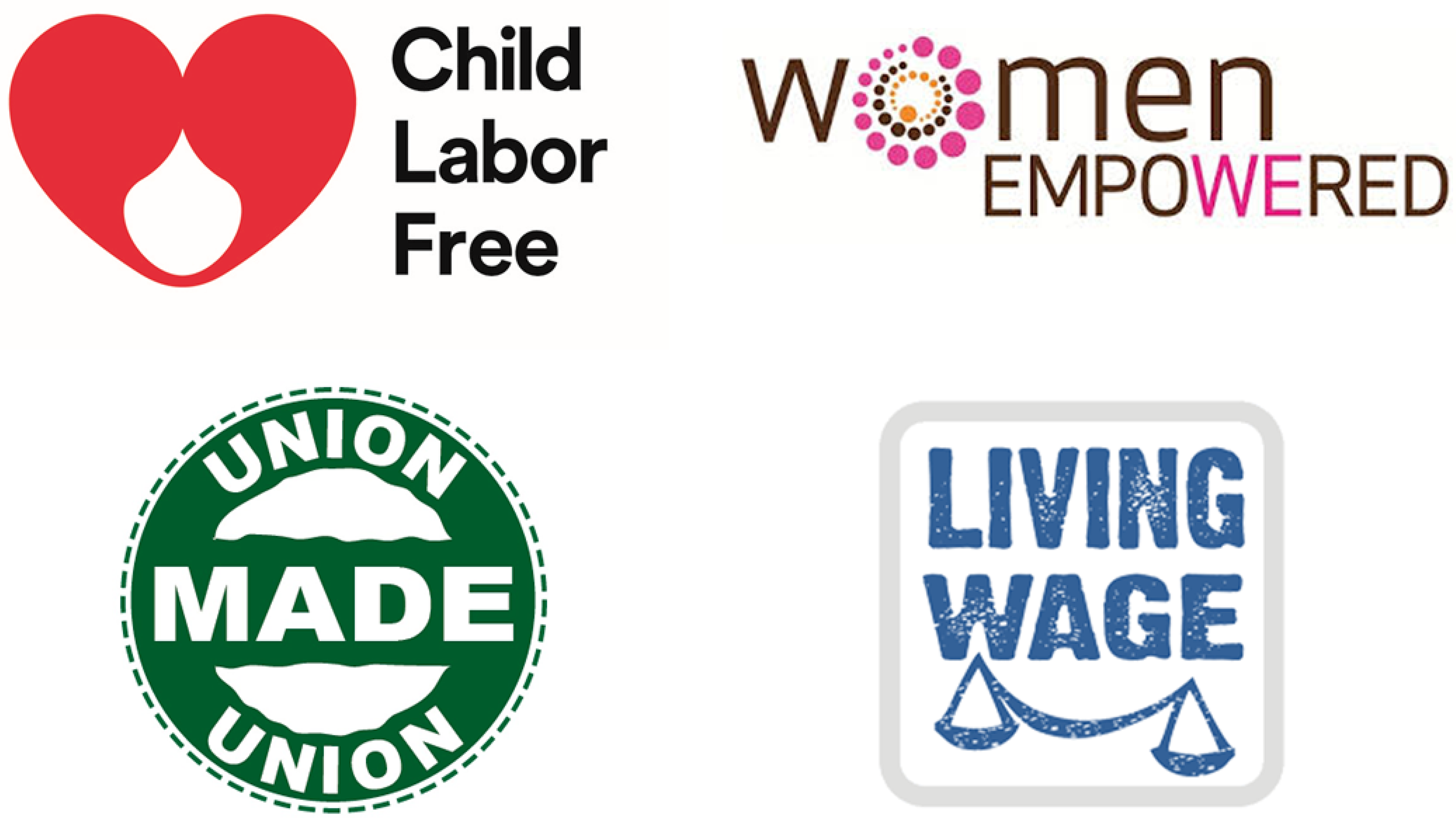
“Child Labor Free” (CLF) is a product label designed as part of a campaign by an NGO of the same name. “Living Wage Product” (LWP) is featured on the website of an ethical merchandising company called Ethix Merch. Union Made (UM) labels date back to the Cigar Maker’s Union in 1874 and have since been used by many unions including the ILGWU and AFL-CIO.Footnote 8 And “Women Empowered” (WE) is a logo designed by an organization called Women Empowering Positive Women.
The CLF label is designed to test consumer reaction to the violation of a baseline protection whereas UM is more evocative of freedom of association rights. WE relates to the concept of discrimination and harassment and, regardless of the importance of this issue for women’s sense of physical security, could be construed as more of a progressive ideal than a baseline protection. LWP could likely go either way. Some may interpret a living wage as a baseline standard, but the term “living wage” frequently has more of a post-materialist connotation when contrasted with the concept of a “minimum wage.”
Before completing the choice tasks for this experiment, respondents were presented with a prompt with descriptors for each label. For example, the “Women Empowered” label was said to indicate that a garment was “made in a workplace that fosters a sense of pride among its female workers and is free of gender discrimination and sexual harassment” while “Living Wage Product” indicates that “workers were paid a fair living wage that covers their basic expenses.” Respondents were asked to read each label description and tick a box indicating whether they had heard of the label before.Footnote 9
We used the respondents’ choices in this experiment to explore three hypothetical scenarios to simulate how consumer WTP would change in response to rising prices. The first scenario is one in which the cost of producing any of the three sweaters is $25. In the second simulation, the cost of producing the sweater with the ethical label jumps to $35. And in the final scenario, all three sweaters experience a price shock of $10. These simulations are designed to capture how consumers might respond to a situation in which the increased costs associated with social compliance are passed onto them or to an economy-wide shock that would force all companies to raise prices. Would consumers still be willing to pay more for a product that is ethically produced under such conditions?
Figure 6 shows the results of the ethical labels experiment. Panel A displays the WTP estimates for the three hypothetical scenarios, for example, the baseline, a $10 price shock to the product with the label, and a $10 price shock to all three products. In the first panel, we see that consumers demonstrate a WTP price premium for all four labels, suggesting a broad level of support for labor-related marketing campaigns. Out of the four labels, the WTP for “Child Labor Free” was clearest the highest, with consumers willing to pay an almost $17 price premium for garments with this label. By contrast, the other three labels registered similar and smaller price premiums (around $8).
Labels TWTP estimates.
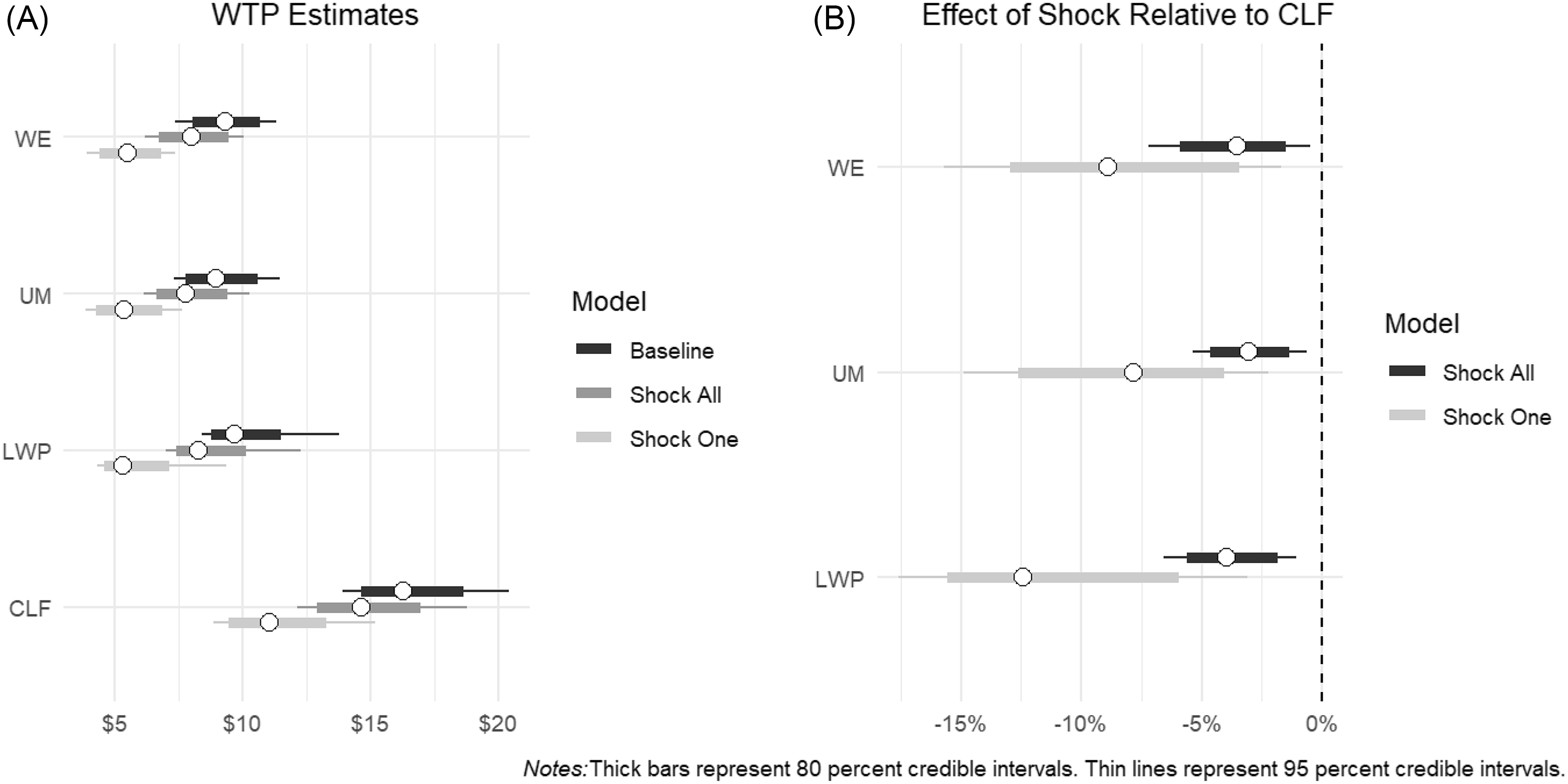
Second, the simulations show that ethically labeled products still command a premium in the context of rising prices. We see that a price shock on WTP has the strongest effect when one company is forced to raise prices. This would be roughly analogous to a situation in which the costs of ethical sourcing are absorbed by one brand, forcing them to raise prices for consumer garments without changes to their competitors’ prices. When all three companies are forced to raise prices the decrease in WTP is much smaller. But in both scenarios, there is still a substantively and statistically significant premium associated with the labor-oriented ethical labels.
In panel B, we zoom in on the resilience of consumer demand for child labor free products in the context of price shocks. Here we display the estimated difference in demand for three labels in contrast with the CLF label. We plot two effects in this graph—the relative difference in WTP (compared to CLF) when one of the labels receives a price shock and the WTP difference when there is an economy-wide price shock. For the WE label, for example, the WTP drops by around 16% with an economy-wide shock and by approximately 45% when there is an individual label price increase. This contrasts with the CLF label, where the WTP drops by around 11% in an economy-wide shock and by around 35% if there is an individual label shock. Thus, plotted in panel B, the drop in WTP for the WE label during an overall shock is around 5% greater than the CLF label and around 10% greater than the CLF label given an individual label shock.
The trends for the UM and LWP labels are similar, showing that a price shock has a significantly greater negative effect on consumer WTP for the WE, LWP, and UM labels relative to the CLF labels. These findings demonstrate that while consumers initially display robust support for all four labels, this enthusiasm is tempered by price shocks. Furthermore, enthusiasm wanes less for the labor standard that is most clearly associated with a basic human right and more for the labels that could be construed as enabling rights.
Discussion
Our experiments examined how consumers react to various labor-related messaging by apparel brands. The goal of the experiments was to gauge public sentiment around different labor rights to better understand the conditions under which consumer sentiment can be mobilized to support FACB rights in garment-manufacturing countries. The value of our methodological approach, which featured Bayesian hierarchical models, is that it allowed us to estimate consumer willingness while simulating real-world competitive dynamics. In this way, we were able to test not only consumer sentiment toward a broad range of labor rights, but also to examine the relative strength of consumer reactions toward labor rights when directly contrasted with one another, or with other environmental rights.
We report three main findings from our results. First, and somewhat counterintuitively given the rise in marketing around environmental sustainability, we find robust support for labor-related messaging in direct contrast to environmental messaging. Out of the four overarching certifications, consumers were willing to pay the highest premium for the more labor-oriented certifications. This remained true even in simulations where they were placed in direct competition with the environmental certifications. These findings suggest that when presented with a basket of products featuring competing labels, consumers would be more willing to pay a price premium for certifications that emphasize labor-related protections rather than those that solely emphasize environmental concerns.
Second, positive information about brand efforts to sign onto industry-level collective bargaining efforts receive a fairly muted response among consumers. However, media exposés around the violation of union rights result in a declining consumer WTP, with the strongest response toward allegations of violence toward union leaders. These findings suggest that information about violent attempts to suppress unions can induce boycotting behavior. This empirical result sheds important light on the role consumers can play in promoting FACB rights in supply chains. Promoting positive information about industry-level governance attempts, while important for company reputations, does not appear to result in tangible price premiums to the firm. On the other hand, the strong consumer response to violent repression does indeed lead to tangible sales drops. This suggests that brands, activist communities, and NGOs may be able to more effectively shape firm behavior by publicizing FACB rights violations when they occur, rather than expending resources in positive marketing around FACB rights.
The recent protests in Bangladesh, beginning in 2022 and escalating into the ouster of Sheikh Hasina in 2024, help illustrate some of our findings around consumer support for FACB rights. Following the tragic Rana Plaza factory collapse, companies with suppliers in Bangladesh have signed onto a variety of private governance initiatives such as the Accord on Fire and Building Safety and the Alliance for Bangladesh Worker Safety. Despite these initiatives’ success in reducing workplace hazards, the effectiveness of these campaigns has been undermined by the lack of pro-labor reforms, which would allow workers to organize, form unions, and collectively bargain for better working conditions (Bair, Anner, and Blasi Reference Bair, Anner and Blasi2020). These ongoing worker grievances—particularly the failure to pay a living wage—culminated in an ongoing wave of protests from November 2023 onward and were met with police brutality, violent suppression, and the detention and arrest of workers and protestors.Footnote 10 To respond to these concerns, brands would have to negotiate with union leaders and increase living wage payments, which would ultimately drive up production costs and consumer prices. While firms might do this automatically by distinguishing themselves using “ethical” branding, our results suggest that their strongest commercial incentives to respect FACB rights come not from positive marketing of these efforts, but rather, from the negative media attention around union repression.
Finally, we also addressed the question of which labor rights most capture consumer attention. Here our results clearly indicate that consumers are more motivated by baseline concerns related to fundamental human rights than higher-order enabling rights related to worker voice and empowerment. Even after a sizeable price shock, the WTP estimates for the CLF label remain much higher than the other three labels. This finding is in line with recent work that suggests that there is an almost universal norm condemning the use of child labor (Amengual, Mota, and Rustler Reference Amengual, Mota and Rustler2023), and that consumers accordingly reward companies when they proactively market their products as child labor free. The size of the WTP decline for the other three labels compared to the CLF label demonstrates that ethical labeling is a potential avenue for the trading up effect even in the context of price increases—however, comparatively speaking, child labor is the only standard for which firms can effectively rely on a market-based mechanism to offset production costs associated with upgrading.
The findings on the price premiums have implications for companies’ ability to mobilize consumer demand to upgrading their supply chains. In a highly competitive industry where brands engage multiple suppliers around the globe, all competing with tight lead times and razor-thin profit margins, the price premium received for an ethically labeled good must be enough to offset the higher production costs that arise from granting workers more rights. However, our WTP estimates suggest that with respect to enabling and more progressive issues, consumer WTP wanes as prices increase. This finding resonates with other research suggesting that ethical labeling tends to increase sales of an item only among the higher-priced items (Hainmueller, Hiscox, and Sequeira Reference Hainmueller and Hiscox2015) and suggests that consumer demand for FACB rights may not be great enough to generate higher profit margins.
Thus, overall, our findings contain some positive signs on the use of ethical labeling to improve labor rights in supply chains. We find evidence that consumers are motivated by the labor-related messaging, and the WTP estimates on the CLF label suggest that consumer demand on this issue could perhaps translate into increased margins for apparel brands. On the question of FACB rights, however, we are less optimistic about the power of a positive ethical labeling campaign. For these rights, traditional naming and shaming tactics that highlight labor rights violations may have the strongest effect on corporate behavior.
Conclusion
Consumer power can play a vital role in global economic relations, as their ability to punish or reward companies affords them the ability to set an agenda around social standards in supply chains. Consumers are, however, somewhat understudied actors in the field of international political economy, which tends to emphasize the role of states, corporations, and multilateral institutions in setting the regulatory agenda for business responsibility (Büthe Reference Büthe2010; Mattli and Woods Reference Mattli and Woods2009). Furthermore, while many marketing and business studies do carefully examine the nature of consumer demand toward various social rights, we still only have mixed evidence about consumer preferences to support FACB rights in supply chains.
Our study attempts to provide a clearer picture of consumer sentiment to better understand the contexts under which these actors are most likely to influence corporate social responsibility outcomes. We disaggregate social rights by contrasting labor-related framings versus environmental messaging, and we also compare consumer reactions toward more baseline human rights compared with broader collective labor rights. Finally, our experimental setting allows us to manipulate pricing and informational cues to determine the contexts under which consumers react most strongly to labor rights violations.
These findings have important implications for the study of ethical consumerism and labor protections in developing countries. First, by demonstrating consumer WTP for labor-related labels and certifications, our findings question a common assumption that ethical consumption is limited to issues of environmental sustainability. We find that a labor-related framing resonates just as strongly with consumers and in fact is the preferred option when placed side by side with solely environmental messaging. While the rising discourse around climate change and environmental sustainability might indicate that the average consumer is much more concerned with the environment, our findings offer a corrective and show that at the individual level, consumers are actually more likely to choose more anthropocentric ethical labeling schemes.
While our experimental evidence is limited to the garment industry, our findings can be applied more broadly to other consumer-facing industries, such as chocolate, coffee, and packaged goods. These goods often market their ethical sustainability initiatives, which can range from highly specific initiatives to combat modern slavery and child labor—to broader ethical labels like Fair Trade. Our findings show that since consumers are primarily motivated by human interest concerns, companies may actually find it more profitable to market their efforts to combat modern slavery or child labor in their supply chains, rather than advertising their more general sustainability practices.
Second, we shed light on the specific types of labor protections that resonate most strongly with consumers. Here we find that consumers do have a strong hierarchy in terms of the types of labor issues they deem more salient. Respect for core labor standards and organized labor has been systematically undermined by neoliberal trends in most OECD countries since the 1980s, but despite these trends, we do not find evidence of an anti-union bias among consumer respondents. However, the protection of FACB rights ranks much lower than the more universally respected right against the use of child labor. This suggests that consumers are much more likely to respond to some campaigns than others and that emphasizing FACB rights in proactive campaigns may not necessarily translate into profits at the firm level.
Finally, we note an interesting disconnect between ethical and political consumerism. While consumers demonstrate a WTP for ethically sourced garments, they do not respond similarly by buycotting a garment when they hear about a company’s involvement in GFAs. Consumers appear to respond to positive information when it is attached directly to a product in the form of an ethical label or certificate, but when similar positive information is presented in the form of a news report, this elicits less of a consumer reaction. This is an interesting gap that deserves further investigation and explanation.
Our results also have importance for the policy and activist community. From a policy standpoint, we do find that ethical labeling can be effective, but these price premiums can dissipate quickly in the event of price shocks. Prior research has warned that ethical labeling may be ineffective in the context of lower-priced goods, where demand may be elastic based on price increases. We contribute to this discussion by examining demand based on various labor-related issues, finding that demand for FACB rights appears to be highly elastic based on price but that demand for garments without child labor is more inelastic to price changes. From an activist standpoint, this might suggest that a single issue like union rights may not be as effective to promote through an ethical labeling campaign. Activists and NGOs are better placed to use media leverage to name and shame companies, rather than promoting positive coverage of brands’ actions to FACB abuses.
Supplementary material
To view supplementary material for this article, please visit https://doi.org/10.1017/bap.2024.38.


 Open access

