


Introduction
High consequence infectious diseases (HCIDs) such as Marburg, Ebola, and Lassa fever have the potential for person-to-person spread, high mortality, and limited treatments. Rapid identification and isolation of suspected cases are critical. Yet, failures to isolate patients are commonReference Foote, Styles and Quinn1, and nosocomial transmissions have occurred2. Because HCID symptoms are nonspecific and overlap with common clinical entities, detailed travel and exposure histories are essential to identify at-risk patients. Healthcare providers require timely access to specialized knowledge including HCID geography, symptoms, incubation periods, and exposure risk factors. However, this expertise is not immediately available to most providers. While isolation of an HCID suspect is critical, isolating patients at low risk for an HCID results in delays in diagnosis and management of more common conditions, resulting in poor patient outcomesReference Tan, Cullen, Koumans and Arguin3.
Clinical decision support systems (CDSS) may facilitate patient assessment, relieving clinician cognitive burden. CDSS has been shown to increase guideline adherenceReference Sutton, Pincock, Baumgart, Sadowski, Fedorak and Kroeker4, aid in diagnosing emerging diseasesReference Lazarus, Green and Jerry5, and assist in infection control precautionsReference Dugdale, Rubins and Lee6. We developed a CDSS, “EvalHCID,” to assist clinicians in categorizing suspect HCID cases as high- or low-risk and performed an initial assessment of its accuracy and usability by emergency department (ED) advanced practice providers (APPs).
Methods
Infectious diseases, infection prevention, and information technology specialists provided iterative feedback on EvalHCID logic to ensure application of Centers for Disease Control and Prevention (CDC) guidance to a range of scenarios for select viral hemorrhagic fevers, Middle East Respiratory Syndrome, and novel influenza. EvalHCID was integrated into a pre-existing, mandatory ED workflow that includes a universal symptom and international travel screen (Supplementary Figure 1). EvalHCID was incorporated into the electronic health record (Epic Systems) in May 2024.
ED APPs, who provide the majority of the frontline care in our ED, were recruited for an accuracy and usability assessment. Usability was assessed using the System Usability ScaleReference Chfp, Kortum and Miller7. In a classroom setting, participants evaluated four hypothetical patient scenarios, each emulating a different HCID and focusing on the four core components of an HCID evaluation: travel, symptoms, disease incubation period, and epidemiologic risk (Supplementary Materials). In two scenarios, the provider used curated intranet resources (the previous workflow), and in the other two, EvalHCID. Intranet resources included a list of countries with circulating HCIDs, as well as HCID guides providing a grid of symptoms and exposure risk factors (Supplementary Figure 2). Participants timed their completion of each scenario. This study received a non-human subjects determination by the Mass General Brigham IRB. Statistical analysis used two-tailed t-tests.
Results
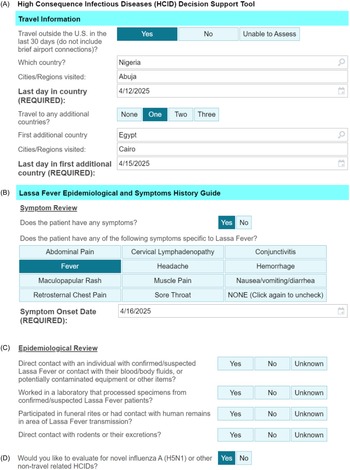
Providers launch EvalHCID based on one of the two prompts: a best practice advisory that loads (Supplementary Figure 3) when, in initial screening upon presentation to the ED or inpatient admission, patients report travel to a country with a current outbreak and relevant symptoms of possible infection (Supplementary Figure 1); Providers may also load EvalHCID at-will. To ensure that patients at low-risk for HCIDs do not experience delays in usual evaluation, we designed EvalHCID with a series of diagnostic “off-ramps” (Supplementary Figure 4), with additional risk stratification questions loading only if a patient continues to progressively meet high-risk criteria. Travel history from the initial screening is imported into EvalHCID or entered manually, with support for itineraries containing up to four countries (Figure 1A and Supplementary Movie 1). This is referenced against an internal country database, and a symptom review guide specific to the relevant HCID is loaded for travel to countries with current outbreaks (Figure 1B). If the patient reports a relevant symptom, onset date is checked against their last day in-country to determine if symptoms developed within an incubation period consistent with that HCID. If symptoms developed outside this period, EvalHCID assesses the patient as low-risk, while if within that period, epidemiological review loads (Figure 1C). If the patient denies epidemiologic risk factors for that HCID, EvalHCID assesses the patient as low-risk, while if the patient reports a risk factor, EvalHCID assesses the patient as high-risk and provides isolation guidance and infection control contact information. A note is automatically generated in the electronic health record (Supplementary Figure 5). EvalHCID may also be used in the absence of patient travel for the assessment of exposure risk factors for domestically acquired infections (eg, H5N1) (Figure 1D).
EvalHCID Clinical Decision Support System. A) Travel history is imported automatically from a required universal entry screening, or entered manually by the provider. The last day in-country is recorded. B) Country travel is cross-referenced against an internal, curated database of circulating, high-impact HCIDs, and a review of symptoms focused to circulating HCIDs loads to facilitate history taking. The date of symptom onset is used to check if the patient is within a “plausible incubation period” for the HCID of interest (EvalHCID subtracts the last day in country from the symptom onset day). C) If the patient has a relevant symptom and is within a plausible incubation period, epidemiological and exposure review loads. D) EvalHCID can be used for patients who have not traveled, to assist in the evaluation of domestically acquired HCIDs like novel influenza (such as H5N1). See also Supplementary Movie 1.

Twenty ED APPs were recruited to participate in an analysis of EvalHCID accuracy and usability. Participants had a median age of 35 years (IQR, 33-39) and 5 years (IQR 3-10) in their current roles. They reported previously conducting a median of 1 to 2 HCID risk assessments. Accuracy was assessed in two domains: at-risk for HCID (ie, which HCID the patient was at risk for based on travel) and HCID risk level (high- vs low-risk based on symptom, incubation period, and exposure factors). The rates of misidentification of at-risk for HCID were low using either intranet resources or EvalHCID (2.5% and 5%, respectively). In contrast, use of intranet resources resulted in more frequent misidentification of HCID risk level (45%), compared to 10% risk misclassification by participants using EvalHCID. Per case, the duration of assessment was significantly faster using EvalHCID (3 min versus 5 min, P < 0.01). Users reported similar confidence in the accuracy of their evaluation regardless of the method; however, they reported significantly higher perceived difficulty using intranet resources (4 out of 5 on a Likert scale) compared to using EvalHCID (2 out of 5) (P < 0.01). Overall, EvalHCID was scored at 90 out of 100 (CI, 86–94) on the System Usability Scale, corresponding to a usability of “Excellent.”
Discussion
As laid out in the Joint Commission’s standards for HCID or Special Pathogens, healthcare organizations must identify high-risk patients at points of entry8. While EvalHCID can be used as a standalone tool toward this aim, it is likely best paired with structured travel screening with a robust workflow to prompt providers of patients with a positive screen to perform EvalHCID. This ensures that high-risk patients are identified rapidly, undergo appropriate isolation, and the appropriate individuals are informed to advise on next steps. In the user analysis, participants using EvalHCID as opposed to conventional resources conducted a faster evaluation and demonstrated substantially less misclassification of patients as being high-risk for an HCID. This is important for multiple reasons: rooms appropriate for high-risk patients are limited in most EDs; extended evaluations of misclassified patients expend significant provider clinical time; and patient experience can be degraded by undergoing unnecessary evaluation for an HCID. Perhaps most importantly, unnecessary HCID evaluations delay the diagnosis of more common HCID mimics. During the 2014–2016 Ebola virus disease outbreak, CDC identified delays in malaria evaluation in travelers from West AfricaReference Tan, Cullen, Koumans and Arguin3, and delays in diagnosis have been identified as the unifying factor in fatal malaria cases in the United StatesReference Mace9.
In summary, we developed and implemented EvalHCID, a CDSS to assist in the identification of returning travelers at high-risk for having an HCID. By providing a structured approach that extends specialized expertise to the frontline clinician, this tool has the potential to improve HCID preparedness, particularly for smaller facilities without infectious disease providers. Limitations of our study include its single-center design and the use of scenarios created specifically for use in the study. Future efforts should further develop and validate scenarios that test core provider HCID evaluation competencies in multiple provider roles.
Supplementary material
The supplementary material for this article can be found at https://doi.org/10.1017/ash.2025.10038.
Acknowledgments
The research presented in this article was initially presented at IDWeek, October 19th 2024, in Los Angeles, CA, IDSA. The research presented in this letter is supported by a grant from the Centers for Disease Control and Prevention (CDC), CK22-2203 to ESS.
Author contribution
JEL: study concept and design, acquisition of the data, analysis and interpretation of the data, drafting of the manuscript, and critical revision of the manuscript for important intellectual content.
MSJ: study concept and design, analysis and interpretation of the data, drafting of the manuscript.
CVG: project management, drafting of the manuscript, and analysis and interpretation of the data.
EFS: critical revision of the manuscript for important intellectual content.
JP: acquisition of the data and critical revision of the manuscript for important intellectual content.
ESS: study concept and design, critical revision of the manuscript for important intellectual content, and acquisition of funding.
Competing interests
JEL, CVG, MJ, LG, EFS, JP, and ESS report no conflicts of interest relevant to this article.


 Open access

