




In a community in the north of the Ecuadorian Amazon, three elderly Kichwa sisters skilfully practise the art of manga allpa awana, or weaving clay. In its most basic sense, mangallpa awana refers to the creation of a diverse range of ceramic bowls, vessels, and figurines both for daily use and artistic expression. This weaving extends beyond shaping clay. It involves harmoniously combining precise ingredients in a latent rhythm, guided by artistic intuition and a spiritual as well as a scientific understanding of the elements being used and, therefore, the world from which they originate: the living forest. This praxis embodies Kichwa millenary knowledge central to sustaining the communal and territorial fabric of Life, encompassed by the interrelationality of all beings, human and non-human. In sustaining this world-making practice, elderly women like these sisters safeguard the living forest, and with them, our very existence as Kichwa people. More broadly, manga allpa awana reflects the crucial role of Indigenous women in the global struggle to protect our millenary wisdom, territories, and, thus, planetary life.
Despite its profound significance, like many other Indigenous art forms, mangallpa awana is often misrecognised and undervalued by dominant society at large. In this line, we pose these questions: Why do Amazonian Kichwa women persist in maintaining this millenary practice when it does not conform to the market logic of the “modern” industrial world—a world that privileges mass-produced objects lacking history and meaning? Why should this practice be recognised for the profound value it holds, when it is so often denied the status of art, and is instead dismissed as craft or even manual labour? And why is the knowledge embodied in manga allpa awana so vital to transmit and sustain, considering its arduous process, the increasing scarcity of its materials, and its relegation to the “traditional” rather than the “artistic” and/or “scientific” realm?
Since time immemorial, daily practices such as ceramic art have been at the heart of sustaining and transmitting our millenary knowledges, language, history, values, and principles that define our ways of being. In other words, world-making practices, like this, embody our cosmovision, that is, our relational existence with and as part of the cosmos, comprising our spiritual, cultural, social, political, and economic forms of organising and being. In this sense, manga allpa awana withholds holistic knowledge that is not only artistic but also spiritual, scientific, and political.
Aiming to go beyond dominant approaches to both science and art, which often fall within rational and exclusionary or reductive frameworks, this article reconsiders the multilayered value of manga allpa awana by understanding it as a form of relational science. Writing about world-making practices such as this is also an important contribution to the field of Indigenous Public Humanities, as it recognises elderly Indigenous women as central political actors in sustaining and transmitting millenary knowledge essential to the preservation of our territories, and thus global biodiversity and planetary futures. Focusing on Kichwa women from Sarayaku in the northern province of Sucumbíos in the Ecuadorian Amazon, we show how weaving clay safeguards cosmovisions and embodies relationality in ways that challenge hegemonic divisions between art and science, as well as the relegation of Indigenous epistemologies to the realm of “tradition.”Footnote 1 The act of co-writing this article between mother and daughter, both descendants of Evangelina Gualinga Santi—one of the protagonists of this article—, mirrors what manga allpa awana itself embodies: the collective and intergenerational weaving of knowledge, rooted in love, respect, care, and a profound acknowledgement of the sacredness of Life, in our territories and beyond. In doing so, we honour Indigenous women’s historical and ongoing struggles to defend our territories, ways of being, and Mother Earth, while contributing to broader conversations about bridging diverse and contrasting ways of knowing and being in the quest to heal and liberate Life on Earth in times of unprecedented global crises.
Evangelina weaving clay. Author’s photographs, 2023.

Manga allpa awana
Adela Evangelina, Lucinda Delfina, and Celia Purificación Gualinga Santi, born and raised in Sarayaku in the province of Pastaza, have dedicated their whole lives to ceramic art. Introduced to it in their early childhood, they have practised it alongside everyday agricultural work and family community care. No longer living along the banks of the Bobonaza River where they were born and raised, they continue to transmit their wisdom to younger generations in their current community, also called Sarayaku, located in the province of Sucumbíos on the Aguarico River, where they and their families migrated and established a new community in the 1960s.
Evangelina, the eldest sister, is eighty-six years old, whereas Lucinda is approaching eighty-three and Celia is almost seventy-six. These sisters tell us that this practice allows them to sustain and transmit the millenary wisdom of Amazonian Kichwa people or Sacha Runa Yachay. They know that to stop weaving would be to surrender to the forces of a dominant and hegemonising external world. Together with their daughters and granddaughters, they continue to weave intergenerational fabrics of knowledge, safeguarding this wisdom across generations.
All three sisters remain committed to this fine art, but it is Evangelina who, at her sage age, devotes herself to it the most—except when her health limits her. In addition to pottery, Evangelina is an ancestral architect, a skill she learned from her father, who taught her to build houses and canoes, and she is also an expert on medicinal plants and agricultural practices, knowledge largely inherited through her maternal line. As the eldest sibling and having lost her father at a young age, Evangelina assumed a leadership role both within her immediate family and in the wider community, serving as a core transmitter of knowledge to this day (Figure 1). Her multifaceted expertise exemplifies how Indigenous women are vital fountains of knowledge who keep a community’s social fabric alive and flowing.
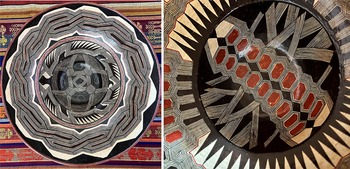
Inside of mucawas by Mayra Gualinga, a professional ceramist from the Tereza Mama community in Pastaza. Author’s photographs, 2025.

“We weave because it is part of our life, because we are old and we do not want to lose this practice that comes from our grandmothers and great-grandmothers.”
Producing this art requires having a sharp eye and a steady pulse, as well as patience and deep knowledge—spiritual, technical, and scientific—of the materials and therefore, the forest from which they originate. These skills allow us to paint the finest lines, depicting the diverse beings that compose the living forest, or Kawsak Sacha. Each mucawa—a ceramic bowl for drinking cold beverages, particularly lumu aswa, a fermented manioc staple beverage—and each tinaja—a large vessel used to store aswa—embraces the image of the boa, the turtle (Figure 2), the snake, the butterfly, the armadillo, trees, and birds, as well as the spiritual visions revealed in dreams and through medicinal plants. In short, all the living forest is contained within these ceramics’ designs, together with the oneiric, transcendental visions and ancestral knowledge held by the artists. At the same time, this practice is grounded in an intimate and embodied understanding of the materials. For instance, artists know how to distinguish between different kinds of clay, each suited to a particular type of vessel. For the mucawa (see Figure 3), a soft, buttery clay free of stones is required; for the tinaja (see Figure 4), a coarser and less malleable clay; for the callana (see Figure 5) and manga, a darker and harder clay. The careful selection of these materials reflects geological knowledge of the territory, passed down through generations and inscribed in practice. Moulding is done entirely by hand, aided by the wiwishku—a tool made from the peel of the pilchi fruit (Crescentia cujete). Pigments are obtained from coloured clays or stones—black, red, pink, yellow, and white—harvested in niche locations within the forest, further reflecting the geoscientific and intimate knowledge of the forest: understanding the diverse materials they hold, where these lie, how to harvest them, and how to combine and refine them later.Footnote 2 To refine a ceramic vessel’s form, the surface is first smoothed with a wetted corn leaf, whose moisture ensures an even, consistent texture, and then polished with a glassy stone to prepare it for intricate painted designs. Brushes are made from strands of children’s hair, used for their delicacy, symbolising the relational and intergenerational nature of this practice. Finally, the pieces are fired and coated with a special tree resin.
Mucawa created by Evangelina Gualinga, representing a boa. Author’s photographs, 2023.

Tinajas storing aswa from the Pakayaku community. Author’s photograph, 2024.

The callana is a bowl used to serve cooked savoury food. Unlike its sister, the mucawa, the callana is left unpainted. After being moulded and pit-fired, it is smoked (kushnichina) with semi-humid wood, which gives it a glossy black finish and ensures its waterproof quality. The manga, the pot used for cooking, follows the same elaboration process as the callana. By contrast, the tinaja—the large vessel used for fermenting and storing lumu aswa—has the most complex making process. Like the mucawa, in addition to the lengthy moulding, firing, and painting processes, it must be sealed with a special resin that strengthens its surface. Harvesting this resin can take up to 6 months, because the trees from which it is sourced are left to slowly bleed from small incisions. We never cut a tree down. Taking only what is needed means moving at the tree’s own pace. Different resins and tools are also selected according to the type of ceramic being produced, each requiring its own distinct collection and preparation process. These processes embody geological, botanical, and chemical knowledge that has been accumulated, tested, and refined across several generations.
As mentioned above, the mucawa is the vessel in which lumu aswa and uku yaku—concentrated aswa, similar to wine—are served, as well as certain cold medicines. Serving drinks in mucawas is a symbol of respect and appreciation to both the substance being poured and the person receiving it. Mucawas come in different sizes depending on the occasion. In festivities, for example, large bowls are used to drink aswa, whereas the smallest are reserved for uku yaku. Miniature vessels called purus, similar in form to tinajas, are also used to serve aswa. Aswa itself is central to Kichwa communal life. Born from manioc, one of the pillar plants of the Amazonian peoples’ diet, it nourishes our people both physiologically and socially. Aswa is a drink made for sharing on any occasion, especially during mingas—collective gatherings for voluntary work that benefit a family or the whole community. Aswa brings people together. Whether in everyday life, meetings, festivities, or any kind of gathering, it sustains the relational fabric of communal life.
Each mucawa is decorated with forest-inspired symbols, painted both inside and out, and coloured with a range of pigment mixtures. Every piece is unique and stands as a signature of the artist, who expresses her own creativity and style. Yet, these personal styles often carry the techniques and creative input transmitted through family lineages. In this way, ceramics embody both individual and collective creativity, skill, and intergenerational knowledge. Beyond these principal vessel types, artists also engage in sculptural experimentation, playing with materials and creating diverse shapes and designs. These examples of ceramic types and their uses represent only a fragment of what manga allpa awana encompasses, yet they reveal the empirical methodologies and multilayered knowledge systems at the heart of this artistic practice, reflecting its relational and scientific essence.
Callanas by Evangelina. Author’s photograph, 2025.

Art and science as concepts do not exist in Runa Shimi or Kichwa language, yet they are intrinsic to how we enact, represent, and transmit cosmovisional knowledge. According to Held, Indigenous sciences, like other sciences, are systems of knowledge based on “tested, rational, methodical, and empirical” methodologies.Footnote 3 However, unlike colonial praxis, their rationality and empiricism are not anthropocentric, nor do they serve domination and extraction. They are grounded in cosmovision and territory, making them relational, holistic, and inherently spiritual. As Held notes, “Indigenous science is holistic in its approach,” meaning its knowledge is interdependent with, and reflective of, broader cosmovisions.Footnote 4
This is true not only for Kichwa but for other Indigenous peoples across the globe. Within Māori cosmovision, for instance, Mātauranga comprises holistic spiritual systems of knowledge that “grow and develop from the close relationship” with their territories.Footnote 5 Likewise, for the Amazonian Kichwa, our cosmovision is rooted in territory: Kawsak Sacha, the living forest, is our greatest teacher and the source of Sacha Runa Yachay, our millenary wisdom. The forest not only provides all that is necessary to live in harmony but also teaches us how to coexist, embedding our scientific knowledge in everyday practices like manga allpa awana, which reinforces the responsibility to care for the land, as will be shown later. These teachings are enacted in daily life through storytelling, working the crops, and artistic creation. This is why, when we speak of ceramic art, we are not only speaking of its material or aesthetic dimensions, but of our relational existence and the practice of our cosmovision.
But what do we mean by art? In our language, the concept of “art”—just like “science” and “craft”—does not exist. For translation purposes, we understand art as an expression and channelling of the magic and power that Pacha Mama—Mother Cosmos—has gifted us.Footnote 6 For instance, when someone holds great ability in any specialised practice, we say a Supay—a powerful guardian spirit—has granted them that power and skill. This relationship is illustrated in a story of Nunguli, the guardian spirit of clay, crops, and fertility. Nunguli gifts a young woman the ability to create all kinds of ceramics after she treats a clay mine in the forest with respect and care, unlike a group that previously mistreated the sacred site. From that moment, her hands carry Nunguli’s blessing, and she becomes one of the most admired ceramists in her community and beyond.
This story reveals a relationship of reciprocity and respect with the forest, who feels, speaks, and responds to our actions. It illustrates how the ability to create ceramics is inseparably linked to those same principles: when the young woman treats the manga allpa site with care, Nunguli blesses her hands. Consequently, art becomes an act of externalising the fulfilment of living, or Sumak Kawsay—life in plenitude, harmony, dignity, and equilibrium.Footnote 7 In other words, art is the profound expression of our collective life as part of, and in connection with, Pacha Mama, the source of all holistic inspiration, artistic and scientific. Therefore, art is a form of knowledge, communication, and an intrinsic element of our relationality with Pacha Mama—just as our science is.
Within our Kichwa cosmovision, women know that the forest is both our home and educational space. As Evangelina reflects: “Our home was our school and weaving ceramics was part of that obligation that we had.” For her, weaving pottery keeps alive the heritage, memory, and “spiritual strength of our people.” Each line, brushstroke, and moulded curve embodies the knowledge and relationship we hold with Kawsak Sacha.
Practising manga allpa awana therefore does more than just preserving a technical and aesthetic discipline. It keeps our history—and thus our collective existence as a people—alive. As it has been shown, this practice embodies our cosmovision which centres the care, respect and thus protection of our territories in collectivity. The territory, however, is not only a physical but also a cosmovisional space that lives in our bodies and actions: it is embodied and protected whether we are in our communities or in urban areas. In other words, we are our territories; our bodies are inseparable from the living forest. Even as migration pushes many women and our families to the cities—due to intersecting social, economic, and environmental factors—we continue to weave this art and the collective historical resistance it carries. It is important to mention that while pottery remains a speciality of women, its endurance depends on the family, the community, and the people as a whole, all of whom sustain the cosmovision this art embodies. In other words, what ceramists create is interdependent with the everyday relational practices of the wider community and people—from tending the crops and speaking our language, to engaging in political resistance—because those actions constitute the very cosmovision that manga allpa awana embodies. No matter where we are, we remain connected to our world because we embody Kawsak Sacha in spirit, and everyday practices like ceramic making sustain this relational fabric, grounded in spiritual, social, artistic and scientific wisdom.
Cosmovision and the decolonisation of art and science
There are over 5,000 Indigenous peoples across the world speaking most of the world’s languages, making it impossible to homogenise us.Footnote 8 Yet many Indigenous and non-Indigenous scholars agree that what connects Indigenous peoples across the globe is our spirituality and relational existence.Footnote 9 As Pairrebenne Trawlwoolway scholar Lauran Tynan writes, “[r]elationality is about connection,” or “being in good relation” to humans and the land as a whole.Footnote 10 These relationships that often take the form of kinship constitute “the spiritual and cultural foundations” of Indigenous life, echoing Cajete’s assertion that such connections and the spiritual essence of the cosmos “must be honoured.”Footnote 11
A cosmovision encompasses the holistic dimensions of Indigenous life—spiritual, social, political, economic, pedagogical, scientific, artistic, and so on—and is defined by our relationship with and as part of the cosmos. This relationship is woven through respect, solidarity, reciprocity, and collective harmony with all the life within Pacha Mama. This spiritual and relational weaving is the essence of Indigenous existence. If relationality is at the core of Indigenous cosmovisions, then art and science cannot be approached as separate but must be understood as interdependent realms. These principles of relationality are embodied and expressed through practices such as Amazonian Kichwa ceramic making, where artistic expression, scientific knowledge, and relationality with the land intertwine.
Understanding how art embodies cosmovision also requires questioning dominant definitions of art and the histories that have shaped them. Defining art is very complex and contested, and attempting to pin it down as a totalised category risks reproducing false universalist logics.Footnote 12 Like many other fields of knowledge and disciplines, hegemonic conceptions and uses of art have been entangled with imperial power. As Berger highlights—particularly in the context of traditional European oil painting (1500–1900)—art has long “serve[d] the ideological interests of the ruling class,” often portraying the world through imperial, elitist, racialised, anthropocentric and patriarchal lenses.Footnote 13 Conversely, Indigenous art has often been framed as “primitive” and displayed in “ethnographic museums rather than in art galleries.”Footnote 14 From the colonial appropriation and exoticisation of Indigenous art to the monuments glorifying European colonists that still stand in major cities, the art enterprise has, in a great extent, been co-opted and used for serving imperial purposes.
Dominant approaches to science have also played a central role in reinforcing imperial epistemologies, deeply entwined with state and capitalist historical development and power.Footnote 15 As Newton-Smith notes, “science” is regarded as the most powerful institution driving “modernity,” both materially and ideologically.Footnote 16 There remains no doubt of this, especially when considering how “modern” science and technology have been central in driving imperial global politics, where weapons of mass destruction are used to perpetuate colonial and genocidal projects, as seen in Palestine right now. Embedded in Enlightenment rationalism and Cartesian dualisms, Western science has claimed universality through notions of objectivity, legitimising its superiority while reducing Indigenous sciences to merely “traditional.”Footnote 17 Furthermore, Western science often atomises and objectifies “nature” to serve anthropocentric, industrial, and/or capitalist ends. To highlight the coloniality of hegemonic approaches to art and “modern” science is not to reject these altogether, but to interrogate the history, intentionality, and paradigms they sustain, and to call for their decolonisation through dialogue with other ways of knowing and being, especially Indigenous ones, which centre relationality and the care for the fabric of Life.
Manga allpa awana as resistance
Manga allpa awana, like many everyday practices that embody our cosmovision, forms the backbone of our existence as Runa or Kichwa people. Through such practices, Kichwa women sustain life within and as part of Kawsak Sacha. As described earlier, manga allpa awana carries scientific knowledge, but it also carries teachings around the reciprocity and respect that guide our relationship with our territories, and enables life in harmony within our communities. Each sphere of life—whether agriculture, hunting, architecture, medicine, storytelling, music, or dance—intricately embodies our cosmovision and together forms our collective existence. In this sense, when weaving ceramic art we are weaving our world. Drawing on Bruno Latour, Mario Blaser describes that the politics of “worlding”—the creation of one or several worlds—“is a politics focused on the processes through which a world is being created.”Footnote 18 Each Indigenous people and their territory form a unique and intricate world and are part of what is known as the pluriverse: a world composed of many worlds, as the Zapatistas, among others, have described.Footnote 19
Yet such world-making practices face challenges. Extractivism, industrialisation, urbanisation, displacement, intersectional discrimination, structural poverty and violations to our individual and collective rights—driven by corporations, the state, dominant society and organised crime—are threatening our cosmovisional practices and existence as a whole. For instance, the rise of industrial production of single-use plastic objects has displaced much of Amazonian pottery. Markets flooded with artificial utensils have replaced our clay work, leading many communities to stop producing this art. This loss is not only material but also cosmovisional: it threatens the transmission of knowledge and our collective memory. Younger generations risk losing the embodied skills, wisdom, and ethical frameworks this art carries.
Nevertheless, elder women like Evangelina, Celia, and Lucinda—and the many ceramic artists from Sarayaku (Pastaza and Sucumbíos), Canelos, Pakayaku, Tereza Mama, and many other Amazonian Kichwa communities—have kept this relational science and art alive, passing it on to daughters, granddaughters, and great-granddaughters. These Kichwa examples represent only a fraction of a continent-wide artistic diversity practised by other Amazonian and non-Amazonian Indigenous peoples, along with the knowledge and resistance that their unique art forms entail. In this sense, the perseverance of Sarayaku elders is much more than cultural continuity: it is a political act of resistance against hegemonic forces that have long sought to erase Indigenous existence, and the territories to which we belong.Footnote 20
At the heart of the politics and resistance of Indigenous peoples lie our cosmovisions, which withhold millenary memory and knowledge rooted in harmonious relationships with Pacha Mama. Even more, they also stand as holistic political and ontological sources that can guide humanity toward healing and reconnecting with the fabric of Life. While Indigenous identity is characterised by our historical resistance against the colonial project of the modern nation-state, it is primarily defined by our spirituality and profound connection to our territories.Footnote 21 The political processes we weave—from day-to-day practices to large-scale political mobilisation—are therefore guided and sustained by these cosmovisions. That is, by the love we hold for Mother Earth.
The struggle of Indigenous peoples worldwide centres on defending our territories through our right to self-determination—in other words, protecting our worlds and right to exist autonomously. By practising and safeguarding Sacha Runa, or Amazonian Kichwa cosmovision, we resist forces that aim to erase our existence, protect the Amazon rainforest—a lung of the Earth—and, with them, planetary futures. Indigenous women, especially the elders, are the primary custodians of this wisdom; manga allpa awana epitomises the responsibility to transmit such cosmovisional knowledge. Thus, Indigenous political resistance is not merely opposition to an ongoing history of domination and oppression; it is the continual weaving and safeguarding of our cosmovisions that seek to protect the sacred fabric of Life.
Weaving futures of liberation
To weave clay means, for Amazonian Kichwa women, to continue braiding our collective history, sustaining our cosmovision, and, therefore, sustaining our world. Manga allpa awana is therefore not only an art form, but also a relational science, a world-making practice, and a political act of resistance. For Indigenous or originary women, resistance involves bringing together our collective strength and power—physical, spiritual, and epistemological—to continue the centuries-long struggle to defend our cultural integrity and territories, where collective life is rooted and unfolds relationally. In keeping this practice alive, elderly Kichwa women safeguard and transmit a cosmovision that centres the protection of the fabric of Life. Indigenous cosmo-visions more broadly envision and strive towards holistic futures for healing Mother Earth, calling for humanity’s spiritual growth and reconnection. Weaving such futures requires a critical interrogation and decolonisation of anthropocentric and imperial ways of knowing and being—including dominant understandings of art and science—which lie at the core of today’s interconnected planetary emergencies. Recognising manga allpa awana as both art and science not only acknowledges pluriversal ways of knowing and being but also opens pathways for dialogue that can articulate different worlds—a vital step in our collective quest to decolonise and weave futures of liberation.
Author contribution
Writing—original draft: M.C.G., P.T.-C.



 Open access

