


In addition to class, race had a key role in the construction of madness and literary value and thus in periodical production in asylums. Benjamin Reiss calls the asylum ‘a happy twin of slavery’, since ‘lunatics, like slaves, were deprived of the right to vote, to sign contracts, to make wills, and to hold property’.1 Analysing the treatment of Black patients at the Alabama Insane Hospital, John S. Hughes observes a correlation between the experience of racial oppression and mental illness:
An unexplored irony of the formal policy of moral treatment and the insistence on occupational productivity was that, wherever possible, all patients, black and white, pursued a daily routine that most southerners would have considered appropriate for blacks: patients lived their days according to a rhythm not of their choosing; whenever possible they worked at physically tiring jobs out-of-doors; everyone deferred to authority; and individuals had few substantive choices to make. Model patients assumed their assigned roles, cooperated, and deferred to authority.2
The suggested parallels between white mental patients and the Black community offer an interesting perspective on asylum publishing, especially in institutions that housed non-white patients. How did the patients involved in publishing (mostly if not exclusively white) experience and navigate these social hierarchies and ideologies? Eannace’s study of the Opal of the New York State Asylum has already started answering the question, by showing that one of the major tools of oppression was ‘popular culture’s re-figuring of “others” as lacking the language skills necessary to make sense’.3 Asylum periodicals’ sane and eloquent writings were thus in themselves a form of resistance and challenge to the ruling ideologies. Empathising with other marginalised groups, Eannace argues, the producers of the Opal used their platform to fight against all inequality and hypocrisy in society: ‘preponderance of opinion [expressed in the periodical] leaned toward the rights of anyone denied full access to the American promise’.4
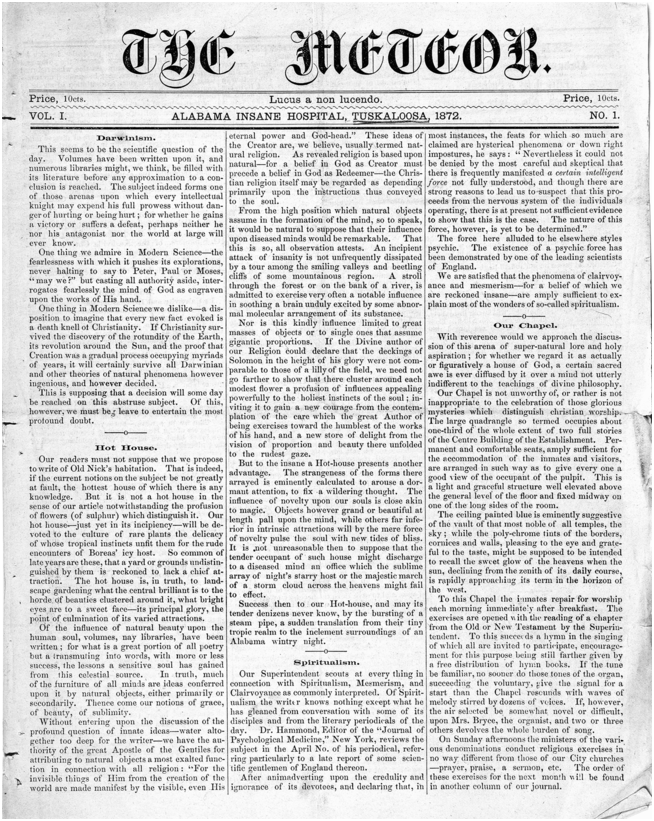
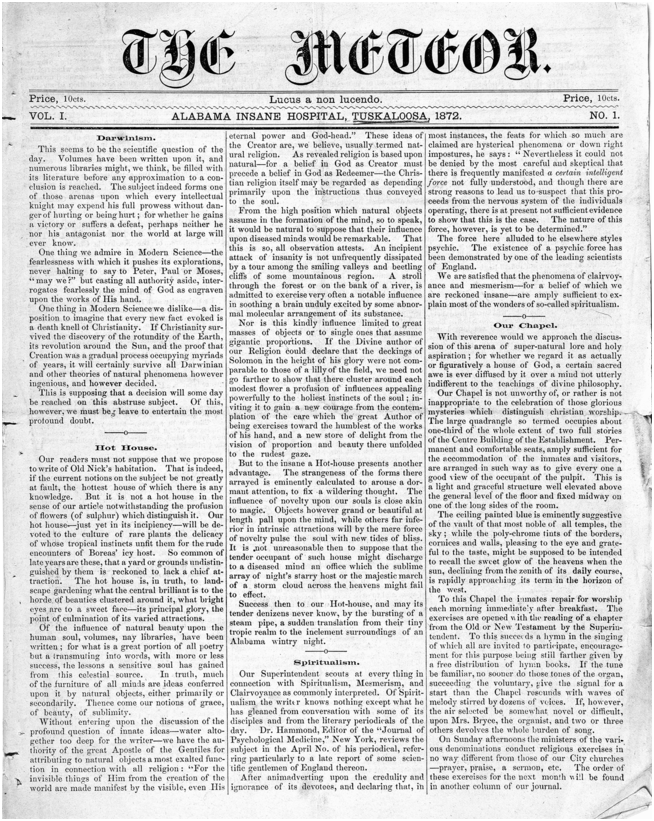
The history of the Meteor of the Alabama Insane Hospital (Figure 5.1) demonstrates a contrasting response to institutionalisation and the loss of rights that accompanied it. In comparison with other tasks, running and writing for a periodical was a form of work of an especially high order. It enabled educated white patients to not only express their creativity, enlightenment, and agency, but to distinguish themselves and reclaim their citizenship, at least figuratively. The launch of the Meteor on 4 July 1872 by a former plantation owner, Joseph Alexander Goree (1825–1896), was an act of rebellion against the irony of losing his own liberty and rights once he was certified as insane. The periodical was part of a larger campaign of literary activity which he led to demonstrate his erudition, high taste, and reason. His Meteor openly declared its aims of communicating updates to the patrons of the asylum. Unlike other asylum periodicals, it also openly discussed the involvement of the physician-superintendent, Dr Peter Bryce (1832–1892), in the publication. This was a strategic move rather than an act of submission, as it recast the patient-editor and the physician as allies and collaborators. Goree found empowerment in his editorial position and was set on proving his reason by maintaining the high literary quality of his publication and keeping madness out of its pages. Though run almost entirely by a single individual and unashamedly catering to the interests of the institution, the message of the Meteor was far from straightforward and homogeneous.5 During the decade of irregular publication, the newspaper accommodated different viewpoints and sought to represent the wider patient community. It also embodied Goree’s declining enthusiasm and growing discontent, as he realised that his project of self-empowerment would fail to earn him his freedom and rights.
Front page of the first issue of the Meteor.
The Alabama Insane Hospital and Joseph Alexander Goree
Established in the outskirts of Tuscaloosa, the Alabama Insane Hospital opened its doors in 1861 and was one of the many public institutions embodying the moral treatment movement in America. Constructed according to the model established by Dr Thomas Kirkbride of the Pennsylvania Hospital for the Insane, the asylum featured a central building with two extending separate wings for men and women and over 300 acres of surrounding land.6 The institution admitted Black patients too, who, for the most part, were segregated from the rest and tended mostly by Black nurses.7 At first, they were placed in the basements of the wards, but in the late 1870s, separate lodges were built behind the main building for the purpose.8 Recommended to the trustees of the asylum by mental health reformer Dorothea Dix, Dr Peter Bryce of Columbia, South Carolina, was the first superintendent and held the position for thirty-one years. After graduating from the New York’s Medical College, he visited several European asylums. In Bill Weaver’s account of Bryce’s superintendency, the alienist emerges as a capable administrator and manager who fought for the good name and the survival of his institution during and after the Civil War.9 Bryce’s application of the moral treatment was intertwined with the institution’s economic dependency on patient labour.10 He claimed that: ‘As a remedial agent judicious employment is of the very first importance.’11 Hughes has shown that Bryce succeeded in engaging an impressive 80 per cent of the patients in some kind of labour over the first fifty years of his superintendency.12
At the end of 1867, the year in which the Meteor’s editor-to-be entered the Alabama Insane Hospital, the asylum housed 150 patients, though the number was rising steeply, while funding was perpetually insufficient.13 Bryce lamented that ‘in the line of amusement for the patients … the Hospital is badly equipped’.14 This clearly changed in the following years, as the physician’s report for 1871 reveals a range of amusements and recreational activities offered to patients: ‘An evening every week is given to diversions of different kinds in the large amusement hall appropriated for these purposes. Creditable theatrical performances, Ethiopian minstrelsy, tableaux-vivants, and games of all kinds, continue to enliven those occasions [italics in original].’15 Billiards, croquet, musical entertainments, walks, and carriage rides were also provided. Though the nature of these entertainments suggests that they were intended primarily for the white patient population, at least some of the theatrical events were attended by Black patients as well. The publishers of forty newspapers sent their titles to the asylum for free, and further donations of books, magazines, and other items from the local community were received.16 The launch of the Meteor in 1872 was part of this expanding recreational programme, but its purposes extended beyond institutional promotion and providing entertainment: to its editor, it was a means to sustain his social status and sense of self.
The known facts of Joseph Alexander Goree’s life offer some insight into who he was, his experience in the institution, and the role of the Meteor in it. He was born in the family of James Lyles Goree (1783–1841), a cotton planter in Perry County, Alabama.17 His father passed away when Joseph was sixteen, leaving behind an estate of nearly 1,800 acres and ninety-four enslaved people to be divided between his wife Martha and six children. Joseph inherited 285.71 acres at the value of $4,508.37 and seventeen enslaved people.18 He studied at the University of Alabama (1841–1842) and Brown University (1843–1845).19 Records from the 1850s indicate that he sold off the people he had enslaved but continued to accrue land in Missouri as well as Arkansas, where his older brother, Dr James Langston Goree, resided. He married Emma Maria Robinson in Indianapolis, Indiana in 1853.20 His wife passed away in the summer of 1854, within two weeks of giving birth to their only daughter, Emma E. Goree.21 By 1860, Emma was staying with her uncle in Arkansas, and she spent most of her life in Indiana.
Restricted access to patients’ records of the Alabama Insane Hospital obscures the particulars of Joseph’s admission to the Alabama Insane Hospital in 1867 and his experience in the institution until his death in 1896. However, census records suggest that he suffered from ‘melancholia’ and ‘monomania’, a kind of partial insanity that involved unhealthy obsession with a particular topic.22 At the time of his admission, only his thirteen-year-old daughter and his sister Lucy, who had moved to Texas, seem to have been alive and in good health. Having struggled with mental distress since at least 1850, his other sister, Mary Ann, was in the South Carolina Lunatic Asylum. In 1858, his brother Robert, also a cotton farmer, had mortally stabbed himself in the chest after a period of ‘depression of spirits’.23 His brother John Rabb had died of lung and liver disease in the early 1850s too, and Dr James Langston Goree had passed away in December 1866 of pneumonia. The whereabouts and death date of his mother have not been confirmed, but if alive, at that time she would have been quite elderly, at 79. The asylum’s financial records from the 1870s mention the receipt of fees for the boarding of a private patient by a ‘Miss Goree’, suggesting that his daughter eventually took charge of his maintenance.24 The Gorees’ history suggests that, even if Joseph’s distress leading to his admission was not directly related to the suffering of his relatives, he had lost most of his closest family and was likely in mourning.
This is not to say that he was alone and forgotten. The prosperity of his family secured him connections with other influential figures in the region, some of whom were directly involved in the establishment of the Alabama Insane Hospital. The Gorees were neighbours to the family of lawyer Andrew Barry Moore, who married Joseph’s sister Mary Ann in 1832 and became Governor of Alabama in 1857. He was an executor of James Lyle Goree’s will. Leah Rawls Atkins has suggested that it was in fact Mary Ann’s suffering that motivated Moore’s support for the construction of the Alabama Insane Hospital, begun in 1852 and completed in 1859.25 On 10 October 1867, sometime after Joseph Alexander Goree’s admission, Moore submitted a petition to the Probate Court of Perry County. In it, he declared Goree ‘a lunatic and incapable of governance of himself, or of conducting or managing his affairs’ and requesting a trial to determine ‘whether or not the said Joseph A. Goree is Lunatic, an idiot or non compos mentis’.26 On 24 February 1868, a jury of twelve declared Goree ‘non compos mentis’, and Moore became his official guardian.27
It is not clear what happened with Goree’s estate after Moore passed away in 1873, but in 1884 the Probate Court at Tuscaloosa County received a similar petition. This time, it was submitted by Dr James Thomas Searcy (1839–1920), a local physician and son of Dr Reuben Searcy – the president of the asylum’s board of trustees. In his petition, James Searcy disclosed that Joseph Alexander Goree had ‘an estate worth about three thousand dollars ($3000.00) and that it is necessary for him to have a guardian to take charge and manage the same’.28 He introduced himself as ‘a personal friend’ and claimed that his proposed appointment as guardian was ‘the wish of the aforesaid Joseph Alexander Goree and of his friends’.29 Three years later, James Searcy succeeded his father as the head of the trustees. After the death of Dr Peter Bryce in 1892, he took over the management of the asylum as a superintendent and held the position until 1919. It is not known whether he retained his guardianship until Goree’s death in the hospital in 1896 and what became of the estate after that. Searcy’s petition cannot be considered entirely malicious, because it contains at least a bit of truth: the physician and his future patient had a long-running relationship. They were close enough for Searcy to name one of his sons Joseph Alexander in 1879. No matter how friendly Goree and Searcy were, however, the guardianship constitutes a conflict of interests. If not blatant examples of abuse of power, Moore’s and Searcy’s guardianship over Goree reveal that his life was intimately intertwined with the Alabama Insane Hospital in ways that exceeded the fact of his admission as a patient. These circumstances contributed to Goree’s complex positioning in his social environment within and beyond the asylum. The son of a cotton planter and a slave owner himself, he ended up confined and legally stripped of his citizen rights, while the responsibility for his person and property were handed first to his brother-in-law and later to his alleged friend.
The Meteor as an Emancipatory Project
In this situation, his education and good taste became significant assets. In the years following his admission, Goree engaged in various literary activities. He ran the asylum library and printed both the Meteor and annual reports of the asylum. In his printing office, he welcomed visitors of the asylum, and, consequently, he was often mentioned in the local press as ‘Dr Goree’, despite never having qualified for the title.30 He wrote poetry and articles for the press, some of which he collected in a scrapbook.31 A reporter visiting the hospital in 1878 described Goree’s writing as ‘replete with lively fancy, sound judgment, good taste, and occasional sparks of genuine wit, all of which show how very sane an insane man can be’.32 This comment’s alignment of fancy, judgement, taste, wit, and sanity is key to understanding Goree’s activity in the asylum. It perfectly illustrates what Simon Gikandi has termed ‘the culture of taste’ established in the Enlightenment and ruled by ‘the ideology of the aesthetic [which] was predicated on the capacity of the aesthetic or the sensual to be posited as analogical to reason’.33 In this system, good manners, education, and discernment of valuable art and literature were linked with the highest ideal of rationality – an ideal reserved for the white middle- and upper-class Europeans and Americans.34 The review of Goree’s work thus suggests that his literary endeavours in the Alabama Insane Hospital were more than a means to pass the time. They were avenues for him to counteract the disempowerment of mental illness and sectioning, to retain his image as a learned, cultured citizen, and, potentially, to prove his sanity through aesthetic judgement.
The launch of the Meteor was a central component in Goree’s campaign to retain his sense of self and reputation as a respectable citizen through literary activity. Through the newspaper, he did not only continue participating in public life and showcase his skill and erudition, but he attempted to reposition himself as a collaborator in the asylum’s therapeutic project and thus an equal to the physician. The first issues featured essays on geology, music, agriculture, local intelligence, and content related to its mission – ‘to keep the Press and the people of Alabama, especially the patrons of the Hospital, en rapport with the doings of the institution, and well abreast with the most advanced views in the care and treatment of the insane’ [italics in original].35 In line with this statement, each of its four three- and four-column pages were filled with updates about the hospital, notices of donations, and musings on topics such as the use of physical restraint in asylums and the plea of insanity in court.36 The periodical also assured readers that its production cost nothing, ‘the whole labor of type-setting and putting it to press being performed by the patients, or by employees of the Hospital in intervals of leisure from their regular duties’.37 It was printed on a small, cheap Quarto Novelty Press, which cost $209.78 and was purchased via a New York–based agent, W. Y. Edwards.38 The newspaper sought to encourage exchanges with other titles, but it was also sold to offset the costs of production.39 Putting an emphasis on its novelty and cost-effectiveness, the Meteor promised to benefit the local community at no cost. This was crucial for an institution which, like many other asylums towards the end of the nineteenth century, depended on public funding and had to justify its existence by proving its usefulness in an economical way.
Despite its humble origins, the Meteor did not lack ambition and expressed aspirations to contribute to the restoration of the country after the Civil War. To convince readers of the value of the publication further, the first issue elaborated on the publication’s title:
We call our paper The Meteor. Meteors are always a surprise. So doubtless will be our little sheet. They appear at irregular intervals. So will it. Their career though short is brilliant, and we intend that our paper, if it do not coruscate with wit, shall glow with a kindly and generous sentiment for all mankind, whatever be their nationality, political principles or religious creed.40
Through this declaration, the Meteor joined other periodicals in seeking to reunite a society torn by political and religious divisions by appealing to a national readership.41 The choice of its launch date, 4 July, reinforced this intention.
This project of reconciliation, however, excluded the Black community within and beyond the institution. In his writing for the press, Goree repeatedly expressed his belief in Black people’s intellectual deficiency, their lack of aesthetic refinement, and the cultural degradation resulting from the abolition of slavery. In 1875, he was allowed to attend a lecture by Dr Middleton Michel at the Druid City Literary Club and subsequently published a commentary in the Tuscaloosa Blade. In his review, he objected to Dr Michel’s attribution ‘to the institution of slavery an influence detrimental to aesthetic culture’.42 He argued that, during the antebellum period, ‘to the highest literary and artistic culture there was not only no indifference, but enthusiastic devotion’.43 In another piece for the Blade, he connected the economic struggles of the South after the Civil War to ‘the anarchy resulting from the long contest for political supremacy between the intelligent whites and the ignorant negroes’.44 Despite the Meteor’s attempts at reconciliation, Goree repeatedly expressed resentment towards the outcomes of the war and scepticism towards the future political and cultural development of the country.
His contempt is also palpable in the Meteor, though expressed mostly through silence. In the surviving copies of the Alabama newspaper, Black patients appear only once, as a target for scorn and mockery. An article in the first number described the amusement hall and the regular entertainments that took place there and reflected on their quality as follows:
If we admit the common run of negroes to be reliable connoiseurs [sic], we should unhesitatingly pronounce as our verdict, ‘sublime! excellent! pretty good!!!’ – as a Frenchman would climax it; for with laughter loud and prolonged does the colored portion of the audience salute most of the attempts at the comical. If however we were to consult our own impressions we should say that excellence was not always attained – that there was some room, however small, for improvement ….
It must be remembered, however, that the performers are conscious of the fact that a large portion of the audience have had little opportunity for attaining to any considerable degree of perspicacity on histrionic subjects, and it is possible that points, incidents and act which impress the writer as absurd exaggeration may seem to others the acme of laughable drollery.45
Goree’s attitude stands in stark contrast to that expressed in the Opal (1851–1860) of the New York State Lunatic Asylum, whose contributors recognised the parallels between their oppression and slavery and used enslaved people as ‘a literary substitute for themselves’.46 The above-mentioned statement indicates that Goree would not have seen Black patients, who at the time constituted about 16 per cent of the patients in the hospital, as fit to contribute or even appreciate the Meteor as readers.47 In the context of the asylum, however, the exclusion of Black patients from his project and his claims on superior taste were more than the effects of normalised prejudice. In the public imagination, all patients, Black and white, were lumped together physically in the space of the institution and symbolically under the label of ‘lunatics’. Highlighting his superior intellectual attainments was part of Goree’s strategy to stand out and retain his membership in what he saw as ‘civilised’ white society.
The Meteor’s open and unashamed commitment to serve the interests of the institution by keeping the public informed of its operations is another strategy that Goree adopted in the pursuit of his self-empowerment. By promising to support Dr Bryce’s work, Goree positioned himself as an ally in the medical project of alleviating insanity and educating the public about its nature and treatment. As the publication relied on its claims to being produced by inmates, the first issue rushed to reassure readers that its authenticity was not compromised:
The Superintendent must not be held responsible for all opinions expressed through it, for while exercising a general supervision, he has thought proper to give its contributors a large discretion in the drift of their articles. Nothing but original matter by patients of the Hospital will be admitted to the honor of a place in its columns.48
This statement clearly establishes the superintendent, Dr Bryce, as the authority determining the contents of the newspaper. However, the supervision that the physician would exercise would be only ‘general’, suggesting that views not fully aligned with his were going to be allowed in the newspaper. His tolerance and permissiveness, the Meteor reassured its readers, would guarantee that the patients’ voices would not be silenced.
Indeed, the Meteor resists reductive interpretations along the doctor–patient dichotomy and adopts an ambiguously pluralistic voice. The newspaper traced closely developments in the management of the hospital and the treatment of insanity more widely. Its ability to do so was largely due to Dr Bryce’s involvement in the project. For instance, the eighth issue notes: ‘the Superintendent has handed us a number of the Middletown, Ct. Daily Constitution, which contains the obituary of Elizabeth Palmer, wife of Dr. A. Marvin Shew, Sup’t of the General Hospital for the Insane’.49 Phrases such as ‘we learn from Dr. Bryce’, ‘in behalf of the Superintendent’, and ‘the Superintendent has requested us to acknowledge’ further indicate that Bryce was frequently in touch with the newspaper office, providing information, opinions, and subjects to be discussed in the publication.50
Although the superintendent’s views were never expressed directly but were paraphrased or potentially appeared anonymously or pseudonymously, the visible involvement of Dr Bryce made it hard for the newspaper to sustain the readers’ trust in its authenticity. Potentially attempting to dispel the doubts, the editorial column was always headed by a reminder that the Meteor was ‘edited by a patient’. Suspicions were eventually voiced in the January 1874 issue of Excelsior, for a time regularly received from the Murray Royal Asylum in Scotland.51 Excelsior’s claim about the Meteor that, ‘though it purports to be “edited by a Patient,” it is obvious the Physician-Superintendent is the responsible or real Editor’, inspired a lengthy response by Goree.52 In the issue of 30 March that year, he questioned the basis of the accusation, refuted it, and counterattacked:
Does not the conductor of Excelsior know that any Superintendent who should suffer a paper to be published from his establishment without his supervision, would deserve a place in one of his own wards? …
He manifestly thinks that The Meteor wires are worked by some one [sic] who is not insane. With this we find no fault. It is our own conviction. But unfortunately we can’t get the Superintendent to see it …
But the editor of Excelsior still thinks that a hospital journal should contain the ‘insane’ contributions of the inmates. If Dr. Lindsay [the Physician-Superintendent of the Murray and editor of Excelsior] thinks thus, why not act accordingly?53
Declaring the involvement of physicians in asylum publications unproblematic and in fact advisable, this statement subverts the doctor–patient dichotomy in its apparent tolerance of medical supervision. At the same time, it presents a case in which a patient openly confronted the authority of two physicians. In these lines, Goree publicly questioned Dr Bryce’s judgement of his sanity and exposed the hypocrisy of another respected physician. At the same time, he disputed the very nature and proper management of asylum periodicals and defended a stance that seems unusual given his position.
The patient-editor’s conviction that medical supervision of periodicals was necessary did not simply pay lip service to the authority on which the publication depended (Dr Bryce’s) but was rooted in Goree’s genuine concerns. This is shown by his reflections on the sanity of contributors to asylum periodicals, including himself. He argues that, while allowing some madness in the periodicals might be entertaining,
to devote any considerable space to such matter would be as absurd as to have occasional dinners at the hospital, to which the public were invited, served up by very insane cooks, to show the guests what repulsive messes a diseased brain can concoct. From partaking at such entertainment we should beg to be excused.54
The parallel drawn between including ‘mad writing’ in the Meteor and inviting outsiders for dinner is curious, since at the time asylum tourism was in fact frequently practised, including in the Alabama Insane Hospital.55 Visits were usually carefully orchestrated, seeking to dispel doubts about the conditions in asylums and impress outsiders with the success of the moral treatment. Opposed to the idea that guests should be given access to patients’ minds, Goree suggests that his newspaper should protect inmates’ privacy. This is further supported by praise of the students at the University of Alabama, who ‘proved excellent neighbors. They [were] never seen prowling around the Hospital’ or annoying the inhabitants.56 Through that position, Goree justified not only the involvement of the supervising physician but his own function as editor and highlighted his own responsibility for representing and protecting the patient community.
Emily Clark has observed that ‘periodicals and tours helped to expose the inside of the asylum to the public, so that there would be no suspicion of internal corruption’.57 This claim implies that these practices were serving the asylum’s interests only, and that those were entirely separate from the interests of the patient community. The Meteor shows that the patient-editor, rather than the physician, could be the curator of the illusion of sanity. A piece, likely written by another patient, objects to Excelsior’s stance ‘that all such journals [asylum periodicals] err in publishing only the choice articles’ and argues that:
with nonsense, come whence it might, no class of readers would be long entertained. Hence, while he [the Meteor’s editor] has … excluded everything but contributions by the inmates, he has not, to use his own expression, ‘hesitated to apply the garote [sic] to any communication that had not other claims to attention than the circumstance of origin in the brain of an insane person.’58
At a time when discussions of madness were imbued either with medical slang or scandalous gossip, this policy of representation cannot be reduced to a ‘false positivity’, as Clark terms it.59 It was driven by a sense of asylum periodicals’ value beyond the ephemeral appeal of the sensation of madness. It also constituted a self-protection mechanism of the patient community against unhealthy and often ill-meaning curiosity. Finally, the image of the editorial ‘garrote’ once again highlights asylum periodicals’ potential to create a hierarchy of their own. The publications empowered at least some of the oppressed and marginalised individuals, turning them into harsh judges of others’ literary taste and sanity.
The Meteor as a Space of Disagreement
Goree’s position on keeping the newspaper focused on the institution and madness-free does not mean, however, that the Meteor did not include writing that departed from these principles and opinions that diverged from the superintendent’s. An article in the first issue arguing in favour of supernatural phenomena begins by stating that: ‘Our superintendent scouts at every thing in connection with Spiritualism, Mesmerism, and Clairvoyance as commonly interpreted.’60 The author defends spiritualism from the physician’s scorn by insisting that ‘the existence of a psychic force has been demonstrated by one of the leading scientists in England’.61 They then conclude: ‘we are satisfied that the phenomena of clairvoyance and mesmerism – for a belief in which we are reckoned insane – are amply sufficient to explain most of the wonders of so-called spiritualism’.62 It is noteworthy that the author’s convictions in spiritual experiences are presented not merely as a source of disagreement with the superintendent but as the reason for the author’s institutionalisation. Given the popularity of various spiritual beliefs at the time, it is unlikely that the author ended up in the asylum only for such opinions. This article shows the physician’s willingness to allow not only public defiance of his views but also, more implicitly, distortion of the circumstances surrounding patients’ admission and disputation of his judgement.
The Meteor is indeed a space in which the physician’s and the patient’s views could coexist, even when diverging. A front-page article in the April 1876 issue, for instance, answers complaints in the press about false pleas to insanity in courtrooms by arguing that any transgression can be explained with some degree of mental disorder. Thus, rather than restricting the use of the plea, the author claims, it should be used more often.63 Another article in the same issue reads thus:
On our first page will be found an article on the responsibility of the insane, in which are some good thoughts. But believing that an exhibit of the views of our Superintendent on the point would be specially interesting, we determined to supplement that article by another, setting forth his views as he has, from time to time, expressed them in our presence. The subject is difficult; for while it is indisputably barbarous to hold persons of diseased minds to a strict accountability, society has a right to demand protection from dangerous characters, whether they be made so by the devil or disease.64
The second article proceeds by offering a middle ground of ‘moderate responsibility’, suggesting that the defendant’s sanity should always be assessed by a commission of experts (alienists), and concluding that ‘the insane are rightly esteemed responsible in a degree’.65 The juxtaposition of these opinions suggests two possibilities. Dr Bryce might have been aware of the former article in advance of publication and, perhaps too busy to respond himself, arranged the insertion of the latter piece. Alternatively, the editor himself decided to balance the boldness of the first article with a more moderate opinion piece. Despite its subduing through the latter article, the former appeared on the front page of the newspaper: the patient’s opinion occupied a respectable place in the Meteor.
This is not the only instance in which the Meteor facilitated the vocalisation of discontent and criticism. In fact, alleged instances of censorship were made public knowledge by the inclusion of ‘intercepted’ correspondence sent by other patients. For example, the first issue contains the following notice: ‘The editor learns with deep sorrow that the handsome widow of the east wing [Ladies’ Wing], had prepared an article for this number of The Meteor but that it was condemned before reaching him.’66 Once again employing a metaphorical language referring to the death sentence, the editor implies that the article did not reach the printing office because of institutional interference. There are other mentions of obstruction of communication: ‘Three very interesting communications from the ladies were by the Superintendent … so carefully laid away that they cannot be found.’67 The editor nevertheless offered brief summaries of the accounts. One was a personal narrative of recurring illness and sectioning, the second was a report on the events in the ladies’ wing over the past week, and the last was a love letter, potentially addressed to someone outside the Hospital. There is evidence that female patients did write for the Meteor, so the censorship was not necessarily aiming to keep the genders separated.68 However, the inclusion of these mentions of intervention might have been driven by Goree’s yearning (similar to John Reid Adam’s) to communicate with the ladies’ ward. His wish eventually got gratified, as he was allowed to move more freely around the institution and to enjoy accompanied visits to the ladies’ ward.69 Either way, paraphrasing intercepted correspondence shows rebellion against regulation, as well as the editor’s commitment to include patients’ stories in his paper.
Finally, the Meteor published ‘the conclusion of the intercepted letter written by a patient of this Hospital for a New York journal’.70 The letter reviews the five newspapers in Tuscaloosa at the time and their editors. The Meteor’s editor, it says, ‘writes articles laudatory of the Hospital, and then avails himself of every opportunity to impose leg-bail upon the officers, in order to make room for any patient decoyed there by his pen’.71 This description resonates with the ambivalence of the Meteor’s attitude towards the institution, reflecting both endorsement of the institution and the patients’ (including the editor’s) plight for freedom. In the restrained platform of the newspaper, the latter was expressed by inserting, retelling, or mentioning patients’ writings that were meant to be left out.
Another way in which the Meteor departed from the ‘laudatory’ narrative about the hospital was by occasionally referring to alternative discourses among the patient population. An article titled ‘The Bright Side’ presents a disruptive image of asylum life. Claiming to report a conversation between inmates, it states:
One of the patients … was bewailing his condition; lamenting his confinement, his lack of profitable employment and variety in his associates, and the general monotonousness of life in a hospital. Another convalescent patient declared, in response, that hospital life was altogether the most pleasant that had fallen to his lot …. It cannot be denied however that by far the most general feeling, among the patients, is one of dissatisfaction; impatience of detention, a desire to return to their homes, and to be making money.72
This article highlights the diversity of patients’ experiences without downplaying the suffering caused by institutionalisation itself. It also yet again highlights patients’ frustration with the financial uncertainty they faced in the asylum, especially if they had families to support. The Meteor invited correspondents to give voice to these negative feelings. The July 1876 number contained a notice from the editor that invited other patients’ contributions and declared that ‘sly cuts at the officers, nurses and employees will not necessarily cause the rejection of an article’.73 This announcement did not cause a detectable change in the character of the newspaper. However, the encouragement of complaints shows the Meteor’s aspiration to become a platform for criticism, as well as praise of the asylum. In fact, the straightforward discussion of patients’ dissatisfaction becomes all the more striking and powerful when embedded in the overarching celebratory narrative that defines the newspaper. At the same time, Goree’s initial commitment to collaborate with the institutional authorities likely helped in earning the trust of the physician, building editorial authority, and gradually pushing the boundaries of what could be said in the newspaper.
The openly critical writing, however, could also be linked to changes in the Meteor’s circulation: the same number from 1876 announced that the newspaper would be ‘printed in the future solely for the use of the patients of the Hospital’.74 The report of the superintendent, issued in the autumn of that year, indicates that the publication ceased altogether at that point: ‘We published in the Hospital until quite recently a little paper called The Meteor, which was edited and printed exclusively by patients …. It was discontinued a few months ago from the lack of interest on the part of the patients who conducted it.’75 The newspaper made a surprising return a year and a half later, in December 1877, stating that, ‘Meteor-like our paper suddenly disappeared …. We purpose, as before, to issue it quarterly, but the quarter may be prolonged to six months or contracted to two or even one.’76 The next issue appeared two years later, and was followed by at least two more on an annual basis, as the periodical transformed ‘from a quarterly … to a semi-occasionally’.77
In that period, the Meteor often reflected its editor’s loss of spirit and faith in the therapeutic effects of the institution whose patient population had nearly tripled since Goree’s admission, reaching 379 at the end of 1877.78 In the December 1879 number, Goree publicly discusses the reasons for his sectioning. Though infused with his usual wit, the list hints at underlying bitterness and frustration. The first reason he mentions is his ‘ideas about animal magnetism and mind-reading which the savants deem unauthorized by any well-attested facts’.79 He also expresses suspicions of exploitation, similar to those of George Black, the printer of the Gartnavel Gazette: ‘Some say that he is kept here for the convenience of the Hospital, to print the poetry of the ladies of the establishment, etc.’80 The ninth and last one in the list simply reads: ‘Ask the Superintendent.’81 This final item hints at resignation, even anger, which would grow over time. Two years later, the twenty-first issue included the following reflection on the reduced frequency of the publication: ‘The editor, who was also the printer, disgusted with the long succession of years that still found him at the Hospital, determined to strike halt in the regular issue, and to print a number only when inclined to do so.’82 This is the last number of the Meteor that has survived in the Alabama Department of History and Archives, though there is evidence that it continued irregularly, at least until late 1883.83
It is hard to tell what happened in the office of the Meteor from 1876 onwards. The reliance of the publication on a single individual was likely a determining factor for its discontinuance. A notice in the last surviving number suggests that his time might have been taken up by his duties as the main printer of the institution: ‘All of the Hospital printing – and it is not a little – is done in The Meteor office.’84 The institution kept growing in size over the years: it housed around 325 patients in 1874 and 545 in 1881. Even though Goree was not working in the printing office alone, the staggering increase in jobs meant less time to dedicate to the newspaper.85 Throughout the run of the newspaper, he seems to have been not only the editor and printer but also the main contributor to the publication. The length of the editorial columns, the predominance of the editorial mode of expression, and the consistency of style throughout the run of the newspaper suggest that a significant portion of the writing was produced by him. Among the few notable communications by other inmates were a notice of a new plant being introduced to the hothouse of the hospital, articles on the nervous temperament and the devaluation of the title LL. D., and a female patient’s defence against the editor’s ‘characteristic “flings” at the weakness of oar [sic] sex’ with a sketch of the daily life in the ladies’ wards.86 Overall, others’ contributions were few, until the decline in the circulation and frequency of the Meteor forced the editor to actively seek the assistance of other patients.
The aforementioned notice from the editor encouraging critical writing by patients in the number for July 1876 also stated that:
Anecdotes and narratives of hospital experience, here or elsewhere, are preferred …. Prose and poetical contributions are solicited ….
The object of this change in the character of our paper – the substitution of many short articles for a few long ones – is to reflect more perfectly the animus [italics in original] of the inmates of the Hospital, or at least of a much larger number than have heretofore contributed to The Meteor.87
This statement marked the introduction of a new editorial strategy. Potentially struggling to fill the pages himself or to keep the attention of his readership, the editor resorted to making the newspaper more inclusive. The same number has a column ‘Personals: Contributed’ and a poem, which, as the the Meteor itself states, was unusual.88 Subsequent numbers contain relatively more ‘communicated’ articles bearing various signatures. A column titled ‘Answers to Correspondents’ offers witty responses to the questions submitted under ten different pseudonyms (though it is uncertain if they represented ten individuals other than Goree).89 The last surviving issue seems keen to underline that: ‘The articles in this number, though not signed, have been written by quite a number of persons connected with the Hospital.’90 This statement, however, does not make it clear whether these contributors were patients (current or former) at all. Despite the editor’s attempt to persuade readers that the newspaper accommodated more diverse perspectives, the change was not too palpable. Most of the writing still consisted of institution-related reports and musings.
The failure of the implementation of Goree’s new editorial strategy is somewhat ironically rooted in his high aspirations for the newspaper and his understanding of aesthetic taste as a marker of civilisation, respectability, and sanity. As most of the Meteor was the editor’s creation, commentary on others’ attempts at writing and on the decision-making involved in editing a newspaper are rare. The scarcity of other patient’s contributions, as well as the reference to the editorial ‘garrote’ mentioned earlier can nevertheless be interpreted as indicators of the editor’s high standards.91 Perhaps, despite all the compromises Goree was willing to make, there simply was no writing he found fit to be published.
This was almost certainly the case when it came to the inclusion of poetry in the newspaper. The issue of July 1876 contained the following reflection:
We used to think that few persons have the art of compressing it [life] into a literary form. Since reading Mr. Sydney Lanier’s Centennial Poem, we have changed our mind. Anyone can manufacture it. We therefore beg pardon of the Hospital bards, and entreat them all to send us their every effusion.92
Goree was clearly sceptical of the value of amateur poetry. Further evidence for it is found in the editorial commentary appended to the only patient’s poem that appears in the surviving issues of the Meteor:
Contrary to our usual custom we introduce a poem into the columns of The Meteor. The writer, we understand, came near landing into one of the back wards while the cacoethes poeticum [italics in original] was full upon him, and for this reason, even if the verses were devoid of real literary merit, he deserves to be rewarded. We like the lines however. They jingle well, and we think have the true ring. That idea about pinning with the evening star, we think we have heard before. B[u]t no matter; it’s good, and will bear repetition.93
This friendly but unenthusiastic comment mimics the attitude of other newspaper editorial commentary on amateur poetry. It shows that Goree, like George Black at the Glasgow Royal Asylum, stuck to the conventional strict editorial tone even at times when he was struggling to keep his newspaper running. He expressed no remorse at rejecting even acceptable writing for surprising reasons such as anonymity: ‘The communication signed “Zoe” is good poetry but being anonymous goes to the fire-kindling box.’94 Though publishing female patients’ poetry separately from the Meteor, Goree was reluctant to admit verse to his paper, even after the newspaper stopped its external circulation.95 It is possible that more poetry was published in issues that have not been located or survived at all. But the fact that the only poem that I have had access to was followed by an apologetic explanation of its publication suggests that the editor’s ‘garrote’ was applied mercilessly to maintain the Meteor up to the standards of its founder.
As the newspaper was part of Goree’s larger campaign to maintain his social status in the community and sense of citizenship, there was more at stake than the reputation of the publication. In Goree’s own worldview, refined aesthetic and literary taste were the highest marks of civilisation, humanity, and sanity. If the Meteor was to serve as evidence of his attainment, education, and well-developed tastes and by association, his reason, he could make no compromises. He had to maintain his image. As the editor of the newspaper, he found various opportunities to seek empowerment. He positioned himself as an equal ally and collaborator to the physician, joined the local literary circles, exercised editorial authority, represented the patient community, and gave voice to his fellow inmates’ discontent, as well as his own.
And yet, after four years of running his paper, he failed to earn back his liberty and autonomy. Without more information about the last twenty years he spent in the Alabama Insane Hospital before his death, it is impossible to say with certainty what caused the discontinuation of the Meteor in 1876, followed by its more sporadic appearances in the following years. These could be signs of Goree’s loss of faith and resignation to his condition, indicators of his deteriorating health, lack of interest, or something else. Whatever the reason, the testimonies of former patients and visitors to the asylum show that his project of proving his worth as a refined citizen was at least partly successful. In his memoir, Rev Joseph Camp recalls his time in the asylum and says that Goree ‘is as compos mentis as he ever was, and is one of the most polished gentlemen I have ever seen’.96 The reporter for the press who visited the asylum in 1878 provides the following description of Goree’s printing office: ‘In this sanctum we found a small but select library, his own property, bought with money furnished by his daughter, an only child, who resides in another state [Indiana].’97 Out of everything that Goree had owned and lost, his sense of self as a man of education and taste remained intact, embodied by what seems to have been his only property – his books.

 Open access