

Hostname: page-component-77f85d65b8-6c7dr Total loading time: 0 Render date: 2026-03-26T19:46:42.708Z Has data issue: false hasContentIssue false

Genistein inhibits Nlrp3/caspase-1 signalling to alleviate traumatic brain injury-induced anxiety-like behaviours in rats

Published online by Cambridge University Press:  27 September 2024

Zhiguang Li
Affiliation:
Department of Neurology, Xingtai Central Hospital, Xingtai, HE, China
Yan Li
Affiliation:
Department of Neurology, Xingtai Central Hospital, Xingtai, HE, China
Jiankai Zhao
Affiliation:
Department of Neurology, Xingtai Central Hospital, Xingtai, HE, China
Zhiyin Pang
Affiliation:
Department of Neurology, Xingtai Central Hospital, Xingtai, HE, China
Fei Guo*
Affiliation:
Department of Basic Medicine, Xingtai Medical College, Xingtai, HE, China
*
Corresponding author: F. Guo; Email: guofei162023@126.com

Abstract

Objective:

Traumatic brain injury (TBI)-induced anxiety is a common but under-investigated disorder, for which neuroinflammation is a significant contributor. Here we aim to investigate the protective effects of genistein, a plant-derived anti-inflammatory drug, against TBI-induced anxiety, and the underlying mechanisms.

Methods:

A rat model of TBI was constructed using the lateral fluid percussion injury method. Genistein at the doses of 5, 10, and 20 mg/kg were used to treat rats at 30 min, 12 h, 24 h, 48 h, and 72 h up to 14 days after TBI. The evaluation of neurological deficit was performed preoperatively, on days 1, 3, 7, and 14 after TBI. The elevated plus maze test was carried out to assess anxiety and explorative behaviours, and the open field test was performed to assess locomotive activities. Brain injury was assessed by measuring brain water content and TdT-mediated dUTP Nick-End Labeling staining. Inflammatory responses were examined using enzyme-linked immunosorbent assay. The mRNA and protein expression were analysed using real-time polymerase chain reaction and Western blot, respectively.

Results:

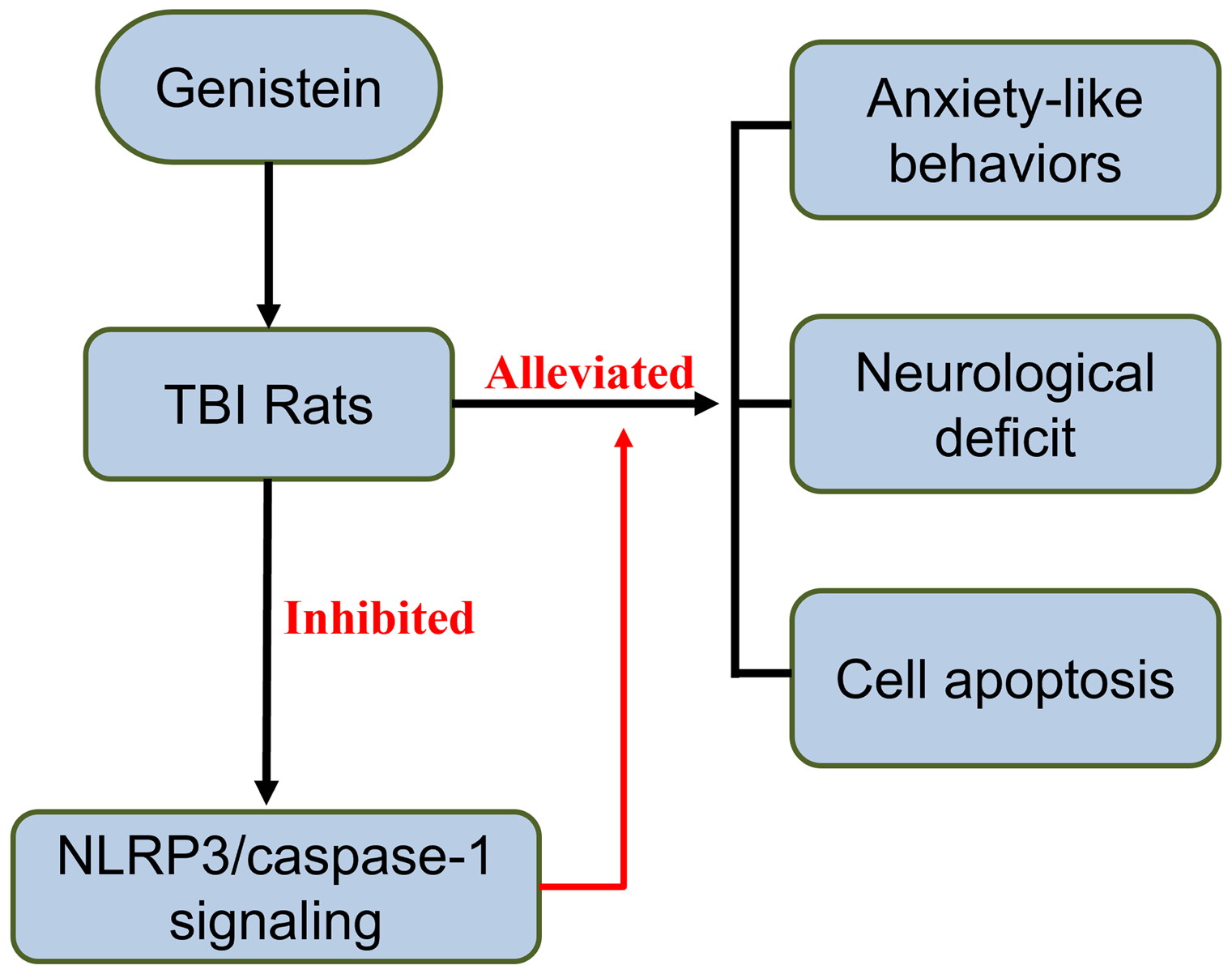
In the behavioural level, genistein treatment alleviated TBI-induced anxiety behaviours and neurological deficit in rats. In the meanwhile, brain oedema was also reduced by genistein treatment, showing alleviating effects of genistein at the pathological level. TUNEL staining also showed reduced apoptosis in rats treated with genistein. Genistein also inhibited Nlrp3/caspase-1 signalling, unveiling the effects of genistein in altering molecular pathways in brains with TBI.

Conclusion:

Genistein alleviates anxiety-like behaviours in TBI rats, which may be mediated via inhibiting Nlrp/caspase-1 signalling pathway.

Information

Type
Original Article
Copyright
© The Author(s), 2024. Published by Cambridge University Press on behalf of Scandinavian College of Neuropsychopharmacology

Access options

Get access to the full version of this content by using one of the access options below. (Log in options will check for institutional or personal access. Content may require purchase if you do not have access.)

Article purchase

Temporarily unavailable

Supplementary material: File

Li et al. supplementary material

Li et al. supplementary material
Download Li et al. supplementary material(File)
File 258.6 KB