


The 2010s witnessed the rise of a remarkable social movement. A rallying cry, conceived in the wake of George Zimmerman’s acquittal for Trayvon Martin’s death (Garza Reference Garza and Hobson2016), and popularized after the shooting of Michael Brown in Ferguson, Missouri (Boyles Reference Boyles2019; Cobbina Reference Cobbina2019), has grown into arguably the largest social movement in US history (Buchanan, Bui, and Patel Reference Buchanan, Bui and Patel2020). In 2016 a massive wave of protests spread across the country in response to a continued series of deaths of Black Americans at the hands of the police (Lee et al. Reference Lee, Mykhyalyshyn, Omri and Singhvi2016), and the movement became a major factor in the 2016 US presidential election (Drakulich et al. Reference Drakulich, Hagan, Johnson and Wozniak2017, Reference Drakulich, Wozniak, Hagan and Johnson2020). In 2020, after the deaths of Ahmaud Arbery, Breonna Taylor, and George Floyd, the movement and the protests grew even bigger, despite the public health restrictions of a pandemic.
Yet in an age of partisan polarization, Black Lives Matter has become a hyperpartisan issue. Despite the size of the protests, the movement has achieved only a thin majority of support from the US public, with declining support after a peak in June 2020 (e.g., Civiqs 2021; Thomas and Menasce Horowitz Reference Thomas and Horowitz2020). Notably, calls for police reform and broader policies to address racial inequalities and injustices have enjoyed only modest success, especially beyond the local level. Race and racial attitudes are important determinants both of support for Black Lives Matter (Drakulich et al. Reference Drakulich, Wozniak, Hagan and Johnson2021; Ilchi and Frank Reference Ilchi and Frank2021) and of voting behavior (e.g., Abramowitz and McCoy Reference Abramowitz and McCoy2019), and a majority of white Americans continues to oppose the movement (Drakulich et al. Reference Drakulich, Wozniak, Hagan and Johnson2021).
So how should we understand the seeming conflicts in the narrative of the importance of this social movement? We recommend embracing its complexity and contradictions and present a story in two parts. The first part involves those we call “the partisans.” People identifying as Democrats or Republicans have taken two increasingly divergent but remarkable paths. The differences between the two parties are increasingly defined by differences in racial attitudes (Pew Research Center 2020b). In the 2020 Democratic primary, candidates openly discussed systemic racism, police reform, mass incarceration, reparations, and other policies aimed at addressing racial inequalities and injustices in ways that seemed to be a departure from more moderate debates of the past, and they have pursued, with mixed success, more aggressive policies to address racial inequalities and injustices. Simultaneously, some Republicans have been more open in presenting issues and rallying voters in racial—and racist—ways (e.g., Abramowitz and McCoy Reference Abramowitz and McCoy2019), with Donald Trump’s presidency seen as a recent nadir in race relations in the United States (Menasce Horowitz, Brown, and Cox Reference Horowitz, Juliana and Cox2019). One result is substantial support for Black Lives Matter among Democrats and substantial opposition among Republicans, reminiscent of patterns seen throughout US history of calls for racial justice and equity followed by backlash from those interested in preserving the racial quo (e.g., Kendi Reference Kendi2017; McAdam and Kloos Reference McAdam and Kloos2014; Parker and Barreto Reference Parker and Barreto2013). Notably, this increasing partisan polarization on issues of race may also reflect a “hardening” on these issues; changes in net support for Black Lives Matter during the 2020 protests appeared less dramatic for Democrats and Republicans than for Americans overall (Civiqs 2021).
The second part of our story involves those we call “the persuadables.” Despite political polarization, not all Americans clearly identify as Democrat or Republican. So how do political independents view the Black Lives Matter movement and the 2020 protests? And under which conditions are these views fixed or persuadable?
For both sides of the story, we push beyond a simple focus on support for the movement generally to ask about how Americans understood the protests themselves. Symbolic interactionists suggest that people act toward things based on the meaning those things have to them and these meanings are formed in social interactions (Blumer Reference Blumer1986). Political and social movement actors understand this and make concerted efforts to shape public understandings of events in ways that support their political goals (Benford and Snow Reference Benford and Snow2000). During the civil rights movement, protesters sought to draw attention to systemic inequalities and injustices; in contrast, pro-segregation political actors sought to reframe the protest activities as promoting lawlessness, characterizing mass protests as riots and civil rights advocates as having no respect for law and order (Beckett Reference Beckett2000; Beckett and Sasson Reference Beckett and Sasson2004; Weaver Reference Weaver2007). In response, movement activists sought to highlight violent and repressive actions toward protesters by law enforcement officers, a framing that appeared to move public opinion in ways that supported the passage of civil rights legislation (Branch Reference Branch1989; Kohut Reference Kohut2015; Schuman, Steeh, and Bobo Reference Schuman, Steeh and Bobo1985). In 2020 the United States witnessed the largest civil rights demonstration in our history. Just as it did more than 50 years ago, it matters not just whether people support the movement behind it but precisely how they understand the protests themselves.
We investigate these questions using three 2020 surveys—including one that we developed—to describe the relationship between partisanship and support for Black Lives Matter. We then explore data from our national survey experiment fielded immediately after the massive wave of protests. We ask whether, and among whom, subtle changes in the framing of the protests could elicit changes in views of those protests and support for the broader movement. We explore a classic debate about the importance of framing protests as violent riots and investigate the seemingly paradoxical effects of highlighting racial justice or problematic police responses to the protests. For the latter, we are particularly interested in differences in the reception of these frames based on American’s racial ideologies. We conclude with a more holistic description of how the public views this significant and historic social movement and how we should understand it in the context of earlier social movements. Specifically, we argue for viewing the possible effects of the movement as contradictory and complicated but also consequential.
Understanding Public Views of Black Lives Matter
Understanding public views of the protests of 2020 and the Black Lives Matter movement more generally requires some historical context, a discussion of the evolution of racial attitudes, and an overview of the idea of framing.
Politics of Race and Justice
The United States has a long history of racist institutions, policies, and practices, including chattel slavery, the Black Codes, Jim Crow laws, Progressive Era policies in northern cities, housing and lending policies, and the police and criminal justice system (e.g., Hinton Reference Hinton2016; Kendi Reference Kendi2017; Muhammad Reference Muhammad2010; Taylor Reference Taylor2019). It also has a long history of both antiracist resistance to and protests against these institutions (e.g., Du Bois Reference Du Bois1935; Hinton Reference Hinton2021; Marable Reference Marable2007), as well as a long history of backlash against or resistance to this antiracist organizing, including through racist collective action and through rallying Americans who wish to preserve white hegemony (e.g., Cunningham Reference Cunningham2013; Maxwell and Shields Reference Maxwell and Shields2019; McAdam and Kloos Reference McAdam and Kloos2014; McVeigh Reference McVeigh2009; Parker and Barreto Reference Parker and Barreto2013; Tonry Reference Tonry2011).
There are striking parallels between the civil rights movements of the 1960s and 2010s. During the late 1960s, incidents of police violence against Black Americans sparked mass protests in dozens of cities across the country (Kerner Reference Kerner1968). Then, as now, a majority of white Americans opposed the protests (Legum Reference Legum2017), and the protests were subject to partisan political debate. In fact, modern partisan polarization can be traced to the civil rights movement and the racist and segregationist counter-movements of the 1960s and 1970s (Carmines and Stimson Reference Carmines and Stimson1989; Lang and Pearson-Merkowitz Reference Lang and Pearson-Merkowitz2015; McAdam and Kloos Reference McAdam and Kloos2014; McVeigh, Cunningham, and Farrell Reference McVeigh, Cunningham and Farrell2014). The Republican “Southern strategy” targeted formerly Democratic voters who were uncomfortable with the threats to the racial status quo posed by the civil rights movement, thereby ensuring by design that the parties would be divided by racial attitudes.
In addition to legislative successes—the dismantling of Jim Crow and the passage of civil and voting rights acts—there are at least two other legacies of the 1960s civil rights movement relevant to public opinion. One was the dramatic decline in overt expressions of racism and support for overtly racist policies and practices it set off (Krysan and Moberg Reference Krysan and Moberg2016; Schuman, Steeh, and Bobo Reference Schuman, Steeh and Bobo1985). The other was the creation of a modern racial ideology that adapted to changing norms by denying racist motivations. Rather than using older, more openly racist arguments that Black Americans were fundamentally inferior and undeserving of an equal legal status (e.g., Kendi Reference Kendi2017), some Americans shifted toward racial ideologies that minimized or denied the role of historical or contemporary racism as barriers faced by Black Americans and instead emphasized individualism to explain racial inequalities (e.g., Jackman and Muha Reference Jackman and Muha1984). The concept of symbolic racism was developed following the demonstrations in Watts in 1965 to help understand why some white Americans superficially expressed support for racial equality but opposed policies that would address inequalities (Sears and McConahay Reference Sears and McConahay1973). Although less overt, this new form of racism still effectively justifies racial inequalities. Related work has described this ideology as laissez-faire (Bobo, Kluegel, and Smith Reference Bobo, Kluegel, Smith, Tuch and Martin1997) or color-blind racism (Bonilla-Silva Reference Bonilla-Silva2018).
Thus, there are lessons and legacies from the 1960s relevant to understanding public opinion about Black Lives Matter, including advocacy for and resistance to racial equality and justice as a generator of political partisanship, as well as a modern racial ideology that cloaks a justification for preserving the racial status quo in an emphasis on individual attribution and a denial of structural or biased sources of inequalities. These legacies have been apparent in recent history. Barack Obama’s election in 2008 was seen as a symbol of racial progress and a possible sign of the beginning of a postracial era. However, his election was followed by the rise of a conservative social movement—the Tea Party—rooted in racial concerns (McAdam and Kloos Reference McAdam and Kloos2014; Parker and Barreto Reference Parker and Barreto2013) and in broader concerns about threats posed to traditional native-born white male Christian hegemony (Hochschild Reference Hochschild2016; Parker Reference Parker2016; Parker and Barreto Reference Parker and Barreto2013). However, Obama’s presidency also helped birth the Black Lives Matter movement not only through the raised expectations of its campaigns but also through frustration with his administration’s silence on key racial justice issues (Taylor Reference Taylor2016). In response, Donald Trump’s campaign for president made unusually explicit references to racial and ethnic resentment (Abramowitz and McCoy Reference Abramowitz and McCoy2019), using the police and the Black Lives Matter movement as racist dog whistles (Drakulich et al. Reference Drakulich, Wozniak, Hagan and Johnson2020; Wozniak, Calfano, and Drakulich Reference Wozniak, Calfano and Drakulich2019). In short, advocacy for racial equality and justice—which necessarily involves the dismantling of existing biases in the distribution of privileges and resources—simultaneously provides the opportunity to rally those concerned about these very social changes. As Kendi (Reference Kendi2017, xi) notes, “Racist progress has consistently followed racial progress.”
Importantly, these reactionary and reinforcing social movements help produce the substantial political polarization at the heart of our story. Although a set of issues have always been heavily polarizing for major political parties, the number of polarizing issues has grown in recent years, and activists have played a key role in this conflict extension (Karol Reference Karol, Thurber and Yoshinaka2015). Additionally, campaigns have increasingly focused on mobilizing their bases, rather than attempting the challenging and risky work of persuasion (Panagopoulos Reference Panagopoulos2016). Social movements internally benefit from ideological, and often partisan, homogeneity (Blee Reference Blee2012; Heaney Reference Heaney2017). Social movements oriented toward racial justice or racism seem particularly likely to foster partisan polarization by using existing parties to organize advocacy for and resistance to racial equality and justice (Abramowitz and McCoy Reference Abramowitz and McCoy2019; McAdam and Kloos Reference McAdam and Kloos2014; Parker Reference Parker2016).
Framing and Public Opinion
Opinions about social movements are not formed in a vacuum. Social movement, political, and media actors will attempt to frame the protests and the movement in ways that support specific social or political goals (Benford and Snow Reference Benford and Snow2000). Highlighting injustices—such as the disproportionate likelihood of the police killing Black Americans—can be a useful motivational frame (Drakulich et al. Reference Drakulich, Wozniak, Hagan and Johnson2020). Using a similar mechanism, opponents can play on an existing interpretive package of related frames (Gamson and Modigliani Reference Gamson and Modigliani1989) on racial inequalities and injustices that emphasizes the idea that Black Americans “deserve” unequal economic status and disproportionate exposure to harsh criminal justice system treatment (Drakulich Reference Drakulich2015a, Reference Drakulich2015b). Relatedly, frames that emphasize disruptive or violent protest incidents—or that highlight confrontations between protestors and the police—can also have damaging effects on perceptions of the movement, particularly given the public’s preexisting associations between Black protestors and criminality (Kilgo and Mourão Reference Kilgo and Mourão2021).
It matters that framing shapes public understandings of social movements. People report participating in protest movements to bring about change (e.g., Cobbina Reference Cobbina2019), but protestors have limited control over the information the public receives and thus how people interpret protest events. Media coverage and political messaging can legitimize the movement by describing the overarching grievances and social problem or delegitimize efforts by emphasizing negative aspects, such as conflict, tension, and violence (e.g., Edwards and Arnon Reference Edwards and Arnon2021).
Importantly, however, not all frames will resonate with all people in identical ways (Snow and Benford Reference Snow and Benford1988). Previously held perceptions and beliefs about the group being examined (Kilgo and Mourão Reference Kilgo and Mourão2021), identity frames (Bonilla and Tillery Reference Bonilla and Tillery2020), respondent characteristics (Simmons Reference Simmons2017), and even local context (Baranauskas and Drakulich Reference Baranauskas and Drakulich2018) shape the frames of protests or justice issues that people adopt. Frames blaming Black Americans for economic and criminal justice inequalities, for example, are more common among those with explicit or implicit racial biases (Drakulich Reference Drakulich2015a). Notably, partisan identification also plays a role both in the exposure to and the adoption of frames, particularly in a polarized environment.
All this suggests a complicated interplay of elite, meso-level, and grassroots forces. Meso-level social movement and counter-movement actors place pressure on partisan political actors and use existing parties to organize movement and counter-movement efforts—which, as we described earlier, has the effect of increasing polarization overall. Political elites become increasingly polarized, sending “elite cues” to the public about “where people with different ideological views ‘fit’ in the two-party system” (Lang and Pearson-Merkowitz Reference Lang and Pearson-Merkowitz2015, 121). Elite and meso-level political actors engage in active framing efforts, in which the target is grassroots public opinion about the issue (Benford and Snow Reference Benford and Snow2000; Goffman Reference Goffman1974). However, these top-down framing efforts will only succeed if the frames resonate with those portions of the public (Snow and Benford Reference Snow and Benford1988). The Southern strategy, as a relevant example, was an elite framing strategy that succeeded because it resonated with large numbers of Americans who were uncomfortable with the changes being proposed by the civil rights movement (Beckett and Sasson Reference Beckett and Sasson2004; Maxwell and Shields Reference Maxwell and Shields2019).
Research Questions and the Prior Literature
Our interest is in understanding how the public viewed the protests in the spring and summer of 2020, a pivotal period in the Black Lives Matter movement. Our questions concern the role of partisanship and the possibility of persuasion. First, we seek to confirm prior work suggesting that general support for Black Lives Matter is politically stratified and, as an extension, explore how people understand the protests. Second, we ask whether people are persuadable in their understandings of the protests and support for the movement. Specifically, we investigate whether the public is influenced by how the protests are framed. Third, we ask whether persuadability is conditioned by partisanship: whether those who identify with a political party are more hardened in their views than those who do not. Finally, we ask whether the effect of these frames depend on people’s broader attitudes about race.
Party Identification, Understandings of the Protests, and Support for Black Lives Matter
First, we seek to understand the political landscape, specifically the relationship between party identification and support for the movement. After the crest of the first major national wave of protests in the summer of 2016 (Lee et al. Reference Lee, Mykhyalyshyn, Omri and Singhvi2016), political party identification was a strong predictor of support for the Black Lives Matter movement, with Democrats far more likely than Republicans to support it (Drakulich et al. Reference Drakulich, Wozniak, Hagan and Johnson2021; Updegrove et al. Reference Updegrove, Cooper, Orrick and Piquero2020). After this first wave, a tracker showed a slow but steady increase in support for the movement in the population overall, crossing over into net support for the movement nationally by early 2018 (Civiqs 2021). In the spring and summer of 2020, a new and unprecedented scale of protests emerged. It was striking in its size, geography, and demographic spread (Buchanan, Bui, and Patel Reference Buchanan, Bui and Patel2020). Companies not associated with left-leaning politics like the NFL and NASCAR expressed support for Black Lives Matter (Buchanan, Bui, and Patel Reference Buchanan, Bui and Patel2020). In other words, there were signs in early 2020 of possible shifts in the politics of Black Lives Matter.
Thus, our first research question asks whether views of the movement remain highly stratified by political party identification after the large wave of protests in 2020. We also go beyond a simple focus on support for the movement to ask how partisan identification influences how the public understood the protests themselves—what they believed the motivations of the protesters to be.
Framing Experiment
This context sets the stage for our main experiment. Black Lives Matter has received substantial attention from political and media actors, in which they made choices about how to frame the issue. Our main research question is whether and how such framing might influence people’s understandings of the protests and support for the movement. We focus on three framings of the protests.
Riots, Looting, and Violence Frame. Our main interest involves a classic question: Does it matter that the demonstrators’ actions are framed as protests or as riots? Writing just before our survey was fielded, a data journalist noticed a striking difference in the use of terminology by three major cable news networks. Although all three similarly described the demonstrations as protests, Fox News was significantly more likely to include looting and rioting language (Mehta Reference Mehta2020). Political actors, including then-President Trump, also used looting language to describe the protests (Haberman and Burns Reference Haberman and Burns2020).
This is far from a novel framing of civil rights protest activity. When actors or groups benefiting from the status quo perceive a threat to that status quo—as is the very purpose of a civil rights movement—a primary weapon in defending against it is the criminalization of the protests and protesters (e.g., Chambliss Reference Chambliss1975). This same framing was used against civil rights protests in the 1950s and 1960s, representing the origins of the “tough on crime” frame (Beckett and Sasson Reference Beckett and Sasson2004; Tonry Reference Tonry2011; Weaver Reference Weaver2007). Not surprisingly, then, fear of crime and violence more generally is fundamentally racialized (Drakulich Reference Drakulich2012; Drakulich and Siller Reference Drakulich, Siller, Johnson, Warren and Farrell2015).
Consistent with this criminalization, frames emphasizing violent or criminal behavior on the part of protesters can effectively erode support for the protests (Edwards and Arnon Reference Edwards and Arnon2021; Kilgo and Mourão Reference Kilgo and Mourão2021), although this may be conditioned by political identification (Hsiao and Radnitz Reference Hsiao and Radnitz2020), perceptions of the race of the protesters (Peay and Camarillo Reference Peay and Camarillo2021), or their cause (Simpson, Willer, and Feinberg Reference Simpson, Willer and Feinberg2018). This emphasis on violence is sometimes accomplished through a selective deployment of public memory, in which modern protests are contrasted with a false image of purely peaceful 1960s civil rights protests (Banks Reference Banks2018). Violent metaphor frames can even intensify partisan polarization (Kalmoe, Gubler, and Wood Reference Kalmoe, Gubler and Wood2018).
Thus, our first framing question is whether the use of this language to describe the protests influences people’s understanding of the causes of the protests or their support for the Black Lives Matter movement. We also explored two other potential framing effects.
Broader Racial Justice Frame. The broader racial justice and civil rights issues voiced by organizers associated with the movement (Cobbina Reference Cobbina2019; Garza Reference Garza and Hobson2016) is another potential framing strategy. Some political and media actors attempted to provide this broader understanding for the movement (e.g., Lowery Reference Lowery2016; Mourão, Kilgo, and Sylvie Reference Mourão, Kilgo and Sylvie2021).
Highlighting injustices is a useful and common motivational frame (Snow and Benford Reference Snow and Benford1988). We constructed an experimental condition to reflect the core frame of the Black Lives Matter movement: that the fundamental issue is systemic racism against Black Americans. This frame has direct parallels to those used by the last civil rights movement, and there are clear links between the two movements (Taylor Reference Taylor2016). Feelings of injustice can draw people into social movements (Cobbina Reference Cobbina2019), and emphasizing the justice-oriented goals of Black Lives Matter protesters can elicit more positive views of the protesters and movement (Kilgo and Mourão Reference Kilgo and Mourão2021). Thus, we are interested in whether this context influences people’s views of the protests or support for the broader movement. As noted later, however, there are also reasons to expect that this framing may provoke a backlash among some Americans—in particular, those invested in maintaining the racial status quo.
Police Violence. Finally, we are interested in a frame that shifts the focus from violence on the part of protesters to violence on the part of the police in response to the protests. This also draws on a classic social movement frame: images of the police attacking protesters during the Selma and Birmingham campaigns have been identified as key moments in shifting public opinion during the civil rights era (Branch Reference Branch1989; Kohut Reference Kohut2015; McAdam Reference McAdam1988; Schuman, Steeh, and Bobo Reference Schuman, Steeh and Bobo1985).
Little research directly tests whether police violence increases support for the protesters’ causes, although some international research finds that excessive state violence at protests increases a willingness to engage in future protests and decreases support for the police (Curtice Reference Curtice2021; Curtice and Behlendorf Reference Curtice and Behlendorf2021). In addition, higher perceptions of police militarization are negatively related to confidence in the police, although the effects may be small and localized to the scenario (Mummolo Reference Mummolo2018). If people expect the police to behave reasonably, it is possible they would have increased sympathy for protesters subjected to police violence (Simpson, Willer, and Feinberg Reference Simpson, Willer and Feinberg2018). We test whether highlighting an aggressive and violent police response influences how people viewed the causes of the protests or support for Black Lives Matter. As with the racial justice frame, however, there are reasons to expect a potential backlash to these frames from some Americans, as we describe later.
Complications and Additional Questions
There are two complications to these framing effects that are also worth exploring. First, the framings of these issues by political and media actors have been highly stratified by politics. People may identify more strongly with their party because their party shares their views on Black Lives Matter (Drakulich et al. Reference Drakulich, Hagan, Johnson and Wozniak2017, 2020), they may be adopting the policy views of their chosen party (Lenz Reference Lenz2012), or they may have already been exposed to substantial framing through media consumption choices. In short, if public views of these issues remain highly stratified by political identification in 2020 (our first research question), then those identifying strongly with one of the two major parties may not be susceptible to the influence of framing. Yet framing effects might occur among those most likely to still be persuadable on the issue: people who do not identify as Republicans or Democrats.
Second, framing effects may be complicated by people’s racial attitudes. Whereas the first framing effect plays into racial stereotypes about Black violence and biases in the ways racial civil rights movements have historically been portrayed, the second and third both attempt to portray the movement in a more positive light, either by highlighting the broader racial justice issues that motivate it or the problematic behavior of the police in response to the protests. There are reasons, however, to suspect that not all respondents will react to these frames in similar ways (e.g., Bonilla and Tillery Reference Bonilla and Tillery2020; Simmons Reference Simmons2017), especially those concerned about threats to the racial order posed by the movement (Drakulich et al. Reference Drakulich, Wozniak, Hagan and Johnson2021). Although injustice frames can be effective in motivating people to engage in a cause, framings that activate perceptions of threat have a special power (e.g., Smith Reference Smith2021). For those who are fundamentally threatened by potential changes to the racial social order, a frame that attempts to make the case for Black Lives Matter may have the opposite effect, triggering a threat response and a more forceful denunciation of the movement, a force akin to the backlashes observed after real or symbolic advancements of Black Americans in the past (Cunningham Reference Cunningham2013; McAdam and Kloos Reference McAdam and Kloos2014; McVeigh Reference McVeigh2009; Parker and Barreto Reference Parker and Barreto2013; Weaver Reference Weaver2007).
Thus, frames attempting to make the case for the movement may trigger a backlash effect—a paradoxical decrease in support when presented with a positive framing of the movement—among some respondents, particularly those invested in maintaining the racial status quo that is being threatened by the movement. To explore this, we examine interactions between the experimental manipulations and a measure of racial attitudes that captures concerns about relative group positions (Drakulich et al. Reference Drakulich, Wozniak, Hagan and Johnson2021). We hypothesize that highlighting the broader goals of the movement addressing racial inequalities may prompt those with these racial concerns to view the protests and the movement in an even more negative light. The police violence frame may have a similarly paradoxical effect. Support for the police—especially when they are being criticized—has long been a racist dog whistle and operated as such in the 2016 election (Drakulich et al. Reference Drakulich, Wozniak, Hagan and Johnson2020). Thus, our framing manipulation that is critical of the police may provoke defensive responses among those concerned about racial group positions and thus more negative assessments of the protests and the movement.
Data, Measures, and Methods
Data
Our analysis draws on an original national survey, in addition to two other national surveys. Lucid, the survey platform used in the original study, is comparable to the American National Election Studies (ANES) on several political characteristics, including party identification, ideology, and political interest (Coppock and McClellan Reference Coppock and McClellan2019, 12; for other recent comparisons, see Tausanovitch et al. Reference Tausanovitch2019). However, because our survey was conducted using nonprobability sampling, we draw on two additional national surveys for our first descriptive research question on the relationship between partisanship and support for Black Lives Matter and to compare the samples on demographics and our key measures of interest. These two surveys are a June 2020 survey by Pew Research (Pew Research Center 2020a) and the second wave of the ANES Time Series Study (American National Election Studies 2021), conducted in November and December 2020.
To explore our framing questions, we embedded an experiment in a survey fielded immediately after a significant wave of protests. On May 25, 2020, George Floyd was murdered by a police officer in Minneapolis. Protests began in Minneapolis the next day and spread across the country through the first weeks of June (Burch et al. Reference Burch2020). From June 17 to July 1, we gathered 5,101 completed surveys through Lucid Theorum, which provided a pool of US adult respondents designed to be representative of the national population on age, sex, race-ethnicity, and region.
Measures and Experimental Design
To explore the role of the framing effects we describe earlier, respondents were randomly assigned to one of four treatment conditions. Those in the control condition were just told “we have a few questions about the recent protests about the police.” The three experimental groups saw this statement and one additional sentence characterizing the protests: “some of the protests have turned into riots, including reports of the looting of stores and violence” (riots and looting), “protesters say they are trying to draw attention to persistent racial inequalities and the continued mistreatment of Black Americans in our society” (racial justice movement goal), or “in some places, the police have confronted protesters aggressively, including reports of protesters being seriously injured by police officers” (police violence).
Respondents in all four conditions were asked their opinion about the causes of the protests and how much four factors “contributed to the recent protests about the police.” We identified these questions—which were asked in a Pew Research study conducted around the same time as ours (Pew Research Center 2020a)—because they captured key understandings of the protests suggested by our theoretical model and reflected popular accounts of the protests in the media at the time. Each reflects a particular problem identification frame (Benford and Snow Reference Benford and Snow2000) that locates the core issue motivating the protests in a distinct location. The first focused on the death of George Floyd: “anger over the death of George Floyd after his arrest by police?” This reflects the most proximate and simple cause: that the protests were motivated by a single specific event that received substantial public attention. The second asked more broadly about race and policing issues, expanding the location of the problem from a specific encounter to a broader problem of policing Black Americans: “tensions between black people and police?” The third is even more broad in its location of the source of the issue, asking about general racial injustices: “longstanding concerns about the treatment of black people in the country?” This question is intended to capture the racial justice frame advocated by the movement itself. The fourth asked more cynically about “some people taking advantage of the situation to engage in criminal behavior?” This question is intended to capture the criminalizing counter-frame. Responses to each were captured in five categories from “none at all” to “a great deal.” We also gauged support for the movement, asking “From what you’ve read and heard, do you support or oppose the Black Lives Matter movement?” with respondents answering in five categories from strongly oppose to strongly support. Table 1 presents descriptive statistics for the key experimental variables.
Means, Standard Deviations, Ranges, and Missing Cases for Experimental Questions

Note: Full N = 5,101.
Nonpartisan respondents are those who identified as independent or as neither Republican nor Democrat. Those who report leaning toward a party were considered partisan. Only about 16% of respondents identified as independent (Table 2).
Means, Standard Deviations, Ranges, and Missing Cases for Racial Attitudes and Demographics

Note: Full N = 5,101.
We include a measure of racial resentment, a dimension of “symbolic racism” widely used in prior work (e.g., Henry and Sears Reference Henry and Sears2002). Four questions capture these views: (1) whether blacks should overcome prejudice without “special favors,” (2) whether “generations of slavery and discrimination have created conditions that make it difficult for blacks to work their way out of the lower class,” (3) whether “blacks have gotten less than they deserve,” and (4) whether racial inequalities are a product of Black people not trying hard enough. The final measure is the average response to the four questions (alpha reliability coefficient is .78), capturing an ideology that rejects structural explanations for inequalities, favors individualistic explanations instead, and reflects a resentment of efforts to address inequalities (e.g., Bobo, Kluegel, and Smith Reference Bobo, Kluegel, Smith, Tuch and Martin1997; Bonilla-Silva Reference Bonilla-Silva2018; Hochschild Reference Hochschild2016).
Although we present the basic survey results without controls, adding racial resentment as a moderator introduces a predictor that is not randomly assigned, making it appropriate to add controls for potential alternative explanations. We include a measure of political ideology on a 7-point scale (from extremely liberal to extremely conservative) and a variety of other sociodemographics, including sex, age, race-ethnicity (Black, Asian, Hispanic, and other, with white as the reference category), whether the respondent has a college degree, and household income (coded from category midpoints).
Table 2 presents means and other descriptive information for these variables, which suggest that our sample is a reasonable reflection of the broader US population on these metrics. On age, sex, and race-ethnicity, this is by design, because our pool of respondents was selected to match the national distribution. Our sample is somewhat more educated; around 44% have a college degree in our sample versus about one-third of American adults, according to the ACS. Our respondents are also less wealthy, with a median household income of around $47,500 compared to the ACS estimate of around $68,000; however, the ACS figures are from 2019 and do not reflect pandemic-related economic impacts.
Given our focus on Americans who do not identify as Republican or Democrat, we also compare the nonpartisans from our survey to information on nonpartisans from the 2020 ANES Time Series study (Table 3). Our sample of nonpartisans was a remarkably close match to the nonpartisans in the ANES on most of the key substantive and demographic measures. In both surveys, the average nonpartisan identified in the middle of the conservative identification scale and the racial resentment scale. Perhaps the largest difference is that our respondents were more likely to report an income under $25,000 and less likely to report an income over $125,000. Thus, our sample may overrepresent less wealthy nonpartisan Americans.
Means, Standard Deviations, and Missing Cases for Nonpartisans in Our Sample Versus the 2020 ANES Time Series (TS) Survey

Note: ANES means and standard deviations include survey weights.
Methods
The analysis proceeded in two stages. In the first stage, we used data from all three national surveys to examine political stratification in views of Black Lives Matter. Using the two other samples addresses two limitations posed by generalizing this basic descriptive information from our sample alone: our sample is a nonprobability sample (the ANES survey is not), and the answers in our sample may have been influenced by our framing experiment. In the second stage, we proceed to examining our framing experiment. We had a smooth, automated survey randomization process. Employing balance tests and including control variables in clean experiments is methodologically problematic and unnecessary (Mutz and Kim Reference Mutz and Kim2020; Mutz, Pemantle, and Pham Reference Mutz, Pemantle and Pham2019). Thus, we present the main experimental results without control variables.
Given our interest in examining the effects of the survey specifically among political independents, who may be more open to influence, we also conduct analyses restricted to the 16% of respondents who do not identify as a Democrat or Republican. This creates perhaps the biggest methodological limitation of our study—that this relatively smaller subsample size creates some imprecision in our estimates (and volatility in our tests of statistical significance). This issue is aggravated in the diagnostics described later in which we drop some respondents in an exploration of internal versus external validity, and it also prevents us from exploring additional subsamples; for instance, looking at differences among independents based on the race of the respondent. Nonetheless, our research represents a useful starting point for analyses of nonpartisan Americans on a politically polarized issue.
Web surveys can not only elicit more honest and less socially desirable responses but also often suffer from lower engagement and “satisficing” (e.g., Kreuter, Presser, and Tourangeau Reference Kreuter, Presser and Tourangeau2008). Recognizing that attention check questions and warning messages may change how people respond and there are variations in passing checks across demographic groups (e.g., Berinsky, Margolis, and Sances Reference Berinsky, Margolis and Sances2014), we instead took two approaches to exploring the impact of inattention. First, we asked a simple question at the end of the survey asking respondents how seriously they took the survey (Aust et al. Reference Aust, Diedenhofen, Ullrich and Musch2013). Seventy-seven percent of respondents reported taking the survey seriously all the time. An additional 10% reported taking it seriously most of the time, whereas less than 2% reported never taking it seriously. We balanced internal and external validity by running all analyses using both the full and restricted samples, presenting the full but finding substantively similar stories using just the serious cases (e.g., Berinsky, Margolis, and Sances Reference Berinsky, Margolis and Sances2014). For our second supplementary check we removed respondents who provided contradictory responses to the symbolic racism scale items, which appeared before the experiment in our survey, and found that these results were substantively similar to the main results.
Although the experimental outcomes are ordinal scales, there are advantages to examining experiments with categorical outcomes using linear models (Gomila Reference Gomila2020; Huang Reference Huang2019), and linear models also have advantages for examining interactions (e.g., Mood Reference Mood2010). Ordinal models produced substantively similar results.
Very little data were missing for the experimental outcomes: 6–14 cases per measure of the 5,101 respondents. No cases were missing for partisan identification. Thus, we were able to run the basic experiment in the full data and just among nonpartisan respondents while losing no more than a handful of cases. More cases were missing for some of the control variables for the full models. Household income was missing for more than 5% of respondents, and data on race were missing for around 3% of respondents. For this reason, we implemented a multiple imputation strategy for the models that include them.
Notably, our experiment is based on a relatively mild treatment: one sentence of text before the questions about the protests. Our question is not whether someone could possibly be influenced by an intensive framing but how and for whom changes in the words used to describe the protests can shape their understandings of events. We see two benefits to this approach. First, given the politically segregated media landscape, many people are unlikely to encounter robust counter-framings in the real world. Second, we see reactions to a subtle framing as a way of identifying people whose views are truly malleable: the persuadables are those whose views may change even with a light framing treatment.
Results
Partisanship, Support for Black Lives Matter, and Understandings of the Protests
We used three surveys to provide a snapshot comparison of the relationship between political party identification and support for Black Lives Matter after the 2020 protests.Footnote 1
Despite differences in timing, the wording of questions, and answer options, the pattern is consistent across all three surveys (Table 4). Those identifying as Democrats expressed strong support for Black Lives Matter and did so at significantly higher rates than political independents. Those identifying as politically independent on average fell in between support and opposition toward the movement but leaned toward support; they were significantly more supportive than those identifying as Republican, who on average expressed opposition to the movement. In sum, support for Black Lives Matter is highly stratified by political party identification.
Average Support for Black Lives Matter by Political Identification

Note: All means significantly different at p<.001 in each sample. ANES means and t-tests include survey weights.
We also looked for partisan differences in understandings of the protests (Table 5). Once again there are striking partisan differences. Democrats were significantly more likely than Republicans to view the protests as motivated by anger over George Floyd’s death, tensions between the police and the Black community, and the broader issue of the systemic mistreatment of Black Americans and were significantly less likely than Republicans to think that the protesters were simply taking advantage of the situation to commit crime. Independents were more mixed in their views but consistent on average across the measures: what stands out about their views is that they appeared less sure than partisans about what were the motivations of the protestors.
Average Agreement with Factors Contributing to the Protests

Notes: Answers range from 1 (strongly disagree) to 5 (strongly agree). Results just for respondents assigned to the control condition. N = 1,278.
Framing Experiment
With this context, we now turn to the results of the framing experiment. The top half of Table 6 reports the main experimental results for five outcomes—four attributions of the causes of the protest and overall support for Black Lives Matter. The reference category for the three experimental conditions is the control group that received a neutrally worded reference to the protests. In the simplest terms, those who were exposed to any of the three frames did not differ in their evaluations of the causes of the protests nor in their support for or opposition to Black Lives Matter compared to those in the control group.
Basic Experimental Treatments Effects for Full Sample and Just Independents

***p<.001, **p<.01, *p<.05. Linear models with robust standard errors.
In this hyperpartisan moment, however, many of those who have adopted the positions of the political party they identify with may have hardened their opinions on Black Lives Matter and the protests, and their views may not be easily manipulable by a framing experiment. Acknowledging this, the bottom panel of Table 6 presents the experimental results only among those respondents who did not identify with either major political party. Strikingly, the framing manipulations seemed to have much more substantial effects among this population.Footnote 2
Our primary expectation concerned the influence of a framing that characterized the protests as riots and mentioned looting and violence on the part of protestors. Among nonpartisans, those who were exposed to this framing were less likely to believe that the protests were motivated by anger over the death of George Floyd, tensions between Black people and police, or long-standing concerns about the treatment of Black people in the country. They were also less likely to support Black Lives Matter. For everything except for perceptions of tensions between Black people and the police, this condition appeared to generate the largest treatment effect.
Next, we turn to the two treatments that were ostensibly more favorable to the protests. Those who were told about the broader aims of the Black Lives Matter movement—that they were trying to draw attention to persistent racial inequalities and the continued mistreatment of Black Americans in our society—were, interestingly, less likely to report that they believed that the protests were motivated by these kinds of long-standing concerns about the mistreatment of Black people. They were also less likely to report believing that the protests were motivated by tensions between Black people and the police and to express support for the Black Lives Matter movement overall. This is consistent with the possibility—rooted in the notion of threat—that these ostensibly positive frames of the movement may trigger a backlash or paradoxical effect, at least among some Americans.
A similar backlash or paradoxical effect appears at work in the police violence frame. Those respondents whose attention was drawn to aggressive behavior on the parts of police officers in reaction to the protests were less likely to believe that the protests were inspired by tensions between Black people and the police, anger over the death of George Floyd, or long-standing concerns about the treatment of Black people in the country, and they were less likely to support Black Lives Matter. Thus, relative to a more neutral description of the protests, attempts to frame them in a positive light by highlighting the broader equity goals or the violent police response to the protests appear to trigger some respondents to be even more skeptical that the protests are motivated by legitimate concerns.
To better understand the effects of the last two experimental conditions, we explored the possibility that reactions to these conditions differed by overall racial attitudes. Specifically, we explored an interaction with modern racism, a measure capturing structural versus individual attributions for Black Americans’ economic and social status (e.g., Kam and Burge Reference Kam and Burge2018). We discovered significant differences in the effects of experimental conditions for two outcomes: the belief that long-standing concerns about the mistreatment of black people were a reason for the protests and support for Black Lives Matter (see Table 7).
Results from Interaction of Experimental Treatments and Racial Resentment among Nonpartisans

***p<.001, **p<.01, *p<.05. Linear models in multiply imputed data. N = 814.
Table 6 suggested that beliefs about the protesters just taking advantage of an opportunity to commit crime are relatively fixed, but it is interesting that the experimental effects did not seem to depend on racial resentment for the other two outcomes: anger about George Floyd and tensions between the police and Black communities. What distinguishes these questions is where they locate the broader issue—and the kind of solution that location implies. Admitting that the protests are motivated by anger over the death of George Floyd has low stakes: people may believe that anger over his death would be assuaged by the conviction of Derek Chauvin for his murder, something that would not fundamentally threaten the racial status quo. Admitting that the protests are motivated by tensions between the police and Black people has only slightly higher stakes, in that it contains the issue—and thus the proposed solutions—to the police specifically (rather than society more broadly). However, to admit that the protesters are motivated by concerns about a much broader racism—the systemic mistreatment of Black people in the United States—is to imply that much more fundamental and radical change may be necessary. Supporting the civil rights movement in calling for these broad changes is to similarly endorse the need for larger social transformations. In other words, those respondents who are most invested in maintaining the racial status quo—those high in racial resentment—appear to be triggered by the two experimental conditions that have pro-Black Lives Matter framings to more strongly reject the two questions that imply there are larger racial issues that require more systemic solutions.
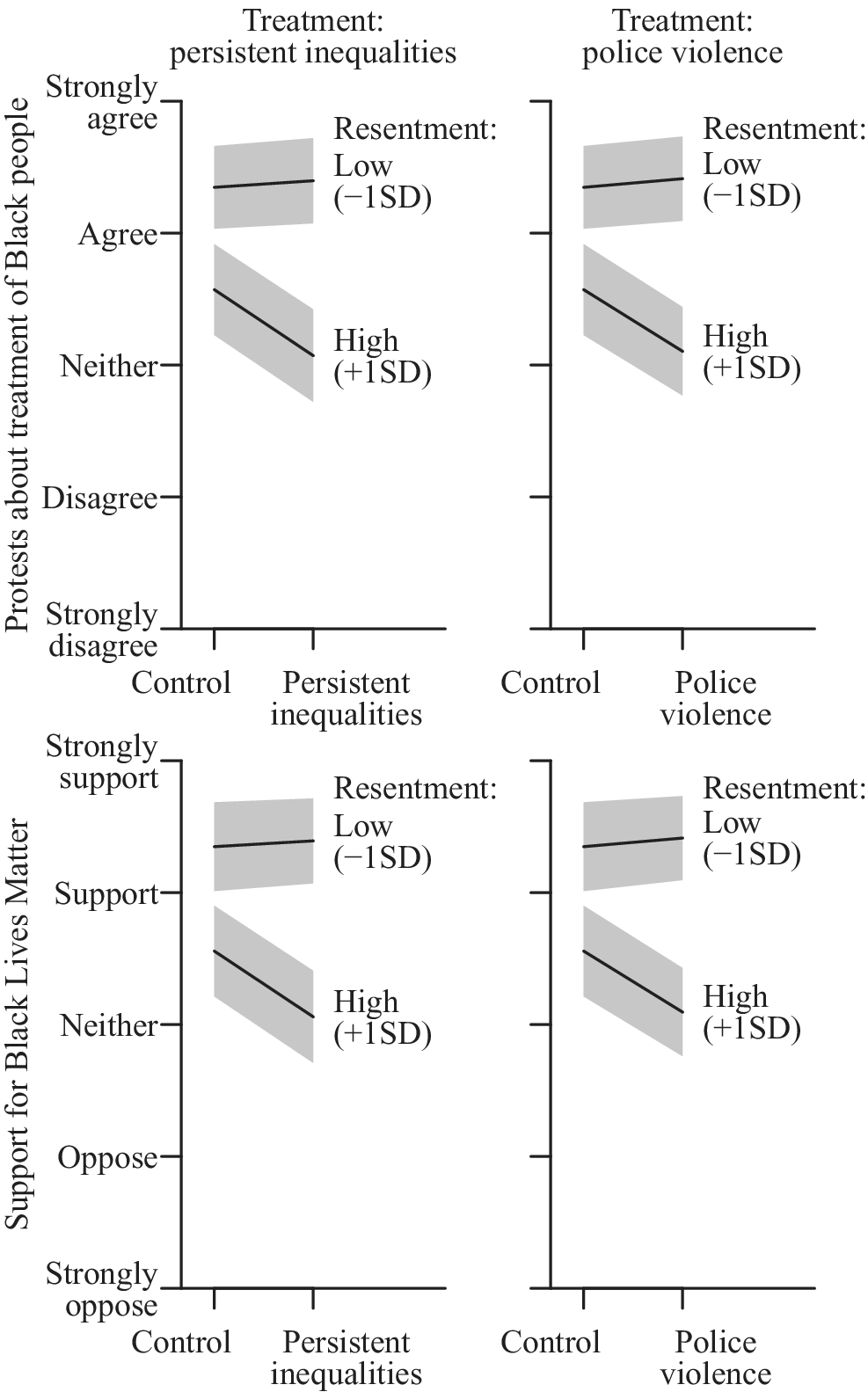
Figure 1 presents predicted values for four significant interactions—between racial resentment and two of the experimental conditions for two outcomes: it compares differences in the effect for hypothetical respondents who are low (one standard deviation below the mean) and high (one standard deviation above the mean) in racial resentment (while holding all the other covariates at their means). In all four cases, the prompts decreased support just among those high in resentment while having little effect—or a small positive effect—among those low in racial resentment. Figure 2 confirms this story by examining the average marginal effects (and confidence intervals) for the experimental conditions (relative to the control) across levels of racial resentment. The two treatments had significant negative effects only among those who agreed with the racial resentment questions.
Selected Predicted Values (and 95% Confidence Intervals) from Interactions of Experimental Treatments and Racial Resentment for Perceptions that Protests Were Motivated by Concerns about Mistreatment of Black People and Support for Black Lives Matter
Average Marginal Effects and Confidence Intervals for Effect of the Experimental Conditions (Relative to the Controls) across Levels of Racial Resentment for Perceptions that Protests Were Motivated by Concerns about Mistreatment of Black People and Support for Black Lives Matter

Discussion and Conclusion
In the spring and summer of 2020, “half a million people turned out in nearly 550 places across the United States” in support of Black Lives (Buchanan, Bui, and Patel Reference Buchanan, Bui and Patel2020). Our interest is in how the public views this movement and the protests, and what this means for the possibility of social and political change to address America’s substantial and persistent racial inequalities. There are two parts to our story. The first focuses on the simple but stark and consequential role of partisanship and the way the parties have oriented themselves in relation to this racial civil rights movement. Support for the movement is powerfully stratified by political party identification: Democrats tend to strongly support the movement and Republicans oppose it. Understandings of the protests—what people believe motivate the protesters—are also politically stratified, with Democrats more likely to believe they were motivated by anger over George Floyd’s death, tensions between the police and the Black community, and the treatment of Black people in society overall. In contrast, Republicans are more likely to believe protesters were simply taking advantage of the situation to commit crime. Independents seem not quite sure what to believe.
Although those who identify as Democrat or Republican have starkly different views of the movement, what they share is that these views appear relatively fixed: partisan respondents did not meaningfully change their views when we explained the broader goals of the movement, highlighted police violence toward the protestors, or described the protests negatively as violent riots. This was also true of Democrats’ and Republicans’ understandings of the motivations of the protesters, which also appeared relatively fixed in response to our framing conditions.
The second part of our story is about the group we describe as the persuadables: those who do not align themselves with one of the two major American political parties. This population, on average, reported more mixed views of the movement, neither strongly supporting nor opposing it. Importantly, we also found that those who do not identify as Democrats or Republicans were less fixed in their views; in short, their views of the movement and understandings of the motivations of the protesters appeared to change in response to our experimental manipulations in the framing of the purposes of the movement. Our main question was whether language describing the protests as riots and highlighting violence and looting—parallels to counter-frames from earlier civil rights movements—could shape views of the movement. We found that it did. Nonpartisan respondents exposed to this frame were less likely to believe the protests were motivated by anger over George Floyd’s death or broader concerns about the treatment of Black people in the country and were less supportive of the movement overall. Interestingly, the effect of exposure to this frame did not depend on the respondent’s level of racial resentment, at least among independents: it made people more likely to disbelieve other motivations for the protestors and oppose Black Lives Matter whether they were high or low in racial resentment. This highlights the effectively toxic influence of such framings in the media, at least for nonpartisans who may not yet have hardened views on the issue.
We also explored the effect of a frame highlighting the broader racial justice goals of the movement and one that draws attention to problematic behavior on the part of the police, rather than the protestors. Interestingly, these frames appeared associated with less support for the movement and legitimate causes of the protests, suggesting a backlash effect. Notably, nonpartisan respondents who were reminded about aggressive and violent police responses to the protests were less likely to believe that the protests were motivated by tensions between the police and Black people.
It may be, however, that people’s reactions to the latter two frames are shaped by their broader understandings of racial inequalities in the United States. Among those who dismiss the significance of slavery and discrimination and blame racial inequalities on stereotypes of Black inferiority, reminders of the broader racial justice goals of the movement or problematic police responses to the protests were associated with sharp declines in the belief that the protests were about systemic mistreatment and in support for the movement overall.
Our findings raise a series of additional questions for future research. One involves heterogeneity among nonpartisans: Are there differences between older and younger independents, independents with different racial and ethnic identities, or independents who are somewhat politically engaged overall? There are also questions about direct and indirect links between reactions to the protests and support for specific policy proposals—including the influence of the framing of those proposals. Finally, given the scope of the 2020 protests, there are interesting questions about how direct exposure to or participation in the protests shapes views of the movement. Cobbina (Reference Cobbina2019), for instance, draws an interesting distinction between more committed protestors and “tourists,” raising questions about the long-term commitments to these issues of the latter group.
Conclusion
Collectively, these findings help us assess the overall impact of Black Lives Matter, speak to the prospects of reform, and highlight connections to past civil rights movements. Although we find that starkly different views of the movement among Democrats and Republicans were relatively firm following the crest of the second wave of the protests in 2020, this has not always been the case: the current views are the product of the influence of competing social movements and partisan sorting. First, there is evidence of real change in the attitudes of Americans on issues of racial equality and justice since the beginning of the Black Lives Matter movement, including a growing acknowledgment of racially disparate policing and an agreement that society needs to do more to ensure equal rights (Pew Research Center 2020a, 2020b).
Second, however, there has also been a clear “backlash” or reactionary rallying of opposition to this movement. Social movements in general tend to inspire counter-movements and counter-framings (e.g., Benford and Snow Reference Benford and Snow2000). Social movements for racial civil rights—or any sign of progress toward racial equality, including Reconstruction, the civil rights movement of the 1960s, and even the election of Barack Obama—seem to motivate opposition (Du Bois Reference Du Bois1935; King Reference King1967; Parker Reference Parker2016; Tonry Reference Tonry2011). The opposition is caused, simply, by a fear of losing racial privileges that exist under systemic racial inequalities, and, more complexly, by the broader social changes that would accompany changes to the racial status quo. Consistent with this, a primary explanation for a lack of support for Black Lives Matter—and for a significant portion of the difference in average views of the movement between white and Black Americans—is a commitment to a racial logic that justifies white privilege (Drakulich et al. Reference Drakulich, Wozniak, Hagan and Johnson2021). In this light, as Martin Luther King Jr. (Reference King1967) argued, the backlash and the toxic and polarized political environment it creates should be expected and factored into the costs of pushing for real change, rather than used as a reason to avoid advocating for change. In retrospect, the supposed “postracial” era in which Obama was elected may simply have been “one in which racially progressive talk was made possible by the lack of significant threats to the racial status quo” (Drakulich et al. Reference Drakulich, Wozniak, Hagan and Johnson2020, 394).
These stories of advocacy for racial equality and justice and counter-advocacy for preserving the racial status quo are evident in our story about the partisans and their divergent views of the movement. They also play out in complicated ways in our story about the persuadables, for whom negative frames of the movement playing on racial crime stereotypes can reduce support for the movement, and where reactions to more positive frames of the protests are conditioned by variations in commitments to the existing racial order. But despite this, nonpartisans were still more likely to support than oppose the movement and in general appear more likely to acknowledge the need to address racial inequalities and injustices (Pew Research Center 2019).
So, what does this mean for the future of the movement? Once again, the striking parallels to the civil rights movement of the 1960s may provide guidance. Racial attitudes drove partisan sorting after the civil rights movement, and our results point to the same story. Support for Black Lives Matter and understandings of the 2020 protests were highly stratified by partisanship and therefore, indirectly, by views of race. When we remove partisanship and look just at independents, racial attitudes once again structure views of the protests and the movement. Although advocacy for the end of legal segregation and discrimination provoked a substantial backlash in the past, it also set off a tremendous transformation in public opinion on these issues, transitioning from overwhelming support for segregation and discrimination in the 1940s to overwhelming opposition by the 1990s (Krysan and Moberg Reference Krysan and Moberg2016; Schuman, Steeh, and Bobo Reference Schuman, Steeh and Bobo1985). This change was facilitated by generational change: young people had more liberal attitudes about race, something that remains true today (Menasce Horowitz, Brown, and Cox Reference Horowitz, Juliana and Cox2019). Notably, Democrats on average are younger than Republicans, and Independents are younger than Democrats (Pew Research Center 2019).
However, as we described earlier, the other public opinion legacy of the civil rights movement, as a response to the success in changing public opinion about explicitly racist policies, was the emergence of a new racial ideology that justified the racial status quo while separating itself from older, more overt racial ideologies (e.g., Bobo and Smith Reference Bobo, Smith, Katkin, Landsman and Tyree1998; Bonilla-Silva Reference Bonilla-Silva2018). Whether new racial ideologies emerge—and exactly what form they take—in response to the Black Lives Matter movement is not yet known. But this history suggests that we should expect a sustained and robust opposition to efforts to achieve racial equality and justice. One response to the protests, for instance, has been efforts to criminalize the protests themselves (Quinton Reference Quinton2021), which parallel the criminalization of voting rights protestors in the civil rights era (e.g., Beckett and Sasson Reference Beckett and Sasson2004; Tonry Reference Tonry2011).
Finally, the civil rights movement did achieve federal civil rights legislation—even if it was not all that was sought and even as some of it, such as the Voting Rights Act, is under threat today. Attempts to maintain the status quo in the face of group conflict create what Chambliss (Reference Chambliss1975) calls contradictions, tenuous and unstable arrangement of social relations that can only be resolved by real changes to the social order. The persistence of the Black Lives Matter movement suggests that pressure for real change will remain, and the intertwining of public opinion with partisan politics presents both barriers to but also mechanisms for such change. Thus, as we argued at the outset, the likely effects of the Black Lives Matter civil rights movement are complicated and contradictory but ultimately consequential.


 Open access

