


Introduction
Biodiversity conservation efforts often focus on the stability of ecosystems in their attempts to protect endangered species or landscapes (Margules and Pressey Reference Margules and Pressey2000, Dudley Reference Dudley2008). Managers and conservationists often delineate protected area boundaries to include defined, stable areas perceived as important habitats for species, such as foraging or breeding areas, and devote significant amounts of money and effort to their maintenance within these borders (Possingham and Andelman Reference Possingham and Andelman2002, Wilson et al. Reference Wilson, Carwardine and Possingham2009). Species respond to shifting patterns of resource distribution across a landscape over time, however, which may have implications for the ability of static protected area boundaries to meet the needs of species of concern as resource distribution changes. Without taking into account the way species respond to increasing uncertainty in climatic and anthropogenic influences on ecosystem function, established conservation practices such as protected areas may fail to achieve their goals.
Many of the fundamental processes driving the distribution and abundance of biotic and abiotic resources are changing at an accelerating rate (Cox et al. Reference Cox, Betts, Jones, Spall and Totterdell2000, Raupach et al. Reference Raupach, Marland, Ciais, Le Quéré, Canadell, Klepper and Field2007, Carnicer et al. Reference Carnicer, Jordano and Melián2009). Climate change coupled with changes in the economy of the region including new or intensifying human uses, such as shifts in agriculture practices or increased demand for freshwater resources, will likely impact ecosystem services and have a negative effect on the availability of resources important to wild species (Travis Reference Travis2003, Opdam and Wascher Reference Opdam and Wascher2004, Foley et al. Reference Foley, Defries, Asner, Barford, Bonan, Carpenter, Chapin, Coe, Daily, Gibbs, Helkowski, Holloway, Howard, Kucharik, Monfreda, Patz, Prentice, Ramankutty and Snyder2005, Foley Reference Foley2011). Novel ecological conditions, which include greater than average frequencies and magnitudes of flooding and drought, may compromise the quality of wildlife habitats over time, limiting the efficacy of protected areas created to conserve important components of landscapes (Tilman Reference Tilman1997, Hannah et al. Reference Hannah, Midgley, Andelman, Araújo, Hughes, Martinez-Meyer, Pearson and Williams2007, Dudley Reference Dudley2008). Our understanding of how novelty emerges and affects ecosystems has improved (Williams and Jackson Reference Williams and Jackson2007, Allen and Holling Reference Allen and Holling2010), and multiple studies have offered broad strategies for adapting the management of specific ecosystems to emerging patterns of novelty (Seastedt et al. Reference Seastedt, Hobbs and Suding2008, Hobbs et al. Reference Hobbs, Higgs and Harris2009). Specific workable strategies, however, require conservationists, managers and researchers to study how species and communities respond to novel conditions.
During the winter of 2010–2011, we witnessed a previously undocumented response by the last viable population of wild Siberian Cranes Leucogeranus leucogeranus, TSN 176185, to a flood event at their largest wintering area in China’s Poyang Lake (Figure 1) resulting in the widespread loss of customary forage items in shallow-water wetlands. Poyang is one of the most important wintering waterbird areas in Asia and provides habitat for more than a dozen other threatened or endangered waterbird species (Barter et al. Reference Barter, Lei and Cao2005, Reference Barter, Cao, Lei and Yang2006; Qian et al. Reference Qian, Yu, Jiang and Prentice2011). Over 98% of the globally estimated 3,800–4,000 Siberian Cranes (Li et al. Reference Li, Wu, Harris and Burnham2012) are in the eastern population that depends on Poyang for wintering habitat. While wintering, they typically forage in shallow water and wet mud for the tubers of submerged aquatic vegetation in the genus Vallisneria (Wu Reference Wu, Wang and Li2005, Burnham Reference Burnham2007). Regions of high Vallisneria density are typically located in areas that are in shallow to moderately deep water during the high-water period in the summer (Barzen et al. Reference Barzen, Engels, Burnham, Harris and Wu2009, Wu et al. Reference Wu, Li, Liu, Zeng, Gao, Li, Liu and Wu2012). When water levels drop 6–8 m, on average, during the late summer and early autumn, Vallisneria beds are accessible to wintering waterbirds (Zeng et al. Reference Zeng, Ji, Huang, Liu and Jia2002, Burnham et al. Reference Burnham, Barzen, Li, Zeng, Wu, Ji and Prentice2009) Since the wintering grounds at Poyang were first documented in the early 1980s, local, national and international observers have consistently documented the association and perceived dependence of wintering Siberian Cranes on shallow water areas at Poyang and these associations were central to the creation of multiple nature reserves, including Poyang Lake Nature Reserve (PLNR) which occupies approximately 5% of the total basin (Li Reference Li and Li2001) and was established to protect wintering areas for cranes and other wintering waterbirds (Liu and Chen Reference Liu, Chen and Harris1991).
Shaded areas indicate Poyang Lake basin at typical winter low water levels with principal tributaries and identified study lakes. Dashed lines illustrate the outer perimeter of Poyang Lake Nature Reserve (PLNR). Insert shows the locations of PLNR and Momoge National Nature Reserve within China.

Following an abnormally early and high flood in the summer of 2010 (Yésou et al. Reference Yésou, Claire, Xijun, Stéphane, Jiren, Sylviane, Muriel, Xiaoling, Shifeng, Burnham, Jean-François, Tiphanie, Jinggang, Rémi and Carlos2011, Jin et al. Reference Jin, Wu, Zeng, Cao, Li, Liu and Wu2012), we observed dramatic changes in the distribution and composition of wetland vegetation at Poyang. Following the flood of 2010, tubers of Vallisneria were almost completely absent within all three study lakes that have been part of a monitoring programme since 1998. Between 2004 and 2011, peak tuber densities within PLNR were 5.9, 37.1 and 23.2 tubers/m in 2004, 2005 and 2008, respectively (Figure 2). These vegetation patterns reflect a documented collapse of Vallisneria in response to a flood in the summer of 1998 when wintering Siberian Cranes remained tied to shallow-water wetlands and mudflats in areas sheltered from flood waters by unbroken dykes (Cui et al. Reference Cui, Zhong and Chen2000, Li Reference Li and Li2001). In January 2011, however, we observed Siberian Cranes shift to grassland areas adjacent to their customary shallow-water foraging habitats. These areas are frequently inundated in the summer months, but are wet meadows dominated by sedges, forbs and cool season grasses during the winter months (de Leeuw et al. Reference de Leeuw, Si, Zeng, Lei, Li and Liu2007). In more than 25 years of anecdotal and opportunistic observations (Liu and Chen Reference Liu, Chen and Harris1991), as well as systematic observations as part of long-term monitoring efforts starting in 1998, Siberian Cranes have not been documented using these grassland areas at any time prior to the winter of 2010–2011 (Shan et al. Reference Shan, Ma, Li, Qian and Tu2012). While long-term monitoring data do focus on general locations of Siberian Cranes within PLNR over the winter months, they do not include information about adult to juvenile ratios or precise locations of cranes within sub-lakes at Poyang (Burnham et al. Reference Burnham, Barzen, Li, Zeng, Wu, Ji and Prentice2009, Zeng et al. Reference Zeng, Liu, Yi, Ai, Li, Liu and Wu2012).
Average number of Vallisneria tubers sampled within three PLNR study lakes from 2004 to 2011. Error bars represent standard error of the mean for each year. While there is a wide range of tuber productivity over time between the three lakes, 2010 is the only year during the presented period where all the study lakes had a synchronised collapse of Vallisneria tubers.

We interpreted the shift to grassland areas, which are distinct from the shallow-water and wet mud of customary foraging areas (Barzen et al. Reference Barzen, Engels, Burnham, Harris and Wu2009), as novel and indicative that shallow- water areas were not providing enough nutrition for the birds. Siberian Cranes appeared to shift their foraging focus from the tubers and rhizomes of Vallisneria in shallow waters to the bulbs of Tulipa edulis and taproots of Potentilla limprichtii, both of which are widespread in the adjacent grasslands (Sun et al. Reference Sun, Zhou, Zhou, Bao, Zhong, An, Li, Liu and Wu2012a,Reference Sun, Zhou, Zhuo, Bao, An, Zhong, Li, Liu and Wub). We hypothesized that this novel habitat selection, and the corresponding shift to new food items, might affect cranes in two, important ways: 1) winter survival and/or spring migration could be affected if individuals failed to secure enough energy to survive the winter months or fuel the return migration north (Rockwell et al. Reference Rockwell, Bocetti, Marra and Amenazada2012), and 2) as northern nesting cranes appear to be capital breeders that carry much of the energy that fuels breeding efforts with them as they migrate in the spring (Krapu et al. Reference Krapu, Iverson, Reinecke and Boise1985), they may be susceptible to carry-over effects between their wintering and breeding grounds (Rappole et al. Reference Rappole, King and Diez2003) with reduced nutrition intake at Poyang contributing to declines in production of young in the subsequent breeding season as seen in many species of waterfowl (Alisauskas and Ankney Reference Alisauskas and Ankney1992).
The shift to grassland areas in 2011 and subsequent foraging responses by wintering Siberian Cranes to these areas were also documented by Jia et al. (Reference Jia, Jiao, Zhang, Zhou, Lei and Liu2013), although important differences exist between their analysis and the work we present here. Due to the logistical challenges of effectively delineating very shallow water and very wet mud at a distance, we chose to group the habitats used by wintering Siberian Cranes to only seasonal grasslands and their expected habitats of shallow water and wet mud. Our analysis took a more comprehensive approach by including foraging observations from multiple winters, identifying multiple novel forage items from representative plant structures in Siberian Crane faeces, and considering the implications of novel foraging on the population of Siberian Cranes as a whole.
In light of expected increasing frequency of extreme events including floods and droughts at Poyang (Shankman et al. Reference Shankman, Davis and de Leeuw2009, Liu et al. Reference Liu, Wu and Zhao2013) and shifting human use patterns, we expect future conditions at Poyang may force Siberian Cranes to forage in grassland areas again. Our goal was to estimate any potential impact of novel foraging habitat use and new food items following the flood of 2010 to anticipate how novel foraging may affect the Siberian Crane population in the future. Our first objective was to determine how Vallisneria tuber densities fluctuated within a local protected area before and after the flood event. Our second objective was to quantify differences in Siberian Crane behaviour, individual foraging success and total flock foraging efforts between customary wetland and novel grassland habitat use. Our final objective was to determine whether annual Siberian Crane juvenile recruitment, as measured at a migratory stop-over location, reflected foraging patterns we observed at Poyang Lake during the winter of 2010–2011.
Materials and methods
Study areas
The Poyang Lake basin is a dynamic freshwater system located at approximately 29oN and 116°E. Draining 162,000 km2 of China’s Jiangxi province through five main tributaries and hosting a human population of over 12 million people, the lake empties through a single outlet to the Yangtze River (Shankman et al. Reference Shankman, Keim and Song2006, Zhang et al. Reference Zhang, Ye, Werner, Li, Yao, Li and Xu2014; Figure 1). The lake is subject to dramatic inter-annual and seasonal hydrological fluctuations that average 6–8 m between summer high and winter low water levels (Shankman et al. Reference Shankman, Davis and de Leeuw2009). During summer, Poyang is China’s largest freshwater lake and typically fills 4,000 km2 of the basin (Zhang et al. Reference Zhang, Sun, Chen and Jiang2011a). In autumn and winter, water levels drop so that the surface area is often less than 1,000 km2 (Feng et al. Reference Feng, Hu, Chen and Li2011). As water levels recede, isolated lakes and river channels appear across the basin and a patchwork of herbaceous vegetation and open mudflats is exposed (Yésou et al. Reference Yésou, Claire, Xijun, Stéphane, Jiren, Sylviane, Muriel, Xiaoling, Shifeng, Burnham, Jean-François, Tiphanie, Jinggang, Rémi and Carlos2011), providing a wide range of foraging and roosting habitat for hundreds of thousands of migratory waterbirds in winter (Ji et al. Reference Ji, Zeng, Wang, Gong, Xu and Bao2007). Distribution and abundance of the lake’s vegetation are directly influenced by hydrological fluctuations that vary between seasons and years (de Leeuw et al. Reference de Leeuw, Si, Zeng, Lei, Li and Liu2007, Dronova et al. Reference Dronova, Gong and Wang2011). Typically, wetland vegetation assemblages include permanently submerged aquatic vegetation restricted to areas that are inundated for the majority of the summer growing season, followed by a transition zone of vegetation that can alternate between shallow-water wetlands (submerged vegetation and mudflats) to seasonal grasslands (wet sedge meadow communities, short-stature grasslands) before transitioning to warm-season emergent and dry land vegetation at the highest elevations within the lake basin (Barzen et al. Reference Barzen, Engels, Burnham, Harris and Wu2009).
This study took place within PLNR, which encompasses 22,400 ha of the north-western portion of Poyang Lake basin (Li Reference Li and Li2001). The reserve’s territory is not contiguous and its jurisdiction is limited to the seasonal shallow-water lakes and immediately adjacent areas (Zeng et al. Reference Zeng, Ji, Huang, Liu and Jia2002, Burnham et al. Reference Burnham, Barzen, Li, Zeng, Wu, Ji and Prentice2009; Figure 1).
Momoge National Nature Reserve (MNR) is located within the Songnen Plain in north-eastern China’s Jilin province at approximately 45°N and 123°E. At 1,400 km2 (Ming et al. Reference Ming, Xian-guo, Lin-shu, Li-juan and Shouzheng2007; Figure 1), MNR provides critically important habitat for migratory waterbirds staging between breeding areas in north-east Asia and wintering areas across southern China. A complex landscape consisting of agriculture, water reservoirs and isolated wetlands, MNR offers an opportunity to observe migratory waterbirds closely and where our range of highest counts of Siberian Cranes from 2010 to 2012 was 3,115–3,639 individuals. Siberian Cranes stop at MNR for several weeks to forage on the rhizomes and below-ground biomass of Scirpus planiculmis and S. triqueter during migration between north-eastern Siberia and Poyang Lake (Kong et al. Reference Kong, Zheng, Wu, Ning, Wang and Han2013).
Vegetation sampling
We obtained density estimates of Vallisneria tubers in wetland habitats from the long-term (2004–2011) ecological monitoring at PLNR (Burnham et al. Reference Burnham, Barzen, Li, Zeng, Wu, Ji and Prentice2009). Within this monitoring protocol, benthos is sampled every 50 m along two perpendicular transects that intersect at the centre of each of three study lakes within PLNR and are repeated annually in late October and early November before large numbers of wintering waterbirds arrive at Poyang. Within each sample point, monitors used grab samplers that measured approximately 15 x 20 x 15 cm to collect four sub-samples of substrate and vegetation (Wu et al. Reference Wu, Li, Liu, Zeng, Gao, Li, Liu and Wu2012). The number of Vallisneria tubers in each sample point was then recorded by PLNR staff (Burnham et al. Reference Burnham, Barzen, Li, Zeng, Wu, Ji and Prentice2009, Wu et al. Reference Wu, Li, Liu, Zeng, Gao, Li, Liu and Wu2012).
We identified grassland forage items by observing six different flocks of Siberian Cranes between 10 February and 20 February 2011 foraging in grassland habitats with no co-foraging heterospecifics in view (see observation methods below). When the flocks departed, we examined the observed foraging area and collected fresh crane faecal samples. We examined probe holes and freshly excavated stems discarded by cranes and collected leaves and shoots to identify remains of consumed plant species. Also, we exhumed underground root and bulb structures of consumed plant species identified by the discarded vegetative shoots and recorded the appearance of their root structures. Finally, we examined faecal samples under a dissecting microscope and noted whether material corresponding to the consumed plant species, such as the dark outer layer of Potentilla taproots and fibrous connective hairs of Tulipa bulbs seen within the faeces. Due to the logistics and time constraints of establishing an observation protocol for Siberian Crane foraging behaviour, we were not able to sample for the densities of novel food items in seasonal grasslands in either year.
To determine nutritional composition of the grassland forage items, we weighed 31, 24 and 38 fresh samples of Potentilla limprichtii taproots, Vallisneria spp. tubers and Tulipa edulis bulbs and then dried them at 60°C to constant weight (99 hours) to determine dry weights and calculate the amount of water in the samples. Dried samples were then ground to a powder. From the homogeneous powder total nitrogen was calculated via spectrophotometry and crude protein was estimated by multiplying these values by 6.25 (Helrich Reference Helrich1990, Ministry of Health for the People’s Republic of China 2010a). Water soluble carbohydrate content was estimated with the Anthrone colorimetric method (DuBois et al. Reference DuBois, Gilles, Hamilton, Rebers and Smith1956), crude fibre content with an enzymatic assay and starch composition with an Anthrone reagent (Halligan Reference Halligan1907, Ministry of Health for the People’s Republic of China 2003, Zhang and Qu Reference Zhang and Qu2003). Finally, we placed samples in a Muffle Furnace at 550 ± 25°C for four hours to determine the remaining ash content within each sample (Ministry of Health for the People’s Republic of China 2010b). Nutritional analysis was conducted at the College of Life Sciences, Nanchang University in Jiangxi Province, China.
Siberian Crane observations
Behavioural observations
We began systematic observations of flocks at Poyang February–March 2011, November–December 2011, and February–March 2012 using spotting scopes of 20–60x magnification. We attempted to sample an equal number of wetland and seasonal grassland foraging flocks, with priority going to the largest observable flocks. The logistics of observing large flocks at Poyang, however, limited our ability to observe an equal number of flocks in both habitats throughout the day and we sampled flocks opportunistically throughout daylight hours. Observers were located within 600–1,000 m of flocks. Given the patterns of use by Siberian Cranes in previous winters (Ji et al. Reference Ji, Zeng, Wang, Gong, Xu and Bao2007), as well as the daily activity budgets of the birds through the winter (Wu Reference Wu, Wang and Li2005), and that the nutritional value of the forage items does not change during winter as tubers of Vallisneria are in their dormant state, we assumed that foraging behaviour of the birds remained relatively constant during our observation periods across both years.
To determine if flock behaviours differed between habitats, we performed instantaneous scan samples of flocks (adapted from Altmann Reference Altmann1974). In 2010–2011, we made 83% and 88% of wetland and grassland flock observations between 11h00 and 16h00 and in 2011–12 we made 88% and 60% of wetland and grassland flock observations between 11h00 and 16h00, respectively. Depending on the size of the flock, observations could take as few as two, or as many as 30, minutes. After an observation was completed, we waited approximately 30 minutes before beginning another observation. We adopted this strategy to maximise the number of observations, by minimising time spent searching for flocks. We made the assumption that the 30 minutes between observation bouts would provide independence of our observations. Our observations began at the leading edge and ended at the trailing edge of each flock. Data for all observable birds in one flock were categorised as an observation bout. Observation bouts of a given flock continued until the flock either left the area or poor visibility prevented observations, typically around 16h30–17h30.
-
1. Time budget
We assigned all observed behaviours into one of six categories adapted from Altmann (Reference Altmann1974) and similar to the categories of Chavez-Ramierez (Reference Chavez-Ramirez1996): foraging (probing, gleaning, digging or excavating food from substrate, feeding juveniles and handling food in mandibles or swallowing), socialising (inter- or intra- specific interactions, excluding provisioning juveniles), locomotion (walking or flying into or out of the flock, walking while searching for food), comfort (loafing, sleeping, preening or stretching), alert (head-up posture, guard calling, pre-flight displays), unknown (any behaviour or individual that could not be clearly seen).
To compare behaviour of individuals seen in wetland versus grassland foraging flocks, we used a Wilcoxon signed-rank test for behavioural data that did not fit a normal distribution (socialising, locomotion, alert and unknown behaviors), and used an ANOVA for other behaviors (foraging and comfort behaviors) that met the assumptions of parametric tests. In the ANOVA, we weighted the proportion of the flock engaged in foraging by flock size because the number of foragers we observed within wetland and grassland flocks were highly correlated to the size of the flock.
-
2. Individual foraging
To estimate individual foraging success, as defined by the number of swallows per minute by a single observed crane, we used focal sampling of individuals within flocks (adapted from Altmann Reference Altmann1974) in wetlands and grasslands. We chose individuals for observation by selecting them at random from a bearing falling between the leading and trailing edges of an observed flock. We selected the first individual closest to the random bearing that was actively foraging. Foraging individuals were defined as birds engaged in obtaining or manipulating food through acquisition behaviours: probing or digging in the substrate. We defined an observation bout as the number of minutes a foraging bird was observed and we defined foraging minutes as the amount of time a bird spent actively manipulating or ingesting food.
Within an observation bout, we tallied ingested food items when we observed a distinctive head-jerk motion that cranes use to move food from their mandibles to the opening of the oral cavity and into the oesophagus. An observation bout was made up of foraging minutes plus non-foraging minutes and was only counted if an individual crane foraged for at least two minutes. This time is based on the minimum amount of time it takes wild Sandhill Cranes Grus canadensis (TSN 176177) to become sated during controlled feeding trails (J. Barzen pers. obs.). We restricted observation bouts to 20 foraging minutes, which we determined was the maximum time that we could effectively observe an individual within a large flock (defined as > 25 individuals). Of the 29 distinct flocks we observed, the average observation bout across both habitats in 2010–2011 was 20.05 minutes and in 2011–2012, it was 9.1 minutes. Only four flocks were composed of less than 25 individuals and we feel confident that the randomisation protocol for selecting individuals for observation minimized the likelihood that we observed the same individual multiple times.
For each individual, we recorded the total time elapsed for each individual observation bout as well as the portion of time individuals spent actually acquiring or manipulating food. Within an observation bout, we paused the stopwatch each time focal individuals stopped foraging, i.e. an individual walked to a new area, interacted with another bird, or began comfort behaviors. Using swallows per minute for each bird as a metric of individual foraging success, we estimated the effects of year and habitat on foraging success using ANOVA and post ANOVA pair wise tests with Tukey’s correction method for four means (two habitats over two years). We tested the significance of flock association, i.e. the degree to which being within a particular flock, affected individual foraging success using a linear mixed effects model (Bates et al. Reference Bates, Maechler and Bolker2011):
 $$\surd {S_{myh}} = \left[ {\left( {{F_{smh}} * {F_{smy}}} \right) + \left( {1\left| {\,{F_f}} \right.} \right)} \right]$$
where √S myh is the square root of swallows per minute over both habitats and years, F smh is the fixed effect of habitat, F smy is the fixed effect of year and 1| F f is the random effect of flock association. We found that flock association had no significant effect on individual foraging success. Because of this, we present only the results of the ANOVA table without weighting the analysis by flock association.
-
3. Total flock foraging effort
Our final foraging estimate combined (i) the proportion of birds within flocks exhibiting foraging behaviours, (ii) the foraging success on individuals within flocks, and (iii) the total time an average individual spent foraging in a day into a calculation of total flock foraging effort. Total flock foraging effort is a metric of the number of food items consumed, on average, per bird per day within grassland and wetland habitats during both winters. We used the following calculation:
 $${I_{hy}} = {{\left( {{f_{av}} * {s_{min}} * {t_{{\rm{for}}}}} \right)\,} \mathord{\left/ {\vphantom {{\left( {{f_{av}} * {s_{min}} * {t_{{\rm{for}}}}} \right)\,} {\,{k_{tot}}}}} \right. \kern-\nulldelimiterspace} {\,{k_{tot}}}}$$
where I is equal to the number of items consumed by an average individual within a flock in habitat h in year y , f av equals the average number of foraging individuals within observed flocks, and s min equals the average swallows per minute of individual foragers. The variable t for represents the average time spent foraging throughout the day, in minutes and is derived from the percentage time we observed individuals actively forage (total foraging minutes divided by the total number of observed minutes of focal individuals). We then multiplied the percentage time we observed individuals actively foraging by 360, which is the estimated number of minutes available to wintering Siberian Cranes if the only activity they undertook during the majority of the day was foraging. (J. Burnham, pers. obs.). The variable k tot is the average total flock size observed. We determined whether the number of items consumed between habitats within years differed with Wilcoxon rank-sum tests. Because food manipulation times were typically under 2 seconds, we assumed that one observed swallow equalled one consumed food item, a pattern observed in other studies of wintering cranes (Alonso et al. Reference Alonso, Bautista and Alonso2004, Avilés et al. Reference Avilés, Sánchez and Parejo2006).
-
a. Juvenile recruitment observations
To understand potential effects of novel diet shifts on natality we examined adult to juvenile ratios of birds during fall migration in 2010, 2011 and 2012 in north-east China where it is possible to make close observation of 78–92% of the flyway population just before they depart for the wintering grounds at Poyang Lake (Kanai et al. Reference Kanai, Ueta, Germogenov, Nagendran, Mita and Higuchi2002). Multiple studies have used juvenile to adult ratios as an indicator of recruitment in passerines (Peach et al. Reference Peach, Buckland and Baillie1996), smaller waders (Clark et al. Reference Clark, Robinson, Clark and Atkinson2004), as well as Sandhill Cranes (Bennett and Bennett Reference Bennett and Bennett1990). We visited 25 fixed observation points every other day, except during days with heavy rain, during three periods: 23 September–11 November 2010, 17 September–9 November 2011, and 13 September–17 November 2012. MNR is small enough that it is possible to account for large groups of migrating cranes in different parts of the reserve, reducing the chances that we significantly over-counted the number of individual cranes present. We used our highest one-day count of total observed adult cranes and juveniles during each field season to estimate the annual ratio of juvenile to adults. These data represented the peak number of adults and juveniles observed at Momoge. Collectively, we observed most of the world’s population of 3,800–4,000 individual Siberian Cranes during each season. We conducted a Chi-square test for equal proportions to determine whether the proportion of juveniles to adults differed among years.
Because the ratio of juveniles to adults observed in fall could have been affected by environmental conditions during the breeding season immediately preceding the fall count, we also examined temperature of the breeding area for two time periods (21–31 May, 1–10 June) during which temperature has been found to be related to Siberian Crane reproductive success (Germogenov et al. Reference Germogenov, Solomonov, Pshennikov, Degtyarev, Sleptsov, Egorov, Bysykatova, Vladimirtseva and Okoneshnikov2013). Using data from the Global Historical Climatology Network Chokurdokh weather station (station ID: RSM00021946) available from the Climate Data Online database (NOAA, 2015), we calculate period averages from daily temperature data for each year 2010–2012. The Chokurdokh weather station is adjacent to documented concentrations of breeding Siberian Cranes (Germogenov et al. Reference Germogenov, Solomonov, Pshennikov, Degtyarev, Sleptsov, Egorov, Bysykatova, Vladimirtseva and Okoneshnikov2013).
Results
Vegetation
Density of Vallisneria tubers fluctuated widely from 2004 to 2011 among the three study lakes located within PLNR and between years (Figure 2), but the only time all three lakes had a synchronised collapse of Vallisneria tuber densities was in 2010 following the summer flood (0.2, 0.7 and 0.5 tubers m-2 for Da Hu Chi, Sha Hu and Mei Xi Hu, respectively; Figure 2). In autumn 2011, following a summer growing season with normal water levels, Vallisneria density was higher than in 2010: 5.8, 15.3, and 21.3 tubers m-2, for Da Hu Chi, Sha Hu and Mei Xi Hu, respectively.
Within grassland foraging areas, we observed widespread occurrence of P. limpritchii and T. edulis forbs in winters of 2010–2011 and 2011–2012. We also identified remnants of P. limpritchii taproots and T. edulis bulbs in Siberian Crane faeces. Crude protein content of tubers was 11–12% for Vallisneria and P. limpritchii while T. edulis contained 20% protein. The proportional composition of starches and sugars together ranged from ∼ 60% (P. limpritchii and T. edulis) to 75% (Vallisneria). There was substantial variation in proportion of crude fibre among the three plants, with Vallisneria containing 4.5%, while T. edulis and P. limpritchii contained 10.9% and 20.7% crude fibre respectively (Table 1). Vallisneria tubers were also higher than the other two plant parts in total fat.
Nutritional content of dried forage items used by Siberian Cranes at Poyang Lake.

Flock foraging
We first observed grassland foraging by Siberian Cranes in early January 2011, when they occurred in small groups of 3–20 individuals, often in close proximity to other Grus species including White-naped Grus vipio, TSN 176189, Hooded G. monacha, TSN 176186 and Eurasian Cranes G. grus, TSN 176183. During initial observations of grassland foraging by Siberian Cranes, we observed individuals and small groups follow other, grassland foraging Grus (e.g. White-naped or Eurasian Cranes) and then aggressively chase the other individuals away. After displacing the foraging Grus, Siberian Cranes would consume forage items at the site where the other Grus individuals had been foraging (J. Burnham pers. obs.). Between mid-January and February 2011, flocks of over 1,000 Siberian Cranes were observed foraging in grassland areas on six occasions (J. Burnham pers. obs., X. Wang, PLNR field staff, pers. comm.). We made observations of these large flocks prior to the initiation of a standardised data collection protocol. Once standardised data collection began at the end of February 2011, we observed 40 flocks (mean flock size ± SD = 124.88 ± 234.62) totalling 4,995 individuals across both habitat types in that winter, and 22 flocks (mean flock size ± SD = 397.27 ± 2576.16) totalling 8,740 individuals across both habitat types in winter 2011–2012. Because these numbers are higher than the globally estimated population, we assume that we observed the same individuals multiple times within each season. In 2010–2011, we observed fewer individuals in wetlands than during the winter of 2011–2012 (Table 2). We adjusted significance levels of pair-wise comparisons within each year using the Bonferroni correction (Rice Reference Rice1989).
Differences in the percentage of Siberian Crane behaviours seen in flocks using wetlands versus flocks using grasslands over two wintering seasons at Poyang Lake (2010–2011: wetland flocks n = 23, wetland individuals n = 4,098, grassland flocks n = 17, grassland individuals n = 897; 2011–2012: wetland flocks n = 17, wetland individuals n = 7752, grassland flocks n = 5, grassland individuals n = 988). Bonferroni corrected, significant P-values are shown in bold.
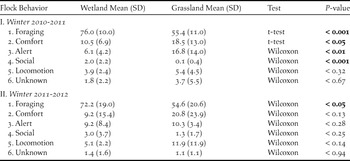
Foraging was the most frequently observed behaviour exhibited by birds using both grassland and wetland habitats in both years, although wetland flocks consistently contained a higher percentage of foraging birds (Figure 3). Other behaviours that differed between habitats in 2010–2011 included comfort, alert and social behaviours (Table 2). Flock association was not a significant contributor to the model and we therefore report results of the non-weighted ANOVA only. Habitat was the only significant predictor variable of behaviour categories over both years (ANOVA, F-value = 30.72, P < 0.001).
Percentage of all observed Siberian Crane flocks engaged in six behaviour categories across both habitat types during two winters (2010–2011 wetland individuals n = 4,098, 2010–2011 grassland individuals n = 897, 2011–2012 wetland individuals n = 7,752, 2011–2012 grassland individuals n = 988). Box plot mid line represents median, box edges represent the inter-quartile range, whiskers represent the full distribution of the data, and small circles represent data outliers (i.e. data points that are more than 1.5 * the interquartile range from the nearest quartile).

Focal foraging
Foraging success (measured as swallows/min) in wetlands was half that of birds using grasslands in 2010–2011 (P < 0.001, Figure 4). Mean foraging success of individuals was three times higher in wetlands in 2011–2012 (mean = 2.51 swallows/minute) than during the winter of 2010–2011 (mean = .81 swallows/minute; t = -7.071, df = 46.036, P < 0.001). Flock association did not influence foraging success and we removed this variable from further analysis. With the higher amount of wetland foraging success in 2011–2012 following a recovery of Vallisneria tubers (Figure 2), we did not find a difference in foraging success between wetlands and grasslands in that year (P < 0.41, Table 3, Figure 4). Conversely, the number of forage items per bird per day consumed in wetlands and grasslands in 2010-2011 did not differ (wetland mean = 175.4, SD = 23.4 and grassland mean = 202.9, SD = 45.7) while in 2011–2012 they did (wetland mean = 451, SD = 113.9 and grassland mean = 193.9, SD = 112.2; Table 3). The average wetland forager in 2011–2012, had a much higher calculated average daily consumption than those for grasslands (Wilcoxon rank-sum test P < 0.01).
Foraging success of Siberian Cranes, as measured by swallows per minute, of focal individuals foraging in wetland and grassland habitats during the winters of 2010–2011 and 2011–2012 (2010–2011: wetland n = 21, grassland n = 9; 2011–2012: wetland n = 41, grassland n = 4. Box plot mid line represents median, box edges represent the inter-quartile range, whiskers represent the full distribution of the data, and small circles represent data outliers (i.e. data points that are more than 1.5 * the interquartile range from the nearest quartile).

Comparison of individual Siberian Crane foraging success when utilising wetland versus grassland habitats in two wintering seasons at Poyang Lake (2010–2011: wetland n = 21 individuals, grassland n = 9 individuals; 2011–2012: wetland n = 41 individuals, grassland n = 4 individuals). All comparisons made with Wilcoxon Rank-Sum Test. Within year Bonferroni corrected significant P-values are shown in bold.

Juvenile recruitment
In 2010, 2011 and 2012, the percentage of young at MNR was 15.4% (n = 3,115 birds aged), 11.5% (n = 3,381) and 15.9% (n = 3,639), respectively. A Chi-square test for equal proportions supported rejection of the null hypothesis that juvenile to adult proportions were equal in 2010, 2011, and 2012 (χ2 = 31.611, df = 2, P < 0.001). The counts of juveniles plus adults represents 78–82% in 2010, 85–88% in 2011 and 90–92% in 2012 of the globally estimated population of 3,800–4,000 Siberian Cranes (Li et al. Reference Li, Wu, Harris and Burnham2012).
Temperature in the breeding area
There were no extreme negative temperatures in the breeding area during May 21–June 10 during the years 2010–2012. Following criteria established by Germogenov et al. (Reference Germogenov, Solomonov, Pshennikov, Degtyarev, Sleptsov, Egorov, Bysykatova, Vladimirtseva and Okoneshnikov2013), summed daily averages for the 21–31 May and 01–10 June periods of 2010, 2011 and 2012 were 5.33, 3.16 and 10.39°C, respectively. All three summed averages during the breeding seasons from 2010–2012 fit within the temperature ranges identified as ‘good’ or ‘very good’ in terms of Siberian Crane breeding productivity defined by Germogenov (pers. comm.).
Discussion
Following a summer flood in 2010 and subsequent, widespread decline of Vallisneria tubers in China’s Poyang Lake, we observed Siberian Cranes foraging in grassland habitats during the winter months of 2010–2011. Grasslands were not previously known to be used by Siberian Cranes for foraging, and these patterns were not documented by observers prior to 2010. Following a more typical summer growing season at Poyang and a recovery of Vallisneria, we also observed grassland foraging in the winter of 2011–2012, although by fewer flocks and individuals. We also found consistent behavioural differences between flocks using grasslands and wetlands regardless of Vallisneria availability across both winters. Foraging success rates and calculated rates of an individual’s food item consumption were higher in grassland habitats during the winter of 2010–2011, but higher in wetlands during the winter of 2011–2012. In addition to these observations, we documented lower juvenile to adult ratios, an index of breeding success following the 2010 flood at Poyang at a staging area in north-eastern China in 2011. Taken together, these observations raise important questions about the implications of grassland foraging for the world’s largest wild population of endangered Siberian Cranes and the conservation and management of the broader Poyang Lake ecosystem. Quantifying the relationship between winter foraging sites and reproductive success is necessary to understand the degree to which use of grasslands in the wintering area affects fitness.
Differences in foraging behaviour between Siberian Crane flocks in wetlands and grasslands may be attributable to multiple causes. Jia et al. (Reference Jia, Jiao, Zhang, Zhou, Lei and Liu2013) suggested that closer proximity to anthropogenic or interspecific disturbances (e.g. roads, vehicles, wildlife observers, domestic animals or other wintering waterbirds) in grasslands compared to wetlands as the cause of behavioural differences they observed in the winter of 2010–2011; a pattern that has been documented in Whooper Swans Cygnus c. cygnus; Rees et al. Reference Rees, Bruce and White2005). We observed consistent levels of foraging across both habitats and higher percentages of grassland flocks exhibiting comfort behaviour than wetland flocks during both winters, however, which we feel is inconsistent with the disturbance hypothesis offered by Jia et al. (Reference Jia, Jiao, Zhang, Zhou, Lei and Liu2013). In addition, while we agree with Jia et al. (Reference Jia, Jiao, Zhang, Zhou, Lei and Liu2013) that the seasonal grasslands at Poyang may be a sub-optimal wintering habitat for Siberian Cranes, the nutritional comparisons we present between expected and novel forage items provide an explanation rooted in the physiology of the birds for why the seasonal grasslands are likely sub-optimal foraging habitat. We observed that Siberian Cranes largely returned to the expected shallow-water habitats dominated by Vallisneria during the winter of 2011–2012, with the exception of only five flocks observed in seasonal grasslands, suggesting a preference for shallow water and mudflat areas over seasonal grasslands. Finally, the paper by Jia et al. (Reference Jia, Jiao, Zhang, Zhou, Lei and Liu2013) makes no attempt to evaluate how these novel foraging patterns might affect the broader population of Siberian Cranes, a link that we present here with correlation between a decline in juvenile to adult ratios following widespread foraging in seasonal grasslands.
Additionally, at the onset of grassland foraging by Siberian Cranes, we observed them follow grassland foraging congeners (e.g. Eurasian Cranes and White-naped Cranes) on multiple occasions and chase the congeners away from forage items they were consuming. We suspect that interspecific interactions may have been important in facilitating the shift of Siberian Cranes to grassland food resources.
An alternative explanation for these patterns is that nutritional differences between grassland and wetland forage items motivated Siberian Crane behaviour and habitat selection during this time. Measured proportions of fibre in grassland plants eaten by Siberian Cranes were between two (T. edulis) and four (P. limpritchii) times higher than the proportion of fibre in the wetland plant Vallisneria, values that are in line with other studies that examined digestibility of wetland and terrestrial plants (Korschgen and Green Reference Korschgen and Green1988, Catling and Spicer Reference Catling and Spicer1994). We expect that a higher proportion of indigestible fibre requires more time for digestion (Petrie et al. Reference Petrie, Drobney and Graber1998), leading to higher rates of non-foraging activity in grassland flocks in both years.
Slower digestion rates from consuming grassland plants mean Siberian Cranes would not be able to consume the same total volume of material (and potentially the number of calories) of food as they do while foraging on the tubers of readily-digestible Vallisneria. If reduced caloric consumption is related to lower digestibility of grassland forage items, it could have resulted in birds having lower energy reserves as they left the wintering ground in early 2011. There is strong evidence of this type of teleconnection between energy stores accumulated on wintering grounds and subsequent breeding outcome in a variety of other capital breeding waterbirds (Alisauskas and Ankney Reference Alisauskas and Ankney1992) such as Pink-footed Goose Anser brachyrynchus (Drent et al. Reference Drent, Both, Green, Madsen and Piersma2003), Lesser White-fronted Goose (Wang et al. Reference Wang, Fox, Cong and Cao2013), Canvasback Aythya valisineria (Barzen and Serie Reference Barzen and Serie1990), Sandhill Crane (Krapu et al. Reference Krapu, Iverson, Reinecke and Boise1985) and Whooping Crane Grus americana (Gil-Weir Reference Gil-Weir2006, Gil-Weir et al. Reference Gil-Weir, Grant, Slack, Wang and Fujiwara2012). Additionally, Cong et al. (2013) suggests that wetland habitat foraging might explain higher breeding success in eastern Bewick’s Swan Cygnus columbianus bewikii when compared to farmland foraging swans wintering in Europe. Unfortunately, long-term data on juvenile to adult ratios for Siberian Cranes along the eastern flyway are not currently available. This information would help inform our knowledge of broader population patterns. One concerning scenario is that grassland food items which contain less available calories than customary food items, could result in less energy available for Siberian Crane egg production, incubation and related activities, resulting in lower recruitment over time. The current data suggest that this may have occurred during the breeding season of 2011. Under this scenario, while grassland habitats may be suitable refugia habitat when Vallisneria productivity or accessibility is poor (because wintering Siberian Cranes were able to obtain enough energy for daily maintenance at Poyang and migration to MNR), long-term dependence on seasonal grasslands may negatively affect subsequent breeding efforts by Siberian Cranes.
An alternative explanation for the decline in juvenile to adult ratios we observed at Momoge in 2011 is that conditions on the cranes’ Arctic breeding grounds were anomalous relative to 2010 and 2012. The areas where Siberian Cranes breed in north-eastern Russia are known to have highly variable weather conditions within and between years. Nesting success of Siberian Cranes in these areas are positively correlated to the summed average temperatures taken over two time periods, 21–31 May and 1–10 June (Germogenov et al. Reference Germogenov, Solomonov, Pshennikov, Degtyarev, Sleptsov, Egorov, Bysykatova, Vladimirtseva and Okoneshnikov2013). Temperatures on the nesting grounds between 2010 and 2012 were considered either “good” (2010 and 2011) or “very good” (2012) for breeding (Germogenov, pers. comm.). In addition, the patterns we observed at Chokurdokh, the closest community with available weather data, appear to reflect broader temperature patterns of an overall increase in air temperatures during the last 12 years (Overland et al. Reference Overland, Hanna, Hanssen-Bauer, Kim, Kim, Walsh, Wang and Bhatt2013). While long-term data on juvenile to adult ratios at Poyang are lacking, comparisons with Whooping Cranes, another wetland-dependent species with a small population and long migration, help provide context for these ratios. The recruitment rate for Whooping Cranes measured on their wintering grounds in Texas from 1940 to 1995 was 13.9% and prior to 1967, when removal for eggs for captive breeding programs started, the recruitment rate averaged 16.1% (Drewien et al. Reference Drewien, Brown and Kendall1995). It is difficult to assess the implications of the recruitment patterns we observed in our three-year study, but given the conservation status of the Siberian Crane additional work focusing on recruitment patterns at Poyang and Momoge would help determine how carry-over effects between wintering habitat use and breeding weather conditions interact to affect the reproductive success of the species.
Because it was not documented prior to 2010, we interpret grassland foraging by wintering Siberian Cranes as indicative of novel ecological conditions at Poyang Lake. Similar to other systems, novelty at Poyang arises from the anthropogenic alteration of the system at scales that were historically unattainable (e.g. sand dredging), previously undescribed combinations of species (e.g. Siberian Cranes foraging in grasslands) and the introduction of new species (e.g. mitten crabs Eriocheir sinensis) by humans (Hobbs et al. Reference Hobbs, Arico, Aronson, Baron, Bridgewater, Cramer, Epstein, Ewel, Klink, Lugo, Norton, Ojima, Richardson, Sanderson, Valladares, Vila, Zamora and Zobel2006, Seastedt et al. Reference Seastedt, Hobbs and Suding2008). While no single reason explains the abnormal flood level and timing at Poyang in the summer of 2010, the lake’s water fluctuations are becoming less predictable, and multiple studies have documented changes in established hydrological cycles between 2000 and 2012 (Yésou et al. Reference Yésou, Claire, Xijun, Stéphane, Jiren, Sylviane, Muriel, Xiaoling, Shifeng, Burnham, Jean-François, Tiphanie, Jinggang, Rémi and Carlos2011, Liu et al. Reference Liu, Wu and Zhao2013). Contributing factors include thousands of water control structures within Poyang’s watershed (Barzen et al. Reference Barzen, Engels, Burnham, Harris and Wu2009), widespread sand dredging since 1999 (de Leeuw et al. Reference de Leeuw, Shankman, Wu, de Boer, Burnham, He, Yesou and Xiao2010, Lai et al. Reference Lai, Shankman, Huber, Yesou, Huang and Jiang2014), climatic changes, and the influence of the Three Gorges Dam on the fluctuations of the Yangtze (Gao et al. Reference Gao, Jia, Kettner, Xing, Wang, Xu, Yang, Zou, Gao, Qi and Liao2014).
In addition to the changing hydrology at Poyang, multiple biotic and abiotic characteristics of the lake are changing. Multiple ecosystem health metrics have declined from 1985 to 2012 (Zhou et al. Reference Zhou, Bai and Jiang2012) and the lake experienced increased organic matter, nitrogen and phosphorus from 1992 to 2008 (Wang et al. Reference Wang, Ni, Jiao, Jin, Feng, Liu and Zhang2012). Cultivation of mitten crabs has increasingly replaced traditional fish aquaculture at Poyang, leading to a rapid decline of submerged vegetation in many of the lakes where waterbirds winter (Li et al. Reference Li, Wu, Harris and Burnham2012). Unfortunately, mitten crab cultivation leads to the loss of Vallisneria and this correlates to a dramatic decline in wintering waterbird use in other areas of the lower Yangtze (Xu et al. Reference Xu, Wang and Zhang2003, Fox et al. Reference Fox, Cao, Zhang, Barter, Zhao, Meng and Wang2011). Another ecosystem stressor, large-scale, industrialised agriculture, is increasingly common in seasonal grassland areas within the lake basin that are important to a wide range of wintering waterbirds (Zhang et al. Reference Zhang, Cao, Barter, Fox, Zhao, Meng, Shi, Jiang and Zhu2011b, Wang et al. Reference Wang, Fox, Cong and Cao2013, Yan et al. Reference Yan, Schneider, Schmid, Huang, Pan and Dilly2013). These industrial agriculture areas are often adjacent to the winter sub-lakes that waterbirds utilise and their conversion to agriculture removes grassland vegetation that wintering migrants forage on when wetland foods may not be available or accessible.
Changing ecological patterns will present new management challenges for the continued conservation of Siberian Cranes and Poyang’s broader ecosystem. Eliminating crab aquaculture within Poyang’s protected areas and/or allowing Vallisneria to recover in areas that are used to raise crabs could benefit the recovery of submerged aquatic vegetation, including Vallisneria. Currently, the protected areas at Poyang are restricted to the shallow-water areas in the main body of the lake basin that waterbirds typically utilise during the winter months. Expanding to include portions of the Poyang basin that are sheltered from floods behind dykes as well as including seasonal grasslands adjacent to shallow-water wetlands could also increase the probability that foraging habitat for wintering waterbirds would be available following future flood events. Flood sheltered areas were highly utilised after the previous significant flood in 1998 (Li Reference Li and Li2001), but many of these areas are no longer used by wintering waterbirds as the introduction of mitten crabs and other shifts in aquaculture practices have reduced the presence of Vallisneria in these areas (Li et al. Reference Li, Wu, Harris and Burnham2012). Development of incentives for local communities to conserve grasslands and prevent their conversion into agriculture and other more intensive uses that have limited use for wildlife or establishing conditional use rules that restrict certain activities within the basin when defined hydrological or vegetation conditions occur, could also buffer this important habitat from negative anthropogenic effects. Finally, given the collapse of Vallisneria following two flood events, in 1998 and 2010, extreme caution must be exercised with planning for a water impoundment structure at Poyang’s outlet (Qi and Liao Reference Qi and Liao2013). If an impoundment structure is built, it has the potential to retain water at depths that are unsuitable for the growth of Vallisneria or to limit access to optimal food resources for the last viable, wild population of Siberian Cranes during the winter months.
Acknowledgements
We would like to thank Jim Harris and Li Fengshan of the International Crane Foundation and Bill Karasov of the University of Wisconsin-Madison for providing constructive comments that improved the writing of this manuscript. We are grateful to Li Fengshan of the International Crane Foundation and Qin Haiming of Nanchang University for their involvement in the sampling and analysis of wetland plants at Poyang. Eric Wood, Sarah Carter, Christina Locke and Chris Hamilton also provided valuable feedback and support at multiple points during the development of this work. We would also like to thank the field staff of Poyang Lake and Momoge National Nature Reserves for the extensive assistance and support they provided during field seasons. Our project was funded by the Felburn Foundation, the International Crane Foundation, Terry and Mary Kohler Foundation and Windway Capital Corporation, the University of Wisconsin-Madison Department of Forest and Wildlife Ecology and NSF IGERT Grant No. DGE-0549369.



