


Introduction
When the president of the National Constituent Assembly of Ecuador, architect Fernando Cordero, presented the final draft of the Ecuadorian Constitution in July 2008, he proclaimed 'This Constitution is made of water' (García Reference García, Acosta and Martínez2010). It included a large number of progressive articles related to water and its management, of which the most celebrated ones are the recognition of the human right to water, the prohibition of all form of water privatization, citizens participation in water governance and the recognition of ‘nature’s’ water rights (Harris and Roa-García Reference Harris and Roa-García2013; Roa-García et al. Reference Roa-García, Urteaga-Crovetto and Bustamante-Zenteno2013). Such a ‘wet’ Constitution resulted, for a great part, from the prolonged and steady presence and involvement in the national political arena of the third sector represented by committed individuals, NGOs and social movement organizations with visions of a better, more just and sustainable society (Andolina et al. Reference Andolina, Laurie and Radcliffe2009; Hoogesteger Reference Hoogesteger2014; Jameson Reference Jameson2011). Many of the articles that were included in the Constitution came directly from proposals of NGOs and grassroots organizations as attested by García (Reference García, Acosta and Martínez2010) who states that
The achievements in the Ecuadorian Constitution of 2008 with regards to issues on water are not the property or legacy of any single organization, institution or platform in particular; it has no owners nor proprietors. To have such a ‘wet’ Constitution is the result of accumulated social and political histories over the past twenty years… (p. 174)
In this article, I trace the origins, constituency and development of el Foro de los Recursos Hídricos (Water Resources Forum, WRF),Footnote 1 one of the policy advocacy platforms that played an important role in the definition of many of the water related articles of this Constitution. I describe the context, main actors and dynamics that have made WRF a nationally recognized multi-stakeholder platform that critically analyses Ecuadorian water governance with the aim to develop new and progressive policy proposals. I show that this broad-based platform, its development, activities and proposals are propelled and coordinated by national development NGOs that have skilfully articulated to grassroots organizations, other third sector and state organizations. Based on this case, I argue that NGOs that closely articulate to grassroots and other non-governmental organizations through extensive multi-actor networks can play an important role in the democratization of governance by forming, within civil society, a critical and proactive network that through different means participates in governance and policy debates.
The data of this research were gathered through fieldwork in Ecuador. The study is based on qualitative data and follows an interpretive approach, which considers the meanings and interpretations given by social actors to their context and actions (including those of others) as constituting their social reality (Mason Reference Mason2002). Data gathering consisted of over sixty in-depth semi-structured interviews, participation, observation and active involvement in the activities of the described institutions (formal and informal meetings, capacity building programmes, workshops and public events) between 2008 and 2013. This primary material was supplemented by reviewing secondary data and newsletters published by WRF. Through the research design, which was informed by a respondent driven sampling methodology (Heckathorn Reference Heckathorn1997), data were gathered from within an existing network of actors that included high state officials, researchers, NGO personnel and leaders and members of grassroots organizations. The data from the different information sources and research methods were triangulated to corroborate findings and test their validity (Lincoln and Guba Reference Lincoln and Guba1985).
In what follows, I first present an short discussion on the role and position of NGOs in the development of the global South. Second, I focus on the role development NGOs have played in water governance in the Andean region of Latin America. Then, I present the socio-political context in which the basis for WRF was established. In subsequent sections, I first analyse the rise, development and networks of WRF by focusing on its relations with external agents. After this, I focus on the socio-political context and strategies that enabled WRF to importantly contribute to the ‘wet’ Ecuadorian Constitution of 2008. In the last section before the conclusions, I present the challenges the present international context has brought to WRF. In the conclusions, based on the case of WRF, I reflect on the potential roles and limitations of NGO involvement in the democratization of societies in Latin America.
NGOs and Development in the Global South
NGO have received much attention in the literature since the 1980s; much of which has lauded these ‘new’ actors as the institutional ‘alternative’ to existing development approaches (Mitlin et al. Reference Mitlin, Hickey and Bebbington2007; Srinivas Reference Srinivas2009). Much of the literature stresses the importance of NGOs and attributes them ‘new’ roles in poverty alleviation, provision of services, civil society empowerment and democratization (Kilby Reference Kilby2006). Resultantly, at international level, NGOs have been recognized as key actors for pursuing established international developmental goals (Brinkerhoff et al. Reference Brinkerhoff, Smith, Teegen, Brinkerhoff, Smith and Teegen2007).
Most NGOs that work on development challenges in the global South frame themselves as part of civil society, in which they play an empowering and representative role through which they advance what they see as broader community interests (Sacouman Reference Sacouman2012). Nevertheless, most NGOs are not membership based, financed or governed (Fowler Reference Fowler2000). Rather as Kilby (Reference Kilby2006) points out ‘NGOs are largely guided and driven by staff, self-appointed Boards, or very small numbers of formal members; and the driver for their work emerges generally from a religious or ethical base—their values’ (p. 952). Most are dependent on external funding agencies, are formally registered by the state and adopt non-violent approaches to their work.
As such, Kilby (Reference Kilby2006) argues that development NGOs can be defined as public benefit organizations that work as voluntary, self-governing independent bodies that operate on the basis of values or shared interests and which Bebbington (Reference Bebbington1997b) describes as
… private, professionally staffed, non-membership and intermediary development organisations, […] created from the mid-1960s through to the mid-1980s that were founded on the basis of a commitment to an alternative, more democratized and inclusive development (p. 1756).
According to Uvin and Miller (Reference Uvin and Miller1996), the rise of NGOs on a large scale ‘parallels a slow but profound change in the international development aid system’ (p. 344) and responds to the internationally increased attention for ‘less state’ and more ‘bottom-up; market based’ development and increasing levels of civil society participation in issues concerning their own development. This international trend, which was supported and greatly promoted by the World Bank and other international organizations and donors (Andolina et al. Reference Andolina, Laurie and Radcliffe2009; Brown and Kalegaonkar Reference Brown and Kalegaonkar2002; Yashar Reference Yashar2005), has gone hand in hand with a search for another form of development which Petras and Veltmeyer (Reference Petras and Veltmeyer2006) describe as follows:
a widespread search for “another form of development,” a decentralised and participatory form of local development based on more sustainable forms of “democratic” or “good” governance. The result has been a veritable flood of proposals and alternative models for bringing about “development” on the basis of social capital, i.e., though the agency of “self-help” of community-based or grassroots organisations, with the assistance and support of partner institutions and “international cooperation” for development (p. 87).
Brown and Kalegaonkar (Reference Brown and Kalegaonkar2002) argue that beyond the trends in international NGO policy, the evolution of development NGOs is also importantly shaped by the interplay of global forces, the national context and how these affect the ‘political, economic, and social forces that operate in the long term’ (p. 232). In this context, these same authors identify four critical ‘external’ challenges which NGOs have to face and which I use to analyse the development of WRF and its struggles for the democratization of Ecuadorian water governance. These challenges are
(a) Relations with international actors The most challenging international relations for local development NGOs are often those with international funding agencies. In this context, the increased globalization of NGO funding and international policies has to a certain extent (re)shaped NGOs, their activities and lines of accountability in the global South (Brown and Kalegaonkar Reference Brown and Kalegaonkar2002; Brown Reference Brown2014; Mitlin et al. Reference Mitlin, Hickey and Bebbington2007). Southern development NGOs have been faced with the fact that many funding opportunities are directly related to the internationally prevailing ideas and rules; many of which have been dominated in the last decades by ideas inspired in neoliberalism (Dagnino Reference Dagnino, Bebbington, Hickey and Mitlin2007; Edelman Reference Edelman1999; Petras Reference Petras2008). However, and at the same time, as Mitlin et al. (Reference Mitlin, Hickey and Bebbington2007) point out, global NGO networks are not necessarily characterized by uneven North–South relations, and many NGOs around the world have developed their own strategies to resist, use and manoeuvre international pressures and demands.
(b) Legitimacy and accountability with the general public Sometimes there is little public understanding for the work and forms of operation of NGOs. Uncertainty about their funding sources, their motivations (religious and/or political), alliances and their local legitimacy sometimes makes it hard for NGOs to gain public legitimacy. The fact that the constituent base and governing body of development NGOs are often very narrow, just as their (inter)national funding sources, can also create problems around the public acceptance of their role(s), perspectives and activities (Brown and Kalegaonkar Reference Brown and Kalegaonkar2002; Brown Reference Brown2014), which is sometimes aggravated by the difficulty of measuring the impacts of their work in clear and simple terms. Another sometimes problematic issue is that NGOs are often in first instance accountable to those who provide funding, and only in second instance to the beneficiaries of their activities.
(c) Relations with institutions of the state Governments create and control the political and legal contexts within which development NGOs can work within national or regional administrative boundaries. Some governments facilitate NGO operations, fund their activities and closely work with them, while others are suspicious of their work, funding and political motivations and might consider them as competitors in services delivery, as critics of state policies and programmes, and/or as agents of international donors and interests (Brown and Kalegaonkar Reference Brown and Kalegaonkar2002; Mitlin et al. Reference Mitlin, Hickey and Bebbington2007). This has made the relation between NGOs and national governments both a threat and an opportunity for the advancement of development NGO programmes.
(d) Relations with institutions of the market Just as with the relations with governments, some development NGOs become very critical of the private businesses and their operations, while others have come to see these as funding sources and/or as partners for the advancement of development goals.
Development NGOs’ Democratization Efforts in Ecuadorian Water Governance
From the mid-1980s on, many European donor agencies focused on funding NGOs that worked on making the rural poor the agents of their own development (Bebbington Reference Bebbington1997a; Bebbington and Farrington Reference Bebbington and Farrington1993; Perreault Reference Perreault2003). Many such development NGOs focused on fostering development by strengthening local representative grassroots institutions (Biekart Reference Biekart, Bebbington, Hickey and Mitlin2007). Through increased participation from grassroots organizations, empowered social actors were expected to positively contribute to the transformation of their societies by increasing the levels of democracy, transparency and accountability through mechanisms of social control (Bebbington Reference Bebbington1997b, Reference Bebbingtonc; Mitlin et al. Reference Mitlin, Hickey and Bebbington2007).
Since the 1980s, the Andes became a ‘hot spot’ for international donors, development organizations and NGOs. Non-governmental sources of support and international development funds streamed into Bolivia, Peru and Ecuador (Bebbington Reference Bebbington2004). There is great variety and diversity in the orientation and goals of funders and NGOs that became active in the developmental domain. For instance, some funders and NGOs are ideologically grounded in Marxist ideas and have been engaged in anti-neoliberal political activism, others have come forth from church organizations, others have actively promoted the co-production of grassroots organizations as a means towards a more democratic civil society (Bebbington Reference Bebbington1997a; Becker Reference Becker2008; Hoogesteger Reference Hoogesteger2012) and others have promoted the advancement of capitalist and market-environmentalist ideas such as payment for environmental services (Boelens et al. Reference Boelens, Hoogesteger and Rodriguez de Francisco2014). Their scale of operation also varies greatly and ranges from international networking activities and programmes to very localized small community projects.
In Ecuadorian water governance, NGOs have played an important role in the creation of water user organizations and their broader networks and alliances (Hoogesteger Reference Hoogesteger2012, Reference Hoogesteger2013a). Just as in the case of the Bolivian irrigators movement (Assies Reference Assies2003; Perreault Reference Perreault2006, Reference Perreault2008), and many peasant and agrarian movements in Latin America (Borras et al. Reference Borras, Edelman and Kay2008; Edelman Reference Edelman2008), in Ecuador, developmental and environmental NGOs have come to play a key role in the consolidation of water users organizations, federation and inserting these in broader multi-actor networks (Boelens Reference Boelens, Boelens and Hoogendam2002, Reference Boelens2008b; Boelens et al. Reference Boelens, Bustamante, Perreault, Boelens, Getches and Guevara-Gil2010). The NGOs studied in this article concern NGOs that, although parting from sometimes different ideological groundings, have been committed to the political and economic empowerment of peasant and indigenous communities as a means of democratization. Their strategy to do so has been to support the development of rural peasant livelihoods and the co-productionFootnote 2 of organizational structures of representation. These organizations are co-produced to, at local level, provide a service to their constituents (Ostrom Reference Ostrom1990) and to develop political agency at broader scales. Processes of co-production not necessarily imply the direct involvement of the state (even though the state is somehow always there through legal and institutional frameworks)(Mitlin Reference Mitlin2008).
Although NGOs were involved in the co-production of community managed irrigation systems in the Ecuadorian Highlands since at least the 1970s (Boelens Reference Boelens2008a), since the 1990s, some of these same NGOs engaged in setting up and strengthening water user associations in state-managed irrigation systems (Hoogesteger Reference Hoogesteger2013a, Reference Hoogestegerb). This was the result of the growing international and national recognition that irrigation management, even of the large state built and state-managed irrigation systems, could best be done by water user associations (Tiaguaro-Rea Reference Tiaguaro-Rea2012; Rap Reference Rap2006). International funders financed these interventions in the irrigation sector through NGOs and other non-state actors (often private companies) that took over some of the tasks that had for decades been the state domain (Cremers et al. Reference Cremers, Ooijevaar and Boelens2005). These policy changes were the result of a search from international funders and many development aid agencies to reduce state expenditure in the irrigation sector (Tiaguaro-Rea Reference Tiaguaro-Rea2012; cf. Suhardiman and Giordano Reference Suhardiman and Giordano2014). As is exposed below, these changes brought about an increased involvement of the third sector in Ecuadorian water governance. Although the involvement of the third sector increased above all at irrigation system level, it was also involved in efforts to up-scale water users representation and participation at regional, provincial and national levels (see Hoogesteger Reference Hoogesteger2014; Andolina Reference Andolina2012; Carroll and Bebbington Reference Carroll and Bebbington2001). In this contribution, I focus specifically on the increased involvement of NGOs and user based federations in the Ecuadorian national policy domain as is explained below.
Neoliberalism, the State and NGOs in Ecuadorian Water Polices of the 1990s
In Ecuador, the process of economic integration and neoliberal restructuring, which started in the early 1980s, reconfigured the social and political landscape (Hey and Klak Reference Hey and Klak1999). Amidst a period of political instability, economic recession, soaring inflation rates and socio-political turmoil between 1990 and 2000, water policies and regulations shifted roles and responsibilities from national to local governments, private service providers and water users associations while also changing the institutional and legal setup (Cremers et al. Reference Cremers, Ooijevaar and Boelens2005). In 1993, the Law of State Modernization, Privatization and Provision of Public Services was enacted, opening the doors for far-reaching national water reforms and an increased involvement of the private and third sector in water governance. It paved the way for institutional reforms in 1994 (see Boelens et al. Reference Boelens, Hoogesteger and Baud2013) and the implementation of a World Bank financed Irrigation Management Transfer programme between 1995 and 2001. Through this programme, three private international consortia of consultancy companies transferred 35 formerly state managed irrigation systems (out of the 79) to newly created local water user associations (Hoogesteger Reference Hoogesteger2013b). In parallel, several internationally funded national and international NGOs engaged in programmes to strengthen and consolidate local water users organizations and federative initiatives (Hoogesteger Reference Hoogesteger2012; Hoogesteger Reference Hoogesteger2013a). In January 1996, the National Consultative Water Council resolved that water permits could be given indefinitely by the state. At the same time, it enabled marketable water transfers and the privatization of water services delivery as happened with the water and sanitation services of the cities of Guayaquil and Machala (Fernández and Buitrón Cisneros Reference Fernández and Buitrón Cisneros2012; FORO 2005). In 1998, the ‘new’ Ecuadorian Constitution further entrenched some of the neoliberal water governance premises (Cremers et al. Reference Cremers, Ooijevaar and Boelens2005).
In an Ecuadorian context of a retreating state, economic recession and widespread levels of rural poverty and marginalization, NGOs fit well with some of the neoliberal ideas that dominated policy making (Andolina et al. Reference Andolina, Laurie and Radcliffe2009, cf. Dagnino Reference Dagnino, Bebbington, Hickey and Mitlin2007). First, with private and/or international funds, they took over many functions that had hereto been done by the state. Second, NGOs competed with each other both locally as well as internationally for (private and public) funds for the execution of local development projects. Third, NGOs as project executers were often more flexible and competitive than state agencies while also being tightly held accountable for in terms of resource spending and project implementation. Finally many NGOs stimulated empowerment and self-help of the marginalized groups, making them responsible for their individual and sometimes collective livelihoods and institutions through the introduction of economic rationality and systems to guarantee transparency and accountability. An ideology which fit well with liberal ideas of individual freedom and responsibility (Andolina et al. Reference Andolina, Laurie and Radcliffe2009). In this sense for instance, Alvarez et al. (Reference Alvarez, Dagnino, Escobar, Alvarez, Dagnino and Escobar1998) question whether NGOs did not become neo- or para- rather than non-governmental organizations that help to reinforce a public sector displaced by the state. In this context, the Ecuadorian government greatly facilitated and applauded the activities of international donors and development NGOs in the country. As a result the World Bank, the Dutch-based Netherlands Development Organization (SNV), the Swiss Agency for Development and Cooperation (COSUDE), the American CARE foundation and other international funding agencies and NGOs found fertile grounds to advance their interests in the poverty stricken Ecuadorian Andes (Andolina et al. Reference Andolina, Laurie and Radcliffe2009; Carroll and Bebbington Reference Carroll and Bebbington2001). They did so by financing and collaborating with national NGOs that actively engaged in the irrigation sector such as the Ecuadorian Central for Agricultural Services (CESA), the Institute of Ecology and Development of the Andean Communities (IEDECA), the Ecuadorian Fund Populorium Progressio (FEPP) and others which established the basis for the creation and consolidation of the WRF as is explored below.
Co-producing a National Multi-Stakeholder Platform with International Support
The origins of WRF can be traced back to the early 1990s when with international funding both the Swiss (COSUDE) and the Dutch government (DGIS) tried to develop a capacity building programme for state employees, practitioners and community leaders in the field of natural resources management in Ecuador. This initiative was coordinated with the Ministry of Agriculture, Livestock, Aquaculture and Fisheries (MAGAP) and the local branch of the Food and Agriculture Organization of the United Nations (FAO). The evaluation of this initiative was negative and prompted an alternative for organizing the envisioned capacity building programmes.Footnote 3 Under the leadership of NGOs and with the auspices of MAGAP, the initiative was reinvigorated. To do so, in 1995, the inter-institutional Consortium for Capacity Building for the Management of Natural Resources (CAMAREN) was co-produced based on the joint effort of national NGOs, international funding agencies and national state agencies. Its members were six NGOs,Footnote 4 MAGAP and the governmental Advisory Commission of the Environment (Comisión Asesora Ambiental, CAM). Its constituents defined that CAMAREN would work on the principle of making capacity building programmes based on the experiences that NGOs had accumulated through their projects and programmes. Five capacity building programmes were identified which were irrigation, domestic water supply, management of páramos,Footnote 5 soil management and agroforestry. The programmes were inspired on Paulo Freire’s ideas on education and were designed so that they could be implemented in different parts of the country, where relevant experiences could be visited.Footnote 6
Through the implementation of these programmes, a broad network of participants and trainers quickly developed (above all in the Andes region). After 2 years, this network included numerous community leaders, over 90 institutions and more than 120 capacity builders (García Reference García2009). This network was based on a mutual collective learning process that relied on the exchange of ideas and experiences. This network of people and institutions came to be known as the ‘CAMAREN space’, which, through its programmes, started to transform the way natural resources management was framed and conceived of amongst NGOs and some of the personnel of national ministries. One of the main changes it brought about was a change from a technically dominated view on natural resources management to one that included attention to gender equality, empowerment, participation and sustainability.Footnote 7
In 1996, as a result of a couple of national and inter-Andean workshops on the IMT process (also financed with Dutch and Swiss funds), the Inter-institutional Forum for Irrigation (FIR) was formed. It brought representatives of water user associations, NGOs and state institutions together, with the aim of forming a multi-actor platform for dialogue, analysis and the creation of proposals for irrigation management. This initiative was presided by the state agency the National Council for Water Resources (CNRH), and the secretariat was delegated to the NGO CESA. Because of a lack of action by the presidency, which was put in the hands of CNRH, the initiative fell apart. This short-lived initiative, which quickly rose and fell created the precedent for WRF. Based on (a) the evaluation of CAMAREN and (b) the networks that were created in the CAMAREN space and FIR, CAMAREN and its member organizations decided to establish a national multi-stakeholder platform (forum) with an explicit anti-neoliberal agenda (again internationally financed). This marked the beginning of WRF.Footnote 8
WRF was conceived of as a plural and open platform that was formed by its participants. According to one of its founders, it aimed to bring together multi-ethnic groups, grassroots organizations, individuals, non-governmental organizations, state institutions and academics from the whole country to analyse, debate and create proposals for water resources management. As stated by one of the founding members and now the secretary of WRF, Antonio Gaybor, ‘we started with the idea that we would create proposals and that these proposals would be taken up and defended by the member institutions and organisations…’.Footnote 9 Initially, in view of this departing point, a strategic choice was made not to formalize this space as an organization but to give it the position of a multi-stakeholder platform, that conceives of itself as
… an open, democratic and plural space. In it there are participants of: popular organisations, NGOs, governmental institutions, universities, unions, water users organisations (both irrigation and domestic water supply) local and regional governments. All these participants contribute to the analysis of the situation of water resources and to the formulation of proposals to improve its management. The WRF is a space to collectively build and jointly propose alternatives for the management of natural resources.Footnote 10
According to García (Reference García2009), the WRF has, through its history, gone through four different phases which are:
• Positioning of water management on the national agenda and its social legitimation (2001–2002).
• Broadening of the social and political constituency (2002–2003).
• Development of political agency through the creation of public policy proposals and the pronunciation of public statements with regards to water resources in Ecuador (2004–2006).
• The construction of public policies by including most of the proposals that had been devised in WRF in the 2008 Constitution and drafts of the national water law (2007–present).
Through these phases, WRF has come to be recognized as a critical and constructive platform at national level.Footnote 11
Increasing Public Legitimacy and Accountability by Broadening the Social Base
Throughout the years, the constituency of the WRF steadily grew, especially through the increased participation of water users associations and provincial initiatives of water users federations (García Reference García2009).Footnote 12 One of the important strategies of WRF to engage in and among a multiplicity of water related stakeholders in Ecuador has been its National Assembly. The WRF National Assembly has been organized since 2002, as a national event that brings together a very broad audience of participants to debate and discuss water issues. The first National Assembly was held in 2002, with 370 participants from nine provinces of Ecuador. The National Assembly has gradually grown in size and composition of participants. The first National Assembly was dominated by representatives of NGOs and state institutions. Yet throughout the years, an increasing number of representatives of grassroots organizations (farmers unions and water users organizations of domestic water supply and irrigation systems) from throughout the country have become part of this event, while the number of representatives from NGOs has slightly decreased. In 2012, the seventh National Assembly of WRF was held in Quito bringing together 855 participants (the majority were water users) from 23 of the 24 provinces of the country (FORO 2013).Footnote 13
In order to organize and plan the National Assembly and other WRF activities, the national platform of WRF has periodic meetings with a large number of its members. To work out proposals and analyse specific issues in depth, working groups are created from among these participants. These are commissioned to draft proposals, that are subsequently presented and discussed again in the national platform meetingsFootnote 14 to prepare the National Assembly which is organized around defined themes. These themes are dealt with through case studies which are presented, discussed and framed by all participants; sometimes leading to the creation of policy proposals (see for instance Gaybor Reference Gaybor2008; FORO 2005, 2008). To disseminate the results of the discussions, popular publications have been made from every event.Footnote 15 These activities have enabled WRF to (a) broaden the existing networks in the whole country and (b) learn and get to know a multiplicity of local realities, ideas and experiences which sometimes lead to concrete actions, research and proposals. For instance, the attention of WRF was drawn to the large ‘water grabs’ that were taking place in the Ecuadorian coastal region around banana and sugar cane plantations. For this case, first research was done, published and broadly shared (see Gaybor Reference Gaybor2010). Later, the research results were used to substantiate the demand of WRF to revise all the water concessions (allocations) in Ecuador to ensure a socially just distribution of water, a proposal that was included in the 2008 Constitution (República del Ecuador 2008).
Balancing Relationships with the Changing State
As mentioned earlier WRF developed in an internationally and nationally favourable historical context for development NGOs in Ecuador. One of its first successes and concrete proposals were presented in 2004. After the National Assembly of WRF, a proposal for legal reforms was presented to National Congress and a broad debate against the privatization of the provision of domestic water supply services in some of the cities of the country was started (see FORO 2005). WRF publicly rejected the Free Trade negotiations that were being held with the United States of America in the early 2000Footnote 16 as these included some important issues concerning water resources. In subsequent years, WRF presented new and amended proposals for a new water law to National Congress and established several positioning documents with regards to public policies and the legal frameworks around water (García Reference García2009; Gaybor Reference Gaybor2008; FORO 2005, 2008, 2013).
Showing the broad networks and recognition of WRF, this platform has been invited to all formal spaces for civil society participation in the state domain at national level. Additionally several of its members have been invited to take up important directive positions in ministries and commissions of the state. Since 2008, the most remarkable appointments are three members of WRF have been appointed Secretary of the National Irrigation Institute (INAR), the coordinator of WRF was invited to become Minister of the National Water Secretariat (SENAGUA) (but refused), and other members have been hired as consultants for SENAGUA, MAGAP and INAR. Beside these personal invitations and close relationships with high state officials, the capacity building programmes of CAMAREN have been increasingly funded by governmental agencies. Yet the most important success of WRF up until now is the inclusion of several of its proposals in the 2008 Constitution (García Reference García, Acosta and Martínez2010). A process is analysed below.
A Changing Political Landscape
Rafael Correa, who promised to reverse the neoliberal model, won the presidential elections in late 2006 with the political party Alianza País. This political party promised to ‘build a new fatherland (patria)’ through a renewed, clearer, stronger State involvement in the country’s development (de la Torre and Conaghan Reference de la Torre and Conaghan2009). Already during the election campaign Rafael Correa had taken up water management and the irrigation sector as one of its important campaign issues (Boelens et al. Reference Boelens, Hoogesteger and Baud2013). One of the campaign promises of Rafael Correa was that of ‘sowing the countryside with irrigation systems’. To fulfil this promise after his election, on 31 October 2007, INAR was created within MAGAP, through presidential decree No. 695 to
guide the planned development of irrigated agriculture, in potentially irrigable areas and promote the expansion of the irrigated area in the country, especially for the small and medium farmers; and take care of the proper administration of hydraulic infrastructure and the renewable natural resources… (Decreto Ejecutivo 695, 2007, p. 1).
A couple of months later, on 15 May 2008, through Presidential Decree No. 1088, the National Water Secretariat (SENAGUA) was created. Although it falls out of the scope of this research to investigate what the precise determinants of the creation of these two institutions were, it is interesting to note that similar proposals for the creation of these institutes had been pushed forward by WRF before and after the elections (see for instance Mosquera Reference Mosquera2011).
The 2008 Ecuadorian Constitutional Process
Shortly after its possession of power, on 15 April 2007, the government of Rafael Correa called out for a popular consultation (referendum) on whether or not a new constitution should be made for Ecuador. With an almost 82 % yes, the population voted for a new constitution (CentroCarter 2008). The new constitution would be written by a democratically chosen Constituent Assembly for which new elections were called out (Becker Reference Becker2011).
Alianza País won 80 of the 130 seats of the Constituent Assembly in September 2007 (Machado-Puertas Reference Machado-Puertas2008). The success of Alianza País can be attributed amongst others to Correa’s skilful promotion of popular social reforms prior to the constitutional referendum and election (Petras Reference Petras2008) and to the inclusion of selected people from other political parties, as well as many from outside of the traditional political arena (Becker Reference Becker2011). These included several academics, NGO-leaders and social-movement activists (Becker Reference Becker2011). The president’s discourses emphasized the role of democracy in decision making and pushed forward the liberal ideology of individual rights. On 29 November 2007, the Constituent Assembly was installed to start its work. According, to Becker (Reference Becker2011) this ‘provided a critical juncture for indigenous movements by opening up a historic opportunity to decolonize the country’s political structures’ (p. 48). Arguably, it was not only the indigenous movement that got a great opportunity to change the country’s political structures but also the whole range of organized civil society groupings.
The president of the Assembly had the conviction that the Constituent Assembly should be a space for civil society participation.Footnote 17 To guide and structure this process, a special unit was created as part of the Constituent Assembly, the unit of social participation (CentroCarter 2008). This unit received and processed civil society proposals through an electronic documentation system (CentroCarter 2008). To get feedback, discussions and inputs for the different themes, this unit also coordinated forums, discussion rounds and debates in which the assembly members and ‘all relevant social actors’ were brought together.
As a unit, we stimulated social control and participation of the grassroots groups to change the role of these social subjects; so that they go beyond only turning in proposals to a phase in which they could really participate in the debates of the Assembly. The idea was to open the processes in the Assembly to a broader social base (Member of the unit of social participation—June, 2009).
In the participatory process, between January and June 2008, 1632 proposals were receivedFootnote 18 by the unit of social participation, and fifty six forums were held in the whole country with an alleged participation of more than 70,000 attendants (UPS 2008).
The ways through which WRF engaged in the discussions and negotiations around the water issues that were to be included in the new Constitution were manifold. In first instance, WRF, just as CONAIE, had already presented and socialized proposals for reforming the existing water law since 2004 (CONAIE 1996; FORO 2005, 2008). In the election campaign towards the Constituent Assembly and during the process that led to the Constitution, the proposals of WRF were formally and informally presented and explained to diverse candidates with the idea of getting them compromised for the inclusion of these principles in the new Constitution. These presentations were also made and given to the president of the Constituent Assembly, who had a strong affinity with natural resources management issues.
Second, WRF together with the Constituent Assembly organized two national conferences to collect and deliberate about the different proposals that were related specifically to water issues. These conferences, which were held in Manabí and Latacunga, were logistically and methodologically coordinated by WRF and a team of the Constituent Assembly.Footnote 19
Third, WRF held its National Assembly in Portoviejo on 8 and 9 May 2008. This was organized near the city of Montecristi where the Constituent Assembly was working. Most members of the Constituent Assembly were invited to the event in which the proposals of WRF were debated and refined. At the end of this WRF National Assembly, a mobilization was organized in Montecristi in order to formally and publicly hand over the proposals of WRF to the president of the Constituent Assembly and to a delegation of about thirty of its members. The mobilizations was composed of most of the participants of the WRF National Assembly that were joined by numerous irrigators from the whole country amounting to a total of 2500 people. The proposal that was handed over included a couple of basis guiding principles, article proposals for the new Constitution and a proposal for a new water law for EcuadorFootnote 20 (García Reference García, Acosta and Martínez2010).
Fourth, several direct entries to members of the Constituent Assembly were used and established. With members of the Constituent Assembly who identified with the water proposals that were brought forward by civil society organizations WRF members had a couple of personal meetings to explain their proposals. These same members were often approached throughout the process to discuss specific water related issues. Another important direct entry point to the Constituent Assembly members were their advisors. Many of them were linked to the network of WRF, came from the NGO sector, and played a key role in the articulation of many of the articles and how these were framed and defended in the plenary discussions. In this way, a constant pressure was excreted to include the demands that had been brought forward by WRF. As mentioned by one of the assembly members
WRF was there daily insisting in a very specific manner about the issues and articles related to water. I think this is a fundamental element. It enabled to importantly complement the articles on water in the Constitution (June 2009).
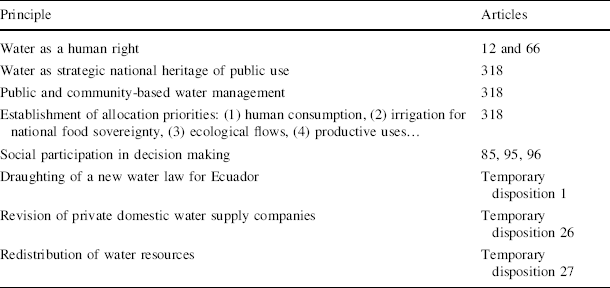
The draft constitution that was presented to the new president of the Constituent Assembly, Fernando Cordero, in July 2008, contained many progressive articles that were related to water resources. The most important proposals that had been presented by WRF (and some of these proposals were much more broadly shared within the Ecuadorian water users movement) were included in the constitution. These included the human right to water, water as national strategic heritage of public use, exclusivity of public and community organizations to manage water resources (no private water providers), establishment of water allocation priorities, the establishment of a single national water authority, social participation in decision making and the redistribution of water resources based on principles of social equity (see Table 1) (also see Acosta Reference Acosta, Acosta and Martínez2010; García Reference García, Acosta and Martínez2010; Republic of Ecuador 2008).
Main principles that were incorporated in the 2008 Constitution (own elaboration)

|
Principle |
Articles |
|---|---|
|
Water as a human right |
12 and 66 |
|
Water as strategic national heritage of public use |
318 |
|
Public and community-based water management |
318 |
|
Establishment of allocation priorities: (1) human consumption, (2) irrigation for national food sovereignty, (3) ecological flows, (4) productive uses… |
318 |
|
Social participation in decision making |
85, 95, 96 |
|
Draughting of a new water law for Ecuador |
Temporary disposition 1 |
|
Revision of private domestic water supply companies |
Temporary disposition 26 |
|
Redistribution of water resources |
Temporary disposition 27 |
The final approval of the constitution through a referendum in September 2008 was greatly supported by most social groups and many WRF members.
The efforts of WRF were important for the definition of some articles and principles of the new constitution, but these were only a small part of the larger lobby of very diverse organizations that form the Ecuadorian water users movement. A large number of NGOs and grassroots organizations, as well as the indigenous movement, made water one of their key demands. For instance, the Urban Forum fought for a prohibition of water cuts on public schools and hospitals; organizations from Guayaquil demanded that all water debts for domestic water supply of the poor be abolished and farmer unions fought for a more just distribution of irrigation water. The indigenous movement put forward most of its historic demands that had already been presented for years in their water law proposal. As put by the president of the Constituent Assembly
We had a high participation and mobilization of society. Their presence and their contributions were substantial. I don’t want to minimize the work of the colleagues of the Assembly, but I think that the contributions of the committed civil society groups that have been engaged in the defence of water for years enabled us to consolidate a very solid position (March, 2011).
Most of the proposals from civil society coincided on the basic principles such as the human right to water, the non-private character of water, participation, public and communitarian water management, and the recognition of customary water rights systems in community managed irrigation. Amongst the different groups that struggled for the inclusion of their demands in the Constitution and later the water law, as García (Reference García, Acosta and Martínez2010) puts it
… there are many more consensus and complementarities than differences. The paradox is that different organisations, platforms or institutions with very similar proposals have not been able to find consensus and that each one arrived to the Assembly through their own paths (p. 174).
These included the indigenous movement which, although allegedly side-lined in most discussions of the constituent assembly (Petras Reference Petras2008), framed the gains of the constitution 'as the result of long struggles of diverse social movements [… stressing that]…the new constitution embodied very important social, cultural, political, economic, and environmental advances, including plurinationality, interculturality, collective rights, rights of nature […] water as a human right…' (Becker Reference Becker2011, p. 60). The confluence of all these proposals can be seen as the result of the increased global, national and local centrality that water and its governance gained in a plurality of social spaces to which WRF, CAMAREN and its capacity building efforts contributed.
WRF’s Challenges in the New National and International Context
The development and positioning of WRF took place in a national and international context that was favourable for development NGOs, and its most important policy achievements came about through a national process of change which enabled NGOs and civil society organizations to actively participate in the formulation of a new national legal framework, but since then the context has changed. The Ecuadorian economy started to recuperate since the early 2000s, and since 2007, the ‘new’ government of Rafael Correa has made great investments in public infrastructure, increased the minimum wages, improved the provision of social services and greatly invested in rural development programmes (Becker Reference Becker2011, Boelens et al. Reference Boelens, Hoogesteger and Baud2013). These investments have further reduced the number of people that live in extreme poverty in the country, decreasing the ‘need’ for international funding of development projects. This has affected the flow of funds to NGOs that execute these programmes. COSUDE has ‘departed’ from Ecuador, SNV stopped its water programme and many other international NGOs have either left the country or greatly reduced their support programmes. This has made it harder for WRF and its participating NGOs to secure continued funding for their activities. At the same time, and maybe more challenging is the fact that after its initial democratic initiatives which peaked during the process that led to the 2008 Constitution, the government of Rafael Correa has become more centralistic and repressive, increasing its control over the funding and activities of NGOs (Boelens et al. Reference Boelens, Hoogesteger and Baud2013), and, while many of the important achievements of the 2008 Constitution are remarkable in legal terms (Roa-García et al., Reference Roa-García, Urteaga-Crovetto and Bustamante-Zenteno2013), their implementation and materialization remain in many aspects white elephants (Boelens et al. Reference Boelens, Hoogesteger and Baud2013). In this new socio-political and historical context, WRF has maintained its networking, discussion and research activities, but its capacity to exert direct political agency at national level has been greatly curtailed.
Conclusions
According to Biekart (Reference Biekart, Bebbington, Hickey and Mitlin2007), in the last decades, European NGOs and donor organization have financed a large number of NGOs (and their activities) in the Global South. One of the main spear points of much of this support has been the development of ‘political participation’ from civil society. With the aim of developing the voice of the marginalized and promote active citizenship through democracy, several long-term programmes have been financed in Latin America. Yet the impact of these efforts on the formation of civil society organizations remains disputed (Chahim and Prakash Reference Chahim and Prakash2014).
The case of WRF shows how the shared efforts of national NGOs that were supported by international funding were able to create and stimulate a critical mass that has significantly contributed to the water governance policy debates in Ecuador. As such, it has fomented democracy by enabling a multiplicity of individuals, NGOs, state representatives and grassroots organizations to take part in national water governance debates. This points at the important role NGOs can play in the development of third sector political agency in the water governance domain. The key to this development was the creation of a broad network that includes development NGOs, grassroots organizations, academics and state representatives. In this way, WRF was able to establish effective relations with international, governmental and many civil society organizations in a favourable historically specific international context, which created a unique possibility for democratic participation in national policy making through the 2008 Constitutional process. At present, in a transformed international context, the possibilities of WRF to change governmental policies has been curtailed. Nevertheless, its networking, capacity and awareness building activities, which lie at the heart of its public legitimacy, harbour the possibility to bring about changes to governmental policies when the socio-political context allows. In terms of the capacity of NGOs to bring about change and democracy to societies in Latin America, this case suggests that development NGOs and international efforts to support these can positively contribute to a deepening of democracy through the empowerment of grassroots organizations and the broader third sector, but that their capacity to bring about changes in public policies very much hinges on the historical context in which these operate.
Acknowledgments
This research was funded by the Netherlands Organization for Scientific Research (NWO) through its division of Science for Global Development (WOTRO) under project number W 01.65.308.00: ‘Struggling for water security: Social mobilization for the defence of water rights in Peru and Ecuador’. We thank the editors and anonymous reviewers for the insightful comments on earlier drafts. The usual disclaimers apply.

 Open access

