

Introduction
In the literature of the so called ‘heroic age’ of Antarctic exploration, there are many references to ‘medical comforts’. In some cases, this is used as a euphemism for alcoholic beverages for example ‘I took a flask of medical comforts . . .’ (Skelton 2004) and while these were certainly used as medical comforts, the term covered much more than that. This article describes the use of medical comforts during these expeditions.
Dietetic food and medical comforts
At the end of the 19th and beginning of the 20th century, the regulation of air, food, drink, sleep, and lifestyle was central to medical treatment regimes and dietetic food was a significant part of medical treatment (Church Reference Church2005). Recommended treatments were often very prescriptive as shown by one doctor's recommendations for the treatment of acute dysentery: ‘fresh milk, three eggs, custard, one pint of beef-tea, Bovril or chicken broth, one pint of arrowroot or cornflour, clotted milk, cocoa for supper and three lemons’ (Anon 1916a). The merits of different foods and alcoholic beverages were frequently described in medical journals of the time. Examples are descriptions of Plasmon, a milk extract, as described below (Anon. 1900a, 1910a), bottled fruit (Anon. 1912a), beef tea, (Anon. 1903) whisky (Anon. 1912) and brandy (Anon. 1903).
The term ‘medical comforts’, seems to have originated in the army. Thus in 1859, The Lancet commented with regard to field ambulances: ‘Another most desirable addition is that of medical comforts, in the shape of tea and sugar, cocoa-milk, arrowroot, concentrated beef tea, and brandy, with the means for heating a little water to prepare invalid drinks and diet’. (Anon. 1859). The term seems to have covered several functions. The primary use was for dietetic food for the treatment and prevention of illness. Also, as the name suggests, it was ‘luxury’ food and drink for ill, injured and convalescing soldiers and sailors. Most references relate to the provision (or, often, the lack of provision!) of medical comforts in military hospitals between the Crimean War and World War I though the term was used both before and after that period. The term was also used in relation to passenger and emigrant ships and in hospitals. The Merchant Shipping Act 1894 laid down that ‘the Board of Trade shall issue scales of medicines and medical stores suitable for different classes of ships . . .’ and as well as a list of drugs and medical equipment, was a list of foodstuffs to be carried (Leach and Spooner Reference Leach and Spooner1906).
Medical comforts taken to the Antarctic
In an interview about R.F. Scott's Discovery expedition (1901–1904), R. Koettlitz (one of the expedition doctors) was asked: ‘What did you take in the way of medical comforts?’ and replied: ‘Plasmon, Bovril, soups and arrowroot were the chief invalid foods and we also had some Frame Food and Schweppes soda water, champagne and brandy’ (Anon. 1905).
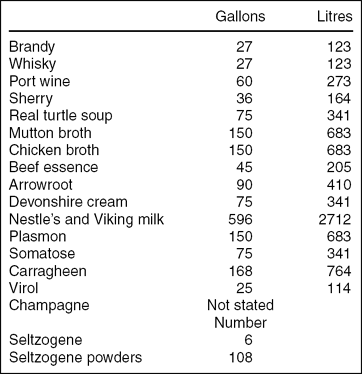
A.B. Armitage in his book about the expedition lists the medical comforts taken: some were taken in large volumes as shown in Table 1.
Medical comforts taken on the Discovery Expedition (1901–1904) (Armitage Reference Armitage1984: 311).

The expedition also took ‘invalid Bovril’ (Anon. 1901a). Lime juice was also a medicinal food, used to prevent scurvy, and they took 156 gallons of this (Armitage Reference Armitage1984) although it is not described as a medical comfort.
As one looks at the list in Table 1, it is obvious that there is overlap between medical comforts, normal rations and alcohol used socially. There is also an overlap between medical comforts and medication: they also took Kepler's malt extract, a food supplement, but this was on the list of drugs rather than medical comforts. Burroughs Wellcome, the manufacturers of this product, described it as a drug to avoid tax (Beckett Reference Beckett2008).
E.R.G.R. Evans, discussing Scott's Terra Nova expedition (1910–1913) says ‘Medical comforts included Brand's Essence, Bovril, and all the kindred commodities an ordinary sick bay would keep in stock’ (Evans Reference Evans1937). As a naval officer, he is comparing the supplies with those on a naval vessel and this would not be unexpected as Scott was, of course, a naval officer and both the medical officers, E.L. Atkinson and G.M. Levick, were naval surgeons. Interestingly, neither of these products is mentioned in the published list of stores taken (Atkinson Reference Atkinson, Debenham, Priestley, Wright and Lyons1924) and I have not found any other reference to medical comforts on this expedition.
D. Mawson's Australian Antarctic expedition (1911–1914) took ‘Certain medical comforts, such as malted milk and Plasmon’ (Mawson Reference Mawson1915 I: 319). Mawson also mentions Plasmon powder and Plasmon chocolate, Bovril and Neave's health diet but these are listed under food.
Frame food was also taken on C. Borchgrevink's Southern Cross expedition (1898–1900) which left behind six cases of Frame food (jelly), two cases of Frame food (extracts) and one case of Frame food (tablets) (Anon. 2004: 143–147) but these are not listed as medical comforts. Borchgrevinck also took ‘Nao’ (a beef extract) (Borchgrevink 1980).
There is no real mention of medical comforts on Shackleton's expeditions and no description of the types of food mentioned above apart from alcohol, Plasmon (used as a sledging ration) and the items that could form part of normal rations for example soups (Anon. 2003: 128–140).
The overlap between medical comforts and normal rations was considerable. On Discovery, 8 cases of Nestles milk (medical) and 8 cases of Ideal milk (medical) seems to have been stored separately from 52 cases of Nestles milk, 52 cases of Viking milk and 10 cases of Ideal milk as part of the normal ration (Anon. 1901b). Other forms of soup were also taken as normal rations. While alcoholic beverages were supplied as medical comforts, they were also supplied for normal consumption. In the army, cocoa and chocolate were regarded as medical comforts but on Terra Nova, they were listed as food (Akinson and others Reference Atkinson, Debenham, Priestley, Wright and Lyons1924: 47). Oxo, a beef extract, is listed as a ‘special travelling food’ (Atkinson and others Reference Atkinson, Debenham, Priestley, Wright and Lyons1924: 49).
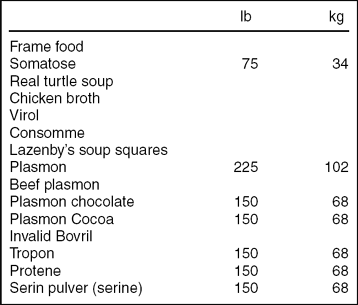
When sledging, it was important to keep weight to a minimum and so sledging rations were concentrated foods with a minimum of water. Many of the medical comforts were concentrated and so foods that, in one context, were used as medical comforts were also taken as sledging rations. Sledging foods taken on the Discovery expedition that were also used as medical comforts are shown in Table 2.
Concentrated foods taken as sledging rations on the Discovery expedition (Anon. 1901b). Quantity (where stated)
Other invalid foods including ‘Carnigen’, and ‘Hipi’ were investigated for use as concentrated foods for sledging (Armstrong Reference Armstrong1900) but do not seem to have been taken.
Plasmon, in particular, was taken in enormous quantities; both Shackleton and Mawson took a ton of Plasmon biscuits (Anon 2003; Mawson Reference Mawson1915 II: 315). Plasmon biscuits were particularly hard in consistency and Mawson compares then with geological specimens (Mawson Reference Mawson1915 I: 188; Savours in press)
On the list of food supplies taken by Scott on his second expedition is ‘salt (Cerebos), 600 – 1lb tins’. (Atkinson Reference Atkinson, Debenham, Priestley, Wright and Lyons1924: 48). Surprisingly this was also considered (at least by the manufacturers) as a health food. An advertisement says that ‘there were special reasons, however, why Captain Scott may have chosen ‘Cerebos’ Salt which he had used on his previous expedition. ‘Cerebos’ Salt contains a small proportion of phosphates which . . . give important nutritive value to it, besides counteracting the tendency to scurvy’ (The Times (London) 22 June 1910: 9)
In a nursing journal, the phosphates in Cerebos salt had earlier been described as ‘a valuable bone, brain and nerve nourisher’ and recommended for ‘those suffering from brain or nerve exhaustion’ (Anon 1895). Although there are a number of references to Cerebos in the Antarctic literature (perhaps to satisfy one of the sponsors of the expedition) the only medical reference to its use that I have found is nothing to do with these properties, but rather it being better than sea water for flavouring their meals. When the Terra Nova northern party was trapped for the winter in a snow cave, Dr Levick wondered if diarrhoea they were suffering was due to use of sea water and decided, on 7 April 1912, to use some of their remaining ‘cerebos’ to see if that made a difference (Levick Reference Levick1912a: 7 April 1912). Eight days later, he wrote: ‘at the end of the week's trial of fresh water and cerebos in the hoosh [stew] instead of sea water, there is no doubt that the sea salt was the cause of the diarrhoea as during the whole week there has been none excepting Dickason, for a very short time. . .’ (Levick Reference Levick1912a: 15 April 1912).
Use of medical comforts
Alcohol was certainly used, if not always in the way that the phrase ‘medical comfort’ suggests that it should have been! The concentrated foods used as sledging rations undoubtedly were. However there is very little recorded of their use in illness. One recorded example, which also describes the rationale for their use, was by Dr Levick describing the experiences of Scott's northern party: ‘Those who still have diarrhoea are on a liquid diet of nourishing soup which will keep up their strength without giving too much work for their inflamed guts’ (Levick Reference Levick1912b: 26 September 1912).
In Shackleton's Ross Sea party, A. Spencer-Smith showed faith in beef extracts: ‘Nearly fainted at 11 am and had to tell at lunch how weak I am: much sympathy and an extra Bovril cube all to myself’ (Spencer-Smith Reference Spencer-Smith1916) and J.L. Cope, describing R.W. Richard's illness in his medical report on the expedition says that ‘during the whole of his illness he was taking “Virol”’ (Cope Reference Cope1917).
On the Southern Cross expedition, Borchgrevinck wrote of one of the Lapp expedition members: ‘Must suffered a good deal from the cold, and I had at times to use medical stimulants to keep him from passing away. I kept him alive principally by giving him ‘Nao’, a very fine essence of beef, which gradually became a necessary part of our sledge provisions’ (Borchgrevinck Reference Borchgrevinck1980).
In his book on his first Antarctic expedition (1903–1905), J.-B. Charcot says of ‘polar anaemia’: ‘I believed, above all, on absolute rest and the good effects of milk, somatose and fish with a little digitalis and caffeine’ (Charcot Reference Charcot1908: 68).
Relationship between the expeditions and food manufacturers
Expeditions have always tried to save on costs by asking manufacturers to donate equipment, food etc. and manufacturers have been able to use this support in advertising and have often asked for testimonials.
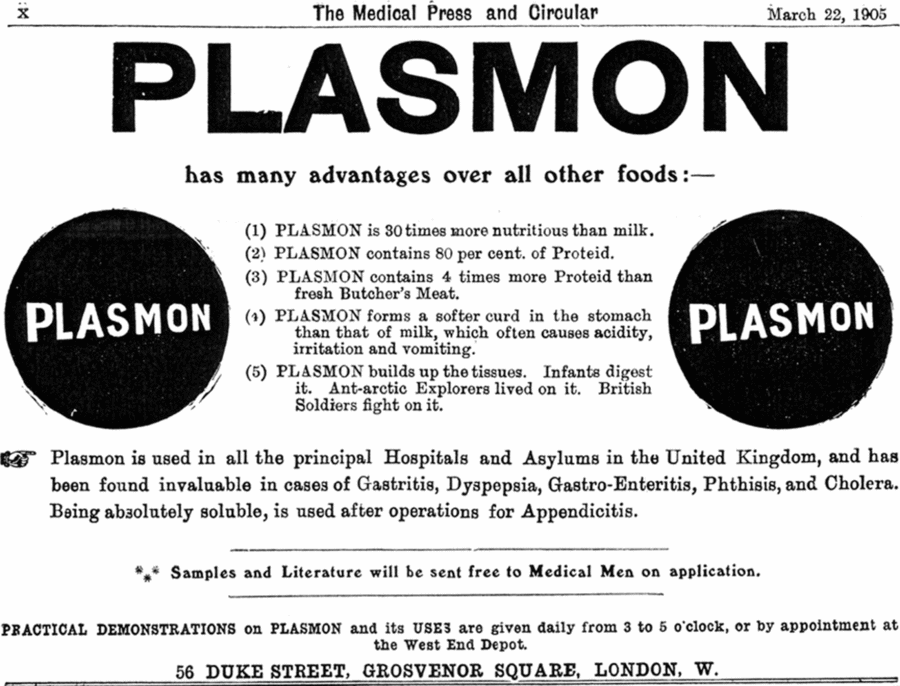
Medical food was extensively advertised in medical journals of the time and to doctors at exhibitions, but the only advertisement in a medical journal that I have found that mentions an Antarctic connection is one for Plasmon that says that it ‘. . . builds up the tissues. Infants digest it. Ant-arctic (sic) explorers lived on it. British soldiers fight on it’ (Advertisement frequently used. One example is in The Medical Press and Circular (London) 22 March 1905: x; Fig. 1) and others in different publications (Figs. 2, 3). Diet during illness and convalescence was, perhaps, a nursing responsibility more than a medical one, and medical comforts were also marketed to the nursing profession. This marketing was not just through advertisements but often as news. Thus nurses were told that the Belgian Antarctic expedition (1897–1899) took very large quantities of ‘Liebig Company's extract’ (Anon. 1897), and that the same company had supplied the Discovery expedition with large quantities of ‘Lemco’ (Anon. 1901c). (This is not mentioned in Armitage's list of medical comforts shown in Table 1.) Discovery also took Bovril and, in relating this, the Nursing Record and Hospital World said: ‘There is little that can be said that has not often been expressed in praise of their concentrated Extract of Beef’ (Anon. 1901c). The British Journal of Nursing, referring to the Discovery expedition (1901–1904) reported that ‘The use of Plasmon and its preparations as an article of diet should be considerably increased by the testimony borne to its value by Lieutenant E. Shackleton R.N. and some of the others who have tested it under some of the most strenuous conditions of life’ (Anon. 1909).
Advertisement for Plasmon in a medical journal (The Medical Press and Circular (London) 22 March 1905: x).
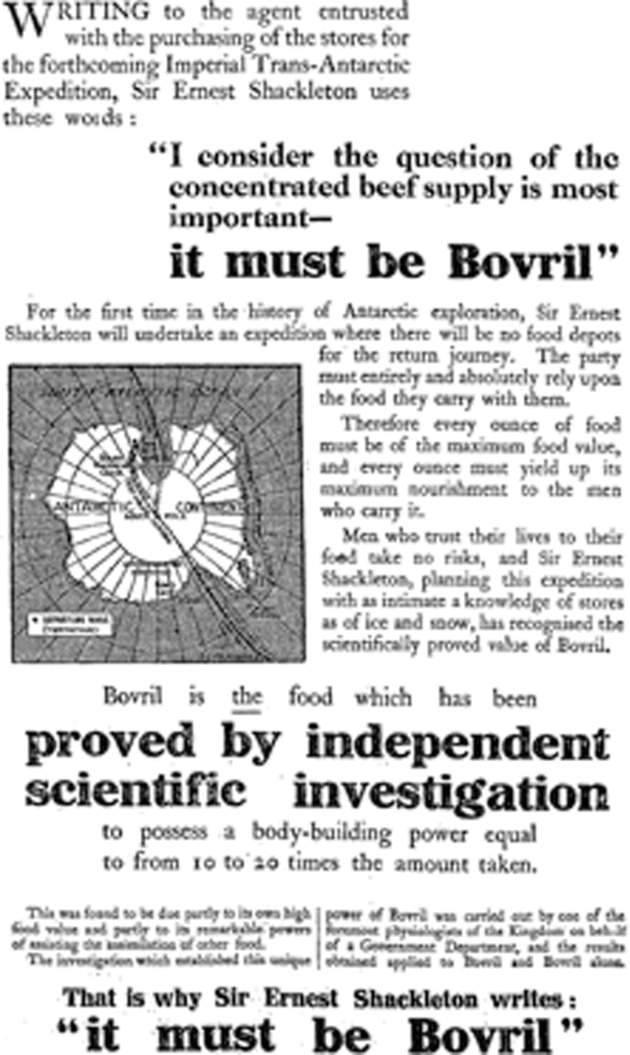
Advertisement for Bovril from The Times (The Times (London) 21 April 1914: 5).
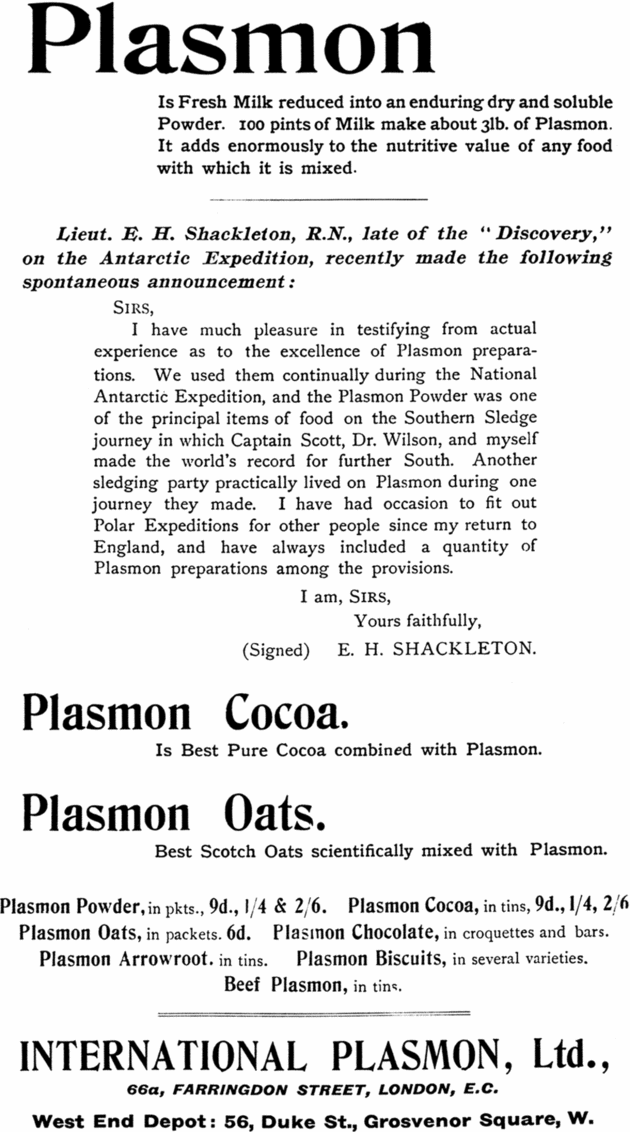
Advertisement for Plasmon (Discovery Antarctic Exhibition 1904: 12).
They took Plasmon, Plasmon biscuits and Plasmon cocoa and the article has short testimonials from E.H. Shackleton, D. Mawson (who, before organising his own expedition had been on Shackleton's first expedition) and Dr E. Marshall. Shackleton's name was also used in a testimonial for Virol in the same journal (Anon 1917).
The Antarctic connection was used in advertisements to the general public for Bovril (The Times (London) 21 April 1914: 5) (Fig 2), Plasmon (Discovery Antarctic Exhibition 1904: 12) (Fig 3) and for other products, in the UK, Australia and New Zealand. This early Antarctic connection continued to be used as late as 1959 for Bovril (advertisement in The Times (London) 9 March 1959: 36) and 1975 for Oxo (advertisement in The Times (London) 23 October 1975: 27)
As noted, there was much overlap between normal rations and medical comforts. Custard powder was not listed as a medical comfort but custard was a component of many diets for gastric ulceration (Brunton Reference Brunton1902), and other gastrointestinal problems (Ewart Reference Ewart1897) and nurses were told that Discovery took large quantities of Bird's egg powder and custard powder (Anon. 1901d). There was no mention of health in this article (although mention in a nursing journal, perhaps, implies health) but in an earlier article, Bird's custard powder is described as: ‘pure, light, appetising, delicious, nutritious and easy of digestion, and consequently an invaluable luxury for the most fastidious invalid. . .’ and this is linked with Nansen's use of it on his Arctic expedition in the Fram (1894–1896) (Anon 1900b).
What were the medical comforts?
Some of the ‘medical comforts’ are still in use today particularly as ingredients in cooking but at the end of the 19th century and well into the 20th century, these were promoted as health foods, body builders, invalid foods etc. The items taken were a very small number of the many health foods being promoted at the time. Bovril, Liebig Company's extract, Oxo, Lemco, Somatose and Nao were all beef extracts. Before the Discovery expedition many of the products were examined in government laboratories and the report on Somatose makes interesting reading:
“Somatose” is an altered proteid probably prepared by the action of acid on insoluble albuminous matter. The exact character of compounds so produced varies with the rigour of the treatment and the finished article is not likely to be of uniform composition. “Somatose” is said to be produced from beef, but as it is tasteless and contains no characteristic substance it is impossible to trace its precise origin. The total phosphoric anhydride present amounts to only 0.11 per cent. I should have some hesitation in recommending “Somatose” as suitable for the Antarctic Expedition’ (Thorpe Reference Thorpe1901).
Carnigen was probably very similar: the name suggests a meat origin and it is said to be ‘dietetic albumose’ (Anon 1901e) that is a substance produced from breaking down, or partly digesting, albumin. Invalid Bovril was a more concentrated form of Bovril, supplied without seasoning, and ‘is most suitable for use in the sick room’. (Anon 1900c). Brand's Essence also referred to as a meat extract. Brand's essence of chicken is still available but the company used to make essences of mutton and beef. I suspect that it was the latter that was taken. Hipi was a mutton extract (Anon 1902).
Plasmon was ‘the casein of milk separated by a very simple process and dried.’ It was a ‘tasteless, odourless white powder which is entirely soluble in water though the solution exhibits a slight opalescence similar to that of milk. The dry powder swells up in water to a gelatinous mass which dissolves as more water is added. . . . The important dietetic salts of milk are retained. . . It is extremely digestible and [is] . . . of great value as a nutrient in enfeebled conditions of the digestive organs and . . . an excellent means of administering food to the sick’ (Anon 1900d), An advertisement indicated that it was useful in tuberculosis, anaemia, malnutrition, diabetes, obesity, gout, neurasthenia, neuritis, peritonitis, typhoid, rickets, infantile diarrhoea and for growing and delicate children (The Times (London) 17 July 1913: 4).
Protene was very similar: ‘Protene is a flour composed of the casein of milk . . . for ordinary purposes 25 per cent of protene is mixed with wheaten flour and it is claimed that bread, etc made with this flour is four times more nutritious than the best meat’ (Anon 1899). Biscuits were also made from protene.
Liebig's Company Extract, Oxo and Lemco were all products of the same company and Virol was produced by Bovril. Some of the names represented a range of products. As noted above, International Plasmon Ltd IT produced Plasmon, and also used the name with biscuits and cocoa. It also had other products. Somatose also produced Iron Somatose (a combination of iron with Somatose and Milk Somatose, based on casein (Anon. 1900e), and so, presumably similar to Plasmon.
Neave's health diet was ‘a milk and cereal diet [which] has proved invaluable for the aged and convalescents, for nursing mothers and dyspeptics as it makes little demand on the digestive organs, and is highly nutritious’ (Anon 1912b).
The main medicinal use of brandy was as a stimulant drug (Guly Reference Guly2011) but alcohol had other medicinal uses and was used as a food. While it does supply calories, there is a limit to the rate at which alcohol can be metabolised so small quantities frequently are required (this also reduced the risk of intoxication). It is easily absorbed and so was recommended for use in those with difficulty in absorbing food or those with anorexia and vomiting. ‘In acute fever . . . alcohol is an admirable food, because it requires no digestion and is easily absorbed’ (White Reference White1920). As it does not ferment in the gut, it was said to be useful in severe flatulence (Hutchison Reference Hutchison1920). However it contained very little nitrogen and a person would need 203 bottles of claret or 113 bottles of sherry to obtain the daily nitrogen requirement (Hassall Reference Hassall1865).
In fever, it would also reduce the temperature. In convalescence, ‘certain patients are made more comfortable and contented, worry less and take their food with keener enjoyment, if they are given alcohol’ or, rather, ‘alcohol in a form in which the patient enjoys it’. This is obviously not an effect of the alcohol itself. ‘It would hardly be maintained that the same quantity of the drug, administered in a distasteful mixture, would have the same effect’ (Dale Reference Dale1920).
The British Pharmocopoeia, the standard reference book on drugs, said that ‘the most important action of alcohol is on metabolism; in ordinary doses it is almost completely oxidized, and spares the oxidation of fat . . . it surpasses starch and sugar in alimentary value, since weight for weight, it contains more energy. . . It is employed as a food during convalescence from fevers, but when used for this purpose the dose should not exceed 3 or 4 ounces of alcohol per diem’ (Anon. 1907: 69).
Seltzogene siphons were a means of producing soda water by the generation of carbon dioxide from bicarbonate of soda or tartaric acid and so the soda water siphons mentioned by Koettlitz and the Seltzogene in Table 1 are probably the same thing. Soda water was not just for mixing with alcoholic drinks but The Lancet said ‘it is well known that soda-water-and-milk is an excellent beverage and food for the invalid, especially where sensitive conditions of the digestive organs exist’ (Anon 1900d).
Many of the medical comforts were food items treated to extract the ‘essential goodness’ of the food while leaving them easier to digest. Frame food extract was an extract of the food elements of bran from the indigestible cellulose. It was a dry brown powder of biscuit-like odour and slightly bitter taste and formed the basis of Frame food porridge, Frame food jelly and Frame food bread, (Anon 1889), it was so-called because it ‘builds up the frame’ (Advertisement in The Medical Press and Circular 8 February 1905 p xiii) Frame food tablets were ‘intended as a substitute for regular meals when from various causes food cannot be obtained, and are said thus to prevent the exhaustion which follows prolonged abstinence’ (Anon 1893)
Virol was a health food or body builder based on red bone marrow, malt extract, eggs and lemon juice (Anon 1916b).
Arrowroot is a starch extract of the root of a tropical plant and is used for thickening sauces. When heated the starch turns to jelly and so thickens the liquid. As a carbohydrate it was thought to be easily broken down and absorbed and was used as a source of nutrition in patients with bowel problems, particularly diarrhoea.
Carragheen is an edible seaweed also used as a thickener for soups and sauces and used by itself as a pudding. It is still much used and there are many claims of health giving properties by herbalists. It was also advertised in New Zealand as a cold and cough medicine (advertisement in Wanganui Herald (New Zealand) 28 December 1909: 7)
Did they do any good?
Meat extracts were advertised to imply that they represented the whole nutritional value of the meat. In 1865 Hassall said that ‘It is stated that thirty-two pounds of raw beef . . . furnish but one pound of Liebig's extract, and hence the inference has been drawn that one pound of this extract is equivalent in nutritive value to thirty-two pounds of lean beef’ (Hassall Reference Hassall1865). However he showed that the nutritional value was, in fact small: ‘So far as the nitrogen is concerned, nearly two pounds and three-quarters of lean beef are . . . equal to one pound of the extract’ and that to supply a person's daily requirement of nitrogen would require 6 3/4 oz of extract whereas the instructions advised using a small teaspoon (1/8 oz). The nutritional value was therefore small. Similarly Plasmon advertised that 100 pints of milk formed 3lb of their product (Discovery Antarctic Exhibition 1904:12).
It was later suggested that beef extracts stimulated an exhausted system, enabling a patient to digest food, which without it, would have lain heavy on the stomach. An advertisement for Lemco said that ‘In the light of recent practical experience and scientific experiment, the efficiency of beef-extract as a gastric stimulant can hardly be over-estimated. Lemco is pronounced to be one of the most powerful gastric stimulants known’ (The Medical Press and Circular (London) 23 April 1913: 3). Similarly two advertisements for Oxo said that ‘Oxo presents its nutrients in a readily dissolvable and absorbable state; not only is it a nutrient in itself, but it possesses the faculty of making torpid gastric juices vigorous as in normal health, and consequently promotes the absorption of other food. Its use is physiologically sound and a physiological economy’ (The Medical Press and Circular (London) 30 April 1913: 5) and Oxo ‘goes into the system and becomes a living, nourishing force long before other foods are half digested. One of the greatest advantages of Oxo for the sick room is that it gives strength quickly’ (The Medical Press and Circular (London) 1 Feb 1905: 4). In reality, they had no stimulant action and in large doses, had a purgative effect (Slade Reference Slade1907)
While they may not have had the effects they were supposed to have, the foods would have supplied some calories and undoubtedly would have been enjoyed as many of the products are still enjoyed today. By making people feel better, they would increase the appetite which would clearly have been of benefit and while one cannot function without nutrition, in difficult circumstances, psychological strength may be more important than physical strength. Short-term use would have done no harm and probably did some good.
The main problem with these products is the lack of vitamins. In 1921 McCarrison said that ‘The invalid foods used in the treatment of dysentery are often dangerously deficient in these indispensable substances’ [that is vitamins] (McCarrison Reference McCarrison1921) and a few years later a report said: ‘A large proportion of medical casualties on foreign service consists of intestinal diseases, and both during the acute stage and the subsequent convalescence the diet is largely restricted to bread, condensed or tinned milk, and invalid foods, which may be regarded as either free from vitamin B or very poor in it’ (Committee of Lister Institute and Medical Research Council 1924). Long-term use of these foods in invalids, though well-intentioned, may have predisposed people to disease. There were deaths from cardiac disease on many of the Antarctic expeditions and similar illnesses, not resulting in death, on other expeditions. I have argued elsewhere that the cause of these deaths was wet beri-beri due to thiamine (vitamin B1) deficiency (Guly in press). Two of the deaths were Hanson (Southern Cross expedition) and Ramsay (Scottish expedition, 1902–1904). We know that both were ill at sea before reaching Antarctica; there is little detail about Ramsay but Hanson had a diarrhoeal illness and it is likely that he was fed invalid food. While scurvy sufferers were fed fresh food if it was available, other illnesses would have been treated with invalid foods and, as noted above, diarrhoea sufferers would have been fed food designed to avoid ‘giving too much work for their inflamed guts’ (Levick Reference Levick1912b: 26 September 1912)
Virol, however, did contain vitamins B and A (Anon. 1916b).
Conclusion
Medical comforts were dietetic foods for the treatment and prevention of illness and ‘luxury’ food and drink for the ill, injured and convalescent. There was considerable overlap between medical comforts and normal rations, sledging rations and medicine. There was also overlap between alcoholic beverages used as medical comforts and the same drinks used on social occasions. Substances used as medical comforts were heavily advertised but they were of limited value and if ill patients were fed exclusively on these foods, this may have contributed to the vitamin deficiencies which occurred on these expeditions.
Acknowledgment
This research was funded by the Wellcome Trust which gave me a Short Term Research Award in the History of Medicine for Clinicians and Scientists for a research project ‘Medicine during the Heroic Age of Antarctic exploration’.

 Open access

