


The new primary school was built on a hill, a short walk from the homes and shops of a village located in a southern district in Ghana. The freshly painted yellow walls shone in the sunlight. Parents were excited when the local government hired contractors to begin work on the classrooms because the old school was dark, stuffy, and overcrowded. However, despite their glossy exterior, the new buildings turned out to be little more than fools’ gold. Ill-fitting window shutters flapped in the wind; wild animals had gotten in and littered on the floors. Wires hung precariously from uncovered electricity sockets, ready to snap at curious young hands. The ceilings bowed and bulged. The classrooms had been padlocked shut, unused, since they had been painted.
The school was yet another “failed” development project on the local government’s list. The district’s internal auditor was frustrated by the abandoned school and similar projects that were poorly constructed, never finished or existed only on paper. Ghana is not a wealthy country by global standards. Most people earn less than $200 per month, or about $6 a day.Footnote 1 Local governments have significant developmental mandates; they are expected to construct and maintain local public infrastructure on limited budgets.Footnote 2 Given the high public demand for better infrastructure and scarce public resources, it is frustrating (and puzzling) when such funds are wasted.
Yet two-thirds of local government infrastructure projects are successfully completed.Footnote 3 About half of the high-ranking local bureaucrats I surveyed for this book believed that local officials engaged in corruption; yet the other half did not. Overall, Ghana’s public sector features multiple pockets of excellence.Footnote 4 Indeed, prior work establishes that there are often more within-country differences in the performance of public sector units than there are across countries.Footnote 5
This book investigates how, why, and when states deliver public services efficiently. Many existing theories of governance and development fail to explain this internal variation. For example, macrostructural factors such as a country’s colonial heritage, institutionalization of property rights, level of democracy, or electoral system cannot account for the internal variation in governance outcomes in low- and middle-income countries.Footnote 6 An adequate theory of governance must be flexible enough to explain variation in performance across public sector units (local governments, departments, and agencies).
Theories that highlight state capacity as the central driver of or impediment to public sector effectiveness are also inadequate.Footnote 7 While state capacity can vary across units,Footnote 8 and thus may explain internal variation, poor governance outcomes are often not the result of insufficient personnel, a lack of bureaucratic knowledge, or inadequate financial resources. For instance, the school project I describe was fully funded and administered by well-educated, highly trained, and extremely competent local bureaucrats. If insufficient capacity was not the reason for the project’s failure, what was?
While the availability of resources can no doubt influence governance outcomes,Footnote 9 in this book I argue that many governance failures are the result of the sub-optimal organization of relations between politicians and bureaucrats. A deeper awareness of politicians’ incentives, and their levers of control over bureaucrats’ careers, is therefore essential to understanding when the state is able to deliver effectively. I concentrate on bureaucratic management, rather than bureaucratic selection and resources, as the primary driver of public sector performance. My theory emphasizes the importance of considering politicians’ electoral strategies and incentives when theorizing public sector outcomes. My theory assumes that politicians gain voters’ support by distributing goods to them using either a rule-based (programmatic) or discretionary (non-programmatic) approach.Footnote 10 Prior work has established that the latter is a primary determinant of voter–politician linkages in many developing democracies.Footnote 11 Politicians who rely on non-programmatic practices face a dilemma in how to treat the public sector. On the one hand, they have an incentive to invest in bureaucratic competence to facilitate the efficient delivery of goods, especially programmatic benefits.Footnote 12 On the other hand, they may be discouraged from investing in competence, as this typically reduces bureaucratic loyalty.Footnote 13 Most importantly, decreased loyalty makes it harder for politicians to engage in non-programmatic distribution because the discretionary allocation of goods often entails politicians asking bureaucrats to bend or break formal rules; at its worst, it can involve asking bureaucrats to engage in corruption to capture public funds.
To overcome this dilemma and support their desire to promote administrative efficiency without compromising their ability to engage in non-programmatic (or clientelistic) distribution to win electoral support, I argue that politicians will often adopt a “middle-ground” approach to public sector professionalization. This strategy involves politicians professionalizing bureaucratic selection, yet because merit-based practices reduce loyalty, they will retain the ability to control individual bureaucrats’ careers. Politicians will use what I call career control to generate forced bureaucratic loyalty. Career control tools include political interference in bureaucrats’ (i) promotions, (ii) work portfolios, and (iii) geographic or departmental transfers. These tools are powerful because they affect bureaucrats’ professional advancement and can negatively affect their personal lives and well-being. Politicians can leverage these tools to co-opt the state.
Variation in politicians’ opportunities and motivation to use career control tools can explain disparities in governance across public sector units. Politicians’ opportunities to employ such tools are typically not evenly distributed. For example, those with strong ties to elites may be better able to transfer or block a bureaucrat’s promotion. I propose that politicians are more motivated to co-opt bureaucrats where they most desire to engage in non-programmatic distribution – often where local electoral competition is high. Local electoral competition encourages clientelism and drives up the cost of election campaigns.Footnote 14 It therefore encourages politicians to use career control tools to co-opt bureaucrats, which undermines good governance practices.
Applying this theory to the opening vignette, the school project failed because the local government awarded the contract to a political insider rather than engaging in a competitive process. The mayor had an incentive to control procurement outcomes to fund local party campaign activities to support the incumbent president, so he contracted with a firm that was willing to channel a share of the project’s budget into the incumbent party’s campaign chest. As I discuss in this book, electoral politics often incentivize politicians to find nefarious ways to finance election campaigns, and they frequently turn to public procurement.Footnote 15
However, electoral pressures on politicians are only half of the story. In the southern district of Ghana that I referred to at the start of this chapter, I asked the internal auditor why, as a professionally trained and meritocratically recruited bureaucrat whose salary is funded by the public purse, he did not push back against or expose such practices. More broadly, why do bureaucrats condone corrupt behavior from which they personally gain little? After all, Ghana’s Whistleblower Act (Act 720) of 2006 protects bureaucrats who expose corrupt practices. The auditor explained that attempts to block or expose bad governance practices could severely jeopardize a bureaucrat’s career. Well-connected politicians can transfer them to faraway locations or make their work lives a misery.Footnote 16 Thus, the mayor of this district engaged in informal management practices to co-opt the state.
1.1 Key Concepts and Empirical Focus of the Book
This book accepts the positive role that states have played (and continue to play) in promoting progress,Footnote 17 and focuses on the state’s role in development. I define governance as “a government’s ability to make and enforce rules, and to deliver services.”Footnote 18 Regarding service delivery, I focus on the state’s ability to provide safe and effective public infrastructure – an essential government task. Most low- and middle-income countries, particularly those in Africa, have insufficient infrastructure to support economic growth and human development.Footnote 19 In this book, I follow prior work that defines meritocratic recruitment as a system in which “individual merits – such as education, knowledge, skills and job-related experience  constitute the main grounds for hiring to bureaucratic positions.”Footnote 20
In Ghana, as the book’s opening vignette highlights, planning and constructing (or repairing) public works is the primary task of local governments. The book’s empirical chapters focus on two aspects of infrastructure provision: (i) the siting of new projects within districts and (ii) public procurement (contracting private firms to construct these projects). Examining these processes highlights how local development is the product of a series of administrative processes. I explain why meritocratically hired bureaucrats help politicians facilitate bad governance practices and why such practices vary across districts.
A focus on public procurement is warranted as it accounts for 10–25 percent of public spending globally.Footnote 21 It is often a country’s largest source of private spendingFootnote 22: it constitutes about 14% of GDP (and 50% of government spending) in African countries.Footnote 23
Malfeasance in procurement, particularly in infrastructure projects, is a common problem in many countries. Corruption consumes an estimated 10–30 percent of the cost of capital investment projects around the world.Footnote 24 For example, a 2011 study found that 58 percent of municipal governments in Brazil engaged in illegal public procurement.Footnote 25 In Nigeria, 38 percent of publicly funded projects that exist on paper are never started.Footnote 26 Yet corruption in public procurement is not exclusive to developing countries, and large international firms are also implicated in public scandals.Footnote 27 Further, Organisation for Economic Co-operation and Development (OECD) data reveal that 57 percent of foreign bribery cases resolved between 1999 and 2013 involved public procurement.Footnote 28
My focus on the state puts politicians (ministers, Members of Parliament [MPs], and local mayors) and bureaucrats – the public officials responsible for delivering development – at the center of the analysis. The politicians I focus on when discussing the book’s main case – Ghana – are mayors (known locally as District (Metropolitan or Municipal) Chief Executives), who head the local governments.Footnote 29
Over 80 percent of countries have decentralized at least some aspects of governance.Footnote 30 Local governments are important units because they provide local public goods and services and have close ties to citizens. In Ghana, political power is decentralized to local governments, which are formally responsible for districts’ “overall development.”Footnote 31 Fiscally, local governments largely rely on transfers from the central government. Local governments provide public infrastructure (such as local roads, schools, and health clinics) and some public services (e.g. sanitation and monitoring educational quality).Footnote 32
Citizens are much more likely to interact with local than national government officials. Nearly one-quarter of Africans (22%) have contact with their local councilors in a given year,Footnote 33 compared to 11% of citizens who contact their national representative. In Ghana, the same data indicate that close to one-third of citizens (28%) had been in contact with their local councilor in the last year, compared to 16% who had contacted their MP. Similarly, in India, while both local and national politicians spend a significant share of their time in one-to-one meetings with constituents, national politicians report spending about a fifth of their time meeting citizens compared to block councilors, who dedicate about a third of their time to such interactions.Footnote 34
I focus on bureaucrats who hold high-level administrative positions within local governments. They work in various capacities, such as budget officers, planning officers, and departmental directors, and interact regularly with their political principals – local mayors. In Ghana, all local bureaucrats are recruited centrally from the capital and are then posted to work in a particular local government. They are typically highly educated. While these bureaucrats do sometimes interact with the general public, they are not “street-level” officials in the same way that, for example, police officers or nurses are.
1.2 Existing Arguments
Before outlining my theory in more detail, I overview existing arguments that seek to account for poor governance and variation in public sector performance. I discuss arguments related to bureaucratic selection, bureaucrats’ and politicians’ incentives, and the demands of voters. My theory draws on all of this literature, and casts doubt that arguments focused on only one of these areas can sufficiently explain variation in governance.
1.2.1 Bureaucrat Selection
Two related arguments emphasize bureaucratic selection as a primary driver of low state capacity and poor governance. The first focuses on the supply of high-quality bureaucrats, while the second concentrates on the demand for these individuals.
Much prior work in this area has discussed the limited supply of well-trained potential bureaucrats as an impediment to administrative capacity, especially in African countries in the decades after independence. A well-cited anecdote is that on the eve of independence, the Belgian Congo had only six people with a university education.Footnote 35 There were too few highly trained individuals, largely because foreign officials staffed most professional positions under colonial rule. In most countries, overseas personnel held all senior roles, as well as a significant share of jobs at each level of the administrative structure except the secretarial level. Before independence, Africans held only 6% of senior posts in Kenya (and 12% of mid- and senior-level posts in Tanzania).Footnote 36 These staffing patterns led to the severe underdevelopment of local universities: most African countries did not have a single university at independence.Footnote 37
The supply challenge was exacerbated by the fact that new postcolonial leaders not only had to fill existing positions but also had to recruit new bureaucrats to expand the public sector to fulfill their developmental ambitions. The number of civil servants in African countries roughly tripled in the twenty years after independence.Footnote 38
Universities struggled to keep up with the demand for well-trained individuals. While tertiary education enrolments grew by an average of 15 percent a year between 1960 and 1980, many governments had to recruit less educated individuals.Footnote 39
Politicians also viewed public sector recruitment as an opportunity to stabilize their governments. Leaders used public sector jobs as patronage to build elite coalitions and to create patron–client networks from the center to peripheral regions.Footnote 40 In ex-anglophone colonies, public service commissions that were previously politically independent were placed under the control of the president: this was the Kenyan government’s first constitutional amendment.Footnote 41 Purposeful politicization thus undermined policymaking and policy implementation in the decades following independence.Footnote 42
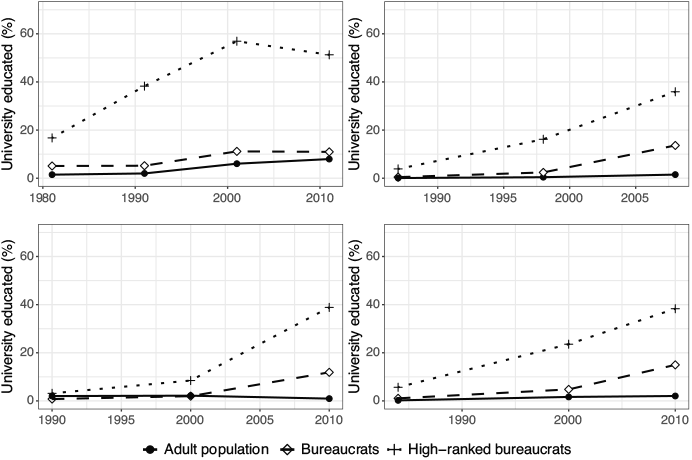
Yet, supply constraints seem insufficient to account for the bad contemporary governance outcomes in many developing democracies. While only a small share of the population of African countries has a university education (see Figure 1.1), there has been a huge increase in the number (and share) of people with a bachelor’s degree on the continent.Footnote 43 Figure 1.1 displays relevant data for the four countries (Botswana, Zambia, Malawi, and Ghana) with three or more data points. The three lines in the figure represent the share of university-educated people in three categories: (i) the entire population, (ii) all bureaucrats, and (iii) high-ranking bureaucrats.
Share of high-ranking bureaucrats with a university education
Note: Bureaucrats are classified using the INDGEN variable. I code those who give their occupation as “Public administration and defense” as bureaucrats. Within this subgroup, I code high-ranking bureaucrats using the OCCISCO variable, as those who classify themselves as “Legislators, senior officials and managers” or “Professionals.”
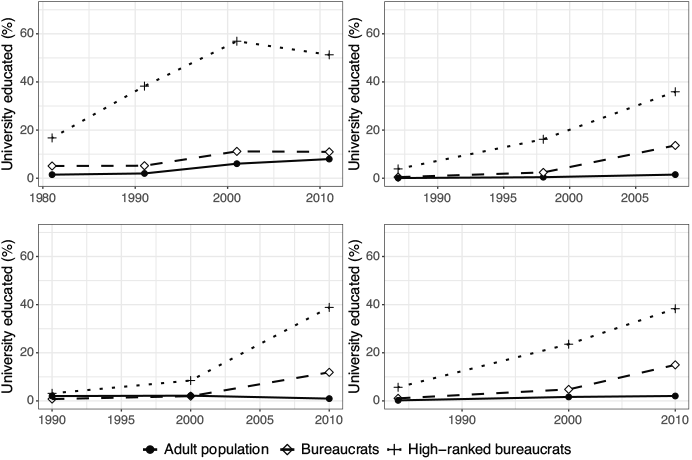
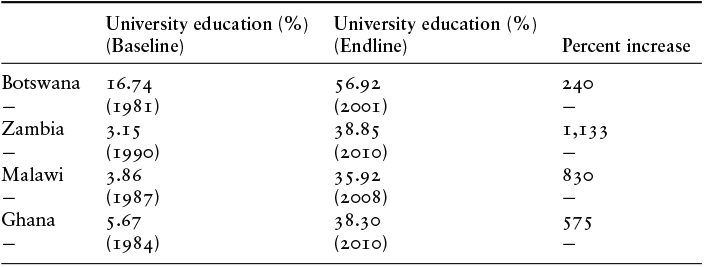
Figure 1.1 illustrates that the share of bureaucrats with a university education has risen rapidly since 2000.Footnote 44 There has also been an explosion in the share of high-ranking bureaucrats with a university education. Table 1.1 displays the overall changes in the share of high-ranking bureaucrats with a university education for each country. All four countries for which over-time data is available have experienced an astonishing rise in the percentage of bureaucrats with a university education, ranging from an increase of 240% to 1,100% over a twenty-year period. For example, in 1990 only 3% of Zambia’s high-ranking bureaucrats were university educated, compared to nearly 40% in 2010. Ghana experienced a similar increase from 6% in 1984 to almost 40% in 2010. Increasingly, then, it seems that bureaucratic capacity or expertise is not the primary constraint on administrative performance.
| University education (%) (Baseline) | University education (%) (Endline) | Percent increase | |
|---|---|---|---|
| Botswana | 16.74 | 56.92 | 240 |
 | (1981) | (2001) |  |
| Zambia | 3.15 | 38.85 | 1,133 |
 | (1990) | (2010) |  |
| Malawi | 3.86 | 35.92 | 830 |
 | (1987) | (2008) |  |
| Ghana | 5.67 | 38.30 | 575 |
 | (1984) | (2010) |  |
These figures also suggest that the demand for educated workers has increased since democratic elections were reintroduced in many countries in the early 1990s. Theoretically, it makes sense that higher levels of democracy incentivize politicians to hire high-capacity bureaucrats. Indeed, recent empirical analysis establishes that in Indonesia, the introduction of competitive elections increased the government’s demand for high-performing bureaucrats.Footnote 45 Again, the lack of demand for well-trained bureaucrats does not fully explain poor governance.
1.2.2 Bureaucrats’ Incentives
Multiple factors shape bureaucrats’ incentives to work hard or engage in corruption or malfeasance, including how they are recruited into the public sector and their working conditions after they are hired. Indeed, poor governance is often said to result from bureaucrats’ politicized recruitment, inadequate remuneration or insufficient monitoring. Meritocratic selection procedures involve recruiting and hiring bureaucrats based on their skills, competence, and intrinsic motivation – a key component of a professional public sector. When bureaucrats are recruited based on their personal or political connections rather than merit, they may be motivated to prioritize the interests of their political patrons over the public good. Cross-national evidence supports the assumption that meritocratically hired bureaucrats perform better. States with higher levels of merit-based hiring have lower levels of corruption and are less likely to waste government resources.Footnote 46 Bureaucrats also believe that colleagues hired on the basis of merit are less corrupt and have high levels of public service motivation.Footnote 47
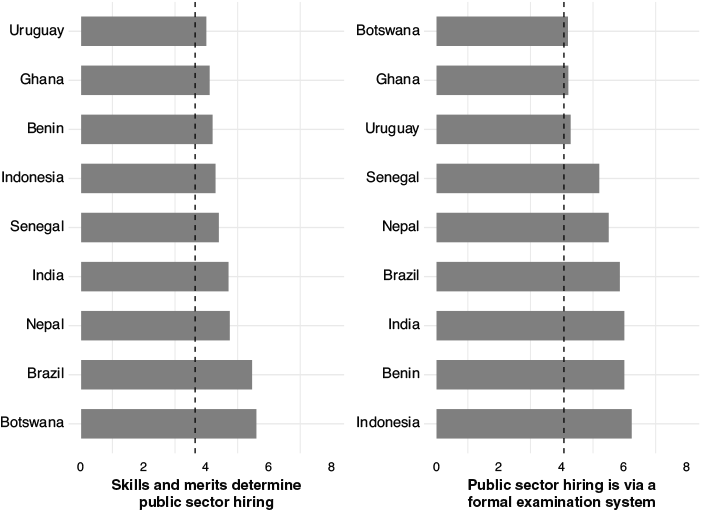
Globally, there is evidence of increased meritocracy in the recruitment of civil servants. The data suggest that meritocratic recruitment procedures are standard in a significant subset of low- and middle-income countries. Many countries have adopted formal examination systems to recruit personnel. The Quality of Government (QoG) Institute collects expert opinions on the condition of the public sector. Figure 1.2 displays aggregated responses from its second survey wave in 2014 and 2015 across several developing democracies.Footnote 48 The data show that countries across multiple continents, including Benin, Botswana, Brazil, Ghana, India, Indonesia, Nepal, Senegal and Uruguay, lie above the non-OECD mean on two important indicators of merit: the extent to which (i) “skills and merit” determine recruitment and (ii) formal examinations are used (1 = “hardly ever”; 7 = “almost always”).Footnote 49 The non-OECD means for these two questions are 3.64 and 4.07, respectively. Botswana and Brazil perform particularly well on the first indicator, with averages of 5.6 and 5.46, respectively, nearly two points above the overall mean. Indonesia, Benin, and India score highly on the exam indicator, with averages of 6.24, 6.00, and 6.00, respectively. These latter figures suggest that in these countries, exams are a regular part of the recruitment process. Ghana lies just above the non-OECD average on both indicators.
Meritocratic recruitment indicators in select developing democracies
Note: The dashed lines represent the non-OECD mean on this indicator for countries included in the aggregated dataset. Note that only countries with three or more expert responses are included in this dataset.
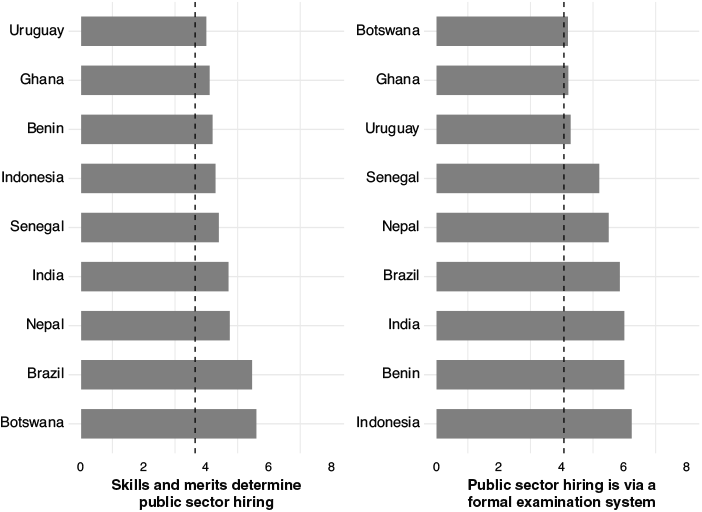
Overall, the QoG data suggests that while public sector recruitment in Ghana may not be perfectly meritocratic, merit plays an important role in recruiting at least some, and perhaps most, bureaucrats. I present additional evidence in Chapter 3 that indicates merit is a crucial factor in recruiting local high-ranking bureaucrats.
In this book, I propose that a lack of meritocracy in recruitment cannot adequately explain administrative underperformance in general – or in Ghana in particular. Indeed, local government bureaucrats are centrally recruited in Ghana, which rules out selection as a factor in explaining internal variation in governance.
Focusing instead on bureaucrats’ conditions of service after they have been hired, seminal models of administrative performance suggest that bureaucrats perform well and engage in less corruption when they receive high wages (relative to outside options) and when their actions are monitored.Footnote 50 The higher a bureaucrat’s salary, the more costly it is to risk-taking a bribe and potentially getting fired. Monitoring by public agencies or politicians increases the likelihood that corrupt acts will be detected. Empirical studies have established that high wages and higher levels of monitoring can improve performance.Footnote 51
Yet despite the attractive logic of simple economic models of bureaucrats’ incentives, prior work does not detect a consistent cross-national negative association between higher bureaucrat wages and corruption.Footnote 52 Counterintuitively, some evidence suggests that higher wages can have the opposite effect on corruption by increasing bureaucrats’ reservation price for bribes and motivating them to request larger kickbacks.Footnote 53
Perhaps more importantly, these models cannot explain a common phenomenon in developing countries – bureaucrats stealing not for themselves, but on behalf of politicians and political parties.Footnote 54 If bureaucrats are doing the politicians’ bidding, then standard models of corruption (which consider bureaucrats’ motivations in isolation from the broader political environment) are inadequate. If politicians know about, encourage, or more forcefully coerce bureaucrats into stealing on behalf of political parties, then regardless of how high their wages are, bureaucrats may be prone to engage in corruption.
Bureaucrats are more likely to bow to pressure from politicians to engage in corruption in less wealthy countries with limited private sector employment opportunities. In such contexts, bureaucrats have fewer attractive exit options if they were to leave the public sector. Overall, in contexts where bureaucrats are not fully isolated from politicians’ informal influence, theories of public sector performance cannot evaluate bureaucrats’ incentives in isolation; they must also consider the incentives of politicians and how they interact with those of bureaucrats.
1.2.3 Politicians’ Incentives
An alternative explanation for the coexistence of bureaucratic professionalization and bad governance is weak electoral institutions – specifically, insufficient political competition. High levels of national-level party competition have been shown to drive public sector reform.Footnote 55 The effect of competitive national elections operates through three main mechanisms: (i) incumbents adopting reforms to capture votes, (ii) a forceful opposition in parliament, and (iii) incumbents’ expectations of executive turnover and their fear of the future.
When competition is high enough that political parties have similar levels of popularity, incumbents may adopt meritocratic reforms to attract votes.Footnote 56 Public opinion has been found to motivate the adoption of public sector reforms in the United States: politicians in the U.S. House and Senate passed legislation on merit-based hiring partly because they feared not doing so would cost them their seats.Footnote 57 Across Latin American countries, a high level of national party competition is associated with the adoption of reforms.Footnote 58
When national elections are competitive, politicians also face strong opposition parties in parliament. Electoral competition in Eastern European parliaments stimulated administrative reforms and the development of administrative capacity after the countries’ democratic transitions.Footnote 59 Viable opposition parties dissuaded incumbents from attempting to exploit the bureaucracy, which led to the introduction of ombudsmen offices and other civil service reforms.
Finally, when national elections are competitive, politicians expect executive turnover, which incentivizes them to tie their hands in the present to prevent their opponents from using power against them in the future. In the United States, the jobs covered by the Pendleton Act (1883), which introduced competitive civil service examinations, were extended every time a president from an opposition party was elected.Footnote 60 Across states and cities, reforms to insulate the public sector have followed periods of increased partisan competition.Footnote 61
Recent theoretical work on civil service reforms suggests that the extent to which electoral competition incentivizes politicians to insulate the civil service varies depending on opposition party characteristics.Footnote 62 If the incumbent party expects to lose in a future election, because current investments in the public sector are only realized in the future, in equilibrium, incumbents will only invest in the bureaucracy today if they expect their opponent will do the same. The presence of ethnically aligned and clientelistic parties makes politicians less likely to invest in civil service reform, since incumbents will expect opponents to underinvest in the public sector and provide private goods if they win.Footnote 63 Therefore, high levels of inter-party competition may not translate into better governance in all contexts, especially where non-programmatic distribution is a core electoral strategy.
Furthermore, the competitiveness of national elections cannot explain internal variation in governance across agencies or districts within a country. Below, I argue that the positive role that national-level competition sometimes has on reform adoption may not be replicated at the local level. High levels of local electoral competition may instead incentivize politicians to increase non-programmatic distribution, and thereby undermine good governance practices by motivating politicians to interfere in administrative processes to redirect public resources.
1.2.4 Voters’ Demands
A final common explanation of poor governance entails two demand-side factors related to voters and their preferences. First, individual voters – especially poorer ones – may wish to receive private rather than public goods from politicians. Second, voters may have low expectations of what public goods politicians can provide with public budgets. In general, if politicians can win elections by providing non-programmatic (private) benefits, they have fewer incentives to invest in state capacity – and may instead prefer to hire bureaucrats who are political loyalists.
Some studies have established that citizens in developing democracies prefer individual politicians who provide universalistic or public goods,Footnote 64 and that voters reward governments that provide such goods.Footnote 65 Yet, other research has demonstrated that voters do not always reward – and sometimes appear to punish – politicians who increase the supply of public goods.Footnote 66 Politicians in many developing countries allocate substantial resources to private benefits for constituents, particularly during election campaigns.Footnote 67 This behavior appears rational because voters reward the distribution of gifts.Footnote 68
These mixed findings are compatible if we conceptualize voters as facing a collective action problem regarding their preference for programmatic distribution. A voter may prefer a politician who provides (or promises to provide) programmatic or universal benefits, but individually not want to miss out on receiving non-programmatic benefits when politicians distribute goods in this way, such as during election campaigns. Politicians face the same collective action problem: they may wish to stop providing private benefits, but risk losing to an opponent who continues to provide such goods.Footnote 69
The mixed findings regarding voters’ preferences for programmatic versus non-programmatic goods may also result from heterogeneity in distributive preferences across voters, which are shaped by their social class and degree of economic security. Wealthier citizens are more likely than poorer voters to prefer and expect politicians to provide programmatic goods.Footnote 70 Therefore, in theory, politicians may only have strong incentives to invest in administrative capacity and distribute programmatic benefits to voters when the majority of the electorate is not economically vulnerable.Footnote 71 Politicians would thus not be sufficiently incentivized to move away from non-programmatic distribution until the country becomes richer.
Politicians’ limited incentives to invest in administrative capacity may also be linked to citizens’ low expectations regarding what governing politicians can provide. Voters’ past experiences shape their future expectations and what information is available to them. They are often uninformed about how much their national and local governments have to spend, which can lower their expectations regarding state-led developmentFootnote 72 – thus giving politicians room to under-provide public goods.
Voters’ preferences and expectations are likely to be important in explaining governance outcomes. My theory recognizes that an important way in which voters’ demands shape administrative performance and corruption is by escalating the cost of election campaigns because citizens expect candidates to distribute private goods. These preferences incentivize politicians to capture rents to cover these campaign costs. This book provides insights into exactly how bureaucrats help politicians capture public funds, and why bureaucrats – even those hired based on merit – go along with party-directed corruption.
1.3 The Argument in Brief
My theory combines findings from past research on voters’ demands and politicians’ electoral strategies with insights on bureaucrats’ incentives from public administration. As discussed earlier, voter–party linkages in developing democracies are often established around non-programmatic distribution. This has implications for public sector development because the extent to which politicians rely on programmatic versus non-programmatic distribution influences the types of bureaucrats they will want to hire.
On the one hand, highly competent bureaucrats can implement programmatic policies most effectively. Such policies, by their nature, require designing and then administering policies and programs based on formal criteria. As a first step, such distribution requires capturing information from the public or from communities to ascertain their eligibility. For example, only families with an income below a certain threshold may be eligible for a cash transfer program, or a community project may only be available to disadvantaged communities. Evidence-based classification requires high levels of administrative competence. At the second step, formal eligibility must guide actual distribution. Bureaucrats selected based on merit may then be less inclined to politicize final allocation. More generally, highly competent bureaucrats will be better able to provide universalistic goods, including a stable economy, education, and healthcare services.
On the other hand, loyal bureaucrats may be most helpful to politicians who prioritize delivering non-programmatic benefits to voters because they may be better able to help politicians identify party sympathizers. It is also likely easier to convince a loyal bureaucrat than a non-loyal one to help politicians capture public funds or engage in corruption on their behalf. As discussed earlier, administrative corruption often seeks to provide politicians with funds to distribute private benefits to voters during election campaigns.
In summary, politicians focused on programmatic distribution may have incentives to adopt merit-based hiring structures and processes. Those who prioritize non-programmatic distribution will be more motivated to retain structures that reward bureaucrats’ partisan loyalty.
In practice, politicians in developing democracies typically combine programmatic and non-programmatic distribution. Democratization puts pressure on politicians to deliver universal benefits, for example, fostering economic growth and stability as well as delivering capital infrastructure, transport, education, and health services.Footnote 73 At the same time, as discussed earlier, many voters – especially less wealthy voters – may have strong expectations of private distribution. Politicians therefore mix programmatic and non-programmatic distribution in an effort to diversify their risks.Footnote 74 Domestic civil society or international donor organizations may also pressure politicians to move toward programmatic politics, and transparent bureaucratic selection and governance.
Given politicians’ goal of mixing programmatic and non-programmatic distribution, they may want to hire bureaucrats who are both competent and loyal. However, institutional structures that support merit typically make it harder for politicians to interfere to select individuals based on partisan loyalty. Further, the pool of competent partisan workers is likely to be shallower and more heterogeneous than the pool of professional appointees.Footnote 75
To solve this dilemma, I argue that politicians will recruit bureaucrats via competitive procedures that reward merit, but will retain formal or informal mechanisms through which they can control bureaucrats’ career progression. Career control tools include the ability to influence bureaucrats’ daily work tasks, determine the locations or agencies where they work, and the speed at which they can be promoted.Footnote 76 Such tools allow politicians to extract loyalty from bureaucrats when needed: bureaucrats fear being punished by politicians if they do not abide by their wishes. The control politicians exercise over bureaucrats’ careers after they have been hired is therefore a central (and often overlooked) impediment to good governance.
Career control can impose heavy costs on bureaucrats. Disrupting their career progression undermines bureaucrats’ key goals, which are often to increase their salary, their control over policy, and their professional or social status. Career control can also profoundly affect bureaucrats’ personal lives, well-being, and morale. For example, by interfering in their work portfolios, politicians may take substantively interesting work away from bureaucrats, which can make their work life unsatisfying. Similarly, discretionary and unplanned geographic transfers can separate bureaucrats from their families. Bureaucrats, particularly those in developing countries, often seek to work in specific regions of the country, either because they have personal ties to these areas or due to internal disparities in living standards. Accordingly, politicians’ threats of transfers constitute a potent tool of control.
While bureaucrats can leave the public sector if politicians interfere in their careers, their exit options are often unattractive. Well-paid jobs in the formal sector – public or private – are rare in many developing countries, especially outside of capital cities. Furthermore, while there is variation across countries, on average public servants are better paid than their private sector counterparts (what has been termed as the public sector wage premium).Footnote 77 Furthermore, where private sector salaries are higher, public workers often have perks such as free accommodation and fuel allowances. Finally, many bureaucrats value the job security of public sector positions.
I argue that the significant internal variation in governance outcomes across agencies and districts in a country can be explained by differences in politicians’ opportunities and motivation to leverage career control tools to exert influence over bureaucrats. Career control is often exercised through informal processes that require the co-operation of other politicians or bureaucrats. The position and size of an individual politician’s party or political networks determine how easily they can control bureaucrats’ careers. For example, a head politician or central-/regional-level official may need to sign off on transferring a bureaucrat to another post or agency. Politicians with close ties to such individuals will have more opportunities to employ career control tools. Since most interference will result from informal processes, politicians’ influence over bureaucrats’ careers will depend on country-specific norms and rules.
Further, I argue that politicians in certain types of districts are particularly motivated to use career control tools to engage in non-programmatic distribution. Local electoral competition increases politicians’ incentives to use career control tools. There is evidence that electoral competition encourages non-programmatic distribution as politicians compete with each other for every vote.Footnote 78 Electoral competition also boost the costs of election campaigns.Footnote 79 Where politicians seek to engage in non-programmatic distribution, they have strong incentives to interfere in administrative processes, and to use career control to extract bureaucratic loyalty.
My argument generates three important observable implications that I assess in this book. First, it implies that meritocratic recruitment is insufficient to protect against poor governance and misallocation. Second, my theory predicts a positive relationship between politicians’ opportunities to control bureaucrats’ careers and worse governance outcomes. Third, governance outcomes should be worse where politicians are motivated to control careers in order to engage in non-programmatic distribution. I argue that this will be where local elections are competitive.Footnote 80
1.4 Empirical Strategy
Studying bureaucracies in any context is challenging, largely due to the difficulties of gaining access to bureaucratic offices and the data generated within them. Scholars of American bureaucracy increasingly rely on Freedom of Information Act requests to access data, but many low- and middle-income countries either do not have such legislation or fail to answer such requests.Footnote 81 Furthermore, where corrupt governance practices are common, bureaucrats have few incentives to share data and may instead seek to hide their actions and public sector outcomes. Public sector outputs can also be hard to quantify and measure – especially across multiple sectors, agencies, or locations.
Past work has used citizen surveys that ask about the provision of public services to measure public sector outputs such as access to health and education services.Footnote 82 This approach assumes that if citizens report lacking access to a particular public good, then this good was never budgeted for. Yet public funds are quite often allocated to public infrastructure that is never built. Data from African countries indicates high levels of “ghost” and “unfinished” projects.Footnote 83 This suggests that scholars interested in bureaucratic processes and outputs should collect data on original budget allocations rather than relying on end-users’ access.
As this discussion highlights, studying the public sector (in almost any context) involves evaluating some degree of bureaucratic malpractice or corruption. Given that corrupt acts are also typically illegal, perpetrators have strong incentives to conceal their involvement in these activities. While researchers can employ end-user surveys to gather data on petty corruption, they cannot rely on public reports to obtain accurate data on mid-level or grand corruption. An alternative to surveying the mass public is to survey private firms and ask if they have paid bribes to politicians or bureaucrats in return for public contracts. However, this approach is unlikely to produce reliable estimates if firms collude with politicians or bureaucrats: firm owners may have incentives to lie.
An alternative data source to investigate mid-level and grand corruption is audit reports. Seminal work on corruption in Brazil, for example, uses audits from randomly sampled municipal governments to track irregularities in financial management and procurement.Footnote 84 However, audits are only effective at measuring corruption when politicians and bureaucrats cannot manipulate audit reports, which is not the case in many settings, including in Ghana.
To overcome these challenges, I adopt two broad approaches. First, I analyze a single-country case (Ghana) in depth, which allows me the time to gain access to public bodies and collect data on public sector outputs and the processes that produce them. A within-case analysis also has methodological advantages, such as holding background factors constant. Ghana is a particularly attractive case to study public sector outputs because classic explanations of bureaucratic inefficiencies are insufficient. As I document in detail in Chapter 3, most Ghanaian civil servants are well educated and recruited through competitive processes.Footnote 85 While personal and political connections can play a role in who is ultimately recruited, these connections cannot help applicants without the necessary professional qualifications.Footnote 86
Within Ghana, I focus on local governments to investigate subnational variation in governance and development. As in many other African countries, local governments in Ghana are mandated to deliver public services to residents. A central office in the capital, Accra, recruits and hires all bureaucrats, which allows me to hold bureaucratic capacity largely constant across offices. After they are hired, bureaucrats can be posted to any of the country’s local governments.
My second broad approach is to combine qualitative and quantitative research methods. Mixed methods are particularly useful for studying sensitive topics such as bias and corruption in the distribution and construction of local public goods. In-depth interviews in which a rapport is built between the interviewer and interviewee can increase the likelihood of making discoveries. Interviews give respondents the opportunity to frame issues in their own words, which can reveal new perspectives on problems. In-depth interviews also have a unique ability to help researchers understand agents’ goals and incentives. To increase the generalizability of data collected via interviews, I interviewed bureaucrats and firms from a random sample of local governments. Since it would have been too time consuming to conduct interviews in each of the local governments sampled ( ), the collection of quantitative data further aids generalizability.
Quantitative research methods make it possible to investigate whether the insights gained from interviews are generalizable. Furthermore, large-n anonymous surveys and survey techniques that provide plausible deniability can promote honest responses. Finally, experimental methods are unrivaled in their ability to tackle questions of causality, which makes them a powerful tool for any researcher. Triangulating evidence from qualitative and quantitative methods thus permits both rich theory generation and thorough theory testing.
1.4.1 Sample and Data Sources
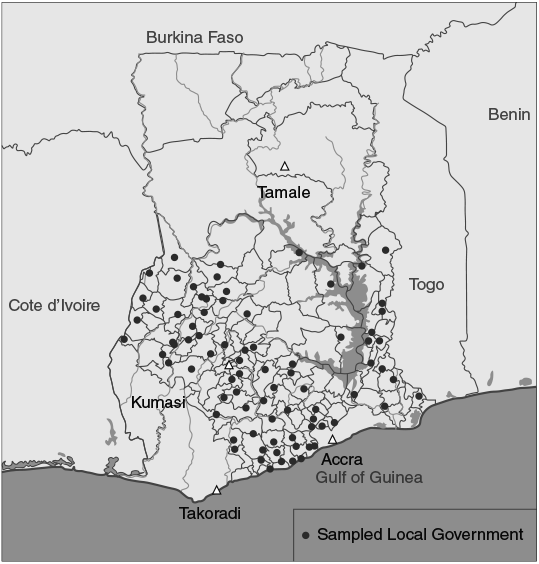
I collected data from a random sample of 80 of Ghana’s 216 local governments.Footnote 87 I restricted the sampling frame to districts from five contiguous regions (Central, Eastern, Brong-Ahafo, Ashanti, and Volta).Footnote 88 Before sampling, I stratified districts by level of electoral competition to assess my theoretical expectations about how local electoral competition affects governance. I measure electoral competition using the parliamentary election results from the 2012 general election. This process ensures that half of the sampled local governments preside over competitive districts. Figure 1.3 maps the locations of the local governments in the sample.
Map of the eighty local governments in the sample
Note: The map displays the boundaries of the country’s sixteen regions and four largest cities. Within the regions in the sample, I display the boundaries of each district. The dots indicate the location of the sampled local governments.
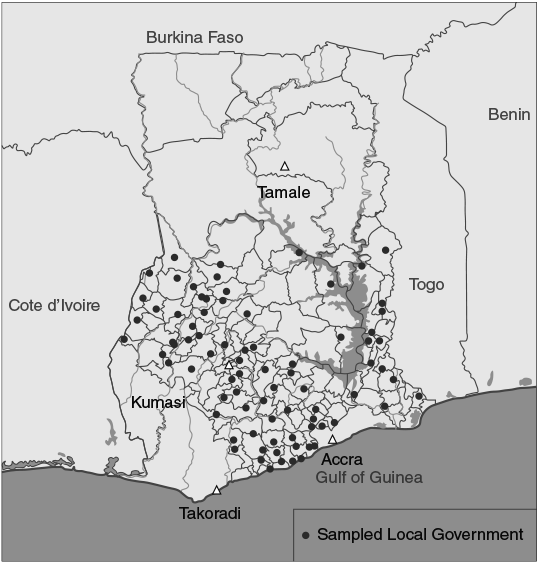
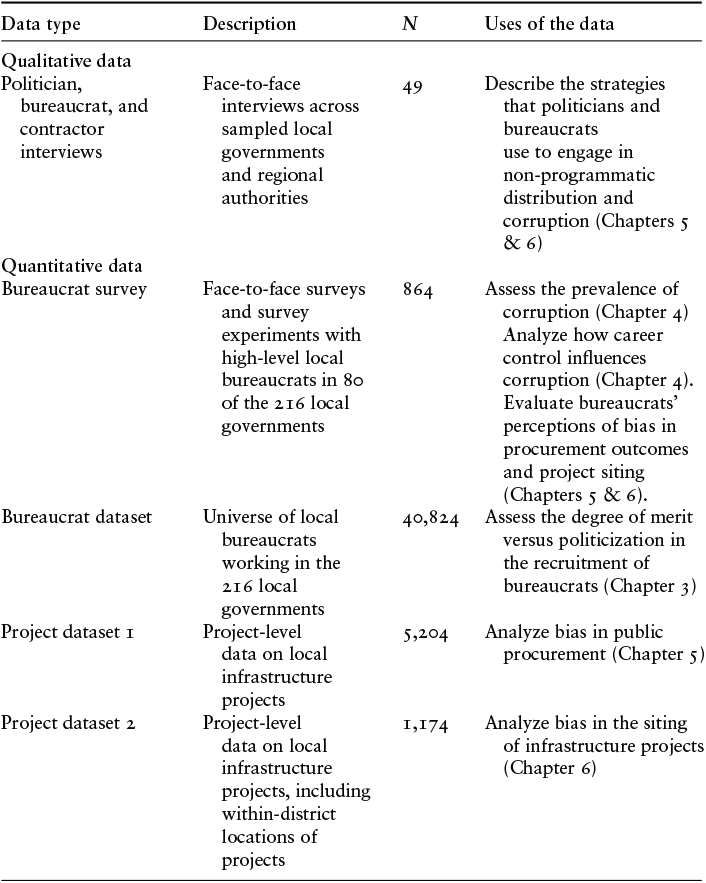
Table 1.2 overviews the qualitative and quantitative data I collected. The bulk of the qualitative data comes from in-depth interviews with local bureaucrats ( ) working across several local governments. These interviews were conducted between August 2015 and March 2016. I interviewed civil servants working in all six regions in the sample, as well as in two pilot districts in Greater Accra. I also interviewed a handful of high-level regional bureaucrats from the sampled regions. Interviews lasted an average of 30–40 minutes, but some lasted over two hours. These interviews provided deep contextual knowledge of administrative processes and decision-making within districts. I also interviewed a small number of local politicians and private contractors. Interviews with private contractors were conducted in February 2018. In all cases, I reassured interviewees that their comments would be anonymous. I did not record the interviews; I typed what respondents said as they spoke.
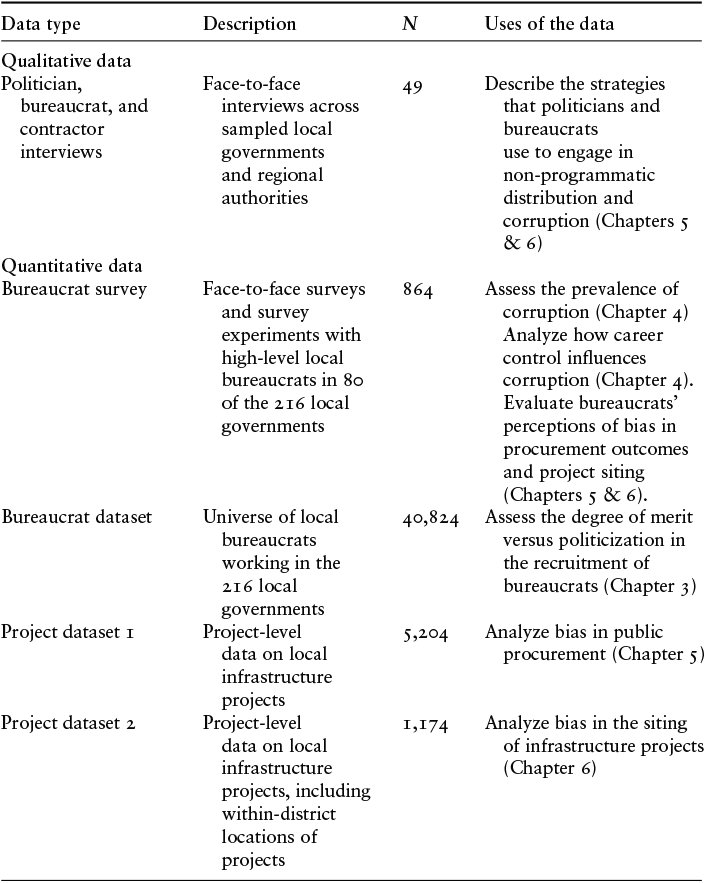
Table 1.2 Long description
Table presents five sources of data used in the book., with columns for data type, description, sample size (N) and an explanation of uses of the data. Qualitative data from politician, bureaucrat, and contractor interviews includes 49 face-to-face interviews across local and regional governments, used to document strategies undermining competitive public procurement. Quantitative data from a bureaucrat survey includes 864 face-to-face surveys and experiments with high-level bureaucrats in 80 of 216 local governments, used to assess corruption prevalence, evaluate politicization, and analyze political control over careers. A bureaucrat dataset covers 40,824 local bureaucrats across 216 governments, used to assess merit versus politicization in recruitment. The first project dataset includes 5,204 infrastructure project records and is used to analyze politicization levels, while a second dataset includes 1,174 project records with within-district location data, also used to analyze politicization of project locations.
I also collected three types of quantitative data. First, I obtained access to the first dataset of individual bureaucrats working across all local governments in the country. This data was collected in 2016 as part of a European Union-funded project focused on local government staff and capacity building. This data allows me to provide detailed descriptive information on bureaucrats who work across local governments. I also use this data to assess the first implication of my theory. In Chapter 3, I establish that most high-ranking bureaucrats are hired based on merit. This data also allows me to conclude that the same is likely not true for bureaucrats hired into low-ranking positions.
Second, I conducted an original face-to-face survey of high-ranking bureaucrats working across the sampled districts ( ). I selected the holders of the twelve most important positions in the local government system, which are constant across districts. I hired and trained a team of enumerators to conduct the surveys in private. The survey included a number of questions on the bureaucratic hiring process; I use this data to complement the analysis of recruitment in Chapter 3.
This survey also included questions that allow me to assess the theory’s second observable implication – that bureaucrats will be more likely to engage in bad governance when politicians can credibly threaten them with career control tools. Because politicians often informally influence bureaucrats’ career progression, it can be hard to collect objective data to measure politicians’ individual leverage. Arguably, what is most important is how much power individual bureaucrats perceive politicians have over their careers. In Chapter 4, I use the survey responses to measure bureaucrats’ perceptions of local politicians’ ability to interfere in their careers and assess whether this correlates with corruption.
I embedded three experiments (two audio vignette experiments and a list experiment) in the bureaucrat survey to assess potential politicization in the allocation of public goods projects across communities and in the awarding of public contracts. In both audio experiments, respondents listened to the vignettes through individual headphones. The first assesses bureaucrats’ perceptions of whether a community’s voting record influences their chances of receiving a project. The second audio experiment considers which private firm traits shape whether they receive projects. These experiments allow me to randomly manipulate community and firm characteristics, which then helps me assess the traits’ causal effects on community and firm selection. I leverage variation in electoral competition across sampled districts to assess the third implication of the theory.
The list experiment focuses on a mechanism to explain bureaucrats’ individual participation in corruption or misallocation. Responses to all experimental questions were self-administered to promote honesty, as respondents entered their answers directly into a cell phone.
The third source of quantitative data is a dataset I constructed on local public goods projects undertaken by the eighty local governments in the sample between 2008 and 2016. I digitalized reports that local governments submit each year to the National Development Planning Commission to document their progress in implementing their Medium-Term Development Plans (MTDP) that they write every five years (see Figure 1.4 for an example). My dataset includes 5,204 projects; 3,837 (73.7%) include the name of the firm that was awarded the contract.
Extract from the annual progress report

Figure 1.4 Long description
Columns include serial number, project description, location, contractor, award date, completion date, project cost source of funding, and status.
I use this project database to investigate two aspects related to the construction of public infrastructure. First, in Chapter 5, I explore which private firms are hired to build each local project. Using this data, I investigate the potential politicization of public procurement based on the number of projects firms typically win, and across how many locations.
Second, in Chapter 6, I assess evidence of political interference in the allocation of projects to communities within districts. The progress reports include the locations of each project. For local governments in one region of the sample (Central Region), I worked with bureaucrats to precisely link these projects to electoral areas (EAs) – the smallest political unit within a district. Again, in these analyses, I investigate the potential role of electoral competition to assess the third observable implication.
1.5 Broader Implications
The book’s theoretical argument and results have several important implications, many of which I discuss in the concluding chapter (Chapter 7). However, two are particularly significant. The first is the need to move beyond a focus on bureaucratic selection when considering how to improve the performance of public sector offices in developing democracies. There is little doubt that meritocratic recruitment is crucial to ensuring that bureaucrats possess the relevant knowledge and skills to deliver public services effectively. However, the power relations between politicians and bureaucrats are equally consequential to public sector performance. The second key implication is the need to build more complex models of political and bureaucratic decision-making in order to assess the competing dyadic as well as triadic relationship among voters, politicians, and bureaucrats.Footnote 89 Often, these actors’ incentives are considered in isolation, or the agency of one actor is dismissed at the expense of another. Models of politics that consider relations among these three sets of actors are likely to be the most beneficial to future theoretical and empirical advancements.
1.5.1 Career Protection after Meritocratic Recruitment
My argument implies that in addition to competitive hiring procedures, career separation between politicians and bureaucrats is a key, if not the key, ingredient of better governance. This argument builds on prior work. As others have noted, career separation is crucial as it supports opportunities for checks and balances between politicians and bureaucrats.Footnote 90 Further, impartial promotion procedures incentivize bureaucrats to focus on performance rather than on building political connections, which can increase public sector effectiveness.
However, my argument highlights the danger of using indicators of meritocratic recruitment to measure career separation between politicians and bureaucrats.Footnote 91 While recruitment based on merit may increase the likelihood of career separation, this relationship is not automatic. I argue that politicians often have very strong incentives to combine merit-based hiring with tools designed to impede career separation.
The concept of career separation is closely related to that of bureaucratic autonomy. Indeed, political control over bureaucrats’ careers limits bureaucratic autonomy. Historical accounts of the professionalization of the public sector in Britain and the United States describe the process of taking power from politicians and empowering bureaucrats.Footnote 92 More recent work on governance by Francis Fukuyama theorizes that mid to high levels of bureaucratic autonomy will produce the highest levels of performance (an “n-shaped” relationship between autonomy and the quality of government).Footnote 93 He argues that the inflection point at which more autonomy will reduce performance varies depending on the capacity of the state: “lower-capacity countries have their inflection points shifted to the left [less autonomy], while they are shifted right [more autonomy] for higher-capacity countries.”Footnote 94 In other words, for optimal outcomes, bureaucrats should be more closely bound by rules in lower- than in higher-capacity countries. However, my argument implies that even in so-called lower-capacity countries, optimal levels of bureaucratic autonomy are still likely to be quite high.
My argument fits with empirical evidence from bureaucracies in developing democracies that points to the potential benefits of high levels of bureaucratic autonomy, which have been found to promote administrative performance.Footnote 95 For example, in Nigeria, greater bureaucratic autonomy is correlated with the quantity and quality of public services delivered, while a one-standard-deviation increase in monitoring corresponds to a 14 percent decrease in project completion rates.Footnote 96 My argument highlights an important mechanism through which autonomy can increase performance – by allowing bureaucrats to administer public programs independently of political considerations.
Overall, my argument implies that scholars and practitioners both need to consider (and develop) better measures of career separation. By describing the specific tools politicians employ to control bureaucrats’ careers, scholars can develop appropriate indicators. These indicators will in turn allow scholars to develop more sophisticated arguments to understand variation in governance practices across both geographic space and public sector units.
1.5.2 Triadic Models of Politics that Consider Politicians’, Bureaucrats’, and Voters’ Incentives
An important implication of this book is that scholars and policymakers should treat public sector outcomes as the result of complex interactions among voters, politicians, and bureaucrats. Commons models of bureaucratic corruption suppose that bureaucrats’ decisions to engage in corruption result from an individual and isolated process. Bureaucrats will accept a bribe if its value outweighs the risks of being caught and losing their current wage. At the same time, common models of distributive politics view politicians and voters in dyadic relationships with each other: politicians consider voters’ preferences and distribute benefits to them to maximize their chances of winning elections. The former models ignore potential pressures that politicians place on bureaucrats to engage in corruption, while the latter overlook bureaucrats’ agency in blocking politicians’ ability to allocate public goods with discretion.
My theory suggests that voters, politicians, and bureaucrats interact in competing dyadic relationships, and in a triadic relationship with each other.Footnote 97 For example, politicians’ level of control over bureaucrats’ careers shapes the latter’s decisions about whether to engage in corruption. Accordingly, bureaucrats may gain little personally from engaging in corruption, and instead direct captured rents toward politicians or political parties.Footnote 98 My insights on corruption can equally be applied to other types of bureaucratic behavior. For example, bureaucrats have been shown to use their positions to provide favors to constituents, typically to benefit their political superiors.Footnote 99
Prior work has explained bureaucrats’ provision of favors by referencing their shared fate with politicians: stability in bureaucrats’ jobs depends on continuity in the appointment of their political principal.Footnote 100 As with corruption that bureaucrats undertake primarily for the benefit of political parties, administrative favors cannot be understood without considering politicians’ incentives and ability to hire, relocate, or reassign tasks among bureaucrats. But voters are also an important part of this phenomenon: citizens’ preferences and expectations shape the types of favors that bureaucrats perform. Thus, an important takeaway is that bureaucrats’ incentives, as well as the preferences and incentives of politicians and citizens, shape the functioning of the public sector and bureaucrats’ day-to-day activities – from more nefarious actions such as corruption to more mundane functions such as assisting with personal requests.
However, as this book emphasizes, it is important not to exaggerate bureaucrats’ susceptibility to political pressure. They do not always bow to the whims of their political superiors, and politicians vary in the extent to which they expect or ask bureaucrats to engage in corruption, distribute favors, or politicize distribution. While the corruption literature potentially underplays politicians’ role in directing administrative corruption, research on distributive politics often assumes that bureaucrats are completely beholden to politicians. Many models of distribution treat bureaucrats as a silent actor, and assume they are universally willing to help fulfill politicians’ demands.
The conventional wisdom in the study of electoral politics in African democracies maintains that elected politicians favor their party supporters (or co-ethnic voters) when distributing public services.Footnote 101 Yet, a careful reading of prior studies illustrates that non-favoritism is just as common as – or more common than – favoritism. For example, one study that focuses on education and health provision finds evidence of ethnic favoritism in only six of the eighteen African countries studied.Footnote 102 Recent evidence suggests that variation in politicized distribution is likely to be partly explained by whether or not a politician’s supporters live in segregated communities within constituencies.Footnote 103 Bureaucratic autonomy is yet another overlooked aspect of politicians’ opportunity to favor their supporters with public goods. Where bureaucrats have the autonomy to implement policy, they may be unwilling to help politicians engage in favoritism. They can exert their independence to undermine or block such attempts. Bureaucrats implement government policies and should therefore be a central actor of any explanation of distributive bias. However, scholars of distributive politics typically ignore bureaucratic decision-making.
Excluding bureaucrats from discussions of distributive politics assumes that bureaucratic autonomy is universally low, and that the programmatic distribution of state resources is not possible. Yet without examining bureaucrats, we cannot explain the null results reported in prior work. Some of these null relationships may arise from high levels of bureaucratic autonomy and professionalism within certain sectors in countries.Footnote 104 Considering the role of all three actors will thus generate theoretical and empirical advancements.
1.5.3 Plan of the Book
This book is divided into five parts. Part I is composed of Chapters 1 and 2, which describe the puzzle that drives the book: why meritocratically hired bureaucrats may still engage in corruption or undermine attempts at programmatic distribution. Chapter 2 develops my theory of governance, which focuses on the incentives and preferences of politicians, bureaucrats, and voters. I argue that politicians in developing countries face a dilemma when they seek to invest in bureaucratic capacity: they must weigh increases in bureaucratic competence against the potential loss of bureaucratic loyalty. I propose that politicians have incentives to hire bureaucrats on the basis of merit to promote bureaucratic competence, but also to retain the means to control their careers. This allows them to extract loyalty as necessary. Therefore, variation in governance results from disparities in politicians’ opportunities and motivation to employ career control tools.
Part II of the book, which consists of Chapter 3, describes the study’s empirical setting – Ghana. I provide a short history of public sector development, an overview of electoral politics, and a history of local governance. Importantly, Chapter 3 presents evidence that recruitment into high-ranking bureaucratic positions has become relatively meritocratic over time in Ghana. This sets the stage for the puzzle the rest of the book investigates: why do bureaucrats hired based on merit misallocate public resources and engage in corruption?
Part III of the book is presented in Chapter 4, which focuses on how politicians extract loyalty using career control tools. It assesses the second implication of my argument – that such tools are correlated with bad governance outcomes. I demonstrate a positive correlation between politicians’ perceived ability to enact bureaucratic transfers and corruption in public procurement within local governments.
Part IV of the book discusses the consequences of career control tools beyond corruption. I provide evidence of political interference in two types of administrative processes – awarding public contracts to construct new public infrastructure and allocating local public goods within districts. Chapter 5 establishes that contracts to build local public goods are often awarded on the basis of political criteria: firms aligned with the ruling party are more likely to win contracts. Chapter 6 provides evidence that local public goods are also often allocated according to political criteria: more local public goods are awarded to communities that vote for the ruling party. Both chapters demonstrate that political interference is higher in competitive electoral districts, where mayors have more incentives to engage in non-programmatic distribution.
Chapter 7 constitutes Part V of the book. It first discusses the theory’s scope conditions. I then present the parallel cases of India and Indonesia and provide evidence that politicians’ use of career control tools is important for understanding governance outcomes in both contexts. Finally, Chapter 7 discusses reforms countries could adopt to overcome the bad governance equilibrium described in the book.


 Open access